A History of the County of Oxford: Volume 11, Wootton Hundred (Northern Part). Originally published by Victoria County History, London, 1983.
This free content was digitised by double rekeying. All rights reserved.
A P Baggs, Christina Colvin, H M Colvin, Janet Cooper, C J Day, Nesta Selwyn, A Tomkinson, 'Parishes: Over Worton', in A History of the County of Oxford: Volume 11, Wootton Hundred (Northern Part), ed. Alan Crossley (London, 1983), British History Online https://www.british-history.ac.uk/vch/oxon/vol11/pp293-300 [accessed 1 May 2025].
A P Baggs, Christina Colvin, H M Colvin, Janet Cooper, C J Day, Nesta Selwyn, A Tomkinson, 'Parishes: Over Worton', in A History of the County of Oxford: Volume 11, Wootton Hundred (Northern Part). Edited by Alan Crossley (London, 1983), British History Online, accessed May 1, 2025, https://www.british-history.ac.uk/vch/oxon/vol11/pp293-300.
A P Baggs, Christina Colvin, H M Colvin, Janet Cooper, C J Day, Nesta Selwyn, A Tomkinson. "Parishes: Over Worton". A History of the County of Oxford: Volume 11, Wootton Hundred (Northern Part). Ed. Alan Crossley (London, 1983), British History Online. Web. 1 May 2025. https://www.british-history.ac.uk/vch/oxon/vol11/pp293-300.
In this section
OVER WORTON
Over Worton lies 3 miles (5 km.) south-west of Deddington and 9 miles (16 km.) south of Banbury. Before its amalgamation with Nether Worton in 1932 it was a small parish of 630 a. (255 ha.), (fn. 1) roughly square in shape, bounded on most of the west and south by small streams; on the north the boundary with Nether Worton followed the line of the hillside, and the eastern boundary partly followed a shallow declivity. A projection on the south, south of Cockley Brook, contains Worton Wood, earlier a common pasture called the Heath; (fn. 2) parts of the wood are ancient, but planting has much altered its character since 1760. (fn. 3) In the 19th century it was said to be 'dear to fox-hunters'. (fn. 4)
The chief feature of the terrain is a wide flattopped ridge running east to west across the centre of the parish and roughly defined by the 150 m. contour; the northern slope is Middle Lias clay, the village site stands on marlstone, and further south is Upper Lias clay and beyond it a cap of Chipping Norton limestone. South of Cockley Brook there is another limestone outcrop on the Heath. (fn. 5) The parish lies remote from major roads. The lane running south from the village was known in the 17th century as Woodstock way; that crossing the parish along the ridge without touching the village is presumably ancient.
Signs of Romano-British occupation have been found just outside the north-west corner of Worton Wood. (fn. 6) In the village itself, a few yards north-west of the church, is an unexcavated mound usually thought to be a round barrow; a suggestion that it might have been the motte of a very small castle, the church standing in the bailey, has not been verified. (fn. 7)
The Anglo-Saxon name Worton (Ortune), meaning a settlement by a bank or slope, (fn. 8) refers presumably to the escarpment on which the village was built. Ridge and furrow north and south of the site suggests that the occupied area has changed little since medieval times, but the number of houses has probably fallen sharply. In 1316 there were at least 24 landholders, (fn. 9) implying a population far greater than any recorded thereafter. The beginnings of depopulation may be discerned in the 15th century, (fn. 10) and there was a further reduction of the farming community in the 17th, leading to the inclosure of the parish in 1642. (fn. 11) At that date only 17 adults were recorded. (fn. 12) In 1662 only 2 houses were assessed for hearth tax besides the manor house and rectory; both were of two hearths only, and although other cottages below the taxable limit presumably existed the village was evolving towards its condition in 1759, when it was said to comprise 3 farmhouses and 3 cottages. (fn. 13) In the 18th century there were not more than 10 houses, and in 1801 only 9 houses and 53 inhabitants. (fn. 14) The close control of a single watchful landlord prevented the kind of growth usual in early 19thcentury Oxfordshire, and there were only 56 inhabitants in 1831. Thereafter the population fluctuated between 45 and 89, depending largely on the presence or absence of large parties at Over Worton House. The combined population of Over and Nether Worton was 114 in 1931 and 108 in 1971. (fn. 15)
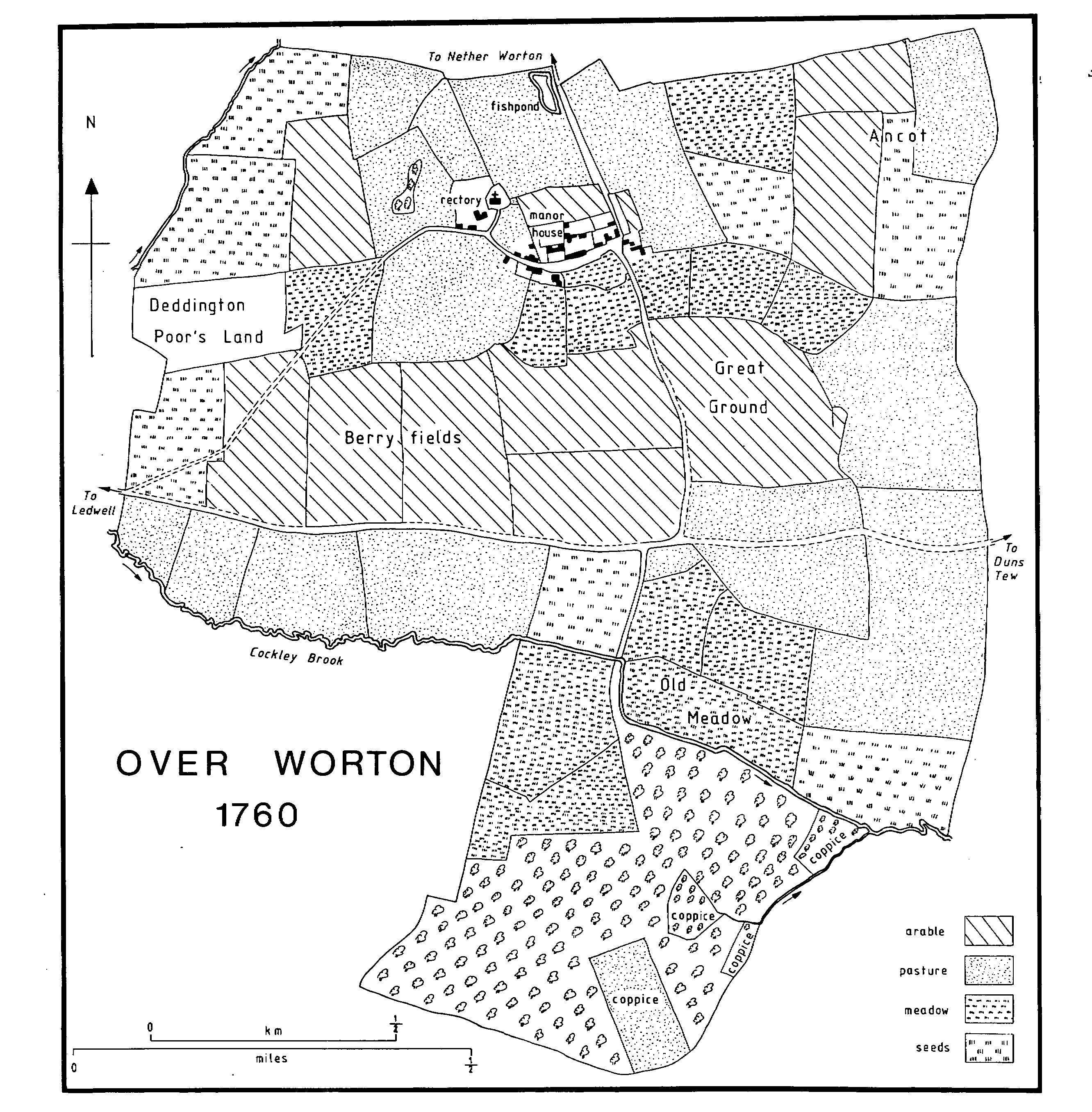
Over Worton, 1760
The village was rebuilt in the early 19th century by the Wilson family. The only notable survivals of the earlier village are the remains of an ancient cross, now forming the base of a war memorial, and what were presumably the manorial fish ponds, west of the gated lane to Nether Worton. In 1760 there were no outlying farmhouses, and houses flanked both sides of the lane to the church and of the north-south street. (fn. 16) By 1827 Heath Farm had been built, and the two other outlying farms followed shortly afterwards; (fn. 17) Heath and Rest Hill Farms were built to a similar plan round an enclosed courtyard. In 1816 the rectory was rebuilt on its ancient site, (fn. 18) and at about that time Over Worton House replaced the former manor house. A farmhouse south of the manor house was demolished and further east several other farms and cottages seem to have been removed. (fn. 19) The Grove, of which the earliest part was dated 1826, was probably associated with the manor house, since it was called the Lodge until enlarged, with some Gothic revival detail, and renamed in the 1870s. (fn. 20) Rest Hill Farm and Grange Farm (later the Grange), a brick building of c. 1830 at the east end of the village, were later treated as residences, the farms being worked from buildings some distance away. (fn. 21) The rebuilding of the church and the construction of a pair of estate cottages in the traditional style, thatched, with stone mullioned windows and dripmoulds, completed the restoration of the village. The Wilsons transformed Worton into something of a centre for evangelical Anglicanism in the early 19th century. (fn. 22) Throughout the century, though usually Over Worton House was leased, most of the village houses were occupied by a succession of Wilsons and their relatives and friends.
In modern times two or three modern houses have been built on the outskirts and a wooden village hall in the centre. The village retains an atmosphere of secluded ease, and its park-like setting, the bold, unfinished church tower, recall the circumstances of its reconstruction by a single dominant family.
Manors.
All three estates in Worton mentioned in 1086 seem to have lain in Nether Worton. (fn. 23) OVER WORTON manor was first mentioned in 1187 when for reasons unknown it was seized by the king from Jordan de Clinton. (fn. 24) It was claimed later that it had belonged to the Meppershall family of Bedfordshire by serjeanty of service in the royal larder, and was held by Jordan from them. (fn. 25) Certainly Jordan held Aston Clinton (Bucks.) by larderer serjeanty (fn. 26) and was connected with Robert of Meppershall before 1168. (fn. 27) An offer by Gilbert of Meppershall of 20 marks to recover lands belonging to his serjeanty (fn. 28) was presumably related to Jordan's forfeiture of 1187, but it seems to have been rejected, and an attempt by William de Clinton to recover the manor in 1228 was similarly unavailing. (fn. 29) In 1198 Richard I gave the manor to Adam of the Moor, his falconer, and in 1199 John ordered that it should be held by falconry service. (fn. 30) After Adam's death it was regranted in 1229 to Nicholas de Moels during pleasure, but the grant was soon turned into a grant in fee for the service of a pair of gilt spurs. (fn. 31) Over Worton was later described variously as held by serjeanty of rendering spurs or falconry service, (fn. 32) and as a knight's fee held in chief or, from 1458, as of the honor of Wallingford. (fn. 33) Although free tenants of the manor even had a proportionate amount of knight service assessed on their holdings (fn. 34) it seems unlikely that the tenure was formally changed.
Nicholas de Moels was one of the king's knights, in royal service from late in John's reign, and raised to the ranks of the baronage by marriage to an heiress; (fn. 35) he had strong ties with the south west, and Worton until the end of the Middle Ages remained in the hands of West Country aristocratic families and hence on the periphery of the estates of largely absentee lords. Nicholas (d. c. 1264) was succeeded by his son Roger (d. 1295) and grandson John (d. 1310). (fn. 36) John's sons Nicholas (d. 1316) and John (d. 1337) were followed by his daughter Muriel, who married Sir Thomas Courtenay. (fn. 37) Their son Hugh succeeded in 1362 and died, still a minor, in 1369; (fn. 38) his heirs were his sisters, of whom one, Muriel, had married John Dynham, to whose family Worton passed. (fn. 39) His son, grandson, and great-grandson, all called John Dynham, died holding the manor in 1428, 1458, and 1501. (fn. 40) The last left Worton to be divided between four coheirs, his sisters or their children, who were Elizabeth Sapcotes, formerly wife of Fulk, Lord Fitz Warin, Joan, wife of John, Lord Zouche, Edmund Carew, and John Arundell. The unprofitable holdings thus created gradually passed into the hands of smaller local men. The Arundell share was sold in 1576 to the copyhold tenants of the manor by John Arundell of Lanherne. (fn. 41) The Carew share was probably conveyed in 1512 to William Compton, (fn. 42) and sold in 1586 to the copyholders by his grandson Henry, Lord Compton. (fn. 43) Elizabeth Sapcotes (d. 1516) settled her share on her third husband, Thomas Brandon, with reversion to Richard Sapcotes, her son by her second husband. (fn. 44) After Richard's death in 1542 (fn. 45) his share was sold to Sir Michael Dormer, who settled it on his younger son John Dormer of Barton. (fn. 46) John left it to his second son Jasper, who alienated it in 15845. (fn. 47) In 1592 it was acquired by John Meese, perhaps acting for all the copyholders. (fn. 48)
The Zouche share was sold in 1518 to John Bustard of Adderbury. (fn. 49) Probably it, too, was eventually purchased by the copyholders, for some of them later conveyed their complete holdings as freehold. (fn. 50)
The manor remained only for a short time divided thus among a group of small yeomen. One of them, John Meese (d. 1621), (fn. 51) and his son Robert, were engrossing all holdings, beginning with part of the Arundell share in 1576 and the Compton share in 1586, much of the Dormer share in the period 158993, (fn. 52) and much of the rest of the manor by 1622. (fn. 53) Certainly by c. 1640 the process was complete, and Robert Meese held the whole parish as manorial lord and direct landowner except for the glebe and 1 yardland belonging to the Deddington charity feoffees; (fn. 54) but he fell into financial difficulties and in 1649 the manor was sold to John Cartwright of Aynho (Northants.), (fn. 55) whose descendants held it for 150 years. (fn. 56) William Cartwright may have lived in the manor house in 1662, (fn. 57) but the later Cartwrights were absentee, though not far distant, landlords. In 1799 the manor was bought by William Wilson, already the owner of Nether Worton. (fn. 58) Wilson was a successful silk manufacturer, established in London since c. 1780 (fn. 59) and making the transition to country gentleman. In 1821 under his will Over Worton passed to his second son, the Revd. William, who held it until his death in 1867. (fn. 60) His daughter-in-law, Ann, widow of William Wilson (d. 1860), vicar of Banbury, had a life interest, and was followed by her son, William Wilson, later a vice-admiral, who was recorded as lord until 1911. The manor was acquired in 1913 by A. C. Thimbleby, (fn. 61) who was lord until the mid 1950s.
The 17th-century manor house was of 14 hearths. (fn. 62) The surviving Over Worton House, a large plain ironstone building, was built in the early 19th century by William Wilson; at the same time the closes facing the south front were turned into a small park, (fn. 63) but have since reverted to fields.
Economic History.
The two-field system of crop rotation in use in Worton in the Middle Ages evidently included the demesne, which was liable to rights of common. (fn. 64) A bequest of 1577 of the hitching of beans and peas and half the hay in the hitch indicates a development, common in north Oxfordshire, towards a rotation of three crops and a fallow, and the laying down of some open-field arable to grass. (fn. 65) A terrier of 1633 shows a division of a holding into arable and leys usual under such arrangements. (fn. 66) Apparently there was not much meadow in the parish, for even the demesne included only a small share of common meadow, variously estimated at between 2 a. and 10 a. Probably it lay along the brook south of Heath Farm, an area called Old Meadow in 1760, while the open-field leys, recalled in a few post-inclosure field names, seem to have lain on the Upper Lias clay slopes. (fn. 67) Attached to the glebe of 2 yardlands in 1641 was common pasture for 4 horses, 8 neat beasts, 60 sheep, and a bull. (fn. 68) The rector probably provided a common bull for the village herd, and in 1581 the rector bequeathed his best bull to a cousin, the rector of Swerford. (fn. 69) The demesne in 1362 was entitled to common pasture for only 2 horses, 4 oxen, and 200 sheep; there was, however, a separate demesne pasture of 18 a. super la Doune. (fn. 70)
The demesne comprised 8 yardlands in 1279, and was estimated in the 14th century as 100 or 180 a., probably varying attempts to express 1 ploughland. In 1279 the whole parish contained 26 yardlands, excluding the glebe, and 28 yardlands in the 17th century; as late as 1825 church rates were levied on 25 yardlands. (fn. 71) The yardland seems to have been small; one of only 18 a., however, was regarded as below the standard, (fn. 72) which might have been c. 20 field acres. References to yardlands of 11 a. and 15 a. may indicate the equivalent in statute acres. (fn. 73)
In 1196 the manor fully stocked was worth c. 6 12s.; later valuations, though probably somewhat arbitrary, rose to a peak of c. 14 10s. in the early 14th century, fell abruptly in mid century, and recovered slowly to 10 12s. by the early 16th century. A value of 5 given in 1458 may be artificial, but one of 5 1s. 1d. in 1362 probably reflects economic decline, presumably through plague, for the demesne, previously valued at 6d. an acre, was said to be worth only 2d. (fn. 74)
The tenurial structure was simple: in 1279 there were 18 villeins each with a yardland, paying rent of 2s. 3d. for three quarters of the year and working in the harvest quarter on alternate days to 1 August and every day thereafter until Michaelmas, excluding weekends and festivals. In addition each villein ploughed 2 a. a year and contributed to a collective aid of 19s. (fn. 75) The only other tenant in 1279 held 7 a. for 4s. rent, and paid 1d. a year to the rector because he had redeemed him from serfdom. Despite his personal freedom his tenure seems not to have been freehold. No free tenants were recorded in 1279 or 1295, (fn. 76) but from 1310 there were 3, holding 2 yardlands in all; (fn. 77) their names were not among the taxpayers of 1306, but two of them paid tax in 1327. (fn. 78) By 1310 there were 3 cottars on the manor. Despite the apparent crisis following the Black Death, much of the traditional structure survived in 1428 when there was 1 ploughland of demesne and 16 tenements representing the 18 villein holdings of the early 14th century. By 1458, however, there were only 10 tenements, and the demesne, said to be 300 a. and presumably swollen with properties lapsed to the lord, was let to various tenants at will. (fn. 79) The survival of the name Berry field attached to post inclosure fields south of the village suggests that the demesne was consolidated. (fn. 80)
By the 16th century there seem to have been c. 10 copyholders with tenements ranging from 1 to 5 yardlands, paying rent of c. 7s. 6d. a yardland. Prominent among the tenants were the Coxes, of whom three accounted for half the parish's subsidy assessment in 1524, while in 1581 George Cox and his brother's widow were among the three most heavily taxed; (fn. 81) he left the copyhold of a quarter of his lands to his daughter in 1586, enjoining his nephew, George, not to interfere with her possession. (fn. 82) Probably the other three quarters of his land was freehold and already settled on her. The name continued in the nephew's line, but the Coxes failed to purchase the freehold of their farm, for in 1617 John Cox held only a quarter of his 2 yardlands freely. Cox's tenement was still so named in the 18th century. (fn. 83) Although in 1524 Richard Carter was taxed only on wages, by 1543 he, or another of the same name, was in the top rank of subsidy payers; (fn. 84) the Carter holding was 4 yardlands, eventually all freehold. The family remained prominent until in 1615 Richard Carter mortgaged his land, and in 1620 it passed to Robert Meese. (fn. 85)
The Meeses were comparative latecomers in Worton, appearing c. 1575 but possessed of advantages denied to their fellow copyholders, notably the law practice of Edmund Meese of Gray's Inn, younger brother of John; (fn. 86) he died unmarried in 1618, leaving 200 to his brother towards building his house and 1,000 to John's daughter, Elizabeth. (fn. 87) Robert Meese, father of John and Edmund, had held 4 yardlands to which John had added through marriage with a daughter of George Cox. (fn. 88) After acquiring 4 yardlands from the Holloway family, secured through a mortgage c. 1602, John Meese was accused of using a legal title to a quarter of the manor, conveyed to him in trust for the other tenants, to dispossess Robert Dyer, husband of Felix Holloway's daughter and heir. (fn. 89) The Meeses may not have risked anything openly illegal, but they took full opportunity of the sale of manorial rights to buy up the freehold of smaller holders who could not afford to purchase, and in 1598 they acquired the interest of Thomas Martin of Gray's Inn, who played a part in the sales and also extended mortgages to some of the copyholders. (fn. 90)
Inclosure of the open fields, ratified by a Chancery decree of 1642, (fn. 91) was a natural consequence of concentration of ownership. The immediate spur perhaps was Robert Meese's need for money, which compelled him to sell the estate in 1649. (fn. 92) Apart from 12 a. allotted to the Deddington charity feoffees for 1 yardland, and 42 a. to the rector for glebe, all the land belonged to Robert Meese. The glebe lay in the north west of the parish, but 6 a. of pasture were assigned to it in the south, on the Heath, an anomaly later removed, probably by William Wilson, who certainly bought up the Deddington land. (fn. 93) A complaint by tenant farmers in 1665 that new ditches prevented them from driving their sheep from the Heath to pen them on their land suggests that some form of common pasture survived inclosure. In the period 166090 there was further subdivision of the few large closes created at first, and much hedgemaking. Large areas were let for grass only, and if permission to plough was given it was narrowly defined. (fn. 94) By 1760 the field boundaries were much as in modern times; there were c. 135 a. of arable, 65 a. of seeds (a sign of progressive farming), 95 a. of meadow, and 197 a. of pasture, while the 80 a. of the Heath was largely woodland. (fn. 95) Only minor changes of field boundaries and land use had occurred by 1827, (fn. 96) and in 1840 there were c. 190 a. of arable, 78 a. of woodland, and the rest was grass. (fn. 97) In both 1760 and 1840 the arable lay on the central ridge or on the marlstone to the north; the clay slope south of the village was used for grass, mostly meadow, and pasture and meadow occupied the valley of the brook.
The disappearance of the small farmer was well advanced by the time of inclosure, when only two long leases survived, both for small holdings. (fn. 98) John Mosley, descendant of a copyholder whose tenement had passed to the Meeses in 1616, (fn. 99) held a house and 7 a. on a 3,000-year lease. Thomas Hartwell held for three lives a house, orchard, and close of c. 3 a., probably that later known as Heartwell on the east side of the village; his few possessions at his death in 1670 reflected the scale of his farming, (fn. 100) and his son's attempt to lease an additional 10 a. soon afterwards was frustrated. (fn. 101) The only other lease existing in the late 1640s, a three-year one to William Chebsey of c. 100 a. in the east part of the parish, (fn. 102) was more typical of the leases made in later centuries, of which most were short-term. The village closes were often let individually, but elsewhere certain groupings foreshadowed the later farms. (fn. 103) The Great Ground and surrounding fields formed the nucleus of a holding which became Heath farm, and in the north-east the field called Ancot became Rest Hill farm; in the west, however, two separate 'bargains' of two or three fields did not coalesce until much later to form the nucleus of Grange farm. The lessees included local gentry, such as the Drapers of Nether Worton, as well as local farmers who often lived outside the parish.
The absence of working farmers was reflected in the hearth tax assessments of 1662, (fn. 104) and in 1759 there were said to be only three farmhouses. (fn. 105) All lay in the village one by the manorhouse, another on or near the site of the house now called the Grove, and another south of the village street near the Grange. There were also farm buildings attached to the rectory. Apart from the glebe, and 22 a. in the south-west of the parish held by tenants from outside the parish, the land was divided into three holdings of between 150 a. and 200 a., held by the families of Castle, Reeves, and Hollier. (fn. 106) All those families kept their tenancies during the later 18th century, (fn. 107) but the advent of William Wilson as lord brought rapid changes. By 1814 the Castles' farm in the north-east had passed to Isaac Gibbs who in turn moved c. 1830 to another Over Worton farm; (fn. 108) shortly afterwards a farmhouse called Town, Home, and finally Rest Hill Farm, was built near the centre of the north-eastern holding. (fn. 109) The Reeves's holding in the south-east had passed by the 1820s to George Merry who in turn gave way c. 1830 to Isaac Gibbs, by which date Heath Farm had been built. The Holliers' holding in the west passed into new hands c. 1800 and the farm buildings sometimes called Lower Grange Farm, were built between 1827 and 1840, while the Grange or Grange Farm became a residence. (fn. 110) The building of outlying farmhouses, and the rebuilding of those in the village as residences was probably the work of the Wilsons. From 1830 Grange and Rest Hill farms and the glebe were united in the hands of a single tenant, first Edward Boddington, by 1840 Thomas Root, by 1851 the Coleman family, and by 1861 Gorden Dayman. (fn. 111) The buildings at Lower Grange Farm were usually occupied by a cow-keeper. (fn. 112) There seems to have been a reversion to the traditional three farms in the later 19th century, (fn. 113) although in 1913 the grouping of fields was somewhat different to that in the earlier period. Heath farm comprised 161 a. of which only 34 a. were arable; Grange farm (137 a.) and Rest Hill farm (162 a.), however, contained a total of c. 178 a. of arable, and there was 86 a. of woodland. (fn. 114) The principal crops were wheat, barley, and oats, and because of the extent of pasture the parish contained a heavier density of cattle than most others in the area. (fn. 115)
Local Government.
In 1279 Roger de Moels claimed to have a free court by charter, but he had to demand it twice a year at the hundred court and submit to annual entry by the hundred bailiff to hold a view of frankpledge. (fn. 116) Though manorial courts were held, no rolls survive. A remnant of the hundredal view at Over Worton continued into the 20th century. (fn. 117)
The two churchwardens were financed by a levy on the yardland until 1825, (fn. 118) when they turned to the pound rate used by the overseers for many years. In 1776 only 4 was spent on poor relief, but in 1803 38 or 14s. per head of population; the rate in the pound was 1s. 6d. and there were 4 adults on permanent out relief. (fn. 119) By 1813 the number had risen to 6, but the cost per head had fallen slightly. In 1820 and 1821 the parish spent no more than 1s. a head on relief but, as at Nether Worton, costs rose in the late 1820s and in 1831 expenditure was 24 or c. 8s. a head. (fn. 120) In 1834 Over Worton was included in Woodstock poor law union, being transferred in 1932 from Woodstock to Chipping Norton rural district, and in 1974 became part of West Oxfordshire district. (fn. 121)
Church.
The church was first mentioned in 1254. (fn. 122) The advowson was held with the manor (fn. 123) until 1337, when, on the death of John de Moels, it passed to his second daughter, Isabel, wife of William de Botreaux. It remained in the Botreaux family until 1463, when it passed to William Botreaux's daughter Margaret, wife of Sir Robert Hungerford. (fn. 124) During minorities, or by lapse, the Crown presented in 1324, 1351, 1353, 1398, 1399, and 1400. Members of a cadet line of the Hungerfords presented until at least 1599. (fn. 125) In 1620 Nathaniel Barkesdale and Edward Roberts presented, and in 1621 Edmund Goodyer and Giles Smith. (fn. 126) Goodyer was the friend and executor of Edmund Meese, (fn. 127) and it may be that the Meeses had acquired the advowson as well as the manor and were granting turns. Their successor in the manor, John Cartwright, presented in 1664, and thereafter the advowson was held by the manorial lords. (fn. 128)
The living was a rectory endowed with all tithes and 2 yardlands of glebe. Its valuation for various 13th-century taxes at between 1 and 3 (fn. 129) was presumably an underestimate; the advowson was valued in 1316 and 1337 at 7 and 7 13s. 4d., (fn. 130) and in the early 16th century the rectory was valued at c. 7. (fn. 131) In 1581 the glebe and tithes were let for 30, and in 1665, after inclosure, for 80. (fn. 132) In the 1630s the living was valued at 50. (fn. 133) In 1716 it was stated that the value of the rectory had not exceeded 80 during the previous 7 years, but by the early 19th century it had at least doubled. (fn. 134) In 1840 the tithes were commuted to a rent charge of 136. (fn. 135)
The rectory house was taxed on 8 hearths in 1662, (fn. 136) and in 1685 was described as 8 bays of building besides a brewhouse and large barns. In 1665 and 1685 it was only partly occupied by the rector, who leased the glebe with much of the house and outbuildings. (fn. 137) By the later 18th century the house was considered unsuitable for family occupation, and the present house was built in 181617. (fn. 138)
John, rector of Over Worton, was holding 7 a. in Nether Worton in addition to his glebe in 1279. (fn. 139) In the period 13501400 as many as 12 rectors were presented, many of them acquiring the living by exchange, usually for a vicarage in the neighbourhood. By the later Middle Ages there was greater stability, rectors tending to serve Over Worton until their deaths. John Dobler served the living from 1519 to 1553. (fn. 140) Robert Foster, rector 155381, who came from an Over Worton family related to the Carters, was resident throughout his incumbency; (fn. 141) he may have been a religious conservative in 1559 when he was examined by the Privy Council. (fn. 142) John Bailey (d. 1624) was resident and farmed his own glebe. (fn. 143) Thomas Bill, rector 166482, was litigious, quarrelling at various times with farmers of the glebe, (fn. 144) parishioners, (fn. 145) and the churchwardens. When presented in 1667 for administering the sacraments without a surplice he explained that it had been washed only once in the past three years, revealing a dispute over the laundry which he apparently won, since thereafter the churchwardens paid regularly for washing the surplice. (fn. 146)
Probably few other rectors were so constantly resident; many were fellows of Oxford colleges and employed curates. (fn. 147) The curate of Hannibal Potter, fellow of Trinity College, died in 1634 owning nothing but his clothes, books, and a bed, the whole being worth less than 10, in contrast to the personalty of John Bailey (d. 1624), which was worth c. 140, including 100 of stock and crops. (fn. 148) Some rectors resided merely during the university vacation; Thomas Bolton of Queen's College, 175263, contrived to live at Over Worton for two thirds of the year and kept no curate, (fn. 149) and James Burton, 17711825, at first came out from Oxford every Sunday, but later became a considerable pluralist, employing curates. (fn. 150) One was a fellow of Merton College, another a notable fox-hunting curate, who with the aid of a tightly organized timetable served five churches each Sunday. (fn. 151) In the 18th century and later Over and Nether Worton were usually treated as a single parish, and the services held alternately at the two churches.
The Wilsons brought a new atmosphere to the parish because of their strong religious interests and evangelical bias. William Wilson, lord from 1821, was in orders and held a succession of livings, while Joseph Wilson of Nether Worton was a founder of the Lord's Day Observance Society. (fn. 152) Changes were made even before the death of James Burton, especially the rebuilding of the rectory house, which was later occupied by some notable curates and rectors. From the first the Wilsons established a tradition of family service at Worton. Daniel Wilson, curate 18049, nephew and son-in-law of William Wilson (d. 1821), later became bishop of Calcutta. His sermons at Worton drew large audiences from outside the parish; during the long vacation he held an additional mid-week service, and his 5060 communicants (on one occasion as many as 160) were in great contrast to the 7 or 8 reported in 1738. (fn. 153) William Wilson (d. 1867) served as curate before his father died, and from 1825 to 1833 the living alternated between John Davis, another son-in-law of William Wilson (d. 1821), and Daniel, son of Daniel Wilson. Several later members of the family held the living for short periods. In the 1820s the young J. H. Newman regularly visited the curate, Walter Mayers, 18238, his friend and mentor, who ran a tutorial establishment at the rectory and was a zealous evangelical; in 1824 Newman preached his first sermon after ordination at Over Worton, and served there on several later occasions. At that date three Sunday services were held in the Wortons. (fn. 154)
Church attendance continued at a high level throughout the 19th century. There were said to be 4050 communicants in 1823 and 3040 in 1831. (fn. 155) On census day in 1851 there were 76 attenders for the morning service at Nether Worton and 50 in the afternoon at Over Worton. (fn. 156) In 1854 the rector claimed complete attendance of all available at ordinary services, and that all the adult parishioners were communicants. (fn. 157) In the 1890s, despite occasional complaints of the high turnover of the labouring population, there were still c. 30 communicants. (fn. 158)
The church of HOLY TRINITY, almost completely rebuilt in the mid 19th century, comprises nave, chancel, south aisle, south porch, and a large northern tower of which the lower stage forms a vestry. (fn. 159) The medieval church seems to have been similar in plan, except that the chancel was narrower and the tower stood at the west end of a possibly shorter nave. (fn. 160) The Decorated south aisle windows may incorporate medieval work, although the aisle windows before restoration were square-headed. The chancel, which earlier had 14th-century windows, was entirely rebuilt in the Early English style. The medieval church was repaired at considerable expense in 1804 and 1819, and was reported to be sound in 1834. (fn. 161) In 1844, however, rebuilding began under the supervision of J. M. Derick and at the expense of the Revd. William Wilson. (fn. 162) The tower was built in 1849; (fn. 163) a plan to surmount it with a spire was apparently given up by Mrs. Wilson because of the cost. (fn. 164) Her payment for a new tower roof in 1858 (fn. 165) may represent the final abandonment of the plan; unfilled scaffolding holes remain in the walls.
An effigy of an Elizabethan lawyer in the south aisle probably represents Edmund Meese (d. 1617), whose memorial tablet is on the west wall. The porch contains memorials to several members of the Wilson family. The stained glass in the chancel by C. Clutterbuck attracted contemporary criticism. (fn. 166) The brass chandelier in the chancel was given by Horatio Fitzroy, lessee of Over Worton House, in 1860. The font is Victorian, an earlier, 12th-century, font was removed to Hempton. (fn. 167) The plate includes a chalice of 1573 and paten covers of 1573 and 1680. The two bells are modern. (fn. 168)
A holding of 2 a. called the Church Lands was used by the churchwardens for church repairs; at inclosure in 1642 land in Berry field was allotted, and held by Robert Meese in trust for the church, he and his successors as lords of the manor paying c. 1 10s. a year to the churchwardens. (fn. 169) The obligation survived into the 20th century. (fn. 170)
Nonconformity.
A single Roman Catholic was recorded in Over Worton in 1738. (fn. 171) The house of John Higgins was licensed for Congregational worship in 1672, and in 1676 there were 5 nonconformists in the parish. (fn. 172) In 1682 the rector reported that the dwindling dissenting element comprised 5 women in 4 different families, 'persons of inferior rank, little sense, and, I hope, no bad influence'; 3 were Quakers, and one an Independent, but the only one thought to attend meetings, presumably outside the parish, was an Anabaptist. (fn. 173) By 1738 there seem to have been no Protestant nonconformists, but in 1773 a meeting of unknown denomination was licensed at William Holloway's house; (fn. 174) it seems to have been short-lived. In 1866 there were 2 dissenters, one of them a preacher. (fn. 175)
Education.
There was a Sunday school in 1805, and in 1808 it was attended by 12 children. (fn. 176) From that date until 1937 the children of Over Worton attended the day school in Nether Worton; in 1979 they went to Steeple Aston and Bloxham. (fn. 177)
Charity for the Poor.
By 1786 there was a bread charity of unknown origin of 8d. a week for two poor widows, payable by the lord of the manor. (fn. 178) It survived until at least 1939. (fn. 179)