A History of the County of Oxford: Volume 5, Bullingdon Hundred. Originally published by Victoria County History, London, 1957.
This free content was digitised by double rekeying. All rights reserved.
'Parishes: Ambrosden', in A History of the County of Oxford: Volume 5, Bullingdon Hundred, ed. Mary D Lobel (London, 1957), British History Online https://www.british-history.ac.uk/vch/oxon/vol5/pp15-30 [accessed 30 April 2025].
'Parishes: Ambrosden', in A History of the County of Oxford: Volume 5, Bullingdon Hundred. Edited by Mary D Lobel (London, 1957), British History Online, accessed April 30, 2025, https://www.british-history.ac.uk/vch/oxon/vol5/pp15-30.
"Parishes: Ambrosden". A History of the County of Oxford: Volume 5, Bullingdon Hundred. Ed. Mary D Lobel (London, 1957), British History Online. Web. 30 April 2025. https://www.british-history.ac.uk/vch/oxon/vol5/pp15-30.
In this section
AMBROSDEN (fn. 1)
The ancient parish of Ambrosden comprises most of the three townships and modern civil parishes of Ambrosden (1,515 a.), Blackthorn (2,085 a.), and Arncot (1,700 a.). (fn. 2) The present acreages of Ambrosden and Blackthorn date from 1932 when Langford, Wretchwick, and Middle Wretchwick Farms, formerly in Bicester Market End township, were added to Ambrosden, and 54 acres transferred from Ambrosden to Blackthorn. (fn. 3) Before this date Ambrosden civil parish, comprising Ambrosden Park farm, several small-holdings, the hamlet itself, and about 100 acres of Wretchwick farm had covered no more than 605 acres. (fn. 4) There is no record of any recent change in the boundaries of Arncot. The ancient parish is shaped like a mushroom, some three and a half miles long from north to south, four miles from east to west across the widest part in the north, and two miles across the 'stem' in the south. The River Ray and its tributary streams form much of the boundary on the north, north-east and west. The land is low-lying, mostly at about 200 ft., except for Graven Hill (372 ft.) in the north-west corner, Arncot Hill (355 ft.) in the extreme south, and Blackthorn Hill (252 ft.) in the centre of the widest part of the parish. The land is drained—until recent years very inefficiently—by the Ray and its numerous feeders. The river crosses the parish from north-east to south-west, passing under three bridges, Heath Bridge, Blackthorn Bridge, and Arncot Bridge, the last an 18th-century structure with five arches. (fn. 5) Leland noted that there was a wooden bridge at Blackthorn. (fn. 6) The present structure dates from 1833, when it was built by the local turnpike trust. (fn. 7) The Ray was once navigable: in 1764 a barge of coals came up to Arncot Bridge and returned to Oxford laden with corn. (fn. 8) The soil is clay and stonebrash. (fn. 9)
The main road from Bicester runs across the northern part of the parish and divides at Wretchwick, one branch going south to Thame, the other continuing to Aylesbury along the course of Akeman Street. From Akeman Street two roads run north, one to Launton and one to Marsh Gibbon (Bucks.). From Wretchwick a road branches off to Ambrosden; formerly it ran past the church and in front of the manor-house, but in 1741 Sir Edward Turner (fn. 10) obtained a licence to inclose the highway, and a new road, reputed to have cost a guinea a yard, was made to connect Ambrosden village with Merton. (fn. 11) Sir Edward intended to continue it to Oxford, but the project was never carried out. A branch road goes to Lower Arncot, now consisting only of Manor Farm and an inn, and to Upper Arncot. Since 1941 the road between Bicester and the Arncots has been widened and straightened, and now by-passes Ambrosden. The former L.M.S. railway line from Oxford to Bletchley, opened in 1851, crosses the north-west corner of the parish, and the direct London-Birmingham line of the old G.W.R., completed in 1910, (fn. 12) runs parallel to the BicesterAylesbury road. Where the latter railway crosses the road there is a halt serving Blackthorn. An infrequent bus service connects Ambrosden, Blackthorn and the Arncots with Bicester and Oxford.
The hedges are well timbered with ash, oak, and elm, but there is little woodland left, although in the early 19th century the parish was described as 'pleasantly wooded'. Graven Hill Wood survives in part, and Arncot Wood and Little Wood are probably the remnants of the extensive woods at Upper and Lower Arncot mentioned in Domesday. (fn. 13)
The old part of the village of Ambrosden now consists of a few scattered houses, including the Park Farm, a public house called the 'Turner Arms', a corn mill, and the school. The houses and cottages are mostly built of coursed rubble. Some stand on the high road leading from Merton to Bicester, opposite the park, church, and vicarage, others on the road branching off to Arncot. At the Merton end of the village is one 19th-century house and a substantial 18th-century house of coursed rubble. To the east, near the church, are some 19thcentury cottages of stone, roofed with slates, and beyond them are the school, built of yellow brick in a Victorian Gothic style, and the school-teacher's house. Since the establishment of the Central Ordnance Depot (fn. 14) a new housing estate has been laid out beside the old village. Three types of welldesigned houses, built of brick and roofed with tiles, have been erected, and are grouped around a green with elm trees. The architect was R. Potter of Salisbury, and nearly 200 houses were erected in 1951 and 1952. (fn. 15)
Water was brought to the village when mains were connected with the depot from the Buckinghamshire Water Board. Gas is supplied from Bicester, and electricity was brought in 1935. (fn. 16)
Of the two manor-houses which were built at Ambrosden during the 17th and 18th centuries nothing now remains. When Sir William Glynne bought the estate in 1673, a manor-house, dating possibly from the Middle Ages and built by Ashridge College, was still standing on the site of the present Park Farm. (fn. 17) It was evidently a substantial building since in 1665, during the ownership of Francis Mildmay, it was returned for the hearth tax as having thirteen hearths. (fn. 18) Sir William Glynne found this house so decayed that he decided to build a new one, slightly to the north, on higher ground behind the church.
A contemporary print shows that it was a twostoried building, (fn. 19) facing the main highway, which ran at that time from the church to Wretchwick Farm, and was separated from it by a walled-in lawn. Following 17th-century custom, fruit-trees were trained to grow against the wall of the house. A wing at the back was used for offices, and to the west of the house was a small pleasure-ground and formal garden. (fn. 20)
The house possessed a valuable library which included deeds relating to Bicester Priory and Eynsham and Oseney Abbeys, as well as documents which Sir William Glynne, the first baronet, had collected or acquired from his father, Chief Justice Glynne. In 1729 this collection was offered for sale for £1,000 and was eventually bought by an Oxford bookseller. (fn. 21)
In 1729 Ambrosden estate was bought by Sir Edward Turner. The existing house proved too simple for the cultivated taste of his son Sir Edward, who rebuilt it soon after 1740. He also transformed the landscape by creating a fine park, five miles in circumference, which was embellished in typical 18th-century style with lakes, statues, and clumps of trees grouped to form a harmonious design. The new house, which cost £4,000, was approached by a semicircular drive through an avenue of trees, and entered by a central porch. It was built with the materials of the old house and with stone from Stone Pitts quarry at Blackthorn, and was faced with Bibury stone. (fn. 22) The principal façade, 200 ft. long, had a range of eleven pedimented windows surmounted by an attic. There was a rusticated basement, and the roof was concealed behind a balustraded parapet. The offices were underground, and 'entered by a covered area, that opened at some distance from the house.' (fn. 23) The architect was Sanderson Miller of Radway, who also designed some of the ornamental buildings on the estate. (fn. 24)
In 1767 Sir Edward's son, Sir Gregory Turner, who had always considered the house too big, decided to pull part of it down so as to reduce it to a smaller size. As this proved impossible, the whole was pulled down in 1768. In 1819 the ruins of the basement were uncovered, and plans for rebuilding were considered but abandoned. (fn. 25)
The Vicarage, a pleasant two-storied house with attics, stands next to the church. It is built of coursed rubble and ashlar, and has a tiled roof. It replaced an older house, possibly the one built by Ashridge College soon after the ordination of a vicarage in 1336, (fn. 26) when the old rectory house was ordered to be repaired. This house was described in 1634 as being partly decayed, (fn. 27) and four years later the vicar, John Stubbings, rebuilt it at a cost of £800. (fn. 28) The date 1638 and the letters I.S.D. are inscribed on the east front of the present house, which is still largely a 17th-century building with some original windows and an original fireplace and a staircase. It had six hearths according to the tax returns of 1665. In 1838 the vicar, L. G. G. Dryden, repaired the house, adding four rooms on the west side at a total cost of £2,000. He also furnished one of the rooms with oak panelling from the manorhouse at Merton. (fn. 29) In 1951 the Vicarage was sold by the Ecclesiastical Commissioners.
The only other houses of architectural interest in the village are the 18th-century Park Farm and the post office with its attractive 18th-century details: it has two stories and is built of coursed rubble and ashlar.
Blackthorn hamlet lies to the east of Ambrosden at the foot of Blackthorn Hill, between Akeman Street and the River Ray. Its houses and farms straggle round the ancient village green, a large rectangular area converted into arable fields in 1776. (fn. 30) It was on this green that the 'Roman game' of running at the quintain was played after weddings in the 17th century by the inhabitants. (fn. 31) In the 18th century matches with the single-stick were played on Blackthorn Hill, but they are said to have ceased by 1823. (fn. 32) Wier Farm lies at the north-west corner of the 'green'. Manor Farm, said to be on the site of the former manor-house, lies at the south-west corner, with the bulk of the village spreading out along the intervening stretch of road. Pound Farm, bearing the date 1658 on its chimney-stack and containing some old panelling, Whitehouse Farm, the school, and the chapel (fn. 33) lie along the southern edge of the former green; there too at one time were the pound and the smithy. The Crown Inn flourished in 1785, and Kiln Farm, now divided into two houses, dates from the second half of the 17th century. It contains a good well-staircase of two flights with turned balusters, moulded hand-rail and ball finials: it dates from the late 17th century and is made of oak. (fn. 34)
The Arncots, which were once populous villages, (fn. 35) have now been swallowed up by the Central Ordnance Depot. Manor Farm, probably once the manor-house, is an ancient stone building and bears the date 1679. There are several outlying farms in the parish; Folly Farm and Essex Farm on either side of the road to Marsh Gibbon (Bucks.); Castle and Cluehill Farms between Piddington and Little Wood.
A windmill at Ambrosden worth 40s. is mentioned in an extent of 1300. (fn. 36) In 1346 John Fyppes held a water-mill at Upper Arncot and was presented for exacting toll beyond the lawful amount. (fn. 37) Windmill Field at Ambrosden and Windmill Way are mentioned in an extent of 1633. (fn. 38) In 1809 one of the windmills on Blackthorn Hill was for sale, with the house adjoining. (fn. 39) Since 1880 the Ordnance survey maps have shown two windmills on Blackthorn Hill, and one on the rising ground behind Upper Arncot, all grist mills. (fn. 40)
During the Civil War there was some military activity in the neighbourhood: in June 1643, when part of the king's forces was at Bicester, the parliamentary scouts reported that Blackthorn Bridge was being guarded. (fn. 41) But save for the cholera epidemic at Blackthorn in 1832, (fn. 42) events in the townships have never attracted attention. Certainly the most momentous event in their recent history was the establishment by the War Office of the Central Ordnance Depot in 1941. The choice of Ambrosden parish as its site was largely determined by the existence of the two main-line railways which cross just outside Bicester. The government purchased land from most of the farms in the parish, and one, Wood farm at Lower Arncot, was almost entirely absorbed by the depot. The farm-house was abandoned, but has since been converted into the Tally Ho! Inn. The construction of the depot was completed in 1945, and in 1954 it covered an area of 12½ square miles, surrounding Ambrosden and the Arncots, (fn. 43) and extending into Piddington. (fn. 44)
Ambrosden parish has been connected with two outstanding people: White Kennett (1660–1728), vicar 1685–1708, was influential at the court of Queen Anne, Bishop of Peter borough from 1718 to his death, a notable scholar and author of the Parochial Antiquities frequently cited in this history; (fn. 45) Sir Edward Turner, whose descendants were so long associated with the village, brought distinction to the neighbourhood in the 18th century. (fn. 46)
Manors.
After the Conquest Hugh d'lvry, butler to William I in Normandy, and brother of Roger d'Ivry, (fn. 47) supplanted the lady Elveva who had held freely an estate assessed at 10 hides at AMBROSDEN in the time of the Confessor. (fn. 48) On his death, in about 1101, Hugh was succeeded by his nephew Roger (II) d'Ivry, (fn. 49) and it is probable that Ambrosden eventually passed with the Ivry barony to the St. Valery family. (fn. 50) It is not until 1194, however, that both Ambrosden and its dependent hamlet of Blackthorn are definitely recorded as belonging to the honor of St. Valery. (fn. 51) The manor followed the same descent as Beckley until about 1288, when Edmund of Cornwall gave it to the house of canons (fn. 52) which he had founded in 1283 at Ashridge (Herts.). (fn. 53) It is possible that the canons had to allow the claim which Margaret, by then widow of the earl, made in 1300 for a third of the estate as her dower. The outcome of the suit is not known but Ashridge was in possession in 1309 (fn. 54) and continued to hold the manor until the Dissolution.
When Ashridge was dissolved in 1539, its properties passed to the Crown, and in 1542 the manor of Ambrosden, apparently without Blackthorn, (fn. 55) was granted to John Denton, resident at Blackthorn and lord of one of the manors in Bicester. (fn. 56) He was the son of Thomas Denton of Caversfield, and married Magdalen, daughter of Sir John Brome of Holton. (fn. 57) Before his death in 1576 (fn. 58) he gave Ambrosden manor to his younger son Edward Denton on his marriage in 1568 to Joyce, daughter of Anthony Carlton of Brightwell Baldwin. (fn. 59) In 1586 Edward Denton settled the manor on Edward Smyth of Stoke Priory (Worcs.), the husband of his youngest daughter Dorothy. (fn. 60) In 1604 Edward Denton and Smyth sold it to Margaret, daughter of Richard Whethill of London. (fn. 61) She became the second wife of Sir Thomas Mildmay of Chelmsford, a member of a well-known Roman Catholic family, and left him the manor in her will. (fn. 62) Their son Walter was in possession in 1617; (fn. 63) in 1621 he settled the estate on his wife Helena, and died two years later, leaving as heir his son Francis, a minor. (fn. 64) Francis was of age by 1638, and married to Mary, the daughter of George Brooker of White Knights (Berks.). (fn. 65) In 1648 Francis's estates were sequestered, since he was a Roman Catholic and a royalist; (fn. 66) as he was heavily in debt at the time, his lands, estimated as worth £250 a year, were valued at £50. (fn. 67) Again, in 1652, it was reported that the Mildmay estate, allegedly worth £255 a year, was in fact of little value owing to mortgages. The following year the manor was discharged from sequestration, forfeited by Mildmay, and bought from the Treason Trustees by John Warre of London. (fn. 68) In 1657 it was, apparently, again sold by the Treason Trustees to William Drax, a London merchant, and his brother-in-law Alexander Jackson, a London goldsmith. (fn. 69) They alleged in a Chancery suit in 1657 that they had lent Francis Mildmay £1,200, and that their purchase of the estate was their only way of recovering the money. (fn. 70) Nevertheless, Mildmay seems to have recovered the estate next year, for he is then found mortgaging Ambrosden manor to Sir James Drax of London. (fn. 71) Mildmay's financial embarrassments evidently continued to be serious, for according to the evidence given by Drax in a Chancery suit Mildmay had borrowed £3,300 from him on the security of the manor and advowson of Ambrosden. It was alleged that after conveyance of the property Mildmay refused to 'set forth and discharge the same estate . . . or to declare the annual value of the manor', contrary to his agreement. (fn. 72) His case is typical of the Roman Catholic gentry at this date.
In 1660 Mildmay sold 100 acres of the manor to seven purchasers, of whom five were local men, (fn. 73) mainly yeomen, and was able at his death to leave the rest of the property to his son.
In 1673 Mary Mildmay, Francis's widow, and her son Walter sold the manor to Sir William Glynne, Bt., of Bicester. (fn. 74) He was the descendant of an ancient Welsh family, but since 1654 he had been closely connected with Oxfordshire. On purchasing the Ambrosden estate, he rebuilt the manor-house (fn. 75) and, according to White Kennett, 'kept there a hospitable table and well governed house' and 'by his prudence and charity reformed a rude and licentious people'. He was succeeded in 1690 by his son, Sir William Glynne, and he by his brother, Sir Stephen Glynne, who lived at Merton nearby before moving to Ambrosden. (fn. 76) The Ambrosden estate was, however, so burdened with legacies that the Glynnes first raised a mortgage, and then arranged for its sale, the purchase being completed in 1729 just after the death of Sir Stephen. (fn. 77)
The purchaser was Sir Edward Turner, (fn. 78) who in 1718 had married Mary, daughter of Sir Gregory Page, of East Greenwich, a director of the East India Company and an immensely wealthy and ostentatious merchant prince. Both Sir Edward and his father-in-law had made large fortunes by immediately selling their South Sea stock when prices soared, and then reinvesting the proceeds in land. Sir Edward Turner was succeeded by his son Edward, a man of taste and one of Ambrosden's most outstanding inhabitants. At Balliol he had been remarkable for his 'distinguished scholarship and the regularity of his behaviour', and for the marriage he contracted there with Cassandra Leigh, the master's niece. He was considered 'one of the first matches amid the Commonalty of England, both from his large estate and as being heir presumptive to the rich estates of Page and Turner', while she came from a moderately wealthy Gloucestershire family. Her father, William Leigh of Adlestrop, had married Mary, daughter and coheir of Robert Lord of Cottisford, whose family had also enriched itself by trade. The Turners' house at Ambrosden became the meeting-place of politicians and of cultivated society. Dr. Leigh and other University wits and learned men were frequent visitors.
On Sir Edward's death in 1766, the estate went to his son, Sir Gregory Turner, 3rd Bt., who in 1775 took the name and arms of Page under the will of his great-uncle Sir Gregory Page, whose estates he inherited. He shared his great-uncle's taste for extravagant living. He never lived at Ambrosden. (fn. 79) His son and heir, Sir Gregory Osborne Page-Turner, 4th Bt., is said to have inherited more than £300,000 of funded property, besides a rent roll of £24,000. He held Ambrosden until his death in 1843, being succeeded by his brother Sir Edward George Thomas Page-Turner, who died intestate in 1846. Sir Edward Henry Page-Turner, 6th Bt., was his son and heir and died without issue in 1874. He left all his estates, after his wife's death, to the issue of his eldest sister and coheir, Fanny Maria, who had married the Revd. Frederick Henry Marvell Blaydes. Her surviving son, Frederick Augustus, took the name and arms of Page-Turner in 1903. (fn. 80) The Ambrosden estate was sold in 1930, a year before his death.
Blackthorn was held by the lords of Ambrosden in the Middle Ages. In 1194 the two were held together of the honor of St. Valery, (fn. 81) and in 1279 Blackthorn was said to be a hamlet of Ambrosden. (fn. 82) In 1309 Ashridge was granted free warren in its demesne lands in Ambrosden and Blackthorn. (fn. 83) BLACKTHORN manor, as a separate entity, is first mentioned in 1564, when Elizabeth I sold it to John Denton of Ambrosden for £612 3s. 9d. It was then worth £70 4s. 8d. a year. (fn. 84) It appears that Leonard Parrott, of Draycot (Oxon.), was in possibly tortious possession at this date, for Denton brought a suit in Chancery against him for detention of the deeds of the manor and entry of the premises. (fn. 85) John Denton died in 1576 after settling the manor on his wife Magdalen, with remainder to their eldest surviving son Edward. (fn. 86)
In 1586 the manor was conveyed with that of Ambrosden to Edward Smyth, son-in-law of Edward Denton. (fn. 87) It is not known exactly what happened after this date; Edward Denton's brother William is known to have resided at Blackthorn and to have been the first of the Blackthorn line of the family; his wife Mary was buried in the church in 1624. The extent of their property is unknown; nor is it certain whether they resided in the manorhouse, but according to Dunkin 'Denton's posterity continued there [Blackthorn] for many years' (fn. 88)
The next evidence of the manorial descent shows that the connexion with Ambrosden had been severed and that the Blackthorn estate had passed to the Nourse family of Wood Eaton. (fn. 89) In 1636 Philippa Nourse, widow, and her son John Nourse conveyed the manor to Edward Rudge. (fn. 90) By 1679, another Edward Rudge, the latter's son perhaps, was lord of the manor; (fn. 91) in 1706 he, or possibly still another Edward Rudge, and his wife Mary conveyed the property to John Wheatley. (fn. 92) In 1712 it was in the hands of Hugh Naish, but by 1713 had passed to Sebastian Smythe. (fn. 93) He was succeeded in 1752 by his daughter Barbara Smythe, who died in 1787, having left the manor by will to Sir John Whalley-Gardiner, Bt., of Roche Court in Fareham (Hants). (fn. 94) He was followed in 1797 by Sir Henry Ashhurst, who sold the property in or before 1800 (fn. 95) to a Mr. Mulcock of Bicester, 'an eccentric and dissipated character'. (fn. 96) It does not seem that he was long lord of the manor for it was held in the 1820's by Richard Cox, an alderman and banker of Oxford. (fn. 97) James Morrell was lord in 1852. (fn. 98)
There were two manors at Arncot corresponding to the two medieval hamlets of Nether or Lower Arncot and Over or Upper Arncot.
At the time of Domesday, William son of Mann held land at LOWER ARNCOT, later also known as ARNCOT PRIORIS. (fn. 99) It had previously been held by three freemen. (fn. 100) No further reference to the manor has been found until Roger of Caux, in Stephen's reign or perhaps earlier, granted the estate with the wood and other appurtenances to Missenden Abbey, for the sake of the souls of his father Gerald and his mother Adelaide. His son William confirmed the grant on receipt of 100s. from the canons. (fn. 101)
In 1232 Bicester Priory purchased the estate from Missenden, and agreed to pay a fee-farm rent of £6 13s. 4d. a year. (fn. 102) The transaction is of special interest as it arose through a bequest by Alan Basset of High Wycombe of 200 marks to the University of Oxford for the maintenance of two chaplains. Bicester Priory was his executor in the matter, and bought the Arncot estate to provide 8 marks yearly for the support of two chaplains or scholars residing in the University. (fn. 103) The fee-farm to Missenden appears regularly in the surviving accounts of the priory's estates, (fn. 104), and at its dissolution Missenden had over £6 worth of profits from the fee-farm of Arncot and its rents. (fn. 105)
The manor was granted, probably soon after the priory's dissolution, to Thomas Martin of Ambrosden, a wealthy yeoman, who is known to have held at least 400 acres of arable and pasture for 240 sheep in Bicester parish, in addition to his Arncot lands. (fn. 106) He died before 1553 seised of Arncot manor and of 16 messuages, 2 cottages, and 18 virgates of land in the Arncots. He left a portion of the land to be held in dower by his widow, and another portion to his second son John. The manor itself, then valued at £6 12s. a year, passed to his elder son Nicholas, (fn. 107) who was apparently succeeded by the younger son John, for in 1580 the latter received licence to alienate the manor to Thomas, another brother. (fn. 108) Thomas, described as a gentleman of Gray's Inn, died in 1587 (fn. 109) seised of this and the manor of Upper Arncot.
In 983 Ethelred II granted the hamlet of UPPER ARNCOT, later also known as ARNCOT ABBATIS, to Abingdon Abbey. (fn. 110) This charter says that the inhabitants called it 'Earnigcote', and gives the Saxon bounds of the estate. The Abingdon Chronicle states that in the Conqueror's time Abbot Athelhelm, who gave many of the abbey's possessions to his Norman kinsmen, gave Arncot to Robert d'Oilly and Roger d'Ivry. Robert and Roger were certainly recorded as the abbey's tenants in 1086. (fn. 111) Although the hamlet occurs among the abbey's possessions which were confirmed by Eugenius III (1149–53), (fn. 112) the list of properties was doubtless traditional, and there is no other evidence of Abingdon's overlordship in the 12th century or later.
The Oseney cartulary refers to the gift of Arncot to the church of St. George in Oxford castle by Robert d'Oilly and Roger d'Ivry in 1074. (fn. 113) But this does not agree with the evidence of Domesday, and it seems likely therefore that the gift was made between 1086 and the death of Robert d'Oilly, some time between 1092 and 1100. St. George's lands were transferred to Oseney Abbey in about 1149 by Henry d'Oilly (d. 1163), the son of Robert (II) d'Oilly. (fn. 114) Oseney remained lord of the manor until its dissolution in 1539. In the 14th century the abbot established that this land was not, like some other abbey lands, part of the honor of St. Valery, as it was an independent gift of Robert d'Oilly. (fn. 115)
At the Dissolution, the manor of Upper Arncot passed first to the Crown and then to the newly founded cathedral of Christ Church. (fn. 116) It reverted to the Crown in 1545, but was later acquired by the Martin family, who had been substantial tenants in Ambrosden for some years. A John Martin and his son John were assessed on goods worth £15 and £4 respectively in Upper Arncot for the subsidy of 1523, (fn. 117) and a Thomas Martin (fn. 118) had bought Lower Arncot manor, with appurtenances in Upper Arncot, soon after the Dissolution. His sons apparently added to the property by buying the manor of Upper Arncot, for his third son, Thomas Martin, died seised of both Arncot manors in 1587. He left them to his sister Marion and her husband, Henry Standard of Steeple Aston. (fn. 119)
The Martins and then the Standards probably resided at Lower Arncot, where there was a manorhouse, (fn. 120) and not at Upper Arncot where there is no trace or record of one. Dunkin, the local historian, furthermore noted the tradition that any family of consequence had always resided at Lower Arncot. (fn. 121) The Standards remained lords of the two manors until the 18th century. Henry Standard was succeeded by his son Thomas, who moved to Middleton Stoney, where he had purchased property, and was followed at Arncot by his son Henry in 1613. (fn. 122) He, or a son of the same name, was in possession in 1664; (fn. 123) but little else is heard of the family until 1706 when Thomas Standard of Arncot, who seems to have been a bachelor, left the Arncot manors by will to his nephew Charles Graham. (fn. 124) In 1732 Charles Graham conveyed the manors to Charles Hutchinson, M.D., and by the middle of the century the property had come into the possession of Barbara Smythe of Cuddesdon, (fn. 125) who had also inherited Blackthorn. (fn. 126) On her death in 1787, the Arncot manors were conveyed to Sir John WhalleyGardiner. By 1813 they had been sold, allegedly for £7,400, to Richard Holloway of Arlescot (Warws.). The latter died in 1820; William Holloway was squire in 1852, and his family remained lords of Arncot until the late 19th century. (fn. 127)
Economic and Social History.
The earliest evidence of settlement in the parish comes from Blackthorn, where Iron Age pottery has been found. (fn. 128) The Roman pottery found here and elsewhere in this area may well be explained by the closeness of Akeman Street. (fn. 129) The Saxons gave the villages their names. It was at one time thought that 'Ambrosden' derived from Aurelius Ambrosius, (fn. 130) the leader of the Britons against the Saxons, but the medieval forms, 'Ambresdone', 'Ambresden', or 'Aumbresden' indicate that it means 'Ambre's hill'. The later from 'Ambrosden' may have arisen from a mistaken identification of the first element with the name of St. Ambrose. (fn. 131) The settlements at Blackthorn (OE. blaec-porn or -pyrne) and Arncot (probably derived from Earningcote, or 'Earn's cottage'), (fn. 132) no doubt, have also had continuous histories from the Saxon period. In White Kennett's time Danish remains were discovered at Ambrosden. (fn. 133)
In 1086 Ambrosden and Blackthorn were organized as one estate of 16 plough-lands, 2 of them lying in demesne at Ambrosden and the rest, it seems, at Blackthorn, though Domesday does not mention the hamlet. (fn. 134) As the value of the manor had risen from £8 in King Edward's time to £12 in 1086 there must have been considerable progress in bringing the scrub and marshland into cultivation. This process was continued in the 12th and 13th centuries, for by 1300 there was a more numerous and highly organized community. There were then 37 virgaters at Blackthorn (3 more than the number recorded in 1279), who held by money rents of 9s. 5d., and appear to have been the descendants of the 24 villeins attached to Ambrosden in Domesday Book. Twenty cottars had replaced the 11 bordars of 1086. (fn. 135) In the demesne there were 366 acres of arable worth £9; 78 acres of meadow worth £4 10s.; and pasture worth 6s. 8d. a year. The works and customs of the villeins amounted to £19 8s. 6d., and the tollage of the customary tenants was fixed at £6 yearly. The total value of the manor was £54 15s. 4d. There is no evidence for the size of the virgate in this district, but if it was about 22 acres, a common figure for mid-Oxfordshire, and it is assumed that the cottars had some land, at least about 1,440 field acres must have been under cultivation.
No evidence about the field system on Ambrosden manor is found until after the Reformation. There were then a West, a South, and an East Field, (fn. 136) which presumably dated from the medieval period. Some of the field names are known: a meadow called 'Stripwike', closes called 'Oak', 'Church', and 'Chimney'; Acre Field, Cursden Field, Windmill land, Bees Bridge, and Church Leys. The ancient names of Bryer furlong, and of two closes called Parsonage and Orchard are recorded as late as the mid-19th century. (fn. 137)
Blackthorn, which had a separate field system, probably had three fields in the medieval period; Windmill and Marsh Fields are mentioned in 1650, (fn. 138) and South Field in 1661. In the 16th century, and doubtless earlier, the common pasture lay towards the hamlet of Wretchwick, (fn. 139) and there were meadows called 'Heyatisham' and 'Reffham'. (fn. 140)
The two estates at Arncot show a similar record of expanded cultivation in the early medieval period, no doubt representing clearance of woodland and drainage of the marsh. In 1086 Lower Arncot had a demesne of 2 plough-lands with 1 bondman at work; the other 3 plough-lands were tilled by 4 villeins and 2 bordars, (fn. 141) but by 1279 there were 6 free tenants, 3 holding a virgate each for rents of from 3s. to 6s. 8d., and 3 holding half a virgate each, also for money rents. Five customary tenants held a virgate or less each (3¾ virgates in all) and there were 4 cottars. (fn. 142) One of the free virgates was Eustace de Pirie (Woodperry); in 1296 his sister Sibyl, daughter of Walter son of the steward of Woodperry, sold all her brother's Arncot land, which he held by hereditary right, to John FitzNiel of Boarstall. (fn. 143)
No detailed series of accounts for this manor survive, but the accounts of the bailiffs of Bicester Priory for 1277–8 show that at the end of the year there were in the granary 14 quarters of wheat, barley, and peas; and the stock comprised 3 draught horses, 4 foals, 16 oxen, 1 heifer, 1 bullock, 2 steers, 2 sows, 14 pigs, and 20 head of poultry. (fn. 144) Occasional entries concerning the administration of Arncot are to be found in the general accounts of all Bicester Priory's manors. In the early 14th century the manor was still in charge of bailiffs. (fn. 145) In the 15th century, when the demesnes were farmed out, the priory's bursar made periodic tours of inspection. (fn. 146) In the reign of Richard II Arncot was let to John Chambre for £6 a year. (fn. 147) He seems to have been succeeded by his son John Chambre the younger, who was paying a rent of £5 a year in 1412–13 (fn. 148) and held the manor for seven years. About 1422, John and a colleague John Yve took the priory's demesnes for a term of eight years, at a rent of 33s. 4d. (fn. 149) Two later-15th-century farmers are recorded. John Marsh (see below) paid £2 a year in 1446–7, and William Howchyn accounted for a rent of £4 in 1451–2, (fn. 150) but did not pay as the bursar had mortgaged the manor to him. The rents and hidage which Bicester Priory received from their free and customary tenants in years when the demesnes were not farmed out averaged a little over £4 a year in the 15th century, (fn. 151) to which may be added 3s. rent for a tenement called 'Frankleyns' which regularly appeared in the sacristant's accounts. (fn. 152) From time to time the priory's income was increased by the payment of entry fines by the customary tenants; in 1412–13, for instance, 8s. was paid for entry to a messuage and half a virgate of land and 13s. 4d. for 'cheminage' and 1 virgate in Arncot called 'Helhowse'. (fn. 153) The general accounts reveal very little of the manorial economy of Arncot, though it was recorded that in 1315–16 20s. was paid in wages at harvest time and 40s. was spent on seed corn. (fn. 154) The priory's grange accounts for 1346–7 record the receipt of corn from Arncot (fn. 155) and show that an Arncot man was employed in 1433–4 cutting wood for fuel for the priory in Bernwood, (fn. 156) and that in his wood near Panshill the prior kept fallow deer whose carcasses were commonly sent for food to the priory at Bicester. An inquisition of 1363, however, shows that venison did not go to the prior's table alone, for Thomas FitzNiel of Arncot, a notorious poacher, had been busy with his bow and arrows in the prior's wood. (fn. 157)
Oseney Abbey's manor of Upper Arncot was farmed by five virgaters in 1279, all holding at the will of the abbot, (fn. 158) but, as only fragmentary court rolls of the 14th century survive, (fn. 159) little is known of the manor's economy. There is evidence that it shared a common field system with the other Arncot manor, for in 1281 the prior of Bicester had a dispute with Oseney Abbey over his right to inclose a parcel of the common field belonging to both Arncots. (fn. 160) There were probably two fields, East and West Field, as at the time of inclosure in 1816. (fn. 161)
In the early 16th century, the estate was valued at 59s. It was managed by Oseney's bailiff of Westonon-the-Green, where the manorial court for the neighbouring manors, including Arncot, Chesterton, and Wretchwick, was held. (fn. 162) Later in the century it was said to contain 240 acres of arable, 100 acres of pasture, 20 acres of meadow, 20 acres of heath, 39 acres of wood including 'Calves Harte' (30 a.), and 'Stroude Land' (30 a.). (fn. 163)
The Upper Arncot Wood belonged to Oseney, and the abbot had free estovers there under a grant of Henry III. (fn. 164) The woods called Prior's Hill and Thornhill at Lower Arncot were Bicester Priory's property, and were within the purlieus of the forest of Bernwood. (fn. 165)
There is evidence to suggest that the royal forest played an important part in the life of the whole parish. In the 15th century, as probably in earlier times, the inhabitants enjoyed pasture rights in the forest. The two Arncots paid 6s. 8d. for these and did certain agricultural services at Boarstall, the seat of the forest's keeper. (fn. 166) Ambrosden and Blackthorn paid 24 hens at Christmas, 24 bushels of oats at Easter, and 480 eggs, and performed certain regular reaping services at Boarstall for the same rights. (fn. 167) In 1454 the priory granted the Vicar of Bicester and his successors four wagon-loads of firewood a year out of this wood. (fn. 168) After the Dissolution the grant was withheld by the Blounts, the lords of Bicester, but the vicar recovered his rights by a decree in Chancery in 1608. (fn. 169) The wood has since disappeared.
The manorial customs for these manors are mostly unrecorded; only for Blackthorn is there any evidence of interest. A Chancery decree of 1584 ratified an agreement made in 1578–9 between the lord of the manor and the copyhold and customary tenants, at their request. The lord, Edward Denton, informed the court that he and his father had had trouble over the manorial customs, and by this settlement he agreed to hold a court baron at his own cost, at least once a year. It was further agreed that the tenants' lands were to be enjoyed without impeachment of waste; the heriot and entry fine were to be 3s. 4d. each. When land descended to a minor under fourteen, it was to be held by his next of kin during the minority. Customary tenants were to be allowed to demise their land for a term of years, even without licence, and to live outside the manor. (fn. 170)
Instances of inclosure are found as early as 1281 and 1299. In the first case, after inclosure by Bicester Priory at Arncot, (fn. 171) it was provided that no further encroachments might take place without the mutual consent of the priory and the other party, Oseney Abbey. This suggests that further inclosure was expected. In the second case, the Rector of Ashridge was allowed to inclose 3 acres of common pasture (excepting meadow to be mowed) in Blackthorn, in return for allowing Bicester Priory to inclose 3 acres in Wretchwick. (fn. 172) There was some inclosure in Ambrosden in the 17th century, if not before. The inquiry held into the land of Walter Mildmay (d. 1623), lord of the manor, refers to several inclosures of land, meadow, and pasture; (fn. 173) ten closes are mentioned in deeds of 1638 and 1660; (fn. 174) and in 1685 the vicar, White Kennett, referred to past inclosures of commons. (fn. 175) According to Dunkin a considerable portion of Ambrosden field was inclosed in 1702, but the process was not completed until 1785. (fn. 176) Arthur Young, writing about 1809, refers to Ambrosden as inclosed. (fn. 177)
At Blackthorn inclosure was achieved in 1776, the people having petitioned in 1774 for an act to inclose the common fields. There were 36 'yardlands' in favour of the inclosure and 3 against, while Barbara Smythe, the lady of the manor, said that she would have nothing to do with it. The total area inclosed was 1,850 acres; as a result, 60 acres of arable became pasture, Arthur Young noting that the land was a loss to the wheat-growing area. Sir Gregory Page-Turner, who had been buying land in Blackthorn, received an award of 224 acres and the Stone Pitts; the lady of the manor 183 acres; Christopher Doilly 188 acres; and William Croxton 162 acres. Four other farmers received awards: Thomas Cooper (77 a.), Richard King (83 a.), Thomas King (62 a.), and a Mr. Kirby (78 a.); 7 persons had holdings of between 10 and 50 acres, and the rights of 7 cottagers with less than 10 acres each were recognized. (fn. 178)
The inclosure award for Arncot is dated 1816. Local opinion appears to have been favourable towards the act: at a preliminary meeting three representatives of the smaller farmers, including two of the Deeley family, (fn. 179) were present to endorse the proceedings. The area covered by the award was 1,391 acres. The lord of the manor, Richard Holloway, received 464 acres, with a small parcel of land in compensation for his loss of rights over the waste. The rectory lands at Arncot amounted to 159 acres; the vicar received 111 acres, and John Coker and George Osmond, who had been buying up land in the parish, 112 and 204 acres respectively. The trustees of the Woodstock poor held 96 acres; 5 persons received allotments of between 50 and 100 acres, 5 between 20 and 50 acres, and 11 under 20 acres. (fn. 180)
Social conditions in the parish deteriorated towards the end of the 18th century, due largely to an increase in population. Each hamlet had probably always been responsible for raising money and caring for its poor. The average poor-rate between 1783 and 1785 was £40 a year for Ambrosden and £146 a year for Blackthorn, which was poorer and more populous. In 1803 the Ambrosden rate rose to £67 8s. (2s. 10½ d. in the pound) and that of Blackthorn to £348 (5s. 6½d. in the pound), while at Arncot, now separately returned, the rate was £216 (4s. 5d. in the pound). An analysis of how the money was spent shows some striking differences. In Blackthorn 14 persons, 6 of them able-bodied, received permanent relief, and 29 men received occasional payments: a high figure which may be accounted for by the large number of small farmers and the ease with which newcomers could settle in this 'open village'. Efforts were made to find work for the poor and £49 was earned by their labour. In Arncot 45 children received relief, in Blackthorn only 3. Of 26 adults receiving weekly allowances in Arncot, 6 were incapacitated by age or illness: 4 others received occasional relief. Ambrosden, with the smallest population and much greater consolidation of tenure, gave permament relief to 4 adults and 10 children and occasional relief to 4 persons. (fn. 181) As a result of the agricultural depression, rents due to the Church Charity in Blackthorn were reduced in 1805 and again between 1822 and 1830. (fn. 182)
The population of the 'open village' of Blackthorn rose from 305 in 1801 to 417 in 1831 (fn. 183) as a result of the working of the poor laws rather than of increased prosperity. No new houses were built and in 1821 92 families were living in 72 houses. There was a slight improvement by 1831, when 94 families occupied 81 houses. (fn. 184) In Arncot the population rose from 209 in 1801 to 270 in 1821, after inclosure, when 58 families occupied 39 houses, (fn. 185) and to 314 in 1831, when 57 families were employed in agriculture and 6 in trade. Nine families employed labour, 2 were their own employers and there were only 4 servants in the whole parish. (fn. 186) In 1830 it was asserted that a great part of the Turner estate was unoccupied because of the burden of the heavy poorrates. (fn. 187)
Under the prevailing circumstances the people's amusements were naturally not refined. In 1829 the Oxford Journal was scandalized by the races held in Ambrosden Old Park; attended, it asserted, by a thousand idlers; characterized by 'dullness and stupidity' and marred by 'brutal and disgraceful fighting' despite the presence of several of the gentry. (fn. 188) The press was equally contemptuous of the mis-spelt challenge to a Whit-Monday match issued by the 'Blackthorn gentelmen Cricket players'. (fn. 189) In 1832 came the consequence of overcrowding and a bad water-supply—an outbreak of cholera in Blackthorn, in which at least 27 people died. (fn. 190) Towards the end of the century social conditions grew worse with the appearance at Arncot of a squatters' camp of 40 huts built of wattled hurdles and mud. This, with flooding and an inadequate water-supply, did much to destroy what attractions the village possessed. (fn. 191)
Private charity did something to relieve a black picture. There were occasional provisions of food and coal by the Page-Turners (fn. 192) and in 1817 the villagers of Ambrosden founded a friendly society, 'The Ambrosden Amicable Society of Tradesmen', in an effort to improve social conditions. There were monthly meetings at the 'Turner Arms' and an annual feast. Membership was limited to 101; there were entrance fees of 2s. 6d. and a monthly subscription of 2s. Stewards were appointed to visit the sick, and members received unemployment and sickness benefits. (fn. 193)
The total population of the townships rose in 1851 to 937, made up of 172 for Ambrosden, 348 for Arncot and 417 for Blackthorn. Thereafter the figures showed a steady decline: Arncot fell to 311 in 1871 and 196 in 1901; Blackthorn to 351 and 260 in the same years. At Ambrosden, where living conditions were better, the loss of population was less marked and was not continuous. It was the only one of the three townships to have more people in 1901 than it had a century before. In the early 20th century the total population decreased further to 474 in 1931, and of the townships Arncot lost most, with its numbers falling from 196 to 124. The 1951 population, however, showed a marked increase due to the establishment of the Central Ordnance Depot in 1941: the figures were Ambrosden, 2,436; Blackthorn, 236; Arncot, 3,207. (fn. 194)
Up to the Second World War most of the population continued to be employed in agriculture, though a stone quarry and a brick and tile works which had opened on Blackthorn Hill in 1819 were still working at the end of the century. (fn. 195) They are now disused. In 1935 there were sixteen farmers and three smallholders in the enlarged parish. (fn. 196) Of the farms on the Page-Turner estates, Langford farm was estimated at 322 acres in 1930; Wretchwick, Middle Wretchwick and Little Wretchwick at 316 acres, 107 acres, and 170 acres respectively, and Park farm at 252 acres. (fn. 197) Other farms with more than 150 acres in the 1930's were West View and Manor farm in Lower Arncot, and Pond, Manor, Essex, and West farms in Blackthorn. (fn. 198) Since 1941, however, when the Central Ordnance Depot was established, Wood farm (Lower Arncot) has been swallowed up by the depot, and most of the other farms have lost some land. The establishment of the depot has led to an improvement in the condition of the agricultural land left to the farmers, owing to the successful completion of a drainage scheme. The Ray has been widened, deepened, and cleared of the weeds which formerly choked it; other drainage channels have been cleared and new ones dug, with the result that the flooding which was once a regular occurrence has virtually ceased. (fn. 199) The depot has therefore solved the worst problems which faced the townships in the 19th century; it has provided employment and houses and has stopped the flooding. Near the new housing estate the garrison was building a Welfare Centre with 12 acres of grounds in 1954. (fn. 200)
Church.
The first notice of the advowson occurs in 1239 when the lord of the manor, Richard, Earl of Cornwall, presented Nicholas de Anna to Ambrosden church. (fn. 201) In 1283 Edmund, Earl of Cornwall, gave it with the manor to the college of Ashridge, (fn. 202) but the earl nevertheless presented in the following year. (fn. 203) On his death in 1300, his widow Margaret, despite her husband's grant, claimed a third of the advowson as dower. (fn. 204) While the dispute was unsettled the king took the advowson into his own hands, and on a vacancy presented Maurice de Pissiaco. (fn. 205) The claim of Ashridge to the patronage was, however, upheld in the courts and its candidate, John de Capella, was accordingly instituted as rector in place of the king's nominee. (fn. 206)
In 1308 Ashridge obtained a papal bull granting it the right to appropriate the church on the next vacancy. (fn. 207) The usual plea of want and poverty commonly made by religious houses had been urged and accepted. The king licensed the appropriation in 1309, and, on the death of the incumbent in 1334, the Bishop of Lincoln confirmed the grant, (fn. 208) and in 1336 ordained a vicarage. (fn. 209)
Ashridge held the advowson and rectory until the Dissolution, when, both having fallen to the Crown, the advowson was sold to John Denton, the purchaser of Ambrosden manor. (fn. 210) From him it passed to the successive lords of the manor—the Mildmays, Glynnes, and Page-Turners.
In the Dentons' time, Elizabeth I usurped the right of presentation on the grounds that it went with the ownership of the rectory estate in Blackthorn. (fn. 211) It followed that when the rectory estate was granted to the Bishop of Oxford in 1590, it was assumed that the right of patronage was included in the gift. But some years later, when the bishop attempted to collate, Walter Mildmay brought an action, and Chief Justice Hale decided that the bishop's patent from Queen Elizabeth would in no way vitiate Henry VIII's grant to John Denton, that Mildmay had prior right, and that though the queen had presented, it was only for one turn. (fn. 212)
In 1807 the advowson was sold by Sir Gregory Page-Turner to Joseph Moberley, (fn. 213) but this seems only to have been for one turn, as Sir Gregory Page-Turner again presented in 1816 and in 1821. (fn. 214) The advowson was held by his family until the manor was sold in 1930, when it passed into the hands of the trustees of the late F. A. W. PageTurner. (fn. 215)
Ambrosden parish originally included Piddington, and the vicars until 1428 served the chapels of Piddington and Muswell as well as their own church. (fn. 216) In 1428 Piddington acquired parochial status, the Vicar of Ambrosden agreeing to relinquish all his rights to tithe and other profits in return for 20s. and a quartern of wheat each year. Each chaplain on his admission was to pay due obedience to the vicars of Ambrosden in token of the chapel's dependence on the mother church. (fn. 217)
In the 13th century Ambrosden church was one of the richest parish churches in the county: its glebe was said to consist of 4 virgates in 1279, (fn. 218) while for taxation purposes the church was valued at £20 in 1254 (fn. 219) and at £26 13s. 4d. in 1291. (fn. 220) After the appropriation by Ashridge the greater part of the church revenues was enjoyed by the college, and only a small portion was assigned to the vicar. (fn. 221) A clause in the Bishop of Lincoln's ordination of 1336 states that the appropriators should pay threequarters of the extraordinary burdens of the church and the vicar a quarter. It may be that the church property as a whole was divided in the same proportion, though as regards the glebe Ashridge seems to have taken an even higher proportion. PostReformation terriers give the vicarage roughly half a yardland (fn. 222) and the rectory 3 yardlands. (fn. 223) The earliest known valuation of the rectory estate (called Blackthorn as the glebe lands were there) is dated 1535, when it was rented for £30 1s. 8d. a year. (fn. 224) In accordance with the ordination of 1336 fixed deductions were made; 8s. 7¾ d. for procurations and synodals, and 15s. for a payment to the archdeacon for 'the indemnifying of the church of Ambrosden'.
A survey made by the parliamentary commissioners in 1650 (fn. 225) shows that the estate then consisted of 'a very ancient and ruinous house' in Blackthorn, which was called the parsonage house though it was never the home of the priest, with barns, stable, and dovehouse, and 4 acres of ground, all valued at £10 a year. There was also adjoining pasture ground (10 a.) valued at £15; a meadow called Cow Close (20 a.) valued at £25; 60 acres of arable valued at £20; right of common for 60 sheep and 4 cows for each yardland, and a small cottage adjoining the parsonage house rented for 13s. 4d.; in addition, the average annual value of tithes of corn and hay was estimated at £130.
In 1737 the bishop's lessee, John Nourse of Wood Eaton, believed that the estate consisted of 150 acres, but it was so dispersed that he could not say definitely. (fn. 226) In 1757 Nourse's tenant estimated that the glebe consisted of 3 yardlands and that the farm included the house with close and paddock, and dairy grounds towards Piddington. (fn. 227)
As the result of the inclosure award in 1774, (fn. 228) the acreage was increased to 343 acres, the farm becoming the largest in Blackthorn. An allotment of 134 acres was made as compensation for the loss of common rights and of the great tithes of the three hamlets. In 1792 the whole was let for £1 an acre.
The lordship of the rectory estate was enjoyed by the canons of Ashridge from 1334 until the Dissolution, when it passed to the Crown. In 1551 Edward VI granted it to the Bishop of Winchester, (fn. 229) and in 1590 Elizabeth I regranted it to the Bishop of Oxford. (fn. 230) During the Commonwealth, the bishop's lands were confiscated and his Blackthorn estate, valued at £63 18s. 4d. a year, was granted in 1650 for a consideration of £505 to Thomas Lord and R. Parrott. (fn. 231) It was apparently bought during this period, possibly from Lord and Parrott, by Ursula Denton. (fn. 232) In a Chancery suit of 1666, she alleged that her husband and his ancestors had for long been lesses of the bishop, and when the bishop's lands were restored at the Restoration she resumed her old position of tenant. (fn. 233) After her death in 1669 the estate was leased to John Nourse of Wood Eaton (fn. 234) and was held by his descendants until the early 19th century. (fn. 235)
At the end of the 19th century a Mr. Mitchell of Truro was lessee, and on the expiry of his lease the estate lapsed to the Ecclesiastical Commissioners. (fn. 236) The Church Commissioners were still lay rectors in 1953.
The vicar, according to the ordinance of 1336, (fn. 237) was to have the house which had been customarily inhabited by the priest, and the two adjoining cottages; also 14 acres of arable and 2 of meadow with common pasture wherever the tenants of Ambrosden and Blackthorn had it; also all tithes, rents, &c., except the tithes of corn and hay, and rent of 6s. 8d. from a cottage in Blackthorn.
In the 15th century the vicarage was worth about £10; (fn. 238) in 1535 it was valued at £11 16s. clear of 3s. for synodals and procurations. (fn. 239) The value of the living was not increased after the Reformation and, in fact, in White Kennett's words, was 'stript more naked' by 'the corruption of after ages'. (fn. 240) A terrier of 1633–4 shows the vicar still with his ancient amount of glebe, but with the buildings much decayed. (fn. 241) A few years later, during the Civil War, his position was serious: the incumbent, Dr. Stubbings, owing to tithe being withheld, had to implore the inhabitants of Piddington to continue with their customary payment of wheat, for without this, he assured them, he would starve. (fn. 242)
In 1650 the parliamentary surveyors estimated the vicar's small tithes as worth £40 a year; by 1706 they were valued at £50. (fn. 243) White Kennett relates how an attempt was made by Dr. Robert Skinner on his restoration to the See of Oxford in 1660 to augment the vicar's small income. (fn. 244) At the grant of his first lease to the rectory estate, the bishop ordered an augmentation of £20 yearly to be paid by the tenant to successive vicars. The clause was inscribed in the first draft of the indenture, according to local testimony, but was omitted in the signed copy. The lessee (Ursula Denton's son) is said to have bribed the bishop's son, who was also his secretary. These 'very unfortunate men', as White Kennett calls them, thus 'diverted the Bishop's pious design'. The substantial truth of this account is supported by a suit unsuccessfully brought in Chancery in 1666 by the incumbent against the Dentons. (fn. 245)
His income, in fact, was less about this time than formerly. The rector had ceased to pay the archdeacon's procurations and the charge now fell on the vicar, the 17th-century inclosures had led to a further loss, the vicar's rights of common, unlike those of other commoners, not being recognized. (fn. 246) White Kennett also complained that the people of Blackthorn were refusing to allow him right of common in their fields, or to pay him his due tithe on furze. (fn. 247)
It was not until 1733 that the value of the living was considerably improved by a gift of £200 from Sir Edward Turner and £200 from Queen Anne's Bounty, which was used to purchase a messuage and three-quarters of a yardland in the open fields of Arncot. (fn. 248) About the same time the vicarage was discharged from the payment of first-fruits and tenths, and its clear yearly value was given as £42 5s. 3d. (fn. 249) By the Blackthorn inclosure award (1776) the vicar's right to tithe and common was recognized, and he received as compensation an allotment of 21 acres of arable and 77 acres of pasture. (fn. 250) In 1805 the vicarage estate consisted, over and above the new Blackthorn land, of about an acre of garden and orchard, 33 acres in the open fields of Arncot with the right of common there for 6 cows and 30 sheep, the small tithes of Ambrosden and Arncot, tithes of wood in Arncot, and 'head and garden money' for the whole parish. Piddington still paid its 20s. and a quartern of wheat. (fn. 251)
By the Arncot inclosure award (1816) the vicar received 111 acres. Blomfield states that at the end of the 19th century the land in Arncot was reckoned as ncarly 105 acres, and in Blackthorn as nearly 76 acres; he estimated the gross income as being about £350. (fn. 252) In 1953 the net yearly value of the benefice was £393. (fn. 253)
In the medieval period the religious life of the community seems to have suffered from the low stipend assigned to the vicar on the appropriation of the church by Ashridge in 1334. There were 25 successive priests in the course of two centuries. The case of John de Capella (1301–36) suggests that all was not well before the appropriation. He borrowed money from a merchant of Mechlin, failed to repay £57, and was threatened in 1317 with the sequestration of his church goods. (fn. 254) His difficulties were aggravated by the conduct of his parishioners, who refused to pay their accustomed dues and obliged him to appeal to the Court Christian about the nonpayment of mortuary dues. In 1313 the Dean of Bicester was ordered to go to Ambrosden church to admonish and, if necessary, excommunicate the backsliders. (fn. 255)
The 16th century was distinguished by abnormally few changes of incumbents, Richard Hunt (1518–47) and William Brooke (1547–85) being vicars successively for nearly seventy years. (fn. 256) Three 17th-century vicars left their mark on the parish. John Stubbings (d. 1655), instituted in 1635, was described by Aubrey as 'that Jolly fatt doctor', (fn. 257) and was a man of some wealth and benevolence, noted for his hospitality and his scholarship. He accepted the 'poor vicarage for the sake of doing good upon it'; he built the parson's house (fn. 258) and intended to endow the vicarage with his own fortune. But during the Civil Wars, after having been taken from his house by the parliamentary forces and imprisoned at Gloucester, he was upon his return to Ambrosden reduced to such poverty, on account of the parishioners' refusal to pay tithes, that he had to sell his estates and buy a life annuity. (fn. 259)
The Puritan Edward Bagshawe was called by Wood 'a very troublesome person, of a huffing, proud and scornful carriage . . . and very loose in his morals'. (fn. 260) Far more influential was White Kennett, later to become chaplain to Queen Anne and Bishop of Peterborough. (fn. 261) He soon attracted the interest of Sir William Glynne, with whose son he had struck up a friendship at Oxford and, after being curate and schoolmaster of the church school at Bicester, he was presented in 1685 to Ambrosden vicarage by his patron. (fn. 262) This connexion with the family at the Park bore fruit in a great improvement in the social and religious life of the parish. White Kennett says of Sir William that 'he was often promoting the strength and beauty of his parish church' and 'set an example of constant access and good behaviour in it'. (fn. 263) The vicar's own high church principles led him to pay much attention to the beautification of his church (fn. 264) and the dignity of its services. He enforced discipline; for instance, solemn penances for fornication were exacted in church. (fn. 265) He encouraged Christian charity, and the record of collections for the repair of churches, for sufferers from fire and other misfortunes, is an impressive testimony to his success. Some of the largest collections were made for distressed Protestants abroad: in 1690 nearly 28s. went to the relief of Irish Protestants; in 1709, 10s. 1d. to the 'distressed Palatines'; in the same year 19s. 7d. went voluntarily (i.e. without a brief) to the Scottish Episcopal clergy. (fn. 266)
Fortunately for the parish, it was only after White Kennett left Ambrosden that he developed low church sympathies, won the nickname of 'Weathercock Kennett', and the enmity of Sir William Glynne, who could 'no longer endure him in his sight'. (fn. 267) White Kennett's interest in antiquarian research, to which he devoted so much of his life, was first awakened by his inquiry into the administration of Ambrosden Church Charity. (fn. 268) He says that on his presentation to the church he found 'some disturbance in the parish about the manner of expending and accounting for the annual profits of certain lands', and that he felt obliged to reconcile the differences. (fn. 269) In 1695 he published his Parochial Antiquities attempted in the History of Ambrosden, Burcester, etc.—a scholarly work which is still of historical value. He resigned his Ambrosden cure in 1708, but he had lived little in this parish after becoming Rector of Shottesbrooke (Berks.) in 1695. Wood sums him up as 'an excellent philologist, a good preacher, and well versed in the history of antiquities'. (fn. 270)
In the 18th century, though the vicars were mostly resident, zeal and energy seem to have been lacking until the last 20 years of the century: Thomas Cockerell, instituted in 1721, was resident from 1727 until his death in 1765; Samuel Terrent (1765–79), and Joseph Eyre (1779–1816) also resided. (fn. 271) The scattered hamlets and farms made their task difficult. Cockerell, in 1738, (fn. 272) put the absence from church down to the fact that so many lived so far from the church, and states that for this reason he administered the sacrament to a number of old people in their homes. Old age reduced his activity, and in 1759 (fn. 273) he was said to have been incapable of doing his duties for some years. His son, a Fellow of University College who resided with him out of term, officiated in his place. With his successor the nadir was probably reached. Children were only catechized in Lent; the number of communicants dropped to twenty, despite all the 'exhortations' of the vicar and the pious example of the family at 'the great house'; and absence from church was attributed to drunkenness and idleness. (fn. 274) Samuel Terrent's report in 1778 that the parish was 'rather indifferent to religion would thus appear to be an understatement. (fn. 275) All this was changed by the evangelical zeal of Joseph Eyre. By 1787, (fn. 276) there were between sixty and seventy communicants. Eyre had not only catechized the children regularly, but had instructed adults on Sunday evenings. He distributed among them scriptural tracts, visited every house, admonished absentees, and occasionally visited the public house at Blackthorn after service to see if any of the inhabitants had preferred it to church. (fn. 277) The choir (fn. 278) was actively encouraged, and in 1781 a bassoon and hautboy were bought for £6 3s. and £2 2s. was disbursed for teaching the singers. By 1802, when Eyre resided in Reading, where he had the living, and his curate lived at Ambrosden Vicarage, 150 communicants out of a population of 618 were reported. In 1811 there were about 170. (fn. 279) Nevertheless, the increasing population, unemployment and poverty, combined with 'want of due pastoral care', resulted in a rapid worsening of the standard of religious and social life in the early 19th century, particularly at Blackthorn. (fn. 280) Its distance from the church and the bad state of the roads resulted in spiritual destitution until relieved by the efforts of the nonconformists. (fn. 281)
From 1821 to 1866 the living was held by Sir Henry Dryden and Lempster Dryden, relatives of the Page-Turners. Although the latter resided, he had a curate to do his work, and was said by his successor, Charles Bagshawe, to have totally neglected the parish. (fn. 282) Bagshawe (1866–84) set a very high standard and devoted himself to the welfare of the parishioners. He visited regularly, gave allotments to the poorer ones, ran a night school for boys over thirteen, and founded the mission rooms in Arncot and Blackthorn. He used his influence to raise the low wages of the agricultural labourers. 'I am not in favour', he wrote, 'of high wages, which are spent in pleasure, but a great advocate of men being paid what they are worth'. (fn. 283) His hard work resulted in a steadily rising congregation, which by 1878 averaged 450. (fn. 284)
The church of ST. MARY THE VIRGIN (fn. 285) consists of a chancel and vestry, a nave with clerestory on the south side, south aisle, south porch, and west tower. The only survival of the 12th-century church is a Romanesque north doorway. The two short pillar-brackets for images with caps of stiffleaf foliage in the chancel are of 13th-century date. The embattled western tower was also built in the 13th century. Pargetting on the church tower represents, in panels on the east face, a lion rampant and a dragon (the supporters of the arms of Elizabeth I), with the date 1587, and on the west face a bird, possibly the falcon of the Boleyn family. (fn. 286)
The nave (68 ft. by 11 ft. 7 in.) was rebuilt when the south aisle, separated from it by an arcade of four arches on octagonal columns, was added in the first half of the 14th century. The exterior wall of the south aisle is finished by an openwork parapet pierced with foils, and is surmounted by a cornice of heads and ball flowers. The wall is supported by handsome buttresses with niches.
It is probable that the canons of Ashridge built the present chancel (c. 1375–1425). By the ordinance of 1336, (fn. 287) they were responsible for its upkeep. The piscina, standing on an octagon shaft, is of the same period as the chancel; so also is the small vestry or muniment room on its south side.
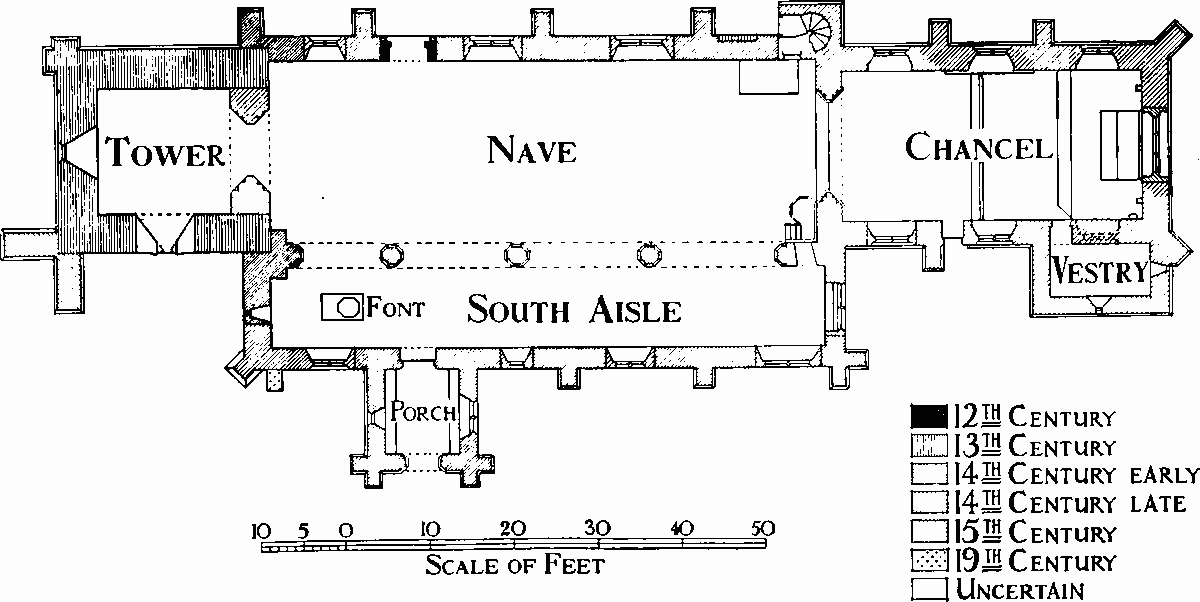
Plan of St. Mary's Church
The latter half of the 17th century saw renewed interest in the care of the fabric and beautification of the church. Ursula Denton alleged that she spent about £100 (apparently between 1649 and 1660) on the restoration of the chancel. (fn. 288) White Kennett's influence is reflected in the churchwardens' accounts. (fn. 289) They record the following items of expenditure: in 1687, £1 4s. 'for a new cover of wainscot for the font', and £1 6s. 'for a crane of iron for the cover . . . and a lock'; in 1688, £9 'for a new pulpit and tipe' (fn. 290) (i.e. sounding board), and £12 2s. 7d. for ornaments for the pulpit. These include payments for 7½ yards of damask, a quantity of gold fringe, and gold and silk tassels. In 1691 £4 13s. 6d. was paid to Richard Robinson, smith, of Oxford, for making the vane and for iron-work to support it. An Oxford painter, William Holship, received £2 for gilding. Another smith, Thomas Staunton, received £4 5s. for the ironwork to support the cross on the steeple. In 1699 two masons were paid £24 13s. for 'whiting, rough-casting and pointing the tower'.
There were a number of monuments to the Denton family: (fn. 291) a brass bearing the figure of a gowned man commemorating John Denton (d. 1576), a tablet to Mary, wife of William Denton, and a tomb to John Denton (d. 1649). Other 17thcentury inhabitants commemorated were the vicar, John Stubbings (fn. 292) Thomas Marsh of Arncot, Joseph Marsh of Blackthorn, (fn. 293) and Mrs. Anne Standard (fn. 294) (d. 1632) of Nether Arncot. Only the memorial to the vicar now remains.
The dial plate, costing £5 12s., and the clock, for which Vincent Smith received £9, were added in 1711 and 1713. (fn. 295)
In 1771 the church was in a bad state of repair and the parishioners complained that the rain was coming in. The Churchwardens were summoned to appear before the bishop's court to answer for their failure to repair the roof or to have raised money for it. An order was accordingly issued and in 1772 £48 was spent on the roof and tower. Matthew Clarke, carpenter and surveyor of Bicester, was employed.
In 1780 the church roof was covered in at a total cost of £36 6s. The masons employed were Francis Blewitt and John Heritage; the carpenter was Henry Horner. In 1782 the south aisle was likewise 'ceilinged' at a cost of £13 13s.
In 1764 a west gallery was erected by the parishioners for the use of the choir. Blomfield states that the tower arch was then filled in and that the oilpainting of the Resurrection at the Last Day (20 ft. by 12 ft.) was painted on the partition and the wall above. (fn. 296) It was a 'competent piece of work', well above the average standard of a local craftsman, and possibly done by a painter from Oxford or London employed by Sir Edward Turner at Ambrosden Park. (fn. 297)
The upper part of the chancel arch was filled in at the same time. (fn. 298) The royal arms (now gone) were hung on a partition supported by the beam of the old roof loft. A gallery pew was suspended against the north wall which was reached by the former rood-loft staircase from outside. (fn. 299)
There are a number of memorials to well-known 18th-century inhabitants. They include one to the Allen family, the vicar Thomas Cockerell (d. 1765), John and Richard Tanner (d. 1742 and 1743), and members of the Croxton family.
A tombstone in the churchyard commemorates Theophilus Metcalfe, 'learned, skilful and tenderhearted physician' to Sir Edward Turner.
In 1811 'thorough repairs' were undertaken at a cost of £239 10s., of which £100 was paid out of the Church Charity fund. In 1847 the nave was reroofed at a cost of £470. In 1867 a London architect, C. N. Beazley, was commissioned to carry out a complete restoration. It included a new roof for the aisle, extensive repairs to the chancel and tower, the removal of the box pews and galleries, reflooring and reseating, the renewal of the tracery in the windows and external parapet, and the installaction of an underground stove for heating. The cost was £1400, of which £1,100 was paid by the trustees of the church fund and £300 raised by private subscription. The church was reopened by Bishop Wilberforce on 10 November 1868. (fn. 300) There was seating for 551.
An organ was installed in 1909. (fn. 301)
In 1951 the 18th-century mural painting, curious rather than beautiful, was destroyed by order of the Parochial Church Council. (fn. 302)
In the 1690's the entrance to the churchyard was widened by the grant of a piece of land by Sir William Glynne. A new wall and churchyard gates were subsequently built at a total cost of £13 13s. 6d. and £26 1s. 9d. respectively. The churchwardens' accounts for 1694–6 show that some of the stone came from Bicester, that the two stone urns to top the piers cost £5 and that the joiner Richard Harris received £4 5s. (fn. 303)
An inventory of 1553 gives a complete list of church goods which included '2 chalices of parceled gylte', a red velvet cope and vestment, 2 damask vestments, a red cope and one of blue camlet. (fn. 304) Some of these may have been provided by Ashridge College, as by the ordinance of 1336 it was to provide books, vestments and other ornaments at least for the first turn. (fn. 305)
The church plate includes a silver chalice, dated 1656, and a silver communion flagon of 1725, the gift of Katharine Lister, daughter of Sir William Glynne. (fn. 306)
In 1553 there were four bells and a 'little bell', (fn. 307) for the upkeep of which bequests were frequently made. (fn. 308) White Kennett had the tenor recast by Richard Keene of Woodstock and another bell dated 1697 made by him. In 1928 the bells were rehung. There is now a ring of eight bells with a sanctus bell. The last was made by Peter de Weston of London in the first half of the 14th century and is one of the few medieval bells to be inscribed. (fn. 309)
The registers date from 1611; there is a gap during the Interregnum and they were irregularly kept in the first half of the 18th century. (fn. 310)
In 1689 the churchwardens' accounts record the purchase of a box for the church records, and a chest dated 1785 still stands in the chancel. (fn. 311) The room on the south side of the chancel was described as the muniment room in the accounts in 1791 when the cost of repairs was entered. (fn. 312)
Roman Catholicism.
Roman Catholicism survived in the parish until the late 17th century. The subsidy roll of 1641 shows that Matthew Benningfield and Francis Mildmay, both substantial landowners, and John Sheriff, also a landowner, were, as Roman Catholics, taxed at double the ordinary rate and that Mary Mildmay, three of her servants, and a labourer paid a poll tax. (fn. 313) The Mildmays were staunch adherents of the old faith; Francis Mildmay's wife Mary was the daughter of George Brooke of White Knights (Berks.), a member of a noted Roman Catholic family with a branch at North Aston. In 1648, after Francis had been declared a papist and a delinquent, his estates were sequestered. (fn. 314) In 1663 his son, Walter Mildmay, was charged as a recusant for refusing to appear in church; (fn. 315) two other members of the family were professed nuns in 1644 and 1658, and another became a Benedictine monk in 1674. (fn. 316) When the Mildmays left in 1673 all Roman Catholic influence seems to have come to an end, for no papists are listed in the Compton Census of 1676 or in the list of recusants of 1767.
Protestant Nonconformity.
A contemporary writer describes how the vicar, Dr. Stubbings, suffered from the 'maligne and phanatical people' who refused to pay tithes (fn. 317) —an attitude no doubt encouraged by the proximity of Bicester, where nonconformity was strong, and by the influence of Edward Bagshawe. He was vicar from 1659 until his ejection in 1661; he was strongly puritan in outlook, a man of turbulent, domineering personality and of considerable ability. (fn. 318) No nonconformists, however, are recorded in the Compton Census of 1676. In 1691 a 'dissenting meetinghouse' was registered at the house of William Croxton. (fn. 319)
In the early 19th century there was a considerable religious revival led by the nonconformists. In 1820, Mr. Sparks, a Congregationalist, was sent by the Home Missionary Society to Blackthorn, where he held services in an old bakehouse. (fn. 320) In 1844 Martha Penn's house on the green (presumably in Blackthorn) was registered for teaching and preaching; (fn. 321) in 1870 a larger though very simple building was obtained: it held 200 people and cost £450. (fn. 322) In 1861 the Blackthorn congregation had been described in the minute book of the 'Protestant Dissenters at Bicester' as a branch church, and the Bicester minister had administered the Lord's Supper there for the first time. (fn. 323) This connexion with Bicester continued until 1884, when Blackthorn was attached for administrative purposes to the Marsh Gibbon (Bucks.) group. (fn. 324) In 1926 a new building was erected, and the church was transferred to the charge of the minister of the church at Bicester. In 1944 this connexion ended. (fn. 325)
It was not until 1831 that a house in Ambrosden was registered as a Congregational meeting-place. (fn. 326) In 1844 premises belonging to William Moore were registered for the purpose of teaching and preaching. (fn. 327)
Methodism was first recorded in the parish in 1823, when Richard Croxton, an Arncot farmer, applied to have his house registered as a place of worship; (fn. 328) and in 1834 a chapel was built on the green at Upper Arncot and registered as a Wesleyan Methodist chapel, (fn. 329) but owing to the rapid increase in the congregation it had to be enlarged in 1847 at a cost of £200. (fn. 330) This stone building with seating for 75 is still in use as a Methodist church. (fn. 331) As early as 1830 the Wesleyans opened a Sunday school, which by 1833 had 22 boys and 35 girls. (fn. 332)
Schools.
In 1808 there was no school in the parish and those children who received any education obtained it at Bicester. (fn. 333) In 1818 a school was opened at Ambrosden, first in the Vicarage and later in a private house, with an attendance of 12 to 16 children. (fn. 334) By 1833 there was a school at Arncot for about 30 children, entirely supported by the vicar, who reported that the state of education was very unsatisfactory 'and that the parishioners could not be persuaded to pay for it. (fn. 335) The Educational Return for 1835 gives two schools in the parish, both supported by the parents and with an attendance of 22. (fn. 336) But by 1854 the incumbent reported that a dame school 'in one of the hamlets' was the only educational provision for the parish, and that the inhabitants 'both farmers and labourers were so very poor that there was no prospect of raising funds'. (fn. 337) In 1868 there was a temporary school in each of the three hamlets, (fn. 338) but it was not until 1873 that a school board was finally set up for the parish (fn. 339) and in 1876 a school, costing £1,350, was opened at Ambrosden with accommodation for 85 children. Its average attendance was then 70. It was shortly followed by the opening in 1876 of an infant school at Arncot in the mission room, with an average attendance of 30, (fn. 340) and of another school at Blackthorn.
Arncot School was closed by the managers in 1920, and the children were sent to Ambrosden school, which took children from Ambrosden and Merton and senior children from Piddington and Blackthorn. The Blackthorn school remained open for children up to the age of eleven. (fn. 341)
In 1952 Ambrosden primary school had an average attendance of 194, children from the War Department housing estate being accepted, and the Blackthorn primary school had an attendance of 16. (fn. 342)
Charities.
The Church Charity originated in a medieval estate held by the church in Blackthorn, consisting of two cottages, one close and half a yardland, which had been given to provide for the repair and maintenance of the building. The charity was in existence in 1336 (fn. 343) and may date from the original endowment of the church. In 1825 the Brougham Commissioners (fn. 344) said that it consisted of a cottage, a close, and 25 acres. In 1568 the property was rented for £13 6s. 8d., (fn. 345) in 1805 for £39, in 1861 for £70. (fn. 346)
The charity escaped confiscation with the rectory lands at the Dissolution, but soon after two informers lodged information that it was 'concealed' land and a Crown escheat. In 1568 it was reported to be in the seisin of the queen and to have been granted to the informers for £16 at an annual rent of £13 6s. 8d. The inhabitants of Ambrosden immediately petitioned the queen for the restoration of their church lands. After a further inquiry in 1615 the intruders were dispossessed and fined £30 for arrears of rent and £10 for waste. It was then ordered that the land should be settled in trust, and feoffees appointed from the parishioners. This decision was contested by the intruders and the Chancery suit which followed was not finally settled in the parishioners' favour until 1635. (fn. 347) The legal expenses of the suit appear to have been raised from a church rate of 3d. for every yardland in spite of some objections to a levy for this purpose. (fn. 348)
In 1685 White Kennett found that the money arising from the charity was being misapplied. Instead of being kept in the chest specially provided, it was paid direct to the churchwardens, distributed by them to the three hamlets, and used to pay for various parish expenses. What was properly a 'church stock' was thus converted into a 'parish stock'. This practice gave rise to collusion and great disorder, especially as the churchwardens were also feoffees for the trust. White Kennett appealed to Bishop Fell, but as the feoffees refused to comply with the bishop's injunction, a second judgement was sought from the Charity Commissioners. They ordered (1685) the appointment of a new trust and that the money sequestered during the last seven years should be repaid by the churchwardens. (fn. 349)
After the inquisition of 1685 the fund was faith fully administered. Early account books existed in White Kennett's time, but had disappeared by Blomfield's. The latter refers to accounts begun by White Kennett in 1686 and continued until his own day. (fn. 350) These too are now missing. (fn. 351)
Joseph Marsh (d. 1698) left 20s. a year for the purpose of apprenticing one poor child every seven years. (fn. 352) The charity appears to have been properly adminstered through the churchwardens, the money being paid every seven years by the owner of the endowed land. In 1793 the payment was increased to £20 per annum from parish funds.