A History of the County of Oxford: Volume 9, Bloxham Hundred. Originally published by Victoria County History, London, 1969.
This free content was digitised by double rekeying. All rights reserved.
'Parishes: Adderbury', in A History of the County of Oxford: Volume 9, Bloxham Hundred, ed. Mary D Lobel, Alan Crossley (London, 1969), British History Online https://www.british-history.ac.uk/vch/oxon/vol9/pp5-44 [accessed 9 May 2025].
'Parishes: Adderbury', in A History of the County of Oxford: Volume 9, Bloxham Hundred. Edited by Mary D Lobel, Alan Crossley (London, 1969), British History Online, accessed May 9, 2025, https://www.british-history.ac.uk/vch/oxon/vol9/pp5-44.
"Parishes: Adderbury". A History of the County of Oxford: Volume 9, Bloxham Hundred. Ed. Mary D Lobel, Alan Crossley (London, 1969), British History Online. Web. 9 May 2025. https://www.british-history.ac.uk/vch/oxon/vol9/pp5-44.
In this section
ADDERBURY
The ancient parish of Adderbury (fn. 1) covered an area of 6,045 a. and included the townships of Adderbury East (2,058 a.), Adderbury West (1,160 a.), Bodicote (1,291 a.), Barford St. John (726 a.), and Milton (810 a.). (fn. 2) It was reduced in size in 1855 when Bodicote became a separate ecclesiastical and civil parish, and again in 1932 when Barford St. John was joined with Barford St. Michael to form a new civil parish. (fn. 3) The modern civil parish of Adderbury (East and West) with Milton covers 4,028 acres.
The ancient parish was largely bounded by rivers: on the east the Cherwell separated it from Northamptonshire, on the south the River Swere was the dividing line with Deddington parish and Wootton hundred, and on the west the Sor Brook, a tributary of the Cherwell, separated it from Bloxham. (fn. 4) The Middle Lias limestone underlies the whole of this area and there is an outcrop of Marlstone over a large part of it. (fn. 5) The soil is fertile and its characteristic reddish colour distinguishes the landscape, while the local quarries have provided good building material. There are many disused quarries for both building stone and ironstone. (fn. 6) The land lies mostly between the 300 and 400 ft. contours and the landscape is one of undulating hill and river valley. Generations of landowners and tenants have left their mark: it was common practice to stipulate in leases that tenants should plant trees, usually oaks or elms, (fn. 7) and well-timbered hedges diversify the natural bareness of the uplands. Resident gentry have created parks and gardens such as those around Adderbury House, and Bodicote and Cotefield Houses; and the needs of fox-hunters have led to the planting of coverts. (fn. 8)
Through the centre of the parish runs the main road from the Midlands by Banbury to Oxford (turnpiked in 1755), (fn. 9) and the Banbury–Buckingham road branches off it. The course of both these roads was altered by the inclosure award of 1768; their previous course can be seen on Ogilby's map of 1675, where it is noted that there was then 'an indifferent way' from Adderbury to Deddington. (fn. 10) Before the award the Buckingham road branched off the Banbury–Oxford road at Weeping Cross east of Bodicote, and ran south-eastwards to Nell Bridge, a line which followed that of the ancient Saltway. (fn. 11) After 1768 a minor road, branching off just to the north of Adderbury village, became the main Banbury–Buckingham road. Weeping Cross probably dated from the 15th century; it was repaired and embellished in 1730 and removed in 1803. (fn. 12) It might possibly have been a halting place for coffins on their way to the mother church at Adderbury, for Bodicote had no separate burial ground until 1754. (fn. 13)
Many of the parish bridges date from the Middle Ages: Aynho or Nell Bridge (fn. 14) was kept up by the Bishop of Winchester or his lessees; West Bridge or St. Mary's Bridge (i.e. the bridge over the Sor Brook between the two Adderburys) was the responsibility of New College, Oxford, or its lessees. (fn. 15) A bridge called 'Whytesbridge' was built in 1387, and 'Middle Bridge or Grylysbridge' was repaired with stone in the reign of Henry IV. (fn. 16) A report on Oxfordshire bridges in 1878 stated that the one wide arch of Adderbury Bridge (i.e. West Bridge) was mainly built of large squared stones dug near Adderbury and was finished with Hornton stone. (fn. 17) Ham (or Bloxham) Bridge was rebuilt in 1859 and carries the Milton–Deddington road over the River Swere, here little more than a brook. The repair of this bridge was shared by Adderbury and Deddington. Another bridge across the Swere, carrying the main Adderbury–Deddington road, lies c. 1⅓ mile below Ham Bridge.
Communications were greatly improved by the construction of the Banbury–Oxford section of the Coventry–Oxford canal between 1778 and 1790. Tarver's and Nell Bridge Locks, and Twyford, Adderbury, and Nell Bridge Wharfs were built on its course through the parish. (fn. 18) In 1887 there followed the construction of the Banbury, Chipping Norton and Cheltenham branch of the G.W.R. (fn. 19) It ran through Milton and Adderbury to meet the Oxford and Birmingham line at King's Sutton Junction. There was a halt at Milton and a station at West Adderbury. These were closed to passenger traffic in 1950 and the line was finally closed in 1964. (fn. 20)
Apart from the unusually large and scattered parish of Cropredy, Adderbury was the largest parish in north Oxfordshire and was more thickly populated than any other. In 1642 342 of its men took the Protestation Oath compared with 257 in Bloxham parish, (fn. 21) and in 1676 871 adults, almost certainly an under-estimate, were recorded in the Compton Census. (fn. 22) In the early 19th century population increased very rapidly, rising from 1,775 in 1811 to 2,525 in 1841. Thereafter it steadily declined, but changes in the boundary of the ancient parish invalidate any comparison between 20thcentury and earlier totals. (fn. 23)
Despite the parish's rich soil and plentiful water supply little evidence has been found of pre-historic settlement. There were Romano-British villa sites at Bodicote and near Adderbury West. (fn. 24) It is uncertain when the first Anglo-Saxon settlements were made but it is probable that the Upper Cherwell area was overrun in the 6th or early 7th century, possibly by invaders from the east. The double village of Adderbury took its name from an Anglo-Saxon, Eadburga, the earlier form of the place-name being Eadburgesbyrig. (fn. 25) Since the parish feast used to be on the Saturday before 18 July, the feast day of St. Eadburga of Aylesbury (d. c. 650), who may have been the daughter of Penda, King of Mercia, (fn. 26) it is likely that the place was named after her. (fn. 27) Adderbury's position on the route through Banbury to the Midlands probably encouraged its development. The village was first mentioned in the time of Wynflaed (c. 950) and by the 11th century was one of the centres of a large royal estate. (fn. 28) In the 13th and 14th centuries Adderbury East and West were the largest settlements in the parish. They lay on opposite slopes of the Sor Brook valley and were together nearly as large and prosperous as the two parts of Bloxham, which were similarly sited on either side of a valley. (fn. 29) For the poll tax of 1377 there were 300 contributors. (fn. 30) In 1642 114 men from Adderbury East and 61 from Adderbury West took the Protestation Oath compared with 213 at Bloxham. (fn. 31) Growth certainly continued in the 18th century, though as incumbents always included Milton in their returns for Adderbury this can only be estimated roughly. In 1768 it was reported that there were 224 families in the three villages and in 1778 300 houses. (fn. 32) In 1801 there were 1,144 inhabitants in the two Adderburys, Adderbury East being far the larger; the peak figure was reached in both villages in 1841 when the figures recorded were 1,060 and 442 for Adderbury East and West respectively; in 1961 the figures were 1,312 and 534. (fn. 33)
Although the growing population and prosperity of the Adderburys has led to much new building on the outskirts, the villages still retain their regional character. A high proportion of houses and cottages in both date from the prosperous period of the 16th and 17th centuries, and many from the 18th century. Consistent use of local stone and careful restoration and rebuilding in the 19th and 20th centuries in traditional styles of architecture have given the villages a pronounced architectural harmony. Grass verges and low garden walls in front of the cottage rows are a common feature. (fn. 34)
The older part of Adderbury East lies partly on the main Oxford–Banbury road, but mainly on both sides of a sinuous branch road which runs westwards down the hill to the Sor Brook. The splendid medieval church, the two manor-houses on either side, the tithe barn, and the Old Vicarage are grouped at the lower end of the village street. It is likely that in the Middle Ages the peasants' houses were mainly around the green at the upper end of the village. The green, notable for its ancient elms and chestnuts, was probably at one time more extensive: in the late 14th century it was prominent enough for the place to be called Adderbury-on-theGreen. (fn. 35) The site of the village cross, which once stood there, is known. (fn. 36) It was at this end of the village that in the Tudor and Stuart periods the houses of the rising gentry were built — the mansions of the Wilmots, the Cobbs, and perhaps of the Danvers family, and also many farm-houses.
Adderbury East in 1665 had nearly as many taxable inhabitants as the whole of Bloxham or Deddington, a market town, and had a greater number of substantial houses. (fn. 37) There were 25 fair-sized dwellings besides the school. Four were assessed on 5 or 6 hearths and the rest on 3 or four. (fn. 38) Towards the end of the century Celia Fiennes described Adderbury as a pretty, neat village 'where are two or three good houses; one of Sir Thomas Cobb's and Lady Rochester's looks neat and well with good gardens'. (fn. 39) In the 18th century the nearby spa at Astrop (Bucks.), (fn. 40) the facilities for hunting, and the proximity of a number of large seats, including Wroxton and Broughton, encouraged aristocratic residents. The Wilmots' house was transformed by stages into the Duke of Buccleuch's palatial mansion and the upper end of the village was greatly altered by the laying out of the duke's grounds and the alteration of the course of the highway at inclosure in 1768. The vicar, writing in 1796, went so far as to say that 90 cottages had gone 'to embellish the environs of the heavy pile'. (fn. 41) This destruction followed by rebuilding accounts for the predominantly 18th-century character of the older cottages and houses on the Banbury road and very possibly for the present isolated position of the East End. If the green had once extended further to the east and was taken into the grounds of Adderbury House in 1768, Sydenham Farm, Fleet Farm, and Home Farm, all 17th-century or earlier buildings, would have been cut off from the rest of the village.
The chief 19th- and 20th-century additions to Adderbury East have been the schools, stone-built in the Gothic style in 1831 (the Sunday School), 1854, and 1961; (fn. 42) the Wesleyan Chapel (1893); (fn. 43) the Institute, given by J. W. Larnach in 1897; and the houses, built both by the R.D.C. and private enterprise, along the main road to Banbury and on Milton road.

Adderbury, c.1790
Of the principal houses the 'great house' in the post-medieval period was not one of the medieval manor-houses but Adderbury House. It stands on the east side of the main road to Banbury and is surrounded by extensive, walled grounds. A comparatively small part of the 18th-century house remains and still less of its 17th-century predecessor. Compared with Wroxton Abbey, Broughton Castle, or even Hanwell Castle, the 17th-century house was small. Its owner, the widowed Ann, Countess of Rochester, was assessed on 14 hearths for the tax of 1665. (fn. 44) After renewing the lease from the Bishop of Winchester in 1661 she is said to have spent £2,000 on building and richly furnishing the house, and on the gardens, so as to make it 'fit for a family who at that time were not possessed of any other save only a house near Scotland Yard'. (fn. 45) She evidently did not rebuild entirely, for the additions were described as being 'graft to the old mease'. (fn. 46) Dr. Plot, writing in 1676, classed the remodelled house among 'our most stately buildings' and 'among the most eminent in the country', (fn. 47) and the Warden of New College reckoned that it had cost £4,000 in all to build. (fn. 48) An inventory taken in 1678 mentions the Great and Little Halls, Drawing-Room, Great Room above stairs, Great Square Chamber, Lesser Dining Parlour, and 11 other rooms, excluding the offices. (fn. 49)
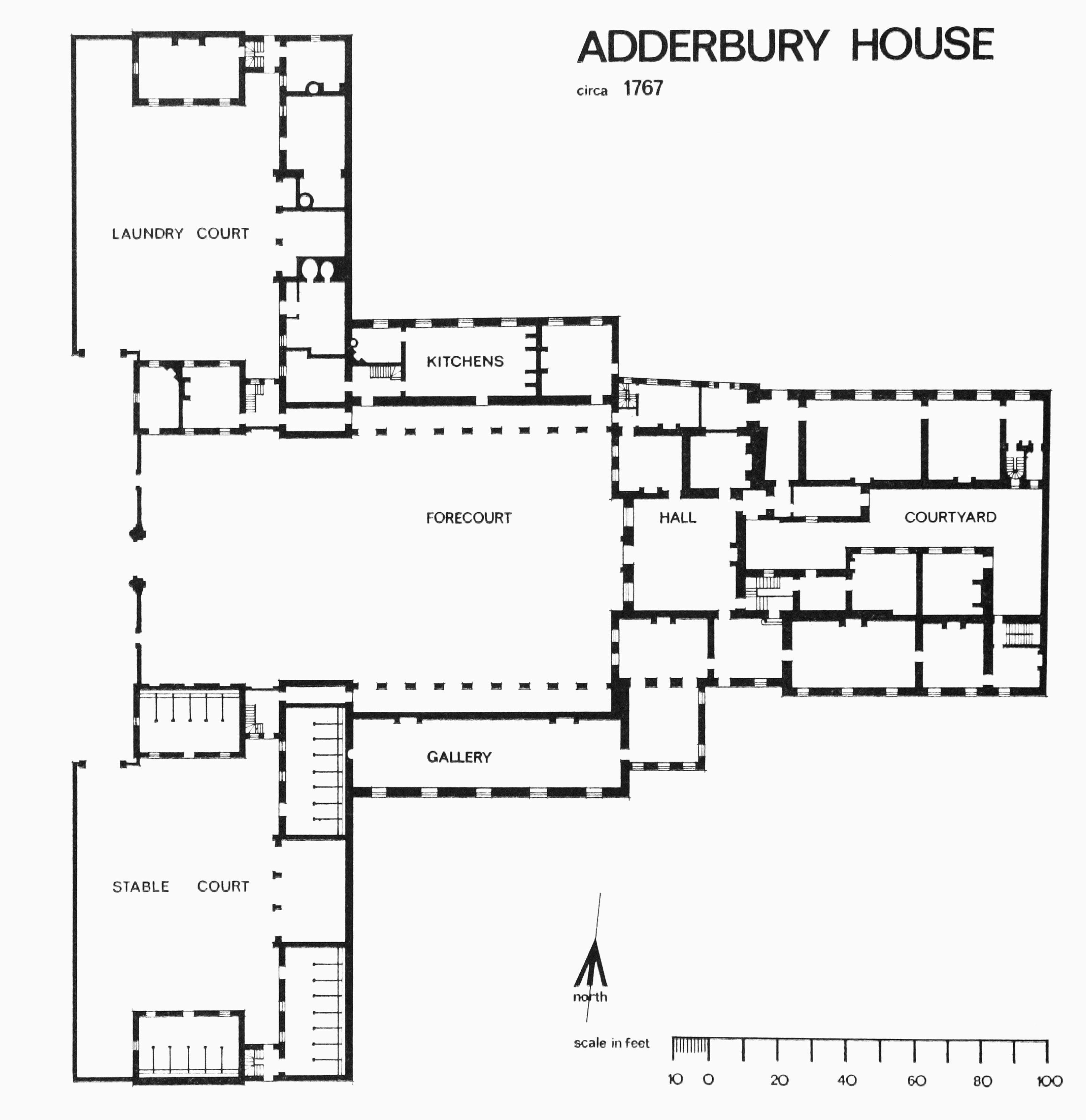
Adderbury House
From an architect's survey of c. 1767 in the Soane Museum.
Despite Plot's eulogies the house proved to be neither of a scale nor of an architectural design to satisfy John, Duke of Argyll, who obtained the lease in 1717. A constant traveller, seen in most of the courts of Europe, he had 'a head admirably turned to mechanics' and there is reason to suppose that he at once set about making plans for rebuilding. According to Horace Walpole the duke rebuilt the house in several stages. (fn. 50) Drawings (fn. 51) show that the existing south front, originally surmounted by 6 Jacobean gables, was remodelled probably in 1722, the date on the rainwater heads. The Georgianization of the north front probably took place at the same period. James Gibbs was subsequently employed to design a new entrance front with a recessed portico, but his plan was not carried out. The arcaded wings were added in or soon after 1731, and were designed by Roger Morris. The southern wing contained a grand gallery nearly 80 ft. long, with a coffered ceiling and other ornamental features. This was in the Palladian style, but the arcades were a Vanbrughian feature which recall Eastbury House, Dorset, then being completed by Morris to Vanbrugh's designs. The stables and other offices were probably added still later. (fn. 52) Of this grandiose building only the stable block, the north arcade, and the south front of the main building survive. Before the last alterations in c. 1900 the south front had a plain elevation, 3 stories high, with round-headed sash windows. (fn. 53) It is evident from the plans that portions of the earlier house were incorporated in the Georgian mansion, and some traces of what may be 17th-century masonry can still be seen on the north side of the existing house.
On the death of John, Duke of Argyll, in 1743 the house was occupied first by his eldest daughter Caroline and then by her son Henry, Duke of Buccleuch. (fn. 54) In 1768 the duke was by account 'carrying on great works at Adderbury'. (fn. 55) The opportunity, afforded by inclosure that year, to extend the park of Adderbury House may well have been taken, but it also seems likely that there were alterations to the stables, the duke being a wellknown rider-to-hounds, and to the interior of the house. The duke's architect was in all probability Sir William Chambers, who was engaged that year on work at the duke's town house in Grosvenor Square. (fn. 56) When Adderbury House was sold in 1774 it was said to contain 56 rooms, including a lofty entrance hall, 3 drawing-rooms, a library, and a billiard-room. (fn. 57) The whole was later described as a superb mansion worthy of royalty, (fn. 58) but Horace Walpole considered it 'large but very inconvenient' and admired the numerous pictures and busts more than the architecture. (fn. 59)
The grounds matched the house in magnitude. They covered c. 224 a. of flower-gardens and parkland, enclosed with a verge of evergreens and forest trees. There was also a 'fine serpentine stream of water . . . in full view of the house'. (fn. 60) The park, like the house, was the work of several owners: it had certainly been enlarged as early as 1734, when land was bought from Sir Edward Cobb, and again by the Rt. Hon. Charles Townshend; (fn. 61) later the Duke of Buccleuch employed 'Capability' Brown to make a design for altering the park and gardens. (fn. 62)
Early in the 19th century the estate was bought by J. E. Field, who in 1808 decided to pull down most of the building and convert it into 'a handsome dwelling suitable for a family of distinction'. (fn. 63) Brewer described the result as a 'happy effort of architectural consistency and adaptation'. (fn. 64) An early 19th-century drawing shows that all that remained of the central block was the south front, to which a central doorway and porch were added. Two of the first-floor windows were cut down and provided with iron balconies. (fn. 65) The house was bought by W. H. Chamberlin in 1826, but it was not until J. W. Larnach became its owner in 1891 that it was enlarged to its present dimensions. (fn. 66) Larnach built additional accommodation to the north of the existing house, and added the pedimented projection in the centre of the south front, together with its Ionic portico. Though corresponding exactly to the style of the 18th-century work, the present east and west elevations are due entirely to Larnach. In 1948 the Oxfordshire County Council acquired the house and grounds for use as an Old People's Home. (fn. 67)
The second most important house in Adderbury East was probably the Cobb mansion, of which only the two sets of 17th-century gateposts remain. Drawings exist of the house before its final destruction, and something is known of its history from documents. The 16th-century William Cobb, a freeholder as well as a lessee of New College, may have been the original builder. A stone with the date 1582, which has been inserted in the south side of the eastern gate pier, (fn. 68) presumably came from the old house before it was remodelled in the 17th century. William Cobb died in 1598, but his widow Alice lived on there until 1627. (fn. 69) Their son William was knighted in 1634 and 7 of his children were baptized in the village church between 1622 and 1637. (fn. 70) In 1665 when Sir Thomas Cobb was living at the house it was assessed for the tax on 16 hearths, a higher assessment than that for the Countess of Rochester's house. (fn. 71) Warden Woodward of New College, who visited it when on progress in 1668, has left a record of Sir Thomas's hospitality to himself and some of the local gentry. In 1673 Woodward could not lodge there, as part of the house had been pulled down and had not yet been rebuilt. (fn. 72) The remodelled house is depicted in two water-colour copies of an early engraving. (fn. 73)
The Cobb family continued to live in this house until the death of Sir George in 1762. His heirs were his two married daughters, one of whom in 1768 leased the house to George Montagu, the bachelor friend of Horace Walpole. (fn. 74) Walpole wrote in 1768 that he had heard that Montagu had got 'into an old gallery that has not been glazed since Queen Elizabeth, and under the nose of an infant Duke (of Buccleuch) and Duchess'; he complained that his friend had given himself up 'to port and parsons and would end like a fat farmer, repeating annually the price of oats and discussing stale newspapers'. (fn. 75) After one winter in the house Montagu wanted many repairs and alterations, including sash windows 'to let in the sun'. (fn. 76) By 1815 it was in ruins; it was partly demolished and the kitchen wing was converted into cottages and a small house. (fn. 77)
Close to the Cobb mansion was another of the village's larger houses. Since the 18th century it has been called the 'Rookery'. One side fronts upon the green, the other upon the High Street. It now appears to be a typical 3-gabled Jacobean house, but it is likely that the core of the house is older. Some of the walls in the north-west wing are of a much greater thickness than is usual in this region in 17th-century buildings. The date 1656 on the 2storied projecting porch with a small powder closet over the entrance is probably the date of a remodelling. Wall-paintings on the upper floors appear to date from the Civil War period. The property was occupied in the 18th century by Samuel Clarson (d. 1802), a descendant of the Clarsons of Horley. On the death of Elizabeth Clarson (d. 1824) the house passed to her cousins, Mary and Elizabeth Wyatt, and finally to the Bradford family, relations by marriage. C. W. Bradford Wyatt, an ornithologist of repute, lived there on the death of his aunt, Elizabeth Bradford Wyatt (d. 1878), (fn. 78) and replaced the early-19th-century sash windows by the present stone-mullioned ones. (fn. 79) Early in the next century, a large wing containing the present drawing-room and a new stair-case was added. The house is now the home of Godfrey, Lord Elton.
These houses at the upper end of the village have a comparatively short history compared with that of the two manor-houses and the Old Vicarage at the lower end. Adderbury Manor is on the site of the manor-house of the Bishops of Winchester, who acquired their Adderbury estate in 1014 or 1015. The existing house, though much altered in later periods, probably dates in the main from the 16th century, but incorporates medieval walling. The house was occupied successively in the late Middle Ages by the families of Adderbury, Councer, and Bustard, the lessees of the bishop. (fn. 80) Anthony Bustard (d. 1568) was wealthy and may have rebuilt the medieval house sometime after 1534, for the initials A. B. were found on the interior woodwork by the Revd. Dr. T. Woolston, who was living in the house in the late 18th century. (fn. 81) The Woolstons kept a boarding-school there; the house had 10 bedrooms besides attics, ground-floor rooms, and an underground cellar. (fn. 82) It must have been already considerably restored for it had been described as ruinous in 1712, and in the 19th century (in 1887 in particular) it was again carefully restored and modernized. (fn. 83) It still retains its mullioned windows, but the stonework has mostly been renewed; there are traces of the original medieval hall-house in the dining-room and bedroom above, (fn. 84) and the large open fire-place with 4-centred arch is late 15th- or early 16th-century. This stonework, however, is reported to have been brought from another house. (fn. 85)
The second manor-house in Adderbury East, the Grange, though rebuilt in the 17th century, also incorporates medieval features and has a wellpreserved medieval tithe barn. The house is on the site of the early medieval rectory-house, but when New College appropriated the church in 1381 (fn. 86) this house became a secular manor-house or grange and was leased to tenants. The Warden of New College frequently stayed there, held his courts, and entertained the 'best and most substantial' of the parish. In 1395, for instance, he entertained 16 of them. (fn. 87) In the 1320s the rector's house had consisted of a great hall with a chamber, a detached kitchen, and other outhouses, all of which were inclosed by a wall. The main entrance into the inclosure was called the Town Gate. The fact that stone was brought for repairs in 1327–8 from Slaughter (Glos.) (fn. 88) suggests that the house was of good quality. Between 1386 and 1388 John Wylot, mason, was employed in building the walls, and stone slates were brought from Charlton; in 1388 there is a reference to the thatching of 4 houses 'lying in the rectory' (i.e. in the courtyard); in 1390 a stone porch was constructed; in 1395 a 'great door' and a new room; in 1443 a new gatehouse was built at a cost of over £13. The accounts also refer to the rectory's garden, malt-house, brew-house, granary, hay grange, pig-house, ox-house, and sheepcote, and to the gutters between the hall and the kitchen. The malt-house and brew-house, as well as the main house itself, were all stone slated. (fn. 89)
The medieval building was probably still in existence in 1659 when Warden Woodward described the rectory-house as 'very large, containing much building', but 'impossible to be made convenient and handsome without pulling down'. There were 6 mean rooms above stairs and 4 barns. (fn. 90)
As the college still kept its courts at the house and the Warden and his 'rider' stayed there, its condition was a matter of frequent complaint. (fn. 91) It was not until 1683, however, that Sir Thomas Cobb, the lessee, finally contracted with John Bloxham of Banbury, 'carpenter and surveyor' to rebuild the house for £130. The existing house is substantially the same as the house that Bloxham rebuilt and completed in 1684. (fn. 92) It is of 2 stories, with attics, and a cellar. Originally it had 4 gables, but since a fire c. 1884, which destroyed the oldest part, the north kitchen-wing, it has had 3 only. The roof incorporates several re-used medieval timbers, including a moulded roof principal, perhaps an indication of the shortage of wood that afflicted the north and central parts of Oxfordshire after the Civil Wars. A large new kitchen block was built in 1829 and the north wing that was burnt down in the 19th century was rebuilt and is now occupied by the library. The college sold the house in 1875 and it has been modernized by the present owner Mr. P. E. Middleton.
The date of the tithe barn is difficult to determine, but differences in construction indicate that the 2 western bays are either an extension or a reconstruction. The architectural character of the remainder suggests a date early in the 14th century for the construction of the barn, but some work may have been carried out in 1421–3, when a mason was paid over £20 for making 17½ rods of masonry and 7 buttresses for a new building at the rectory. (fn. 93) It is possible that the buttresses in question were those of the barn, and that the masonry included the 2 western bays in their present form; it is equally possible, however, that the new building was the rectory house itself. In 1877–8 the barn was converted into a stable by Lord Haldon, who inserted a floor and 2 dormer windows. (fn. 94)
The Old Vicarage probably stands on the site of the medieval vicarage-house, which was enlarged in 1397. (fn. 95) The main part of the existing house probably dates from the 16th and 17th centuries. Warden Woodward of New College noted in 1663 that the house was 'reasonable well' in repairs, but that the vicar would improve it in time. (fn. 96) The main range faces north and is of 2 stories with cellars and attics. A square stair-case projection was added at the rear of the house, probably in the late 17th century, and rises to the attics. The roof is partly hipped and retains most of its original rafters. There are dormer windows in it both back and front. Some stone fire-places seem to be of rather earlier date than the house and may have been re-used. One mullioned window remains in the stair-case projection and another in the cellar. The other early windows have been replaced by sash ones, perhaps in 1768 when the vicar was living in college until his house, which was 'very ruinous' could be put right. (fn. 97) Considerable alterations were also made in the time of R. R. Stephens (1858–74), who seems to have been responsible for adding the south-east projecting wing and the bays to the ground floor on the south side. (fn. 98) The present vicarage-house is a smaller, equally ancient house that was once probably a farm-house. It is L-shaped, has 2 stories, cellars, and gabled attics. It retains many original stonemullioned windows and open fire-places with 4-centred arches and moulded jambs and spandrels.
Another of the smaller houses in Adderbury East belonged to the Danvers family; it was assessed on 4 hearths in 1665 (fn. 99) but cannot now be identified. Adderbury East has many other houses, inns, and cottages dating from the 16th, 17th, and 18th centuries that deserve notice. Of particular architectural interest is a single-unit house in the main street, of 2 stories with gabled attic. It is very large for this type of house, measuring 19 x 17½ ft. inside and is distinguished by fine details. (fn. 100) The school and schoolmaster's house facing the green is a 16th-century building. In 1589 the vicar left money for a free school and begged the inhabitants to help 'cart the material for it with their carts and carriages'. (fn. 101) The original building remains largely intact, including some of the original stone-mullioned windows and parts of the original tie-beams and the horizontal struts of the queen-post roof. In 1659 Warden Woodward mentioned the 'school and kitchen, etc. below, with 6 or 7 rooms above, lower and upper', and commented that they might be made very good. (fn. 102) For the hearth tax of 1665 as many as 4 hearths were returned for it. (fn. 103) The extension on the south side was built in 1847 in a similar Tudor style. In 1965 the house was for sale as a private dwelling having been considerably altered inside.
Among the farm-houses in Adderbury East are Green Farm, the 'Royal Oak' in the High Street and the 'Bell', both once farm-houses, and the Old Mill House. In East End there are 3 farm-houses dating from the 16th or 17th century which have been little altered. Sydenham Farm and the Home Farm, for example, are L-shaped in plan, and of 2 stories with attics, and retain many of their original stone-mullioned windows. The 'Plough' and East House (once The Lawn) are 18th-century additions, the latter being built by the Duke of Buccleuch for his Scottish agent. (fn. 104)
Adderbury West straggles up the hill from the Sor Brook to the main Bloxham–Deddington road. Except for the 20th-century bungalows, which lie apart from the old village, and the disused Independent chapel, erected in 1829, it is built almost entirely of the local stone and in the regional style. Here also grass verges, climbing fruit trees on the house walls, small unwalled flower gardens, and a green planted with chestnuts, set off the excellence of the buildings. (fn. 105)
The largest and most important of the manorhouses was Le Halle Place. It is substantially a 3gabled 17th-century house remodelled in the 19th century. It contains some medieval work, probably part of the house granted to Walter atte Halle in 1310. (fn. 106) The property descended to the Barber family in the 17th century and the parish registers testify to their residence for most of the period from 1629 to 1854. In 1665 William Barber was assessed for tax on 12 hearths; (fn. 107) he was connected with Oxford and London merchants and presumably acquired his wealth in trade. (fn. 108) Much of the rebuilding probably dates from his day. In 1716, when Edward Barber leased part of the house, among the rooms mentioned were 'two over the hall, commonly called "hall chamber"'. (fn. 109) The Barber family ceased to live there on the death of John Barber, known as Squire Barber, in 1854. (fn. 110) The present house has a forecourt with a high screen-wall pierced by three pairs of apparently 17th-century stone gateposts. It is possible, however, that these are not all original as in 1730–1 a gatehouse with loft and chamber over it was mentioned. (fn. 111) To the west of the house is a 4-gabled square dovecot of the 17th century. On the north is a range of single-storied stabling with attic dormers. It is built of coursed ironstone rubble and may be rather later in date than the dovecot. The house now consists of a coursed-rubble front or west elevation of 2 stories with 2 projecting wings, between which, at eaves level, are 3 gabled dormers. The east elevation has 2 gables. In 1728 some sash windows were inserted in the principal rooms in the front of the house by Edward Barber. (fn. 112) In the late 19th century these were replaced by stone-mullioned and transomed windows. (fn. 113) The interior contains much 17th- and 18thcentury panelling and a fine oak stair-case with panelled walls of the early 17th century; this, however, may have been brought from elsewhere. Leading to the hall there is a stone doorway with 14th-century ball flower ornament in its moulded arch. To the south is another doorway with a pointed arch, and in the passageway leading to it are medieval vaulting ribs.
Of the other large houses Crosshill, standing in a commanding position on the hill-top, has a 3storied Georgian facade of ashlar, with 7 sash windows with stone key-stoned architraves, and a central stone doorway. The latter has moulded side pilasters and is surmounted by a broken pediment containing a blank cartouche. In the inside there are mid-18th-century panelling and door frames, but most of the fittings appear to be c. 1800, when marble fire-places and steel grates were inserted. The house stands on the foundations of a 16th- or 17th-century building of which the cellars and footings remain on the north side. It was lived in in the later 18th century by Christopher Aplin. (fn. 114) who was probably responsible for the remodelling of the house and for the stable range. It is possible that it was this house that Mrs. Holford Cotton took on the death of her husband, the vicar, in 1822. In 1823–4 she paid the architect C. S. Smith and others over £4,000 for additions and repairs to an unnamed house in Adderbury. (fn. 115)
The house now known as Little Manor may have belonged to the Doyley family. It is an old house, remodelled in the 18th century. In 1665, when Bray Doyley (fn. 116) was lord of Adderbury West, he was assessed on 6 hearths for his house. (fn. 117) In 1696 his house consisted of 2 parlours, a hall, rooms over the great and little parlours, 3 chambers, and garrets, kitchen, pantry, brew-house, cheese-chamber, and dairy. (fn. 118) This may have been the manor-house of the St. Amands, the medieval lords of Adderbury West. (fn. 119)
Among the smaller houses and cottages of architectural interest are the 17th-century South Bank, The Leys, the 'Dog and Partridge', and Callary Cottage. The last is dated 1665, but a medieval window of 2 lights, trefoil-headed with a moulded hood, has been incorporated.
Close to Little Manor lies the Friends' Meeting House, which bears the date 1675 and was built at Bray Doyley's expense. (fn. 120) It is a plain one-storied building with a gabled attic dormer and is fitted inside with galleries. (fn. 121) It is now (1965) disused.
Bodicote lies in the north of the parish, slightly to the west of the main Oxford–Banbury road. It is 2 miles distant from Banbury, by which it was probably much influenced. Its name probably derived from the Anglo-Saxon personal name Boda. (fn. 122) Evidence suggesting that Bodicote was an offshoot from Adderbury is set out below. (fn. 123) In the Middle Ages Bodicote was apparently a smaller settlement than either of the two Adderburys. (fn. 124) By the 16th century it may have outstripped Adderbury West in population, though not in wealth, and by 1642 as many as 91 took the Protestation Oath. (fn. 125) Its growth was connected with the development of the weaving industry at Banbury and other north Oxfordshire villages. In 1759 the curate recorded that there were 84 houses, and in 1768 that there were 80 or 100 families. (fn. 126) By 1801 Bodicote with 574 inhabitants was far more populous than Adderbury West. In 1831 numbers reached 779, but declined thereafter during the 19th century. Although Bodicote lost 301 a. to Banbury in 1932, its population had reached 1,056 by 1961. (fn. 127)
The village lies mainly on either side of a long street, but several small lanes branching off it suggest that as population increased building sites were let on the closes formerly attached to the High Street houses and ran backwards towards the open fields. The High Street was paved with stone as early as the 17th century. (fn. 128) A new drainage system was laid down in 1894 and by 1903 the village was lighted by gas supplied from Banbury. (fn. 129) The medieval church, the 'Baker's Arms', and a school built in the Gothic style just before 1852 (fn. 130) are the chief buildings in Church Street. In High Street, a continuation of Church Street, are the 'Plough', various shops, including the Post Office and the Co-operative stores, and some large 18th- and 19thcentury mansions, inclosed by high garden walls. Among the large houses are Bodicote House, an 18th-century house which is mentioned in a deed of 1722 and is now the offices of the Banbury Rural District Council; Bodicote Manor, a Georgian house incorporating an older house, Bodicote Grange (since 1932 in the borough of Banbury), and The Elms. Among the surviving 17th-century houses are Broughton House and Paddock Farm, both modernized in the 18th and 19th centuries, and a house immediately to the north of Paddock Farm which has a date panel inscribed 'T.B. 1687' and retains some of its original wood-mullioned windows. It may have been the home of the wealthy Bradford family that had 3 taxable houses in the hamlet in 1665. Thomas Bradford himself then had a 3-hearth house. (fn. 131) The south wing of the Old Barn, built in an L-shaped plan in two builds, probably dates from early in the 17th century, but the rest of the house is of a later period. The 2 largest houses in the village in 1665, each assessed on 5 hearths, and inhabited by Alexander Hawtrey and William Knight, (fn. 132) have not been identified. There are some 17th-century cottages at Farm Place.
Among the 19th-century additions are the Wesleyan chapel (1845) in East Street, a row of houses in East Street dated 1885, and a parish room and library given in 1893 by J. F. Stankey of Bodicote House. (fn. 133) A notable 20th-century addition is the crescent of council houses, with a green in front. Bodicote is fast losing its ancient rural character, and traditional building materials of stone and thatch are being superseded by brick, slate, and concrete. The medieval cross, which stood in the middle of the village near the 'Plough Inn' until at least 1841, has now gone, and so also has the 18th-century workhouse, and the Baptist chapel in Chapel Lane, erected in 1817–18 and demolished c. 1906. (fn. 134) The 'White Hart', mentioned in 1833, has changed its name to the 'Horse and Jockey'.
The hamlet of Milton lies on the western boundary of the parish, on the north side of the road from Bloxham to Deddington; the old part of the hamlet lies well off this road on a branch lane. The name was originally Middleton (fn. 135) and was perhaps so named as it lay between Adderbury and Bloxham. The old part of the hamlet consists of farm-houses and cottages, two of them now used as a Post Office and shop. They are built of the local ironstone and date mainly from the 17th century.
For a brief period in the later 17th century Milton achieved importance as a centre of early nonconformity in north Oxfordshire. (fn. 136) The Presbyterian chapel has disappeared, but Samuel Cox's cottage, in whose garden it was built c. 1708, still stands on the west side of the hamlet. (fn. 137) In 1665 Milton had 7 substantial houses, 1 assessed on 5 hearths, 2 on 4 hearths, and 4 on 3 hearths, and there were 14 other smaller houses. (fn. 138) This is the only basis for an estimate of Milton's population until the 19th century. In 1801 the population was 105 and rose to a peak figure of 205 in 1831; though numbers fell to 131 in 1881 they had risen to 203 by 1961. (fn. 139)
Today there is a 16th- or 17th-century inn, the 'Black Boy', which retains, like many other houses in the hamlet, some of its original mullioned windows. It has a 17th-century stair-case projection at the back but its front has been remodelled. This inn perhaps did a more than local trade in the 18th century when a bridle path ran from Deddington to Banbury through Milton, and probably attracted travellers away from the toll-road. (fn. 140) Glebe Farm, once used as a Sunday school, is in origin a late 17th-century house of merit. It has two date-stones, one placed there by the Turner family in 1694, the other inscribed H.J.G. 1876. McGreal's farmhouse is a good example of the early-17th-century regional style, a 2-unit plan combining hall and parlour. (fn. 141) Manor Farm is a reconditioned house of about the same date; it has 2 stories and cellars and a thatched tithe barn. A nearby cottage has a 14thcentury traceried window, and another single-story cottage has a doorway with a stone frame with a pointed chamfered head and plain jambs. These details may have been re-used after Milton's medieval chapel ceased to be used. (fn. 142) Now there is a 19thcentury church. In the 20th century a row of cottages has been put up.
Barford St. John, the smallest of the hamlets, lies in the extreme south-west of the parish on either side of the Bloxham-Deddington road. Barford, like Adderbury, grew as two villages, Barford St. Michael and Barford St. John, divided by a river, the Swere. Only Barford St. John, generally known in the Middle Ages as North or Little Barford, lay in Adderbury parish and Bloxham hundred. The name Barford derived from the Old English bere, meaning barley, compounded with ford because the river was fordable there. (fn. 143) Both Barfords lie at c. 350 ft. above the valley floor which is liable to flooding, so much so that the road over the bridge is sometimes impassable for motor traffic. (fn. 144) In 1784 c. 30 families lived in Barford St. John, by 1801 there were 100 inhabitants, and by 1901 only 55. In the 1961 census returns it was included with Barford St. Michael. (fn. 145)
The manor-house lies close to the church on rising ground. It was largely rebuilt c. 1920 on a long rectangular plan facing west with a wing on the north-east. It is of 2 stories and built of coursed ironstone rubble with stone end copings. The south gable end seems least restored and bears a date panel with 1598, W.M.S. The square stone dovecot was built c. 1713. (fn. 146) and the barn, 175 ft. long, to the south-east of the house, may date from about the same time. It was presumably this house for which William Gamock was assessed on 8 hearths for the tax of 1665. (fn. 147) It is likely that the original manor-house lay south-east of the church and nearer the river. There are traces of the moat and earth banks of an early fortified dwelling. (fn. 148) Manor Farm or Moat Farm, perhaps the Belcher's house which was assessed on 4 hearths in 1665, (fn. 149) dates from 1606 and bears the initials T. and A.B. on the south gable. It, too, is of 2 stories and is built of local material on an L-shaped plan with wings to south and east. Originally it consisted of hall and parlour only, but a newel-stair contained in a gabled stair-tower has been added. A 13th-century stone window of 2 lights has been reset in the ground-floor room in the west face. (fn. 150) Among other 17th-century buildings are the Crown Inn, remodelled in modern times, Mead and Street Farms, both in the village, and Barford Mill at the bottom of Coombe Hill. In Church Lane, close to the church, there is a house built on the 2-roomed plan, dating from 1680–90. Its doorway has a richly moulded architrave of stone. (fn. 151)
The airfield at Barford opened during the Second World War is now (1965) an Anglo-American radio station.
Among the gentry of Adderbury may be mentioned the Danverses, Doyleys, Penistones and Bustards. (fn. 152) The Barbers of Adderbury West were prominent from at least 1634, when Robert Barber made proof of his coat, (fn. 153) until the mid-19th century. The Dalby family of Milton and Goodwin family of Bodicote, although neither was armigerous, (fn. 154) were well-established and affluent. The aristocratic element at Adderbury East brought the parish into contact with a wider world. One notable visitor in 1739 was Alexander Pope, who stayed with John, Earl of Rochester, at Adderbury House and commemorated the visit in a poem; (fn. 155) another was Horace Walpole, who visited his friend Montagu in 1770. (fn. 156) In the 19th century the villages continued to attract a large number of resident gentry: in 1854 there were 18 in Adderbury East, 5 in Adderbury West, and 12 in Bodicote. (fn. 157)
The parish had a number of distinguished vicars (fn. 158) and other individuals of note: William (d. 1349) of Adderbury and John (fl. 1445) of Adderbury became Priors of Wroxton; (fn. 159) Richard Andrew, born in Adderbury c. 1400, was a distinguished royal clerk and Dean of York (1452–77); (fn. 160) John Cole (b. c. 1624) made a reputation as a translator from French, (fn. 161) and his brother William (d. 1662), educated at the grammar school at Adderbury and later at New College, was considered the most famous herbalist of his time; (fn. 162) William Oldys, the son of Adderbury's ill-fated royalist vicar, (fn. 163) and a distinguished lawyer and Chancellor of Lincoln, was born and educated at Adderbury; (fn. 164) Robert Parsons (1647–1714), chaplain to several members of the Rochester family and at one time the vicar's curate, became Archdeacon of Gloucester and was said to be responsible in 1680 for the profligate Earl of Rochester's death-bed repentance. (fn. 165) From Bodicote came Regenbald (fl. 1065), Chancellor to Edward the Confessor; (fn. 166) the mathematician and author, John Kersey the elder (1616–c. 1677); (fn. 167) and Hubert Stogdon (1692–1728), a nonconformist divine. (fn. 168)
Joseph Tyrell (d. 1878), the 'Bodicote bodysnatcher', brought notoriety to the village. In January 1832 he was imprisoned for stealing a corpse from Broughton churchyard in October of the previous year. Local tradition maintains that Tyrell had been helped by other Bodicote men. (fn. 169)
In the 17th century the parish was deeply involved in political strife. As early as 1638 Thomas Bodicote made 'undutiful speeches' and refused to pay ship money. (fn. 170) Both political parties were represented in the parish. Of the gentry Wilmot was for the king and it was alleged that it was his influence and threats that prevented Adderbury men from going to the aid of Banbury in July 1642. (fn. 171) Cobb and Doyley were for Parliament, and along with Lord Saye and Sele and his son were the only men to be excepted from the general pardon offered by Charles I in 1642 to all in the county who had taken arms against him. (fn. 172)
Throughout the summer and winter of 1643 and 1644 Royalist or Parliamentary troops were in and about the villages. In May 1643 the Earl of Northampton's troops were at Bodicote; in June and July 2 troops of the King's horse were reported to be at Adderbury; and in August 3 troops of Prince Charles's regiment were there; (fn. 173) at the same time Lord Wilmot also had a strong force in this area to prevent the advance of the Earl of Essex to the relief of Gloucester, but the latter's forces later passed through Adderbury without much opposition. (fn. 174) In January 1644 Prince Charles's regiment was again at Adderbury; (fn. 175) in March Prince Rupert's regiment, quartered at Adderbury, was said to have been 'ruined' by a Parliamentary assault; (fn. 176) in the autumn Adderbury was probably permanently occupied either by Parliamentary troops besieging Banbury, or by royal relief forces. The Earl of Northampton with 800 horse and 500 foot was certainly quartered there in October. (fn. 177) It may have been at about this time when the Parliamentary troops were in occupation that the vicar, Oldys, was killed by them. In February 1645 Nell Bridge was being guarded by Dutch troops and c. 40 men were at Sir William Cobb's houses where they had made some fortifications. (fn. 178) The 'bridge between Aynho and Adderbury', i.e. Nell Bridge, was pulled up later by 50 musketeers lodged at Lord Wilmot's house. (fn. 179) In March it was reported that all the Earl of Northampton's regiment was quartered at Bodicote and Adderbury preparatory to marching westwards. (fn. 180)
A less tragic effect of the war, though nevertheless a serious and probably common one, is illustrated by the action for debt brought in 1652 by a dependant of Lord Wilmot's. She claimed that the steward, though he lent her £30, would not pay her her annuity of £60 in March 1646, on the ground that if the parliamentary forces then besieging Banbury Castle won they would seize the profits of the manor. (fn. 181)
Manors and Other Estates.
In 1014 or 1015 Athelstan (d. 1016), son of Ethelred II, granted to the Bishop of Winchester land at Adderbury that he had bought from his father for 200 mancuses of gold and 5 pounds of silver. (fn. 182) Between 1038 and 1044 Bishop Aelfwine leased the estate to Osgod for life, (fn. 183) but in 1086 it was again in the hands of the Bishop of Winchester; at this time it was reckoned as 14½ hides. (fn. 184) ADDERBURY was one of the manors confirmed to the See of Winchester in 1284. (fn. 185) In 1551 Bishop John Ponet surrendered the lands of his see in exchange for an annuity of £1,333 6s. 8d., (fn. 186) and in 1552 the Crown granted Adderbury to Sir Andrew Dudley (d. 1559). (fn. 187) In 1558 the Crown restored the manor to Bishop John White, (fn. 188) whose successors held it until the 19th century. (fn. 189)
From 1405 onwards the demesne lands were leased at rents which rose from £15 16s. to £23 13s. 4d. in 1478. Among 15th-century lessees were John Adderbury in 1405, John Mason in 1436, Roger atte Welle in 1442, John and Thomas Chedworth in 1478, and William Councer in 1493. (fn. 190) John Bustard, who took a 40-year lease in 1511, (fn. 191) was the son of William Bustard of Nether Exe (Devon). He married first Elizabeth Fox of Barford (d. 1517) and secondly Margaret, relict of William Pope. (fn. 192) He was succeeded in 1534 by his eldest son Anthony, who in 1536 let his Adderbury farm to a creditor, James Merynge of Adderbury. (fn. 193) William Bustard, Anthony's eldest son by Jane Horne of Sarsden, succeeded his father in 1568. (fn. 194) In 1601 the customary lands of the manor were leased to Thomas Gardner, Thomas Edolf, and William Walter. (fn. 195) In 1629, after the death of William Bustard, all the leases were taken up by Charles Wilmot, Viscount Wilmot of Athlone, (fn. 196) who was succeeded, probably in 1643, by his son Henry, Viscount Wilmot of Adderbury and later Earl of Rochester, the prominent Royalist commander. Henry's Adderbury estates were sequestrated by the Parliamentarians in 1645, (fn. 197) and were sold to Edward Ash, (fn. 198) one of the commissioners of the Committee for Compounding, who in 1649 granted them to Joseph Ash and James Wainwright. (fn. 199) Henry died in exile in 1658 and in 1661 his relict Anne bought a new lease for 3 lives from the Bishop of Winchester, who had recovered the manor at the Restoration. (fn. 200) Anne survived her son John, Earl of Rochester (d. 1680), and her grandson Charles (d. 1681), and in 1683 granted the lease to trustees to the uses of her will, which made Edward Henry Lee, Earl of Lichfield, her residuary legatee. After Anne's death in 1696 the earl successfully maintained his title to the lease against the sisters of Charles Wilmot. (fn. 201) At his death in 1716 the lease reverted to the Bishop of Winchester, who sold it to John Campbell, Duke of Argyll and Greenwich. (fn. 202) The Duke's relict Jane succeeded to the lease in 1743 and was followed in 1767 by her daughter Caroline, who in the same year was created Baroness Greenwich in her own right. She had married first Francis, Earl of Dalkeith (d. 1750), and secondly Charles Townshend. (fn. 203) In 1770 Caroline's Adderbury estates, with others purchased by Townshend, were settled on Henry, Duke of Buccleuch, her son by her first husband, subject to the payment to Caroline of an annuity of £1,000. (fn. 204) The duke continued to lease the Winchester manor until 1801 when the estate was split into a number of lots. (fn. 205) Richard Heydon, Richard Bignell, and Fiennes Wykeham, all of Banbury, took a lease of the manor in that year, (fn. 206) and were succeeded in 1837 by Benjamin William Aplin of Banbury, who purchased the manor from the Bishop of Winchester. Aplin was succeeded by Charles Henry Dairds in 1879 and George Bliss in 1882. Oliver Stockton was lord of the manor in 1920, (fn. 207) and Godfrey, Lord Elton, has been so since 1954.
In 1381 William of Wykeham, Bishop of Winchester, gave the rectory of Adderbury to New College, Oxford. (fn. 208) Although RECTORY manor had its own courts (fn. 209) it had little land until 1768 when the college received 456 a. for the rectorial tithes. (fn. 210) The first lessee (ante 1387) of the college's estate was Walter atte Halle, who was followed by John Berewyk (in 1387), Simon Veysey (1418), William Thomelyn (1428), Robert Chedworth (1432), John Knolles (1448), Alice Knolles, widow (1467), Thomas Lynde (1468), and Thomas Smythe (1472). John Cokkys of Weston, lessee from 1494 to 1500, (fn. 211) was probably the wool merchant of that name mentioned in 1507. (fn. 212) He was succeeded by Thomas and George Smythe (1504). Thomas Penystone, lessee from 1509 to 1527, claimed to have been unfairly ejected by John London, Warden of New College, (fn. 213) who replaced him by his brother Ralph London, lessee from 1527 to 1566. Simon Edolf, (fn. 214) who next took up the lease, was succeeded at Adderbury by his son Thomas c. 1599. Richard Fiennes (d. 1613) was the lessee in 1610, and he was succeeded by his son William, Lord Saye and Sele. (fn. 215) Shakerley Marmion of Adderbury leased the manor from 1616 to 1620 when it was taken by Alice and William (later Sir William) Cobb of London. The manor then remained in the Cobb family for nearly a century and a half. Sir William was succeeded in 1659 by his son Thomas, created a baronet in 1662, who died in 1699. Sir Thomas's eldest son Sir Edward died unmarried in 1744, and the latter's brother and successor Sir George died in 1762, leaving 2 daughters: Anne, who married John Blagrave of Southcot (in Reading), and Christian, who married Paul Methuen of Corsham (Wilts.). (fn. 216) In 1791 the latter's children Paul Cobb Methuen and Christian, wife of Frederick, Lord Boston, conveyed their share to Richard Heydon, (fn. 217) who, with Richard Bignell and Charles Wyatt, (fn. 218) appears to have obtained a lease of the whole manor in 1794. Wyatt alone took a lease in 1818 and he was followed by John Whittlesee (in 1828), Nathaniel Stilgoe (in 1850), and Zachariah Stilgoe (in 1875).
In 1086 the Conqueror held in demesne 34½ hides in Adderbury and Bloxham which had formerly belonged to Earl Edwin of Mercia. (fn. 219) By the 13th century the Adderbury part of the estate had been split into 3 manors. One of these, later known as ST. AMAND'S, was described in 1285 as ½ fee in Adderbury and Milton and was reckoned as 3 hides. (fn. 220) This must have been the ½ fee held in Oxfordshire by Richard d'Oilly in 1186, which later evidence shows to have been in Adderbury. (fn. 221) By 1199 Richard had enfeoffed Arnold (or Arnulf) de Mandeville, (fn. 222) with the manor. (fn. 223) In 1205 Richard obtained the wardship of his grand-daughter and heir, the daughter of Ralph d'Oilly, (fn. 224) but he evidently died soon afterwards, for in the same year Arnulf had custody of his lands and the heir, (fn. 225) whom he married. (fn. 226) Arnulf's English lands were seized and restored at least 3 times between 1204 and 1221, (fn. 227) and were finally confiscated as terra Normannorum in 1224, when Henry III granted Adderbury to Walter de Verdun, (fn. 228) lord of Bloxham. (fn. 229)
In 1229 Walter was succeeded at Bloxham by his son Ralph, (fn. 230) but Adderbury was granted to his nephew Amaury de St. Amand. (fn. 231) On Ralph's death in 1230 Amaury obtained his lands also, (fn. 232) and in 1239 Amaury's brother William quitclaimed Bloxham and Adderbury to him. (fn. 233) Amaury, steward of the king's household from 1233 to 1240, (fn. 234) died in 1241 on Richard of Cornwall's crusade. (fn. 235) His son Ralph succeeded to Adderbury, (fn. 236) and died in 1254; (fn. 237) his grandson Amaury (fn. 238) came of age in 1256 and held Adderbury until his death in 1285. (fn. 239) Amaury was succeeded in turn by his sons Guy (d. 1287), Amaury (II), who died in 1310, and John. Mary, the relict of Amaury (II), held Adderbury in dower in 1316, but his brother John, who married Margaret, daughter of Hugh Despenser the elder, held it at his death in 1330. (fn. 240) John's son Amaury (III) came of age in 1335 and meanwhile Adderbury was in the custody of a king's clerk, John of Leicester. (fn. 241) Amaury (III), Justiciar of Ireland (1357–9), in 1346 granted a life-lease of Adderbury to John of Evesham. (fn. 242) He was succeeded in 1381 by his son Amaury (IV), who died in 1402, (fn. 243) leaving as heirs his grandson Gerard Braybroke, son of his daughter Eleanor, and Ida, his daughter by his second wife Eleanor. In 1395 Amaury (IV) had granted an annuity of £13 6s. 8d. from Adderbury and Bloxham to Edmund Danvers, (fn. 244) and in 1401 he had settled these manors on his wife, Eleanor. (fn. 245) In 1418 Eleanor sold them and other property to Sir Thomas Wykeham and others for an annuity of £66. 13s. 4d. (fn. 246)
Sir Thomas (d. 1441) sold the reversion of the property in 1439 to John Danvers, son of Richard Danvers of Epwell, who bought it for the children of his second wife, Joan Bruley of Waterstock. John died c. 1449 and Adderbury passed to Sir Thomas Danvers of Waterstock, his eldest son by Joan. (fn. 247) The manor was held of Sir Thomas by Thomas Fyfeld on whose death in 1491 it was called 'Fythfelds'. (fn. 248) Sir Thomas was succeeded in 1502 by his brother William (d. 1504). (fn. 249) William's son John died in 1509, leaving his relict Margaret a life estate in Adderbury, (fn. 250) and his son and heir John died in 1517, leaving his 4 sisters as his heirs. (fn. 251) Adderbury, however, passed to the younger John's uncle Thomas, who died childless in 1523. At that time a third of the manor was still held in dower by Anne, relict of William Danvers (d. 1504). (fn. 252) Thomas's brother William, (fn. 253) of Upton (in Ratley, Warws.), succeeded, and was followed in 1558 by his eldest son George who married Margaret, daughter of Thomas Doyley of Hambleden (Bucks.). (fn. 254)
In 1565 George Danvers sold St. Amand's to his brother-in-law Robert Doyley of Merton, (fn. 255) who in the same year settled the manor on himself and his second wife Katherine Tregyan, with reversion to their heirs male. (fn. 256) Robert died in 1577, and Katherine held the manor until her death in 1585, (fn. 257) when it passed to her eldest son Robert. By his first wife, Elizabeth Weston, Robert had two sons, John and Nathaniel, but his second wife, Anne Yates of Witney, whom he married in 1598, attempted unsuccessfully to induce him to settle his Adderbury property on her and her children. In 1600, at her suit, Robert was found to be a lunatic; a subsequent petition did not effectively alter that conclusion and the Court of Wards retained the management of his estates. (fn. 258) Robert's eldest son John married Anne Bray of Fifield Merrymouth and succeeded his father in 1640. (fn. 259) He supported Parliament in the Civil War and was succeeded in 1656 by his eldest son Bray Doyley, a Quaker, (fn. 260) who died in 1696 leaving St. Amand's to his nieces Dorothy and Elizabeth, daughters of his brother Robert. Dorothy had married Thomas Oliffe of Aylesbury and Elizabeth married William Markes of North Crawley (Bucks.). (fn. 261) In 1701 Bray's surviving brother Edmund unsuccessfully claimed the manor as his heir male. (fn. 262) Dorothy and Elizabeth divided the estate, and in 1722 William Markes's trustees gave part of his share to his youngest son Richard. Under an agreement made in 1729 between Doyley and Richard Markes and Thomas Oliffe, the last received the manor-house. In 1751 Doyley Markes left most of his lands to Richard, who with his brother-in-law Thomas Marshall sold St. Amand's manor to Daniel Zachary of London in 1757. (fn. 263) Zachary sold it to Charles Townshend in 1766. (fn. 264) In 1770 it presumably passed with Towshend's other lands to the Duke of Buccleuch.
A second part of the former royal demesne, later known as HAGLEY'S or BROWN'S manor, was held in chief as a knight's fee by Oliver de Linguire in the 12th century. (fn. 265) A Roger de Linguire is mentioned in connexion with Oxfordshire in 1182, (fn. 266) and in 1192 Robert de Linguire paid relief for the Adderbury fee. (fn. 267) Robert was succeeded in 1238 by his son Henry, (fn. 268) whose daughter and heir Lucy married Henry Hagley, who inherited the manor in her right in 1259. (fn. 269) In 1285, however, a William de Linguire held ⅓ fee in Adderbury of Henry. (fn. 270) Henry's son Edmund succeeded his mother at Adderbury in 1297 (fn. 271) and his father at Hagley (Worcs.) by 1304. He died c. 1322 (fn. 272) and in 1332 his son Edmund granted Adderbury to his own son Henry and Henry's wife Katherine. (fn. 273) In 1365 Henry was succeeded by his nephew Henry (II), son of his sister Isabel, who took the name Hagley. (fn. 274) In 1409 Henry (II) settled the manor on himself and his wife Alice for life, with remainder to his brother William and his wife Maud. (fn. 275) Alice outlived Henry (II) and William, and was succeeded in 1433 by Maud, by then the wife of Humphrey Hay. (fn. 276) In 1435 the reversion of the manor was granted by Alice, Humphrey, and Henry (II)'s heir, Thomas Hagley, to John Matthew and another. (fn. 277) Thomas alleged that John Matthew was merely to obtain the manor on his behalf (fn. 278) but John evidently succeeded Maud, for it was he who in 1460 (fn. 279) sold the manor to William Brome (or Brown) of Holton. (fn. 280)
William died in 1461 (fn. 281) and his son Robert in 1485. (fn. 282) Robert's son Christopher came of age in 1498 (fn. 283) and died in 1509, when the custody of his son John and of his Adderbury estate was granted to Edward Greville. (fn. 284) John held no land in Adderbury at his death in 1536 (fn. 285) and had probably sold Hagley's to the Danverses, who were said in 1586 to have sold it with St. Amand's to Robert Doyley. (fn. 286) It followed the same descent as St. Amand's until the 18th century, when it was probably acquired from the Oliffes and Markeses by Christopher Doyley of Twickenham (Mdx.), great-grandson of Christopher, a younger son of Robert Doyley and Anne Yates. (fn. 287) Christopher agreed to sell the manor to the Duke of Buccleuch, (fn. 288) but only part of the purchase money had been paid by 1779 when he and the duke conveyed the manor to Christopher's nephew Christopher Aplin. (fn. 289) Aplin was lord of the manor until 1792, (fn. 290) when it was conveyed to Richard Bignell and Charles Wyatt of Banbury, mortgagees of the duke. (fn. 291) Thereafter manorial rights appear to have lapsed.
A third manor formed out of the royal demesne and known by the 14th century as CIRENCESTER (fn. 292) was held in King John's time as ½ fee by Hasculf des Préaux. (fn. 293) He sold it to Thomas le Bret ante 1212 (fn. 294) and Thomas later (c. 1217–22) enfeoffed Cirencester Abbey for a yearly rent of £7 10s. (fn. 295) After Thomas's death (fn. 296) the rent was granted in 1225 to his nephew William de Brion, (fn. 297) whose right was disputed by Robert le Bret, another nephew, in 1230. (fn. 298) Robert won his case but in 1232 granted the rent to William, (fn. 299) who, while confirming his uncle's gift to Cirencester, reduced the rent to £7. (fn. 300) William was succeeded in 1243 (fn. 301) by his son Simon, who died in 1247. (fn. 302) Simon's daughter Margaret married Ralph de Gorges, on whose death in 1290 the rent passed to Richard de Brion, Rector of West Grimstead (Wilts.), Margaret's uncle. (fn. 303) In 1294 Richard sold it for £60 to his kinsman and heir Brian de Turberville and his wife Joan. (fn. 304) Brian granted it for life to William of Ludford and John, son of Robert of Ludford, in 1306, (fn. 305) and in 1325 granted its reversion to Ingram Berenger (fn. 306) of Shipton Bellinger (Hants). (fn. 307) In 1329 the manor was seized by the king on the pretence that Cirencester Abbey had acquired it contrary to the Statute of Mortmain: it was restored. (fn. 308) The rent was not recorded among Ingram's property at his death in 1336, (fn. 309) nor was it claimed by his successors, and by 1402 the abbey was considered to hold the manor in chief. (fn. 310) Cirencester Abbey held the manor (fn. 311) until its dissolution in 1539. (fn. 312)
In 1545 the Crown sold Cirencester manor to John Pope, (fn. 313) brother of Sir Thomas, founder of Trinity College, Oxford. Pope sold it in 1560 (fn. 314) to Robert Standard, who was succeeded by his son Henry and his grandson Thomas (d. 1622). (fn. 315) In 1662 Thomas's son Henry sold it to Sir Thomas Cobb, (fn. 316) and it descended in the Cobb family (fn. 317) until the late 18th century when it appears to have been sold by Paul Methuen and John Blagrave, the husbands of the two Cobb coheirs, daughters of Sir George Cobb, to William Steuart of London. (fn. 318) He sold it to William Jorns of Barford, who left it to his brother-in-law Richard Jorns (d. 1824). Richard's son William gave it to his own son Richard William Jorns in 1866, and in 1875 the latter sold it to New College. (fn. 319)
In 1086 1 hide in ADDERBURY was held of Robert of Stafford by one Robert. (fn. 320) The overlordship descended in the Stafford family (fn. 321) and in 1237 the estate, together with lands in Duns Tew, was held of the honor of Stafford as 1 fee of Mortain, (fn. 322) owing the service of ½ knight. (fn. 323) The Robert who was tenant in 1086 was very possibly Robert d'Oilly, for in 1166 Henry d'Oilly was mesne lord of the fee. (fn. 324) The d'Oillys, moreover, were chief lords of a knight's fee in Duns Tew which included lands in Swerford and Adderbury. (fn. 325) The Tew family were probably under-tenants of the Stafford fee in Adderbury by the reign of Henry I. The first known member of the family is Joibert of Tew who was succeeded by his brother Hugh, (fn. 326) probably the Hugh of Tew who was pardoned 30s. danegeld in Oxfordshire in 1130. (fn. 327) Hugh was succeeded by his son Walter, (fn. 328) who held one fee of the honor of Stafford under Henry d'Oilly in 1166. (fn. 329) Walter was succeeded by his son Hugh, whose relict Iseult had received her dower in Adderbury and Tew by 1204. (fn. 330) Hugh's successor Walter was probably his nephew. (fn. 331) He paid a fine to Aveline, relict of Osbert Longchamp, in 1208 (fn. 332) and was still alive in 1218. (fn. 333) Walter's successor was his elder son Hugh. (fn. 334) In 1248 Hugh was pardoned for the murder of Laurence, Archdeacon of York, (fn. 335) and he was still alive in 1253. (fn. 336) The last of the family to hold in Adderbury was another Hugh, possibly his son. This Hugh settled his Adderbury estate on the marriage of Maud, one of his three daughters, to Roger de Lyons, but later recovered it in exchange for lands in Swerford. (fn. 337) Between 1268 and 1270 Hugh sold it for £150 and an annual rent of 6d. to Nicholas of Weston, a merchant, (fn. 338) who before his death in 1271 sold it to Oseney Abbey for 225 marks. (fn. 339) His relict Emma and his son Adam quitclaimed the property before 1277, and the claims of Richard, son of Roger de Lyons, were defeated in 1288. (fn. 340) Edward II confirmed the estate to Oseney in 1320, (fn. 341) and the abbey held it until the Dissolution. (fn. 342)
In 1542 the manor was granted to Christ Church, Oxford, (fn. 343) but it appears to have reverted to the Crown. It changed hands frequently, being sold to Sir Thomas Pope in 1535 (fn. 344) and to Henry Vavassor and Thomas Ward in 1557. (fn. 345) In 1586 it was sold by Henry Edmond to Walter Lloyd, (fn. 346) a younger son of George Lloyd of Ampney Crucis (Glos.). (fn. 347) Walter's descendant Noah Lloyd granted the manor in 1619 to Alice Cobb, (fn. 348) whose son William married Noah's daughter Susan. (fn. 349) The manor then descended in the Cobb family, which held the Cirencester manor, and seems to have lost its identity after the 1660s. (fn. 350)
Walter Giffard, later Earl of Buckingham, held 17/8 hide, probably in BODICOTE, in 1086. (fn. 351) Walter died in 1102 and on the death of his son Walter in 1164 the honor of Giffard escheated to the Crown. (fn. 352) In 1190 half the honor was granted to William Marshall, later Earl of Pembroke, husband of Isabel de Clare, who was descended from a sister of the elder Walter Giffard. (fn. 353) The overlordship of Bodicote then followed the descent of the Earldom of Pembroke: Walter Marshall was overlord in 1243. (fn. 354) After the deaths in 1245 of both Walter and his successor Anselm the overlordship appears to have lapsed, for it was not mentioned in the partition of Marshall inheritance. (fn. 355)
In 1086 Bodicote was held of Walter Giffard by Hugh de Bolebec, who took his name from Bolbec (Seine Inf.). (fn. 356) He was succeeded by his son Walter and his grandson Hugh, who at his death c. 1165 held 10 fees in chief and 20 of the honor of Giffard. Hugh's son Walter was a minor in the custody of his uncle Walter in 1165, and in the custody of Reynold de Courtenay in 1168. Walter was dead by c. 1175 when Reynold had the custody of the lands of his daughter Isabel. She herself was the ward of Aubrey de Vere, Earl of Oxford, who in 1190 obtained licence to marry her to his son Aubrey. She died childless c. 1207, but before 1211 her husband's younger brother Robert married her aunt and coheir, Isabel de Bolebec. (fn. 357) Robert succeeded his brother as earl in 1214, and thereafter the mesne lordship (after 1245 the overlordship) of Bodicote followed the descent of the Earldom of Oxford. (fn. 358) Robert, Earl of Oxford (d. 1632), was the last recorded overlord. (fn. 359)
In the mid-13th century the tenants of Bodicote were the Holcot family of Holcot (Northants.) and Barcote, in Buckland (Berks.). John of Holcot held Bodicote as one knight's fee in 1242, (fn. 360) and a John who was alive between 1260 and 1270 and dead by 1284 was apparently his successor. (fn. 361) A third John of Holcot and Barcote died c. 1316, (fn. 362) and by 1346 Bodicote was held by Fulk of Holcot, (fn. 363) either John's son or perhaps his grandson. (fn. 364) Fulk was still alive in 1371 (fn. 365) but had died by 1375, (fn. 366) and in 1384 his widow Agnes was holding Bodicote. (fn. 367) Fulk's son John died before 1428, when his relict held the manor. (fn. 368) He left two sons, John and Richard, and it is uncertain which received Bodicote. Holcot passed to John, and to his son John, who died childless in 1482, while Barcote descended through Richard (d. c. 1465) to his son Richard, who eventually inherited Holcot from his cousin John. (fn. 369) Richard held Bodicote at his death in 1503, (fn. 370) but its subsequent descent is doubtful, although Richard's great-grandson William described himself as 'of Bodicote' in his will made in 1573. (fn. 371) Part of Bodicote seems to have been joined to the Winchester manor in Adderbury, for the Duke of Argyll was said to be lord of Bodicote manor early in the 18th century, (fn. 372) and in 1785 the Duke of Buccleuch was the largest proprietor. The latter's Bodicote estate passed by 1795 to Richard Heydon and Charles Wyatt, and by 1796 to James Gardner, who was succeeded c. 1818 by William and James Gardner. Another part of Bodicote was held by the Blagrave and Methuen families at the end of the 18th century, and by 1795 passed from them to Heydon and Wyatt, and by 1829 to John Whittlesee. (fn. 373) The manorial rights, however, appear to have followed the same descent in the 19th century as the Winchester manor in Adderbury. (fn. 374)
In 1086 Berenger de Todeni held 1½ hide in BODICOTE of his father Robert. (fn. 375) It is likely that this estate became part of the manor of Broughton, also held by the de Todenis. (fn. 376) As late as 1836 the Lords Saye and Sele of Broughton included Bodicote among their lordships. (fn. 377)
Robert d'Oilly held 2½ hides in BARFORD ST. JOHN in 1086. (fn. 378) Part of this estate may have been represented in the 13th century by £10 worth of land in Barford held in 1243 (fn. 379) by Thomas of Warblington. (fn. 380) A manor in Barford worth £20 was seized by Thomas in 1265 (fn. 381) from the Montfortian John de St. Valery, who was probably the son of Henry de St. Valery of Norton (in Wonston, Hants). (fn. 382) John attempted to recover his estate in 1267 (fn. 383) and was evidently successful. No more is heard of the Warblington estate, but in 1293 John's son Richard granted his manor to Roger Beaufeu. (fn. 384) Richard, however, had settled part of the estate on his young son John and John's wife Isabel de Navers; although the couple were divorced while still minors Isabel was awarded her half of these lands by the king's court in 1297. (fn. 385)
In 1308 Roger Beaufeu settled the manor on the brothers Roger and Thomas Beaufeu and their heirs. (fn. 386) The first Roger, who may have been the royal justice of that name, (fn. 387) died soon afterwards, perhaps in 1309, when Roger and Thomas called on Richard de St. Valery to warrant the manor to them. (fn. 388) In 1314 Roger's relict Joan was awarded damages for the detention of her dower in Barford. (fn. 389) Roger and Thomas, who seem to have been kinsmen of the Beaufeus of Waterperry, (fn. 390) were succeeded by a Thomas Beaufeu, who held ¼ fee in Barford in 1346, (fn. 391) and by a John Beaufeu who held it in 1428. (fn. 392) John's son Richard, living in 1449, (fn. 393) married Alice, daughter and coheir of Thomas Swynnerton of Whilton (Northants.). (fn. 394) Alice held Barford until her death in 1472, (fn. 395) when it passed to her son Humphrey (d. 1485), (fn. 396) who married Joan, daughter and coheir of John Hagford of Emscote in Milverton (Warws.). Their son John died in 1516 (fn. 397) and his son John in 1529. (fn. 398) He was succeeded by another John Beaufeu (d. 1583), (fn. 399) whose son Thomas mortgaged the manor in 1616, (fn. 400) and finally sold it in 1624 to Sir Thomas Chamberlayne of Wickham. (fn. 401) At his death in 1625 Sir Thomas Chamberlayne left the manor to his heir Thomas, (fn. 402) and it appears to have descended in the Chamberlayne family until 1682 when it passed to Sir Robert Dashwood on his marriage to Penelope, daughter and coheir of Sir Thomas Chamberlayne, Bt. (fn. 403)
By 1718 (fn. 404) Barford had passed from the Dashwoods to Col. Fiennes Twisleton of Broughton, son of Cecily, de jure Baroness Saye and Sele. (fn. 405) Its descent in the 18th century is unknown, but it apparently passed at some time to Twisleton's kinsmen the Viscounts Saye and Sele, for in 1781 Richard Fiennes, the last viscount, left it to Fiennes Trotman of Shelswell, a great-nephew of Lawrence, Viscount Saye and Sele (d. 1742). Fiennes Trotman died in 1782, and his nephew and successor, also Fiennes Trotman, in 1823. (fn. 406) The latter's son Fiennes died in 1835, (fn. 407) and in 1848 the manor was sold by his widow to Francis Francillon, who in 1850 sold it to Edward Cobb of Calthorpe. (fn. 408) In 1879 Cobb sold it to Sir Henry William Dashwood of Kirtlington, and in 1898 the latter's son Sir George sold it to Magdalen College, Oxford, (fn. 409) who held it in 1965.
In 1212 Hugh de Plescy held 7 hides in BARFORD ST. JOHN, said to have been given to Richard de Meri at the Conquest and by him in marriage to Engelger de Bohun, who had granted them to Hugh's ancestors. (fn. 410) There is no mention of this estate in Domesday Book. In 1243 the estate was counted as ½ fee, part of the 2 fees of Ducklington (fn. 411) of the d'Oilly's honor of Hook Norton; in the 14th century it was held to make ¼ fee with lands in Kirtlington (fn. 412) which also belonged to Ducklington. (fn. 413) It is therefore likely that it had always belonged to the d'Oilly honor. Hugh de Plescy was probably succeeded by John de Plescy, Earl of Warwick, whose son Hugh (d. 1292) obtained the honor, which had descended to his stepmother from the d'Oillys. The overlordship remained in the de Plescy family in the 14th century (fn. 414) and presumably passed from them through the Lenveyseys and Chaucers to the dukes of Suffolk in the 15th century. (fn. 415)
The Roger who held Ducklington under Robert d'Oilly in 1086 was probably Roger de Chesney, and the 2 fees of Ducklington, including the Barford lands, appear to have passed to his eldest son Hugh (d. between 1163 and 1166) who married Denise of Barford, to their son Ralph by 1166 (d. ante 1196), and to Ralph's daughter Lucy. Lucy married Guy de Dive (d. 1218), and their son William (fn. 416) was the tenant of the Barford lands in 1243. (fn. 417) William died in 1261 (fn. 418) and his son John was probably killed at the Battle of Evesham in 1265. (fn. 419) His lands were forfeited but were recovered by his son Henry in 1273. (fn. 420) Henry died in 1277 (fn. 421) and his son John in 1310. (fn. 422) It is likely that by this time the manor was held by under tenants of the Dives, who continued as mesne lords. John Dive's son Henry died in 1327 (fn. 423) and was succeeded by his son John, who was still alive in 1349. (fn. 424) The last of the line, John's son Henry, died without issue in 1362, having previously settled much of his property on Roger Mortimer, Earl of March (d. 1360), (fn. 425) and no more is heard of the mesne lordship.
In 1316 the Dives' undertenant of Barford appears to have been a Ralph de Bereford. (fn. 426) Later the property was said to have descended to the two daughters of a Reynold de Bereford, (fn. 427) one of whom was probably Ela, relict of Roger Wyot, who held it in 1327. (fn. 428) Robert le Symple and John Wyot, descendants of the daughters, held the manor in 1346, and by 1428 it had passed to Thomas Snareston and Thomas Benet. (fn. 429) The later history of this estate is not known.
In 1310 Henry Marwell, Bishop of Winchester, granted a house and 96 a. in Adderbury to Walter atte Halle, brother of Master Thomas Abberbury, and his son Richard. (fn. 430) In 1323 Walter's son John paid a fine for acquiring the land without the king's licence. (fn. 431) A Walter atte Hall was mentioned from 1355 to 1373, (fn. 432) and either he or a successor of the same name leased the rectorial tithes from New College ante 1387. (fn. 433) John, son of Walter atte Hall, leased the Winchester demesne between 1405 and 1420. (fn. 434) The proportion which John's brother and successor Thomas sold to John Fitzalan in 1446–7 probably included his Adderbury lands, for Fitzalan sold to John Goylyn the elder in 1452–3, (fn. 435) and at his death in 1485 John Goylyn the younger held Tisoes Place and Hall Place in Adderbury. (fn. 436) His son, another John, was succeeded in 1506–7 by his daughter Margaret, wife of John Docwra, who in 1519 sold the estate to Richard Fermor. (fn. 437)
In the 17th century the Barber family acquired Hall Place. Robert Barber of King's Walden (Herts.), who purchased many Oxfordshire estates before his death in 1651, obtained the assignment of a mortgage of the Adderbury estate (fn. 438) in 1610. It then came by assignments to Robert's son William (d. 1688), who probably held Adderbury before 1651 and lived there in 1665. (fn. 439) His son Robert, Sheriff of Oxfordshire in 1697, added to the estate, and his son Edward, sheriff in 1728, died heavily in debt in 1759. A kinsman John, son of the Revd. John Barber of Buscot (Berks.), succeeded and was prominent in Adderbury parish government in the 1760s. He died in 1773 and his son John in 1818, and his grandson John left his property in 1855 to his niece Susannah, wife of the Revd. W. C. Risley. The Risleys were a prominent family in Adderbury in the 19th century. (fn. 440)
In 1086 William, Count of Evreux, held a hide and 2½ yardlands in Bodicote. (fn. 441) He endowed his foundation of Noyon Abbey with all his English lands, (fn. 442) and his grant was confirmed by his grandson Count Simon between 1140 and 1157. (fn. 443) Noyon held land in Bodicote (fn. 444) until the dissolution of alien priories in 1414. It was then granted to Sheen Priory (Surr.) which held it until the Dissolution. (fn. 445)
Clattercote Priory (fn. 446) had lands in Bodicote worth 2s. 0½d. in 1291. (fn. 447) By 1535 they were worth 14s. (fn. 448) In 1538, after the dissolution of Clattercote, they were granted to Sir William Petre. (fn. 449) They were later re-purchased by the Crown and in 1546 were granted to Christ Church, Oxford. (fn. 450)
Local Government.
In the 13th century, besides ordinary manorial jurisdiction, the Bishop of Winchester had gallows and view of frankpledge in his manor. The lord of the St. Amand's manor probably also had these rights over his Adderbury tenants. (fn. 451) New College, Oxford, later acquired the right to hold the view in its rectory manor. Regular manorial courts were also held by Cirencester Abbey, by Oseney Abbey, and by the lords of Brown's manor. (fn. 452) Courts for the Winchester and New College manors were held until the 19th century. The last court leet was held in 1895 and the last court baron in 1898, apart from a special court baron held in 1909. (fn. 453)
The courts concerned themselves with the usual business of admissions and surrenders, the exaction of heriots, and the regulation of the open fields. At the view of frankpledge assaults, including those in which blood was shed, and a variety of misdemeanours were dealt with. In the reigns of Elizabeth I and James I presentments included such offences as keeping open a saw pit on the green, charging excessive toll, using false weights or selling beer in unsealed measures, allowing the kiln-house to be ruinous, having defective butts, pillory, or ducking stool, playing unlawful games, and fishing without licence or using a fishing net for trolling the river. Penalties were imposed on those who neglected to attend the court and in one case a tenant forfeited his tenement for prosecuting the lord's tenants out of the lord's court, that is in the hundred and in the county court. As late as the end of the 17th century the homage was often called upon to carry out administrative duties, such as surveying the manor and defining its boundaries, as well as regulating the actual conduct of open-field farming. (fn. 454)
The officers of the courts were the usual ones. On the Winchester manor, for example, there were aletasters, affeerors, constables and haywards. (fn. 455) Among the recorded customs which were enforced in this court were the following: a tenant was succeeded by his eldest son or eldest daughter; a widow held her husband's land while sole and chaste; a man who married an heiress paid half the entry fine and had a life tenancy of the land; and heriots were due at death, on exchange, surrender to use, and even for mortgages. (fn. 456)
Until 1734, when the overseers' accounts begin, little is known of the government of the parish through the vestry; after that date the evidence relates chiefly to Adderbury East and Barford St. John. It is clear, however, that the medieval tithing divisions formed the basis of local government up to modern times and that each of the 5 townships had its own officers and separate administration. (fn. 457) Although Adderbury East and Adderbury West, after a dispute lasting from 1852–4, eventually became united in a single vestry for church administration (fn. 458) a similar union did not take place for local government.
Besides the normal parish officers Adderbury had a body of 12 feoffees, which was responsible for the town estate. (fn. 459) Unlike the Bloxham feoffees, who virtually ruled the town in the 17th century and later, the Adderbury feoffees contented themselves with administering the charity, and their part in local government lay in the grants of money they gave for the use of the poor. In the 18th century this was given either to the overseers to help them to meet their expenses, or to the feoffee elected for each side of the town, so as to buy cloth to be distributed to the poor; in the 19th century it was used for more varied purposes such as education and the support of a village dispensary. (fn. 460)
Normally 2 overseers were appointed yearly for Adderbury East, except for the years 1815–19 when there was only one, and 2 surveyors of the highways. The officers were mostly substantial farmers but on one occasion, from 1768 to 1771, the Duke of Buccleuch was surveyor. (fn. 461) The surveyor's accounts were approved yearly by 6 or 8 persons and then by the justices. Expenditure varied greatly according to the work in hand; in 1773, when Nell Bridge was repaired, it was £76, in 1785 only £5, and in 1813, when Twyford Causeway was repaired, £116. Long Wall in East End, New Bridge, and Church Bridge accounted for most of the rest of the expenditure. Part of the town estate (1¼ a.), known as Nell Bridge Acre, was used for repairing Nell Bridge. The surveyors received £2 a year rent from that land after inclosure; (fn. 462) the rest of their funds came from the inhabitants as composition money for labour due or from levies.
Most of the constable's expenses in Adderbury East between 1801 and 1835 are attributable to the relief of the travelling poor. During the war years this was given chiefly to sailors and soldiers, their wives and families; the amount of relief decreased after 1815, except for the year 1818–19, when the constable's expenditure trebled owing to the extraordinary number of people whom he had to take to the justices at Oxford and elsewhere. The constable also had to pay over the Marshalsea money at Bloxham, although he did not have to raise it, and had to attend many meetings concerned with the militia. On one occasion he went to Birmingham 'after soldiers', probably substitutes, and to various places for baggage waggons. His accounts were normally approved by the church wardens and overseers, and one or two others; he was allowed a yearly salary, by the jury until 1809 and afterwards by the vestry.
The vestry's chief problem was relief of the poor. Of the householders assessed for hearth tax in 1665 as many as 19 were discharged as poor. (fn. 463) The poor also figured prominently in the progress notes of Warden Woodward of New College. It appears that the Cobbs were accustomed to give 2s. a week in bread to the poor, besides a dinner, and doles at Christmas, and that the College let a house at the nominal rent of 12d. a year to the parish for the use of the poor. It had once been used to stack coal for the parish poor, but was now used to house them. The Warden asked for the removal of the occupants because they left filth about. The Warden's reluctance to allow his tenants to divide their houses also reveals that the influx of poor into the parish had already caused trouble. He feared that the justices or the parishioners might force the college to maintain the poor who had been thus encouraged to come in. On the other hand he realized that the natural increase in population made the division of houses a necessity, for otherwise the parish would be obliged to build houses on the waste. (fn. 464)
In the year 1734–5 between 13 and 16 people received monthly payments from the Adderbury East overseers, as well as extra payments which included sums for rent, clothing, medical attention, or burials. Expenses fluctuated between £70 and £110 until 1749, when a workhouse was bought and equipped. Although the initial purchase and equipment of the workhouse in 1749 was expensive, by 1756 expenditure on the poor had been reduced to £60 of which more than £30 was paid by the feoffees. The workhouse apparently closed between 1757 and 1759, when the monthly list of payments started again and for the first time payments were made to men 'on the round'. Costs immediately rose to £102 in 1757–8 and to £95 in the first half of 1758–9; the reopening of the workhouse almost halved this expenditure. The workhouse never provided a permanent solution to the problem of the poor; by 1764 monthly payments and payments to 'roundsmen' had begun again, causing a 25 per cent. rise in costs within 10 years.
Disputes arose in 1760 over the levying of a 4d. rate; later the same year 44 people were excused poor rates on their houses and it was agreed that all persons occupying houses under the annual value of 40s. would henceforth be exempted. The already heavy burden was increased between 1760 and 1770 by a second smallpox epidemic. There had already been an outbreak in 1750, when one of the victims was Francis, Earl of Dalkeith, and it is probable that the pest house, called Carthagena, was built at that time on land belonging to the town feoffees. Once again the overseers had to arrange for the isolation, medical attention, and burial of the victims. By 1775 Adderbury East was spending £272 on poor relief out of £348 raised. Here a comparison is possible with other parts of the parish: in Adderbury West £146 was spent, at Bodicote £132, at Milton £63, and at Barford St. John only £12. By 1785 expenditure at Adderbury East had fallen to £207 and at Milton to £57, but had increased in the other townships. (fn. 465)
Poor law costs rose rapidly in the next two decades. In 1792 the total expenses were up by nearly £100 at Adderbury East, and in 1795 they reached over £525. Expenditure fell in the next year to £378 and stayed about this level until 1800, when 'head money', ranging from 12s. to 1s. 2d., began to be paid to c. 22 men. There is no clear indication what head money was; the workhouse payment had ceased in 1796, so it is unlikely to be a capitation fee for that, particularly as it was possible both to draw head money and go on the 'round'. Expenses rose catastrophically to £1,269 in 1801; flour distributed to the poor accounted for £425, monthly payments were high, there were 16 roundsmen in the winter, and 40 persons receiving head money. Expenditure was reduced to £446 by 1809. During this period payments for clothes and rent went on, a doctor received a regular fee of £20 a year, together with £5 5s. in 1809 for 'nockalatin the poor'; many bills were paid for the constable, including one of £137, which was possibly spent on substitutes for the militia.
The problem which faced Adderbury East was not unique. In 1802–3, for example, when Adderbury East spent £541 on relief, Adderbury West, with less than half the population, spent £340. (fn. 466) Distress was probably greater there as more of its inhabitants were weavers and labourers and there were fewer wealthy ones to bear the cost of relief. The same number of adults and nearly as many children as in Adderbury East received out-relief, while 19 persons compared with 9 at Adderbury East were occasionally relieved. The relief given in Adderbury West was at a much lower level than in Adderbury East where the rate levied was 4s. 11½d. in the pound compared with 6d. (fn. 467) Whereas rents from the feoffees' estates were used for the purchase of cloth and linen for the poor in Adderbury East, the portion allotted to Adderbury and Milton was said not to be so well used. (fn. 468)
The most striking rise in expenditure, however, was at Bodicote where in 1802–3 relief cost £384, levied by a 6s. rate. At Milton £156 was spent at a rate of 4s. 2d. Barford St. John, though the same size as Milton, had much less of a problem, since 7 persons only were relieved at a cost of £77 compared with 39 at Milton. In the whole parish £1,498 was spent on relief for a total population of c. 1,923. (fn. 469)
From 1809 onwards expenses in Adderbury East rose again to £1,058 in 1812–13. The overseers bought 12 houses in 1811, which were let at 19s. each a year. The end of the war brought little reduction in expenditure; it fell to £732 in 1816, but rose immediately in the next year to £1,036, with 40 people on the monthly list, and 25 roundsmen in June, and remained at this level until at least 1820.
In 1835 Adderbury East spent only £470 on relief out of £632 raised, and Adderbury West only £302 out of £401. In Bodicote and Milton, however, there had been no improvement, and at Barford St. John relief actually cost more. In all parts of the parish expenditure fell considerably during the following year. By 1835 the parish had been incorporated in the Banbury Union. (fn. 470)
Economic History.
By the 11th century there were 5 settlements in the parish, each with its own fields, but there was no simple equation of manor and vill, for several manors contained land in more than one set of fields. The royal manor was reduced before 1086 by 14½ hides granted to the Bishop of Winchester and 1 hide granted to Robert of Stafford. (fn. 471) There were 4 small manors, Robert d'Oilly's 2½ hides in Barford St. John and 3 Bodicote manors which together formed a 5-hide unit. (fn. 472)
The royal estate in Adderbury was administered with Bloxham as one manor. The chief item of revenue was the corn rent, worth £28 10s. a year; there was also 40s. from wool and cheeses, over 24s. from pannage, and a due of 40 swine when pannage was charged. These money payments were the commuted food rents of an earlier economy and are characteristic of ancient royal demesne in Oxfordshire at this date. (fn. 473) The large demesne farm was worked by 27 serfs with 13 ploughs. There was a considerable amount of meadow land (2 leagues, 5 furls. by 4 furls.), pasture (4 sq. leagues), and woodland, and 6 mills. There were 88 customary tenants, 72 villani, and 16 bordars; the number of ploughs held was omitted from the record. It is known, however, that in King Edward's time there was land for 48 ploughs. Since that time the estate had risen in value from £56 to £67. The Adderbury part of it almost certainly lay on the western side of the present parish in Adderbury West adjoining Bloxham. This royal estate was not only a large and rich agricultural unit, but was also of administrative importance, for the soke of two hundreds belonged to it. (fn. 474)
The other large Domesday estate, the Bishop of Winchester's, had risen in value from £12 to £20; it had land for 20 ploughs, but there were 23 in use: 4 were worked by 9 serfs on the demesne and 19 by the customary tenants, who included 27 villani and 9 bordars. There were 36 a. of meadow and 2 mills. The whole estate was additionally described as 3 leagues and 3 furlongs in length and 1½ league in breadth, (fn. 475) which suggests that it was a compact estate taken out of the royal manor. Later evidence confirms this interpretation, for Winchester's lands lay in the fields of Adderbury East, Bodicote, and Milton, and not in Barford or Adderbury West. (fn. 476)
The Evreux estate at Bodicote was reckoned as 1 hide and 2½ yardlands; there was land for 1 plough and this was on the demesne worked by 2 serfs and 5 bordars. (fn. 477) The other two Bodicote manors were undercultivated: one, reckoned as 2 hides less ½ yardland, had land for 2 ploughs but only one was in use, worked by 2 villani, on the demesne; (fn. 478) the other, reckoned as 1½ hide, had land for 1½ plough but only one was in use, worked by 3 bordars on the demesne. (fn. 479) Both the estates, however, had retained their pre-Conquest values of 40s. and 30s. respectively. (fn. 480) At Barford there was land for 1½ plough but 2 were in use on the demesne, worked by 1 serf, and 2 villani and 3 bordars had another ½ plough. The estate had increased in value from 30s. to 50s. (fn. 481) No details are given of Robert of Stafford's hide.
By the late 13th century the Adderbury part of the Domesday royal manor had been split into three, the small Stafford manor had passed to Oseney Abbey and had been augmented by various purchases, (fn. 482) and only the large Winchester manor remained intact. The last is by far the best documented, but there are some scattered notices relating to the condition of some of the others in the Middle Ages. In 1296 the demesne farm of Hagley's manor consisted of 80 a. of arable and 4 a. of meadow, and free rents amounted to 18s. a year. (fn. 483) In 1432–3 this manor was said to contain 200 a. of arable and 12 a. of meadow. (fn. 484) The Cirencester manor, which does not appear to have had a demesne farm, was probably larger. The abbot was receiving £3 from assized rents in the reign of Henry III, and in the 16th century customary tenants held 8 yardlands of arable and ½ yardland of meadow. (fn. 485) The St. Amand manor was more valuable. In 1294 its free tenants were paying rents worth £4 14s. 4d. and 1 lb. of pepper, and its customary tenants held 10½ yardlands. (fn. 486) Some 35 years later the demesne farm consisted of 34 a. of arable and 2 a. of meadow. (fn. 487) Week-work may have been commuted on all the manors by the end of the 13th century; this was certainly so on the Winchester manor, where it was commuted before 1208, and on St. Amand's, where the rent for a yardland was 20s. On Hagley's manor the rent was 40s. in 1433. (fn. 488)
An indication of the flourishing state of the Winchester manor in the early 13th century was the royal grant of 1218 allowing the bishop to hold a weekly market. (fn. 489) In 1231 there were 452½ field acres of arable in Adderbury East and West and 57½ of meadow. (fn. 490) In the late 13th century the tenants held 4½ hides in Bodicote, 38 yardlands, 9 cotlands, 8 acrelands, and 16 cottages in Adderbury. The differences of organization between Bodicote and Adderbury suggest that Bodicote was a later offshoot from Adderbury, developed by free settlers. There was much free land there; (fn. 491) the holdings of the customary tenants were measured in hides rather than in yardlands; and their burdens were apparently lighter than those of the Adderbury customaries. Boon services on each of the 3 hides of nief land in Bodicote were valued at 7s. a year, but in Adderbury the services from each of the yardlands was valued at 9s. and from each of the cotlands at 6s. 8d. The Bodicote tenants were burdened with carrying services and paid more for the present given on the institution of a new bishop, but these duties may have entailed an enhanced status. They were obliged to convey the bishop's rent, at their own cost, to the gate of his castle of Wolvesey at Winchester. If the money were stolen they must restore it, a clause which was doubtless intended to ensure that the bodyguard provided was adequate. Also they were to carry the letters of the lord at their own cost if the journey could be made in two days. It was their duty to rescue, if they could, any man of the bishop taken anywhere in England. (fn. 492)
In the 13th and 14th centuries the demesne was managed by a reeve and hired labourers, assisted by operarii or tenants who worked all the year in specified jobs and whose rent was therefore acquitted. The rest of the tenants owed labour services only in the autumn. The trading accounts for 1245 show that the demesne farm made a profit of c. £35 and just over 100 years later the profit was £55. In the same years the income received from rents was £20 12s. 9d. and £21 10s. 4d., while court dues amounted to £10 6s. 6d. and £20 9s. 9d. Entry fines rose to £4 or £5 in the early 14th century compared with £2 in 1252. At these dates demesne farming was of greater financial importance than rents, but scarcity of labour after plagues in the 14th century probably encouraged the bishop to lease the demesne lands. The Winchester manor was probably the last in the parish to be directly exploited. All the other manors had absentee landlords who by the 14th century were granting most of their land for life or for a term of years.
The assessment of the parish for early-14th-century taxes made up a large proportion of the total assessment of the hundred. (fn. 493) Adderbury village and, to a lesser extent, the hamlets were notable for the high number of inhabitants assessed at substantial sums between 2s. and 5s. In 1316 48 of the 74 Adderbury contributors came into this category; 17 were assessed at less than 2s., and a handful at sums up to 10s. Eight of the 13 Barford contributors were assessed at sums between 2s. and the highest contribution of 4s., and 9 of the 16 Milton contributors at sums between 2s. and 3s. 6d., while one Milton man was assessed at 5s. 6d. (fn. 494) The details of Bodicote's assessment in 1316 are not known, but in 1327 exactly half of the 22 contributors were assessed at sums between 2s. and 5s. The 1327 assessment for Adderbury, Barford, and Milton confirms the impression of a group of prosperous communities with Adderbury outstanding. (fn. 495)
A high death rate in the plague years is suggested by the 62 entry fines and 84 heriots paid between 1348 and 1350 on the Winchester manor alone. By 1351 29½ yardlands out of a total of 38 had changed hands since 1346 as well as 6 cotlands and 25 cottages; the tenant of Bodicote mill died and a new one was not found until 1353; and it was difficult to get tenants for cotlands and acrelands as late as the 1360s. After 1370 there was an improvement, and Winchester was able to exact an increased rent and a small entry fine from its new tenants in return for the commutation of labour services. The poll-tax returns for Adderbury itself are missing; the 43 adults returned for Barford and the 89 for Bodicote (fn. 496) may suggest growing population there, since the discrepancy between the number of inhabitants assessed in 1327 and in 1377 is unusually large. The difficulty of securing tenants, however, persisted into the 15th century when some of the copyhold land had to be let for life only, as no other tenants could be found. Between 1375 and 1405 c. 50 a. of demesne had been let in separate lots and in 1405, when all labour services were finally commuted, the whole of the remaining demesne was let on a stockand-land lease to John Adderbury. In 1420 a group of villagers took up the lease. Such was the prevailing agricultural depression that the rent received from the main demesne farm in 1444 was only £21. In 1478 when there were new lessees the rent was only increased by £2 13s. 4d. (fn. 497)
The decline in Adderbury's prosperity is confirmed by variations in the rent of the rectory manor. The annual rent paid by the bailiff from 1387 was normally £66 13s. 4d., but in 1394 this was reduced because of the smallness of the corn crop and in 1395 because of the low price of corn. From 1399 to at least 1414 the rent was £54 13s. 4d. and though there was a £3 increase in 1420–21 the rent was far below that paid in 1387. (fn. 498)
The medieval evidence about crops and rotations is for the most part scanty, but it seems that each of the villages had its own set of 2 fields and that the normal system of open-field farming was followed. The 2-field arrangement continued long after estates in the cornbrash belt of Oxfordshire had taken to 3 fields. At Barford, for instance, in the 14th century a yardland of 19¾ a. and 3 forere was divided nearly equally between East and West Fields in 46 parcels. (fn. 499) The Bodicote yardland seems to have consisted in 1247 of c. 30 a., sometimes held in very small parcels: one ¼ yardland consisted of 2 1-a. strips, 10 ½-a. strips, and 1 ¼-a. strip (roda). (fn. 500) An acre of meadow seems to have been the normal allotment for a yardland. (fn. 501)
The crops grown, at least on the Winchester demesne, were wheat, rye, oats, and spring barley; dredge was treated as a separate crop in the accounts of this estate after 1265; less wheat was grown there in the 14th century than in the 13th, but a small crop of peas was sown on the fallow field. Stock rearing was an important part of the economy: horses, oxen, bulls, cows, sheep, pigs, and hens were normally kept both on the demesne and by the tenants. For a short period, 1327–34, no sheep were kept on the demesne, and the reeve paid for tenants' sheep to manure the land. Thereafter, until 1348, an inter-manorial system of sheep-farming was in force. The ewes were mainly kept at Adderbury and the lambs were sent thence to Witney, another of the bishop's manors, while most of the hogs were sent back from Witney to Adderbury. The Black Death put an end to this arrangement and the numbers of sheep kept at Adderbury rose until 1405 when the bishop let out his arable demesne and at the same time abandoned sheep-farming. In 1436 a new stock was bought and an arrangement made with the lessee of the demesne to look after them. Bishop Wayneflete ended this system in 1444 and thereafter 300 sheep were included in the lease of the demesne. By 1495 much arable seems to have been converted into pasture, for an allowance of £3 was made in that year to the lessee of the rectory manor because 'several of the lands of the Bishop of Winchester and others lay barren and uncultivated'. It is significant that at the close of the century John Cokkys, lessee of the Winchester manor 1494–1500, was a woolman as well as a farmer, and was so described when he was in trouble in 1507 for selling to foreign merchants 'otherwise than for ready money'. (fn. 502)
How wide-spread was the increase in sheepfarming on the Winchester and other manors and to what extent it led to early inclosure is uncertain. In 1517 only 70 a. of recent inclosure in the parish were reported, (fn. 503) but when parliamentary inclosure came in 1768 it seems that there were 965 a. of old inclosure in the two Adderburys and Milton and 43 a. in Barford. No more than 100 a. of the Winchester estate were still open-field land. (fn. 504) The likelihood of some early inclosure on the Winchester estate is supported by the fact that Anthony Bustard, lessee of the manor 1534–68, kept as many as 1,200 sheep. (fn. 505) Whether of medieval or of later date there were certainly many inclosures before the Duke of Argyll took the Winchester lease in 1717, and some were then alleged to have existed in 1647. (fn. 506)
The later 16th and early 17th centuries were probably a prosperous period: local men profited from the dissolution of the monasteries, acquired their lands, (fn. 507) and benefited from rising prices. Their prosperity is reflected in tax lists, (fn. 508) in the amount of new building in the villages, in the confirmation of 1635 of the exemption of Adderbury men as tenants of ancient demesne from toll and other dues throughout the kingdom, (fn. 509) in the monuments in the church, and in the inventories attached to local wills.
These inventories reveal not only the increasing comfort in the farm-houses but also a great variety in farming practice. Among the lesser men, with chattels valued at sums ranging from £11 to £60, the lowest in the scale had mainly sheep and very little arable; some wealthier men had only arable and kept horses for ploughing or practised mixed farming. (fn. 510) Wheat, barley, oats, peas, and grass were the most common crops, though maslin also occurs. (fn. 511) Hemp may have been grown then but no mention of it has been found before 1732. (fn. 512) Most farmers, but not all, made cheese and butter for sale. Among the richer yeomen the Maule, Bradford, and Jackman families were prominent. The Bradfords provide an example of the rapid fortunes made in this period; Thomas Bradford, who had a small mixed farm, died in 1624 with chattels worth £44; John Bradford died in 1683 with chattels worth the large sum of £701. John, too, had a mixed farm, his grain and hay about equalling in value his stock of horses (£50) cows (£50), and large flock of sheep (£70). (fn. 513) Of the Maules, John (d. 1616) was worth £164 in chattels and had a small mixed farm of which a yardland was leased; another John Maule of Milton (d. 1680) kept 80 sheep and a dozen horses and cows, and his goods were valued at £240. (fn. 514) The will of Thomas Maule (d. 1680) is of special interest as it shows that he had been making numerous small purchases of land and cow commons from his neighbours. (fn. 515) Of the Jackmans, Thomas (d. 1643) left goods worth £241, a trifle more than those left by Robert Doyley, 'gentleman' (d. 1640). About half the value of Jackman's goods consisted of grain, and a quarter of horses and other beasts, while Doyley's crops were also about twice the value of his beasts; a rather higher proportion of his total wealth was in household furnishings. (fn. 516) Other members of the Jackman family appear to have been acting as bankers: one had £110 worth of debts due upon bond and £7 in ready money out of a total valuation of £119; another had £150 in money only. (fn. 517)
In the absence of estate maps the arrangement of the fields in this period is not clear. As in other north Oxfordshire parishes, however, the original 2-field arrangement seems to have given way to quarters. This change had taken place by 1628 at the latest in the field of Adderbury East, where each quarter was divided into 9 or 11 furlongs. (fn. 518) There was leys land or greensward intermixed with the open-field arable, in addition to the inclosed or common meadow and pasture which lay along the river banks and elsewhere. In a terrier of the rectory estate, made in 1628, there is a reference to 11 one-acre parcels of ley ground and also to common meadow, 'always laid out by lot'. (fn. 519)
The same terrier shows the continued existence of many minutely sub-divided arable holdings alongside the consolidated bishop's demesne. The rectory estate in 1628 was made up of 54 separate parcels of land scattered in the quarters of Adderbury East. There were 36 one-acre strips (11 being described as 'whole ridged' acres), 14 half acres, described as 'single lands' or 'lands', 3 headlands, and 1 'fore shorter land'. (fn. 520) Another terrier of 1663 of a half yardland reveals that it was divided into 37 separate arable parcels of land, to which were attached fractions of 17 plots in Mill Mead, and other places, as well as leys in Brook furlong and on the Downs. (fn. 521) At this date the stint allowed was 30 sheep and 3 cows to the yardland. (fn. 522) The lord's reservation, in a lease, of the pasture in the Berry and in 2 meads suggests that pasture was highly valued, (fn. 523) and so also does the requirement in another lease that £5 extra should be paid for every acre ploughed. (fn. 524)
New College's relations with its tenants during this period were not altogether happy. Warden Woodward found them 'clamourous and unruly'. They disputed the payment of fines, 'exceedingly low ones' in the college's view; they demanded a dinner as of right when the courts were held, and also the killing of a bull at Christmas, as a free gift to the poor, along with the dole of 3d., bread, and beer to each poor man. Both demands proved to be unjustified as it was established that the dinner and the bull had been given as a courtesy only by the Cobb family, who were the lessees of the college, and by their predecessors. (fn. 525) The warden was also worried about immigration into the parish, encouraged by the dividing up of houses. (fn. 526)
This movement of population, however, was not all in one direction. Apprenticeship certificates and other records show that Adderbury people were constantly moving out of the village either temporarily or permanently, in order to better themselves. (fn. 527) In the late 17th century the eldest son of an Adderbury miller entered the church and another son became a citizen and wine-cooper of London. (fn. 528) A Bodicote man, Richard Wise, became a London clock-maker. (fn. 529)
Inclosure of the open fields of Adderbury East and West in 1768 was facilitated by extensive purchases, in the years 1717–67, by John, Duke of Argyll, and his son-in-law Charles Townshend, a trustee for the Duke of Buccleuch: they spent at least £12,000, paying sums varying between £2,300 for the St. Amand manor and £30 for the acres of small freeholders. Much of the property was bought on the assignment of mortgages and included at least 16 'lands' in the common fields that were bought to make the park of Adderbury House. (fn. 530) These purchases reduced the number of freeholders, which had been particularly high since the Doyley family sold much of their land in Adderbury West in the 17th century. (fn. 531)
The movement to inclose was initiated by Charles Townshend and supported by Warden Hayward of New College and Paul Methuen; it was opposed by the vicar and John Barber, the squire of Adderbury West, (fn. 532) and others. Townshend, the grandson of 'Turnip Townshend', was a strong believer in the merits of inclosure and Hayward, who had already promoted the inclosure of Shutford, was to acquire a great reputation in his college as an estate manager. (fn. 533) He argued that the arable land would not only be improved but would double in value, while the price per acre of meadow and common pasture would be trebled. The land at Bodicote would be even more greatly improved as there was more extensive common pasture. He claimed that some of the most respectable farmers were in favour of inclosure and that the vicar's opposition was based merely on 'general dislike of the practice'. (fn. 534) Paul Methuen considered that the breeding of sheep and black cattle would be the 'chief improvement'; it was calculated that there would be a rise in the Methuen receipts from rents of £480 over the existing rental of £672. (fn. 535) The vicar got up a petition which he claimed was signed by nearly two-thirds of the principal landholders. There were 29 signatures; except for John Barber's they were mostly those of small property-holders. They claimed that inclosure would tend 'to the ruin and destruction of a populous village'. The cost of ditching and fencing would be one of the chief difficulties, particularly with regard to the glebe. The vicar also feared that the vicarage would lose by the commutation of tithes. (fn. 536) Opposition, however, was overcome and the award was made in 1768.
Out of 4,310 a. allotted New College received 544 a., (fn. 537) the vicar received 312 a., and the Duke of Buccleuch, 682 a. for the lands purchased by John, Duke of Argyll, and 100 a. as the lessee of the Bishop of Winchester. Townshend was awarded 340 a. There were 6 allotments of between 200 and 100 a., and 126 smaller allotments, 97 of which were of less than 20 a. (fn. 538) The Buccleuch estate, valued at £54,000 in 1774, was divided into a number of medium-sized tenant farms, and when the property was sold in 1801 many of the tenants were able to buy the freehold of their farms. (fn. 539) The parish has never since been dominated by one landowner.
After inclosure New College's property consisted of a consolidated holding, still known (1965) as Bodicote Grounds Farm. The fines paid on this estate between 1774 and 1820 throw light on the state of agricultural property in this period of war. The fine rose from £791 in 1774 to £1,327 in 1794 and to over £2,118 in 1810. It apparently remained at the last figure until 1822 when it dropped to £1,694. (fn. 540) The Methuens also received higher rents; there was an increase of £15 8s. on the freehold land and £227 on the leaseholds. (fn. 541) It was reckoned that the lands allotted in exchange for leasehold tithes in Adderbury East, Bodicote, and Cote Field would let for £134 more, and that an increase of £142 would be realized from the exchange in Adderbury West and Milton. (fn. 542)
Barford St. John was not inclosed until 1794. Of the six proprietors the two largest were Sir Henry Watkin Dashwood who was allotted 287½ a. for his 20½ yardlands, and Michael Corgan who received c. 148 a., including 10 a. for tithes. (fn. 543)
In the 19th century farming methods were improved. The land was considered especially suitable for the 'turnip and barley system of husbandry' and a variety of new cropping systems was tried throughout the parish. A 5-course system of husbandry was prescribed on the Winchester estate: the course was barley, clover, vetches, and turnips, wheat, and then fallow; a 6-course rotation, followed by a 5-course, was laid down in a Bodicote lease of 1843. (fn. 544) The 6-course rotation was summer fallow followed by turnips, barley and clover, clover (12 months), clover (2 years), wheat, barley, beans, and peas or vetches. Small quantities of hops were also grown. This may be compared with the course used a century earlier by Edward Barber (d. 1759): he sowed corn, pulse, oats, and vetches, whereas his father had previously sown wheat, barley, and peas with one quarter of his land fallow each year. (fn. 545) Arthur Young comments fairly favourably on the courses used in the early 19th century, though he regretted the failure to grow beans on the rich Adderbury soil: he had praise for one farmer who cultivated spring wheat with success, for another, John Wilson of Bodicote, who drilled peas with a special drill so that the seed was not trampled on, and for this same farmer who got a crop of 6 qr. an acre, whereas the county average was 4 qr. an acre. (fn. 546) He commented on the great improvement in production brought about by inclosure; he thought that the red sand was among the finest soils in the country and marvelled at the remarkable ignorance of the commissioners, who had valued the clay of which the parish had some small amount at 12s. to 14s. an acre higher than the sand, which as everyone now knew was far more valuable and could be let in some parts of the country for as much as £3 an acre. (fn. 547) Although good crops were grown, however, the parish remained essentially a stock-raising area throughout the 19th century. In 1809 Arthur Young noted that there was nearly as much grass as arable, and that it was 'under dairies and fatting cows'; that both longand short-horned cattle were kept, the former being hardier and better for fattening, the latter better for milk. (fn. 548) Experiments with sheep breeds had been made: farmers had switched from the 'Warwick breed' to a cross of the New Leicester, which were far more profitable. Breeding flocks were kept and folded, sometimes for as much as 9 months in the year. (fn. 549) John Barber (d. 1818) has recorded that he penned his sheep at night all the year round on the pulse stubble. (fn. 550) Later in the century the Adderbury flocks of Oxford Down sheep gained a wide reputation, (fn. 551) while most farms continued to be noted for their good grazing land and stock. (fn. 552)
After c. 1777 Bodicote had a special enterprise, the cultivation of rhubarb and other medicinal plants, such as henbane, belladonna, and poppies. The cultivation of rhubarb was first introduced by Dr. William Hayward, an apothecary of Banbury. He died in 1811 and his farm was carried on by the Usher family for many generations. (fn. 553) In 1833 two fields in Bodicote were growing rhubarb. The business was greatly improved and enlarged by Richard Usher (d. 1898) and became a company trading as R. Usher & Co. They grew and prepared pharmaceutical extracts, dried herbs, and the like; the firm's activities later declined and it finally closed in 1946. (fn. 554)
Although there was much tenant farming in the 19th century the break up of the Buccleuch estate led to a temporary increase in owner-occupiers. In 1786 the duke was paying one third of the land tax of the two Adderburys; there were 45 other landowners in Adderbuy East, of whom 25 were owneroccupiers; at Adderbury West the proportions were 26 and 10, at Milton 19 and 6, at Bodicote 34 and 12, and at Barford there were 5 owners. (fn. 555) Soon after inclosure the duke sold his estate, and Paul Methuen and John Blagrave followed suit. (fn. 556) It is possible that some of the smaller allottees were squeezed out on account of the expenses of inclosure. (fn. 557) By 1831 the number of landowners had been reduced to 82, none of them paying more than c. £17 in tax, and owneroccupiers to 35. In Adderbury West at this date all the holdings were freehold, although copyhold still survived in Adderbury East. (fn. 558)
Another change was brought about by the completion of the canal in 1790. It enabled farmers to send their corn further afield for sale and so to get a better price. This, however, caused hardship to the poor at the outset. (fn. 559) The poor profited on the other hand from being able to get cheap coal from the Wednesbury collieries. (fn. 560) The introduction of machinery also caused hardship, and there seems to have been some local discontent. When the Banbury men rioted in 1830 a mob marched to Bodicote and burnt machinery on an estate there. The yeomanry were routed and regular troops from Coventry had to be called in to restore order. (fn. 561) The influence of Banbury, however, was generally on the side of improvement. The importance of the agricultural market there had a stimulating effect; (fn. 562) so also had the Banbury branch of the National Farmers' Union, which worked hard to raise the common level of farming. (fn. 563)
The percentage of arable under wheat decreased between 1909 and 1914, and the amount of per manent pasture increased. (fn. 564) In 1962 the main crops were wheat, barley, oats, beans, swedes, and potatoes. (fn. 565) Poultry production on an intensive scale was a recent development. (fn. 566) The size of farms as elsewhere in Oxfordshire had considerably increased. (fn. 567)
The proximity of markets at Banbury and Deddington probably encouraged a small trading element in Adderbury even in the Middle Ages. A merchant held a house and land in Adderbury at the end of the 13th century, (fn. 568) a wool merchant lived in Adderbury in the late 15th century, (fn. 569) and in the 16th century a merchant was buried in the church. (fn. 570) The development of Banbury as a centre of the weaving industry and later of Shutford as a centre of the plush industry, together with the construction of the Banbury—Oxford canal encouraged non-agricultural pursuits. (fn. 571) In 1841 Bodicote had at least 10 families of plush-weavers, a linen-weaver, a stocking-weaver, a blanket-maker, a machine-maker, and a dyer; at Milton there were 6 plush-weavers; there were 26 weavers in Adderbury East and West. (fn. 572) Later in the century the industry declined and many weavers left the district for Coventry. (fn. 573)
Both the Adderburys and Bodicote had a great variety of other skilled craftsmen and women, as well as tradesmen and professional men. In 1841 there were 3 coal merchants, whose living depended on the canal, a seedsman, a land agent, a road surveyor, 3 surgeons, and 4 solicitors. Among the craftsmen were several stone-masons, a rope-maker, a brick-maker, a basket-maker, a printer, and a clock-maker. (fn. 574) Since the 16th century Adderbury had had some outstanding clock-makers. The craft was closely connected with the Quaker community; Richard Gilkes (1715–87) was the best-known practitioner. (fn. 575) Another Richard Gilkes, perhaps his father, had been apprenticed in 1678 to William Hancorne, a member of the Clock-makers' Company of London. (fn. 576) Joseph Williams and Richard Tyler practised the craft at the end of the 18th century. (fn. 577) Another noted craftsman who came from London to live in Adderbury East and whose work was known far outside was Charles Harris (d. 1851), violinmaker. (fn. 578) George Herbert of Banbury had a 'good fiddle' made by him. (fn. 579) Herbert has also commemorated another Adderbury craftsman who 'turned' the blocks for the silk hats made by Herbert's father. (fn. 580)
The local stone quarries were noted in the 17th century, and also a 'spongy chalk' used at Adderbury and Milton for pointing. (fn. 581) Ironstone quarries began to be worked intermittently after 1859 and regularly after the opening of the Banbury and Cheltenham railway in 1887. (fn. 582) The workings were in Adderbury East near Sydenham Farm and in Adderbury West on either side of the Banbury– Oxford road. There were brick works near Twyford Bridge c. 1880. (fn. 583)
In the 20th century other industrial undertakings have been sited on the outskirts of the villages. The largest, Twyford Mill Ltd., seed merchants, took over the war-time buildings of the Northern Aluminium Co. and in 1955 were employing some 2,000 men and girls. Twyford Vale, an offshoot of this company, opened a pre-packaging factory in 1958. A staff of 31 was employed to wash and pack potatoes and vegetables from Twyford Mill's 3,000 a. of local farm land. (fn. 584) Another industrial undertaking was Modern Conveyors Ltd. (fn. 585)
Mills.
In 1086 2 mills, each worth 30s. a year, were attached to the Winchester manor. (fn. 586) These were probably in Adderbury East and in Bodicote. By the 13th century their tenants held them by payment of an entry fine and not on an annual lease. (fn. 587) The fine for the Adderbury mill between 1305 and 1474 was £6 13s. 4d. and thereafter £5. (fn. 588) In the 16th century this mill was held by Anthony Bustard and then by his son John. (fn. 589) Between 1558 and 1579 3 Adderbury men brought an action in Chancery, alleging that Anthony Bowlestred (Bustard?) had purchased land from the Bishop of Winchester and built a mill on it which he called Lord's Mill; he now demanded suit of mill from the Winchester tenants who 'always did maulte at home'. (fn. 590)
The Bodicote mill was held at the beginning of the 14th century by Hugh the miller, who was among the highest contributors to the tax of 1327. (fn. 591) Bodicote's miller died in the Black Death and was not replaced until 1353. (fn. 592) In the 16th century the mill was held for a time by Edward Councer of Bloxham, who owned nearby Grove mill in Bloxham, then by William Dauntesey of London. (fn. 593)
The king had 6 water-mills on his estate in Adderbury and Bloxham in 1086; one of these was probably the mill belonging to the St. Amand manor, originally a royal manor, which was worth 13s. 4d. in 1294 and 30s. in 1330 when it was let to John of Leicester. (fn. 594) In 1616 Robert Doyley sold 2 watermills, one from the St. Amand's manor and one from Brown's manor, also originally a royal manor, to William Westley, who sold them in 1629–30. (fn. 595)
About 1250 the Abbot of Cirencester granted his share of a mill with the multure of all his tenants in Adderbury and Milton to the brothers John and Simon de Briddesthorne who were to pay 8s. rent and each of their heirs 6s. 8d. relief. (fn. 596) This too may once have been one of the king's mills.
In 1675 there were at least 3 mills in Adderbury and one in Bodicote. (fn. 597) The Duke of Argyll had the mill in Adderbury East removed to its present position because it interfered with the landscaping of his grounds. (fn. 598) By 1920 Adderbury mill had become a steam-mill, and was run by a miller and a baker. It was still in use in 1924, but had ceased to function by 1939. (fn. 599) The derelict buildings were still standing in 1963. Bodicote had 2 mills in 1854, one owned by a corn-miller, the other by a miller and maltster. (fn. 600) By 1869 only the corn-miller remained, and in 1887 Bodicote mill, as it was called, had become a bakery as well. (fn. 601) It had ceased working by 1915.
The mill at Little Barford, or Barford St. John, was first mentioned in 1307, when it was held by Roger Beaufeu. (fn. 602) In 1327 the lessee paid the second highest contribution to the tax. (fn. 603) The mill followed the descent of the Beaufeu manor and was sold by Sir George Dashwood to Magdalen College, Oxford, in 1898. (fn. 604) This mill too had ceased working by 1915. (fn. 605)
Churches.
The likelihood is that Adderbury church was founded before the Conquest: the village was named after St. Eadburga (fn. 606) and in 1270 the Bishop of Winchester claimed that Athelstan had given the church to his see in 1014 or 1015. (fn. 607) Moreover, Adderbury in the Middle Ages was the mother church of a wide area, including the chapelries of Milton, Bodicote, and Barford St. John. Milton chapel probably did not survive the Reformation, Bodicote became a separate parish in 1855, and Barford St. John was amalgamated with Barford St. Michael in 1890. (fn. 608)
The descent of the advowson is complicated, (fn. 609) partly perhaps because of the wealth of the living. The Bishop of Winchester's ancient right was not disputed, but in 1257 the king successfully claimed his right to present during a vacancy in the see. (fn. 610) The first papal provision was made in 1297 at the request of the Bishop of Winchester when Adderbury's rector, Edmund of Maidstone, died on a visit to Boniface VIII; the Pope provided Robert of Maidstone. (fn. 611) In 1330, on the death of one of the king's presentees, (fn. 612) the advowson appears to have reverted to the Pope; Itherius de Concoreto, papal nuncio, seems to have been the next rector and on his resignation or marriage the Bishop of Winchester presented in 1344 his own nephew, Master Thomas de Trillek. (fn. 613) This led to a papal protest that the benefice was reserved to the papacy and at the bishop's request the Pope provided Trillek and remitted the fruits received. (fn. 614) The king ratified this papal provision in the same year. (fn. 615) When Trillek became Bishop elect of Chichester in 1363, the Pope presented John, Cardinal of St. Mark's. (fn. 616) Whenever a vacancy occurred in the See of Winchester, however, the king claimed his right: (fn. 617) in 1365 he was successful in a suit with the Cardinal of St. Mark's over this but ratified the cardinal's estate in Adderbury in the following year. (fn. 618) In 1371 the king again presented and Cardinal John, 'unjustly incumbent' of Adderbury, was summoned to Westminster and so also in 1373 was William of Wykeham, Bishop of Winchester. (fn. 619) In 1374 the king made a presentation but revoked it immediately on the grounds that it had been made in the belief that Cardinal John was dead. (fn. 620) The cardinal died between 1377 and 1379, (fn. 621) when William of Wykeham presented. The king confirmed the presentation in 1380, notwithstanding the judgment whereby Edward III had recovered his right of presentation against the then Bishop of Winchester on the grounds that the temporalities of the see were in his hands. (fn. 622) In 1381, when the living again became vacant, the controversy was ended by Bishop Wykeham's grant of the advowson to New College, Oxford. (fn. 623)
Papal licence for the appropriation of the church had been obtained in 1379 and royal licence was granted in 1381. (fn. 624) Thereafter New College regularly presented to the newly created vicarage Fellows or members of the college.
Valuations of the rectory in 1254, 1291, 1341, and 1535 give the following figures: £41 4s., £46 13s. 4d., £48 15s. 8d. with portions, and £56 5s. 2d. Of the last sum £1 5s. 2d. came from the rent of customary tenants and the rest from tithes. (fn. 625) Allowing for several small expenses the net income was £52 18s. 5d. in 1535. (fn. 626) In 1794 the rectory was worth £1,327, by 1810 the net annual value was £10 more, and in 1827 it was valued at £1,250. (fn. 627)
In 1381, when the rectory was granted to New College, it consisted of land and tithes. (fn. 628) The tithes included most of the great tithes from the Adderburys and Bodicote, and the lesser tithes from the demesne of the Winchester manor and of the New College rectory manor. The great tithes of Barford St. John and Milton were excluded. (fn. 629) Various deductions from the tithes had to be made: Oseney Abbey had a claim to tithes worth 13s. 4d. and the owners of the former Oseney manor were still claiming tithes in 1700. (fn. 630) Eynsham Abbey claimed tithes worth 6s. in 1291 and 26s. 8d. in 1535. (fn. 631) After the Dissolution the Eynsham tithes were leased for 21 years; but the freehold evidently went to Lord Saye and Sele, who already held land in Bodicote, and later to Robert Barber. (fn. 632) Another claimant to the share of the rectory tithes was the Rector of Barford St. Michael. His share was valued at 5s. in 1291, (fn. 633) but payment later appears to have lapsed. The origin of this charge is not known, but it is possible that certain lands or common rights in the township of Barford St. John once belonged to the founder of the church of Barford St. Michael. As late as the 18th century tenants of certain lands in Barford St. John claimed right of burial in the churchyard of Barford St. Michael without paying special fees and the inhabitants of Barford St. Michael claimed a right of common in the same lands. (fn. 634) At inclosure in 1768 New College received 456 a. in lieu of rectory tithes of open-field land, 33 a. for tithes of old inclosures, and 55 a. in lieu of open-field glebe. (fn. 635)
Before the ordination of a vicarage in 1381 there had been a temporary vicarage on at least two occasions: in the early 12th century William Giffard, Bishop of Winchester (1107–29), granted a house to Master Geoffrey, the vicar, and in 1262–3 Wybert of Kent, the rector, presented a vicar. The vicarage then consisted of all the altarage, but the rector received the great tithes and tithes of hay. (fn. 636) By the ordination of 1381 the vicar was assigned the great tithes of Barford, the small tithes from the whole parish (i.e. 5 tithings), except those from the rectory manor and the tithes of hay from the Winchester manor. The vicarial tithes were augmented in 1397 by the addition of the great tithes of Milton. (fn. 637) By the ordination of 1381 the vicar was also allowed all customary offerings and oblations from the chapels of Barford and Bodicote and mortuary dues from all parishioners buried in Adderbury cemetery. He was to have as his vicarage the house with a croft and meadow land which William Giffard, Bishop of Winchester, had once given to Master Geoffrey, at an annual rent of 6s. The vicar was also to have 8 a. in the fields of Barford, a house which belonged to Adderbury church, 16 a. in the field of Adderbury West and 18 a., called 'le Chirchelonde', lying in the demesne of the Bishop of Winchester in Adderbury East, meadow in Bodicote called 'Parsonsham', and 2 a. in Barford belonging to the church; also a house and 1 yardland at Bodicote belonging to the church. The vicar was to pay tithes great and small on this Bodicote property but not on his other land. He was to support all the burdens of his office, to pay procurations and synodals, to be responsible for the cure of souls of his parishioners in Adderbury and the dependent chapels, to celebrate mass and other divine offices, and to administer the sacraments in the church and chapels either himself or by chaplains provided by himself; he was also to provide a lamp for the chancel of Adderbury church, bread, wine, and wax for all services, and 2 processional candles and 2 other candles for the high altar. All repairs were his responsibility except those of the chancel and the rectory-houses. (fn. 638)
In 1535 the vicarage was worth £21 4s. 9d. net. The rent of 6s. a year for the vicarage was paid to the Bishop of Winchester and was still paid in 1805, and procurations cost 11s. 8d. (fn. 639) The living has never been augmented. (fn. 640) With the chapels of Bodicote and Barford St. John its gross value in 1852 was c. £750. (fn. 641) In 1883, after Bodicote had become a separate parish, Adderbury was worth £522. (fn. 642)
The main sources of income were the tithes and glebe. In 1765 these were valued at £263 15s. by the vicar, who considered that the improved value of the vicarage after inclosure would be £418. (fn. 643) In 1768 the vicar was allotted 43 a. in lieu of openfield glebe and 269 a. for tithes. When Barford was inclosed in 1794 the vicar received 3½ a. for glebe and 78 a. for small tithes. (fn. 644) In 1874 the glebe consisted of 130 a. at Adderbury, 206 a. at Milton and Barford, and 60 a. at Bodicote. (fn. 645) In 1965 some 56 a. were left. (fn. 646)
The payment of tithes after the Reformation became an increasing cause of quarrels, which were undoubtedly encouraged by the nonconformist element in the parish. There was a dispute over tithes with a Barford farmer in 1617–18, and again in 1621 when the rectorial lessee brought a case against a tenant for avoiding payment of tithes on wool. The issue was the length of time sheep brought in from outside could stay in the parish without payment of tithe. Payment was of vital importance to the curate, for the tithes formed the main part of his income. (fn. 647) Again in 1661 (fn. 648) and in Edward Somervill's time (1721–4) there were other lawsuits. (fn. 649) Somervill tried to exact tithes in kind from Bodicote and break a modus, made by one of his predecessors, which, owing to the rise in prices, had turned out disastrously for the living. A parishioner brought an action for trespass against him and he was obliged to accept 8s. a yardland for his hay tithe and was allowed tithe milk for 3 months a year only. Even this unfavourable arrangement was unpopular in the village and the vicar alleged that the men of Bodicote had laid stones in the road to upset his carter's waggon, and had flung dung into the milk and rotten eggs at those who milked the tithe milk. (fn. 650) In 1751 another vicar was at issue with the inhabitants of Adderbury when it was successfully argued that a modus had been made in Elizabeth I's reign or earlier. (fn. 651) His successor was faced with a different anxiety: 13 Quaker families in Adderbury had been excused Easter offerings and so the Churchmen paid very unwillingly. (fn. 652) The damage that might be done to the vicarage by a single easy-going vicar is brought out in the comments of Warden Hayward of New College, who complained that Cox, a man of a 'generous disposition', had greatly underlet his tithes. The Warden was of the opinion that the college must insist on good terms for the vicarage as Cox was so adverse to doing so. (fn. 653)
As the living before its appropriation was often in the hands of royal and papal officials the rectors were mostly absentees and the cure was frequently left to ill-paid curates. Among the rectors were the pluralists Peter de Cancellis (fl. 1232), (fn. 654) Robert of Maidstone (1297–1319), chaplain to the Bishop of Winchester, (fn. 655) and Thomas Trillek (1344–63), later Bishop of Chichester, who was able to spend £200 on the rectory-house. (fn. 656) Others such as Wybert of Kent (fl. 1260), a king's clerk, (fn. 657) and John, Cardinal of St. Mark's (1363–c. 1378), (fn. 658) probably used the living only as a source of income. The latter's proctor was engaged in a lawsuit in 1377 over 30 a. in Adderbury which he claimed had been granted to the church long before the Statute of Mortmain. (fn. 659)
The appropriation of the living by New College meant that the parish not only acquired a number of resident, educated vicars, but was also in contact with the Fellows. Visits of Fellows are recorded, for example, in 1388, 1390, and 1392; the expenses of one of these and of 'other good parishioners' eating with him are entered in the college accounts, as are the expenses of the Warden's dinner with numerous men of the parish. (fn. 660) Not all vicars were resident; soon after the death of the first vicar, who served for 14 years, there was probably a return to non-residence. Master John Monk, (fn. 661) instituted in 1395, made an exchange after two years and the next vicar after one year. Then Monk, who had resigned to become a chaplain of Canterbury, was again instituted as vicar and held office until his death in 1414, but it is doubtful whether he resided. Of his successors one resigned in less than a year, and each of the next two after six years. There followed two vicars who each spent 20 years in the parish and a third who was there for nearly thirty. One of these, Martin Joyner (1462–81), refused the wardenship of New College in 1475. (fn. 662)
Little direct evidence has been found of the effect on Adderbury of the religious change of the 16th century, but certainly the distinguished John London, Vicar of Adderbury from 1526, was conservative in his views and played an active part in putting down 'heresy' both inside and outside the University. He was Warden of New College, canon of four churches, and a royal commissioner for the dissolution of the monasteries. (fn. 663) The parish was well provided with curates at this time: London had two to help him at Adderbury as well as having a curate both at Bodicote and at Barford. (fn. 664) In 1540, however, the latter was found to be inadequate. (fn. 665) William Binsley (vicar 1551–4), was chancellor to Cardinal Pole and a persecutor of all Protestants, (fn. 666) and as late as 1566 the college's influence was against radical changes, for in that year the Warden and many Fellows were accused of being cryptopapists. (fn. 667)
The policy of Protector Somerset, however, had inevitably brought about changes. In 1547, for instance, the college contributed to the cost of Bibles for Barford and Bodicote. (fn. 668) An effect of the Anglican settlement under Elizabeth I may be seen in the vicar's foundation of a free school, (fn. 669) and the growing strength of Puritanism in the neighbourhood may account for the acceptance of the living by John Pryme (1589–96), a noted Puritan preacher at Oxford and the author of several sermons and treatises. At the visitation of 1576, when he was a New College Fellow, he was accused of being 'seditious and factious', probably because of his zealous Puritanism; at Adderbury he was 'much followed for his edifying way of preaching'. (fn. 670) The influence of Puritanism is more clearly seen in the later controversy surrounding Francis Wells, Curate of Bodicote, (fn. 671) which probably had an impact on the whole parish. Of the Vicar of Adderbury at that time it is known only that he presented the churchwardens for neglecting to provide a decent communion table and for placing the reading desk in an unsuitable position. (fn. 672)
The Civil War heightened religious differences. Hostility to the Established Church was violently expressed by a village carpenter who went into the church and tore in pieces both the book of Common Prayer and the Bible. (fn. 673) It was probably at this time, too, that much of the coloured glass, in which the medieval church was particularly rich, was destroyed. (fn. 674) William Oldys (vicar 1626–45), a Royalist, was killed in Adderbury in 1645 by Parliamentary soldiers who had been informed of his movements by one of his parishioners. (fn. 675) His successor William Barker, another Royalist, was sequestered for 'malignancy and other scandals' in 1646, (fn. 676) and the Puritan Curate of Bodicote, Francis Wells, was put in as 'minister', only to be removed at the Restoration, after a chancery action. During his ministry at Adderbury it is evident that he steered a middle course, thus offending both sides in the religious and political controversy. In 1661 he was charged by some of his parishioners with refusing to administer the sacrament, with allowing it to be administered 'in an indecent and irreverent manner' by a 'mere lay parson', and with denying baptism and burial. Consequently, it was alleged, 60 inhabitants went elsewhere to church. This dispute, which arose in part out of the vicar's claim to mortuary and other dues was exacerbated by the political situation. Some accused the vicar of preaching against Charles I and others declared that he had so strongly condemned the king's execution that they were surprised that he had not lost his cure. He was quoted as saying that he had read of kings putting saints to death, but never of saints putting kings to death. He was also said to have described the king's execution as 'a most horrid act', and those responsible as 'bloody minded men'. (fn. 677)
The institution of William Beau (1661–1706) meant that the vicarage became once again a stronghold of Royalist opinion. Ejected from New College, he had become a major in Charles I's army and later fought in Poland. When made Bishop of Llandaff in 1679, through the influence of Charles, Earl of Rochester, he was licensed to hold Adderbury in commendam. (fn. 678) He was careful of his church's temporal interests but less so, it seems, of its spiritual ones. He tried to ensure the proper payment of tithes and brought a suit in 1661 over this matter, but his parishioners countered by accusing him of failing to serve Bodicote adequately. (fn. 679) In 1686 the vicar was accused of similar neglect at Barford. (fn. 680) The task of the vicars of Adderbury was made more difficult by the strength of nonconformity: the parishioners' tendency to frequent both Church and Presbyterian services led the curate to write in 1682 that they seemed to be 'like the borderers between two kingdoms', uncertain 'what prince they are subject to'. (fn. 681) He found at Adderbury not only indifference to religion and worldly-mindedness but also 'a factious, schismatical spirit'. (fn. 682)
Difficulties grew during the course of the 18th century. The large parish with its growing population received inadequate attention from its vicars, who found the endowments of the living insufficient to pay for proper clerical assistance. In 1755, however, the position was probably no worse than elsewhere. The archdeacon made a number of orders both for Adderbury and Barford, which suggested that there had been minor but not serious neglect. (fn. 683) At this time there were 2 services and a sermon at Adderbury every Sunday, prayers were read twice a week and on Holy days, the sacrament was administered 3 or 4 times a year, and children were catechized only between Easter and Whitsun. (fn. 684) A real decline began after 1778: the vicar was non-resident until 1802, and duty was performed by a curate, whose answers to visitation questions were often meagre in the extreme. (fn. 685) Many families absented themselves from church, the poor pleading lack of decent dress; and there were also middle-class absentees who had no such excuse. (fn. 686) Even with resident vicars the number of communicants continued to drop: there were 40 in 1823 compared with 50 in 1814, despite an increasing population, and the newer nonconformist sects grew in strength. (fn. 687) Bodicote also was badly served at this period. (fn. 688) The church's ministry reached perhaps its lowest level after 1823 when the incumbent went mad and because of financial difficulties no resident curate was appointed until 1829. (fn. 689) In the interval the church was served by the Vicar of Bloxham for a modest charge. When he was unable to continue, the bishop was advised that legally half the gross value of the vicarage could be assigned to curates for Adderbury and the chapelries. (fn. 690) A curate was appointed to Adderbury at a stipend of £130 with the use of the vicarage-house; Bodicote had its own curate and neighbouring incumbents did duty at Barford. (fn. 691)
Adderbury's new curate was zealous for innovations and suggested to the bishop that instead of preaching a second sermon on Sundays he might revive the ancient custom of catechizing publicly or the custom of expounding considerable portions of the scriptures by means of a popular running commentary. (fn. 692) There followed the first major restoration of the church building, and the curate's report of 1831 shows a great revival of church activity: he had a Sunday afternoon congregation of nearly a third of the population and 70–90 communicants; he had a thriving Sunday school and had started a private lending library as well as circulating 180 tracts a week. (fn. 693) In 1836 the parish obtained a resident vicar and there is further evidence of renewed vigour in the conduct of the parish. By 1854 the churches of Barford St. John and Bodicote had been restored (fn. 694) and in Adderbury itself there were 6 regular weekly services, catechism every Sunday in the boys' and girls' schools alternately, and monthly communions. During Lent and Advent there were services every day. Some lightening of his burden and better provision for the hamlets was long over-due: Bodicote was made into a separate ecclesiastical parish and Milton chapel was built. (fn. 695) About this time a reorganization of parochial government was carried out. Hitherto the vicar had appointed the warden for Adderbury East and the parishioners of Adderbury West the other. In 1852 the parishioners of Adderbury East claimed the right to vote with Adderbury West and after much discussion it was proposed to end the old division between the two villages and have one common rate, one vestry, and one warden. (fn. 696)
During the incumbency of Henry Gepp (1874– 1913) there were daily matins and evensong on Fridays besides a full complement of Sunday services. Bible and communicant classes were held and a parish-room opened in Water Lane in 1890. (fn. 697) Gepp took an active part in organizing educational projects in the parish and in many of the social clubs which flourished in the late 19th century. (fn. 698) He was responsible for letting out allotments in Barford on his own ground; all tenants were to maintain a character for morality and sobriety, and it was hoped that tenants would attend church at least once a day on Sundays. (fn. 699)

The Church of St. Mary the Virgin, Adderbury
Despite his efforts the vicar noted that about half the population, including dissenters, was habitually absent from church. The large number of prescriptive and facultied pews, which left only 136 free sittings, was considered a barrier to church-going among the less privileged. (fn. 700) The principle on which pews had once been granted is expressed in a 17thcentury vicar's petition to the bishop for an enlarged pew for Mr. Barber, the High Sheriff, stressing 'his public relation besides his private quality and reputation amongst us'. (fn. 701) In 1830 the occupiers of 36 houses in the parish were granted exclusive use of certain sittings. (fn. 702) In 1885, after a petition by c. 150 inhabitants, (fn. 703) the plans for restoration included provision for at least 170 free sittings. (fn. 704)
The church of ST. MARY THE VIRGIN is a large cruciform building with chancel, north and south transepts, nave, north and south aisles with porches, and a western tower with a spire. (fn. 705) The spire is celebrated, along with Bloxham and King's Sutton, in a local rhyme. (fn. 706) The earliest work dates from the earlier 13th century when a church with transepts and a nave of 5 bays was apparently built: in the east wall of the north transept are remains of 13th-century lancet windows with wall paintings on the splays and on the north wall there are the remains of an arcade. It is probable that there was once a 5-light lancet window in this wall. Similarly in the south transept there are traces of lancets in the east wall and of arcading on the south wall. Of the original 13th-century nave arcade the capitals alone remain. The piers and arches were reconstructed in the 14th century, only the westernmost bay probably retaining its original proportions.
Extensive alterations were made in the late 13th or early 14th century. The tower and spire were added. The nave arcade was reconstructed: the arches of the eastern bays appear to have been enlarged so that there were 4 arches instead of an original 5 arches. (fn. 707) The aisles were so much widened that they are now broader than the nave.
The similarity between the carving of the capitals of the columns that support the 2 arches separating the aisles from the transepts and that executed in other north Oxfordshire churches suggests that the same mason may have been employed. The capitals are carved with the heads and shoulders of women or knights with arms linked. (fn. 708) At this period Decorated windows, of which the original tracery has since been destroyed, were inserted in the walls of the transepts in place of the former lancets. North and south porches were added, the north one sheltering a fine doorway with elaborate mouldings and carved decorations. Over the entrance is carved a shield charged with the emblems of the Crucifixion. A notable addition was the continuous frieze round the exterior walls of the aisles: the one on the north side depicts a lively series of musicians and their instruments interspersed with grotesque figures. This kind of work is also found in other north Oxfordshire churches. (fn. 709)
Later in the 14th century a clerestory was added to the nave and a new roof was constructed. This roof is remarkable for its original moulded arched braces supporting the tie-beams. (fn. 710) At a later date clerestories were added to the transepts and so the easternmost windows of the nave clerestory were turned into interior windows.
The chancel, with a vestry on the north side, is a notable example of Perpendicular architecture. It was built between 1408 and 1419 at the expense of New College, and the building accounts show that the chief mason was Richard Winchcombe, later to be the builder of the Divinity School at Oxford, and that a carpenter named John was responsible for the timber roof. (fn. 711) Taynton freestone was employed for the dressed stonework. The total cost to the college was c. £400. The wooden chancel screen was also made at this time. It is similar to a screen in Winchester Cathedral and may possibly have been made by Winchester craftsmen. (fn. 712) No major alterations were made before the 19th century, but some repairs were done between 1722 and 1727. (fn. 713) The stone work of the spire was repointed by White of Witney in 1766, but part of it fell in 1777 and in 1815 John Cheshire of Over Whitacre (Warws.) rebuilt 17 ft. of it. (fn. 714) Meanwhile the chancel had fallen into a bad state. In 1770 3 of the chancel windows were taken out and the space walled up; apparently the steward of Sir John Cobb, who, as lesseee of the rectory, was responsible for the upkeep of the chancel, refused to do more after a quarrel with the vicar. (fn. 715) Later the tracery was removed from the other 3 chancel windows and between 1787 and 1789 the churchwardens had all the tracery removed from the windows in the body of the church and replaced by plain stone bars. (fn. 716) A contemporary wrote that the way in which the church had been treated furnished a 'deplorable instance of the economy which seeks to avoid the expense of repair by the total destruction of its object.' (fn. 717) Late-18thcentury drawings show the extent of the mutilation: one from the south-east shows a chancel window and all the transept windows in the south and east walls barred, while 2 chancel windows are entirely blocked: one from the north-east shows the northeast window of the chancel blocked and the transept windows without their tracery. (fn. 718)
Outraged public opinion probably caused the first major restoration, which was carried out at an unusually early period. Between 1831 and 1834 J. C. Buckler restored the chancel at the expense of New College. (fn. 719) The tracery inserted in the 6 windows was modelled on the Early Perpendicular style; the mutilated stone reredos was repaired and the canopied niches filled with figures; the fine workmanship of the sedilia and piscina was restored after the large Cobb monument, which had been placed in front of them, had been removed. At the same time the nave was repaired. It was not, however, until 1866–70 that the body of the church was thoroughly restored by Sir Gilbert Scott. New tracery was designed for the windows of the transepts, based on examples at Bloxham and on a drawing showing the original windows before their destruction. The musicians' gallery was taken down, the tower arch opened, and the south transept restored. (fn. 720) In 1886 there were further extensive alterations in accordance with the plans of J. O. Scott. The north and south aisles and the north transept were re-roofed, the old timber being used where possible; the pitch was raised to the original gables which still survived. The north and south porches were restored, the floor was re-laid, a new heating system was installed, and the church was re-seated. (fn. 721) The builders were Messrs. Cooper & Co. of Aylesbury.
The tower was restored in 1927; in 1952 the spire, partly rebuilt in 1922, was again repaired by the Souwestone Restoration Co. and in 1956 4 pinnacles were restored and other work was carried out by the same firm. In 1955 a successful experiment in re-roofing the church with aluminium instead of lead was carried out. (fn. 722) Electric lighting was installed in 1944 and improved electric light was installed in the choir in 1955. (fn. 723)
Various changes were made in the 18th and 19th centuries in the fittings of the church. Growing population in the 18th century and an increasing desire for comfort led to the erection of private galleries. In 1832 John Plowman of Oxford was employed to put up a large west gallery for the musicians, (fn. 724) and a smaller one beneath it for the school children. (fn. 725) A private gallery in the middle of the church was made for the vicarage but was taken down in 1831. (fn. 726) About this time the wooden Communion table of 1634 (fn. 727) was removed from the east end of the chancel to the vestry and was replaced by a stone altar; in 1832 the 17th-century box pews were removed and the nave was re-pewed and a new pulpit, reading desk, and clerk's seat were erected. (fn. 728) In 1870 New College gave the oak stalls on the south side of the chancel; in 1886 the church was again re-seated with oak benches; in 1905 more choir stalls, designed by J. O. Scott, were installed; and in 1956 oak panelling was erected in the north transept. (fn. 729)
At the restoration of 1866 the early-15th-century screen, which had been cut down to the level of the Jacobean pews of the Cobb and Wilmot families, standing on either side of the central aisle, was restored; its original tracery, which had been removed, was replaced. A loft to surmount it was designed by Sir Gilbert Scott and the Cobb pew removed, but the Wilmot pew remained until 1906. (fn. 730)
In 1877 a new organ, made by Messrs. Walker & Sons, London, was bought. The case was designed by G. G. Scott, the room over the vestry was used as an organ-chamber, and an archway was made in the chancel wall. (fn. 731)
The medieval font was replaced in 1831 by one designed by John Plowman and given by the Revd. W. C. Risley. (fn. 732)
There is now no stained glass of earlier date than the 19th century though Rawlinson recorded armorial glass in the south chapel and in a window in the north aisle. (fn. 733) Some armorial glass (1834), formerly in the east window and now in one of the south windows, is by Thomas Willement. Two windows (1870 and 1888) in the transepts are by Ward and Hughes, and one (1905) by Clayton and Bell. The west window (1912) is by Messrs. Powell & Sons. (fn. 734)
A brass inscription set in the floor near the pulpit commemorates Roger Welles, merchant of Adderbury and 'special benefactor' of the church. (fn. 735) There are also two 15th-century brasses to an unidentified knight and lady, and one of 1508 to Jane Smith. There is a memorial to Edmund Birch, informator publicae scholae de Adderbury (d. 1620). There were once two fine monuments. One commemorated John Bustard (d. 1534) and his wife Elizabeth (d. 1517) and Jane (d. 1568), wife of Anthony Bustard. An inscription, once part of that monument, is on the south wall of the south transept. (fn. 736) The other monument was to Alice (d. 1627), relict of William Cobb. Twelve of her children and the family arms were depicted on it. It was removed from the chancel in 1831 and was later restored at the expense of Lord Methuen, her descendant, and set up in Corsham church (Wilts.). (fn. 737) Sir George Cobb, her last lineal descendant, was buried in the chancel in 1762.
The only early silver is a silver-gilt chalice of 1692. (fn. 738)
There is a ring of 8 bells of which all but one date originally from 1789. The sanctus bell dates from 1681. The vicar H. J. Gepp, recorded some interesting customs in connexion with bell-ringing. (fn. 739)
The churchwardens accounts have many references to the clock, which was ordered in 1684. (fn. 740)
Registers are complete from 1598 for baptisms, burials, and marriages. (fn. 741)
Milton had a chapel of St. John in the Middle Ages which seems to have been abandoned after the Reformation, the inhabitants thereafter attending Adderbury, but probably keeping their own parish officers. (fn. 742) The chapel was described in 1783 as destructa. (fn. 743) A 13th-century doorway in a cottage opposite to Manor Farm is likely to be a survival from it.
The 19th-century religious revival led in 1851 to plans for a new church at Milton. A former nonconformist meeting-house there was used temporarily for services held by the Curate of Barford. (fn. 744) The new church was consecrated in 1857. (fn. 745) During Gepp's incumbency the chapelry was well served: there were celebrations monthly of Holy Communion, and matins and evensong were held on alternate Sundays. (fn. 746) The Glebe farm-house was restored and a room was reserved in it as a parishroom with a library. (fn. 747)
The church of ST. MARY THE VIRGIN, Milton, was built in 1856–7 after the design of W. Butterfield. The builders were Franklin & Hopcraft and the site was part of the vicar's glebe. (fn. 748) The church comprises a nave, south porch, and chancel. It is in the early Decorated style and has a small central tower with 2 bells. Electric light was installed in 1948 and repairs supervised by J. M. Surman, architect, were carried out in 1953. (fn. 749) The church plate and bells are 19th-century. The east window is by F. Preedy of London.
Barford's ancient chapel, valued at £4 6s. 8d. in 1291, (fn. 750) survived the Reformation and continued to be served by the Vicar of Adderbury or his curate until it was annexed to Barford St. Michael in 1890. (fn. 751)
The chapel is known to have had its own curate with a stipend of £5 6s. 8d. in 1526, (fn. 752) and to have still had one in the late 16th century and at various dates in the 17th century. In 1540 the curate was charged with not reading the royal injunctions, not making any sermons or processions, and with being unable to administer the sacraments. (fn. 753) In 1618 he was engaged in a struggle over the payment of tithes which formed part of his stipend, (fn. 754) and is mentioned in the complaints brought by the villagers later in the 17th century. The villagers alleged in 1686 that the chancel had been ruinous for 24 years and that the vicar refused to admit responsibility for its repair or to hold services until forced to do so by legal action; that no service was conducted round Christmas because of the mud and rain; and that burials and marriges were conducted at Adderbury only. (fn. 755) In the mid-18th century there was no resident curate but prayers and a sermon were held every Sunday. In 1792 the vicarage-house was said not to have been used as such in the memory of man; it was ruinous and was taken down. (fn. 756) By 1805 at the 4 annual celebrations there were only 8 communicants. There was no Sunday school, but children went to the school at Barford St. Michael, just across the river. (fn. 757) The restoration of the church in 1849 was a sign of new life, but in the 1850s Bishop Wilberforce evidently feared that the curate, 'cynical and non-resident', was unsuitable. (fn. 758)
The chapel of ST. JOHN, Barford consists of a nave, chancel, and south porch with an octagonal bell-turret over it. Of the original 12th-century church there remain the south doorway with chevron ornament and possibly the font. (fn. 759) The chancel appears to have been rebuilt in the 13th century, the chancel arch and a two-light window in the south wall being of this date. The decorated nave windows and two piscinae were inserted in the 14th century. The church formerly had a tower which stood inside the nave at its south-west corner. Buckler's drawing shows that it was of medieval character, though possibly of post-Reformation date. (fn. 760) The date 1622 was carved on the highest stage of the tower. (fn. 761)
Repairs to the chancel were ordered in 1684, (fn. 762) and these were evidently carried out for in Rawlinson's time there was a tablet bearing the names of the churchwardens and the date 1684. (fn. 763) The chancel was again recorded as out of repair in 1752, 1755, and 1844. (fn. 764) A restoration of the church was proposed in 1855 (fn. 765) and carried out in 1864 in accordance with the plans of G. E. Street. (fn. 766) The tower was removed and was replaced by a bell-tower standing over the new south porch.
A new oak Communion table was provided in 1861.
There is an armorial tablet to James Belcher (d. 1722). (fn. 767)
William Cumming, M.D., gave a silver chalice with paten cover in 1746. (fn. 768) The bells are 19thcentury.
The churchyard was opened in 1838 on land given by the vicar. (fn. 769)
The registers are complete from 1771 for births, 1784 for marriages, and 1839 for deaths. (fn. 770)
Bodicote's ancient chapel continued to be used after the Reformation and became a separate parish church in 1855. (fn. 771) The new vicarage was worth £270 net with residence and was in the gift of New College. There were 12 a. of glebe. (fn. 772)
In 1526 Bodicote had its own curate at a stipend of £5. (fn. 773) After the Reformation the curate at times did duty at Adderbury also. (fn. 774) The chapelry had its own wardens and its own registers, but burials took place at Adderbury until the early 18th century; at least between 1754 and 1837 marriages too were celebrated at the mother church. The vicar was not bound to attend burials, but he was often invited to do so when 'notables' were buried and was paid a mortuary fee of 10s. Five members of the Wise family, for example, were buried by the vicar between 1725 and 1730. (fn. 775) In 1754, after a petition by the vicar and others, Bodicote churchyard was consecrated. (fn. 776) Ground adjoining the chapel had long been used but never consecrated. The question arose as early as 1713 when the vicar was willing to have a churchyard at Bodicote if 10s. a time was paid for burials and a sermon as well, the poor being exempted from any payment. (fn. 777)
In the early 17th century Bodicote had a notable curate, Francis Wells. In 1634 he was charged with preaching against 'the king's Declaration and Book'. He denied this, but said that he had admonished the congregation to beware of the abuses done in church ales and that he thought God would not have his Church upheld and repaired by them. (fn. 778) He was also presented for failing to wear a surplice when perambulating the bounds, failing to follow the usual custom of reading a chapter at various stages of the perambulation but substituting instead the singing of psalms by the people, and preaching too often and too long. His Sunday sermons numbered two, each lasting about 1¼ hour. When his churchwarden forbade him to preach on a certain Sunday, saying it was against the canons and against the churchwardens' oath, he took away the pulpit cushion. (fn. 779) In the 1660s the Vicar of Adderbury was accused of having neither prayers nor sermon in Bodicote chapel for several Sundays and of having prayers at 'unseasonable and uncertain times'. (fn. 780) He admitted that the chancel of the chapel was ruinous. (fn. 781)
In the later 18th century the congregation seems to have been somewhat neglected: the curate lived at Adderbury, where he did part duty, and Bodicote had only one Sunday service and sermon; the children were catechized in Lent only and the sacrament was administered no more than 3 times a year. (fn. 782) The visitation returns of 1768 and 1771 suggest that both the vicar and his curate were ignorant of Bodicote affairs. (fn. 783)
In the early 19th century, although neglect continued, there seems to have been a revival of interest among the villagers. Much was done to beautify the church and to keep it clean. (fn. 784) The curate did not reside, however, as there was no vicarage-house; in 1808 the vicar was himself serving the cure and the number of communicants had fallen from 40 to c. 25. (fn. 785) The growing population of Bodicote led to requests for more services and for a better paid curate, but financial and other difficulties prevented anything from being done. (fn. 786) The curate from 1818, James Nutt, served Barford also but wished to resign his 'arduous duties' there to the Curate of Barford St. Michael without any diminution in his stipend of £70. Nutt stressed the strength of nonconformity in Bodicote where the chapel had 3 Sunday services. (fn. 787) By at least 1831 he was resident in the village and conducted two services on Sundays and on Christmas Day and Good Friday, attended by congregations of 200 or 300 out of a possible 600. From c. 1820 he had had a well-attended Sunday school. (fn. 788) In the 1850s, after the rebuilding of the church, Wilberforce thought that the low church curate was 'pretty good' and his wife 'invaluable'. (fn. 789) From the vicar's visitation return of 1866 it appears that Bodicote had benefited from becoming a parish; the vicar was resident and held no other benefice; there were 2 Sunday services, monthly Communion services, and weekly Sunday school. There was an average Sunday congregation of 200 and numbers were increasing; by 1878 it was thought they were over 250. Communion services were then being held twice a month, there was morning prayer every Friday, and 7 voluntary teachers assisted the vicar with the Sunday school. (fn. 790)
The church of ST. JOHN THE BAPTIST, (fn. 791) Bodicote, is a stone building, largely rebuilt in 1843–4. It comprises a chancel, nave of 3 bays, aisles, and a western tower. The earliest surviving feature is the chancel arch, which dates from the early 13th century. The building was much altered at later dates: the chancel was rebuilt in the 14th century and the aisles were also probably added then. Buckler's drawing of 1823 shows that the chancel roof had once been steeply pitched. It was subsequently lowered, but traces of the former level remained on the east face of the tower. (fn. 792) An embattled tower was added in the 15th century. It stood on the north side of the nave in the middle of the north aisle. (fn. 793) A medieval rood-loft survived until 1843. (fn. 794)
In 1766 a west gallery was built for the singers. (fn. 795) In 1809 a new roof and in 1812 a clerk's seat and a pulpit were provided. (fn. 796) In 1837 the chancel was repaired and tracery which had been taken out of the windows in the 18th century, in order no doubt to economize on repairs, as at Adderbury, was again put in the east window. (fn. 797) The rapidly increasing population led to an enlargement in 1843–4. The medieval tower was removed, and a new tower was built at the west end of the nave. The north aisle was rebuilt, and the whole church was much altered and re-seated. The architect was John Plowman and the builder Robert Franklin of Deddington. (fn. 798) Further changes followed: in 1866 a north porch was added, (fn. 799) and in 1878 the organ was moved from the west end to the chancel, new seats were placed in the chancel, a new pulpit was built, and a new vestry was made at the base of the tower. A new organ was given in 1914. (fn. 800)
There is a medieval font and a 17th-century wooden eagle lectern. There were once several inscriptions to two 17th-century families, the Huckles and the Wises; (fn. 801) only an inscription to Hawtrey Huckle (d. 1784) remains. (fn. 802)
The church plate dates from the 19th century. (fn. 803)
There were once 3 bells, but in 1843 5 new bells were cast. The saunce bell was originally cast in 1624. (fn. 804)
A piece of charity land attached to Bodicote chapel was exchanged at inclosure in 1768 for 2 a., subsequently let at £7 a year. This land was probably given and used for repairs to the building. In 1907, however, the income was given to the Nurses' Fund. (fn. 805)
The registers are complete from 1563 for baptisms and marriages, and from 1567 for deaths. (fn. 806)
Roman Catholicism.
Thomas Moore and Michael Bustard both appeared on a list of recusants remaining at liberty in the county in 1592, (fn. 807) and c. 1640 another Roman Catholicfamily was mentioned. (fn. 808) The Compton Census of 1675 listed one family in each of the two Adderburys, and throughout the 18th century the vicars recorded one or two papist families. (fn. 809) In 1768 they were described as of no great note'. (fn. 810) There was still one family in 1817 which worshipped at Warkworth (Northants.). (fn. 811) In the 20th century there was a considerable Roman Catholic community. Services were held in the 1940s in a room at 'The Court', the house of Lady Bedingfeld, a member of an ancient Roman Catholic family. She left Adderbury c. 1955.
The church of ST. GEORGE in Adderbury West was built in 1956 and is served from Banbury.
Protestant Nonconformity.
The strength of Puritan feeling in the parish before the Restoration, the institution of an undistinguished vicar in 1661, (fn. 812) and the influence of some of the most outstanding ejected ministers of the neighbourhood facilitated the early growth of nonconformity in Adderbury. In 1669 the vicar reported that c. 200 of his parishioners, some Quakers, some Presbyterians, and some Anabaptists, attended weekly meetings in the houses of Bray Doyley, William Gardener, and Widow Swift. (fn. 813)
Milton became a centre for Presbyterians from a large area. Their early teachers were Christopher Newell, ejected Vicar of Bloxham, Samuel Wells, ejected Vicar of Banbury, and Thomas Whately, formerly Vicar of Sutton-under-Brailes (Warws.) and son of the eminent Puritan Vicar of Banbury. (fn. 814) Samuel and Josiah Cox's house in Milton was licensed in 1672 (fn. 815) and in 1682 the Vicar of Adderbury stated that the Presbyterian 'conventicle' at Milton was 'peopled from all quarters roundabout'; and that Whately and Stedham of Banbury preached there. The social and political importance of this Presbyterian group is made evident by the vicar's comment that the meeting was 'a great exchange for politics' and that 'by reason of our numerous freeholders herabouts the county knights are generally chosen in it'. (fn. 816) In the early 18th century the decision to create a permanent chapel was taken and a building of 3 bays was erected on land in Milton belonging to the yeoman farmer, Samuel Cox, the elder. The trustees in 1708 included 4 yeomen, a weaver, and 2 gentlemen of Bloxham. (fn. 817) When a permanent chapel was acquired at Bloxham, the Milton and Bloxham chapels shared the same pastor, and Bloxham, being the larger village and having a more influential and richer congregation, seems to have taken the leadership of the movement later in the 18th century. (fn. 818) The reports of vicars and curates of Adderbury in the 18th century are brief and illinformed: in 1768 it was said that there were 11 Presbyterian families of 'no great note', who had a meeting-house at Milton and a teacher, but whether either was licensed was not known; (fn. 819) in 1790 there were said to be c. 50 Presbyterians, Independents, or Baptists, no regular teacher, but sometimes a tailor, a weaver, or a farmer who officiated; (fn. 820) by 1811 the numbers of Presbyterians had been reduced to 2 families of 6 persons, (fn. 821) and Milton chapel ceased to be used by the Presbyterians c. 1842. (fn. 822) By 1851 it had been taken over temporarily by the Church of England for services held by the Curate of Barford. (fn. 823)
Presbyterianism also developed in Bodicote, where in 1699 Alice North's house was licensed for worship. (fn. 824) In 1759 7 Presbyterian families were said to reside in Bodicote, 'none above the rank of middling farmer'; the same number was reported in 1781 and a 'few' in 1817. (fn. 825) This small group was strengthened in 1814 by the arrival of Peter Usher, unordained Presbyterian minister of Banbury from 1796 to 1814, who farmed at Bodicote until 1844. (fn. 826) A son, W. R. Usher, who still lived on the family farm, was a leading Presbyterian and a trustee of the Banbury meeting-house in 1863. (fn. 827)
The Quaker community at Adderbury, because of its leading member Bray Doyley, lord of Adderbury West, was unusually important in the county as a whole. Doyley's social standing clearly contributed to the comparative leniency with which he was treated by the magistrates. In an attack on Quakerism in 1660 William Fiennes, Viscount Saye and Sele, addressed himself first to Doyley, 'a sober and discreet gentleman and a neighbour of mine', and grieved that he had been 'wrought upon by these seduced and seducing people'. (fn. 828) When Doyley refused to pay a fine after his arrest in 1665 at a Banbury meeting the magistrate paid for him and he was released from prison. (fn. 829) It was alleged in 1684 that the justices were so favourable that many Quakers came to live in north Oxfordshire to avoid prosecution, although this was clearly an exaggeration. (fn. 830) Doyley was first prosecuted for non-payment of tithes in 1661 and he refused to pay them up to his death in 1695. (fn. 831) He was three times arrested for attending meetings and on the third occasion it was at North Newington in Lord Saye's own parish and on the orders of Sir Thomas Cobb of Adderbury, 'who had a mind to hasten his preparation for banishment' in accordance with the Act prescribing banishment for the third offence. (fn. 832) Sir Thomas Chamberlain, however, sent him to prison for two months only, as if for a second offence, and finally got him released despite the wishes of his fellow magistrates. (fn. 833)
Doyley played a prominent part in Quaker affairs both at local and national levels. He organized the counter-attack on Viscount Saye and Sele's pamphlet against the Quakers in 1659. (fn. 834) In 1675 he built a meeting-house on his estate at Adderbury West and was so zealous in his support of the movement that the vicar complained in 1682 that he filled any of his vacant houses with Quakers from outside the parish and would have no other tenants. (fn. 835) He was frequently appointed to act for the Banbury Division in financial matters, or to attend the assizes to look after the presentments and indictments of Friends. (fn. 836)
Other Adderbury Quakers were fined and imprisoned for attending meetings either in the village or elsewhere in the county. Thomas Baylis and Christopher Barret were taken at a meeting at Banbury in 1660 and were imprisoned for two months before being released by Sir Anthony Cope. (fn. 837) Members of the families of Poultney, Treppas, Aris, and Garner were all fined for being at meetings at Milcombe, Banbury, Adderbury, and Milton between 1660 and 1674. (fn. 838) Prosecutions for nonpayment of tithes began in 1659 when Timothy Poultney was imprisoned for 15 months. (fn. 839) Imprisonment, however, was exceptional after c. 1666, but distraint of goods went on until well into the later 18th century. (fn. 840) Barret and 5 other Quakers were constant offenders up to the end of the 17th century; from 1692 to 1766 the Maules, father and son, of Milton, paid fines each year, and in 1766 a Maule paid as much as £25. Other recurring 18th-century offenders were from the families of Stow, Gilkes, Halkes, King, Trafford or Turford, Robinson, and Pottinger. (fn. 841) It is noticeable from the 'Book of Sufferings' that after the immediate post-Restoration years Adderbury Quakers were more often prosecuted for the non-payment of tithes than urban Banbury. On the other hand, after the disappearance of the Maules of Milton, Adderbury Quakers ceased to bear witness in this way. (fn. 842)
The Quaker community in Adderbury in the 17th century included 27 family names. Four of these names (Maule of Milton, Soden, Barrett, and Williams) recur down to the 19th century and 15 other names are continued into the 18th century. For the 18th century the Quaker registers give 50 family names, of which 6 persisted into the 19th century. Most of these Quakers lived in Adderbury itself; only 9 families are known to have lived in Milton, 8 in Bodicote, and there is one reference for Barford. (fn. 843)
Adderbury Particular Meeting was one of the most important in Banbury Division, until the 19th century second only to Banbury itself. Monthly divisional meetings were regularly held there and, in the 17th century, occasional Quarterly Meetings. The Monthly Meetings appointed overseers of the poor for the Quakers of Adderbury and the earlier minute books give their names and the names of those who received relief—3 persons in 1737 and 5 in 1739. The Monthly Meeting also let the grazing of the burial ground and organized the repair of the meeting-house in 1746. In 1770 the Division disowned William Halford, a prominent Quaker in the village, for insolvency caused by 'sloth and want of care'; (fn. 844) in 1783 another Quaker was disowned for joining the army and 10 years later a man who procured a substitute for the militia was reprimanded. (fn. 845)
The general decline in the local Quaker community started in the last quarter of the 18th century. In 1786 proposals were made for the union of several meetings, Adderbury, Shutford, and Bicester among them; in 1790 it was decided that Bicester's few remaining members should be deemed to belong to Adderbury meeting. (fn. 846) By 1811 there had been a considerable decline in numbers and in 1851 only 16 persons attended on Census day. (fn. 847) At Banbury meeting in 1870 there were 3 regular members and 5 attenders from Adderbury. Tabular statements of Banbury Monthly Meeting for 1905–9 record only 1 member and 4 attenders from Adderbury, which thereafter ceases to be mentioned. (fn. 848) It is not known when the Adderbury meeting-house ceased to be used.
Although Anabaptists were recorded at Adderbury in 1669 (fn. 849) the sect appears to have made little progress until the end of the 18th century. In 1759 and 1781 the vicar reported 2 Anabaptist families, neither above the rank of 'middling farmer', living at Bodicote. (fn. 850) In 1793 John Claridge and 2 others applied for a licence for Claridge's house in Bodicote, probably for use by Baptists. A house in Adderbury was probably registered at the same time. (fn. 851) Growth in the next few decades was very rapid and should be related to factors such as the increase of population, the spread of radical ideas, the inadequate arrangements made in the 1820s by the vicars of Adderbury for serving the outlying villages, and possibly to the dying-off of the Presbyterians. (fn. 852) By 1817 it was reckoned that one third of the village of Bodicote was Baptist. (fn. 853) There was a resident minister and a new chapel was being built. (fn. 854) The chapel, which stood in Chapel Lane, was later described as a handsome building of three stories with its front built of ashlar from the demolished mansion of the Cobb family at Adderbury, and with a well for baptisms. (fn. 855) In 1820 the vicar called the community 'a conventicle of Anabaptists', in 1841 Beesley termed it Strict or Particular Baptist, and the 1851 Census recorded it as Baptist and Independent. (fn. 856) The congregation was only 50 in 1851. (fn. 857) This was doubtless drawn partly from the surrounding villages, and the vicar's report in 1854 that there were only 4 Baptists in the parish may not have been very inaccurate. (fn. 858) In 1866 the Baptist meeting-house was only occasionally opened, (fn. 859) and having ceased to be used regularly was sold in 1902 and demolished a few years later. According to the original trust deed, the money should have been divided amongst the subscribers, but as the list was lost it was divided between other Baptist chapels and the Building Fund. (fn. 860)
In 1828 the minister of the Independent church at Banbury and George Cakebread, a Particular Baptist of Bloxham, sent in a certificate for a private house in Adderbury West. (fn. 861) Two years later a certificate for a newly built meeting-house was signed by the same minister and Jonathan Dury. (fn. 862) As George Cakebread had been baptized by the Presbyterian minister Joseph Jevans in 1803 and one of the Dury family had married into the Presbyterian Usher family, (fn. 863) it looks as if the Adderbury Independents were closely allied with the declining Presbyterian groups as well as with the Baptists. The deed of 1827 conveying the land for the chapel, burial ground, and manse, states that it was for the use of Paedo-Baptists or allied denominations. (fn. 864)
In 1842 the chapel received a small endowment from Thomas Cox: £3 for the minister and £2 for the Sunday school. (fn. 865) The average congregation in 1851 was 80–100 and the vicar reported in 1854 that there were at least 60 'Independents'. (fn. 866) In 1870 the manse for the minister was pulled down and replaced by a school. The chapel was closed at the end of 1955 and was sold two years later. (fn. 867) The minister used to have three services on Sunday and a Sunday school as well as meetings during the week. (fn. 868)
Although Methodism was not mentioned in the reports of 18th-century vicars it had probably taken root in the hamlets before the end of the century. In 1851, when the Primitive Methodists at Milton had a congregation of over 60, including 28 Sundayschool children, the steward said that the chapel dated from before 1800, in which case it pre-dated the beginnings of Primitive Methodism. (fn. 869) At Bodicote the vicar reported the existence of a lively group of Methodists in 1802: many there were 'tinctured with Methodism'; they had a resident teacher, two occasional visiting teachers, and a meeting-house. (fn. 870) This meeting was probably a licensed private house, for a chapel was built in Bodicote in 1845, and in 1851 it was stated that on Census day the evening congregation was 60. (fn. 871) Adderbury East had a small chapel from 1810; a licensed preacher with a small congregation was recorded in 1811; and by 1851 there was a congregation of 30–40. (fn. 872) As the vicar estimated that there were only 20 Wesleyans in the whole parish in 1854 it may be that both at Bodicote and Adderbury the chapels were attended by people from outside the parish and by churchgoers. (fn. 873) The movement, however, was evidently growing, for in 1893 Adderbury chapel was rebuilt to seat 200. (fn. 874) The chapels at Adderbury and Bodicote were still in use in 1965. The Methodist community was flourishing, with a membership of 45 at Adderbury and 38 at Bodicote. (fn. 875)
Schools.
The first school to be founded in the parish was the free grammar school in Adderbury East, endowed by the will of Christopher Rawlins in 1589. Although the essential function of this school was to teach grammar to boys who had already received some elementary education, the Warden and Fellows of New College, Oxford, who were the trustees of the bequest, decided that if the parishioners would pay for an usher to teach reading, writing and arithmetic, he might lodge in the school house and prepare boys for entry to the master's class. The school continued on these lines for at least two centuries. (fn. 876) Three of the 17th-century masters, one of whom is buried in the chancel of the church, were graduates. In 1768 the vicar reported that the school was kept according to the design of the founder. (fn. 877) There is, however, no record of Latin or grammar being taught after this date. The master's salary, originally fixed at 20 marks a year, had risen to £20 by 1771 and to £25 with a rent-free house in 1818. (fn. 878) The overseers appear to have made payments of 2s. 6d. to various parishioners to help with school fees at this time. (fn. 879) New College continued to pay the salary, but it was complained that the parishioners had no deed of endowment and did not know how large the funds were. (fn. 880) By 1833 the master was paid £30 and had 50 boys in the school, (fn. 881) by 1860 the salary was £50, and in 1939 the college was still contributing this amount. (fn. 882)
There was some hesitation about starting a public elementary school for girls as it was feared that it would ruin the dame schools of which there were 7 in 1831. (fn. 883) Some also thought that education of any kind would spoil the girls for domestic service. Their objections were overcome, however, and a girls' school was founded by public subscription in 1832, starting with 76 pupils. (fn. 884) Prejudice against the idea of educating working-class girls, however, persisted in the parish for many years, and it may have affected the average attendance at the girls' school, which was sometimes lower than normal. In 1874, a year in which this feeling was commented on as being very strongly held by the upper classes, only 51 out of 82 girls in the school had attended the required 250 times. (fn. 885)
In the mid-19th century the reorganizing zeal of the recently appointed resident vicar was turned towards education. By 1854 he claimed to have been much occupied in starting an infant school for 70 children and the supervision of its buildings and this, he observed, on top of his constant care of 1,470 people, left him no time for instituting evening classes as he intended. (fn. 886) By 1866 this situation had been remedied and an evening class for men was tolerably well attended. In this year the three separate elementary schools in Adderbury East had a total attendance of 226 children, (fn. 887) 90 of whom were at the infant school which was taught by one uncertificated mistress. This school, and the girls' school, were supported by voluntary contributions, the boys' school still by endowment and fees. (fn. 888) Fees paid by the parents were raised in 1877 from 1d. a week to 2d. a week each for two of a farm labourer's family, 3d. a week each for three of an artisan's family, 4d. for each child of a farmer occupying under 50 a. or of a tradesman, and 6d. for each child of a farmer occupying over 50 a. (fn. 889) Further funds were provided by a Scheme of 1871, by which a fifth of the revenue of £350 a year from the foeffees' land in Adderbury and Milton was spent on education. The schools were managed by committees which were elected by the subscribers and maintained a high standard. Reading, writing, and arithmetic were taught, as well as grammar, geography, history, needlework, drawing, singing, and drill. The government inspectors commended the work and the schools were exempted from annual examination. The vicar and curate both taught in the day schools as well as holding Sunday schools in which they were assisted by 10 voluntary helpers. They also taught in the adult evening school and gave cottage lectures in Lent. Additional stimulus to education was also given by the opening of a reading library in 1879 and a parochial library the following year.
In 1899 the schools' committees were appealing for further support in order to avoid 'the costly expedient of having a school board', which would not be 'welcomed' in the village. (fn. 890) By 1896 evening classes were being supported by a parliamentary grant. (fn. 891) In 1939 the boys' school had the status of a nonprovided elementary school. In 1962 the Church of England Schools for girls, boys, and infants were all transferred to the new Christopher Rawlins school building. The church found £4,500 towards the cost of £22,000 to secure continuation of 'aided' status. The school was managed by a board of 6, of whom 2 were appointed by New College and 4 by local bodies. There were 146 pupils in 1965. (fn. 892)
The earliest recorded Sunday school in Adderbury East was in 1802. (fn. 893) In 1833 it was attended by 68 boys and 66 girls, while another Sunday school, started in Adderbury West in 1829, took 25 children. (fn. 894) Classes were being held on Sundays in 1854 in both the boys' and the girls' school premises in Adderbury East and were attended by c. 30 more children than the 117 usual daily pupils. (fn. 895) This state of affairs was officially recognized when, by a Scheme of 1874, the vicar was empowered to use the boys' elementary school as a Sunday school and for other parochial purposes. (fn. 896) The girls' and infants' schools in Adderbury East were also still being used for Sunday classes. (fn. 897)
Adderbury has also had a number of private schools. The fact that Rawlins's school was originally intended for boys who could already read suggests that there were dame schools in the 17th century providing elementary education. In 1663 it is recorded that an old paralytic man earned his living by teaching children English (fn. 898) and there were probably dame schools in the 18th century. In 1808 there were said to be 2 dame schools, and in 1818 6 schools for boys and girls had 142 pupils. (fn. 899) A daily school for 30 boys and girls at Adderbury West, who were being educated at their parents' expense, was no doubt also an elementary school. (fn. 900)
The superior social character of Adderbury East village encouraged the setting up of private schools for older children. In c. 1780 Dr. Woolston, a clergyman, opened a boarding school for boys at the Manor-house, then known as Adderbury House. (fn. 901) It was probably this school which was advertised in 1829 as a school where boys were prepared for commercial and professional situations. (fn. 902) In 1833 it had 58 pupils; (fn. 903) it was closed just before 1851. (fn. 904)
In 1808 a boarding school for girls had 17 pupils and was perhaps Miss Weller's school, which moved to Oxford in 1825. (fn. 905)
Children from Bodicote had always been eligible for Rawlins's boys' school at Adderbury. (fn. 906) Otherwise the only education available there in the early 19th century seems to have been supplied by Sunday schools and dame schools, charging small fees. A Sunday school was mentioned in 1814 and again in 1823, when it was said to be supported by voluntary subscriptions. (fn. 907) In 1833 there were 2 Sunday schools, one Church of England with an attendance of 72 children under 16 years of age, the other Wesleyan, with a roll of 40 boys and girls. (fn. 908) In 1831 the vicar stated that most children went to dame schools, and in 1833 the existence of 2 daily schools for 50 children was officially reported. (fn. 909) There was also a day and boarding school, the Bodicote Classical, Mathematical, and Commercial Academy, possibly the same as the Gentlemen's Boarding and Day School kept at Draycot House by Richard Hartley. (fn. 910)
A National school was built in Bodicote in 1852 on land given by the vicar with the consent of New College; in 1857 it was described as a mixed voluntary school and by 1866 was receiving a parliamentary grant and had between 40 and 50 children on the books. (fn. 911) It was still partly supported by voluntary subscriptions, partly by school pence, and partly by the vicar, who met any deficit. (fn. 912) Four pupil teachers assisted and evening classes were held. (fn. 913) A public elementary school was established by a deed of 1875: it was under Church of England control, the vicar being empowered to use it as a Sunday school. (fn. 914) The average attendance at the school was 105 in 1879, and 110 out of 124 children registered as pupils attended regularly in 1890, (fn. 915) a particularly high rate. The school was managed by a local committee. School pence were paid by the children, and this, together with subscriptions and a government grant, covered salaries and other expenses. (fn. 916) The managers had to make continual efforts to raise money to keep up with the demands of the government inspectors. (fn. 917) The school was enlarged in 1892 and again in 1900 to accommodate 180 children. (fn. 918) In 1961 it had the status of a controlled school, but numbers had dropped to 76, though by 1965 they were up to 118. (fn. 919)
Barford was the worst served village in the parish. In 1815 there were 25 children needing education, but the numbers were too small and the tenant farmers were not well enough off to contribute towards the cost of a school. Some of the children went to a school at Barford St. Michael, which adjoined Barford St. John, (fn. 920) but there were complaints in 1818 that the poor had not the means to educate their children. (fn. 921) In 1852 a Church of England mixed school was established for the two Barfords at Barford St. Michael and a certificated mistress who had previously taught at Adderbury school was appointed. (fn. 922) This school was closed in 1957 and the children were transferred to Deddington primary and secondary schools. (fn. 923)
Charities.
In 1603 a body of feoffees in Adderbury and Milton held land and money given at various dates from at least 1462 for several town purposes, chiefly payments of fifteenths, repair of the church, and relief of the poor. (fn. 924) In 1603 the administration of the feoffees' estate was regularized by the Commissioners for Charitable Uses. It was decreed that income from land called 'Town Hook' in Milton was to be used, as it had been time out of mind, for Milton only, and that the following charities should be used as the donors intended: £4 stock given by Anthony Bustard and Richard Gill in their lifetime (c. 1540) for a coal charity, a quarter of maslin yearly given by Anthony Bustard for a bread charity out of his lease of the demesne of Adderbury manor, (fn. 925) and a sum of 3s. yearly given for a bread charity by Thomas Hall of Bodicote. Hall's charity was still being distributed in 1824, in the form of penny loaves given away by the overseers on Good Friday. (fn. 926)
A decree of 1627 regularized the following additional bequests: by will dated 1605 John Sadler gave 40s. for a coal charity; in 1617 by their wills Christopher Jakeman gave the feoffees £5 and Thomas Herbert gave £10, the interest to be used for the poor; by will dated 1624 John Adkins gave £10 for the same purpose; William Bustard gave a cottage in Adderbury East for the poor there, though there is no record that it was used exclusively for that hamlet; John Baylis gave £1 by will; and Mary Green gave £20 in her lifetime, the interest to be spent on cloth for 6 poor persons of Adderbury. (fn. 927) Only Mary Green's gift was separately mentioned after 1627; after inclosure it formed part of an allotment in Adderbury West let for £2 10s. a year. Up to this time, according to existing records, there seems to have been a fairly regular distribution of coats and gowns. (fn. 928) The other charities, all of which were supposed to have been laid out in lands, were merged in the town estate which in the 18th century comprised 6 yardlands and some houses, including several alms-houses where lodging was provided free. (fn. 929)
The cost of inclosing the town estate in Adderbury West in 1767–8 was met by a loan of £150 from Ann Harrison of Bodicote, which was largely repaid by 1774; the inclosed estate was let for £55. (fn. 930) In 1786 the feoffees' income from the whole town estate was £130 and in 1800 £155. (fn. 931) In 1811 the feoffees paid £203, of which £164 10s. was raised by sale of land, to redeem the land tax on the estate. (fn. 932)
In 1823 the amount received from Milton (c. £60) was distributed there among 28 families in the form of clothing coupons to be used in local shops. In Adderbury East c. £82 out of a total income of c. £116 was distributed at the rate of 7s. worth of linen to the head of each poor family, and c. £21 was given in money to the more careful and sober poor. (fn. 933) In Adderbury West from 1804 to 1817 almost the whole income was distributed in linen at Michaelmas and Lady Day. In 1804 linen was given to 78 families. Every poor person in the division received the charity in turn; at times money or additional clothing was given to persons in special need. (fn. 934)
In about 1817 a coal fund was established with £45 from the income of the feoffees' estate. Each summer 40 or 50 tons of coal were bought and retailed to the poor in winter at a small profit. The profit was insufficient to maintain the stock, but in 1825 it was found that a Mr. Spencer had made up the deficiency. (fn. 935)
By a scheme of 1871 the income from the 11 cottages and 109 a. of the town estate was divided into 5 portions, each of £70, for church repairs, education, provident club, coal and clothing club, and for the benefit of the poor in case of special distress or emigration. To the amount allotted to the provident club was added the 3s. rent charge given before 1603 by Thomas Hall of Bodicote for bread. The distribution of bread has ceased c. 1850. A further Scheme of 1897 increased the portion given to the sick and provident clubs at the expense of the portion given for eleemosynary purposes. (fn. 936)
In 1874 and 1890 4 cottages belonging to the town estate in Adderbury East were sold and the money spent on building 3 new ones. In 1920 a farm and 72 a. at Milton and in 1949 the Pest House and a cottage in Adderbury East were sold. (fn. 937) Between 1954 and 1960 more land and 7 cottages were sold. (fn. 938)
One charity was confined to Bodicote. Alice Pittam, by will dated 1723, left her house and land with a rent charge of 15s. a year to be given on Good Friday to landless poor not receiving relief. In 1824 the money was given to 15 poor widows. Between 1923 and 1926 17s. 4d. a year was spent on coal. (fn. 939)