A History of the County of Oxford: Volume 9, Bloxham Hundred. Originally published by Victoria County History, London, 1969.
This free content was digitised by double rekeying. All rights reserved.
'Parishes: Bloxham', in A History of the County of Oxford: Volume 9, Bloxham Hundred, ed. Mary D Lobel, Alan Crossley (London, 1969), British History Online https://www.british-history.ac.uk/vch/oxon/vol9/pp53-85 [accessed 30 April 2025].
'Parishes: Bloxham', in A History of the County of Oxford: Volume 9, Bloxham Hundred. Edited by Mary D Lobel, Alan Crossley (London, 1969), British History Online, accessed April 30, 2025, https://www.british-history.ac.uk/vch/oxon/vol9/pp53-85.
"Parishes: Bloxham". A History of the County of Oxford: Volume 9, Bloxham Hundred. Ed. Mary D Lobel, Alan Crossley (London, 1969), British History Online. Web. 30 April 2025. https://www.british-history.ac.uk/vch/oxon/vol9/pp53-85.
In this section
BLOXHAM
Bloxham parish lies on gently rising ground 3 miles south-west of Banbury. (fn. 1) The ancient parish, out of which the parishes of Bloxham (3,142 a.) and Milcombe (1,254 a.) were formed in 1854, covered 4,397 a. and included Milcombe township. (fn. 2) Its boundaries partly followed the meandering course of the Sor Brook in the north and east, and of the River Swere in the south. The soil and scenery are varied: the parish is covered for the most part by Middle Lias Marlstone; in the north and south, where the land lies on the 325 ft. contour, there are wide and fertile river valleys; in the centre the land rises gradually to 500 ft. at Hobb Hill, which is capped by Oolite rock, and to 525 ft. at Fern Hill and Rye Hill. Between a feeder of the Sor Brook, which crosses the centre of the parish, and the northern boundary lies a fertile plateau at c. 275 ft. There are no woods in this upland parish, but there has been considerable planting of trees in the hedges, probably in the 18th and 19th centuries. There are a number of disused quarries in the parish; the Oolite and Middle Lias rock was used for building stone and the Marlstone for its iron ore. (fn. 3)
The principal road in the parish is a route of historic importance for it ran from Banbury to Chipping Norton and the wealthy wool producing area of the Cotswolds. Several roads connect Bloxham with the neighbouring villages of Barford, South Newington, Wigginton, Milton, Adderbury, and Tadmarton, and also with the road from Banbury to Shipston-on-Stour that skirts the western boundary of the parish. The chief bridges, for the upkeep of which money was left from medieval times on, (fn. 4) were the Great Bridge (later Old Bridge) on the old High Street, and the Little Bridge to the west of the old High Street; there were also Cumberford Bridge, Wickham Bridge, and Bridle Road Bridge near Grove Mill. (fn. 5)
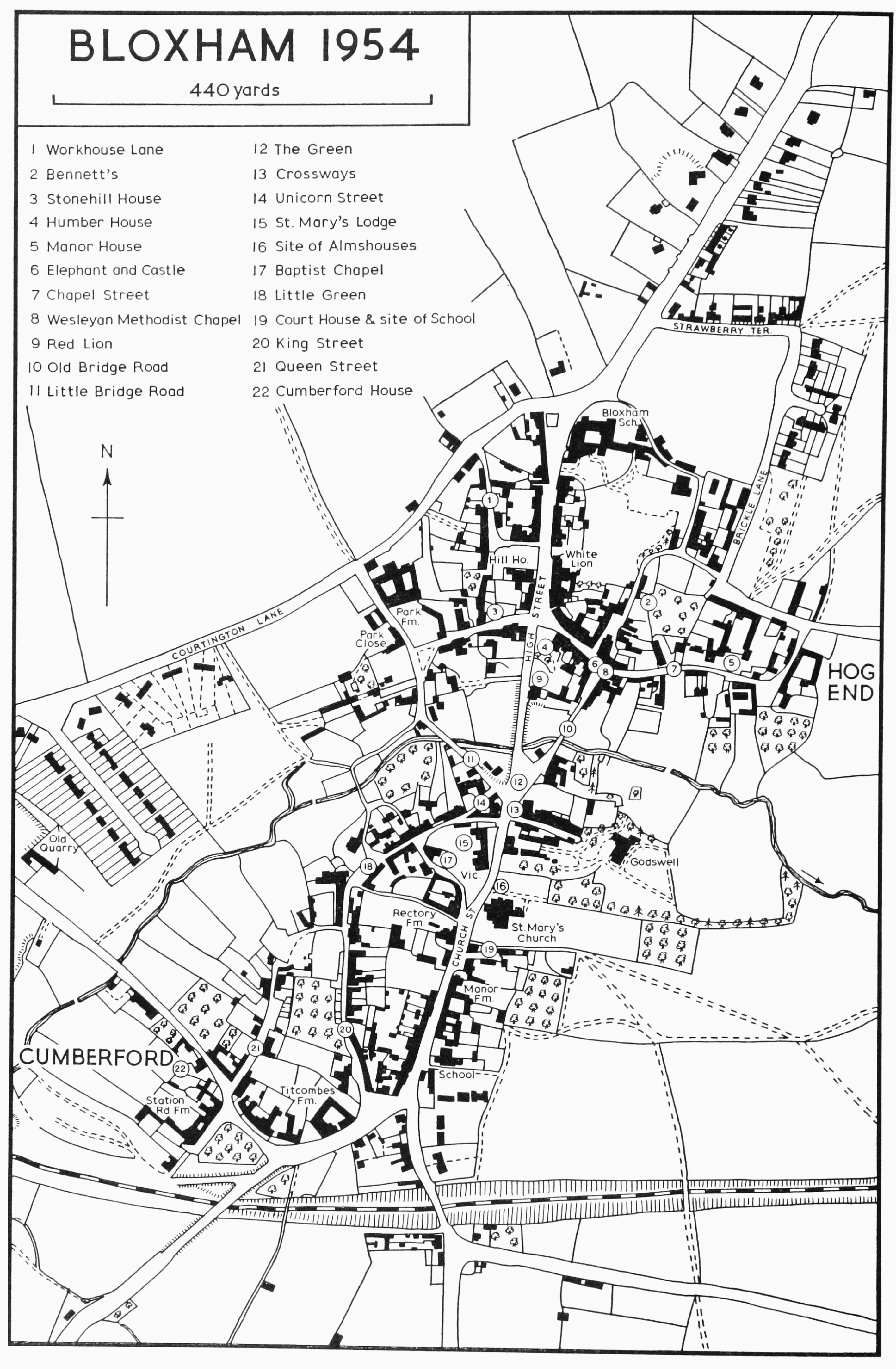
Bloxham, 1954
Several inns, built with courtyards and stabling sufficient in size to provide for travellers, lay on the main road as it passed through Bloxham. Five were licensed in 1753, and in 1782 and 1783 there were six. (fn. 6) The 'Hawk and Partridge', 'Joiners' Arms', 'Elephant and Castle', and 'Red Lion' were among the six. Three of these still flourished in 1965. The 'Red Lion' seems to have been the leading 18thcentury inn and was used by the town feoffees for meetings. A Friendly Society was founded there in 1769. (fn. 7) The present 'Red Lion', which is on a site different from that of 1783, (fn. 8) was evidently built in the 1830s to serve travellers on the new highway, when the course of the main road through Bloxham was altered. The 'Bull and Butcher', the 'Crown', the 'Hare and Hounds', and the 'Unicorn', all 18thor early-19th-century inns, have since disappeared. The 'Railway Tavern' in Queen's Street came into being after 1855 when work began on a single-line railway track between Banbury and Cheltenham. The line was completed by 1887 with a station at Bloxham; but it was closed in 1950 for passenger traffic, and finally abandoned in 1964. The station has been demolished. (fn. 9)
Although the fertility of the soil and plentiful water supply probably attracted early settlements, little evidence has been found. An earthwork near Upper Grove Mill, marked as a castle on a map of 1882, (fn. 10) has not been excavated and its date is not known. Of the 4 Romano-British sites found in the parish the most important was a settlement on the Bloxham-Tadmarton road c. ½ mile west of Bloxham village; this was inhabited from the 1st to the 5th century by a poor community engaged in agriculture. (fn. 11) The Anglo-Saxon settlers, however, chose the valley slopes both to the north and to the south of a small stream, and an unknown Saxon, named Blocc, gave Bloxham its name. (fn. 12) Double settlements of this type are found at Adderbury and the Barfords. (fn. 13) In the late Anglo-Saxon period Bloxham was part of a large estate, belonging to the earls of Mercia, stretching from the boundary with Tadmarton and Wigginton in the west to the River Cherwell. (fn. 14) As the head of a hundred it had clearly been important at least since the time of Edward the Elder. (fn. 15) A 'mural mansion' in Oxford was attached to Bloxham manor. (fn. 16)
Bloxham's importance survived the Conquest: in the Middle Ages it was a large parish with 403 contributors to the poll tax of 1377 of whom 78 lived in Milcombe. (fn. 17) In 1642 213 names were listed on the Protestation Returns for Bloxham and 44 for Milcombe, (fn. 18) and in 1676 the Compton Census gave a total of 880 inhabitants for the whole parish. (fn. 19) As in other parishes in this region there seems to have been a steep rise in population in the late 17th century. In 1738 the incumbent estimated that there were 192 families, and in 1805 that there were 230, figures that are unlikely to have been more than guesswork. (fn. 20) The population of the parish rose steadily from 1,358 in 1801, of which only 201 lived in Milcombe, to a peak 19th-century figure of 1,759 in 1881. (fn. 21) In the 20th century Bloxham has become a dormitory town for Banbury: building development has been extensive, farm-houses have been converted into urban residences, and farmers have moved out of the centre of the town. In 1961 the population of Bloxham was 1,359, a slight reduction of the 1951 figure; Milcombe's population, however, rose from 169 to 415 in the same period. (fn. 22)
Modern Bloxham forms a continuous village. In the Middle Ages, however, its north and south sections, separated by the brook, were distinct communities known as 'le Crowehead Ville' and 'le Downe End'. (fn. 23) There is no evidence of any correlation between the two villages and the manors of Bloxham Beauchamp and Bloxham Fiennes. (fn. 24) By the 17th century the two villages were known as Bloxham North and Bloxham South. (fn. 25)
Bloxham retains to a large extent its medieval street plan. (fn. 26) This was extemely irregular and consisted of a network of winding streets or alleys lying on either side of the present main street, which runs down the hill from the cross-roads in the north, across the brook, and up the hill to the exceptionally fine church, and to the Manor and Rectory Farms on the crest. This road was straightened before 1815 when the trustees of the Banbury and Chipping Norton turnpike purchased two cottages on the brook in order to alter the tortuous line of the old road. (fn. 27) It originally turned left at the church, passed along Unicorn Street, and came out by the Green. It then ran down Old Bridge Street to the Great Bridge and on to the 'Elephant and Castle', where it again turned left to join the present stretch, of the main road in Bloxham North. (fn. 28)
The focal point of the northern village seems to have been the cross-roads by the 'Elephant and Castle', though Park Close and Park Farm on the hill-top would have formed another nucleus. In the south the church, the vicarage-house, (fn. 29) the almshouses, (fn. 30) the Court House, the St. Amand or Fiennes manor-house, with the Manor and Rectory Farms formed an important group of buildings, but the real heart of the village seems to have been the green and 'little green', into which King Street runs. If Hog End and Cumberford were comparatively late developments, the evidence of surviving houses shows that the outskirts of the Bloxham of today were, by the 16th century, at least partly occupied. Until changes made by the R.D.C. most of the village street names dated from about this period or earlier. Tank Lane, now King Street, occurs in 1513 and was so named after the family who had the chief farm there. Humber Lane and the Humber family occur in 1536, (fn. 31) and other lanes were likewise called after the families of Doughty, Job, and Budd. These too may have been of medieval origin, but the earliest documentary evidence for them dates from c. 1700. (fn. 32) Church Lane (now Street), Great Bridge, and Little Bridge Street are medieval names which have survived. (fn. 33) Chapel Street takes its name from the Methodist Chapel, but contains many cottages dating from the 16th17th century and a farm-house of still older date. Similarly Queen (formerly Grub) Street has many dwellings dating from the 17th century and earlier. Until at least 1802 the main streets leading into the village were all gated. (fn. 34)
In 1665 29 houses in Bloxham North were assessed for hearth tax and of these, excluding the manorhouse, 8 had 3 hearths and 1 had four. (fn. 35) In Bloxham South 28 houses were assessed and of these, excluding the manor-house and another largish house with 5 hearths, there were 7 with 4 hearths and 6 with three. (fn. 36) The sites of the two manor-houses are uncertain, but it seems probable that the present Park Close is roughly on the site of the Beauchamp manor-house and that Godswell is roughly on the site of the St. Amand house. (fn. 37) The medieval house of the Beauchamp manor stood in an extensive inclosure, walled and hedged; in 1314 Queen Margaret, who was then in possession, complained that her close and house had been broken into, the trees felled, and that the intruders had hunted and fished there. (fn. 38) When the manor was surveyed in 1592 the site of the manor-house, with gardens, orchard, and park covered 24 a. (fn. 39) Between 1601 and 1612 Sir Thomas Garway, a London merchant of the Staple, who was the lessee of the two manors, built himself a new mansion on the premises. It was later inhabited by John Griffith, who by will dated 1632 left 'the chamber wherein I now lye myselfe in my house at Bloxham . . . with the gallerie thereunto adjoining and the outward chamber wherein my men lie'. (fn. 40) The house was probably lived in by John (II) Griffith (d. 1662), two of whose children were baptized in the church in 1643 and 1649. (fn. 41) In 1665 Mrs. Margaret Griffith, probably his relict, owned the house, which was assessed on 13 hearths and was the only large house in Bloxham. (fn. 42) Shortly afterwards it passed to the Cartwrights of Aynho, whose deeds often refer to it as the 'Great House'. (fn. 43) In 1667 John Cartwright gave it as a marriage portion to Ursula Cartwright (née Fairfax) on the occasion of her marriage to his son William. (fn. 44) In 1714 a 'Madame Balle' and a 'Madame Husney' were living there rent-free. (fn. 45) William Cartwright of Aynho still had this house in 1718. (fn. 46) It may have been rebuilt about this time, since the present Park Close, formerly Cartwright property and now the house of the headmaster of Bloxham School, has an early-18th-century facade, remodelled in the 19th century. (fn. 47) The rear of the house is still in the main an early-17th-century building, and retains its stone-mullioned windows. At the end of the 19th century the house was standing in a small park. (fn. 48)
The St. Amand manor-house, which later passed to the Fiennes family, had a prison, either attached to it or within it, which almost certainly served for Bloxham hundred, of which the St. Amands were lords. (fn. 49) The ground for connecting Godswell with this manor is that the site of this 19th-century house was once owned by the Councers, who had long farmed the manor-house from the Cartwrights. (fn. 50) In the 18th century their house was somewhat to the west of the present Godswell (fn. 51) and was presumably the one with 6 hearths on which Jonathan Councer was assessed for hearth tax in 1665. (fn. 52) The remains of a dovecote in the grounds of the adjoining Manor Farm reinforces the argument that the manor-house was sited hereabouts.
Pike Hall, which was part of Eton College's rectory estate, stood opposite the south end of the church in 1801. John and William Davis were lessees in 1819 and 1829 respectively. (fn. 53)
Although Bloxham contains no outstanding house the village has an exceptional number of good yeoman houses dating from the 16th and 17th centuries. One of the best examples is Seal Cottage (formerly Blue Gates) (fn. 54) in King Street, which dates from the mid-16th century; it has been comparatively little altered, apart from the addition in the 18th century of an upper floor, stairs and dormerwindows, and the closing of the street entrance on the west side by the construction of an oven. The original doorway with carved spandrels was then rebuilt in the rear wall. The 'Joiners' Arms' in Old Bridge Street dates from the mid-16th century and resembles Seal Cottage in size, structure, plan, and detail. The 13th-century moulded doorway standing in a wall in its yard formed part of a later cottage, now demolished, in which this feature had been incorporated. (fn. 55) Station Road Farm is another 16th-century farm-house with a re-used medieval feature, a 2-light 13th-century window built into the rear wall.
In connexion with the building or rebuilding of houses in the 16th century an Elizabethan lease of some interest has survived. (fn. 56) A yardland was granted on condition that the tenant built a house on it by 1590 'fit for the owner of a yardland to live in'. It was to have 2 bays and so, presumably, was to be built on the 2-unit pattern commonly found in this region. (fn. 57) Park Farm, built on a 2-unit plan with the fire-place backing upon the through passage, dates from the early 17th century. Cheese House or Painter's Farm (now called 'Manor House') is a similar house with cellars and attics. Though it was modernized in the 18th century, it retains some of its mullioned windows. Its stables bear William Cartwright's initials 'W. C. Esq. 1759'. The 'Elephant and Castle' was originally of the same date: one stone-mullioned window and a door with a stone label and dripstone of this period remain. The 'Hawk and Partridge' is also a 17th-century house in origin and retains its original rubble walling at the rear. Bennett's can be dated to c. 1630–40; it is of the through passage type but with 3 ground-floor rooms instead of the earlier two. All 3 rooms—kitchen, hall, and parlour—have wide fire-places with timber bressumers. The house has a cellar and a cock-loft over the parlour, with a stair-case leading from one to the other. A second stair-case from the first floor leads to two attic chambers over the hall and kitchen. The hall fire-place is placed against the rear wall, thus bringing the hall entrance nearer to the doorway from the village street. This improved plan was to become common in the region in the second half of the century. (fn. 58)
The large farm-house immediately south of the church is similar in size but of a slightly advanced type and may have been built c. 1640 or later. It had a kitchen, hall, and parlour, but the hall had lost its former significance and was the smallest of the 3 rooms. A newel staircase in a projecting turret leads from the cellar to the attics. The house was modernized in the 18th century and has been completely remodelled internally in the 20th. Titcombe's Farm is another fine house of c. 1650 with an arched stone doorway. Like many of Bloxham's farmhouses it lies parallel to the road with an extended wing and farm-yard at the rear of the house. The Court House (or Town House), on the south edge of the churchyard, was probably rebuilt in 1685 and 1689. In the latter years as much as £90 was spent on it. (fn. 59) It incorporates an earlier doorway of medieval character. In the 19th century the building housed the parish fire-engine. The schoolhouse which once adjoined it has been demolished except for the south doorway which bears the almost illegible inscription: 'G.C.:T.W.:T.M. Townesmen Anno. 1610'. (fn. 60) Until at least the early 19th century an important ancient building of unknown function stood to the east of this school; (fn. 61) the stone corbels once supporting the timber studding of its second story survive in the churchyard wall.
Of the cottages the row of 8 under one thatched roof in King Street are among the earliest and least altered. They are 2-storied, built of coursed ironstone rubble, and have a number of original 3-light and 2-light stone-mullioned windows in moulded frames with square moulded labels over them. On no. 3 there is a sculptured stone, found in the flagged floor, and reset in the road elevation. Campbell Cottage and a cottage opposite are also good examples of the period; so also is the end cottage in Sycamore Terrace. This last house and the rest of the terrace were perhaps used as weavers' cottages in the 19th century; in 1956 they were completely modernized. Six 4-story cottages on the north side of Queen Street, which were certainly weavers' cottages, were demolished c. 1950. (fn. 62)
The growing size of families and increasing standards of comfort and wealth led to the building of a number of 'gentlemen's residences' in the town in the 18th century. Stonehill House, for example, now divided into flats, is an 18th-century enlargement of an earlier building. The Georgian part is a building of 6 bays, faced with ashlar. Adjoining is a 2-storied range with 3-light stone-mullioned windows dating from the 17th century. St. Mary's Lodge, once a girls' boarding school, (fn. 63) is a house of 2 builds, partly late-18th-century and partly 19thcentury. Crossways is a 2-storied 18th-century house with contemporary sash and casement windows on the ground floor. Hill House has an 18th-century wing added to a 17th-century house and Cumberford House was modernized in 1742. This date and the letters R.P. are cut on a date-stone over the lowest window in the south gable; its stone fire-place dated 1619 was brought from a house in Adderbury. Among the many 18th-century cottages may be mentioned an effective row of 6 to the east of Crossways; they are 2-story buildings of coursed rubble and mostly retain their 18thcentury casement windows.
The chief 19th-century building is Bloxham School. The school, originally known as All Saints' School, was founded in 1853 by the Revd. J. W. Hewett as a Church of England boarding school for the sons of 'the professional classes'. It was housed originally in the vicarage-house and from 1854 in a farm-house. In 1857 Hewett went bankrupt, his school came to an end and the derelict building was bought by P. R. Egerton, Curate of Deddington, who re-opened the school in 1860. With the financial help of his wife's family (Gould) and of the Duke of Marlborough he built it up until in 1896 he handed it over to the Society of the Woodard Schools. The original building was extended in 1860–3 at a cost of £28,000. The architect was G. E. Street and he built in the local stone in the Gothic style. The building was enlarged in 1864, 1869, and 1871, when the school chapel was built, and now dominates Bloxham North and the outskirts. (fn. 64)
Other 19th-century buildings were the new vicarage-house designed by the vicar George Bell (1811–15), (fn. 65) the Baptist chapel (1859), and the Wesleyan chapel, (fn. 66) both built of red brick with stone facings, and the infant school at the south end of the village. In the late 19th century residential houses were built along the Banbury road and in Strawberry Terrace to the north of the village. In the 20th century there has been housing development both by private enterprise and the R.D.C. The earliest council estate of 12 houses was built in 1919 in Courtington Lane to the north of the village near the Tadmarton road, and was extended in 1936 and 1961 with a further 84 brick houses. Another council estate of 18 stone and roughcast houses was built in Buckle Lane in 1951. A group of 12 welldesigned houses on the Barford road were put up in 1924. (fn. 67)
The village obtained a recreation ground of c. 5 a. given by George Allen in 1910 (fn. 68) and there are local teams for football, cricket, and athletics. The first village hall was erected by the Co-operative Society in 1899–1900 in Workhouse Lane. The Ex-servicemen's Hall was opened after the First World War, and the Ellen Hinde Memorial Hall, built in the 1930s by the daughter of the founder of All Saints' School, was given to the village c. 1946. The last has become a new social centre and is doing something to counteract the pull of Banbury. (fn. 69)
Various town properties shown on a map of 1801 have since been demolished. Besides the almshouses on the edge of the churchyard, there were the poor-houses on the green where Unicorn Street once joined Old Bridge Street, the workhouse, whose site is still commemorated by the street name Workhouse Lane, and the pest-house near the railway line beyond the station. (fn. 70)
Milcombe village, which lies 1½ mile to the southwest of Bloxham seems always to have been very scattered; it now straggles along the road to Wigginton and on a branch road. The chief buildings in 1882 were the church, the school (1832), the Baptist chapel (built in 1824), (fn. 71) and the 'Horse and Groom' on the former road, the manor-house and the smithy on the latter. (fn. 72) After 1871, when Milcombe's population reached its 19th-century peak, (fn. 73) the agricultural depression caused a decline and in the first decade of the 20th century the village was 'dilapidated' and full of empty houses. (fn. 74) During and after the Second World War prosperity returned. By 1964 Milcombe had ceased to be a remote village and had become a dormitory for Banbury industrial and business workers. Council houses, built of honey-coloured brick and of good design, had been built and a new estate of 'continental' houses and bungalows was being rapidly developed off New Road by private enterprise.
The manor-house, Milcombe Hall, was mostly demolished in 1953, and the remnant that still stands was converted in 1964 into a modern dwelling. It is of 2 stories and retains some 2- and 3-light mullioned and transomed windows both at the back and front. A pair of 17th-century gateposts remains. So does the early-18th-century octagonal dovecot. (fn. 75) It has an octagonal roof of stone slates with 4 dormers and a small leaded cupola at the summit. The manor-house was lived in by the Dalby family. Between 1564 and 1629 19 of the family were baptized in the church and 14 were buried there between 1563 and 1625. In the early 18th century the Thornycrofts remodelled part of the house. Lady Thornycroft died there in 1704 and Sir John in 1725. (fn. 76) Manor Farm has a 19th-century Gothic front of 3 stories, but the back of the house, which was probably once the front, is early-17th-century. The entrance doorway, now blocked, has a square label and the date 1630.
A cottage at Milcombe of late-18th-century date is typical of many single-cell cottage plans in the region; it measures only 12 ft. 6 in. by 10 ft. 6 in. internally. (fn. 77) It forms the nucleus of a terrace of cottages each with their fire-place, bread-oven, and winding stair. (fn. 78) These were the homes of the landless labourer, a class enlarged by inclosure in 1794 and 1802.
The chief house outside the villages was once Bloxham Grove, a 17th-century house largely rebuilt in the 19th century. It is very possibly on the site of the 'Logge' (Lodge) conveyed in 1528 with the Warren by Edward Fiennes to James Merynge on a repairing lease. (fn. 79) It was owned by Sir James Dashwood in 1738. The Revd. George Warriner, a principal landowner, who lived there in the 19th century (fn. 80) may have been responsible for planting the avenue of beeches between it and Adderbury. In 1852 it was described as a 'good modern mansion', (fn. 81) but in 1964 was in poor condition. Nearby is a small derelict wooden windmill. There are 5 isolated farms but none is older than the inclosure of the common fields in 1794 and 1802.
Bloxham and Milcombe rarely had resident lords of great standing and in the post-medieval period it was the lesser gentry and yeomen farmers who were the leaders of society, except possibly for a short period in the 17th century when the Cartwrights used their 'Great House' at Bloxham for junior members of the family. (fn. 82) This dominance of the local farmers may have encouraged the growth of nonconformity, and Bloxham was notable in the 17th century and later for the strength, in particular, of its Presbyterian and Baptist communities; it also accounted for the stout resistance offered on more than one occasion to high-handed actions by men of authority, as both the Fienneses of Broughton and Sir John Thornycroft of Milcombe found to their cost. (fn. 83) The local leaders in the 17th century and later were members of the Councer, Dalby, Sabell, Stranke, and Youick families. In the 18th century the Davis family was notable for its progressive farming and for its clerics, including a Vicar of Bloxham.
The impact of the Civil War on Bloxham seems to have been small; in June 1643 the royalists built some small fortifications at Bloxham (fn. 84) and in 1647 John Cartwright complained that none of the small rents due to Bloxham parsonage had been paid since 1640. (fn. 85)
Manors and Other Estates.
Before the Conquest Bloxham and part of Adderbury formed a large estate held by Edwin, Earl of Mercia; (fn. 86) before Edwin's time it seems to have belonged to Tostig, Earl of Northumbria, who was deposed by his thegns in 1065 and replaced by Edwin's younger brother Morcar. It was from Morcar, presumably, that Edwin obtained the estate. (fn. 87) In 1086 Bloxham, with part of Adderbury and a hide and a yardland in Ledwell and Sandford St. Martin, formed a royal manor, which was assessed at 34½ hides, had the soke of two hundreds, and the duty of helping to keep the defences of Oxford in repair. (fn. 88) Edwin's estate may have passed to the Crown by 1067; certainly Bloxham church was in the king's hands at that date. (fn. 89)
BLOXHAM remained a royal manor until King Stephen granted it to Waleran, Count of Meulan. (fn. 90) Waleran was in Oxford in 1140 and his two charters about Bloxham may date from then. (fn. 91) In 1141 he made terms with the Empress and after 1142 was never in England again. (fn. 92) He clearly lost Bloxham, either then or at the general resumption of Crown lands on the accession of Henry II, for the manor was in the king's hands in 1155–6, except perhaps for 1 knight's fee. (fn. 93) Thereafter the manor was divided into two parts.
One part, known later as the manor of BLOXHAM BEAUCHAMP, was held from 1156 by the justiciar Richard de Luci until his death in 1179. (fn. 94) It was then in the sheriff's hands for a few years. (fn. 95) It was then held successively by Walter de L'Espalt (1191–4), (fn. 96) William de Ste. Mere Eglise (1196–7), (fn. 97) Imbert de Carenci (1197–1202), (fn. 98) and Ingram des Preaux (1202–4). (fn. 99) Then it was again in the sheriff's hands for several years, (fn. 100) except for a period after 1218 when it was granted during pleasure to Walter de Verdun, the holder of the second Bloxham manor. (fn. 101)
During the reign of Henry III various ways of managing this manor were adopted. Sometimes it was in the hands of a bailiff, as in 1236 when Walter of Tew was appointed keeper of Bloxham and Woodstock. (fn. 102) In 1242 it was held by Engelard de Cygoniac, (fn. 103) and in 1251 Bloxham, with several other manors, was farmed to John of Handborough and Peter of Leigh, bailiffs of Woodstock, for 6 years at £98. (fn. 104) In 1226 Peter of Leigh was ordered to hand the manor over to Amaury de St. Amand, (fn. 105) the holder of the second Bloxham manor, to whom the king had committed it at will.
In 1269 this Bloxham manor was granted to Queen Eleanor, together with other property, in exchange for the honor of Richmond, (fn. 106) and for most of the next 50 years it was held by the queens of England. Eleanor held the manor until her death in 1291; it then reverted to the Crown and on Edward I's marriage in 1299 to Margaret, sister of Philip IV of France, was given together with Oxford and Headington as part of the Queen's dowry. (fn. 107) After Margaret's death in 1318 Bloxham was again assigned in dower, this time to Edward II's wife Isabel. (fn. 108) She held it for a year only for in 1319 it was granted for life and rent-free to John of Weston the younger because he had been maimed in the king's service. (fn. 109) In 1338, before John of Weston's death, Edward III granted the reversion of the manor to Roger de Beauchamp, his yeoman, first at the usual rent and afterwards rent-free. (fn. 110) Later he was granted it in fee but Beauchamp's heirs were to pay the usual rent. (fn. 111) When Roger de Beauchamp obtained possession in 1343, on John of Weston's death, (fn. 112) Bloxham's history as a royal demesne manor ended, although the king still expected an income from it.
Roger de Beauchamp, lord of Ditchley (in Spelsbury) and chamberlain of Edward III's household, (fn. 113) died in 1380, leaving as heir his grandson Roger, a minor; (fn. 114) Roger died in 1406, and his son John in c. 1412, leaving a son John, who died young and unmarried, (fn. 115) thus bringing the male line of the family to an end. In 1406 Bloxham had been enfeoffed on John de Beauchamp and Margaret, the daughter of John of Holland of Northamptonshire, (fn. 116) perhaps a fiancée who died before marriage, since his later wife was Edith Stourton. (fn. 117) After John de Beauchamp's death Edith, who later married Sir Robert Shottesbrooke, held Bloxham in dower until her own death in 1442. (fn. 118) It was discovered in 1421 that only £20 a year rent had been paid since the time of Edward III whereas in Edward I's reign the rent had risen from £20 to £35. The Shottesbrookes were, however, forgiven any arrears and were allowed to hold the manor for life at the old rent. (fn. 119) The Beauchamp property descended on the death of Edith Shottesbrooke to her daughter Margaret Beauchamp. She married first Oliver St. John (d. c. 1435), secondly John Beaufort, Duke of Somerset, and finally Leo Welles, Lord Welles, a Lancastrian slain at the Battle of Towton in 1461. (fn. 120)
On Margaret's death in 1482 (fn. 121) Bloxham descended to John de St. John of Bletsoe (Beds.), her son by her first husband. (fn. 122) He, or more probably his son, died in 1525, (fn. 123) and his grandson John (fn. 124) sold Bloxham in 1545 to Richard, Lord Saye and Sele, (fn. 125) who was already owner of the second Bloxham manor.
The second part of Bloxham manor, known later as BLOXHAM FIENNES, was held from 1158 to 1174 by Engelard de Bohun, (fn. 126) a powerful Norman supporter of Henry II. In 1175 it was given to Ralph, the son of Walter de Verdun, (fn. 127) and was subsequently always held by his family. Ralph was succeeded by his son William in 1198 or 1199, (fn. 128) and William by his brother Walter in 1203 or 1204. (fn. 129) Walter, who was a justiciar, died in 1229 and his son Ralph paid relief as his successor in Bloxham. (fn. 130) The next year Ralph died abroad, probably in Poitou, and his property went to his relative Amaury de St. Amand. (fn. 131) From this time until the 15th century Bloxham descended with the St. Amand manor of Adderbury. (fn. 132) The holding was generally designated as a third of Bloxham: Amaury de St. Amand held a fee in 1242, while the king had 2 fees in demesne, and in 1254 he held a third of the manor 'which had once been in the king's hands'. (fn. 133) There are later references to the St. Amand manor as a third of Bloxham, notably in 1285 when the king brought a plea of quo warranto against Amaury de St. Amand, demanding why he withheld the hundred and a third of the manor which had once belonged to the king's father. (fn. 134) Amaury defended his right and the matter was ordered to be settled by precedent. (fn. 135) He seems to have won his case, for the third of the manor continued to descend in the St. Amand family and all connexions with the royal demesne ceased.
In 1418 this Bloxham manor was sold with part of Adderbury to Sir Thomas Wykeham. (fn. 136) Sir Thomas sold his Adderbury land in 1439 but kept Bloxham, which passed on his death in 1443 to his son William. (fn. 137) William was still alive in 1455 when he made a settlement of the manor, (fn. 138) and on his death this Bloxham manor and Broughton were inherited by his daughter Margaret, wife of William Fiennes, Baron Saye and Sele. (fn. 139) From this time Bloxham Fiennes descended with Broughton and the barony of Saye and Sele. (fn. 140)
On the death of Richard Fiennes, Lord Saye and Sele, in 1501, the manor was held in dower by his relict Elizabeth until her death in 1527. (fn. 141) In 1545, when Richard, Lord Saye and Sele, purchased Bloxham Beauchamp, the two manors were united. (fn. 142) Bloxham is still (1965) in the family's possession. Lt.-Col. Ivo Murray Twisleton-Wykeham-Fiennes, Lord Saye and Sele, is the present lord. (fn. 143)
Much of the manor's land, however, was sold in the 17th century. In 1601 Richard Fiennes (d. 1613) sold the 2 manor-houses of Bloxham Beauchamp and Bloxham Fiennes with 16 yardlands and 2 mills to Sir Thomas Garway, merchant of the Staple. In 1612 this property, together with the new dwelling-house built by Sir Thomas Garway, was sold to John Griffith, a descendant of William Griffith, Chamberlain of North Wales. On John's death in 1632 the property probably passed to his brother Richard (d. 1636) and to Richard's son John (d. 1662). (fn. 144) John conveyed the property to Ambrose Thelwell in 1653. The conveyance, however, may have been a mortgage, for Mrs. Margaret Griffith, probably John's relict, was assessed for tax on the new house in 1665. Before 1667, however, the house and various closes passed to John Cartwright of Aynho, and was absorbed in his other property in the parish. (fn. 145)
In 1086 William, Count of Evreux, was holding a MILCOMBE manor assessed at 4½ hides. In 1108 he and his wife Helewis granted it with his other English estates to Noyon Priory (Noyon-surAndelle). (fn. 146) The priory was returned as one of the lords of Milcombe in 1242, and in 1291 held 30s. rent there. (fn. 147) In 1414, on the dissolution of the alien priories, Noyon's possessions were granted to Sheen Priory (Surr.) and Sheen retained 30s. rent in Milcombe until the Dissolution. (fn. 148) There is no record of a grant by Henry VIII of this Milcombe estate and it presumably passed to the tenant. (fn. 149)
Noyon Priory had been leasing the estate from the 12th century. The earliest recorded tenant was Master Robert de Inglesham (fl. 1168), Archdeacon of Surrey and perhaps also of Berkshire. (fn. 150) He was succeeded by John de Inglesham and Roger de la Dune, who quitclaimed their rights to Milcombe and other property in 1208 and restored the charters concerning them to the monks. (fn. 151) In 1232 the Prior of Noyon was involved in a lawsuit with Race Fitz Alexander of Milcombe over customs due there. (fn. 152) It is probable that John of Milcombe, who was returned with the Abbot of Eynsham and Ralph de Bereford as one of the lords of the parish in 1316, was tenant of the priory's land (fn. 153) and that it descended with his family until 1370 when John, son of John of Milcombe, sold his lands to Sir Thomas of Broughton, lord of Broughton. (fn. 154)
The manor thereafter descended with the Broughton lordship: (fn. 155) in 1534, for example, tenements in Milcombe were stated to be held of Broughton manor and their tenants did suit at Broughton, (fn. 156) and the lords of Broughton were lords of Milcombe in the 18th century. (fn. 157) After 1836, however, there is no record of a connexion between this manor and Broughton, and it may perhaps be identified with the manor which Mrs. Selina Hosford held in 1869, (fn. 158) and which Christ Church, Oxford, purchased in 1872 and have since retained. (fn. 159)
In 1086 a second MILCOMBE manor, assessed at 3½ hides, was held by Alfric, lord also of Ascot (in Great Milton), Chastleton, Rollright, and Stonesfield. (fn. 160) Alfric's successors in all five places were the d'Oillys, who held Ascot by 1100 and probably Milcombe as well, since by 1109 Niel d'Oilly, lord of Hook Norton, had granted this Milcombe estate to Eynsham Abbey. (fn. 161) It was valued at 40s. a year and was clearly intended for the maintenance of a monk whom Niel d'Oilly had nominated. (fn. 162) The grant was confirmed by Henry d'Oilly in the last quarter of the 12th century. (fn. 163) The property was added to in the course of the Middle Ages; (fn. 164) it was valued at £3 10s. in 1291 and at £5 6s. 8d. in 1535. (fn. 165) In 1539 the king made a grant of Eynsham's property to Sir George Darcy and a further grant of it in 1543 to Darcy and Sir Edward North, Treasurer of the Court of Augmentations. (fn. 166) By 1551, however, John Croker (d. 1569), lord of Hook Norton manor, was in possession. (fn. 167) Before 1563 he settled a part of the property on his younger son Gerard; (fn. 168) his heir John succeeded to the other part in 1569. (fn. 169) In 1584 John Croker the younger conveyed his part of the manor to Thomas Hawten of the Lea, in Swalcliffe, (fn. 170) a family that was allied by marriage with the Crokers since Margery Croker, sister of John Croker, had married an Edward Hawten. (fn. 171) Thomas Hawten sold his Milcombe estate in 1603 to Edward Hawten and in 1606 Edward sold it to John Bonner of Swerford, (fn. 172) who was already in possession of Gerard Croker's share of Milcombe manor. Sir Gerard Croker of Steeple Barton had sold it to John Bonner's father, also John, some time before 1563. (fn. 173) The elder John had also acquired more Milcombe land (described as a manor) from John Dormer in 1566. (fn. 174) His son John succeeded in 1589 and appears to have run into debt for he sold a part of the estate in 1625 to Roger Snelson, a London dyer, and in 1628 he and his son William sold 'the manor and lordship of Milcombe' to Christopher Allanson of London. (fn. 175) Allanson devised this property in 1631 to his brother and to some of the children of his sister Judith, and it was later partitioned between four members of the family. No manorial rights were mentioned. In 1647 Snelson sold his interest to William Bonner of Milcombe and in 1656 William Bonner of Henleyon-Thames sold 'Milcombe manor or lordship' to John Cartwright of Aynho. (fn. 176)
A third MILCOMBE manor first recorded as such in the early 16th century, evidently descended from the estate of the judge Ralph de Bereford (d. c. 1329), who was one of the principal landowners in the hamlet in the early 14th century and was returned as one of the lords of the vill in 1316. (fn. 177) His relict Agnes was in possession in 1333 when she was licensed to have an oratory. (fn. 178) Ralph had held Milcombe with an estate in Mollington (in Cropredy) which descended to Robert de Bereford (fl. 1327, 1340), and to Edmund Waldyff, who married Robert de Bereford's daughter Margery. (fn. 179) Edmund's son Thomas, a minor on his father's death in 1395, was granted livery of his parents' lands in 1404. (fn. 180) He can be identified with the Thomas Waldyff recorded in Warwickshire in the late 15th century. His connexion with Milcombe is not noted although he still held Mollington in 1428. (fn. 181) The Milcombe estate passed, probably by marriage, to Humphrey Willingham, described in 1464 as of Mollington and Milcombe. (fn. 182) Willingham was still alive in 1482 when a commission was issued to arrest him, but by 1506 his estates, described as the manors of Milcombe and Mollington, were held by his daughter and heir Grace and her husband Robert Halse. (fn. 183) Halse put the manor in trust for himself and his wife, but after his death Grace and her second husband, William Saunders, were involved in a lawsuit with the heirs of the trustees who maintained that Milcombe had been sold outright to Edmund Hall. (fn. 184) Edmund Hall's heirs were his daugher Elizabeth, wife of Laurence Woodhull (Odell) of Mollington, and Alice, wife of Richard Harcourt. (fn. 185) The outcome of the lawsuit is not known, but the manor was evidently divided into moieties. One moiety was probably that moiety of a Milcombe manor which Thomas Langrich and his wife Joan sold in 1515 to a Thomas Westall and his heirs for 100 marks, for a John Hall was one of the feoffees. (fn. 186) The later descent is not clear, but it may have been that moiety which Roger Becket and Alice his wife, perhaps Edmund Hall's coheir, conveyed in 1532 to Robert Dormer of Wing (Bucks.). (fn. 187) In 1566 John Dormer, who may have been a son, granted a Milcombe manor to John Bonner, and thereafter it was merged with Bonner's other Milcombe estate. (fn. 188)
Another moiety of a Milcombe manor was granted in 1530 by Edmund Peckham, Treasurer of the Mint, and Ann his wife to William Billing of Deddington. (fn. 189) Billing died in 1534 holding tenements in Milcombe, said to be parcel of Milcombe manor and to be held partly of the Prior of Merton (Surr.) and partly of Broughton manor, as well as a mill and tenements described as the rest of Milcombe manor. (fn. 190) It is doubtful whether any manorial rights were attached to this land and no such rights were mentioned when the land was sold to George Dalby in 1556. (fn. 191)
The rectory estate was granted first to Westminster Abbey in 1067. (fn. 192) Nevertheless Henry II granted it c. 1180 to Godstow Abbey, and after an appeal to Rome by Westminster Abbey a settlement was made whereby the nuns retained the rectory subject to a payment by them to Westminster of a pension out of the benefice of £3 6s. 8d. (fn. 193) The abbey then held the rectory until its dissolution in 1539, (fn. 194) when it was farmed by a tenant, Anthony Bustard, who was still holding it in 1546. (fn. 195) In 1547 the estate was granted by the Crown to Eton College, which continued to lease it after the Godstow lease expired and still owned it in 1965. (fn. 196)
At first Eton leased the property on 21-year leases and until 1605 entry fines were charged. Rents were paid partly in money and partly in kind and these rents remained virtually unchanged until 1793; (fn. 197) a typical lease was that to Sir Anthony Cope of Hanwell in 1605; he paid an entry of £40 and his rents were 14 qr. of wheat, 4 bushels of malt, £16, and 40 fat wethers. (fn. 198) Another distinguished family to hold the lease were the Cartwrights of Aynho (Northants.); Richard Cartwright entered into the property in 1624 and his son, John, ten years later. (fn. 199) The latter endowed two scholarships at Brasenose College, Oxford, with £10 a year issuing out of Goodwin's farm in this estate. (fn. 200) In 1683 William Cartwright's relict, Ursula, was lessee. (fn. 201) Thomas Cartwright sold the lease in 1713 to Dr. George Freeman, Rector of Steeple Aston, but Thomas Gabell of Bloxham remained the actual tenant until 1737. (fn. 202) By this time the 10-year lease had replaced the former long leases. The Davis family became the chief lessees in the 1770s when John Davis of Bloxham took up the lease; in 1793 it was renewed by his executors, and the rent, raised for the first time since 1602, was set at £16, 2,340 gallons of wheat and malt, and 40 fat wethers. In 1793 the lease was taken up by Harry Davis, and in 1797 by Samuel Davis, the Revd. Henry Davis, John Davis the younger, and others; again the rent was raised since Eton had the redeemed landtax. (fn. 203)
By 1819 the rectory estate had been divided, although both halves were still leased by the Davis family. In 1819 John Davis of Bloxham and Samuel Davis paid a fine of £684 for a 10-year lease of the rectory-house and the Bloxham land for which they were to pay £23 8s., 702 gallons of wheat and malt, and 12 fat wethers or £9 12s. a year. This land was leased again to the Davis family in 1822 and in 1826. The Milcombe part of the estate was also leased on 10-year leases, the lessees in 1820 being the Revd. Henry Davis and Samuel Davis. A £456 fine was levied and they paid £7 17s., 468 gallons of wheat and malt, and 8 fat wethers in rent. The lease was renewed in 1822 and in 1826 but in 1829 the two estates were reunited and leased to William Davis, Samuel Davis of Hampshire, and John Davis the younger. The fine for a 10-year lease was then nearly £1,000, and Eton continued to lease the estate to the Davis family until at least 1856, a fine being regularly levied for each renewal. (fn. 204)
A small estate in Milcombe belonged to Merton Priory (Surr.). Roger Fitz Ralph (fl. early 12th century), probably the nephew of Niel d'Oilly, granted 2 hides to the priory in free alms; (fn. 205) the prior was one of the lords of the fee of d'Oilly in 1242 and held £1 10s. 8d. rent in Milcombe. (fn. 206) In 1538 the priory held 24s. assized rent in Milcombe. (fn. 207) After the Dissolution the estate was probably held by the former tenants. (fn. 208) In 1534 William Billing held tenements in Milcombe partly of Merton Priory and these may well have been among the proprety sold by John Billing to George Dalby in 1556. (fn. 209)
The Dalbys, a yeoman family, evidently profited by the break-up of the monastic estates in Bloxham and the 16th-century price revolution. Alice Dalby held a house and yardland under Eynsham Abbey in 1530; a John Dalby was resident in Milcombe in 1536; and in 1556 George Dalby, a yeoman of Milcombe, added to his holding by buying a farmhouse, 4 yardlands, and Milcombe mill from John Billing. (fn. 210) On his death in 1570 he had a house in Milcombe, held of Broughton manor. (fn. 211) His son John (d. by 1616) and grandson George Dalby (d. by 1626) succeeded. (fn. 212) Some of the Dalby estate, like the mill, (fn. 213) was sold in 1651 to John Youick and so came to the Cartwrights. In 1653, however, a John Dalby still held 5 yardlands in Milcombe. (fn. 214) A Dalby married George Violet of Sandford, (fn. 215) who in 1667 acquired from John Dalby of Sandford a 1,000-year lease of the farm-house where John Dalby of Milcombe had lived, and 14 yardlands in Milcombe. (fn. 216) This lease was held under the Cartwrights. In 1673 Joseph Key of London bought the freehold. (fn. 217) Josiah Key's daughter and heir Elizabeth married John Thornycroft and so brought the estate to that family. (fn. 218) Thornycroft, who was created a baronet in 1701 and became Sheriff of Oxfordshire, lived at Milcombe. He died in 1725 and his son Sir John Thornycroft died in prison in 1743 without heirs. (fn. 219) An Edward Thornycroft was still one of the chief landowners in Milcombe in 1793. (fn. 220)
Another farm in Milcombe was held by the Goodwins, a wide-spread family of gentry of yeoman origin in north Oxfordshire. In 1653 Richard Goodwin of the Lea in Swalcliffe, who had recently acquired 3 yardlands of the Allanson estate in Milcombe, (fn. 221) granted 5 yardlands there to the use of William, his son and heir. In 1656 John Cartwright bought from William Goodwin the freehold of 9 yardlands and a house. (fn. 222)
From c. 1180 until 1201 or 1202 Osbert of Headington held Crown land in Bloxham worth 32s. a year. (fn. 223) He was no longer in possession in 1203, and in 1219 Walter de Verdun had the custody of his heirs. (fn. 224) In 1230, after the death of John, Osbert of Headington's eldest son, his younger son William, born posthumously, claimed it from his cousin Ralph, son of Osbert's brother Richard, and in 1235 they agreed to divide 6 yardlands and 5s. rent in Bloxham and 2 yardlands in Headington. (fn. 225) They were no doubt the 6 yardlands held in demesne in 1284–5 by Adam of Headington and Ralph de Flore for 1/7 fee. (fn. 226)
Ralph, son of Richard the Clerk of Milton, granted in free alms to the Hospital of St. John the Baptist in Oxford a house and 70 a. in Bloxham and Milton, with meadow in Bloxham, a grant confirmed by the king in 1240. (fn. 227) By 1270 the hospital had added to its land a house and 2 yardlands. (fn. 228) This land, like the hospital, went to Magdalen College, Oxford, in the 15th century; it was valued at 36s. 8d. in 1535. (fn. 229)
In the later 12th century Walter de Verdun gave Cirencester Abbey, in free alms, ½ yardland in Bloxham, and his son Ralph added the other half. The yardland was held by Richard de Bereford who was also given to the abbey with his family and his service. (fn. 230) Walter later added another ½ yardland, quit of all service except to the king. (fn. 231) Amaury de St. Amand confirmed this grant and freed the ½ yardland of royal service. (fn. 232) Cirencester Abbey's Bloxham land was probably attached to its Adderbury manor. (fn. 233)
Local Government.
For most of the Middle Ages there were 4 manorial courts in Bloxham: the holders of the St. Amand (later Fiennes) manor, the royal (later Beauchamp) manor, and the rectory estate had assize of bread and ale and gallows, (fn. 234) while Eynsham Abbey held an ordinary manorial court for its Milcombe tenants. (fn. 235) These courts dealt with the usual business of manorial courts, for instance tenure, infringements of manorial custom, breaking of the assizes, overcharging, and assaults. (fn. 236)
When the Fienneses acquired both the principal manors they continued to hold the manorial courts separately, except on very rare occasions, as in July 1598, when a joint court of Bloxham Fiennes and Bloxham Beauchamp was held. Between 1631 and 1648 the courts leet and baron were held in the Town House before Lord Saye and Sele; when a joint court was held it was usually a court baron. The courts were held until 1925 but their work had long been confined mainly to the admission of tenants.
The main sources for local government in the 17th and 18th centuries are the constables' and overseers' accounts, beginning in 1684 and 1706 respectively, and the extensive records of the feoffees of the town estates. (fn. 237) For the purposes of local government Bloxham itself was divided into two distinct districts north and south of the river, and Milcombe formed a separate tithing. Two overseers were annually appointed for Bloxham, one each for the north and south sides of the river. (fn. 238) Two constables were similarly appointed to serve for a year, one for each side, and payments for ale to the surveyors of highways suggest that in 1686–7 there may have been 2 surveyors for each side of the river. (fn. 239) Bloxham North and South were united for highway purposes in 1883. (fn. 240) Bloxham and Milcombe each had 2 churchwardens. All parish officials, except the tithingmen, were appointed in the Vestry. Office was normally held for one year, but between 1868 and 1880 the same overseers served for 2 or even 3 years. The constables in Bloxham dealt with the payment of muster masters for the militia, land tax, and carriage of the king's goods, and with the care of the vagrant poor. At some periods they also paid the Marshalsea money. Funds were raised by a levy on the yardland. From 1691 the levy was made on 94 yardlands for the north side and 62 for the south side. (fn. 241)
A great part in local government was played by the feoffees of the town estate, which had been given and was used for many town purposes as well as for the poor, (fn. 242) for example two sums of 3s. 4d. which Richard Dalby and John Samon each gave before 1602 as a stock for highway repairs. From 1627 the estate's income was divided into thirds, one of which was reserved for payments of fifteenths and other town charges, and part of another third was for the upkeep of the Great and Little bridges. (fn. 243)
The present consitution of the feoffees dates from two decrees of 1627 and 1635. Having criticized the old feoffees' administration of the estate the Charity Commissioners in 1627 appointed 16 new feoffees, of whom 3 were to serve annually as 'townsmen' to receive and disburse the profits; one townsman was to be elected by Viscount Saye and Sele and his heirs, (fn. 244) and the others by 6 holders of yardlands, the vicar, churchwardens, and overseers. These electors were to approve the accounts before they were inspected by the lord's steward at Broughton, and to appoint new feoffees when the number fell to eight. After 1635, because of the difficulty of finding 6 holders of yardlands willing to elect, all tenants and copyholders of over 20s. yearly were to elect 2 townsmen, and the lord's steward the third. (fn. 245) One townsman acted for the north side of the town, another for the south, and the third, elected by the steward, seems to have functioned as a watchdog on the other two. The vicar, churchwardens, and overseers continued to approve the accounts. In 1824 it was found that new feoffees were not elected but co-opted. (fn. 246)
The feoffees regularly repaired the bridges, and met most, if not all the cost of rebuilding the Town House in 1689, paid for work on the school-house and pest-house, and built in 1781 new town houses, which were let at low rents to the poor. They paid for and sowed the furze seed on the common, counted the cattle there, and saw that the driftways to and from the common were kept clear. They paid for the scouring of the brooks and streams, particularly the Washbrook, the town ditch and gutters, and for cleaning the streets. In 1750 they completed the purchase of a fire-engine from a London manufacturer, and in 1846 assisted with the purchase of 'two new water carts in case of fire'. Regular payments were made from 1880 to 1929 for the upkeep and repair of the fire engine and town pump, and after that date they gave a yearly donation to the Bloxham Fire Brigade. (fn. 247)
The activities of the feoffees up to 1895, when the Local Government Act of 1894 was adopted, were supplemented by those of the vestry. In the 19th century there were constant disputes over the choice of parish officers, and between 1860 and 1873 over re-rating after the adoption of the Tenements Act. In 1863 the vestry sent a petition to Quarter Sessions asking that no steps be taken under the Provisional Order for the better management of highways with reference to Bloxham. In 1866 the parish favoured the continuation of the Turnpike Trust (Banbury, Chipping Norton, and Burford) even though it would cost them £232 yearly to take over their section.
Although threatened with an injunction in 1873 for alleged pollution of drinking water at Adderbury the vestry was unwilling to pay for an adequate drainage scheme, and opposed the view that one was necessary implied in a report of 1874; instead they declared that Broughton was to blame for pollution of the Sor Brook, that Bloxham's privies did not pollute the stream, and that the brook below the sewer was not used because there were springs. The cost of the drainage scheme was considered excessive and the vestry was hardly prepared to pay the £1,800 for which the rate had already been levied. They declared that there was 'no more healthy, cleanly, well cared for village in the whole of the Union than that of Bloxham'. (fn. 248)
If this was so, the feoffees are probably to be thanked. During the 19th century they laid down a drainage system of 6 cesspits, emptied by contract labour twice a year. When the Bloxham Gas Company started in 1870, they decided to provide street lighting, with 21 lamps, and until 1937 the village continued to be lit at their expense. They paid half the cost of repairing the Court (formerly Town) House in 1885–6, and £10 for fitting up the library there. After 1888 the Court House was used as a club and reading-room and the feoffees paid for the lighting until 1934 at least. By 1900 most of the streets were paved with York stone, at their expense. (fn. 249)
The primary responsibility for poor relief rested until 1834 with the vestry and its officers, the overseers of the poor, but much assistance was also given by the feoffees. The townsmen's records throw light on the treatment of the poor before 1700, when the overseers accounts begin. In 1700 tenants of 6 town houses were let off arrears of rent through their poverty. It was argued that if they had been turned out, the town would probably have found them other houses and paid the rent, and this 'would have been a much greater charge to the town'. Earlier, in 1678, the townsmen bought hemp to set the poor to work. Throughout the period for which there are records the feoffees provided rent free or very cheap housing for some paupers including paying for much repair work; after inclosure, which deprived the poor of their right to gather fuel on the commons and of common grazing rights, land for allotments was provided, a small rent being charged to those who could afford it; money for apprenticeships was given; in 1758 the poor received £83 distributed in summer and winter at the rate of 1s. each to c. 346 adults who were neither property owners nor tradesmen and 6d. each to 416 children; in 1796 the townsmen paid £60 to the bakers to reduce the price of bread and in 1800 they were again forced to do this. (fn. 250)
The townsmen also handed over money to the overseers to assist in ordinary poor relief expenditure. These sums were occasionally considerable; in 1724 the overseers got £70, nearly two thirds of their expenditure, but the contribution normally varied between £20 and £40. After 1792, however, there was often no contribution at all, probably because the feoffees were giving more in direct relief. The total expenditure of the overseers in 1706 was £80 and up to 1740 the average annual total was c. £110. In the 1740s the sum fell to under £100 but in 1752 it was nearly £132 and it evidently continued to increase as, after a 22-year gap in the accounts, the average spent between 1774 and 1792 was over £400. Thereafter the figure rose steeply from £517 in 1793 to over £1,290 ten years later and the peak came in 1810 when £2,222 was spent. This was very heavy expenditure for a parish which throughout the period had just over 1,000 inhabitants. After the 1834 Act Bloxham became part of the Banbury Union and in 1835 only £1,185 was spent on relief; (fn. 251) in 1851–2 the figure had fallen to £496. (fn. 252)
The main item of the overseers' expenditure was the workhouse, first mentioned in 1736 when 24 people were living there. It seems to have been farmed out for monthly payments, at first for £7–£9, paid alternately by the overseers of the North and South sides. The reduction in the total spent on relief in the 1740s is reflected in the reduction of the monthly payment to under £5 but in 1774 the master of the workhouse was getting £26 5s. a month. In 1782 the workhouse costs were based on actual disbursements but two years later it was farmed out again, though after some discussion the parish reverted to actual bills in 1786, when the master got a salary of ten guineas. In the spring of 1800 the workhouse was costing up to £94 a month and in 1801 £152 but the figure went down to £60 in 1802 and in 1804 the workhouse was again let, at £60 a month. (fn. 253) Later an extra allowance was made for the increase in the price of bread. In 1811 a new form of contract was used; the master received 3s. 3d. a head a week for each of the 21 paupers. Workhouse costs were considerably reduced and the emphasis was probably shifting from in to out relief. Payments to roundsmen first appear in 1776 but they were not a regular feature in the accounts until c. 1803 when they were costing £3 5s. a month. In that year accounts for the South side were divided under the headings 'Account extraordinary', 'By the list', 'Workhouse Bills', 'Roundsmen and Boys', and 'For Soldiers' Wives'. Money was spent throughout on clothes and rent, on coals and medical care, and on apprenticeship fees, and the accounts also included lump sums for the constables' expenditure and the county rates. A pest-house was mentioned in 1813; (fn. 254) it seems to have been started in 1766 and was still in use in 1836. (fn. 255)
Milcombe's overseers, like the township's other officers, seem to have been quite independent of Bloxham; their accounts have not survived. In 1776 £49 14s. was spent on out-relief from a total of £61 6s. 8d. raised from rates. (fn. 256) There was the usual heavy increase in expenditure at the end of the 18th century; in 1802–3 £249 was spent on out-relief out of a total of £309 raised at a rate of 4s. 9¼d. At that date 14 adults and 58 children were receiving permanent relief, and 14 adults were occasionally relieved. (fn. 257) After 1834 Milcombe formed part of Banbury Union; in 1851–2 £126 was spent on the poor. (fn. 258) Milcombe, like Bloxham, had a town estate, administered by 2 elected townsmen and used partly for the poor and partly for the upkeep of public roads and bridges. It seems that the money was rarely used for the poor. (fn. 259) In 1825 the income from the estate was c. £22, which was applied, after necessary expenditure on repairs, in discharge of the constable's and churchwardens' expenses. In 1855 a third of the income of £33 went to the surveyor of highways and a third to the churchwardens. (fn. 260)
In 1602 Milcombe had 3 charities for mending the highways: Richard Dalby bequeathed and John Farthinge and John Stranke gave 6s. 8d. apiece. (fn. 261) No further reference to these sums has been found.
Economic History.
In 1086 Bloxham formed only a part of a royal estate of 34½ hides, the details of which, as given in Domesday Book, apply to the whole. The food renders once paid to the king had been commuted for a corn rent almost equal in amount to that paid by the royal manor of Benson. The total rent had increased from £56 in 1065 to £67. The demesne was worked by as many as 27 serfs. The tenants included one free man, 72 villani, and 16 bordars. The free man, a thegn named Saiet, had served as a free man in the time of Earl Tostig, was later given by Earl Edwin to the Norman Ralph d'Oilly, and was finally returned to the royal demesne. (fn. 262)
Milcombe was established as a hamlet by at least 1065 and in 1086 comprised 2 estates, the 4½-hide manor of the Count of Evreux and Alfric's 3½ hides: this clearly represents the division of a single estate, for each held half the mill, half the meadow (30 a. in all), and half the pasture. The arable was divided into 3-plough lands on the Evreux estate and 2 on Alfric's, which was fully cultivated with 1½ plough on the demesne and ½ plough held by tenants. The Evreux estate, however, had only 1 plough and had decreased in value from £2 in 1065 to 30s. in 1086, while Alfric's farm retained its value of 30s. Three serfs and 4 bordars are recorded on the two estates and in addition 3 villani on Alfric's estate. (fn. 263)
The demesne farm of the royal manor in 1266 included 14 a. of meadow and 8 a. of pasture. (fn. 264) In the late 14th century this manor included a home farm with 200 a. of arable, 12 a. of meadow worth 2s. an acre, and 20 a. of separate pasture worth 30s. in all. (fn. 265) The St. Amand estate in 1285–6 also had a large demesne farm with 200 a. of arable worth 6d. an acre, 8 a. of meadow worth 3s. an acre, and 4 a. of pasture at 1s. 8d. an acre, a dovecot, and a watermill. (fn. 266)
A fragmentary description of the royal manor in 1266 mentions sokemen, holding at least 60 yardlands, and cottars. In 1275–6 one free tenant held 9 a. another (the Abbess of Godstow) 100 a., and a third (Elias of Tingewick) 58 a., the mill, and 6 yardlands. (fn. 267) The standard holding of the sokemen was one yardland, but their rents and services are not known. There were at least 4 cottars on the royal manor who owed works. (fn. 268) On the St. Amand manor in 1285–6 there were 25 virgaters, each paying 4s. rent and services worth 2s. 8d. The services, which could be commuted, included harrowing and sowing for 1 day in Lent, ploughing for 1 day with 1 man, lifting and carting the lord's hay, and harvesting his corn with 1 man for 8 days and carting it for 2 days. The rents and works of cottars were worth 11s. 11d. and 14s. 8d. (fn. 269) On land held by Amaury de St. Amand in chief of Queen Eleanor were a further 8 tenants holding 1 yardland each in socage, paying 6s. rent together with reaping service for 8 days with 1 man, valued at 2d. a day. (fn. 270)
In both Bloxham and Milcombe were wealthier tenants able to sell and exchange lands freely; their grants are recorded in many Eynsham and Godstow charters. (fn. 271) In the tax assessments of the early 14th century large numbers of tenants were assessed at between 6s. and 2s. In 1316 23 tenants of the St. Amand manor were assessed at this rate, and in 1327 (the only complete tax list) two-thirds of the contributors paid over 2s., the highest paying 14s. and four others 7s. or 8s. (fn. 272) Milcombe too was a prosperous hamlet: more than half the 29 contributors in 1316 paid between 2s. and the highest contribution of 11s., whilst the total of £4 12s. was more than those of some of the smaller parishes in the hundred. (fn. 273)
The return of 1327 suggests that Bloxham town itself was more flourishing than any other rural community in north Oxfordshire. It had 70 contributors compared with Adderbury's 76, while its total assessment was over £2 more. As a parish Adderbury with its 3 hamlets was richer than Bloxham and Milcombe together. (fn. 274) This position was reversed, however, after the re-assessment of 1344. (fn. 275)
Milcombe had a separate field system, and it is possible that, as later, Bloxham had 2 sets of fields, divided by the brook. (fn. 276) A grant c. 1210 of 3 a. in the East Field and 3 a. in the West Field (fn. 277) suggests a 2-field system which probably still existed in the 14th century when 200 a. were equally divided into fallow and sown land. (fn. 278) Milcombe, however, had 3 fields c. 1235 when land in the South, West, and North fields was granted. (fn. 279) The lack of woodland on the Bloxham highlands was compensated for by the attachment to Bloxham manors of 2 woodland areas in Wychwood forest. (fn. 280) The valuation of Bloxham meadowland in 1286 at 3s. an acre suggests that it was scarce, whereas pasture may have been plentiful since ½ yardland in Milcombe carried with it 100 sheep commons. (fn. 281) In 1180–1 stock purchased for the royal manor included 250 sheep, and in 1194 300 sheep were bought in a half-year. (fn. 282) The existence of inclosed pasture on the demesne in the 14th century also suggests that sheep-farming for the wool market was important. Court rolls of the 14th century, however, suggest that on the whole farming practice was conservative. There seems to have been very little consolidation of holdings; one holding of 8 a. was distributed in 6 separate pieces. (fn. 283)
There is no clear indication that the population of the parish was reduced by the plague in the 14th century. In 1377 there were as many as 403 contributors to the poll tax. (fn. 284) That there had been some decline may perhaps be inferred from the policy of leasing adopted in the early 15th century. In 1431–2 the demesne of Bloxham Beauchamp manor was leased to 4 men for 12 years at £13 6s. 8d. a year, and in 1435–6 to 4 others for £13 a year. By the terms of the first lease the tenants were to hand back the demesne in the West Field well fallowed and manured; the fallow was to have been ploughed for the third time. By the second lease 20 a. were to be returned well fallowed, 7 a. ploughed for the third time, and 29 a. manured. (fn. 285) A close, the rabbit warren, the manorial courts, and feudal dues were excepted from the leases, but all houses on the manor were included and were to be kept in good repair. Roughly the same terms occur in a third lease of 1443–4, (fn. 286) but when the manor was leased a century later (1526–7, 1534–5) for 40 years, both warren and courts were also leased. (fn. 287)
Leasing was the rule, too, on the property of Eynsham Abbey by the 15th century; in 1438 the abbey received £3 12s. from assized rents, 7s. 6d. from other 'foreign' rents, and £1 10s. for customary aid. The total assized rent and aid of £13 13s. was the same 30 years later. Profits of court brought in an additional £4 10s. (fn. 288)
If there was any conversion to sheep-farming it was on a comparatively small scale. No inclosures were reported in 1517 and when the 2 main manors were surveyed in 1592 the only large demesne inclosure was 211 a. of pasture and meadow called the Grove, attached to the manor of Bloxham Fiennes. The rest of the manor consisted of 1,702 a. of 'fields, meads, and closes', less the area covered by the Fiennes part of Bloxham town. No closes at all were mentioned in the account of the 939 a. of Bloxham Beauchamp, which was described as consisting of fields and meads only, and of part of the town. (fn. 289) The date of the inclosure of the Grove is not known but it was presumably after 1421 when pasture at the Grove called 'cotemanlese' was recorded in connexion with a tenant's 12-acre holding. (fn. 290)
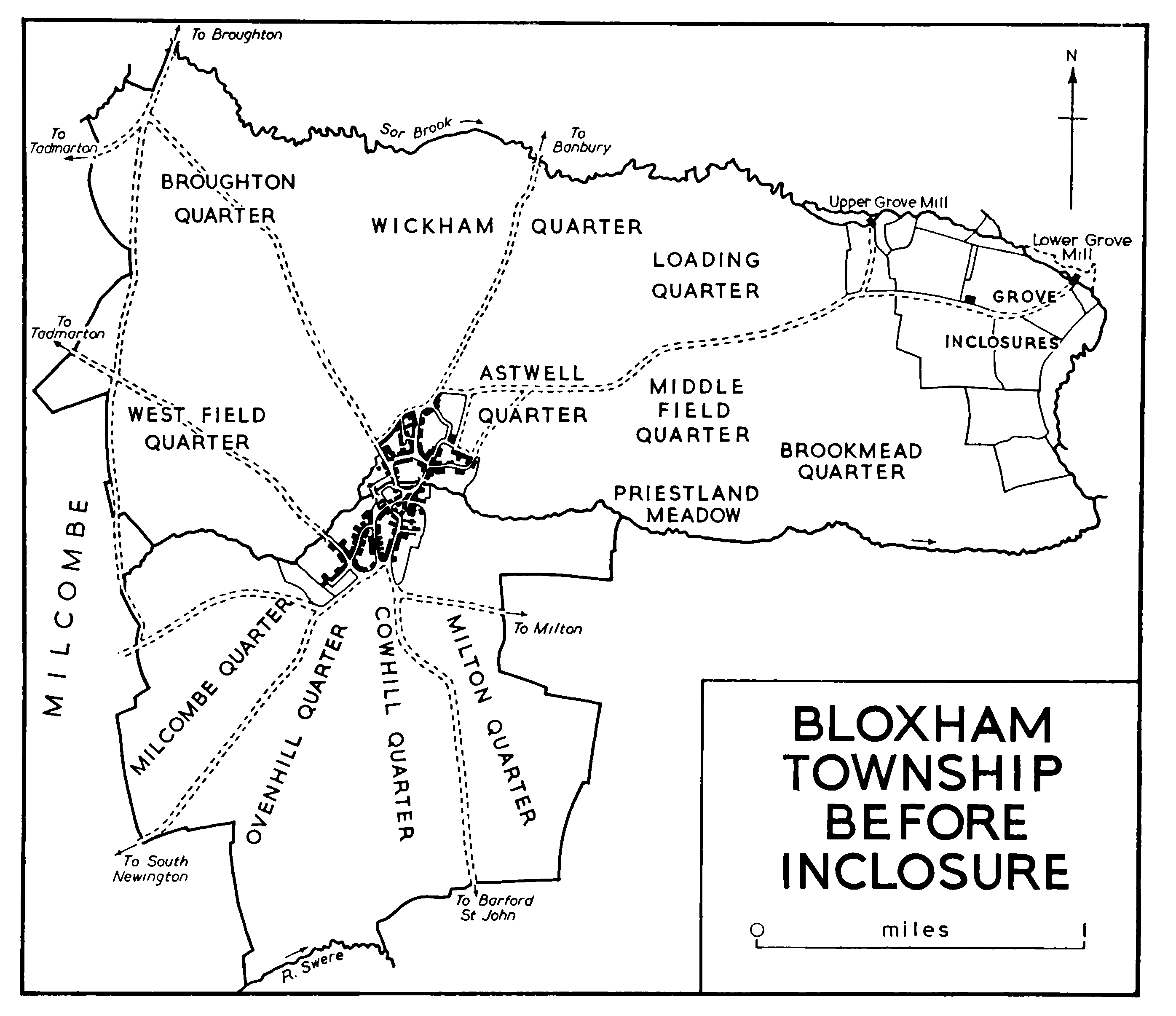
Bloxham township before inclosure
Based on Davis, Oxon. Map (1797) and the inclosure award and map (1801).
The date of the re-organization of the field system into 'quarters' is also unknown, but it was probably completed at the latest by 1542 when the term Broughton Quarter first occurs in the court rolls. (fn. 291) Whether the medieval fields were ever divided into 4 in accordance with the common practice found both in north Oxfordshire and elsewhere, or whether some more complicated arrangement based on furlongs was adopted at Bloxham is not altogether clear. Bloxham South field certainly seems to have been divided into the conventional 4 quarters. The 17th-century names Milcombe, Milton, Cowhill, and Ovenhill Quarters (fn. 292) survived until the inclosure of 1802. (fn. 293) Their position can be plotted and they evidently correspond to the 4 principal divisions of the field. In Bloxham North field, however, the arrangement was far more complicated. The names of 9 'quarters', undoubtedly in the North Field, occur in 16th- and 17th-century documents, and 7 of them at least are distinct 'quarters', and not merely alternative names. (fn. 294) A terrier of 1663 describing how 2 holdings of 1½ yardland had been 'divided out of three yardlands in open court' throws some light on the problem of this re-organization. (fn. 295) The yardlands and ½ yardlands were dealt with separately, but in each case the arable strips were divided into 4 groups. In one terrier these were Middle Field, Broughton and Astwell Quarters, Wickham and Westfield Quarters, and Loading (i.e. Lodyn) and Brookmead Quarters; in another terrier the fourth group was Loading and Westfield Quarter. It is possible, though evidence is lacking, that the quarters in Bloxham North were arranged to provide 2 separate rotation courses, and in such a large and dispersed area this would have been convenient. Peas were grown and there was some leys farming: a number of references to a tenant holding leys occur between 1513 and 1552, (fn. 296) while a peas field was mentioned in 1598. (fn. 297) Despite re-organization some holdings at least were in 1663 still minutely sub-divided: 1 yardland contained 25 strips and a ½ yardland 30 strips. (fn. 298)
At Milcombe the old 3-field organization had given way by the end of the 16th century to a complicated system based on quarters. These seem to have been in 2 sets, one on the north side, the other on the south side. In 1592 3 divisions of the field were specifically called quarters, of which one was the old South Field, presumably much diminished. These divisions all contained furlongs and leys ground, while water furrows were mentioned in one. In a terrier of 1769 6 quarters and South Field were mentioned, all apparently on the south side; in 1752 there were at least 3 quarters on the north side and 4 on the south side. Milcombe Field, as a whole, had an estimated 1,200 a. (fn. 299)
A custumal of 1552 for the 2 main Bloxham manors, then both in the hands of the Fiennes family, described the elaborate arrangements for the rights of the lord and tenants to several and common rights. It confirms the existence of leys farming and seems to point to a 2-year rotation, though there is also some evidence of a 4-year cycle. Some tenants, for instance, had common in Priestlands every second year when it lay fallow. Other land in the west part of Bloxham North was described as fallow every other year. On the other hand Chalcott Leys was several to the lord of Broughton 3 years together from Lady Day to Lammas and then common to the tenants of the north side. Various meadows were several for part of the year and common every other year. There is also a reference to the special rights of occupiers of 'ancient cottages' in Bloxham. They had the right to keep a cow on the common and one breeder. All tenants had the right to take the manure of beasts (heardlyme) going into 'Neelands' from Lady Day to St. John the Baptist's day. (fn. 300)
Over some of the customs of 1552 there were subsequent disputes. In 1556 Richard Fiennes was sued in Chancery by some of his tenants led by Anthony Councer. They complained about damage done to their corn by rabbits from the warren in the Grove, and about fines of 1s. and 2s. an acre of arable and meadow, which they claimed was more than the customary rate. Richard Fiennes proved that he had clear right to warren there, that damage by rabbits was less than ever before, and that the fines he charged were long since approved by custom. In 1569 it was agreed that he should henceforth breed rabbits within a limited area, which must be walled round, and that any rabbits found outside this area could lawfully be killed by the inhabitants. Anyone losing land when the Grove was walled was to be compensated with land elsewhere in the manors. (fn. 301)
The court rolls throw additional light on the husbandry of this period. Sheep were obviously kept in large numbers, for in 1514 it was ordered that a tenant should have no more than 90 sheep and another 100 commoning in the fields. (fn. 302) Each tenant was limited to a stint of 4 cows or 50 sheep to a yardland in 1535, and no 'ancient cottage' was to keep more than 1 cow and 2 pigs. (fn. 303) The number of sheep to a yardland was reduced in 1538 to 40, but exceptions were allowed. (fn. 304) Even so the increased allowance of 60 sheep to a yardland for the tenants of the north side in 1542 seems to have been a temporary measure; the reductions of stints on Bloxham Beauchamp manor to 20 sheep and 2 beasts in 1552 and 20 sheep and 8 lambs in 1617, (fn. 305) and presentations at the end of the 16th century for overloading the commons, keeping sheep on the fallow field, and sheep in the peas field, show that there was a growing pressure on the available commons. (fn. 306) Flocks of between 90 and 180 sheep and lambs are recorded in the 17th century and in 1717 John Youick had sheep valued at over £90 and beasts worth £66 6s. (fn. 307) As for crops, a farmer who died in 1615 was growing 28 a. of peas as well as barley, wheat, and maslin; another (d. 1667) had wheat, barley, peas, beans, oats, and vetches. (fn. 308) In 1718 the incumbent described Bloxham as fertile, champion, and having 'more corn than pasture'. In fact the only inclosure, apart from small inclosures in and on the outskirts of the town, was still the inclosure at the Grove. When surveyed in 1609 the Grove covered 206½ a. and included 4 fields and a number of meadow closes along the river banks. (fn. 309)
After the Reformation there were no long-standing resident landowners in Bloxham and the yeoman freeholders and copyholders were the dominant element in the community. The position of Bloxham tenants is fully defined in the 1552 custumal. It was there laid down that, since their status was especially privileged because Bloxham claimed to be ancient demesne, tenants could surrender their lands to whom they wished, in fee simple, estate tail, or for a term of life or lives, year or years. The words ad voluntatem domini were not to be inserted in the copies made by the lord's steward, as this was 'against the custom and repugnant to their estate'. These words had certainly appeared in the court rolls of 1536 and 1539, and this abuse was now rectified. No tenant could lease his land for more than one year; otherwise a lease was to be void but the land was not to be forfeit, although in 1543 a man who had leased his land for 20 years was declared to have forfeited it. A fixed scale of fines was set down; only one heriot was payable even if many separate tenements were held, and this rule applied whether the tenant had died, or had surrendered his land to another, when heriot was also taken. Where land had been handed over to a group of tenants or to feoffees, no heriot was to be paid until the death of the last tenant or feoffee.
Descent was to the heirs at common law, including daughters, and a married man holding land in the manor could surrender it to his wife for her life, and to her heirs. But no tenant could take a surrender from a woman without the presence of the steward. Elaborate precautions were laid out to ensure that any heir who was sick, imprisoned, or 'letted in the Kinge's warres' could appoint a deputy to enjoy the profits of the land until he was able to come to take his oath of fealty. If he was able to come and did not do so, the lord might seize the land until fealty was taken. All cases relating to land were to be brought to the lord's court, unless a writ of right close had been taken out. (fn. 310)
It appears to have been necessary to re-affirm the rights and privileges of the tenants of Bloxham in 1606 when Richard, Lord Saye and Sele, sold some land to a syndicate of Banbury drapers. He covenanted with all his tenants, the feoffees of Bloxham, Adderbury, and Deddington town lands, and 94 others, that in spite of the sale they would still hold their lands by the payment of the ancient and accustomed yearly rents, and all fines and heriots would be extinguished. This extinction of fines had first been applied to the 23 properties of Bloxham town estate in 1602 and was now extended to all tenants. It was still to be lawful for them to surrender land to others, the new owner being admitted without fine or heriot, and heirs to copyholds would be admitted without fines too. Tenants were to be free of reeveship and gathering the lord's rent, and could have a court baron if they wished and if they bore the cost. (fn. 311)
Out of 81 contributors to the subsidy of 1523 there was a group of 15 who were assessed at comparatively high rates — 6 at between £20 and £25 and 9 at between £10 and £20. At the other end of the scale were 32 labourers paying the lowest possible rate of 4d. (fn. 312) Of those assessed William Councer, taxed on £60, was outstanding and his family illustrates the rapid rise of a yeoman family into the ranks of the lesser gentry. William appeared regularly in the court rolls of the 16th century and was already occasionally styled 'gentleman'. He was followed by Anthony and Edward Councer, both of whom played a large part in Bloxham affairs. (fn. 313) The family owned two mills and when George Councer died in 1629 his estate was worth £957. (fn. 314) Although George Councer was undoubtedly more prosperous than most of his fellow townsmen, there were several yeoman farmers who had by this time acquired considerable wealth. John Lovell (d. 1634), for example, had chattels worth £385; John Stranke of Milcombe (d. 1617) left goods valued at £305, and Clement Stranke (d. 1639) left £205 worth. (fn. 315) In the second half of the 17th century the Councer family was still pre-eminent, for Jeremy Councer (d. 1667) left well over £1,000 in chattels, but there was still a flourishing group of yeoman farmers, such as William Huckle (d. 1681), whose inventory totalled £280. (fn. 316)
In the later 18th century rather more than half the 90 landowners in Bloxham South were tenants and 72 of the total number held only small properties assessed for land tax at under £1. Of the 42 owneroccupiers William Davis and George Councer held the largest estates, paying taxes of over £16 and £14 respectively, while 2 tenant farmers paid £11 2s. and £9 17s. 8d. No others were assessed above £5. In Bloxham North all the large farms were held by tenants: one belonging to George Warriner was rated at £23; another held by Elizabeth Cartwright at over £22. Of the remaining 30 properties assessed at over £16 were assessed at between £5 and £15 and 24 between £1 and £5. There were 7 owneroccupiers in this group, of whom 4 were assessed at between £7 and £11. (fn. 317)
In Milcombe the chief proprietors were Edward Thornycroft, with land assessed at over £18, and William Cartwright of Aynho and the Revd. Henry Davis with land assessed at £11 and £8 16s. respectively. There were 7 farms rated at c. £5, and 9 at under £1, most of which were owner-occupied. (fn. 318) Inclosure in 1794 made little immediate difference to this pattern in Milcombe. After allotments for tithes and glebe, most of which was leased by the Davis family, (fn. 319) the main allotments were to William Cartwright, lord of the manor (255½ a.), and Edward Thornycroft (308 a.). There were 4 of between 122 and 79 a. The remainder were much smaller. John Davis had 22½ a., the feoffees of Bloxham town land 22½ a., the feoffees of Milcombe town land 12½ a., and the poor 16 a. In all 1,135½ a. were inclosed and there were approximately 119 a. of old inclosure. (fn. 320)
In Bloxham the pattern of landholding was confirmed by the inclosure of 1802. There were 2,773 a. to be inclosed; old inclosures, including roads and house plots, amounted to only 366 a. After allotments for tithes and glebe, (fn. 321) John Preedy and George Warriner received 386 a., George Councer, Robert Potter, Henry Davis, and the Bloxham feoffees received between 118 and 98 a., and 6 others received between 50 and 100 a. Of the allottees 89 had under 50 a., and two-thirds of those had less than 20 a. (fn. 322)
Arthur Young visited Bloxham 10 years after inclosure and was particularly impressed by 2 farmers, Warriner and Davis. The latter he described as an excellent practical farmer, who had had a great deal of experience as an inclosure commissioner, 'having been employed upon 26 at the same time'. Davis thought that inclosure had greatly increased arable production and that as much could now be grown on half the number of acres as on the whole before, with turnips and grass taking up the other half. Though much grass-land had been ploughed up, much had been laid down, and he considered the position was practically unchanged. He claimed that although rents had gone up the effect on the poor had been small, since only the inhabitants of 'ancient' cottages had had the right to graze cows on the common; others, however, disagreed with this view. (fn. 323) Both farmers experimented with new crops and machinery. Warriner had introduced a threshing-mill, as well as two Rotherham ploughs and a Nottinghamshire ploughman to work them. Davis drilled everything, all white corn, peas and beans, and turnips; drilling was condemned by his neighbours but produced an astonishing wheat crop. Young did not fully approve of the rotation adopted by either. Davis planted first turnips, then barley, followed by 2 lots of seeds, then wheat, and finally two-thirds oats and one-third peas and beans. Warriner grew turnips, followed by clover, then barley or spring wheat, and lastly wheat. He did not grow oats since he did not think that two white crops should immediately succeed one another. Both men experimented with new crops; Warriner had made a great success of spring wheat where his neighbours had failed, and his crop was good and worth more than barley. Over all he took 4 qr. per acre of wheat, compared with the county average of three. He had grown 6 a. of cabbage in 1806 and 5 in 1807, which was unusual in Oxfordshire. He 'ate them off' with sheep, getting better corn crops afterwards. He had also successfully grown carrots to feed his horses and cows, and parsnips with less success. Davis had tried swedes, grew turnips to 'eat off' with sheep, and had successfully reversed the common practice by feeding his clover to animals the first year and mowing it the second. Warriner laid down 2½ a. with meadow fescue in 1806 and from the seed was planting 14 more in 1807, mixed with Dutch clover. He also followed the Bloxham practice of laying 15 to 25 qr. per acre of loamy sand or lime on the red land and found it successful. As for stock Davis was changing to shorthorns since they gave more milk and butter. He had a cross between Leicestershire and Gloucestershire sheep, bought after inclosure; he did not fold them but kept them on large tracts of land in summer and normally got more rams than ewes. Altogether Young gave a picture of 2 able farmers, keeping abreast of the times and willing to experiment, and no doubt exercising considerable influence on Bloxham agriculture. (fn. 324)
Twenty years after inclosure Bloxham South remained much the same as before. In 1826 there were 81 proprietors, 42 of them owner-occupiers, of whom 36 had houses or land assessed at less than £1. Most of the land was held by copyhold or 'college hold'. The rents of the various properties were given with this 1826 assessment; there were 5 over £100, of which the highest were the former Councer estate at £250 and another estate at £235. In Bloxham North there were 83 proprietors, 34 of them owneroccupiers, 26 having only a house or a house and a small piece of land. The chief proprietors were George Warriner, occupying his own land at a rent of £458, and Eton College, which leased its property at a rent of £405. There was one other large farm with a rent of £228, 4 with rents between £100 and £200, and 10 with rents between £50 and £100. (fn. 325)
In Milcombe the former Cartwright estate was leased at £320 and the Thornycroft estate was leased at £332. There were 3 other farms at rents between £160 and £93 and the rest were below £50. The 1831 assessment shows that most of these properties were freehold. (fn. 326)
Although there was some agricultural progress in Bloxham in the early 19th century there was also much distress. There were many unemployed weavers, and large sums were spent on poor relief up to 1835. (fn. 327) The townsmen allowed 15 per cent. discount on the rent of some of the town's tenants in 1821, 1823, and 1830. (fn. 328) The effects of the introduction of the Speenhamland system and of the inclosures were felt keenly: an unknown author in 1834 addressed the inhabitants of Bloxham on the inadequate supply of allotments, on pauperization, and the ill effects of inclosure. (fn. 329) Nevertheless, the feoffees and other responsible officers and inhabitants of Bloxham managed to keep the poor of Bloxham from participating in the disturbances at Banbury in the winter of 1830. The poor were rewarded for their law-abiding behaviour by a distribution of 20 fat sheep and 11 tons of coal which had been paid for by private subscription. (fn. 330) The feoffees also acted quickly by making more land available for allotments. This, however, only partly solved the problem, for there were cases of arson and on one occasion the Court House was stormed and a meeting of the feoffees broken up. (fn. 331)
Later in the century the agricultural depression brought further economic distress to both farmers and labourers. One of the effects was the growth of larger farms. As early as 1851 this trend was clearly visible: (fn. 332) there was one large estate farm of 359 a. at the Grove on which 12 men were employed, 4 farms between 200 and 300 a., and 4 between 100 and 200 a. Most of the small farms were under 40 a. and included one at Milcombe which evidently specialized in medicinal plants. The owner, described as a farmer and druggist, employed 6 men and a boy on a 36 a. farm. In 1867 and 1876 there were 19 farms of under 100 a. The 3 largest farms at Milcombe were owned in 1876 by New College (418 a.), Christ Church (282 a.), and Eton College (173 a.). There were 7 farms at Bloxham of between 120 and 350 a., the largest being that owned and occupied by George Warriner. (fn. 333) At Milcombe there were only 5 farmers in 1903, (fn. 334) compared with 8 in 1851. The farming was, and remained, mainly mixed. In 1914 44 per cent. of each cultivated acre was arable and of this, 24 per cent. in Bloxham was under wheat, 17 per cent. in Milcombe. Barley was the next most important crop, in Bloxham as important as wheat, in Milcombe more so. Oats, swedes, turnips, mangolds, and potatoes made up the rest. Of the cultivated area in both parishes 56 per cent. was permanent pasture and in both places for every 100 a. cultivated there were 21 head of cattle; there were 7 cows and heifers per 100 a. in Bloxham and 5 in Milcombe. Sheep were much more important, with 52 and 71 per 100 a. in 1909 and 45 and 54 in 1914. Small numbers of horses and pigs were kept in both areas. (fn. 335)
By 1963 there were 15 farms, and a smallholding of 40 a. belonging to the feoffees. Most Bloxham farms were under 150 a., and therefore small, but Bloxham Grove had c. 350 a., Ells farm 300 a., and Rectory farm 240 a., while Manor farm at Milcombe had 300 a. The increasing traffic on the main road, which cut off farmers living in Bloxham from their land, combined with the high prices being offered for building sites, was leading many farmers to sell part of their land for housing. (fn. 336)
Although Bloxham was predominantly a farming community its size and its proximity to Banbury encouraged other occupations. Medieval evidence is scant: fine stone quarried in Bloxham was used for the seats of the priory church at Bicester in 1296, (fn. 337) a fishmonger was living in the town in 1467, and there may have been an early fulling mill in Bloxham. (fn. 338) A wool-winder occurs in 1636 and by 1768 at least there was a woollen manufactory employing a number of weavers. (fn. 339) A master hemp dresser and weaver, Matthew Jellyman, occurs in 1773. (fn. 340) In the early 19th century there were shagweavers and plush-weavers in the town, (fn. 341) and the 1851 census listed 13 weavers, of whom 5 were employed in Edward Gascoigne's plush manufactory; the other 4 plush-weavers, 3 linen-weavers and a ribbon-weaver probably worked for Banbury masters. (fn. 342) In 1864 there was a rope and twine maker in Bloxham. (fn. 343)
The building trade continued to be important. In 1851 there were 11 stone-masons, 15 slatters, thatchers, carpenters and plasterers, and a brickmaker. (fn. 344) One marble-mason, George Cakebread, (fn. 345) was outstanding and was responsible for an elaborate classical monument to the Hitchcock family in the churchyard at Deddington; throughout the later 19th century the Adkins family of masons was particularly prominent. In 1851 one master carpenter employed 6 men, and the Butler family of carpenters later introduced a saw-mill and timberyard which by 1900 employed 40 men. (fn. 346)
After the First World War ironstone was exploited. In 1918 the Bloxham and Whiston Iron Co. were in possession of 191 a. of land in Bloxham, in 1919 Lord Saye and Sele leased more land to the Brymbo Steel Co., (fn. 347) and by 1939 the Claycross Coal and Iron Co. was established in Bloxham. (fn. 348) Since the Second World War other industries have started. In 1947 I. & C. Steele and Co. Ltd. established a carpet-mill with 3 looms and 6 employees, choosing Bloxham because of its central position and good rail connexions. In 1964 it was specializing in Wilton carpets of high quality, partly hand-made. There were 6 looms and c. 30 employees, most of whom lived in the parish. (fn. 349) The firm of Tibbett & Co., which manufactured ready-to-build concrete structures, expanded rapidly after it came to Bloxham in the late 1950s and in 1964 there were 30–40 employees. (fn. 350)
The growth in trade and industry, and the existence of a boys' public school and girls' private school in Bloxham, led in the 19th century to an increased demand for shops. Already in 1851 there were 4 grocers and 15 tailors, besides several shoemakers and bakers, dress-makers and milliners, a coal dealer, and a watch and clock maker. (fn. 351) By 1864 a chemist's shop had opened; later the Banbury Co-operative and the Gas Light and Coke Co. were established. In the 19th century 3 carriers plied daily to and from Banbury (fn. 352) and apparently the innkeepers and the maltsters flourished. The use of private cars and the opening of a bus service between Bloxham and Banbury in 1910 gradually increased the dependence of the town on Banbury, but by 1964 the growing residential population had encouraged the opening of new shops. There was still a post office and a Co-operative Stores; there were also 5 general stores, 6 other shops, and 6 public houses.
Mills.
In the late 19th century there were 3 water-mills in the parish: Upper Grove Mill and Lower Grove Mill lay on the Sor Brook in the north and there was a third mill in Milcombe. (fn. 353) The 2 Bloxham mills probably descended from 2 of the 6 mills which belonged to the royal estate at Bloxham and Adderbury in 1086. (fn. 354) Their descent is confused, however; leasing and sub-leasing was common (fn. 355) and it is not clear whether references to Bloxham mills relate only to the 2 Grove mills under various names or to other ephemeral water-mills.
In 1241–2 William de St. Amand was farming one or more Bloxham mills along with other royal mills. (fn. 356) In 1273 Elias of Tingewick held 2 Bloxham mills. One had been held of the Crown by William de Mategrey in the time of Henry III, and had been granted to Elias by Queen Eleanor; the other was granted by Elias to Amaury de St. Amand. (fn. 357) On Amaury's death in 1285 it was valued at 13s. 4d. (fn. 358) and it descended with the St. Amand manor until it was sold by Eleanor de St. Amand to Thomas Wykeham shortly before 1431–2, the year in which Wykeham granted it to trustees. (fn. 359) It was then known as Clare Mill, and is not to be confused with another of Thomas Wykeham's mills, called Wykham Mill, which also lies on the Sor Brook, but just within the parish of Banbury. Clare Mill presumably passed with the manor from the Wykehams to the Fiennes family in c. 1455. (fn. 360) Deeds of the mill are mentioned in a Chancery suit of c. 1500, (fn. 361) but no later reference to the name Clare has been found; it is likely that it was this mill that Richard Fiennes leased for 41 years in 1581–2 to Thomas Blyth, miller of Bodicote, under the name of Bloxham Grove Mill. (fn. 362) In 1602–3 Sir Richard Fiennes granted a water-mill, presumably this one, to Thomas Chamberlain (fn. 363) and 20 years later Sir Thomas Chamberlain was in possession of 2 Bloxham watermills, which he leased to 3 tenants. (fn. 364) His grandson Sir Thomas held it in 1681. (fn. 365) This mill was almost certainly the later Lower Grove Mill for a lease of 'Grove Mill' was made by the Dashwoods to Robert Marriot, who was tenant in 1797. (fn. 366) Marriot's mill is marked on Davis's map on the site of the modern Lower Grove Mill. (fn. 367)
A Bloxham mill described as Grove Mill belonged to the Beauchamp manor in 1473. (fn. 368) By 1513 William Councer was the lessee, and he was still in possession in 1532 with Thomas Perkins and James Merynge, (fn. 369) who was leasing the manor by 1534. (fn. 370) Councer, however, sublet his share first in 1533 and then again in 1535–6 to Anthony Bustard of Adderbury who took it on an 80-year lease. (fn. 371) George Councer was seised of 2 water-mills in 1635 and in 1662 Jeremy Councer surrendered them to Michael Bellow and his heirs. (fn. 372) The second water-mill might have been purchased from Sir Thomas Chamberlain, who, as has been said, was holding 2 mills in the 1620s.
The Grove mills were named in the 1851 census and in 1869. By 1887 Upper Grove Mill had passed to the Cherry family who worked it until at least 1939. Bloxham Grove (or Lower Grove) Mill did not operate after 1903. (fn. 373)
Richard Madsey, recorded as the holder of a horse-mill in 1513 and of a water-mill in 1516 (fn. 374) may have been a tenant of one of the Grove mills. There was at least one other water-mill in Bloxham, however: in 1544–5 Roger Carroll obtained a 21year lease of a mill which had once belonged to Chacombe Priory (Northants.). It was regranted to Richard Pettifer in 1554. (fn. 375) Finally frequent references to Windmill Hill occur in court rolls from 1618 and the remains of a windmill are visible on the hill next to Upper Grove Mill.
Milcombe Mill was situated in the extreme southeast corner of the township. In 1086 it was divided between the Count of Evreux and Alfric, each drawing 2s. from it yearly. (fn. 376) By the 14th century it had passed to Eynsham Abbey, the tenant being Margery, daughter and heir of Robert de Bereford of Milcombe; it remained on her death, by the courtesy of England, to her husband Edmund Waldyff (d. 1394). (fn. 377) In the 15th century the mill was in the hands of the Eburton family; in 1547 it was transferred from Alice Eburton of Milcombe, widow, and her son Thomas, to her son Richard Eburton, a London draper, (fn. 378) and later descended to Edmund Peckham, a relation by marriage. (fn. 379) In 1530 it was sold with half the manor to William Billing. (fn. 380) At this time it was held partly of the Prior of Merton and partly of Richard Fiennes. (fn. 381) The Billings continued to hold Milcombe Mill until 1556, when John Billing of Deddington granted it to George Dalby of Milcombe. (fn. 382) It remained in the Dalby family until 1651, when John Dalby of the Middle Temple sold his estate in Milcombe to John Youick. (fn. 383) In 1665 Youick sold the mill to John Cartwright, and in 1667 Cartwright leased this water-mill and a windmill to John Parsons of South Newington. (fn. 384) The water-mill was still in operation in 1887, but had closed down by 1903. (fn. 385)
Churches.
The earliest evidence of the existence of a church at Bloxham is a charter of 1067 by which William I granted it to Westminster Abbey. (fn. 386) Since Bloxham was an important royal manor in the late Anglo-Saxon period, (fn. 387) however, its church was probably founded before the Conquest. Milcombe was a dependant chapelry of Bloxham until it became a separate parish in 1854. Until at least the 13th century there was a chapel on part of Bloxham manor in Wychwood forest. (fn. 388)
About 1180 Henry II granted the church to Godstow Abbey; (fn. 389) it was held by the abbess and convent until the Dissolution when it passed first to the Crown and in 1547 to Eton College. (fn. 390) In the Middle Ages presentations were normally made by Godstow; (fn. 391) in 1312, however, the Pope provided, and in 1349 the king presented while Godstow was vacant. (fn. 392) Out of the next 8 presentations at least 5 were made by Godstow. At the end of the 14th century the patronage appears to have been granted to Sir Thomas West, for in 1407 the king presented during the nonage of Sir Thomas's heir. (fn. 393) In 1487 the abbess granted the right of presentation to a group of persons. (fn. 394) In 1504 the Archdeacon of Lincoln and others presented by reason of a grant made to them by the late Abbess of Godstow, but the patronage was again exercised by the abbey in 1511 and 1519. Before its dissolution the abbey granted the next turn to the Bishop of Lincoln who exercised his right in 1545; (fn. 395) in 1547, however, the advowson passed with the rectory to Eton College, (fn. 396) which regularly presented until the union of the benefices of Bloxham and Milcombe in 1921, when the Rector of Wigginton was granted one turn in four. (fn. 397)
The rectory was valued in 1254 at £13 13s. 4d. (fn. 398) and in 1291 at £23 6s. 8d., after the deduction of a pension of £3 6s. 8d. paid to Westminster Abbey. (fn. 399) In 1535 it was farmed for £21 a year, and there were a few payments from tenants which appear also to belong to the rectory. (fn. 400) In 1679 its net value was £200 and in 1769 £406. (fn. 401) The rectory comprised tithes and glebe. The tithe customs of the parish were complex and until inclosure in the late 18th century there were disputes from time to time with the Vicar of Bloxham over small tithes, and with the Rector of Wigginton over tithes in Milcombe. (fn. 402) Godstow's share of the tithes was increased c. 1270 by the grant by Amaury de St. Amand of the great and small tithes of his demesne and tenant land in Bloxham, and a similar grant in 1346 by Sir Roger Beauchamp whose aunt Maud was the abbess. (fn. 403) Sir Roger also gave the tithes of his own and his tenants' woodlands and assarts in Queenwood in Wychwood forest. (fn. 404) In 1608 the rectorial tithes, by then in the hands of Eton College, included tithe of corn on any land then greensward, inclosed or not, which should be broken up or sown thereafter. (fn. 405) In 1793 Eton College was paying the Rector of Wigginton £15 a year, presumably the product of an agreement over Milcombe tithes. (fn. 406) At inclosure in 1794 Eton was allotted 114 a. for Milcombe tithes, and in 1802 423 a. for Bloxham tithes, and the long dispute with Wigginton's rector was resolved by the allotment to him of a total of 32½ a. in Milcombe. (fn. 407) The rectorial glebe comprised 1½ hide, a meadow, and a house in 1067; (fn. 408) in 1285 it was said that at the time of the original grant to Godstow the glebe was 100 a. (fn. 409) In 1200 Eynsham Abbey granted to Godstow a house in Milcombe for the use of a chaplain; in 1210 a rent-charge of 2s. and before 1235 16 a. of land were given by the family of Alexander of Milcombe. (fn. 410) Later Maud, wife of Race Fitz Alexander, gave up her dower, and her son Robert confirmed to the abbey leases made by his mother of 2½ yardlands and pasture for 100 sheep. (fn. 411) In 1287 Ralph Ben granted a house and 8½ a. of land in Bloxham in return for a corrody and a pension. (fn. 412) There is little evidence for the administration of the Godstow estate, but the control was probably not very great since in 1297 the abbey brought an action against 14 inhabitants of Bloxham to recover possession of a house, 32 a. of arable, and 1 a. of meadow. (fn. 413) The abbess suffered from the 'great might' in the county of Sir Thomas Wykeham of Broughton, who apparently claimed overlordship of some of her Bloxham land. In 1535 the Godstow estate comprised 3 yardlands in Bloxham and 2 in Milcombe; the whole was regarded as rectory glebe after the Dissolution. (fn. 414) At inclosure Eton College were allotted for glebe 115 a. in Bloxham and 56 a. in Milcombe. Thus after inclosure the rectory estate was over 700 a. (fn. 415) In 1965 the estate (832 a.) comprised 5 farms in Bloxham and Milcombe and 16 a. in Milton (in Adderbury). (fn. 416)
Apart from the usual burdens of the church expenses and responsibility for the upkeep of the church it seems that the rectors had another: in the 14th century the parishioners claimed that, by custom, since the appropriation of the church, Godstow Abbey was bound to distribute to the poor weekly half a quarter of grain. For lack of written evidence it was decided that Godstow had no such obligation. (fn. 417) A later composition must have been made, however, for in the 16th century the abbey was distributing £1 6s. 8d. a year to the poor, as was Eton College in the early 17th century and in 1824. (fn. 418)
About 1176 the Rector of Bloxham established a curacy, supported by altar dues, tithe of flax, and certain other small tithes. (fn. 419) About 1180 when the church was granted to Godstow Abbey, however, no curate was mentioned. The life interest of a rector was reserved, he paying to the abbey a pension of 2s. a year. (fn. 420) After the appropriation of the church by Godstow a chaplain was installed, but before 1221 a vicarage was ordained by Hugh of Welles, Bishop of Lincoln. It was at that time prescribed that, besides the vicar, 2 chaplains were necessary. (fn. 421)
In 1254 the vicarage was worth only £2 13s. 4d. but in 1291 was valued at £6 13s. 4d. (fn. 422) It rose in value during the Middle Ages and in 1535 was worth £17 9s. 4d. (fn. 423) In 1658 the Trustees for the Maintenance of Ministers augmented the living with a grant of £40. (fn. 424) This probably did not survive the Restoration and in 1675 the vicarage was worth only £25. (fn. 425) In 1721 the living was augmented by a grant of £200 from Queen Anne's bounty which was used to buy a yardland in Barford St. Michael. (fn. 426) In 1814 the vicarage was valued at £310 and in 1831 at £262 net from which a curate received £100, (fn. 427) so that the vicar was not rich. The loss of the income from Milcombe after 1854 was consequently serious; in 1888 Bloxham's net value of £158 was lower than that of Milcombe. (fn. 428) In 1917 the net value was only c. £207 and the union of Bloxham and Milcombe benefices a few years later was almost inevitable. (fn. 429)
The income of the vicarage came from tithes and glebe. It was endowed at its ordination with a house belonging to the rectory estate, the altarage of Bloxham and Milcombe, except for Bloxham's tithe wool and lambs, and the grain (ground small) called 'chirchsede' given to the two churches. Godstow Abbey was to pay all church expenses except synodals. (fn. 430) In 1601 the endowment of the vicarage consisted of small tithes, apparently of the whole parish, a small meadow close, and church dues; the vicar received 4d. for churchings, 6d. for a marriage, 2d. from every communicant at Easter, 4d. for a dove-house, 1d. for a garden, and so on. (fn. 431) After the Restoration, in common with many Anglican clergy, Bloxham's vicar, Nicholas Page, found difficulty in establishing his right to certain of his proper endowments. In the Exchequer of Pleas he pressed his claim to Bloxham mortuaries (certainly part of the vicarage's endowment in 1601) and to tithes in Milcombe. By 1683 according to his curate's evidence, Page was unable to recover mortuaries from several parishioners, although they had paid them for 10 years past. Ursula Cartwright, lessee of the rectory and arbitrator in the case, decided that mortuaries were not anciently owed to the vicar and that they had been paid to Page only out of fear, 'he being a very passionate man'. Her suggested compromise, whereby the town should pay the vicar £20 of which she would contribute £5 5s., was met by a reminder from Page that she was 7 years in arrears with procurations out of the rectory. (fn. 432) The outcome of the dispute is not known. In 1708 37 parishioners declared that Milcombe's tithes (presumably the small tithes in this case) were divided between the Vicar of Bloxham and the Rector of Wigginton, who held services at Milcombe every fourth Sunday. (fn. 433) In 1794, when Milcombe was inclosed, the vicar's share of tithes there was commuted for 65 a. in Milcombe Heath and Combe. When Bloxham was inclosed in 1802 the small tithes were commuted for 79 a. in Bloxham North and 7 a. in the Great Leys. At the same time the vicar's glebe was exchanged for 1 a. in the Great Leys. (fn. 434) In the early 19th century these 3 pieces of land in Bloxham, Milcombe, and Barford St. Michael, formed the main endowment of the vicarage. In addition the vicar received £20 a year from Eton College and Easter dues amounting to between £3 and £5. (fn. 435)
Bloxham's earliest known rector was Seffrid, Archdeacon of Chichester from 1176 to 1178, and Bishop of Chichester from 1180, by which date he had probably resigned the rectory. (fn. 436) Although he was clearly non-resident he took pains to establish the curacy mentioned above. The earliest known Vicar of Bloxham was John of Verdun, who held the living by 1221. (fn. 437) Another early vicar was referred to in a letter from the Franciscan Adam Marsh to Bishop Grosseteste as a 'pestilent priest'; apparently he had an illegitimate child at Barford St. John and had been ordained not, as he claimed, by the Bishop of Salisbury but in Ireland. (fn. 438) In the early 15th century the living was frequently exchanged: 3 vicars were instituted in the years 1406–8, for example, and each one made an exchange. (fn. 439) The first known graduate to serve Bloxham died in 1474, (fn. 440) and between then and 1546 there were at least 8 vicars of whom 5 were graduates. (fn. 441)
The Reformation seems to have encountered some opposition at Bloxham. At the visitation of 1540 it was reported that one man was refusing to attend church and had threatened the vicar with 'words of insult', but this may have been only a personal quarrel. (fn. 442) The vicar instituted in 1545 was Lewis Thomas, last abbot of the Cistercian Abbey Cwmhir (Radnor), (fn. 443) who may have exerted a conservative influence, since bequests were still made for rood lights, the Jesus altar, the high altar, and for dirges and masses. (fn. 444) The vicar's curate, John Wade, was strongly conservative: he took an active part in the opposition to the first prayer book of Edward VI and was condemned to be hanged from the steeple of Bloxham church. (fn. 445) The execution does not appear to have taken place for Wade lived to make his will in 1553. (fn. 446) No record has survived of the visit of the Chantry Commissioners in 1545, but it seems that, as at Thame, (fn. 447) steps were taken to forestall the commissioners: the town lands, given originally for the maintenance of a morrowmass priest and lights before the altar of St. Peter, were diverted to other uses. (fn. 448)
The early bias of Eton College towards Puritanism is shown by its choice of Bloxham incumbents in the later 16th century. Thomas Lovell, for instance, who became vicar in 1578 after being curate, and died at Bloxham after nearly 20 years of office, (fn. 449) published a strongly Puritan discussion of dancing and minstrelsy. (fn. 450) The book was dedicated to Robert Crawley who was in prison for creating a disturbance about the wearing of surplices in church. (fn. 451) Lovell was a strict disciplinarian and an ardent preacher and catechizer. One parishioner was accused in 1584 of being absent from divine service and of failing to receive the Eucharist for 12 months; another made his communion elsewhere because the vicar refused to let him do so at Bloxham unless he could say the catechism without the book, and this he thought he was not bound to do, as he could and did read it. (fn. 452) Lovell's successor John Lancaster (fn. 453) did not wear a surplice until he was charged with not doing so in 1598, and though he then complied, saying he had 'no scruples on the matter', his orthodoxy remained suspect and 7 years later he was deprived by the Bishop of Oxford. (fn. 454) The strength of nonconformity in north Oxfordshire generally, and in particular at Banbury, made this a difficult period for the church. Roger Matthew, who was presented in 1605 and was at Bloxham for 50 years, was a learned theologian, (fn. 455) 'cruelly ejected by the Oliverians'. He too seems to have been disinclined to conform altogether to the Established Church. He was cited in 1633 for reading the prayers in a 'confused and abrupt' manner, not reading them in the correct order, and saying one part of the litany procession one Sunday and another part the next. (fn. 456) He kept a register of preachers from 1606 to 1631 and he noted in the parish register in 1638 'the outbreak of the Scotch Puritan rebellion'. (fn. 457) He published a treatise on the reciprocal duties of clergy and laity as well as a sermon preached at Bloxham. At and before his death in 1657 he left bequests for the poor and to the parish for church uses. (fn. 458) Two years later the Puritan Christopher Newell, member of a prominent south Oxfordshire family, was instituted, but was replaced in 1663 by Nicholas Page, who was vicar for 34 years. (fn. 459) Although Page's career was stormy, this may have been only because of the complex tithe customs and not because of his theological views. (fn. 460) After Page's death in 1696 Mordecai Pointer, a 'puritanical popular preacher', canvassed the town to petition the college to present him to the living. 'His principles and these unworthy practices' led some of those present at Page's funeral to recommend to Eton Thomas Fletcher, 'a very sensible and civil man', and he was accepted. (fn. 461)
In 1708 there was a dispute between Sir John Thornycroft and a group of parishioners over Sir John's burial vault and over his proposal to block one of the windows in an oratory in the church with a monument to Lady Thornycroft. Apparently he had dug up the ancient burial place of the Dalbys without authority, and had cast out the bones 'in an indecent manner'; it was thought, moreover, that others with more property in the parish had better right to the aisle. As for the monument the parishioners asserted that the vicar had no right to decide such matters without the consent of the churchwardens and 'some other of the most substantial inhabitants concerned'. They also begged the bishop to prevent the mutilation of one of the finest churches in England. (fn. 462)
The poverty of the living and meanness of the vicarage house before its enlargement in the early 19th century (fn. 463) probably accounts for the fact that before the 19th century only one Etonian, Robert Pargiter (1724–41), was vicar. (fn. 464) During the 18th century between a third and a half of the population was said to be nonconformist (fn. 465) and although vicars were resident they failed to attract increased numbers despite a steady increase in population. In 1738 the vicar was giving 2 services each Sunday at Bloxham; he also reported that he catechized regularly during Lent and that at Easter and Christmas there were c. 60 communicants. (fn. 466) Although Sunday schools were started later in the century the number of services was not increased and there was a falling off in the number of communicants. (fn. 467) By 1778, on account of the vicar's failing health, a stipendiary curate had been appointed. The vicar remarked that although too many were absent on Sunday without excuse the situation was no worse than in other places. (fn. 468)
In 1802 there were c. 80 communicants at Bloxham. George Bell (1789–1852), who was resident, was an able and conscientious vicar; (fn. 469) he fought hard and successfully to rectify abuses of the town charities by the Bloxham feoffees, (fn. 470) and to improve the financial position of his parish clerk; (fn. 471) he also rebuilt the vicarage-house. In 1820, however, he was unwilling to hold more than 2 services on Sunday on the ground that no more had ever been held. (fn. 472) In later years he was infirm and although he had the help of a curate, and at times had congregations of 400 and 500 (including school children), (fn. 473) his successor considered that the parish was neglected and that the people were 'in a very low state of religious life'. James Hodgson (1852–86) was a High Churchman and was particularly distressed at his parishioners 'having no notion of a church as a place of worship'. (fn. 474) He began weekly communion services, daily matins and evensong, and 5 services on Sundays. He catechized either in church or the chapel of the grammar school, held a successful evening school for men, and opened a reading-room and library. His congregation of c. 300, however, was comparatively small, a fact which he attributed to long habits of neglecting the church, to dissenting feelings, and to his own inability to 'win the hearts of his parishioners', (fn. 475) who came readily to be confirmed but did not subsequently communicate. He was involved in quarrels over pews: Bishop Wilberforce's description of pews as 'the Devil's freehold in a church at which he can at any time stir up malice and hatred' was made with particular reference to Bloxham. (fn. 476) In 1853 J. W. Hewett became Hodgson's curate without stipend and in 1855 moved from the vicarage to the grammar school which he had opened. (fn. 477) Through the school he aimed to give a biblical education 'in the principles of the Catholic and apostolic church'; the attempt involved him in bankruptcy. (fn. 478) The vicar, along with the bishop and archdeacon, was a trustee of the deed of endowment of 1855 and so became involved in the chancery suit which followed. (fn. 479) Another outward sign of Hodgson's religious enthusiasm was the restoration of the parish church in 1864, with which he was actively concerned. (fn. 480) It was a part of his aim of impressing on people the value of the church.
The church of ST. MARY (fn. 481) consists of a nave,
north and south aisles, south chapel, chancel with
north vestry, north and south porches, and western
tower. (fn. 482) It is, as Rawlinson described it in the early
18th century, 'a very large and handsome' parish
church, (fn. 483) 110 ft. long and 70 ft. wide. It is one of a
number of outstanding north Oxfordshire and
Northamptonshire churches in the limestone belt:
the spires of the three most notable are the subject
of a local saying,
Bloxham for length,
Adderbury for strength,
And King's Sutton for beauty. (fn. 484)
These churches form a distinctive group, built of
the variety of limestone called 'Hornton'. The grandeur of Bloxham church may be attributed to the
fact that the patronage belonged first to the Crown
and from the time of Henry III to various rich
feudatories. The existing church is predominantly
of 14th-century date and apart from its tower and
spire (198 ft.) is notable for the sculptured ornamentation on the exterior of the building. (fn. 485)
A rebuilding evidently took place in the mid-12th century and parts of this earlier church were used when there was a second rebuilding in the 13th century. There survive a doorway with carved tympanum reset in the north wall of the chancel and the voussoirs of the south doorway of the nave, which were re-used when the doorway was rebuilt in the early 14th century. The chancel arch also rests on 12th-century responds which appear too far apart to be in their original positions. The most unusual feature, however, is the use in the chancel of the 12th-century mouldings as the reararches for the tracery of the 13th-century windows. Cable, zig-zag, and beak-head motifs are used in these arches. (fn. 486)
The 13th-century church apparently consisted of a chancel, nave, north and south aisles, and possibly a western tower. The south aisle was probably added rather later than the north aisle. The chief 13thcentury features now remaining are the chancel, including the windows in the north and south walls, the nave arcades with cylindrical piers on the north side, and clustered piers with early stiff-leaved capitals on the south side.
Soon after 1300 the north and south aisles were widened and the shallow north transept was constructed. The last is separated from the north aisle by a striking diamond-shaped pillar from which spring 2 arches. The clustered shaft of the pillar has an elaborately carved capital depicting the heads and shoulders of knights and ladies with linked arms, a feature found in other north Oxfordshire churches and possibly carved by the same mason. (fn. 487) The windows in the north wall of the north aisle and those in the south aisle still retain the tracery of this period. The north and south porches are contemporary with the widened aisles. The south porch is vaulted in 2 bays and is surmounted by a parvise, the upper part of which is of later date. The west tower and spire are also of early-14th-century date. The tower is richly ornamented and its west doorway has elaborate mouldings with a pattern of leaves, birds, and ball flower. Round the hood-mould of the door are the 12 apostles seated on thrones and above is portrayed the Last Judgment. (fn. 488)
The Milcombe chapel, the large east windows of both aisles, and the clerestory of the nave are Perpendicular in style and were added in the 15th century. It is considered that this chapel and the east windows were the work of the master mason, Richard Winchcombe, who was responsible for the rebuilding of Adderbury chancel (1418) and the Divinity School at Oxford (1430). (fn. 489) The chapel is separated from the south aisle by an arcade of 2 bays with 4-centred arches which evidently replaced a transept opening similar to that still existing on the north side of the church. The chapel is characterized by great lightness. Its east window has 7 lights and the windows on the south and west walls are of 4 or 5 lights. As in the Divinity School the recesses are carried down to form window seats and those at the east end, as at Adderbury, form a reredos. The east windows of both north and south aisles are in exactly the same style. The clerestory was also added in the 15th century, and the upper story of the south porch is the work of the builders of the Milcombe chapel. The exterior of the chapel has a number of boldly-carved gargoyles, a parapet without battlements, and square-topped pinnacles. The carving of the gargoyles and the treatment of the pinnacles are similar to Winchcombe's work at Adderbury.
There were few major alterations to the fabric between the 15th and the 19th centuries. Presumably something was done to the chancel in the early 16th century after it had been reported as 'ruinous'. (fn. 490) The roofs of the north and south aisles were reconstructed in 1686; (fn. 491) and at some unknown date the steeply-pitched chancel roof was replaced by a flat one. The line of the original roof is still visible at the west end. Probably in the 18th century the tracery of the east window was removed. (fn. 492) The expense of repair, as in the case of the Adderbury east window, was doubtless considered too great. The spire was several times repaired in this century, having been damaged by storms. (fn. 493) On the fourth occasion (1792) the architect S. P. Cockerell gave advice freely and a drawing of 1805 shows the date of this restoration on the spire. (fn. 494)
In 1864 a major restoration was begun with G. E. Street as architect. It was completed in 1866 at a cost of £6,000. (fn. 495) The aim was to restore all the fabric in the most 'solid manner' without making any fundamental alterations. The roofs of the nave and chancel were renewed and those of the north and south aisles were restored; the walls were stripped of plaster and the stonework repaired; the memorial slabs on the floor (63 in number) were removed and the whole of the floor was tiled; the west gallery, probably an 18th-century addition, was removed and the tower was thrown open to the church by the removal of the lower floor; the pews, most of which had been introduced in the later 18th century were removed and the church was reseated. A vestry and organ-chamber were erected on the north side of the chancel and a new organ supplied by J. W. Walker was installed.
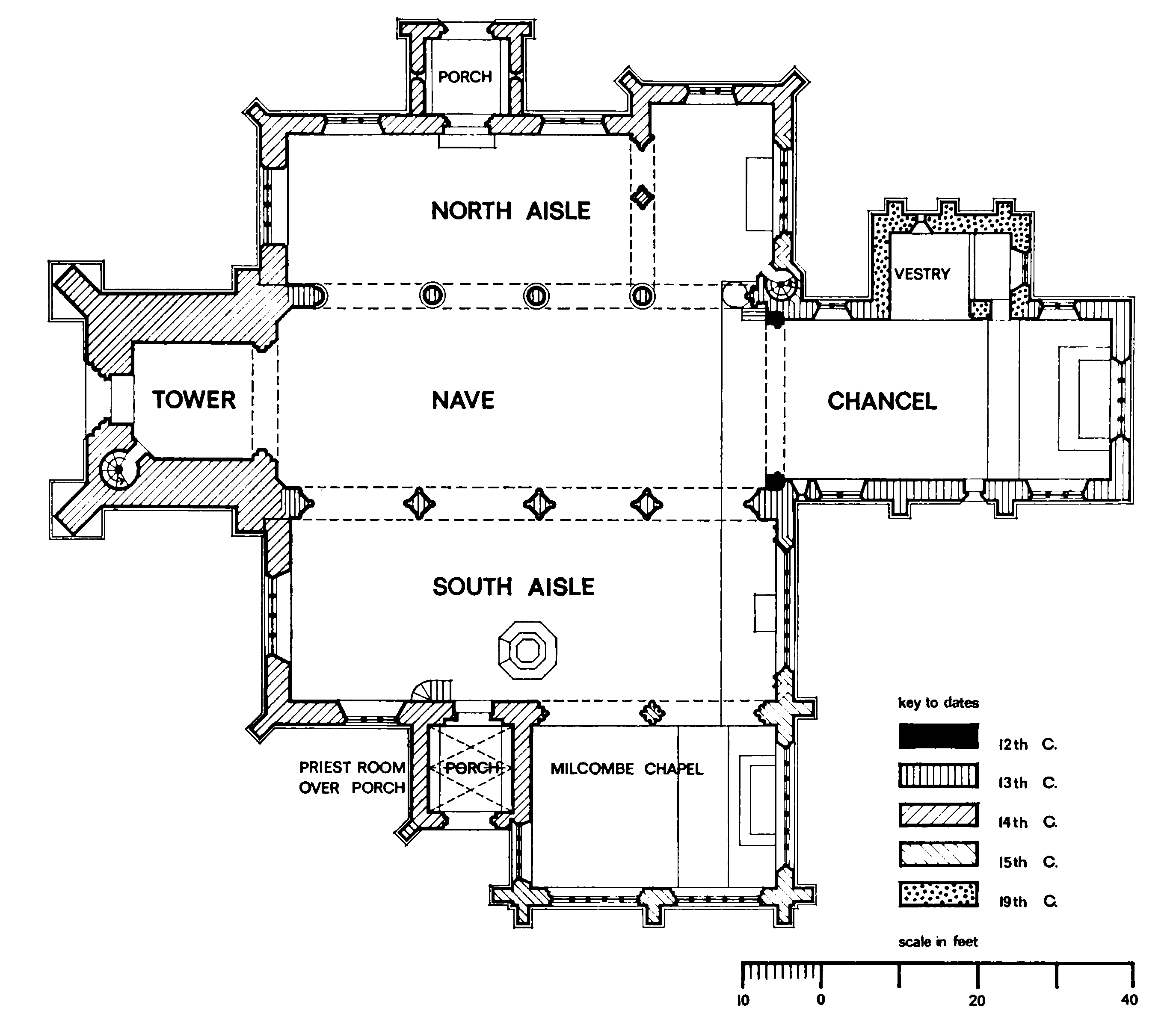
The Church of St. Mary, Bloxham
The church furniture also received attention: the 15th-century chancel screen was repainted, except for the panels, in what were believed to be the original colours, and it was restored to the chancel; (fn. 496) a new pulpit, litany stool, and sculptured reredos for the high altar were installed. The late-medieval font with its Jacobean cover was moved to its present position in the south aisle. (fn. 497) The ancient stone altar in the Milcombe chapel was also restored by G.E. Street; the figures in the niches were not added until 1894. (fn. 498)
In 1926 a new clock face was added on the west side of the tower; the church had had a clock at least since 1754. (fn. 499) Electric light was installed in 1935. (fn. 500) In 1956 major repairs were once again necessary; these included the repair of the spire, releading the nave and chancel, and re-roofing the south aisle and Milcombe chapel which had been attacked by the death-watch beetle. (fn. 501)
At one time the church walls were richly painted. There remain 3 late-medieval paintings. A giant St. Christopher and 2 other figures, one kneeling, beside him, is over the north doorway and the fragment of a doom is on the south side of the chancel arch. A 15th-century mural in the Milcombe chapel consists of a series of scenes which seem to tell the story of some youthful martyr.
A few fragments of the 14th-century glass, rearranged by Clayton and Bell in 1866, remain in the upper lights of a window in the north aisle. (fn. 502) The chancel east window (1869), a small window on the south side of the choir (1919), and the north aisle east window (1921) are by Morris and Co. The chancel east window was made up from designs by William Morris, Burne-Jones, and Philip West. The St. Christopher in the choir window is from a Burne-Jones design of 1868. The figure of St. Martin in the north aisle window is from a BurneJones design of 1878, and the other figures are probably from designs by J. H. Dearle. (fn. 503) The west window (1886) in the south wall of the chancel is by Kempe.
There are 3 late brasses: John Griffith of Penrhyn (d. 1632), Thomas Gabell of Bloxham (d. 1754), and Thomas Godwin, vicar (d. 1762).
There is a large marble monument in the Milcombe chapel to Sir John Thornycroft, Bt. (d. 1725); it is signed by Andrew Carpenter, London. This and other memorials to the family were originally at the east end and were moved to their present position during the restoration in 1866. The memorials include those of Elizabeth, Lady Thornycroft (d. 1704), wife of Sir John and daughter of Josiah Key of Milcombe, with the arms of Key and Thornycroft impaled; and John Thornycroft (d. 1687) and his wife Dorothy (d. 1717/18).
The following vicars are commemorated: Robert Pargiter (d. 1741); John Davis (d. 1789); Harry Davis, perpetual curate of Barford St. Michael (d. 1841); George Bell (d. 1852); James Hodgson (d. 1886). There are memorials to 19th-century members of the Holloway family. (fn. 504)
Rawlinson mentions inter alia an inscription to W. Dalby (d. 1695), member of a landed family at Milcombe; and Nicholas Page (d. 1696), vicar for 34 years. (fn. 505) These are no longer in the church.
The church now has no old plate: 2 silver chalices and a paten were melted down and recast when the church was restored in 1866. (fn. 506) The old plate included a communion cup and plate given c. 1685 by Ursula Cartwright of Aynho (Northants.). (fn. 507) The 19th-century set was given away when the vicar gave a new set in 1928. (fn. 508)
There is a ring of 8 bells, but all except the fifth, probably of c. 1570, and the tenor, dated 1648, have been recast in the 18th century or later. (fn. 509) A bell cast at the Reading foundry c. 1520 was in use until 1903.
The books given to the church and town in 1685 or 1686 by George Councer and John Cartwright of Aynho (fn. 510) consist of The Acts and Monuments of the Church and Piscator's Commentaries on the Whole Bible (3 vols. 1646). There is also in the church a Book of Homilies (1746), an 18th century Hebrew Concordance (2 vols. 1754) by John Taylor, and a History of the Bible (1752) by the Revd. T. Stackhouse. These books are now in the upper room above the south porch. In 1950 Miss E. M. Harper gave a Genevan (or Breeches) Bible (1583).
In the 16th century some of the income from the town estate was used for repairs to the church. By decrees of 1627 and 1635 a third share of the income of the estate was to be devoted to church repairs and to bridges. In 1824 it was found that this third was being spent was directed. (fn. 511)
The registers are complete from 1630. (fn. 512)
The chapel of Milcombe was in existence by c. 1200 when Robert, Abbot of Eynsham (1197–1205), gave Godstow Abbey a house in Milcombe for the chaplain, (fn. 513) and there are further references to it between 1215 and 1218. (fn. 514) In 1708 it was stated by the principal inhabitants of Bloxham that Milcombe was a 'distinct liberty'; that it and Bloxham were as 'two parishes in respect of all levies and taxes'; that the churchyard was not consecrated for burials; and that it was customary for the inhabitants to be buried at Bloxham and Wigginton. (fn. 515) A century later it was asked whether banns had been published there before 1753 and whether it was lawful to perform marriages there. (fn. 516) The Vicar of Bloxham reported that banns were and had been beyond living memory regularly published at Milcombe but that no solemnization took place except by favour of the minister on particular occasions. There had been only 4 marriages in the past 30 years. He also stated that Milcombe had no distinct register. (fn. 517) Local opinion was that banns had been published before 1753 and that the register had been lost. (fn. 518) On the last point at least it was correct. The Milcombe register has since been discovered: it began in 1562 when John Edyngson was made curate. The wording of the entry suggests that he was resident. There were then 2 churchwardens. The entry 'non marryed this year' suggests that marriages could be celebrated at Milcombe. (fn. 519) By the 19th century Milcombe had acquired its own burial ground and in 1854 marriages were said to have been performed there for many years. (fn. 520)
In the same year it was made a separate ecclesiastical parish. The living was to be a perpetual curacy, Eton presenting for 3 turns and the Rector of Wigginton for one. (fn. 521) As income the curate was to get £75 a year from the Vicar of Bloxham and part of the glebe of Wigginton, worth £25, (fn. 522) the Rector of Wigginton being no longer responsible for serving Milcombe one Sunday a month. By 1888 the living had been improved by £800 from Queen Anne's Bounty. (fn. 523) In 1917 the net value of Milcombe was c. £165. (fn. 524) In that year the Vicar of Bloxham was licensed to hold Milcombe in plurality and in 1921 the benefices were united. (fn. 525)
Before it became a separate parish Milcombe had been served by curates-in-charge or by the Vicars of Bloxham themselves. In the 16th century a former incumbent of the chantry of St. James in Chipping Norton was curate; (fn. 526) of his 16th-century successors one, who died in 1571, served for 9 years and another for twenty. (fn. 527) For the 17th century no information has been found, but by 1738 the Vicar of Bloxham had no curate and supplied the chapel himself. (fn. 528) The division of duty at Milcombe chapel between the Rector of Wigginton and the Vicar of Bloxham (fn. 529) probably precedes the grant of Bloxham to Godstow. From the Wigginton register it appears that in the 17th and 18th centuries a quarter of the hamlet of Milcombe was reckoned as being in the parish of Wigginton. All baptisms, marriages, and burials of the inhabitants of this quarter were performed at Wigginton. (fn. 530) In the late 18th century the Rector of Wigginton continued to do duty every fourth Sunday at Milcombe. (fn. 531) Three communion services were held at Milcombe in 1738 and four by 1808. (fn. 532)
The first vicar after the creation of the new parish was Philip Hookins. He restored the church, and his successor, H. C. Blagden (1860–75), contributed to the building of the vicarage-house in 1862. (fn. 533) He reported an average attendance of 30 at morning service and 50 or about a third of the adult population in the afternoon. He considered that the main hindrance to his work came from the fostering of dissent in neighbouring parishes. (fn. 534)
The church of ST. LAWRENCE, Milcombe, (fn. 535) appears to have been built in the 13th century. It had a chancel, a nave with south doorway, and a north aisle. The existing nave arcade is of a plain 13thcentury character, but the aisle was taken down in the 18th century and rebuilt in 'churchwarden style'. (fn. 536) The battlemented tower was added early in the 14th century. Windows were inserted in the body of the church in the 14th and 15th centuries, but these have since been removed or rebuilt. The nave was re-roofed in the 15th century, (fn. 537) and the chancel appears to have been re-roofed in the 18th century.
Rawlinson noted in 1718 that the church was indifferently kept. (fn. 538) Some repairs were done to the walls and battlements in 1742, to the wall and roof in 1789, and to the tower in 1837. (fn. 539) By 1859 the building was very dilapidated and it was restored in 1860 through the efforts of the incumbent Philip Hookins. The architect was G. E. Street. The faculty was for rebuilding the chancel and vestry, taking down the south wall of the nave and the arcade between the nave and north aisle, rebuilding the porch, providing a new roof, and moving the pulpit and lectern. All the windows in the church were restored and a new floor was put in. In addition the church was reseated and new benches were made after the pattern of the old. The old materials, including the lead, were sold. (fn. 540) Some of the lead was used to build the new school, and in 1869 this had 2 Perpendicular windows and a Decorated one from the old church. (fn. 541)
In 1906 an organ was installed and in 1945 a faculty was obtained to move it to the back of the church. In 1948 electric lighting was installed and in 1950 new heating. (fn. 542) In 1962 the church was again in need of repair. (fn. 543)
There is a much restored 15th-century chancel screen, (fn. 544) and tracery from the former medieval bench-ends is fixed to a panel at the east end of the north aisle. During the restoration a 15th-century mural painting, representing the Seven Deadly Sins, was uncovered. (fn. 545) The font dates from the 15th century. (fn. 546) There are 3 bells, of which 2 are dated 1607 and 1750. (fn. 547)
The earliest register dates from 1562 and extends into the 18th century, relating to Milcombe only. After the mid-17th century, however, entries for Milcombe are also regularly found in the Bloxham registers, and there are no further separate Milcombe registers until 1813. (fn. 548)
In the early Middle Ages besides Milcombe chapel there was another chapel on the king's Bloxham estate, called the church of St. John. It belonged to a small community of Benedictine monks and hermits and was situated at 'Felelia' in Bloxham Wood in Wychwood Forest. (fn. 549) The chapel and hermitage existed at least as early as the reign of Henry I, who granted it to Eynsham Abbey, with the assent of the Bishop of Lincoln. King Stephen confirmed the grant and gave the community an additional 7 a. of forest land. Waleran, Count of Meulan, also confirmed the grant when he became lord of Bloxham. (fn. 550) It seems that at this time all was not well with the house. The headship was sought by a monk of Tewkesbury, but eventually Geoffrey asked his friend Walter, Abbot of Eynsham, to undertake the care of the place. Geoffrey was supported in this by the Bishop of Lincoln, and the brothers of 'Felelia' were enjoined to be obedient to Eynsham Abbey which then seems to have absorbed the community. (fn. 551)
The chapel of St. John was still in existence in 1235, but in 1298 'Felelia' was described as 'le Forsakeneho'. (fn. 552) In 1315 it was uncertain to whom the site belonged. An inquiry was held as the bailiffs of the queen's manor of Bloxham claimed it as part of Bloxham, as in fact it had originally been. The abbot's claim, however, that it was part of his Charlbury manor was recognized as just and the royal bailiffs were ordered to stop interfering. (fn. 553)
Roman Catholicism.
In 1731 Dame Anne Lytcott and 4 women members of the Conquest and Brent families had small properties in Bloxham. (fn. 554) In the rest of the century the only Roman Catholics in this strongly Puritan area appear to have been some poor women, varying in numbers from one to four between 1738 and 1774. (fn. 555) The church of ST. PETER was built in 1938 and is served from Banbury.
Protestant Nonconformity.
From the 17th century nonconformity flourished and was closely associated with the dissenting movement in Banbury and the neighbourhood. In 1669 it was reported that Quakers and Anabaptists each had meeting places in Bloxham, though in neither case were the numbers 'considerable'. (fn. 556) Nevertheless, seven years later 100 dissenters were recorded, 80 in Bloxham and 20 in Milcombe. (fn. 557) It is likely that some of these were Presbyterians attending the meeting-house at Milton (fn. 558) in Adderbury. Presbyterians probably first began to meet in Bloxham itself c. 1700. It appears that no chapel was built, but that the Town House was used. (fn. 559) The influential Councer and Huckle families were members of the sect (fn. 560) and the Presbyterians rapidly became the most important body of dissenters in Bloxham. In 1738 the vicar stated that four of the congregation were among the richest men in the village. The meeting had its own minister, who also looked after the Milton meeting-house. Presbyterians from other parishes came to the Bloxham meeting-house and Anabaptists also, so that the vicar was unable to be certain of their respective numbers, but he estimated that there were 30 Presbyterians and that their number had much lessened 'of late years'. (fn. 561) Nevertheless the vicar stated in 1768 that they formed a fifth of the parish and a very careful return made in 1808 recorded that they had formed as much as a third c. 1780. (fn. 562) As late as 1805 they were still the dominant sect but by 1817, when the vicar reckoned that there were 8 or 9 families of Presbyterian Unitarians, (fn. 563) they were losing ground to the Baptists.
Something is known of the ministers and the organization of the congregation. (fn. 564) Perhaps the first minister to reside at Bloxham was Andrew Durel (d. 1723), a Huguenot refugee, who had charge of both the Bloxham and Milton chapels. (fn. 565) He was not in principle a dissenter and is said to have often attended the parish church at Bloxham. The great popularity of the movement at this time may be gauged by the report that his congregation, gathered from the whole neighbourhood, numbered 500, of whom 20 were gentlemen, and the rest tradesmen, farmers, and labourers. It was reckoned that they had more than 20 votes for the county among them. (fn. 566) In the 1760s and 1770s the minister was Thomas Brabant, (fn. 567) formerly a classical tutor at a dissenting academy at Daventry (Northants.). He was never ordained as he had unorthodox views on baptism and was, in fact, known as an Anabaptist. He was minister for about 30 years and died at Bloxham in 1804. The vicar wrote in the burial register after the entry of Brabant's name 'formerly a dissenting minister hereof respectable character and abilities but in doctrine errans'. (fn. 568) Another outstanding minister was Joseph Jevans (1799–1839), who had also been educated at a nonconformist academy and was, again like Brabant, a friend of leading nonconformists of the day. He was a man of outstanding piety and his great services to Bloxham, which included the opening of a Sunday school in his own house, (fn. 569) were recognized by the vicar when he 'made a point of conducting the (funeral) service himself instead of deputing his curate to perform the office as was his custom'. (fn. 570) The last of Bloxham's ministers was D. L. Evans. The congregation provided him initially with a stipend of £60. This must have entailed sacrifices, for Jevans, though originally paid £50, had been receiving only £20 in his later years. After two years' subscriptions, however, the congregation fell off, Evans left Bloxham, and the chapels at both Bloxham and Milton closed. During the previous century and a half the community had probably very much depended on one or two leading families like the Councers and Cakebreads. Jevans kept a register of baptisms which shows that he baptized the children of Lyne Councer, attorney, nearly a century after the family's connexion with Presbyterianism was first recorded. (fn. 571) George Cakebread, one of the family to be baptized by Jevans, and later a mason of some distinction, (fn. 572) signed a certificate of registration for the Particular Baptist meeting-houses at Bloxham and Milcombe. (fn. 573) Some of the Presbyterian community returned to the Church of England. (fn. 574)
The Bloxham Anabaptists were holding meetings once a month in the house of a member called Ingram in 1669, and the vicar complained of their not coming to church. (fn. 575) Another vicar reported in 1738 that there were 11 Anabaptists who had a licensed house but did not meet more than once a quarter; that Daniel Wilmot of Hook Norton was their visiting teacher; and that they were on friendly terms with the Presbyterians and attended their meetings. (fn. 576) By the beginning of the 19th century the Particular Baptists had become the most vigorous of the nonconformist bodies in the parish, and, in fact, in the neighbourhood. A meeting-house was registered in 1808 in the names of 6 local men of whom 3 belonged to the Gascoigne and Cakebread families. (fn. 577) The congregation of 'a few score' was apparently collected by the efforts of a labourer, who occasionally preached. There were said to be 10 families in the group at this time of whom some took communion in the parish church but more went to the Baptist chapel in Banbury. (fn. 578) In 1812 a chapel was built and registered. (fn. 579) In 1817 12 families with a preacher were reported; the vicar described them as 'Calvinistic Baptist Independents', (fn. 580) and there is no doubt that Baptists and Independents were closely allied in the neighbourhood. For instance George Cakebread, a Baptist, signed with the Independent minister of Banbury the registration certificate of the Adderbury Independent chapel, (fn. 581) but no other reference to Independents at Bloxham has been found. In 1821 a Baptist minister was ordained. (fn. 582) According to the 1851 Census the congregation numbered 100, (fn. 583) but this cannot be taken to mean a solely Baptist congregation, for many Church people went to dissenting meetings in the evening. (fn. 584) There was also a Baptist Sunday school. (fn. 585) A new and larger chapel was built in 1859. (fn. 586) In 1966 there were 11 members. (fn. 587)
Meanwhile the sect had also been making headway in Milcombe. In 1738 there were only 2 families of Anabaptists there. They had licensed a meetinghouse and were visited monthly by the Hook Norton minister, Daniel Wilmot. (fn. 588) In 1774 only one family, qualified as 'pauper', was recorded, but in 1822 a meeting-house at Milcombe was registered by the Bloxham Baptists and their minister. (fn. 589) A chapel was built in 1824 and in 1851 a congregation of 51 was recorded in the Census return. (fn. 590) Some almost certainly came from outside the parish and when the chapel was rebuilt just before 1866 the vicar commented that this had been done through the efforts of a dissenting farmer from outside; that during the rebuilding many local dissenters had come to church; and that there were only about 8 bona fide dissenting families, some of whom normally attended church and school. Had there been no 'irritation' from without he considered that dissent might have died away. (fn. 591)
The influence of Bray Doyley of Adderbury and the strong Quaker community in Banbury and north Oxfordshire generally made itself felt in Bloxham in the 17th century. There were many Quakers in the parish who belonged to the Adderbury Meeting, and came under the jurisdiction of the Monthly Meeting of the Banbury Division, which in the early 18th century was fairly frequently held in Bloxham. (fn. 592) The village never had a permanent meeting-house, but meetings were held in the houses of Friends, and in the mid-17th century Milcombe seems to have been more zealous than Bloxham itself. In 1665 Quakers met in Edward Butcher's house in Milcombe; Butcher had been imprisoned in 1660 for refusing to take the oath of allegiance. (fn. 593) In 1669 the house of George Anson of Bloxham, apparently a weaver, was regularly used. (fn. 594) The vicar thought that the numbers attending were not great and in 1682 he described the local Quakers as 'so obstinate and ignorant' that it was 'vain to offer anything to their consideration'. (fn. 595) Quakers from Adderbury, Tadmarton, and Great Tew were arrested at meetings in Bloxham. (fn. 596) Those living in Bloxham suffered also for their attendance at meetings: between 1660 and 1665 George Tomkins and Edward Butcher, both of Milcombe, went to prison for several weeks 3 or 4 times for going to meetings at Banbury and in Milcombe, and 3 others were imprisoned for the same reason. (fn. 597) Refusal to pay ecclesiastical dues was a further source of trouble; one man was distrained on for refusing to pay towards church repairs. Edward Butcher, the first to suffer for withholding tithes, was imprisoned in 1659 and his goods were distrained on in 1665. Thomas Stranke, member of a leading Milcombe family, was also twice sent to gaol, once for 2 years, for the same offence. Many of those distrained on were poor, but Butcher, Tomkins, and Stranke from Milcombe, and Anson from Bloxham, who were the chief offenders, seem all to have been fairly well-to-do. After 1695 one of the most obstinate offenders was William Lamley of Bloxham, who was treasurer of Banbury Division in 1740 and represented the division at the Yearly Meeting in London in 1741 and 1748. (fn. 598) At least 6 other families were regularly fined in the earlier 18th century. These included Thomas Harris (d. 1757), whose family mostly attended Sibford Meeting and Joseph Harris of Sibford Ferris, (fn. 599) who evidently had a considerable amount of land in Bloxham since the tithe impropriators took from him in 1779 crops to the value of £20. Earlier in the century, in 1738, the vicar stated that the Quakers in his parish paid their dues on compulsion. (fn. 600)
As in Adderbury the Bloxham Quaker community increased greatly in the early 18th century. At least 18 family names from Bloxham and 7 from Milcombe appear in the Quaker registers in the 17th century; in the early 18th century there were 28 new names in Bloxham and 5 in Milcombe, with a higher proportion of new names to old than in Adderbury. (fn. 601) The society may have been declining by 1738, when the vicar reported that there were 8 Quaker families in Bloxham and 5 of low rank in Milcombe. (fn. 602) His figure for Bloxham, however, can hardly be correct. Thereafter the visitation returns give 6 families for Bloxham and 2 or 3 for Milcombe; they met in each others houses. (fn. 603) The parson in 1768 said that a house was licensed, (fn. 604) and in 1775 the house of William Harris, scrivener, was licensed. (fn. 605) Harris was probably the same man as William Harris, schoolmaster, who died in 1792, and also as the William Harris of Bloxham who in 1770 was appointed to look after the abstracts of meetinghouses, burial grounds, and charities. (fn. 606)
By the 19th century the Bloxham Quakers had almost disappeared. Only two family names are to be found in the Quaker registers and the vicar recorded only 2 families in 1802 and 1805. (fn. 607) Thomas Gilkes, whose house at Milcombe was registered for meetings in 1835, may have been a Quaker. (fn. 608)
No Methodism was reported in Bloxham before the 1820s. In 1823, however, there were said to be 9 or 10 Methodists, meeting at a house registered in 1821. (fn. 609) In 1851 there was a congregation of between 120 and 150, but only 134 sittings and 'standing room'. (fn. 610) Church people used to go there or to the Baptist chapel in the evening. There was also a Wesleyan Sunday school. (fn. 611) The vicar would not give an estimate of numbers attending the chapel in 1854, (fn. 612) but in 1866 he said there were 210 dissenters (presumably mostly Wesleyans and Baptists) and in 1878 c. 100 in Bloxham and 17 in Milcombe. (fn. 613) A new Methodist chapel was built just before 1869 (fn. 614) and in 1965 it seated 250. It was then served by ministers from Banbury and Brailes. There was a membership of 31. (fn. 615)
Schools.
At some date between 1601 and 1627 William Hartley and his wife Mary granted the Bloxham feoffees 1 a. of arable land in trust for the use of a grammar school master, who might teach grammar at Bloxham. In default of such a master the grant was to be used for the poor living in the almshouse. (fn. 616) In 1627 it was found that the money accruing had been misapplied and it was ordered that School Acre should be handed over to new feoffees and be used for its proper purpose. (fn. 617) The school house, of which the door alone survives, was built next to the Court House in 1610. It is not known whether the building was still used as a grammar school when it was restored in 1674. (fn. 618) By 1738 it was occupied by a charity school supported by the subscription of local landowners, in which 20 boys were taught to read and write. (fn. 619) In 1771 the death of the principal contributor cut the value of subscriptions by half and the number of boys taught had been reduced to 10 by 1774. (fn. 620) The school seems to have come to an end soon after that date.
By 1808 there were 4 schools in Bloxham: a day school where 40 boys were taught reading, writing, arithmetic, and mensuration, and 3 schools for young children who were taught reading, needlework, and straw-plaiting. A Sunday school which had been started by the Presbyterians had ceased to exist by this date. (fn. 621) Ten years later the number of schools in the parish had doubled. Four day schools were attended by 83 children, 9 of whom came from neighbouring parishes. Three infant schools taught 29 children under the age of seven. Another school had 37 pupils, mostly boys, and a further 27 young adults attended in the evenings. In addition to these schools a long established girls' boarding school now took 6 local girls as day pupils. Two Sunday schools, which were receiving the endowment from School Acre in the form of £1 worth of coal and candles, were the sole means of education for 34 children. They were also attended by 30 of the children who went to the day schools. The vicar considered it a matter for congratulation that 14 per cent. of the children in his parish were receiving some sort of education. He strongly recommended the establishment of a National school in the parish and the provision of more evening schools so that the children might be free to earn during the daytime. (fn. 622)
Elementary education in the parish had been put on a sounder footing by 1831 when a free school was established, supported by a bequest from Job Faulkner. By his will dated 1807 this money, amounting to £30 a year, had been left, after the life interest of a wife and brother, to the vicar and churchwardens, who were to pay a schoolmaster to teach reading, writing, arithmetic, and mensuration to 28 boys between the ages of 5 and 14. The boys were to be the sons of poor persons not being farmers; they might belong either to the Established Church or to a dissenting body provided that they attended church or chapel regularly. Each boy leaving at the age of 14 after 2 years' regular attendance might receive 2s., a Bible, and a certificate of good conduct. A prize of 1s. and a new prayer book was to be awarded at Christmas to the 2 best pupils and up to 6s. a year could be spent on books for each boy if the income allowed. Money collected at an annual charity sermon, for which an extra guinea had been allowed, was to be spent on coal for the schoolroom. (fn. 623) This school became the principal school in Bloxham and although the value of the Faulkner bequest had fallen by 1833 to £20 a year it was attended in that year not only by the 28 free pupils but also by 22 children paid for by their parents. In addition to the free school there were also at this time 2 day schools with 23 children, mostly boys, 3 infant schools with 46 children and the girls' day and boarding school. All these children were paid for by their parents. Two Sunday schools run by the Church of England taught 76 boys and 54 girls. Fifteen of these girls were given the opportunity to learn to write in a Wednesday class. The Baptists and Wesleyans also ran Sunday schools, the former with 45 and the latter with 7 pupils. In 1851 these had 25 and 27 pupils respectively. (fn. 624) All 4 Sunday schools were supported by subscriptions. (fn. 625)
In 1854–5 the vicar declared that new school buildings were urgently needed; that the girls' church day school was held in borrowed premises; that the boys' free school was in the very dilapidated school house owned by the feoffees, which was so overcrowded that infant classes were held in a loft accessible only by a dangerous ladder; and that there was no residence for the master or mistress. The Faulkner bequest, with the annual £5 from the feoffees for school sermons and voluntary subscriptions, was insufficient to finance the school and the vicar himself made up the deficiency of £14. He also contributed £11 to the girls' school and the Sunday schools. (fn. 626) The boys' free school and the girls' Church school were apparently regarded as an entity in 1857 when a copy of the school rules was attached to the report. The rules laid great stress on punctuality and cleanliness. Both boys and girls attended for 6 hours a day. Apart from the 28 free scholars, children of poor parents paid 2d. or 1d. a. week according to age and the size of the family and those in better circumstances had to pay 4d. or 6d. The entry fee of 2d. was recharged if a child was away for more than 2 weeks without sufficient excuse. In addition to the usual basic lessons singing, religious instruction, and, to a slight extent, history, geography, and grammar were taught. Books had to be bought by the children and could be obtained at reduced prices or on hire purchase if necessary. They could be re-sold to the master if, when the children left school, they were clean and whole. (fn. 627)
With the help of a grant made by the Guardians of the Banbury Union in 1862 the free school was rebuilt on a new site and enlarged to take 100 pupils. It was opened in April 1863 as a mixed school in union with the National Society, supported by endowment, voluntary subscriptions, and a small Government grant. (fn. 628) An improvement grant of £142 was made in 1866. (fn. 629) Attendance in this year averaged 84, and most of the children also attended the Sunday school, which was the sole means of education for 16 children. The vicar regretted that he was unable to keep a hold on more of the children after they left day school. A night school was attended 3 times a week by 18 boys in the winter, but the library and reading room were not an attraction to the young, of whom only 15–20 were members in 1868. In this year there were also 2 dame schools with 12–15 pupils each. Most of the younger children, about 75 on average, attended the infant school, which had been established in 1866 with accommodation for 100, supported entirely by a lady of the parish. (fn. 630) This generous support continued until 1877 when the infant school came under the same management as the mixed school. It was held in part of the same block of buildings in a classroom built in 1875 with the aid of a Government grant. (fn. 631)
In 1890 the average attendance had reached 228, only 11 short of the maximum possible accommodation. (fn. 632) By 1902 the number of school places had been increased to 278, but average attendance had dropped to 209. The Education Department had spent a total of £274 on building grants to Bloxham schools up to this date and £1,033 had been subscribed for the same purpose. (fn. 633) In 1931 the mixed and infant departments were amalgamated and it was decided that no child under 5 would in future be admitted. Attendance in 1938 was 119. In 1965 Bloxham school still belonged to the Church of England with Controlled status and a roll of 133 children. New school buildings had been provided. (fn. 634)
All Saints School, later known as Bloxham School, a public school under the Woodard Foundation, is described elsewhere. (fn. 635)
No information about the education of children in Milcombe has been found before 1833, when it was reported that c. 20 boys and girls attended a day school and 40 attended 2 Sunday schools. All 3 schools were supported partly by subscription, partly by the poor rates. (fn. 636) In 1834 the Vicar of Bloxham noted that there were 2 day schools in Milcombe and that at least a seventh of the population in his parish had some schooling. (fn. 637) In 1859 some of the material from the dilapidated church was used to build a school on rented land, the ownership of which was disputed between the feoffees and the vicar. (fn. 638) The school was enlarged in 1883 and in 1889, (fn. 639) and by 1898 was receiving a Government grant. (fn. 640) It was used for evening classes in the winter, at least in 1878, and spasmodically as a reading-room. (fn. 641) Although there was accommodation for 110 children in 1903 there were only 34 pupils. (fn. 642) In 1920 the school closed and the children were sent to the school at South Newington. (fn. 643)
Charities.
A town estate, administered by feoffees and townsmen, (fn. 644) was made up of many charitable endowments of which only some were for the poor. The rents of much of the estate, given originally for a chantry, (fn. 645) were diverted in 1550 to the upkeep of the bridges and other uses. In 1603 the estate comprised 8 yardlands, several properties, including the Town House for keeping court in, and various sums of money; only those endowments specifically for the poor are listed below. (fn. 646)
Among the oldest was an annual payment to the poor of grain out of the rectory, commuted to a quarterly payment of 6s. 8d. which was still being paid by the lessees of Eton College in 1824. (fn. 647)
In 1603 it was stated that the almshouse in Bloxham South had belonged to the town 'beyond the memory of man'. In 1824 the almshouses consisted of 4 apartments on the north side of the churchyard. There were at that time 3 more ranges of buildings, used for housing paupers, who mostly paid no rent; two of these ranges seem to have been part of the town estate in 1603. (fn. 648) The almshouses were sold in the mid-19th century, the money was invested, and the interest carried to the poor's account. (fn. 649)
Before 1603 an ancestor of Christopher Pitt gave 3s. 4d. yearly out of Garner's land in Bloxham for the benefit of the poor. This sum was still paid out of Garner's land in 1824.
The following bequests also listed in 1603 have no further known history: William Dalby, Rector of Upper Heyford, by will gave £20 to his overseers, who appointed £16 to be used as a stock for the poor of Bloxham, and William Calcott of Williamscote gave £100 as a stock.
Between 1603 and 1627 Robert Samon surrendered a copyhold tenement subject to the payment of 3s. 4d. a year to the poor; this was probably the origin of the 3s. 4d. paid yearly out of a farm called Hawtin's Hook in 1824.
Between 1603 and 1627 Ann White gave by will 20s., George Dalby of Milcombe 20s., and Edmund Busby, of Shenington, and Philip Kendal each gave 40s. stock for the poor; by 1824 this money was all lost. (fn. 650)
The income from the sum of £40, left at an unknown date by John Gascoigne for apprenticing poor children, was thought by the Charity Commissioners in 1824 to have been used partly in building cottages, inhabited by paupers, and partly in repairing the church spire. Subsequently 40s. a year was set aside for the purpose of the bequest. (fn. 651)
The income of the town estate, which in 1692 was c. £92, rose steadily; in 1803 it was c. £235 and in 1877 c. £414, probably the highest figure, but by 1935 it had fallen to £211 10s. (fn. 652) At inclosure in 1794 and 1802 the open-field estate had been exchanged for c. 23 a. in Milcombe and c. 108 a. in Bloxham. (fn. 653) Between 1845 and 1871 the almshouses and 11 other cottages were sold and £325 stock bought. In 1930 the feoffees sold £335 stock to produce £184 for repairs and the extinction of manorial dues. (fn. 654) Between 1954 and 1959 more than 100 a., including the Milcombe land and 8 cottages, were sold. (fn. 655) The property then comprised the ancient Town House, c. 57 a. of land, and £6,379, of which over £1,100 represented reinvested accumulated income. The total annual income was £343 14s. 8d. (fn. 656)
In 1627 the Charity Commissioners, finding that the town estate had been administered badly and that able men rather than the poor had benefited from its income, decreed that henceforth the income should be divided into three and that a third should be spent on the poor. Until 1805, however, expenditure was recorded in one general account. (fn. 657) In 1811 the townsmen gave from the poor's third £129 15s., to be distributed in doles by the overseers, as well as £50 worth of bread. (fn. 658) In 1818 £89 was carried to the poor's account, but this fell to as little as £33 in 1822; (fn. 659) such great fluctuations were due largely to property repairs which were allowed for before the total income of the estate was divided. At this time the poor's share was used to buy coal in summer to sell cheaply to the poor during winter.
The Charity Commissioners in 1824 criticized the manner of observance of the three-fold division of income: the use of houses and cottages to house paupers was seen as removing a burden from the town at large, and consequently it was considered unfair that the expense of repairs fell partly to the poor's account. The Commissioners thought that a third of the estimated value of the property should go to the poor. (fn. 660) The amount distributed to the poor remained in the region of £80 throughout most of the 19th century. From 1861 small sums were subscribed regularly to local hospitals. In 1887 £2 was given to a man to go to Droitwich, £6 2s. 6d. to help a man to emigrate to Canada, and £10 to a family for the same purpose. The last entry in 1892 was £1 5s. spent to supply clothing. (fn. 661) In 1955 the poor were given £44 10s. at Christmas and in 1959 96 poor people received £1 each. (fn. 662)
Two bread charities mentioned in 1603 were not merged in the town estate. William Huggins surrendered a cottage to feoffees in trust, and the rent of 6s. 8d. was being distributed in bread to poor widows in 1824. Thomas Hall of Bodicote gave 3s., and in 1824 this sum, charged on lands in Bodicote, was being distributed to the poor of Bloxham North. (fn. 663)
In 1630 Roger Matthew, Vicar of Bloxham, gave £20 to the town as a loan charity for poor tradesmen and others who could give security; the money was soon lost owing to the insolvency of the borrowers. (fn. 664)
When in 1637 an acre of land was given to support a schoolmaster, (fn. 665) it was decreed that in default of a master the rent should go to the poor in the almshouse. After inclosure land allotted for School Acre was joined with a small fuel allotment, and the whole was leased for £3 3s.; although there was then no master, only the income from the fuel allotment was paid to the poor. (fn. 666)
Two legacies of £100 and £200 were bequeathed by the wills of John Potter (d. 1892), a Bloxham farmer, and of William Potter (d. 1894). The dividends were to be disposed annually among 10 poor men or 10 poor women living in Bloxham. The endowments in 1912 were represented by £101 5s. and £225 stock. (fn. 667)
Milcombe, like Bloxham, had an ancient town estate. The first known reference to it was in 1625, when it consisted of land and houses in Milcombe left by Thomas Stranke at an unknown date. As in Bloxham the charity was partly for the poor and partly for the upkeep of public roads and bridges and for other town uses; in 1688 the trustees were accused of refusing to apply the funds to the poor. (fn. 668) At inclosure in 1794 the town lands, which in 1786–8 brought in only £7 rent, were exchanged for 12 a. on Milcombe Heath and were subsequently let at £12, their full value. There were also 8 cottages let to poor people at a nominal rent of 6d. a week. In 1825 none of the income of the estate went directly to the poor, but in 1855 a third of the income of £33 went to the trustees of a fuel allotment. (fn. 669) The cottages were described in 1860 as very poor places, 'habitable and that is all', and by 1904 the whole estate was almost derelict through neglect. Two of the cottages were converted in 1860–1 into a schoolroom (fn. 670) and the rest had been condemned before the whole estate, including the fuel allotment, which had been added to it, was sold in 1957 and 1958 for over £2,000. This money, by a scheme of the Charity Commissioners, was used for the building of the village hall. (fn. 671)
At inclosure in 1794 16 a. were allotted in lieu of common rights. This land was let for £19 in 1860, and coal tickets worth 11s. 5d. were distributed indiscriminately without regard to character or receipt of parish relief. The fuel allotment was amalgamated with the town lands in 1916 and was sold in 1958. (fn. 672)
It was recorded in 1603 that certain sums of money had been given as a stock for the relief of the poor of Milcombe. William Tay and Ellen Gurdon had each given 10s. and an unknown donor 20s.; John Hunt had left 10s. and this had been made up to 40s. by the inhabitants. The annual income was 7s. 8d. Eton College were bound to pay out of the rectory of Bloxham a stick of wheat a year to Milcombe and this had been paid until within a few years of the inquiry. There is no further direct reference to any of these bequests. (fn. 673)