A History of the County of Wiltshire: Volume 11, Downton Hundred; Elstub and Everleigh Hundred. Originally published by Victoria County History, London, 1980.
This free content was digitised by double rekeying. All rights reserved.
A P Baggs, Elizabeth Crittall, Jane Freeman, Janet H Stevenson, 'Parishes: Enford', in A History of the County of Wiltshire: Volume 11, Downton Hundred; Elstub and Everleigh Hundred, ed. D A Crowley (London, 1980), British History Online https://www.british-history.ac.uk/vch/wilts/vol11/pp115-134 [accessed 1 May 2025].
A P Baggs, Elizabeth Crittall, Jane Freeman, Janet H Stevenson, 'Parishes: Enford', in A History of the County of Wiltshire: Volume 11, Downton Hundred; Elstub and Everleigh Hundred. Edited by D A Crowley (London, 1980), British History Online, accessed May 1, 2025, https://www.british-history.ac.uk/vch/wilts/vol11/pp115-134.
A P Baggs, Elizabeth Crittall, Jane Freeman, Janet H Stevenson. "Parishes: Enford". A History of the County of Wiltshire: Volume 11, Downton Hundred; Elstub and Everleigh Hundred. Ed. D A Crowley (London, 1980), British History Online. Web. 1 May 2025. https://www.british-history.ac.uk/vch/wilts/vol11/pp115-134.
In this section
ENFORD
The parish of Enford lies in the north-east corner of Salisbury Plain some 22 km. north of Salisbury. (fn. 1) In its ancient form it was oval and slanted north-east to south-west. No natural feature, except the Christchurch Avon which formed the north-western boundary with West Chisenbury, a detached tithing of Netheravon, defined its limits. (fn. 2) The area of the ancient parish was increased to 3,314 ha. (8,190 a.) when West Chisenbury was added in 1885. (fn. 3) The modern parish measures over 11 km. at its widest point from Enford down at the west end to Coombe hill at the east end and in length about 4 km. from the northern boundary near Chisenbury camp to Coombe hamlet on the southern boundary. On either side of the Avon, which flows through the middle of the parish, the six tithings of Enford extended finger-like to east and west. (fn. 4) Their hamlets face each other across the Avon. Those on the west bank, Compton, Enford, and Fifield, cluster in the wide loops formed by the meandering river. The eastern hamlets of East Chisenbury, Littlecott, Longstreet, and Coombe, stand directly opposite. Compton alone has no eastern twin. New Town, consisting of a scatter of cottages south of Enford village, was considered part of Enford tithing. (fn. 5) Longstreet, known as 'Fyfhyde' or 'Langefyfyde' in the Middle Ages, and Littlecott probably formed the medieval tithing of Littlecott and Fifield. (fn. 6) They appear to have emerged as separate tithings by the 18th century. (fn. 7) All the other tithings seem to have existed in the 13th century. (fn. 8) East Chisenbury, so designated in the 13th century to distinguish it from the Chisenbury in Netheravon, was called alternatively Chisenbury Priors, or, later, Priory from its connexion with Ogbourne Priory. (fn. 9)
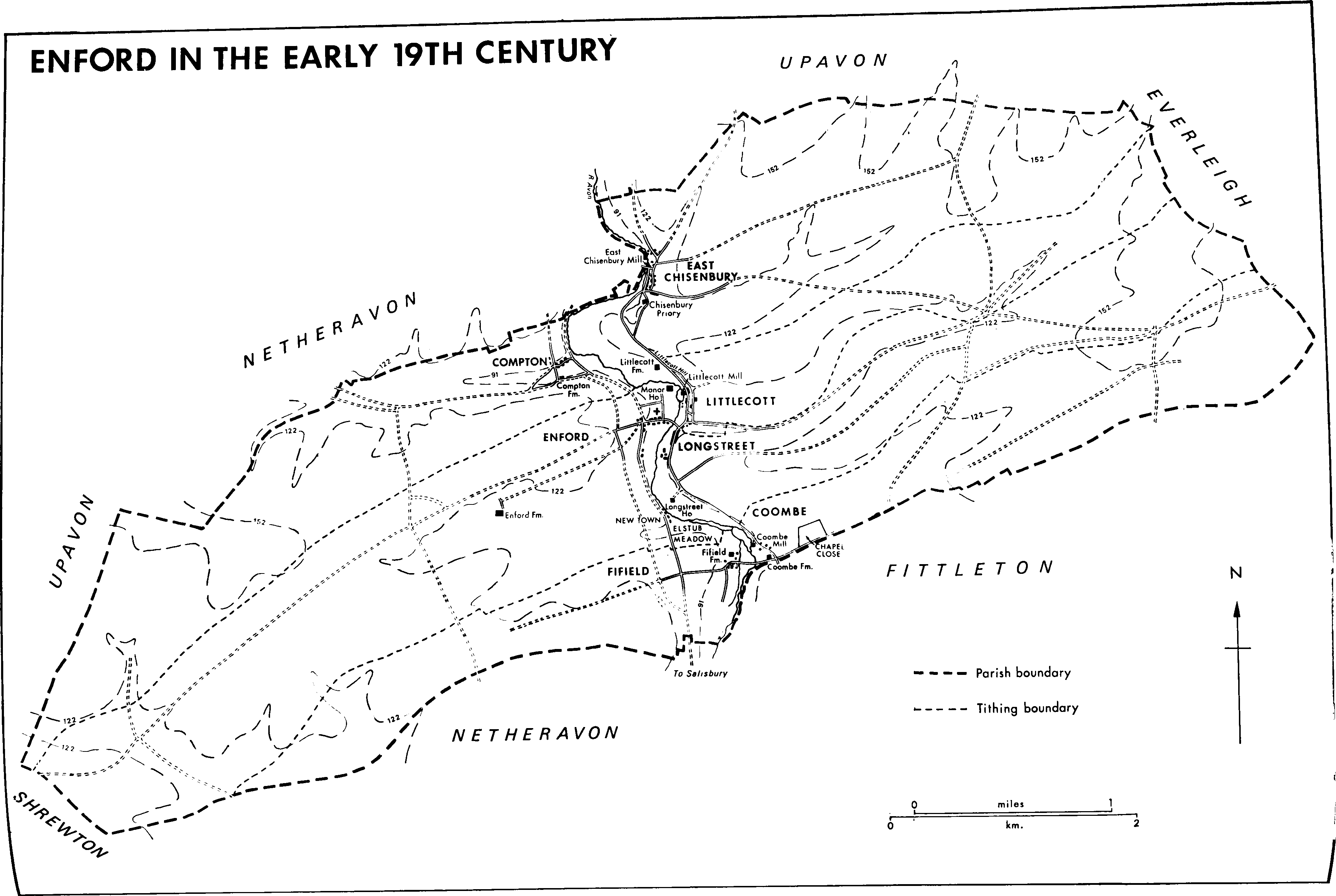
Enford in the Early 19th Century
The valley carved from north to south through Enford by the Avon divides the parish into two geologically identical halves. (fn. 10) Both contain massive bluffs of Upper Chalk which rise from heights of over 107 m. to over 152 m. on either side of the valley. The higher slopes once provided grazing for large flocks of sheep. The lower reaches were formerly occupied by open fields, and were, although mostly in Ministry of Defence ownership, largely under arable cultivation in 1976. North-east of East Chisenbury clay-with-flints deposits are found in two places, in one of which a height of 172 m. is reached. On the north-western boundary with West Chisenbury an eastwards flowing tributary of the Avon gouged out a valley, now mostly dry, called Water Dean Bottom on whose floor the Middle Chalk is exposed. The hamlet of Compton grew up on the gravel deposits left by the stream near its confluence with the Avon. The Middle Chalk is also exposed east of the hamlets of East Chisenbury and Littlecott. Narrow strips of gravel, nowhere over 500 m. wide, which have been deposited on either side of the river, provide the relatively dry terraces on which Enford's village and hamlets developed. East of Coombe another of the Avon's tributary streams, also now dry, cut a valley through the chalk. It is indicated by the gravel deposits which extend along the south-eastern parish boundary for about 2.5 km. Between the gravel terraces and the Avon the river banks are covered with rich alluvial soils. Once the site of common meadows, the area was still lush grassland in 1976.
The plentiful archaeological evidence found in the parish indicates human activity there from the Neolithic Period. Remains include barrows of various types and numerous ditches. (fn. 11) In the Iron Age there may have been a fairly settled community in the area later covered by East Chisenbury tithing. Of the two hill-forts there, Chisenbury camp or trendle and Lidbury camp, Lidbury has an associated field system (350 a.) on Littlecott down. (fn. 12) Slag found in Lidbury camp's ditch may suggest iron-working there at that time. (fn. 13) Enford down and Rainbow bottom both show extensive field systems, and others extend into the parish from Everleigh, Fittleton, and Upavon. (fn. 14) Settlement on the downs, particularly at East Chisenbury, may have continued unbroken into Romano-British times. A street village of that period existed at Chisenbury warren in the extreme north-east corner of the parish. (fn. 15) Remains of a domestic building of similar date found between the Avon and the Salisbury—Upavon road near Compton indicate settlement there. (fn. 16)
For medieval taxation purposes Chisenbury was always assessed separately, and Coombe included in the neighbouring manor of Fittleton. Compton was often dealt with separately since it was usually considered part of the liberty of Everleigh. Sometimes it was included in Amesbury hundred. Littlecott and Fifield tithing was sometimes assessed with Enford and sometimes separately. (fn. 17) In 1377 Chisenbury had 96 poll-tax payers, Littlecott and Fifield 49, and Enford, probably then including Fifield tithing, 32. (fn. 18) In the 16th century the parish, then assessed as an entity, made the highest taxation contributions in Elstub hundred. (fn. 19) In 1576 Compton tithing was assessed with Alton, in Figheldean, as part of Amesbury hundred. (fn. 20) It has been calculated that 616 people lived in the parish in 1676. (fn. 21) When systematic enumerations began in 1801 814 people lived there. (fn. 22) Fifield, the only tithing for which separate figures were then given, had 140 inhabitants. Numbers in Enford as a whole had fallen slightly by 1811 but thereafter rose and in 1831 reached 961. By 1841 the population had fallen to 797, of whom 187 lived at Enford, 149 at Chisenbury, 73 at Compton, 79 in Coombe, 98 in Fifield, 52 in Littlecott, 81 in Longstreet, and 78 in New Town. The total increased to 911 in 1851 and remained fairly steady for the next 20 years. During the 1860s Fifield's population decreased because young men were apparently leaving the hamlet to seek work elsewhere. (fn. 23) The later 19th century saw a steady decline in population, despite the addition of 47 people when West Chisenbury was transferred to Enford in 1885. (fn. 24) In 1921 652 people lived in Enford. Figures rose to 716 in 1931 but in general the 20th century witnessed a slow decline. In 1971 656 people lived in the civil parish.
The Avon, zigzagging southwards across the plain, has determined the pattern of Enford's communications with the surrounding area. The roads and lanes which link the parish to near-by settlements constitute a ladder-like network along its valley. Of those which served Enford and its hamlets in the later 18th century, ones not still in use could usually be traced in 1976 as footpaths. (fn. 25) On either side of the Avon roads, probably of considerable antiquity, wind parallel to it, mostly clinging to the gravel terrace directly below the scrub-fringed lee of the plain but occasionally forsaking it for an exposed course over the chalk, as at the northern end of Chisenbury tithing and west of Enford village. The road west of the river was turnpiked in 1840. (fn. 26) A toll-house and associated gate still stood in the village street near the church in 1876. (fn. 27) Most roads leading east and west across the plain fell out of general use after much downland in Enford was bought by the War Department in the late 19th century and the early 20th. (fn. 28) In 1956 the Crown successfully prosecuted the Wiltshire county council, as the representatives of the parishioners of Enford, for failing to keep a stretch of Water Lane in repair. (fn. 29)
From at least the later 18th century the roads running along the valley sides were linked by lanes carried across the river by numerous bridges. (fn. 30) Of the bridges linking East Chisenbury with West Chisenbury the wooden footbridge at the northern end of East Chisenbury was replaced by a suspension footbridge made by James Dredge in 1848. After its demolition in 1960 it was replaced by a concrete structure. (fn. 31) The bridge which carried the lane over the Avon from Enford to Longstreet was replaced in 1844 by a three-span cast iron beam bridge made by Tasker & Fowle of Andover. A new bridge, supported on the original piers, was built in 1971. (fn. 32) A concrete footbridge linked Coombe and Fifield in 1976.
The village of Enford lies among meadows on the Avon's west bank between the river and the main Salisbury road. It flanks the lane, known in the earlier 20th century as Enford Hill, which runs eastwards across the river to Longstreet. (fn. 33) The only surviving buildings of any age are the church and the former Vicarage, in 1976 called Enford House. (fn. 34) The manor-house, reputedly destroyed by fire, stood north-east of the church by the Avon. (fn. 35) Until recently Enford Hill was fairly closely built up with cottages. Most were apparently of 19th-century date and all displayed the combination of thatched roofs, timber-framing, and the use of bricks and chalk blocks typical of the area. (fn. 36) Only one or two remained in 1976. Manor Cottage, which stands some distance north-east of the church, was originally a small 18th-century house. It was partly reconstructed at first floor level in the 19th century. A symmetrical range of three cottages with a central pediment was built on its east side c. 1800 and demolished c. 1950. (fn. 37) A few houses, their sites cut into the chalk, stand along Chapel Lane west of the Upavon—Salisbury road. Some 1.5 km. south-west of that lane Enford Farm, from which the manorial demesne was worked in the 19th century, stands exposed on open downland. (fn. 38) Originally a narrow mid18th-century house five bays wide, its size was doubled, and many alterations made both inside and out, in the 19th century. New Town, mentioned in the later 17th century, lies 500 m. south of Enford and comprises a few brick cottages of the 19th century and later scattered along the east side of the main Salisbury road. (fn. 39) The Elstub hundred courts were probably formerly held in Elstub meadow, which borders the Avon to the south-east.
Longstreet, which extends southwards from Lower Farm at the east end of Enford bridge and for 500 m. along either side of the lane running south to Coombe, is mentioned in the 13th century. (fn. 40) The lane, which contains the one or two shops in the parish, is closely built up with large cottages giving directly upon it. Although nothing of 17th-century date remains visible, a house on the west side bears evidence of 18th-century refronting. Opposite it stands the Swan inn, which from the early 18th century to the later 19th was part of the Longstreet farm estate. (fn. 41) The building the inn occupied in 1976 was of later-18th-century date and much enlarged in the 19th century. Its sign spans the road at roof level. Most houses in the hamlet date from the 18th and 19th centuries and are built of various mixtures of brick, flint, and chalk. A few are timber-framed and have thatched roofs. At the southern end of the hamlet a broad shelf somewhat above road level is all that remains of a road which once ran parallel on the east.
The hamlet of Littlecott comprises, besides Littlecott Farm and mill, a few houses of various dates from the 17th century scattered along the lane running north on the Avon's east bank from Longstreet to East Chisenbury. Littlecott House, essentially a substantial brick building of the later 19th century, has been the official residence of the Station Commandant, and later of the A.O.C., R.A.F. Upavon, since 1928. (fn. 42) A council housing estate of the earlier 20th century stands north of Water Lane.
Coombe lies on the same side of the Avon near the southern parish boundary. The extensive outbuildings of Coombe Farm and a few houses of more recent construction stand along the east side of the hamlet's lane, known in the early 19th century as Coombe street. (fn. 43) Coombe Cottage, which stands north of the farm-house on the west side, is a small 17th-century timber-framed and gabled house almost completely encased with walls of brick, flint, and chalk. The scarred landscape east of Coombe shows chalk to have been extensively quarried there at some date.
Fifield, opposite Coombe west of the Avon, is approached from the main Salisbury road by a long lane, on either side of which the hamlet huddles near the river. On the lane's north side the former Fifield Farm, in 1976 called Fifield Avon, stands enclosed to the east by a cob wall. Its main north-south 17th-century range, which once had lateral gables, is timber-framed with brick nogging and some replacement in brick. The south end was heightened to two full storeys c. 1800 and the south front extended to the east by one room and given a central doorway. After having been divided into cottages, the house was brought back into single occupation in the 20th century and remodelled in 1972 when a stone fire-place was introduced into the principal room. (fn. 44) Opposite that house a cluster of three small thatched and timber-framed houses, probably of 17th-century date, have been partly encased with brick, flint, or chalk walls.
The small hamlet of East Chisenbury lies north of Chisenbury Priory on the former western boundary of the ancient parish. It is ranged east of the Avon on either side of the lane leading north to Upavon. Another lane, still used as a footpath in 1976, once ran parallel to it along the river bank. (fn. 45) Four of the most substantial cottages are timber-framed with thatched roofs. Although added to and partly rebuilt in brick at various dates, they appear to be of 17th-century origin. They were perhaps formerly attached to copyholds in Chisenbury tithing. There are also some 18th- and 19th-century cottages, and an inn, the Red Lion, of 19th-century date. At various dates in the earlier 20th century council housing, including blocks of flats, has been built on the east of the lane at the hamlet's northern end.
In the later 18th century and the earlier 19th Compton hamlet comprised a few dwellings which clustered in Water Dean Bottom between Compton Farm and the main Salisbury road. (fn. 46) By the 1880s, however, the farm-house stood solitary, as it did in 1976. (fn. 47)
Manors and other Estates.
In 934 King Athelstan expressly granted an estate of 30 hides at Enford to support the cathedral clergy of Winchester. (fn. 48) Of those 30 hides 5 were held of the monks in 1086 by William, 2 by Harold, 3 by an unnamed Englishman, and 1 by the priest at Enford. (fn. 49) Except the priest's hide none may be certainly identified with any of the estates traced below. The monks of the Old Minster, later St. Swithun's Priory, held the manor of ENFORD until the Dissolution. (fn. 50) They were granted free warren within the manorial demesne in 1300. (fn. 51)
The Crown granted the manor to Thomas Culpeper in 1541. (fn. 52) After Culpeper's attainder and execution later the same year Enford was forfeited to the Crown, which in 1543 granted the estate to Winchester College. (fn. 53) In 1551 Culpeper's elder brother Thomas successfully established his title to the manor under the terms of the grant made to his brother in 1541. (fn. 54) He was succeeded c. 1558 by his son Sir Alexander (d. 1600), and grandson Sir Anthony Culpeper. (fn. 55) During 1614 and 1615 the manor was apparently sold to members of the Petre family. In 1614 John Petre received a Crown grant of the estate and the following year Sir Anthony Culpeper conveyed the same property to John's brother Thomas. (fn. 56) In 1621 John and Thomas, with Thomas Forster, sold to William Rolfe, who sold in 1635 to Sir Henry Clarke. (fn. 57)
At Sir Henry's death c. 1654 the manor passed to his second son Henry (d. 1681), M.P. for Great Bedwyn in 1661, under the terms of a settlement made in 1639. (fn. 58) In 1673 the younger Henry settled the estate on his son Henry and daughter-in-law Hester. Thus the third Henry, M.P. for Ludgershall in 1685, was succeeded at his death in 1689 by his widow Hester (fl. 1715). (fn. 59) From Hester the manor passed to her son George Clarke, who in 1747 sold it to Sir Hildebrand Jacob, Bt. (d. 1790). (fn. 60) Jacob sold it in 1748 to Paulet St. John (d. 1780), who in 1763 settled the manor on his son Sir Henry Paulet St. John. (fn. 61) Sir Henry sold it c. 1769 to Thomas Benett (d. 1797). (fn. 62)
Thomas's son John Benett (d. 1852) sold the estate, which then extended over most of Enford and Fifield tithings, in 1836 to Sir Edmund Antrobus, Bt. (d. 1870). Sir Edmund's son and namesake, the third baronet, sold Enford manor (then reckoned at 2,384 a.) in 1899 to the War Department, whose successor, the Ministry of Defence, was owner in 1975. (fn. 63)
The capital messuage of Enford, then described as a 'mansion-house', stood north-east of the church in a loop of the Avon opposite Littlecott mill in the earlier 19th century. (fn. 64) It was no longer standing c. 1886. (fn. 65)
The 5 hides at Enford held in 1086 by William (fn. 66) were in 1275 held by John of Fifield. (fn. 67) Presumably after 1275 what is probably the same estate was held by Simon of Fifield, who arranged that after his death it should remain to St. Swithun's Priory. (fn. 68) It apparently thereafter merged in the convent's manor of Enford.
In 1066 Harding held land later called the manor of COMPTON. (fn. 69) At the Conquest the estate was granted to Aubrey de Couci but he forfeited it c. 1080. (fn. 70) In 1086 the king held Compton. (fn. 71) The estate seems to have been granted, like Aubrey's Leicestershire possessions, to Hugh de Grentmesnil (d. 1093). (fn. 72) After the death on crusade of Hugh's son Ives, the Grentmesnil lands in England were appropriated by Robert, count of Meulan (later earl of Leicester, d. 1118), to whom they had been entrusted during Ives's absence. (fn. 73) Compton thus became part of the honor of Leicester. Its overlordship passed like the capital manor of Netheravon and was partitioned with the honor in 1206–7 after the death in 1204 of Robert, earl of Leicester. (fn. 74) The overlordship of that moiety allotted to the earl of Winchester is last mentioned c. 1264. (fn. 75) The overlordship of the other moiety descended like the Leicester moiety of the capital manor of Netheravon and eventually became part of the duchy of Lancaster. (fn. 76)
In 1248 Walter the clerk, of 'Tydewyk', and his wife Agnes held a moiety of Compton of Simon, earl of Leicester. (fn. 77) What may be the same estate was held by the Breamore family as mesne tenants in 1298 and in the 15th century was called the manor of COMPTON BREAMORE. (fn. 78) John Breamore, who held the estate in 1348, was succeeded by his son, another John. (fn. 79) The younger John was succeeded at his death in 1361 by his daughter Avice. (fn. 80) The estate then passed like the manor of West Chisenbury in Netheravon to Richard Browning (d. 1573). (fn. 81) Richard's son Francis in 1577 sold it to John Ranger, (fn. 82) who, with his son Robert, sold it in 1595 to George Duke (d. 1610). (fn. 83) Compton Breamore then passed in the Duke family to George's descendant Robert (d. 1793), who sold in 1761 to William Hussey. (fn. 84)
The earl of Winchester's moiety, held c. 1264 by William Burdet, may be identifiable with the estate, known from the 17th century as the manor of COMPTON COOMBE, held in 1293 by the Coombe family. (fn. 85) Then and in 1329 the Coombes were said to hold under the Breamores, (fn. 86) but in 1298 under Edmund, late earl of Lancaster. Richard of Coombe died c. 1293 seised with his son Richard of 6 bovates of land at Compton. (fn. 87) The younger Richard settled the estate in 1313 on himself and his wife Anstice. (fn. 88) By 1325 the land had passed, according to the 1313 settlement, to Richard's nephew Richard who that year settled it on himself, his wife Maud, and their son, another Richard. (fn. 89) The nephew Richard died seised c. 1329 of 5 virgates in Compton. (fn. 90) The lands presumably passed to his widow Maud and eventually to his son Richard, who, as Sir Richard of Coombe (d. 1361), exchanged his Compton lands in 1358 with Adam Kingsmill for others elsewhere. (fn. 91) What is evidently the same estate was, however, the property of Walter of Coombe before 1361. (fn. 92) It passed to Walter's son Robert who was in possession by 1412. (fn. 93) Robert was succeeded by his son John and grandson Richard of Coombe. Richard was dead by c. 1456–60, when his brother John claimed the Compton estate. (fn. 94)
The manor of Compton Coombe was held by the Dauntsey family in the earlier 16th century. (fn. 95) From William Dauntsey (d. 1543) it passed to his brother Ambrose (d. 1555), and to Ambrose's son John (d. 1559). (fn. 96) John was succeeded by his sons Ambrose (d. 1562) and John. (fn. 97) In 1628 Sir John Dauntsey sold it to James Ley, earl of Marlborough (d. 1629), whose son Henry, earl of Marlborough, sold it c. 1630 to Thomas Bower (d. 1635). (fn. 98) Thomas's son Henry sold the manor to the Revd. John Straight in 1658. (fn. 99) On Straight's death in 1680 Compton Coombe passed to his son John. (fn. 100) The younger John was dead by 1703 and his son William in possession. (fn. 101) William Straight's successor at his death c. 1724 was his kinsman the Revd. John Straight (d. 1736). (fn. 102) In 1750 Mary, John's widow, and her son William Straight sold the estate to Edward Marchant. He in 1761 sold to William Hussey, who bought Compton Breamore in the same year. (fn. 103)
Thus reunited the moieties passed successively, under the terms of the will of William Hussey (d. 1813), to his grand-nephew John D. Hussey (d. 1817), and then to John's nephew Ambrose Hussey. (fn. 104) Ambrose was succeeded in 1849 by his son Ambrose D. Hussey (Hussey-Freke from 1863), who in 1897 sold the Compton estate (922 a.) to the War Department, whose successor, the Ministry of Defence, was owner in 1975. (fn. 105)
Compton Farm, from which the reunited estate was worked from at least the later 18th century, is set back west of the Salisbury—Upavon road in Water Dean Bottom. (fn. 106) The original small 18thcentury brick farm-house was much enlarged in the 19th century.
In 1275 the bishop of Winchester held 1 knight's fee in Coombe subinfeudated in moieties. (fn. 107) He is last expressly mentioned in 1282 as overlord of the moiety then held by Adam de Grindham and in the mid 14th century as overlord of that held by the Coombe family. (fn. 108) By the 16th century the reunited estate was considered to be part of the duchy of Lancaster. (fn. 109)
Richard of Coombe held in 1275 the moiety later called the manor of COOMBE (fn. 110) A Simon of Fittleton held what is clearly the same estate c. 1282. (fn. 111) He may have been the father of Richard of Coombe who died seised c. 1293 of 1 carucate of land at Coombe. (fn. 112) Richard's son Simon died c. 1300 seised of 100 a. there. (fn. 113) The estate passed to Simon's posthumous son Richard (d. c. 1329), who in turn was succeeded by his widow Maud, with whom he was jointly enfeoffed. (fn. 114) Maud, who married secondly Robert of Ramsbury, died c. 1352 when Coombe passed to her son Sir Richard of Coombe (d. 1361). (fn. 115) Sir Richard conveyed the manor to William Holbeach and his wife Maud. (fn. 116) William died in 1367 and, under the terms of a settlement of 1364, Maud succeeded her husband at Coombe. (fn. 117) Maud apparently sold the estate c. 1385 to Robert Dyneley and his wife Margaret. She, then the widow of Sir Percival Sowdan, in 1427 sold it to William Darell. (fn. 118) On William's death the manor passed to his widow Elizabeth (d. 1464), with whom he had evidently been seised jointly. (fn. 119) Elizabeth was succeeded by her son Sir George Darell (d. 1474) and grandson Sir Edward Darell (d. 1530). (fn. 120) Sir Edward's heir was his grandson Sir Edward Darell (d. 1549) (fn. 121) who settled Coombe on himself and his second wife Mary for lives in 1548. (fn. 122) On the death in 1598 of Mary, who married secondly Philip Maunsell and thirdly Henry Fortescue, the manor passed to John Darell, the grandson of Sir Edward (d. 1549). (fn. 123) He sold the manor in 1612 to Thomas Jeay. (fn. 124)
Jeay was succeeded at his death in 1623 by his son, another Thomas, who sold in 1626 to Sir Richard Grobham. (fn. 125) The property thereafter descended like St. Amand's manor in Netheravon to John Howe, Lord Chedworth (d. 1804). (fn. 126) Chedworth's trustees sold the estate, which then comprised two farms, to John Montagu Poore in 1807. (fn. 127) Poore was succeeded by his son Robert Montagu Poore in 1808. (fn. 128) On Robert's death c. 1837 Coombe passed to his widow Anna Maria, who married secondly Mark Anthony Saurin. (fn. 129) On her death in 1865 she was succeeded by her son Robert Poore (d. 1918). (fn. 130) The Poores apparently retained the farm in the earlier 20th century. (fn. 131) In 1975 it was owned by Mr. S. Crook.
Coombe Farm stands immediately north of the southern parish boundary on the west side of the lane from Fittleton to East Chisenbury. (fn. 132) The old range, running east-west, is now rendered. In 1778 that wing was partly encased and extended in brick, and a new east front built to produce an L-shaped house. (fn. 133)
The other moiety of Coombe was held by Philip de Grindham in 1275. (fn. 134) Adam de Grindham held the same estate c. 1282. (fn. 135) From Adam the estate passed successively to his son and grandson, both named John, and to his great-grandson Adam. Adam's heir was his son John de Grindham who was succeeded by his daughter Margaret. (fn. 136) She may perhaps be identified as the Margaret who, with her husband Robert Turny, was owner in 1387. (fn. 137) In 1428 the moiety was held by another Robert Turny, who, with his wife Christine, before 1431 sold it to William Darell, already owner of the other moiety. (fn. 138)
The estate known from the 16th century as the manor of ENFORD LITTLECOTT, LITTLECOTT FIFIELD, or LITTLECOTT, may perhaps be identifiable with the 8 virgates held at Littlecott by Simon of Littlecott in the early 14th century. (fn. 139) A Simon of Littlecott, perhaps the same, was a free tenant of the capital manor of Enford in 1333. (fn. 140) Another Simon of Littlecott apparently owed suit there in 1360. (fn. 141) What may be the same estate at Littlecott was held by Ralph Littlecott in 1484. (fn. 142) Ralph's lands passed to Simon Littlecott, whose daughter and heir Alice married Robert Thornborough (d. 1522). (fn. 143) Robert held the estate for life after Alice's death, and was succeeded by his son William (d. 1535), and grandson John. (fn. 144) John's son Edward seems to have been in possession in 1599. (fn. 145) The manor was afterwards owned by Sir George Kingsmill (d. 1606), who in 1605 settled it for life on his wife Sarah (d. 1629). (fn. 146)
Thereafter the descent of the property is obscure. The manor may perhaps be identified with the estate which Robert Hunt held at Littlecott in 1656. (fn. 147) What may be the same lands were held in 1727 by Charles Gresley and Joan, widow of Thomas Gresley. (fn. 148) The Gresleys remained owners until the end of the 18th century. (fn. 149) By 1804 John Moore owned Littlecott and in 1841 the estate was held by his trustees. (fn. 150) The farm was bought in the 1860s by Welbore Ellis Agar, earl of Normanton (d. 1868), and descended with that title until 1898. At that date the estate, then enlarged by the addition of another farm at Littlecott and reckoned at 565 a., was offered for sale. As the property of A. E. B. Maton it was bought in 1912 by the War Department, whose successor, the Ministry of Defence, was owner in 1976. (fn. 151)
Littlecott Farm, which stands on the west side of the lane running along the east bank of the Avon from Longstreet to East Chisenbury, is a T-shaped chalk and flint house of the 18th century much altered in the 19th century. (fn. 152) It was occupied as two dwellings in 1976.
In 1360 Henry Tidworth held an estate of the lord of the capital manor of Enford. (fn. 153) It may be identified with what became known variously as the manor of FIFIELD, LONG FIFIELD, or LONGSTREET. (fn. 154) The estate had passed by 1361 to John Wroth, who was succeeded in 1396 by his son John (d. 1407). (fn. 155) The estate passed like the manor of Puckshipton in Beechingstoke to Joan, Lady Ingoldisthorpe (d. 1494). (fn. 156) She was succeeded at Fifield by her granddaughter and coheir Elizabeth, widow of Thomas le Scrope, Lord Scrope (d. 1493). (fn. 157) Elizabeth in 1511 conveyed the estate to Richard Fox, bishop of Winchester, who afterwards gave it to St. Swithun's Priory. (fn. 158) By 1535 the profits of the manor, then usually called Long Fifield, had been allotted to the priory's hoarder and kitchener. (fn. 159) At the Dissolution the manor passed to the Crown, which in 1541 granted it to the newly formed cathedral chapter at Winchester. (fn. 160)
The reversion of the estate, then leased by Thomas Dreweatt, was sold in 1857 by Winchester chapter, with the Ecclesiastical Commissioners' consent, to D. H. Dreweatt, R. Goddard, and J. Tanner, perhaps Dreweatt's trustees. (fn. 161) In 1861 Dreweatt offered Longstreet farm (390 a.) for sale. (fn. 162) Mr. T. Crook was owner in 1976.
Longstreet House stands on the Avon's east bank between the river and the lane leading north to Longstreet hamlet. (fn. 163) Its driveway was once flanked by an avenue of elms. (fn. 164) The house, of earlier-17th-century origin, is built of flint and chalk, in 1976 rendered and colour-washed on the east, and has stone framed windows and doorways and a slated roof. (fn. 165) In the 18th century the interior, especially on the first floor, was remodelled extensively. Externally the house was given a more symmetrical appearance by extensions made to north and south in the 19th century. The east entrance front was aggrandized by the addition of semi-octagonal bays at ground floor level on either side of its original gabled twostoreyed porch, and ornamented with cut bargeboards at the same date.
In 1367 a John de Buttesthorn held an estate at Enford of the prior of St. Swithun. (fn. 166) The priory's overlordship is last mentioned in 1494. (fn. 167)
John de Buttesthorn, perhaps another, died seised in 1399 of 1 carucate and some meadow land in Enford which may be identified with the estate called LONGSTREET farm in the 17th century. (fn. 168) John was succeeded by his daughter Elizabeth, wife of Sir John Berkeley. (fn. 169) Sir John held the estate in 1412 and at his death in 1427 it passed, like the manor of Chamberlain's, Grimstead's, or Compton's Bemerton, to Sir Maurice Berkeley (d. 1474), his son by Elizabeth. (fn. 170) Sir Maurice's son and successor William (d. 1485) was succeeded by his sister Katharine, who married first John Stourton, Lord Stourton (d. 1485), and second Sir John Brereton. (fn. 171) At Katharine's death in 1494 her Enford estate passed to her second husband, who was succeeded by his daughter by Katharine, Werburgh (d. 1525). (fn. 172) Werburgh's second husband Sir William Compton held the lands until his death in 1528 when they passed to Peter, his son by Werburgh. (fn. 173) At Peter's death in 1544 the estate came to his son Henry Compton, later Lord Compton. (fn. 174)
Henry, Lord Compton, sold the estate to Simon Hunt in 1575. (fn. 175) Simon was succeeded at his death in 1591 by his son Thomas. (fn. 176) Thomas (will proved 1622) was succeeded by his son Thomas (d. by Apr. 1656) and grandson, also Thomas. (fn. 177) Thomas the grandson c. 1656 sold Longstreet farm to William (later Sir William) Constantine. (fn. 178) On Sir William's death in 1670, the farm passed successively, according to the terms of his will, to his widow Anne (d. 1684) and daughter Anne. (fn. 179) In 1698 Anne, then the wife of Richard Hosier, sold to Thomas Hunt (d. 1711). (fn. 180) In 1713 it was decreed in Chancery that the farm should be sold to pay Hunt's debts when his daughter and heir Anne reached 21 years. (fn. 181) In 1720 Longstreet was sold to John Baden. (fn. 182)
Baden (d. 1726) was succeeded by his son Robert (d. 1730), who devised Longstreet to his cousin William. (fn. 183) In 1759 William Baden sold the farm to his nephew Robert Baden (d. 1806), who devised it to Andrew Baden (d. 1819), son of Edmund Smith Baden of Day House in Chiseldon. (fn. 184) Longstreet apparently remained in the Baden family throughout the 19th century. In 1826 Miriam, widow of Andrew Baden, farmed there and in 1844 another Andrew Baden, presumably her son, was owner. (fn. 185) The Badens apparently still owned the property in the earlier 20th century. (fn. 186) The Ministry of Defence acquired that part of the farm nearest the hamlet of Longstreet from H. T. and H. Young in 1968 and two years later bought the remainder, further east on the downs, from L. E. Bull and R. J. Combes. (fn. 187)
Two houses, in 1976 known as Baden Farm and the Grange, were attached to the estate. (fn. 188) Baden Farm, from which the land was still worked in 1976, stands at right angles to the lane which curves southwards to Coombe. It is a partly timber-framed and partly brick and flint thatched house dating from the 17th century. The Grange, of flint and brick with a hipped roof, stands west of it beside the Avon. A small house was built, perhaps by one of the Badens, in the earlier 18th century. It was probably Robert Baden (d. 1806) who converted it to a double pile plan by adding a block on the east, and who extended it to the south by building a low kitchen range. In the mid 20th century the house was enlarged on the north-west and replanned internally, and a water-garden was constructed to the west beside the Avon. In 1976 the Grange, then detached from the farm, was the home of Lt.-Col. J. R. Merton, a portrait painter. The late-18th-century stables and coach-house east of the house have been converted as a studio.
In 1320 Peter de la Folye conveyed a small estate in Enford and Littlecott to Henry de la Folye. (fn. 189) Five years later Henry acquired more land there from Philip de la Hulle. (fn. 190) A Henry de la Folye, perhaps the same, in 1337 settled the estate on himself for life with successive remainders to his son Adam and daughter Joan. (fn. 191) The estate then passed like the manor of West Chisenbury in Netheravon to Joan Ringwood and Clemence Devereux in 1416. (fn. 192)
In 1540 Robert Richards sold to his brother Edward a small estate in Littlecott and Enford. (fn. 193) Edward Richards still held 1 hide in 1553. (fn. 194) It seems probable that the estate passed to Sir Richard Grobham (d. 1629) and descended like the manor of Coombe to John, Lord Chedworth (d. 1804), who died seised of a farm of 136 a. at Littlecott. (fn. 195) It was offered for sale in 1807 and may then have been bought by the tenant Henry Hunt, whose family had apparently been lessees since the earlier 17th century. (fn. 196) In 1814 Hunt sold to William Akerman, owner in 1817. (fn. 197) George Taylor owned the farm, then reckoned at 217 a., in 1840. (fn. 198) Like the manor of Littlecott, the land was bought in the 1860s by the earl of Normanton and thereafter merged in that estate. (fn. 199)
Lower Farm, from which the land was worked from at least the earlier 19th century, stands on the east side of Longstreet at its junction with the road carried across the Avon by Enford bridge. (fn. 200) It is an L-shaped brick house of the early 19th century and the garden retains a cob wall to the south.
In 1571 Robert Richards owned a farm at Longstreet, then tenanted by John Miles. (fn. 201) Miles seems to have acquired the freehold by 1579. (fn. 202) The farm was apparently the property of John Barnaby c. 1582. (fn. 203) A John Barnaby, probably the same, held the estate in 1602. (fn. 204) It was afterwards bought by Sir Richard Grobham, who in 1627 settled the lands on his wife Margaret for life as jointure. (fn. 205) The lands seem to have merged in Grobham's other estates in Enford.
An estate of 5 virgates at Compton was held in 1627 by Henry Buckerfield, a lunatic. (fn. 206) The estate seems to have belonged in 1650 to Henry's younger son Bartholomew who in that year sold it to John Rolfe. It was then said to be in Compton Breamore. (fn. 207) Rolfe sold it in 1698 to the executors of Robert Hillman, who in 1702 sold it to George Duke, of Sarson, in Amport (Hants). (fn. 208) In 1743 George's son John sold to Frances Offley, who was to hold the estate as security until John's kinsman Robert Duke (d. 1749) of Lake, in Wilsford, should repay the money that she had lent him to buy the lands. (fn. 209) Robert's son Robert discharged the debt and in 1751 Frances conveyed the estate to him. (fn. 210) Thenceforth it became part of the manor of Compton Breamore. (fn. 211)
William of East Dean in 1301 gave a rent of 1 mark yearly from John of Littlecott's lands in Coombe and Littlecott to Amesbury Priory for the soul of Eleanor of Provence (d. 1291), widow of Henry III, who had entered the convent in 1285. (fn. 212) The rent is last mentioned in 1541. (fn. 213)
The profits of Enford church were appropriated in 1291 by the convent of St. Swithun, Winchester. (fn. 214) The appropriated rectory passed to the Crown at the Dissolution and was granted in 1541 to Thomas Culpeper the younger. (fn. 215) Thereafter it descended with the capital manor to Anthony Culpeper who sold it in 1602 to Sir Richard Grobham (d. 1629). (fn. 216) The property passed in the same way as the manor of Netheravon St. Amand to John Howe, Lord Chedworth (d. 1804). (fn. 217)
Of the hide of land to which the priest at Enford was entitled in 1086 some was allotted to the vicar in 1270 and 1292. (fn. 218) Besides the great tithes, in 1341 the appropriators had a house and 1 carucate and 2 virgates of land at Enford. No more is heard of that house and land, which may eventually have been merged in the capital manor, also held by St. Swithun's. The tithes arising from Compton tithing were replaced by a payment of £55 in 1772. (fn. 219) By 1807 the great tithes from the estate at East Chisenbury belonging to St. Katharine's Hospital, London, had been commuted to a modus of £8 10s. (fn. 220) In 1807 Lord Chedworth's trustees offered the money payments and the remaining tithes for sale in lots. (fn. 221) Those tithes arising from Enford and Fifield tithings were apparently bought by John Benett who held nearly all the land there. (fn. 222) The Littlecott tithes were bought, with an estate in the tithing, by Henry Hunt. (fn. 223) The impropriated tithes arising from the vicarial glebe in the tithing were ceded to the vicar at Littlecott inclosure in 1817. (fn. 224) After 1830 George Taylor, who then owned Hunt's Littlecott estate, sold all the great tithes not arising from his own lands. In 1840 he was allotted a rent-charge of £55 in place of both great and small tithes from his farm, and Elizabeth Godden, who then owned the remainder of the great tithes of Littlecott, received a rent-charge of £85 to replace both great and small tithes. (fn. 225) The impropriated tithes of Coombe tithing were evidently sold with Coombe farm in 1807 to John M. Poore. Those arising from the farm were afterwards merged, while to replace the remainder Anna M. Saurin, widow of Robert M. Poore, was allotted a rent-charge of £50 in 1843. (fn. 226) The great tithes of Longstreet were owned in 1844 by Thomas Dreweatt, who in that year received a rent-charge of £182 in lieu. (fn. 227) In 1857 Thomas and Edward Gaby, who then owned the modus paid from the estate of St. Katharine's Hospital at Chisenbury, received a rent-charge of £135 in lieu. The Ecclesiastical Commissioners, owners of the impropriated tithes arising from the former prebendal estate at Chisenbury, were then allotted a rent-charge of £28 to replace them. (fn. 228)
In 1066 Spirtes the priest held an estate at Chisenbury. (fn. 229) Niel the physician held the manor of CHISENBURY, later called CHISENBURY PRIORS or PRIORY, in 1086. It then belonged to the church of Netheravon. (fn. 230) The manor was afterwards held by Robert, count of Meulan (d. 1118). (fn. 231) The overlordship of the estate passed with a moiety of the honor of Leicester to Edmund, earl of Lancaster, and is last mentioned in 1275. (fn. 232)
In 1112 the count of Meulan gave the manor to the abbey of Bec-Hellouin (Eure), and the income from it was apparently set aside for the support of the monks' kitchen. (fn. 233) In 1254, however, the profits were assigned for life to William de Guineville (d. 1258) when he retired as the abbot of Bee's proctorgeneral in England. (fn. 234) Chisenbury was administered, from at least the 13th century, from Bec's Ogbourne estate. (fn. 235) In 1404, ten years before the formal suppression of the non-conventual alien priories, Chisenbury was granted at farm to William of St. Vaast (d. 1404), prior of Ogbourne, and John, later duke of Bedford, for lives or while the war with France continued. (fn. 236) On the duke of Bedford's death in 1435 the Crown granted the profits of Chisenbury to his brother Humphrey, duke of Gloucester (d. 1447), who apparently soon surrendered them. (fn. 237)
The Crown granted the manor in 1441 to the hospital of St. Katharine by the Tower, London. (fn. 238) Although a Crown grant of Chisenbury was made in 1451 to Eton College it does not seem to have been permanent and the estate was restored to St. Katharine's in 1462. (fn. 239) The hospital remained owner until the 20th century. The copyhold lands of the manor, in the north part of Chisenbury, were sold at an unknown date. The greater part was included in the estate sold by A. E. B. Maton to the War Department in 1912. The following year St. Katharine's sold 308 a. to the War Department. (fn. 240) In 1921 the remainder of the estate, 74 a., except the manorial rights, was sold to A. J. Phillips, Robert Dixon, and M. L. Mason. They in turn sold to F. V. Lister in 1923. (fn. 241) The property afterwards changed hands several times, and in 1964 half of it was bought by Sir Richard Harvey, Bt., owner in 1975. (fn. 242)
St. Katharine's Hospital leased the estate for lives from at least the 16th century. The Maton family were lessees until 1587 when Leonard Maton assigned the remainder of his term to his son-in-law Matthew Grove. (fn. 243) Thereafter the Groves established themselves at Chisenbury as virtual lords. (fn. 244) In 1613 Chisenbury Priory manor was leased to Hugh Grove (fl. 1650), Matthew's nephew. (fn. 245) Hugh died after 1650 and it is uncertain whether his son Hugh, who was executed in 1655 for his part in Penruddock's rising, predeceased him. (fn. 246) By 1658, however, the younger Hugh's son, also called Hugh, was lessee, and on his death that year devised his interest in Chisenbury to his widow Anne for life. (fn. 247) A new lease was made to Anne in 1660 and in 1682 she assigned her interest to her brother-in-law John Grove (d. 1699). (fn. 248) In 1708 the manor was leased to Thomas Chafin of Zeals. (fn. 249) When Chafin's lease was surrendered in 1724, Hugh Grove, son of John (d. 1699), obtained an interest. (fn. 250) After Hugh's death in 1765, a lease was granted in 1768 to his nephew William Chafin Grove (d.s.p. 1793) of Zeals. (fn. 251) After William Chafin Grove's death his trustees held the property on behalf of his widow Elizabeth (d. 1832), and nephew Chafin Grove (d. 1851). (fn. 252) Chafin Grove was succeeded by his cousin William Chafin Grove (d. 1859). (fn. 253) On the death without issue in 1865 of William's son and successor, another William, the Chisenbury estate passed to his sister Julia (d. 1891), on whose death the family's connexion with the manor ended. (fn. 254)
The house attached to the estate has been known as Chisenbury Priory since at least the later 19th century. (fn. 255) It is set among walled gardens east of the Avon and is approached from the lane running northwards from Littlecott by a long tree-lined drive. (fn. 256) It may perhaps have been Hugh Grove (fl. 1650) who constructed the original L-shaped house. of rubble with stone dressings which had two storeys and attics. Later in the 17th century the addition of a back wing on the north-east resulted in an open-sided court being formed on the north of the house. It may have been at about that time that a water-garden, fed by a leat constructed from the river along the valley side west of the hamlet of East Chisenbury, was laid out west of the house. (fn. 257) The present water-garden was designed and planted by Sir Richard Harvey, Bt., and Lady Harvey. In the early 18th century the north-east rear wing was fitted with panelling. Building operations in the later 18th century both enlarged and modernized the house. About 1767 the south entrance front was given a fashionable brick façade with stone dressings. (fn. 258) The architraves of the ground floor windows on that elevation were then surrounded by alternating segmental and triangular pediments. At the same time the interior of the main block was refitted with panelling and moulded plaster ceilings were inserted in the principal rooms. A little later a long kitchen wing of flint, chalk, and brick was added on the west. (fn. 259) The thorough restoration which the house underwent after 1923 included the introduction of a 17th-century panelled interior in the north-west wing, the repair of the garden walls, and the addition of formal entrance gates with brick piers to the southern forecourt.
Some time before 1462 John Stourton, Lord Stourton, held an estate at Chisenbury which descended like the manor of Poulshot. (fn. 260) John was succeeded there by his son William, who in 1468 settled the lands on his son John and daughter-in-law Katharine. (fn. 261) Thus Katharine (d. 1494) succeeded her husband at his death in 1485. (fn. 262) When Katharine died, the estate reverted to her husband's brother William, Lord Stourton (d. 1524) (fn. 263) The land passed with the Stourton title to William, Lord Stourton, who sold it to Thomas Long in 1544 and confirmed the sale four years later. (fn. 264) From Thomas, who died c. 1562, the estate passed to his widow Joan (d. 1583), and nephew Edward Long (d. 1622). (fn. 265) Edward's son and successor Gifford died seised in 1635. (fn. 266) The estate has not been traced further. It seems likely, however, that it was later acquired by the Grove (sometimes Chafin Grove) family, and is probably identifiable with the 193 a. of freehold land owned at East Chisenbury by William Chafin Grove in 1856. (fn. 267)
In 1874 Julia Chafin Grove and her trustees sold the estate to the Ecclesiastical Commissioners. (fn. 268) It thereafter merged with the lands of the prebend of Chute and Chisenbury at East Chisenbury. (fn. 269)
An estate at Chisenbury was apparently held by the earls of Leicester. (fn. 270) Its overlordship passed like a moiety of the honor of Leicester to Edmund, earl of Lancaster, and is last mentioned in 1275. (fn. 271)
The estate was granted to Salisbury chapter and its profits formed part of the endowment of a prebend within the cathedral. (fn. 272) The manor of CHISENBURY, or CHISENBURY PREBEND as it became known, remained the property of the prebendaries of Chisenbury (later called Chute and Chisenbury) until the 19th century. (fn. 273) Their tenure was interrupted when in 1650 the estate passed to parliamentary trustees. (fn. 274) Under the provisions of the Cathedrals and Ecclesiastical Commissioners Act of 1840 the lands became vested the same year in the Ecclesiastical Commissioners on the voidance of the prebend. (fn. 275) The estate was augmented in 1874 by the purchase of another 200 a. in East Chisenbury. The enlarged estate, 621 a., was sold in 1912 by the Ecclesiastical Commissioners to the War Department, whose successor, the Ministry of Defence, was owner in 1976. (fn. 276)
In 1595 Matthew Grove was tenant. From him the leasehold apparently passed like that of the manor of Chisenbury Priory until the 19th century. (fn. 277)
Economic History.
In 1066 the parish contained, besides the estate of the monks of Winchester cathedral at Enford, independent estates at East Chisenbury and Compton. The Enford estate then included four smaller ones and numerous lesser estates had emerged at Enford and East Chisenbury by the 13th century.
The estate at Enford had been worth £34 when the bishop of Winchester first received it. It was assessed for geld at 30 hides in 1066. In 1086 it contained land enough for 24 ploughs. The 10 demesne hides, worth £20 and perhaps to be identified with the later manor of Enford, supported 3 ploughs and 6 serfs. Elsewhere on the estate 12 villeins and 15 bordars had 10 ploughs. The estate's meadow land covered 17 a. and there was pasture 2½ leagues long and 1½ league broad. In 1086 the four smaller estates attached to it between them contained land for 10 ploughs and together were worth £19. (fn. 278)
The demesne mentioned in 1086 apparently remained in hand until the earlier 15th century, when the work force comprised the usual manorial officials, 5 ploughmen, 2 carters, and a dairywoman. (fn. 279) A farmer is first mentioned in 1433. (fn. 280) Thereafter the demesne was farmed at £40 yearly until the later 15th century when the rent was £46, a sum which remained constant in the 16th century. (fn. 281) The increase may perhaps be accounted for by the fact that from at least 1485 until the end of the 16th century the manorial mill mentioned below was leased with the demesne. (fn. 282) The Maton family were farmers throughout the 16th century. (fn. 283) Enford farm, the lands of which were situated west of the Avon and were conterminous with Enford tithing, represented the demesne in the earlier 19th century. (fn. 284)
The tenantry lands of the manor were situated mainly in Fifield tithing. Some time before 1248 the holder of ½-hide and seventeen virgaters held land there and paid rents totalling £13. Besides the usual agricultural duties they were bound to cart wood from Stockton and Savernake. Each could pasture 30 second-year sheep, 1 wether, oxen, and other beasts at the lord's pleasure on his hill pasture for 6d. yearly or certain ploughing services. In Enford tithing, besides the demesne, there were then five virgaters and two ½-virgaters owing similar duties to those of the Fifield tenants. The Enford tenants, however, were allowed to use the demesne fold and pasture unconditionally. The dairywoman, her assistants, and the shepherd then received special allowances of cheese. (fn. 285) In 1543 fourteen copyholds paid a total of £8 in Enford tithing, in which the tithing of Littlecott and Fifield (the later Littlecott and Longstreet tithings) was then apparently included. The most substantial was a composite holding of 2½ yardlands held for 35s. yearly. Only two tenants then held at will. In Fifield tithing the copyholds, of which there were eleven, were larger, there being six of 2 yardlands or more. Copyhold rents then totalled £9, and at least five holdings appear to have been formed by the amalgamation of smaller holdings. (fn. 286) Ten years later 26 copyhold estates within the manor paid a total of £19. (fn. 287)
During the Middle Ages the manorial economy was closely linked with that of the other Wiltshire estates of St. Swithun's Priory. The manor, with its wide expanse of arable and grazing downland stretching westwards from Enford village, was able to support large flocks and as a result to maintain a considerable arable acreage. Worth £40 c. 1210, there were 650 ewes and 275 lambs on the estate. (fn. 288) Flocks remained large in the Middle Ages. (fn. 289) In 1335 12 weys of wool were sent to Winchester. (fn. 290) It was apparently Enford's duty, in the considerable exchanges of stock and grain made between the manors of St. Swithun's, to supply hoggasters to other Wiltshire manors in the 15th century. (fn. 291) After the demesne was leased in the early 15th century fixed amounts of wheat, barley, oats, and poultry were sent to St. Swithun's from Enford. (fn. 292) In 1403 524 a. of arable, one of the higher acreages among the Winchester estates, were cultivated at Enford. Of that total 234 a. were worked by customary tenants, 258 a. by hired labourers, and 32 a. by manorial servants. (fn. 293) In the summer of 1403 no cheeses were produced. (fn. 294) Corn and sheep stocks continued high in the 16th century but thereafter the estate's economy is obscure until the 19th century. (fn. 295)
In the earlier 13 th century, perhaps to augment that produced by the meadow land of Enford and Fifield which was in a narrow strip along the Avon's west bank, hay from 10 a. at Patney, another estate of St. Swithun's, was carted to Enford by the virgaters of the manor. (fn. 296) Most customary tenants in Enford, and all those in Fifield, in 1543 made payments, presumably for pasture rights there, for Patney 'woodfare'. Patney mead and its hay were then included in the farm of the capital manor. (fn. 297) Most meadow land in Enford and Fifield had been inclosed by 1809. That year John Benett, as lord of the capital manor, was allotted 2 a. in Enford and 1 a. in Fifield tithings. (fn. 298)
An open field system may have prevailed at Enford in 1066. (fn. 299) A south field is mentioned before 1248. (fn. 300) In the earlier 19th century the open fields of Enford and Fifield tithings were on the chalk west of the Upavon—Salisbury road and were separated from the downland pastures of the capital manor by the track running north-westwards across the plain towards Devizes. The Enford fields comprised Town fields near the village and North, Middle North, South, and Middle South fields beyond to the west, (fn. 301) but very little land in the tithing then remained uninclosed. When what did remain was inclosed in 1809 John Benett was allotted 2 a. of arable and Enford cow down, 245 a. In Fifield tithing he was allotted 189 a. of arable and 212 a. of downland. His four copyhold tenants in Fifield then received a total of 119 a. of arable. (fn. 302) A few years later all had been merged to form Fifield farm. (fn. 303)
In 1066 the manor of East Chisenbury was estimated at 8 hides and was worth £13. In 1086 the estate had land enough for 5 ploughs. There were 2 serfs with 2½ ploughs on the 4½ hides then in demesne. Elsewhere within the manor 8 villeins and 12 bordars had 2 ploughs. The meadow land extended over 20 a. and the pasture was 1 league long and 5 furlongs broad. (fn. 304)
About 1210 the manor was worth £15 and had a flock of 150 sheep. (fn. 305) In 1294 the demesne, reckoned to contain 253 a. of arable, 8 a. of meadow, and pasture for 300 sheep and 20 oxen, maintained a flock of 398 sheep. Its total value was then £9, and that of the entire estate £18. (fn. 306) By the earlier 15th century the demesne had been farmed at £16 yearly. (fn. 307) It is to be identified with Chisenbury farm, 751 a. in 1792, which then occupied the southerly half of East Chisenbury tithing. (fn. 308)
The tenantry lands of Chisenbury were in the northern half of the tithing. (fn. 309) In the earlier 13th century twelve virgaters each paid 5s. and owed the usual agricultural duties. From the six cottars, who each held 5 a., were drawn the ploughman and the shepherds. The ploughmen's wives milked the ewes and made cheese. In addition two crofters paid small money rents and owed certain duties. At the same date another estate of 6 virgates, which paid 23s. yearly, also formed part of the estate. (fn. 310) It was considered a freehold in 1294. (fn. 311) There were then 7 virgaters each paying 5s., 4 tenants who held 1½ virgate each, 4½-virgaters, and 5 cottars. All, except the ½-virgaters who owed works only and the cottars who held for rent, owed both rents and works. (fn. 312) In 1792 there were within the manor 6 copyholders who held a total of 130 a. in the north part of the tithing, 8 cottagers, and 1 free tenant whose farm extended to 106 a. (fn. 313)
The sheep-and-corn husbandry of the estate persisted into the 19th century. The manor's meadow land, called Tenanting mead, was situated north-west of the hamlet between the Avon and the lane to Enford. In 1792 Chisenbury farm had its own fields, named as the fields above Appleton, the Ride, Middle, Bottom, and Larkball fields, in the south-western quarter of the tithing. The tenants' open arable was situated immediately north of them and included the Broak, Hangman's, Summer, and Lyden fields. Beyond to the east of the arable lay the demesne and tenantry down pastures. (fn. 314) In 1809, when the tenantry lands were inclosed, the devisees of William Chafin Grove, as tenants of St. Katharine's Hospital, were allotted 133 a., including 105 a. of downland, which adjoined Chisenbury farm to the south. The remaining land, chiefly arable, was redistributed among the six copyholders in allotments totalling 103 a. Some 177 a. were then allotted to replace the lands in the commons and open fields of the farm of the free tenant. (fn. 315)
In 1066 Compton was assessed for geld at 7 hides and valued at £10. It was worth the same in 1086 when the estate had enough land for 6 ploughs. The 3 hides and I virgate in demesne were worked by 6 serfs with I plough. Elsewhere at Compton there were 5 villeins and 5 coscez with 3 ploughs. There were 5 a. of meadow and pasture 3 furlongs long and 1 furlong broad. (fn. 316)
In 1765 the demesne was represented by Compton farm, then assessed at some 24 yardlands, which by that date had been enlarged by the addition of various smaller estates. The only substantial estate then held of the manor was a leasehold of 27 a. The open arable lay in North, South, Near, and Barrow fields, all of which were subdivided. Of the 894 a. of the manor 596 a. were arable and 294 a. pasture. There was a waste of 60 a. on which the farmer of Compton could pasture 1,120 sheep. (fn. 317) At inclosure in 1772 William Hussey as lord received 867 a. and his leasehold tenant 27 a. (fn. 318)
Details of the economy of the other estates in the parish are scanty. About 1210 the prebendal estate at Chisenbury was worth £4. (fn. 319) No more is known of it until 1700 when it was worth £64 and comprised in demesne 120 a. of arable, 4 a. of pasture, and Long mead, 4 a. It also included four copyhold estates. (fn. 320) When the open fields of East Chisenbury were inclosed in 1809, two tenants of the prebendary there were together allotted 37 a. The four copyholders received a total of 17 a. including a little meadow land. (fn. 321)
Longstreet tithing was divided into two estates. Of the more northerly, known in 1976 as Baden farm, practically nothing is known until the 19th century. That to the south, Longstreet farm, was the estate of Winchester chapter. (fn. 322) Its demesne was farmed at £9 3s. 4d. during the 16th and 17th centuries. (fn. 323) The estate was let on leases for lives and held in the later 16th century by the Rolfe family, and by a branch of the Poore family in the 18th century and the early 19th. (fn. 324) In 1649 the farm, worth £120, comprised 184 a. of arable in High field, 84 a. in Lower field, 5 a. of water-meadows west of the farm-house, 6 a. of pasture near by, a meadow of 2 a., and feeding for 600 sheep on Longstreet down. (fn. 325) The farm had 21 a. of pasture, including a watermeadow of 5 a., in 1805. Its 240 a. of arable were then in Pooklanch, Middle, South, Hanging, Pintail, and High fields. (fn. 326) When the open fields and commons of Longstreet were inclosed in 1809 the assignee of Winchester chapter's tenant John Poore was allotted 372 a. of which 187 a. were downland. Andrew Baden was allotted 309 a. including a down of 164 a. for Baden farm. (fn. 327)
Littlecott tithing, like that of Longstreet, included two fairly large farms. Of their economy nothing is known before the 19th century. The open arable was then apparently situated in Upper field adjoining Chisenbury, and in Middle and Lower fields. Beyond it to the east were downland pastures. The meadows lay between the Avon and the lane along which Littlecott hamlet stood. In 1817 719 a. of arable, meadow, and pasture were inclosed. The lord of Littlecott received 332 a. including a down of 181 a., and for his farm in the southern half of Littlecott William Akerman was allotted 222 a. including 99 a. of downland. (fn. 328)
The old sheep-and-corn husbandry predominated in the parish throughout the 19th century. Cobbett remarked on the many wheat ricks he saw in 1826 at Chisenbury farm. (fn. 329) On Enford farm, however, arable gave way to dairy farming when S. W. Farmer (d. 1926), the partner of Frank Stratton, rented the land in the later 19th century. (fn. 330) Other farms in the parish probably continued to maintain sheep. (fn. 331) In the 1880s F. R. Moore of Littlecott was a noted breeder of Wiltshire Down rams. (fn. 332)
After the acquisition by the War Department in the later 19th century and the earlier 20th of most large farms in the parish, the agricultural use of much land on either side of the Avon became limited. West of the river the downs were included in the firing ranges of Salisbury Plain. Some 200 a. east of the Avon at East Chisenbury were later included in the airfield of the Central Flying School established in the adjoining parish of Upavon in 1912. (fn. 333) Land at Littlecott bought by the Wiltshire county council in 1911 was afterwards equipped as smallholdings. (fn. 334) In 1976 all farms in Enford were given over to mixed farming. Those of Coombe and Longstreet, the only privately owned farms in the parish and together reckoned at c. 1,200 a., were worked by Crook Bros. (fn. 335) All the farms in Ministry of Defence ownership were then administered by the Department of the Environment and farmed subject to certain restrictions. East of the Avon Mr. H. Young tenanted Baden farm, 142 ha. (351 a.), and Mr. C. B. Wookey held most land at Littlecott and East Chisenbury. West of the river 625 ha. (1,545 a.) at Enford, Fifield, and Compton were leased by Mr. E. V. Sargent and Mr. J. Waight. (fn. 336)
Mills. In 1086 two mills on the monks' estate at Enford paid 25s. (fn. 337) One was perhaps either the mill at Littlecott or that at Fifield mentioned in the 13th and 15th centuries, or it may have been at either Compton or Coombe. (fn. 338) The other was attached to the demesne of the capital manor and tenanted yearly at 15s. in the earlier 13th century. (fn. 339) In 1726 the inhabitants of Coombe, who had their own mill, (fn. 340) and those of Compton, as well as the Enford tenants, were ordered to grind their corn there. (fn. 341) In 1840 the mill, which straddled the Avon north-east of the church, was considered to lie in Littlecott tithing. (fn. 342) It continued to descend with the capital manor and in 1899 passed with it to the War Department. (fn. 343) Known from at least the mid 19th century as Littlecott mill, it remained in use until the early 20th century. (fn. 344) The 19th-century mill-house and buildings were sold by the War Department in 1960 and were occupied as a private dwelling in 1976. (fn. 345)
There was a mill worth 10s. within the manor of Compton in 1086. (fn. 346) At least from the 13th century the estate descended in moieties and its mill may have been shared by the tenants of Compton Breamore and Compton Coombe. The moiety attached to the Breamore estate is last mentioned in 1348. (fn. 347) The Coombe moiety, with some land, was conveyed by feoffees to Walter, son of Richard Coombe of North Tidworth, and his wife Edith in 1337. (fn. 348) By 1356 Walter had been succeeded by his son Walter. (fn. 349) The younger Walter is probably the Walter of Coombe who in 1379 held not only a moiety of the mill, but the entire Compton Combe estate. (fn. 350) No more is known of the Coombe moiety.
A mill attached to Coombe manor was let for some £4 in the 15th century. (fn. 351) It passed with the manor until 1811 when the trustees of Lord Chedworth sold it to Christopher Crouch, who sold it in 1819 to Sir John Methuen Poore, Bt. (fn. 352) The mill was reunited with the manor when Sir John (d. 1820) devised it to his nephew Robert Montagu Poore, lord of Coombe. (fn. 353) Thereafter it appears to have again descended like the manor of Coombe. (fn. 354) Its ownership, however, has not been traced further. The mill remained in use until the early 20th century. (fn. 355) In 1976 the mill-house, apparently of 19th-century date, was a private dwelling and stood beside the Avon west of the Coombe—Littlecott lane. The mill buildings retain an iron water-wheel made in the later 19th century by Tasker & Sons of Andover (Hants). (fn. 356)
In 1086 the estate later called the manor of Chisenbury contained a mill which paid 7s. 6d. (fn. 357) In the early 13th century the proctor of Ogbourne, as representative of Chisenbury's lord the abbot of Bee, was bound to pay 2d. yearly to Roger de la Folye, probably lord of West Chisenbury, for the mill sluice. (fn. 358) The mill remained part of the estate until at least 1923, when it was sold with what remained of the manor to F. V. Lister. (fn. 359) Mill and mill-house, no longer standing in 1976, were formerly situated on the marshy river bank north-east of the footbridge leading across the Avon to West Chisenbury. (fn. 360)
Local Government.
The franchisal jurisdiction of the prior and convent of St. Swithun, Winchester, as lords of Enford, extended to varying degrees over the entire parish except Compton manor which in 1334 was deemed part of the liberty of Everleigh. (fn. 361) The prior's prison at Enford, mentioned in 1249, perhaps served not only the parish but also that part of his hundred of Elstub situated in the valley of the Christchurch Avon. (fn. 362) In 1255 St. Swithun's had return of writs within the manor, a right confirmed in 1285. (fn. 363)
The priory's manorial rights, however, were limited to the capital manor, which then apparently comprised the tithings of Enford and Fifield. (fn. 364) Separate manorial courts were held by the lords of East Chisenbury and Coombe, who also claimed certain franchisal jurisdiction. (fn. 365) It is not clear where the tithing of Littlecott and Fifield, mentioned from the 13th to the 16th centuries and to be identified with the later tithings of Littlecott and Longstreet, owed suit.
Records of courts at which both Enford and Fifield homages presented survive for 1281, and thereafter continue spasmodically until the 18th century. (fn. 366) The courts were generally held twice yearly and in the Middle Ages on the same day as the hundred court of Elstub which was held in a meadow south of New Town between the Upavon—Salisbury road and the river. (fn. 367) They dealt with the usual copyhold business and small administrative matters. In 1483, however, the homage of Enford reported that all the manorial buildings were in need of thorough repair. (fn. 368) Although Fifield homage frequently presented all well, in the early 16th century it accused the inhabitants of Netheravon of encroaching on land in Fifield and ploughing it. (fn. 369) In 1506 tenants of the capital manor in Fifield were ordered to grind their corn at Enford mill. (fn. 370) Certain franchisal jurisdiction within the capital manor to which St. Swithun's had been entitled until the Dissolution was granted with Enford in 1541 to Thomas Culpeper. (fn. 371) Although courts were thenceforth called views of frankpledge and courts baron, the only additional business dealt with was the election of tithingmen for Enford and Fifield tithings.
Inhabitants of Coombe tithing, who from at least the 13th century shared a common lordship with the neighbouring manor of Fittleton, owed suit at the court of that manor. (fn. 372) At the biannual courts, which surviving 15th-century records show to have been designated views of frankpledge and manorial courts, presentments included those made by the tithingman and homage of Coombe. (fn. 373)
In 1275 the prior of Ogbourne, as proctor of Bee Abbey in England, claimed the right to have gallows and to hold the assize of bread and of ale within Bec's manor of Chisenbury. (fn. 374) Medieval courts, records of which survive for some years in the 13 th and 14th centuries, were called courts in the 13th century and in the 14th courts and views of frankpledge. Two tithingmen presented at the courts and views, which, like the earlier courts, were generally held twice yearly. (fn. 375) Those of the 17th and 18th centuries for which records survive were called either views of frankpledge and courts baron or courts leet and baron. They were generally held once yearly in autumn by the Groves and their successors the Chafin Groves as tenants of St. Katharine's Hospital, London. The only vestige of franchisal jurisdiction then to survive was presentment by the tithingman. Otherwise the court's functions were limited to purely manorial affairs such as the regulation of small agricultural matters and copyhold business. (fn. 376)
Numerous papers of the overseers of the poor survive. (fn. 377) They include poor-rate assessments and disbursements covering various years in the 18th and 19th centuries for all Enford's tithings. Henry ('Orator') Hunt's claim in 1815 that half the agricultural labourers in the parish were paupers may not perhaps have been unfounded. (fn. 378) After 1835, when Enford became part of Pewsey poor-law union, and throughout the 1840s an average of some £50, one of the larger totals for Pewsey union, was spent on out-relief in the parish. (fn. 379) In 1858 £97 was so spent. (fn. 380)
Summary accounts of the surveyors of highways for Fifield tithing run from 1803 to 1817. (fn. 381) There are also 19th-century highway account and rate books for Littlecott and Longstreet tithings, which then appear to have been administered together for all local government purposes. (fn. 382)
Church.
There was probably a church on the estate of the cathedral monks of Winchester at Enford in 1086. It was possibly served by the priest who then held land, presumably for his support, within that estate. (fn. 383) The advowson of the rectory apparently belonged to the bishops of Winchester; in 1280 the Crown presented during a vacancy. (fn. 384) In the 12th and 13th centuries, however, the bishop's patronage was disputed by the convent of St. Swithun. (fn. 385) The quarrel was resolved in 1284 when St. Swithun's finally acknowledged the bishop's right. (fn. 386) The rectors presented by the bishops appointed vicars to serve the cure and for their support allowed them the altarage, mortuary fees, and small tithes from the parish in return for a yearly payment of 40s. and 1 lb. of cheese. (fn. 387) A vicarage was ordained in 1270 and augmented in 1292. (fn. 388) In 1290 the bishop granted the advowson of the rectory to the convent of St. Swithun, lords of the capital manor, who appropriated the church the following year. (fn. 389) Thereafter the priors presented vicars until the Dissolution, except in 1494 when the right was delegated to Thomas Jame. (fn. 390)
In 1539 the advowson passed to the Crown, which in 1541 granted it to Thomas Culpeper the younger. (fn. 391) It thereafter passed like the capital manor to William Rolfe, (fn. 392) and, while it did, the lords of Enford frequently delegated their right to present. Thus in 1572 Hugh Powell presented, in 1592 Philip Powell, and in 1623 Henry Crispe and John Thorpe. (fn. 393) In 1636 William Rolfe settled the advowson on himself and his wife Sarah, who survived him and who, as Sarah Methwold, sold the advowson to the governors of Christ's Hospital, then in London, in 1676. (fn. 394) In 1973 the vicarage was added to the united benefice of Netheravon with Fittleton, thereafter called Netheravon with Fittleton and Enford. The first turn of presentation was then allotted to the patrons of Enford, Christ's Hospital. (fn. 395)
In 1291 the vicarage was assessed for taxation at £5. (fn. 396) It was worth £20 in 1535. (fn. 397) In the later 1640s the vicarage was worth £120. (fn. 398) From 1829 to 1831 the net average yearly income of the benefice was £350. (fn. 399)
By the 13th century the small tithes had been assigned for the vicar's support. (fn. 400) When the vicarage was augmented in 1292 the vicar was apparently also allowed the great tithes from the glebe then allotted to him in Compton tithing. (fn. 401) By 1705 the vicar received a payment of £1 6s. 8d. in place of vicarial tithes from the Chisenbury estate of St. Katharine's Hospital. The prebendary of Chute and Chisenbury similarly took vicarial tithes from his lands at Chisenbury, and he made no payment for those from his demesne. For those arising from his tenantry lands, however, he gave the vicar 26 lb. of wool and 3s. 4d. each year. (fn. 402) At an unknown date the vicar's right to tithes in kind from Coombe and Littlecott mills was replaced by moduses of 11s. for each. (fn. 403) During the later 18th century and the earlier 19th the vicar's right to all remaining tithes in kind from the parish was gradually replaced by allotments of land. Thus in 1772 when the open fields of Compton were inclosed the vicar received 60 a. to replace his tithes and glebe there. (fn. 404) In 1809 the vicar was allotted 171 a. in Enford, Coombe, Longstreet, and East Chisenbury tithings in place of those tithes not already replaced by money payments. (fn. 405) When the fields of Littlecott were inclosed in 1817 the vicar exchanged his tithes there with William Akerman, owner of a farm in the tithing, for 14 a. (fn. 406) The vicar may afterwards have purchased those arising from his own Littlecott lands, mentioned below, because in 1840 they were expressly merged in his freehold. The rest of the vicarial tithes of Littlecott, which by that time had been sold off, were then extinguished by the rent-charges allotted in place of the great tithes. (fn. 407) In 1840 and 1843 the moduses of 11s. paid in respect of Littlecott and Coombe mills were converted into rentcharges. (fn. 408) The payments from East Chisenbury were replaced by a rent-charge of £3 9s. in 1844. (fn. 409)
At the ordination of the vicarage the vicar was assigned 7 a. from the rectorial glebe in Enford and Fifield (later Longstreet) fields and a meadow in Broad mead, and absolved from the 40s. that he paid to the rector yearly. (fn. 410) At the augmentation of the vicarage in 1292 the vicar was excused his yearly gift of cheese to St. Swithun's, as rector, and given 2 virgates of land in Compton and another meadow. (fn. 411) The vicars retained that estate until the later 18th century. (fn. 412) The Compton lands were probably replaced in 1772 by the allotment then made in place of tithes there. (fn. 413) In 1809 6 a. in Enford tithing were allotted to replace vicarial glebe in Enford and Longstreet tithings. (fn. 414) The vicar then also exchanged with the lord of the capital manor certain lands to which he was entitled in Enford and Fifield tithings for some 60 a. in Littlecott and 14 a. in Compton. (fn. 415) The Littlecott lands were replaced by an allotment of 111 a. when that tithing's open fields were inclosed in 1817. (fn. 416) Thus, with the lands acquired to replace tithes, the vicar had an estate of c. 354 a. in the 19th century. (fn. 417) Some 62 a. were sold to the War Department in 1898. (fn. 418) In 1911 another 136 a. were sold in lots to local landowners. The largest parcels, 54 a. in Coombe and 42 a. in Chisenbury, were sold to Robert Poore and E. B. Maton respectively. (fn. 419) The same year another 152 a. were sold to the Wiltshire county council. (fn. 420) Most of the remaining few acres of glebe were sold off in the 1960s and 1970s. (fn. 421)
A vicarage-house is first mentioned in 1588. (fn. 422) That which existed in the 17th century survived as the north-west wing of the house which stood south-west of the church behind a thatched cob wall in 1976. (fn. 423) In 1783 the Vicarage was reported to be much dilapidated and was restored by James Boyer, vicar 1782–93, who also enlarged and refronted it in 1784 by adding a new brick block on the east containing a staircase and principal rooms. (fn. 424) Service quarters and out-buildings were added in the 19th century. In the earlier 20th century the coach-house was converted for use as a music-room and there and in other rooms reproduction fittings in 18th-century style were introduced. (fn. 425) In 1976 Enford House, as it was then called, was occupied as two dwellings. About 1876 a site for a new house on the east side of the Upavon—Salisbury road was acquired. (fn. 426) A small 19th-century brick house there was afterwards converted and extended as a Vicarage. (fn. 427) That was sold as a private dwelling and replaced by a new Vicarage north of it in 1965. (fn. 428) When Enford was combined with the united benefice of Netheravon with Fittleton in 1973 that house was in turn sold for private use, and in 1976 the incumbent of the united benefice lived at Netheravon. (fn. 429)
John Westley, vicar 1472–94, gave a flock of 1,000 sheep to support a chaplain to celebrate mass in Enford church. (fn. 430) The chaplains appointed in the earlier 16th century had a house near the church. (fn. 431) More sheep were later given to replenish the flock, then apparently depleted. (fn. 432) The flock was let at £7 14s. 6d. in 1548. (fn. 433) The chantry property then included 30¼ oz. of plate and some vestments. (fn. 434) The chantry-house afterwards probably became part of the capital manor and was burnt down in the later 16th century. (fn. 435)
Thomas Jeay, vicar 1592–1623, bequeathed £10 for investment to pay for the preaching of a sermon each Easter Monday in Enford church. The charity is not heard of after 1783. (fn. 436)
John Enford, instituted in 1419, served the church for most of the earlier 15th century. (fn. 437) William Fauntleroy, vicar 1511–35, was a noted pluralist among whose many preferments was a canonry in Lincoln cathedral. (fn. 438) Thomas Jeay was also rector of Fittleton. (fn. 439) The incumbencies of Henry Culpeper, vicar 1623–70, and Thomas Jacob, vicar 1670–1725, together spanned over a century. (fn. 440) Culpeper, a younger son of Sir Anthony, the last Culpeper to hold the capital manor, subscribed to the Wiltshire Concurrent Testimony of 1648 and was reported to preach regularly. (fn. 441) William Cooke, vicar 1733–80, was also rector of Didmarton with Oldbury (Glos.) and chaplain to the earl of Suffolk. Among the works he published on numismatic and antiquarian subjects were An Inquiry into Patriarchal and Druidical Religion, Temples, etc. . . . (1754) and A Medallic History of Imperial Rome . . . (1781). (fn. 442) James Boyer, vicar 1782–93, did not reside since from 1776 to 1799 he was headmaster of Christ's Hospital. (fn. 443)
Curates assisted the incumbents in the later 18th century and in the 19th. (fn. 444) Two Sunday services, one with a sermon, were held in 1783, but very few weekday ones. The eight communion services held over the past year had been attended, in a parish reported to have its share of 'practical atheists', by an average of twenty communicants. (fn. 445) Average attendances on Sundays over the past year were reckoned in 1851 as 135 at morning and 120 at afternoon services. (fn. 446) Congregations averaged 160 on Sundays in 1864. Weekday services were then held during Lent and Holy Week. The Sacrament was administered at the great festivals, again to an average of some twenty communicants. Fewer attended the monthly celebrations of Holy Communion. (fn. 447)
The church of ALL SAINTS (fn. 448) stands between the west bank of the Avon and the Upavon—Salisbury road. (fn. 449) Of flint rubble and ashlar, in places rendered, it comprises chancel with octagonal north chapel, aisled and clerestoried nave with south porch, and west tower. A church probably stood there by the later nth century. (fn. 450) It was perhaps into the nave walls of that building that the arches of the present four-bay arcades were cut in the mid 12th century. (fn. 451) The south doorway is of later-12th-century date. The chancel arch appears to have been reconstructed at about the same time. The chancel, the internal north wall of which retains its original arcading, was probably rebuilt some time after 1223 when 60 bent timbers were allotted by the Crown for the purpose. (fn. 452) The octagonal building, north of the chancel and joined to it by a short passage, is of the same date. It was probably intended as a chapel since it retains aumbries and a piscena, and either it or the north aisle may perhaps be identifiable with the chapel of St. Audrey at Enford mentioned in 1391. (fn. 453) Lead was bequeathed to roof a porch in 1267. (fn. 454) The south aisle was widened c. 1300, its original doorway being reset and a new porch added. The north aisle was much enlarged and its east end fitted as a chapel in the earlier 14th century. The fact that the north aisle extended westwards beyond the nave suggests the existence of a west tower by that time. In the earlier 14th century, too, a fourlight east window was inserted in the chancel and diagonal buttresses added externally at its east end. The roof of the nave was raised and a clerestory, blind to the north but with four two-light windows to the south, was added in the 15th century. The west tower was then rebuilt and a slender spire added. The tower stands somewhat higher than the nave, from which it is approached by steps, to accommodate the westwards rise in the ground. At the same date a rood-screen with a newel stair at the south-east corner of the nave was inserted. A partial reconstruction of the chancel was begun in 1779. (fn. 455) The south chancel wall was then rebuilt in brick and the roof renewed.
By 1807 the churchyard had been enclosed, at least to the north, south, and west, by a thatched cob wall, a part of which remained to the south in 1976. The spire fell in 1817. (fn. 456) The considerable damage to nave, aisles, and tower was apparently made good in the later 1820s and the church was reopened in 1831. (fn. 457) Repairs were partly financed by the sale for £345 of the lead with which nave and aisles had formerly been roofed. (fn. 458) The thorough restoration and refitting of the church undertaken by C. E. Ponting in 1893 included the provision of a new nave ceiling, the rendering of most of the internal walls, and the blocking of the doorway in the north aisle. (fn. 459)
Two monuments are noteworthy. In the north aisle Jennifer Baskerville (d. 1616), the mother-in-law of Thomas Petre who with his brother John held the capital manor in the early 17th century, is represented by a small free-standing stone effigy of a kneeling woman. (fn. 460) On the south wall of the chancel a wall tablet by Thomas King of Bath (d. 1804) commemorates the Poore family of Longstreet. (fn. 461) The royal arms dated 1831, placed above the chancel arch after the completion of the repairs of the 1820s, were restored in 1970. (fn. 462) The church clock of c. 1700 apparently had no external face in the early 19th century. One on the tower's south wall was provided in 1846. (fn. 463) The stump of a churchyard cross, already dilapidated in 1807, stands beside the south porch. (fn. 464) Several later-18th-century tomb-chests stand south of the church.
The king's commissioners took 23½ oz. of plate in 1553 but left a chalice for the parish. In 1976 the church possessed, besides several pieces of 19th-and 20th-century date, a later-16th-century chalice, a paten hall-marked 1716 and inscribed as the gift of Thomas Jacob, vicar 1670–1725, and an alms-dish given by William Scrachly in 1753. (fn. 465) In 1553 Enford church had four bells and a sanctus bell. There was a ring of six in 1975. Of those (ii), 1619, is by Roger Purdue (d. 1640), (iv), 1629, and (v), 1658, by John Lott, (vi), 1791, by Robert Wells, and (iii), 1813, by James Wells. The peal was rehung in 1912 when (i), by Taylor of Loughborough, was added. (fn. 466)
Registrations of baptisms begin in 1631, marriages and burials in 1633. All are deficient for the period 1643–53, although a few births and baptisms are recorded. Marriages are lacking for the period 1665–71. Otherwise the registers appear complete. (fn. 467)
A chapel at Compton, possibly dedicated to St. Nicholas, was given by Geoffrey de Brionne some time before 1118 to the abbey of Bec-Hellouin. The gift was confirmed by Robert, count of Meulan (later earl of Leicester, d. 1118). (fn. 468) In the later 12th century the abbey apparently gave up its right to the chapel in favour of the rector of Enford in return for a yearly payment of 13s. 4d. on 6 December. (fn. 469) The chapel, like Enford church, was probably appropriated in 1291 by St. Swithun's, Winchester. (fn. 470) Between 1358 and 1361 the convent agreed to keep the chancel in repair, while dwellers in Compton were to supply the chapel's furnishings. (fn. 471) In 1365 the inhabitants of Compton established that they, and not the vicar of Enford, were entitled to appoint and maintain the chaplain. (fn. 472) The chapel is last mentioned in 1395 when an altar in honour of St. Nicholas was dedicated there. (fn. 473)
A chapel, served by a chaplain, probably existed at Coombe c. 1194. (fn. 474) It stood east of the lane running through the hamlet towards Fittleton. A field called Chapel close marked its site in the early 19th century. (fn. 475) Chaplains were appointed and largely supported, probably in consultation with the chief inhabitants of the tithing, by the lords of that moiety of Coombe manor held by the Coombe family and their successors. (fn. 476) They also received whatever offerings were made at the chapel. (fn. 477) In 1387 the vicar of Enford challenged the right of the lord of Coombe to appoint and complained that, because mass was celebrated earlier at the chapel on Sundays and festivals, inhabitants of Enford attended there rather than at the parish church. (fn. 478) In 1391 the inhabitants of Coombe accused the vicar of keeping the chapel and the house attached to it in his own hands, of demanding 13s. 4d. yearly from the chaplain, and of preventing the chaplain from celebrating mass there. (fn. 479) Later in 1391 the lord of Coombe's right to appoint chaplains acceptable to the vicar received episcopal confirmation. The chaplains, however, were ordered thenceforth to say mass at the mother-church on Sundays and festivals. (fn. 480) An altar, dedicated to St. Nicholas like that in the chapel at Compton, was consecrated at Coombe chapel in 1395. (fn. 481) The lords of Coombe are last mentioned as patrons in 1464. (fn. 482)
There may have been a chapel dedicated to St. Audrey within the parish church in the 14th century. (fn. 483) It was probably then served by the parochial chaplain mentioned in 1387 and 1391. (fn. 484)
Nonconformity.
Only one person did not conform in Enford in 1676. (fn. 485) Certain parishioners who refused to attend church in the 1680s may have been nonconformists. (fn. 486) A house to be used by dissenters was certified at Enford in 1710. (fn. 487) Independency flourished in the parish in the late 18th century, and houses were registered by Independents at Compton in 1798 and at Fifield and Enford in 1797. (fn. 488)
Baptists were licensed to worship at Enford in 1799. (fn. 489) A chapel for Particular Baptists was built c. 1819 on the west side of the lane running south-westwards to Enford Farm. (fn. 490) On Census Sunday in 1851 101 people attended in the morning, 112 in the afternoon, and 120 in the evening. (fn. 491) The chapel became War Department property in 1899 and was destroyed by fire in 1959. Services were held c. 1968 in a private house. (fn. 492)
In 1821 a house at East Chisenbury was certified for worship by 'independent' Methodists. (fn. 493) The same denomination certified a house at Enford in 1823 but no more is heard of that. (fn. 494) The Chisenbury group may have flourished and is probably to be identified with the Primitive Methodists who built a chapel there c. 1845. (fn. 495) On Census Sunday in 1851 fourteen people attended chapel in the morning, 48 in the afternoon, and 51 in the evening. (fn. 496) A new chapel was built on the east side of the lane from Littlecott to Upavon in 1896. (fn. 497) Sunday services were still held in 1976.
Education.
In 1548 the chaplain who served Westley's chantry in Enford church was reported to have taught children in the parish. (fn. 498) John Adams alias Coleman, although not licensed to do so, taught at Enford in 1686. (fn. 499) The parish had no school in 1783. (fn. 500) The north aisle of the church was, however, used as a school in the early 19th century. (fn. 501) A day-school in the parish was attended in 1818 by 23 children, and two 'elementary' schools were each attended by seven pupils. (fn. 502) In 1833 twelve boys and fifteen girls were taught in a day-school at Enford supported by subscription. (fn. 503)
In 1842 a sum raised by subscription under the auspices of John Prince, vicar 1793–1833, was used to buy £670 stock, the annual interest to be administered by the incumbent and used to support a church school at Enford. (fn. 504) About 1845 such a school with house adjoining was provided by Sir Edmund Antrobus, Bt., lord of the capital manor of Enford, on the west side of the Upavon—Salisbury road. (fn. 505) In 1858 it was supported partly by Sir Edmund and partly by £15 income from the endowment. It was then attended, albeit irregularly, by 20–30 pupils taught by a mistress who had received some training at Salisbury. (fn. 506) On return day in 1871 22 boys and 39 girls were present at the school, which by then was affiliated to the National Society. (fn. 507) In 1899 the school buildings were sold with the manor of Enford to the War Department, which transferred the freehold to the school managers. (fn. 508) The school received £18 from Prince's charity in 1901. (fn. 509) In 1906 it had been attended by an average of 124 pupils over the past year. (fn. 510) Average attendance figures remained fairly steady until 1912 and then slowly declined until in 1938 an average of 91 children was taught there. (fn. 511) In 1966 the school was closed and replaced by two classrooms constructed next to the village hall at Longstreet. (fn. 512) The income from Prince's charity was transferred to the new school, where in 1976 57 children from Enford and its hamlets were taught by three teachers. (fn. 513) The charity income given to the school in 1977 was some £10 yearly. (fn. 514)
A boarding-school at Enford was kept by Robert Tucker in the 1840s and 1850s. (fn. 515) Ann Pearce kept a day-school at Longstreet in 1855. (fn. 516) What is apparently the same school was run by Jane Dear from at least 1867 to 1880. (fn. 517) Dissenters, whether the Enford Baptists or Chisenbury Methodists is unknown, supported a school in the parish where 40 children were taught in 1858. (fn. 518)
Charities for the Poor.
Robert Baden of Littlecott, probably the Robert who died seised of Longstreet farm in 1730, bequeathed £20, the interest to be given each Easter to the poor of Enford. (fn. 519) An unknown benefactor may have augmented that sum c. 1738. In 1783 the overseers were apparently accustomed to distribute £13 10s. each Easter to the unrelieved poor. (fn. 520) They continued payment of yearly doles in the early 19th century. Part of the capital of Baden's gift was later deemed lost. That deficiency was made good, and the capital much increased, by subscription. In 1815 a total of £70 was invested and the annual income of, £3 3s. 6d. thereafter used to buy bread which was given out in January or February to those who did not receive parish relief. In 1901 the yearly income of £2 7s. 4d. was allowed to accumulate over three years and the total then used to buy bread.
William Munday by will proved 1810 bequeathed £20, the interest to be spent on bread for the poor of Coombe tithing each Christmas. In 1901 the annual income of 15s. 4d. was spent trienially according to Munday's wishes. (fn. 521)
J. H. Alt, vicar 1834–75, at an unknown date gave money, the interest to be used to provide coal for widows in Enford. The sum seems to have been represented by stock worth £80. (fn. 522)
By a Scheme of 1967 the Baden, Munday, and Alt charities were amalgamated and the joint income, then under £5 yearly, was distributed to needy parishioners either as money grants or as gifts in kind. (fn. 523)