A History of the County of Wiltshire: Volume 11, Downton Hundred; Elstub and Everleigh Hundred. Originally published by Victoria County History, London, 1980.
This free content was digitised by double rekeying. All rights reserved.
A P Baggs, Elizabeth Crittall, Jane Freeman, Janet H Stevenson, 'Parishes: Wroughton', in A History of the County of Wiltshire: Volume 11, Downton Hundred; Elstub and Everleigh Hundred, ed. D A Crowley (London, 1980), British History Online https://www.british-history.ac.uk/vch/wilts/vol11/pp235-252 [accessed 1 May 2025].
A P Baggs, Elizabeth Crittall, Jane Freeman, Janet H Stevenson, 'Parishes: Wroughton', in A History of the County of Wiltshire: Volume 11, Downton Hundred; Elstub and Everleigh Hundred. Edited by D A Crowley (London, 1980), British History Online, accessed May 1, 2025, https://www.british-history.ac.uk/vch/wilts/vol11/pp235-252.
A P Baggs, Elizabeth Crittall, Jane Freeman, Janet H Stevenson. "Parishes: Wroughton". A History of the County of Wiltshire: Volume 11, Downton Hundred; Elstub and Everleigh Hundred. Ed. D A Crowley (London, 1980), British History Online. Web. 1 May 2025. https://www.british-history.ac.uk/vch/wilts/vol11/pp235-252.
In this section
WROUGHTON
Wroughton, covering 2,813 ha. (6,950 a.), bounds upon Swindon to the north. (fn. 1) As a result of Swindon's boundary extensions Wroughton lost 148 a. (60 ha.) to the municipal borough in 1928 and 36 a. (15 ha.) in 1934. (fn. 2) Wroughton's southern boundary, 9 km. distant, is on the Marlborough Downs, and is formed by the trackway known as Smeathe's ridge which passes through the middle of Barbury Castle to meet the ridge way west of it. (fn. 3) A more or less straight road formerly running from Swindon up to Smeathe's ridge and Barbury down makes the eastern boundary. The western boundary also follows the straight course of an ancient road leading to the downs and known in the 14th century as Salthrop way. (fn. 4) After c. 4 km., however, the boundary leaves that road to take an irregular course which has the effect of excluding the Basset Down estate in Lydiard Tregoze and, since 1934, of including 19 a. called Can Court fields until then in Lydiard Tregoze. (fn. 5) From Can Court fields the boundary turns eastwards and then southwards to join the ridge way.
Until the boundary changes of 1928 and 1934 the north-east corner of the parish lay on the lower slopes of Swindon hill, the geology of which has been discussed elsewhere. (fn. 6) The rest of the parish is divided between Kimmeridge Clay in the north half and Lower Chalk in the south half. (fn. 7) A belt of Gault separates the two and provided the site for the early settlement of Wroughton. South of the Gault an outcrop of Upper Greensand forms an escarpment, the first of the two stages by which the land climbs to the outcrops of Middle and Upper Chalk around the 259 m. contour on Barbury down.
The greensand escarpment, which runs right across the parish, provides from the top a commanding view of the flat clay lands of the Thames valley. At Quidhampton and Salthrop in the west part of the parish it is well wooded, and in the east part two wooded coombs, Coombe bottom and Markham bottom, cut deeply into it. The church, Vicarage, and former rectory-house (now Wroughton House) stand together on a promontory almost at the top of the escarpment, apart from and overlooking the village below. Traces of a bank and ditch southwest of the church show that the site, a natural vantage-point, was once enclosed by earthworks. (fn. 8) Also on the promontory is the pasture called the Ivory, a name commemorating the Lovels of Ivryla-Bataille (Eure), lords of Elcombe from the 12th century to the 15th. (fn. 9) From the escarpment the ground rises more gently for about 3 km. before making the second stage of the ascent to 259 m. and the great Iron-Age camp of Barbury Castle, one of a string of camps which crown the northern edge of the Marlborough Downs. (fn. 10) Seven bowl-barrows lie near the camp, and some rectangular earthworks north of it are of Roman date. (fn. 11)
Two battles have been fought within Wroughton. The first was in 556 when the West Saxons led by Cynric and Ceawlin defeated the Britons near Barbury Castle. (fn. 12) Although it is marked on Ordnance Survey maps north-west of the camp, the exact site cannot be proved. (fn. 13) The second was the battle of Ellendune in 825 when Egbert, king of Wessex, defeated the Mercian king, Beornwulf, in what has been described as 'one of the most decisive battles of Anglo-Saxon history'. (fn. 14) Again the site is debatable, but the suggestion that it was on the downs above Markham bottom seems reasonable. The stream which runs through that coomb might then be the stream said by chroniclers to run red with blood. (fn. 15)
The parish was divided into five tithings. Elcombe, Overtown, Salthrop, and Westlecott all lay in Blackgrove (later Kingsbridge) hundred. Blagrove Farm in the north-west corner of the parish represents the meeting-place of that hundred. (fn. 16) The prior of St. Swithun's, Winchester, held an estate in the fifth tithing, Wroughton, which was therefore in the prior's hundred of Elstub. It is not known how exactly the tithing of Wroughton represents the prior's estate, which was called Ellendune in 1086. Attempts have been made to trace the bounds of Ellendune as given in 956. (fn. 17) Probably included in the tithing, 'Wervetone', identified as Lower Wroughton, was a separate estate in 1086 although later the site of the prior's manor-house. (fn. 18)
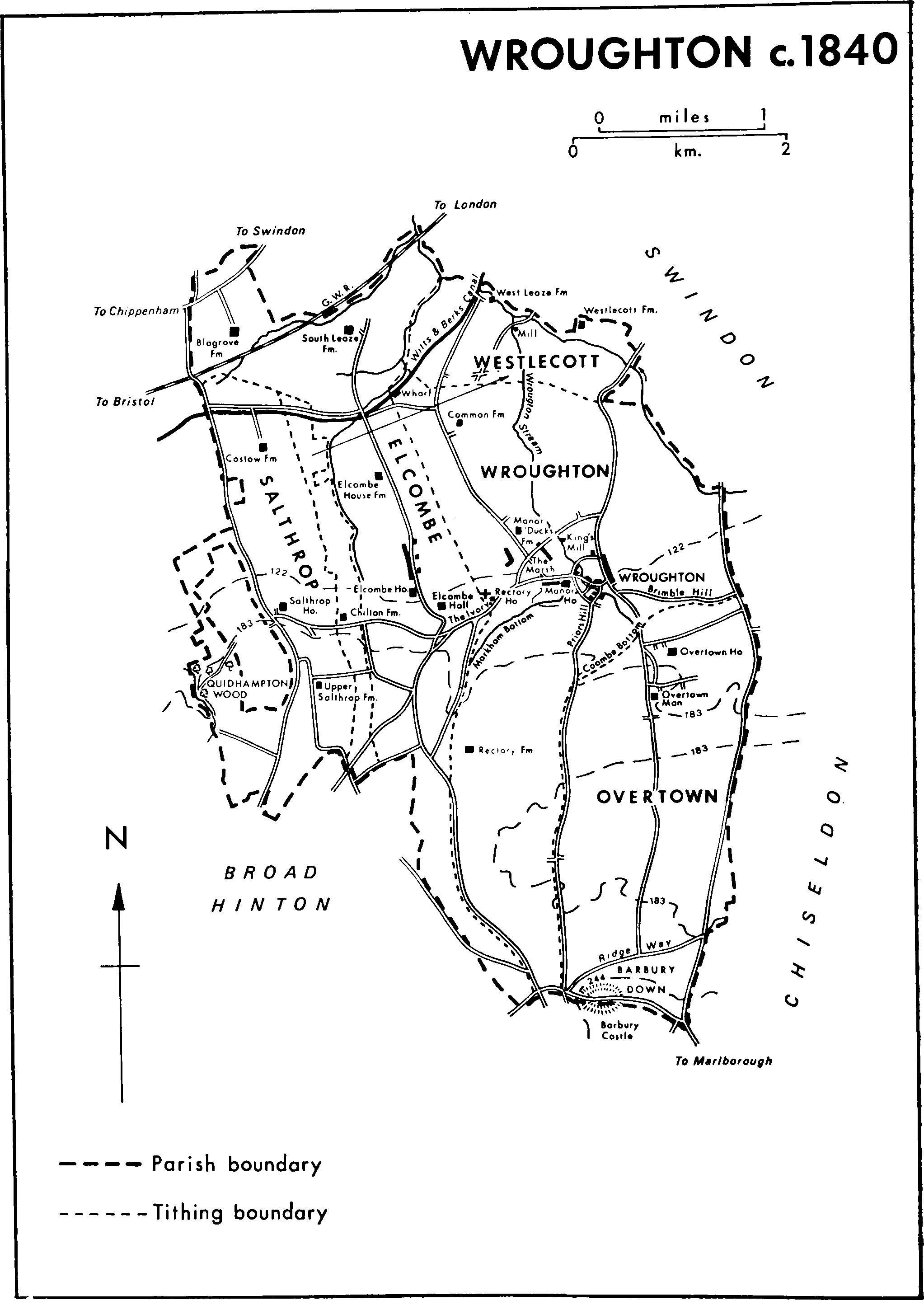
Wroughton c. 1840
In the 13th century the name used for the prior's manor was not Ellendune but Wroughton, but the fact that the manor undoubtedly included Ellendune is shown by the phrase, used in 1270, 'Elendone quod est Worftone'. (fn. 19) Land in Ellendune was given at an early date to the parish church. The connexion between Ellendune and the church, which was usually called Ellendune church until the 19th century, (fn. 20) suggests that the name Ellendune may at some time have been expressly applied to the upland part of the parish where the church stands. The name, thought to mean elder tree down, supports the suggestion, while the name Wroughton, meaning farm on the river Worfe, an early name for the Wroughton stream, presumably refers to the lower part of the parish. (fn. 21) The presence of six mills in Ellendune in 1086, however, suggests that it also embraced the lower part of the parish. It seems that lowland estates were taken from the larger estate called Ellendune, (fn. 22) which encompassed a settlement and the church, and with their farmsteads were called Wroughton, and that they gave their name to the tithing and to all the estates and settlements in it. Although in 1086 Ellendune was only one of six estates within the parish, its name, taking many forms, (fn. 23) was long used for the entire parish. In 1324, for example, Quidhampton was said to lie 'in parochia de Elydon'. (fn. 24) Wroughton began to take over as the parish name towards the end of the 15th century. The form Wroughton alias Elyndon was then frequently used. (fn. 25)
Although Wroughton was the largest of the tithings and contained within it the parish church and the main settlement, Elcombe and Overtown were once fairly populous. In 1334 when Wroughton's contribution to the fifteenth was 1065., Elcombe and Overtown contributed 72s. and 70s. respectively, Westlecott paid 33s. and Salthrop 19s. (fn. 26) In 1377 Wroughton had 160 poll-tax payers, Elcombe 86, Overtown 63, and Salthrop 27. (fn. 27) To the benevolence of 1545 only the contributions of Wroughton, £3 18s. 8d., and Salthrop and Westlecott, both 33s. 4d., are known. (fn. 28) To the subsidy of 1576 Wroughton contributed £7 10s. and Elcombe £3 1s. 8d. (fn. 29) Only in 1841, when 220 labourers working on the G.W.R. line were included in the count, were the populations of the tithings given separately by the census enumerators. Wroughton then had a population of 1,445, Elcombe 348, Overtown 78, Salthrop 56, and Westlecott 36. (fn. 30)
Much of the population made up the labour force required to work the numerous farms in all the tithings and was dispersed. At Elcombe, however, which had a chapel until the 15th century, (fn. 31) there was a small settlement. In the earlier 17th century Elcombe street, as it was then called, leading north from Elcombe Hall to Elcombe common, was lined with cottages on either side. (fn. 32) In 1977 few of those remained and Elcombe consisted mainly of three or four scattered farms.
It has been suggested that a small settlement at Quidhampton (sometimes pronounced 'Quiddington'), (fn. 33) lying below the ridge in Salthrop tithing, was destroyed by a landslide in the 19th century. (fn. 34) Reference to a chapel in the 16th century gives weight to the suggestion that there was a hamlet at Quidhampton, (fn. 35) and a substantial farm-house in the area, perhaps the remains of Quidhampton manor-house, was destroyed by a landslide c. 1822. (fn. 36) At Overtown, which lies entirely on the chalk upland part of the parish, faint traces of earthworks in the park-land south of Overtown House may indicate another small settlement. (fn. 37) The tithing of Westlecott, in two portions, contained no hamlet. Chilton Farm lies in the southern portion. The history of the northern portion, in which lies Westlecott Farm, has been closely connected with that of Swindon within which much of it lay after 1934. (fn. 38)
The road which formed the western boundary of the parish led southwards towards Avebury and the Kennet valley by a route avoiding the highest land of the Marlborough Downs. It now diverges from its old route south of Salthrop House and winds south-eastwards to join the road from Wroughton to Beckhampton, in Avebury. From Salthrop a road ran eastwards across the parish to the church and was known in 1616 as Churchway. (fn. 39) The eastern boundary road climbed to the crest of Barbury down and continued across the downs to Marlborough. It originally entered Wroughton from the north on a direct course from Swindon up Ladder hill. By the later 18th century, when the road was turnpiked, that northern section had been abandoned, and to reach Swindon the road had been diverted westwards down Brimble hill. (fn. 40) It began to lose its position as a main road to Marlborough after 1819 when the road through Badbury, in Chiseldon, was turnpiked. (fn. 41) In 1866 it was still in use as a road to Marlborough, (fn. 42) but in 1977 it led only as far as Barbury Camp country park, established c. 1975, and thereafter became a rough track. Another road leading to the downs made the boundary between the tithings of Wroughton and Overtown. In 1977 it, too, ended on the downs. A small stretch of the main road from Swindon to Chippenham crosses the north-west corner of the parish, and was presumably one of the roads said in 1633 to impede farming in the region. (fn. 43) Apart from that the only main road through the parish in 1977 was that from Swindon, which passed through the village as High Street, and left it up Church Hill for Beckhampton. It was turnpiked in the later 18th century. (fn. 44) A bridge to carry it over the motorway from London to South Wales was built in 1971. (fn. 45)
The Wilts. & Berks. canal was cut across the parish in 1804 with a wharf where coal was the chief commodity handled. (fn. 46) Traffic ceased in 1906 and in 1962 the canal was filled in. (fn. 47) The section of the G.W.R. line from London to Bristol was completed across the parish in 1840. (fn. 48) The line between Swindon and Marlborough, opened in 1881 and closed in 1961, skirted the parish in the north. (fn. 49)
A reservoir for Swindon Water Company's waterworks was constructed on the site of Bedford's mill at the foot of Coombe bottom in 1866. The stream coming from the coomb was thereby dammed. (fn. 50) The reservoir was abandoned in 1971 when the works were no longer in use. (fn. 51)
In 1937 a large area of downland in the south part of the parish was acquired for the R.A.F. as an airfield, and hangars, workshops, and other accommodation for an aircraft supply and servicing depot were built. (fn. 52) No. 15 Maintenance Unit was established there in 1940. From 1941 to 1946 No. 76 Maintenance Unit (Packing Depot) was also at Wroughton. In 1972 the R.A.F. establishment was closed and the airfield and buildings were transferred to the Royal Navy. In 1941 more land in Overtown was taken for an R.A.F. hospital. The hospital was opened with accommodation for 56 patients, but has since been much enlarged. During the war it was used as a casualty clearing station. In 1967 it was renamed Princess Alexandra's R.A.F. hospital and was recognized as a teaching hospital with over 300 beds.
The old village of Wroughton lay at the foot of the greensand escarpment where two streams coming from the chalk, head-streams of the river Ray, met to flow northwards as Wroughton stream. At the same point three roads from the downs converge, and round the rough circle formed by their meeting and along the narrow lanes connecting them the earliest village was sited c. 400 m. from the church. The manor-house of the Winchester cathedral manor, (fn. 53) demolished in 1961, stood in the middle of the village at the foot of Prior's hill, with a large rectangular moat, presumably on the site of its medieval predecessor, beside it. Two of the parish's eight mills, with their substantial mill-houses, stood within the village where the network of narrow lanes is closely built up with cottages and small houses mostly of 18th- and 19th-century origin. The road leading from the village to the church, in 1977 called High Street, was probably built up early. In 1773 it was lined with houses on both sides. (fn. 54) A fire destroyed many of the thatched houses in the street in 1896. (fn. 55) A few remain. During the 18th century many cottages were built on the common and around the Marsh, an area north of High Street where Markham Road and Wharf Road ran in 1977. (fn. 56)
In 1801 the population of the parish was 1,100 and by the middle of the 19th century 1,645. (fn. 57) The building of the canal and wharf early in that century had led to a little development along Wharf Road. In the second half of the century New Swindon rose as an industrial centre but, apart from some housing near the boundary with Old Swindon in an area now called North Wroughton, and the building of a few large houses, such as Wroughton Hall, (fn. 58) in the middle of the village, Wroughton showed little sign of growth. Alfred Williams, writing c. 1913, remarked that the agricultural workers lived in the old cob and thatch cottages in the village, while those working in Swindon lived lower down in houses of brick and tile. (fn. 59)
In 1901 the population was 2,448. The first large development of council housing occurred in 1921 when Perry's Lane was built up. (fn. 60) At about the same time vacant sites within the village were used for small private houses. The boundary changes of 1928 and 1934 made little difference to Wroughton's population as only 30 people were transferred to Swindon. In 1951 the population was 4,085. By 1961 it had risen to 5,108 (fn. 61) and the 1960s were the period of Wroughton's great expansion. Coventry farm, Manor (formerly Duck's) farm, and part of Berkeley farm, north of the old village, were developed as private estates. Houses were built on the site of the manor-house and in 1973 its moat was planted as a small public garden. Council development took place along Wharf Road and associated roads to its west. (fn. 62) By 1971 the population had risen by over 3,000 to 8,263. (fn. 63) In 1973 Wroughton was provided with a new shopping centre built in the grounds of the former Wroughton Hall and on land east of it. A new library and a community centre were part of the same complex. Apart from the expansion of Wroughton village and housing for service personnel on the downs, there has been little building elsewhere in the parish in the 20th century. In 1975 Thamesdown Borough Council purchased all the land in Wroughton north of the railway line for housing development which had been begun by 1977. (fn. 64)
Manors and other Estates.
A charter of King Ethelwulf of 844 granting 30 hides at Ellendune to the church of Malmesbury is thought to contain much spurious material, and there is no evidence to confirm that Ellendune belonged to Malmesbury. (fn. 65) In 956 King Edwy granted 30 hides in the same place to his thegn Elfheah. (fn. 66) By his will of 968 X 972 Elfheah gave the land back to the king. (fn. 67) In 1086 the bishop of Winchester held those 30 hides which had been assigned for the support of the monks of the cathedral priory. (fn. 68)
The manor held by the bishops for the monks was called, not Ellendune, but WROUGHTON. (fn. 69) In the early 13th century the prior was receiving the profits of the manor, (fn. 70) and in 1242–3 he was said to hold the township of Wroughton in chief. (fn. 71) Disputes between the prior and the bishop made necessary a papal confirmation of the priory's right to administer its own estates, (fn. 72) and in 1284, when the disputes were ended, the bishop surrendered to the prior all his rights within Wroughton manor except those of warren and chase. (fn. 73)
At the Dissolution Wroughton was granted to the newly formed chapter of Winchester cathedral. (fn. 74) Upon the commutation of chapter estates in 1861 it passed to the Ecclesiastical Commissioners. The manor then comprised 1,140 a. The manor-house and 615 a., including 99 a. of copyhold land, were sold by the commissioners in 1864 to William Wyndham Codrington (d. 1905) whose ancestors had been lessees of the demesne land since 1813. (fn. 75) The remaining copyhold lands were enfranchised.
W. W. Codrington bought the land of the rectory estate, of which he was lessee, shortly after he bought Wroughton manor, (fn. 76) and the two estates were merged. Codrington was succeeded by his son William Frederick (d.s.p. 1947), who in 1911 sold Hackpen farm, part of Wroughton manor, to John Dixon of Chiseldon. (fn. 77) In 1919 Codrington sold Wroughton House with some land to his cousin Claude Alexander Codrington (d. 1955). (fn. 78) Rectory farm was sold in 1920 to E. Manners, who sold it in 1937 as part of the site for Wroughton airfield. Wharf and Common farms, parts of the manor, were sold in 1919 to the county council as part of its smallholdings scheme. In 1977 they still belonged to the council. (fn. 79)
In the early 17th century the chief messuage and the demesne lands of the manor were leased to Giles Franklyn. (fn. 80) In 1631 one Chadwell was lessee, perhaps the Edmund Chadwell who was lessee in 1649. (fn. 81) Chadwell was followed as lessee by Gabriel Stert. (fn. 82) In 1771 the lessee was Hill Haggard and in 1785 Arthur Evans. (fn. 83) Evans was succeeded in 1792 by his widow Catherine who in 1813 was followed as lessee by Mary Codrington. (fn. 84) Mary's son William (d. 1842) and grandson W. W. Codrington succeeded her as lessees. (fn. 85)
Expenditure on repairs in the 15th century suggests that the prior of Winchester had a large house in Wroughton. A great gate giving entrance to a courtyard and a large barn are mentioned in 1488. (fn. 86) In 1649 the house had a hall, a parlour, and seven chambers as well as various smaller rooms and many outhouses. It had a dovecot, fishpond, and large moat. (fn. 87) When sold in 1916 it was described as gabled, with stone tiled roofs, and with much interior panelling, and it had recently been restored. (fn. 88) It was demolished in the 1960s. (fn. 89)
In 1086 an estate of 10 hides at Wroughton was held by Alfred, a king's thegn. In 1066 two other Englishmen, Bricnod and Alwin, had held it. (fn. 90) The estate, which cannot be located positively, perhaps lay in Lower Wroughton. (fn. 91) It may have been detached from the bishop of Winchester's demesne at an early date, (fn. 92) but seems to have been reunited with the manor.
Godric held 1½ hide of the bishop of Winchester's demesne in Ellendune in 1066. Free tenure of the land was created after the Conquest and an unnamed knight held it in 1086. (fn. 93) It was probably the land which Walter Daundely held of the bishop in 1242–3. (fn. 94)
In 1275, when it was held by Robert Daundely, it was said to be in Lower Wroughton, (fn. 95) and it was later called the manor of LOWER WROUGHTON. (fn. 96) By the 1280s Robert had been followed by another Walter Daundely. The bishop then relinquished all claim to Wroughton manor to the prior of St. Swithun's, and Daundely's land, while still said to be held of the bishop, was expressly said to lie within the prior's manor. (fn. 97) Although the descent of Lower Wroughton is not thereafter clear, the Daundelys' heirs were the Bayntons and it was presumably by inheritance that the manor was held by Nicholas Baynton in 1401. (fn. 98) John Baynton, Nicholas's grandson, held it of the prior of St. Swithun's in 1428. (fn. 99) It passed with the Baynton's manor in Overwroughton until the attainder of Sir Robert Baynton in 1471, (fn. 100) but never seems to have been restored to a Baynton. It may afterwards have been merged in Wroughton manor.
The estate in Wroughton held by sinecure rectors consisted of the great and some of the lesser tithes of the parish. (fn. 101) A landed estate was mentioned in 1249. (fn. 102) Under inclosure awards of 1796 and 1797 the rector received land in place of tithes. (fn. 103) The remaining tithes were converted into a rent-charge of £570 in 1843. (fn. 104) After the abolition of the sinecure rectory in 1840 the estate, consisting of over 600 a. and the rent-charge, passed to the Ecclesiastical Commissioners. (fn. 105) In 1869 the commissioners sold the land, Rectory farm, to William Wyndham Codrington (d. 1905), already the lessee. (fn. 106) It was merged with Wroughton manor as the Codrington estate.
The rectory estate was leased to Giles Franklyn early in the 17th century and continued to be leased to the Franklyn family at least until 1782. (fn. 107) By 1786 Sarah Franklyn had been succeeded as lessee by William Codrington (d. 1802). (fn. 108) Thereafter Codringtons remained lessees until 1869.
The rectory-house, immediately east of the church, has been renamed Wroughton House. In 1671 it was described as an old mansion-house. (fn. 109) It may have been largely rebuilt soon afterwards for the main block of the present house dates from c. 1700 and has an elevation of five bays with north and south entrances. Later in the 18th century, perhaps when William Codrington became lessee, extensive additions were made to the east and north-east, mainly to provide service rooms. (fn. 110) Further small additions were made beyond them in the earlier 19th century. In all the new work the external details of the old house were reproduced. At the same time the principal rooms were remodelled and refitted. In 1977 the service wings were being converted into two houses.
Elcombe was among the estates which had belonged to Earl Aubrey de Couci but which he had forfeited some years before 1086. (fn. 111) Many of those estates had belonged before the Conquest to an Englishman, Harding. By 1130 they had passed to Robert, earl of Leicester (d. 1168). (fn. 112)
In 1206–7 the honor of Leicester was divided between the sisters of Robert, earl of Leicester (d.s.p. 1204). Two virtually new honors resulted from that partition, those of Leicester and of Winchester. (fn. 113) The overlordship of ELCOMBE was at different times ascribed to both. In 1242–3 it was said to belong to Simon de Montfort, earl of Leicester, and in 1361 was considered to have passed with other Leicester lands to Henry, duke of Lancaster. (fn. 114) When last heard of in 1467 the overlordship was said to belong to the duchy of Lancaster. (fn. 115) Between 1264 and 1362, however, it was sometimes said to belong to the heirs of Roger de Quency, earl of Winchester (d. 1264), son of Saier de Quency, earl of Winchester (d. 1219), to whom some of the Leicester lands had passed at the partition of 1206–7. (fn. 116)
In 1167–8 Elcombe was held of Robert, earl of Leicester, by William Lovel or d'lvry. (fn. 117) William, whose family came from Ivry-la-Bataille (Eure), had married Robert's sister Maud. (fn. 118) By 1170 William had been succeeded by his son Waleran d'lvry. (fn. 119) Waleran was succeeded before 1177 by his brother William Lovel (d. 1213). (fn. 120) William was followed by a son John (d. by 1252) and a grandson Sir John Lovel (d. 1287). (fn. 121) His great-grandson John Lovel became Lord Lovel, on whose death in 1310 Elcombe passed as dower to his widow Joan (d. 1348). (fn. 122) Lord Lovel was succeeded by a son John (d. 1314) and a grandson John (d. 1347). (fn. 123) John (d. 1347) was succeeded by his son John who died a minor and unmarried in 1361 to be succeeded by his brother John. (fn. 124) That John, Lord Lovel, died in 1408 holding Elcombe jointly with his wife Maud to whom the manor was delivered. (fn. 125) After Maud's death in 1423 Elcombe passed to her grandson William, Lord Lovel, and from father to son in the Lovel family to Francis, Lord Lovel. (fn. 126) Francis, created Viscount Lovel in 1483 by Richard III, with whom he was in high favour, was attainted in 1485 and afterwards disappeared, having presumably been killed at the battle of Stoke in 1487. (fn. 127)
Between 1485 and 1499 the profits of the manor were taken by Sir John Cheyne (created Lord Cheyne in 1487, d. 1499). (fn. 128) They were taken by the king from 1499 to 1512 when the manor, with other lands formerly Viscount Lovel's, was granted to William Compton (knighted in 1513) and his wife Werburgh, formerly wife of Sir Francis Cheyne. (fn. 129) Sir William Compton was succeeded in 1528 by his son Peter, and Peter in 1544 by his son Henry, later Lord Compton. Henry died in 1589 and his son William, Lord Compton (d. 1630), sold Elcombe in 1605 to Thomas Sutton (d. 1611). (fn. 130) Sutton was the founder of the London Charterhouse and Elcombe was one of the manors with which he endowed his foundation. It remained part of the Charterhouse estate until 1919 when it was sold to the Wiltshire county council to provide smallholdings for discharged soldiers. (fn. 131) Elcombe Hall was sold in 1924 to Mrs. I. D. Taylor, and in 1977 was the home of Dr. W. L. Calnan. Land in the south part of the estate was sold in 1922 and more in the north part in 1973 and 1975, but in 1977 the county council still owned nearly 2,000 a. in Elcombe. (fn. 132)
Elcombe Hall was built in the earlier 19th century on the site of an older house of which nothing remains above ground. In 1616 a house of about the same size stood on the site. (fn. 133)
In 1066 Salthrop belonged to Ulwin. In 1086 it was held in chief by Humphrey Lisle. (fn. 134) It passed with the rest of Humphrey's fief, which included Castle Combe, to the Dunstanvilles and in 1242–3 was held by Walter de Dunstanville (d. 1269). (fn. 135) The manor of SALTHROP descended with the barony of Castle Combe and was conveyed with it in 1309 by William de Montfort, son of Parnel de Dunstanville and Robert de Montfort, to Bartholomew of Badlesmere, Lord Badlesmere. (fn. 136) It was probably among those Castle Combe estates which passed after the execution of Badlesmere in 1322 to the Despensers. (fn. 137) It was certainly restored, after the elder Hugh le Despenser's death in 1326, to Badlesmere's widow Margaret as dower in 1331. (fn. 138) It passed to Margaret's son Giles, Lord Badlesmere (d.s.p. 1338), and to her daughter Margaret (d. 1344), wife of John Tybotot, Lord Tybotot (d. 1367). (fn. 139) The last reference to the overlordship occurs in 1370 when it was held by Robert, Lord Tybotot (d. 1372). (fn. 140)
As part of the barony of Castle Combe Salthrop, reckoned a single fee, was held in 1242–3 by Geoffrey Bluet. (fn. 141) In 1275 the fee was said to be divided between Robert Bluet and the abbot of Stanley, most of whose land, however, lay in the neighbouring parish of Lydiard Tregoze. (fn. 142) In 1281 Salthrop was settled on Peter Bluet and his wife Lucy. (fn. 143) In 1311 it was settled on Peter and Lucy for life with remainder to William Everard and his wife Beatrice. (fn. 144) Peter was dead in 1329 but Lucy lived until 1337. (fn. 145) She was succeeded by William Everard. (fn. 146) William died in 1343. (fn. 147) His son, Sir Edmund Everard, died in 1370 holding the manor jointly with his wife Felice and leaving as heirs his sisters, Elizabeth, wife of Robert of London, and Margaret, widow of Thomas of Ramsbury. (fn. 148) It is possible that Margaret left no issue, for in 1380 Salthrop was settled on Robert and Elizabeth. (fn. 149) They left no issue and their estates were evidently divided; some manors passed by a sister of Robert to the Calston family and thence to the Darells of Littlecote in Ramsbury, but others, including Salthrop, passed in a way which is not clear to the Lovel family. (fn. 150) Salthrop was held by John, Lord Lovel, jointly with his wife Maud at the time of his death in 1408. (fn. 151) Thereafter it followed the same descent as Elcombe manor and the Charterhouse was endowed with it in the early 17th century. (fn. 152)
In 1739 Thomas Bennet, whose ancestors had been lessees of Salthrop from at least 1616, exchanged the manor with the governors of the Charterhouse for his manor of Costow. (fn. 153) Bennet's heir was his daughter Martha (d. 1787) who married Peter Legh (d. 1754). Their daughter Elizabeth married Anthony James Keck, and secondly William Bathhurst Pye who took the name Bennet. (fn. 154) Elizabeth's daughter Elizabeth Keck married Thomas Calley (d. 1836) of Burderop in Chiseldon, thereby bringing Salthrop into the Calley family. (fn. 155) Thomas's son, John James Calley (d. 1854), sold the manor to Arthur Wellesley, duke of Wellington (d. 1852), whose son Arthur, duke of Wellington, sold it in 1861 to M. H. N. Story-Maskelyne (d. 1911). (fn. 156) In 1976 it was owned by Mr. N. M. Arnold-Forster, a direct descendant of Story-Maskelyne. (fn. 157)
Salthrop House occupies a site where there was a large house in the earlier 17th century. (fn. 158) The present house has an ashlar faced main block of c. 1795 in the style of James Wyatt. (fn. 159) The entrance front to the west is of three bays with a central bow, whilst the north and east fronts are of four and five bays respectively. The house has a principal room at each corner and a curved central staircase below an oval skylight. Most of the original fittings survive. In the later 19th century a grey-brick service wing was added to the north.
Although not named in Domesday Book, the lands on which the manors of Quidhampton and Costow were based were probably included in Humphrey Lisle's Salthrop and Overwroughton holdings in 1086. (fn. 160) They passed with those holdings to the barony of Castle Combe. (fn. 161)
The overlordship of QUIDHAMPTON passed with the rest of the Castle Combe lands to Bartholomew, Lord Badlesmere. (fn. 162) After the death without issue of Giles, Lord Badlesmere, in 1338 Quidhampton formed part of the dower of his widow Elizabeth. (fn. 163) Later, on the partition of his lands among his sisters in 1341, it was allotted to the eldest sister Margery, wife of William de Ros, Lord Ros of Helmsley (d. 1343). (fn. 164) There is no later reference to a lord of Castle Combe as overlord. In 1472 the manor was said to be held of the prior of Bradenstoke, (fn. 165) and, probably erroneously, in 1506 of the abbess of Wilton, and in 1616 of William Herbert, earl of Pembroke, who was successor to the abbess's estates. (fn. 166)
Quidhampton was named as a separate estate in the later 13th century when it was held by Richard of Highway. Richard gave some part of it in 1269 to Stanley Abbey, reserving for himself the hall, ox-house, and western part of the court. (fn. 167) Richard's son William acquired more land in Quidhampton in 1304 when he conveyed all his land there to his son Richard. (fn. 168) In 1324 the estate passed from Richard of Highway to John Goudhyne who granted it in 1337 to Robert Russell. (fn. 169) Robert was dead in 1364, and in 1412 Thomas Russell held what was then called Quidhampton manor. (fn. 170) Thomas was followed by John Russell, but in 1473 the lordship of the Russells came to an end. In a way no longer understood John Collingbourne made good a claim to be John Russell's heir. (fn. 171) His successor, William Collingbourne, was attained and executed for his support of Henry Tudor. (fn. 172) After Bosworth, however, his lands were restored to his heirs, (fn. 173) and in 1489 Quidhampton was held by his daughter Margaret and her husband George Chaddington. (fn. 174) George and Margaret sold the manor in 1502 to Sir Bartholomew Reed (d. 1506), an alderman and goldsmith of London. (fn. 175) Reed settled Quidhampton on his wife Elizabeth for life with remainder to his nephew William Reed. (fn. 176) By 1543 William Reed had been succeeded by John Reed and in 1582 a John Reed sold the manor to Thomas Crane. (fn. 177) In 1596 Crane devised it to his daughter Sarah. (fn. 178) Sarah married William Brocket and in 1603 they sold the manor to Richard Spenser (d. 1616), (fn. 179) members of whose family had been lessees since 1543. (fn. 180) Spenser was succeeded by his son John, (fn. 181) who died in 1628 having settled the estate on his wife Ann for life. (fn. 182) His son John, a minor in 1628, sold it in 1648 to Sir Thomas Bennet (d. 1670). (fn. 183) Quidhampton thereafter passed with Costow manor and from 1739 with Salthrop manor. (fn. 184)
The lands on which the manor of COSTOW was based, probably part of the Overwroughton and Salthrop holdings of Humphrey Lisle in 1086, passed to the Dunstanvilles, lords of Castle Combe. (fn. 185) Walter de Dunstanville (d. 1269) held land in Costow which he granted to Stanley Abbey. (fn. 186) On the partition of the Castle Combe estates among the heirs of Giles, Lord Badlesmere, the overlordship of Costow was awarded to his sister Maud, wife of John de Vere, earl of Oxford (d. 1360). (fn. 187) It passed to John's son Thomas, earl of Oxford (d. 1371), (fn. 188) but was apparently forfeited by his grandson Robert de Vere, earl of Oxford (d.s.p. 1392), who was found guilty of treason and deprived of all honours and estates. (fn. 189) It was held by Thomas Beauchamp, earl of Warwick (d. 1401), at the time of his death but no later reference to it has been found. (fn. 190)
Costow was referred to by name in 1182 when a grant of 1 hide there by Roger son of Geoffrey to Bradenstoke Priory received papal confirmation. (fn. 191) Whether this land was part of the Dunstanville estate is not known. The grant was again confirmed by bull in 1184. (fn. 192) Bradenstoke still had land there in 1231 when a tenement was disputed by the prior and the abbot of Stanley. (fn. 193) Costow was not afterwards named as a Bradenstoke estate, and the priory either lost it or it was merged in the adjoining estate of Chaddington in Lydiard Tregoze which also belonged to Bradenstoke. (fn. 194)
Besides the land granted by Walter de Dunstanville, Stanley Abbey was granted land in Costow by John son of Peter, a grant confirmed in 1227. (fn. 195) Stanley retained the estate called Costow until the Dissolution when, with some of the abbey's estates in Lydiard Tregoze, it was granted to Edward Seymour, Viscount Beauchamp (from 1537 earl of Hertford, from 1546 duke of Somerset, the Lord Protector, d. 1552). (fn. 196) It passed to Somerset's son, Edward Seymour, earl of Hertford (d. 1621), who sold it in 1608 to Sir John Bennet (d. by 1627). (fn. 197) Sir John settled the farm on his son William in 1621 and William devised it in 1635 to his brother Sir Thomas Bennet. (fn. 198) Sir Thomas (d. 1670) was succeeded by his son Thomas (d. 1703). (fn. 199) In 1739 Costow was exchanged for Salthrop manor by Thomas Bennet, probably the son of Thomas (d. 1703). (fn. 200) Upon that exchange Costow farm became part of the Elcombe estate of the Charterhouse. (fn. 201)
A small estate in Costow called Cockharis was held in 1539 by Michael Quintin who leased it to John Sadler. (fn. 202) In 1560 Quintin sold it to John's widow Agnes and son Thomas. (fn. 203) Anthony Sadler, Thomas's son, sold the estate in 1597 to William Bennet (d. 1608). (fn. 204) At the same time Anthony and his brother William assigned to Bennet their lease of Costow farm. (fn. 205) From 1608 the Cockharis estate and Costow farm were held by Sir John Bennet, William's brother, and they descended together. (fn. 206)
Costow Farm appears to have stood further north in the earlier 17th century. (fn. 207) The present substantial brick house is of the late 18th century or the early 19th.
Overwroughton was held in 1086 by Humphrey Lisle and of him by Robert. In 1066 it had been held by Alnod. (fn. 208) Like Salthrop it became part of the barony of Castle Combe and the overlordship of the two estates followed the same descent. (fn. 209)
A knight's fee in OVERWROUGHTON was granted early in the 12th century to Tewkesbury Abbey by Adelize, wife of Robert de Dunstanville, and probably heir of Humphrey Lisle. (fn. 210) It was confirmed to the abbey by Walter de Dunstanville, probably him who died in 1195. (fn. 211) Tewkesbury retained a manor in Overwroughton until the Dissolution. (fn. 212)
In 1540 the site of the abbey's manor and lands called Turneys and Uffcott were granted to William Richmond alias Webb (d. 1579). (fn. 213) In 1546 William conveyed the same estate to Sir George Baynham. (fn. 214) Sir George died in 1546, leaving a son and heir Christopher, then a minor. (fn. 215) In 1554 Christopher Baynham conveyed half the manor with half of Turneys and Uffcott to Thomas Sadler. The remainder he sold in equal portions to William and John Sadler, Thomas's brothers. (fn. 216) In 1584 there was some repartition of the property among the Sadlers, the exact outcome of which is unknown. In 1611 Robert Sadler, perhaps Thomas's grandson, and his wife Grace conveyed his share to a John Sadler. (fn. 217) In 1627 an estate described as the capital messuage, farm, and premises of Overtown, then replacing the earlier name of Overwroughton, was conveyed by a John Sadler of Overtown and his wife Susan and a William Sadler and his wife Joan to William Calley (knighted 1629, d. 1641) of Burderop. (fn. 218) That conveyance, however, does not seem to have included all the estate that had been granted to William Richmond alias Webb at the Dissolution. In 1631 Oliver Richmond Webb (d. 1635), William's great-grandson, sold 172 a., said to be parcel of the farm, to Sir William Calley. (fn. 219) From Sir William Overtown House and farm passed in the Calley family in the same way as Burderop to Joan Marion Calley. (fn. 220) She died unmarried in 1973 and was succeeded by her kinsman Sir Henry Langton (since 1974 Sir Henry Calley).
A house of the earlier 17th century is represented by the south-eastern corner of the present Overtown House. It had a short east range with a central entrance and a longer wing to the west. Late in the 17th century a west range was added and a new staircase was placed in the west end of the old house. The open court formed by the three ranges was built over in the 18th century, partly to house a new main stair. About 1800 low projecting wings of red brick were added to each end of the east front. In the earlier 19th century the west range was extensively remodelled, both inside and out. The house was completely reroofed in 1976–7.
The earl of Gloucester held a fee in Overwroughton in 1275. (fn. 221) Only one other reference to the Gloucester overlordship has been found: in 1428 John Baynton was said to hold lands in Overwroughton, sometimes called ROCHES manor, of the honor of Gloucester. (fn. 222) Baynton's estate, however, was held of several lords and there was probably confusion about the overlordship.
In 1331 John Turney settled an estate, called the manor of Overwroughton, on himself for life with remainder to Gilbert of Berwick. (fn. 223) A John Turney still held land in Overwroughton in 1336, it was said of the abbots of Hyde and Tewkesbury. (fn. 224) Gilbert had possibly succeeded to the Turney estate by 1353, (fn. 225) and in 1356 he was said to hold Overwroughton manor of the prior of Farleigh. (fn. 226) In 1359 what was presumably another estate, also called Overwroughton manor, was conveyed to him by Sir John FitzPayne and Joan his wife. (fn. 227)
When Gilbert of Berwick died in 1361 his estate in Wroughton was said to be held of the priory of Newent (Glos.), an alien priory of the Norman abbey of Cormeilles, which had land probably near Barbury Castle. (fn. 228) The estate passed to his daughter Agnes and her husband John de la Roches and to his grandson Sir John de la Roches. (fn. 229) Sir John settled it in 1399 on himself, his wife William, and their son. (fn. 230) He died in 1401 (fn. 231) and William in 1410 when, reckoned as half Overwroughton manor and called Roches manor, the estate was held of Tewkesbury Abbey. (fn. 232) At William's death the Rocheses' heirs were Sir John's daughter, Elizabeth, wife of Walter Beauchamp (d. 1430), and John Baynton, son of Elizabeth's sister Joan. (fn. 233) In 1412 Walter Beauchamp held the Overwroughton manor, (fn. 234) but by 1428 John Baynton (d. 1465) had come of age and the estate had passed to him. (fn. 235) Sir John held Lower Wroughton manor as well as the Rocheses' half of Overwroughton manor. (fn. 236) The two estates passed like Faulston manor in Bishopstone at least until 1485. (fn. 237) In 1536 land in Wroughton was acquired by Sir Edward Baynton, Sir Robert's grandson, along with lands formerly belonging to Stanley Abbey. (fn. 238) Sir Edward's manor in Overwroughton was probably smaller than the earlier Roches manor and at his death in 1545 was said to be held of Chiseldon manor. (fn. 239) In 1547 Sir Edward's son Andrew conveyed the manor to William Sharington. (fn. 240) Sharington was attainted soon afterwards, and although most of his lands were restored in 1550 his Overwroughton manor was apparently not among them. (fn. 241) What happened to it is not clear but it was perhaps acquired by William Richmond alias Webb after he had conveyed c. 1546 most of the Overwroughton manor which had belonged to Tewkesbury Abbey.
When Richmond alias Webb died in 1579 he held an estate in Overwroughton which was described as a manor and could have been Roches since in 1635 it was said to be held of Chiseldon manor. (fn. 242) From him the Overwroughton manor passed to his son Thomas, (fn. 243) from Thomas (d. before 1564) to his son Edmund (d. 1621), (fn. 244) and from Edmund to his son Oliver (d.s.p. 1635). Oliver settled the manor on his nephew Edward Richmond Webb (d. 1645). (fn. 245) It passed to Edward's great-grandson, Borlase Richmond Webb (d. 1737), (fn. 246) who sold it in 1733 to Peter Delmé. Delmé sold it in 1779 to George Boughey. (fn. 247) In 1795, after Boughey's death, the estate, called Overtown farm, was sold to the tenant Thomas Washbourne. (fn. 248) It remained in the Washbourne family at least until 1859. (fn. 249) By 1870 it had been bought by a Mr. Kemble and in 1882 Henry Kemble, probably his son, owned it. (fn. 250) Several owners followed. In 1919 it was bought by F. T. White who in 1920 added Parslo's and Mudgell farms to his estate. (fn. 251) In 1977 the farm, known as Overtown Manor, belonged to his grandson Mr. J. F. F. White.
Overtown Manor is an L-shaped house of the early 17th century. It was extended to the east, probably in 1693 when the north front was reorganized as seven bays with a central entrance. There was an extensive renewal of the fittings soon after 1800 when the entrance was moved to the west front. In 1879, when the Kembles lived in the house, the south wing was demolished and rebuilt to a larger scale to provide new principal rooms.
Thomas Sadler owned land in Overwroughton in 1699. (fn. 252) By 1780 he had been succeeded by William Sadler. (fn. 253) William conveyed the estate, then called the manor of Overwroughton, to William Powell Bendery in 1787. (fn. 254) Bendery had been succeeded by 1819 by a member of the Brook family. (fn. 255) In 1843 the estate belonged to Samuel Brook. (fn. 256) In 1859 it belonged to Edwin Parslo and was known as Parslo's farm. (fn. 257) In 1937 most of its land was sold to make Wroughton airfield.
In 1086 one Harold held an estate of 5 hides in WESTLECOTT of Hugh the Ass. In 1066 it had been held by Levric. (fn. 258) In the 13th century there were two holdings in Westlecott. In 1224–5 John son of Simon was at variance with Geoffrey Bluet and Alice his wife over half the manor. (fn. 259) John is to be identified with John of Fifhide who in 1228 renounced his right in half the manor to Geoffrey, who was to hold it of Alan Basset. Basset was apparently overlord in the right of his wife Aline, (fn. 260) and the overlordship descended like Wootton Bassett manor until at least 1336. (fn. 261)
Geoffrey Bluet still held the moiety in 1242–3. (fn. 262) In 1281, like Salthrop manor, it was settled on Peter Bluet and his wife Lucy, (fn. 263) and from that date the two estates passed in the same way. (fn. 264) In 1370 land said to be in Chilton formed part of the Westlecott estate and in the 15th century Chilton, which was sometimes described as a manor, appears as the name for that moiety of Westlecott. (fn. 265) That connexion between Westlecott and Chilton presumably accounts for the fact that Chilton farm was a detached part of Westlecott tithing in the 19th century. (fn. 266)
The other moiety of Westlecott manor was held in 1242–3 by Amfelice Pilk. (fn. 267) In 1262 it was held by Roger, son of William Lof. (fn. 268) Roger sold the estate to Katharine, relict of John Lovel, who granted it to Lacock Abbey. (fn. 269) Her brother Philip Basset (d. 1271) released the nuns from service due to his manor of Wootton Bassett. (fn. 270) Westlecott was held by the abbey until the Dissolution. (fn. 271) In 1540 it was granted to the lessee, John Goddard, (fn. 272) whose son Thomas (d. 1598) bought Swindon manor. Westlecott descended like Swindon, (fn. 273) and Westlecott farm remained part of the Goddard estate in 1977. (fn. 274)
The manor-house, which in 1977 stood in Westlecott Road in the suburbs of Swindon, was enlarged and remodelled in 1926. The main doorway and the south-facing walls are, however, probably of the later 16th century. A stone, possibly not in situ, on the south front bears the initials of Thomas Goddard and the date 1589. The Goddards may have lived in the house before moving to the manor-house in Swindon. (fn. 275) The house was a private nursing-home for a time in the 1960s, but in 1977 was in private occupation. (fn. 276)
Economic History.
The largest estate in Wroughton in 1086 was that of 30 hides held by the bishop of Winchester for the benefit of the monks of St. Swithun's. The demesne was assessed at 15 hides and on it there were 3 serfs and 4 ploughs. Beyond the demesne there were 25 villeins and 14 bordars with 7 ploughs. There were 60 a. of meadow, and pasture ½ league long by 3 furlongs broad. There were 20 a. of wood. The estate had appreciated from £14 in 1066 to £18. In Lower Wroughton the estate assessed at 10 hides held by a king's thegn had land for 4 ploughs, supported 5 serfs, 3 villeins, and 3 bordars, and in 1086 was worth £5. There was 1 plough on the estate assessed at 1½ hide. (fn. 277)
In the 13th century the prior of St. Swithun's manor probably included all those lands except the 1½ hide and a small estate taken to endow Wroughton church. In 1210 the manor, valued at £25, was the fourth most valuable among the priory's Wiltshire estates. Assized rents amounted to £13. The stock included 22 oxen, 100 sheep, and 16 pigs. Two bailiffs (custodes) were in charge. (fn. 278) Slightly later there were nine customary tenants, including four millers, nearly all of them with holdings of ½ hide. All paid small rents and owed much labour service, for which they received allowances of food and drink. Most of their arable land was divided between two fields. Some seventeen virgaters held land likewise distributed, and owed smaller amounts of rent and service. They were allowed to use the marsh for their sheep after Lammas, and could keep their flocks on their own land for the rest of the year. There were about eighteen cottars holding a few acres each in the two fields, and paying small rents or performing labour services. From that group were drawn farm servants such as ploughmen, shepherds, and cowmen. (fn. 279)
By 1387 the priory had leased the demesne, and had probably been doing so for some time. (fn. 280) The manor continued to be supervised by the prior's officers who visited regularly to audit accounts and hold courts. (fn. 281) In 1541 Wroughton, rated at about £31, was the second most highly valued of the dean and chapter of Winchester's Wiltshire estates. The demesne was leased for £10 13s. 4d., but the farmer was allowed 10s. for collecting rents due to St. Swithun's, and 6s. 8d. for a livery gown ('pro toga sua'). (fn. 282) The 6s. 8d. was still being allowed in 1649. (fn. 283)
Because the manor extended over the whole length of the parish it contained a good balance of soils. (fn. 284) Sheep-and-corn husbandry could be undertaken in the southern half, and pasture farming on the heavier land in the northern half. In 1649 the demesne farm had four pieces of inclosed pasture, 78 a. in the Lammas meadow, and 300 a. of arable in the common fields. (fn. 285) Later evidence shows one field to have been high on the downs at Hackpen, (fn. 286) and another, called West field, at the bottom of Market hill. (fn. 287) In 1649 there were 20 a. of sheep down for the demesne flock, 70 a. of grazing for cattle, and 30 a. for horses. At that time there were two freeholders and some nineteen copyholds. (fn. 288)
In 1794 the chapter agreed to inclose at the request of William Codrington, the lessee of the rectory estate which then included land scattered throughout the common fields of Wroughton tithing. (fn. 289) The award was made in 1796. Much of the land in the 37 allotments was awarded to the rector, (fn. 290) and 392 a. were awarded to the lessee of the manor. Field names included Great and Little Upper fields, West, Market Hill, and Ladder Hill fields. (fn. 291)
In 1861 Wroughton manor included the manor farm, c. 516 a., and 624 a. of copyhold land. The 615 a. bought by W. W. Codrington in 1864 were merged with Rectory farm. (fn. 292) Most of the remaining land was divided between four or five farms. (fn. 293) The Codrington estate was broken up and sold at sales of 1907, 1911, and 1919. (fn. 294) A large part of the downland was lost to agriculture when the airfield was established in 1937, but Hackpen farm, worked by F. J. Horton & Sons in 1977, continued. (fn. 295) Two farms and part of another were sold for building land in the 1960s, (fn. 296) but in 1977 Common, Wharf, Berkeley, Artis, Wood, and Cowleze were still small working farms. (fn. 297)
The rectory estate consisted of tithes and land. (fn. 298) In 1249 the rector, perhaps occupying his own lands, admitted ploughing one of his meadows and so depriving a tenant of his pasture rights. The rector was ordered to restore the land to pasture. (fn. 299) About 1291 the estate was valued at £33. (fn. 300) In 1341 it included 2 carucates of arable land and some meadow land and pasture. The rents and services of the tenants were valued at 10s. (fn. 301) In 1535 the estate was worth c. £38 gross. (fn. 302) Early in the 17th century the land, 117 a., consisted chiefly of arable, lying scattered in the Upper and Hackpen fields of Wroughton tithing. There was also a plot of marsh in East field, a few dispersed acres of meadow, and 4 a. of inclosed pasture. (fn. 303) Later in the 17th century, when the total area was reckoned at 148 a., there was a little more inclosed pasture. The arable was divided between the Lower field, where a quarter was left fallow each year, and the poorer land of the Upper field, where half was left fallow. (fn. 304) By the Wroughton inclosure award of 1796 the rector was allotted over 550 a. to replace tithes and glebe, and by the Elcombe inclosure award of 1797 was allotted c. 124 a. in place of tithes. (fn. 305) Most of the land formed Rectory farm in Wroughton tithing and became part of the Codrington estate in 1869. (fn. 306) Rectory farm was in 1920 a downland farm of some 450 a., mostly pasture and grazing land. (fn. 307) Since 1937 its land has been covered by the airfield.
Elcombe, at 27 hides, was the second most highly assessed estate in Wroughton in 1086. There were only 5 ploughs although there was land for 8; the demesne of 24 hides was worked by 6 serfs with 2 ploughs, and the remaining land supported 3 villeins and 14 bordars with 3 ploughs. There were 60 a. each of pasture and meadow and 20 a. of wood. The value of the estate had fallen from £27 in 1066 to £24 in 1086. (fn. 308)
In 1172–3 the sheriff rendered account for 68s. rent from Elcombe with 40s. for the farm of the manor at Michaelmas. Stock worth £6 4s. was sold. (fn. 309) In 1287 the manor was said to comprise 140 a. of arable land, 16 a. of meadow land, common pasture for 50 oxen, and an inclosed pasture at Blagrove. The 32 customary tenants held 13 virgates and their works and dues were valued at £9 6s. (fn. 310) The area of the manor referred to in the 14th century was inexplicably variable. (fn. 311) The greatest area of arable land, 350 a., was mentioned in 1348. (fn. 312) Of 80 a. of inclosed pasture in 1362,40 a. lay among the thorns. (fn. 313) In 1310 there were two free tenants, holding 1 virgate and ½ virgate, and 27 customary tenants. (fn. 314) In 1362 there were twenty bond tenants and a free tenant. (fn. 315)
In the 13th century the Lovels had a fishpond at Elcombe which the constable of Marlborough Castle was twice ordered to stock with bream. (fn. 316) They also had a park which, after Francis Lovel's attainder in 1485, was granted for life to a member of the royal household. (fn. 317) The park, which included a rabbit warren, (fn. 318) lay east of Elcombe street and was divided into an upper and a lower park. (fn. 319) It was later merged in Elcombe farm as pasture. (fn. 320)
In the later Middle Ages Elcombe was the centre of an estate which included Salthrop manor and lands at Uffcott in Broad Hinton and at Mannington in Lydiard Tregoze. (fn. 321) By the mid 16th century the Wroughton part of the estate included, besides the demesne farm of Elcombe, two large farms, Salthrop and Chilton. (fn. 322) In 1633 the estate comprised about fourteen farms. The demesne farm measured 251 a., and there was a farm of 129 a. called Elcombe Street farm. Chilton farm, 209 a., had all its arable land consolidated on the downland. On the clay in the north part of the tithing Blagrove farm had been divided into north, west, and east farms, but the pasture of those farms was considered to be the worst on the manor because of its wetness. Farms called South Leaze and West Leaze on the clay west of Blagrove were, on the other hand, reckoned to be excellent pasture farms. West Leaze was formerly called Westcott and was one of the farms of Westlecott manor which became part of the Elcombe estate in the 15th century. (fn. 323) The common pastures of the Elcombe estate were Elcombe Horse hay, Elcombe marsh, Mare leys, Black croft, and a green called Elcombe Street green. The common down was on Markham Down hills. (fn. 324) Throughout the 17th century many of the farms were leased to members of the Sadler family, sometimes one member of the family working more than one farm. (fn. 325) There were some eighteen copyholders occupying 685 a. (fn. 326)
An inclosure award for Elcombe was made in 1797 when some 1,296 a. were inclosed, including the lands in Uffcott but not those in Lydiard Tregoze. (fn. 327) By 1832 many of the farms on the Elcombe estate had been amalgamated. The demesne farm was then known as Upper farm, and Lower farm presumably represented Elcombe Street farm. North and West Blagrove farms were worked together with land in Lydiard Tregoze. South Leaze and East Blagrove farms were worked together. (fn. 328) The closeness of the railway and the nature of the land encouraged a great expansion of dairy farming on all the farms in the late 19th century. (fn. 329) In 1919 the Elcombe estate was broken up when it was sold to the county council for smallholdings. (fn. 330) In 1977 five or six farms were working mainly as dairy and pasture farms.
In 1086 Salthrop was assessed at 10 hides of which 8 were in demesne. On the demesne there were 3 serfs and 2 ploughs and elsewhere on the estate there were 9 bordars and 1 plough. There were 20 a. of meadow and 30 a. of pasture. The value of the estate had fallen to £4 from £5 in 1066. (fn. 331)
From the early 15th century Salthrop was one of the largest farms on the Elcombe estate. (fn. 332) In 1616 Salthrop farm measured 326 a. and its arable and meadow lands, above and below the escarpment, lay intermingled with those of Costow farm, which was not part of the Elcombe estate, and with those of Studley farm in Lydiard Tregoze. The common land of Salthrop was shared between Salthrop and Costow farms. (fn. 333) The land of Salthrop was inclosed and allotted in 1739 and Salthrop and Costow farms were exchanged. (fn. 334) In 1846 Upper Salthrop farm and Quidhampton farm, both downland farms, measured 595 a. and were worked together. (fn. 335) By 1977 they had been amalgamated and with land in Lydiard Tregoze formed Salthrop farm, 500 a. (fn. 336)
In 1086 the estate which later passed to Tewkesbury Abbey was rated at 10 hides, 2 of which were held by a 'Frenchman'. It had land for 4 ploughs. There were 2 ploughs on the demesne of 5½ hides and 6 villeins and 9 bordars also had 2 ploughs. There were 30 a. of pasture and 2 a. of wood. The value of the estate was £5 and had been in 1066. (fn. 337) About 1210 Tewkesbury Abbey's Overwroughton estate was valued at £10. Among the farm stock were 16 oxen, 27 ewes, 20 hoggets, and 15 lambs. Rents of assize totalled £4 13s. 6d. A hayward, carter, and dairyman were among the farm servants. (fn. 338) Shortly before the Dissolution the farm was leased for £11 14s. 8d. (fn. 339) The farm which the Calleys acquired in the 17th century measured 479 a. in the 19th century and had land at Hackpen mead and Hackpen field. In 1853 it had 410 a. of arable land, chiefly for wheat but also bearing crops of beans, peas, clover, and vetches. It was then well cultivated and considered to be a remarkably compact farm, apart from the land at Hackpen. (fn. 340)
The farm held by the Richmond Webbs from the 16th century to the 17th, represented by Overtown Manor farm in 1977, measured nearly 600 a. in the later 18th century. (fn. 341) Part of Parslo's and Mudgell farms were added to it in 1920, but in 1937 much downland was taken for the airfield. (fn. 342) In 1977 Overtown Manor farm, c. 1,000 a., comprised the greater part of the land available for agriculture in Overtown tithing. Overtown House farm lost land to the airfield and had some 120 a. in 1977. (fn. 343)
In 1086 Westlecott was assessed at 5 hides of which 4 were demesne. There was land for 4 ploughs. The demesne supported 1 serf and 1½ plough. There were additionally 3 villeins and 6 bordars with ½ plough. There were 25 a. of meadow and 30 a. of pasture. In 1066 and in 1086 it was worth £2. (fn. 344)
Of the two parts into which the manor had divided by the 13th century (fn. 345) one, containing Chilton and Westcott (later West Leaze) farms, became part of the Elcombe estate in the 15th century. (fn. 346) The other, in the north-east corner of the parish, contained the farm still called Westlecott in the 20th century. It was one of the first farms near Swindon to be acquired by the Goddards and, as their estate there expanded, Westlecott farm was involved in the agrarian arrangements of other farms. (fn. 347) It lay on the southern and lower slopes of Swindon hill and in the 17th century measured c. 166 a., mostly pasture and meadow land. Among the pastures were Cliff pasture and Bushey leaze. (fn. 348) Such arable as it had perhaps lay in West Swindon field, a large arable field of the adjoining Goddard manor of West Swindon, within which was a field called Westlecott. (fn. 349) Arable belonging to Westlecott was said to lie in Swindon in 1836. (fn. 350)
Until the airfield was built over part of the gallops in 1937 there were several training stables for racehorses in Wroughton. (fn. 351) Tom Leader of Fairwater House in the High Street trained the winner of the Derby in 1874. (fn. 352) Horses from the same stables, trained by E. A. Craddock, also won a number of important races. In 1906 the Hon. Aubrey Hastings took over the Barcelona stables in the Pitchens from which he trained several Grand National winners. He was followed in 1929 by Ivor Anthony whose horses maintained a high record of successes. In 1977 horses were bred and trained at Overtown House and Overtown Manor. (fn. 353)
The only large manufacturing industry in Wroughton is the firm of R. A. Lister & Co. Ltd. After the Second World War the firm, which was based in Dursley (Glos.), bought the workshops built for the Admiralty during the war. There they established their subsidiary, Marine Mountings Ltd., manufacturing small internal combustion engines. In 1952 about 350 people were employed. (fn. 354) In 1963 the firm became part of the Hawker Siddeley Diesel Group, but continued in business as R. A. Lister & Co. Ltd. At about the same time it began making diesel cylinders for civil engineering, agricultural, and marine uses. The works were later much enlarged and in 1977 about 750 people were employed. (fn. 355)
A small business making agricultural implements was opened in 1891 in the High Street by H. H. Barrett. From there it moved to Moormead Road where wooden wheels for waggons were made and later trailers for tractors. In 1977 the business was in the same premises, somewhat enlarged, under the management of Mr. Eric Barrett, and employed about 40 people. (fn. 356)
Mills.
There were eight mills on the Domesday estates in Wroughton. Those of Overwroughton and Westlecott each had one, paying 15d. and 5s. respectively, and Ellendune had six, paying together 42s. 6d. (fn. 357) In the earlier 19th century there were still seven mills along the stream which rose in Coombe bottom, joined another in the village, and flowed north to Swindon.
All the mills have had many different names, usually taken from those of their owners or occupiers. A mill owned by three generations of the Freeman family was known as Freeman's mill in 1572. (fn. 358) There were two mills on the dean and chapter of Winchester's manor in 1649. One, occupied by Richard Franklyn, was a grist-mill with 11½ a. attached. The other, described as an overshot gristmill, was occupied by Richard Sadler with 38 a. (fn. 359) Sadler had been accused in 1647 of raising the level of the water passing through his mill to the detriment of the mill above his on the stream. (fn. 360)
In the later 18th century and the earlier 19th the Seymour family worked the mill in Perry's Lane later called King's mill. (fn. 361) It was equipped with a steam-engine in 1860, but soon afterwards ceased working. (fn. 362) In 1977 the mill, of brick with a tiled roof and bearing a date-stone 'J.S. 1771', was occupied as a private house. Considerable 19th-century alterations are evident. In 1820 Thomas Fielden Woodham was milling at the mill later called Woodham's on the east side of Bakers Road. He was succeeded in 1829 by Philip Pavey, and Pavey in 1845 by John Edwards. (fn. 363) Woodham's, in 1977 a brick and rubble building of the 19th century, was the largest mill in the parish. When offered for sale in 1864 it was a three-storey flour-mill with three pairs of stones driven by a steam-engine. It also had an overshot water-wheel and stones for bone and seed milling. (fn. 364) Soon after 1864, however, it ceased working as a mill. It was converted into a private house in 1967. (fn. 365) Detached and to the east is a substantial early-19thcentury mill-house. Between 1816 and 1845 Thomas Bedford and his son Thomas worked a mill in Overtown dell at the foot of Coombe bottom. (fn. 366) Called Bedford's mill, it was bought in 1866 by the Swindon Water Company as the site of a reservoir. (fn. 367) At the same time the company purchased the water rights of King's and Woodham's mills and of a mill, sometimes called Green's, south of Green's Lane, which were all deprived of a sufficient volume of water by the damming of the stream for the reservoir. (fn. 368) North of King's mill and lower on the stream were two more mills. One near Coventry Farm was converted to steam in 1854, and another north of that has sometimes been called Lower mill. Both ceased working in the later 19th century. Coventry mill was demolished in 1940. (fn. 369)
The mill in Westlecott was leased with its tolls by Thomas Goddard (d. 1704) to a Swindon baker in 1687. (fn. 370) In 1791 a mill, perhaps the same one, then recently occupied by George Wayte and called Wayte's mill, was let by Ambrose Goddard (d. 1815) to Henry Cook, a Swindon carpenter and millwright. (fn. 371) Like the other mills it ceased working in the later 19th century.
There was a windmill on Elcombe manor in 1287 and it was still there in 1348. (fn. 372) It may have stood for much longer, but it has not been traced.
Local Government.
Records of the courts of Wroughton manor survive from the later 13th century to the 18th. (fn. 373) By the later 13th century the prior of St. Swithun's had withdrawn his suit from Blackgrove hundred court and thereafter Wroughton tithing was transferred to his hundred of Elstub, while the other four tithings, Elcombe, Overtown, Salthrop, and Westlecott, remained in Blackgrove (later Kingsbridge hundred). (fn. 374) From c. 1274 the prior had full franchisal jurisdiction within Wroughton tithing, and the manor courts, which were held twice a year, were also called views of frankpledge and courts leet. From the mid 15th century to the mid 16th separate presentments were made by the hayward, an ale-taster, and the chief tithingman. The hayward and ale-taster presented faults relevant to their spheres of authority. Among offences brought before the court by the chief tithingman were overcharging by butchers or sellers of fish, and the imposing of excessive tolls by millers. (fn. 375) At later courts business came to be almost entirely confined to copyhold and agrarian matters. (fn. 376)
Sir John Lovel (d. 1287) claimed full franchisal jurisdiction for Elcombe, basing his claim upon the overlordship of the honor of Leicester. (fn. 377) Elcombe may thereafter have been withdrawn from the hundred court, and the tithing was not present at the tourns held for Kingsbridge hundred in 1439, 1502, and 1511. (fn. 378) Manor court rolls survive for Elcombe and its members from the 16th century to the 18th. (fn. 379) The court was given various names, but was usually called a view of frankpledge and court baron. Occasionally the two were held separately. From the 17th century the chief business of the court was the appointment of officers, including a constable, two tithingmen, and two surveyors of the wastes and fields. The court dealt with such matters as the relegation of sheep to certain fields and the ringing of pigs. In the 18th century the obligation to serve as tithingmen was attached to certain farms.
Lacock Abbey was released from service due to the manor of Wootton Bassett for their estate in Westlecott by Philip Basset (d. 1271), and in 1299 Hugh le Despenser made a further release of the same service. (fn. 380) There is no record to show whether Westlecott was represented in any court other than the hundred court in the Middle Ages. After the mid 16th century it was presumably dealt with in the courts held by the Goddards for their other estates in the neighbourhood. (fn. 381) That part of Westlecott which was merged in the Elcombe estate was represented at the Elcombe courts. (fn. 382) The only record found of courts held for Overtown is a fragment of a court book of the mid 16th century for the manor held by the Bayntons. (fn. 383)
Among the parish records are accounts of churchwardens, 1649–1898, overseers, 1649–1828, and surveyors, 1715–67, and vestry minutes 1785–1904. (fn. 384) In 1692 and throughout the 18th century allowances for the poor were fixed in advance every month by the vestry. (fn. 385) In the 17th century there were three or four overseers, the office being filled by the occupiers of certain farms. (fn. 386) In the 18th century the parish was organized for taxation and most administrative purposes by two sides known as the Elcombe side and the Wroughton side. (fn. 387) In 1633 three cottages in Elcombe street were used for the poor. (fn. 388) By 1798, when there were 35 residents, a row of cottages off Markham Road served as a workhouse for the parish. (fn. 389) In 1803 the workhouse was farmed out for a year at the rate of 1s. 9d. per inmate per week. (fn. 390) In 1795 payments to the poor both within and without the workhouse were increased because of the high price of wheat. Two more cottages were built in 1800, bringing to five the total used for the poor. In 1815 the vestry appointed a manager of the workhouse who was also to act as vestry clerk and assistant to the overseers. (fn. 391) The cottages were sold in 1847 and the money put towards the building of the union workhouse. (fn. 392) Estimates for building a smallpox house were received in 1792 and a pest-house was built. (fn. 393) Wroughton became part of the Highworth and Swindon poor-law union in 1835. (fn. 394)
Church.
A church wall is mentioned in the bounds of Ellendune appended to the charter of 956. (fn. 395) Since that church, of which no trace remains, was almost certainly on the boundary between Ellendune and Elcombe, it may have been on the site of the present church which stands on or very close to that boundary. By 1107 the bishop of Winchester had assigned the church to the precentor of St. Swithun's Priory for making books ('ad libros faciendos'). (fn. 396) Although the estate called Ellendune came to be called Wroughton, the church was long known as Ellendune church. (fn. 397) About 1124 it was among the churches which the bishop acknowledged that he had wrongfully appropriated. (fn. 398) It was confirmed to the precentor c. 1150 when it provided an endowment for repairing the organs as well as for writing books. (fn. 399) In 1243 the prior obtained papal confirmation of his right to the church. (fn. 400) In 1284, however, as part of the composition between them, the prior surrendered all claim to the church to the bishop, except for an annual pension from it, perhaps a recognition of the earlier endowment for the precentor. (fn. 401) The church was not appropriated by the bishop and the benefice was a sinecure rectory until such benefices were abolished under the Cathedrals and Ecclesiastical Commissioners Act of 1840. (fn. 402)
It is not known whether the prior presented to the church. In 1172 the bishop confirmed the priory's patronage of churches, including Wroughton, (fn. 403) but the bishop regained the advowson, if he had ever lost it, and a presentation by the king in 1250 was made sede vacante. (fn. 404) The king may have attempted to gain the advowson soon afterwards (fn. 405) but in 1284 surrendered all claim to the bishop. (fn. 406) Thereafter, with a few exceptions, presentations of rectors were by the bishops of Winchester or, sede vacante, by the king. An exception occurred in 1493 when the bishop of Salisbury presented during a vacancy at Winchester. (fn. 407) In 1530 the archbishop of York presented with the bishop of Winchester. (fn. 408) The bishop conceded the patronage twice, in 1551 when three persons, one a mercer and citizen of London, presented, and in 1610 when Nicholas Longford presented. (fn. 409) The last presentation of a rector was in 1825 and on the death of the rector then presented the rectory estate passed to the Ecclesiastical Commissioners. (fn. 410)
It is not known when the rectors began presenting vicars to serve the church, but by c. 1291 a vicarage had been endowed. (fn. 411) The first known presentation was in 1316, but the vicar then presented was replacing an earlier one. (fn. 412) Thereafter the rectors presented vicars except in 1389, 1491, and 1778 when the bishop of Salisbury presented, apparently by lapse. (fn. 413) During the sequestration of the rectory in 1649 an incumbent was appointed by the Wiltshire Committee for Scandalous Ministers and endowed with all the assets of the rectory. (fn. 414) After the Restoration rectors presented vicars until the sinecure rectory was abolished. (fn. 415) The advowson of the vicarage then passed to the bishop of Winchester, but it was transferred in 1852 to the bishop of Gloucester and Bristol in whose diocese Wroughton had been since 1836. In 1897 the advowson passed to the bishop of the new diocese of Bristol. (fn. 416)
The vicarage was worth £4 c. 1291. (fn. 417) In 1535 it was valued at roughly £12, including an annual pension of 135. 4d. from St. Swithun's Priory. (fn. 418) By 1671 the value had risen to £80 and the vicar was receiving £45 a year charged upon the rectory and paid by the rector's lessee. (fn. 419) That payment was abolished in 1876 when the Ecclesiastical Commissioners gave to the vicarage £265 of the rentcharge which they received in respect of the rectory estate. (fn. 420) In 1828 the vicarage had received two augmentations of £200 from Queen Anne's Bounty, and the then vicar gave £400. (fn. 421) In 1829–31 the average gross annual income was £160. (fn. 422) In 1851 the annual income was £178. (fn. 423)
By 1843 the payment of all vicarial tithe had been extinguished either by allotments of land under the inclosure awards, or by the substitution of prescriptive annual payments. Most of the dean and chapter of Winchester's land was tithe free. In 1843 the vicar was awarded a rent-charge of £22 for payments still due. (fn. 424)
The vicarage glebe was small. In 1671 there was 1 a. of pasture adjoining the churchyard and a vicarage-house. (fn. 425) The glebe was enlarged by allotments of 29 a. and 18 a. in place of tithes under the inclosure awards of 1796 and 1797. (fn. 426) The Ecclesiastical
Commissioners added a small piece of ground in 1897. (fn. 427) The vicarage-house was considered old in 1787, although not unsuited to such a meagre living. (fn. 428) The house, which was of stone, ran north-south. It was extended to the east in brick in 1727, (fn. 429) and refronted to the west in the 19th century. It was replaced as the vicarage-house in 1968 by a smaller one built near by and came to be called Ivery House. (fn. 430)
The pension of £5 awarded to St. Swithun's Priory out of the church in 1284 is mentioned in 1291 and 1539, and after the Dissolution passed to Winchester chapter. (fn. 431) In 1127 tithe due to the church from land in Elcombe was given as a portion to the priory of Minster Lovell (Oxon.), a cell of the abbey of St. Mary of Briaco at Ivry (Eure) of which the Lovels of Elcombe were benefactors. (fn. 432) The prior of Minster Lovell received £2 from Elcombe in 1291. When Minster Lovell was suppressed as an alien house in the 15th century, the land was transferred to Eton College, founded in 1440. As Bryan's acre, or sometimes Eton College piece, the land was leased by the college until 1797 when it was possibly sold to the lessee. (fn. 433)
A chapel or chantry of Elcombe existed in 1308. (fn. 434) Priests to serve it were presented by the Lovels, one of whom was presumably its founder. Between 1349 and 1363 three presentations were made by the king while he had the wardships of John, Lord Lovel (d. 1361), and his son John (d. 1408). (fn. 435) The chapel was once said to be in the parish church, but it is generally believed to have stood some way away, perhaps in a field opposite Elcombe Farm. Stones from it are thought to have been used in the building of the school near the church. (fn. 436) In 1419 it was said to be dedicated to St. Mary. (fn. 437) No reference to it after 1448 has been found. (fn. 438) A single reference has been found to a chapel of St. Anne at Quidhampton in 1589. (fn. 439)
The rector mentioned in 1249 perhaps resided in the parish. (fn. 440) Few, if any, later rectors resided and they were almost invariably pluralists, holding prebends or other dignities elsewhere. (fn. 441) Although the profits of the rectory were not taken, as might have been expected, to endow a prebend, one rector, Francis Morley(d. 1696), styled himself prebendary of Elingdon alias Wroughton in Winchester cathedral. (fn. 442)
Pluralism and non-residence were fairly rare among the vicars until the 19th century. (fn. 443) John Honyland, presented in 1439, was also rector of Hornblotton (Som.). About 1440 he was accused of breaking into Wroughton church and stealing a book, some vestments, candles, and other goods belonging to his parishioners. (fn. 444) Several 19th-century vicars held other benefices and lived away from the parish where they employed curates. James Merest, vicar 1783–1827, was curate of Wortham and rector of Brandon and of Wangford (all three in Suff.). After 1812 he also kept a school in Diss (Norf.). His curate at Wroughton also served the churches of Broad Hinton and Berwick Bassett. (fn. 445)
In 1783 Merest's curate held two services on Sundays in the summer and one in winter. Holy Communion was celebrated four times a year. There were then between 20 and 35 communicants in the parish. Many were said to absent themselves from church. (fn. 446) In 1812 the average number of communicants was 50 and a sermon was preached on Sunday afternoons by subscription. (fn. 447) On Census Sunday in 1851 200 people were in church in the morning and 300 in the afternoon. (fn. 448) A small iron mission church, dedicated to St. Andrew, was built at North Wroughton in 1935. It was served by the vicar of the parish church. It was closed in 1969. (fn. 449)
The church of ST. JOHN THE BAPTIST AND ST. HELEN is built of dressed sarsen stone and has a chancel with north chapel and organ chamber, an aisled and clerestoried nave with south porch, and a west tower. (fn. 450) It was extensively restored in the mid 19th century when some of its medieval features as well as many later fittings were removed. (fn. 451)
The north and south doorways of the nave are both of the 12th century and although reset may originally have led into an aisled nave whose north arcade appears to have survived until the 19thcentury restoration. In the 14th century the chancel was rebuilt, presumably on a larger scale than its predecessor, and the first two bays of the south arcade were also rebuilt. The western bay of that arcade is of the 15th century and probably the result of a delayed rebuilding of the 12th-century original. In the 15th century the tower, porch, and north chapel and vestry were added and the outer walls of both aisles were rebuilt. That work probably coincided with the building of the clerestory and a new nave roof.
Until the 19th century the interior of the church contained a notable collection of pews and galleries. In addition to the box-pews which filled the nave and aisles, there was a private pew in the north chapel and another, in the form of a gallery, at the west end of the chancel. At the west end of the nave there were two superimposed galleries, the upper one presumably for a choir or church band. Apart from the north arcade, which was rebuilt in a 14th century style, the other structural losses of the 19th century were the chapel and vestry on the north side of the chancel and several windows, most notably those in the south aisle which had square heads and were rebuilt in 14th-century style.
Besides the font in use in 1977 there was in the church the bowl of another of the early 14th century. The pulpit was given by H. W. M. Light, vicar 1840–75. The royal arms in the south aisle are dated 1817. The bellcot at the east end of the nave roof came from the Lawn, the former Goddard family home in Swindon, in 1966 to replace an earlier one. (fn. 452)
The king's commissioners took 16 oz. of plate in 1553 but left a chalice of 16 oz. with a paten. In 1977 the plate included a cup and paten with hall-marks of 1576, a flagon of 1710, a paten given in 1719, and some alms-dishes given in 1851. (fn. 453)
There are six bells: (i), 1660, is by William Purdue of Salisbury; (ii), 1622, and (iii), 1596, are by John Wallis of Salisbury; (iv), 1784, is by Robert Wells of Aldbourne; (v), 1624, is by John Danton of Salisbury; and (vi), 1955, is by Mears and Stainbank of Whitechapel. (fn. 454)
Registers of baptisms begin in 1653 and of marriages and burials in 1654. All are complete. (fn. 455)
Roman Catholicism.
A small community of Presentation Sisters living in Wroughton taught at the Groundwell Road school in Swindon in the early 1960s. In 1964 they left Wroughton to live in Swindon. A community of the Sisters of the Holy Spirit then moved to Wroughton from where they did missionary work in Swindon and the neighbourhood. (fn. 456) They lived in Barcelona House until the convent of the Holy Spirit was built for them in the Pitchens c. 1970. (fn. 457) St. Joseph's church in Devizes Road was dedicated in 1954 and was served from Swindon until the early 1970s when it became the church of its own parish. (fn. 458)
Protestant Nonconformity.
There was a dissenter, probably a Baptist or a Quaker, in the parish in 1676. (fn. 459) In 1683 there was none. (fn. 460) Licence for a village station for Baptists was granted in 1782. No permanent Baptist congregation resulted, although a mission was established for a time c. 1886. (fn. 461)
In the 19th century five houses were licensed as dissenters' meeting-places: those of Thomas Pickett in 1818 and of William Pickett in 1829, that of Frederick Newport in 1833, that of George Gibbs in 1850, and that of Robert Hiles at Elcombe in 1836. (fn. 462) Of those meetings only those led by the Picketts and Gibbs are known to have established themselves for any length of time. In 1851 William Pickett led a group of Calvinistic dissenters which on Census Sunday in that year met with a congregation of around twenty. It had no meeting-house, but assembled in the kitchen of a private house, and it has not been possible to link the congregation with any of the later chapels. (fn. 463) The group of Primitive Methodists meeting under the leadership of George Gibbs in 1850 was still worshipping in a private house in 1851 when on Census Sunday attendance in the afternoon was 80 and in the evening 70. (fn. 464) The house may have been that at Lower Wroughton known to have been used by Primitive Methodists. It was later demolished and in 1976 its site was covered by the buildings of the Roman Catholic convent. (fn. 465)
A Primitive Methodist chapel was built in the High Street in 1853, perhaps for Gibbs's congregation. Another chapel was built in 1880 and is still in use as a Methodist church. (fn. 466)
A Wesleyan Methodist chapel was built in Devizes Road in 1823. On Census Sunday in 1851 attendance was 150 in the morning and 165 in the evening. (fn. 467) The chapel had been unused for many years when demolished in the early 1970s to make way for the Community Centre. (fn. 468)
Education.
In 1743 Thomas Bennet of Salthrop charged Quidhampton farm with an annual payment of £40 to found schools in Wroughton and Broad Hinton. (fn. 469) The Wroughton school was intended for poor children between the ages of five and sixteen born in the parish. In 1787 the number of pupils was limited to 36. By 1808 others had been admitted and the schoolmaster's original salary of £20 a year was augmented by subscription. (fn. 470) A few children were paid for by their parents. In 1818 the school was united with the National Society and had about 200 pupils. (fn. 471) The rent-charge was extinguished in 1902 by an investment of £1,650 by the owner of Quidhampton farm. The interest was then used for promoting religious instruction and for general school purposes. The annual income in 1962 was £26. (fn. 472)
The school stood in the garden of the rectoryhouse. It had a room above for girls and one below, traditionally called the 'abbey kitchen', for boys. It was in poor condition in 1859. In 1866 it was replaced by a new school built near by. That school was for boys. A school for girls was built soon afterwards just off High Street. (fn. 473) In 1908 the girls' school had an average attendance of 114, the boys' of 140. (fn. 474) In the late 1920s the boys' school became a senior mixed school and the girls' a junior mixed school with accommodation in 1932 for 148 and 156 respectively. (fn. 475)
In 1948 the schools were so overcrowded that the senior children were moved to a secondary modern school opened as a temporary measure in a hutted camp built during the war in Burderop Park in Chiseldon. (fn. 476) They remained there until 1967 when they moved to the county junior and comprehensive schools newly built in Inverary Road. (fn. 477) In 1976 the junior school had about 600 pupils and the comprehensive, which was known as the Ridgeway School and drew children from a wide area, about 1,150. (fn. 478) The old school near the church was opened as a diocesan youth centre called Legge House in 1968. (fn. 479)
An elementary school for infants was opened in Lower Wroughton in 1877 and average attendance in 1903 was 135. (fn. 480) It was closed in 1929 when average attendance was about 90, and the infants were moved to their own buildings on the site of the girls' school off the High Street. (fn. 481) The school, with much enlarged accommodation, remained there in 1976 when about 420 children attended it. (fn. 482)
A church school was opened for children living on the Salthrop side of the parish in 1864. (fn. 483) Average attendance was 32 in 1908 and 18 in 1938. (fn. 484) The school was closed in 1966. (fn. 485)
Charities for the Poor.
Thomas Bennet of Salthrop (fn. 486) charged a farm in Broad Hinton with £300 for the benefit of the Wroughton poor. In 1834 £10 10s. was paid by the owner of the farm and was distributed among the twenty most deserving of the second poor. Another charge of £200 was imposed upon the same farm by Elizabeth Bennet, Thomas's sister, to help girls entering domestic service. In 1834 £7 was distributed from Elizabeth's benefaction. In 1903 60 applicants received 10s. 6d. each from Thomas Bennet's charity and 12 applicants received 10s. each from Elizabeth Bennet's. (fn. 487)
Thomas Sutton (d. 1611), founder of the London Charterhouse and lord of Elcombe manor, with three other persons bequeathed small sums to provide an apprenticing charity for Wroughton boys. In 1834 the bequests were in the form of a rent-charge on a house and land in Wroughton and produced about £10 a year. The money was allowed to accumulate until it was possible to pay premiums of £15. In the 1890s several boys were apprenticed. In 1902 the charity had about £11 in hand. (fn. 488)
The Bennet and Sutton charities were combined by a Scheme in 1969. Thereafter the money was to be used to help needy young people entering a trade or profession. (fn. 489)