
Journal of the House of Lords: Volume 13, 1675-1681. Originally published by His Majesty's Stationery Office, London, 1767-1830.
This free content was digitised by double rekeying. All rights reserved.
'House of Lords Journal Volume 13: 22 October 1680', in Journal of the House of Lords: Volume 13, 1675-1681, (London, 1767-1830) pp. 612-614. British History Online https://www.british-history.ac.uk/lords-jrnl/vol13/pp612-614 [accessed 24 April 2024]

In this section
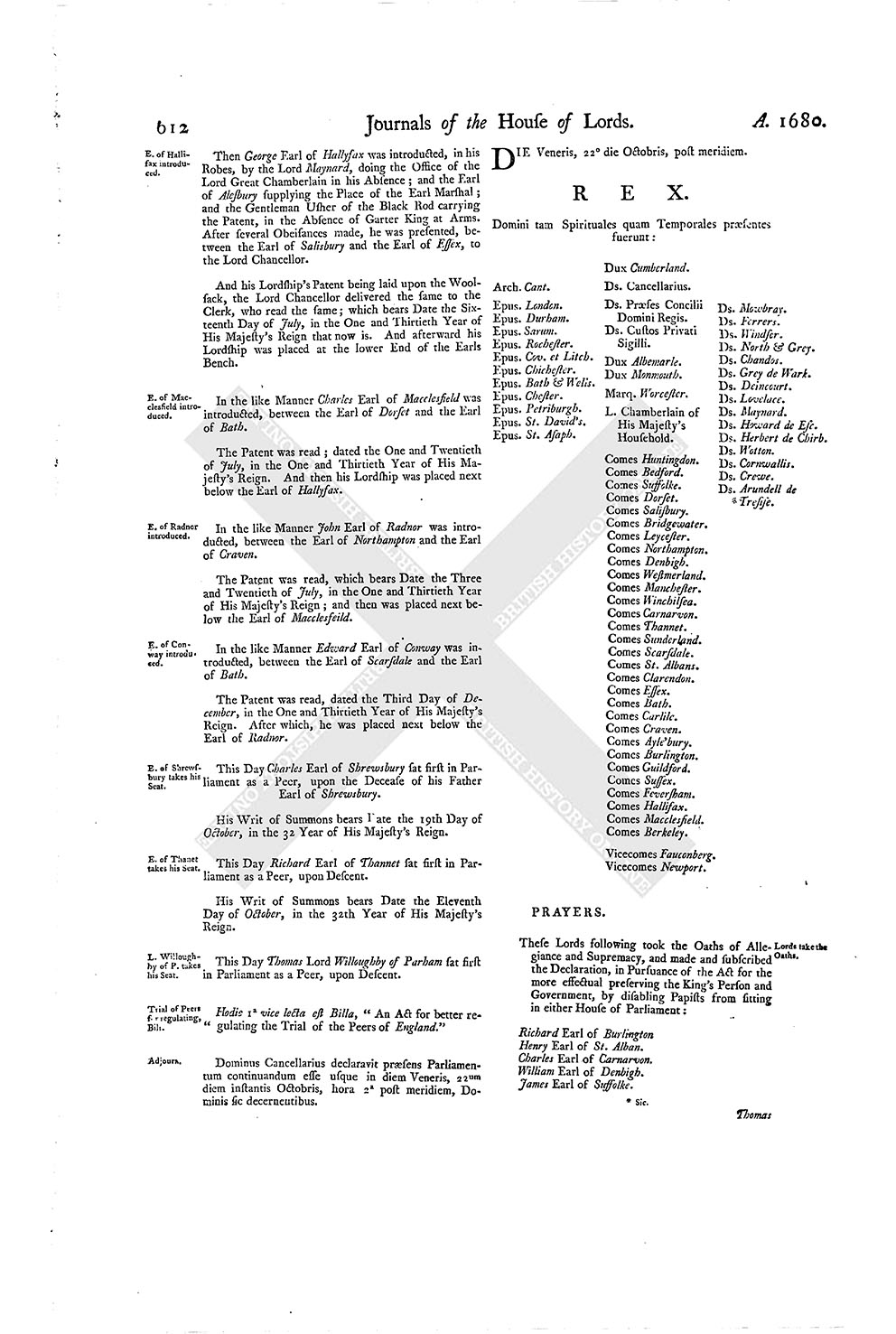
DIE Veneris, 22 die Octobris, post meridiem.
REX.
Domini tam Spirituales quam Temporales præsentes fuerunt:
|
Arch. Cant. Epus. London. Epus. Durham. Epus. Sarum. Epus. Rochester. Epus. Cov. et Litch. Epus. Chichester. Epus. Bath & Welis. Epus. Chester. Epus. Petriburgh. Epus. St. David's. Epus. St. Asaph. |
Dux Cumberland. Ds. Cancellarius. Ds. Præses Concilii Domini Regis. Ds. Custos Privati Sigilli. Dux Albemarle. Dux Monmouth. Marq. Worcester. L. Chamberlain of His Majesty's Household. Comes Huntingdon. Comes Bedford. Comes Suffolke. Comes Dorset. Comes Salisbury. Comes Bridgewater. Comes Leycester. Comes Northampton. Comes Denbigh. Comes Westmerland. Comes Manchester. Comes Winchilsea. Comes Carnarvon. Comes Thannet. Comes Sunderland. Comes Scarsdale. Comes St. Albans. Comes Clarendon. Comes Essex. Comes Bath. Comes Carlile. Comes Craven. Comes Ayle'bury. Comes Burlington. Comes Guildford. Comes Sussex. Comes Feversham. Comes Hallifax. Comes Macclesfield. Comes Berkeley. Vicecomes Fauconberg. Vicecomes Newport. |
Ds. Mowbray. Ds. Ferrers. Ds. Windsor. Ds. North & Grey. Ds. Chandos. Ds. Grey de Wark. Ds. Deincourt. Ds. Lovelace. Ds. Maynard. Ds. Howard de Esc. Ds. Herbert de Chirb. Ds. Wotton. Ds. Cornwallis. Ds. Crewe. Ds. (fn. 1)Arundell de Tresise. |
PRAYERS.
Lords take the Oaths.
These Lords following took the Oaths of Allegiance and Supremacy, and made and subscribed the Declaration, in Pursuance of the Act for the more effectual preserving the King's Person and Government, by disabling Papists from sitting in either House of Parliament:
Richard Earl of Burlington.
Henry Earl of St. Alban.
Charles Earl of Carnarvon.
William Earl of Denbigh.
James Earl of Suffolke.
Thomas Lord Windsor.
William Lord Bishop of St. David's.
John Lord Bishop of Chester.
George Earl of Berkley.
Thomas Earl of Sussex.
The House was adjourned during Pleasure.
King present.
His Majesty being sat in His Royal Throne, the Commons presented to Him William Williams Esquire, for their Speaker, being unanimously chosen by them.
Who after he had made a short Speech, the Lord Chancellor, by His Majesty's Command, declared as followeth:
Speaker of H. C. presented, and approved of.
"Mr. Speaker,
"His Majesty hath well considered the Election the Commons have made; and doth very much approve and allow of their Choice. He hopes there will be found the same Unanimity in all other Matters that relate to His Service, as hath been exprest in this Election.
"It is your Duty, Mr. Speaker, having received this Signification of His Majesty's Pleasure, to apply yourself chearfully to undergo this Burden; and as His Majesty will graciously accept all your Endeavours in His Service, so He doth not doubt but your Performances will answer Expectation; and give general Satisfaction."
Then the Speaker desired, in the Name of the House of Commons, the ancient Privileges and Customs belonging to them; videlicet,
"That our Persons, and Estates, and Servants, may be freed from Arrests.
"That we may have Freedom and Liberty of Speech.
"That we may have free Access to your Royal Person, as Occasion shall require."
To which the Lord Chancellor, by His Majesty's Command, told them,
L. Chancellor's Speech to the Speaker.
"Mr. Speaker,
"His Majesty hath graciously heard all your Petitions; and doth fully and freely grant them all.
"The Freedom of yourselves and Servants from Arrests, and of your Estates from Molestation, is not only a Privilege, but an Honour and Dignity, due to those who serve in this Capacity. And if any Man presume to affront those whom the King hath called together to consult with, and whose Counsels the King intends so much to rely upon; it shall not be enough for you to right yourselves in your own House; but the King will cause it to be further prosecuted at His Suit, as a Contempt of His Royal Authority.
"The Liberty of Speech, you desire, is necessary in all public Debates: And the King doth not think a Privilege of this Kind can ever be more safely lodged, than where it is trusted to you; for He is confident, that you yourselves will take a strict Care that no Man shall exceed the decent Limits of it.
"As for Access to His Royal Person, which is seldom denied to any Man, you may be sure it shall be amply granted to you; for whatever it be which a People may expect from a Prince who hath set His Heart upon them to do them Good, all this you may safely promise yourselves from the King: And rest assured, that nothing in the World shall be able to intercept those gracious Influences which may be necessary to bring your wife and well-weighed Councils to Perfection.
"And now, Mr. Speaker, these Points being so well over, His Majesty is extremely desirous that no more Time may be lost; but that, when you return to your House, you would hasten through the rest of the Preliminaries as fast as you can, that so you may be ready to enter upon Business as soon as is possible. And God Almighty direct and prosper all your Consultations."
After this, His Majesty withdrew; and the Commons went to their House.
The House is resumed.
Earl of Berkely introduced.
The Lord Chancellor acquainted the House, "That His Majesty hath been pleased to give an Addition of Honour to the Lord Berkeley; who was ready to be introduced."
And accordingly he was introduced, between the Earl of Denbigh and the Earl of Bath, after the usual Manner.
His Patent, creating him Earl of Berkeley, was read; which bears Date the Eleventh Day of September, in the 31th Year of His now Majesty's Reign. And his Lordship was placed on the Earls Bench, next above the Earl of Conway.
L. Deincourt introduced.
The Lord Chancellor signified to the House, "That His Majesty hath been pleased to summon the Lord Deincourt (Son to the Earl of Scarsdale) by Writ to Parliament;" and moved, he might be called in.
Hereupon he was brought in, after the usual Manner, between the Lord Wotton and the Lord Cornwallis.
His Writ was read, as followeth:
His Writ of Summons.
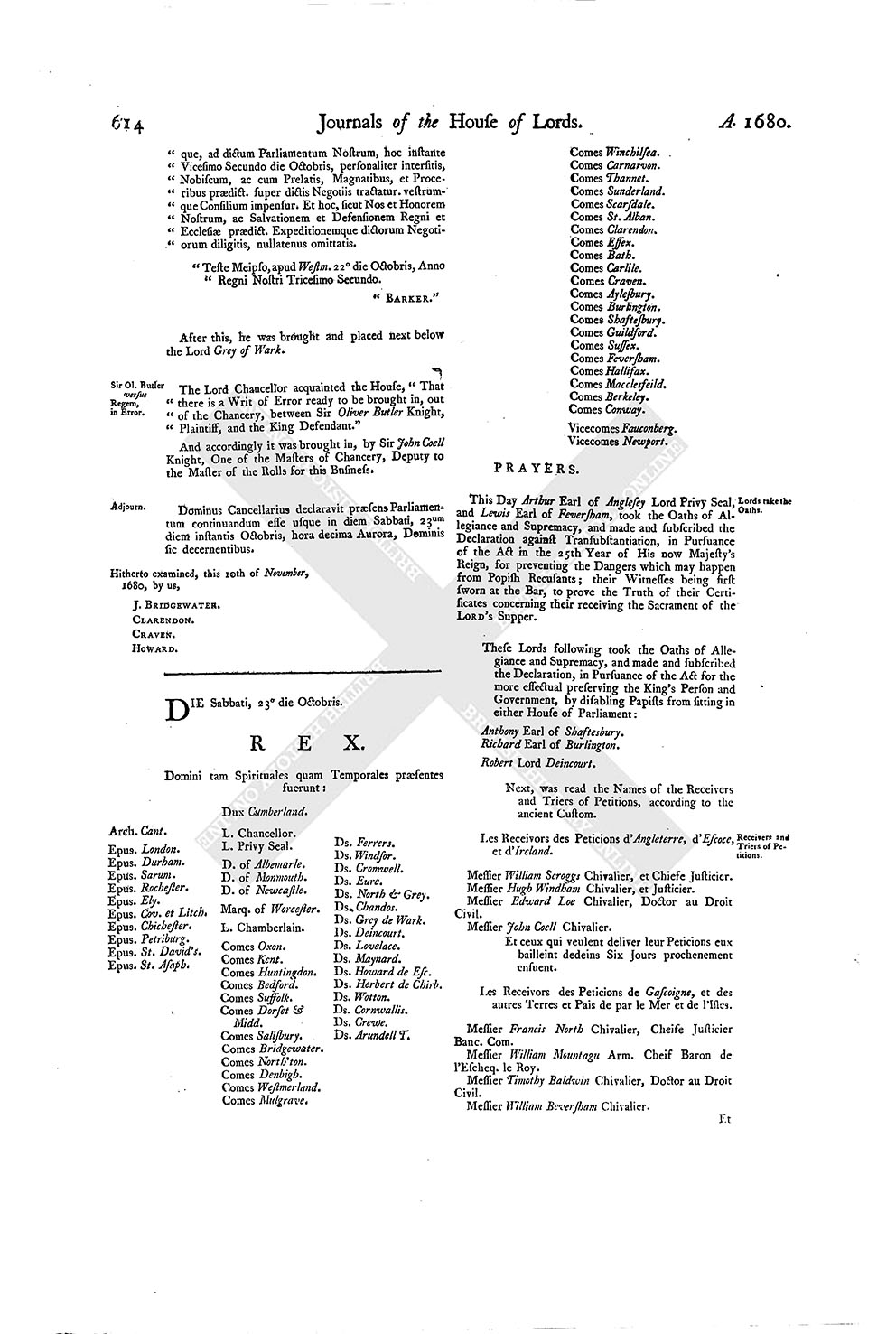
"Carolus Secundus, Dei Gratia, Angliæ, Scoc. Franc. et Hiberniæ Rex, Fidei Defensor, &c. Prædilecto Nostro Roberto Deincourt de Sutton, Cheval. Salutem: Cum nuper, de Avisamento et Assensu Concilii Nostri, pro quibusdam arduis et urgentibus Negotiis, Nos, Statum et Defensionem Regni Nostri Angl. et Ecclesiæ Anglicanæ concernentibus, Parliamentum Nostrum apud Civitatem Nostram Westm. Decimo Septimo die Octobris, Anno Regni Nostri Tricesimo Primo, teneri ordinabamus, et ibidem, cum Prelatis, Magnatibus, et Proceribus dicti Regni Nostri, Colloquium habere et Tractatum; quod quidem Parliamentum tune et ibidem inceptum fuerat, et abinde, per separales Prorogationes, usque Vicesimum Tertium diem Augusti ult. præterit. continuat. et ab eodem Vicesimo Tertio die Augusti idem Parliamentum Nostrum usque Vicesimum Primum diem instantis Octobris ulterius prorogat. fuerat, apud Civitatem Nostram Westm. prædict. ibidem tune tenend. et prosequend.; vobis, sub Fide et Ligeantia quibus Nobis tenemini, firmiter injungendo, mandamus, quod, consideratis dictorum Negotiorum Arduitate et Periculis imminentibus, cessante Excusatione quacunque, ad dictum Parliamentum Nostrum, hoc instante Vicesimo Secundo die Octobris, personaliter intersitis, Nobiscum, ac cum Prelatis, Magnatibus, et Proceribus prædict. super dictis Negotiis tractatur. vestrumque Consilium impensur. Et hoc, sicut Nos et Honorem Nostrum, ac Salvationem et Defensionem Regni et Ecclesiæ prædict. Expeditionemque dictorum Negotiorum diligitis, nullatenus omittatis.
"Teste Meipso, apud Westm. 22° die Octobris, Anno Regni Nostri Tricesimo Secundo.
"Barker."
After this, he was brought and placed next below the Lord Grey of Wark.
Sir Ol. Butler versus Regem, in Error.
The Lord Chancellor acquainted the House, "That there is a Writ of Error ready to be brought in, out of the Chancery, between Sir Oliver Butler Knight, Plaintiff, and the King Defendant."
And accordingly it was brought in, by Sir John Coell Knight, One of the Masters of Chancery, Deputy to the Master of the Rolls for this Business.
Adjourn.
Dominus Cancellarius declaravit præsens Parliamentum continuandum esse usque in diem Sabbati, 23um diem instantis Octobris, hora decima Aurora, Dominis sic decernentibus.
Hitherto examined, this 10th of November, 1680, by us,
J. Bridgewater.
Clarendon.
Craven.
Howard.