A History of the County of Somerset: Volume 9, Glastonbury and Street. Originally published by Victoria County History, London, 2006.
This free content was digitised by double rekeying. All rights reserved.
M C Siraut, A T Thacker, Elizabeth Williamson, 'Parishes: Podimore Milton', in A History of the County of Somerset: Volume 9, Glastonbury and Street, ed. R W Dunning (London, 2006), British History Online https://www.british-history.ac.uk/vch/som/vol9/pp155-164 [accessed 30 April 2025].
M C Siraut, A T Thacker, Elizabeth Williamson, 'Parishes: Podimore Milton', in A History of the County of Somerset: Volume 9, Glastonbury and Street. Edited by R W Dunning (London, 2006), British History Online, accessed April 30, 2025, https://www.british-history.ac.uk/vch/som/vol9/pp155-164.
M C Siraut, A T Thacker, Elizabeth Williamson. "Parishes: Podimore Milton". A History of the County of Somerset: Volume 9, Glastonbury and Street. Ed. R W Dunning (London, 2006), British History Online. Web. 30 April 2025. https://www.british-history.ac.uk/vch/som/vol9/pp155-164.
In this section
PODIMORE MILTON
The ancient parish of Podimore Milton, known as Middleton or Milton Abbatis from its ownership by Glastonbury abbey (fn. 1) and later as Milton Podimore, derives part of its name from the Puddi moor which was shared with Yeovilton. (fn. 2) The rest may signify its site between Ilchester and Cary Fitzpaine in Charlton Mackrell. The parish lay 3 km. north-east of Ilchester and measured 2 km. from east to west and 2.5 km. from north to south. It was bounded on the north by Dyke brook, a ditch in 1332–3, and by another stream, on the west by the Fosse Way, on the south by a rhyne through Puddi moor, possibly the 14th century Holydych, and on the east largely by a bank called la Brodewall in 1332–3, (fn. 3) possibly the boundary between Milton and Downhead manors a length of which was broken c. 1380. (fn. 4) The parish measured 990 a. in 1838. (fn. 5) In 1933 it became part of Yeovilton parish and henceforward was known as Podimore. (fn. 6)
The Puddi moor in the south-west lies on alluvium below 15 m. (50 ft.), from which the land rises gently on Lower lias clay to 30 m. (100 ft.) on Cogbury in the north-east. There are bands of alluvium along the Cary and its tributaries. Podimore village and land to the south east are on gravel. (fn. 7)
Communications
The parish was quartered by an east-west route between Wincanton and Langport known as the street in the early 13th century, (fn. 8) and by a north-south route from Glastonbury via Cary Fitzpaine to Ilchester. Only the southern half, now known as Church Street, survives, the rest is now largely access to Higher Podimore Farm. (fn. 9) It was probably the king's highway opposite the dovecot damaged in 1305, and the Cary way used for pasture in 1311–12 and 1332–3. (fn. 10) A route called the Port path was probably disused by 1311–12 and in 1322–3 it was used for arable and pasture. (fn. 11) The Fosse Way and the Ilchester-Wincanton road were turnpiked by the Ilchester trust in 1753 (fn. 12) and the Langport road in 1824 by the Langport, Somerton, and Castle Cary trust, which built a tollhouse near the junction with the Fosse Way. (fn. 13) The house was sold to John Wingfield Digby in 1881 when the trust was wound up. (fn. 14) East Mead Lane linking Yeovilton with Cary Fitzpaine, was important enough to have a bridge across the Cary known as Warmans as early as 1332–3. (fn. 15) Popple Bridge, where the Fosse crossed the river Cary on the western boundary, was known as Bricklemarsh Bridge in 1764 (fn. 16) and before 1813 comprised two arches over two branches of the river. (fn. 17) Major alterations to the road system in 1977 included the realignment of the road from Wincanton into a very large roundabout on the western edge of the parish. (fn. 18)
Settlement And Population
There is evidence of Iron-Age and Romano-British settlement notably in the former east field where a possible Romano-British trackway passes through an area known in the 14th century as la Chastele and later overlain by medieval ridge and furrow. The site may have been in use until the 4th century. There is a possible earlier site to the west of the village in the former west or little field. (fn. 19)
The medieval village appears to have stretched from the parish boundary at Snagg, later Locksley, Farm in the south to Higher Podimore Farm in the north. Its open arable fields overlay the prehistoric sites and constrained building to the immediate vicinity of the road. There were about 36 houses including freeholds in 1332–3, mainly on the west of the street, but by 1516 seven tofts were recorded. (fn. 20) Foundations were frequently discovered in the 18th century although there were said to be still c. 200 inhabitants in the 1780s. (fn. 21) Between 1777 and 1838 at least four more sites were abandoned and isolated gardens and small orchards as well as personal field names, probably indicate the sites of earlier dwellings. However, a terrace of small dwellings for labourers replaced some cottages near the church. (fn. 22) The population rose slightly from 154 in 1801 to a peak of 176 in 1821 but thereafter declined to 136 in 1871 and fell sharply to 89 in 1881 when six houses were uninhabited. Thereafter it fluctuated, falling to 61 in 1931. (fn. 23) Most surviving farm houses date from the 17th century. (fn. 24) The Royal Naval air station at Yeovilton encroached into the south-east of the parish during the 20th century. (fn. 25)
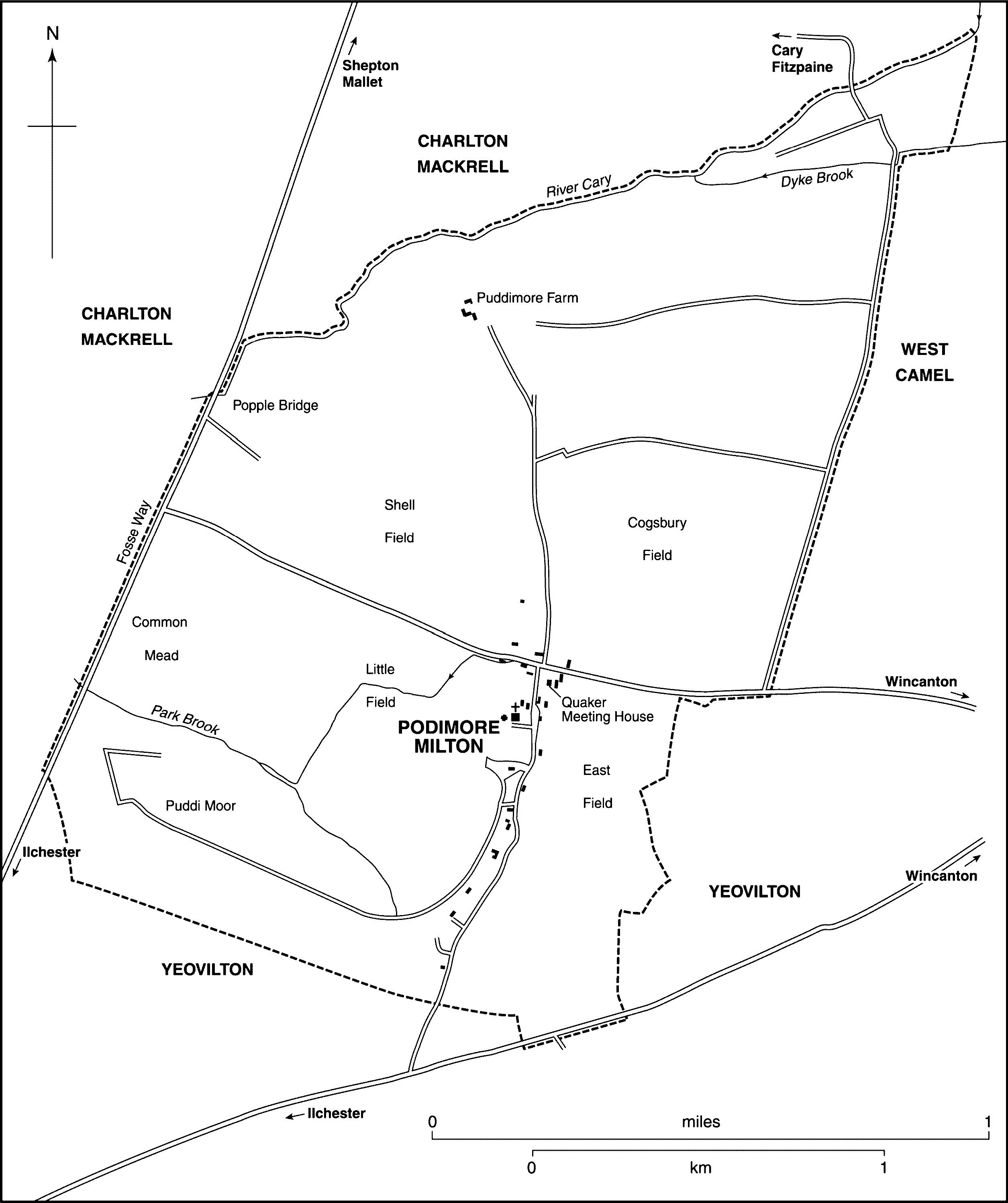
FIG. 56. Podimore Milton in 1777
Social Life
In 1316 and 1364 seven people were presented for selling ale in breach of the assize. (fn. 26) Between 1687 and 1795 there was one licensed house, (fn. 27) but by 1840 there was said to be none. (fn. 28) By 1871 a butcher had opened a beerhouse which by 1891 was known as the Butchers Arms. (fn. 29) It stood on the Langport road and was held with a small farm. It was bought by the Digby trustees in 1899 and sold in 1919. (fn. 30) By 1939 it had been renamed the Podymore inn, possibly after obtaining a full licence, (fn. 31) and it remains in business. A second beerhouse in the village street was kept by a grocer's husband in 1881. (fn. 32) In the late 20th century a motel and a service station opened at the roundabout.
MANOR AND OTHER ESTATES
Milton Manor
The grant by King Edgar of two hides of land north of the river Cary to Glastonbury abbey in 963 or 966 (fn. 33) may be the only surviving record of the acquisition of the 6-hide estate at Middleton the abbey held in 1066 and 1086. (fn. 34) The suggestion that the abbey's possession then or later was 'less than secure' (fn. 35) may explain why five hides were granted in fee by Abbot Henry of Blois (abbot 1126–71) to the Middleton family. (fn. 36) The fee was returned to the abbey in two parts, in 1277 (fn. 37) and 1328, (fn. 38) but holdings evidently involving land outside the parish as well as inside had been alienated, becoming substantial freeholds. By 1332–3 the abbey's demesne farm measured 350 a. (fn. 39) and the abbey subsequently increased its holding, possibly by absorbing other freeholds. (fn. 40)
At the Dissolution the manor passed to the Crown and in 1544 it was sold to John Malte of London, said to be the king's tailor. (fn. 41) John (d. 1546) had settled Podimore in 1544 on his daughter Meriel, wife of John Horner (d. 1587). Meriel (d. 1547) (fn. 42) left an infant son Thomas Horner (d. 1612) who was succeeded in the direct male line by Sir John (d. 1659), Sir George (d. 1677), George (d. 1708), and Thomas, later Strangways Horner (d. 1741). (fn. 43) Thomas was followed by his brother John (d. 1746) and John's son Thomas although the land was said to be held for their lives by the younger Thomas's three sisters who surrendered their interest in 1780. In 1798 Thomas sold the manor with c. 814 a. and the advowson to Edmund Broderip and William Melliar of Wells. (fn. 44) They bought out most of the freeholders and by 1828 had increased the size of their holding to over 923 a. when Broderip sold his half to Melliar. (fn. 45) Melliar (d. 1840) left the estate to his partner James Lovell Lovell in trust for his brother John Melliar (d. 1840) for life and Andrew Foster (d. 1841), provided Andrew took the name Melliar. Andrew's widow Elizabeth, later wife of the Revd. Charles Ward, purchased the remaining freehold property during the minority of her son William Melliar Foster Melliar, and it was conveyed to him on his coming of age in 1857. In 1860 William Melliar sold the manor, excluding the advowson, to the trustees of Lord Digby under an agreement of 1859 made with George Wingfield Digby. It remained part of the Sherborne Castle estate until 1919 when it was broken up and sold. There was no reference to lordship in the sale. (fn. 46)
The Manor House
A new hall was built in 1301 covered with 15,000 stone tiles and a chamber and dovecot were repaired. (fn. 47) In 1333–4 manor buildings comprised hall, chamber, kitchen, chapel, stable, oxshed, and barn, a 3-a. barton, a 6-a. garden, and a dovecot. Later the buildings were divided between two tenants. (fn. 48) Neither the dovecot nor the chapel was recorded in 1516 but the hall, chamber, and kitchen were held by the farmer of the demesne. (fn. 49) In 1534 the site also comprised stable and oxshed with a separate barn and barton. (fn. 50) The capital messuage was let to the English family from 1599 and in 1696 by George Horner to his younger son John. It appears to have formed the nucleus of Podimore or Higher Podimore farm which has a 17th-century house much altered in the 19th century. (fn. 51)
Other Estates
Apart from the manor there were a number of fees and freeholds based in but not confined to the parish. Before 1171 Henry of Blois, abbot of Glastonbury, gave five of his six hides as a knight's fee to the ancestor of Richard son of Robert. (fn. 52) Richard did homage in 1189 and was still in possession c. 1197. (fn. 53) Richard's son Robert succeeded before 1221 (fn. 54) and was himself followed before 1268 by his son William of Middleton. (fn. 55) In 1272 William conveyed half his fee, which included 102 a. of arable in Podimore and the holdings of two villein tenants, to John of Bitton. (fn. 56) His heir, bishop William of Bitton (bishop 1267–74), in 1273 gave it to his brother Thomas, archdeacon of Wells, and his successors as endowment for a chantry in Wells Cathedral. (fn. 57) In 1328 the then archdeacon granted the former half fee back to Glastonbury abbey. (fn. 58) Meanwhile in 1277 William of Middleton had conveyed the rest of his fee back to the abbey. (fn. 59) The principal mesne tenancy was thus extinguished, probably on the initiative of the abbey, which was described as having reappropriated it. (fn. 60)
In 1333 the abbey also reappropriated a ferdel of land which had been part of the Middleton fee and had descended from Thomas of Middleton through his son Robert to Robert's daughter Alice. (fn. 61) About 1290 Alice settled her inheritance on Joan, daughter of Richard Dyne of Martock. Joan, successively wife of Hugh le Nevue and Robert of Ramsbury, in 1327 granted the land to Thomas de Shirreve and his wife Margery. In 1333 through an intermediary they sold it to Glastonbury abbey. (fn. 62)
By the earlier 14th century a number of freeholds of the manor were described as formerly of the Middleton fee and as held by knight service. (fn. 63) Among them was that of Ralph of Yeovilton who held a virgate formerly Ralph Marshal's and for which he did homage to the abbot in 1338. (fn. 64) Ralph was alive in 1346 but by 1383 it was held by his son Peter of Yeovilton whose wife Idonea was an heiress. They settled it in the same year on their daughter Margery wife of Thomas Payne and in 1387 gave Thomas and Margery a life interest in both parental estates. (fn. 65) Thomas and Margery's daughter Catherine (fl. 1473) was succeeded by Giles Daubeney, Lord Daubeney, her grandson by her first husband. Giles (d. 1508) was succeeded by his son Henry (cr. earl of Bridgwater 1538, d. 1548), (fn. 66) but he held only 3 a. in 1516 and 1539, formerly part of Robert of Netherton's fee. (fn. 67) Subsequent descent is uncertain but it may have been sold to Edward Seymour (d. 1621), as suit was claimed from William, marquess of Hertford, in 1653 and 1659. (fn. 68)
Robert of Netherton held six messuages and a virgate by knight service in 1333, let to several tenants and sometimes known as the fee of Netherton. (fn. 69) In 1516 it was said to be held by William Knoyle. (fn. 70) William Knoyle (d. 1502) had in 1502 purchased from John, son and heir of John Huntley, the reversion of Alice Huntley's life estate in Podimore Milton described as a messuage and 30 a. held of the abbot of Glastonbury by knight service. Alice (fn. 71) survived and William's son Peter was a minor. (fn. 72) Peter was followed by his son Leonard (d. 1532) whose son Edward came of age in 1551. (fn. 73) Edward was succeeded by a namesake (fl. 1638) (fn. 74) but the estate has not been traced further.
In 1333 William of Trent held several estates including two by knight service: a messuage and virgate formerly Walter the Marshal's and a messuage and ferdel which had previously belonged to William Dame Inold. He also held a messuage of William of Coker. (fn. 75) The ferdel had escheated and been divided among the customary tenants by 1516 but a messuage and 7 a. in the Netherton fee which had been held successively by Alexander de Horsey and William of Trent had descended to Richard Strete and Marshal's messuage and virgate had passed to Richard Fowell. William Blake (fl. 1531) held 3 a. of the Netherton fee by fealty. (fn. 76) In 1527 William Portman held land in right of his wife Elizabeth, daughter and heir of John Gilbert, and in 1539 he held Marshal's messuage and virgate. (fn. 77) The estate descended in the Portman family like Clavelshay in North Petherton (fn. 78) and in 1612 and 1625 was described as a messuage, cottage and dovecot, and 90 a. held of Podimore Milton manor. (fn. 79) Suit was claimed from the Portmans in 1659 but in 1750 Henry William Portman demanded suit from a tenant to his manor of Corton Denham. (fn. 80) In 1806 Edward Berkeley Portman exchanged a messuage and 45 a., actually 38 a., with Broderip and Melliar, lords of Podimore manor, for land in Corton Denham. This was confirmed by Portman, with his son Edward, in 1821 and the land was absorbed into the manor. (fn. 81)
About 1197 Hugh of Greinton held a fee described as in Greinton and Middleton (fn. 82) for which he had done homage in 1189. (fn. 83) It probably represented in part the Domesday estate at Middleton not forming the Middleton fee. It was described as a hide in Middleton in the earlier 13th century (fn. 84) and descended like Greinton manor to Roger le Cok. (fn. 85) The land appears to have been held by Roger's aunt Eve, daughter and coheir of Hugh de Greinton, and her husband Hugh Trivet. In 1243 Eve gave a hide to Martin de Leigh and his wife Alice for a pepper rent and the service of a sixth of a knight's fee. (fn. 86) In 1268, following litigation in which it was said that Alice had held the land as dower and that after her death it passed to Hugh Trivet, Hugh bought back the estate from Martin and granted him a life interest. (fn. 87) In 1280 the estate, described as a messuage and 60 a., was claimed by Martin's nephew Nicholas of Marlborough. (fn. 88) It appears to have passed to Walter of Cnolton who in 1227 bought a small freehold from Maud wife of John of Gotepathe. (fn. 89) Walter was dead by 1307 when his widow Joan released to the abbot of Glastonbury any claim to William of Middleton's estate. (fn. 90) John de Cnolton (fl. 1329–34) was said to hold a quarter fee in mesne, including six messuages in 1333. His chief tenant was the secondhighest taxpayer in Podimore in 1327. John was dead by 1338 leaving his son John a minor. The child was in the care of Sir John de Clevedon but was abducted possibly on behalf of the abbot of Glastonbury who, following disputes, sold the ward's marriage to Sir John. The estate was later appropriated by Abbot Walter Monington (1342–75) and absorbed into the manor. (fn. 91) It may have been the estate of 9 messuages and 200 a. which Glastonbury was licensed to acquire in 1365. (fn. 92)
A half fee in Milton, outside the Glastonbury estate, was held by Peter de Insula in 1303 but by 1346 it had passed to Peter Lyte (d. 1348). Peter was also the grandson of Isabel, daughter of Peter of Draycott (fl. 1210), who settled his Podimore land on her marriage to Robert Lyte. That estate descended like Lytes Cary in Charlton Mackrell to Edmund Lyte who held in 1375 and to the latter's son John, tenant in 1428. (fn. 93) It remained part of the Lytes Cary estate, although land called Lytes Podimore appears to have been sold off, until 1802 when the remaining land (26 a.) was sold to Edmund Broderip and William Melliar. (fn. 94)
ECONOMIC HISTORY
In 1086 there were 6 hides and 6 plough teams of which 4 hides and 7 a. were in demesne with 2 ploughs worked by 6 serfs. The 8 villeins and 6 bordars worked nearly 2 hides with 4 teams. There were 40 a. of meadow and 100 a. of pasture but the abbey had only one riding horse and 3 sheep. The estate was worth £6. (fn. 95)
About 1299 Glastonbury abbey's total receipt from the share of the estate returned to them (fn. 96) was just over £13, of which just £2 15s. was assized rent. Some 80 a. of demesne arable was sown with wheat, 24 a. with oats, and 3 a. with beans. A hayward, a hind, and two oxherds worked the farm and livestock comprised 16 oxen, a horse, a few geese, and capons. The dovecot produced 84 squabs for sale. Two thirds of the wheat crop was sent to Glastonbury. There were 160 ewes feeding on the demesne meadow and 120 lambs on the corn. (fn. 97) Demesne rents remained under £3 into the second decade of the 14th century but the demesne arable expanded, reaching 147 a. in 1311–12 and 135 a. in 1313–14, including small quantities of barley and peas. (fn. 98) By 1303 a ploughman, a part-time assistant ploughman, and a part-time carter were employed. (fn. 99) Two years earlier a mixed flock of 218 sheep were washed before some were sent to Glastonbury and some lambs to Doulting: 205 remained including new lambs. (fn. 100) In 1302–3 the produce included 31 cheeses, the wool of 124 sheep and 47 lambs, and the skins of 62 which had died. The dovecot produced 187 squabs. (fn. 101)
The sheep flock was not kept at Podimore every year but in 1313–14 it numbered 228 and, with 4 cows, produced 146 cheeses and 34 lb. of butter. The dovecot was less profitable than in the previous year when 223 squabs had been sold, but there were 15 hives of bees. (fn. 102) In 1314–15 there were no sheep and only one hive. (fn. 103) Between then and the acquisition of the estate of the archdeacons of Wells in 1328 (fn. 104) assized rents evidently nearly doubled, and by 1330–1 amounted to over £8 6s. including a small amount of hertpeny. Demesne arable sown in 1330–1 included that formerly of the archdeacon of Wells and comprised 121 a. of wheat, 33 a. of oats, and 16 a. of beans. The sheep flock had returned and there were 24 plough oxen. (fn. 105)
During the year 1330–1 a wide ditch 200 yd. long was dug, perhaps part of a planned reorganization of the arable fields which is thought to have been completed by 1333. (fn. 106) The purpose of the change is not apparent; (fn. 107) the demesne arable under both systems was 274 a. though the new fields, numbered one to three, were described as for winter sowing, spring sowing, and fallow. Demesne meadow, in Puddi moor, in the Ham by Popple Bridge, and beside the river Cary, measured just over 51 a., pasture 23 a. with grazing along the sides of the parish, and winter grazing in demesne fallow. The extent of 1332–3 recorded 7 freeholders (fn. 108) and their tenants, 3 tenants of the former archdeaconry estate, 1 halfvirgater, 5 ferdellers, 4 5-a. tenants, and 8 with 4 a. or less. Only two tenants had more than one house. No works were recorded but those serving as wykeman, reeve, or oxherd paid no rent and were rewarded in kind. The demesne ploughs required three teams of 8 oxen. (fn. 109)
In the first full year after the arable changes 179 a. of arable was sown, 80 a. with wheat, 44 a. with oats, and most of the rest with dredge corn. Among sales were 5 ricks of hay, the milk of 73 ewes, 31 sheepskins, and over 10 stones of wool. By Michaelmas 1334 all the lambs had gone, leaving an adult flock of 130 and there were 23 oxen. (fn. 110) Thereafter few details of Podimore's agriculture have survived, although in 1340 pasture was said to have been overburdened by the abbey flock and capable of supporting only 80 ewes a year. (fn. 111) In 1346 two surveyors of the murrain were amerced after 33 ewes and 49 lambs died. (fn. 112)
In 1361–2 the manor delivered 138 qr. of oats to the granger of the abbey, a larger quantity than from any other manor, and also 94 qr. of wheat. (fn. 113) In 1365 the abbey appears to have acquired an estate of c. 200 a. (fn. 114) Between the late 1360s and the 1400s there were complaints that houses had not been rebuilt, possibly indicating that the village had reduced in size. (fn. 115) In 1375 the moor was flooded and the tenants were blamed for not ditching. (fn. 116)
Post-Medieval Agriculture
By 1516 a third of the former demesne farm had been alienated and the rest, some 230 a., was let as a single unit. Its arable, confined to two of the three open fields then known as west, north, and south, amounted to only 37 a. The farmer also held a 3-a. wood of oak and ash. There were still 8 freeholders, 2 of whom claimed to hold virgates, and customary tenants comprised 4 resident virgaters, 9 half-virgaters and 7 ferdellers. The increase in holdings was probably due in part to the acquisition in 1365 of the reversion of several tenements. (fn. 117) Total rents amounted to over £17. Some grassland was in closes but several freeholders had rights to small parcels within them. There were no smaller estates but 7 tofts with crofts were held by tenants, one of which can be identified as lying north of the Wincanton-Langport road. (fn. 118) By 1535 the demesne farm had acquired c. 20 a. of grassland but the farmer paid the same rent. (fn. 119)
In 1544 the rental was over £24 10s. but there was said to be no wood nor underwood beyond what barely sufficed to inclose the pastures. (fn. 120) In 1566 a man claimed ten yearlings and two bullocks kept on 4 a. of pasture had been chased to death. (fn. 121)
Pasture land was short and in 1659 it was declared that the common fields must not be breached until the majority of tenants was ready, 3 a. was allowed for each rother beast, only one horse could be pastured for each tenement, sheep were restricted to no more than five per acre, and no sheep pasture was to be sold beyond 24 December. (fn. 122) Holdings were small although some tenants held more than one. Common meadow at Old Mead in the west of the parish survived into the early 18th century but pasture at Summerleaze and Puddi moor had been inclosed by the 1660s. (fn. 123) In 1667 George Horner secured a temporary injunction against the tenant of the capital messuage, who was said to have cut down trees, preventing him parcelling ancient arable, ploughing meadow or pasture, or digging out trees. In the later 17th century the farm was divided up and the fields let out at rack rents totalling £182, compared with a rent roll of under £20. The nuts and apples of the orchard were also let. (fn. 124)
A survey of the manor, about half the parish, in 1762 listed eight tenants holding seventeen tenements, a few of which were sublet. Only two holdings were over 50 a. and the arable still lay in the common fields. (fn. 125) By 1777 pasture and meadow were in large closes but the arable lay in narrow strips and the intermixing of manor and freehold land prevented consolidation. The land was almost evenly divided between arable and pasture and of twenty farms on the manor the largest was Podimore farm (225 a.), an amalgamation of several 1762 holdings. There were three others with over 50 a., but a few tenants continued to rent several holdings. (fn. 126) In 1796 there remained nearly 400 a. of freehold land of which the largest holding was 50 a. but the tenants of both manor and freehold land rented up to six holdings each and, in addition to the tenant of Podimore farm, two men were farming over 100 a. (fn. 127) In the late 18th century the soil was said to be cold and wet, but orchards thrived, wheat, beans, and oats were grown but little barley or clover and no turnips; the land needed draining and was badly managed. (fn. 128)
Following the sale of the manor in 1798 exchanges were made to facilitate inclosure of the arable fields and small freeholds were bought up. (fn. 129) Consolidation of arable was complete by 1806 and old inclosures were thrown together to create large fields. (fn. 130) By 1811 the manor covered c. 920 a. and was organised into four farms of between 205 a. and 260 a. Tenants were encouraged to convert arable, now in large inclosures but not completely fenced and often of poor quality, to grass, and to plough up distant pastures. A rotation of fallow, wheat, and beans needed the addition of turnips and artificial grasses. Buildings had been improved and new orchards planted but more were needed and the soil was good for apples. Some draining had been carried out but the Puddi moor was still liable to flood. (fn. 131) Apple trees continued to be planted in 1820 and the moor was levelled and ploughed. (fn. 132) In 1822 one farmer grew 53 a. of wheat, barley and beans, sheared 120 sheep, produced 80 lambs, milked 4 cows, mowed 20 a. of clover and 40 a. of meadow, made 20 hogsheads of cider, and sold 20 fat sheep. Another produced slightly less and grew oats instead of barley and no clover. (fn. 133)
The manor was considered a desirable investment in 1827 although 420 a. of the 924 a. were still arable and drainage had not been carried out. The four farms had good houses and buildings although up to 12 cottages let with them were in need of repair. (fn. 134) By 1838 further rearrangement resulted in one farm of c. 550 a. and three of under 150 a. with a gross annual rental of £1,095. There had been no reduction in arable but there was 11 a. of plantation and one farm had a milkhouse. A terrace of five cottages had been built recently. (fn. 135) By 1851 there had been a return to more evenly sized farms with the large Podimore farm divided between the Brooke brothers working in partnership and paying £700 rent. The farms employed a total of 38 labourers. (fn. 136) Under Digby ownership the farms were reduced to three and in 1871, following the retirement of Richard Brooke, to two, of 700 a. and 355 a. employing 31 labourers. The larger farm had been divided again by 1883 and by 1919 there were four farms on the manor. (fn. 137)
By 1905 arable had been reduced to 268 a. (fn. 138) In 1919, when the manor estate was divided for sale, it comprised Church farm (194 a.), an amalgamation of Church and Elm farms with a house only at the latter but retaining two yards; a 94-a. arable and dairy farm opposite; Higher or Puddimore farm (273 a.), also with two farmyards and with a dairy and cheese room; and a smallholding of 28 a. with the beerhouse. (fn. 139) Lower farm was bought by the tenants and sold again in 1942, by which time it had been reduced to 138 a. Although some grass had been converted to arable during the war, it was primarily a dairy farm with a large dairy and milk cooling house. (fn. 140)
There is no record of a mill but Mill Close was named in 1838. (fn. 141)
Trades And Crafts
Fullers were recorded in 1272 (fn. 142) and in 1333 when lands were described as at fuller's and carpenter's doors. Arnulph le Webbe was also mentioned. (fn. 143)
Some craftsmen were recorded in the 19th century and several women were sewing kid gloves between 1851 and 1871 but only two in 1881. (fn. 144) There was a malthouse south of the church by 1805 but it may have gone out of use by 1829. (fn. 145) A smithy on the Langport-Wincanton road had become a butchery by 1856 attached to a beerhouse and with a slaughter house across the road. (fn. 146) A shopkeeper kept a school in 1851, and by 1881 there were two grocers. Only one shop was recorded between 1894 and 1906. (fn. 147) By 1980 there were neither shops nor services. (fn. 148)
LOCAL GOVERNMENT
Before 1277 the Middleton family claimed strays and other privileges within the tithing of Milton. Under Glastonbury abbey the tithing appeared twice a year at the Whitley law hundred court. (fn. 149) Records of the twice yearly curia and halimotes, sometimes combined with courts called tourns, survive in part from 1300 to 1719. (fn. 150) Business was agricultural but also included pleas between tenants. Courts were held once a year in the later 18th century. (fn. 151) A pound was repaired c. 1299 and a manor pound lay south of the village in 1838. (fn. 152)
Churchwardens were recorded in the 1550s. (fn. 153) By 1614 there were two sidesmen (fn. 154) and an overseer by 1653. (fn. 155) In the later 18th century Podimore was governed by an overseer of the poor who looked after the roads, and a churchwarden, who in the early 19th century was sometimes also an overseer. Separate highway surveyors were appointed from c. 1786. (fn. 156) The overseer paid for medical treatment and inoculation in 1789 and in the 1790s large sums to find men to serve in the army and the navy. Between 1799 and 1801 the overseer's expenses rose from £105 to £156 and included the cost of funerals, removal orders, and drilling volunteers. From 1806 until 1811 or later a calendar of monthly pay to paupers was kept and in 1844 a room was being rented to pay the poor. (fn. 157)
A poorhouse, possibly the parish house recorded in 1659, was partly rebuilt in 1768 and was last recorded in 1811. It stood on the Langport road opposite the Quaker meeting house and was demolished before 1886. (fn. 158)
Podimore Milton became part of Yeovil poor-law union in 1836, Yeovil rural district in 1894, and, as part of Yeovilton parish, of Yeovil, later South Somerset district in 1974. (fn. 159)
CHURCH
The church was recorded in 1189. (fn. 160) The living remained a sole rectory until 1943 when it was united with Kingsdon under an order of 1923. It was held with Babcary and Yeovilton from c. 1965 (fn. 161) but in 1978 it was disunited from Kingsdon, united with Yeovilton, and held as a united benefice with Ilchester with Northover and Limington. (fn. 162)
The advowson was held by Glastonbury abbey until the Dissolution (fn. 163) when it passed to the Crown and was sold with the manor to John Horner. It descended with the manor until 1860. (fn. 164) It then passed through the hands of several clergymen (fn. 165) until the union with Kingsdon. In 1948 Edward Page of Ivythorn transferred it to the bishop of Bath and Wells who has one turn of patronage in every nine. (fn. 166)
In 1291 the church was valued at £8 3s. 4d. (fn. 167) It was charged with a pension of 10s. to the Glastonbury almoner from the later 11th century until the Dissolution. (fn. 168) In 1535 the rectory was assessed at £13 6s. 8d. gross (fn. 169) but in 1544 it was valued at only £7 6s. 4d. (fn. 170) Its reputed value c. 1670 was £90 (fn. 171) but c. 1830 the gross income was £197 of which £75 had been paid to the curate on the bishop's order. (fn. 172) The living was augmented by £102 a year by the Church Commissioners in 1939. (fn. 173) The tithes, valued at £11 6s. 8d. in 1535, (fn. 174) were let for £150 in 1811 but in 1823 the rector demanded tithes in kind. They were commuted in 1838 for a rent charge of £194 10s. (fn. 175)
A small parcel of land was successfully claimed as church property in 1280 (fn. 176) and may be the plot west of the church for which the churchwardens paid 2d. rent in 1516. (fn. 177) In 1535 the rectory land was worth £2. (fn. 178) After the Dissolution the Crown held c. 4 a. of rectory land, the rest presumably held by the rector. (fn. 179) The total glebe in 1614 was 33½ a. but the parson's claim to pasture for oxen was denied. (fn. 180) Following several exchanges and the sale of 7½ a. of glebe arable in 1801 the quantity of glebe had shrunk by 1838 to 22 a. which remained in 1939. (fn. 181)
The rector's court and priest's house were recorded in the 13th century (fn. 182) and the barn was in decay in 1600. (fn. 183) In 1614 the house contained hall, parlour, kitchen, buttery, milkhouse, and several chambers above. The outbuildings included a barn and stable and there were bartons either side of the house. (fn. 184) In 1815 it was described as a farm house occupied by a farmer (fn. 185) and was said c. 1830 to be unfit. (fn. 186) The house was rebuilt shortly before 1838 when it was occupied by the rector. (fn. 187) It was later occupied by the curate. (fn. 188) In 1923 it was decided that when the living fell vacant the house would be sold but this did not take place until c. 1944. (fn. 189)
Church Life
A wax rent was paid to the church in 1243 (fn. 190) and in 1307 1s. was paid for a light in the church. (fn. 191) Some medieval rectors were not subdeacons when instituted; one was given seven years study leave and another six. (fn. 192) John Fishpoole, rector 1550–4, was in dispute with his warden over almsgiving and fasting in 1553 and was deprived the next year for marriage. (fn. 193) The rector was usually resident in the later 16th century. (fn. 194)
Thomas Spratt or Pratt, rector 1628–32, was incumbent of Stratton on the Fosse when instituted to Podimore in breach of his agreement not to accept a second living. (fn. 195) He was presented in 1629 for failing to read the litany or wear a surplice. (fn. 196) William Kemp, instituted in 1639, was imprisoned in 1645 by the Parliamentarians and then by the Royalists who thought him disaffected although his parishioners attested his loyalty to the king. He was replaced by Josiah Wyatt, a member of the Ilchester and Ilminster Presbyterian classis. Kemp successfully petitioned for his restoration to Podimore in 1660. (fn. 197) Edwin Sandys (d. 1705), rector 1675–1705, was also rector of Yeovilton from 1671 and archdeacon of Wells from 1683. (fn. 198)
There were between 10 and 15 communicants c. 1780 (fn. 199) and there was one Sunday service in 1815 but two by 1827. (fn. 200) Communion was celebrated three times a year in 1840 but monthly by 1870. (fn. 201) On Census Sunday 1851 27 people attended the morning service and 46 the afternoon with 25 children at both. (fn. 202) The parish was served by curates for most of the 19th century. (fn. 203) In the early 20th century there were two Sunday services but Easter communicants fell from 21 in 1923 to 5 in 1941. In 1922 evening lectures on church history were held in the parish room. (fn. 204)
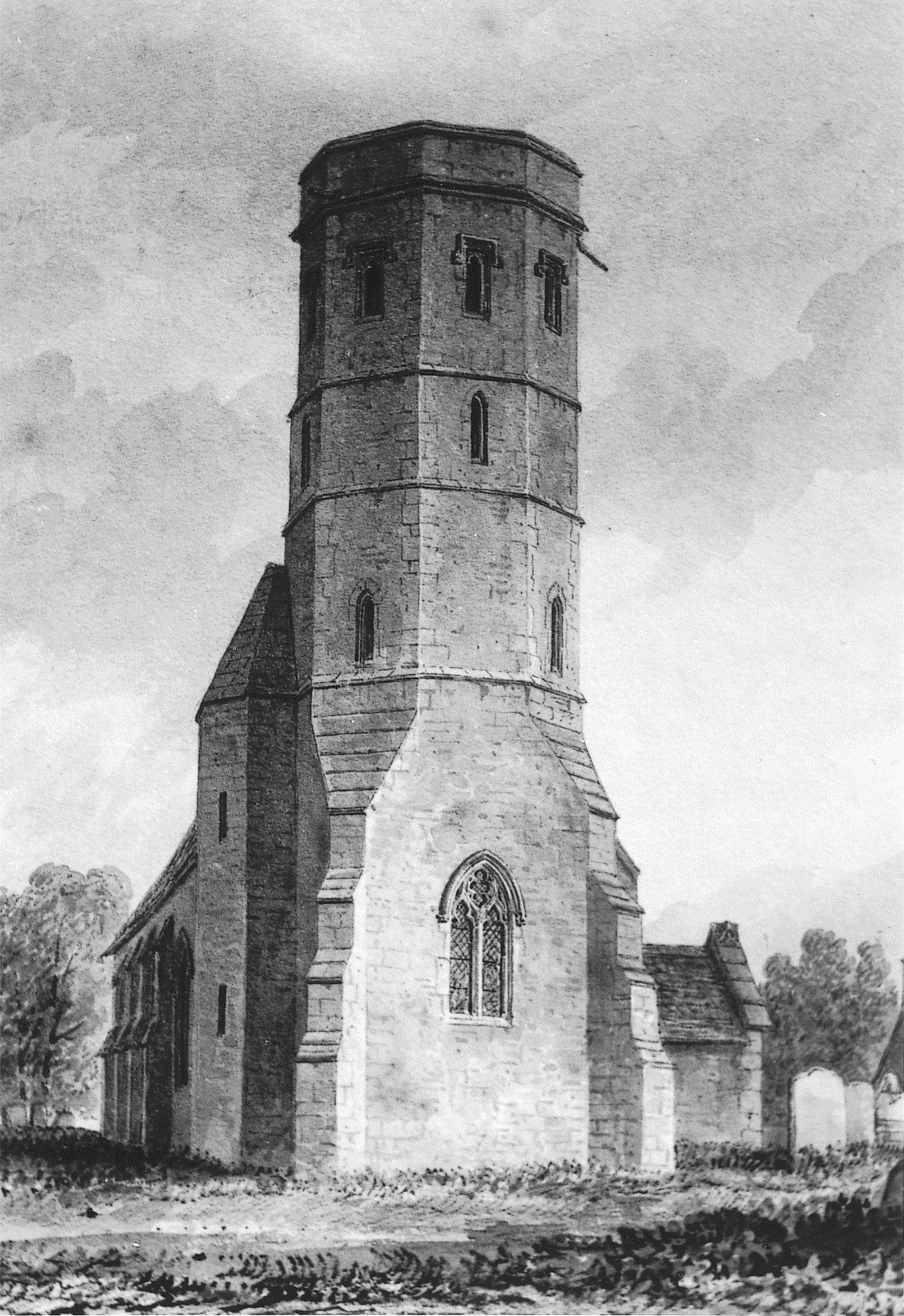
FIG. 57. Podimore Milton church, c. 1832
Church Building
The church of St. Peter, so dedicated by 1307, (fn. 205) comprises chancel, nave with south porch, and west tower, built in the late 13th century or the early 14th of local lias with Ham stone dressings. The architectural features include three octagonal upper stages of the tower and Decorated windows in nave and chancel. There is 15th-century border glass in the Perpendicular east window. (fn. 206) The chancel also has two probable 16th-century windows, and the pulpit is lit from a 17th-century window. Traces of wall painting survive on the north wall of the nave. (fn. 207) In 1843 a rood stair projection survived and nave and chancel had coved roofs with ribs and bosses. (fn. 208) Restoration in 1871–2 included a new nave roof, a rebuilt porch, and a restored chancel arch. (fn. 209) There was a conical cover on the medieval tub font c. 1780. The 17th-century pulpit and communion rails survive, although c. 1780 the communion table was said to be fit only for the fire. (fn. 210) Some late 17th-century benches have been re-used.
There are three bells; the oldest of 1633 by Robert Austen and the other two of the 18th century. (fn. 211) The plate includes an Elizabethan cup and a paten of 1729 given by Archdeacon Law in 1828. (fn. 212) The registers date from 1635 but there are many gaps. (fn. 213)
In the churchyard in 1847 stood the three steps and base of the 14th century cross. (fn. 214) A top was added as a war memorial in the 1920s.
NONCONFORMITY
Quaker meetings were held at Podimore from the late 1650s, at least two residents were in Ilchester gaol in the 1660s for attending meetings and 17 men were arrested at a meeting in 1662 and imprisoned. (fn. 215) Large numbers came to hear George Fox in 1656, 1663, and 1668 at the house of William Beaton who died in prison in 1681. (fn. 216) His widow married another Quaker prisoner who built a meeting house behind their house at Podimore in 1687. (fn. 217) It was set back from Ilchester road east of the corner with the village street (fn. 218) and was licensed in 1689 and again in 1700. (fn. 219) George Fox, possibly because of his many visits to Podimore, left books to the Meeting in 1694. (fn. 220) A burial ground had been created by 1693 and some Quaker burials were recorded in the church register. (fn. 221) In the 1780s four Quaker families comprised the 'principal people' in the parish, (fn. 222) but by 1803 there were apparently no Quakers and the meeting house was in disrepair. (fn. 223) It was later said to have been damaged by fire and was a private house in 1862. In 1842 the burial ground was sold in trust for the lord of the manor. (fn. 224)
Baptisms of the children of Quakers and Anabaptists were recorded in the early 18th century. (fn. 225) A house was licensed for an unknown denomination in 1822. (fn. 226)
EDUCATION
There was no school in the late 18th century (fn. 227) but a Sunday school had opened and been discontinued before 1819 when an old woman kept a day school. (fn. 228) The Sunday school had been re-opened by 1825 and had 42 children. (fn. 229) In 1833 and 1847 it had 38 children and was supported by subscription, and there was a schoolroom by 1840, possibly the parish room recorded in 1922. (fn. 230) In 1833 12 children attended two infant day schools at their parents expense. (fn. 231) In 1851 there were 25 Sunday schoolchildren. (fn. 232) There was a private day school kept by a shopkeeper in 1851 and 1861 and a schoolroom in a house was recorded in 1871. (fn. 233)