
Journal of the House of Lords: Volume 13, 1675-1681. Originally published by His Majesty's Stationery Office, London, 1767-1830.
This free content was digitised by double rekeying. All rights reserved.
'House of Lords Journal Volume 13: 7 December 1680', in Journal of the House of Lords: Volume 13, 1675-1681, (London, 1767-1830) pp. 703-706. British History Online https://www.british-history.ac.uk/lords-jrnl/vol13/pp703-706 [accessed 12 April 2024]

In this section
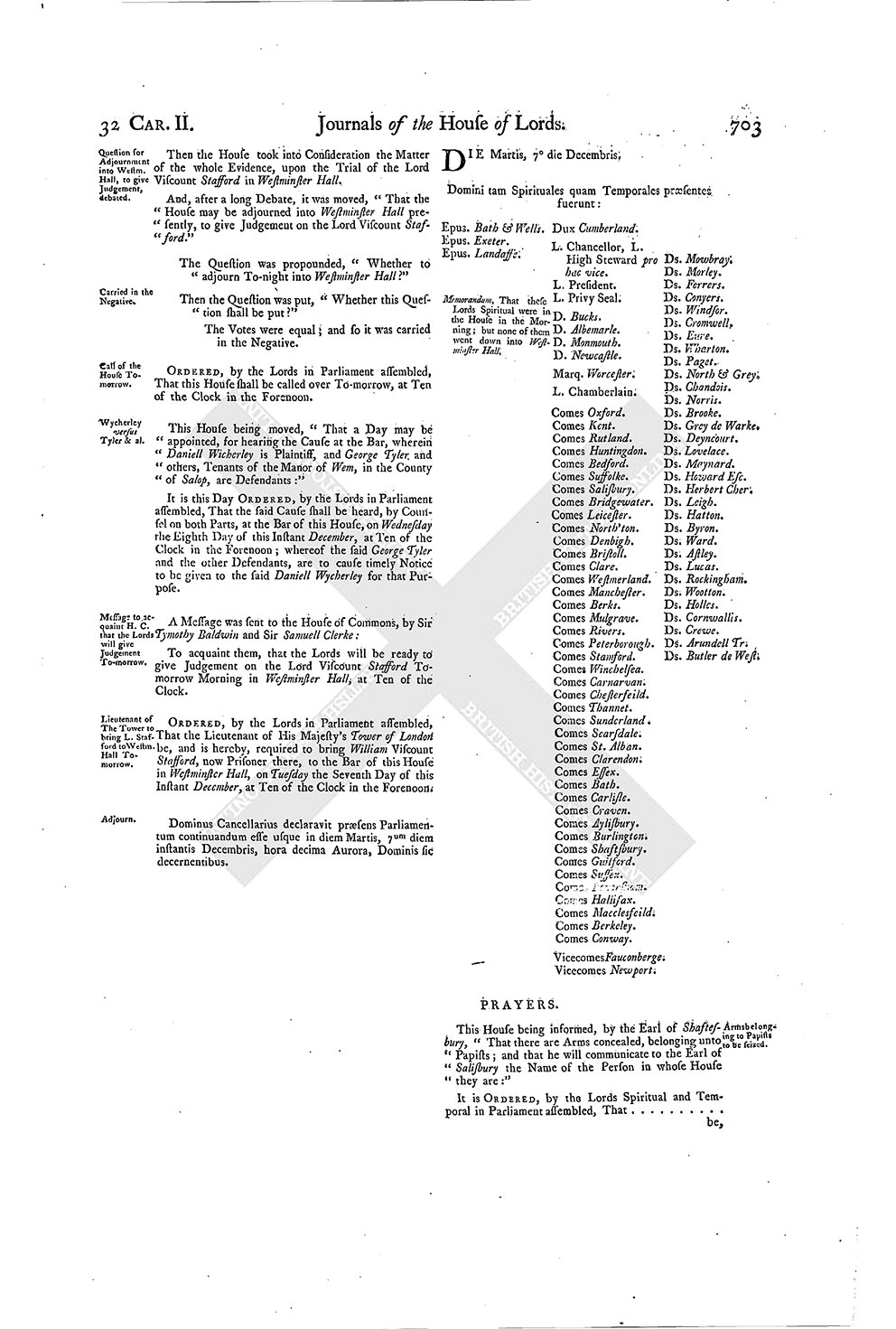
DIE Martis, 7 die Decembris.
Domini tam Spirituales quam Temporales præsentes fuerunt:
Memorandum, That these Lords Spiritual were in the House in the Morning; but none of them went down into Westminster Hall.
PRAYERS.
Armsbelonging to Papists to be seized.
This House being informed, by the Earl of Shaftesbury, "That there are Arms concealed, belonging unto Papists; and that he will communicate to the Earl of Salisbury the Name of the Person in whose House they are:"
It is ORDERED, by the Lords Spiritual and Temporal in Parliament assembled, That .......... be, and are hereby, authorized and required to repair to the House of any such Person as they shall be directed by the Earl of Salisbury and the Earl of Shaftesbury, and search for and seize such Arms as they shall find there, and give this House an Account thereof; and for so doing, this shall be a sufficient Warrant.
To ......... and to the Serjeant at Arms attending this House, his Deputy and Deputies, and to all His Majesty's Officers and Ministers Civil and Military, to be aiding and assisting in the Execution hereof.
Call of the House.
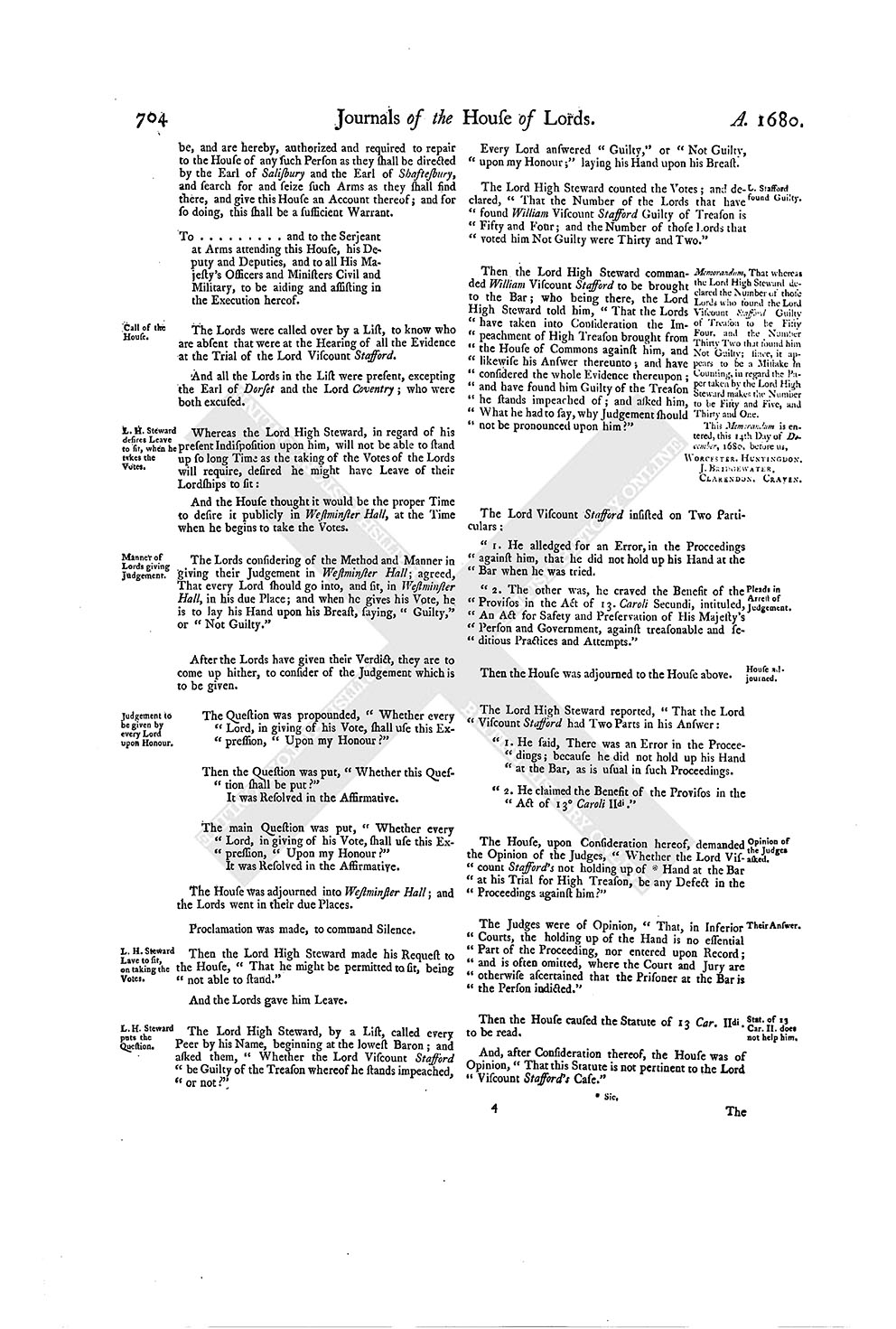
The Lords were called over by a List, to know who are absent that were at the Hearing of all the Evidence at the Trial of the Lord Viscount Stafford.
And all the Lords in the List were present, excepting the Earl of Dorset and the Lord Coventry; who were both excused.
L. H. Steward desires Leave to sit, when he takes the Votes.
Whereas the Lord High Steward, in regard of his present Indisposition upon him, will not be able to stand up so long Time as the taking of the Votes of the Lords will require, desired he might have Leave of their Lordships to sit:
And the House thought it would be the proper Time to desire it publicly in Westminster Hall, at the Time when he begins to take the Votes.
Manner of Lords giving Judgement.
The Lords considering of the Method and Manner in giving their Judgement in Westminster Hall; agreed, That every Lord should go into, and sit, in Westminster Hall, in his due Place; and when he gives his Vote, he is to lay his Hand upon his Breast, saying, "Guilty," or "Not Guilty."
After the Lords have given their Verdict, they are to come up hither, to consider of the Judgement which is to be given.
Judgement to be given by every Lord upon Honour.
The Question was propounded, "Whether every Lord, in giving of his Vote, shall use this Expression, "Upon my Honour?"
Then the Question was put, "Whether this Question shall be put?"
It was Resolved in the Affirmative.
The main Question was put, "Whether every Lord, in giving of his Vote, shall use this Expression, "Upon my Honour?"
It was Resolved in the Affirmative.
The House was adjourned into Westminster Hall; and the Lords went in their due Places.
Proclamation was made, to command Silence.
L. H. Steward Lave to sit, on taking the Votes.
Then the Lord High Steward made his Request to the House, "That he might be permitted to sit, being not able to stand."
And the Lords gave him Leave.
L. H. Steward puts the Question.
The Lord High Steward, by a List, called every Peer by his Name, beginning at the lowest Baron; and asked them, "Whether the Lord Viscount Stafford be Guilty of the Treason whereof he stands impeached, or not?"
Every Lord answered "Guilty," or "Not Guilty, upon my Honour;" laying his Hand upon his Breast.
L. Stafford found Guilty.
The Lord High Steward counted the Votes; and declared, "That the Number of the Lords that have found William Viscount Stafford Guilty of Treason is Fifty and Four; and the Number of those Lords that voted him Not Guilty were Thirty and Two."
Memorandum, That whereas the Lord High Steward declared the Number of those Lords who found the Lord Viscount Stafford Guilty of Treason to be Fifty Four, and the Number Thirty Two that found him Not Guilty; since, it appears to be a Mistake in Counting, in regard the Paper taken by the Lord High Steward makes the Number to be Fifty and Five, and Thirty and One. This Memorandum is entered, this 14th Day of December, 1680, before us,
Worcester. Huntingdon.
J. Bridgewater.
Clarendon. Craven.
Then the Lord High Steward commanded William Viscount Stafford to be brought to the Bar; who being there, the Lord High Steward told him, "That the Lords have taken into Consideration the Impeachment of High Treason brought from the House of Commons against him, and likewise his Answer thereunto; and have considered the whole Evidence thereupon; and have found him Guilty of the Treason he stands impeached of; and asked him, What he had to say, why Judgement should not be pronounced upon him?"
The Lord Viscount Stafford insisted on Two Particulars:
"1. He alledged for an Error, in the Proceedings against him, that he did not hold up his Hand at the Bar when he was tried.
Pleads in Arrest of Judgement.
"2. The other was, he craved the Benefit of the Provisos in the Act of 13. Caroli Secundi, intituled, An Act for Safety and Preservation of His Majesty's Person and Government, against treasonable and seditious Practices and Attempts."
House adjourned.
Then the House was adjourned to the House above.
The Lord High Steward reported, "That the Lord Viscount Stafford had Two Parts in his Answer:
"1. He said, There was an Error in the Proceedings; because he did not hold up his Hand at the Bar, as is usual in such Proceedings.
"2. He claimed the Benefit of the Provisos in the Act of 13° Caroli IIdi."
Opinion of the Judges asked.
The House, upon Consideration hereof, demanded the Opinion of the Judges, "Whether the Lord Viscount Stafford's not holding up of (fn. 1) Hand at the Bar at his Trial for High Treason, be any Defect in the Proceedings against him?"
Their Answer.
The Judges were of Opinion, "That, in Inferior Courts, the holding up of the Hand is no essential Part of the Proceeding, nor entered upon Record; and is often omitted, where the Court and Jury are otherwise ascertained that the Prisoner at the Bar is the Person indicted."
Stat. of 13 Car. 11. does not help him.
Then the House caused the Statute of 13 Car. 11di. to be read.
And, after Consideration thereof, the House was of Opinion, "That this Statute is not pertinent to the Lord Viscount Stafford's Case."
Commons demand Judgement.
The House being made acquainted, "That the Commons were at the Door, with their Speaker:"
They being admitted in; the Speaker demanded "Judgement of High Treason, against William Viscount Stafford, upon the Impeachment of the Commons of England in Parliament, in the Name of the Commons in Parliament, and of all the Commons of England."
Debate concerning the Judgement to be given.
The House took into Consideration what Judgement was to be given, upon William Viscount Stafford.
And it was moved, "That he might be beheaded."
After some Debate, the Judges were asked, "Whether, if any other Judgement than the usual Judgement for Treason were given upon him, it would attaint his Blood?"
Judges Opinion.
The Judges were of Opinion, "That the Judgement for Treason, appointed by Law, is, to be hanged, drawn, and quartered; and in the Courts and Proceedings below, they can take no Notice of any Judgement for Treason but that."
Attorney General heard about it.
Also the King's Attorney General desired to be heard, on His Majesty's Behalf.
Which the House gave Leave for him to be.
Who said, "He knew of no other Judgement by Law for Treason, but Hanging, Drawing, and Quartering. If any other Judgement were given, it would be prejudicial to His Majesty; and would be a Question in the Inferior Courts as to his Attainder for Treason."
Usual Judgement to be pronounced.
ORDERED, That the Lord High Steward do pronounce the ordinary Judgement of Death upon the Lord Viscount Stafford, as the Law hath appointed, in Cases of High Treason.
Message to acquaint H. C. that the Lords will presently give Judgement.
A Message was sent to the House of Commons, by Sir Tymothy Baldwin and Sir Samuell Clerke:
To let them know, that the Lords are ready to come down into Westminster Hall, to give Judgement upon William Viscount Stafford.
House adjourned to Westminster Hall.
The Lord High Steward adjourned this House into Westminster Hall; and all the Lords went in their Places.
Proclamation was made, for keeping Silence.
The Lord Viscount Stafford being brought to the Bar; the Lord High Steward spake as followeth:
Lord High Steward's Speech to L. Stafford.
"My Lord Viscount Stafford,
"That which your Lordship hath said in Arrest of Judgement hath been found by my Lords, upon due Consideration had of it, to be of no Moment at all: It is no effential Part of any Trial, that the Prisoner should hold up his Hand at the Bar; there is no Record ever made of it, when it is done; the only Use of it is, to shew the Court who the Prisoner is; and when that is apparent, the Court does often proceed against him, though he refuse to hold up his Hand at the Bar: Therefore the Omission of that Ceremony, in this Case, is no legal Exception, as all the Judges have declared.
"And as to the Provisos in the Statute of the 13th Year of this King; their Lordships do find, that they are in no Sort applicable to this Case; forasmuch as the Proceedings against your Lordship are not grounded upon that Statute, but upon the Statute of the 25th of Edward the Third: And yet, if the Proceedings had been upon the latter Statute, the Provisos therein could have done your Lordship no Service at all.
My Part, therefore, which remains, is a very sad one; for I never yet gave Sentence of Death upon any Man; and am extremely sorry that I must begin with your Lordship.
"Who would have thought, that a Person of your Quality, of so noble Extraction, of so considerable Estate and Fortune, so eminent a Sufferer in the late ill Times, so interested in the Preservation of the Government, so much obliged to the Moderation of it, and so personally obliged to the King and His Royal Father for Their particular Favours to you, should ever have entered into so infernal a Conspiracy, as to contrive the Murder of the King, the Ruin of the State, the Subversion of Religion, and, as much as in you lay, the Destruction of all the Souls and Bodies in Three Christian Nations?
"And yet the Impeachment of the House of Commons amounts to no less a Charge: And of this Charge, their Lordships have found you Guilty.
"That there hath been a general and desperate Conspiracy of the Papists, and that the Death of the King hath been all along one chief Part of the Conspirators Design, is now apparent, beyond all Possibility of Doubting.
"What was the Meaning of all those Treatises, which were published about Two Years since, against the Oath of Allegiance, in a Time when no Man dreamt of such a Controversy? What was the Meaning of Father Conyers' Sermon upon the same Subject; but only because there was a Demonstration of Zeal, as they call it, intended against the Person of the King, which the Scruples arising from that Oath did somewhat hinder?
"To what Purpose were all the Correspondencies with Foreign Nations, the Collections of Money among the Fathers Abroad and at Home? What was the Meaning of their governing themselves here by such Advices as came frequently from Paris and St. Omers? and how shall we expound that Letter which came from Ireland, to assure the Fathers here, "that all Things were in a Readiness there too, as soon as the Blow should be given."
"Does any Man now begin to doubt how London came to be burnt? or by what Hands and Means poor Justice Godfrey fell? And is it not apparent, by these Instances, that such is the frantic Zeal of some bigoted Papists, that they resolve, no Means, to advance the Catholic Cause, shall be left unattempted, though it be by Fire and Sword?
"My Lord,
"As the Plot in general is most manifest, so your Lordship's Part in it hath been too too plain. What you did at Paris, and continued to do at Tixall in Staffordshire, shews a settled Purpose of Mind against the King. And what you said at London, touching honest Will, shews you were acquainted with that Conspiracy against the King's Life, which was carrying on here too. And in all this, there was a great Degree of Malice; for your Lordship at one Time called the King "Heretic and Traitor to God;" and at another Time, you reviled Him, for misplacing His Bounty, and rewarding none but Traitors and Rebels.
"And thus, you see, that which the Wise Man forewarned you of is come upon you, Curse not the King, no not in thy Heart; for the Birds of the Air shall reveal, and that which hath Wings will declare the Matter.
"Three Things I shall presume to recommend to your Lordship's Consideration:
"In the First Place, your Lordship now sees, how it hath pleased God to leave you so far to yourself; that you are fallen into the Snare, and into the Pit, into that very Pit which you were digging for others: Consider, therefore, that God Almighty never yet left any Man, who did not first leave Him.
"In the next Place, think a little better of it than hitherto you have done, what Kind of Religion that is, in which the blind Guides have been able to lead you on, into so much Ruin and Destruction, as is now like to befall you.
"In the last Place, I pray your Lordship to consider, that true Repentance is never too late: A devout penitential Sorrow, joined with an humble and hearty Confession, is of mighty Power and Efficacy, both with God and Man.
"There have been some of late, who have refused to give God the Glory of His Justice, by acknowledging the Crimes for which they were condemned; nay, who have been taught to believe, it is a mortal Sin to confess that Crime in Public, for which they have been absolved in Private; and so have not dared to give God that Glory, which otherwise they would have done.
God forbid, your Lordship should rest upon Forms! God forbid, your Lordship should be found among the Number of those poor mistaken Souls, whom the First Thing that undeceives is Death itself!
"Perhaps your Lordship may not much esteem the Prayers of those whom you have long been taught to miscall Heretics; but, whether you do or no, I am to assure your Lordship, that all my Lords here, even they that have condemned you, will never cease to pray for you, that the End of your Life may be Christian and pious, how tragical soever the Means are that must bring you thither.
"And now, my Lord, this is the last Time that I can call you ("my Lord";) for the next Words I am to speak will attaint you.
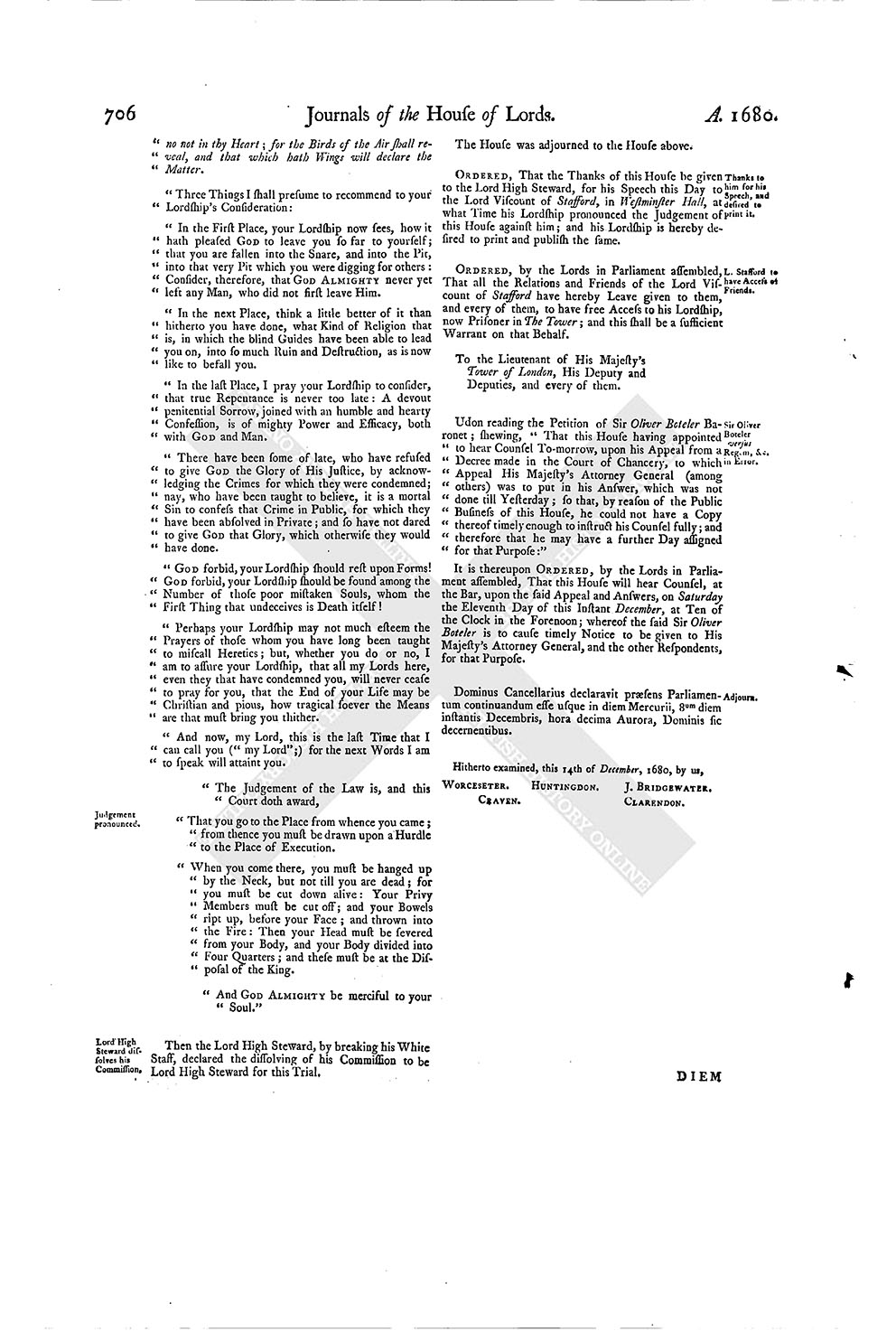
"The Judgement of the Law is, and this Court doth award,
Judgement pronounced.
"That you go to the Place from whence you came; from thence you must be drawn upon a Hurdle to the Place of Execution.
"When you come there, you must be hanged up by the Neck, but not till you are dead; for you must be cut down alive: Your Privy Members must be cut off; and your Bowels ript up, before your Face; and thrown into the Fire: Then your Head must be severed from your Body, and your Body divided into Four Quarters; and these must be at the Disposal of the King.
"And God Almighty be merciful to your Soul."
Lord High Steward dissolves his Commission.
Then the Lord High Steward, by breaking his White Staff, declared the dissolving of his Commission to be Lord High Steward for this Trial.
The House was adjourned to the House above.
Thanks to him for his Speech, and desired to print it.
ORDERED, That the Thanks of this House be given to the Lord High Steward, for his Speech this Day to the Lord Viscount of Stafford, in Westminster Hall, at what Time his Lordship pronounced the Judgement of this House against him; and his Lordship is hereby desired to print and publish the same.
L. Stafford to have Access of Friends.
ORDERED, by the Lords in Parliament assembled, That all the Relations and Friends of the Lord Viscount of Stafford have hereby Leave given to them, and every of them, to have free Access to his Lordship, now Prisoner in The Tower; and this shall be a sufficient Warrant on that Behalf.
To the Lieutenant of His Majesty's Tower of London, His Deputy and Deputies, and every of them.
Sir Oliver Boteler versus Reg. m, &c. in Error.
Udon reading the Petition of Sir Oliver Boteler Baronet; shewing, "That this House having appointed to hear Counsel To-morrow, upon his Appeal from a Decree made in the Court of Chancery, to which Appeal His Majesty's Attorney General (among others) was to put in his Answer, which was not done till Yesterday; so that, by reason of the Public Business of this House, he could not have a Copy thereof timely enough to instruct his Counsel fully; and therefore that he may have a further Day assigned for that Purpose:"
It is thereupon ORDERED, by the Lords in Parliament assembled, That this House will hear Counsel, at the Bar, upon the said Appeal and Answers, on Saturday the Eleventh Day of this Instant December, at Ten of the Clock in the Forenoon; whereof the said Sir Oliver Boteler is to cause timely Notice to be given to His Majesty's Attorney General, and the other Respondents, for that Purpose.
Adjourn.
Dominus Cancellarius declaravit præsens Parliamentum continuandum esse usque in diem Mercurii, 8um diem instantis Decembris, hora decima Aurora, Dominis sic decernentibus.
Hitherto examined, this 14th of December, 1680, by us,
Worceseter. Huntingdon. J. Bridgewater.
Craven. Clarendon.