
Survey of London Monograph 17, County Hall. Originally published by Guild & School of Handicraft, London, 1991.
This free content was digitised by double rekeying. All rights reserved.
'The building of County Hall, 1909-22', in Survey of London Monograph 17, County Hall, (London, 1991) pp. 49-56. British History Online https://www.british-history.ac.uk/survey-london/bk17/pp49-56 [accessed 25 April 2024]
In this section
CHAPTER V. The Building of County Hall 1909–1922
What is this Work began on the construction of County Hall in 1909, before either elevations or internal planning had been finalized. Considerable delays resulted, partly because of the clumsy dual responsibility of the architects, and partly through unforeseen problems over the construction of such a massive building on the riverside site. However, not only the river wall and foundation slab, but to some extent the substructure, were sufficiently independent of the superstructure to allow construction to begin before the design of the latter had been fully thought out.
The general plan of construction (fig. 21) was to erect a coffer dam up to the boundary with Holloways' premises, behind which the embankment wall could be built, and then to clear the site of made ground and Thames mud by excavation – about 19 feet in all – and lay a five-foot thick concrete foundation 'raft' on top of the ballast which underlies the area. Over and above the structural advantages of this scheme on a piece of littoral with uncertain bearing strength and stability, the slab gave complete flexibility for the planning and setting out of the building (Plate 6).
The immense task of constructing the building presented problems of its own. These were made more serious as the process of designing fell far behind in relation to site works. Riley suggested to Knott in the summer of 1909 that the contract for the construction of the building itself might be split into two sections: the first to cover substructure and the building up to ground floor level (including foundations and two basements); and the second to cover superstructure – the remaining, more complicated and contentious part of the building. Knott immediately acknowledged the advantages of this idea, and there is no doubt that the building was completed more quickly as a result of this separation of contracts. (fn. 1) In addition the building was divided vertically into Sections and Blocks (fig. 22), on which work started progressively.
The Embankment Wall
The contract for building the embankment wall was won, in October 1908, by Price & Reeves, of Waterloo Place. (fn. 2) They began by erecting the coffer dam, starting work on this in January 1909. The dam was closed on 10 September and the area behind it cleared of water during the following week. It was a single-pile construction, consisting of a row of 600 tongued-and-grooved timber piles, 14 inches square, driven through 4 feet of mud and 11 feet of ballast into the clay, 'until their points were 9 feet below what would be the bottom of the new wall'. (fn. 3)
The wall itself, on which work began in September 1909, is an impressive structure, similar in its main features to the embankment wall in front of St Thomas's Hospital (Plates 8b, 9b). Built of concrete founded on clay, it is faced with ashlar work of Aberdeen and Cornish granite and surmounted by a granite parapet. The engineering work and overall design of the wall were the responsibility of the LCC's Chief Engineer, Maurice Fitzmaurice, who also supervised its construction, Knott's contribution being limited to designing the architectural features of the central section. (fn. 4) The massive ornamental bronze mooring-rings of lions' and horses' heads (Plate 31a, b) were modelled by the sculptor Gilbert Bayes on Knott's recommendation (see page 59). (fn. 5) The wall was completed in September 1910 at a cost of £58,090, some £4,500 below the contract price. (fn. 6)
Foundations and Substructure
The contract for the construction of the raft foundation had been awarded to F. & H. F. Higgs in April 1909. (fn. 7) The late departure of Lambeth Borough Council from the site delayed demolition work, and further problems arose because of friction with Price & Reeves over access. A technical problem arose too. Behind the coffer dam a deep foundation trench was dug, and the gap strutted on to the unexcavated foreshore. When Higgs began their excavation at this point, they faced the prospect of a collapsing coffer dam (Plate 6a, b). These problems were eventually overcome, but, together with flooding of the excavation, they increased the original contract sum of £46,900 by nearly £5,000. (fn. 8)
The work was also considerably delayed. The contract had divided the raft into two sections, from Holloways' boundary to the southern boundary of the Lambeth site, and from there to Westminster Bridge Road. The intention was to build the centre section of County Hall first, and to gain time by dividing up the foundation and substructure work. Although Higgs's whole contract was finished only four months late, on 3 October 1911, Section A was delayed by 13 months – from 7 June 1910 to 5 July 1911. (fn. 9)
Discovery of the Roman Boat
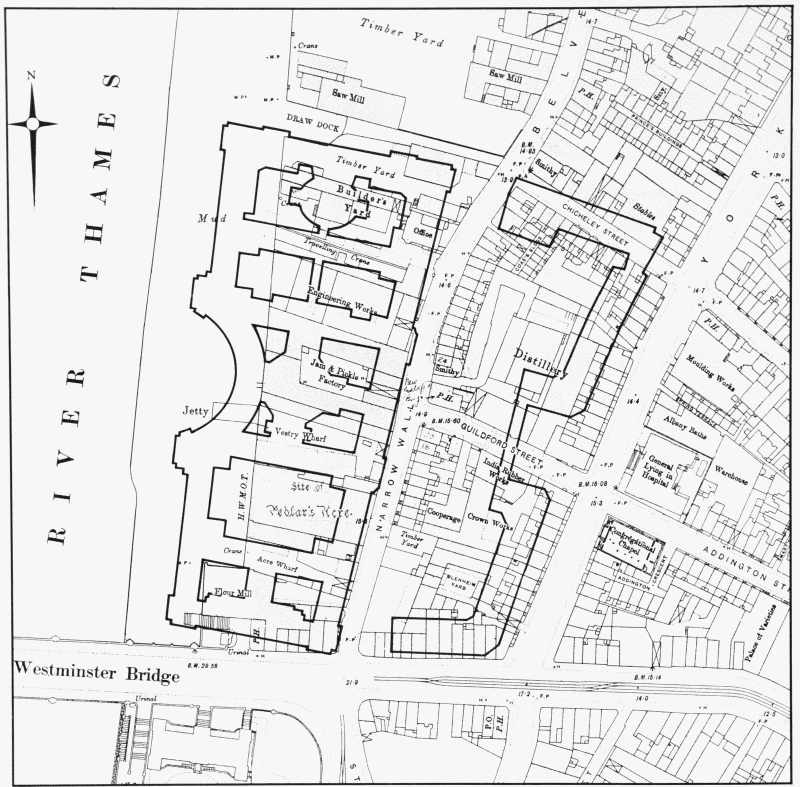
Fig. 21. Outline plan of County Hall, and the New County Offices (North and South Blocks), showing the relationship to the existing street plan. Much of the east side of Belvedere Road (Narrow Wall) was demolished for road widening after the building of County Hall
During excavations for the raft, in May 1910, the sub stantial remains of a Roman boat were uncovered on the foreshore. Theories about its origin have varied, from the initial one of a galley, sunk in a battle between Allectus and Constantius, AD 296, to a ferry boat holed in old age by her own mooring post. The modern view is that it is an authentic Roman 'round-bottomed ocean-going' boat with a 'protruding keel'. (fn. 10)
The discovery was apparently made by F. L. Dove, a former Chairman of the Establishment Committee. In January 1910, while inspecting the excavation for the concrete raft with R. C. Norman, Dove noticed a dark curved line in the face of the excavation, which the workmen suggested was a sunken barge, but he realized that it must be of considerable antiquity, and should be treated with care. Removal of the soil revealed the 'remains of a Roman boat, carvel-built of oak, lying N.E.-S.W., its bow towards the shore', 19 feet below high water. It measured approximately 38 feet in length, and about 18 feet in beam. (fn. 11) The vessel was protected in situ and then stored by the Council, eventually finding its way into the Museum of London.
Progress of the Building Programme
The delay to the contract caused by Higgs's late finish was more theoretical than real as there were other problems. A major difficulty was that the design details and even the method of construction were not yet finalized, partly due to the activities of the Assessors, and partly to a fruitless attempt by Knott to persuade Riley to adopt new methods of construction. Knott expended months of effort attempting to convince Riley of the wisdom of using a reinforcedconcrete floor structure. Riley, being responsible for this part of the design, was extremely critical of Knott's proposal to use a patent flooring system. He argued so strongly, always backed by structural and cost calculations, that Knott eventually gave in and a system of steel joists with concrete casing and infill was adopted. (fn. 12)
The only stanchions and girders of heavy construction are in Block 2, the area occupied by the Main Committee Room, where the upper floors are built above large clear spans over the boiler room. Because the architectural style is of a massive nature, load-bearing brickwork seemed the obvious choice and the idea of using steelwork generally for vertical structure was ruled out virtually from the beginning. The roof, however, is steel framed, with plate girders built up in curved sections from the top of the brickwork at fifth-floor level to form the structure of the sixth floor as well as the roof slope (Plate 9a). Walling is generally of London stock brickwork, with blue engineering bricks set in sand and cement where loading demanded higher strength. The clearest sense of how County Hall is built is to be felt in the sub-basement, where the heavy solidity of the building is apparent in the massive piers visible in corridors of painted brickwork.
Drawings for the substructure were by no means ready for sending out to tender in the middle of 1910. Although Riley complained in the autumn of 1909 that Knott's revisions to the design had already held up the works by nine months, (fn. 13) it will be seen from events described in the last chapter that many design changes were still to come. But in mid-June 1910 Riley's schedule still foresaw Knott's drawings coming into his office at the end of August. These would be checked by Riley, given to the quantity surveyors at the end of October, and work would begin at the end of March 1911. Allowing fifteen months for substructure works, it was estimated that the whole building (Sections A, B and C) would be completed towards the end of 1915. To save time, Riley recommended the procedure, eventually adopted, of asking contractors for both sub- and superstructure contracts to quote for Section A, and to agree the construction of Sections B and C at the same rates, thus saving the time and expense of preparing new bills of quantities and getting tenders for those parts of the building.
While Riley undoubtedly hoped that the 1915 completion date would be met, the Establishment Committee were warned in June 1910 that this might have to be modified because of unexpected difficulties. (fn. 14) A major problem was Knott's slowness in providing drawings, compounded by the cumbersome method by which they were then checked in Riley's office.
Knott had originally promised to deliver drawings of the whole building by October 1909. Two firms of quantity surveyors, John Learning & Sons and J. Rider Hunt & Company, were chosen by tender in February of the following year, but still had nothing to work on. At the beginning of June 1910 Knott was only promising substructure drawings at the end of that month. Steelwork drawings were of particular importance, and although some of these were being delivered, subsequent changes meant that many, having been checked and sent to the quantity surveyors, were rendered useless, because of altered loadings. Riley complained at the end of November that he still had not received small-scale plans of the building, dealing with drainage, ventilation, water supply, means of escape, and so on. He warned that dealing with matters of detail before more general questions were settled, 'involves considerable risk of alterations being required ... later on'. (fn. 15)
Plans and sections of the whole building were finally delivered by Knott on 20 January 1911, (fn. 16) nearly fourteen months after they had been requested by Riley. Nevertheless, changes were still required, some of them substantial. Thus the height of the Council Chamber – 100 feet in Knott's original scheme – was only reduced to its eventual height of about 50 feet in March 1911. (fn. 17)
Substructure tenders for Section A were presented to the Council on 25 July 1911. Charles Wall Limited won the contract with the lowest tender of £47,738, considerably below Riley's estimate of £56,000, and at the same time it was agreed to award them the contract for Sections B and C as well, at an estimated cost of £104,000. (fn. 18) By early December the brick piers beneath the Council Chamber were built up to a height of 12 feet and some steel joists and girders were being fixed at basement-floor level. The average number of men on the site was 68, most of whom were bricklayers. (fn. 19)
The Establishment Committee were very concerned about the delays. At a meeting in December 1911, Isidore Salmon, the Vice-Chairman, complained that it would be nearly three months before the working drawings for the Council Chamber block would be ready for the contractor. Both Riley and Knott were asked to explain the delay, the former blaming the latter, and the latter the changes made by the Assessors and the illness of Norman Shaw. (fn. 20)
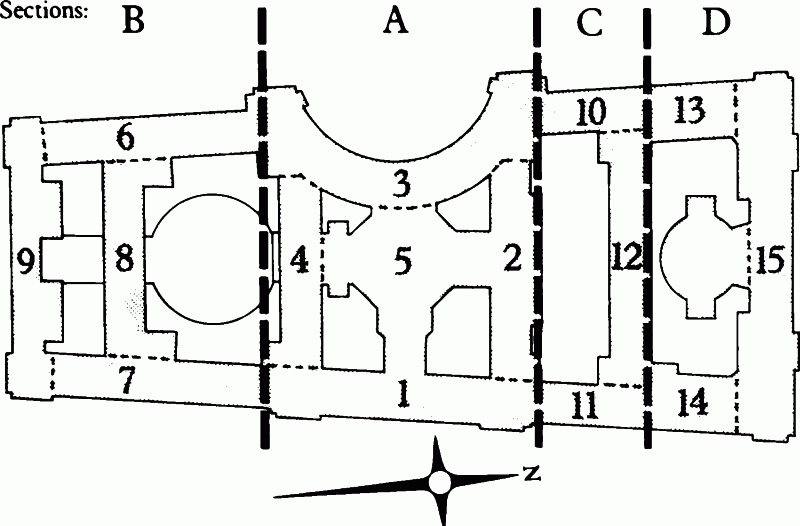
Fig. 22. Plan of County Hall showing the division of the building into Blocks (numbered) and Sections (lettered) for construction purposes
A few months later a revised completion date – the end of 1917 – was put forward, (fn. 21) and the matter was discussed at length in Council. Edward Smith, a Progressive Member of the Establishment Committee, declared that the present condition of affairs was a crying scandal and the LCC was the laughing-stock of London. He referred sarcastically to the arrangement by which Riley had responsibility for checking Knott's steelwork drawings, and the inevitable delays and disagreements which arose as a result. (fn. 22)
If in public Riley did nothing to diminish the feeling that Knott was to blame, in private he said it outright. However, with a growing feeling that adverse criticism of one architect would reflect badly on both, or that Knott might snap back, Riley began to find other reasons for the lack of progress on the building. He made the point that there had been a coal strike, preventing the manufacture of bricks, and in early June 1912 a dock strike began, stopping delivery of any materials. He was also quick to point out the value of his suggestion to split the contract into sub- and superstructure, contrasting it with Knott's delays over various points, like the 'extension of the Crescent' or the construction of floors. (fn. 23) When comparisons were made with other sites, Riley provided Salmon with ammunition about other London buildings which were behindhand including various government contracts, such as the War Office, which took over six years to build. (fn. 24)
In June 1912, dissatisfaction at the lateness of the drawings led Edward Smith to threaten to move the adjournment of the Council if the complete superstructure drawings were not delivered as promised on 9 July. This date was met, though Knott delivered only the complete general drawings, saying that he had always meant to supply only those and not the details as well. He got away with this, though the Council rather felt they had been deceived by the qualification. (fn. 25)
Confidence was partly restored, however, and at the Council meeting on 16 July, when Smith asked facetiously if any steps were being taken to secure the erection of the new County Hall within the next 10 years, Salmon, now Committee Chairman, was ready with a revised schedule. Tenders for the first section of the superstructure would be invited in January 1913, construction would begin in April, and it was hoped to complete the whole building by midsummer 1916, (fn. 26) an improvement of roughly eighteen months on the completion date given only four months earlier.
There is no obvious reason for Knott's slow progress with the drawings. If we had any record of his version of events, to oppose or balance Riley's detailed records, the reasons might become clear. It seems evident, however, that Knott was spending a disproportionate time in redesigning the scheme, and doing so in an unsystematic way. Riley pointed out on several occasions that Knott was working out detailed arrangements of groups of rooms without reference to what was happening elsewhere in the plan. The problems could well have been caused by his inexperience. He had virtually opened his career with one of the largest commissions of the Edwardian period and could hardly have been expected to deal efficiently with such a complex problem. It was here that Knott needed, but did not always welcome, the help which Riley's experience and technical skill could provide. The friction between the two men was seized upon by some politicians and sections of the press as an important factor contributing to the delay, Knott and Riley being seen as more interested in quarrelling than in getting on with the job in hand.
The question of who was to blame for the delay was to simmer on as a political issue long after it had ceased to have any practical significance. In 1913 Salmon defended the Municipal Reformers' record over the new County Hall, blaming the Progressives, and claiming that the greatest delay had taken place because of the competition and the three years taken to find, select and appoint an architect. Norman, too, was inclined to put the blame on the competition and on the choice of a young and inexperienced architect. (fn. 27) The Progressives were held to be responsible because they had devised the 'system of the two architects', an implication vigorously repudiated by Percy Harris and Edward Smith, who implied the real reason for delays was that the two architects did not get on, and that this in itself was, 'a crushing condemnation of the Moderates' business capacity'. (fn. 28)
The Laying of the Foundation Stone
By March 1912 the works were sufficiently advanced for King George V, accompanied by Queen Mary, to lay the foundation stone. There was some discussion about where the ceremony should be held. It was suggested that the stone might be laid in a convenient place and relaid in a prominent one at a later date, but the idea was rejected as unconventional. So a permanent location had to be chosen, one that was visible either on the outside of the building or on the Principal Floor inside it. The latter seemed the only practical solution, and the stone – a large block of Iona marble – was laid in the north-east lobby adjacent to the Council Chamber (fig. 31) on Saturday 9 March 1912 (Plate 7a, b). Edward White, Chairman of the Council, and Maurice Fitzmaurice, the Chief Engineer, were knighted on the occasion. The ceremonial tools used for laying the stone are among the finest artefacts commissioned by the Council. The trowel was designed and made by students of the Central School of Arts and Crafts, and the mallet, plumb-rule and spirit-level by the Bromsgrove Guild of Applied Arts (Plate 7c-e). (fn. 29)
The Erection of the Superstructure
Shortly after the foundation stone was laid, the Council considered ways of speeding the works along. It was hoped to time things so that the superstructure could be begun immediately the substructure was complete – estimated as mid-April 1913. One suggestion was to invite contractors to submit alternative tenders for three- and twoyear periods of construction, with a bonus for each week saved on the contract time. However, no contractor was interested in such an arrangement so, as with the substructure, bills of quantities were prepared for Section A only, and tenderers were asked on what conditions they would be prepared to take on the work for Sections B and C. While other firms submitted lower prices for Section A, Holland & Hannen and Cubitts agreed to do all three sections at the same rates and this brought their overall price below the rest, at an estimated £968,211. (fn. a)
The contract with Holland & Hannen and Cubitts was signed on schedule in April 1913. Knott made such good progress with the drawings for the other two sections that these were issued to the contractors in mid-June. (fn. 31) Moreover, completion of the substructure was sufficiently advanced by the end of August 1913 to allow Holland & Hannen and Cubitts to make a start. (fn. 32)
While construction was under way, minor changes were being made to the internal organization of County Hall. Many suggestions were offered, the most ambitious and romantic coming from R. M. Sebag-Montefiore, a Municipal Reformer, who wanted the Establishment Committee to consider 'the advisability of providing a roof garage for the use of members' aeroplanes'. F. L. Dove, the Committee Chairman, replied that, as aviation was not yet an 'exact science', the river would make a safer landing place. (fn. 33) More mundane but more practical were Salmon's efforts to organize staff restaurants and locate committee rooms where they would be most useful. Isidore Salmon (1876–1941) was Chairman and Managing Director of the well-known caterers J. Lyons, who were at the time expanding rapidly. Their Strand Palace Hotel had opened in 1909, and both the Regent Palace Hotel and Strand Corner House were to open in 1915. These projects made him well qualified to superintend catering arrangements for the new County Hall.
The building of County Hall was dogged by bad luck, as well as by unfortunate politics. Having missed their chance to build during the last years of a period of stable prices before 1895, the LCC held their competition just as costs began to rise at an increased rate after 1906. By the time a start was made on construction, widespread strikes and lockouts prevailed, making progress slow and erratic. The coal and dock strikes of 1912 have already been mentioned; two years later came the so-called Triple Alliance of miners, railway men and transport workers, each agreeing to support the others in strike action. 1914 also saw the famous strike and lockout in the building industry brought about by employers' use of non-union labour. A principal reason for union solidarity, and of this strike in particular, was the growing numbers of tradesmen who were being put out of work by new processes and methods of construction. (fn. 34) The employers, the Master Builders Association, reacted to the strike by locking out all workers who were unwilling to sign a document which would bind them to ignore blackleg labour. This ploy, designed to lure blackleg workers and often used successfully in previous disputes, was less successful on this occasion; few competent workmen would sign, and the strike dragged on. (fn. b)
In addition to the waste of public money involved, and the political embarrassment, Council staff were increasing at a rate unforeseen when building work began, and space was urgently needed. Between 1908 and 1911 there had been an increase of 16 per cent from 2,100 to 2,441; Sections A, B and C would hold only 2,270. (fn. 36)
The strike hurt. After years of underspending on the capital vote for County Hall, the beginning of 1914 had seen the job moving ahead at last. From the 68 men employed on site in December 1911, the number had risen to 560 in January 1914, with 139 at work on the substructure and the remainder employed on the super structure contract, 250 of them on site and 171 in outside yards. (fn. 37) Now all that came to a halt. Settlement of the strike was being slowly worked out when the declaration of war in August 1914 ended all strikes practically overnight. However, the County Hall schedule had slipped by some four months.
Extension of the County Hall Site
In the autumn of 1912 the Committee had decided to take possession of Holloway Brothers' site for building Section D. The Council were bound to give two years' notice of their intention to end Holloways' lease, and 1914 was one of the optional years for acquisition. (fn. 38) Early in 1914 Salmon had told Riley that he wanted to be ready to begin Section D (fig. 22) 'the moment Holloway Brothers vacate'. Riley assumed that the working drawings for the raft foundations were well forward, and that Knott's suband superstructure drawings for the section were also ahead of schedule. (fn. 39) Knott provided drawings for the preparation of bills of quantities in July, and a contract for the river wall extension was signed towards the end of the month with Morrison & Mason of Glasgow, for £23,000, although work began only after war had been declared, on 17 August. (fn. 40) (fn. c)
The Effect of the Great War
The war's initial impact was not on manpower but on supplies, and the County Hall job was fairly well stocked in many areas. As late as March 1916 there were still 400 men at work, (fn. 42) though the northern extensions of the embankment wall had fallen behind schedule. Because of military demand for the railways, moving granite up from Cornwall for the wall was proving difficult and only about 20 per cent of the contract value had been executed. (fn. 43)
Even so, work to the building was progressing as never before, and in December 1915 the contractors were estimating that the roof would be on by the following June. But this optimism was misplaced: when an expenditure of £200,000 on the building in 1916 was suggested, the Comptroller pointed out that there was a Treasury objection to spending on building because it tied up scarce labour needed for the armed forces, and competed with projects needed for the war, and that work would probably have to stop once the building was covered in. (fn. 44)
The Council was of course in direct competition with the Ministry of Munitions, which wanted builders in great quantity for the construction of factories. The Ministry had been formed in the early part of 1915 under Lloyd George, and County Hall, as one of the largest office developments in London, was not to escape its attentions.
The building first suffered when the contractors took men off because the supply of materials dwindled. Holland & Hannen and Cubitts had written to the Council in March 1915 proposing suspension of works, but were told that they must continue as best they could and that the architects would consider claims for an extension of time. (fn. 45) The contractors argued that there were insufficient materials to continue the job properly, and negotiations went on until, on 24 January 1916, Riley caught their men dismantling a crane without the Council's permission. He was told that they had been ordered to do this by the Ministry of Munitions. Riley ought to have known that with Henry Holloway in that very Ministry, busily earning his knighthood, he was unlikely to get very far. His protest was met by a Ministry letter ordering a complete stop to the works under the Defence of the Realm Act. (fn. 46)
Wartime occupation of County Hall
There is little doubt that the move to stop work at County Hall was ill-timed, although there is some reason for believing the LCC view that the Ministry was influenced to act by Holland & Hannen and Cubitts, if not by Holloway. (fn. 47) It can be argued that the completion of the building would have served the war effort as well as complete cessation. Besides wanting men and equipment to build munitions factories, the Ministry needed somewhere to house its burgeoning administrative staff, which was to grow from nothing to 65,000 by the end of the war. The Government had already taken over and occupied many London buildings. The new County Hall would make an ideal place for the Ministry for exactly the same reasons that it suited the LCC; but it was unfinished. There were no doors, no windows, no partitions or plastering. It was a shell, and there was no question of its being immediately habitable.
After necessary work had been done to close the contract, the building stood idle for almost a year. Knott's office was running down as his staff enlisted.
The office is like the ten little nigger boys, one by one they disappear, & I think the final end of the County Hall stint will be a mass of drawings, mostly torn, & every one in the wrong drawer, possibly a skeleton of a bulky person will be lying near (tho' not near enough to be of use) supposed by its bulkiness to be Collins. If any survivors are found, they would of course be redrawing the seating in the Council Chamber. (fn. 48)
Knott himself joined the Royal Flying Corps at the end of 1916, and spent the war designing 'shops' for them. However, he was stationed in London and hoped to visit his office in the evenings to take care of the little business there was to be dealt with. (fn. 49)
In February 1917, the Principal Architect to the Office of Works had a look around the partly completed building, and was critical of the Ministry of Munitions' decision to stop work on County Hall. (fn. 50) Early in March Riley reported that the Office of Works wanted to take over Sections A and B from basement to third-floor level, and works were soon in hand to fit up these areas. (fn. 51)
Next in line was the Food Controller, who wanted various rooms on the Principal Floor for a Food Economy Exhibition, which took place in the summer of 1917 – the first public function to take place at the new County Hall. Many government departments and other organizations contributed. As The Times reported:
the new L.C.C. Hall will be given over to working exhibits, practical demonstrations and lectures dealing with every phase of national economy and welfare. The Council chamber is to be transformed into a French market where London housewives may study the shopping methods of our allies. A war economy restaurant conducted by the Savoy Hotel management will be installed in a series of rooms and terraces overlooking the Thames and in the Great Courtyard, where the Ministry of Munitions occupies the Central Stand; open air concerts will be given by bands of the British Army. (fn. 52)
By November 1917 the Army Council was fitting up the rest of the building for occupation by up to 1,900 Ministry of Food staff. (fn. 53)
To mark the end of the war, fireworks were launched from the roof of County Hall on Saturday 16 November 1918, provided naturally enough by the Ministry of Munitions. (fn. 54) (fn. d)
If the LCC thought they would get all this back when the war ended they were badly mistaken. Not only was the Ministry of Food staying put in the spring of 1919, but having given up occupation of Grosvenor House, Mayfair, to the Ministry of Pensions they were concentrating their forces at County Hall. (fn. 56) In May of that year 134,400 square feet were occupied as government offices and a further 112,900 square feet used as storage. (fn. 57)
Construction work could, of course, continue while the building was part occupied, and an arrangement was made for Holland & Hannen and Cubitts to complete their contract at cost plus a fixed profit. Building operations resumed in mid-May 1919 (Plate 8c), despite the wartime removal of plant and scaffolding, and by the end of the month 110 men were back at work. (fn. 58) However, the LCC itself was desperate for office space and wanted to transfer its own staff there. During the war the Government had taken over other Council premises, and because of a staff depletion during the war, the leases of yet other buildings had not been renewed. Now the staff was growing again. Further, as the Clerk, James Bird (Plate 11), pointed out, the LCC was under pressure to contribute to post-war reconstruction: 'the Ministry of Labour [was] pressing us to go on with the New County Hall; the Local Government Board pressing us to begin Housing; and the Ministry of Education probably looking for an early resumption of the 40 and 48 suspended schemes'. (fn. 59) The staff of the LCC was to grow now much more rapidly than had been foreseen before the war, indeed, to a large extent as a result of it.
Repossession of County Hall
During the war elections had not been contested, and the Progressives under the Rev. J. Scott Lidgett and the Municipal Reformers under Norman formed a coalition administration on the lines of that at Westminster. The first post-war election was held in March 1919. The Progressives had agreed not to contest many seats if the Municipal Reformers would incorporate certain Progressive material in their manifesto. At the last minute this agreement was cancelled, and the election went ahead on party lines. A Municipal Reform victory resulted, but at the same time the first significant Labour group of fifteen Members was elected.
One subject united both major parties. They were demanding an extension of the geographical area under Council control, as well as higher government grants for such work as housing, and a generally strengthened central local authority for London. The Government was hesitant even to discuss these matters, the Prime Minister Lloyd George refusing for some months to receive an LCC delegation headed by Norman and Lidgett. The Ministry of Health, which had replaced the Local Government Board in 1919, later set up a Royal Commission – the Ullswater Commission – to consider if any changes were needed, but its report in 1923 did not advocate any.
The Municipal Reformers' 'centralist' phase was to last until 1922, when the London Municipal Society challenged for the right to make Municipal Reform policy, and won. Thereafter the LMS ideal of a weak central authority in London combined with strong local boroughs would be Municipal Reform doctrine.
This was an uneasy period in relations between the LCC and central government, partly because of the LCC's demands for reform and the government's resistance to it. There was also pressure on the LCC to deal with the urgent post-war issues of housing and education. The tension engendered did not help the Council in its struggle to repossess its partly completed headquarters. (fn. 60)
The Ministry of Food were understandably hesitant to quit premises on which they had spent £100,000, but of which they had had little use. (fn. 61) The Council's patience was nevertheless wearing thin. At the beginning of June 1919, they sent a deputation to meet Sir Alfred Mond (1868–1930), the First Commissioner of Works. An extremely successful manufacturer in the chemical industry and one of the founders of ICI, Mond had been responsible for the building during the war, but now he came to the LCC's aid, promising a gradual reduction of the 1,000 Ministry of Food staff over the next few months, with complete withdrawal by the end of September. (fn. 62)
With this problem finally resolved the Council could plan the completion of County Hall.
Knott had been discharged from the Royal Air Force in January 1919. It seems the war had a softening effect on the previously brittle relationship between himself and Riley and the job proceeded smoothly thereafter. Riley, who had been due to retire as Architect to the Council in 1918, had been kept on for an extra year because of the war. (fn. 63) Amid protests from the Department, his post went to George Topham Forrest (1873–1945), a Scot, who had worked in the North and for Essex County Council. He was Architect to the Council from 1919–1935 (Plate 11). (fn. 64) Riley's retirement did not affect his involvement in the County Hall project, for which he retained his personal appointment. Although this was an anomaly, no-one could have foreseen in 1907 that the building would still be unfinished twelve years later. He was given administrative assistance and a room at County Hall, a reasonable one at first and later a small and viewless one – room 524a, on the crescent, behind the cornice.
County Hall now began to take on the image of an important public building. By July 1919 349 men were working on the contract, a number which kept steady through the autumn. In October it was reported that over 6,000 cubic feet of Portland stone had been fixed, together with a large number of marble columns, plinths, pilasters and wall linings in the Council Chamber and lobbies. In other areas, structural work was being disrupted by lack of steel due to coal and rail strikes. The building had reached fifth-, and in some places, sixth-floor level. (fn. 65) Other decisions were being taken over the decorative finishes of the Principal Floor, where a large number of rooms were under completion. In this area, some pre-war decisions on finishes and decoration were revised, the whole floor not being completed until well after the official opening date in 1922.
The Establishment Committee were able to meet in County Hall, the first committee to do so, in July 1919, though it must be said that they resumed meeting at Spring Gardens immediately after. (fn. 66) Staff from the Architect's Department started moving in the summer, and by early September the whole department was in the new building. (fn. 67)
By March 1921 over a thousand men were on the job, the highest number ever. The roof structure was up, windows were being fixed, and the marble work to the Ceremonial Staircase was nearing completion. (fn. 68) By October the Evening News could report the installation of the Education Department from their offices on the Embankment, to be followed by part of the Comptroller's Department, and before Christmas by the Librarian:
But it has been a long business. It is now thirteen years since the plans were accepted. During that time Londoners have grown weary of watching the slow progress of the great new structure.
The present generation has grown up to believe in an incomplete LCC hall, and it will take years to change their convictions. (fn. 69)
Nevertheless, County Hall was being completed at a time of growing optimism, the beginning of 'normal times' after the years of war and post-war hardship. The official opening in July 1922 was to be a royal occasion which gave Londoners an opportunity to see their long-promised Hôtel de Ville.
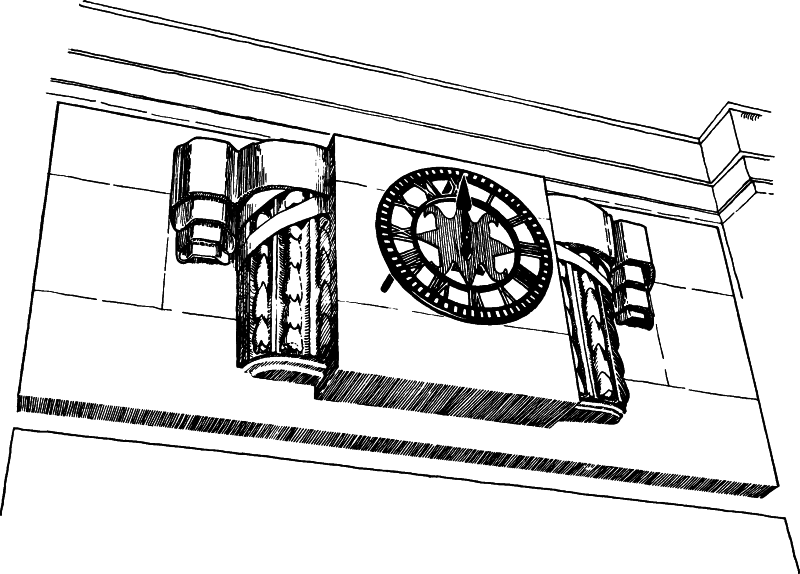
Sketch of a clock designed by Ralph Knott in the Main Entrance Hall, Belvedere Road