
Survey of London Monograph 17, County Hall. Originally published by Guild & School of Handicraft, London, 1991.
This free content was digitised by double rekeying. All rights reserved.
'The Second World War and post-war development', in Survey of London Monograph 17, County Hall, (London, 1991) pp. 110-119. British History Online https://www.british-history.ac.uk/survey-london/bk17/pp110-119 [accessed 13 April 2024]
In this section
CHAPTER X. The Second World War and Post-War Development
The effect of the Second World War on the work of the LCC was very much greater than that of the Great War. Since 1919 the LCC's responsibilities for hospitals and care of the elderly and sick had increased; under the emergency legislation it was to act as the co-ordinating authority for London, and as ideas for post-war planning developed, it became the major partner in shaping rebuilt London. These two roles were to bring another round of staff increases, with consequent extensions to County Hall.
At the end of the Second World War the LCC was faced not only with the need to complete the blocks on the east side of Belvedere Road (fig. 50), but also to reinstate considerable areas of damage to County Hall itself. The building had been involved in over thirty 'incidents', nineteen of which occurred within its precincts. (fn. 1) The most serious was on the night of 19–20 September 1940, when a high explosive bomb made a hole 30 feet deep and as many feet across in the Members' Terrace, shattering all the windows and causing a good deal of internal damage (Plate 42a). Though 200 people were working in the building at the time, there were only two fatalities. As The Times reported:
In the council chamber most of the windows were blown out and the chairman's seat leaned forward to where it had been pushed by a massive door blown in on it. The dome over the entrance to the chamber was smashed and the carpet beneath strewn with glass ... Many of the staff continued at their work after the explosion, carrying on by the light of torches because of the black-out curtains having been destroyed. (fn. 2)
Although the damage affected about 160,000 square feet of office space, more than two thirds of this was soon brought back into use after temporary repairs. (fn. 3)
The 1940 bombing affected the Crescent particularly badly and had also destroyed staff dining-rooms and kitchens on the sixth and seventh floors. Space for these functions had to be found elsewhere, and other accommodation was rendered temporarily unusable. Considerable structural repairs were required and those still outstanding in the Crescent in 1950 involved the taking down of:
over 5000 of the existing stone and brick walling ... to varying levels, in some cases down to the top of the first floor windows, together with the major portion of the attic storey, the main entablature, and over 5000 of the stone columns to their bases. (fn. 4)
The process of reinstating war damage was a prolonged one, not being completed until the late 1960s, and was carried out in parallel with plans for completing the County Offices (now known as North and South Blocks – see below) and the schemes for setting out the adjoining part of the South Bank. (fn. 5)
Post-war Schemes for the South Bank
After Labour's election victory in 1934 the Council had taken steps to acquire the parts of the South Bank between County Hall and Waterloo Bridge which it did not already own, intending to replace the industrial and commercial premises there with a modern town planning scheme – including a riverside park and cultural buildings. This was part of their attempt to put into practice the provisions of the 1932 Town and Country Planning Act. The acquisition of the land was a slow and difficult process which brought out several defects in the Act, and no firm development plans were made before the war.
In response to Lord Reith's request in March 1941 for Reconstruction Plans, (fn. 6) the LCC commissioned the County of London Plan, prepared by J. H. Forshaw, Architect to the Council from 1941 to 1946, and Sir Patrick Abercrombie, Professor of Town Planning at University College, London. Forshaw's predecessor, Frederick Hiorns, who had retired on grounds of age, after two years as Architect to the LCC, was thanked warmly by the authors for his 'very valuable pioneer work'. The Plan appeared in 1943, and was followed by the Greater London Plan in 1944.
In addition to the general principles laid down to guide post-war reconstruction and redevelopment generally, which affected the development of the area round County Hall, the authors made specific proposals. They collected together and rationalized the various projects which had been developed within the LCC and outside it, and incorporated these into their plan for the South Bank. They called for the replacement of Hungerford Bridge – Charing Cross Railway Bridge by a road bridge and the construction of a tunnel to take trains beneath the river, while the South Bank was to become a 'great cultural centre'. (fn. 7)
After the war the LCC brought in the distinguished architect, Charles Holden (1875–1960), as planning consultant. The choice was not so much theirs as that of the Ministry of Public Building and Works, who were interested in using the South Bank for government offices. Holden was preparing plans for the whole South Bank from Westminster Bridge to Bankside, and his brief from the LCC in 1947 was to act as architectural and planning consultant for the general layout of the area. His studies were to be based on approximate schedules of accommodation for the various buildings proposed, including the layout and massing of buildings, access and traffic arrangements, provision for the parking of vehicles, general directions as to the type of building materials to be used, 'and all other matters which the Consultant may with the concurrence of the Architect ... of the Council ... deem necessary to be included'. (fn. 8)
While generally accepting the Abercrombie-Forshaw road layouts, Holden felt their detailed proposals were flawed, observing, in his Report to the LCC of June 1948, that it appeared that 'the area had been planned piecemeal, more with a view to disposal of sites than to beneficial co-ordinated planning', and asking for 'a free hand in replanning the area'. In fact, his proposals to integrate the existing County Hall buildings into his layout involved making physical modifications to them. He thought the river-front Crescent the worst part of the composition, suggesting the addition of an attic storey and parapet built up on the existing wall, with a second attic storey rising on top of that, but set back six feet. The flèche would be re-erected at the lower level. His reason for proposing these changes was simple. He wanted County Hall to resemble the buildings he was hoping to see erected to its north along the river:
From the architectural point of view the harmony and scale in the buildings along the Riverfront would be greatly enhanced: for the existence of a high pitched roof with the inconvenient accommodation resulting is out of character with the nature and spirit of modern frame construction.
He then set about replanning the layout of sites and internal roads, suggesting that Belvedere Road to the north of County Hall be realigned and widened, both for reasons of improved access to the proposed office buildings and to give a better view of County Hall. The LCC's officers pointed out, however, that this would mean reducing the length of the proposed extension to North Block along Chicheley Street by 65 feet, with a consequent loss of office space. Yet there was no sign that they regretted the architectural implications of the idea. On the contrary, they agreed that this change would result in 'a more dignified and architecturally satisfactory entrance to Belvedere Road from County Hall Courtyard' – the new name used by the LCC officers for the southern stretch of Belvedere Road which had been closed in 1948. (fn. 9)
So began the disintegration of Hiorns's pre-war plan, in which the internal façades of the returns to the North and South Blocks were seen as a means of focusing attention on the Belvedere Road entrance to County Hall, and of making a place there. The post-war planning schemes of Holden and Robert Matthew, Architect to the LCC from 1946 until 1953, were to turn the extension of North Block along Chicheley Street away from the County Hall buildings, and address it to what was anticipated to be a much more exciting group to the north. The County of London Plan provided for office development to the north of County Hall as far as Hungerford Bridge, with a park laid out along the river front. Theatres and concert halls were to be further north next to the approach to Waterloo Bridge. These planners therefore felt justified in thinking that the north façade of North Block ought to have a strong architectural relationship with this area, and that the County Hall Courtyard was of secondary importance.
In time this plan influenced the decision to hold the Festival of Britain Exhibition on the South Bank, a festival first mooted in 1943 as a centenary celebration of the Great Exhibition of 1851. The original scheme was for an international affair to be held in Hyde Park, and even when it was made a strictly national event, the South Bank site, of only thirty acres, was opposed in many quarters as being too small. But the site had two advantages. Firstly, the LCC had decided to build a concert hall there in any case, so providing a major facility at no expense to central government, who were to finance the Festival. Secondly, it had a strong advocate in Herbert Morrison (1888–1965), the best known pre-war leader of the LCC, now Lord President of the Council, who was in charge of setting up the Festival of Britain. The South Bank site was selected in 1949.
Post-war Accommodation Problems
A decision about permanent war damage reinstatement was deferred in the autumn of 1947, when it was felt that the Ministry of Health, responsible for financing the repairs, was unlikely to provide the necessary funds immediately. Nevertheless, the Architect was instructed to proceed with all preparatory work in readiness for more favourable times. Temporary repairs continued since additional accommodation was needed for a number of reasons, one of them being the demolition of No. 23 Belvedere Road, for the South Bank Scheme, which displaced 200 staff.
Space was also needed because some departments were expanding, in particular those of the Architect, the Valuer, and the Director of Housing. Also to be considered was the old question of centralization of staff, of whom about ten per cent were housed away from County Hall. There were still 300 at Spring Gardens, the lease of which would expire in 1958, and not only would renewal be costly, but the buildings would remain, in the opinion of the Chief Officers, 'not very suitable for office purposes'.
A report prepared early in 1950 distinguished between the short term problem of the best way to utilize the existing space at County Hall, and the long term one of providing additional accommodation to meet the needs of the increased staff and the transfer from Spring Gardens. (fn. 10)
When the County Hall competition was held in 1907, space standards had been put at something over 100 square feet per person, but over the years this had fallen. Lower standards were being recommended generally in government circles. A mean of 80 square feet per person was adopted in the 1950 report, producing the equivalent of an increase in floor area in the building of over 57,000 square feet, enough to house 720 extra staff.
Much of the building was 'poorly provided with natural light', but the adoption of strip lighting was a means of eliminating a distinction between actual and useful floor area which had been employed until that time. By artificially lighting this formerly 'dead' space, a further gain of 21,000 square feet was made.
But the long-term problems could not be solved by arithmetic and electricity alone. In addition to the 300 staff at Spring Gardens, 200 staff occupied temporary offices on the Principal Floor, the jealously guarded province of Members and Chief Officers. (fn. 11) Much of the extra accommodation could have been provided by the reduced space standards, but for the extensive war damage which was still to be repaired. Replanning the main building according to lower space standards was, in any case, meant to be a short term measure.
Thus, the completion of the North and South Blocks, which had been indefinitely postponed in 1938, became almost inevitable, although an immediate start was out of the question. There were government restrictions on office building, but informal talks with the Ministry indicated that the LCC would be given sympathetic consideration as soon as economic and industrial conditions improved. (fn. 12) Though the Chicheley Street site was needed in the short term as a car park for the Festival of Britain, the extension to the North Block represented the most significant piece of accommodation, providing room for 750, and for that reason alone was most attractive to the Council. The North Block stopped well short of the realigned Chicheley Street, leaving space for another 85,000 square feet, while the South Block already extended around the corner on to Westminster Bridge Road, leaving only 30,000 square feet to be built there, which would accommodate 300 staff. Thus, an estimated 1,050 spaces for officers would be provided by the new buildings, and 1,013 were needed.
Costs were put at £902,000 for the North Block Extension and £503,500 (including £125,000 for land acquisition) for the South Block Extension. The building time was estimated at thirty-eight and thirty-three months respectively. For war damage reinstatement the cost was estimated at £785,000, the major part of which would be paid for by the War Damage Commission, and the time at thirty-nine months. A provisional timetable suggested that the North Block should be completed between 1952 and 1956, and the other works between 1957 and 1961, after the North Block Extension had been occupied. (fn. 13) At the beginning of August 1950 the Council passed estimates for the work in full with a liability on capital account of £1,280,000 for the extensions to North and South Blocks, excluding land acquisition, and approved £737,500 for war damage reinstatement. (fn. 14)
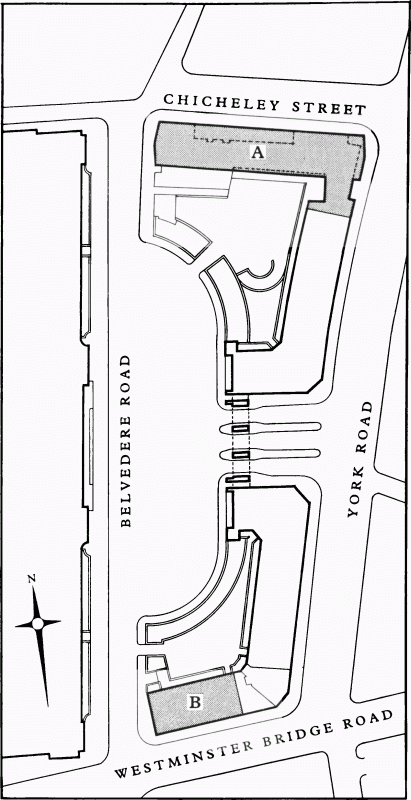
Fig. 50. North and South Blocks as built, 1936–1963. Post-war sections are indicated by stippling. A North Block Extension (1955–8); B South Block Extension (1960–3)
The Completion of North Block
By the spring of 1952, although the Ministry had not given permission for the Council to proceed, a modification of the pre-war scheme had been prepared by the Architect's Department. The project, nominally under the control of the Architect, Robert Matthew, was being run by Edwin Williams (1896–1976), an architect who had worked for Sir Guy Dawber, and then on the Festival Hall together with Matthew himself, Leslie Martin, and Peter Moro. (fn. 15) Williams was a senior member of the Building Regulations Division, who had been appointed Senior Architect for the County Hall extensions, a post he held under successive Architects to the LCC, including the two successors to Matthew, (Sir) Leslie Martin (1953–5) and (Sir) Hubert Bennett (1955–71). (fn. a) Other members of the team were C. H. Bates, R. A. Laker and C. G. Shankland.
Hiorns's pre-war plan had to be modified, for the decision to widen Belvedere Road reduced the space available and there was now a requirement for about 8,000 square feet for a branch of the Westminster Bank. (fn. 17) Moreover, the Council architects were keen to promote their own ideas. They needed to convince the Establishment Committee to go along with them, and produced a report with this in mind. They presented three alternatives to the Hiorns plan, rather confusingly known as schemes 3, 4 and 5. Having noted that the 1930s plan envisaged the North and South Blocks completing an 'architecturally related precinct', with road barriers at the Westminster Bridge Road and Chicheley Street ends of Belvedere Road, they went on:
The shortening of the North wing ... with enhanced possibilities in the development of the adjoining land between County Hall and Charing Cross Viaduct and the widening of York Road, now present an opportunity to explore less formal and more flexible arrangements for satisfying accommodation requirements. (fn. 18)
Scheme 3 was a truncated version of the Hiorns block, its end pavilion missing to allow the widening of Belvedere Road, and with a capacity for 707, rather than 838 staff. Scheme 4 was designed to restore all the accommodation of the block, and more. As the report continued:
the elevational freedom would allow of greater freedom in construction, internal planning, and arranging the accommodation economically and flexibly.
The extra cost of scheme 4 over scheme 3 was estimated at only £50,000, largely because different methods of construction and thinner detailing would be cheaper. But the building would have risen eleven storeys to parapet level, twenty-five feet higher than the North Block adjoining it.
Scheme 5, preferred and recommended by the Architect, depended on sleight of hand. If the Committee were to rescind their decision to shorten the block in accordance with Holden's plan, which had anyway been much altered, it would be possible to provide the full accommodation at a reduced height. This was ostensibly a return to Hiorns's scheme, retaining his layout and section, but omitting his architecture, which would be replaced by something 'fresh, distinctive and contemporary'.
When the Establishment Committee eventually reported to Council, in the summer of 1954, they presented only two schemes for consideration. One was the abbreviated Hiorns project (scheme 3), the other a new design for a stylistically modern building which kept the cornice line of the earlier work but tucked an extra storey into an immensely tall roof. Accommodation in this second scheme was for 760 staff compared with 707 in the first. (fn. 19) The more up-to-date scheme was chosen and shortly afterwards the Ministry gave its go-ahead for work to begin.
The tender of Gee Walker & Slater Limited was, at £659,331, the lowest received for building the extension and was approved by the Council at the end of November 1955. (fn. 20) Problems arose over tenders for steelwork, all ten firms tendering the identical sum of £50,238 19s. 3d., and the LCC decided to recommend to central government that the matter be referred to the Monopolies Commission. (fn. 21)
The South Bank and the County Hall site were not completed according to Holden's grand design. Already modified by Robert Matthew and Leslie Martin, in the intervening years it had been lost sight of. Shell redeveloped their own land without much relation to the rest of the area, and further problems arose over the site for the National Theatre, with repercussions on the development of County Hall.
The National Theatre had its origins as the Shakespeare Memorial National Theatre, and for many years its promoters tried to get it built in South Kensington, with Lutyens as architect. After Lutyens's death in 1944, both architect and site were changed, the foundation stone being moved in 1951 to the new site just to the north of County Hall, on the present location of Jubilee Gardens. (fn. 22) The new alignment of Chicheley Street was altered to take account of this, and laid out at a slight angle to the north front of County Hall, to allow oblique views of the theatre when built. By the time the site for the National Theatre was moved once more, Chicheley Street had been laid out on this new axis, as had the extension to North Block. Both were set, like broken bones by an incompetent surgeon, according to mistaken principles. A slight aesthetic lameness can be detected to this day.
The extension to North Block was completed in the early spring of 1958, and was not well received (Plate 44). The architectural critic J. M. Richards was particularly harsh, describing it as 'this senseless cliff of solid-looking stonework', a 'most unfortunate design' and a 'compromise that falls between all possible stools'. (fn. 23) Outlining the respective cases for completing the 'Giles Scott' scheme and building something quite different, Richards blamed Council Members for forcing a compromise, apparently unaware that Matthew and Martin had both recommended such a move in the early 1950s. Indeed, to Richards the compromise went further than just the building, marring the LCC's reputation for an 'architectural policy which in the last ten years has brought so much credit to them, and has been admired all over the world'.
He saw the building as being 'in several practical ways less satisfactory even than the Scott building which was its starting-point'. Many of the fashionable architectural devices employed do indeed impinge upon the convenience of the building in use. Loadbearing columns had not 'freed the plan', as modern architecture demanded they should, but merely cluttered it up by being too close to the walls, which themselves had the appearance of loadbearing structures. The offices (Plate 44d) are worse lit than those of the Hiorns-Scott building, partly because of the adoption of rectangular windows and the peculiar treatment of the end walls. But, as Richards pointed out, this under-lighting is only partly due to the refusal, 'presumably for stylistic reasons', to provide larger windows, 'it is chiefly due to the width of the building being far too great'.
Richards was an advocate of the 'stylistic unity' theory proposed by Holden and his followers, assuming that the North Block was to become part of the larger South Bank rather than the County Hall precinct. In defence of the option for a 'modern' solution to the extension block, he claimed this function for it:
It had the additional role of providing the background to the new South Bank development and should conform to it in style, which there was then every reason to hope would be a frameand-cladding rather than a masonry style. Although the end elevation of the Ralph Knott wing also faced the new site, this was due later to be partly blanketed by the National Theatre.
Fortunately, the anticipated 'blanketing' of the impressive northern façade of County Hall never occurred, leaving clearly visible one of the best elevations on the South Bank. This would certainly not now be seen as an embarrassment, and with the current public image of the Modern Movement, perhaps the position has been reversed, at least for the time being.
The completion of the North Block was significant in a practical way, for it was suggested to the Council in 1957 that it presented an opportunity to re-group the office staff in a more modern arrangement. (fn. 24) The original system placed Heads of Department on the Principal Floor, easily accessible to Members and conveniently located for attending committee meetings, while the staff of their departments were organized vertically above them in the building. This system logically called for a building that could expand vertically with a growing organization, but of course this was impossible, and departments found themselves scattered in many parts of the County Hall and its extensions. The Council therefore decided to change the system and allocate accommodation so that each department and its Chief Officer would be together.
The Completion of South Block
The 1950 building programme had assumed that the completion of North Block would provide enough space for the decanting of staff while war damage repairs were carried out, as well as for the centralization of office staff when the lease of Spring Gardens expired. The increasing numbers of central office staff, which had reached 6,568 by 1957, now made this impossible, so it was suggested in that year that the South Block be completed. If started immediately there was a good chance the building could be finished by the early months of 1962. (fn. 25)
It was accepted by the Council that the new wing alongside Westminster Bridge Road would have to accommodate both an extension to the existing Post Office as well as a new tea-shop for J. Lyons, who would be displaced. The inclusion of the tea-shop was advocated by C. G. Shankland, one of the architects working on the scheme, as 'good comprehensive planning' in view of the future increase of office workers attracted to the new South Bank. (fn. 26) Two designs were prepared for the completion of South Block, one a simple truncation of the 1930s scheme, providing 250 places, and the other an L-shaped plan, again to a shorter length than the original, which brought the total up to 320. It was recognized that an extra seventy places were not going to solve the LCC's accommodation problem, and since the smaller scheme – thought by the architect to be the more satisfactory – was estimated to cost about fifteen per cent less per place, it was adopted. (fn. 27)
In the new scheme the block facing Belvedere Road had a simpler treatment than that proposed in the original New County Offices scheme, and for reasons of economy the short return along Belvedere Road was omitted. The cost per place was higher than that of the North Block Extension because of the need to continue the design of the existing South Block along Westminster Bridge Road. It was recognized that no architectural solution was 'practicable which would enable a departure from this form which is basically more expensive than a modern building employing new techniques'. The main expense would be the work in Portland stone which would have to consist of solid slabs with setbacks to carry the cornices and mouldings through the elevation; apart from the extra cost of the stone itself, this involved heavier and more expensive construction and steelwork. (fn. 28)
Tenders for foundations were received in July 1960, and the contract was won by the Demolition & Construction Company Limited, at £33,029 7s. 5d. W. J. Simms, Sons & Cooke, Limited, were awarded the main building contract with a price of £379,056, and finished the building early in 1963. (fn. 29)
It was intended that the opportunity would be taken to re-plan the courtyard, by removing the plinth and replacing it with a fountain – a programme first mooted in 1949. (fn. 30) The plan also provided for an increase in the number of car-parking spaces. In the event, the idea of a place with gardens in front of County Hall was abandoned. The plinth was demolished, the fountain was never built, and the courtyard became a car-park.
From the time of the South Block Extension, the Council seems to have thought of County Hall merely in terms of square feet of office space. Buildings designed subsequently were no longer intended as expressions of the Council's belief in its political or social roles. The involvement of the Royal Fine Art Commission with the Island Block project, which is discussed below, is indicative of the Council's new attitude. The RFAC saw themselves as stepping in to prevent the building becoming too obtrusive, almost to defend London from a Council which had once seen itself as setting the standards for urban development in the capital.
Addington Street Annexe
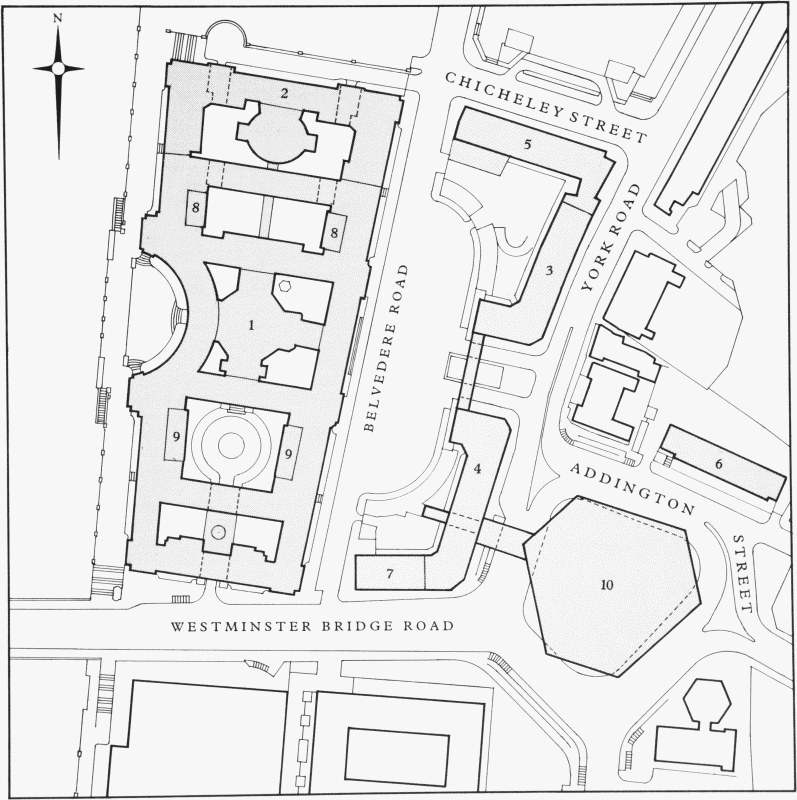
Fig. 51. Outline plan of the County Hall complex in 1986 showing the various buildings and additions. 1 Main Building (1913–22); 2 Main Building (Northern Front) (1930–33); 3, 4 North and South Blocks (1936–9); 5 North Block Extension (1955–8); 6 Addington Street Annexe (1960); 7 South Block Extension (1960–3); 8 Infill building, H courtyard (1970–3); 9 Infill building, Members' Courtyard (1972–4); 10 Island Block (1970–4)
Before work on the South Block Extension was begun, the Council agreed to a recommendation by the Establishment Committee for the provision of more temporary office space, to the east of York Road, in Addington Street. During the 1930s the LCC had been negotiating with the Ecclesiastical Commissioners for the purchase of land between York Road and Belvedere Road for their extension scheme, and were forced to take Addington Street off the Commissioners' hands at the same time. A redundant school and some cottages, scheduled for demolition, stood on the site, and the future of the area from a town planning point of view was uncertain. In March 1960 the Council decided to build a prefabricated four-storey structure on the site to help with the decanting problems while war damage repairs were going ahead. The building was finished in the autumn of 1960, providing space for 340 staff at an estimated cost of £118,750. It was expected to have a serviceable life of seven years, but was still in use in 1986. (fn. 31)
Though modest in size, and not generally reviewed in architectural publications, the Addington Street extension was seen by at least one critic as a fine example of modern design (Plate 45a). Ian Nairn thought it displayed 'just the sort of sober richness and care over details that would transform most office blocks – yet without any pretensions or appliqué aesthetics'. Written in 1964, his observations also reflect a boredom in architectural circles with the pompous commercial classicism of the 1930s. He called it 'an enormous relief from the exhausted style' of the Hiorns-Scott building. (fn. 32) His words recall the misgivings about classicism generally as a modern idiom, expressed by Halsey Ricardo at the time of the competition, over fifty years earlier.
The Creation of the GLC
In 1965 the LCC was replaced by the GLC, an event which, despite the delegation of many powers to the London Boroughs, was to mean the recruitment of more staff, and even more pressure on space at County Hall.
By a sad irony, the passing of the LCC coincided with that of one of its most distinguished Members. Herbert Morrison had been one of the strongest opponents of the creation of the GLC, and his death in early March 1965 was the occasion of a poignant ceremony. Morrison's body was cremated, and he had asked in his will that his ashes 'be scattered into the high tide of London's river from the terrace of County Hall where I was privileged to render several years of happy service to the people of London'. (fn. 33) This deed was performed by the Leader of the Council, Sir Isaac Hayward (1884–1976), a few hours before the LCC's final meeting. As the tide was low at the time, Morrison's ashes were scattered from the LCC fireboat Firebrace, which had set out from the Festival Pier.
War Damage Reinstatement
Though much discussed, the repairs to war damage at County Hall were deferred because they did not offer the immediate gains in accommodation that new building did. However, some of the most substantial internal changes were made to County Hall in connexion with war damage reinstatement. These involved the 'refurbishment' of the Chairman and Members' accommodation overlooking the Thames in the Crescent (Plate 43c), and ultimately the removal of the contents of the Members' Library to Clerkenwell, and its use as offices. The staff restaurant and kitchens were moved from the sixth and seventh floors to a position beneath the Members' Terrace. Plans for this move, which made a gain of 20,000 square feet of office accommodation, were approved in 1964, and the new restaurant opened two years later, in July 1966. (fn. 34) The Times described the new restaurant 'suite' in somewhat exaggerated terms as 'encompassing the whole length of the building and a range of vision as fine as any in London', and went on to itemize a foyer, 324–seat cafeteria (Plate 43b), two 90–seat waitress service restaurants, a senior officers' restaurant seating 60, a snack bar and a 'beautiful gallery coffee lounge with seats in riverside picture window recesses'. (fn. 35) The severe granite wall, relieved only by a few 'arrow-loops', which faced the public embankment walk in front of the Members' Terrace, was replaced with a full-height strip of sheet glass screened by net curtains, thus providing the new coffee lounge with a panoramic view of the Thames (Plate 42b). This alteration to the river front was not universally welcomed, arousing, in particular, the ire of the Victorian Society.
A further modernization was the redecoration of the Belvedere Road entrance hall in 1968. Knott's severe design, planned with visions of the mob storming the Ceremonial Staircase, gave way to a comfortable lobby where the mob could await the attentions of authority 'in a modern, friendly and efficient atmosphere'. (fn. 36) Carpeting appeared in place of mosaic, and the marble chimneypieces disappeared behind curtaining. Staff were discouraged from using the redecorated entrance, and Hector, the County Hall cat, was removed as being infra dig. (fn. 37) Some ten years later, it was discovered that the marble fireplaces had disappeared for ever, as, of course, had Hector.
One South Bank cat did rather better. In 1948 George VI, reading of the South Bank development, had expressed concern for the fate of the two Coade stone lions on the Lion Brewery, which was being demolished at the time. The LCC loyally agreed to preserve the lions, and in 1951 they were exhibited at the Festival of Britain. The larger lion was subsequently removed to York Road, and after a brief sojourn at Waterloo Station in the early 1960s, was installed in its present position atop the pedestal on the corner of Westminster Bridge in 1966. (fn. b)
The Island Block
The efforts of the LCC to centralize their staff, while sometimes approaching their goal, had never actually achieved it. Each new plan, projected to resolve the dilemma once and for all, had been overwhelmed by an ever-growing central office staff, a problem which continued under the GLC.
In 1967 and 1968 the Establishment Committee reported that a third of central office staff were in scattered accommodation, and dusted off the now familiar arguments for bringing everyone together. They invited a firm of management consultants to advise on the problem, and were disconcerted to be told that decentralization was the answer – that some 2,000 staff working at County Hall could be sent to work outside central London. The Committee rejected this advice, preferring to take advantage of proposals to build the long-awaited roundabout at the junction of York Road and Westminster Bridge Road, and giving instructions that a scheme be prepared for an office building on the traffic island at the centre of the roundabout. This was announced to the press in February 1968. (fn. 39)
The first Island Block design was for a 'triple-octagon tower block of 15 storeys, 170 ft high', containing 154,000 square feet of offices, estimated to cost £3,020,000 and providing room for 1,540 people. The Council approved this design early in 1969, but the Royal Fine Art Commission was opposed to it, asserting that the area was sensitive to high buildings. The Establishment Committee, though they felt that there were no views in the vicinity that a tower could spoil, agreed to modify the plans. (fn. 40)
Work on site began on 4 December 1970, and the building was officially opened on 21 October 1974 (Plate 45b-d). The block was designed by R. A. Laker, J. E. Knight and W. Sutherland, under Sir Roger Walters as Architect to the Council. Trollope & Colls were the main contractors. The structure of the building is situ-cast concrete faced with 'grit blasted calcinated flint panels which should minimise the irregularities of weathering', according to the architects. The cost of the building was £3,623,647. Ancillary works, including landscaping and alterations to the South Block, added a further £226,773. The cost per square foot was very high, mainly because of the restricted nature of the site, which made construction difficult, and the high level of servicing. (fn. 41)
As built the Island Block provides the same accommodation as the earlier project would have done, with a hexagonal plan rising from the basement through seven storeys, the last three of these stepped back. Isolated by the swirl of heavy traffic and by the deep light well which surrounds its lower storeys, the building has no entrance at ground level and is connected to the rest of County Hall by means of subways and a bridge across York Road from South Block. The main entrance is from the Belvedere Road Courtyard via an ingeniously contrived escalator up to the bridge (Plate 45c), so that the visitor arrives directly on the 'second floor' of the Island Block. There is a roof garden on the top of the building, though it is unused. Internally the spaces are arranged as large open offices on the burolandschaft (landscaped artificially controlled deep office space) principle and the whole building was a sealed environment, fully air-conditioned with automatic solar-control blinds. These bright orange blinds were controlled by solar cells on the roof, but problems were found in tuning the system so that rapidly changing weather conditions did not cause them to be rolling and unrolling themselves throughout the day.
When it was opened, the Island Block contained the Valuation and Housing Departments. These two departments had to be easily accessible to the public, hence the complicated escalator and bridge arrangement, though some users found its open plan as confusing as the corridors of the original building. Some architectural critics saw the idea as a clever use of otherwise dismal urban space, and the building itself as a realization of this idea to a high architectural standard. 'Not many buildings', wrote David Rock, 'are taking advantage of the sophistication in internal environmental techniques and it needs a client body like the GLC to advance such techniques'. He thought the stepped-back floors gave 'a simple Teutonic solution to the design problem'. (fn. 42) When the building was opened Edward Jones agreed that 'a much aboveaverage working environment has been achieved', even though 'the initial programmatic difficulties will not disappear'. But he was also interested in the wider implications of the development, noting that the new building housed approximately a quarter of the total 8,500 office staff working for the GLC at the South Bank headquarters. Before the adoption of the burolandschaft principle of office planning, the two per cent daylight factor would have necessitated a tower of Centre Point proportions on that site. (fn. 43)
Infill Buildings
Coincident with the building of the Island Block were two schemes that gained more space by filling in parts of the two large internal courtyards – the Members' Courtyard and H courtyard to the north of the Council Chamber. These provided for 496 and 250 people respectively, at the space standard of 80 square feet per person, and were built using curtain wall construction. The cost for both schemes was estimated at £754,000. Altogether, the three developments pushed central office accommodation from 6,500 to 8,800 places. (fn. 44)
These infill structures are utilitarian in design, with no deference to Knott's work which surrounds them (Plates 42c, d, 43a). While this is excusable in the northern area, it is indefensible in the magnificent Members' Courtyard. Although the two infill blocks were built within two years of each other – that in H courtyard in 1970–3, that in the Members' Courtyard in 1972–4 (fn. 45) – they are much further apart than that in style. Owing to its green-tinted spandrel panels and clear glass, the former looks like a product of the 1950s, whereas the black glass and glazing bars of the Members' Courtyard infill reflect much more accurately the fashion in curtain wall design then prevailing.
In 1973 feasibility studies were made for expansion northwards. The Times reported the proposals as being for 'a building of moderate bulk which might house a new council chamber and would certainly include members' accommodation and space for the public to meet members and officials'. (fn. 46)
Nothing came of these proposals, and within a few years central government had taken away some of the Council's functions, a process culminating in the abolition of the GLC.
Working at County Hall
County Hall developed a distinctive character, that, as in all buildings, grew out of the nature of the work carried on there and the collective personality of the Members and staff, and which was also partly determined by its design. The immense size of the building tended to the development of isolated communities within it. Many such 'villages' existed in County Hall, the inhabitants of which knew of each others' existence, and sometimes ventured into each others' territory, but tended to maintain an independence of character. This was partly based on the differing work done in the various departments, and to some extent on the architecture of the building itself. The Architect's Plan Room, for example, deeply embedded in the sub-basement, was in recent memory a distinct and almost monastic community, where silence prevailed, and visitors were rare.
Recollections are inevitably personal and varied, but certain features do emerge from those of the former Members and officers that help to convey a sense of the unique atmosphere of County Hall when it was the centre of a London-wide local authority.
The scale of the building and its internal layout were the features which, not unnaturally, made the greatest impression upon the councillors, their officers, and those members of the public who had reason to visit it. The size of County Hall did not appeal to all, and ten years after its official opening Sir Harry Haward, a former Comptroller of the LCC, thought that a number of Members still felt some regret at leaving Spring Gardens where, although the offices were 'mean and uninspiring ... there was an intimate character about the Chamber and its lobby which is entirely lacking in the vast building across the river'. (fn. 47) To Herbert Morrison its magnitude was not inappropriate, however, for he regarded the 'massive building' of County Hall as an expression of the power of municipal government in London and 'a highly organised workshop of public administration' which gave the impression of modernity. (fn. 48) The staff who worked there also reacted to the building's scale in different ways. One found that 'the great building ... always seemed to me to lack the charm of the great Victorian town halls', while another regarded its size as 'oddly liberating by reason of the anonymity it bestowed'. (fn. 49)
It was the lengthy corridors which did much to convey the sense of scale of the building and contributed a great deal to its distinctive personality. They ran for five-anda-quarter miles, and much time could be spent simply walking from one room to another along 'those echoing corridors with highly polished floors ... leading for hundreds of yards' and 'in places extending as far as the eye could see'. Due allowance had to be made for the time which was required to make a journey within the building in order to arrive at a meeting on time. The consequences of a misjudgment were not entirely pleasant, for 'Latecomers had to pound, breathless, along the slippery parquet of the identically panelled corridors, frantically trying to find the right door'. Such unwelcome experiences could make a lasting impression. A former officer recalled that 'After twenty years, I still have the occasional bad dream when I am hurrying through those endless corridors, up stairs with no top, in lifts that don't work, in tunnels (there is one) that turn into dwindling caves and potholes, always late for something very important'. Even an experienced Member heading for a familiar destination on the Principal Floor 'had to allow at least ten minutes, once inside County Hall, to be punctual for a meeting'. The corridors were apparently 'interminable' and even 'formidable', but they did have some helpful features, among them 'the deep window sills along one side ... which gave the assurance one could stop and juggle around with one's papers before reaching one's destination'.
The corridors were partly to blame for the problems which many encountered in finding their way around County Hall, for although their arrangement was a logical one, it was not readily understood. There was, moreover, an inherent difficulty of orientation within the building. One Member found that this caused him considerable problems 'until I was advised that the trick was to open a door and get a view of the river'. The numbering of the rooms also had a logic to it, but it did not survive intact, due to the subdivision of rooms and the creation of new ones as the pressure upon accommodation increased. That the population of County Hall had risen considerably was very apparent to an officer returning there in 1968 after an absence of eighteen years, to find that the building was crammed full of people ... there were printers in the roof space and scientists in the sub-basement'. The effect of the greater numbers employed within the building was that 'alterations and adaptations were constantly being carried out in one part or another, with the result that the numbering of the rooms ... became chaotic, especially when old cross-corridors were closed and new ones opened'. In addition, departments were reorganized and relocated within the building, disturbing the original arrangements. The Survey of London was particularly mobile, having nine sets of offices within thirty years, two of them outside County Hall. The combined result of such reorganization, the layout and room numbering was that it required 'months or years to fully understand how rooms had been subdivided (and not always logically renumbered) and why cross corridors would wind off apparently to nowhere'. Even after many years of service, one officer 'would sometimes come across a tiny room off a cross corridor which I had not known to exist'.
The consequence was that it was by no means easy for visitors to find their way within the building. Indeed, this rather understates the situation, for, as one Member reported, it was 'not surprising to find a visitor completely lost' (fn. 50) and an officer later recalled that 'many were the lost souls one encountered on a journey in County Hall'. The difficulties were experienced by the diarist of The Times who, in 1966, attempted to keep an appointment with 'the holder of a high office' and so began a search which led 'down passages, measureless to man ... Upstairs and down, round corners, finding numbers on doors apparently planned as part of a game of snakes and ladders ... [until] by guessing and good luck, we found the promised room'. The conclusion drawn from this evidently memorable adventure was that 'The designers of the Cretan labyrinth and the Hampton Court maze would treat the County Hall men as their peers'. (fn. 51)
What of the rooms themselves? The chief ones, on the Principal Floor, were generally much appreciated. One Leader of the GLC recalled, with evident pleasure, his 'magnificent suite of offices ... in the curved section of the river frontage'. A change of post or rank often meant a change of room, however, and perhaps a change of aspect. A Member who served on the LCC and GLC for twenty years experienced a range of the accommodation which County Hall offered to Members, from 'a lovely front room with a river prospect' to 'a rather sinister internal room with a half-concealed entrance'. The Council Chamber and Conference Hall were regarded as fine rooms, 'well designed, comfortable and convenient for Members, but much too high' and both 'were acoustically a disaster'. The visitors' galleries in the Chamber were 'too high up, too remote and very uncomfortable' and the view of the Members which they afforded 'was chiefly confined to seeing the not infrequently bald tops of their heads'. The space allocated to the press was also less than satisfactory, for by the 1950s they were placed 'at the back of a bank of members' seats, so that a stranger would not have known a reporter from a member'. Strictly speaking, the Principal Floor was restricted to the use of the Members and their staff and those senior officers who had business there. There were exceptions to this rule, one being that the Members' Library could also be used by officers. It represented 'a civilised refuge, with a desk at which to ruminate and make notes for speeches' and a quiet spot 'where one could research and write in peace'. The sanctity of the Principal Floor was gradually eroded; it was no longer maintained in the early 1970s and by the early 1980s had been completely abandoned.
The impression created by offices elsewhere in County Hall depended partly upon their aspect. One officer found himself working with a section 'housed in one large and inconvenient room on the ground floor, at the south end of the crescent, with an outlook largely obscured by the sub-structure of the members' terrace'. Those rooms facing the river were to be preferred, for obvious reasons. 'The view from the fourth-floor offices was always beautiful on late winter afternoons when the lights came on along the Victoria Embankment.' Their occupants could also appreciate one of the few benefits of London's polluted atmosphere, which was the 'exceptional beauty of the sunsets, on occasion, behind Big Ben, going down in a haze of mauve, purple, indigo'. One drawback of the rooms on the riverfront was 'the strong winds, especially in the winter months'. Indeed, much of the building suffered with 'related problems of heating and ventilation'. This applied to the older parts and to the later multi-storey infill rooms on the east and west sides of the Members' Courtyard and H courtyard which had large windows. They therefore became rather hot in summer, for 'the internal sun-blinds provided were of little use', and cold in winter, when 'the air-conditioning system ... led to trouble, because at times the occupants of one floor would block up the vents on account of draughts, thereby creating even colder air-flows for those in the rooms above or below them'. Even the small offices in the original building were less than ideal, especially those which were long and narrow 'so that two people sitting by the window had good light, while the more junior staff tended to have less light further into the room'. The position of a room relative to the catering facilities also affected the equanimity of its occupants. One officer, whose room was in the basement directly below the canteen, could identify a 'fish day' long before lunchtime arrived. The pungency of the odours was much reduced when the new staff restaurant complex was opened in 1966. Even apart from the cooking facilities, County Hall did have a distinctive smell, which, once experienced, 'was never to be forgotten'. The floor polish and the disinfectants used contributed largely to it and the drains also played an important part in the 'unique and subtle blend' of smells 'which pervaded many of the corridors'. There were some seasonal variations and 'on very hot days the drain element tended to predominate'.
Individual impressions of the building as a place of work varied, but in general they were favourable. Although the grandeur of the principal areas did not extend to the offices, it was felt to be a 'pleasant rather than unpleasant building to be employed in'. The ceremonial areas were at their most splendid when they were decked out in municipal flowers for the entertainment of a visiting head of state, though the annual Chairman's Reception also gave an opportunity for 'exotic floral displays'. An officer who had worked there for almost forty years remembered it as 'pleasant, comfortable and convenient ... a building to be proud of', while for one elected Member County Hall 'was the "second best club in London" yielding place only to the House of Lords!'