
Survey of London Monograph 16, College of Arms, Queen Victoria Street. Originally published by Guild & School of Handicraft, London, 1963.
This free content was digitised by double rekeying. All rights reserved.
'The College of Arms: Architectural description', in Survey of London Monograph 16, College of Arms, Queen Victoria Street, (London, 1963) pp. 29-35. British History Online https://www.british-history.ac.uk/survey-london/bk16/pp29-35 [accessed 16 April 2024]
In this section
IV. ARCHITECTURAL DESCRIPTION
The present College of Arms is somewhat changed from the building that was completed in 1688. The formation in 1866 of Queen Victoria Street mutilated its design and several alterations have been made in its plan and elevations.
The original building was no doubt designed by Morris Emmett and although it was erected in separate sections by different subcontractors, in the course of some eighteen years it did not depart in any essential particular from the lines at first laid down. The plans accompanying the warrant of 1673, although they show only the north and west ranges, set out the manner of the building and in spite of some irregularity in the site, the scheme is eloquent of the rational and effective principles that governed planning in the reign of Charles II. There was a uniform height of three stories, divided by plain brick string courses, with an additional basement and attic floor. The doors and the windows, divided by one mullion and transome, later to be replaced by sashes, were regularly spaced—there was some revision in the number of windows in the sides of the court before building—and the level hipped roof of tiles rose from an adequately moulded cornice enriched with modillions. The dormer windows were all provided with neat pedimental gables. The central parts of the three ranges towards the court, and of the exterior of the west range towards St Benet's Hill projected slightly to allow of wide pediments, those to the north (interior) and to the west (exterior) having straight sides while those that flanked the court were curved. The northern pediment crowned an arrangement of four brick pilasters, the height of the two upper floors, having Ionic capitals of stone with swags linking the volutes and stone-ornamented bands and moulded bases to the shafts. These stood on rusticated brick pilaster projections covering the ground and part of the basement floor and in the centre was a flight of steps. The curved pediments at the sides had two similar pilasters and in the centre of the west range was the main entrance, a large semicircular arch with projecting voussoirs.
This gateway had a much larger arch on the external front to Benet's Hill and the two were connected by a deep cove, forming a covered porch, which was considered 'a curiosity' by Maitland. (fn. 1) From a drawing of it (Plate 4) signed T.M. and dated 1814 we get a good idea of its form with the royal arms set on the key block and a moulded cornice above, which has survived the removal of the gate and can be seen today. It is interesting to note that in 1814 some of the windows were still of the mullion and transome type and had not yet been replaced by sashes. The west external front, apart from the gate, seems to have been carried out very simply, the range of windows above the gate being in two pairs in the central projection (which carried a plain pediment with a lunette within it), the remainder having three windows on each side. This follows the warrant plans. A scheme for a more ambitious treatment of this front (Plate 35) has already been referred to, but was evidently rejected on grounds of economy. The south end of this front returned eastwards, the length of one room along the south boundary and with the exception of the chimney stack, was without features and unpierced by windows on the front. When the east range was built the design of the west range was followed, including the return at the south end (in this case westwards), and the two southern extremities were connected by a terrace and railings. The articles of agreement for the west wing (1683) help to fill in some details (see Appendix 2):
The front over the gateway on the Inside to be all rubbed brick, with architraves round the fower windows, and such a cornish of stone (called a 'carved mundillion cornish' in the priced estimate) and two such pillasters part brick part stone with Rustick bases of bredth equal to the base of the said pillasters as are already made in the front of the Entrance into the Hall. Also a Cornish of stone [in front] over the gateway on ye outside answerable to that within. With a large keystone over the Top of the Arch that shall reach in height 2 Inches or thereabouts above the sd Cornish and as much below the Top of the Arch. To carry up the Coynes of the Gateway with stone as it is begun. With a Pediment over the top of the Inside front, of the same moulding & Cornish as that over the Entrance into the Hall.
The specification of 1687 (Appendix 3) for the east range gives details of the terrace, and the decision in chapter, 21 December 1687, to proceed with this work, which was to follow the west design, with its 'Circular Pediment & rubbed front & Pilasters', shows that the side pediments were curved and thus varied in this respect from that to the north (hall) range. This arrangement is confirmed by T. Malton's view of the College court which was published in 1768, but Malton shows the sash windows which were substituted for the casement windows shown in the engraved view by B. Cole. Some time, probably early in the nineteenth century, the pediments and the modillion eaves-cornice were removed and a parapet substituted. The alterations that deprived the College of its south-west and south-east wings, when Queen Victoria Street was made, have already been referred to and also the post-war repairs and the gift of the new gates.
The internal surface finishing and the sumptuous carvings were probably the chief elements in the pride of Maurice Emmett and his fellow craftsmen. The most important of these is the arrangement of the Court room, which includes a magnificent throne described in the chapter on the furniture and fittings. The Court room is twice the height of the ground floor rooms, the lower half being panelled (Plates 42 and 43) like the rest of the College. On the east side of the room is a gallery (Plates 10, 18, 36 and 42), and the Public Office, which is east of the Court room, is entered by a pair of doors below this, being contained on their east face by a broad architrave having a panel of festoons of drapery in the head and supported by carved angle ornaments (Plate 26). On the north-east, the Record room is entered by similar double doors (Plate 25). The panelling in the Public Office is bolection-moulded with wide-fielded panels raised above a wainscoted dado beneath a chair-rail and surmounted by an entablature with a rich cornice and architrave separated by a plain frieze. This treatment is varied on the western part of the north wall, where the upper panels are divided into three. There is a fine fireplace in the centre of the east wall with a moulded marble surround supported by carved cherub's heads and pendants. Over this is an important moulded mantelshelf. In the overmantel is a large central panel surrounded by finely carved foliage and birds with the arms of the Earl Marshal above (Plate 24).
The most important other woodwork is the remaining stair with a moulded string and massive balusters (Plates 28 and 29). Each of the square newels has a capping of the stair-rail and a turned finial below (Plate 41). The stair in the east range of the College is post-1688. The heralds' rooms are wainscot-lined and have good eight-panelled doors with their badges, which are moveable, carved above them on the outside (Plate 41). The new Record room, already referred to as designed by Mr Abraham, has a pleasant metal balustrade (Plates 11 and 27).
Appendix I
Appendix 2
Articles of agreement indented and made between the Kings, Heralds and Pursuivants of Armes of the one part and John Hodge of...carpenter of the other part Witnesseth etc:
The Carpenter to carry up the building of that part of the College of Armes whereof ye Foundations onely are at present laid, vizt. that part which fronts on the west to the Street called St Bennets Hill & containing in length in front about 66 foot more or less together with a Return on the South side of the said Colledge as the foundation is now layde.
To observe the same dimensions and Scantlings of brickwork & carpenters Works as are already observed in that pt of the College already built and to observe the ornaments and range of the same.
The front of the Gateway on the Inside to be all rubbed brick, with Architraves round the fower windows and such a Cornish of stone and two such pillasters part brick part stone with Rustick bases of bredth equal to the base of the said pillasters as are already made in the front of the Entrance into the Hall.
Also a Cornish of stone over the Gateway on ye outside answerable to that within with a large keystone over the top of the Arch that shall reach in heighth 2 Inches or thereabouts above the sd Cornish and about as much below the Top of the Arch.
To carry up the Coynes of the Gateway with Stone as it is begun with a Pediment over the Top of the Inside front of the same & carving as that over the Entrance into the Hall.
The ground floor to be of Oak.
The whole building to be tyled in by Midsomer next.
The whole work to be done and all workmen & materials discharged by the sd. Hodge for 540li.
To be paid in this manner.
At ye laying of the ground floor 40li ye one pair of stairs floor 100li. At the 2 pair of stairs floor 100li. At ye Garret floor or 3 pr of stairs 100li. At the tyling in of the whole 100li & within 3 months after tyling in, ye last 100li.
[Note: At the foot of the estimate, giving the priced quantities for the above work is the following:] The 3d of febreary 1682–3, memorandom I doe agree to doe all this worke mentioned in this Bill for 540 pounds
John Hodge
[The quantities include 'luteren' windows (dormer windows) including the 'frontispees' over them, the 'mundillion' (modillion) cornice to the street and the 'carved Mundillion' cornice to the Court, mantle 'trees' and grates, partitions, doors, ceilings, plasterwork, painting gutters and plumbing work.]
Appendix 3
SPECIFICATION OF WORKS: 1687
Endorsed: Proposals for building the East End of the College of Armes: 1687
1. To build the East End or side from Sr. Hen: St Georges Lodgings home to th: Alms houses, with a Return of 14 foot on the South side, answerable to the Return at Sr. John Dugdales Apartment, according to the Order and Scantlings already built and as the same shall be agreed upon by the Referrees of the Office of Armes both as to the Groundplot and upright, with a passage in the middle over against the great gate of 4 foot wide.
2. That the space on the South side unbuilt between the said 14 foot Return and Sr. John Dugdales Lodgings shall be a Terrace Walk level with the ground floor of the Building already erected under which shall be a vault divided by Brick walls into 11 foot at each end and 15 foot in the middle which middle part shall be for one or more houses of Office for the Society. [See sketch below].
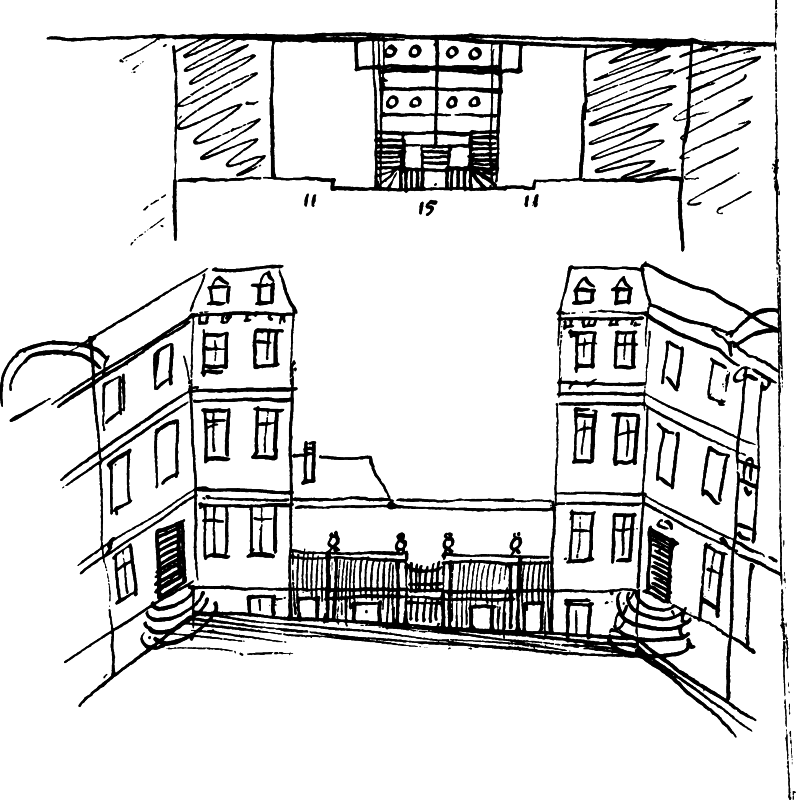
The above sketches occur among the College papers and appear to refer to the spaces 11 and 15 feet wide in the centre of the south side of the quadrangle specifically mentioned in paragraph 2 of the Specification of Works, 1687.
3. That there shall be a Wall 3 foot high above the said Terrace fronting the Court the whole 36 foot except the doreway in the middle, with such windows for lights into the said vaults as shall be agreed upon.
4. That the back part of the Terrace shall be built up with a handsom brick wall as high as the Eves of the said Alms houses till it meet with Sr. John Dugdales Apartment.
5. That there shall be a new pair of Oak or Wainscot Gates at the great coming in on St Bennets Hill.
6. That the Court be levell'd or brought to an easy ascent from ye said great gates to the East Side, vizt. to be sunk about two foot and a half at the East end below the present Ground floor and paved with a fair broad passage quite cross from West to East and so likewise from South to North as shall be agreed upon, & the squares between with Com'on Paving.
7. That all the Cellar Windows to the Court built and to be built shall be Curbed with stone and faced down with brick.
8. That to every dore opening into the Court or Quadrangle there shall be fair stone steps like those now at Garters Corner, either square or round as shall be directed.
9. That there shall be a com'on Sewer provided that may carry the water out of the Cellars of the Building to the Thames.
10. That there be Spouts to bring down the Rain Water.