An Inventory of the Historical Monuments in Westmorland. Originally published by His Majesty's Stationery Office, London, 1936.
This free content was digitised by double rekeying. All rights reserved.
'Brougham', in An Inventory of the Historical Monuments in Westmorland(London, 1936), British History Online https://www.british-history.ac.uk/rchme/westm/pp54-63 [accessed 9 May 2025].
'Brougham', in An Inventory of the Historical Monuments in Westmorland(London, 1936), British History Online, accessed May 9, 2025, https://www.british-history.ac.uk/rchme/westm/pp54-63.
"Brougham". An Inventory of the Historical Monuments in Westmorland. (London, 1936), British History Online. Web. 9 May 2025. https://www.british-history.ac.uk/rchme/westm/pp54-63.
In this section
14 BROUGHAM (D.b.)
(O.S. 6 in. (a)III, S.E., (b)IV, S.W., (c)VIII, N.W.)
Brougham is a parish on the S. bank of the River Eamont, 11 m. N.W. of Appleby. The Roman station, the church, Brougham Chapel, the castle and the Countess' Pillar are all important monuments.
Roman
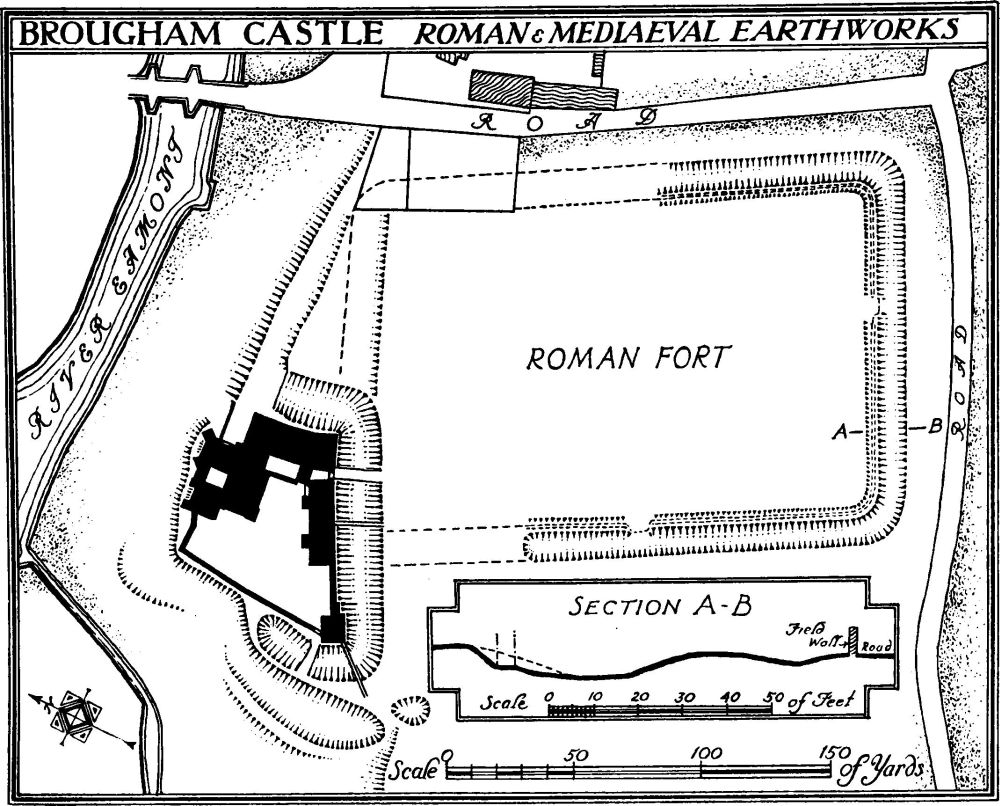
b(1). Fort (Brocavum) situated immediately S.E. of the Castle and about 250 yards S.E. of the confluence of the Eamont and Lowther rivers. The longer axis is N.W. to S.E.; the width is about 120 yards and the length was about 180 yards, on the probable assumption that the S. moat of the castle is an enlargement of the Roman N. ditch. The area would thus have been about 4½ acres, a size which suggests a milliary cohort-fort. The N. quarter of the fort is practically obliterated and elsewhere the ramparts are badly robbed. Slight traces of the bank remain, and there are indications that it was formerly revetted externally by a stone wall; the removal of this wall (perhaps by the castle builders) has exaggerated the width of the berm. A single ditch is visible. There is no indication of internal buildings. The pottery found by H.M. Office of Works, chiefly in clearing out the S. moat of the castle, dates from the 2nd to the later part of the 4th century, with a marked preponderance of the later period.
Various traces of Roman occupation, including gravestones, have been found, but ill-recorded, on or about a low hill about ¼ m. E. of the fort; they point to some sort of vicus spreading along the Kirkby Thore road. In this connection it may be noted that the Brougham gravestones (Plate 4) show an unusually high proportion of British personal names. A hoard of coins ranging from Valerian to the Tetrici was found about 100 yards N.E. of the fort-rampart in 1910.
[See C. and W. Trans., o.s., vi, 16; N.S., xxii, 140; xxxii, 124. Inscriptions: C.I.L., vii, 295, 297, 299, (?300), 302 (Clifton), (?303); Eph. Epig., iii, 84–7, 88 (Clifton), 89, 91; v, p. 200; viii, 953–4, 960–1 (Clifton); Journ. Rom. Studies, xxii, 223. Finds: Pottery, C. and W. Trans. N.S., xxxii, 134; Coins: C. and W. Trans. N.S., xi, 209.]
Condition—Fairly good.
Ecclesiastical
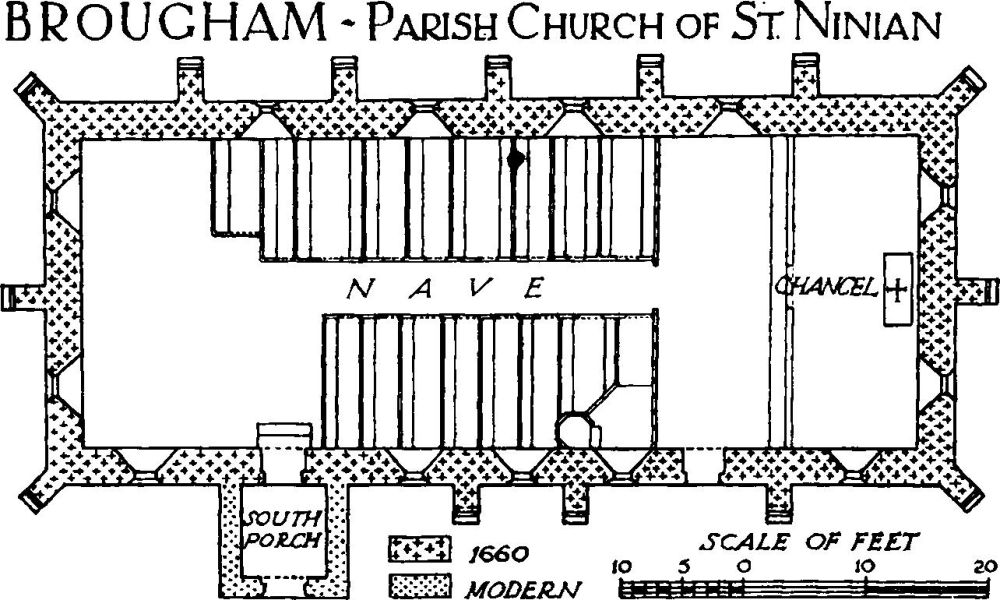
b(2). Parish Church of St. Ninian (Plate 10), formerly called Ninekirks, stands on the E. bank of the Eamont on the N. side of the parish. The walls are of sandstone rubble, with dressings of the same material; the roofs are slate-covered. From the diary of Lady Anne Clifford, Countess of Pembroke, it is clear that she pulled down and entirely re-built and enlarged the Church in 1660. It has been repaired in modern times and the South Porch was added in 1841; the bell-cote is also modern.
The church and its fittings (Plate 82) are interesting examples of 17th-century work.
Architectural Description—The Chancel (25¼ ft. by 21 ft.) is structurally undivided from the nave and occupies the three easternmost bays of the building. In the E. wall are two windows each of one segmental-headed light in a square head with a moulded label; on the E. gable, internally, is a wreath in plaster enclosing the initials and date A.P. 1660 (for Anne Countess of Pembroke). The N. and S. walls have each a similar window; W. of the S. window is a doorway with double-chamfered jambs, segmental head and moulded label.
Brougham Castle, Roman & Mediaeval Earthworks
The Nave (46½ ft. by 25 ft.) has three windows in the N. wall and four in the S. all similar to those in the chancel; the S. doorway has double-chamfered jambs and elliptical head. In the W. wall are two windows similar to those in the E. wall. The buttresses of the church are of two stages with a moulded base.
The Roof is of nine bays with collar-beam trusses having curved braces below and short king-posts above the collar-beams.
Fittings—Bell: one, inscribed "Ninekirkes 1696." Chest: In nave—plain, of hutch-type, with iron straps and bands, two staples remaining, mediæval. Churchyard Cross: S. of church—square base with moulded top, mediæval, shaft and head modern. Coffin lids: In nave—(1) slab with ornamental cross and sword, 13th-century. In churchyard—S.E. of church, (2) slab with traces of cross and sword; S.E. of porch, (3) slab with foliated cross, sword and indent of shield, both 13th-century. Communion Rails: with heavy turned balusters, moulded rails and square posts, c. 1660. Font: octagonal bowl with splayed under side and the date 1662 on one face, slender shaft on modern base. Monument and Floor-slabs. Monument: In churchyard—S. of chancel, to William Dobson, 1712–3, headstone. Floor-slab: In chancel —re-set fragments to [Cuthbert] Bradley, incumbent, [1624]. Panelling: In chancel—covering S. doorway, made up screen, with central door of enriched panels, carved and arcaded panels at sides flanked by standing figures supporting continuous cornice; above cornice, panelled top stage with four terminal figures, late 16th or early 17th-century materials re-used. Plate: includes an Elizabethan cup, without datemark. Poor Box: In nave—box with moulded lower edge and inscription "Remember the poor," square post with the date 1663. Pulpit: seven-sided with panelled faces, brackets at angles supporting bookrest, one side carried up as standard to support sounding-board; sounding-board with embattled cresting and turned pendants at the angles, c. 1660. Screen: Between chancel and nave—of oak with central doorway and eight bays on each side, side bays with turned balusters and shaped and pierced heads of Gothic form, close boarding below in two main bays on each side; opening formerly fitted with doors but now retaining only the heads of these, fixed in position and similar to the heads of the side bays, c. 1660, cornice modern. Seating: In nave—nine pews on N. and seven on S. side, all with panelled enclosures and some modern work; two blocks on N. comprising the first two and the fourth to the sixth pews, carried up to height of screen with turned balusters, deep panelled frieze and cornice, doors, each with two open upper panels divided by a baluster; one pew on the S. side with the initials and date I.B. 1661; book-rests modern. Miscellanea: In nave—in glass case, skull and remains of prick-spur, etc., from under coffin-lid (1). Incorporated in E. wall of chancel, fragment of 12th-century moulded stone; over head of S. doorway grotesque head-corbel. In churchyard—S.E. of church, Roman altar (?) of sandstone (14¾ in. by 6 in.) with concave sides, uninscribed.
Brougham - Parish Church of St. Ninian
Condition—Good.
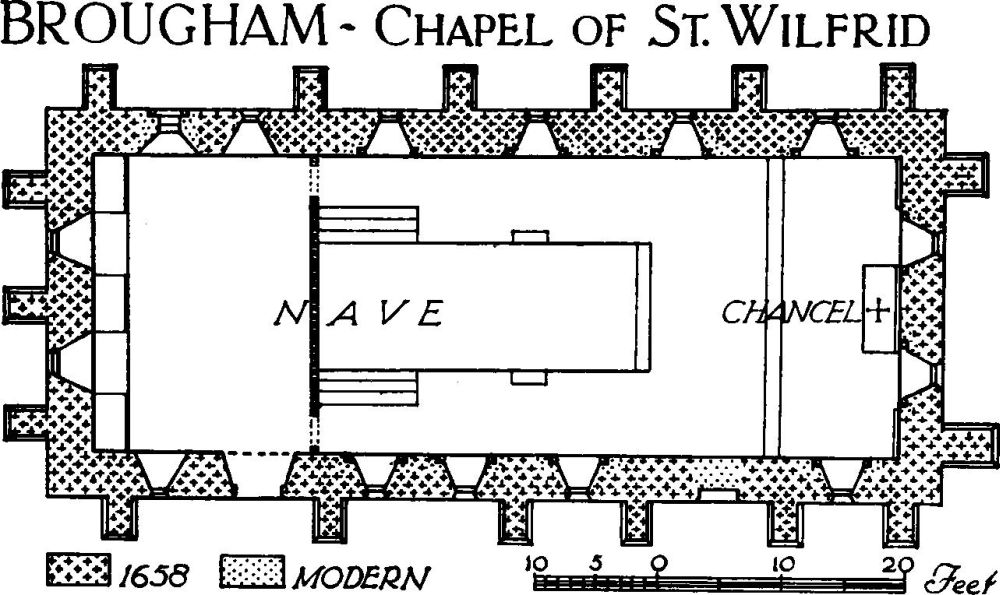
a(3). Chapel of St. Wilfrid (Plate 10) stands on the W. border of the parish. The walls are of coursed sandstone rubble with dressings of the same material; the roofs are slate-covered. The chapel consisting of continuous Chancel and Nave was entirely re-built by Lady Anne Clifford in the spring of 1658. It was thoroughly restored c. 1840–50 by Lord Brougham and Vaux when the windows were altered and the interior fitted with woodwork collected from various sources.
The chapel is of interest as a complete mid 17th-century building and some of the imported fittings are noteworthy.
Architectural Description—The Chancel and Nave (65 ft. by 23¾ ft.), without structural division, have low-pitched gables and two-stage buttresses. In the E. wall are two windows each of one pointed light (round-headed internally) in a square head with a moulded label; the internal shafts and rear-arch are modern; in the gable is a modern window. In the N. wall are six windows of which the first five are similar to the lower windows above described, except that the fifth has plain splays; the sixth window is modern. In the S. wall are five windows uniform with the first five windows in the N. wall; the chancel doorway, now blocked, has double hollow-chamfered jambs and ogee arch under a square moulded label; the S. doorway has moulded jambs and segmental-pointed arch under a square moulded label. In the W. wall are two windows similar to the fifth windows in the side walls. On the W. gable is a bell-cote with two square-headed openings, cornice and pediment.
The Roof is of nine bays with collar-beam trusses with curved braces under the collars; it is now ceiled with elaborate 19th-century heraldic plaster-work.
Fittings—Font: octagonal bowl with moulded rim and curved underside, octagonal stem and moulded base, probably 17th-century with 19th-century enrichments to bowl and stem. Glass: In E. windows— foiled panels of the Virgin and Child and the Crucifixion, with the figure draped, and quarries with vine and oak-leaf ornament; foliage quarries also in window in gable, 14th-century, Virgin and Child, 16th-century, all foreign. Locker: In chancel—in N. wall, with imported carved panel of the Resurrection on door, c. 1500. Organ Case: In three sections against W. wall—modern but incorporating imported old material, including enriched posts, traceried panels, carved panels of the Entry into Jerusalem, the Virgin and Child and the Crucifixion, moulded and cusped arches with a carved panel at the top, foreign and mostly c. 1500. Panelling: On E. wall—dado incorporating imported traceried panels, foreign and c. 1500. Forming a partition across W. end of church—imported carved panels of the early life of Christ, David and Goliath, Cain and Abel, etc., all 16th-century; on adjoining side-walls, frieze of 17th-century panels carved with cherub-heads and swags. Incorporated in stalls various imported French panels probably of the 16th century, with tracery, heraldry, the initials M.A., etc. In nave—on N. and S. walls, dado incorporating similar panels also with the initials M.A., fleurs-de-lis, etc. Pulpit: modern but incorporating much old work, including geometrical panels, imported figure-subjects of the Virgin and Child, the Assumption, a Pieta and probably God the Father, 16th-century and later. Plate: Includes a secular cup (Plate 54) with repousse lobe decoration, given by James Bird (steward of Lady Anne Clifford), 17th-century Nuremberg work, also a 17th-century German paten. Reredos: Against E. wall—imported triptych in separate leaves of carved and painted woodwork with traceried and enriched setting; middle panel with the Crucifixion with a subject below; N. leaf with the Bearing of the Cross, the Presentation and the Circumcision; S. leaf with the Descent from the Cross, the Baptism and the Entombment, all Flemish or German and c. 1500; below side leaves, four trefoil-headed panels with figures of St. George, a hermit, St. John the Baptist and St. John the Evangelist, 14th-century. On W. side of main screen—reredos with four imported panels of St. George, St. Martin, the Adoration of the Magi and probably St. Anne and the Virgin, Flemish or German, c. 1500. Scratchings: On stonework— various masons' marks, 17th-century. Screen: Across nave—imported screen with a series of enriched circular posts supporting cinque-foiled arches, moulded and enriched cornice, probably French, c. 1500.
Brougham - Chapel of St. Wilfrid
Condition—Good.
Secular
b(4). Brougham Castle (Plate 85), ruins and earthworks, stands on the S. bank of the river Eamont. The walls are mainly of red sandstone with dressings of the same material. Under Henry II the property was granted to Gospatrick son of Orm and under John it passed to the family of Vipont; the marriage of the Vipont heiress to Roger de Clifford (died 1282) brought the property to that house and with them it remained until the extinction of the family by the death of Lady Anne Clifford in 1676. It passed from her through the Earls of Thanet to the present owner, Lord Hothfield, who placed the castle under the guardianship of H.M. Office of Works in 1928.

Brougham Castle
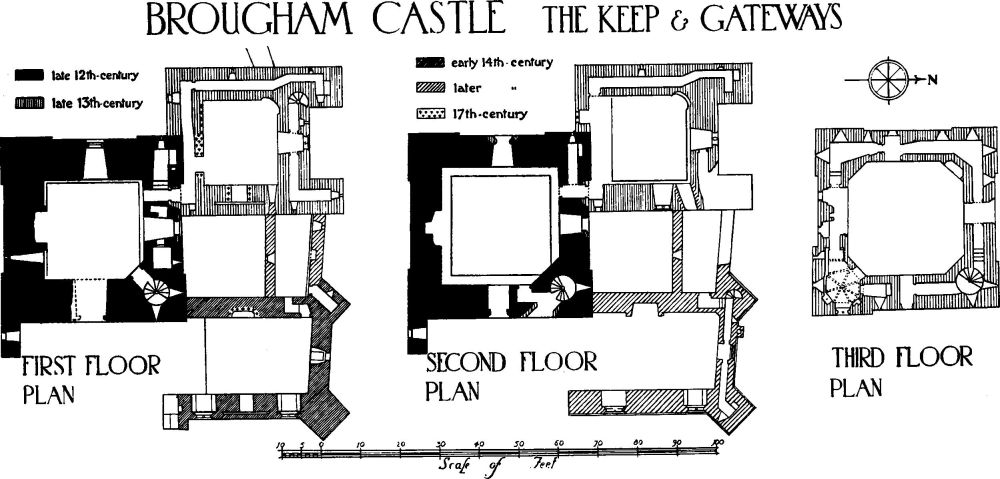
The earliest part of the existing building is the square Keep (later known as the Pagan Tower) which was built c. 1170–80; it was entered by a forebuilding on the E. face, but there is no evidence of what else the castle consisted at this date. Early in the 13th century a rectangular building was erected, axially with and to the E. of the keep; the form and position of this building suggest that it was originally a chapel, but it was subsequently raised to at least three storeys as is indicated by the structure of the adjoining buildings, though the supposed chapel itself has been largely destroyed; the apartment on the second floor of this building was later the Great Chamber. Rather later in the 13th century much of the curtain-wall seems to have been built and with it a block of buildings on the E. side probably containing the hall (on the first floor) and the offices. In the same century a vault was inserted in the ground floor of the keep and other alterations made at a higher level. Late in the 13th century the western block of building against the S. curtain was built and the top stage added to the keep; at much the same time, c. 1290–1300, the Inner Gatehouse and the S.W. Tower (later called the Tower of League) were built, and c. 1300 the Outer Gatehouse was built, and c. 1330 the top storey was added and the narrow building erected between it and the inner gatehouse. Roger, 5th Lord Clifford (d. 1388), is said to have built the greater part of the castle towards the E., and to him must be assigned the reconstruction of the Great Hall with its porch; shortly after, the Chapel block was inserted against the S. curtain and between two earlier blocks; perhaps at this time the earlier chapel was heightened and transformed into the great chamber. At the same period a corridor was built connecting the keep with the porch of the hall. An inscription, now placed on the outer gate house, probably refers to the 5th Lord Clifford. Much repair is said to have been done on the castle by Henry, 2nd Earl of Cumberland (d. 1569–70), but little work of this date can be identified. The castle suffered much in the Civil War and was lying "ruinous and desolated" in 1651 when the Lady Anne Clifford, Countess of Pembroke, began the repair of the building; her work, mainly undertaken in 1651–2, consisted largely of reroofing and reconditioning the existing buildings, but she pulled down the old bakehouse and brewhouse adjoining the Tower of League and re-built them; her buildings may be represented by the northern foundations against the W. curtain and now turfed over. The particulars of her visits recorded in her diary and elsewhere permit the identification of the chief rooms in the castle in her day. The Great Hall on the first floor gave access upstairs to the Great Chamber, the Painted Chamber, the Passage Room and her own chamber in succession, the last immediately adjoining the middle room of the Pagan Tower (or Keep). This succession is only possible on the second or top floor of the gatehouse blocks, and the Lady Anne's own chamber, in which she died, must thus have been in the third storey of the inner gatehouse. The castle was abandoned and its demolition begun by Thomas Tufton, 6th Earl of Thanet, in 1691; stone, lead and timber from it were sold in 1714; since then the remains have gradually deteriorated until their complete repair was undertaken by H.M. Office of Works.
Brougham Castle the Keep & Gateways
The remains of Brougham Castle form the most extensive and important survival of military architecture in the county. The 12th-century keep is still largely complete, as are the two gatehouses, the three together forming a remarkable example of defensive planning.
The Keep (Plate 87) or Pagan Tower (about 45 ft. square without the buttresses) is of four stages, the three lower storeys being of c. 1170–80 and the top part an addition of the end of the 13th century. The walls are of coursed rubble with ashlar dressings and the angles have clasping buttresses, not however projecting on the E. face. The ground storey formerly had an inserted 13th-century stone vault in four bays with chamfered ribs; it sprang from moulded corbels and a central column and was intact late in the 18th century (Grose); the angle-corbels and springers still remain but the original loop-lights in the N., S. and W. walls have been reopened and the blocking supporting the vault removed; the loops have lost their rear-arches; in the N.W. angle is a garde-robe, in the N.E. angle a turret-staircase and in the E. wall are remains of a former entrance; the opening may originally have communicated with the space under the forebuilding, but has been subsequently cut through to the building on the E. The forebuilding is now much ruined, but originally contained a flight of steps leading up to the main entrance on the first floor and entered by a doorway on the S.; this was superseded by the 13th-century entrance on the E. The second storey has, in the E. wall, one jamb and half the arch of the original entrance; it is of c. 1180 and had shafted jambs with moulded capitals and bases and a round arch of two moulded orders; the jambshaft is missing; much of the E. wall-face has gone at this level. The internal faces have remains of an added late 13th-century wall-arcade with two-centred arches resting on shafts with moulded bases and carved capitals, of which two only survive. In the S. wall is a gap representing a former fireplace and a square-headed window. The N. and W. walls have each an original round-headed window with moulded angles to the splays; the N. window is partly destroyed; the external face of each is in two orders, the outer order of the arch being rounded and resting on attached shafts cut on the order in the 13th century. There is a garde-robe in the N.W. angle and two small chambers flanking the N. window. The third storey has, in the N. and W. fronts, an original window altered in the 13th century and similar to those in the stage below. In the E. wall is an original round-headed window of two chamfered orders; farther N. is a later doorway cut through the wall, and in the slabroof of the adjoining passage is an inscribed Roman tombstone. A gap in the S. wall shows the flue of the fireplace below, and there is a garde-robe in the N.W. angle. The late 13th-century top storey is differentiated from the earlier work by the colour of the quoins; there are some remains of the machicolation-corbels, but the parapets have gone; the turret on the S.E. oversails towards the E. and S. on corbelling and two carved head-corbels. The room in this stage is of octagonal form, the short sides being carried on corbelling; it is surrounded by a slab-roofed wall-passage interrupted on the E. side to form a small chamber; the passage is lit by loop-lights and there are larger square-headed windows in all the walls. In the N.W. angle is a fireplace with chamfered jambs and a flat arch with joggled voussoirs. In the S. wall are remains of a doorway into the wall-passage; it had a two-centred arch of two moulded orders, the inner continuous and the outer springing from attached shafts with moulded capitals and bases; the E. side only remains; other doorways have shouldered segmental arches with a flat cusp at the springing. In the S.E. angle is a semi-octagonal chapel or oratory (Plate 88) covered with a ribbed vault in seven cells, with a central boss carved with two heads; the ribs are chamfered and two of them spring from shafts with a moulded and a head-corbel; two others stop on to a defaced head and a rosette respectively; the entrance (Plate 89) from the S. wall-passage had a cusped arch and there is an inner cusped and higher arch; in the S. wall are two recesses with moulded reveals, one having a pointed and one a trefoiled head; there are two more recesses with trefoiled heads on the N. side of the entrance. The E. window was formerly of two trefoiled lights with a trefoil in a two-centred head, but the mullion is missing; the N. splay has remains of two carved figures; in the N.E. wall is a locker with moulded jambs and square chamfered head; in the S.E. wall is a piscina formerly having shafted jambs and an ogee head in a segmental-pointed arch; the drain was octofoiled. On the jamb of the N.W. doorway of the oratory are remains of small carved figures, probably of the 16th century. The chamber N. of the oratory has a locker with rebated reveals in the N. wall.
The Great Chamber Building (54 ft. by 23 ft.), E. of the keep, was built early in the 13th century, but was probably raised at a later date to the full height of the outer gatehouse, the wall of which butted against it. Very little of the building is now standing, but it had clasping buttresses to the E. wall; the S.E. buttress remains to some height and in the E. wall adjoining it are remains of a window-jamb with a dog-tooth ornament carved on one jamb-stone. In the N. wall is part of an original loop-light at a lower level.
The Outer Gatehouse (Plate 86) is of three storeys, faced on the E. and N. with rough ashlar; the two lower storeys are of c. 1300, and the top storey is probably an early 14th-century addition. The outer gateway is of two chamfered orders with a portcullis-groove between; the outer arch is segmental and the inner of segmental-pointed form. Above the arch is a patch in the wall in which is re-set a panel with the inscription in black-letter "thys made Roger"; it probably replaces an inscription-panel of Lady Anne Clifford, now at Appleby Castle. This inscription reads "Brougham Castle was repaired by the Ladie Anne Clifford Countesse Dowager of Pembroke Dorsett and Montgomery, Baronesse Clifford, Westmerland and Veseie, Lady of the Honour of Skipton in Craven and High Sheriffesse by inheritance of the countie of Westmerland, in the yeares 1651 and 1652 after it had layen ruinous ever since about August 1617 when King James lay in it for a time in his journie out of Skotland and towards London until this time. Isa. Chap. 58 Verse 12. God's name be praised." The inner gateway has jambs and segmental-pointed arch of one chamfered order. The gate-hall is covered with a segmental-pointed vault of ashlar and the doorway in the N. wall has a shouldered head. The guardroom on the N. has a segmental vault of ashlar springing from the end walls; it is lit by loops and a square-headed window; in the N. wall is a fireplace with a flat lintel and in the N.E. angle is a garde-robe. Below this chamber is a cellar or dungeon, lit by a loop and approached by an opening in the floor above; the roof is a pointed vault of ashlar. The room on the S. of the gate-hall was formerly roofed with a segmental-pointed vault with square ribs; only the springers now remain. In the E. wall is a garde-robe and a loop-light which appears to be of two dates, the inner part being an insertion between the ribs of the vault. The first floor appears to have formed one room and has a series of recesses in the E. wall; two of these form window-recesses with seats; the windows were each of two trefoiled and transomed lights with a quatrefoil in a two-centred head; the mullions are missing; the middle recess served to work the portcullis. In the N. wall is a square-headed window and in the W. wall is a passage to the room on the W. and a fireplace probably of the 17th century. The S. wall, like most of that on the floor below, has been destroyed. The second floor also forms one large room (called the Painted Chamber in the 17th century) and has two 14th-century windows in the E. wall, with seats; they were each of two trefoiled and transomed lights with a flowing quatrefoil in a two-centred head, but the mullions are largely missing. In the middle of the wall-face at the top, are three heavily projecting machicolation-corbels. In the N. wall is a wall-passage leading to a staircase to the roof and a garde-robe; the window in the middle was probably similar to those in the E. wall. In the W. wall is a fireplace with a broken segmental head. Between the two gatehouses is a small courtyard with a narrow four-storeyed building on the N. side. This building is probably of the 14th century and contemporary with the upper part of the outer gatehouse. The windows are of the small square-headed type or loops. The doorway on the ground floor has a shouldered head and there is a fireplace on the first floor with a corbelled hood.
The Inner Gatehouse (Plate 87) is of three storeys, faced with rough ashlar and was built c. 1290–1300. The outer archway has jambs and segmental-pointed arch of two chamfered orders separated by a portcullis-groove. The inner archway has chamfered jambs, a segmental-pointed inner order to the arch and a segmental outer order; the rear-arch is shouldered and segmental-pointed. The gate-hall (Plate 89) has a quadripartite vault of two bays with chamfered cross and diagonal ribs. In the S.W. angle is a small chamber and in the N. wall a corridor ending in the N.E. angle; both are slab-roofed. The first floor has a wall-passage in the N., W. and S. walls, communicating with the keep and with two chambers or garde-robes in the N. angles and interrupted by the stair-turret; the S. and W. corridors are lit by square-headed windows or loops. In the middle of the N. wall is a window formerly of two trefoiled lights with a piercing in a two-centred head; the mullion is missing. In the N.W. angle are remains of a fireplace. The second floor formed the Lady Anne's chamber and communicates with the third storey of the keep, It has a passage in the W. wall with a garde-robe at the N. end, and there was probably a staircase in the N.E. angle, now fallen. A later cutting communicates with the passage-building on the N.E. In the E. wall is a window of two trefoiled and transomed lights with a quatre-foiled in a two-centred head; there are remains of a similar window in the N. wall and across the N.W. angle is a fireplace with a shouldered head, partly fallen.
The Great Hall occupied the first floor of the E. range of the castle. The wall on the E. is of the 13th century altered late in the 14th, but the W. wall is probably all of the 14th century; it has been destroyed except for about 3½ ft. above the ground. It contains remains of a doorway, fireplace and window. The E. wall of the ground floor has no features except a gap representing a late doorway. In the middle of the building is a square foundation perhaps for the hearth of the hall above. The hall itself (41 ft. average by 21½ ft.) retains only its E. wall heightened in the 14th century. In it there are three original 13th-century loop-lights, one partly open and two blocked; there are also two 14th-century windows each of two trefoiled lights in a square head; one window has lost its mullion; between the windows is a gap representing a later fireplace. In the remaining fragment of the N. wall is one moulded jamb of a 15th-century doorway with a pointed arch in a square head and a moulded label. The hall was approached by a flight of steps in a porch on the W. side; the porch is only standing in its lower part but retains the moulded jambs of its outer doorway. The room in the S.E. angle of the castle probably contained the kitchen on the first floor. The outer walls are probably partly of the 13th century heightened in the 14th century, but the angle seems to have been partly reconstructed. The room on the ground floor retains its stone pavement and remains of a later staircase against the E. wall. There are square-headed or loop-lights in the S. and W. walls. The room was formerly covered with a 14th-century ribbed barrel-vault springing from the N. and S. walls. The kitchen, on the first floor, has a window-opening in the W. wall, once of two lights. In the E. wall is a two-light square-headed window probably of the 17th century and also a small 14th-century window. In the S. wall is a similar window and remains of a large fireplace. There was a third storey to this building, probably an alteration of the 17th century. To the W. of it is a small open court with a late opening cut through the curtain-wall at the S. end and a well at the N. end.
The Chapel Block is a late 14th-century insertion between the earlier building on the W., the small courtyard and the earlier curtain. It is of two storeys, with the chapel on the first floor. The ground-floor room has two 17th-century square-headed openings in the curtain and other small original windows in the E. and N. walls. The N. doorway has chamfered jambs and two-centred head and the E. doorway a square head. In the N. wall are remains of a 17th-century fireplace. Against the N. wall outside are remains of the staircase to the chapel which landed in a porch on the top of a small square chamber with a slab-roof. In the N.E. angle of the main building is a skewed passage giving access to the small courtyard mentioned above. The chapel itself (39 ft. by 20 ft.) has a large E. window with moulded jambs and destroyed head; the mullions and tracery also have been destroyed. The N. wall has been largely destroyed except on the W. side of the porch; this fragment has remains of a staircase leading from the chapel to a room over the porch. In the heightened curtain-wall on the S. side are two late 14th-century windows each of one trefoiled light. The sedilia (Plate 89) in the same wall are in three bays with moulded jambs and divisions and trefoiled arches in a square head with foiled spandrels; the piscina, farther E., has a foiled arch in a pointed head. The corbels of the former roof remain at a higher level. The adjoining building on the W. is perhaps of late 13th or early 14th-century date, but has been repaired in the 17th century. It was probably of three storeys, but only the E. wall remains to its full height, the other walls not standing anywhere above the first-floor level. The walls towards the courtyard have a moulded plinth and are ashlar-faced; the plinth is returned along the E. wall also. In the N. wall is the base of an original doorway with moulded jambs; the small annexe on this wall is reduced to foundations. In the E. wall are remains of a doorway with a garde-robe opening off its S. splay. The upper part of the E. wall has a 14th-century doorway, at the first-floor level, communicating with the chapel and a second communicating with a garde-robe. Above these doorways are the marks of a later and probably 17th-century roof. The S. or curtain-wall is probably of the 13th century, as is its continuation as far as the S.W. tower.
Between the keep and the porch of the great hall are the bases of the walls of a corridor of late 14th-century date; the doorway W. of the porch has moulded jambs and the adjoining doorway in the cross-wall has chamfered jambs.
The S.W. Tower (called the Tower of League (Plate 89) in the 17th century) was built late in the 13th century and is of four storeys, but the S.E. angle has fallen and some of the facing has been removed. The ground floor has cruciform loops and an original fireplace with a shouldered head and joggled voussoirs. In the N. wall is a staircase to the floor above, and an extension of the tower on the E. side contains a garderobe approached by a passage. The first-floor room has a pointed window in the W. wall and a fireplace, the head of which has been destroyed; the staircase from this level becomes spiral and is connected by a wall-passage with a garde-robe in the E. extension. The second-floor room has a pointed window in the W. wall and remains of a fireplace in the S. wall; there is a garde-robe in the N.W. angle and the N. wall-passage communicates with the parapet-walk of the W. curtain. The top-floor room has remains of a corbelled fireplace, a square-headed window on the W. and remains of another in the E. wall. The W. curtain-wall for about 30 ft. N. of the tower was probably built with the tower; it retains a small part of the parapet; cut through the wall is a 17th-century or later doorway; farther N. the wall is probably of the 13th century and has lost its internal facing. The whole of the N.W. angle is modern, but the surviving portion adjoining the inner gatehouse is of the same date as that feature. A range of buildings formerly stood against the W. curtain, the foundations of which are shown on the plan; only the foundations at the S. end, including traces of an oven, are now exposed; these presumably were the bake and brew-houses destroyed by the Lady Anne Clifford. To the W. of the chapel-range is a large well 5½ ft. in diameter.
Outside the main enclosure of the castle there is a massive foundation extending E. from the Great Chamber block, and there is also a retaining wall on the outside of the approach to the outer gatehouse.
The Moat extends along the whole of the S. side and returns along part of the E. and W. sides. It is about 56 ft. wide on the S. and E. sides, but narrower on the W. There are causeways, probably of late date, approaching the two late doorways on the S. and W. faces, and remains of two walls carried across on the S. face and at the S.W. angle.
Condition—Good, in charge of H.M. Office of Works.
b(5). The Countess' Pillar (Plate 64) stands on the S. side of the main road about 1,000 yards E. of the castle. It was erected in 1656 to commemorate the last parting between Lady Anne Clifford and her mother. It stands about 14 ft. high and consists of an octagonal shaft with a chamfered base and moulded capping; above this is a square block with a cornice, pyramidal capping and finial. The square block has, on the N. face, two carved and painted shields-of-arms, (a) Clifford impaling Vipont, and (b) Clifford impaling Russell, a skull and the date 1654. The other three faces have painted sundials with metal gnomons and on the S. face also is a brass tablet inscribed, "This pillar was erected Anno 1656 by ye Hon'ble Anne Countess Dowager of Pembroke and daughter and sole heire of ye Rt. Hono'ble George Earl of Cumberland and for a memorial of her last parting in this place with her good and pious mother ye Rt. Hono'ble Margaret Countes Dowager of Cumberland ye 3rd of April 1616. In memory whereof she also left an annuity of four pounds to be distributed to ye poor within this Parish of Brougham every 2nd day of April for ever upon ye stone table here hard by." The stone table referred to is a flat slab about 3 yards to the E. of the pillar.
Condition—Good.
b(6). Hornby Hall, now three tenements, 1,050 yards E. of the church, is of two storeys; the walls are of rubble and the roofs are slate-covered. It was built probably about the middle of the 16th century by Edward Birkbeck; the porch was built c. 1584 and alterations were made early in the 17th century. The house has a modern extension on the W. The S. front retains, on the ground floor, two original windows of three and four four-centred lights respectively, in square heads with moulded labels; the transomed windows on the first floor have modern heads. There are remains of other original windows. The three-storeyed porch (Plate 21) is gabled and has an outer archway with moulded jambs and four-centred arch in a square head with blank shields in the spandrels; above it is a panel with a moulded label, a defaced achievement-of-arms and two smaller shields-of-arms. The inner doorway has a four-centred head and is fitted with a battened door with moulded ribs planted on. The first floor has a 16th-century window of two four-centred lights in a square head with a moulded label; the top floor has a similar window of one light. The N. wall has an original four-light window, similar to that on the S. front, and on the floor above is a three-light window. There is an original window in the E. end now under the archway of the later farm buildings. Inside the building, the hall occupies the middle of the range with the kitchen to the E. The hall has a ceiling divided by beams into three bays; the middle bay retains one panel of enriched plasterwork with moulded ribs forming a geometrical design and pendant in the middle. The fireplace has original moulded jambs and segmental head; the doorway, S. of it, has original moulded jambs, square head and label. In the W. wall is a doorway with moulded reveals embattled enrichment on the lintel and an elaborate enriched label; on the lintel (Plate 30) are the initials and date T.I.B. 1602. The entrance-lobby has a doorway with a triangular arch in a square head and E. of the lobby is a spiral staircase. The kitchen has a fireplace with a segmental head. The room, W. of the hall, has a re-set early 17th-century overmantel of three bays with enriched arcaded panels and a range of frieze-panels above with intersecting arches; the main middle panel has an achievement-of-arms of Birkbeck. The room on the first floor of the porch has or had a ceiling with the date 1584. The main room on the first floor was lined with panelling and has a carved mantelpiece and an enriched ceiling.
Condition—Good.
a(7). Brougham Hall, immediately S. of (3), was largely re-built in the first half of the last century by Lord Brougham. This house was demolished in 1934, but adjoining the road on the N. of the site is a two-storeyed range of rubble outbuildings, probably of 17th-century origin. The adjoining gateway has an elliptical head and is fitted with a panelled and nail-studded door with a wicket. Inside the building, one room has a segmental barrel-vault and on the upper floor is some early 17th-century panelling. The E. end of the stables incorporates seven Roman inscribed stones (Plate 4).
Condition—Fairly good.
b(8). Hospital Farm, house, 750 yards E.S.E. of (3), is of two storeys with attics. The walls are of rubble and the roofs are slate-covered. It was built late in the 16th or early in the 17th century, but the N.W. end may be of earlier origin. The house has a central block and side wings and retains some original stone-mullioned windows with moulded labels. Inside the building are some 17th-century panelled doors and a fireplace with a triangular arch in a square head.
Condition—Good.
Unclassified
c(9). Remains of Barrow, on the S. side of Leacet Plantation, 2¼ m. S. of the church, now consists only of seven stones forming part of a circle and of which the most westerly only just shows above the turf. The highest is standing 4 ft. above the ground level and the diameter of the circle is about 37 ft. It was excavated in 1880 (Cumb. and West. Trans., O.S. v, p. 76) when three additional stones were found N. of the plantation-wall. In the middle at a depth of about 3 feet were remains of a burnt burial. A small inner circle of stones, possibly accidental, was also found, and at the foot of four of the stones of the main circle were burial urns ("five cinerary urns, one foodvessel and one incense cup") of the Bronze age.
Condition—Poor.