
An Inventory of the Historical Monuments in Westmorland. Originally published by His Majesty's Stationery Office, London, 1936.
This free content was digitised by double rekeying. All rights reserved.
'Cliburn', in An Inventory of the Historical Monuments in Westmorland, (London, 1936) pp. 67-69. British History Online https://www.british-history.ac.uk/rchme/westm/pp67-69 [accessed 25 April 2024]
In this section
17 CLIBURN (E.b.)
(O.S. 6 in. (a)IV, S.E., (b)VIII, N.E.)
Cliburn is a parish and small village 7 m. N.W. of Appleby. The church and Cliburn Hall are the principal monuments.
Ecclesiastical
b(1). Parish Church of St. Cuthbert stands at the S. end of the village. The walls are of sandstone rubble with dressings of the same material and some tufa; the roofs are covered with slates and lead. The church, consisting of Chancel and Nave, was built about the middle of the 12th century, and at a later period a S. porch was added. The building was drastically restored in 1886–7 when the South Aisle and Chapel were added and the South Porch re-built.
Architectural Description—The Chancel (12¼ ft. by 13½ ft.) has a 13th-century lancet-window in the E. wall; below and S. of it are traces of an earlier window or opening. In the N. wall is a 12th-century window of one round-headed light. In the S. wall is a modern arch. The late 12th or early 13th-century chancel-arch has jambs and round arch of one chamfered order.
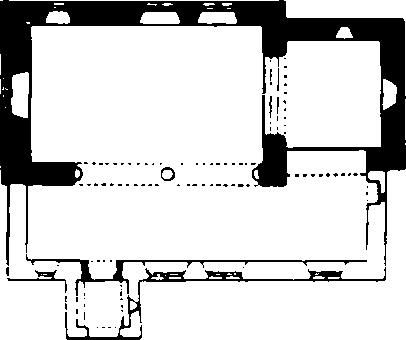
The Church, Plan
The Nave (29½ ft. by 17 ft.) has three modern windows in the N. wall, a modern S. arcade and a modern window in the W. wall. The bell-cote on the W. gable is also modern.
The South Aisle is modern, but in the S. wall is a re-set 12th-century doorway with plain jambs, corbelled lintel with a small figure carved at each end and a round head with cheveron-ornament enclosing a plain tympanum. The re-built S. porch incorporates old material.
Fittings—Chest: In nave—of hutch-type, with the initials and date T.H. 1696 incised on front. Churchyard Cross: S. of chancel—square tapering base, mediæval, shaft modern. Coffin-lids: In porch— (1) fragment with base of cross-shaft; (2) fragment with branched shaft of cross and stepped base; probably 13th-century. Consecration Cross: On W. jamb of S. doorway—small incised cross. Font: octagonal bowl (Plate 43) with moulded underside, shaft with zig-zag cutting, moulded necking and chamfered base, late 12th-century, bowl later or re-cut. Plate: includes Elizabethan cup (Plate 54) with band of ornament round bowl, a 17th-century pewter flagon and paten and an olive-wood cross inlaid with ebony and mother of pearl, said to have come from Vallombrosa. Sundial: On E. jamb of S. doorway, scratch-dial. Miscellanea: Incorporated in porch—two inscribed Roman stones (Plates 3, 4) (p. xlii) found during the restoration.
Condition—Good.
Secular
b(2). Cliburn Hall, house and outbuildings, 150 yards E.N.E. of the church. The House is of three storeys; the walls are of local rubble and ashlar and the roofs are slate-covered. The house was built or re-built by Richard Cliburn in 1567, but the thickness of some of the walls may indicate that portions of an earlier building were incorporated. At the N.W. end is a rather later extension with a two-storeyed wing extending towards the S.W. The house was re-roofed in the 19th century when the former parapet was removed; other alterations have been made in recent years. The S.W. front has a projecting two-storeyed wing, probably a porch-wing; the upper storey projects slightly on continuous corbelling; the former mullioned and transomed windows have been replaced by modern work in recent years. The former doorway in the N.W. return-wall is blocked. The main block has a doorway at the first-floor level, approached by steps; it has a square head and above it is a re-set panel inscribed "Rychard Cleburn thus they me cawl Wch in my tyme hath bealded ys hall, the yeare of owre lorde God who lyst for to neam (?) 1567— R.D. Mayson"; above the panel are the initials R.C. and a cartouche of the arms of Cliburn quartering Kirkbride. Farther S.E. are two windows each of four transomed and elliptical-headed lights with a moulded label; two other windows have been destroyed by a rebuilding round and above the doorway. The ground floor, approached by steps, has an original window with an iron grate. Both the S.E. end and the back (Plate 18) have a series of original transomed windows similar to those on the S.W. front, and the ground floor has a window with a grate. In the addition, at the first-floor level, is a doorway with a modern head, opening on to a solid stone platform approached by steps and giving access to a well enclosed in a square block of masonry. Inside the building, the ground floor both of the main block and the extension has elliptical barrel-vaults of rubble, groined back over the windows; two doorways have triangular arches in square heads and the large S.E. fireplace has an arched head. On the first floor, the middle beam of the main room or hall rests on shaped corbels; the blocked fireplace has moulded jambs and flat three-centred head; the original doorway, N.E. of the fireplace, has the scratched name John Lowther; another doorway has the names James Lowther, William Lowther and the figures 68. In the N.W. wall of the former hall are two more 16th-century doorways, one with a triangular and one with a three-centred head. The second floor has an original fireplace with a triangular arch in a square head.
The Outbuildings, extending S.W. from the S.E. end of the house, are probably of late 16th-century date and retain a series of original doorways and remains of an original window at the first-floor level.
Condition—Good.
d(3). Winderwath, house and outbuilding in a detached part of the parish, about 3 m. N.N.E. of the church. The House is of two storeys; the walls are of rubble and the roofs are slate-covered. There are remains of a mediæval building incorporated in the present structure, which was, however, largely re-built and remodelled late in the 17th century. The house was again altered c. 1860, when a S.E. wing was added; this has been extended in recent years. The exterior has no ancient features except a 17th-century doorway on the W. front; it has a moulded architrave and panelled and enriched pilasters, supporting consolebrackets, enriched frieze and cornice; above the doorway is a re-set shield-of-arms of Clifford impaling Vipont. Re-set in a gable of the N. wing is a grotesque head-corbel, a stone carved with a cinquefoil and a shield bearing a cross with a cinquefoil in the quarter. Inside the building, the dining-room has a 17th-century fireplace with rusticated jambs and head, enriched Ionic side-pilasters, frieze with blank shields and a wreath and a moulded cornice. In the main E. wall is a 15th-century window of one trefoiled light with a moulded label. In the N. wall of the kitchen is a mediæval doorway with a two-centred head and E. of it is a late 17th-century fireplace; it has a corbelled lintel enriched with mouldings and carved blocks.
The Stable and barn, W. of the house, is a two-storeyed building of the 17th century, retaining an original doorway and window.
Condition—Good, much altered.