An Inventory of the Historical Monuments in Westmorland. Originally published by His Majesty's Stationery Office, London, 1936.
This free content was digitised by double rekeying. All rights reserved.
'Helsington', in An Inventory of the Historical Monuments in Westmorland(London, 1936), British History Online https://www.british-history.ac.uk/rchme/westm/pp104-109 [accessed 9 May 2025].
'Helsington', in An Inventory of the Historical Monuments in Westmorland(London, 1936), British History Online, accessed May 9, 2025, https://www.british-history.ac.uk/rchme/westm/pp104-109.
"Helsington". An Inventory of the Historical Monuments in Westmorland. (London, 1936), British History Online. Web. 9 May 2025. https://www.british-history.ac.uk/rchme/westm/pp104-109.
In this section
36 HELSINGTON (D.g.)
(O.S. 6 in. (a)XXXVIII, S.W., (b)XXXVIII, S.E., (c)XLII, N.E.)
Helsington is a parish 2 m. S.W. of Kendal. Sizergh Castle and Helsington Laithes are the principal monuments.
Ecclesiastical
b(1). Parish Church of St. John, formerly a chapel of Kendal, stands on the W. side of the parish. It was built in 1726 and contains the following:—
Sizergh Castle, Helsington
Fitting— Credence Table: modern, incorporating turned legs and moulded top, probably late 17th-century.
Secular
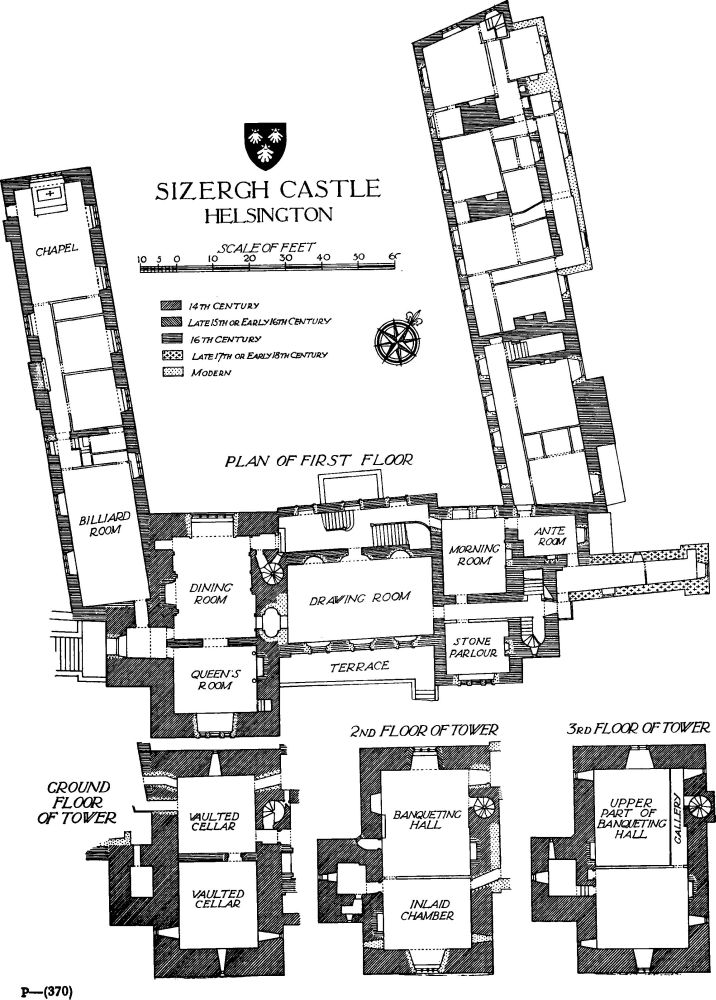
c(2). Sizergh Castle, nearly 1 m. S.E. of the church, is of two, three and four storeys; the walls are of local rubble and the roofs are covered with slates and lead. It came into the possession of the Strickland family in the 13th century. The earliest part of the building is the pele-tower at the S. end of the main block, which dates from the second half of the 14th century; there was almost certainly a building adjoining the tower on the N. and represented in part by the existing main block with its N. cross-wing; it was perhaps of one storey only, as indicated by the marks of a roof on the N. face of the tower. About 1560 the main block was reconstructed and heightened and the two long W. wings were added, the northern perhaps incorporating earlier work in the kitchen. A considerable amount of work was done at this time by Sir Walter Strickland and his widow, as is indicated by the dates of 1563, 1564, 1569 and 1575 on various overmantels. Alterations were made to the tower in 1749 and c. 1770–80 Cecilia Lady Strickland again reconstructed and heightened the main block. In 1891 the panelling and overmantel of the Inlaid Chamber were removed to the Victoria and Albert Museum. In 1898 the lowest storey of the main block was altered by the cutting of a carriage-way through it.
The house is of great interest not only as including work of a variety of dates but more especially for its remarkable woodwork.
The W. front (Plate 68) of the main building has the four-storeyed tower on the S., finished with an embattled parapet. The ground-storey has an original window of one square-headed light; the window on the first floor is modern; that on the second floor is of 15th or early 16th-century date and of three trefoiled lights in a square head with a moulded label; the top storey has an original window of two trefoiled ogee lights in a square head with a moulded label; between the two upper windows is a niche with buttressed jambs and ogee crocketed label, enclosing an achievement-of-arms of Deincourt quartering Strickland. The hall-block has no ancient features but before the heightening was finished with a series of gables; the adjoining bay on the N. retains its 16th-century gable with barge-boards carved with running foliage and an apex-post.
The E. front of the main block has the four-storeyed tower (Plate 101) at the S. end. It has windows in the ground and top storeys similar to the corresponding windows on the W. front; the other windows are modern or restored. The return face on the N. of the tower has a square-headed light to the ground-storey. The low terrace-wall in front of the hall-block represents the line of the original hall, marks of the roof of which remain on the N. face of the tower. The terrace wall contains a 16th-century window of two transomed lights in a square head with a moulded label. The main wall of the existing hall-block is set back 8 ft. and has no ancient features. The N. cross-wing has a 16th-century gable with carved barge-boards similar to those on the W. front.
The S. face of the tower has a small projecting wing carried up above the main parapet and embattled, as is the staircase-turret on the N. face. On this face are several original single-light windows. The tower has five chimney-stacks, three of which are octagonal and additions perhaps of the 15th century; the other two are rectangular and probably of the 16th century.
The 16th-century S.W. wing is of two storeys and has, on the N. face, a series of five original three-light windows on each floor; all are square-headed and those in the upper range have transoms. There are three original doorways, one now fitted with a window and the others with depressed arches in square heads. The N. end of the wing has two original windows of three and five lights respectively; the gable has carved barge-boards similar to those on the main block. The windows on the lower floor of the S. face are largely modern or restored; the upper windows, of three transomed lights, are largely original. The rectangular chimney-stacks of this and the N.W. wing are probably original.
The 16th-century N.W. wing is of two storeys. The windows on the S. face are either of the 18th century or modern restorations of old work. The W. end has carved barge-boards similar to those of the S.W. wing; a small single-light window in the lower storey and two windows in the upper storey, of two and three lights respectively, are original. The N. face of the wing has a low annexe built against the W. part and to the E. of it is the great chimney-stack of the kitchen. The thickness of the lower part of the adjoining wall may indicate that parts of the kitchen are of earlier date than the rest of the wing. In the upper floor, besides various 18th-century and modern openings, is a late 17th or early 18th-century window of four transomed lights with solid wood-frame and mullions. Adjoining the main block on the N. is an added 16th-century wing with carved barge-boards similar to those already described and with a three-light transomed window on the ground floor and a similar two-light window on the top floor. Projecting N. from this wing is a long narrow wing of four storeys, gabled at the N. end and with carved barge-boards; the wing was perhaps added late in the 17th or early in the 18th century to provide garderobes.
Interior. The ground floor of the Tower has a barrel-vault of rubble and in the dividing wall is a 14th-century doorway with moulded jambs, two-centred arch and label; the tower is entered by a round-headed archway in the N. wall with a doorway of similar form from it to the turret-staircase; in this doorway is an old door of feathered battens. The first floor has the Queen's Room on the E. and the Dining Room on the W. The former has a 16th-century stone fireplace (Plate 104) with moulded jambs and four-centred arch in a square head; flanking it are fluted Ionic columns of oak, with bulbous bases; the overmantel is flanked by Corinthian columns supporting the main entablature and enclosing panels filled with carved scrolls, etc.; a central feature, with small Corinthian columns and a scrolled pediment, encloses the royal arms with the date and inscription 1569 "Vivat Regina"; the walls of the room are lined with panelling of the same period with a panelled skirting and entablature; the panelled doors are similar and flanking the cupboards and elsewhere are panelled pilasters; the ceiling is divided by moulded wooden ribs into a series of octagonal and cross-shaped panels, and in the middle of each octagon is a boss or pendant. The Dining Room has a stone fireplace (Plate 102) similar to that in the Queen's Room but with cartouches in the spandrels; it is flanked by terminal pilasters of oak with men's figures supporting the overmantel; this is in three bays, flanked by Corinthian columns and divided by terminal pilasters with women's figures; the bays are filled with conventional carving with birds, etc.; in the middle is an achievement of the quartered arms of Strickland and at the sides are cartouches (a) Strickland quartering Deincourt impaling Neville quartering Ward, and (b) the quartered coat of Strickland impaling Tempest quartering Umfraville; below it is the date 1564; the walls are lined with panelling with a middle and upper entablature and divided into bays by panelled pilasters supporting columns, of which some are missing. The ceiling is divided by moulded wooden ribs to form a star-pattern, but it is of doubtful antiquity. The second floor of the tower has the Inlaid Chamber on the E. and the Banqueting Hall on the W. The Inlaid Chamber (Plate 99) was formerly lined with the panelling removed to South Kensington in 1891; the overmantel is dated 1575; the original ceiling (Plate 49) was not removed and has an enriched entablature and a general surface divided by plaster ribs into star-shaped panels with a moulded pendant in the centre of each; various panels have conventional enrichments and a number of coats-of-arms and heraldic beasts; the arms are (a) the quartered coat of Strickland; (b) Tempest quartering Umfraville; (c) Boynton quartering old Boynton, Delsee and Monceaux; the soffit of the window-embrasure has ribbed plaster panelling; the walls are now lined with 16th-century Flemish tapestry. The Banqueting Hall now extends through two storeys and is open to the main roof of the tower; the stone fireplace is similar to those on the floor below; in the S. wall is an original doorway with chamfered jambs and two-centred head. The room contains a considerable amount of movable furniture belonging to the house and including pieces dated 1562, 1570 and 1571. The top storey of the tower has a room only on the E. side. It has a fireplace with hollow-chamfered jambs and segmental head; the W. wall is an old timber framed partition inserted under the earlier roof (Plate 105); this is of early 16th-century date and of low pitch and extends over the Banqueting Hall; it has stop-moulded principals, rafters and ridge-piece. The stonework of the tower has a number of masons' marks.
The Hall-block has, on the ground floor, a wide stone fireplace with chamfered jambs and flat four-centred arch in a square head; the main room has exposed ceiling-beams; a small room on the W. has a screen made up of late 16th or early 17th-century panelling; the upper part of this block has no ancient features. The ground floor of the North Cross-wing has two rooms, the Muniment Room on the E. with a barrel-vault and a passage-room on the W. which has a re-set screen against its E. wall; it has a central doorway flanked by panelled posts with a carved pediment above enclosing a quartered shield of the arms of Strickland; the side bays have plain panelling with an entablature; the screen (Plate 106) has a cresting of carved monsters with a central pedestal bearing the date 1558; the screen was probably that of the great hall. The first floor has two rooms; the Stone Parlour, to the S., is lined with late 17th-century panelling; the Morning Room, to the W., is lined with 16th-century panelling with diamond-shaped enrichments and panelled pilasters at intervals; the fireplace is flanked by panelled pilasters supporting the overmantel (Plate 103); this is flanked by Corinthian columns and has richly carved panels, including a centre-piece with small Corinthian columns, a pediment and an achievement of the quartered arms of Strickland; on the pediment are the initials and date W.S. 1563; the ceiling has moulded wooden ribs forming a series of diamond-shaped and oblong panels, the former enclosing rosettes. The second floor has also two rooms, the Bindloss Room on the E. and the Boynton Room on the W. The former is fitted with early 17th-century panelling and overmantel brought from Borwick Hall (Lancs) in 1854; the panelling is made up with modern work; the overmantel incorporates a panel with Ionic side-columns supporting an entablature with the date 1629 and pediment; the panel itself has a carved and arched head and an achievement-of-arms of Bindloss. The Boynton Room is lined with panelling similar to that in the Morning Room below; the overmantel (Plate 107) is of three bays divided and flanked by fluted Ionic pilasters; the panels are richly carved with conventional ornament including male figures in the side panels; the middle panel has a shield of the quartered arms of Boynton impaling Tempest quartering Umfraville, also the initials and date T.A.B. 1575.
The North-west Wing contains the great kitchen with a fireplace (13½ ft. wide) in the N. wall, spanned by a segmental arch. The upper floors contain a little 17th-century panelling and a 16th-century stone fireplace with a depressed arch in a square head. The South-west Wing contains a 16th-century fireplace with stop-moulded jambs and square head; the chapel has an open roof with four plain trusses perhaps of the 17th century. The stonework of both wings has masons' marks. The added wing, N. of the cross-wing of the main block, has, on the first floor, an anteroom lined with early 16th-century linen-fold panelling; the fireplace has an early 18th-century stone surround.
Condition—Good.
b(3). Helsington Laithes, house, bridge and barn, 1½ m. N.N.E. of (2). The House is of two storeys with attics; the walls are of rubble and the roofs are slate-covered. The block at the W. end was built probably late in the 15th or early in the 16th century. To it was added, probably late in the 16th century, an E. wing with a cross-wing at the end of it. The staircase-wing N. of the kitchen was added probably late in the 17th century and there are 18th-century additions on both the N. and S. sides. The external features are mostly modern, but on the S. side the original block (Plate 15) retains some original stone windows; that on the ground floor has two segmental-headed lights and a second window, with a square head, perhaps formerly a doorway; the floor above has a window of three ogee-headed lights in a square head with a moulded label. The chimney-stacks mostly have late 16th-century diagonal shafts, but the W. stack has three grouped cylindrical shafts. Inside the building, the S. room in the cross-wing has a large plaster wall-panel (Plate 52) with moulded ribs forming a geometrical design; it has floral enrichments, a cartouche with the initials I. and A.B. (for James and Agnes Bellingham?) and the date 1538; the details of the plaster work are exactly repeated at Levens Hall and it appears probable that the date should read 1583. The late 17th-century staircase has turned balusters.
The Bridge, under the roadway leading to the house, is of one span and has a round arch with long voussoirs of rubble. It is probably of the 16th or 17th century.
The Barn, N.E. of the house, is probably of the 17th century and has a roof of plain timbers.
Condition—Good, much altered.
Monuments (4–18)
The following monuments, unless otherwise described, are of the 17th century and of two storeys. The walls are of rubble and the roofs are slate-covered. Many of the buildings have exposed ceiling-beams.
Condition—Good or fairly good.
b(4). Cottage, 150 yards N.N.E. of (3), was built probably early in the 16th century. Inside the building is an original moulded bressummer in front of the fireplace. In the E. wall of the adjoining outbuilding is the re-set head of a 14th-century window of one trefoiled ogee light.
b(5). Lane Head, house, ¼ m. W. of (3), has an added wing on the N.W. Inside the building are several original panelled doors.
b(6). House, on the E. border of the parish, 1¼ m. E. of the church.
b(7). Larkrigg, house, 1,050 yards S.E. of (6), has an original door-frame and nail-studded door.
b(8). Hawes, house, 620 yards W. of (7), has a modern added block on the W. side. In the N. wall is an original window of two lights with a solid frame. Inside the building the original staircase has turned balusters and square newels with ball-terminals.
b(9). Holeslack, house, 680 yards S.S.E. of the church, is said to have been the dower-house of Sizergh Castle. It was built probably late in the 16th century on an L-shaped plan with the wings extending towards the N. and W. The N. wing has a later extension. There are several original windows with solid frames and another of the 17th century. The chimney-stacks have cylindrical shafts. The circular staircase has an oak newel and at the top is an original screen with moulded muntins and cornice.
b(10). Berry Holme, house, ¼ m. N. of (9), has a crow-stepped gable at the W. end and cylindrical chimney-shafts. Inside the building is a parallel partition with the initials and date R. and E.K. 1644 over the door.
b(11). Low House, 1,050 yards N.E. of the church, is of L-shaped plan with a later extension on the W. and an 18th-century addition on the E. There are some original windows with solid frames and the original N. chimney-stack has a cylindrical shaft. Inside the building are some original panelled doors.
b(12). High House, 280 yards N.W. of (11), contains an original staircase with flat shaped balusters and a panelled door of the same age.
b(13). Park End, house, ¼ m. W. of the church, retains some original windows with solid frames and a cylindrical chimney-shaft. Inside the building, the wide, open fireplace (Plate 33) is fitted with an old oak crane or sway.
Heversham, the Parish Church of St. Peter
b(14). House, on the E. side of the road, 600 yards N.W. of (13).
b(15). Cottage, 20 yards N.W. of (14), has a half-round staircase-projection.
b(16). Boundary House, two tenements, 30 yards N. of (15), was built late in the 17th or early in the 18th century.
b(17). Cottage, 120 yards N. of (16).
a(18). Wheatsheaf Inn, 250 yards N.N.W. of (17).