
An Inventory of the Historical Monuments in the City of Oxford. Originally published by His Majesty's Stationery Office, London, 1939.
This free content was digitised by double rekeying. All rights reserved.
'Christ Church', in An Inventory of the Historical Monuments in the City of Oxford, (London, 1939) pp. 29-48. British History Online https://www.british-history.ac.uk/rchme/oxon/pp29-48 [accessed 26 April 2024]
Christ Church
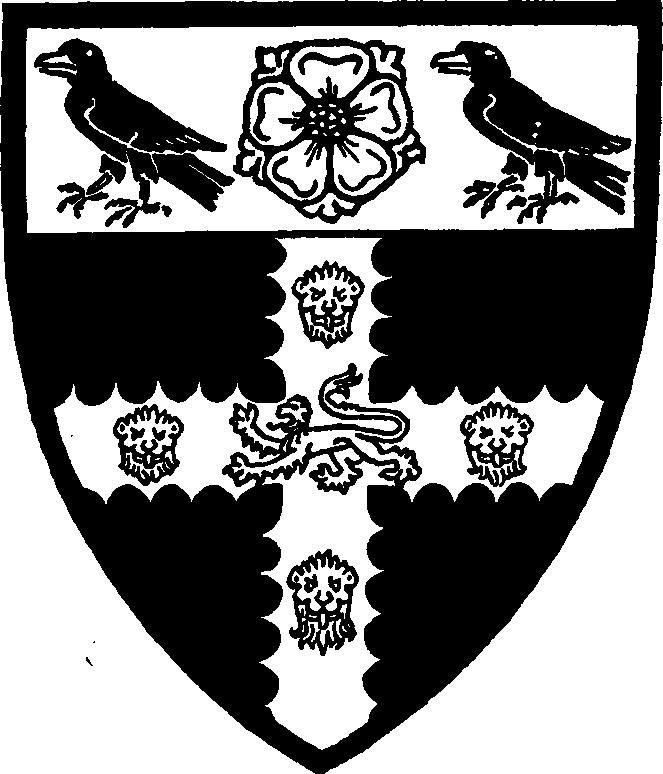
Christ Church Arms
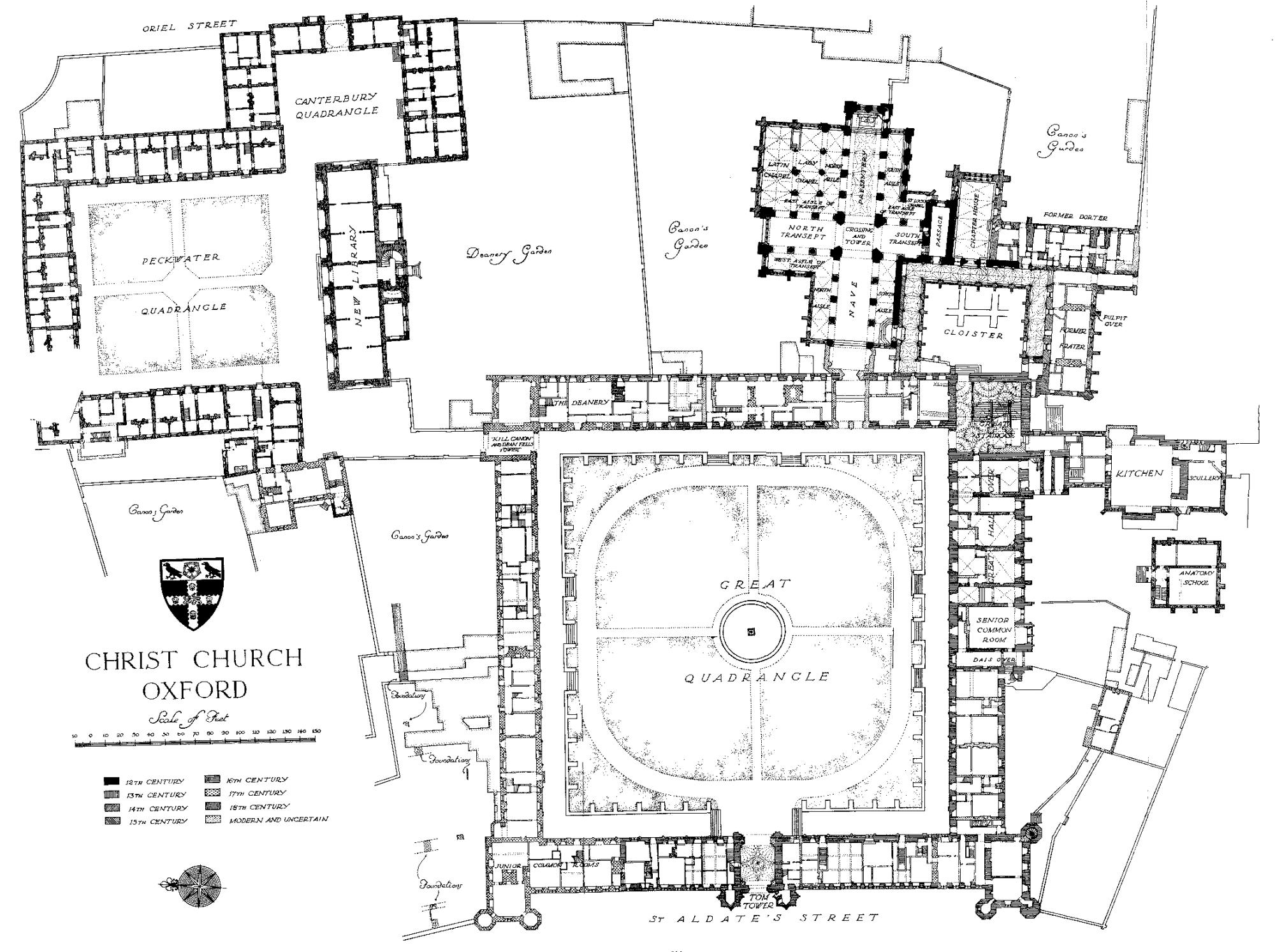
(9) Christ Church, college and cathedral, stands on the E. side of St. Aldate's Street. The walls are of Oxfordshire stone and the roofs are covered with lead and slates. The history of the priory and church of St. Frideswide will be dealt with under the account of the Cathedral, but some account will here be given of the monastic buildings as they subsequently formed an integral part of the college. The W. end of the Chapter House was re-built rather before the church but after the middle of the 12th century. The chapter-house itself was re-built and no doubt enlarged in the first half of the 13th century and the Dorter-range extending to the S. of it was probably re-built at the same time. The Frater was re-built late in the 15th century and in the last decade of the century the Cloister was re-built and a large Prior's Lodging added to the S. of the Dorter by Robert Sherborne, later Bishop of Chichester. The college, first called Cardinal College, was founded by Cardinal Wolsey in 1525 on the land of the dissolved priory; the foundation-stone was laid on July 15th by John Longland, Bishop of Lincoln, and by the end of the following year some of the Lodgings on the W. and S. sides of the great quadrangle were ready for occupation, the lower part of the gate-tower was built, the Great Hall was begun and the walls of the proposed chapel on the N. side of the quadrangle and of the college cloister were level with the ground; the Kitchen had also been completed. At the time of Wolsey's fall in 1529, the whole of the S. side of the quadrangle and about two-thirds of the E. and W. sides were finished though little or no progress had been made with the N. range or the college cloister. It seems probable that it had been Wolsey's intention to destroy entirely the priory church and probably also the claustral buildings, but the destruction of the church extended only to the western bays; foundations probably of Wolsey's work in the cloister never proceeded above ground-level; it is possible that these were the foundations of the new steeple referred to in the paybook of 1528. The college was refounded by Henry VIII in 1532 and the see of Oxford transferred here in 1546, the W. end of the priory church being closed in to form the cathedral. The monastic buildings became part of the college, the old Dorter the lodging of the canon of the second stall, the old Frater the library, and the old Prior's Lodging the E. side of the Chaplain's Quadrangle. The Library was restored by Otho Nicholson in 1613. Little further work was done till Samuel Fell, Dean (1638–48), built the vaulted roof of the great staircase under one "Smith, artificer of London"; this dean's further work was interrupted by the Civil War but John Fell, Dean and later Bishop also (1660–1686) completed the E. and W. ranges and built the N. range in its entirety; the N.W. towered angle of the quadrangle with the adjoining lodgings on the S. were built in 1668 but the N. side of the quadrangle seems to have been built in 1665; all four ranges of the quadrangle were finished with balustraded parapets, a raised terrace constructed within the bases of the walls of Wolsey's cloister and a round fountain made (in 1670) in the middle of the quadrangle. The same dean restored the Chaplain's Quadrangle, one range of which had been destroyed by fire; in 1681–2 he partly re-built and completed the great gatehouse or Tom Tower, from the designs of Sir Christopher Wren and under the supervision of Christopher Kempster of Burford. At some uncertain date, probably in the 17th century, the building to the W. of Peckwater Quadrangle was erected. In 1706 the new building of Peckwater Quadrangle was begun from a bequest of Dr. Anthony Radcliffe; it replaced three sides of old Peckwater Inn, and was finished in 1711. The remaining side of the old inn was later replaced by the New Library which was not completed till 1761. In 1720 a fire destroyed the louvre and part of the roof of the Great Hall, which was restored at considerable cost, to which George I contributed £1,000; at the same time a vault was inserted under the floor. The Anatomy School, now the Chemical Laboratory, S. of the Hall, was built in 1766 from the design of Henry Keene. In 1773 the new building of Canterbury Quadrangle was begun from the designs of James Wyatt and largely at the expense of Richard Robinson, Archbishop of Armagh; the gateway was finished in 1778; these buildings replaced the old structures of Canterbury College, which stood to the E. of the new library. Wyatt also designed the existing early 19th-century great stone staircase. A fire in 1809 completely gutted the lodgings on the S. side of the quadrangle. In 1842 the terrace and steps in the great quadrangle were restored. In 1862–5 the Meadow Building was erected, the S. and part of the E. ranges of the Chaplain's Quadrangle being pulled down. The great quadrangle was restored in 1876–8, when the balustraded parapet was replaced by battlements and towers carried up over Fell's tower or Kill-canon and the hall staircase; the W. entrance to the cathedral had been formed in 1872. The W. front of the college was largely refaced in 1910–2 and the refacing of the buildings of Peckwater Quadrangle was finished in 1931.
Architectural Description—The W. Range of the Great Quadrangle has a symmetrically designed front to the street with the gatehouse tower or Tom Tower in the middle and projecting wings at the two ends. The main range is of two storeys, but, owing to the fall of the ground, there is a basement under the S. end. The main building is the work of Wolsey, but this only extends to about half the length of the range N. of Tom Tower; beyond this the work is of c. 1668. The range has a moulded plinth and a string-course between the storeys of Tudor date or character and a balustraded parapet of late 17th-century date; the string-course has bosses, probably all restored, carved with beasts, roses, shield supported by putti, a leopard with a shield, fleur-de-lis and various badges of Cardinal Wolsey. The restored windows are of one or two cinque-foiled and transomed lights with moulded reveals and labels. The projecting bays at the N. and S. ends of the front have octagonal turrets at the angles and both have a projecting bay-window at the first floor level; these windows are of four lights on the front and one on each return, and rest on moulded corbelling. On the N. wing, above this corbelling, are the arms of Wolsey surmounted by a cardinal's hat and above the window are the arms of Charles II; both carvings are restorations; the angle-turrets have a series of carved cardinal's hats, most of which have been restored. On the S. wing the corbelling has scroll-work and three putti, the middle one holding the pole-axe and pillar of Wolsey; on the face of the bay is a restored shield-of-arms of Wolsey with pillars, hat, motto "Dominus michi adjutor" and his initials supported by putti; above the bay-window is another shield of the same arms, possibly original; the cardinal's hats on the turrets of this wing have all been restored except three, which are much decayed. Tom Tower (Plate 198) and gateway is of two main stages, the lower substantially of Wolsey's work and the upper of 1681–2. The lower stage is of two storeys and has flanking turrets. The restored central archway has moulded and shafted jambs and four-centred arch in a square head with Wolsey's arms in the spandrels and a moulded label; immediately above this is a deep band of cusped panels enclosing various badges of the king and the cardinal; the archway is fitted with original oak doors of two leaves with a wicket in the N. leaf; the leaves have vertical moulded panels on the outside face, with vertical and diagonal latticeframing at the back. Above the archway is a restored late 17th-century window with shafted jambs and two-centred arch with a crocketted ogee label and finial; in the spandrel is a shield of the See impaling Fell; the window itself is of double form divided by a niche; each part is of two cinque-foiled lights with tracery in a two-centred head; the niche has a crocketted canopy and contains a statue of Wolsey by Francis Bird, erected in 1719; below it is a cartouche with the inscription "D.D. Jonathan Trelawney de Trelawney Wolsei in episcopatu Winton. successor. A.D. 1719"; below the window is a range of panels with the Stuart royal arms in the middle. The pair of restored and richly panelled Tudor turrets, flanking the gateway, are of two stages, the lower of square form with a diagonal projection on each free face and the upper octagonal and finished with late 17th-century ogee cappings with pinnacles and vases at the angles; between the stages is a quatre-foiled band with vases on the diagonal projections. The late 17th-century upper stage of the tower, designed by Wren, has recently been refaced; it stands on a square base tabled back at the angles and has a lower storey with cornices above and below; this storey forms three bays on each face, the outer semi-octagonal on plan with cinque-foiled-headed panels and ogee capping; the middle bay has either a clock-face or a square panel in the form of a Gothic rose-window. The second storey or bell-chamber is octagonal with buttresses and pinnacles at the angles and finished with a lead-covered ogee cupola; each face of the storey has a Gothic window of two cinque-foiled lights with tracery in a two-centred head with a crocketted and finialed ogee label. The E. face of Tom Tower is generally similar to the outward face but less restored, and in place of the flanking turrets are slender shafted and panelled pinnacles rising from the ground and finished at the level of the main window-head with cusped heads and crocketted spires. The main archway has shafted jambs and moulded four-centred arch in a square head, with traceried spandrels enclosing painted shields of Wolsey and Henry VIII; the niche in the main window has a figure of Queen Anne and below it an inscription "Annae principi optimae secretarius ipsius principalis Robertus Harley hac in aede posuit quod illam coleret et hanc amaret"; above the canopy are a rose and thistle, and below, the royal Stuart arms. The gate-hall has, in the S. wall, a Tudor doorway with moulded jambs and four-centred arch in a square head with foliated spandrels and the initial W. The vault (Plate 5) is an insertion by Wren, and to bring the area to be covered to a square a further panelled and shafted arch has been inserted at the back of both the E. and W. archways of the gate; the vault is of fan-type and springs from vaulting-shafts with moulded capitals and bases; the cones have elaborate cusped panelling at their heads and in the central spandrel is a large round panel with a carved wreath, radiating ribs and panels and a central rose; the vault is enriched with an extensive series of shields-of-arms of benefactors, including larger shields of Wolsey, Henry VIII, Charles II and James Duke of York, and smaller shields of (N.E. cone) Robert Spencer Earl of Sunderland, William Bourke Earl of Clanricarde, George Earl of Berkeley, Richard Boyle Earl of Cork, James Annesley Earl of Anglesey, Charles Gerard Earl of Macclesfield, Edward Seymour, Sir Justinian Isham, Sir Charles Shuckborough, Sir Richard Newdigate and Sir Thomas Middleton; (in S.E. cone) Donagh Maccarthy Earl of Clancarty, James Bertie Earl of Abingdon, Antony Cary Viscount Falkland, James Howard Earl of Suffolk, Edward Hyde Viscount Cornbury, John Viscount Scudamore, Sir Nicholas Pelham, Sir Jonathan Trelawny, Sir Nicholas l'Estrange, Francis Lutterell and Dr. Richard Busby; (N.W. cone) John Dolben Archbishop of York, Charles Somerset Marquess of Worcester, Henry Bennet Earl of Arlington, George Compton Earl of Northampton, Charles Viscount Mordaunt, Thomas Thynne Viscount Weymouth, George Morley Bishop of Winchester, Robert Shirley Lord Ferrers, Thomas Lord Leigh, Hugh Viscount Cholmondley and Thomas Needham Viscount Kilmorey; (S.W. cone) Heneage Finch Earl of Nottingham, George Savile Earl of Halifax, James Butler Earl of Ossory, Thomas Herbert Earl of Pembroke, Thomas Grey Earl of Stamford, Francis Viscount Newport, Henry Compton Bishop of London, Thomas Wood Bishop of Lichfield, Henry Yelverton Lord Grey of Ruthin, George Booth Lord Delamer and Richard Graham Viscount Preston. In the S.W. angle of the gate-hall is set the upper part of a group of mediæval shafts with moulded capitals. The bell-chamber is approached by a late 17th-century spiral staircase of wood with symmetrically turned balusters and central newel. The great bell called Great Tom came from Oseney Abbey, but was recast by Christopher Hodson in 1680.
Christ Church, Oxford
The Great Quadrangle (Plate 82) or Tom Quad (276½ ft. by 271 ft.) is surrounded by a raised terrace the retaining wall of which, in its present form, is modern, but represents the base of the arcade-walls of Wolsey's projected cloister. In the middle is a round basin of 1670, with a modern curb and a modern lead figure of Mercury. The surrounding ranges of building are generally of two architectural storeys with modern embattled parapets; the lower storey all round the quadrangle has a wall-arcade from which was to spring the projected stone vault of the cloister; though almost completely restored this arcading represents the original arrangement and was reproduced also on the N. side when that and parts of the adjoining ranges were built late in the 17th century; the bays of the arcading are divided by triple shafts with moulded capitals and bases and the four-centred wall-ribs or arches have the springers of diagonal ribs; in the anglebays the vaulting-shafts are replaced by the broad panelled and moulded responds of projected cross-arches. The doorways, generally, have moulded jambs and four-centred arches in square heads with labels; the windows of the lower floor are generally of one or two cinque-foiled lights. On the upper floor the windows of the chambers are either of two cinque-foiled and transomed lights or of small single cinque-foiled lights with labels; each of the large windows commonly alternates with two of the small windows, except on the N. side. The W. range has been very largely refaced, but some of the doorways are partly ancient and have carved spandrels; that in the fifth bay from the N. has foliage, a Tudor rose and two crockets on the key-stone; that in the eighth bay has a dimidiated rose and pomegranate and a leopard's head, which is repeated on the key-stone; the doorway in the second bay S. of the entrance has Wolsey's badges of the cross-staff and pillars and the griffin and pillar; that in the sixth bay has foliage and a rose on the key-stone; the arcading in the last bay is interrupted by a transomed window, probably representing a 17th-century alteration; in the first bay is a stone with a partly defaced inscription with the name John Steyner (?) and the date 1572. The N. range is of late 17th-century date and appears to have been completely refaced in the 19th century. In the E. bay is an archway and passage, known as Kill Canon; it has an archway with panelled and shafted jambs and panelled four-centred arch; the building was raised by one storey in 1876–8 and is known as Dean Fell's Tower; it has modern statues of Fell and Dean Liddell; the archway on the N. face is four-centred and has a moulded and eared architrave; the niche above has a shell head and is flanked by windows of two cinque-foiled and transomed lights. The passage-way has a panelled plaster vault springing from moulded corbels. The N. face of the range, further W., is partly of three storeys; it retains a number of 17th-century windows, mostly altered or restored and many fitted with 18th-century sashes; where original they follow the lines of the earlier Tudor windows; the return wall of the W. range continues the lines of the W. front. The E. range has been almost entirely refaced towards the quadrangle; the openings in the lower storey have been considerably altered since Loggan's view was drawn; some of the doorways are old or partly old; that between the seventh and eighth bays has a Tudor rose on the keystone and masons' marks on the spandrels; the doorway in the tenth bay has a re-set head with a fleur-de-lis and roses on the key-stone. On the E. side of the range the windows, on both floors, seem to have been generally of two cinque-foiled and transomed lights with moulded reveals and labels; most of those on the lower floor have had the mullion and transom cut away and sashes substituted and the rest have been more or less restored and altered; one doorway is original and of the same type as those in the quadrangle; the spandrels have a Cornish chough and a coiled serpent. Near the middle of the range is the butt-end of a wall running E. and the full height of the building. S. of the entrance to the cathedral, the range forms two storeys with a basement and modern attics; in the basement is an original doorway of the usual type but without carvings. The S. range is similar to the other ranges except in the E. half, where the Hall occupies the upper storey and the Great Staircase stands to the E. of it; these buildings will be described later. Some of the doorways are original but partly restored; that in the fourth bay from the E. has carvings of the crossed pillars and the griffin and pillar; that between the seventh and eighth bays has carvings of a Tudor rose and a leopard's head and crown; the doorway in the twelfth bay has carvings of the crossed keys and crown of the see of York and a leopard's head; that between the fifteenth and sixteenth bays has a leopard's head with an arrow in its mouth and a shield of Wolsey's arms and putti; on the key-stone is a half-angel; the doorway in the westernmost bay has a cross-staff with the tassels of a cardinal's hat and the crossed keys and papal crown of York. The S. face of the range is finished with a modern balustraded parapet; the walling of the upper storey has been almost completely refaced; a number of original windows remain more or less restored; the return face of the tower at the S. end of the W. front repeats the features of that front and the building here is of three storeys.
The interior of the ranges flanking the Quadrangle is devoted to lodgings. Those to the S. of the Gatehouse and in the W. half of the S. range preserve their original arrangements least altered. These rooms are approached off the staircases, there being one set of rooms on each floor and on each side of the staircase. In the range S. of the Gatehouse two staircases are of original timber-framing and the doorways in the entrance lobbies are also original; they are of oak with four-centred arches in square heads with spandrels carved with a leaf, dog, rose, cross of St. George, initials ihc., griffin and pillar, leopard's head and crown, etc. The rooms flanking the northern stair retain their moulded ceiling-beams; the S. room is the Law Library. The other rooms have been considerably altered and the rooms of the canon of the sixth stall in the S.W. tower have been completely modernised. The rooms N. of the gatehouse have been extensively altered, but there is an original staircase immediately N. of the gatehouse; the adjoining part retains its moulded ceiling-beams and there are two original fireplaces with moulded jambs and four-centred heads; a fireplace further N. has an early 17th-century overmantel of two arched bays, divided and flanked by enriched pilasters; two original oak doorways also survive. A certain amount of 16th and 17th-century panelling remains in the upper rooms. The original range terminated about half-way between the gatehouse and the N.W. tower and high up in the cross-wall is an original window now only visible from the N.; it was formerly of two four-centred lights. The 17th-century range to the N. contains the Junior Common Rooms on the ground floor; the staircase is partly of this date and on the first floor are two fireplaces with moulded jambs and four-centred heads; one of these is carved with the fleur-de-lis, portcullis, rose and thistle; this was formerly in No. 2 Brewer Street. The N. range is entirely of late 17th-century date and is now assigned to the lodgings of the canons of the first (the Archdeacon), the fifth and the fourth stalls. The first of these contains an original staircase (Plate 45) with turned balusters and close strings; there is also some 18th-century panelling. The middle residence has been entirely modernised. The E. residence has a certain amount of 18th-century panelling and doors; the study is lined with 17th-century panelling and the fireplace has flanking pilasters and an overmantel of two panelled bays divided and flanked by free shafts supporting an entablature; the staircase is similar to that in the W. residence; one room on the first floor has a fireplace and painted panelled overmantel of c. 1730. To the N. of this range a number of sections of foundations were uncovered in 1893; they perhaps formed part of Wolsey's unfinished N. range and are indicated on the plan. The E. range is occupied by the Deanery and the residence attached to the third stall; both these have been ex tensively altered. The N. part of the range is of the 17th century, but further S. the arrangement was perhaps similar to that in the W. range. In the Deanery some of the original moulded ceiling-beams and framed partitions remain, together with two oak doorways, similar to those in the W. range, and one having spandrel-carvings of a rose and a winged man. The 17th-century staircase has turned balusters and close strings; the Servants' Hall is lined with early 18th-century panelling; on the first floor the Smoking Room is lined with late 16th or early 17th-century panelling and has the low-pitched king-post trusses of the roof exposed; in an adjoining room is a stone fireplace with moulded jambs and four-centred head. The next residence to the S. has been entirely modernised. At the S. end of the range, the ground floor room has original moulded ceiling-beams and the walls are lined with early 18th-century panelling finished with a cornice; the fireplace has a panelled surround and an early 17th-century overmantel of three bays divided and flanked by Doric pilasters supporting an entablature; the side bays have arched panels and the middle bay an enriched panel with a broken pediment. The Lecture Room on the first floor has a fireplace, possibly in part original, with a four-centred arch in a square head and foliated spandrels; above the head is a frieze of quatrefoils enclosing shields or paterae. The S. range, W. of the Hall, has been entirely modernised internally early in the 19th century.
The Great Staircase occupies the lower part of the square tower at the E. end of the S. range. It is entered from the quadrangle by an early 16th-century open archway with moulded, shafted and panelled responds and four-centred arch, mostly restored on the outside; on the soffit are the arms of Henry VIII, Wolsey and the sees of York and Winchester; the spandrels on the inner face have the arms of Wolsey and Winchester and the label has stops, carved with half-angels holding hats. In the E. wall is an archway of the same period with moulded jambs and four-centred arch; in the same wall are four Tudor windows each of two cinque-foiled and transomed lights in a four-centred head with a label; the lower parts of the three S. windows had a lower tier of lights, filled in in the 17th century. In the S. wall is a Tudor doorway, completely restored on the N. face; higher up are two windows similar to those in the E. wall but never of more than two tiers; there was a third window to the W. but it has been blocked except for the upper part. In the W. wall is a blocked doorway. The staircase itself is of early 19th-century date, when the whole arrangement seems to have been altered. The vaulted roof (Plate 84) erected by Samuel Fell (1638–48) rests on moulded corbels and a central moulded pier with eight attached shafts having moulded capitals and bases; the roof itself is of Gothic fan-type with a complete central cone and semi-cones against the side-walls; the cones have two tiers of cinque-foiled panels and the flat spandrels between them are filled with circular rose-panels of similar type; the central bosses of these panels are carved with the Royal Stuart arms, the Prince of Wales' feathers, the arms of the University and those of the founder. In the W. wall at the first floor level are two doorways, the northern Tudor and southern modern; the northern has moulded, shafted and panelled jambs and a four-centred arch in a square head with a moulded label and quatre-foiled spandrels enclosing a leopard's head and leaves; the lower part of this doorway is filled with a modern balustrade and there is now no access to it from the staircase; it is difficult to see what was the arrangement of the earlier staircase, which was of timber and must have landed in front of this doorway; in that case, however, it would appear that the landing must have cut across the head of the entrance-archway from the quadrangle. The existing top stage of the staircase-tower was erected in 1879 when also the niches and statues were placed above the entrance from the quadrangle. Between the tower and the hall is an ante-room, taking the place of the 'screens'; it has two Tudor windows in the N. wall each of two cinque-foiled and transomed lights in a square modern head with a label. In the S. wall is a partly restored Tudor doorway with moulded and shafted jambs and four-centred arch in a square head with a rose and the initials T.W. with a cardinal's hat in the spandrels; further E. is a recess with a four-centred head enclosing the doorway from the buttery and the serving-hatch, both with four-centred heads. The doorway to the Hall is apparently modern.
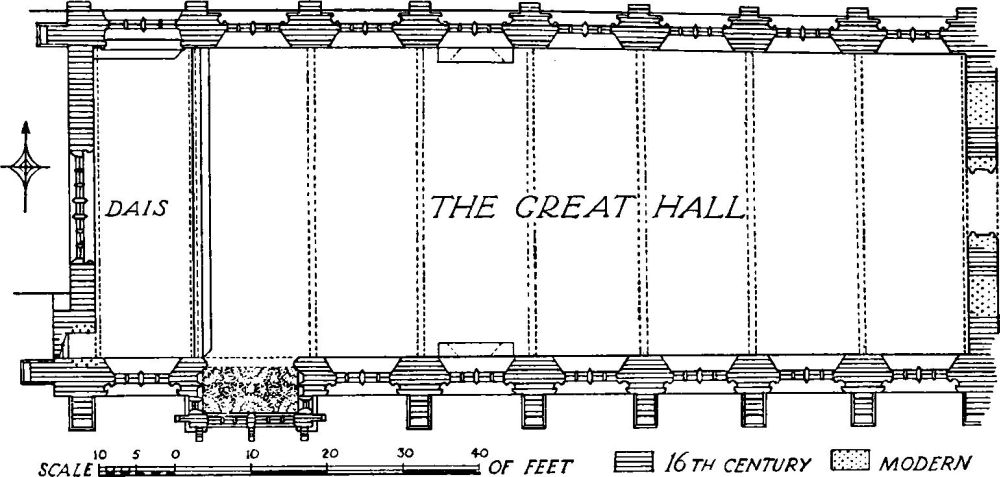
The Great Hall (114½ ft. by 39¾ ft.) was finished in 1529 and is of eight bays (Plates 82, 83, 85) divided by buttresses and finished with a modern parapet and pinnacles, replacing a 17th-century balustraded parapet. Each bay, except the last on the N. and the last but one on the S., has a partly restored window of four cinque-foiled and transomed lights in a four-centred head with moulded reveals and label; the W. bay on the N. forms a shallow projection between the buttresses and contains a window, similar to the others but with two transoms; the internal splays are panelled and the arch is set in a square head with the arms of Henry VIII and Wolsey in the spandrels. The oriel or bay-window, in the second bay from the W. on the S. side, is of two bays on the S. face with slender buttresses between the bays and at the angles; each bay has a window of three cinque-foiled lights with three transoms and tracery in a four-centred head with moulded reveals; the sidewalls of the oriel have stone panelling in the form of a similar window with a pointed head; only the outward light in each case is pierced; the oriel is entered under a tall four-centred arch with shafted jambs and spandrels carved with the founder's arms; the roof has a panelled fan-vault of stone with pendants; the central boss is carved with Wolsey's arms and putti as supporters and a second boss has a leopard's head and crown. In the W. wall of the hall is a window of seven cinque-foiled and transomed lights with tracery in a four-centred head with moulded reveals and label. The walls below the window-sills are lined with early 19th-century panelling and the fireplaces are of the same date. The roof was damaged by fire in 1720 and subsequently repaired with the omission of the louvre; it is now difficult or impossible to say what parts are original Tudor work and what are repairs of this age. The roof (Plate 81), probably by Humphrey Coke, master-carpenter, is of low-pitched hammerbeam type and of eight bays; the trusses rest on moulded and panelled stone corbels with cresting and carvings of the arms of Henry VIII and Wolsey, those of the sees of York and Winchester and the various badges of the cardinal; the timbers are all moulded and the hammer-beams have curved braces with traceried spandrels with the arms and badges of the founder and the sees he held including a saltire perhaps for the see of Wells; the hammer-beams have ranges of quatre-foiled panels on the sides, enclosing similar badges and below are shields with the initials T.W. and T.E.; the side-posts terminate in elaborate pendants with leopard's heads on the soffit; the collar-beams have curved braces, with traceried spandrels, forming four-centred arches; at the apex of each arch is a boss carved with the arms and badges of the founder, the sees he held and two with the date 1529 in addition; above the collar-beam are king-posts and a series of open cinquefoil-headed lights; between the trusses and springing from the ends of the hammerbeams are four-centred arches with traceried spandrels; there are two wall-plates divided by a frieze of quatre-foiled panels enclosing the founder's badges, initials and roses. In the oriel on the S. of the hall is a series of glass roundels and shields-of-arms partly of the 16th century but very extensively restored and some of them entirely modern; the roundels bear Wolsey's badges and the arms are those of Henry VIII, York impaling Wolsey, and Standon impaling Tame. In the W. window are various shields of Wolsey and his sees, his badges and initials in roundels and a shield of Henry VIII.
The Great Hall
The rooms beneath the great hall were remodelled after the fire of 1720, when the present vaulting was inserted; this vaulting was removed from the Senior Common Room about 1875; this room is partly lined with 19th-century panelling finished with an entablature and has a marble fireplace of the 18th-century. In the W. wall is an original doorway with moulded jambs, four-centred head and carved spandrels and in the outer N. wall a fireplace of similar form now cut through for a doorway. In the wall, under the E. end of the hall, are two two-centred arches, each of two hollow-chamfered orders; the heads have been cut away for the later vaulting.
The Kitchen stands to the S. of the Hall and is one of Wolsey's original buildings though much refaced; it is of a single tall storey open to the roof; the walls are ashlar-faced, finished with a restored embattled parapet and low gables and have diagonal buttresses at the W. angles; the E. and W. walls have both a large projecting chimney-stack with a restored embattled parapet; flanking it in the upper part of the E. wall are windows of two four-centred and transomed lights; there are two lower and two upper windows in the corresponding position in the W. wall, the lower of two and the upper of three cinque-foiled and transomed lights; at the W. end of the N. wall are two similar windows but both of three lights. The Kitchen is roofed from N. to S. in three bays with low-pitched king-post trusses; the tie-beams have curved braces and the spandrels have each three openings with three-centred heads. The three original fireplaces have chamfered jambs and moulded four-centred heads and there are original doorways in the N. and S. walls, fitted with panelled doors; in the middle of the N. wall is a blocked arch, probably a serving-hatch originally. The range, between the kitchen and the Hall, forms two blocks and has a modern upper storey; the W. side of the N. block has been refaced in the 18th century and again recently, but the E. side retains two Tudor doorways and a restored window; the W. side of the S. block retains traces of the original low gable, before the addition of the upper storey. Inside the N. block is a Tudor doorway with carved spandrels. The Scullery-range S. of the kitchen is of Tudor date, but has a modern upper storey; the walls have been much refaced and the windows have been restored. To the S.W. of the kitchen is the old Anatomy School built in 1766; it is a simple Renaissance building of two storeys and a basement and is finished with a cornice and plain parapet; on the N. front is a Doric porch.
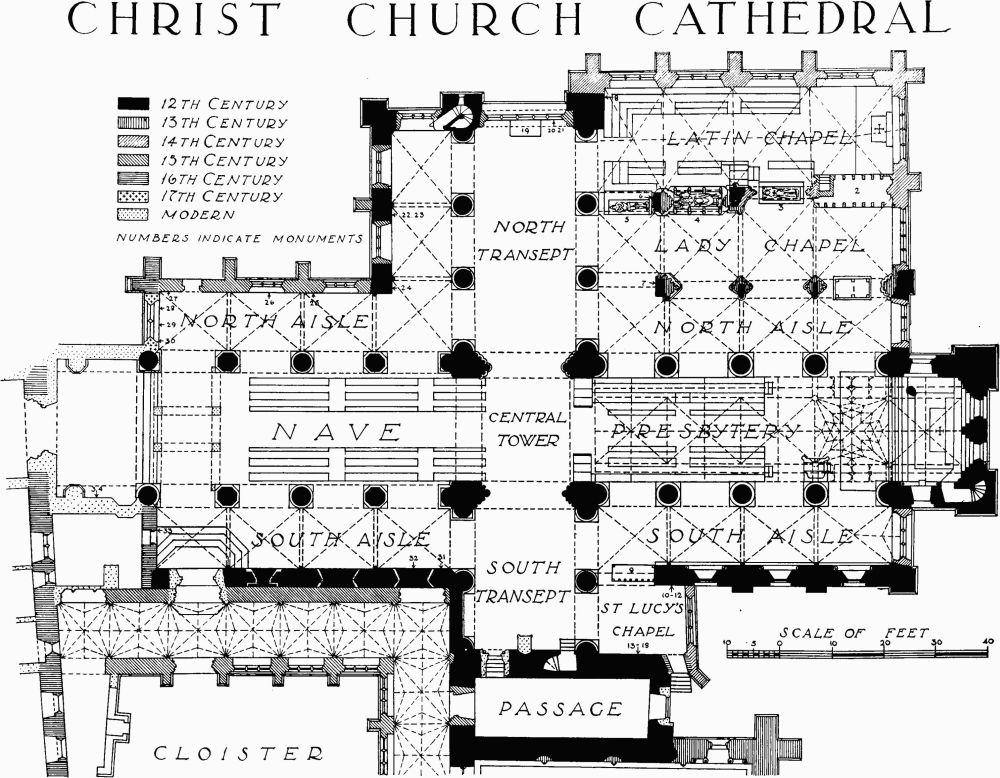
The Cathedral and Collegiate Church of Christ, (Frontispiece) was built as the church of an Augustinian Priory. The walls are of rubble with ashlar and dressings all of local Oxfordshire stone; the roofs are covered with lead and slates. There seems no reason to doubt that a monastery was founded here early in the 8th century by or for St. Frideswide, though the evidence is of much later date. The church of this foundation seems to have been burnt on St. Brice's day 1002 when certain Danes took refuge in it, and was subsequently restored under Ethelred II. By the Conquest the monastery had become a 'minster' of the normal Saxon type and it so remained until 1111 or perhaps rather later when it became a priory of Austin Canons, to which Henry I granted a charter in 1122. It is improbable that any remains of the pre-Conquest building survive. Recent excavation (1936) has rendered highly improbable the existence of the supposed apses E. of the N. aisle and Lady Chapel, which were reported on by Mr. J. P. Harrison in 1887 and also by Mr. J. H. Parker. A small chamber (7 ft. by 5½ ft.) lying N. and S. under the E. arch of the crossing, was found in 1856; it is not now accessible and its date and purpose are uncertain. A tomb-slab preserved in the S. transept may possibly date from the late pre-Conquest or early post-Conquest period. After the establishment of the priory it seems probable that a new church would have been built; there is, however, little evidence of this except for the rather awkward planning of the S. transept and the presumed design of adding a W. aisle to the later church at this point, a design which was never carried out; the cutting of the angle respond, between the transept and the S. aisle, into the S. wall seems to imply that this wall is earlier than the reconstruction; in the W. side of the S. transept, furthermore, are two early 12th-century shafts re-used in the triforium and there is a fragment of the same date incorporated in the vault of the clearstorey-passage. There was a parish church of St. Frideswide on some part of the site, till its union with St. Edward's in 1298. The evidence seems sufficient to presume some early 12th-century structure which was superseded by the existing building. This seems to have been begun after the middle of the 12th century; there is a reference to the tower in 1172 and the E. part of the church was probably completed when the body of St. Frideswide was translated in 1181; the whole church, judging from the detail, must have been completed within twenty years after this date. This late 12th-century church consisted of an eastern arm of five bays with aisles stopping one bay short of the E. end, a N. transept of three bays with E. and W. aisles and a chapel projecting one bay to the E. of the E. aisle at its N. end; a S. transept architecturally similar to the N. transept but with the cloister occupying the W. aisle and a passage occupying the S. bay; crossing and central tower; and a nave of indeterminate length with side aisles. The nave is said to have extended three bays beyond the existing building making seven bays in all, but no direct evidence of this seems to be available and the references to the demolition of the steeple under Wolsey seem to indicate that there was a tower, or possibly two towers, on the W. front, which was the only portion of the church then destroyed. The next alteration to the church seems to have been the addition of the top stage and spire to the central tower; this dates probably from the first quarter of the 13th century. Before the middle of the same century the Lady Chapel was built forming an outer N. aisle to the presbytery; arches were pierced in the N. wall of the 12th-century aisle and a single arch between the new chapel and the 12th-century N. transept chapel. A second translation of the body of St. Frideswide took place in 1289. The Latin or St. Katherine's Chapel was built in the early part of the 14th century and an initial date is perhaps indicated by a royal grant of stone from Wheatley for the fabric of the church in 1316. This chapel replaced the small N. transept chapel and arches were pierced between it and the two E. bays of the Lady Chapel. Shortly after, c. 1330, the chapel of St. Lucy, E. of the S. transept, was extended slightly to the E. and the E. wall and window re-built. At this period also a large three-light window was inserted in the E. wall of the presbytery. Probably towards the close of the 15th century the clearstorey of the presbytery was remodelled and the stone vault with pendants set up. The absence of any trace of Renaissance detail seems to negative the possibility that this vault is Wolsey's work and it seems more probable that he intended to pull down the whole church. Preparations were made to roof the N. transept in a similar manner but the work was not proceeded with; a sum of £30 was left towards this work by James Zouch in 1504 and to this work no doubt belong the great N. window and the rebuilding of the N. aisle of the nave. The priory was suppressed by Wolsey in 1524; its net value in the previous year was £148 16s. 3½d. a year. The building of Wolsey's college 1524–29 necessitated the destruction of the W. end of the church and according to Buckler three bays of the nave extending W. for about 50 ft. were demolished. Either at this time or more probably when the see was transferred here by Henry VIII in 1546 a wall was built between the fourth columns W. of the crossing; this wall had a large window in the upper part. At the same time, or perhaps earlier, stone screens were inserted in the E. arcade of the N. transept. Under Dean Brian Duppa 1629–38 the cathedral was refitted and many of the windows altered for new painted glass. In 1856 these fittings were removed under J. Billings and certain restorations effected. The general restoration, under Sir Gilbert Scott, began in 1870. The W. wall was removed, one bay added to the nave and the present entrance built; the E. window was removed and replaced by the existing restoration of what was considered to be the late 12th-century design; much of the S. aisle of the presbytery was also re-built and the screens were removed from the transept-arcade.
Christ Church Cathedral
The church is of great architectural interest, the late 12th-century work and the presbytery vault are both highly remarkable. Among the fittings the glass and monuments are noteworthy.
Architectural Description—The Presbytery (68 ft. by 20 ft.) is of five bays (Plate 88) and mainly of late 12th-century date. The lower part of the E. wall is of rubble and ancient, the upper part, between the buttresses, is modern except for the angle shafts of the arcade at the base of the gable; the circular and two round-headed windows replace a 14th-century window of three lights, but the rear-arch of the round window and the internal side-shafts are survivals of the original arrangement but have been restored. The clasping buttresses are mainly original, ashlar-faced and with three ranges of arcading; the lowest range has intersecting semi-circular arches with roll mouldings, springing from keeled shafts (one on E. face modern) with simple foliated capitals and moulded 'hold-water' bases; the arcade on each face is of four bays; the middle arcade is of two bays on each face, with semi-circular moulded arches and round shafts with more elaborate foliated caps and moulded bases (one shaft on the E. is modern); the topmost arcade is of three bays on each face with moulded two-centred arches and shafts with simple foliated capitals and moulded bases; the arcade on the S. face of the S. turret is blocked. The N. and S. walls extend one bay beyond the aisles; this bay has on each side a late 12th-century window, partly restored and of one round-headed light of two orders, the inner chamfered and the outer moulded and springing, on the E. side only, from a shaft with a foliated capital and moulded base; on the W. jamb is the start of the impost of the aisle-window; the rear-arch is moulded and springs from shafts similar to those on the outside face; both faces have labels; the S. window is more restored than that on the N. The main arcades, on each side, are of four bays and enclose the triforium; the main arches are semi-circular and of two moulded orders with a moulded label; the piers are cylindrical and the responds are semi-cylindrical, all with square plinths, moulded bases, carved capitals and moulded abaci; the capitals (Plate 101) are of bell-form with interlaced or stiff-leaf foliage with large crockets projecting under the angles of the abacus; the larger crockets of the second column on the N. are carved with heads and there is also a carved head in the foliage of the first column on the N. These main arches have plain round sub-arches with moulded labels and springing from half-capitals on the outward faces of the main piers; these capitals have plain or crocketted foliage and square moulded abaci; above these arches the triforium string-course lines with the abaci of the main arcade; the triforium has an opening in each bay, consisting of two plain round arches springing from a central shaft and half-shafts against the responds; all have foliated capitals and moulded bases with spur-ornaments. Between each arch of the main arcade rises a late 12th-century vaulting-shaft with a tapering termination, with a band of cable, nail-head or dog-tooth ornament and resting on beast-head corbels; the shafts imply that the presbytery was designed to receive a stone vault and it is probable that this was actually erected as there is evidence was the case in the transept. The shafts terminate in late 15th-century capitals at the level of the enriched clearstorey string-course which is of the same period; the capitals have carved foliage and the string-course carved paterae on a running stem.
The clearstorey was remodelled but not entirely re-built late in the 15th century; the five bays on each side have each a window of three cinque-foiled ogee lights in a four-centred head with a moulded label, all partly restored; flanking the windows, externally, are remains of the imposts of the 12th-century clearstorey-windows; the rear-arches are four-centred and cinque-foiled, with a central boss; the soffits have panelled vaults similar to the side portions of the main vault of the presbytery; the splays are pierced by the clearstorey wall-passage (Plate 97), with two-centred openings and a barrel-vault of the same form; enclosing the openings are cinque-foiled and sub-cusped arches with carved spandrels and above them are trefoil-headed panels similar to the soffits of the rear-arches; flanking the windows, internally, are trefoil-headed wall-panels. The late 15th-century stone vault (Plate 102) is of five bays and of lierne type with pendants; the main moulded ribs, with a solid panelled web at the back of them, spring from the vaulting-shafts; constructionally they form four-centred arches across the building but, apparently, the main ribs butt against the pendants, beyond which they are continued only as minor vaulting-ribs; the pendants are octagonal and pierced with trefoil-headed openings, below which is a foliage boss (leopards' heads on W. pair) and above is a carved cornice and cresting; from the pendants spring the ribs of the main vault with ridge, diagonal, subsidiary and lierne members forming an elaborate star-shaped design in each bay; the main panels are cusped and at the intersections are carved bosses; all have foliage and those along the central rib have figures, etc. as follows:—(a) head of Christ, (b) Virgin and Child, (c) Crowned Virgin, perhaps St. Frideswide, flanked by two angels, (d) an archbishop, (e) a bishop flanked by two figures. Above the extrados of the vault, in the eastern bays, rectangular piers rise above the pendants and these are supported by butting arches springing from the haunches of the vaults of the sidespaces between the line of the pendants and the side walls. These side-spaces are covered, in each bay, by a transverse segmental-pointed vault with two ranges of trefoil-headed panels and a central foliage-boss. The vaulting-shafts in the E. angles of the building are of late 12th-century date, those at the W. end are entirely of late 15th-century date; they have concave faces and rest on corbels with foliage and heads of a king and queen. Between the W. end of the vault and the 12th-century tower-arch is a series of canopied niches, two on each side with small lierne ribs between the two upper canopies; the niches contain figures of St. Mary Magdalene and St. Peter (?) on the N. and St. Katherine and St. Paul (?) on the S.; they stand on corbels carved with foliage and beasts; below the lower pair of corbels are two 14th-century corbels with crouching figures of men, one playing a lute. The side walls of the presbytery are finished with a plain restored parapet with a series of carved masks on the string-course, and much restored on the S. side.
The North Aisle (10½ ft. wide) is of four bays (Plates 91, 101) with a late 12th-century stone vault; this has semi-circular hollow-chamfered cross-arches between the bays and moulded diagonal ribs; the cross-arches spring on the N. from half-round shafts with crocketted capitals, square abaci and moulded bases with or without spur-ornaments; the diagonal ribs spring from similar but smaller shafts in the E. angles, but the original corbels in the other bays have been replaced by 13th-century corbels when the outer wall was pierced by arches; on the S. side the vaulting springs from the capitals of the sub-arches of the main arcade. The E. wall retains its N.E. clasping buttress and in the lower part of the rubble wall is a rough arch or recess with the arch set back from the responds which are carried down some 3 ft. below the existing pavement, which represents the original 12th-century floor-level; the head of this arch is visible externally and the late 12th-century plinth stops on either side of the former opening; it must thus be of the same date as the rest of the wall. The E. window of three trefoiled ogee lights with tracery in a two-centred head is largely modern except for parts of the 14th-century splays, moulded rear-arch and parts of the external head and label. The three E. bays of the N. wall are each pierced by a mid 13th-century arch, two-centred and of two moulded orders; the responds have grouped and filleted shafts with foliated capitals and 'hold-water' bases. The W. bay of the aisle forms also the S. bay of the E. aisle of the N. transept.
The Lady Chapel (15½ ft. wide in E. part, 13½ ft. wide in W. part) is a mid 13th-century addition (Plate 91) to the original N. aisle; the E. part was widened when the Latin Chapel was added in the 14th century. The 14th-century E. window is of four cinque-foiled lights with tracery in a two-centred head; the shafted splays are of the 13th century and have foliated capitals and moulded abaci; the N. side was probably re-set in the 14th century. Below the sill is a rough internal recess with a rubble arch; the former opening starts above the 13th-century plinth and blocking-course. The N. wall has an arcade of three bays; the two eastern arches are of early 14th-century date, two-centred and of two moulded orders springing from a pier of four groups of grouped shafts with moulded capitals and bases; the capital on the S. face is of the 13th century re-set and is foliated; the responds are generally similar to the pier. In the third bay is a mid 13th-century arch cut through the late 12th-century S. wall of a former chapel; it is generally similar to those in the S. wall but the capitals are moulded. The 13th-century stone vault of the three bays is quadripartite with moulded ribs and cross-ribs, the latter repeated between the third bay and the transept aisle; the vault of the two E. bays was partly reconstructed when the chapel was widened early in the 14th century; the vaulting shafts are of triple form with foliated or moulded capitals.
The Latin Chapel (56½ ft. by 19 ft.) was built c. 1320 and is ashlar-faced with a moulded plinth and gabled buttresses. The E. window is modern except for the rear-arch. In the N. wall are four windows, partly restored; they are each of three cinque-foiled lights with varied flowing tracery in a two-centred head with a moulded label and rear-arch. The stone vault is of four bays with moulded transverse, wall and diagonal ribs and slighter ridge-ribs, the latter with carved paterae, and a series of bosses along the middle rib as follows—(a) foliage, (b) foliage and flowers, (c) monster and foliage, (d) head of bishop and foliage, (e) foliage, (f) water-leaf foliage, (g) squirrel and foliage, (h) crowned head, (i) head; there are subsidiary bosses, mostly foliage, against the side-walls. The vault springs from vaulting-shafts with moulded capitals and bases; the shaft between the third and fourth bay on the S. is of late 12th-century date and has a crocketted capital with a square abacus; it was the middle shaft of the original chapel of two bays, projecting from the transept; the S.E. angle-shaft of this chapel also survives but has lost its capital.
The South Aisle (11¼ ft. wide) is a late 12th-century structure, much re-built in the 19th century. The walling is of rubble with ashlar buttresses; the upper part is largely refaced except in the W. bay. The early 14th-century E. window, modern externally, is of three trefoiled ogee lights with tracery in a two-centred head; the shafted splays have foliated capitals and ball-flower ornament; the rear-arch forms part of an adaptation of the E. cell of the vault; this has an added ridge and subsidiary ribs, with foliage-ornament and springing from the splay-shafts; the main late 12th-century vault is similar to that in the N. aisle but the responds of the outer wall remain unaltered and the vaulting-shafts in the E. angles have foliated caps and that on the S. is cut short at the string-course below the windows; flanking the responds (Plate 101) of the S. wall, the diagonal ribs spring from corbels carved with foliage and heads. In the S. wall are three windows; the two easternmost are modern but the westernmost is of late 12th-century date and similar to the side-windows of the presbytery; below it is a blocked 12th-century doorway; it has chamfered jambs, round arch and label; the moulded imposts have been re-cut in the 15th century; set in the blocking is a fragment with cheveron-ornament.
The Crossing and Central Tower (17 ft. by 20 ft.) is of late 12th-century date up to the top of the lanternstage of the tower; the bell-chamber and spire (Plate 86) are of the first half of the 13th century. The semi-circular E. and W. arches of the tower are of three roll-moulded orders except the inner order on the E. which has been altered later to a hollow chamfer; there is a label on the inner face of each arch; the outer orders die on to the walls but the inner order springs from half-round shafts with moulded or tapering terminations about 10 ft. from the floor and capitals carved with stiff-leaf foliage (crockets on the E. side); the imposts carved with similar foliage are carried along under the outer orders. The N. and S. arches are similar to those on the E. and W. but are two-centred and the inner order is plain; the responds have each one half-round and four round shafts, with 'hold-water' bases and capitals carved with stiff-leaf foliage or crockets; there is a label on the inner face of each arch. In the angles of the crossing, above the springing of the arches, are four late 15th-century corbels carved with three male heads and a dog or monkey; these seem to have been inserted for a projected vault. Above the arches runs a string-course and between this and the string-course of the lantern-stage, is, on each face, an open arcade to the wall-passage; this arcade is of seven bays with plain round arches, round shafts and half-round responds, with capitals carved with simple leaves, water-leaves or enriched scallops. The lantern-stage has in each face a wall-arcade of four bays with round chamfered arches, springing from shafts with simply foliated capitals; the outer bay on each side is pierced with a round-headed window with rebated outer jambs; between these windows rises the weathering of the former high-pitched roofs of the four arms of the church; the stage has plain semiround turrets at the outer angles. The early 13th-century bell-chamber has, in each face, two windows, each of two pointed lights with a quatrefoil above, all set in an outer arch of two moulded orders; the outer order springs from shafts with foliated capitals and forms part of the external wall-arcade which, with much narrower bays, is continued round the angle-turrets; these turrets are finished with square pinnacles of grouped shafts with ribbed pyramidal cappings; the main walls finish with a corbel-table of moulded and pointed arches on moulded corbels. The spire is octagonal with angle-ribs; it rests on two ranges of squinch-arches, one two-centred and the other round; the top part and capping is modern, the original stonework being now set up in a garden. In each cardinal face of the spire is a projecting gabled window, each of two pointed lights with a quatrefoil above, in a moulded outer order.
The North Transept (43½ ft. by 19½ ft.) is mainly of late 12th-century date. The main arcades (Plate 89), both on the E. and W., are of three bays and generally similar to those of the chancel but with rather more advanced foliage to the capitals; the vaulting-shafts in the S. angles are original and have foliated capitals; the short shafts over the S. column are also original with capitals and head-corbels; the other shafts have been altered at the top and have foliated capitals of c. 1510; of the same date is the clearstorey string-course with foliage-bosses and heads; there is evidence on both sides that a late 12th-century vault has been removed and preparations made for a vault similar to that in the presbytery; this, however, was not set up, but the clearstorey on each side of the N. bay was altered in somewhat the same way as in the presbytery and has a similar window of c. 1510; the other bays have each a late 12th-century clearstorey-window of one round-headed light with external jamb-shafts and a moulded rear-arch with side-shafts, standing on the foliated capitals of free shafts with moulded bases; flanking these shafts are small round-headed openings to the clearstorey-passage, with half-shafts as responds; the passage has a round barrel-vault. The N. wall has square clasping buttresses, similar to those at the E. end; they have three ranges of arcading, the two lower with pointed arches and the topmost with round arches; all have shafts with foliated capitals; the buttresses are finished with tabled cappings and shafted octagonal pinnacles with pyramidal terminations; the lower part of the N.E. turret is covered by the angle of the Latin Chapel. Between the buttresses is a large restored window of c. 1500; it is of five cinque-foiled lights with tracery in a two-centred head and casementmoulded reveals; the internal sill has a moulded cornice carved with five winged angel-heads and two small heads; below it is a range of five panels with cinque-foiled ogee heads and tracery; in two of these panels is a four-centred head with a label and a half-angel at the apex.
The East Aisle of the N. Transept (11 ft. wide) has been much altered by the addition and rebuilding of the chapels to the E. It retains its late 12th-century cross-arches between the bays; they are plain and semi-circular and spring on the E. from foliated imposts; the N.E. respond retains also two shafts with foliated capitals; the vault of the S. bay continues that of the N. aisle of the presbytery; the vault of the middle bay has moulded ribs of different section and has a foliated boss at the intersection; the N. bay forms part of the Latin Chapel.
The West Aisle of the N. Transept (11½ ft. wide) is substantially of late 12th-century date, altered in the 15th century when the buttresses were mostly re-built and the existing windows inserted. The N.W. angle retains its original clasping-buttress, now surmounted by a modern pinnacle; set on the W. face of this pinnacle is a much weathered figure of a woman, probably St. Frideswide. In the N. wall is a much restored 15th-century window of three cinque-foiled and transomed lights with vertical tracery in a two-centred head with a label; above it is an original quatre-foiled opening, lighting the roof-space. The W. wall has a 15th-century plinth; in each free bay is a window similar to that in the N. wall but with the internal splays carried down to a seat; under the northern window, externally, is a blocked opening, probably constructional. The vault is original and of three bays with hollow-chamfered cross-arches and moulded diagonal ribs; these spring from the half capitals of the main arcade and, on the W., from vaulting shafts with crocketted or interlaced foliage-capitals and 'hold-water' bases.
The South Transept (27 ft. by 19½ ft.) is of late 12th-century date (Plate 87) and is structurally of three bays but the S. bay includes the passage from the cloister to the cemetery and a modern gallery above it; it is consequently only at the clearstorey-level that the full length of the transept is open to the church. The main arcades with the enclosed triforium and the clearstorey of the two N. bays are generally similar to the unaltered portions of the N. transept except that the main arch of the middle bay on the W. is unpierced and the columns on this side are engaged in the wall; the triforium opening in this middle bay has shafts with scalloped capitals and moulded bases; the latter are much earlier in character than any others in the church and can hardly be later than the early part of the 12th century; they are thus re-used material; the opening now forms a window. The original vault of the transept has been removed but remains of the makinggood can be seen on the walls and, here only, the moulded springers of the original vault have survived above the two remaining middle shafts; they indicate a ribbed vault, probably of quadripartite form. Above the N.E. main arch are set two corbels carved with half-figures of an angel and a king and probably of late 16th or early 17th-century date. Above the gallery at the S. end, the clearstorey windows are repeated and the main arcade-arches form wall-arches only. In the S. wall, at the high level, is a restored early 14th-century window of five trefoiled ogee lights with intersecting tracery in a two-centred head; the moulded rear-arch and label with head-stops of a bishop and a queen, are of the same date but the lower part of the splays is formed by late 12th-century free shafts with foliage or enriched scalloped caps and moulded bases; standing on these shafts are jamb-shafts similar to those of the clearstorey windows and flanking the free shafts are narrow openings to the wall-passage, similar also to the clearstorey windows.
The Passage (11½ ft. wide) forming the lower part of the S. bay of the transept is a 12th-century structure, with a plain half-round barrel-vault, springing from chamfered string-courses on the side-walls. In the E. wall is a window, modern except for part of the splays and rear-arch which formed part of a 12th-century doorway; part of the round head of this doorway is visible externally. In the N. wall is a modern doorway from the transept. In the W. wall is a 15th-century doorway with moulded and shafted jambs and four-centred arch. The room above this passage is very largely modern and has a modern vault supporting the gallery above. This arrangement replaces an intruded structure formerly used as the Head Verger's house. In the N. wall are incorporated some portions of earlier work apparently in situ. Towards the W. end internally is the W. jamb and part of the segmental rear-arch of the former doorway from the night-staircase of the dorter, which apparently came down over the vault of the passage; further E. are two vertical chamfered jambs with a segmental half-arch between them; this was presumably a recess only, but its purpose is uncertain.
The East Aisle of the S. Transept (11 ft. wide originally) retains an original N. bay, forming the W. bay of the S. aisle of the presbytery; it has a ribbed vault similar to the other bays of the S. aisle and a plain cross-arch to the S., springing from an impost on the E. with 'stiff-leaf' foliage. The S. bay forms St. Lucy's Chapel which was extended slightly to the E. early in the 14th century. It has an E. window of this date and of three cinque-foiled ogee lights with net-tracery in a two-centred head with a moulded label; the moulded and trefoiled rear-arch springs from grouped shafts, in the angles of the chapel, with moulded capitals and restored bases. In the S. wall is an early 16th-century doorway with moulded jambs and four-centred head; in the S.W. angle is a 12th-century vaulting-shaft with a foliated capital, indicating that the aisle never extended further S.
The Nave (75 ft. by 21½ ft.) is now of five bays but the W. bay is entirely modern. The general arrangement is similar to that of the N. transept but the work is of the very end of the 12th century; the alternate columns are octagonal and the foliage is much more developed; it is varied in each capital. The triforium-arches are not pierced and the main arches of the windows of the clearstorey are pointed. The vaulting shafts are original except for the moulded and foliated capitals which are of c. 1500. The nave formerly had a blocking wall of the 16th century between the fourth pair of piers; this was removed in the restoration of 1870 when the fifth bay was reconstructed.
The North Aisle of the Nave (11¼ ft. wide) is now of three bays (Plate 101) and is mainly of the 15th century. It is generally similar to the W. aisle of the N. transept, except that the vaulting is of 17th-century or modern plaster, except the arch opening into the transept aisle; the moulded corbels on the N. wall are also of plaster. In each bay of the N. wall is a window of c. 1500, similar to those in the W. aisle of the N. transept. In the W. wall is a window of c. 1637 and of two plain pointed lights in a two-centred head.
The South Aisle of the Nave (11½ ft. wide) has, in the two E. bays, a late 12th-century vault generally similar to that of the N. transept aisle; it springs from vaulting-shafts with foliated capitals against the S. wall; the vault of the two W. bays is a restoration in plaster. The engaged cylindrical column of the transeptarcade has the half-capital of its sub-arch cut into the wall of the aisle, which seems to imply that this wall is of earlier date than the general design of the church. The first two bays of the S. wall have each a partly restored window of c. 1500 and similar to those in the N. aisle; the third bay has a modern window and the fourth bay a window and doorway, both modern except the rear-arch of the window. In the W. wall is a window, modern except for the splays and rear-arch which are probably of the 17th century; below it is a 16th-century doorway with moulded jambs and four-centred arch in a square head.
The Roof of the lantern of the central tower, has two main moulded cross-beams, with a carved pendant at the intersection; each quarter is divided into sixteen panels by moulded ribs; each panel has traces of a painted cross; the work appears to be of late 16th or early 17th-century date. The roof of the N. Transept is of c. 1510; it is flat-pitched and of three bays with moulded tie-beams, curved braces and wall-posts; each bay is divided into sixteen main and sixty-four smaller panels; the roof rests on plain stone corbels. The roof of the S. Transept is of c. 1500, except the S. bay which is modern; it is similar to that in the N. transept but each bay is divided into twelve main and forty-eight smaller panels; in the middle of each main panel is an applied boss. The roof of the nave appears to be of c. 1500 but is said to have been renewed in 1816; it is flat-pitched, with moulded tie-beams, principals, purlins, plates and ridge; there are posts between the tie-beams and the ridge, wall-posts standing on the vaulting-shafts and curved braces under the tie-beams; the spandrels of these braces have trefoil-headed openings and the spandrels flanking the king-posts are traceried; the spaces between the purlins and the principals have three ranges of square panels, eight in the width of the bay; at the rib-intersections are bosses carved with foliage, heads etc., and the panels themselves are traceried.
Fittings—Bells: twelve; 3rd, 4th and 6th by Abraham Rudhall, first two dated 1698; 7th by Ellis Knight, 1640; 9th and 10th ascribed to a London founder c. 1400, from Oseney Abbey, and inscribed "In multis annis resonet campana Johannis" and "Stella Maria Maris sucurre piissima nobis" respectively; 12th dated 1598, perhaps by Robert Atton; also litany-bell, blank, probably 17th-century. Books: (Plate 105) In presbytery—bible of 1632 or 1639 and prayer-book of 1636, bound in velvet and silver with the arms of the college, saved from the flames in 1647. Brasses and Indents. Brasses: In N. aisle of presbytery— (1) of [James Courthopp or Courthope, M.A. canon, 1557], figure of priest in surplice and amess, inscription, part of marginal inscription and one symbol of evangelist, indents of three others and rest of marginal inscription; (2) to Thomas Palmer, 1558, inscription only. In Lady Chapel—(3) of John Bisshop, 1588–9, figure of youth kneeling at prayer-desk; (4) of Thomas Thornton, M.A., 1613, kneeling figure of man in gown at prayer-desk; on floor, (5) of Edward Courtenay, c. 1450, figure of man in civil dress with shield-of-arms of Courtenay with a label; (6) of John Fitzal[leyn, 1452], figure of man in civil dress with mutilated inscription. In S. aisle of presbytery—on S. wall, (7) of Stephen Lence, M.A., 1587–8, on stone tablet with shaped head, figure of man in cap and gown. In N. transept—on N. wall, (8) of Henry Dow, B.A., 1578, (palimpsest) on tablet, kneeling figure of man in gown at prayer-desk with scroll and achievement-of-arms; (9) of Thomas Morrey, M.A. [1584], on tablet, kneeling figure of man in gown at prayer-desk with scroll. In W. aisle of N. transept—on W. wall, (10) to Robert Hughes, 1632, circumnavigator, inscription only; (11) to Leonard Hutten, D.D., 1632, canon, inscription on scrolls in marble frame. In nave—on second N. column, (12) of John Walrond, 1602, plate with figure of man in civil dress, kneeling at prayer-desk, with scroll and two shields-of-arms, painted inscriptions on stonework above and below. See also Monument (9). Indents: In N. aisle of presbytery—(1) of inscription and shield, now under altar; (2) figure of woman and inscription; (3) to Andrew de Soltre, rector of Ralleye (or Kalleye), 14th-century, mutilated cross with inscription in separate capitals; (4) inscription and two scrolls; (5) of figure and inscription; (6) of four shields and figure; (7) of half-figure of priest; (8) of figure, scroll, four shields and inscription; (9) fragment, of man and wife and inscription; (10) of foliated cross with figure in head; (11) of priest under crocketted canopy with marginal inscription and roundels at angles; (12) of kneeling figure, inscription and plate. In Lady Chapel—(13) of man with four shields, foot and marginal inscriptions, now covered; (14) to a burgess of Oxford, cross with inscription in separate capitals, 14th-century; (15) of priest with scroll, inscription and four shields; (16) to Johan de Coleville, large cross with defaced inscription in separate capitals, 14th-century; (17) of part of figure and inscription; (18) inscription only; (19) of figure, scrolls and inscription; (20) of man, shield and inscription; (21) of figure, part only. In Latin Chapel— (22) inscription and perhaps figure. See also Monuments (2 and 19). Coffin-lids: In N. transept—(1) loose slab from Oseney Abbey, broken and part missing, with vine-scroll border and inscription in capitals referring to the viscera of [Ela] Countess of Warwick, [1297–8]. In S. aisle of presbytery—(2) slightly coped slab. In gallery of S. transept—(3) loose broken slab (Plate 9), with hollow-chamfered edges, top covered with design of concentric circles and with crude face at top, 11th-century. Glass: In Latin Chapel—in three N.W. windows, all lights with borders of running vines, fleurs-de-lis, leopards, leopards' heads and monsters; filling of grisaille quarries of foliage and flowers; across middle of lights, band consisting in each window of elaborate spired and crocketted canopies with figures and inscriptions below each; in second window (Plate 99), St. Catherine with wheel and sword, St. Frideswide with book and sceptre and St. Margaret with dragon, cross and palm, in tracery vine-scroll, head of Christ and dove; in third window, the Annunciation with the Virgin and St. Gabriel and an archbishop in mass-vestments with combined crozier and cross-staff, inscriptions missing, in tracery, vine-scroll and two men's heads; in fourth window (Plate 99), crowned nun with sceptre and book, short name ending in da (?Hilda), the Virgin and Child and St. Catherine with wheel and sword; in tracery vine-scroll, shield of Courtenay with a label, and heads of a king and bishop, late 14th-century made up with modern glass. In S. aisle of presbytery—in third S. window, large figure (Plate 98) of Bishop Robert King in cope, with background of a ruined church, achievement-of-arms of King and shields of the see and Oseney Abbey impaling the same, glass probably by Bernard van Linge, c. 1630–40. In St. Lucy's Chapel—in E. window, in main lights, upper part only of large interior scene probably of a church, by Abraham van Linge, c. 1630–40, below 17th-century shield-of-arms of Dolben, nimbed head of man and kneeling figure of saint, 14th-century; in tracery complete early 14th-century glass (Plate 100), in situ, subjects beginning from top, Christ in majesty, two censing angels with vine-foliage, two kneeling canons, diaper work, shield-of-arms of England and France ancient, six monsters, bird, beasts and small human figures, three larger lights with diapered backgrounds and figure-subjects of St. Martin and the beggar, the martyrdom of St. Thomas of Canterbury with arms on the shields of the knights, and St. Augustine preaching, queen's head, St. Cuthbert with the head of St. Oswald, St. Blaise and a king's head, all with foliage. In N. transept (re-set here in 1927)—in N. window of E. clearstorey, in three main lights, portions of landscapes by Abraham van Linge, in heads of lights, three angels with musical instruments and at bottom, part of a frame with the date 1696, probably by William Price sen. and part of former E. window; in N. window of W. clearstorey, in three main lights, portions with numerous figures and houses etc. in the background, possibly parts of windows by Abraham van Linge representing Christ disputing with the Doctors and the Entry into Jerusalem. In W. aisle of N. transept— in N. window, in tracery, part of a city and other buildings; in tracery of two W. windows; two burning cities, no doubt Sodom and Gomorrah; all by Abraham van Linge. In N. aisle of nave—in W. window (Plate 98), in two main lights, Jonah seated beneath the gourd with the city of Nineveh in front, below, the inscription "Carolus Sunbanke pr[ebendar.] Windsor S.T.P. hū. eccl. olī alu[mnus]" and "Abraham van Linge fecit 163.", in spandrel, 17th-century achievement-of-arms. In chapter-house—in N.E. window, five panels, (a) jumble of figures, border and inscription, 16th or 17th-century; (b) achievement-of-arms of Thomas Ravis, Bishop of London, with date 1607; (c) royal Stuart arms; (d) achievement-of-arms of Herbert Westfaling, Bishop of Hereford and Vicechancellor, died 1602; (e) Pilate washing his hands, foreign, 16th-century; in S.E. window, five panels, (a) the Virgin and Child with an inscription mentioning Robert Canon (or a canon) and the date 1519; (b) achievement-of-arms of Herbert Westfaling; (c) roundel with a leopard's head and crown; (d) achievement-of-arms of Thomas Godwyn, Dean of Wells, 1584; (e) figure of a cardinal, early 16th-century; in second S. window, five panels, (a) lily-pot, early 16th-century; (b) late 16th or early 17th-century achievement-of-arms; (c) pole-axes and cross-staff of Wolsey; (d) achievement-of-arms of Martin Heton, Bishop of Ely, died 1609; (e) female saint, early 16th-century. In window of staircase S. of chapter-house—various quarries with fleur-de-lis, tun, roses and foliage, border of fragments including crowned Ws., two small quatrefoils and three large roundels with two capital Ms and the initials Ihc, the strokes of the two former have delicately rendered figures of the Virgin and angels and the latter, figures of the Crucifixion with the Virgin and St. John and instruments of the Passion, early 16th-century. In sacristy —now loose, panel made up of odd pieces including a figure of God the Father and a roundel of foreign glass with a feast, etc. 16th and 17th century. Monuments and Floor-slabs. Monuments: In N. aisle of presbytery—under E. bay of N. arcade, (1) reconstructed base for the shrine (Plate 96) of St. Frideswide, including parts made probably for the translation of 1289, plinth incorporates range of quatre-foiled panels enclosing foliage and heads including a king and three queens, open arcaded upper part on modern piers, two bays at sides and one at each end, arches deeply moulded and formerly trefoiled, with foliated cusp-points, many broken away, moulded labels with foliage-stops and mitring with horizontal cornice at top, spandrels and angle-pieces with elaborate foliage-decoration, at E. end fig-leaf and vine plant, at W. end, hawthorn leaves and berries and white bryony, on N. side, ivy, oak and sycamore leaves with a broken face and a bird, on S. side columbine, maple and celandine each with a female face; all foliage carved naturalistically. In Lady Chapel —under E. bay of N. arcade, (2) monument and chantry-chapel (Plate 90), called the watching-loft and of late 15th-century date, structure in the form of a small chapel and of two storeys, the lower of stone and the upper of oak; N. face of three wide and three narrow bays with a doorway to the W. all divided by panelled piers with crocketted heads and finished above with a range of trefoiled and crocketted heads, pendant between the piers and raised to a higher level above the doorway, above these a cornice of running vineornament and a cresting of Tudor flowers, three larger bays to the E. fitted on the outside with pedestal-seats and three smaller bays filled at a rather higher level with quatre-foiled and sub-cusped panels enclosing blank shields, five bays pierced towards interior of monument, doorway fitted with 17th-century panelled door; S. side generally similar but whole side treated as nine smaller bays without seats or doorway; W. end flanking arcade-pier, two niches finished as smaller bays at sides; interior of stage filled with slab of altar-tomb having indents of brass figures of man and wife in horned head-dress, five shields and marginal inscription; lower stage roofed by fan-vault (Plate 4) of stone with cinque-foiled panels and foliage-bosses, panelled E. and W. walls; upper stage reached by staircase at W. end and itself of two storeys and of nine bays from E. to W., lower storey closed and with a range of as many canopied niches (much broken) divided by buttresses, upper storey open and with three-centred heads to the lights and elaborate spired and graduated crocketted canopy to each bay; same treatment repeated at W. end; upper stage roofed with a low-pitched ribbed vault; under second bay of N. arcade, (3) of [Elizabeth (Mountfort) wife successively of Thomas, second Lord Montague and Thomas, Lord Furnival, 1354], altar-tomb (Plate 94) and effigy of stone and marble; altar-tomb with moulded plinth and slab, sides of three bays divided by pairs of shafts, middle bay with three and side bays with two cinque-foiled panels, five containing weepers and the spandrels with four shields-of-arms alternately Montague and Mountfort, the weepers represent one man, one woman and three nuns, two with croziers on N. side and two men, a bishop and two women on S. side, many figures headless and mutilated; at ends of tomb, quatre-foiled panels enclosing, at E. end standing figure of woman with symbols of St. Mark and St. Luke, at W. end, the Virgin and Child, the other two evangelists' symbols and two shields as above; effigy of woman (Plate 95) on slab with dog at feet and mutilated angels at head, figure in sideless gown and cloak with diaper-decoration in gesso, reticulated head dress, much original colour on tomb, effigy, weepers and shields. Under next bay W., (4) ascribed to Alexander Sutton, Prior, 1316, altar-tomb, effigy and canopy (Plate 92), plain altar-tomb with moulded top edge, divided on S. only into three bays by buttresses of the canopy, canopy of three bays resting on shafted and buttressed piers, terminating in pinnacles (broken off on S.), in each bay a moulded and cinque-foiled arch under an acute crocketted gable with a trefoiled spandrel and profuse ball-flower ornament, between buttresses at angles, small trefoil-headed niche containing mutilated figure, soffit of canopy formed of ribbed vaulting in three bays with foliage-bosses; effigy of priest (Plate 94) in mass-vestments with feet on lion or dog, head under three-sided canopy with cusped heads, pinnacles and crockets. In E. aisle of N. transept—S. of Latin Chapel, (5) ascribed to Sir George Nowers, early 15th-century, stone altar-tomb and effigy, altar-tomb with five round quatre-foiled panels on each side and one at each end all enclosing shields with repainted arms on S. side and W. end only (a) a cheveron between three leaping greyhounds impaling Darcy, (b) the same impaling Damory, (c) the same alone, (d) the same impaling Basset, (e) the same impaling Lucy, and on W. end (f) Nowers impaling the first coat; effigy (Plate 95) (partly of alabaster but mostly repaired in 17th or 18th century) in bascinet, camail, jupon, etc., head on helm with bull's head crest, feet on lion, remains of arms of Nowers on jupon, figure does not fit altar-tomb and is said to have been brought from Tackley; on E. piers, (6) of [Robert Burton], 1639, author of the Anatomy of Melancholy, oval stone tablet (Plate 30) with scrolled frame, cartouche-of-arms and painted bust of man; (7) of [William] Goodwin, S.T.D. Dean, 1620, painted stone tablet (Plate 30) with enriched side-pilasters, arched recess with bust of man in gown and hood with book, cornice and cartouche-of-arms; on W. wall of Latin Chapel, (8) to Alice (Peyton), wife of Edward Lowe, 1648–9, wooden tablet with pediment and shield-of-arms. In E. aisle of S. transept—N. of St. Lucy's chapel, (9) to Robert King, S.T.P., first Bishop of Oxford, 1557, Purbeck marble altar-tomb and canopy (Plate 97), altar-tomb with moulded plinth and slab with partly restored brass inscription on edge, sides each with three elaborate traceried panels and similar panel at W. end, shield in middle of each with brass missing, octagonal shafts at angles carried up to support canopy, the whole finished with a frieze of quatrefoils and an embattled cornice, sides of canopy with septfoiled and sub-cusped four-centred arch with shields and tracery in spandrels, W. end with trefoiled and sub-cusped arch and traceried spandrels, S. side of seven cusped lights in a flat four-centred head, elaborate panelled and traceried soffit following lines of side-arches and cinque-foiled panelling against E. wall. In St. Lucy's Chapel—on N. wall, (10) to Sir Henry Gage, 1644–5, Governor of Oxford for the King, white marble tablet with rounded head; (11) to Sir William Pennyman, Bart., 1643 and Anne his wife, 1644, white marble tablet with scrolled top and shield-of-arms; (12) to John Squire, 1714, white marble tablet; on S. wall, (13) to Richard Gardiner, S.T.D., 1670, canon, black and white marble tablet with books, broken pediment and cartouche; (14) to William Villiers, Viscount Grandison, 1643 (erected after 1670), white marble pedestal supporting large urn with trophy of arms at back, signed I. Latham; (15) to Sir Peter Wyche, 1643, ambassador at Constantinople, and Jane (Meredith), his wife, 1660, black and white marble oval tablet (Plate 33), with elaborate draped frame with four cherubs, urn and three shields-of-arms; (16) to Sir John Banks, 1644, chief justice of the Common Pleas, oval white marble tablet with scrolls and cartouche-of-arms, monument by John Stone; (17) of William Brouncker, Viscount Brouncker, 1645 and Winefred (Leigh) his wife, 1649, white marble wall-monument with figures of man and wife at table, Corinthian side-pilasters, broken pediment, cherubs and cartouche-of-arms; (18) to Edward Littleton, Lord Littleton of Mounslowe, 1645, keeper of the Great Seal, white and grey marble monument (Plate 29) with moulded base, pedestal, armour and urn, the whole flanked by Ionic columns supporting a curved pediment and cartouche-of-arms, monument erected 1683. In N. transept— against N. wall, (19) ascribed to James Zouch, 1503, altar-tomb with moulded plinth and slab, two round quatre-foiled panels on front and one at each end, each enclosing a shield charged with an inkhorn and pencase, on slab, indent of brass figure of man and inscription, against wall at back, slab with indent of brass kneeling figure of man with scroll and another plate in front, arched label above slab with half-angel at the apex; (20) to Richard Heylin, S.T.D., 1670, canon, alabaster oval tablet with scrolls and cartouche-of-arms; (21) to Dr. Thomas Lockey, 1679, canon, similar to last with blank cartouche. In W. aisle of N. transept—on W. wall, (22) to James Whale, M.A., 1649, white marble tablet with cartouche-of-arms; (23) to Richard Swayne, 1634, black marble slab; (24) to John Torksey, M.A., 1702, precentor, white marble draped tablet (Plate 35) with cherub-heads. In N. aisle of nave—on N. wall, (25) of Alexander Gerard, 1601, painted kneeling figure of man at desk under moulded label; (26) to John Wall, S.T.D., 1666, canon, oval tablet with alabaster bay-leaf wreath and cartouche-of-arms; (27) to William Levett, S.T.P., 1693–4, President of Magdalen and Dean of Bristol, white marble tablet with drapery, cherubs and achievement-of-arms; on W. wall, (28) to Sebastian Smythe, S.T.P., 1674 and Dorothy his wife, 1683, white marble tablet with three cartouches-of-arms at top; (29) to John Weston, LL.D., 1632, canon, black marble and alabaster wall-monument with Doric side-columns, entablature and cartouche-of-arms; (30) to William Creede, S.T.P., 1663, canon, black marble and stone tablet with scrolls, pediment and achievement-of-arms. In S. aisle of nave—on S. wall, (31) of Edward Pocock, S.T.D., 1691, Regius Professor of Hebrew, white marble wall-monument (Plate 29) with bust of man in gown and cap, shield-of-arms on carved apron; (32) to John Corbet, M.A., 1688, white and black marble oval tablet (Plate 33), with scrolls, cherubs and cartouche-of-arms; on W. wall, (33) to James Narborough, 1707, white marble tablet with scrolls and shield-of-arms. In ante-chapel—against S. wall, (34) to John Fell, Bishop of Oxford, 1686, white marble monument (Plate 29) with central pedestal, achievement-of-arms and two urns each with a shield-of-arms, monument formerly in Latin Chapel, where mitre and crozier (head only) still hang. Floor-slabs: In N. aisle of presbytery—(1) with date 1642, on same slab as Indent (3); (2) with date 1643; (3) to Antony Radcliff, S.T.P., canon, 1705; (4) to Roger Altham, D.D., 1714, canon, with shield-of-arms; (5) to I.H., 1691–2; (6) to H.H., 1686. In Lady Chapel—(7) to Sebastian Smith, S.T.P., 1674, with shield-of-arms, on same slab as Indent (15); (8) to Jasper Mayne, S.T.D., 1672, canon; (9) to Henry Aldrich, S.T.P. Dean, 1710, with shield-of-arms; (10) to John Potter, 1710; (11) with incised cross and defaced inscription, mediæval. In Latin Chapel—(12) with date 1640; (13) to C...., 1691–2; (14) with date 1654. In St. Lucy's Chapel—(15) slab with achievement-of-arms, early 18th-century; (16) to General Sir John Smith, 1644, with shield-of-arms. In N. transept— (17) to George Atherton, 1701; (18) to Michael Thomson, 1700; (19) to John Heycock, 1700; (20) to James Radcliff, 1700; (21) to A.H., 1651. In W. aisle of N. transept—(22) to John Corbet, 1688; (23) to P. Bagshawe, 1714; (24) to William, Viscount Brouncker, [1645] and Winifrid, his wife [1649], with shield-of-arms. In N. walk of cloister—(25) to E.H., 1691 (?). Organ and Organ-case: on screen in nave—organ originally built by Bernard Schmidt in 1680, but greatly enlarged and re-built at various times during the 19th and 20th centuries; case, on both E. and W. faces, of five bays divided by two large and two smaller towers finished with pierced carving and cornices and standing on brackets with cherub-heads or acanthus-foliage, bays with pierced carving at top and bottom of each, middle bay with pierced cresting and side bays with large carved scrolls above the cornices, late 17th-century; screen may incorporate some 17th-century portions including enriched Ionic pilasters and round arches with carved key-blocks and shields in the spandrels, made up with modern work. Paintings: In presbytery—on S.E. respond, traces of panel with nimbed figure in foreground, probably early 16th-century; on E. face of S.E. pier, traces of landscape with part of doorway and a shield-of-arms above of Marmion of Oxfordshire quartering Cottesmore (?), probably early 16th-century. In N. aisle of presbytery —remains of paint on vaulting including masonrylines on webs. In Lady Chapel—remains of paintings on mouldings and vault, masonry-lines on E. bay, on middle bay of vault, eight censing angels, 14th-century. In S. aisle of presbytery—on vault of E. bay, figures of two angels, figure playing a musical instrument, two standing angels in the splayed vault of the E. window with roundels enclosing shields below, 14th-century; on vaulting further W. remains of scrolls and masonrylines, probably 13th century. In S. transept—on E. pier, remains of a series of roundels. In chapter-house —on vault, remains of foliage-scrolls and much masonry-lining, in two E. bays, eight painted roundels, four in each bay, (a) St. Peter, with church and keys, (b) St. John the Evangelist, with book, (c) St. Matthew, with book, (d) St. Paul, with sword and book, (e) angel, (f-h) outlines of roundels only, 13th-century. Panelling: In Latin Chapel—against N. wall, re-set early 17th-century panelling. In St. Lucy's Chapel— against E. wall, thirteen panels, with cusped, crocketted and panelled heads, divided by buttresses, late 15th-century. Picture: In Latin Chapel—of St. Katherine, Venetian school, style of Bonifazio Veronese. Piscinae: In Lady Chapel—in E. wall, recess with moulded jambs and trefoiled head and shelf, 13th-century. In S. aisle, of presbytery—in S. wall, recess with hollow-chamfered jambs and ogee arch in a square head with foliated spandrels and large paterae, 14th-century, sill modern. In St. Lucy's Chapel—in S. wall, recess with round head and round drain, possibly 12th-century. Plate: (Plates 104, 105) includes a footless paten of 1566, a set of two cups of 1661, two flagons of 1661, an alms-dish of 1660 and two candlesticks, all given by Dean Fell and with repousse ornament and the candlesticks each resting on three lions, paten of 1698, a set of cup and cover-paten, paten and alms-dish of 1699, given by Dr. William Stratford, canon, in 1729, also two vergers' staves, surmounted by doves and one of them inscribed C.ii.R. with the date 1660, etc. Pulpit: (Plate 42) of oak, hexagonal and panelled in three heights with enriched mouldings, top and bottom range with carved arabesques in panels, middle range with two richly carved arches in each bay, central enriched post as stem with four carved satyrs set against it, sounding-board with panelled and enriched soffit, two enriched pendant arches on each face, cresting and obelisks at angles, springing from angels, six crocketted ogee struts meeting in middle and supporting a pelican, standard of sounding-board, with two enriched arched panels and a carved panel above, early 17th-century. Recesses: In Latin Chapel—in N. wall, with moulded jambs and ogee head, 14th-century. In S. transept— in S.W. pier, with chamfered jambs and ogee-head, probably early 16th-century. In vestry—in N. wall, two, rectangular, date uncertain. Stalls: In Latin Chapel (Plate 43)—in seven lengths, fronts of two types, one with plain panelling, the other with buttresses and panelling with cusped heads and tracery, standards with popey-heads (Plate 48), carved with foliage, grotesque heads, Ihs monogram, a heart, two angels with a cardinal's hat and shield with crossed keys, cardinal's head, evangelists' symbols and two kneeling figures, stalls at W. end have moulded divisions and four misericordes carved with foliage, early 16th-century; two misericordes and stalls on N.W., probably 14th-century; two 17th or 18th-century iron candlesticks on S.W. stall; on S. side, vice-chancellor's throne (Plate 47), consisting of a seat with panelled back, frieze of vine-ornament and a broken pediment and an enclosed desk with enriched arcaded panels and a frieze with birds and strapwork, at back, a standard with a large strapwork-panel, supporting a semi-hexagonal canopy with an entablature, 17th-century, made up with modern work. Tiles: In Lady and Latin Chapels—numerous slip-tiles with ornamental designs, also the arms of the see of Exeter, a double-headed eagle and lions, probably 14th-century. In S. transept gallery—similar ornamental tiles, loose. In passage S. of cloister—in recess on W. side, similar tiles with a lion, eagle, etc. Miscellanea: In S. transept gallery—numerous architectural fragments, 12th-century and later; also a large square stone base with a socket probably for a stone Cross (Plate 9), base sculptured on all four sides with figure-subjects (a) Adam and Eve with the tree of knowledge, (b) the sacrifice of Isaac, (c) seated figure with standing figure on each side, (d) the giving of the Law and the golden calf, carving much mutilated, late 12th-century. In the garden of the Archdeacon's house N. of the great quadrangle— various architectural remains including the top of the spire, most of one of the stone screens formerly in the arches of the N. transept, window-heads, panelling etc.
The Cloister (94 ft. N. to S., alleys 11 ft. wide) was re-built by Robert Sherborne within ten years after 1489. The W. part of the cloister was destroyed for Wolsey's building and the N. alley is now of seven and the S. alley of five bays. Under the range to the W. is a length of rubble walling (about 77 ft. from the E. wall of the cloister) which probably represents the W. wall of the cloister; another 18 ft. further W. is a second rubble wall probably the W. wall of the W. range. In the open square of the cloister are rubble foundations which seem to have nothing to do with the monastic buildings; their level is so high, relative to the cloister-plinth, that it seems probable that they represent some projected building of Wolsey's age, which was to replace the existing cloister. The arcade-wall of the cloister (Plates 83, 86) is generally similar on the three surviving sides; each bay has or had a window of three cinque-foiled ogee lights with tracery in a four-centred head with a moulded label; the rear-arches have panelled soffits; the windows have been more or less restored, the tracery etc. on the E. being entirely modern; the middle bay on this side was formerly a doorway; in the W. bay on the S. side the window has been cut down to form a doorway; in the fourth bay on the N. side is a modern archway and the adjoining bays on the W. are largely modern. Between the windows are two-stage buttresses and above them, on the N. side, an embattled parapet; on the E. and S. sides a storey has been added, probably late in the 16th century; it has windows of two square-headed lights and an embattled parapet. The cloister was designed to receive a vault which was at first erected only over the S. and part of the E. alley. The vault springs from moulded shafts against the piers and the outer walls, with carved capitals and moulded bases; flanking the shafts against the arcade-wall are cinquefoil-headed panels. The four N. windows in the E. alley have cinque-foiled rear-arches. The whole of the vaulting in the N. alley and that of the five N. bays of the E. alley is modern. The vaulting of the rest of the E. and of the S. alley (Plate 163) is of late 15th-century date; each bay has moulded cross, diagonal, ridge, subsidiary and wall ribs with carved bosses at the intersections and short lierne-ribs near the springing. The bosses are mostly carved with foliage with numerous human heads or faces; in addition there are five shields-of-arms, (a) a cheveron between three birds (?) rising, (b) a cheveron between two rings in chief and a beast (?) passant in base, (c) three bars with three roundels in chief, (d) a cheveron between three bull's heads razed and (e) a fesse indented, also figures of God the Father with the Agnus Dei, evangelists' symbols, St. Frideswide holding a book, with four nuns, a wild boar, T-cross, etc. The upper floor of the E. walk of the cloister has a pent-roof with chamfered beams. In the E. wall are two 16th-century fireplaces one with moulded jambs and four-centred arch in a square head and the other with chamfered jambs and four-centred head. This and the upper storey of the S. walk have a two-light square-headed window in each bay.
The E. range of the cloister includes the chapter-house and the former dormitory, now the house attached to the second stall.
The Chapter House (53½ ft. by 23½ ft.) except for the 12th-century W. wall and part of the N. wall, is a rebuilding (Plate 106) of the first half of the 13th century. It is of four bays with a quadripartite vault with moulded cross, diagonal and wall-ribs, with foliated bosses (Plate 107) at the intersections carved also with figures, (a) Christ in Majesty, (b) the Virgin and Child, (c) probably St. Frideswide, crowned female figure, (d) a lion with one head and four bodies. The vault springs from single shafts in the angles and triple shafts (one filleted) between the bays, with carved 'stiff-leaf' capitals (Plate 108) and moulded bases on corbels (Plate 108) carved as follows— N. side, (a) man's head, (b) king's bust, (c) bust of canon, (d) grotesque bust, (e) woman's head; S. side, (a) king's head, (b) woman's bust, (c) bust of canon, (d) grotesque bust, (e) bishop's head. The E. window is of five graduated lancet-lights with external labels, moulded internal reveals and rear-arches springing from attached shafts with foliated capitals and moulded bases; the three middle lancets have inserted 15th or 16th-century transoms with four-centred heads below them; on the inner face of the wall is a free arcade of the same form as the windows and with shafted jambs, quatre-foiled shafts with rows of dog-tooth ornament, 'stiff-leaf' foliage capitals and moulded bases; the two middle shafts are tied back to the outer face of the wall; the outer order of the moulded arches is carried on moulded corbels, with sprigs of foliage, over the shaft-capitals; the spandrels (Plate 103) between this arcade and the vault are carved with scrolled foliage. Below the E. window is a blocked 16th-century window of two square-headed lights, with moulded reveals and label. Set against the E. wall, inside, is the foundation-stone of Wolsey's College at Ipswich dated 1528 and given to the chapter in 1789. The first bay of the N. and the two first bays of the S. wall have each a single lancet-light set in a triple internal arcade, with moulded and shafted jambs and free banded shafts, all with foliated capitals and moulded bases; the splays of the lancet-lights are moulded and shafted and have foliated capitals and moulded bases. In the third bay on the S. is a modern doorway and staircase. In the fourth bay on each side is a square sunk panel (Plate 108) carved with an angel holding a shield of (a) the Empire, and (b) Richard, Earl of Cornwall. These panels were brought from Rewley Abbey, when the L. and N.W. railway-station was built. The mid to late 12th-century doorway (Plate 106) in the W. wall has a round arch of four orders, the two innermost have cheveron-ornament continued down the jambs except for the lowest part where the cutting has not been finished; the two outermost orders are roll-moulded (the inner with nail-head ornament) and spring from shafts with hold-water bases, carved foliage capitals on the N. jamb and scalloped capitals on the S. jamb; the flat label has an enrichment of small arches and leaves; the internal face of the doorway is of three orders, the inner with cheveron-ornament, the middle plain and the outer moulded and springing from attached shafts with carved or scalloped capitals, moulded bases and a label similar to that on the outer face. Set in the doorway is an early 17th-century oak frame, fitted with a panelled door of the same age. Flanking the doorway are two 12th-century windows considerably restored; they had been transformed into round windows probably in the 17th century; they have plain round heads and internal labels, but the horseshoe form of these is modern. High in the W. wall is a triplet of restored 13th-century lancet-lights with shafted splays and moulded rear-arches; the whole is enclosed under a moulded segmental-pointed rear-arch springing from shafted splays.
The Old Dorter Range, now the house attached to the second stall, was perhaps originally a 13th-century building but has been extensively altered and re-built in the 16th, 17th and 18th centuries. It is now of three storeys with attics; the E. wall has been largely re-built with re-used masonry but two buttresses may be mediæval; some of the lower windows and doorways are of the 16th century but the upper windows are mostly 18th-century insertions or alterations. In the ground-floor, towards the cloister, there is a sunk quatre-foiled panel of the 15th century and a doorway of the same period, with moulded jambs and four-centred arch in a square head with a label and headstops; towards the passage, under the frater-range are two doorways, the northern blocked and the southern probably of the 16th century and with a four-centred head; above them is a length of 15th-century string-course with carved bosses. This passage is continued to the end of the Dorter range, the part S. of the frater being of three storeys; in the ground floor on the W. are two late 15th-century windows (Plate 129) each of two trefoiled and sub-cusped lights with vertical tracery in a square head with a label and defaced angel-stops; these windows probably formed part of the prior's lodging built by Bishop Sherborne; the windows above are largely modern. At the S. end of the passage is a re-set late 15th-century archway with moulded jambs and four-centred head. Inside the building, the S. cross-wall on the ground floor has a late 15th-century doorway with moulded jambs and four-centred head. On the first floor the main rooms have been refitted c. 1720; a staircase however incorporates some late 16th-century balusters. On the second floor one room is lined with panelling of c. 1600 and has an overmantel of three bays with terminal figures and arched panels bearing the arms of Wolsey and two pelicans. The S. staircase is of c. 1700 with twisted balusters and newels with ballterminals. In one of the attics is a 16th-century fireplace. Included in this range but now approached from the chapter-house is a room on the first floor, lined on three sides with late 16th-century panelling, made up with modern work; the early 17th-century overmantel rests on fluted pilasters and has enriched arcaded panels with carved frieze and cornice.
The Frater (80½ ft. by 25½ ft.), later the Old Library and now rooms, flanks the S. side of the cloister. It was re-built late in the 15th century and was then of two storeys; when it became the Library is uncertain but the small block between it and the great staircase was added in the 16th century and it was restored in 1613 by Otho Nicholson. After the new library was built it was converted into rooms and is now of four storeys; the inserted floors do not, however, interfere with the original windows on the N. side. On the N. side (Plate 83) the wall towards the cloister has two ranges of openings, the upper oval and the lower with four-centred heads; they are perhaps all of early 17th-century date; in the E. bay is a late 15th-century arch, with a four-centred head opening into the passage; in the E. wall of the added block, which occupies the site of part of the S. walk of the cloister, is a 16th-century doorway of the usual type. The former frater has four original windows in the N. wall, each of three cinque-foiled ogee lights with vertical tracery in a two-centred head with moulded reveals and labels. The E. wall is partly covered by buildings but above the passage is the head of a partly restored original window of ten narrow pointed lights in a four-centred head. The S. wall is divided into six bays by buttresses; the first free buttress from the E. has corbels carved with a man and a head, supporting the semi-hexagonal projecting bay of the frater-pulpit; it has been almost entirely refaced. The windows have also been restored; they are of 17th or 18th-century date but in the second bay from the W. are some traces of the jambs and head of one of the original frater-windows. The W. wall had a large window to the frater; it is now blocked, but the lines of sill, jambs and two-centred arch are visible; below it are two blocked doorways, with four-centred heads, opening into the former screens and monastic kitchen which lay to the W. and have been destroyed.
Peckwater Quadrangle lies to the N.E. of the main quadrangle. The new building was begun in 1705 from the designs of Dean Aldrich, but the S. end of the W. range incorporates earlier work probably of the 17th century. The building flanks three sides of the quadrangle and has recently been almost completely refaced; it is of three storeys with a basement and attics. The elevations (Plate 93) to the courtyard consist of a rusticated ground-storey surmounted by a main order of two storeys; this has Ionic pilasters between each bay supporting a continuous entablature and balustraded parapet; the middle part of each range projects slightly and has six attached Ionic columns and a pediment over the entablature; the frieze on the N. range bears the inscription "Atrii Peckwateriensis quod spectas latus extruxit Antonius Radcliffe S.T.P. hujusce aedis primo alumnus deinde canonicus." The windows and doorways on the ground floor have plain architraves and triple key-blocks; the windows on the first floor have alternate straight and segmental pediments and the windows on the third floor are square with architraves. The same features are carried round the S. ends of the two side wings, but the back elevations of all three wings are plainly treated with ashlar walling and unmoulded openings. The interior is symmetrically divided into sets of rooms and staircases; many of the main rooms are lined with original panelling with dado-rails and cornices and the fireplaces have flat stone surrounds. The staircases have twisted balusters, close strings and square newels with moulded pendants. The block adjoining the S.W. angle of the W. range was built late in the 16th or early in the 17th century, but the E. and S. fronts and the interior were remodelled early in the 18th century and the exterior generally has been largely refaced in recent years. The E. side has a Renaissance composition ranging with the main Peckwater building and of two bays with pedimented windows and balustraded parapet; under the S. end there was formerly a carriage-way now blocked by a modern addition on the W. The E. archway has a four-centred arch and an eared architrave, surmounted by a broken pediment. The W. side of the block retains much of its original form though the windows have been fitted with sashes; many of them retain their moulded jambs and labels. The late 17th or early 18th-century staircase (Plate 45) in the N.E. angle of the building has heavy turned balusters and square newels with ball-terminals. The Library forms an isolated building on the S. side of Peckwater Quadrangle. It was begun in 1716 from the design of Dr. George Clarke, but was not completed till 1761. It is of two storeys on the N. front with a single order of Corinthian columns supporting the main entablature; a Doric entablature, at the first floor level, is supported on pilasters.
The buildings of Canterbury Quadrangle lie immediately to the E. of the Library. The existing buildings were begun in 1773 from the designs of James Wyatt, the gatehouse was finished in 1778 and the S.W. block was built in 1783. The gatehouse has a round-headed outer arch flanked by Doric columns supporting an entablature and attic; the inner arch is flanked by niches and has a pediment below which is the inscription "Munificentia alumnorum praecipue Ricardi Robinson Archiep. Armach."
The Outbuilding, N. of the N. range of the main quadrangle, was built late in the 16th or early in the 17th century. The walls are of rubble and there are some original windows with elliptical heads to the lights and later windows with square heads. The roof is of five bays with heavy tie-beams and curved braces. An Outbuilding, S. of the S. range of the great quadrangle, is probably of the 17th century.
Condition—Good.