
Journal of the House of Lords: Volume 15, 1691-1696. Originally published by His Majesty's Stationery Office, London, 1767-1830.
This free content was digitised by double rekeying. All rights reserved.
'House of Lords Journal Volume 15: 2 May 1695', in Journal of the House of Lords: Volume 15, 1691-1696, (London, 1767-1830) pp. 586-587. British History Online https://www.british-history.ac.uk/lords-jrnl/vol15/pp586-587 [accessed 25 April 2024]

In this section
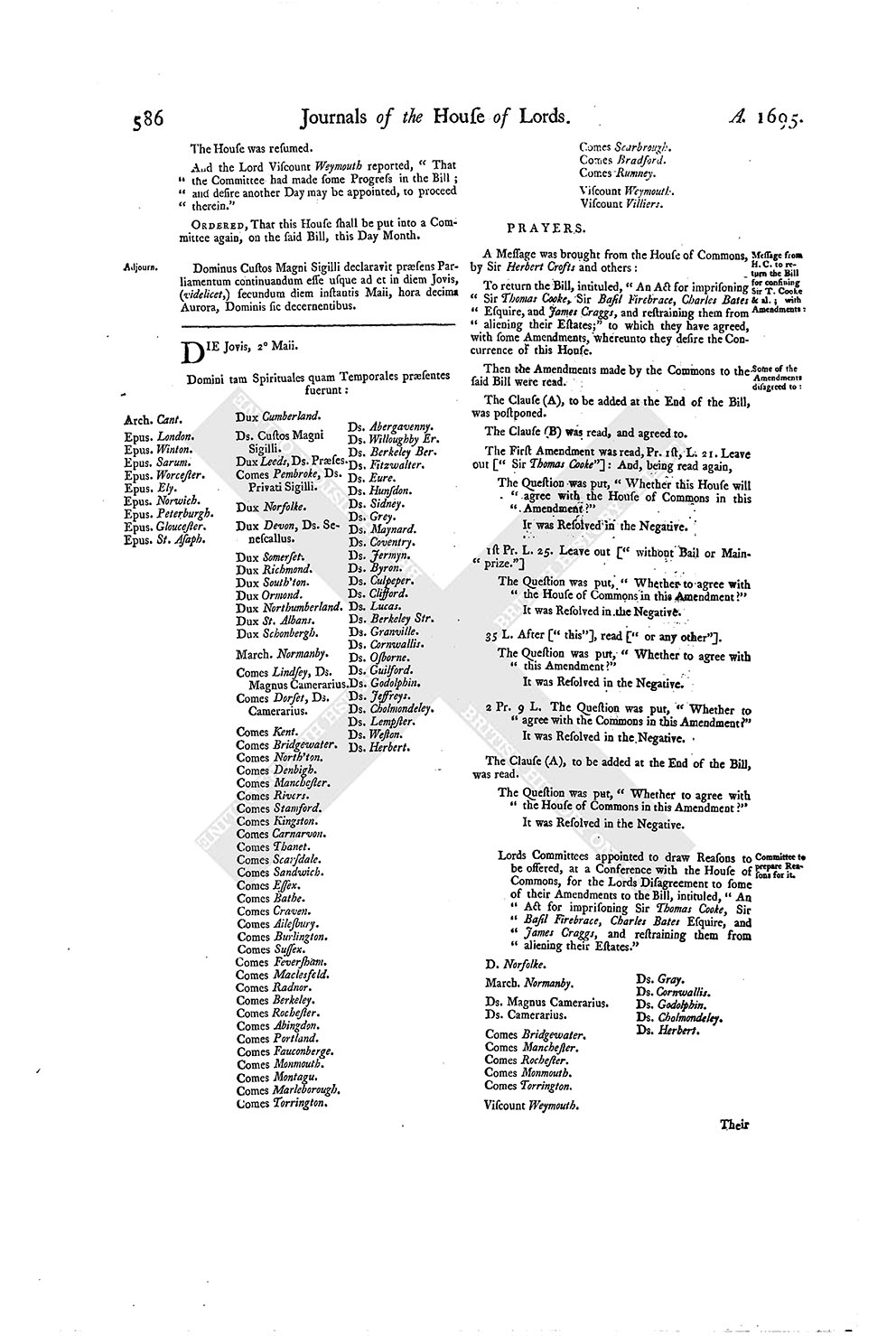
DIE Jovis, 2 Maii.
Domini tam Spirituales quam Temporales præsentes fuerunt:
PRAYERS.
Message from H. C. to return the Bill for confining Sir T. Cooke & al.; with Amendments:
A Message was brought from the House of Commons, by Sir Herbert Crofts and others:
To return the Bill, intituled, "An Act for imprisoning Sir Thomas Cooke, Sir Basil Firebrace, Charles Bates Esquire, and James Craggs, and restraining them from aliening their Estates;" to which they have agreed, with some Amendments, whereunto they desire the Concurrence of this House.
Some of the Amendments disagreed to:
Then the Amendments made by the Commons to the said Bill were read.
The Clause (A), to be added at the End of the Bill, was postponed.
The Clause (B) was read, and agreed to.
The First Amendment was read, Pr. 1st, L. 21. Leave out ["Sir Thomas Cooke"]: And, being read again,
The Question was put, "Whether this House will agree with the House of Commons in this Amendment?"
It was Resolved in the Negative.
1st Pr. L. 25. Leave out ["without Bail or Mainprize."]
The Question was put, "Whether to agree with the House of Commons in this Amendment?"
It was Resolved in the Negative.
35 L. After ["this"], read ["or any other"].
The Question was put, "Whether to agree with this Amendment?"
It was Resolved in the Negative.
2 Pr. 9 L. The Question was put, "Whether to agree with the Commons in this Amendment?"
It was Resolved in the Negative.
The Clause (A), to be added at the End of the Bill, was read.
The Question was put, "Whether to agree with the House of Commons in this Amendment?"
It was Resolved in the Negative.
Committee to prepare Reasons for it.
Lords Committees appointed to draw Reasons to be offered, at a Conference with the House of Commons, for the Lords Disagreement to some of their Amendments to the Bill, intituled, "An Act for imprisoning Sir Thomas Cooke, Sir Basil Firebrace, Charles Bates Esquire, and James Craggs, and restraining them from aliening their Estates."
Their Lordships, or any Five of them; to withdraw presently, in the Prince's Lodgings, near the House of Peers.
Thornehill, a Counsel, feed by Sir J. Champante, attached, for not attending.
Upon Oath made, at the Bar, "That Robert Thornehill Esquire was feed to attend this House as Counsel, this Day, for Sir John Champante;" and he not attending:
It is ORDERED, by the Lords Spiritual and Temporal in Parliament assembled, That the Gentleman Usher of the Black Rod attending this House, his Deputy or Deputies, do forthwith attach the Body of the said Robert Thornehill, and bring him in safe Custody to the Bar of this House; and this shall be a sufficient Warrant on that Behalf.
To Sir Fleetwood Sheppard, Gentleman Usher of the Black Rod attending this House, his Deputy and Deputies, and every of them.
Message from H. C. to return the Bill for reversing the Attainder of Leisler & al.
A Message was brought from the House of Commons, by Sir Henry Ashurst and others:
To return the Bill, intituled, "An Act for reversing the Attainder of Jacob Leisler and others;" to which they have agreed, without any Amendment.
Message to H. C. to sit a while.
A Message was sent to the House of Commons, by Mr. Holford and Mr. Pitts:
To desire them, that they would sit some Time longer.
The Messengers return Answer:
Answer.
That the Commons will sit, as desired.
Thornehill discharged.
ORDERED, That Mr. Thornehill be discharged, without paying any Fees.
Lords Reasons for disagreeing to some of the Commons Amendments to the Bill for imprisoning, &c. Sir Tho. Cooke & al.:
The House was adjourned during Pleasure, and the Committee withdrew.
And, after some Time, the House was resumed.
And the Earl of Rochester reported the Reasons to be offered at the Conference, as followeth; (videlicet,)
"The Lords have disagreed to the First Amendment, in leaving out Sir Thomas Cooke; because both Houses have declared their Opinion, That Sir Thomas Cooke (fn. 1) have not made a full and satisfactory Discovery: And the Lords are doubtful, whether the Act, intituled, "An Act to indemnify Sir Thomas Cook from Actions, &c." may not allow him to be bailed, by virtue of Habeas Corpus Act, at the Discretion of the Commissioners of Accompts; which is contrary to the Intention of their Lordships, who think a Matter of such extraordinary Nature, that has been once under the Consideration of a Committee of both Houses, is fit only for the further Examination and Determination of Parliament.
"To all the other Amendments made by the Commons, excepting Two, the Lords have disagreed; (videlicet,) that made in 29 L. of 1st Press, and the Clause marked (B), to which their Lordships have agreed: And their Lordships conceiving that most of the other Amendments made by the Commons do chiefly relate to the bailing Three of the Persons mentioned in the Bill, as it was sent from the Lords; they have directed their particular Reasons against the Clause marked (A); hoping that, if the Commons can be prevailed with to desist from that Amendment, they will the more easily be induced to agree with the Lords in all the rest. The Reasons for their Lordships disagreeing with the Clause marked (A are, because they conceive the Persons mentioned therein have not deserved the Favour of the Two Houses; and if there be any Prospect that, in a future Session of Parliament, a fuller Discovery of the Truth may be obtained, the Lords are of Opinion, the likeliest Way to attain that End is, that the Persons abovementioned be not left at Liberty to dispose of their Effects, as allowed by the Amendments of the Commons; but that their whole Estates may remain subjected to what Fines may be laid upon them; in which Condition (the Lords conceive) they ought to remain till they have given Satisfaction to both Houses; and if their Persons, as well as their Estates, be not with the strictest Care preserved for the Justice of a future Session of Parliament, all further Inquiry into so soul a Corruption will be wholly ineffectual."
Message to H. C. for a Conference about them.
A Message was sent to the House of Commons, by Mr. Holford and Mr. Pitts:
To desire a present Conference, in the Painted Chamber, upon the Subject-matter of their Amendments to the Bill, intituled, "An Act for imprisoning Sir Thomas Cooke, Sir Basill Firebrace, Charles Bates Esquire, and James Craggs, and restraining them from aliening their Estates."
The Messengers return Answer:
Answer.
That the Commons will give a Conference, as desired.
Managers of the Conference.
Then the Lords following were named Managers of the Conference:
Conference reported.
The Commons being come to the Conference; the House was adjourned during Pleasure, and the Lords went to the Conference.
Which being ended, the House was resumed.
And the Earl of Rochester reported, "That they had attended the Conference, as commanded; and delivered the Reasons."
Message from H. C. to return the Bill for a general Pardon.
A Message was brought from the House of Commons, by Mr. Solicitor and others:
Who returned the Bill, intituled, "An Act for the King's most Gracious, General, and Free Pardon;" to which they have agreed.
Adjourn.
Dominus Custos Magni Sigilli declaravit præsens Parliamentum continuandum esse usque ad et in diem Veneris, (videlicet,) tertium diem instantis Maii, hora decima Aurora, Dominis sic decernentibus.