
An Inventory of the Historical Monuments in Essex, Volume 1, North West. Originally published by His Majesty's Stationery Office, London, 1916.
This free content was digitised by double rekeying. All rights reserved.
'Belchamp St. Paul's ', in An Inventory of the Historical Monuments in Essex, Volume 1, North West, (London, 1916) pp. 16-18. British History Online https://www.british-history.ac.uk/rchme/essex/vol1/pp16-18 [accessed 23 April 2024]
In this section
7. BELCHAMP ST. PAUL'S. (E.a.)
(O.S. 6 in. (a)v. N.E. (b)v. S.E.)
Belchamp St. Paul's is a small parish and village about 5½ m. W. of Sudbury.
Ecclesiastical
b (1). Parish Church of St. Andrew stands ¾ m. N.E. of the village. The walls are of flint rubble with dressings of limestone and clunch ; the roofs are covered with tiles and lead. The N. transept, forming the E. bay of the present North Aisle, was built about the middle of the 15th century; towards the end of the same century the Chancel and Nave were rebuilt, the chancel being widened and the nave probably lengthened towards the W.; the North Aisle, West Tower and South Porch were added about the same time. The church was restored, and the North Vestry added in the 19th century.
The late 15th or early 16th-century bench-ends in the chancel are noteworthy.
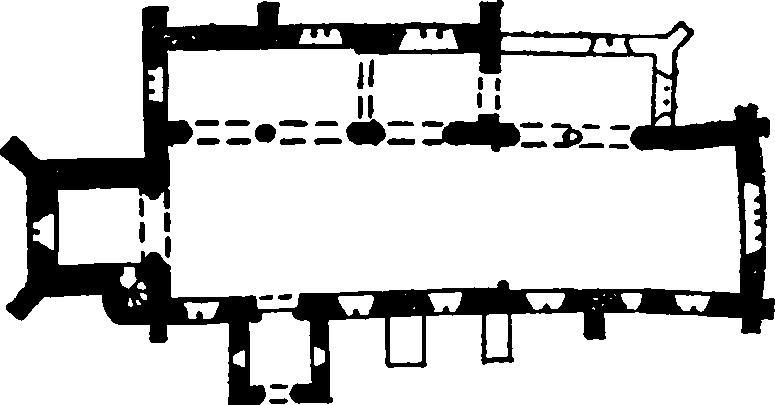
The Church, Plan
Architectural Description—The Chancel (30 ft. by 20½ ft.) is of late 15th-century date, and has a much restored E. window of five cinquefoiled lights with rectilinear tracery in a four-centred head; the external reveals are moulded. In the N. wall is a modern arcade of two bays. In the S. wall are two windows, each of two cinquefoiled lights with a quatrefoil in a four-centred head, all much restored; the western window is continued down below a transom, the lower lights being rebated and fitted with modern shutters. Between the windows is a doorway with chamfered jambs, two-centred arch and moulded label. There is no chancel-arch, but in place of it is a truss with curved principals which have foliated spandrels; against each wall the truss rests on a post which has attached shafts with moulded bases and capitals and foliated corbels.
The Nave (44 ft. by 21 ft.) has a N. arcade of three bays; the easternmost arch is of mid 15th-century date, and is two-centred and of two hollow-chamfered orders; the outer order is continuous, and the inner order rests on semi-octagonal shafts with moulded and embattled capitals and moulded bases; the arch opened into the former N. transept; the two western arches are of late 15th-century date and are two-centred and of two hollow-chamfered orders; the column is octagonal with moulded capital and base ; the responds have attached half-columns. In the S. wall are three late 15th-century windows, each of two cinquefoiled lights with tracery in a two-centred head Between the two western windows is the modern S. doorway.
The North Aisle (9½ ft. wide) includes the former N. transept, which has a N. wall thicker than that of the rest of the aisle. In the E. wall is a modern arch. In the N. wall of the former transept is a late 15th-century window, much restored, and of three cinquefoiled lights under a flat head; between the eastern bay and the second is a late 15th-century segmental arch of two chamfered orders; it crosses the aisle and rests on moulded corbels; further W. in the N. wall, is a window similar to that in the former N. transept, but only slightly restored; W. of the windows are external traces of the labels of a former window and N. doorway, both now destroyed. In the W. wall is a modern window.
The West Tower is of late 15th-century date, and of three stages with an embattled parapet and S.E. stair - turret. The tower-arch is two-centred, and of three chamfered orders; the two outer orders are continuous and the inner rests on semi-octagonal attached shafts with moulded capitals and bases. In the S. wall, opening into the stair-turret, is a doorway with chamfered jambs, double-chamfered and two-centred head and a moulded label. The W. window is of two cinquefoiled lights with tracery in a two-centred head. In the second stage the S. and W. walls have each a window of one pointed light. The bell-chamber has, in each wall, a much restored window of two cinquefoiled lights with a quatrefoil in a two-centred head.
The South Porch is of late 15th-century date. The entrance archway is two-centred and of two hollow-chamfered orders, the outer continuous and the inner resting on much restored semi-circular shafts with moulded bases and embattled capitals. The E. and W. walls each have a window of one trefoiled light.
The Roof of the chancel is of late 15th-century date, and of trussed-rafter type with foliated wallplates. The roof of the nave is similar to that of the chancel, but the wall-plates are moulded and embattled. The late 15th-century roof of the E. bay of the N. aisle is of three bays and low-pitched; the main timbers are moulded and the principals have curved braces and foliated bosses. The lean-to roof of the rest of the N. aisle is of late 15th-century date, and has moulded main timbers. The late 15th-century roof of the S. porch is of the trussed-rafter type, with moulded, embattled and crested wall-plates.
Fittings—Bells: five; 1st and 2nd by Miles Graye, 1682 ; 4th by Miles Graye, 1626. Brasses: In chancel—in middle of floor, (1) to Elizabeth (West), wife, first of John Buckenham, and afterwards of William Golding, 1591, two groups of children, three shields, and inscription (see also Monuments); (2) of [William Golding, 1587], figure of man in plate armour, two groups of children, and two shields, figure of woman and foot inscription lost; both brasses re-set in same slab and disarranged. Communion Table: In vestry—plain, with turned legs, early 17th-century. Font: octagonal bowl, two sides plain, the rest with sunk panels, two panels enclosing saltires, and four panels cusped and enclosing plain shields, etc. 15th-century. Monuments and Floor-slabs. Monument : In chancel—set in wall under S.E. window, two Purbeck marble slabs, with cusped diamond-shaped panels enclosing two brass shields, part of former monument to Elizabeth Golding, 1591 (see Brasses). Floor-slabs: In chancel—(1) to Freere, son of Christopher Layer, 1654, with two shields inlaid in white marble; (2) to Susanna, wife of Christopher Layer, 1669, with impaled shield; (3) to Christopher Layer, 1671, with shield of arms. In churchyard—S. of chancel, coped slab, possibly 13th-century, re-used for John Savell, 1700. Plate: includes a cup and stand-paten of 1680. Sedilia: In chancel—sill of S.E. window carried down low to form seat, W. splay cut back and cinquefoiled, late 15th-century. Stalls: In chancel—five on each side, with grotesque and foilated misericords, fronts with foliated scroll-mouldings, traceried panels, and two standards with elaborately carved figures of a seated king (see Plate, p. xxxiii) and a monk, late 15th or early 16th-century.
Condition—Good.
Secular
b (2). Fish Ponds, N. of the church, consisting of one large and three small ponds.
b(3). Paul's Hall, outbuilding and barn, 60 yards W. of the church. The House is of two storeys with attics; the walls are partly of brick and partly timber-framed and plastered; the roofs are tiled. The W. wing was built before the middle of the 16th century and formed part of a much larger building. It was probably pulled down, and the existing N. wing built in the 17th century; the plan is now L-shaped. The walls of the 16th-century wing are of brick, and at the E. end is an original chimney-stack with a modern top; at the W. end of the wing is an original chimney-stack, which rests on moulded brick corbelling and has an octagonal shaft; N. of it is an original window of two lights with a moulded label, now blocked, and with remains of sham plaster quoins; on the N. side of the wing is an original gabled dormer with a corbelled projection on each side stopping the main eaves; in it is an original window with a moulded label, and formerly with a mullion and transom, both now destroyed. The walls of the N. wing are timber-framed and plastered.
Interior:—There are two doors made up of original linen-fold panelling, and two panelled doors of late 16th-century date. On the ground floor some of the rooms have chamfered ceilingbeams. On the first floor a doorway in the W. wing has an original moulded and stopped frame.
The Outbuilding, W. of the house, is of two storeys; the walls are of brick, and the roof is tiled. It was built in the 16th century and is of five bays. Inside the building the ground floor has stop-chamfered ceiling-beams.
The Barn, S.W. of the house, is timber-framed and weather-boarded. It was built probably in the 17th century, and is of seven bays with aisles.
Condition—Of house, good.
b (4). The Vicarage, nearly ¾ m. S.S.W. of the church, is of two storeys; the walls are partly of brick and partly of plastered timber-framing; the roofs are tiled. The house is modern, except a small wing at the back, which is of late 17th or early 18th-century date. It has four original windows with plain mullioned frames and iron casements.
Condition—Good.
b (5). The Limes, house, on the N. side of the green, 150 yards W. of (4), is of two storeys, timberframed and plastered; the roofs are covered with tiles, thatch, slate and corrugated iron. It was built probably in the 17th century, and is of irregular L-shaped plan with the wings extending towards the N. and W. There are two modern additions at the W. end. The roofs are hipped, and that of the W. wing has a wooden eaves-cornice. The windows in the W. wall of the W. wing have moulded frames, mullions, and transoms, possibly of late 17th-century date. Interior—On the ground floor some of the rooms have chamfered ceiling-beams and exposed joists.
Condition—Good.
Monuments (6–13).
The following monuments, unless otherwise described, are of the 17th century, and of two storeys, timber-framed and plastered; the roofs are tiled or thatched. Some of the buildings have original chimney-stacks, wide fireplaces and exposed ceiling-beams.
Condition—Good, or fairly good, unless noted.
b (6). Pannel's Farm, house, W. of (5), is of two storeys with attics. It was built late in the 15th century, with a small Hall in the middle. Late in the 16th or early in the 17th century, the Hall was divided into two storeys, and a chimney-stack was inserted at the E. end. The roof is half-hipped at each end. Inside the building, in the N. wall, at the first floor level, is a blocked window with plain mullions set diagonally. In the roof is an original truss of the former Hall, with a chamfered and cambered tie-beam which has curved braces; the king-post has a fillet on each face and struts supporting the central purlin.
Condition—Poor.
b (7). Ferret's Farm, house, on the N. side of the Ashen road, 400 yards W. of (6). The roof is hipped at the W. end.
b (8). Gage's House, and outbuilding, 1¼ m. S.S.W. of the church. The House is of two storeys with attics, and was built early in the 16th century on an irregular H-shaped plan with the cross-wings on the N. and S. At each end of the E. front, the upper storey projects and is gabled. The original central chimney-stack has four octagonal shafts on a square base.
Interior:—On the ground floor the N. room has an original moulded ceiling-beam carved with running foliage; in the N. wall is an early 18th-century fireplace with Doric pilasters supporting an enriched frieze and cornice; round the walls is an early 18th-century dado. On the first floor one room has walls covered with early 17th-century panelling which has an enriched frieze.
The Outbuilding, N. of the house, is of two storeys, and was built in the 17th century. The upper part of the walls is weather-boarded.
Knowl Green
b (9). Hole Farm, house, now a storehouse, about 1¾ m. S.W. of the church. The original central chimney-stack has diagonal shafts and pilasters.
b (10). Capper's Farm, house and barn, 170 yards S.E. of (9). The House has an original central chimney-stack with a diagonal shaft.
The Barn, N. of the house, is of three bays with an aisle on the N.E. side.
b (11). Woodbarn's Farm, house, 160 yards S.W. of (10), is almost entirely modern, except for the chimney-stack at the E. end, which is probably of early 17th-century date. It has three offsets, and on the face between the two lower offsets is an embattled set-back.
b (12). Wakeshall Farm, house, about 2 m. S.W. of the church, with a modern addition at one end. Inside the building, the early 18th-century staircase has good turned balusters.
a (13). Claredown Farm, house, outbuilding and barn, about 1½ m. N.W. of the church.
The House is of two storeys with attics, and the roofs are covered with slate. It was built late in the 16th or early in the 17th century, and has an 18th-century addition at the S.E. angle. The N. front has been re-faced with modern brick.
The Outbuilding, S. of the house, is connected with it by a covered way. It was built in the 16th century, and the upper storey projects slightly on the S. side; the 17th-century chimney-stack at the W. end has three sloping offsets. Inside the building, on the first floor, one room has an original moulded ceiling-beam.
The Barn, S.E. of the house, is of the 17th century, and of eight bays with aisles.