
An Inventory of the Historical Monuments in Essex, Volume 1, North West. Originally published by His Majesty's Stationery Office, London, 1916.
This free content was digitised by double rekeying. All rights reserved.
'Birchanger', in An Inventory of the Historical Monuments in Essex, Volume 1, North West, (London, 1916) pp. 26-27. British History Online https://www.british-history.ac.uk/rchme/essex/vol1/pp26-27 [accessed 26 April 2024]
In this section
10. BIRCHANGER. (B.d.)
(O.S. 6 in. xxii. S.E.)
Birchanger is a small parish and village, which adjoins the parish of Bishop's Stortford on the E.
Ecclesiastical
(1). Parish Church of St. Mary the Virgin stands in the middle of the village. The walls are of flint rubble with dressings of limestone and clunch; the roofs are tiled. The evidence of the development of the church has been much obscured by modern restoration and rebuilding. The Nave is probably of c. 1125, and the Chancel was rebuilt apparently c. 1225. In the 18th century the round tower was destroyed. In the 19th century the present North Aisle, with a Vestry at the E. end, and a Porch at the W. end, was added, and the whole church was much restored.
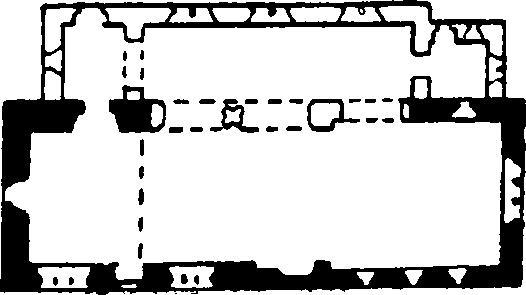
The Church, Plan
Architectural Description—The Chancel (22 feet by 18½ feet) has a modern E. window. In the N. wall is a small lancet window of c. 1225, externally rebated and much restored; further W. is a modern arch opening into the N. aisle. In the S. wall are three lancet windows similar to that in the N. wall and much restored; the middle window is said to have been moved from the N. wall when the aisle was added. There is no chancel-arch, but the extent of the chancel is marked internally by a set-back in the side-walls.
The Nave (39½ ft. by 17 ft.) has a modern N. arcade of two bays, and further W. is a modern doorway with a two-centred rear arch of the 13th century. In the S. wall are two windows; the eastern is a modern copy of the western window, which is of late 15th-century date and of three cinquefoiled lights under a four-centred head. Between the windows is the 12th-century S. doorway, now blocked; the semi-circular tympanum is apparently still in situ, but the rear arch has been raised, to adapt the recess for a staircase to the modern gallery; externally the doorway is covered with plaster; at the E. end of the wall is a large recess with a two-centred head, and in the recess is apparently part of the W. splay of a blocked window. In the W. wall is a doorway of c. 1125 with jambs and semi-circular arch of one plain square order; the imposts are chamfered and diapered, and the tympanum is ornamented with diapering and with incised lines, representing voussoirs. Over the W. gable is a modern bellcot.
Fittings—Font: octagonal, plain moulded bowl, stem ornamented with cusped panels, late 15th-century. Piscinæ: In chancel—with moulded two-centred head, 15th-century. Plate: includes cup of 1567. Seating: In nave—at W. end, seven benches, late 15th-century, much restored.
Condition—Good, much restored.
Secular
(2). Birchanger Place, house and barn, about 150 yards E. of the church. The House is of three storeys, originally timber-framed, but now built almost entirely of brick; the roofs are covered with tiles. It forms an irregular range, facing approximately N.E.; the kitchen at the N.W. end of the house contains traces of early or mid 17th-century work, but the rest of the house was rebuilt and the third storey added in the 18th century. At the N.W. end a chimney-stack with diagonal pilasters is said to bear the date 1655, but the figures are now concealed by the roof. Inside the building, the kitchen has heavy joists in the ceiling; a diagonal beam indicates that the upper storey formerly projected on the S.W. and N.W. sides; the fireplace, now partly blocked, has a heavy moulded lintel of c. 1600. The Barn, E. of the house, is timber-framed and covered with plaster and weather-boarding; the roof is tiled. It was built probably not later than the 16th century, and is of three bays with aisles.
Condition—Of house, good, rebuilt; of barn, fairly good.
Monuments (3–6).
The following monuments, unless otherwise described, are of the 17th-century, and of two storeys; the walls are of plastered timber-framing, and the roofs are tiled or thatched. Several of the buildings have original chimney-stacks, wide fireplaces and exposed ceiling-beams.
Condition—Good, or fairly good, unless noted.
(3). Birchanger Hall, about 100 yards S. of the church, is of rectangular plan, and apparently had a central corridor, with the entrance at one end and rooms on each side. The roof is hipped, and the windows have plain mullions and iron casements.
(4). Cottage, now three tenements, about 400 yards S.E. of the church. The original central chimney-stack has diagonal pilasters.
Condition—Poor.
(5). Cottage, now two tenements, about 550 yards S.E. of the church, was built probably c. 1600, with lean-to offices of one storey at the back; the N.W. end of the building is possibly an addition. The upper storey projects at the E. end of the front.
Condition—Poor.
(6). Duck End Farm, house, about 1,100 yards S.E. of the church, was built apparently in the 16th century, on a rectangular plan. On the W. front the upper storey formerly projected, but has been under-built with brick; an attic floor was inserted, probably in the 18th century. Inside the building, the first floor is carried on heavy chamfered beams, and in the attic some of the original cambered tie-beams of the roof are visible.