
An Inventory of the Historical Monuments in Essex, Volume 1, North West. Originally published by His Majesty's Stationery Office, London, 1916.
This free content was digitised by double rekeying. All rights reserved.
'Bocking', in An Inventory of the Historical Monuments in Essex, Volume 1, North West, (London, 1916) pp. 30-41. British History Online https://www.british-history.ac.uk/rchme/essex/vol1/pp30-41 [accessed 19 April 2024]
In this section
12. BOCKING. (E.d.)
(O.S. 6 in. (a)xxv. N.W. (b)xxv. N.E. (c)xxv. S.E. (d)xxv. S.W.)
Bocking is a small parish and town adjoining Braintree on the N. The principal monuments are the Parish Church, Lyons Hall, Dorewards Hall, Bocking Hall and the old Woolpack Inn.
Ecclesiastical
a(1). Parish Church of St. Mary the Virgin stands at the S.W. end of Church Street. The walls are of flint rubble with dressings of limestone and clunch; the roofs are covered with lead. The E. wall of the Chancel is of c. 1340, and the South Aisle may be partly of the 14th century. The West Tower was built or rebuilt early in the 15th century, and c. 1450 the N. and S. arcades of the Nave were rebuilt, the North Aisle was built on the site of a former aisle, and the S. aisle either raised or rebuilt; late in the 15th century the N. and S. walls of the chancel, with the clearstorey, and the chancel-arch were rebuilt, and the North Vestry, North and South Chapels and South Porch were added; at the same time the clearstorey of the nave was built, and the bell-chamber added to the tower. The church was extensively restored in the 19th century.
The roofs, especially the early 16th-century roofs of the nave and aisles, are of interest, and among the fittings the 13th-century ironwork of the S. door is noteworthy.
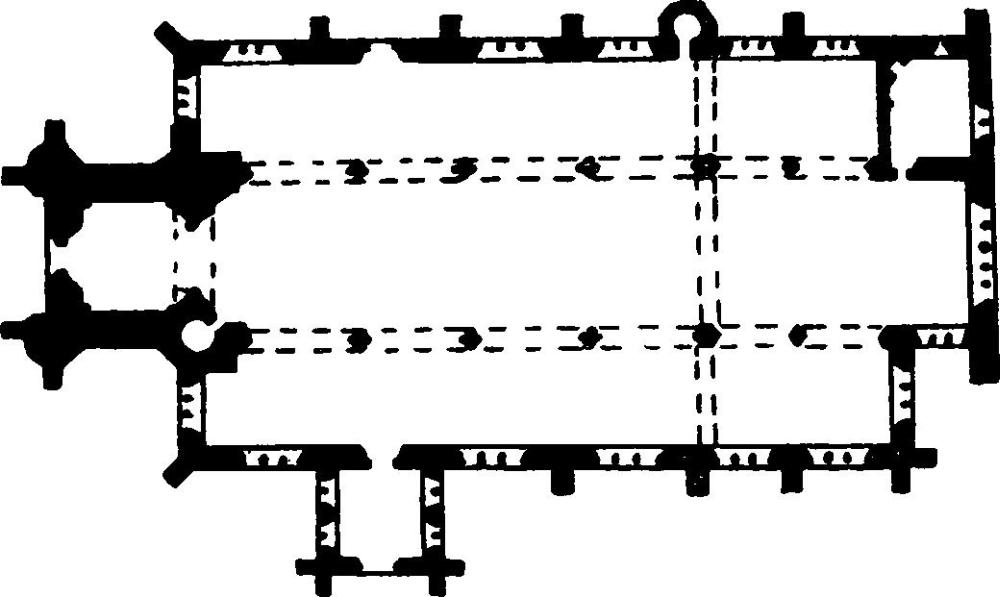
The Church, Plan
Architectural Description—The Chancel (33 ft. by 20 ft.) has an E. window, entirely modern, except part of the moulded label, the moulded two-centred rear arch and the moulded and shafted internal splays with moulded bases and capitals, which are all of the 14th century. In the N. wall is a doorway with chamfered jambs and two-centred arch, probably of the 15th century, but almost entirely restored. Further W. is a late 15th-century arcade of two bays with four-centred arches of two moulded orders; the column and responds are moulded, and have attached semi-octagonal shafts with moulded plinths and capitals, which support the inner order of the arches. In the S. wall is a modern window, and further W. is an arcade of two bays, uniform with that in the N. wall. The clearstorey has, in the N. wall, three windows, and in the S. wall two windows, all of late 15th-century date, much restored; they are each of two cinquefoiled lights under a four-centred head. The late 15th-century chancel-arch is moulded and four-centred, and has a moulded label on the W. side; the inner order springs from moulded corbels carved with angels holding shields; the heads of the angels are missing; the responds are formed by the adjoining responds of the chancel and nave-arcades, but are almost entirely modern.
The North Vestry is of late 15th-century date, and has, in the E. wall, a window of two cinquefoiled lights with tracery in a segmental-pointed head, which has a moulded label. In the N. wall, high up, is a small window of one light with moulded jambs and two-centred head.
The North Chapel (24 ft. by 13½ ft.) has, in the N. wall, two windows, both modern, except the moulded internal splays and rear arch of the western window, which are of the 14th century, re-set. Below the western window and cutting into it, is a doorway with moulded jambs, two-centred arch and label, possibly of the 16th century, but restored with cement. In the W. wall is a late 15th-century arch; it is moulded and four-centred and springs from moulded angel-corbels, now defaced.
The South Chapel (24 ft. by 13 ft.) has, in the E. wall, a window of three lights, entirely modern, except the moulded jambs and label which are of the 14th century, re-set; the jambs have been restored; internally the window is hidden by the organ. In the S. wall are two windows, each of three lights; the eastern window is modern, except the late 15th-century jambs; the western window is also modern, except the late 15th-century internal jambs and rear arch, which are moulded. Below the western window and cutting into it is a 15th-century doorway, much restored; the jambs and two-centred arch are moulded. In the W. wall is an arch uniform with that in the W. wall of the N. chapel.
The Nave (64½ ft. by 20½ ft.) has N. and S. arcades of c. 1450, and each of four bays; the arches are two-centred and moulded and have, in the nave, moulded labels with defaced angel-stops; the columns have each four circular attached shafts divided by hollow chamfers and with moulded capitals and bases; the responds have attached half-columns, but the S.W. respond has been cut into by the buttresses of the tower. In the S.W. angle, opening into the stair-turret of the tower, is a 15th-century doorway with moulded jambs and two-centred head. The late 15th-century clearstorey has four N. and four S. windows, all much restored, and each of three cinquefoiled lights with tracery in a segmental head; at the level of the internal sills is an embattled string-course continued across the E. wall at a higher level.
The North Aisle (13½ ft. wide) has, in the N. wall, three windows of c. 1450, all much restored, and each of three cinquefoiled lights with tracery in a two-centred head under a moulded label. Between the two western windows is the 14th-century N. doorway with moulded jambs and two-centred arch, re-set, and almost entirely modern outside; the hollow-chamfered rear arch has a moulded label. At the E. end of the wall is the semi-octagonal stair-turret of the former rood-loft; the lower doorway is apparently modern; the upper doorway is of late 15th-century date, and has moulded jambs and four-centred arch; the turret is lighted by a square quatrefoiled window of the 15th century, and by three square windows with moulded brick jambs and heads of the 16th century. In the W. wall is a 15th-century window, much restored; it is of three cinquefoiled lights with tracery under a segmental head, which has a moulded label.
The South Aisle (13 ft. wide) has, in the S. wall, three windows of the same date and detail as those in the N. wall of the N. aisle, all much restored; the label of the second window has stops carved respectively with a flower, the water-bouget and the knot of Bourchier, and the molet of Vere. Between the two western windows is the S. doorway, externally modern, but the moulded segmental rear arch and internal label with foliated stops are of the 14th century. In the W. wall is a 15th-century window, much restored, and of three cinquefoiled lights with tracery in a two-centred head; in the wall above it are traces of the rake of the former roof.
The West Tower (12½ ft. by 16 ft.) is of four stages, with a moulded and traceried plinth and a S.E. stair-turret carried up above the embattled parapet; the other angles have crocketted pinnacles; the two lower stages are of early 15th-century date, and the two upper stages of late 15th-century date. The two-centred tower-arch is richly moulded; the mouldings are continued down the responds, and the inner member forms a shaft which has a moulded capital and base, the base now defaced; on the E. side is a moulded label, and above the arch is the weathering of the former roof of the nave. The W. doorway has been partly restored, and has richly moulded jambs and two-centred arch under a square head; the traceried spandrels have plain shields and the moulded label rests on small attached shafts with moulded capitals; the internal splays and rear arch are moulded. The W. window is of three cinquefoiled lights with tracery in a two-centred head which has a moulded label with head-stops: the reveals are moulded and the moulded external sill is embattled. The internal angles have each a group of vertical mouldings, and a vaulting shaft with the springers of a vault which was probably never completed; above the level of the springers in each wall is a moulded recess with a two-centred head forming the wall-rib of the vault. The third stage has, in the N. wall, a small window of one trefoiled light with sunk spandrels and a moulded label; in the W. wall is a window of one cinquefoiled light with a square moulded label. The late 15th-century bell-chamber has, in each wall, a window of two trefoiled lights under a four-centred head with a moulded label.
The South Porch has a modern outer entrance. The E. and W. walls have each two 15th-century windows, of two cinquefoiled lights and tracery in a two-centred head which has a moulded label; all the windows have been externally restored with cement.
The Roofs are all of flat pitch; that of the chancel is of late 15th-century date and of three bays with moulded timbers; the principals have curved braces which form four-centred arches and rest on moulded wooden corbels; at the main intersections are carved foliated bosses, and in the middle of the easternmost principal is a carved angel holding a mitre. The late 15th-century roof of the N. chapel has moulded timbers; the principals have curved brackets, and at the main intersections are foliated bosses; in the middle of the E. principal I.H.C. is carved. The late 15th-century roof of the S. chapel is similar to that of the N. chapel. The early 16th-century roof of the nave is of four bays, and has moulded main timbers enriched with running foliage; the wall-pieces rest on small stone shafts rising from the string-course under the clearstorey; the tie-beams have curved braces with carved foliated spandrels and the following shields:— (a) a mitre; (b) See of Canterbury; (c) Bourchier knot; (d) a dragon; (e) three nails pilewise; (f) Vere molet; at the principal intersections are bosses carved with foliage, a man with a shield and club standing on a beast, and a shield— a cross wavy between two rings in the chief and two harps (?) in the foot. The early 16th-century roof of the N. aisle has moulded timbers; the main timbers are carved with running foliage; at the main intersections are bosses carved respectively with a shield charged with a defaced cross, a man's head in a wreath, a grotesque face in a wreath, an angel with a shield charged with a crown, etc.; the wall-pieces stand on moulded stone corbels, and the curved braces of the principals have spandrels richly carved with foliage, a beast, and two shields, one charged with a mitre, and the other with a molet. The early 16th-century roof of the S. aisle is similar to that of the N. aisle; the bosses are carved with an angel holding a wreath and heart, a leopard's head, a molet and a man's head all in wreaths, a mitre and shields charged with (a) six trefoils with two molets in the chief and (b) a cross.
Fittings—Bells: eight and clock-bell; 3rd and 4th by John Darbie, 1682; 5th by John Darbie, 1685; 6th by James Bartlett, 1682; clock-bell said to be by John Tonne, 16th-century, with black-letter inscription. Brasses and Indents. Brasses: In chancel—(1) to [Richard Colebrand, Dean and Rector of Bocking], 1674, Latin inscription; (2) of Oswald Fitch, 1612, laid down 1613, figure in long cloak and ruff, with inscription. In S. chapel—partly covered by organ, (3) of [John Doreward, 1420,] and [Isabel] his wife, man in plate armour and woman in high-waisted dress and horned head-dress, indent of double canopy, and inscription. Indent: In N. chapel—of four figures, four shields and two inscription plates, probably 16th-century. Chairs: In chancel— two, of oak, elaborately carved, upholstered seat and back, late 17th-century. Chest: In W. tower—of oak, hutch-type, with shaped brackets in front, 17th-century. Communion Table: In N. chapel—with turned legs, carved upper rail, and brackets, early 17th-century. Doors: In S. doorway—of two folds, each with three hinges of elaborate scrolled and foliated iron-work, covering the whole surface, c. 1260, woodwork restored (see Plate, p. 32). In doorway of stair-turret of tower—of plain battens, date uncertain. Monuments and Floor-slabs. Monuments: In chancel—on N. wall, (1) to John Stocker Jekyll, 1598, and Mary his wife, 1617, Thomas Jekyll their son, and Elizabeth his wife, both died 1657, erected by Nicholas, son of Thomas Jekyll, black marble tablet in frame with shield of arms. In N. chapel—on N. wall, (2) of Grisell (Eden) wife of Adrian Moore, 1624, alabaster marble and stone tablet, kneeling figure of lady in ruff, in an arched recess, with Ionic column on each side and pediment at the top, one lozenge and two shields of arms. In churchyard— in angle between chancel and S. chapel, (3) to Judith, 1691, Elizabeth, 1691, John, 1693, Joseph, 1698, Rebecca, 1704, Mary, 1707, John, 1718, children of John Maysent, also to Judith his wife, 1705, slab set in ground, enclosed by ornamental iron railing, early 18th-century; S. of S. chapel, (4) to Mary . . . wife of Samuel Crakanthorp, 1709, also to other members of the family, slab with defaced inscription; (5) similar slab, inscription defaced. S. of S. aisle—(6) to James Swift, 1713, and Mary his wife, 1720, James and Thomas their sons, 1713 and 1720. Floor-slab: In chancel—to John Aylett, 1707, and Mary his wife, 1730. Niches: On tower —in angles of W. buttresses, two, with moulded brackets supported on carved heads, having cinquefoiled and sub-cusped canopies with crockets, finials and vaulted soffits, 15th-century. On S. porch—flanking outer entrance, two, with moulded jambs and cinquefoiled heads, 15th-century. Panelling: In N. vestry—forming dado, the four upper panels carved with strap-work, early 17th-century. Piscina: In chancel—with trefoiled head, 15th-century, sill modern. In S. aisle—with moulded jambs and cinquefoiled ogee head, 14th-century, patched with plaster, sill modern. Plate: includes large stand-paten and plate of 1698; large flagon and stand-paten of 1700. Table: In N. vestry—with twisted legs and lower rails, moulded upper rails with shaped brackets, late 17th or early 18th-century. Miscellanea: In N. aisle—architectural fragments, including cushion-capital and base of shaft, 12th and 14th-century. Built into E. wall of nave—above chancel-arch, two carved heads, 14th-century, one defaced. On column of N. arcade of chancel, and on stonework in second stage of tower—scratched inscriptions, 16th and 17th-century. In chancel—on N. wall, funeral morion, late 16th-century.
The Churchyard has, on the S. and W. sides, a 16th-century wall built of flint rubble, patched with 17th-century brick; it is embattled and has moulded stone copings; near the N.W. end are traces of an opening. The N. wall is of 17th-century brick on a base of flint rubble.
Condition—Good, much restored.
Secular
a (2). Homestead Moat, N. of Fennes Farm, over 1 m. N.N.E. of the parish church.
b (3). Murrell's Farm, house and moat, about 1 m. N.E. of the parish church. The House, now three tenements, is of two storeys, timberframed and plastered; the roofs are tiled. It was built in the 17th century, on a rectangular plan, and has on the S. side a late 17th or early 18th century wing. The original central chimney-stack has diagonal pilasters. Inside the building, some large stop-chamfered ceiling-beams and flat joists are exposed.
The Moat has been partly filled in on the E. side. Condition—Of house, good.
b (4). Willoughby's Farm, house and moat, about 1¼ m. E.N.E. of the parish church. The House, now two tenements, is of two storeys with attics; the walls are timber-framed and plastered; the roofs are tiled. It was built probably late in the 16th or early in the 17th century, on an L-shaped plan with the wings extending towards the W. and S. The S. wing was extended further towards the S. probably in the 18th century. On the S. elevation is an old door with moulded muntins and rails; two doors in the S. wing are of moulded battens. The original chimney-stack of the S. wing has three octagonal shafts.
The Moat is imperfect.
Condition—Of house, good, much altered.
b (5). Lyons' Hall, now a farmhouse, about 1 m. E. of the church, is of two storeys with cellar and attics; the walls are partly timberframed and plastered, and partly of brick; the roofs are covered with tiles and lead. It was built probably c. 1600, on an irregular rectangular plan, and has an 18th-century or modern addition on the E. side.
The carved barge-boards, and the newel-post at the top of the staircase are interesting.
The E. Front has, in the middle, a projecting gable with original moulded barge - boards, a moulded and carved bressumer, and carved brackets. On the S. Elevation is a similar gable with carved barge-boards; the bressumer has carved spandrel-pieces below it and moulded pendants. On the W. Elevation the two southern gables project and have carved bressumers, with carved braces and moulded pendants; near the N. end of the elevation is a slightly projecting wing with two gables, which have original moulded barge-boards. The N. End is built of brick, and has a gable with original moulded barge-boards; the two windows, with square moulded labels, are original, one of the windows is now blocked.
Interior—On the ground floor, the middle room, now the kitchen, has original moulded ceilingbeams and chamfered joists, and the scullery further N. has an open timber ceiling. On the first floor, at the top of the principal staircase, is a square newel carried up to support the ceiling; the upper part is in the form of a square Composite column with panelled and carved sides; above the capital are panels carved with various animals. In several rooms the chamfered ceiling-beams and shaped wall-posts are exposed, and one room has a curved and moulded bracket supporting a ceiling-beam. At the top of the stairs leading to the attic is some old oak panelling, and there are two old oak battened doors. The roofs are original, and under the middle gable there is a shaped and moulded principal with chamfered purlins and collar.
Condition—Good.
a (6). Doreward's Hall, about 700 yards S.S.E. of the church, is of two storeys; the walls are partly of brick and partly of plastered timberframing; the roofs are tiled. The house is said to have been rebuilt by Edward Thursby in 1579, but may be of earlier date; the date, 1572, on the S.W. end of the W. wing is said not to be original; the W. wing was probably the N. wing of Thursby's house, and is the only part of it which remains. Early in the 17th century an addition was made on the E. side, and there are 18th-century or modern additions at the E. end and on the N. side of the original wing. The plan is now of very irregular form.
The S.W. end of the original wing is an interesting example of 16th-century work, and, inside the house, an early 17th-century overmantel is noteworthy.
The S.W. end of the original wing (see Plate, p. 34) is built of brick with plastered dressings, and has, at the angles, octagonal buttresses terminating in pinnacles above the parapet; the storeys are divided by moulded string-courses, and the plinth and coping of the gable are also moulded; on the ground floor is an original square-headed window of three transomed lights, surmounted by a moulded pediment, which has the date 1572 in the plastered tympanum; on the first floor is a similar window of five lights, with a defaced inscription in the tympanum; in the gable is a three-light transomed window with a moulded label; it is now blocked. The original central chimney-stack of the 16th-century wing has three octagonal shafts on a rectangular base with a moulded capping. At the W. end of the 17th-century wing is a contemporary chimney-stack with attached shafts, divided by sunk panels.
Interior—Several rooms have stop-chamfered ceiling-beams and exposed joists. On the ground-floor, in the original wing, the S.W. room has a wall covered with early 17th-century panelling, and the window has old iron casement-fasteners; some similar panelling has been re-used on the staircase.
In the 18th-century wing the ceiling-beams are probably re-used material of earlier date, as are two brackets, each carved only on one side. In the 17th-century wing the kitchen has a wide fireplace with a moulded lintel which has carved stops. On the first floor, in the original wing, the N.E. room has one wall covered with early 17th-century panelling, and the overmantel of the same date has three arched panels divided by fluted pilasters; the frieze is also panelled, and in the middle panel is an inlaid shield of Thursby of six quarters; one of the doors is original and both the doors have old cock's-head hinges. In the 17th-century wing the room over the kitchen has a wall covered with contemporary panelling, re-used and painted.
Condition—Good, but plaster defective.
a (7). Bocking Hall, 50 yards N. of the parish church, is of two storeys with attics; the walls are timber-framed and covered with rough-cast; the roofs are tiled. It was built in the second half of the 16th century, probably on a T-shaped plan, with the cross-wing at the N.E. end. Early in the 17th century a long wing was added on the N.W. side of the S.W. wing, and a smaller wing on the N.E. side of the original cross-wing. The small additions on the E. and W. are modern.
On the S.E. front, the upper storey projects and has curved brackets; the modern porch has an original four-centred door-head with carved spandrels, re-used; the inner doorway has original moulded jambs and four-centred arch in a square head; the door is of plain studded battens. On the W. side of the main block one of the windows is original, and of two lights with moulded mullions and lead glazing; on the same side is an original chimney-stack with offsets and a large octagonal shaft. The central chimney-stack of the N.W. wing is of the 17th century.
Interior—On the ground floor, in the main block, the former Hall has original moulded ceilingbeams with carved stops, resting on chamfered wallposts; the wide fireplace has been reduced to a narrow opening with a chamfered and four-centred head; the walls are covered with early 17th-century panelling for about half their height; the doorway in the S. corner has an original chamfered and four-centred head, and along the S.W. wall is a plain fixed bench; in front of it is an original table with turned legs, and four-way feet. The staircase at the S.W. end of the Hall is original and has solid oak steps, and at the top and bottom, archways with moulded jambs and four-centred arches under square heads; at the foot of the sloping ceiling is an original moulded trimmer. The small room behind the staircase has oak panelled walls, now painted, and the door to the cupboard under the stairs is original, and of moulded battens with elaborate iron scutcheon and handle. In the cross-wing the S.E. room has original panelling up to the ceiling, and a frieze carved with arabesques; over the fireplace is an original overmantel, not in situ, with carved arched panels divided by carved and shaped pilasters; the frieze has carved arabesques. In the N.W. wing the rooms have chamfered ceilingbeams and shaped wall-posts. On the first floor in the original building two rooms have the walls covered with early 17th-century panelling; the S. room has also an overmantel with moulded panels divided by fluted pilasters; at the sides are upright panels carved with guilloche ornament; the doorways have original four-centred heads, but the doors are square-headed and have entablatures and pediments above them; the N. room has also fluted pilasters flanking the fireplace. At the foot of the attic stairs is an original battened door with strap-hinges. In the added N.E. wing are remains of 17th-century panelling. The roof of the original part of the house is of queen-post type with wind-braced purlins, and tie-beams with curved braces.
The wall enclosing the front garden on the N.E. side is of the 17th century, and a short length of wall projecting from the S. angle of the house is also of the 17th-century, and has in it an old garden door.
Condition—Good.
a (8). The Deanery, house and barn, 270 yards S. of the church. The House is of two storeys with attics; the walls are partly of brick and partly timber-framed and plastered; the roofs are tiled. It was built probably in the first half of the 17th century, on a rectangular plan, but has 18th-century and modern additions on the S.W. side. The original part of the S. front has a small curvilinear gable. On the E. elevation the upper storey projects at each end, and there is a 17th-century rain-water pipe with a moulded head. Three chimney-stacks are original, that at the N. end has a panelled side, and another has a shaft cross-shaped on plan.
Interior—On the ground floor, many of the rooms are panelled, and have moulded architraves to the doors and fireplaces, all of early 18th-century date. On the first floor are several original moulded ceiling-beams. The staircase has 18th-century twisted balusters, moulded rails and square newels.
The Barn, S.W. of the house, is of the 17th century, and of six bays, with aisles; the walls are timber-framed and weather-boarded; the roof is thatched.
Condition—Of house and barn, good.
Monuments (9–63).
The following monuments, unless otherwise described, are of the 17th century, and of two storeys, timber-framed and plastered; the roofs are tiled or thatched. Many of the buildings have original chimney-stacks, wide fireplaces and exposed ceiling-beams.
Condition—Good, or fairly good, unless noted.
Church Street, N.W. side
a (9). House, with shop, two tenements, 170 yards W.N.W. of the parish church, is of L-shaped plan with the wings extending towards the S.W. and N.W. At the back is a modern addition. The upper storey of the N.W. wing projects on the N.E. side.
a (10). House, with shop, three tenements, adjoining (9) on the N.E. It was built probably early in the 16th century. There is a late addition of uncertain date at the N.E. end, and at the back are modern additions. At the back is an original doorway with a four-centred head, giving access to an open passage to the front of the house; the passage has original moulded beams and joists, and another doorway, with a four-centred head, in the N.E. wall. Inside the building, the middle part of the house has original moulded ceiling-beams and joists with foliated stops.
a (11). House, three tenements, adjoining (10) on the N.E., is of two storeys with attics. There are modern additions at the back, and in front the upper storey projects and has two plain curved brackets.
a (12). Cottage, now four tenements, 80 yards N.N.E. of (11), is of L-shaped plan with the wings extending towards the S.W. and N.W. The N.W. wing and part of the S.W. wing are of the 18th century.
a (13). Cottage, two tenements, about ½ m. E.N.E. of the parish church.
S.E. side
a (14). House, three tenements, 260 yards E.N.E. of the parish church, is of two storeys with attics. At the back are modern additions. The original central chimney-stack has grouped diagonal shafts.
a (15). House, two tenements and shop, 70 yards S.W. of (14), is of irregular T-shaped plan with the cross-wing at the N.W. end. At the back are modern additions.
Condition—The upper storey over the shop is disused.
a (16). The King William Inn, adjoining (15) on the S.W., is of two storeys with attics. At the back are large 18th-century and modern additions.
a (17). Cottage, at Bridge End, 300 yards S. of the parish church, was built probably in the 16th century, and may have been part of a larger house. There are modern additions on the S.E. and S.W. sides. In the walls of the original building the timber-framing is exposed, and on the N.E. front the upper storey projects. On the N.W. elevation is an original doorway with a three-centred head, and an old studded and battened door. Inside the building, on the first floor, is a doorway with an original three-centred head, and the jambs and mullions of an original window; the mullions are square, set diagonally.
Church Lane, E. side
a (18). House, 800 yards S. of the parish church, with a modern addition on the N. side.
W. side
d (19). House, 1,300 yards S. of the parish church, with a modern addition at the back. The upper storey projects slightly at each end of the front.
d (20). House now four tenements, 50 yards S. of (19). The N. half of the house was built c. 1500, and the S. half was added after the middle of the 16th century. On the S.W. side is a modern wing. On the E. front the upper storey projects; the original part is gabled, and has a moulded bressumer carved with foliage, shields and roses; it rests on hollow-chamfered and curved brackets springing from attached shafts with moulded capitals; the late 16th-century part has a moulded bressumer with billet ornament, resting on curved and moulded brackets which spring from attached shafts with octagonal capitals; the 16th-century doorway has moulded jambs and four-centred arch in a square head. The lower storey of the front elevation and the upper storey of the N. elevation have exposed timber-framing. The 16th-century central chimney-stack has four fluted shafts on a square base with a moulded capping.
Inside the building, on the ground floor, the E. room of the original part of the house has moulded ceiling-beams and joists; the staircase has a door of moulded oak battens. In the S. part of the house one room has moulded ceiling-beams and joists of the 16th century.
Bradford Street, W. side
d (21). The Dial House Inn, 1,600 yards S.S.E. of the parish church, is of two storeys with a cellar.
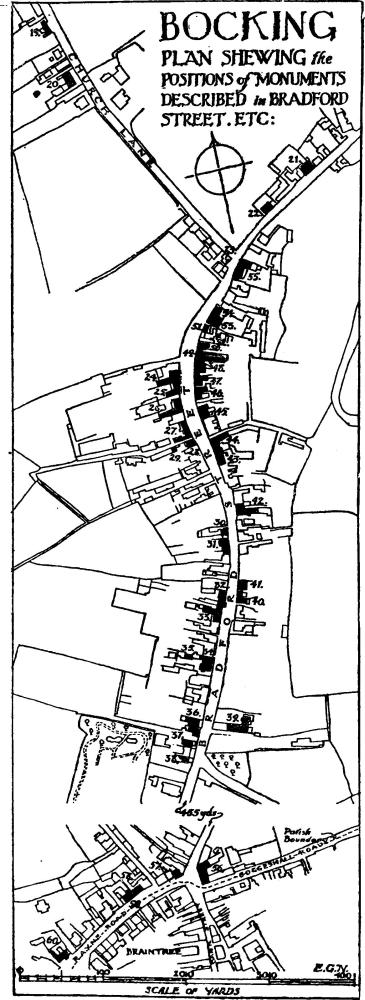
Bocking, Plan Shewing the Positions of Monuments Described in Bradford Street. etc.
It was built probably in 1603, and there are modern additions at the back and S.W. end. On the S. front the upper storey projects, and the bressumer is supported on carved scroll-brackets; over the doorway is a flat wooden canopy supported by pierced scroll-brackets probably of late 17th-century date. On the E. elevation the upper storey projects and at the S. end there is a projecting gable; the bressumers are richly carved, and the upper beam is carved with the date 1603. The two chimney-stacks are original and have moulded cappings and octagonal shafts, with original bases.
Inside the building, on the ground floor, the wallposts are exposed and have moulded and carved caps. In the S.E. room is an original window of three lights with moulded mullions of wood; it is now blocked and enclosed in a cupboard; in the same room is an original doorway with a moulded frame, also blocked. In a cupboard in the S.W. room is another original window with chamfered mullions, now blocked. On the first floor the door of a cupboard is of 17th-century panelling.
d (22). House, two tenements, 80 yards W.S.W. of (21), was built late in the 16th or early in the 17th century. There are modern additions at the back and N.E. end. The original central chimney-stack has three octagonal shafts on a rectangular base with a moulded capping.
Condition—Chimney-stack out of the perpendicular.
d (23). The Six Bells Inn, 90 yards W.S.W. of (22), at the W. corner of Church Lane, is entirely modern, but set in the front is a carved terminal figure of a man, with a wreath of fruit on his head, probably of early 17th-century date.
d (24). House, 150 yards S.W. of (23), is of two storeys with attics. It is of irregular L-shaped plan, with the wings extending towards the N. and W. The W. wing is chiefly of the 16th century; the front or N. wing was built probably early in the 17th century, but was much altered in the 18th century. On the W. elevation of the N. wing are two windows of late 17th or early 18th-century date.
Inside the building, on the ground floor, in the N. wing, in a cupboard, is some linen-fold panelling, not in situ. The top flight of the main stairs has some 17th-century turned balusters, re-used. In the W. wing the original roof construction includes tie-beams, collars and wind-braces.
d (25). Wentworth House, S. of (24), is of two storeys with attics. It is of L-shaped plan, with the wings extending towards the N. and W. On the E. front the upper storey projects, and there are three gables; two of them project; over the doorway is a richly carved 'shell' canopy, of late 17th-century date, resting on brackets, elaborately carved with cherubs' heads, etc. Inside the building, on the ground floor, the middle room has a wall-post with a shaped head; another room has an original fireplace, with a chamfered and four-centred arch, now used as a cupboard; in a passage is a little original panelling. On the first floor, in one room, the timber-framing is partly exposed, and there are traces of painted ornament between the studs.
d (26). House, now two tenements, S. of (25), was built early in the 16th century, and is of L-shaped plan with the wings extending towards the N. and W. There are modern additions on the W. side of the N. wing. On the E. front and on the N. side of the W. wing the upper storey projects, and in the W. wing has curved brackets. Inside the building, on the ground floor, the rooms of the N. wing have original moulded ceiling-beams with carved stops. On the first floor there is a similar beam. In the W. wing is an old door of moulded battens. The roofs of both wings are original, and have cambered tie-beams, king-posts and central purlins with curved struts.
d (27) House (see Plate, p. 37), now four tenements, formerly the Woolpack Inn, 15 yards S. of (26), is of two storeys with attics. It was built, probably in 1590, on an L-shaped plan with the wings extending towards the N. and W. The W. wing was extended further towards the W. in the 17th century, and the middle part of the N. wing was probably rebuilt in 1667.
The E. front, with carved bressumers, baywindows, and remains of pargetting, is interesting.
On the E. Front are three projecting gables, and the upper storey also projects; at the N. end the moulded bressumers are original, and are richly carved with grotesques and foliage; the lower bressumer has the initials R. A. W., and the upper one the date 1590; at the S. end the moulded bressumers, are also original, and the lower one is supported on curved brackets; at the ground floor level, at each end, is an original bay-window with moulded angle-posts, mullions and transom. The middle part of the elevation is of c. 1667, and the lower bressumer is moulded, dentilled and embattled, the gable has moulded and dentilled barge-boards and a bressumer of similar design supported on shaped brackets and carved with the date and initials r. d. 1667 s.d. The upper storey has remains of pargetting, including an interlacing pattern above the bressumer, ornamental panels and fleurs de lis. At the ground floor level is a 17th-century bay-window of semi-hexagonal form with moulded angle-posts, mullions and transom, and a slightly carved cornice.
The Back Elevation has three gables and an original door of moulded and studded battens.
The N. Elevation of the W. wing has some exposed timber-framing, and a 17th-century window of four lights with square mullions set diagonally. On the S. Elevation the upper storey of the 17th-century extension projects.
Interior—Some original or early 17th-century panelling remains in a room at the W. end of the W. wing, and also in a cupboard under some stairs. There are two original doors of studded and moulded battens.
d (28). Cottage, with shop, S. of (29), has been widened on the N. side, and has a modern addition at the W. end. Inside the building are two cusped spandrels of a door, which formerly existed on the N. side of the central chimney-stack.
d (29). Cottage, 20 yards W. of (28).
d (30). Cottage, now two tenements, 120 yards S. of (28). At the back are 18th-century or modern additions. The N. half of the front projects slightly and is gabled, and there is a small gable on the S. half. Inside the building is one door of original panelling, re-used.
d (31). Cottage, S. of (30), was built late in the 16th century, and has modern additions at the back. In front the upper storey projects, and has curved brackets. Inside the building is an original moulded ceiling-beam with carved stops, and an original doorway with a segmental head now blocked. In a shed at the S. end is an old door of moulded battens.
d (32). House, now three tenements, 50 yards S.S.W. of (31), is of two storeys with attics. It is of modified H-shaped plan with the cross-wings at the N. and S. ends. On the S. side the timberframing is partly exposed.
d (33). Fryers, house, S. of (32), is of three storeys, and of T-shaped plan, with the cross-wing at the E. end. The cross-wing was raised one storey in the 18th century, and there are modern extensions on the S. and W. sides. The front has been re-faced with modern bricks. Inside the building the kitchen has a dado of original panelling, re-used. The roof of the W. wing is original.
d (34). House, now four tenements, 50 yards S. of (33), was built late in the 16th century, on a half-H-shaped plan with the wings extending towards the W. There is a modern addition between the wings.
In the S.W. wing is an overmantel which is a good example of early 17th-century work.
The Front Elevation has a wooden cornice. At the W. end of the S.W. wing the upper storey and the gable both project, and have original moulded bressumers with shaped brackets. At the N. end of the main block is an original window of three lights, with moulded frame and mullions and lead glazing. The original central chimney-stack has three octagonal shafts on a rectangular base with a moulded capping. On the S. side of the S.W. wing is an original chimney-stack with two offsets and two octagonal shafts.
Interior—Several rooms in the main block have some early 17th-century panelling. On the ground floor are three original doors of moulded battens. On the first floor is a door of early 17th-century panelling with cock's-head hinges, and in the same room is an original wall-post with shaped and moulded head. In the S.W. wing one room has walls covered with early 17th-century panelling, which has a frieze ornamented with strap-work; the panelled overmantel is divided into two bays by panelled and carved pilasters supporting a carved frieze continued from the walls; a wall-post adjoining the fireplace has a painted pattern in polychrome.
d (35). Cottage, now a workshop, W. of (34), is of two storeys with attics; the attics are an 18th-century or modern addition. On the S. front is a projecting gable with an original moulded bressumer. There are several original windows with moulded frames and lead glazing, probably not in situ. Inside the building the wall-posts with shaped heads show the original height of the cottage.
d (36). House, 80 yards S.S.W. of (34), is of two storeys with attics and cellar. It was built in the second half of the 16th century, probably on a T-shaped plan with the cross-wing at the S. end. In the 17th century wings were added W. of the main block, and S.E. of the cross-wing. At the back there are modern additions, and the plan is now of irregular form. On the Front and S. Elevations of the original house the upper storey projects; on the S. side the projection has an original moulded bressumer, and one shaped bracket remains. At the back of the main block are two gables. The original central chimney-stack in the cross-wing has three octagonal shafts on a rectangular base with a moulded capping. Inside the building there are three old battened doors. The room at the E. end of the cross-wing has an original brick fireplace with splayed sides, chamfered edges, and an oak lintel, now moulded; above it is some 17th-century scroll-ornament painted on plaster. In the cellar is an old bricked well. Some of the collar-beams of the roof are shaped.
d (37). House, now two tenements, S.W. of (36), is of L-shaped plan with the wings extending towards the S. and W. There is a modern extension on the E. side, making the plan T-shaped. Inside the building two rooms have a little original panelling.
d (38). Cottage, 20 yards S.W. of (37), with a modern addition at the back.
E. side
d (39). Little Bradford, house and barn, 80 yards N.E. of (38). The House was built late in the 16th century, on an L-shaped plan with the wings extending towards the S. and E. Early in the 17th-century a wing was added W. of the S. wing, making the plan S-shaped. There are numerous modern additions and extensions. At the W. end of the S. side of the original E. wing the upper storey projects. At the S. end of the original S. wing is a moulded bressumer, with carved interlacing ornament and one bracket. Inside the building, on the ground floor, some rooms have original moulded beams. A cupboard door is of early 17th-century panelling.
The Barn, now a motor-house, S.E. of the house, is of the 17th century and of three bays.
Condition—Of barn, poor.
d (40). House, three tenements and shop, 200 yards N.N.W. of (39), is of L-shaped plan with the wings extending towards the N. and E. At the back are modern additions. In front, at one end, the upper storey projects. Inside the building, one room has an original moulded beam.
d (41). House, three tenements, N. of (40), has, at the S. end, a half-hipped gable, with plain old barge-boards. At the back are three gables.
d (42) House, 90 yards N. of (41), is of three storeys. The front block contains, at the back, a small fragment of an early 16th-century house, which has, on the E. side, an extension of later 16th or early 17th-century date, but the greater part of the block has been entirely altered or rebuilt. Inside the building, on the ground floor, in the original house, is a large, well-moulded ceiling-beam with a foliated stop. On the first floor are some richly moulded joists, also with foliated stops, and, in a room further E., is an early 17th-century panelled door. At the top of a small winding staircase are some 17th-century turned balusters.
d (43). The King's Head Inn, 180 yards N. of (42), with modern additions at the back.
d (44). House, three tenements and shop, adjoining (43) on the N.; it is of half-H-shaped plan with the wings extending towards the E. The N. elevation has a gable at the W. end, and some timber-framing is exposed at the level of the upper storey. On the S. side of the N.E. wing the upper storey projects. Inside the building, a small room at the S. end has some original panelling, with a carved frieze and fluted pilasters. In the S. tenement there is also an original panelled door.
d (45). House, with shop, 35 yards N. of (44), is of two storeys with attics. It was built probably in the second half of the 16th century, on an Lshaped plan with the wings extending towards the N. and E. At the back there are modern additions, and the mansard roof was rebuilt in the 18th century. Inside the building, a room at the N. end has two original moulded beams.
d (46). House, four tenements, N. of (45), was built in the second half of the 16th century, probably on a rectangular plan. In the 17th century a wing was added at the back, making the plan L-shaped. A second wing at the back is modern, and there are other modern additions. In front the upper storey projects and is gabled at each end. Inside the building, at the S. end of the main block, is an original moulded ceiling-beam with one curved bracket; another room has a little old carved panelling. In the 17th-century wing is a door of old panelling.
d (47). House, four tenements and shop, adjoining (46) on the N., was built in the second half of the 16th century, on an L-shaped plan with the wings extending towards the S. and E., and with a small wing at the N. end of the S. wing; there is also an 18th-century or modern addition at the E. end of the E. wing. The small N. wing has a covered entrance with four posts supporting bracketed beams or lintels. Inside the building, on the ground floor, the middle room of the S. wing has an original moulded ceiling-beam and moulded joists. On the first floor a cupboard is partly of old panelling.
d (48). House, four tenements, adjoining (47) on the N., is of two storeys with attics, and was built probably in the second half of the 16th century, on a rectangular plan. In the 17th century a wing was added at the back, making the plan L-shaped with the wings extending towards the S. and E. In the 19th century the front of the house was heightened. At the back of the main block are three gables. On the S. side of the E. wing the upper storey projects. Inside the building, on the ground floor, several rooms have original moulded beams; one beam is carved and has foliated stops. On the first floor, two rooms have original or early 17th-century panelling with carved or fluted friezes and two fluted pilasters.
d (49). House with shop, adjoining (48) on the N., is of T-shaped plan with the cross-wing at the W. end. The N. end of the cross-wing forms a covered entrance. The N. elevation has traces of ornamental plaster work, with two dates and initials, 1722 and 1712, i.e.
d (50). House, two tenements, adjoining (49) on the N., with a modern addition at the back.
d (51). House, two tenements and shop, 20 yards N.N.E. of (50), with a modern addition at the back.
d (52). Cottage, now storehouse, E. of (51); it has an 18th-century or modern addition at the E. end. On the S. front the upper storey projects, and has an original moulded bressumer. At the back some of the timber-framing is exposed, and the roof is hipped at the W. end.
Condition—Bad.
d (53). House, now offices and storehouse, N.E. of (51), was built late in the 16th or early in the 17th century, on an L-shaped plan with the wings extending towards the N.E. and S.E. In the S.E. wing the upper floor has been removed. Inside the building, on the ground floor, is a ceiling-beam supported by a large curved bracket, and the original roof construction includes tie-beams with plain curved brackets.
d (54). House, adjoining (53), is of two storeys with attics. It was built late in the 16th century. On the N.W. front the upper storey formerly projected, but has been under-built. Inside the building, one room has a moulded ceiling-beam.
d (55). House, now six tenements, 90 yards N.E. of (54), was built in the first half of the 16th century, on an L-shaped plan with the wings extending towards the S. and E.; a little later in the same century, the S. wing was extended to twice its former length, and now has an open entrance at the S. end. On the W. front the upper storey projects, and has curved brackets and a moulded and carved bressumer, with carving slightly different from that on the later extension. In the E. wing, on the S. side, the upper storey has exposed timber-framing; it formerly projected, but is covered by a narrow modern addition; in the N. wall is an original window of five lights with moulded mullions and lead glazing. Inside the building are two 17th-century panelled doors, one with cock's-head hinges. The roof of the S. wing has cambered tie-beams; one of them rests on shaped and chamfered wall-posts and has a curved brace. In the E. wing, on the ground floor, the two W. rooms have original moulded ceiling-beams and, on the first floor, two rooms have early 17th-century panelling on the walls.
d (56) The White Hart Inn, at the corner of Bocking End and Coggeshall Road, 1½ m. S. of the parish church, was probably of L-shaped plan with the wings extending towards the S. and E. In the 18th century an E. wing was added at the S. end, making the plan of half-H-shape. The W. front has an open entrance in the middle, and a wooden eaves-cornice. Inside the building, in the main block, enclosed in a cupboard, is an original window of three lights, with moulded mullions, now blocked; in the roof is a cambered tie-beam and a king-post with two curved struts.
Rayne Road, N. side
d (57). House and shop, 40 yards W. of (56), was built probably early in the 18th century.
d (58). House, now three tenements and shops, 50 yards W. of (57), is of two storeys with attics. It was built early in the 16th century, and has modern additions at the back. The middle part was probably the original Hall. The central chimney-stack is of the 16th century, and has moulded capping and a modern shaft. Inside the building, on the ground floor, the middle part has, original moulded ceiling-beams and joists, and a wall-post with a moulded head. In the attic are remains of an original roof-truss, with a moulded side-post, collar-beam and curved brace.
Condition—Poor.
d (59). House, 50 yards W. of (58), was built probably in the 16th century, but was entirely rebuilt early in the 18th century, except the central chimney-stack, and a short wing on the N. side. In front there are two gables and a wooden eaves-cornice. The original chimney-stack has three fluted circular shafts on a square base with a moulded capping. Inside the building, the roof of the N. wing has one original roof-truss with a tie-beam, curved braces and chamfered wall-posts; there are also charred remains of another truss.
Condition—Poor.
d (60). House, four tenements and shop, 100 yards W.S.W. of (59), was built probably c. 1500. A wing at the back appears to have been added in the 17th century, and extended in the 19th century, when a second wing was added and other additions were made. The front has a projecting gable at each end.
d (61). Cottage, two tenements, on the W. side of Panfield Lane, 1¼ m. S.S.W. of the parish church.
c (62). Mill House, at Strait's Mill, nearly 1¼ m. S.E. of the parish church, is of L-shaped plan with the wings extending towards the S. and E. At the E. end is a modern addition. The W. front has two projecting gables with original moulded bressumers and barge-boards.
c (63). Cottage, two tenements, on the N. side of the Coggeshall Road, 1 m. E. of (56), has 18th-century additions on the N. and W. sides. The original central chimney-stack has two square shafts, set diagonally.
Unclassified
a (64). Moated Mound, 1½ m. N.N.E. of the parish church, is about 110 ft. in diameter at the base, and 6 ft. high.
Condition—Fairly good.