An Inventory of the Historical Monuments in Essex, Volume 1, North West. Originally published by His Majesty's Stationery Office, London, 1916.
This free content was digitised by double rekeying. All rights reserved.
'Castle Hedingham', in An Inventory of the Historical Monuments in Essex, Volume 1, North West(London, 1916), British History Online https://www.british-history.ac.uk/rchme/essex/vol1/pp47-61 [accessed 9 May 2025].
'Castle Hedingham', in An Inventory of the Historical Monuments in Essex, Volume 1, North West(London, 1916), British History Online, accessed May 9, 2025, https://www.british-history.ac.uk/rchme/essex/vol1/pp47-61.
"Castle Hedingham". An Inventory of the Historical Monuments in Essex, Volume 1, North West. (London, 1916), British History Online. Web. 9 May 2025. https://www.british-history.ac.uk/rchme/essex/vol1/pp47-61.
In this section
16. CASTLE HEDINGHAM. (E.b.)
(O.S. 6 in. ix. S.E.)
Castle Hedingham is a village and parish about 3¾ m. N.N.W. of Halstead, in the Colne Valley. The principal monuments are the Church and the Castle (see Plate, p. 60).
Ecclesiastical
(1). Parish Church of St. Nicholas (see Plate, p. 47) stands in the middle of the village. The walls generally are of flint rubble with stone dressings; the tower, porch and parapets are of red brick. The roofs are covered with lead and slate. Foundations of an early 12th-century apsidal chancel are said to have been found within the present chancel. The Chancel, Nave and North and South Aisles were built c. 1180. In the 14th century the wall on each side of the first bay of the nave was pierced by an arch. In the 15th century the North Vestry was added. The South Porch was added, and the parapets of the nave and aisles were rebuilt early in the 16th century. Early in the 17th century the nave was shortened by one bay at the W. end, and the West Tower was built. The church was restored in the 19th century, and the Organ-chamber is modern.
The church is of great interest; the wheel-window in the chancel and the nave-arcades, both of the 12th century, the 17th-century brickwork of the tower, porch, and parapets, and the early 16th-century roof of the nave are especially noteworthy; among the fittings the 12th-century doors, the 15th-century stall-work and the Vere monument of 1539 are remarkable.
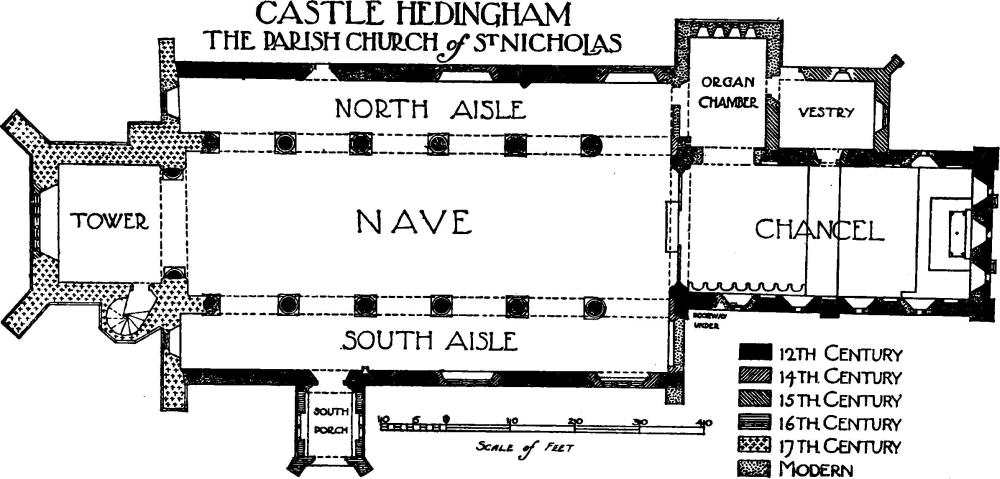
Castle Hedingham, the Parish Church of St. Nicholas
Architectural Description—The Chancel (43½ ft. by 20 ft.) is of c. 1180, and has clasping buttresses of ashlar at the E. angles, and two moulded pilaster buttresses against the E. wall, one of them is carried through the string-course, while the other stops under it, a fact which suggests some alteration from the first design; against the middle of the S. wall is a pilaster buttress of ashlar, and above the buttress is a head-corbel; the corbel-table of the N. and S. walls is modern. In the E. wall are four windows, one being in the gable; the three lower windows are each of one light with moulded two-centred heads and moulded labels; the jambs have attached and keeled shafts with moulded bases, foliated capitals, and square moulded abaci continued along the wall as a string-course; the internal labels and rear arches are moulded, and the internal splays have attached semi-circular shafts with moulded bases, foliated capitals and moulded abaci. Between the windows are recesses, each with a keeled shaft which has a moulded base and foliated capital. In the gable is a wheel window with a moulded opening and label; the eight radiating lights are divided by short shafts with moulded bases and foliated capitals; the internal jambs have shafts with foliated capitals, and the rear arch is moulded; below the window is a moulded external string-course, with a stop carved as a crouching lion at the N. end, and a head-stop at the S. end. Below the sills of the lower windows are internal and external moulded string-courses. In the N. wall are three small windows of similar detail to the lower windows in the E. wall, but without internal labels; the easternmost window is modern, except the internal E. splay; between the windows, and beyond them on each side, are recesses with moulded semi-circular arches; the jambs have shafts with moulded bases and foliated capitals; the two eastern recesses have been partly restored; at the sill level are internal and external moulded string-courses. Further W. is a modern arch, but in the E. respond is the shafted splay of a fourth original window. Below the third recess is a 15th-century doorway, with moulded jambs and two-centred arch in a square head with a moulded label. The S. wall has four windows with recesses between them, and on the E. side; the three eastern windows and the recesses are uniform with those in the N. wall; the westernmost window is modern; at the sill level are internal and external string-courses similar to those on the E. wall. Near the W. end is a doorway, now blocked (see Plate p. xxviii.); it has a semi-circular arch of two orders richly carved with foliage and zigzag ornament; the label has billet ornament; the jambs have each two keeled and attached shafts with moulded bases, having spur ornaments; the capitals are foliated. The two-centred chancel-arch is of two richly moulded orders with zigzag ornament; it was possibly widened and rebuilt in the 14th century, with the old stones and additional new material; the moulded label is also enriched with zigzags on the W. side; the responds have each three attached shafts which have capitals with water-leaf and stiff-leaf foliage and moulded abaci; the moulded bases have spur ornaments, and have been partly cut away.
The North Vestry is of the 15th century, and has, in the E. wall, a window of two cinquefoiled lights under a square head; the label is much decayed. In the N. wall is a lancet window of uncertain date with a modern doorway on the W. side. In the W. wall is a modern doorway.
The Nave (75 ft. by 22½ft.) has N. and S. arcades of six bays; the easternmost bay on each side is of the 14th century, but the others are of c. 1180. In the N. arcade (see Plate p. 49) the first or easternmost bay has a moulded and segmental-pointed arch, springing from a moulded head-corbel on the E. wall; the other bays have semi-circular arches of two moulded orders with a label on the S. side; the piers are alternately circular and octagonal and have square moulded abaci, foliated capitals and moulded bases; the original E. respond was converted into a circular column in the 14th century, and has foliated square ornaments on the later half of the capital; what is now the W. respond was formerly a column before the nave was shortened. The S. arcade is similar to the N. arcade, but the segmental-pointed arch of the first bay is of three chamfered orders, the inner order springing from a moulded corbel, and the E. half of the capital of the first pier is moulded and without foliage. Over the first pier of the N. arcade is the upper doorway of the former rood-loft; it is of the 14th century and has chamfered jambs and a moulded two-centred arch with a label. The clearstorey has brick parapets of early 16th-century date, with moulded string-courses and sunk panels; at each end of the S. parapet is a carved stone molet; the E. wall has a crow-stepped gable of brick and below the S. kneeler is a carved 12th-century head. The N. and S. walls have each six windows; the first or easternmost in the S. wall is of the 14th century, and of two trefoiled ogee lights under a square head with a moulded label; the other windows have internal splays and semi-circular rear arches of the 12th century, but the splays were cut back in the 16th century and larger windows of brick were inserted; they are each of two four-centred lights under a square head, with moulded reveals and label; over the head of each window outside, is a square sunk panel; one panel is blank, one is carved with a boar having a molet on its side, and the rest are carved with molets; below the windows inside is a moulded string-course of the 12th century.
The North Aisle (8½ ft. wide) has a 16th-century parapet and string-course of brick. In the N. wall are two windows of c. 1350; the Eastern window has been slightly restored and is of three trefoiled ogee lights under a square head with a moulded label which has head-stops; the moulded internal splays have shafts with moulded bases and capitals; the hollow-chamfered rear arch has carved ornament and a moulded label; the western window is similar to the other, but is less richly moulded, and the splays and rear arch are plain. Further W. is the late 12th-century N. doorway with a moulded semi-circular arch now of one order, but originally of two orders similar to those of the S. doorway; the jambs have each an attached and keeled shaft with moulded base and abacus and a foliated capital; the roughness of the wall round the doorway shows where the projecting outer order has been cut away. In the W. wall is a modern window, and above it is a lancet window of uncertain date and now blocked.
The South Aisle (9½ ft. wide at E. end, 8½ ft. at W. end): E. of the S. porch the parapet is modern, but the rest of it is of 16th-century brick and similar to that of the N. aisle; in the parapet, over the S. porch, are two quatrefoiled circular panels, the western containing a carved molet. In the E. wall is a 14th-century recess partly restored and apparently part of a former window, but there are no signs of it outside; the splays, segmental rear arch and internal label are moulded. In the S. wall are two windows of c. 1350; the first or easternmost has been partly restored, and is of three cinquefoiled ogee lights with tracery under a square head which has a moulded label with head-stops; the internal splays and segmental-pointed rear arch are moulded; the second window is similar, but of three trefoiled ogee lights; the rear arch is less richly moulded and the splays are plain. Further W. is the late 12th-century S. doorway with jambs and semi-circular arch of three moulded orders set in a projection; the innermost order is partly hidden by a modern door-frame and the outermost order by the walls of the porch; the moulded label has a defaced head at the apex; each order of the jambs has an attached shaft with remains of moulded bases and spur ornaments; the capitals are carved with water-leaf and stiff-leaf foliage and have moulded abaci. In the W. wall is a 16th-century window of two square-headed lights with a chamfered label.
The West Tower (15¾ ft. by 18¼ ft.), dated 1616, (see Miscellanea) is of three stages with a S.E. stair-turret and an embattled parapet which has a pinnacle at each angle; the walls are of red brick with stone dressings. The two-centred tower-arch is of three chamfered orders with a chamfered label on the E. side; the responds are chamfered and have each an attached semi-circular shaft with a moulded base, foliated capital and moulded abacus; part of the shafts, and the bases and capitals are of the 12th century, re-set, and belonged to the former W. respond of the nave arcades. The doorway of the stair-turret has chamfered jambs and four-centred arch. The W. window, much restored, is of five transomed and cinquefoiled lights under a square head; the moulded label which is not in situ is enriched from from N. to S. with the following carved devices of John Vere, 13th Earl of Oxford, died 1512— (1) a whistle and chain, for Lord High Admiral, (2) a screw-jack or cranket on a diapered ground encircled by the garter, (3) a molet in a shield, (4) a boar (verres) grubbing for acorns under an oak-tree, (5) an ox crossing a ford, with a scroll above it, (6) a chair of estate, for Lord Great Chamberlain, (7) a harpy (half only remains), one of the Vere supporters. The N. and S. walls of the second stage have each a loop-light, now blocked. The bell-chamber has, in each wall, a window of three four-centred lights under a square head with a moulded label; the doorway of the stair-turret has double chamfered jambs and a moulded, four-centred arch.
The South Porch is of early 16th-century date and of red brick with diapering of blue bricks; the parapet is embattled; the buttresses have stone dressings. The outer entrance has moulded responds and four-centred arch with a label; above it is a rectangular sunk panel. The E. and W. walls have each a window of two four-centred lights under a square head with a small label; the window-sills form seats.
The Roof of the chancel is of the trussed-rafter type with moulded wall-plates and is probably of the 14th century. The early 16th-century roof of the nave (see Plate, p. 49) is of twelve bays with double hammer-beam trusses; the purlins and upper hammer-beams are richly moulded; the lower hammer-beams and cornice are embattled and carved with running foliage; the side posts have attached buttresses with crocketed pinnacles and terminate in foliated pendants; the soffit of the collar-beam has also a carved pendant; the curved braces have traceried spandrels and below the lowest purlin are carved angels with spread wings, wearing crowns and holding shields charged with various emblems; between two angels on the N. side is a carved molet and in a corresponding position on the S. side is a boar; the molet is repeated in other parts of the roof.
Fittings—Bells: five and clock - bell; 5th by Richard Hille [1423–1440], inscribed 'In Multis Annis Resonet Campana Johannis'; clock-bell, dated 1697. Chest: In S. aisle—with panelled front, each panel containing a lozenge, carved upper rail, lower rail retaining one carved bracket, three locks, early 17th-century. Cupboard: In tower—against W. wall, made up of panelling, carved with various designs and patterns, one bearing initials E.S., early 17th-century, two panels of later date, representing Daniel in the lions' den, and Jonah beneath the gourd (?). Doors: In chancel—in doorway to vestry, of studded battens with strap-hinges, 15th-century; in blocked doorway in S. wall, of three massive battens with fine ornamental ironwork, upper hinge with conventional heads, late 12th-century, lower hinge apparently 15th-century. In N. doorway, of massive battens with ornamental hinges and straps, late 12th-century. In S. doorway, similar to that in N. doorway, one strap carved with small animal, late 12th-century. The three 12th-century doors have joggled boarding. In tower—in doorway to stair-turret, with strap-hinges, early 17th-century. Locker: In chancel—in N. wall, rectangular, with rebated jambs and head, late 12th-century. Monuments and Floor-slabs. Monuments: In chancel—against N. wall, not in situ, (1) of [John, fifteenth Earl of Oxford, 1539, and Elizabeth (Trussell) his wife], altar tomb (see Plate, p. 50) of unpolished touch with polished moulded slab, also of touch, having two panels in high relief; in lower panel two kneeling figures, of man in fluted plate armour with a tabard of arms as on first half of shield in upper panel, mantle of the Order of the Garter, the Garter scocheon being on the right shoulder, and rich chain; of woman in pedimental head-dress and heraldic mantle with the same arms as the tabard; in upper panel the initials I. O. (John Oxford) and shield of arms surrounded by the Garter, supporters, crest, etc., shield—quarterly of eight (a) quarterly a molet in the quarter, for Vere; (b) a lion and over all a fesse with three crosses formy fitchy thereon, for Colbroke; (c) three chevrons with a label, for Clare; (d) a saltire between twelve cherries, for Sergeaux; (e) a fesse between two gemel bars, for Badlesmere; (f) barry wavy, for Samford; (g) a lion, for Fitz Hamon; (h) Vere, impaling Trussell quartered with Burley; with bezants at the crossings for Trussell; sides of tomb panelled, with kneeling figures of four sons (now against the wall) and four daughters with their names, and mottoes on the end pilaster; at E. end a gartered shield as on slab, and, at W. end, a Vere shield of eight quarters. When the tomb was moved to its present place it was reversed, and the children now face west instead of east. In organ-chamber—on W. wall, (2) to Dominic van Heila of Flanders, 1608, and his wife Wilhelmina (Haleme), 1605, painted stone tablet with Corinthian pilasters and shields of arms, formerly in the church of All Hallows, London Wall, and removed to present position in 1766. In churchyard—S.E. of chancel, (3) to Thomas Unwin, 1689, slab on modern tomb. Floor-slab: In N. aisle—now set in N. wall, to Christopher Langton, 1619, incumbent of the parish, with shield of arms. Niche; In N. aisle—in N. wall, small, with moulded jambs and trefoiled sub-cusped head, 14th-century. Painting; On semi - circular stone, now kept at vicarage, crowned head, with background powdered with stars, 13th or 14th-century. Screen: Under chancel arch— of six bays, the two middle bays forming doorway with trefoiled and sub-cusped head having crockets and finial and tracery above it; side bays with similar cinquefoiled heads, close lower panels with sub-cusped and trefoiled heads having foliated bosses and spandrels, bays divided by moulded and buttressed posts, and moulded cornice enriched with carved bosses, late 14th or early 15th-century. Sedilia; In S. aisle—sill of S.E. window carried down to form seat, the straight jambs having trefoiled and sub-cusped ogee heads supporting splays of window over it, 14th-century, seat removed. Stalls: In chancel— on S. side, range of five, with moulded elbow-rests and moulded and carved standards having small attached shafts in front, misericords with moulded edges, third seat also having carved ornament on the edge, all with carved baberies as follows— (a) three plain shields. (b) large leaf and two leopards' heads, (c) a wolf carrying off a monk (?), a fox with a distaff in mouth, and a leopard's head (see Plate, p. xxxiii), (d) three shields each with a cross, (e) a man's face and two leopards' heads, first half of 15th century, third seat possibly 14th-century. Stoups: In S. aisle—E. of S. doorway, square bowl in form of cushion capital, richly carved with foliage and a beast's head, early 12th-century (see Plate, p. xxxii), recess and pillar modern. On S. porch—outside entrance archway, plain, 16th-century. Table: In vestry — with turned legs, moulded upper rail and shaped brackets, 17th-century. Miscellanea: In S. aisle — built into S. wall, carved stone with half figure of a woman with hands folded in prayer, probably early 12th-century. Built into tower—over W. window, stone inscribed 'Robert Archer the master builder of this stepell 1616'; in stair-turret, stones with various initials; in wall of bell-chamber, stone with carved initials C. P. On S. buttress of chancel—scratched sundial; on S. parapet of porch—another sundial.
Condition—Good: tower arch slightly out of shape owing to settlement.
(2). Priory of St. Mary, St. James, and the Holy Cross, remains, about 750 yards W. of the church, and W. of Nunnery Farm. The Priory was founded late in the 12th century by Aubrey de Vere, first Earl of Oxford, for Benedic tine nuns. All that remains is a small fragment o flint-rubble masonry almost level with the ground.
Condition—Fragmentary.
Secular
(3). The Castle, stands on a hill N.E. of the village. It consisted of an inner bailey or mount surrounded by a curtain-wall, with the Keep or great tower in the middle, and the Great Hall and other buildings on the S.W. The outer bailey lay to the N.E. and had a Bridge connecting it with the inner bailey.
The Keep was built c. 1130–40, and the Fore-building was added shortly afterwards. Late in the 15th or early in the 16th century, most of the other buildings were rebuilt, including the Bridge, Curtain, Great Hall and various towers, etc. Three towers are said to have been destroyed late in the 16th century. The remaining buildings, except the Keep and Bridge, were probably destroyed during the 17th and 18th centuries, some of the materials being re-used c. 1718, when the present house was built in the outer bailey. The foundations of some of the buildings destroyed were excavated in 1853 and 1869.
The earthworks are important and extensive, and the Keep is among the finest and most complete examples of 12th-century military architecture in England. The condition of the tower is extraordinarily perfect, and the walls and arched recesses to a great extent retain internally the original plastering.
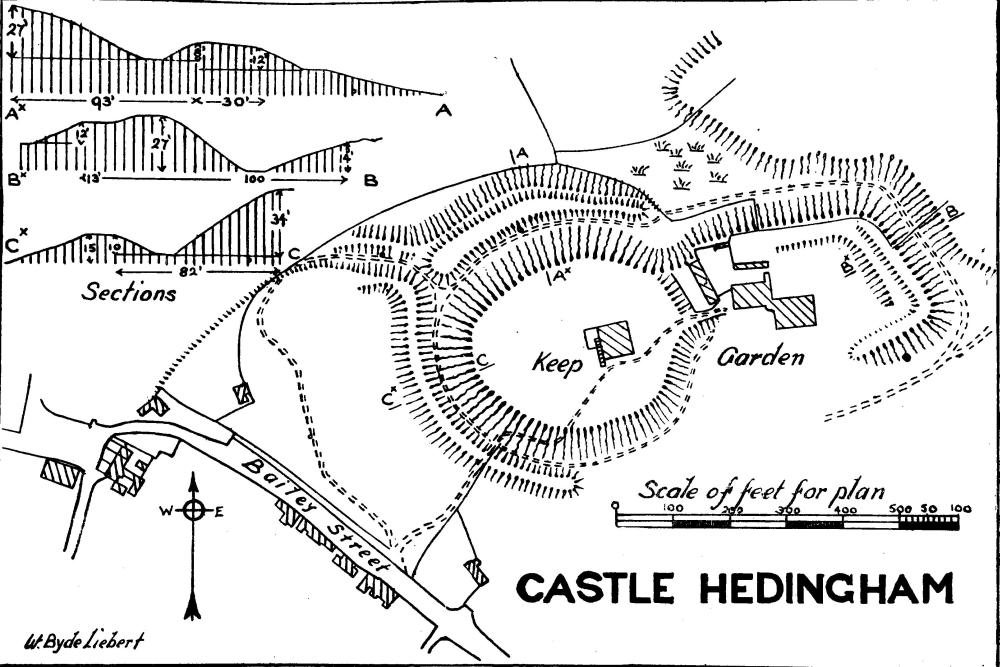
Castle Hedingham
The Earthworks, now consist of the mount forming the inner bailey, and the outer bailey, with slight traces of what was probably a town enclosure on the W. The mount and outer bailey are a partly natural hill with the ground sloping away on all sides except the E., where it is separated from the high ground by a ravine which has been artificially scarped. The mount, approximately oval in shape and flat-topped, has an area on the top of about two acres. It is surrounded on the N., W., and S.W. sides by a deep ditch with a strong bank on the counterscarp. On the S.E. side the ditch and bank have entirely disappeared, and on the E. side the mount is separated from the outer bailey by a shallower ditch, of which both banks are revetted with a Tudor brick wall. The summit of the mount is 27 feet above the bottom of the ditch on the N. side, 34 feet on the W. side, and 38 feet on the S. side; the counterscarp bank is 8 feet high on the N. side and 10 feet on the W. The ditch is about 90 feet wide. Towards the N.W. corner the bank and ditch turn outwards for a short distance, probably indicating the former presence of a town enclosure. There is an old well on the mount. The outer bailey, E. of the mount, has a strong rampart with a modern berm along the E. arm, but no ditch, except on the N.E. and E. sides where a natural ravine has been artificially scarped. The low-lying ground between the N.W. corner of the bailey and the natural spur was probably at one time marshy, and would have afforded a defence for that corner of the work. On the N. side the rampart has no berm and diminishes in strength towards the W. end of the enclosure, which is occupied by buildings. Part of the S. arm of the defences has been totally obliterated by the gardens and terraces of the house which stands within the enclosure. On the E. side the rampart is 17 feet above the interior level and the berm is 13 feet wide. The rampart is about 27 feet above the exterior level.
The Keep or Great Tower (58 ft. by 53 ft., externally) is of four storeys (see Frontispiece); the walls (average thickness on ground floor, 11 ft.) are of flint rubble faced with Barnack stone. It was built c. 1130–40.
At the angles are wide, flat pilaster buttresses, and there is a narrower flat buttress in the middle of each side. The walls have a chamfered plinth, below which is a battering base with a slight roll-moulding in the alternate courses; this base is returned round the angle buttresses, but the middle buttresses spring from it. Originally each angle carried a square turret, but only those at the N.W. and S.E. angles remain. Putlog holes remain in all the walls. Each elevation has a similar arrangement of windows:—in the basement are two narrow loops with chamfered jambs and very deep internal splays; in the second storey, except on the W. front, which has only one window, are two narrow single-light windows with moulded semi-circular heads, and shafted jambs with moulded bases, scalloped capitals and chamfered abaci; the third storey has a lower range of windows similar in number and detail to those in the second storey, but wider, and an upper range of two pairs of coupled windows, each of similar detail to those below, but all partly restored in modern brick; in the fourth or top storey, are two elaborate single-light windows which have shafted jambs with moulded bases, scalloped capitals and moulded abaci, and semi-circular arches of two orders, the outer order carved with cheveron ornament, and the inner order of plain curved section. In the angle buttresses, loops and small windows with semi-circular heads light the staircase and the chambers in the thickness of the walls. The N.W. and S.E. turrets are faced with ashlar, except the upper parts, which are of flint rubble with Barnack stone dressings. The N.W. Turret has, on the E. and S. sides, original plain windows with semi-circular heads; on the N. side is a rough opening of later date with one jamb of modern brick. The S.E. Turret has, on the N. side, an original window, but those on the other sides are of modern brick; there are remains of a brick dome, probably of the 16th century. The embattled parapet which formerly finished the walls is missing, except small fragments which remain against the S. side of the N.W. turret, and against the N. side of the S.E. turret.
The remains of the Fore-building consist of a rectangular projection extending to the height of the basement storey with walls of flint rubble from which all the facing has been removed. At the N. end is a rough opening, now blocked. The stone stairs against the tower, S. of the fore-building, are enclosed by a wall of flint rubble which is also stripped of its facing; at the S. end of the wall appears to have been a turret or buttress. The N.W. and S.W. angles of the keep are toothed for the bonding of the former walls of the fore-building; the toothing at the S.W. angle was apparently for a wall which enclosed the staircase at the S.W. end, and the springers of a former arch are visible.
On the W. Front, in the basement the loop-lights are blocked by the fore-building and the flight of steps leading to the entrance. In the N. half of the second storey is the entrance archway; the jambs have attached shafts with moulded and carved bases and scalloped capitals with moulded abaci; the arch is semi-circular and, of two orders; the plain inner order has a groove for the portcullis; and the outer order is enriched with zigzag ornament; over the archway are grooves cut in the ashlar for the roofs of the fore-building and the staircase. In the third storey the window over the entrance, with the masonery and brickwork between it and the entrance archway are modern. In the fourth storey the twin windows have been considerably restored with modern brick.
On the S. Elevation the western loop in the base ment has modern stone jambs. In the second storey both the jambs of one window and one jamb of the other window have been renewed. In the fourth storey the western of the twin windows has been restored. On the E. Elevation, in the basement, are two modern openings with remains of the original loop over each. In the second and third storeys the windows have been restored. On the N. Elevation one of the loops in the basement has been restored with modern brick, and one of the windows in the second storey is now blocked. The twin windows in the fourth storey have been restored with modern brick.
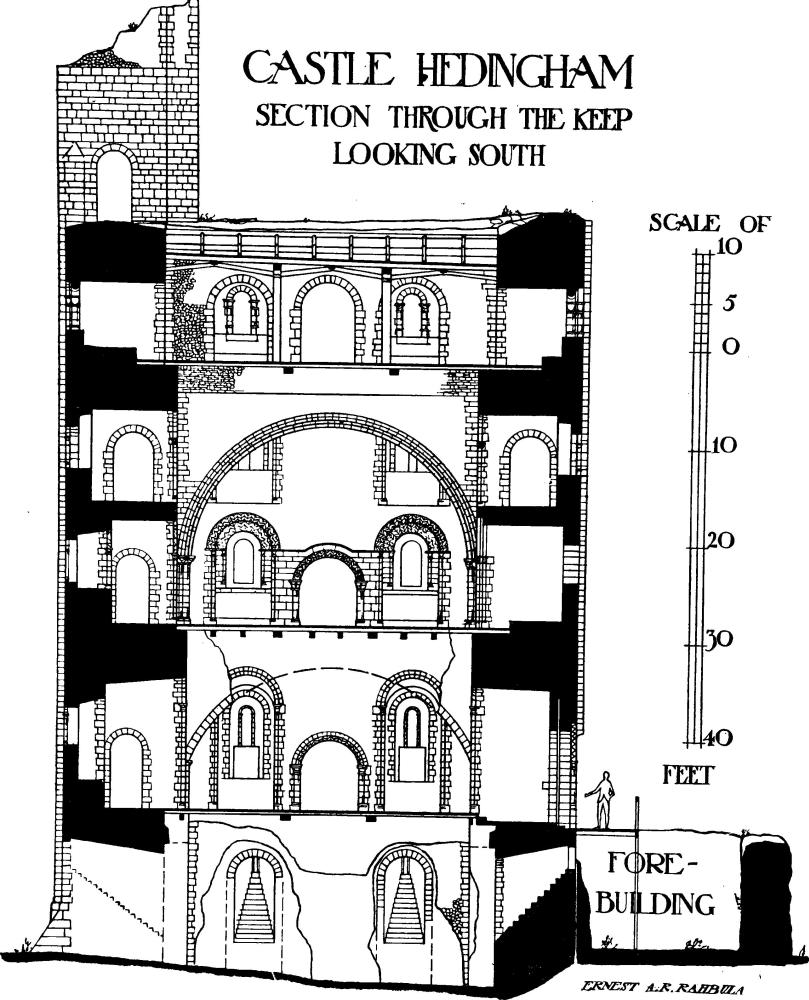
Castle Hedingham, Section Through the Keep Looking South
Interior—None of the original floors remain. The soffits of some of the windows and the vaults of small chambers show the board-marks of the centring, and retain their original plastering.
The Basement is divided into two rooms by a modern brick wall. In the S.E. and S.W. corners are small chambers formed in the thickness of the walls. The splays of the windows have been considerably denuded and are partly plastered. The entrance to the stair-turret in the N.W. angle is almost entirely of modern brick.
The Entrance or First Floor was originally spanned from E. to W. by a plain segmental arch but the middle part of the arch and the wall above it have been destroyed, and the rest of the opening is now filled by a modern brick wall; the plain pilaster jambs of the arch each have a moulded abacus. The angles of the internal jambs of the entrance doorway are shafted and have moulded and carved bases, and scalloped capitals with moulded abaci; the semi-circular arch is of the same section as the jambs; in the S. jamb is a long hole for a draw-bar. All the window recesses have moulded semi-circular arches and shafted jambs with scalloped capitals and moulded bases. At the N.E. corner, in the thickness of the wall, is an entrance passage with groined vaulting to a garderobe. In the middle of the S. wall is an original fireplace consisting of a segmental recess which has shafted jambs, each with a moulded base, scalloped capital and moulded abacus, ornamented with billet-moulding; the semi-circular arch is moulded and enriched with cheveron ornament; the segmental back of the fireplace is of bricks 13/8 in. thick; the flue is short and cone-shaped, and the outlet for the smoke was formed by leaving a rectangular opening in each side of the middle buttress of the wall. In the middle of the N., E. and W. walls, and in the S.E. and S.W. angles, are small chambers in the thickness of the walls; all these chambers are barrel-vaulted and are entered through doorways in the window recesses; the doorways have plain or rebated jambs and semi-circular arches.
The Second Floor is of two storeys, and forms the Hall (see Plate, p. 55). It is spanned by a massive and richly moulded semi-circular arch springing, in the middle of the E. and W. walls, from a shafted pilaster which has a moulded and beaded base and scalloped capital with moulded abacus. All the window-recesses have angle-shafts with moulded bases and scalloped capitals, some of them enriched with bead ornament; the semi-circular arches have rich zig-zag moulding; the abaci of the capitals are continued as a string-course along the S. wall and over the arch of the fireplace; the splays of the original windows have angle-shafts with moulded bases, and scalloped capitals with moulded abaci; the semi-circular arches have rich zig-zag moulding. In the middle of the S. wall is an original fireplace, similar to that on the first floor, but with slightly different detail in the scalloped capitals. The entrance archway from the stair-turret has a continuous roll-moulding. In the N.E., S.E. and S.W. angles of the room are shafts with moulded bases and scalloped capitals (one missing); they originally supported wall-plates of the original ceiling; some plain corbels for the same purpose remain in the walls. At the N.E. corner, in the thickness of the wall, is a garderobe similar to that on the first floor, but with a small recess next to it in the wall; the narrow passage leading to it has a groined vault. The arrangement of the other chambers in the thickness of the walls is similar to that of the floor below. The chamber immediately above the entrance formed the Portcullis Chamber. The upper storey of the Second Floor consists of the Gallery of the Hall. A continuous passage is formed in the thickness of each wall, and is entered from the E. and S. sides of the stair-turret; the S. entrance has double-shafted jambs continued in the semi-circular arch, the shafts of the jambs being enriched with spiral bands of bead ornament; the N. entrance has shafted jambs each with a moulded base, scalloped capital and moulded abacus; the semi-circular arches are of the same section as the jambs; on each side, opening into the Hall, are two arches similar in detail to those of the N. entrance. The passages have barrel-vaults intersecting at the angles.
On the Top Floor the window-recesses are plain, with semi-circular soffits; holes for the original shutter-hinges remain, and provision is made in the soffits to allow the shutters to open. In the middle of each wall is a recess, with a plain semi-circular head, and at the N. end of the E. wall is a smaller recess. In the N.E., S.E. and S.W. angles there are small chambers in the thickness of the walls, entered from the window-recesses as on the other floors.
The Stair-Turret in the N.W. angle has a central stone newel 1 ft. 9 in. in diameter, and steps 5 ft. 2 in. wide, almost entirely restored in brick.
In the Hall are two funeral helms and a pair of gauntlets—one incomplete—of the 16th century. There is also some early 17th-century furniture.
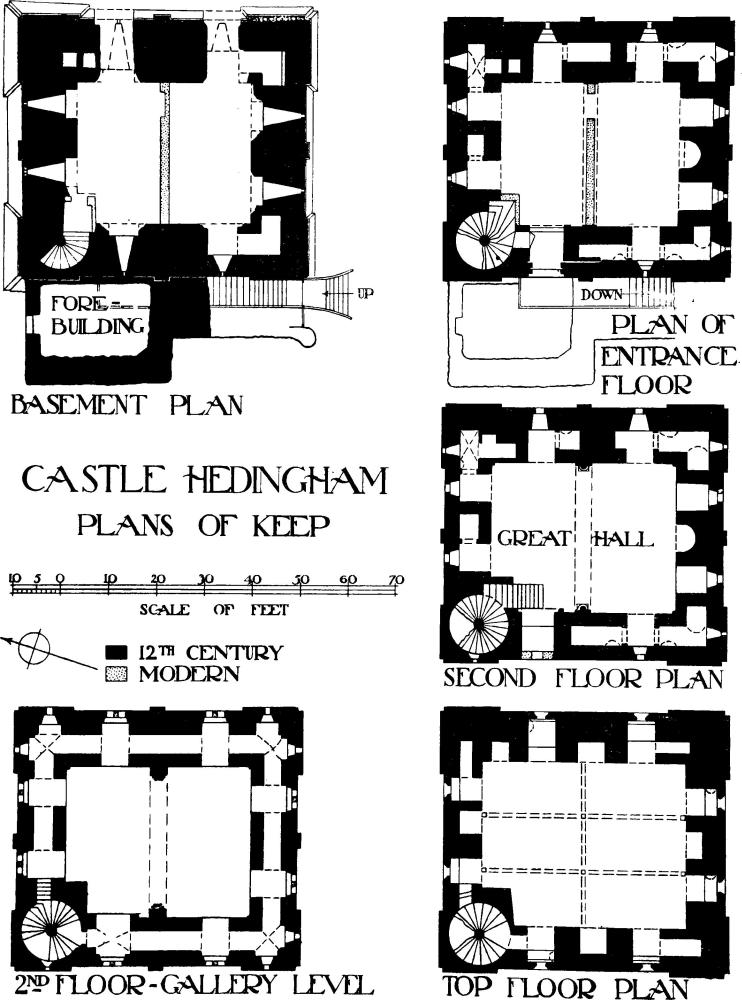
Castle Hedingham, Plans of Keep
The Great Hall of the Castle (about 83 ft. by 37 ft.), stood S.W. of the Keep, and had sub-vaults underneath it. The 19th-century excavations showed a porch at the N.W. end of the S.W. side and a rectangular oriel at the S.E. end of the same side; traces were also found of the butteries adjoining the Hall on the N.W., and of other buildings on the S.W. and S.E.; all these foundations are now overgrown, except part of the oriel of the Hall and part of the building on the S.W. Immediately S. of the Keep traces were found of the E. end of the Chapel, but they are also overgrown. Fragments of the brick Curtain remain at intervals round the inner bailey. Facing S. and outside the curtain, are the bases of two of the angle-turrets of the Great Brick Tower; one is octagonal and one square, and both are hollow and have shallow pits at the bottom, probably connected with former garderobes. Traces of a second tower further N. and of the gatehouse at the inner end of the bridge were also found, but nothing of them is visible. All the foundations which remain exposed are of late 15th or early 16th-century date.
The Bridge, E. of the Keep (see Plate, p. 57), is of brick, and of late 15th or early 16th-century date, much restored with modern brick. It is of four spans with four-centred arches of two chamfered orders; the piers are of 'cut-water' form on the S. side, and the E. and W. spans have been blocked at the N. end; the middle pier is pierced by a small opening with a four-centred head. Adjoining the bridge on the N.W. side is a considerable length of brick retaining-wall, probably of the 16th century.
Condition—Of earthworks, fairly good; of Keep, very good; of exposed foundations, fragmentary; of bridge, good.
(4). Kirby Hall, over 1 m. N.N.W. of the church, is of two storeys with attics; the walls are partly timber-framed and plastered, and partly of modern brick; the roofs are tiled. It was built late in the 16th century, on an L-shaped plan with the wings extending towards the W. and N. There is an 18th-century outhouse on the E. side, and the W. wing has modern additions. The S. front has been re-faced with modern brick. At the N. end of the N. wing is a half-hipped gable. The original chimney-stack at the E. end of the W. wing has four octagonal shafts. The chimney-stack in the N. wing has a number of weathered offsets. Inside the building, on the ground floor, the S.E. room has a moulded ceiling-beam, and the walls have early 17th-century panelling. In the N. wing the ceiling-beams are stop-chamfered.
Condition—Good.
(5). Trinity Hall, in Queen Street, 220 yards S. of the church. The house is of two storeys with attics and cellar; the walls are partly of brick and partly of plastered timber-framing; the roofs are tiled. It was built early in the 18th century with a projecting wing on the S. side, and there are modern additions at the E. and W. ends. The N. front has a wooden eaves-cornice with modillions set in pairs, and three original dormers with horizontal moulded cornices. Three chimney-stacks are original, but two of them are modern at the top.
Interior—Many of the rooms have exposed ceiling-beams. In the hall is some original deal panelling, and three arched openings with classic details; the jambs of the original fireplace are lined with Dutch tiles illustrating scriptural subjects. The parlour has deal panelling and a semi-circular headed recess cased with deal. Over the entrance to the cellar is a beam incised with the date 1582, said to have been taken from a cottage on the site. The original staircase has square newels with moulded caps and bases, twisted balusters, a handrail moulded on one side, and a moulded close string; the walls have deal panelling and a small moulded dado rail. There are several old doors; three of them have bolection-moulded panels.
Condition—Good.
Monuments (6–47).
The following monuments, unless otherwise described, are of the 17th century, and of two storeys, timber-framed and plastered; the roofs are tiled or thatched. Many of the buildings have exposed ceiling-beams, wide fireplaces and original chimney-stacks.
Condition—Good, or fairly good, unless specially noted.
(6). House, 100 yards S.S.W. of (5), on the S.E. side of the Sible Hedingham Road, is of two storeys with attics and cellar. It was built late in the 17th or early in the 18th century, but has modern additions at the E. and W. ends, and the original plan cannot be distinguished. The gable at the W. end, and the two western gables on the N. front have old carved barge-boards, re-fixed. Inside the building, one of the ceiling-beams is moulded, and one room contains some early 17th-century panelling, said to have been brought from the former stables. In another room is a carved oak chimney-piece of the 17th century, said to have come from the old vicarage at Great Saling. There are two old doors of moulded battens.
(7). Cottage, now two tenements, in the N.W. corner of the churchyard, has been partly rebuilt with modern brick. The original chimney-stack at the E. end has diagonal pilasters on two sides.
Church Ponds, N. side
(8). House, now two tenements, 50 yards N. of the church, has 18th-century and modern additions at the back, and has been partly re-faced with modern brick. At the E. end of the S. front the upper storey projects and is gabled.
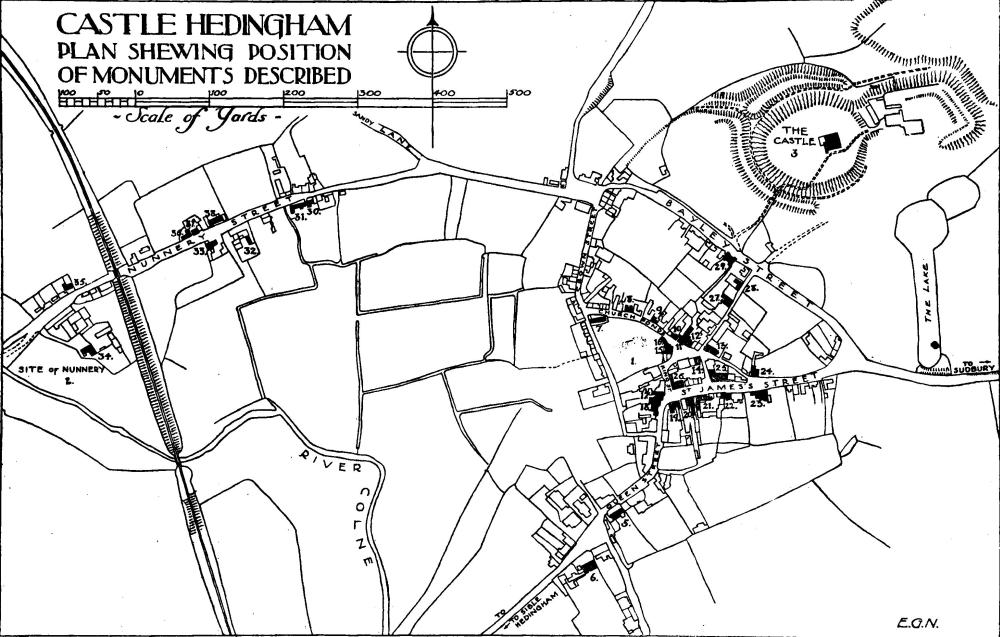
Castle Hedingham, Plan Shewing Position of Monuments Described
(9). Cottage, 40 yards E.S.E. of (8), has a modern addition at the back, and has been partly re-faced with modern brick. The original chimney-stack at the E. end has three pilasters on each side.
(10). House, now two tenements, 40 yards S.E. of (9), has a slightly projecting wing at the S.E. end of the back, and modern additions at the S.E. end of the building.
(11). House, with shop, S.E. of (10), was built probably early in the 16th century, but the original plan has been obscured by modern alterations and additions. On the S.W. front are three gables. At the back is a wing, of which the upper storey projects on the N.W. side; under the projection is a carved oak head, much damaged, said to have been removed from the front of the house. Inside the building, two of the exposed ceiling-beams are moulded. In the front wall are remains of an original window with a moulded mullion, now blocked.
(12). The Falcon Inn, S.E. of (11), was built probably in the later part of the 15th century, but was extensively altered in the 16th century, and has 18th-century and modern additions at the back.
A carved stone shaft of the 12th century in the cellar, and the 15th-century doorways in the central passage deserve notice.
On the S.W. front the upper storey projects and is supported by five brackets, of which two are carved. The central chimney-stack is apparently of the 16th century, but has been mutilated and covered with cement.
Interior—The central pasage has two original doorways with four-centred heads; one has sunk spandrels, the other is now blocked. In one room are remains of an original moulded and embattled ceiling-beam, and in another room is a moulded ceiling-beam resting on a shaped wall-post. In a third room the ceiling-beam is supported by a curved strut. In the front wall are remains of original windows with moulded mullions, now blocked. On the N.W. wall are two 16th-century plaster panels with remains of a rough pattern in black and white paint. The cellar is probably of 16th-century brickwork: in the walls are two original segmental-headed recesses; the main ceiling-beam rests on a 12th-century stone shaft of square section, with hollow-moulded angles which have small bosses at intervals; it is elaborately carved with a floral pattern on all four sides, and possibly formed part of a cross.
(13). House, called "Porter's," 30 yards E.S.E. of (12), is of two storeys with a cellar. It was built, probably in 1675, on an H-shaped plan with the cross-wings at the N.W. and S.E. ends. On the S.W. front the main block and part of the N.W. wing have a parapet with a wooden cornice. The original central chimney-stack has grouped diagonal shafts on a rectangular base, which has a sunk panel carved with the date 1675. Inside the building, in the N.E. wall of the hall, is an original semi-circular recess, with a domed head of wood.
(14). House, 15 yards S.W. of (13), is of two storeys with attics. It was built apparently on an L-shaped plan with the wings extending towards the E. and S. In the 18th century the S. wing was extended towards the E. Inside the building, in the upper storey, an original steeply cambered tie-beam is visible.
(15). House, now two tenements with shop, on the E. side of the churchyard, was built apparently in the 16th century, but has been partly re-faced with modern brick. On the E. front are three gables, of which the northernmost projects, and is supported by two shaped brackets. Inside the building, one of the ceiling-beams is supported by a shaped bracket.
Condition—Bad.
(16). House, formerly almshouses, but now a club, N. of (15).
(17). House, formerly an inn, 60 yards S. of the church, at the S.W. corner of King Street, was built, late in the 16th or early in the 17th century, on a modified L-shaped plan with the wings extending towards the S. and W. At the back of the S. wing are modern additions. On the E. front the end of the W. wing projects, and one angle of the wing is recessed below the first floor to form a porch; the part of the upper storey which thus overhangs is supported by two plain brackets and a modern post. On the S. side of the W. wing the upper storey projects.
(18). The Wheat Sheaf Inn, S. of (17), is of two storeys with a cellar. It was built early in the 16th century, with a central Hall and with a small staircase wing in the middle of the W. side. In the 17th century a N.W. wing was added, and there are small modern additions at the back. On the E. front the upper storey projects and is supported by three moulded brackets; at the top of the lower storey are remains of a moulded beam. Inside the building, in the middle of the original block, are original moulded joists and ceiling-beams, carved with running foliage. In the wall between the former Hall and the staircase wing is an original doorway, with a four-centred head, now blocked. The N. wall of the original block is covered with old panelling, now whitewashed.
St. James's Street, S. side
(19.) House, now two tenements, with shops, at the S.W. corner of the street, opposite (18), is of three storeys with a cellar. It was built early in the 16th century on a half-H-shaped plan, with the wings extending towards the S.
The panelled room, with early 17th-century carving of the Beatitudes and other texts, is of interest.
Interior—On the ground floor, in the N.W. room, is an original moulded ceiling-beam. The middle room is lined with early 17th-century panelling, partly re-set, with incised scriptural texts in the frieze panels; only the E. wall has a cornice; the fireplace has an early 17th-century panelled overmantel, with enriched semi-circular arches carved with flowers; on each side of the fireplace is a cupboard with panelled doors of late 17th-century date; the ceiling has an original moulded beam carved with running foliage. A cupboard near the W. staircase has a door made up of linen-fold and plain panelling, and in the S.E. wing is some 17th-century panelling. On the second floor are two 17th-century doors, and a moulded ceiling-beam.
(20). House, with shop, 10 yards E. of (19), was built early in the 16th century, on an L-shaped plan with the wings extending towards the W. and S. There are modern additions at the back of the W. wing. On the N. front, in the upper storey, are three window-frames probably of early 18th-century date. Inside the building, the ground floor of the W. wing appears originally to have formed a large Hall; one of the ceilingbeams is moulded and re-used. In one of the rooms is some 16th-century panelling, re-set. In the S. wing is a cupboard with two doors of linen-fold panelling.
(21). The Bell Inn, house and outbuildings, E. of (20). The House was built in the second half of the 16th century on an L-shaped plan, with the wings extending towards the E. and S. At the ends of the wings, and at the back of the E. wing are modern additions. At each end of the N. front the roof is hipped. Inside the building, in the E. wing, is an original moulded ceiling-beam and joists.
The Outbuildings, S. of the house, are probably of the same date.
(22). House, now two tenements, 15 yards E. of (21), originally extended further towards the E. The present plan is T-shaped, with the cross-wing at the W. end. At the back is a modern addition, and a passage has been cut through the ground storey.
(23). House, now two tenements, 35 yards E. of (22), is of two storeys with attics. It was built early in the 16th century, with a central hall, and cross-wings at the E. and W. ends. In the first half of the 17th century a wing was added on the W. side of the W. wing, and there is a modern addition on the E. side of the E. wing. Inside the building, on the ground floor, in the original central block, is a moulded ceiling-beam with leaf-stops. In the N.W. room of the original building is a dado of early 17th-century panelling.
N. side
(24). House, opposite (23), has been almost entirely re-faced with modern brick, and the original plan is obscure.
(25). House, 50 yards W. of (24), is of two storeys with attics and cellar. It is of L-shaped plan with the wings extending towards the E. and N., but the original plan is obscured by alterations. At each end of the S. front is a gable.
(26). House, 60 yards W. of (25), was built on an L-shaped plan with the wings extending towards the E. and N. At the back of the E. wing is a modern addition, and the walls have been partly re-faced with modern brick.
Castle Lane, N.W. side
(27). House, 120 yards E.N.E. of the church. The S.E. front was rebuilt in the 18th century, and there are modern additions at the back. The S.W. gable projects, and is supported by a plain bracket. Inside the building, in the 18th-century block, is a moulded ceiling-beam, re-used.
(28). Cottage, two tenements, 20 yards N.E. of (27), with a modern addition at the back.
Bayley Street, S.W. side
(29). House, 30 yards N. of (28), was built c. 1500, with a central Hall and cross-wings at the N.W. and S.E. ends. At a later date an upper floor was inserted in the hall, and there are modern additions at the back. The S.W. front has been re-faced with modern brick and tiles. Inside the building, in the former Hall, are two doorways with original four-centred heads. On the first floor cambered tie-beams are visible, and in the roof of the S.W. wing is a king-post truss.
Nunnery Street, S. side
(30). Cottage, two tenements, ¼ m. N.N.W. of the church, with 18th-century and modern additions at the back.
(31). Cottage, three tenements, W. of (30), was built in the first half of the 17th century; probably at the end of the 17th century the S.W. wing was added, and there is also a modern addition At the E. end of the front is a gable.
(32). House, 90 yards W. of (31), is of the 18th and 19th centuries, except the S.E. wing, which is of the 17th century. The W. side of the wing has been extended. Inside the building, in the original block, are shaped wall-posts and remains of original herring-bone brick paving.
(33). The Rising Sun Inn, 60 yards W. of (32), was built, probably in the second half of the 16th century, on an L-shaped plan with the wings extending towards the E. and S.; there are modern additions at the back. At each end of the N. front is a gable.
(34). Nunnery Farm, house, 200 yards S.W. of (33), was built probably in the middle of the 16th century. A wing was added, probably in the 17th century, at the N.W. end of the S.W. side, and there are 18th-century and modern additions at the end of the original block, and at the back of the 17th-century wing. At the N.W. end of the N.E. elevation is a gable. At the N.W. end of the original block the upper storey projects, and is supported by exposed joists and curved brackets. Inside the building, in the original block, some of the ceiling-beams are supported by curved braces. At the E. side of the fireplace is an original doorway with a four-centred arch under a square head; the jambs are moulded, and the spandrels carved with leaf-ornament and a molet.
N. side
(35). Cottage, now two tenements, 120 yards N. of (34), has modern additions at the back, and the walls have been rebuilt with modern brick.
(36). Cottage, now four tenements, 200 yards E.N.E. of (35), was built on an L-shaped plan with the wings extending towards the W. and N.
(37). Cottage, E. of (36), has a modern addition at the E. end, and has been re-fronted with modern brick.
(38). Cottage, now three tenements, 20 yards E. of (37). The two halves of the structure are evidently of slightly different date, but both of the 17th century; the plan of the whole building is half-H-shaped, with the wings extending towards the S. At the back are modern additions.
(39). Little Lodge Farm, house, ½ m. S.E. of the church, was built possibly in 1588, on a Tshaped plan with the cross-wing at the S.W. end. It has modern additions on the E. side. The original central chimney-stack has a modern cement panel with a molet, the initials i.v. and the date 1588 Sept. 14.
(40). Cottage, now two tenements, about 1,000 yards W. of the church, on the S. side of the road, with an 18th-century addition at the W. end, and a modern addition at the back.
(41). Pannelsash Farm, house, about 1 m. E.N.E. of the church, is of two storeys with attics. It has a modern addition in the middle of the S. side. Inside the building, on the ground floor, one room has early 17th-century panelling, now painted, and with a carved frieze. Another room has an original nail-studded door of moulded battens. On the first floor are shaped wall-posts and cambered tie-beams, and the E. room has early 17th-century panelling with a fluted frieze.
Condition—Poor.
(42). Lawrence's Farm, house, about ¾ m. N.E. of the church, was built c. 1600 on a T-shaped plan with the cross-wing at the S.E. end. The cross-wing has a modern addition at the S.W. end.
(43). Great Lodge Farm, house, about 1 m. N.E. of the church, is of two storeys with attics. It was built c. 1500, with a central Hall on the first floor, and with cross-wings at the N.W. and S.E. ends. An attic floor has been inserted in the original Hall, and there are modern additions at the back and at the N.W. end. On the S.W. front the upper storey of the S.E. cross-wing projects and is supported by two curved brackets. Inside the building the roof of the middle block is of two bays with original king-post trusses, and there is a similar truss in the S.E. wing. The stairs to the attics have solid oak steps.
(44). House, now three tenements, ½ m. N.N.E. of the church, was built, probably in the second half of the 16th century, on a T-shaped plan with the cross-wing at the S.W. end. Inside the building, in the N.W. wall of the N.E. wing two original windows are visible, each of three lights with moulded mullions, and now blocked.
(45). Cottage, 1,000 yards N.N.E. of the church, with a modern addition at the back.
(46). Lippingwell's Farm, now two tenements, nearly 1 m. N.N.E. of the church, with 18th-century and modern additions at the S. end, and on the W. and E. sides. The original central chimney-stack has two octagonal shafts. Inside the building is an original nail-studded door of moulded battens.
(47). Newhouse Farm, house, now two tenements, nearly 1¼ m. N. of the church, was built on a T-shaped plan with the cross-wing at the S.W. end. On the N.E. side of the cross-wing is a modern addition. On the S.W. front, on the first floor, are two original oriel windows with moulded bressumers; the southern window is now blocked. The original central chimney-stack has six octagonal shafts.
Chesterford, Great and Little, see Great Chesterford and Little Chesterford.