
An Inventory of the Historical Monuments in Essex, Volume 1, North West. Originally published by His Majesty's Stationery Office, London, 1916.
This free content was digitised by double rekeying. All rights reserved.
'Great Dunmow', in An Inventory of the Historical Monuments in Essex, Volume 1, North West, (London, 1916) pp. 117-125. British History Online https://www.british-history.ac.uk/rchme/essex/vol1/pp117-125 [accessed 25 April 2024]
In this section
30. GREAT DUNMOW. (C.d.)
(O.S. 6 in. (a)xxiii. S.E. (b)xxiv. N.W. (c)xxiv. S.W. (d)xxxii. N.E. (e)xxxiii. N.W. (f)xxxiii. S.W.
Great Dunmow is a small market town and large parish lying about 9 m. E. of Bishop's Stortford, and about 9 m. W. of Braintree. The principal monuments are the Church, the Clock House, and Bigods.
Ecclesiastical
c(1). Parish Church of St. Mary the Virgin stands at Church End, N.N.E. of the town. The walls are of flint rubble with dressings of limestone and clunch; the roofs are covered with lead. The S. doorway, and some voussoirs of c. 1280, re-used in the nave-arcade, indicate the former existence of an aisled nave of that date. The Chancel and the North and South Aisles were rebuilt c. 1350. In the first half of the 15th century the West Tower was built, the S. aisle was lengthened towards the W., and the walls of the nave extended to meet the tower; immediately afterwards the arcades of the Nave were rebuilt, the chancel-arch was rebuilt with the old stones and widened, and the South Porch was added at the same time. Late in the 15th or early in the 16th century, the South Chapel was built, and the clear-storey of the nave added. In 1526 and subsequent years the S.W. angle of the tower was rebuilt, and in 1580 the stair-turret is said to have been filled in. In the 19th century the church generally was restored, and the North Vestry added.
The 14th-century chancel, the 15th-century tower, and the late 15th-century timber gallery in the S. aisle deserve special notice.
Architectural Description—The Chancel (54½ ft. by 23 ft.). The gable of the E. wall has trefoiled and gabled kneelers and a much weathered cross. The E. window is of c. 1350, and of five lights with tracery in a two-centred head; the jambs and two middle mullions are moulded, and the moulded splays have attached shafts with moulded capitals and bases; the rear arch is hollow-chamfered, and has a moulded label. At the level of the internal sill of the window is a 14th-century moulded string-course, partly restored, which is continued at a lower level along the N. and S. walls. In the E. gable is a triangular trefoiled window of c. 1350 with a chamfered label. In the N. wall are four windows of c. 1350, partly restored outside, and each of two trefoiled and sub-cusped lights with a sub-cusped quatrefoil in a two-centred head; the details are similar to those of the E. window. Below the westernmost window is a low-side window of c. 1350, now blocked, which has chamfered jambs and depressed two-centred head, formerly cusped; the splays and rear arch are moulded. In the S. wa l is a window similar to those in the N. wall, but much restored; further E. and set low in the wall, is a small window, now blocked, of one light with a four-centred head. In the W. half of the wall is a late 15th-century arcade of two bays with moulded two-centred arches; the column has four attached shafts with moulded bases and capitals, and the responds have attached half-columns. E. of the arcade is the shafted splay of a 14th-century window similar to those in the N. wall, and destroyed when the arcade was inserted; W. of the arcade is the shafted W. splay of a similar window, and below it are remains of a low-side window similar to that in the N. wall. The chancel-arch of c. 1350 was widened and re-set in the 15th century; it is two-centred, and of two moulded orders; the responds have each three attached shafts with moulded capitals and bases, partly restored; the moulded W. angles of the responds are of the 15th century.
The South Chapel (34 ft. by 16 ft.) has, in the E. wall, a late 15th-century window much restored outside; it is of three cinquefoiled lights with tracery in a four-centred head which has a moulded label with head-stops. In the S. wall are two windows, similar in design and detail to that in the E. wall, but the eastern window is modern, and the western partly restored. Between the windows is a small doorway, entirely modern, except the 15th-century moulded label and some stones in the jambs, splays and rear arch. In the W. wall is a modern arch.
The Nave (75 ft. by 27½ ft.) has N. and S. arcades of c. 1450 and each of four bays; the westernmost bay on each side is wider than the other bays; both the arcades are of similar form and detail to the S. arcade of the chancel, but the arches have moulded labels with head-stops in the nave; some voussoirs, mostly in the N. arcade, are apparently of 13th-century material, re-used. E. of the N. arcade is the 15th-century doorway of the rood-loft staircase; it has moulded jambs and four-centred arch, much re-cut, and is now blocked. The clearstorey has four N. and four S. windows of late 15th-century date, partly restored, and each of three cinquefoiled lights under a segmental head with a moulded label; some of the windows incorporate 13th-century material.
The North Aisle (10 ft. wide) has, in the E. wall, a window of three trefoiled lights with tracery in a square head, externally modern, except part of the moulded label; the moulded internal splays are of the 14th century, re-used, and the moulded rear arch and internal label are of the 15th century. In the N. wall are four windows; the easternmost is of the 15th century, much restored, and of three cinquefoiled lights under a segmental head with a moulded label; the other windows are all of c. 1350, much restored; they are each of two cinquefoiled ogee lights with tracery in a two-centred head; the internal labels are moulded. In the W. wall are the moulded splays and segmental rear arch of a blocked window of c. 1350.
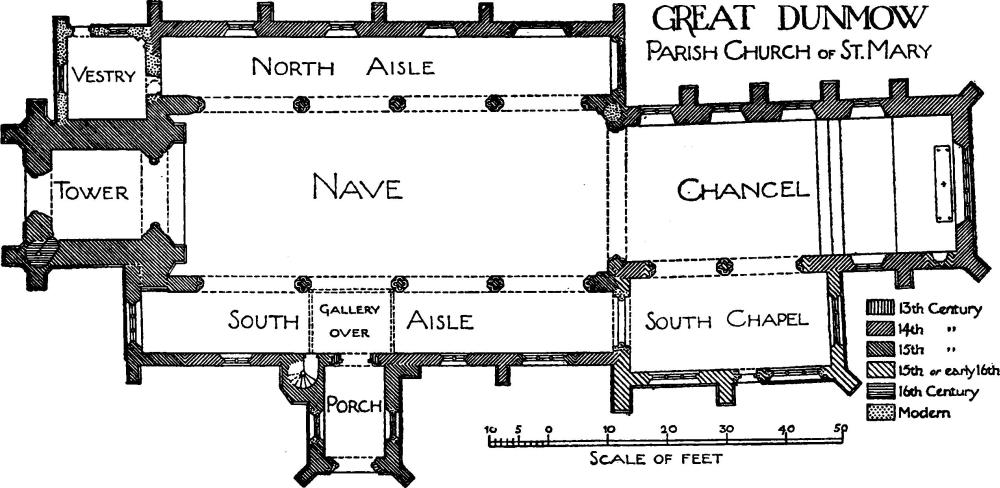
Great Dunmow, Parish Church of St. Mary
The South Aisle (10 ft. wide) has, in the S. wall, three windows; the easternmost is of the same date and character as those in the S. chapel, and has been much restored; the second window of c. 1350, much restored, is of two cinquefoiled lights with tracery in a two-centred head; the splays have attached shafts with moulded capitals and bases, and the hollow-chamfered rear arch has a moulded label; the third window is similar to the second, but less restored, and the splays and rear arch are moulded. Between the two western windows is the late 13th-century S. doorway, re-set, and partly restored; the richly moulded arch is two-centred, and the jambs have each an attached shaft with a moulded capital and base; the labels are moulded. Further W., opening into the staircase of the porch-chamber, is a 15th-century doorway with moulded jambs and four-centred head. In the W. wall is a window similar to the easternmost window in the S. wall, much restored.
The West Tower (15 ft. square) is of three stages with square buttresses which have splayed angles, and are carried up as small embattled turrets; the parapet is embattled and the S.W. stair-turret has been almost entirely filled in; the upper part of the S.W. angle was rebuilt in brick and stone early in the 16th century; on the E. wall of the tower is the weathering of the former roof of the nave; the S.E. buttress is joined to the S. arcade of the nave by a splay of re-used 14th-century material, finished at the head by a half-arch of two moulded orders, springing from a moulded head-corbel on the W. side. The 15th-century tower-arch is moulded and two-centred; the moulded responds have each an attached shaft with a moulded capital and base. The 15th-century W. doorway has moulded jambs and two-centred arch in a square head with traceried spandrels, each containing a plain shield; the moulded label has modern head-stops; the three-centred rear arch is moulded. Above the doorway, outside, is a range of thirteen square panels alternately, cusped and quatrefoiled, divided by narrow panels with trefoiled heads, and each containing a shield, formerly charged with arms, now plain. The W. window is also of the 15th century, much restored, and of three cinquefoiled lights with tracery in a two-centred head; the moulded label has head-stops; the splays and rear arch are moulded. The N., S. and W. walls of the second stage have each a window of two trefoiled lights in a two-centred head with a moulded label and grotesque stops; in the E. wall, below the roof of the nave, is a loop. The bell-chamber has, in each wall, a window of three cinquefoiled ogee lights with tracery in a square head, and a moulded label, all much restored; the tracery has been blocked, and the E. and W. windows have each one blocked light.
The South Porch (15½ ft. by 10 ft.) is of the 15th century, and has an upper chamber approached by a stair-turret at the N.W. angle. The walls have a moulded plinth, and at the angles are panelled and crocketed pinnacles. The outer entrance is modern except the inner part of the moulded responds and two-centred arch, and the moulded external label with head-stops. The E. and W. walls have each a window of two cinquefoiled lights with tracery in a square head, all modern, except part of the shafted internal splays and the moulded external label with head-stops. The upper chamber is open on the N. side to the gallery in the S. aisle. In the S. wall is a window entirely modern, except part of the moulded W. jamb and the moulded label with angel-stops. In the W. wall is a window of three cinquefoiled lights with tracery under a square head, externally modern, except the moulded label with head-stops.
The North West Vestry is modern, but in the W. wall is a window incorporating some 15th-century tracery, with a moulded label and head-stops, also of the 15th century, re-set.
The Roof of the chancel is of the 14th century and of the trussed-rafter type. The flat-pitched roof of the S. chapel is of four bays, and probably of the 16th century; the tie-beams, purlins and ridge are moulded. The roof of the nave is said to be partly of 1776, but the eastern half is possibly of the 17th century; it is flat pitched with plain timbers; five stone corbels on the N. side and two on the S. side are of the 15th century, and have carved heads and moulded abaci. The flat pent-roof of the N. aisle is of the 15th century, except the three E. bays, which are modern; the principals and purlin are moulded. The flat pent-roof of the S. aisle is of four bays and of the 15th century; it has moulded purlins and principals with curved brackets, some of them have traceried spandrels; two corbels are old and carved with grotesque faces. The 15th-century roof over the gallery is continued over the porch-chamber, and is of flat pitch with a moulded ridge and cambered tie-beam. The ground stage of the tower has 15th-century moulded wall-plates and ceiling-beams with carved bosses at the intersections; the moulded stone corbels are carved with heads. The S. porch has moulded wall-plates and at the N. end a moulded beam with curved brackets, and moulded and carved head-corbels, all of the 15th century.
Fittings—Bells: six; 1st by John Darbie, 1671; 2nd without inscription or date; 3rd by John Darbie, 1673; 4th by John Darbie, 1674; 5th by Robert Oldfield, 1613. Bracket: In nave— over middle column of N. arcade, chamfered. Brasses and Indents. Brasses: In S. aisle—on S. wall, (1) to John Huthersaul, 1604, inscription only; on W. wall, (2) of William Glascock, 1579, and Philippa his wife, woman's figure, and two shields, indents of man's figure and two inscription plates. Indents: In chancel—of elaborate cross and defaced marginal inscription, early 14th-century; (see also Monuments.) Chairs: In chancel —three, two with inlaid and carved backs, curved arms, carved rails, carved and turned legs, early 17th-century; third chair, similar to the others but not inlaid, mid 17th-century. Coffin lids: In chancel—(1) with double hollow-chamfered edge and defaced indent of brass cross, c. 1300. In churchyard—S. of church, (2) with double hollow-chamfered edge, 13th-century. Doors: In S. doorway—of two folds, with vertical panels, nail-studded frame and muntins, strap-hinges, probably 16th-century; in lower doorway of staircase to porch, of one studded batten, 15th-century, frame modern; in upper doorway, of oak battens, probably 15th-century. Font: In S. aisle—disused, octagonal bowl with panelled sides; alternate sides shorter than the others, and with projecting buttresses; traces of mortices of former staples, 15th-century, much defaced. Gallery: (see Plate p. 119) In S. aisle—over third bay with entrance on S. side, from porch, supported by two large moulded posts close to columns of arcade, and by moulded cross-beams with curved brackets; side beams moulded, and roof supported on plain posts; on E. and W. sides screen-work with close lower panels, E. side with open upper lights having moulded mullions and modern tracery, late 15th-century; N. front, W. side and some posts supporting roof, modern. Glass: In S. chapel—in tracery of E. window, two shields of arms, (a) partly fessewise ermine and ermines a lion countercoloured, for Killingmarch, impaling in the upper quarter gules a fesse argent between three water-bougets argent (reversed) 15th-century, lower part modern; (b) Bourchier, 15th-century; above shield (b) a crown, 16th or 17th-century; in two windows in S. wall, eleven Flemish panels with figures of apostles, early 18th-century. In N. aisle—in tracery of E. window, foliage, probably 15th-century; in second window in N. wall, in both lights, heads of canopies, 14th-century; in tracery of third window, fragments of medallion with figure of Christ, 15th-century; in both lights, fragments of heads of canopies, 15th-century. In S. aisle—in tracery of eastern window in S. wall, six Flemish panels with figure subjects, early 18th-century; in second window, miscellaneous fragments, including tabernacle work, a shield, argent on a cross gules with five fleur de lis or thereon for Tilty Abbey, 15th-century; parts of figures, a shield with the arms of the Trinity, a quarry with an eagle, a cutting from a plant and the initials I and E. (probably for John and Elizabeth Cutte), a muzzled bear, all 15th or 16th-century; shield of arms, 17th-century, and two heads of canopies, 14th-century, in situ; in tracery, a shield of arms dated 1635; in W. window of aisle, in tracery, six Flemish panels with figure subjects, early 18th-century. In parvise—in W. window, fragments of foliage, 15th-century. In N.W. vestry—in N. window, three ornamental quarries, probably old; in W. window, two fragments, 15th-century, and two Flemish panels with figures, early 18th-century. Monuments and Floor-slabs. Monuments: In chancel—on S. wall, (1) to Sir John Swynnerton Dyer, baronet, 1701, marble tablet with Ionic columns, entablature and achievement of arms. In S. chapel—on E. wall, (2) to Mary (Wiseman) wife of Thomas Cullum, 1662, framed canvas panel painted with shield of arms and inscription. In N. aisle—on N. wall, (3) of Elizabeth (Smith) wife of Francis Vassall, 1652, marble tablet with small figure of woman at the top. In churchyard— S. of the church, headstones, (4) to Jonas Guyver, 1663; (5) to John Taylor, 1713; (6) to Thomas Ball, 1682. Floor-slabs: In chancel—against N. wall, (1) to 'Elenor,' wife of Charles Jennyns, 1645, Purbeck marble slab, inscription on small slab set in wall; (2) to Anne (Belitha) wife of Sir .... 'Swinnerton' Dyer, 1714, with shield of arms; (3) to Sir John Swynnerton Dyer, baronet, 1701, and his wife, 1727, with shield of arms. Niches: (See also Piscina). In porch-chamber—in E. wall, wide middle niche with semi-octagonal shaft, forming pedestal, having moulded base and capital and with cinquefoiled ogee head surmounted by semi-octagonal embattled turret, flanked by two pairs of smaller niches, in two tiers, all with cinquefoiled heads, upper tier with crocketed labels and finials, 15th-century, not in situ. On S. porch—flanking outer entrance, two, each with moulded pedestal and jambs, trefoiled ogee head with crockets and moulded soffit, 15th-century. Piscina: In chancel—double, with shafted jambs, moulded bases and capitals, central shaft missing, two pointed heads with quatrefoil in spandrel, three small niches above it, two circular drains, 14th-century, much damaged and label hacked away. Plate: includes silver-gilt cup and stand paten, without marks, 17th-century, and silver-gilt standing dish of 1709. Sedilia: In chancel—triple, with octagonal shafts and shafted jambs, all with moulded bases and capitals, two-centred moulded heads, 14th-century, much damaged, and labels hacked away. Stoups: external, on tower—S. of W. doorway, with trefoiled ogee head, crockets and vaulted soffit, remains of basin: on S. porch—below niches, two, similar to that on tower, with remains of round basins, 15th-century. Miscellanea: On buttresses of S. porch, two Crosses, in circles, incised, with spandrels, 15th century.
Condition—Good.
Secular
c (2). Clock House, at the N. end of the causeway, 370 yards S.W. of the church, is of three storeys with attics; the walls are partly of brick, and partly of plastered timber-framing; the roofs are covered with tiles. It was built probably c. 1600; at the back is a modern kitchen wing.
The front of the house is a good example of late 16th or early 17th-century brickwork, with original windows and gables.
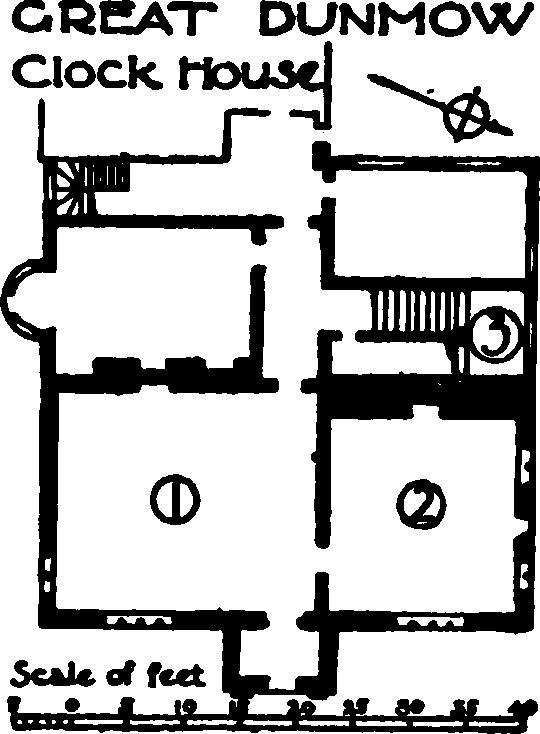
Great Dunmow, Clock House
On the E. Front, at each end, is a curvilinear gable with moulded brick coping and ball finials. The storeys are divided by moulded brick stringcourses; at the base is a moulded plinth. In the middle is a projecting porch of one storey with an inner and an outer entrance, each having a semi-circular head and moulded jambs, all plastered and painted; the outer entrance is flanked on each side by a pilaster with a moulded base and capital supporting an entablature; all the windows are original, except possibly that above the porch; they have moulded brick jambs, heads, mullions and transoms, all plastered and painted; the window in each gable is surmounted by a small moulded brick pediment. The two rainwater pipes are possibly original, and have ornamental fasteners and remains of cresting; one has the initials E.W. Over the middle of the roof is a square timber turret containing an old clock, and with an octagonal cupola in which is a bell said to be inscribed " Bryan Eldridge 1651." On the E. half of both the N. and S. Elevations are string-courses, windows (three now blocked), and a curvilinear gable similar to those on the E. front. On the N. elevation is a rainwater pipe and head, possibly original, the head has a lion passant on a cap of estate. On the S. elevation, above a modern bay window, is a 17th-century carved female bust, of wood. On the W. Elevation there are two original windows with moulded wood mullions. Some of the windows retain original diamond glazing, and ornamental casement fasteners. There are two original chimney-stacks with octagonal shafts.
Interior—The Hall (see plan) (1) has two original moulded ceiling-beams with elaborately moulded stops at their intersection; the moulded wood cornice is of c. 1700. Opposite the entrance is a doorway of c. 1700, with a semi-circular head, fluted pilasters and a moulded entablature. Over the fireplace is a mirror, flanked on each side by a narrow panel of carved scroll-work of 17th or early 18th-century date. The room N. of the hall (2) has a moulded wood cornice of c. 1700. On the first floor are two panelled cupboard-doors, and a moulded door-frame of c. 1600. On the second floor is a fireplace of the same date, partly altered, with a four-centred head, and one room is lined with panelling, re-set and painted. In the attic is a small original panelled door. The staircase up to the first floor (3) is of late 17th-century date, and of the dog-leg type, with turned balusters, moulded string and handrail; the string is carved with a pelican crest, and scroll-work; the newels are plain, and haveball-tops; the walls have a panelled dado, carved with scrolls and pendent foliage.
Condition—Poor; the N.E. corner and gables endangered by heavy ivy.
b (3). Bigods, house, summer-house, barns and garden walls, about 1 m. N. of the church. The House is of two storeys with attics; the walls are of brick and plastered timber-framing; the roofs are tiled. It was built late in the 16th century of brick, but the original plan is doubtful; in the 17th century a N. wing was added, and there are extensive modern additions on all sides, except the S.E., where the original part has been re-faced with modern brick.
On the N.W. Elevation, an original brick gable with moulded coping shews above the later additions; in it is an original window of three lights with moulded and plastered jambs and mullions, and a square head under a pointed and moulded label; an original chimney-stack has three attached octagonal shafts with moulded heads and bases. In the N. wing is a 17th-century chimney-stack with grouped shafts. Little original work is now visible inside the house, except some old ceiling-beams in the kitchen, and a fireplace with the remains of a chamfered head in a room on the first floor.
The Summer-house, about 80 yards S.W. of the house, is of two storeys; the walls are of brick and the roofs are tiled. It was built late in the 16th century. The N.E. Front has a curvilinear gable with a moulded brick coping; in the gable is a raised lozenge carved with a quatrefoil. In the upper storey, a doorway, reached by a short flight of steps, has a semi-circular head with moulded imposts; on each side is a pilaster with a stone capital and base standing on a panelled base, which is carried on a moulded string-course; above the pilasters is a moulded architrave and cornice of cemented brick. On the S.E. Elevation, on the first floor, is a doorway, above which is a window of three lights, with moulded mullions, now partly blocked. On the other two Elevations are similar windows, now blocked.
Three Barns, near the house, are of the 17th century. Two of them are timber-framed and weather-boarded, and have thatched roofs; the third is built of brick, partly modern.
The Walls in the garden are of old brick.
Condition—Of house, summer-house, barns and walls, fairly good.
Homestead Moats
e (4). At the site of Clopton Hall, 1 ½ m. S.S.W. of the church.
f (5). 3 ½ m. S. of the church, and 100 yards N. of Mudwall Farm.
f (6). 150 yards W. of Mudwall Farm.
c (7). At the site of the Old Parsonage, 600 yards N.W. of the church.
c (8). At Marks, nearly ¾ m. N.E. of the church.
d (9). Minchin's Farm, house and moat, about 1½ m. S.W. of the church. The House is of two storeys; the walls are timber-framed and plastered, and the roofs are tiled. It was built probably in the 16th century on a half-H-shaped plan with the wings extending towards the N. In the 17th century a small staircase projection was inserted between the N.W. wing and the main block, and there is a modern addition between the wings.
At each end of the S. front the upper storey projects and has, at the W. end, a moulded bressumer. Inside the building, on the ground floor is an old door of moulded battens. The 17th-century oak staircase has a moulded rail, twisted balusters, and square newels. On the first floor is an old panelled door, and one fireplace is original and has a segmental head of plastered brick.
The E. arm of the Moat has been almost completely destroyed. The island is bisected from E. to W. by a dry ditch.
Condition—Of house, good.
d (10). Tanner's Farm, house and moat, about 2 m. S.W. of the church. The House is of two storeys; the walls are timber-framed and plastered, and the roofs are tiled. It was built late in the 16th century, but has a modern addition at the E. end. At each end of the original N. front the upper storey projects. Some old casement windows remain. Inside the building are some exposed ceiling-beams.
The Moat is incomplete.
Condition—Of house, fairly good.
e (11). Martels, house and moat, about 2 m. S. of the church. The House is of two storeys; the walls are timber-framed and plastered, and the roofs are tiled. It was built late in the 16th or early in the 17th century on a half-H-shaped plan with the wings extending towards the S.W. Inside the building are some exposed ceiling-beams, and in one room is some original oak panelling.
The Moat is incomplete.
Condition—Of house, good.
d (12). Brands, house and moat, about 2½ m. S.W. of the church. The House is of two storeys; the walls are timber-framed and plastered; the roofs are tiled. It was built, probably c. 1630, on an L-shaped plan with the wings extending towards the E. and N. and with a slightly projecting cross-wing at the end of the E. wing. On the S. front the upper storey projects at the end of the cross-wing; W. of the wing is a doorway with a wooden cornice supported by brackets and carved with the date 1630 and the initials R.M. Inside the building are exposed ceiling-beams and joists.
The Moat is incomplete.
Condition—Of house, fairly good.
d (13). Barnston House and moat, about 3 m. S.S.W. of the church. The House is of two storeys; the walls are timber-framed and tile-hung; the roofs are tiled. It was built probably in the 17th century.
The Moat partly surrounds the house.
Condition—Of house, good; much altered.
Monuments (14–46).
The following monuments, unless otherwise described, are of the 17th century and of two storeys; the walls are timber-framed and plastered, and the roofs are tiled or thatched. Some of the buildings have exposed ceiling-beams, wide fireplaces and original chimney-stacks.
Condition—Good, or fairly good, without exception.
High Street, N.E. side
c (14). The Three Tuns Inn, about 300 yards W. of the Town Hall, has a small wing at the back. The original chimney-stack has grouped diagonal shafts, partly rebuilt. Inside the building, on the ground floor, a partition is partly lined with 17th-century paneling.
c (15). House, 20 yards W. of the Town Hall, is of two storeys with attics, and has modern additions at the back.
c (16). The Town Hall, at the S.E. corner of Star Hill, was built probably in the 16th century, but the upper storey has been entirely rebuilt. On the W. and S. fronts the upper storey projects, and at the angle is supported by an original bracket.
c (17). The White Horse Inn, 60 yards S.E. of the Town Hall, is of two storeys with attics and cellars. It was built probably in the 16th century, and has modern additions at the back. The upper storey projects at the S.E. end, and probably projected originally on the N.E. side.
S.W. side
c (18). Cottage, about 300 yards S.S.W. of the Town Hall.
c (19). The White Lion Inn, house and outbuilding, W. of (17). The House is of two storeys with attics. It was built probably on an L-shaped plan with the wings extending towards the E. and S., but has modern additions on the W. side and at the back.
The Outbuilding stands at the back of the house.
c (20). The Saracen's Head Inn, 20 yards S.W. of the Town Hall, with modern additions at the back. Inside the building, on the ground floor, on a partition is some original panelling.
c (21). House, 50 yards W. of (19), is of two storeys with attics. It was built probably c. 1600 on an L-shaped plan with the wings extending towards the E. and S. On the N. front the upper storey projects, and has a moulded bressumer with two original moulded brackets. A chimney-stack, probably original, has a shaft with pilasters on a rectangular base with a moulded capping.
c (22). House, W. of (21), was built probably c. 1600, but is now entered from a modern building on the W. side. On the N. front the upper storey projects.
c (23). The Royal Oak Inn and outbuildings, 350 yards W. of the Town Hall. The House is of two storeys with attics and cellars and has a modern addition at the back.
The Outbuildings adjoin the back of the house, and form an L-shaped block, with the wings extending towards the N. and W.
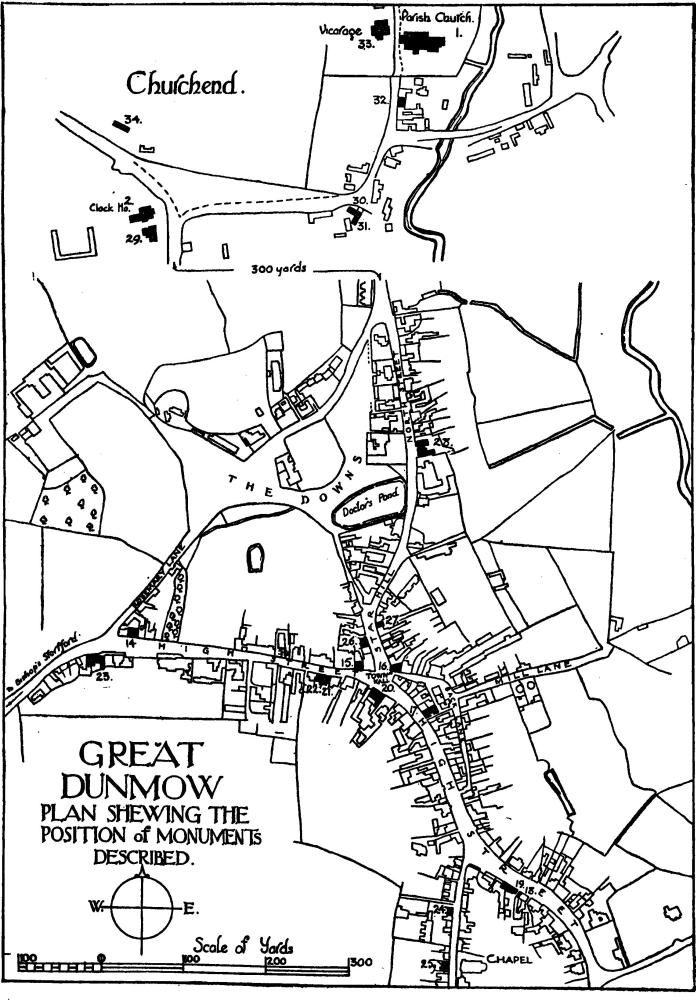
Great Dunmow, Plan Shewing the Position of Monuments Described.
New Street, W. side
c (24). Cottage, now two tenements, about 60 yards S. of the High Street, with modern additions at the back.
c (25). House, now a school, 50 yards S. of (23), was built on an L-shaped plan with the wings extending towards the S. and W.; at the back are modern additions. The original central chimney-stack has grouped diagonal shafts, partly rebuilt.
Star Hill, W. side
c (26). House, now shops, 30 yards N.W. of the Town Hall, was built probably in the 16th century, but has been much altered. Inside the building, on the ground floor, is a moulded ceiling-beam, and in the upper storey is a rough king-post truss with four-way struts.
E. side
c (27). House, now partly a shop, 80 yards N. of the Town Hall, was built probably early in the 16th century, and has modern additions at the back. Inside the building, on the ground floor, are moulded ceiling-beams. On the first floor is a ceiling-beam supported by curved brackets on shaped and chamfered wall-posts.
North Street, E. side
c (28). The King's Head Inn, 300 yards N. of the Town Hall, was built, probably in the 16th century, on a T-shaped plan with the cross-wing at the N. end; at the back are modern additions. On the W. front the upper storey of the cross-wing projects; the central chimney-stack extends to the front wall, and has a small external recess forming a seat. Inside the building, on the ground floor, is an original fireplace with a moulded lintel. In the upper storey one room is partly lined with panelling of c. 1600, and in another room is a ceiling-beam encased with similar panelling. A rough king-post truss is visible in the roof.
The Causeway, W. side
c (29). The Limes, house, about 400 yards S.W. of the church, is of two storeys with attics. It has small modern additions at the back. On the E. front are three gables, and two old rainwater pipes of lead with moulded heads. The original central chimney-stack has grouped diagonal shafts, partly rebuilt, on a square base with a moulded capping. At the back is another original chimney-stack with a moulded capping. Inside the building, on the ground floor, one room contains some 16th-century linen-fold panelling, and some 17th-century panelling with a fluted frieze and moulded cornice. On the first floor is a large cambered tie-beam formerly supported by brackets, and in one room is some 17th-century oak panelling, partly restored. In the attics is an old panelled door.
c (30). House, now three tenements, 200 yards S. of the church, on the S. side of the Great Bardfield Road, was built, probably early in the 16th century, with a cross-wing at the E. end, and a wing extending towards the N. at the W. end. The cross-wing was extended towards the N. in the 18th century. The upper storey projects at both ends of the original cross-wing, and has a moulded bressumer at the N. end. Inside the building, a fireplace, possibly original, has a moulded lintel. In a room in the cross-wing is an original doorway with a four-centred head, now blocked. Another room has some panelling and two panelled doors of the 17th-century.
c (31). Cottage, S. of (30).
c (32). House, now two tenements, on the E. side of the road, about 80 yards S. of the church, is of two storeys with attics and cellars. It was built probably in the 16th century, but the W. front has been much altered. On the E. elevation are two gables; the upper storey projects, and has a moulded bressumer and carved brackets. Inside the building is a large moulded ceiling-beam.
c (33). The Vicarage, W. of the church, is of two storeys with attics. It was built in the second half of the 16th century on an L-shaped plan, with the wings extending towards the N. and W., and with another small wing on the S. side of the W. wing. In the angle between the main wings are modern additions. At the S. end of the E. front the timber-framing is exposed. Inside the building, on the ground floor, in the S.E. room are original moulded ceiling-beams with a moulded wall-plate, and a door made up of panelling of c. 1600. In another room is a cambered and stop-chamfered ceiling-beam, partly cut away, and supported by large curved braces; there is also a moulded wall-plate. On the first floor are original moulded ceiling-beams, and a panelled cupboard door of c. 1600. In the roof is a short piece of moulded timber, re-used.
c (34). Cottage, now two tenements, about 350 yards W.S.W. of the church, on the N. side of the road, with a small modern addition at the W. end.
c (35). Cottage, now two tenements, on the S. side of Parsonage Down, about 600 yards W.S.W. of the church, was built, probably in the 15th century, possibly with a cross-wing at both the E. and W. ends, but only the W. cross-wing remains. The upper storey projects at the N. end of the cross-wing. Inside the building, in the main block on the ground floor, are two embattled and moulded ceiling-beams; above the fireplace is a moulded beam.
c (36). Lower Hall, about ½ m. N.N.W. of the church, was built on a modified L-shaped plan with the wings extending towards the W. and S. The additions on the N. side are modern.
b (37). Maples Farm, about 1 m. N.N.E. of the church, with a modern addition on the W. side.
c (38). Oldhouse, about 1 m. N.E. of the church, on the S. side of the road, was extended towards the E. in the 18th century. Inside the building, over an original fireplace, is a moulded beam.
c (39). Cottage, now two tenements, about ¾ m. N.E. of the church, on the E. side of the road, with modern additions on the N. side and at the E. end. The original central chimney-stack has a shaft with diagonal pilasters.
c (40). Toolies, house, about 1¼ m. E. of the church, is of two storeys with attics. It was built on an L-shaped plan with the wings extending towards the S.E. and N.E. There are modern additions on the N.E. and N.W. sides. Inside the building, one room is partly lined with 17th-century panelling.
c (41). Gatehouse, now three tenements, about 1¼ m. S. of the church, on the S. side of the road, was built on an L-shaped plan with the wings extending towards the W. and S., but has a modern addition on the E. side. The original central chimney-stack has grouped diagonal shafts.
c (42). Clopton's Farm, house and remains of moat, about 1½ m. S. of the church. The House was built on an L-shaped plan with the wings extending towards the S. and W. A modern addition makes the present plan quadrangular. On the E. front the upper storey projects. There are two gables at the end of the W. wing.
c (43). Buttles Farm, about 2 m. S.S.E. of the church, with an 18th-century addition at the back.
f (44). Little Garnetts, house, about 3½ m. S. of the church, on the S. side of the road, with modern additions on the N. and W. sides.
d (45). Cottage, now two tenements, about 2¼ m. S.S.W. of the church.
d (46). Cox Hall, cottage, at Philpot End, about 2¾ m. S.S.W. of the church, on the N. side of the road, with modern additions on the N. and W. sides.