
An Inventory of the Historical Monuments in Essex, Volume 1, North West. Originally published by His Majesty's Stationery Office, London, 1916.
This free content was digitised by double rekeying. All rights reserved.
'Hempstead', in An Inventory of the Historical Monuments in Essex, Volume 1, North West, (London, 1916) pp. 157-161. British History Online https://www.british-history.ac.uk/rchme/essex/vol1/pp157-161 [accessed 27 April 2024]
In this section
40. HEMPSTEAD. (C.b.)
(O.S. 6 in. (a)x. N.W. (b)x. S.W.)
Hempstead is a parish and small village about 6 m. E. of Saffron Walden.
Ecclesiastical
a (1). Parish Church of St. Andrew stands on the E. side of the village. The walls are of flint rubble, with dressings of limestone and clunch, except the E. wall and those of the N. chapel and vestry, which are of brick. The roofs are covered with tiles. The Nave, with N. and S. aisles, was built c. 1350. In the 15th century the Chancel was probably rebuilt, and the West Tower was added. In the 16th century the E. end of the chancel was rebuilt in brick. In the 17th century the North Chapel and Vestry were added. Late in the 19th century the W. tower fell, and the church was generally restored in 1887, when the chancel-arch and tower-arch and the North and South Aisles were rebuilt, and the South Porch was added.
The 17th-century lead coffins, with modelled faces, in the Harvey vault, are remarkable.
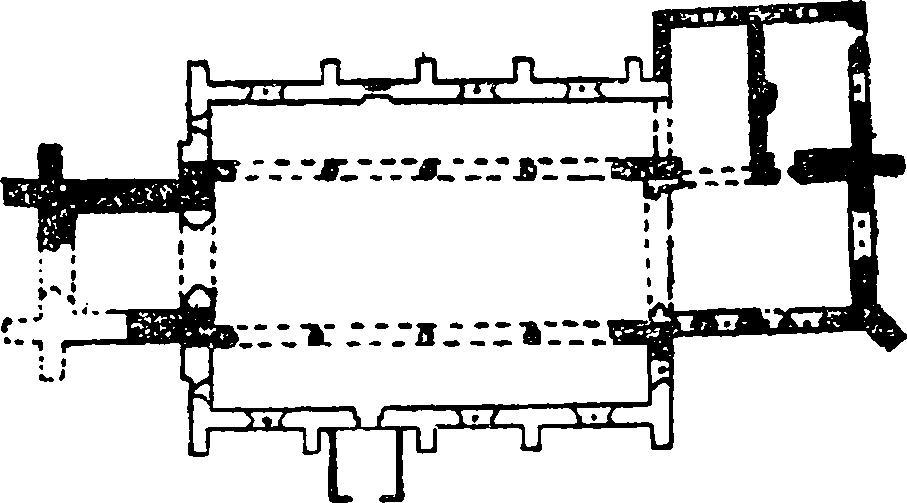
The Church, Plan
Architectural Description—The Chancel (22¾ ft. by 17 ft.) has a 16th-century E. window of three four-centred lights under a square head with a moulded external label; the mullions are modern. In the N. wall is a 17th-century doorway to the N. vestry with chamfered jambs and three-centred arch, all covered with plaster; further W. is a rectangular opening to the N. chapel. In the S. wall are three windows; the easternmost window is of the 15th century, much restored, and of two cinquefoiled lights under a square head; the middle window is similar to the first, but the sill is carried down lower than the other; the westernmost window is modern, except part of the sill. Between the two eastern windows is a modern doorway. The chancel-arch is modern.
The North Vestry (17¾ ft. by 11¾ ft.) is entirely of the 17th century. In the E. wall is a window of two plain pointed lights with a moulded external label; further N. is a doorway with chamfered jambs and depressed arch. In the N. wall is a window similar to that in the E. wall, but without a label.
The North Chapel (17¾ ft. by 10¾ ft.) is entirely of the 17th century, and has, in the N. wall, a window of three lights, similar to that in the N. wall of the vestry; the mullions and sill are modern. In the W. wall is a modern arch.
The Harvey Vault, under the N. chapel and vestry, has in the E. wall and in the N. wall, a 17th-century window with chamfered jambs and square head.
The Nave (56 ft. by 19 ft.) has 14th-century N. and S. arcades each of four bays, with two-centred arches of two moulded orders, and moulded labels in the nave; the columns and responds have clustered shafts with moulded capitals and bases.
The North Aisle (8 ft. wide) is modern, but the three windows in the N. wall have moulded rear arches, possibly of 14th-century material, re-cut. Between the two western windows is a 14th-century doorway, now blocked, with jambs and two-centred head of two moulded orders, slightly restored; the rear arch is moulded. In the W. wall the modern window has a moulded rear arch and external label of the 14th century.
The South Aisle (8 ft. wide) is modern, and has, in the E. wall, a window of two lights, all modern, except the sill and bases of the moulded jambs and mullion, which are of the 14th century. The three windows in the S. wall and the one in the W. wall are uniform with those in the corresponding walls of the N. aisle. The S. doorway is uniform with the N. doorway but is not blocked.
The West Tower (about 14 ft. by 13 ft.) fell down in the 19th century, and only the plinth of the N. wall, the base of the right-angled N.W. buttresses, and part of the N. jamb of the W. door now remain above ground. The moulded plinth has flint chequer-work panels. The tower-arch is modern and is blocked. The 15th-century jamb of the W. doorway is of two moulded orders; near it, above the plinth, is one trefoiled ogee-headed panel with a shield, ermine a cheveron engrailed, probably for Winslow. A large quantity of worked stones from the fallen tower are now stored in the Harvey vault and include a carved gargoyle and three panels similar to that still in situ; the shields bear (a) a fesse with a label of three points; (b) the same with a ring on the centre point of the label; (c) blank.
The Roofs of the N. vestry and N. chapel are flat and each has a 17th-century chamfered beam. The ceiling of the Harvey vault has a large stop-chamfered beam and plain joists of the 17th century.
Fittings—Bells: five and sanctus; sanctus now in vestry, 5th lying in churchyard, rest in wooden shed in churchyard: 1st by Anthony Bartlet, 1664; 3rd by John Tonne, 16th-century, inscribed "Barbara sirenum melos dulcedine vinco"; 4th by John and Christopher Hodson, 1678; 5th by Stephen Tonne of Bury St. Edmunds, 1575; sanctus dated 1662. Brasses and Indents. Brasses: In N. chapel—(1) said to be of [Thomas Huntingdon, 1498, and Margaret (Tyrrell) his wife,] figure of man in plate armour and woman in pedimental head-dress, four shields (a) fretty a chief with three molets thereon, for Huntingdon; (b) Huntingdon impaling two cheverons and a border engrailed with a cinquefoil for difference, for Tyrrell; (c) Huntingdon quartering 1 and 4 nine crosslets fitchy, 2 and 3 a cheveron and a quarter with a lion therein; (d) Huntingdon impaling Tyrrell quartering 2 and 3 three scutcheons, 4 barry wavy a chief; indent of inscription. In nave—(2) of civilian and wife, c. 1530, with two groups of children and indent of inscription; (3) of civilian, c. 1480, with indents of figure of wife and two groups of children; (4) to Richard Westley, 1518, and Joan his wife, inscription only; (5) of civilian and wife, c. 1475, with indent of inscription; (6) said to be of [William Mordaunt, 1518, and Anne (Huntingdon) his wife], large figure of man in fur-trimmed cloak, group of ten sons, indents of figure of wife, group of daughters and four shields. Indents: In nave—(1) of floriated cross, with animal at base, and marginal inscription; (2) of inscription plate; (3) of figures of man and wife c. 1480, two groups of children, and inscription plate. Chest: In vestry, of oak with three strap-hinges, angles strengthened by irons which pass through the angle-stiles, three locks, probably 16th-century. Doors: In chancel— in doorway to vestry, of battens with chamfered three-panel frame planted on, 15th or 16th-century, head probably 17th-century. In E. doorway of vestry—battened door with small drop-handle, solid leaded frame, 17th-century. Font: square tapering bowl, with corners cut off, on round central shaft and four small detached shafts, all with moulded capitals and bases, c. 1350. Monuments and Floor-slabs. Monuments: In N. chapel—against E. wall, (1) to members of the Harvey family—Eliab, 1661, Sarah his daughter, 1655, Elizabeth, another daughter, 1656; Mary his wife, 1673; Sir Eliab Harvey, 1698; Eliab, son of Sir Eliab, 1681; Elizabeth, wife of Edward Harvey, 1695; Matthew, son of Sir Eliab, 1692; Mary, daughter of the third Eliab, wife of Sir William Whitmore, baronet, 1710; large black and white marble monument with cleft pediment and cartouche of arms; (2) to Sir William Harvey, of Roehampton, 1719, and Bridgett (Browne) his wife, 1701, large white marble monument with a column and urn, in a recess, impaled coat of arms. In N. aisle—on N. wall, (3) of William Harvey, chief physician to James I and Charles I, discoverer of the circulation of the blood, 1657, black and white marble tablet with crest and cartouche of arms. Floor-slab: In chancel—to Margerie de Basingge with marginal inscription, early 14th-century. Coffins: In the Harvey vault, under the N. chapel and vestry—thirteen lead coffins with shaped heads and modelled faces of the following members of the Harvey family—Eliab, 1661; Mary, 1673; Sarah, 1655; Eliab, 1681; Dorothy, 1686; Matthew, first page of honour to William III., 1692; Elizabeth, 1659; 'Marey,' 1677; Mary, 1664; Elizabeth, 1695; Dorothea, 1691; E. H., 1686, and M. H., 1695. Panelling: In vestry—loose, remains of pew enclosure including carved pierced panels, moulded rail with turned finials, and panelled door with shaped balusters at the top, 17th-century. Piscinæ: In chancel—with chamfered jambs and head, restored in cement, 15th-century; further W., with chamfered jambs and segmental-pointed head, possibly piscina, 14th or 15th-century, head partly modern. In S. aisle—with double hollow-chamfered jambs and trefoiled ogee head, remains of foiled basin, c. 1350, much damaged. Plate: includes a cup of 1561, and a secular bowl of 1630, with repoussé ornament and a foiled edge and two handles. Seating: In N. chapel—tops of two bench-ends with crudely carved foliage finials, late 15th-century, made up with modern work. Miscellanea: In vestry—three stones carved with faces, probably from the 15th-century tower. In nave—at N.E. corner, funeral helm with the Harvey crest, 17th-century.
Condition—Good.
Secular
Homestead Moats.
a (2). 700 yards N.W. of the church, said to enclose the site of Wincelow Hall.
a (3). Near Lakehouse Farm, 1¾ m. E. of the church, apparently contained a smaller enclosure at the N.E. corner.
a (4). Hempstead Hall, house and moat, 1¾ m. E.N.E. of the church. The House is of two storeys with attics; the walls are of weather-boarded timber-framing; the roofs are tiled. It was built c. 1580, probably on an H-shaped plan with the cross-wings at the E. and W. ends. The E. wing has been rebuilt and has a large modern addition, and the W. wing has an 18th-century extension. In the middle block is a large original chimney-stack with two sunk panels, a moulded capping and four octagonal shafts, each with a moulded base and oversailing top. Inside the building, on the ground floor in the E. wing, is some early 17th-century panelling, re-set; and on the first floor is a panelled door of the same date. In the original chimney-stack in the middle block is a fireplace, probably original, with a three-centred head and chamfered jambs, now plastered and painted. In one room is a stop-chamfered ceiling-beam.
The Moat, S. of the present house, encloses an approximately L-shaped island, and is crossed on the N. side by a wooden bridge which retains some old curved braces.
Condition—Of house, good.
a (5). Church Farm, house and moat, 300 yards E.S.E. of the church. The House is of two storeys, the walls are of plastered timber-framing; the roofs are tiled. The plan is L-shaped, with the wings extending towards the W. and N. The W. wing is probably of early 17th-century date; the N. wing was added late in the 17th or early in the 18th century, and at the same time a small staircase projection was built in the angle between the wings. The date 1775 on the N. wing probably refers only to repairs or alterations. The original chimney-stack of the W. wing has grouped diagonal shafts on a square base with a moulded capping. Inside the building in both wings are exposed ceiling-beams. In the N. wing is a wide open fireplace containing an old jack.
The Moat is incomplete.
Condition—Of house, good.
Monuments (6–34).
The following monuments, unless otherwise described, are of the 17th-century and of two storeys, timber-framed and plastered; the roofs are tiled or thatched. Some of the buildings have exposed ceiling-beams, wide fireplaces and original chimney-stacks.
Condition—Good or fairly good, unless noted.
High Street, W. side
a (6). House, now two tenements, ¼ m. S.W. of the church, with modern additions on the N.W. side and at the N.E. end. The upper storey projects on the northern half of the S.E. elevation, and at the original N.E. end.
a (7). Cottage, now two tenements, 300 yards S.W. of the church.
a (8). House, now two tenements, 80 yards N. of (7), was built on an L-shaped plan with the wings extending towards the N.E. and S.E. There are modern additions on the N.W. side of the N.E. wing, and on the S.W. side of the S.E. wing. Inside the building, in the upper storey, is an original brick fireplace with a four-centred head surmounted by a moulded cornice.
a (9). The Crown Inn, 120 yards N.N.E. of (8), has a slightly projecting wing at the S.W. end of the S.E. side, and a modern addition at the back.
a (10). Cottage, 200 yards N.N.E. of (9), with modern additions at the N. and S. ends. The original chimney-stack has a modern shaft on an original square base with a moulded capping.
Condition—Good, except thatch.
a (11). Cottage, now two tenements, 1/8m. N.N.E. of (10), with a modern addition at the back. Inside the building is an original battened door.
a (12). Cottage, now two tenements, 800 yards N.N.E. of the church, with a modern addition at the back.
a (13). Blagden Farm (see Plate, p. xxvii), house, ¾ m. N.E. of (12), was built in the second half of the 16th century, on a T-shaped plan with the cross-wing at the S. end. At the end of the N. wing and on the N. side of the cross-wing are modern additions. The original central chimney-stack in the cross-wing has four octagonal shafts, modern at the top, on a square base with a moulded capping.
E. side
a (14). Ruses, house and two barns, 300 yards S. of (13). The House is of a modified L-shaped plan with the wings extending towards the N.W. and S.W. There is a modern addition on the S.W. side of the N.W. wing.
The Barns, N.E. and N.W. of the house respectively, are weather-boarded.
a (15). Cottage, now three tenements, 350 yards S.W. of the church.
a (16). Cottage, 60 yards S.W. of (15). Inside the building is an original fireplace with a three-centred head and chamfered jambs.
Condition—Bad.
b (17). Cottage, about ¾ m. S.S.W. of the church. Condition—Fairly good, except thatch.
a (18). Cottage, now three tenements, 80 yards S.S.W. of the church, with a modern addition at the S.W. corner. Inside the building is a 17th-century panelled door, with small balusters in the top panel.
a (19). House, opposite (18), was built on an L-shaped plan with the wings extending towards the S.E. and N.E. There are modern additions on the N.W. side. On the S.W. front the upper storey projects and has curved and chamfered brackets. The original central chimney-stack has grouped diagonal shafts on a rectangular base with a moulded capping.
a (20). Cottage, 300 yards S.E. of the church, nearly opposite Church Farm, with a small modern addition at the E. end.
a (21). Pollards Cross Farm, house, 3/8 m. E. of the church, is of two storeys with attics. It was built in the second half of the 16th century on a modified L-shaped plan with the wings extending towards the W. and N. There are modern additions on the W. side and at the end of the N. wing. The doorway to one of the modern additions has an original door of moulded and studded battens, with a drop-handle and strap-hinges with ornamental ends, re-hung. In the S. wall is an original window of four lights with moulded oak mullions and transom. The original chimney-stack has four tall shafts with moulded bases and modern at the top; on one side of the rectangular base is a sunk panel with chamfered edges.
Inside the building on the ground floor, are two original moulded wall-plates. and an original fireplace with a four-centred arch and moulded brick jambs. On the first floor are two similar fireplaces; one of them has a moulded shelf, and a partition of old panelling now covered with paper. There are several late 16th or early 17th-century panelled doors, two with carved frieze-panels.
a (22). Boyton's Farm, house and barn, ½ m. N.E. of the church. The House was built in the 16th century on an L-shaped plan with the wings extending towards the S.W. and S.E. On the N.E. elevation is an original projecting chimney-stack with remains of grouped diagonal shafts. Inside the building, in the S.E. wing, on both floors are original moulded ceiling-beams, and on the ground floor are wall-posts with moulded capitals. There are two original fireplaces, each with a four-centred head; one fireplace has moulded and the other has chamfered jambs. An original doorway has a four-centred head, and there are several original battened doors with large straphinges. In the N.E. wall are two original windows, now blocked, and each of three lights with moulded mullions.
The Barn, N.E. of the house, is of seven bays with two projections and an aisle. The walls are of weather-boarded timber on a foundation of 17th-century brick.
a (23). Cottage, at Cabbage End, about 1,600 yards E.S.E. of the church.
a (24). Philip's Farm, house, 300 yards E. of (23).
a (25). Field's Farm, house, 500 yards S.W. of (24), with a modern addition at the E. end. The original chimney-stack has sunk panels and four octagonal shafts with moulded bases. Inside the building, on the ground floor, is a wall-post with remains of a carved projecting top. There are three original fireplaces with four-centred heads and chamfered jambs; two of them have raised hearths with moulded oak frames, and are each surmounted by a moulded shelf and a sunk panel. There are two original panelled doors and two battened doors, one with strap-hinges ending in fleurs de lis.
a (26). Lakehouse Farm, house, now two tenements, about 1¾ m. E. of the church, was built late in the 16th or early in the 17th century, but the S. end has been destroyed. There are modern additions on the E. side. The original S. chimney-stack has grouped diagonal shafts on a square base with a moulded capping. Inside the building, on the ground floor, in the N. room is a wall-post with a slightly ornamented top.
a (27). Little Bulls Farm, house, nearly 2 m. N.E. of the church, was built early in the 17th century; there is an addition, possibly of later 17th-century date, at the N. end of the E. side. The S. end of the house and part of the N. side have been refaced with modern brick. On the W. and N. elevations of the original block the timber-framing is exposed and has brick nogging, apparently original.
a (28). Bulls Bridge Farm, house, ¼ m. N.E. of (27), is of two storeys with attics. The roofs are covered with slate. The additions on the N. side and at the E. end are modern.
a (29). Cottage, 800 yards N.N.E. of (13). The original chimney-stack has grouped diagonal shafts on a rectangular base with a moulded capping; attached to the angle-shafts are small coped pilasters.
Condition—Poor.
a (30). Cottage, 700 yards N.W. of (13).
a (31). Spitland, house, ¾ m. N. of the church, with a modern addition at the W. end.
Condition—E. part, bad.
a (32) and (33). Howland's Cottages, two, 400 yards E. of (31).
a (34). Witchtree. house, 1,100 yards N.N.E. of the church, was built in the 16th century, but has a modern slate roof. On the N.E. front part of the upper storey projects, and is supported on an original moulded beam. Inside the building, on the ground floor, are two wall-posts with moulded capitals.
Unclassified
a (35). Mound, at the junction of three roads in the village.
Condition—Fairly good.