
An Inventory of the Historical Monuments in Essex, Volume 4, South east. Originally published by His Majesty's Stationery Office, London, 1923.
This free content was digitised by double rekeying. All rights reserved.
'Chadwell', in An Inventory of the Historical Monuments in Essex, Volume 4, South east, (London, 1923) pp. 24-25. British History Online https://www.british-history.ac.uk/rchme/essex/vol4/pp24-25 [accessed 23 April 2024]
In this section
14. CHADWELL. (C.e.)
(O.S. 6 in. lxxxiv. S.W.)
Chadwell is a parish 2 m. E. of Grays Thurrock. The church is the principal monument.
Roman
(1). In Messrs. Christian and Neilson's gravel-pit, 700 yards S.E. of the parish church, an oven (Plate, p. xxxvi) was found in July, 1922, together with several urns. The oven had apparently been circular and domed, with a diameter of over 5 ft. A flue projected from it for a distance of at least 4 ft. and was 1 ft. 3 in. wide. When the structure was discovered three complete vessels were found within it, and others, more or less fragmentary, together with a decorated clay lamp, were found in the same area. The pottery, which is now in the Colchester Museum, presents unusual features, but most of it is probably of 3rd to 4th-century date. Some of it retains traces of Late Celtic traditions. There is no evidence that it was made on the present site; the purpose for which the oven was originally used was not apparent.
Roman coins of all dates have been found in the parish, and a site about 100 yards E. of the oven has yielded a large quantity of Samian sherds, mostly of late 1st or early 2nd-century date, including a large number of stamps. No traces of buildings were, however, noticed.
Ecclesiastical
(2). Parish Church of St. Mary stands in the village. The walls are of flint-rubble with some ragstone; the dressings are of Reigate stone; the roofs are tiled. The Nave was built early in the 12th century and the western parts of the side walls of the Chancel are of the same date.
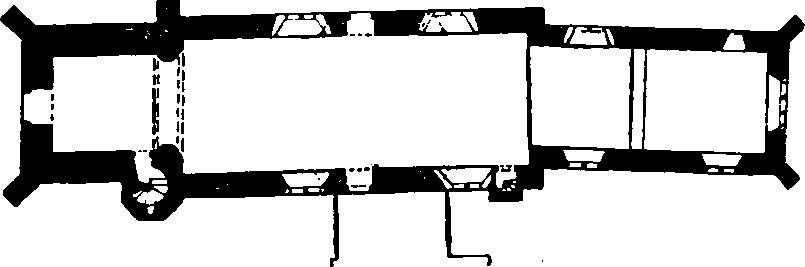
The Church, Plan
The chancel was lengthened in the 14th century. At the end of the 15th century the nave was lengthened towards the W., the rood-loft staircase inserted and the West Tower added. The church has been restored in modern times when the South Vestry was added.
Architectural Description—The Chancel (31 ft. by 13 ft.) has an E. window all modern except the 14th-century splays and rear-arch and part of the jambs. In the N. wall are two windows, the eastern of the 14th century and of one trefoiled light; the western window is modern. In the S. wall are two windows, each of two cinque-foiled lights with tracery in a two-centred head and probably of the 14th century but covered with paint. There is no chancel-arch.
The Nave (44¼ ft. by 17¼ ft.) has in the N. wall two modern windows; between them, set within the 12th-century one, is the early 15th-century N. doorway with moulded jambs and two-centred head; above it is the round head of the 12th-century doorway with diapered voussoirs and a diapered tympanum of small stones (Plate, p. 84); both E. and W. of the doorway is a blocked 12th-century window with a round head; the western is visible only internally. In the S. wall are two windows both modern except the 14th-century rear-arch of the first and the splays and rear-arch of the second; between them is the 12th-century S. doorway of one plain round order enclosing a plastered tympanum supported on a segmental arch; there are two blocked 12th-century windows similar to those in the N. wall; at the E. end of the wall is the 15th-century rood-loft staircase with upper and lower doorways having three-centred heads.
The West Tower (12½ ft. square) is of late 15th-century date and of three stages with an embattled parapet decorated with brick and flint chequerwork. The two-centred tower-arch is of three chamfered orders, the outer continuous and the two inner resting on semi-octagonal responds with moulded capitals and chamfered bases. The W. window is of three four-centred lights in a segmental head with a moulded label; the W. doorway has moulded jambs, four-centred arch and label. The N. and S. walls of the second stage have each a single-light window, much weathered. The bell-chamber has in each wall a window of two four-centred lights and all in square heads except the W. window which has a four-centred head; all have moulded labels.
The Roof of the chancel has at the W. end some old trussed-rafters without collar-beams. The roof of the nave is ceiled but has some old shaped sprocket-pieces.
Fittings—Bells: Three; 1st probably by John Wood, 1694, badly broken; 3rd by Thomas Bartlet, 1628; bell-frame, 17th-century. Brass and Indent. Brass: In chancel—to Cicilye, wife of Thomas Owen, 1603, with shield-of-arms. Indent: Outside N. doorway—of figure, broken. Chair (Plate, p. xlii): In chancel—with carved back, shaped arms, moulded legs with carved rail and claw-feet, late 17th-century, probably French. Chest: In vestry—oak chest-of-drawers with panelled fronts and brass fittings, 17th-century. Door: In W. doorway—of moulded battens with strap-hinges, late 15th-century. Glass: In top and south tracery-lights of E. window, 14th-century fragments of borders, foliage and coloured glass. Monument: In churchyard—N.E. corner, to M.G., 1691, cut on a piece of sarsen stone. Niche: S. of W. doorway, externally, with trefoiled ogee head and rebated jambs with holes for fastenings, possibly stoup, 14th-century. Panelling: In chancel—in S.E. window-recess, eight 17th-century carved panels. Pictures: In chancel—two, "The Finding of Moses," ascribed to (?) Agostino Caracci, and "Christ at the House of Simon Peter," ascribed to Paul Veronese. Piscina: In chancel— with trefoiled head and sex-foiled drain, 14th-century. Sundials: On E. jamb of S. doorway and on quoin of S.E. angle of nave—two scratched dials. Table: In vestry—oval gate-leg table, 17th-century. Miscellanea: Used as quoin of S.E. angle of nave, part of head of 12th-century window.
Condition—Good, but stonework of tower much perished.
Secular
(3). Sleepers Farm, house 50 yards W.S.W. of the church, is of two storeys, timber-framed and plastered; the roof is thatched. It was built in the 15th century and has a cross-wing at the S. end and a modern extension at the W. The upper storey projects at both ends of the cross-wing and is supported on curved brackets. The central chimney-stack is of the 17th century. Inside the building some of the timber-construction is exposed and some of the rooms have open-timbered ceilings. There is an original doorway in the N. wall of the S. cross-wing with a four-centred head and now blocked by the inserted chimney-stack; a 17th-century battened door also remains. The original roof over the S. wing is of two bays with a heavy cambered tie-beam, curved braces and a king-post with four-way struts and there is an original cambered tie-beam with curved braces across the middle of the main block.
Condition—Good.