A History of the County of Stafford: Volume 9, Burton-Upon-Trent. Originally published by Victoria County History, London, 2003.
This free content was digitised by double rekeying. All rights reserved.
'Burton-upon-Trent: Public services', in A History of the County of Stafford: Volume 9, Burton-Upon-Trent, ed. Nigel J Tringham (London, 2003), British History Online https://www.british-history.ac.uk/vch/staffs/vol9/pp97-107 [accessed 30 April 2025].
'Burton-upon-Trent: Public services', in A History of the County of Stafford: Volume 9, Burton-Upon-Trent. Edited by Nigel J Tringham (London, 2003), British History Online, accessed April 30, 2025, https://www.british-history.ac.uk/vch/staffs/vol9/pp97-107.
"Burton-upon-Trent: Public services". A History of the County of Stafford: Volume 9, Burton-Upon-Trent. Ed. Nigel J Tringham (London, 2003), British History Online. Web. 30 April 2025. https://www.british-history.ac.uk/vch/staffs/vol9/pp97-107.
In this section
WATER SUPPLY
Medieval Pipes
The town may have had a piped water supply by the mid 13th century: James the 'conductor' (conductorius), then recorded as a witness in a Burton charter, was possibly a maker or supervisor of a conduit. (fn. 10) There was probably a conduit in the market place in 1431: Abbot Robert Ownesby paid for the stone work of a well (opus lapideum fontis) there that year. (fn. 11) The water may have been piped from Stapenhill: in 1436 Abbot Ralph Henley negotiated the laying down of lead pipes from a spring there to the river Trent; the pipes presumably then continued across the river bed into Burton. (fn. 12)
Wells
A 'common well' mentioned in 1632 and a 'common pump' mentioned in 1770 may also have been in the market place. (fn. 13) There was evidently no longer a common source of water by 1833, when the improvement commissioners noted the need for a public pump: because the water lay close to the surface, most people drew it from private wells. (fn. 14) The water was generally hard, and soft water from wells such as one at Bond End Farm had a market in the mid 19th century. (fn. 15)
Mains Supply
In the later 1850s and 1860s breweries began to take an increasing amount of water by means of deeper wells and artesian borings. (fn. 16) There was a consequent reduction in the supply available for domestic consumption, and in 1861 the improvement commissioners welcomed a proposal from the South Staffordshire Waterworks Co. to supply Burton with water from the company's main pipe at Streethay near Lichfield. (fn. 17) The company promoted the Burton-upon-Trent Water Act, 1861, which established the Burton-uponTrent Waterworks Co. for supplying water to Burton town, Burton Extra, Branston, and Horninglow, as well as other places south-west of Burton. (fn. 18) No progress was made, however, until 1863 when the South Staffordshire company took charge of the local com pany, and a water supply was duly connected in 1864. (fn. 1) An Act of 1866 vested the Burton company in the South Staffordshire company, whose area of supply around Burton was extended to Stapenhill and Winshill. The company, however, was forbidden to draw water within 7 miles of St. Modwen's church, evidently in order to protect local supplies for the breweries. (fn. 2) The cost to the company of maintaining the supply was especially burdensome because there was limited demand for water. Of the estimated annual consumption of 132,409,000 gallons in 1867, the breweries with some other trades drew most of their 80,000,000 gallons from private sources, leaving the company to supply only 480 houses out of a total of 3,873 in Burton town. (fn. 3) By 1876 the company supplied 928 houses with 20,323,000 gallons, but it failed to get a share of the 135,857,100 gallons then consumed by the breweries and because its customers were mainly domestic, it was obliged to charge high rates. (fn. 4)
Although the 1866 Act empowered the South Staffordshire Waterworks Co. to make a reservoir in Horninglow, it was not until 1882 that one was opened, at Outwoods on the high ground north of Shobnall Road. (fn. 5) By that date the company had connected 22 per cent of houses in the borough, its share increasing to 30 per cent by 1892, with a further 17 per cent supplied from stand-pipes. Most of the remaining houses relied on wells, which were generally shallow and subject to pollution. (fn. 6) Only a third of houses in Stapenhill and Winshill had been connected by 1899, in contrast to two-thirds in the rest of the borough, chiefly because the Outwoods reservoir provided insufficient pressure. The problem was remedied in 1907, when the company erected a water tower on top of Waterloo Mount in Winshill. (fn. 7)
In 1919 about 10 per cent of houses in the borough still drew their water from wells, but most houses had been connected to a piped supply by the late 1920s. (fn. 8)
SEWERAGE AND WASTE DISPOSAL
Sewers
The common ditch or gutter mentioned in the 1330s ran along the western edge of the town, across the end of Cat Street. (fn. 9) It was being used as a drain by the mid 16th century, and in the later 1590s it was fitted with a grate. (fn. 10a) Hay ditch, mentioned in 1336, ran from north of the abbey church along the back of tenements in High Street to Burton bridge. (fn. 11a) When Abbot William Mathew paved High Street in 1429, he also laid a gutter. (fn. 12a)
The first action of the improvement commissioners established in 1779 was to lay a sewer along High Street as far as the river at Burton bridge. (fn. 13a) They also dug a new ditch east of Guildables Lane (later Guild Street), from which waste evidently discharged into a ditch running westwards from High Street and joining Branston brook just south of Horninglow Street; the brook then carried the waste into the west arm of the Trent at the north end of Anderstaff Lane. (fn. 14a)
The High Street sewer was badly constructed and discharged waste into the open street. Lack of funds prevented the commissioners from taking remedial action until 1843, when plans to resurface the street forced them to replace the sewer. With grants from the feoffees of the Burton town lands and the Lichfield- Burton turnpike trustees, a new sewer was laid, continuing southwards along Lichfield Street as far as the lock on the Bond End canal, with connecting culverts in Station Street and New Street. The sewer was flushed with water from the canal every time a boat used the lock. (fn. 15a) Only the main sewer was flushed, however; the culverts had to be scoured by hand, and it was claimed in 1853 that the New Street culvert had never been thoroughly cleaned. House privies and sinks were connected to the culverts only by tiles, and one local surgeon believed that most liquid refuse seeped into the subsoil. (fn. 16a)
Improvements from 1853 The new improvement commissioners, having in 1853 engaged a surveyor, John Woodhouse of Overseal (Leics.), rejected his ambitious (and expensive) proposal to link the existing system to a new drain on the town's western boundary. (fn. 17a) Instead they preferred an alternative plan drawn up by Thomas Spooner of Abbots Bromley, whom they appointed in January 1854 as a salaried town surveyor. (fn. 18a) His plan extended the culverts to new streets in the Station Street and New Street areas and made a new main sewer between Horninglow Street and west arm of the Trent, replacing the old line of Branston brook. (fn. 1a)
In the later 1850s there were disputes between the marquess of Anglesey's agent and the commissioners about river pollution and the consequent death of fish. (fn. 2a) The commissioners believed that the pollution was only temporary, the result of insufficient water in the west arm because of drought and too much water being taken to power the mills at Winshill. (fn. 3a) Some Bridge Street residents blamed brewers for emptying waste into the river via Hay ditch. (fn. 4a) The need to increase the flow of water in the west arm was tackled by negotiating the temporary closure of the flint mill and the removal of an eel trap there; the commissioners also took a lease of the west arm from the marquess of Anglesey, and in 1859 ordered the construction of a weir immediately above the outfall of the main sewer. (fn. 5a)
Sewage Works Although advised from 1859 that the outfall sewer should be moved to a lower part of the river, (fn. 6a) it was not until 1866 that the commissioners adopted plans by John Lawson, a London engineer, to connect the outfall sewer to filtering tanks at Stretton. (fn. 7a)
The tanks proved inadequate, chiefly because the breweries used large amounts of hot water for rinsing casks and barrels and Burton in 1878 produced between 5 and 6 million gallons of sewage a day, compared to the 1 million normally expected in a town of similar size. (fn. 8a) Brooks in the expanding western part of the town were used as sewers, so natural spring and rain water as well as sewage came into the outfall sewer. Moreover the brewery waste comprised a high proportion of vegetable matter, which decomposed quickly in the high water temperature and so became specially offensive. The siting and operation of the tanks was criticized and the commissioners were advised not only to reduce the volume of water entering the system but also to link the filtering tanks to an irrigation system. The new borough corporation of 1878, empowered to proceed under a local Act of 1880, (fn. 9a) duly acquired 550 a. for a sewage farm in Egginton (Derb.) and built a steam pumping station at Stretton. The system was operational from 1886. (fn. 10b)
Later Improvements There still remained the problem of dealing with the excessive volume of liquid waste from the breweries and of water from the brooks. A proposal of 1866 to construct a deep-level main sewer with intercepting sewers (fn. 11b) was opposed by the brewers, who feared damage to wells which provided their private water supply, but in the mid 1880s the corporation persuaded brewers to lay down pipes to take clean water directly into the river. (fn. 12b) Work on a deep-level sewer with intercepting sewers was started only in the early 1890s and continued until the end of the decade, connecting the western part of town to the sewage system. (fn. 13b) The additional sewers required the extension of the sewage farm, and an adjoining 235 a. were acquired in 1895. (fn. 14b) By 1900 the farm covered 717 a., of which 515 a. were used for sewage treatment. (fn. 15b) Stapenhill and Winshill were included in the system under a scheme of 1900. (fn. 16b)
In 1950 the corporation commissioned an investigation into the sewage treatment system, and an experimental works was built next to the pumping station at Stretton in 1957. A permanent works there, opened in 1969, treats the sewage in percolating filters. The sewage farm at Egginton remains in use for the deposit of sludge, pumped there electrically since 1971, when the steam pumping station was closed and partly dismantled. (fn. 17b)
Night Soil and Household Waste
Although some houses in 1853 had drains connected to the sewers by culvert tiles, privies and cesspools still had to be emptied by hand. The new improvement commissioners that year issued a bye-law stipulating the times for emptying privies and instructed the scavenger to collect the night soil; three sites were chosen as refuse tips, the main one being in Derby Road. In 1854, however, the town's medical officer of health urged the need for more efficient collection, reporting that it was 'almost impossible to obtain people to empty the cesspools'. (fn. 18b)
In the early 1880s most cesspools contained a mixture of night soil and ashes and were emptied irregularly. About 3 per cent of houses, however, had pail closets, and the corporation was advised by its officers to ensure that all new houses adopted the pail system; (fn. 1b) 23 per cent had pails by 1886 and 49 per cent by 1892. (fn. 2b)
In 1881 the corporation, acting as the urban sanitary authority, purchased the former cotton mill building at Bond End and set up a central waste disposal depot, which included stabling for the night soil collectors' horses. (fn. 3b) Tips on the outskirts of the town remained in use, even after 1890 when a destructor was installed at the Bond End depot. (fn. 4b) The Derby Road tip was almost filled up by 1889, when a new site was proposed near Wetmore Hall Farm, in Stretton; (fn. 5b) there were also district tips at Horninglow, Stapenhill, and Winshill by 1899. (fn. 6b) The amount of night soil was steadily reduced as water closets were connected to the deep- level sewers laid down in the 1890s, but in 1913 more than half the houses in the borough still used pail closets or privies. (fn. 7b) Winshill was fully converted by the late 1920s and the rest of the borough by the early 1930s. (fn. 8b)
Only the Horninglow tip was used from 1932. (fn. 9b) A new destructor was installed at the Bond End site in 1938. It remained in use until 1982, when the site was discontinued. (fn. 10c) A Tesco supermarket was later built there.
MUNICIPAL CEMETERY
Prompted by a request from the parish vestry, the improvement commissioners formed a burial board in 1864. (fn. 11c) A municipal cemetery was opened in 1866 on a 12-a. site in Stapenhill, with designated areas for Anglicans, Roman Catholics, and nonconformists. (fn. 12c) Designed by Lucy and Littler of Liverpool, the cemetery is entered through a castellated gateway, with a house for the registrar on its north side. Two chapels, one originally for Anglicans and the other for nonconformists, stand respectively on the north and south sides of the cemetery. Built of red sandstone, both chapels have small asymmetrical towers on the side facing into the cemetery. The cemetery was enlarged by 10 a. in 1882. (fn. 13c)
There is a designated area for Muslims, the first adult burial taking place in 1980. There is also an area for burials of Chinese people, in use from 1994. (fn. 14c)
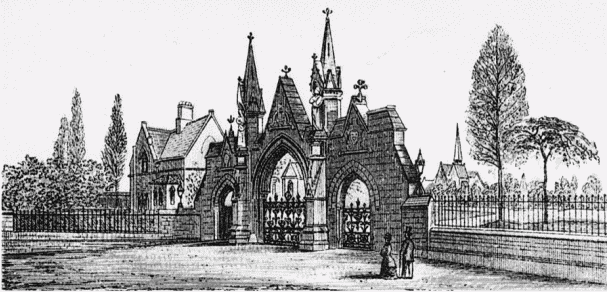
Entrance gate to municipal cemetery, Stapenhill, from the south-west
A crematorium for the Burton area was opened by East Staffordshire district council and South Derbyshire district council in 1975 in Geary Lane, off Ashby Road in Bretby (Derb.). (fn. 15c)
STREET MAINTENANCE
Paving
In 1429 Abbot William Mathew removed the causeway which formed a raised footpath along High Street near the abbey precinct and started to pave the street. He also built a causeway along New Street. (fn. 16c)
When Burton college was established in 1541 it was evidently burdened with an obligation to spend money on the repair of roads and bridges, as well as on poor relief. Burton's quota for the former was noted in 1545 as £20 a year, and that sum was indeed spent in 1544- 5. (fn. 17c) After the college was dissolved in 1545 Sir William Paget as lord of Burton, although retaining responsibility for bridge repair, (fn. 18c) had no obligation to maintain the roads.
A house on the west side of High Street was given by Richard Bowle (or Bowde), apparently in 1581, as an endowment for paving that street. Vested in the feoffees of the Burton town lands, it was known as Pavement House in the early 18th century. (fn. 19a) The income in the early 17th century was 12s. a year, and was paid to the constables, who apparently supervised the paving. (fn. 1c) By the early 18th century, however, the responsibility had fallen on the tenant, and when the house was let in 1727 he was required to maintain the High Street pavement from the bar gates (at the north end) to New Street. (fn. 2c) By the earlier 1820s the income from the house was used to subsidize the repair of the pavement in front of poor people's houses in High Street. (fn. 3c) The endowment was incorporated into the Town Branch of the Consolidated Charities of Burton-upon-Trent in the mid 1870s. (fn. 4c)
In 1698 Celia Fiennes thought that Burton's streets were 'very well pitched', and a visitor in the earlier 18th century noted that High Street was paved with small pebbles. (fn. 5c) Although parochial highway surveyors were appointed on occasion, the constables administered funds for paving in the 17th and 18th centuries; (fn. 6c) the manor also paid for paving the market place in 1704 and again in 1730. (fn. 7c) Responsibility for paving passed to the improvement commissioners in 1779, and nearly £900 was spent on paving in 1780-1, the money presumably raised by a rate. (fn. 8c) Further paving in the late 1780s and early 1790s, however, was paid for by the feoffees of the Burton town lands, presumably because the improvement commissioners were unwilling or unable to raise another rate. (fn. 9c)
After 1815 the income from New Close, allotted to the town lands feoffees in 1771, was applied only towards paving and was administered along with the Pavement House income. The land produced c. £56 a year in the earlier 1820s. (fn. 10d) After Wellington Street was laid out over the land in the early 1850s, the income greatly increased and was used by the feoffees in paving new streets and laying sewers. (fn. 11d)
In 1831 the improvement commissioners resolved to macadamize High Street. Although the pavement there was laid with flag stones in 1838, it was not until the early 1840s that parts of the street were treated with gas tar; the street was re-paved in 1844. (fn. 12d) The commissioners were responsible only for streets designated public highways, and in 1860 they had to request, rather than require, the marquess of Anglesey to pave new streets that had been recently laid out over his land. (fn. 13d) From 1866, however, the commissioners began to sit as a local board of health and were able to serve notices on landowners ordering them to pave and sewer streets that had not yet been declared public highways. (fn. 14d)
Cleaning
According to bye-laws made by the borough court in 1574, the bellman was to clean the market place and its gutters on market day. (fn. 15d) In the late 17th century the manor employed a man to sweep the market place, (fn. 16d) but by 1762 that duty had fallen to the tenant of a house there. (fn. 17d)
Land called New Close in Burton Extra was allotted under the inclosure Act of 1771 to the feoffees of the Burton town lands in trust for cleaning and lighting the streets in Burton and Burton Extra, and for any other public purpose. (fn. 18d) In 1775 the feoffees let the 20 a. they were assigned for £60 a year. (fn. 19b) Street cleaning was also included in the powers of the improvement commissioners appointed in 1779. (fn. 20a) By 1784 the feoffees were employing a paviour and scavenger at a salary of £25 a year. In 1785 Thomas Steere offered to clean the streets without payment, using workhouse inmates. The scheme was evidently a failure, and there was still a salaried paviour in 1788. In 1792 Steere was reengaged for an annual 5 guineas to sweep the streets 13 times a year, at his own convenience; the feoffees provided him with a scavenger's cart. The cleaning seems to have been confined to the market place, as stipulated when Steere's successor was appointed at the same salary in 1793. (fn. 21a)
Possibly after 1815, when the income from New Close was directed solely towards paving, (fn. 22a) the feoffees passed responsibility for street cleaning onto the improvement commissioners. As a consequence of the Poor Law Amendment Act of 1834, however, the commissioners were no longer able to use money from the poor rate to clean and water the streets, and the ratepayers petitioned the feoffees for financial assistance. (fn. 1d) None seems to have been forthcoming, and in 1837 the commissioners were forced to employ a contractor at £70 a year. The contractor, however, was required to purchase the existing water cart and to provide another one. When a new contract was advertised in 1847, the area to be worked covered the market place, High Street, New Street, Station Street, and Bridge Street, and parts of Lichfield Street, Horninglow Street, and Anderstaff Lane. (fn. 2d) The Street cleaner engaged in 1849, Richard Parker, was also the parochial highway surveyor, and in 1853 the new improvement commissioners appointed him as the town's scavenger with the additional duty of collecting night soil. (fn. 3d) Thereafter, street cleaning was included in the scavenger's wider responsibility for waste disposal. (fn. 4d)
Lighting
Oil lamps which lit the main streets by the early 1760s were apparently paid for by subscriptions managed by the feoffees of the town lands. There were at least 30 lamps by 1775, lit between mid October and the end of February. (fn. 5d) Income from New Close was assigned under an inclosure Act of 1771 partly for street lighting, which was included in the powers of the improvement commissioners appointed in 1779. (fn. 6d) From 1815, however, the application of the New Close income was disallowed and lighting had to be supported solely from a rate. (fn. 7d)
In 1831 the commissioners decided to change from oil to gas, and they formed a company which issued shares to raise money to construct a gas works in Cat (later Station) Street in 1832. The works was managed by Samuel Sanders, a Burton plumber and glazier, who contracted to light High Street, the market place, Lichfield Street, Bridge Street, and Horninglow Street with gas for 21 years at £110 a year. He also agreed to continue lamps in other streets and on Burton bridge with either oil or gas at his discretion. The lights were to burn until 2 a.m. between September and the end of March, except for 10 nights after the completion of the first quarter of the moon. (fn. 8d) The improvement commissioners had insufficient funds to reimburse Sanders for the erection of the gas lamp-posts, and the necessary money was provided by the feoffees of the town lands. (fn. 9d) Lighting time was extended in 1835 to 3 a.m. and in 1837 to 5.30 a.m. for most of the winter. (fn. 10e)
In 1852 the shareholders of the gas company transferred ownership to the ratepayers, and in 1853 a new gas works was built in Anderstaff Lane (later Wetmore Road) to replace the Station Street works. There were 75 public lamps in Burton ward in 1854 and 15 in Burton Extra; by 1855 the number in Burton ward had increased to 86. (fn. 11e) Gas street lighting survived until 1959, when the last street was converted to electricity. (fn. 12e)
GAS AND ELECTRICITY
Responsibility for gas supply passed in 1878 to the municipal corporation, which immediately built an additional gas works in Wetmore Road, in order to cope with increased domestic demand. (fn. 13e) By 1897 nearly half the houses in the borough were supplied with gas. (fn. 14e) Under an Act of 1911 the corporation purchased a gas works at Barton-under-Needwood and under an Act of 1913 it acquired ones at Rolleston and Tutbury; the area of supply was extended to Repton (Derb.) in 1923 and to Wychnor and Alrewas in 1924. (fn. 15e)
An electricity works was opened by Burton corporation in 1894 on the east side of Wetmore Road, in the part of Horninglow added to the borough in 1878. (fn. 16e) It was replaced in 1913 by a new plant on the same site, enlarged in 1924. (fn. 17e)
POLICING
In 1629 the constables were ordered by the county J.P.s to appoint common warders to apprehend rogues and vagabonds. The warders appear to have been overzealous and were asked later the same year to show greater respect to poor people. (fn. 18e) Beggars from outside the parish remained a problem in the 18th century and keeping them out of town was one of the duties of the crier in 1711. (fn. 19c) Burton vestry engaged a man in 1737 to drive out vagrants, discontinued his services in 1747, but re-appointed him in 1749. (fn. 20b) A 'bang beggar' was again employed by Burton township in 1826, and his duties in 1828 were to remove street beggars, examine lodging houses, and assist the constables in apprehending prostitutes. (fn. 1e)
There was a watch by 1646 and a watch house by 1678. (fn. 2e) Watch duty was presumably a liability imposed on inhabitants, and in 1711 it was supervised by the bellman (or crier). By 1723 the bellman was paid 10s. a year out of town lands money, and that was still his salary as night watchman in 1788. (fn. 3e) A night watch was established by subscription in 1793. (fn. 4e)
A treble bell which was rung at St. Modwen's church for 15 minutes at 7 a.m. every morning in the earlier 19th century was probably a curfew bell. (fn. 5e) When discontinued in 1867 it was being rung at 5.45 a.m. as well as at 7.45 p.m. every evening between Michaelmas and Lady Day. (fn. 6e) From at least 1875 the feoffees of the town lands paid for the ringing of the morning bell, and continued to do so until 1916. (fn. 7e) The evening bell was again being rung on some weekdays between Michaelmas and Lady Day, at least in the late 1880s. (fn. 8e)
Prosecution of Felons
In 1728 the vestry agreed to defray the costs of prosecuting felons by levying inhabitants in Burton townships, in what was one of the earliest such agreements in the county. The order, however, was rescinded in 1730. (fn. 9e) Burton had a voluntary association for the prosecution of felons in 1802. (fn. 10f)
Salaried Policemen
From 1807 the vestry paid its clerk to assist the annually-elected parochial constable and in 1819 it appointed a police officer, Richard Roe, at a salary of 30 guineas (£31 10s.) a year; he also received £5 from the parochial constables out of their own pockets. The salary was increased to £70 in 1826, when the post was redefined as constable and police officer. (fn. 11f)
Some concern was expressed in 1836 about Roe's efficiency and he was asked particularly to give up selling alcohol at race meetings and other public entertainments and to concentrate on his police duties. He was described as 'highly efficient', however, in 1837 when the vestry applied to the feoffees of the town lands for financial help to pay his salary, the Poor Law Amendment Act of 1834 having invalidated payment out of the poor rate. (fn. 12f)
After the closure of the manorial gaol in the market place in the earlier 1830s, (fn. 13f) there was no secure place of detention until a police station with cells was built in 1848 at the corner of Station Street and Guild Street. (fn. 14f)
The Staffordshire county force continued to provide officers for Burton after the town became a county borough in 1901. (fn. 15f) A new police station with cells was opened behind the magistrates' court in Horninglow Street in 1910. (fn. 16f) It was demolished in 1999, having been replaced in 1998 by a station on the east side of the court building.
FIRE FIGHTING
The requirement by at least the earlier 17th century that householders should have buckets by their wells was probably connected with fire prevention. (fn. 17f) Fire hooks and buckets were maintained out of town lands money from at least 1660, and were evidently kept in the town hall in the market place. (fn. 18f)
There was already a fire engine by 1791, when a new one was acquired by subscription. A second engine was given in the same year by Robert Peel, the owner of a cotton manufactory at Bond End. (fn. 19d) The engines were maintained out of a parish rate, which in 1807 paid a retaining fee of £2 to the man who worked the engine and £1 every time he was called out; he also received 3 guineas for keeping the engines in repair. Eight assistants were each paid £1 as a retainer and 10s. for a callout. There were also fees for four annual practice sessions. (fn. 20c) In 1835 one engine was kept in Horninglow Street opposite Holy Trinity church, and by 1844 the other was kept in the gatehouse of the former monastic precinct near the market place. (fn. 21b) A replacement engine was acquired in 1839. (fn. 22b)
By 1841 the engines were maintained jointly by Burton and Burton Extra townships, but support from the parish rate was evidently later withdrawn and in 1854 it was stated that the engines had been kept for several years by the feoffees of the town lands. The feoffees stopped payments that year and responsibility passed to the improvement commissioners. (fn. 1f) A new engine house for both engines was opened in 1855 in the former gas works in Station Street. (fn. 2f) It was replaced in 1879 by one on the west side of Union Street, (fn. 3f) and that building in turn by one on the south side of New Street, opened in 1903. (fn. 4f) The present fire station in Moor Street was opened in 1973. (fn. 5f)
Brewery Fire Brigades In the 1850s Michael Thomas Bass established a fire brigade for his brewery, (fn. 6f) and Allsopp & Co. also had one by 1904, when it was agreed with Burton corporation that neither brigade would turn out unless requested to do so by the town brigade and that they would attend a fire outside a 5mile radius from St. Modwen's church only if the premises involved belonged to a partner of one of the companies. (fn. 7f) It is uncertain whether a ladies' fire brigade which existed in 1911 and gave public demonstrations was ever called out on active duty. (fn. 8f) The Bass fire brigade survived until 1970.
PUBLIC HEALTH
Health Care
When outbreaks of plague occurred in the mid 1640s and mid 1660s, victims were isolated in 'cabins' erected on Broad holme and Burton meadow. (fn. 9f)
Ratepayers in Burton Extra and Horninglow townships sought unsuccessfully in 1853 to adopt the Public Health Act, 1848, which would have empowered them to set up local boards of health. Their main concern, however, was to escape the powers of the Burton improvement commissioners, which were extended later the same year under a local Act. An inquiry held by a Board of Health inspector in May 1853 highlighted poor sanitation, especially in the Bond End area, and it was claimed that typhus and typhoid were endemic. The inspector concluded that, despite Burton's healthy situation and low density of population, the death rate was relatively high. (fn. 10g)
The 1853 Act extended the area of competence of the improvement commissioners, but did not enhance their powers to implement effective sanitary reform. (fn. 11g) At their first meeting in September 1853, however, they formed a health committee and later the same year appointed an inspector of nuisances and lodging houses, a surveyor, and scavengers. The fear of cholera also prompted the appointment of a local surgeon, William Mason, as medical officer of health, (fn. 12g) and in September 1854 Mason, the nuisance inspector, and the commissioners' clerk visited almost 300 of the most insanitary houses in the town. (fn. 13g)
Additional powers under the Local Government Act, 1858, were first applied for in 1866, and in 1868 byelaws were issued by the commissioners acting as a local board of health. (fn. 14g) A medical officer of health was appointed in 1874, two years after the local board had become an urban sanitary authority under the Public Health Act, 1872. (fn. 15g) A report on labourers' dwellings in 1896 and an inspection of working-class houses in 1897 led to the appointment of two assistant sanitary inspectors. (fn. 16g)
Baths
Although the need for public baths was voiced in 1853, (fn. 17g) it was not until the earlier 1870s that baths were built, and then by Richard and Robert Ratcliff, the sons of the brewer Samuel Ratcliff. The baths, which included swimming pools, stood at the north end of the Hay and were given to the improvement commissioners in 1875. Turkish baths were added in 1903. (fn. 18g) The pools were replaced by one in the nearby Meadowside Centre, opened in 1980, and the building was subsequently demolished. (fn. 19e)
Midwives and Nurses
A midwife was working at Stretton in the late 16th century, and the masters of the Burton town lands paid a midwife in 1600. (fn. 20d) Two midwives were recorded in 1667. (fn. 21c) Christopher Ley was the first surgeon in Burton to be recorded working as a man-midwife: he delivered a pauper child at Anslow in 1756 or 1757. (fn. 1g) Only two female midwives were listed in 1880, but there were 37 in 1904, when a register was drawn up under the 1902 Midwives Act. (fn. 2g)
There was a benelovent society for the relief of lyingin women in Burton and Burton Extra townships in the early 19th century, supported entirely by women subscribers. It is not known how long it survived. (fn. 3g) In 1853 the brewers Bass & Co. engaged a home visitor to report on the moral and physical conditions of its workforce. (fn. 4g)
A nursing institution was established by subscription in 1885 to provide nursing help for the poor, as well as a home in Union Street for nurses at the Duke Street infirmary. (fn. 5g) It was still functioning as a charitable body in 1925, when it employed five district nurses. (fn. 6g) A nurse for Anglicans in the Winshill area only was supported by a fund set up in 1900 in memory of Fanny Gretton of Bladon House, and it still maintained a nurse in 1946. (fn. 7g) Another voluntary body, the Burton-on-Trent Health Society, established in 1911, ran a mothers' and babies' welfare clinic in Union Street. From 1913 half its expenses were met by a Board of Education grant, and in 1919 the clinic was taken over by Burton corporation. The premises were moved to Cross Street in mid 1930s. (fn. 8g)
Physicians, surgeons, and dentists are treated elsewhere in this article. (fn. 9g)
Hospitals
Dispensary A dispensary opened in the market place in 1830 provided drugs and medical treatment for subscribers, and by 1851 it had 2,177 members. (fn. 10h) Provided with premises in an infirmary opened in 1869, the dispensary was closed in 1914. (fn. 11h)
Infirmary and General Hospital In 1828 the vestry of Burton township began to subscribe to Derby General Infirmary, and it still sent patients there in 1836. (fn. 12h) In 1867 a committee of the town's leading brewers met to organise a subscription to erect an infirmary in Burton. Plans were drawn up by Edward Holmes of Birmingham for a 12-bed infirmary, which was opened at the east end of Duke Street in 1869. (fn. 13h)
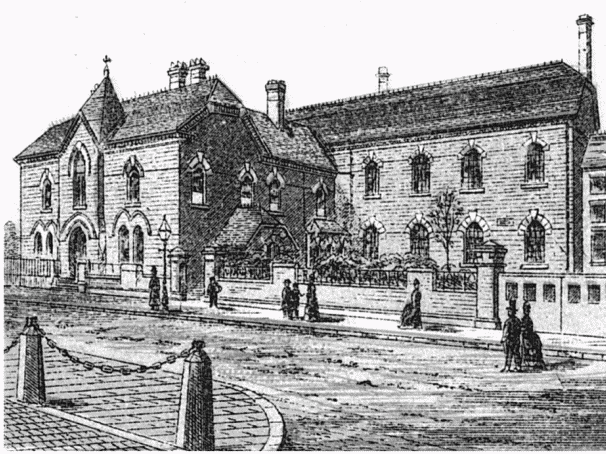
FIG. 39. Duke Street infirmary from the east
The building was enlarged in 1899 to a design by Aston (later Sir Aston) Webb, and was further extended in 1924 and 1931. A new block was opened in 1942. (fn. 14h) From 1971 departments were moved out to the former poor-law union workhouse in Belvedere Road and the Outwoods isolation hospital, both in Horninglow. The Duke Street building was demolished in 1994, and houses later built on the site. (fn. 15h)
The first department to be moved out of the Duke Street infirmary was the care of the elderly unit, which was rehoused in a new building at Outwoods. Phase I of a new district hospital on the Belvedere Road site was completed in 1972 and Phase II in 1993. A new maternity unit was opened at Outwoods in 1988. The hospital was named Queen's hospital by Queen Elizabeth II on a visit in 1995. (fn. 16h)
Isolation Hospitals In 1880 the corporation leased a farmhouse and two cottages at Upper Mills farm for use as a smallpox hospital. (fn. 17h) Those buildings may have remained in use until 1888, when smallpox cases were sent to a cottage in Mear Greaves Lane, in Winshill, still used in 1891. (fn. 18h) From 1894 cases were apparently treated at an isolation hospital at Outwoods until 1916, when a joint smallpox hospital for Burton and Derby was opened on Burton corporation's land at Blakeley farm, in Etwall (Derb.). That hospital was still available for use in 1948. (fn. 1h)
During a scarlet fever epidemic in 1885, the corporation converted the infirmary of the recently-closed poor-law union workhouse in Horninglow Street to an isolation hospital. (fn. 2h) The workhouse site was sold in 1891, and later the same year the corporation opened an isolation hospital at Outwoods, just outside the borough boundary in Horninglow. A temporary building was replaced by the surviving brick building with stone dressings, designed by the borough surveyor, J.E. Swindlehurst, and opened in 1894. There is also a pavilion dated 1894. (fn. 3h) The hospital was used for tubercular cases from 1912. (fn. 4h)
HOUSING
Lodging Houses
The inspection of lodging houses was included in the duties of the 'bang beggar' in the later 1820s. In 1853 they became the responsibility of the nuisance inspector appointed that year. There had been 17 lodging houses in 1851, of which 14 were in New Street and 3 in Anderstaff Lane, and the inspector was asked in 1853 to proceed leniently against their keepers 'during the present want of lodging accommodation'. (fn. 5h) Only one house was found to be satisfactory, but the inspector was allowed to use his discretion in 1858 to register five under-rated houses, two each in Anderstaff Lane and Lichfield Street and one in Fleet Street. (fn. 6h) From 1868 stricter rules were applied, and in 1869 nine houses in New Street, Lichfield Street, and Fleet Street were registered. (fn. 7h) There were 16 lodging houses, licensed to accommodate 250 people in 1896, falling to 11 with 172 people by 1902, when the medical officer of health recommended that several should be closed. (fn. 8h) The worst was in corporationowned cottages in Screw Yard, off Park Street, eventually demolished in 1912. (fn. 9h) The three houses registered in the later 1920s and 1930s could accommodate 134 adults, and the single house registered in the later 1950s had 109 adults. (fn. 10i)
Early Building Societies
In 1851 the Burton Freehold Land Society, established in 1850 under the presidency of Michael Thomas Bass, bought land in Horninglow township and laid out Victoria Crescent. (fn. 11i) In 1854 the Anglesey estate reluctantly allowed the society to buy land in Winshill for a housing development, and the society also probably built houses in Stapenhill about the same time. (fn. 12i)
Burton-on-Trent District Benefit Building Society was formed in 1864, and in the late 1860s or earlier 1870s it built a block of streets off Casey Lane. (fn. 13i) Much of the society's housing was of poor quality and has since been demolished.
The Burton-on-Trent Artisans' Dwellings Co. Ltd. was established in 1899 under the chairmanship of R. F. Ratcliff, a brewer. It acquired land in Horninglow, where by the end of 1901 it had built 123 houses, mostly 2-bedroomed cottages, in Balfour Street and Craven Street, designed by Thomas Jenkins of Burton. Preference was given to tenants who earned 20s. or less a week and who had no more than three children. (fn. 14i)
Early Council Housing
In his report on labourers' dwellings in 1896, the borough surveyor proposed the building of model cottages in Park Street. Nothing was done, probably because the plan required the purchase of additional land and subsidised rents. (fn. 15i) Council houses, however, were built in 1897 in Watson Street, off the north end of Branston Road, for council workers at the adjoining waste disposal depot at Bond End. It was hoped that the houses would attract a better class of workmen. (fn. 16i)
The council's involvement in the provision of working-class houses was further stimulated by a newspaper report of 1899, which commented on the acute pressure for small houses and noted that many working men had to live in surrounding villages. (fn. 17i) The council immediately petitioned the feoffees of the town lands for a lease of land on the west side of Waterloo Street for the construction of 2-bedroomed cottages, stating that in recent years many such cottages had been demolished to make room for commercial and industrial premises and that the marquess of Anglesey had refused to allow any replacements to be built on his land. (fn. 1i) The feoffees agreed to the request, and the council adopted part III of the Housing of the Working Classes Act, 1890, which enabled it to borrow money to finance the houses. (fn. 2i) With the borough surveyor George Lynam as architect, work on a proposed 151 houses was started in 1900, (fn. 3i) and Richmond Street was completed by the end of 1903. (fn. 4i)
Despite the council's concern about the provision of cottages, the Richmond Street houses were 3-bedroomed, a size preferred by the marquess of Anglesey's agents. Although in 1899 the latter agreed to lease land to the council for smaller houses on the east of Anglesey Road on the south side of the town, nothing was done. (fn. 5i)
Housing Associations
The Beth Johnson housing association opened sheltered accommodation on the west side of St. Paul's Square in 1981 and a block of flats in James Street in 1995. (fn. 6i) Since 1986 the Orbit housing association has completed several schemes in Burton, the first being a block of flats called Carlton Court at the corner of Shobnall Street and Shobnall Road. (fn. 7i) In 1989 the association in partnership with Burton Y.M.C.A. opened a block in Milton Street especially for young people aged between 16 and 25 years. (fn. 8i) Flats built by Burton Y.M.C.A. at the east end of James Street in 1993 are also for young people. (fn. 9i)
POST OFFICE AND TELEPHONE SERVICE
Burton had a postmaster by 1699. Until 1765 the London mail had to be sorted at Lichfield, but a separate bag for Burton was introduced that year. The bag still had to be collected at Lichfield, and an onward service to Burton is not recorded until 1796. (fn. 10j) The post office in 1818 was at the George inn in High Street. In 1834 it was at the Three Queens inn in Bridge Street but was again in High Street by 1841. (fn. 11j) It stood next to the George in the later 1850s. (fn. 12j) In 1877 the office was moved to a new building (the present Constitutional Club) on the site of Parker's almshouses on the east side of High Street. (fn. 13j) Moved again to new premises on the north side of New Street in 1905, (fn. 14j) the office was closed in 1992 and a franchise office opened in Safeway supermarket in Orchard Street. (fn. 15j) There was also a sub-post office in High Street in 1999.
Branches of Bass breweries were 'telephonically connected' with their central office in 1879. (fn. 16j) In 1889 the National Telephone Co. opened an exchange for local calls in a shop in New Street, and from 1898 there was an exchange for trunk calls in the main post office in High Street. A combined exchange was opened in New Street in 1912. It was replaced in 1933 by an automatic exchange in Fleet Street, rebuilt and enlarged in 1957 and still in use in 1999. (fn. 17j)