
Journal of the House of Lords: Volume 12, 1666-1675. Originally published by His Majesty's Stationery Office, London, 1767-1830.
This free content was digitised by double rekeying. All rights reserved.
'House of Lords Journal Volume 12: 4 February 1671', in Journal of the House of Lords: Volume 12, 1666-1675, (London, 1767-1830) pp. 419-420. British History Online https://www.british-history.ac.uk/lords-jrnl/vol12/pp419-420 [accessed 25 April 2024]

In this section
DIE Sabbati, 4 die Februarii.
Domini tam Spirituales quam Temporales præsentes fuerunt:
PRAYERS.
Answer from H. C.
The Messengers sent to the House of Commons Yesterday return with this Answer:
That they will give a Conference, as is desired.
Heads for the Conference on the Bill against maiming and wounding.
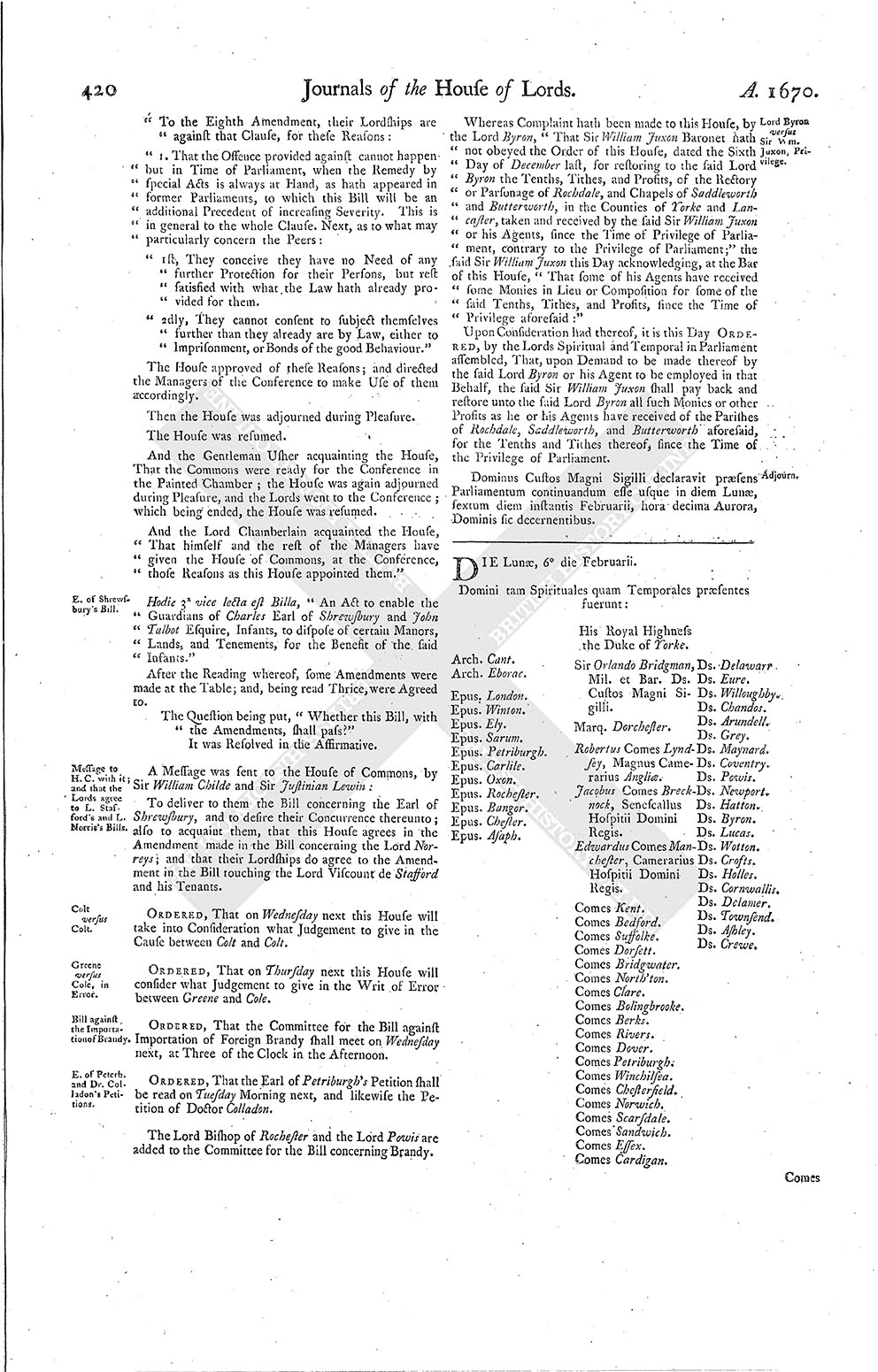
The Lord Chamberlain reported, "That the Committee have prepared some Reasons to be offered to the House of Commons at a Conference, which they offer to the Consideration of the House; which were read, as follows:
"To the Second and Third Amendments, the Lords say, That a certain Day being given for their Appearance, after the Day of the Royal Assent, is, we conceive, sufficient Certainty; because, though it be uncertain what Day the Royal Assent will be given, yet, when the Royal Assent is once given, it is a sufficient Notification of the Time to the whole Kingdom, being ever given in the Presence of the Two Houses of Parliament, and all Subjects are to take Notice of it:
"Certum est quod certum reddi potest.
"As to the referring the Parties sled to the Journal Books of the House of Peers, we see no Weight of Reason in excepting to it, because it rather adds to the Certainty mentioned in the former Reason than any Ways weakens it, though the Flight of Persons accused is no Argument why they should be the better provided for in a Law; that, if this Way seem unusual, it is likewise to be considered that the Occasion is unusual, and Precedents in Point are not to be expected for Practices beyond Example.
"The Lords give this Reason why they do not agree to the Sixteenth of February, which is of Weight with them against all the Reasons given by the Commons for it; videlicet,
"That, the Day when the Royal Assent will be given being uncertain, if it should not be given before the Sixteenth of February, the whole Provision of a Day is rendered insignificant.
"To the Commons Reasons upon the Sixth Amendment, the Lords say, That it seems to them a speedy Remedy upon a particular Fact, to provide a general Law to take Place by the 24th of June, in the mean Time while other Laws are in Force against such Offences; and the Example of the Punishment inflicted by this Law upon these Offenders is sufficient to terrify others from committing the like Offences between this and that Time.
"To the 8th Line in the Sixth Amendment, the Lords say, That Provision uses not to be made by Law, but against designed and contrived Offences, not against accidental Mischiefs; especially when new Felonies (as in this Case) are made, they ought to be strictly and warily circumscribed.
"To the 7th Amendment, concerning the Words ["knowing of and privy to the Offence as aforesaid"], the Lords conceive the Words not superfluous, because Men may perhaps aid and abet, and not be privy to the Offence maliciously designed; and therefore esteem it more safe to continue the Words, the Penalty being so great, to the End it may reach only the Persons privy to the Offence.
"To the Eighth Amendment, their Lordships are against that Clause, for these Reasons:
"1. That the Offence provided against cannot happen but in Time of Parliament, when the Remedy by special Acts is always at Hand, as hath appeared in former Parliaments, to which this Bill will be an additional Precedent of increasing Severity. This is in general to the whole Clause. Next, as to what may particularly concern the Peers:
"1st, They conceive they have no Need of any further Protection for their Persons, but rest satisfied with what the Law hath already provided for them.
"2dly, They cannot consent to subject themselves further than they already are by Law, either to Imprisonment, or Bonds of the good Behaviour."
The House approved of these Reasons; and directed the Managers of the Conference to make Use of them accordingly.
Then the House was adjourned during Pleasure.
The House was resumed.
And the Gentleman Usher acquainting the House, That the Commons were ready for the Conference in the Painted Chamber; the House was again adjourned during Pleasure, and the Lords went to the Conference; which being ended, the House was resumed.
And the Lord Chamberlain acquainted the House, "That himself and the rest of the Managers have given the House of Commons, at the Conference, those Reasons as this House appointed them."
E. of Shrewsbury's Bill.
Hodie 3a vice lecta est Billa, "An Act to enable the Guardians of Charles Earl of Shrewsbury and John Talbot Esquire, Infants, to dispose of certain Manors, Lands, and Tenements, for the Benefit of the said Infants."
After the Reading whereof, some Amendments were made at the Table; and, being read Thrice, were Agreed to.
The Question being put, "Whether this Bill, with the Amendments, shall pass?"
It was Resolved in the Affirmative.
Message to H. C. with it; and that the Lords agree to L. Stafford's and L. Norris's Bills.
A Message was sent to the House of Commons, by Sir William Childe and Sir Justinian Lewin:
To deliver to them the Bill concerning the Earl of Shrewsbury, and to desire their Concurrence thereunto; also to acquaint them, that this House agrees in the Amendment made in the Bill concerning the Lord Norreys; and that their Lordships do agree to the Amendment in the Bill touching the Lord Viscount de Stafford and his Tenants.
Colt versus Colt.
ORDERED, That on Wednesday next this House will take into Consideration what Judgement to give in the Cause between Colt and Colt.
Greene versus Cole, in Error.
ORDERED, That on Thursday next this House will consider what Judgement to give in the Writ of Error between Greene and Cole.
Bill against the Importation of Brandy.
ORDERED, That the Committee for the Bill against Importation of Foreign Brandy shall meet on Wednesday next, at Three of the Clock in the Afternoon.
E. of Peterb. and Dr. Colladon's Petitions.
ORDERED, That the Earl of Petriburgh's Petition shall be read on Tuesday Morning next, and likewise the Petition of Doctor Colladon.
The Lord Bishop of Rochester and the Lord Powis are added to the Committee for the Bill concerning Brandy.
Lord Byron versus Sir Wm. Juxon, Privilege.
Whereas Complaint hath been made to this House, by the Lord Byron, "That Sir William Juxon Baronet nath not obeyed the Order of this House, dated the Sixth Day of December last, for restoring to the said Lord Byron the Tenths, Tithes, and Profits, of the Rectory or Parsonage of Rochdale, and Chapels of Saddleworth and Butterworth, in the Counties of Yorke and Lancaster, taken and received by the said Sir William Juxon or his Agents, since the Time of Privilege of Parliament, contrary to the Privilege of Parliament; "the said Sir William Juxon this Day acknowledging, at the Bar of this House, "That some of his Agents have received some Monies in Lieu or Composition for some of the said Tenths, Tithes, and Profits, since the Time of Privilege aforesaid:"
Upon Consideration had thereof, it is this Day ORDERED, by the Lords Spiritual and Temporal in Parliament assembled, That, upon Demand to be made thereof by the said Lord Byron or his Agent to be employed in that Behalf, the said Sir William Juxon shall pay back and restore unto the said Lord Byron all such Monies or other Profits as he or his Agents have received of the Parishes of Rochdale, Saddleworth, and Butterworth aforesaid, for the Tenths and Tithes thereof, since the Time of the Privilege of Parliament.
Adjourn.
Dominus Custos Magni Sigilli declaravit præsens Parliamentum continuandum esse usque in diem Lunæ, sextum diem instantis Februarii, hora decima Aurora, Dominis sic decernentibus.