
Journal of the House of Lords: Volume 14, 1685-1691. Originally published by His Majesty's Stationery Office, London, 1767-1830.
This free content was digitised by double rekeying. All rights reserved.
'House of Lords Journal Volume 14: 23 November 1689', in Journal of the House of Lords: Volume 14, 1685-1691, (London, 1767-1830) pp. 351-352. British History Online https://www.british-history.ac.uk/lords-jrnl/vol14/pp351-352 [accessed 19 April 2024]

In this section
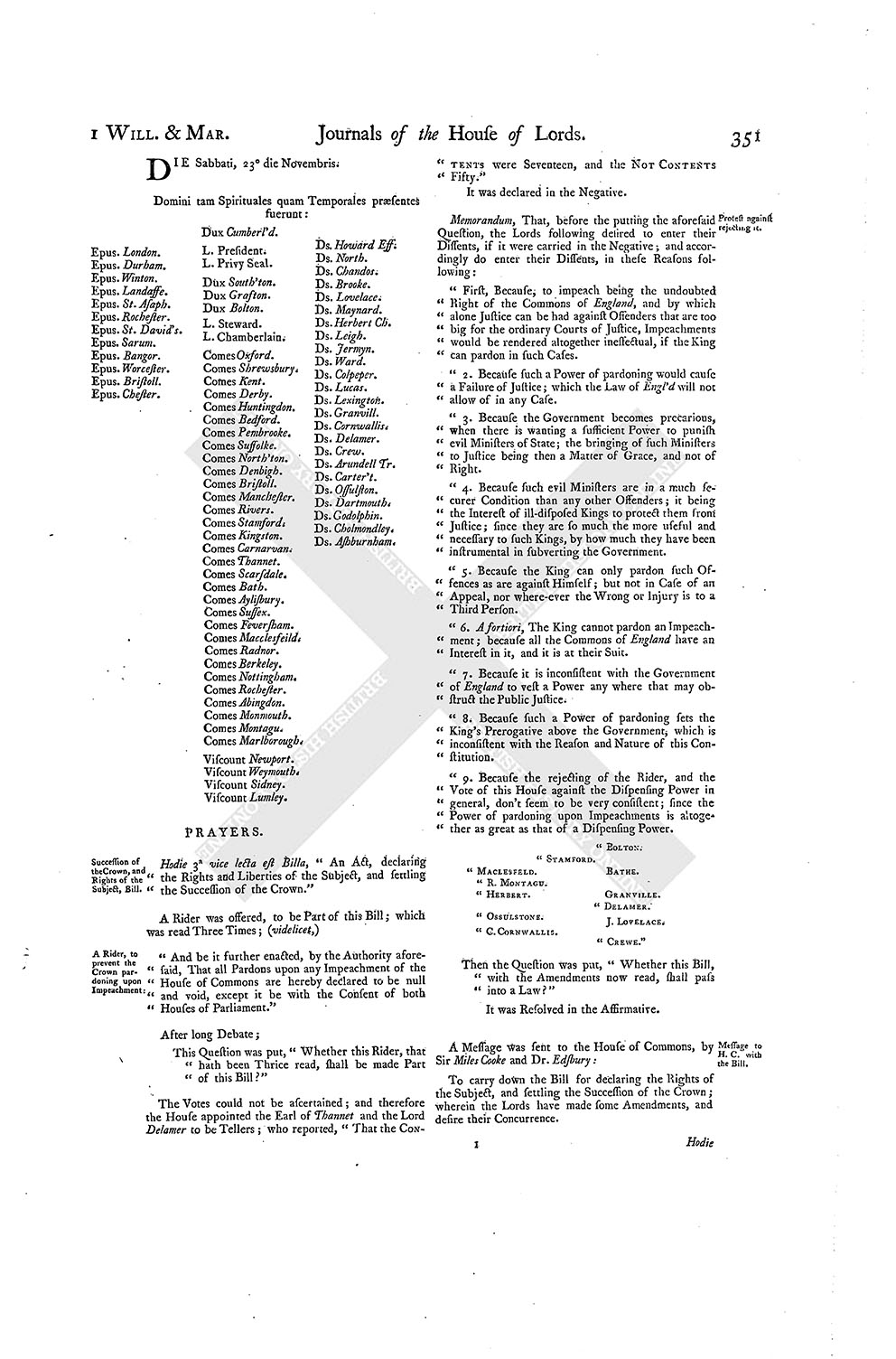
DIE Sabbati, 23 die Novembris.
Domini tam Spirituales quam Temporales præsentes fuerunt:
PRAYERS.
Succession of the Crown, and Rights of the Subject, Bill.
Hodie 3a vice lecta est Billa, "An Act, declaring the Rights and Liberties of the Subject, and settling the Succession of the Crown."
A Rider was offered, to be Part of this Bill; which was read Three Times; (videlicet,)
A Rider, to prevent the Crown pardoning upon Impeachment:
"And be it further enacted, by the Authority aforesaid, That all Pardons upon any Impeachment of the House of Commons are hereby declared to be null and void, except it be with the Consent of both Houses of Parliament."
After long Debate;
This Question was put, "Whether this Rider, that hath been Thrice read, shall be made Part of this Bill?"
The Votes could not be ascertained; and therefore the House appointed the Earl of Thannet and the Lord Delamer to be Tellers; who reported, "That the CONTENTS were Seventeen, and the NOT CONTENTS Fifty."
It was declared in the Negative.
Protest against rejecting it.
Memorandum, That, before the putting the aforesaid Question, the Lords following desired to enter their Dissents, if it were carried in the Negative; and accordingly do enter their Dissents, in these Reasons following:
"First, Because, to impeach being the undoubted Right of the Commons of England, and by which alone Justice can be had against Offenders that are too big for the ordinary Courts of Justice, Impeachments would be rendered altogether ineffectual, if the King can pardon in such Cases.
"2. Because such a Power of pardoning would cause a Failure of Justice; which the Law of Engl'd will not allow of in any Case.
"3. Because the Government becomes precarious, when there is wanting a sufficient Power to punish evil Ministers of State; the bringing of such Ministers to Justice being then a Matter of Grace, and not of Right.
"4. Because such evil Ministers are in a much securer Condition than any other Offenders; it being the Interest of ill-disposed Kings to protect them from Justice; since they are so much the more useful and necessary to such Kings, by how much they have been instrumental in subverting the Government.
"5. Because the King can only pardon such Offences as are against Himself; but not in Case of an Appeal, nor where-ever the Wrong or Injury is to a Third Person.
"6. A fortiori, The King cannot pardon an Impeachment; because all the Commons of England have an Interest in it, and it is at their Suit.
"7. Because it is inconsistent with the Government of England to vest a Power any where that may obstruct the Public Justice.
"8. Because such a Power of Pardoning sets the King's Prerogative above the Government, which is inconsistent with the Reason and Nature of this Constitution.
"9. Because the rejecting of the Rider, and the Vote of this House against the Dispensing Power in general, don't seem to be very consistent; since the Power of pardoning upon Impeachments is altogether as great as that of a Dispensing Power.
"Bolton.
Stamford.
Maclesfeld.
Bathe.
R. Montagu.
Herbert.
Granville.
Delamer.
Ossulstone.
J. Lovelace.
C. Cornwallis.
Crewe."
Then the Question was put, "Whether this Bill, with the Amendments now read, shall pass into a Law?"
It was Resolved in the Affirmative.
Message to H. C. with the Bill.
A Message was sent to the House of Commons, by Sir Miles Cooke and Dr. Edsbury:
To carry down the Bill for declaring the Rights of the Subject, and settling the Succession of the Crown; wherein the Lords have made some Amendments, and desire their Concurrence.
Salt Prize, for the Use of the Navy, Bill.
Hodie 1a vice lecta est Billa, "An Act to apply a Prize of Salt, lately taken, to the victualling of His Majesty's Navy."
The Question being put, "Whether this Bill shall be rejected?"
It was Resolved in the Affirmative.
Derham and Edwards versus Duvall.
Upon reading the Petition of Sir John Edwards; praying, "That he may have an Order for Witnesses to attend at the Hearing of his Cause, to prove his Deeds, and Copies of Records; and that such Writings as are in Sir John Francklyn's Hands, and such as Mr. Duvall hath had away from him (as your Petitioner shall give to each of them a Note or Particular of), may be returned to Sir John Francklyn, to the End your Petitioner may peruse them before the Hearing at the Bar of this House:"
It is thereupon ORDERED, by the Lords Spiritual and Temporal in Parliament assembled, That Sir John Edwards shall have an Order for Witnesses; and that such Writing, Bills, and Accounts, as are in the Custody of Sir John Francklyn, shall be produced at the Hearing; and that Mr. Duvall do return into the Hands of Sir John Francklyn such Deeds and Writings as he hath had from him relating to this Business, of which Sir John Edwards shall give the said Mr. Duvall and Sir John Franklyn a List, in order to their being produced at the Hearing; and that Sir John Edwards may have the Perusal of them in the mean Time, in the Hands of Sir John Francklyn.
Beach versus Fellows & al.
Whereas, by Order of this House of the 15th Instant, Anne Fellowes, Robert Wilde, and Heigham Coke, Defendants, were to put in their Answer to the Petition of Mary Beach on the 29 Instant; the House being this Day moved, on the Behalf of the Petitioner, "That the Defendants may have further Time for answering thereunto, in regard they are at a great Distance:"
It is ORDERED, That the Defendants, Anne Fellowes, Robert Wilde, and Heigham Coke, be, and are hereby, required to put in their Answer or respective Answers thereunto, in Writing, on Friday the Sixth Day of December next, at Ten of the Clock in the Forenoon.
Coke versus Cobb & al.
ORDERED, by the Lords Spiritual and Temporal in Parliament assembled, That the Cause wherein Edward Coke Esquire is Plaintiff, and Thomas Cobb and others Defendants, shall be heard, by Counsel on both Sides, at the Bar, on Wednesday next, at Ten of the Clock in the Forenoon.
Address, for the Committee for Inspections to procure the Books of the Signet-office.
The House being moved, from the Committee for Inspections, "That an Address be made to His Majesty, that they may peruse the Books of the Signet-office from 1680 to the Fourth Year of the late King James:"
To which the House agreed, and made the following Address:
"We, the Lords Spiritual and Temporal in Parliament assembled, do humbly beseech Your Majesty, that the Committee for Inspections may have Leave to peruse the Books of the Signet-office, from 1680 to the Fourth Year of the late King James."
ORDERED, That the Lords with White Staves do wait on His Majesty with the Address.
Adjourn.
Robertus Atkins, Miles de Balneo, Capitalis Baro de Scaccario, Orator Procerum, declaravit præsens Parliamentum continuandum esse usque in diem Lunæ, videlicet, 25um diem Novembris instantis, hora decima Aurora, Dominis sic decernentibus.