
Journal of the House of Lords: Volume 11, 1660-1666. Originally published by His Majesty's Stationery Office, London, 1767-1830.
This free content was digitised by double rekeying. All rights reserved.
'House of Lords Journal Volume 11: 13 September 1660', in Journal of the House of Lords: Volume 11, 1660-1666, (London, 1767-1830) pp. 170-176. British History Online https://www.british-history.ac.uk/lords-jrnl/vol11/pp170-176 [accessed 25 April 2024]

In this section
DIE Jovis, 13 die Septembris.
PRAYERS, by Dr. Hodges.
REX.
Domini præsentes fuerunt:
Message from H. C. with a Bill;-and with Orders, &c.
A Message was brought from the House of Commons, by Arthur Annesley Esquire and others; who brought up these Particulars following:
1. The Return of the Bill of Supplement to the Bill of Poll-money, wherein they agree with their Lordships, with Alterations and Proviso.
2. An Order, Supplement to the Order concerning Dunkerke. (Here enter it.)
Read, and Agreed to.
3. An Order concerning Lightmaker. Read, and Agreed to.
4. To put their Lordships in Mind of the Act of Marriages, and the Order concerning Sales.
5. An Order for issuing out of Monies by the Chamberlain of London, for disbanding the Army.
(Here enter it.)
Agreed to.
The Answer returned was:
Answer.
That their Lordships agree to the Order concerning Dunkerke, the Order concerning Lightmaker, and the Order for Forty Thousand Pounds: To all the rest of the Particulars, their Lordships will send an Answer by Messengers of their own.
Message from H. C. with Orders.
A Message was brought from the House of Commons, by the Lord Herbert; who brought up Two Orders, wherein their Lordships Concurrence is desired:
1. An Order for Ten Thousand Pounds, to be given to the Princess Royal.
Read, and Agreed to.
2. An Order for Ten Thousand Pounds, to be given to the Queen of Bohemia. (Here enter.)
Read, and Agreed to.
The Answer returned was:
Answer.
That this House concurs in the Two Orders now brought up.
The King present.
The King's Most Excellent Majesty, sitting in His Chair of Estate, commanded the Gentleman Usher of the Black Rod to give Notice to the House of Commons, that they speedily attend His Majesty; who being come up with their Speaker, he, after a short Speech, presented His Majesty from the Commons with these Three Bills; videlicet,
Bills brought up by the Speaker of H. C.
"An Act for the speedy raising of Seventy Thousand Pounds, for the present Supply of His Majesty."
"An Act for raising Seven Score Thousand Pounds, for the compleat Disbanding of the whole Army, and paying Part of the Navy."
"An Act for supplying and explaining certain Defects in an Act for the speedy Provision of Money, for the Disbanding of the Army, &c."
Bills passed.
Then His Majesty gave Command for the passing of these Bills following; the Clerk of the Crown reading the Titles, and the Clerk of the Parliaments pronouncing the Royal Assent; videlicet,
"1. An Act for encouraging and increasing of Shipping and Navigation."
"2. An Act to prevent Fraud and Concealments of His Majesty's Customs."
"3. An Act for the speedy disbanding the Army and Garrisons of this Kingdom."
"4. An Act for enabling the Soldiers of the Army, now to be disbanded, to exercise Trades."
"5. An Act for the confirming and restoring of Ministers."
To these Public Bills the Royal Assent was pronounced in these Words:
"Le Roy le veult."
"6. An Act for the speedy raising of Seventy Thousand Pounds, for the present Supply of His Majesty."
"7. An Act for the raising of Seven Score Thousand Pounds, for the compleat Disbanding of the whole Army, and paying Part of the Navy."
"8. An Act for supplying and explaining certain Defects in an Act, intituled, An Act for the speedy Provision of Money, for disbanding and paying of the Forces of this Kingdom both by Land and Sea."
To these Bills the Royal Assent was pronounced in these Words:
"Le Roy, remerciant Ses bons Subjects, accepte leur Benevolence, et ainsi le veult."
"9. An Act for the necessary Maintenance of the Work of Draining the Great Level of the Fens."
"10. An Act for the restoring of the Marquis of Hertford to the Dukedom of Somersett."
"11. An Act for restoring unto William Marquis of Newcastle, all his Honours, Manors, Lands, and Tenements, in England, whereof he was in Possession on the 20th Day of May, 1640, or at any Time since."
"12. An Act for restoring to Charles Lord Gerard, Baron of Brandon, all his Honours, Manors, Lands, Tenements, and Hereditaments, whereof he was in Possession on the 20th Day of May, 1642, or at any Time sithence."
"13. An Act for the settling of the Priory of Watton, and other Lands belonging to the Earl of Winchilsea, in the County of Yorke, in the Hands of Trustees, for the Payment of Debts."
"14. An Act for enabling of Sir George Booth Baronet to make Leases and Sales of Part of his Estate."
"15. An Act for enabling Augustine Skynner and Wm. Skynner to make Sale of some Lands, for Payment of Debts."
"16. An Act for the regulating of the Trade of Bay-making, in the Dutch Bay Hall, in Colchester."
"17. An Act for the naturalizing of Dorothea Helena Countess of Derby, Wife of the Right Honourable Charles Earl of Derby; and Emelia called Countess of Ossery, Wife of the Right Honourable Thomas Butler, called Earl of Ossery, Son and Heir Apparent to the Right Honourable James Marquis of Ordmond and Earl of Brecknock; and Margarett Lady Culpeper, Wife of the Right Honourable Thomas Lord Culpeper, Baron of Thorsway; and the Right Honourable Charles Kirkhoven Lord Wotton, and Dame Emilia his Sister, Children of Katherin Stanhope Countess of Chesterfeild, by John Kirkhoven, Lord of Hemfleet."
"18. An Act for restoring unto Murrough, alias Morgan, Earl of Insiquin, all his Honours, Manors, Lands, and Tenements, in Ireland, whereof he was in Possession on the 23th of October, 1641, or at any Time since."
"19. An Act for restoring to Thomas Lord Culpeper, Son and Heir and Sole Executor of John Lord Culpeper, Baron of Thorswey, and Master of the Rolls, deceased, all the Honours, Manors, Lands, and Tenements, Leases not determined, and Hereditaments whatsoever, whereof the said John Lord Culpeper was in Possession on the 20th Day of May, 1642, or at any Time after, which have not been since sold or aliened by the said John late Lord Culpeper, by Acts or Assurances to which himself was Party and consenting."
"20. An Act for the incorporating of the Master and Wardens of the Company of Haberdashers, London, to be Governors of the Free School and Almshouses at Newport."
"21. An Act for restoring of Sir George Lane Knight, to the Possession of the Manor of Kathclyne and Lisduffe, and other Lands in Ireland."
To all which Private Bills the Royal Assent was pronounced in these Words;
"Soit faict come il est desiré."
The King and Ld. Chancellor's Speeches.
After this, the King was pleased to make a very Gracious Speech; and referred Himself further to the Lord Chancellor, who, by His Majesty's Command, made a very elegant Speech.
ORDERED, That His Majesty be desired from this House, that He would be pleased to give Order to have His Speech to be printed; and that His Majesty be desired to command the Lord Chancellor to print his Speech.
Order to revoke the one for securing the Profits of Livings where the Ministers were ejected.
Whereas there is an Act of Parliament passed, intituled, "An Act for restoring and confirming of Ministers;" which, amongst other Things, provideth for the settling the Rights and Possessions of several Ministers, as well those which have been sequestered and ejected as others, and what Profits shall respectively belong unto them:
It is thereupon ORDERED, by the Lords in Parliament assembled, That the Order of the Three and Twentieth of June, 1660, concerning the staying and securing the Profits of the Livings and Benefices mentioned in the said Order, in the Hands of the Churchwardens and Overseers of the Poor, be repealed and vacated; and that they, and every of them, do account for what they have respectively received, according to the said Order, unto the Persons to whom the same shall appertain, by virtue of the said Act.
Order for a Weekly Allowance for Dunkirk.
"ORDERED, by the Lords and Commons in Parliament assembled, That the Sum of Twelve Hundred Pounds a Week shall be paid to Colonel Edward Harley, Governor of Dunkirke, upon Accompt, to the Garrison of Dunkirke, from the First Day of August, 1660, until the Sixth Day of November next, and paid out of the Moiety of Excise of Ale and Beer, for the Maintenance of the said Garrison."
"Resolved, by the Lords and Commons assembled in Parliament,
"That the Customs, Contributions, and other Revenues, arising in Dunkirke, shall also go towards the Maintenance of the said Garrison of Dunkirke."
Order for 40,000£. for disbanding the Army.
"Whereas, by Order of the Lords and Commons in Parliament assembled, bearing Date the Fourteenth of August, 1660, the Sum of Forty Thousand Pounds was appointed to be reserved out of the Monies coming in of the Assessments commencing the Four and Twentieth of June, 1660, to be employed toward disbanding the Army: ORDERED, by the Lords and Commons in Parliament assembled, That Sir Thomas Playter, Receiver General of the said Assessment, do forthwith give Assignations upon the respective Receivers in the several Counties for the said Sum of Forty Thousand Pounds, or so much of the said Assessment as remains not otherwise charged by Orders and Directions of both Houses of Parliament, according to such Warrants, Orders, or Directions as he shall receive on that Behalf from the Commissioners for disbanding the Army."
Order for 10,000£. for the Princess Royal.
"Resolved, by the Lords and Commons assembled in Parliament,
"That the Sum of Ten Thousand Pounds be presented to her Highness the Princess Royal; and that the same be charged upon the Excise, in Course, with Interest after the Rate of Six Pounds per Cent.; and that the said Ten Thousand Pounds be paid to the said Princess Royal, or her Assigns, next after the several Sums ordered to be paid to their Highnesses the Dukes of Yorke and Glocester: And the Commissioners of Excise are hereby authorized and required to make Payment thereof accordingly."
"Resolved, by the Lords and Commons assembled in Parliament,
"That if Alderman Backwell, or any other Person, will advance the said Sum of Ten Thousand Pounds, the same will be reputed an acceptable Service, and the same shall be re-paid to the said Person or Persons that shall advance the same, with Interest, out of the Grand Excise, in the Method expressed in the former Order."
Order for 10,000 £. for the Queen of Bohemia.
"Resolved, by the Lords and Commons assembled in Parliament,
"That the Sum of Ten Thousand Pounds be presented to Her Majesty the Queen of Bohemia; and that the same be charged upon the Excise, in Course, with Interest after Six per Cent.; and that the same be paid to Her Majesty the Queen of Bohemia, or such as She shall appoint to receive the same, next after the Ten Thousand Pounds charged on the Excise for her Highness the Princess Royal: And the Commissioners of the Excise are hereby required to make Payment thereof accordingly."
"ORDERED, by the Lords and Commons assembled in Parliament, That if Alderman Backwell, or any other Person, shall advance this Money, the same will be reputed an acceptable Service; and shall be repaid the same, with Interest, out of the Grand Excise, in the Method expressed in the said former Order."
Lightmaker's Goods, seized for Arrears of Excise, not repleviable.
The House being informed, "That the Commissioners of Excise having given Eight several Judgements against Edward Lightmaker, of London, Brewer, for neglecting to make true Entries, and not paying and clearing the Excise for Ale and Beer, from the Twentythird of June, 1660, to the Eighteenth of August following; and that thereupon the said Lightmaker appealed to the Commissioners of Appeals the Sixth of September, who, upon full Hearing, affirmed the said Judgements; whereupon the Commissioners of Excise did, by Warrant, take a Distress for the Fine, by Way of Execution; upon which, Lightmaker brings a Replevin to the Sheriff of London, to restore the Goods taken in Execution: It is ORDERED and Declared, by the Lords and Commons in Parliament assembled, That the said Goods, so adjudged, are not in this Case repleviable; and that the Sheriff of the City of London is hereby required forthwith to deliver the Goods, so taken in Execution, to the proper Officer of the Excise, for His Majesty's Use."
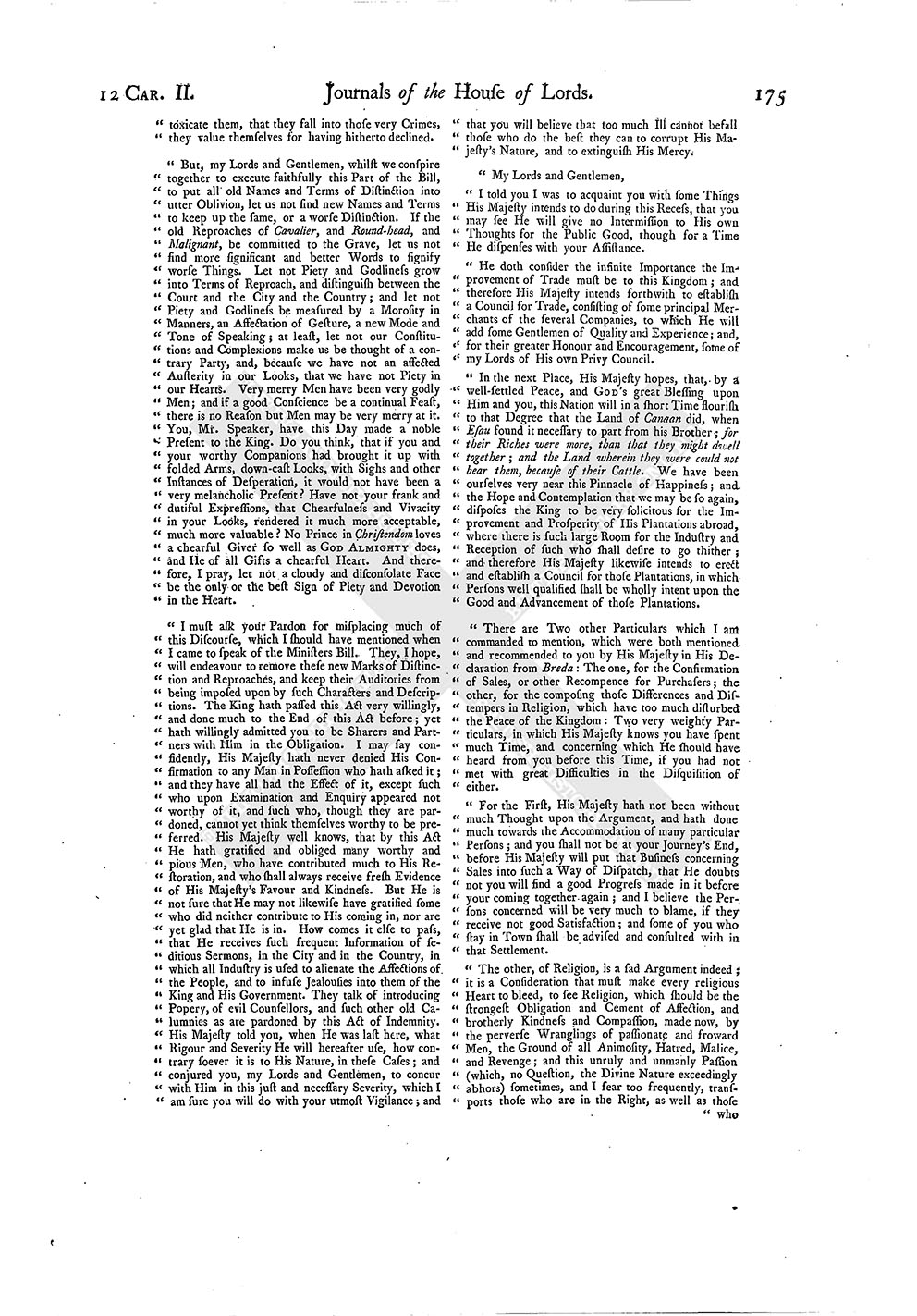
"His Majesty's Most Gracious Speech to His Two Houses of Parliament, on Thursday the 13th of September, 1660.
The King's Speech.
"My Lords and Gentlemen,
"If My Presence here had not been requisite for the passing these many Bills, I did always intend to see you together before your Adjournment, that I might again thank you for the many good Things you have done for Me and the Kingdom; and in Truth I do thank you more for what you have done for the Public, than what you have done for My own Particular; and yet I do thank you too for that, with all My Heart: But, I confess to you, I do thank you more for the Provision you have made to prevent Free Quarter during the Time the Army shall be disbanding, which I take to be given for My Satisfaction, than I do for the other Present you have made Me for My own particular Occasions; and I do promise you, which is the best Way I can take to gratify you, I will not apply One Penny of that Money to My own particular Occasions, what Shift soever I make, till it is evident to Me that the Public will not stand in Need of it; and if it do, every Penny of it shall be disbursed that Way, and I dare say I shall not be the poorer for it. I cannot but take Notice of One particular Bill I have passed, which may seem of an extraordinary Nature, that concerning the Duke of Somersett; but you all know it is for an extraordinary Person, who hath merited as much of the King My Father and Myself as a Subject can do; and I am none of those who think that Subjects by performing their Duties in an extraordinary Manner do not oblige their Princes to reward them in an extraordinary Manner. There can be no Danger from such a Precedent; and I hope no Man will envy him because I have done what a good Master should do to such a Servant.
"My Lords and Gentlemen,
"I will not deny to you that I had some Inclination, when I consented upon your Desire to your Recess, to have made a Session, which I thought most agreeable to the ancient Order of Parliaments; and I hope you will all join with Me in reducing the Proceedings of Parliaments to the ancient Rules and Orders of Parliaments, the Deviation from which hath done us no Good; and I think there were never so many Bills passed together as I have this Day given My Assent to, without a Session. But, upon the Desire and Reasons given by the House of Commons for an Adjournment without a Sessions, I did very willingly depart from that Inclination, and do as willingly give you Leave, and direct you, that you adjourn yourselves till the Sixth Day of November, when I hope you will all meet again; and in the mean Time, that you will be all welcome to your Countries, and do Me much Service there. I have many other Particulars to say and recommend to you, in which I cannot enough trust My own Memory; and therefore I shall command the Chancellor to say the rest to you."
After His Majesty had ended His Speech, the Lord Chancellor said as followeth:
Lord Chancellor's Speech.
"My Lords and Gentlemen,
"The King tells you, that He hath commanded me to say many Particulars to you. And the Truth is, He hath charged me with so many, that I have great Reason to fear that I shall stand in much Need of His Mercy, for omitting many Things He hath given me in Command; at least, for delivering them in more Disorder and Confusion than Matters of such Moment and Importance ought to be to such an Assembly; for which the King Himself hath even a Kind of Reverence, as well as an extraordinary Kindness. I am to mention some Things He hath done already, and many Things He intends to do during this Recess; that you may see, how well content soever He is that you should have Ease, and Pleasure, and Refreshment, He hath designed Work enough for Himself.
"The King hath thanked you for the Provision you have made that there may be no Free Quarter during the Time the Army shall be disbanding; and hath told you what He will do with that Money you have given Him, if there should want wherewithal to disband it. And now, I hope, you will all believe that His Majesty will consent to the Disbanding. He will do so; and yet He does not take it unkindly at their Hands who have thought that His Majesty would not disband this Army. It was a sober and a rational Jealousy; no other Prince in Europe would be willing to disband such an Army; an Army to which Victory is entailed, and which, humanly speaking, could hardly fail of Conquest, whithersoever He should lead it; and if God had not restored His Majesty to that rare Felicity as to be without Apprehension of Danger at Home or from Abroad, and without any Ambition of taking from His Neighbours what they are possessed of, Himself would never disband this Army; an Army, whose Order and Discipline, whose Sobriety and Manners, whose Courage and Success, hath made it famous and terrible over the World; an Army, of which the King and his Two Royal Brothers may say, as the Noble Grecian said of Eneas,
"Stetimus Tela aspera contra Contulimusque Manus, experto credite, quantus In Clypeum assurgat, quo Turbine torqueat Hastam.
"They have all Three, in several Countries, found themselves engaged in the Midst of these Troops, in the Heat and Rage of Battle; and if any common Soldiers (as no Doubt many may) will demand the old Romance Privilege for having encountered Princes single, upon my Conscience, he will find both Favour and Preferment. They have all Three observed the Discipline, and felt, and admired, and loved, the Courage of this Army, when they were the worse for it; and I have seen them, in a Season when there was little else of Comfort in their View, refresh themselves with Joy, that the English had done the great Work, the English had got the Day; and then please themselves with the Imagination what Wonders they should perform in the Head of such an Army: And therefore, when His Majesty is so entirely possessed of the Affection and Obedience of this Army, and when it hath merited so much from Him, can it be believed or imagined, that He can without some Regret part with them? No, my Lords and Gentlemen, He will never part with them; and the only sure Way never to part with them, is to disband them. Should it be otherwise, they must be exposed to the daily Importunity of His great Neighbours and Allies; and how could He refuse to lend them His Troops, of which He hath no Use Himself? His Majesty knows, they are too good Englishmen to wish, that a Standing Army should be kept up in the Bowels of their own Country; that they who did but in Bello Pacis gerere Negotium, and who, whilst an Army, lived like good Husbandmen in the Country and good Citizens in the City, will now become really such, and take Delight in the Benefit of that Peace they have so honestly and so wonderfully brought to pass. The King will part with them, as the most indulgent Parents part with their Children, for their Education, and for their Preferment: He will prefer them to Disbanding, and prefer them by Disbanding; and will always retain such a Kindness for them, and such a Memory of the Service they have done Him, that both Officers and Soldiers, after they are disbanded, shall always find such Countenance, Favour, and Reward from His Majesty, that He doubts not but, if He should have Occasion to use their Service, they will again resort to Him with the same Alacrity as if they had never been disbanded; and if there be any so ill amongst them (as there can be but very few, if any), who will forfeit that Favour and Protection they may have from Him, by any withstanding His Majesty's Commands, and the full and declared Sense of the Kingdom, His Majesty is confident, they will be as odious to their Companions as they can be to any other honest Men.
"My Lords and Gentlemen,
"I am in the next Place, by the King's Command, to put you in Mind of the Act of Indemnity; not of any Grants, or Concessions, or Releases, He made to you in that Act, I have nothing of that in Charge; no Prince hath so excellent a Memory to forget the Favours He does; but of what He hath done against you in that Act, how you may be undone by that Act, if you are not very careful to perform the Obligations He hath laid upon you in it. The Clause I am to put you in Mind of, is this:
"And, to the Intent and Purpose that all Names and Terms of Distinction may be likewise put into utter Oblivion, be it further Enacted, by the Authority aforesaid, That if any Person or Persons, within the Space of Three Years next ensuing, shall presume maliciously to call, or alledge, or object against any other Person or Persons, any Name or Names, or other Words of Reproach, any Way tending to revive the Memory of the late Differences or the Occasion thereof; that then every such Person, so as aforesaid offending, shall forfeit, &c."
"It is no Matter for the Penalty; it is too cheap a one, the King wishes it had been greater; and therefore hath, by His just Prerogative (and it is well for us He hath such a Prerogative), added another Penalty more insupportable, even His high Displeasure against all who shall swerve from this Clause in the Act. Give me Leave to tell you, that, as any Name or Names, or other Words of Reproach, are expressly against the Letter, and punishable accordingly, so evil and envious Looks, murmuring and discontented Hearts, are as directly against the Equity, of this Statute, a direct Breach of the Act of Indemnity, and ought to be punished too; and I believe they may be so. You know Kings are in some Sense called Gods, and so They may in some Degree be able to look into Mens Hearts; and God hath given us a King who can look as far into Mens Hearts as any Prince alive, and He hath great Skill in Physiognomy too: You would wonder what Calculations He hath made from thence; and no Doubt, if He be provoked by evil Looks to make a further Enquiry into Mens Hearts, and finds those corrupted with the Passions of Envy and Uncharitableness, He will never choose those Hearts to trust and rely upon. He hath given us a noble and princely Example, by opening and stretching His Arms to all who are worthy to be His Subjects, worthy to be thought Englishmen, by extending His Heart with a pious and a grateful Joy, to find all His Subjects at once in His Arms, and Himself in theirs. And shall we fold our Arms towards one another, and contract our Hearts with Envy and Malice to each other, by any sharp Memory of what hath been unneighbourly or unkindly done heretofore? What is this but to rebel against the Person of the King, against the excellent Example and Virtue of the King, against the known Law of the Land, this blessed Act of Oblivion?
"My Lords and Gentlemen,
"The King is a Suitor to you; makes it His Suit very heartily, that you will join with Him in restoring the whole Nation to its primitive Temper and Integrity, to its old Good-manners, its old Goodhumour, and its old Good-nature; Good-nature, a Virtue so peculiar to you, so appropriated by God Almighty to this Nation, that it can be translated into no other Language, hardly practised by any other People; and that you will, by your Example, by the Candour of your Conversation, by your Precepts, and by your Practice, and by all your Interest, teach your Neighbours and your Friends how to pay a full Obedience to this Clause of the Statute, how to learn this excellent Art of Forgetfulness. Let them remember, and let us all remember, how ungracious, how indecent, how ugly, the Insolence, the Fierceness, the Brutishness, of their Enemies appeared to them; and we may piously and reasonably believe, that God's Indignation against them for their Want of Bowels, for their not being Englishmen (for they had the Hearts of Pagans and Infidels), sent a Whirlwind in a Moment to blow them out of the World, that is, out of a Capacity to do more Mischief in the World, except we practise their Vices, and do that ourselves which we pretend to detest them for. Let us not be too much ashamed, as if what hath been done amiss proceeded from the Humour, and the Temper, and the Nature of our Nation. The Astrologers have made us a fair Excuse, and truly I hope a true one. All the Motions of these last Twenty Years have been unnatural, and have proceeded from the evil Influence of a malignant Star; and let us not too much despise the Influence of the Stars: And the same Astrologers assure us, that the Malignity of that Star is expired. The good Genius of this Kingdom is become superior, and hath mastered that Malignity; and our own good old Stars govern us again; and their Influence is so strong, that with our Help they will repair in a Year what hath been decaying in Twenty; and they only shall have no Excuse from the Star, who continue their Malignity, and own all the III that is past to be their own, by continuing and improving it for the Time to come. If any body here, or any where else, be too much exalted with what he hath done, or what he hath suffered, and from thence thinks himself warranted to reproach others, let him remember the Story of Nicephorus ; it is an excellent Story, and very applicable to such Distempers: He was a pious and religious Man, and for his Piety and Religion was condemned to the Fire: When he was led to Execution, and when an old Friend who had done him Injury enough fell at his Feet and asked his Pardon, the poor Man was so elated with the Triumph he was going unto, with the Glory of Martyrdom, that he refused to be reconciled unto him; upon which he was disappointed of his End, and for this Uncharitableness the Spirit of God immediately forsook him, and he apostatized from the Faith. Let all those who are too proud of having been, as they think, less faulty than other Men, and so are unwilling to be reconciled to those who have offended them, take Heed of the Apostacy of Nicephorus; and that those Fumes of Envy, and Uncharitableness, and Murmuring, do not so far transport and in- toxicate them, that they fall into those very Crimes, they value themselves for having hitherto declined.
"But, my Lords and Gentlemen, whilst we conspire together to execute faithfully this Part of the Bill, to put all old Names and Terms of Distinction into utter Oblivion, let us not find new Names and Terms to keep up the same, or a worse Distinction. If the old Reproaches of Cavalier, and Round-head, and Malignant, be committed to the Grave, let us not find more significant and better Words to signify worse Things. Let not Piety and Godliness grow into Terms of Reproach, and distinguish between the Court and the City and the Country; and let not Piety and Godliness be measured by a Morosity in Manners, an Affectation of Gesture, a new Mode and Tone of Speaking; at least, let not our Constitutions and Complexions make us be thought of a contrary Party, and, because we have not an affected Austerity in our Looks, that we have not Piety in our Hearts. Very merry Men have been very godly Men; and if a good Conscience be a continual Feast, there is no Reason but Men may be very merry at it. You, Mr. Speaker, have this Day made a noble Present to the King. Do you think, that if you and your worthy Companions had brought it up with folded Arms, down-cast Looks, with Sighs and other Instances of Desperation, it would not have been a very melancholic Present? Have not your frank and dutiful Expressions, that Chearfulness and Vivacity in your Looks, rendered it much more acceptable, much more valuable? No Prince in Christendom loves a chearful Giver so well as God Almighty does, and He of all Gifts a chearful Heart. And therefore, I pray, let not a cloudy and disconsolate Face be the only or the best Sign of Piety and Devotion in the Heart.
"I must ask your Pardon for misplacing much of this Discourse, which I should have mentioned when I came to speak of the Ministers Bill. They, I hope, will endeavour to remove these new Marks of Distinction and Reproaches, and keep their Auditories from being imposed upon by such Characters and Descriptions. The King hath passed this Act very willingly, and done much to the End of this Act before; yet hath willingly admitted you to be Sharers and Partners with Him in the Obligation. I may say confidently, His Majesty hath never denied His Confirmation to any Man in Possession who hath asked it; and they have all had the Effect of it, except such who upon Examination and Enquiry appeared not worthy of it, and such who, though they are pardoned, cannot yet think themselves worthy to be preferred. His Majesty well knows, that by this Act He hath gratified and obliged many worthy and pious Men, who have contributed much to His Restoration, and who shall always receive fresh Evidence of His Majesty's Favour and Kindness. But He is not sure that He may not likewise have gratified some who did neither contribute to His coming in, nor are yet glad that He is in. How comes it else to pass, that He receives such frequent Information of seditious Sermons, in the City and in the Country, in which all Industry is used to alienate the Affections of the People, and to infuse Jealousies into them of the King and His Government. They talk of introducing Popery, of evil Counsellors, and such other old Calumnies as are pardoned by this Act of Indemnity. His Majesty told you, when He was last here, what Rigour and Severity He will hereafter use, how contrary soever it is to His Nature, in these Cases; and conjured you, my Lords and Gentlemen, to concur with Him in this just and necessary Severity, which I am sure you will do with your utmost Vigilance; and that you will believe that too much Ill cannot befall those who do the best they can to corrupt His Majesty's Nature, and to extinguish His Mercy.
"My Lords and Gentlemen,
"I told you I was to acquaint you with some Things His Majesty intends to do during this Recess, that you may see He will give no Intermission to His own Thoughts for the Public Good, though for a Time He dispenses with your Assistance.
"He doth consider the infinite Importance the Improvement of Trade must be to this Kingdom; and therefore His Majesty intends forthwith to establish a Council for Trade, consisting of some principal Merchants of the several Companies, to which He will add some Gentlemen of Quality and Experience; and, for their greater Honour and Encouragement, some of my Lords of His own Privy Council.
"In the next Place, His Majesty hopes, that, by a well-settled Peace, and God's great Blessing upon Him and you, this Nation will in a short Time flourish to that Degree that the Land of Canaan did, when Esau found it necessary to part from his Brother; for their Riches were more, than that they might dwell together; and the Land wherein they were could not bear them, because of their Cattle. We have been ourselves very near this Pinnacle of Happiness; and the Hope and Contemplation that we may be so again, disposes the King to be very solicitous for the Improvement and Prosperity of His Plantations abroad, where there is such large Room for the Industry and Reception of such who shall desire to go thither; and therefore His Majesty likewise intends to erect and establish a Council for those Plantations, in which Persons well qualified shall be wholly intent upon the Good and Advancement of those Plantations.
"There are Two other Particulars which I am commanded to mention, which were both mentioned and recommended to you by His Majesty in His Declaration from Breda: The one, for the Confirmation of Sales, or other Recompence for Purchasers; the other, for the composing those Differences and Distempers in Religion, which have too much disturbed the Peace of the Kingdom: Two very weighty Particulars, in which His Majesty knows you have spent much Time, and concerning which He should have heard from you before this Time, if you had not met with great Difficulties in the Disquisition of either.
"For the First, His Majesty hath not been without much Thought upon the Argument, and hath done much towards the Accommodation of many particular Persons; and you shall not be at your Journey's End, before His Majesty will put that Business concerning Sales into such a Way of Dispatch, that He doubts not you will find a good Progress made in it before your coming together again; and I believe the Persons concerned will be very much to blame, if they receive not good Satisfaction; and some of you who stay in Town shall be advised and consulted with in that Settlement.
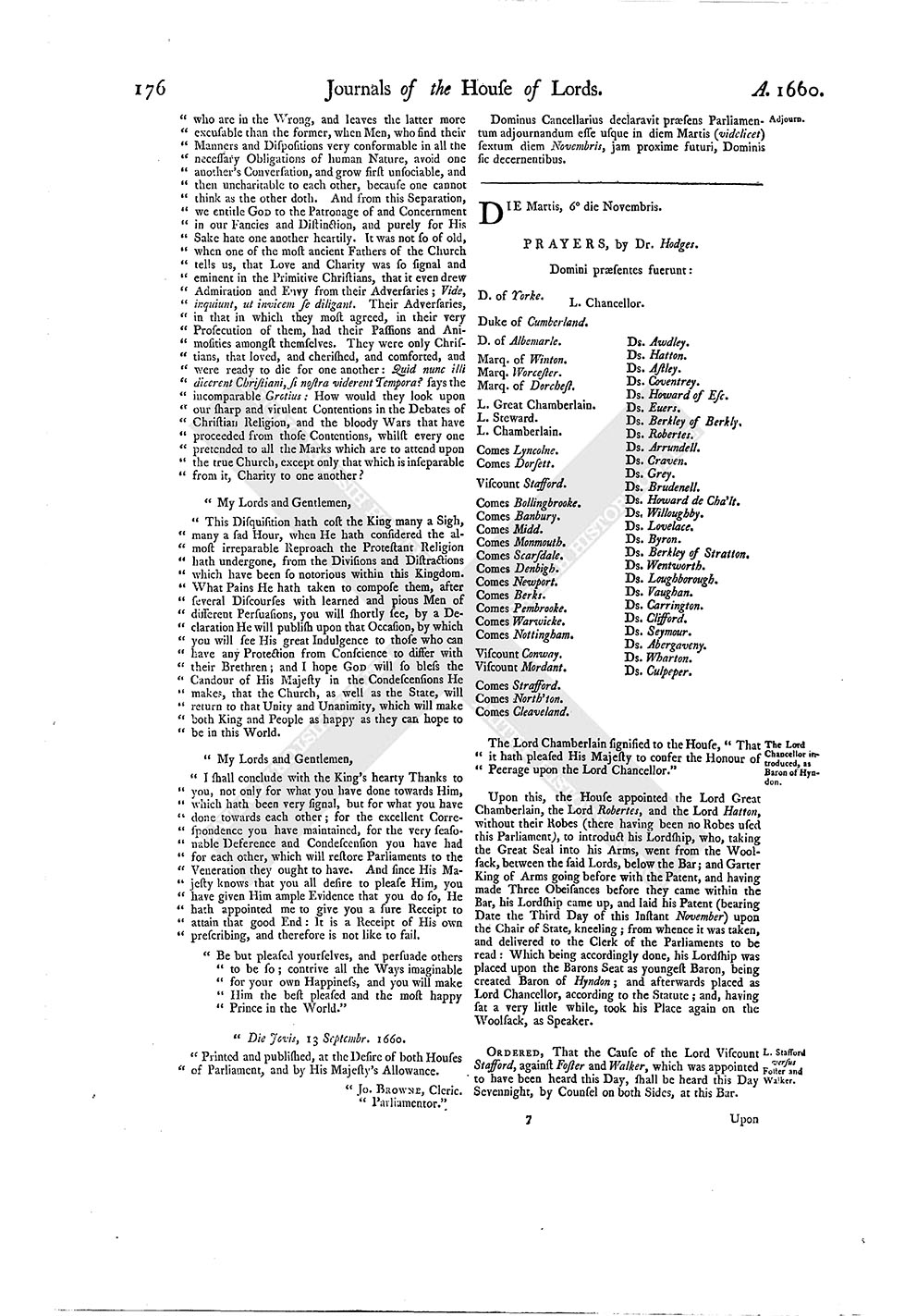
"The other, of Religion, is a sad Argument indeed; it is a Consideration that must make every religious Heart to bleed, to see Religion, which should be the strongest Obligation and Cement of Affection, and brotherly Kindness and Compassion, made now, by the perverse Wranglings of passionate and froward Men, the Ground of all Animosity, Hatred, Malice, and Revenge; and this unruly and unmanly Passion (which, no Question, the Divine Nature exceedingly abhors) sometimes, and I fear too frequently, transports those who are in the Right, as well as those who are in the Wrong, and leaves the latter more excusable than the former, when Men, who find their Manners and Dispositions very conformable in all the necessary Obligations of human Nature, avoid one another's Conversation, and grow first unsociable, and then uncharitable to each other, because one cannot think as the other doth. And from this Separation, we entitle God to the Patronage of and Concernment in our Fancies and Distinction, and purely for His Sake hate one another heartily. It was not so of old, when one of the most ancient Fathers of the Church tells us, that Love and Charity was so signal and eminent in the Primitive Christians, that it even drew Admiration and Envy from their Adversaries; Vide, inquiunt, ut invicem se diligant. Their Adversaries, in that in which they most agreed, in their very Prosecution of them, had their Passions and Animosities amongst themselves. They were only Christians, that loved, and cherished, and comforted, and were ready to die for one another: Quid nunc illi dicerent Christiani, si nostra viderent Tempora? says the incomparable Grotius: How would they look upon our sharp and virulent Contentions in the Debates of Christian Religion, and the bloody Wars that have proceeded from those Contentions, whilst every one pretended to all the Marks which are to attend upon the true Church, except only that which is inseparable from it, Charity to one another?
"My Lords and Gentlemen,
"This Disquisition hath cost the King many a Sigh, many a sad Hour, when He hath considered the almost irreparable Reproach the Protestant Religion hath undergone, from the Divisions and Distractions which have been so notorious within this Kingdom. What Pains He hath taken to compose them, after several Discourses with learned and pious Men of different Persuasions, you will shortly see, by a Declaration He will publish upon that Occasion, by which you will see His great Indulgence to those who can have any Protection from Conscience to differ with their Brethren; and I hope God will so bless the Candour of His Majesty in the Condescensions He makes, that the Church, as well as the State, will return to that Unity and Unanimity, which will make both King and People as happy as they can hope to be in this World.
"My Lords and Gentlemen,
"I shall conclude with the King's hearty Thanks to you, not only for what you have done towards Him, which hath been very signal, but for what you have done towards each other; for the excellent Correspondence you have maintained, for the very seasonable Deference and Condescension you have had for each other, which will restore Parliaments to the Veneration they ought to have. And since His Majesty knows that you all desire to please Him, you have given Him ample Evidence that you do so, He hath appointed me to give you a sure Receipt to attain that good End: It is a Receipt of His own prescribing, and therefore is not like to fail.
"Be but pleased yourselves, and persuade others to be so; contrive all the Ways imaginable for your own Happiness, and you will make Him the best pleased and the most happy Prince in the World."
"Die Jovis, 13 Septembr. 1660.
"Printed and published, at the Desire of both Houses of Parliament, and by His Majesty's Allowance.
"Jo. Browne, Cleric.
"Parliamentor."
Adjourn.
Dominus Cancellarius declaravit præsens Parliamentum adjournandum esse usque in diem Martis (videlicet) sextum diem Novembris, jam proxime futuri, Dominis sic decernentibus.