
Journal of the House of Lords: Volume 11, 1660-1666. Originally published by His Majesty's Stationery Office, London, 1767-1830.
This free content was digitised by double rekeying. All rights reserved.
'House of Lords Journal Volume 11: 8 May 1661', in Journal of the House of Lords: Volume 11, 1660-1666, (London, 1767-1830) pp. 240-245. British History Online https://www.british-history.ac.uk/lords-jrnl/vol11/pp240-245 [accessed 24 April 2024]


In this section
Anno 13 Caroli Secundi.
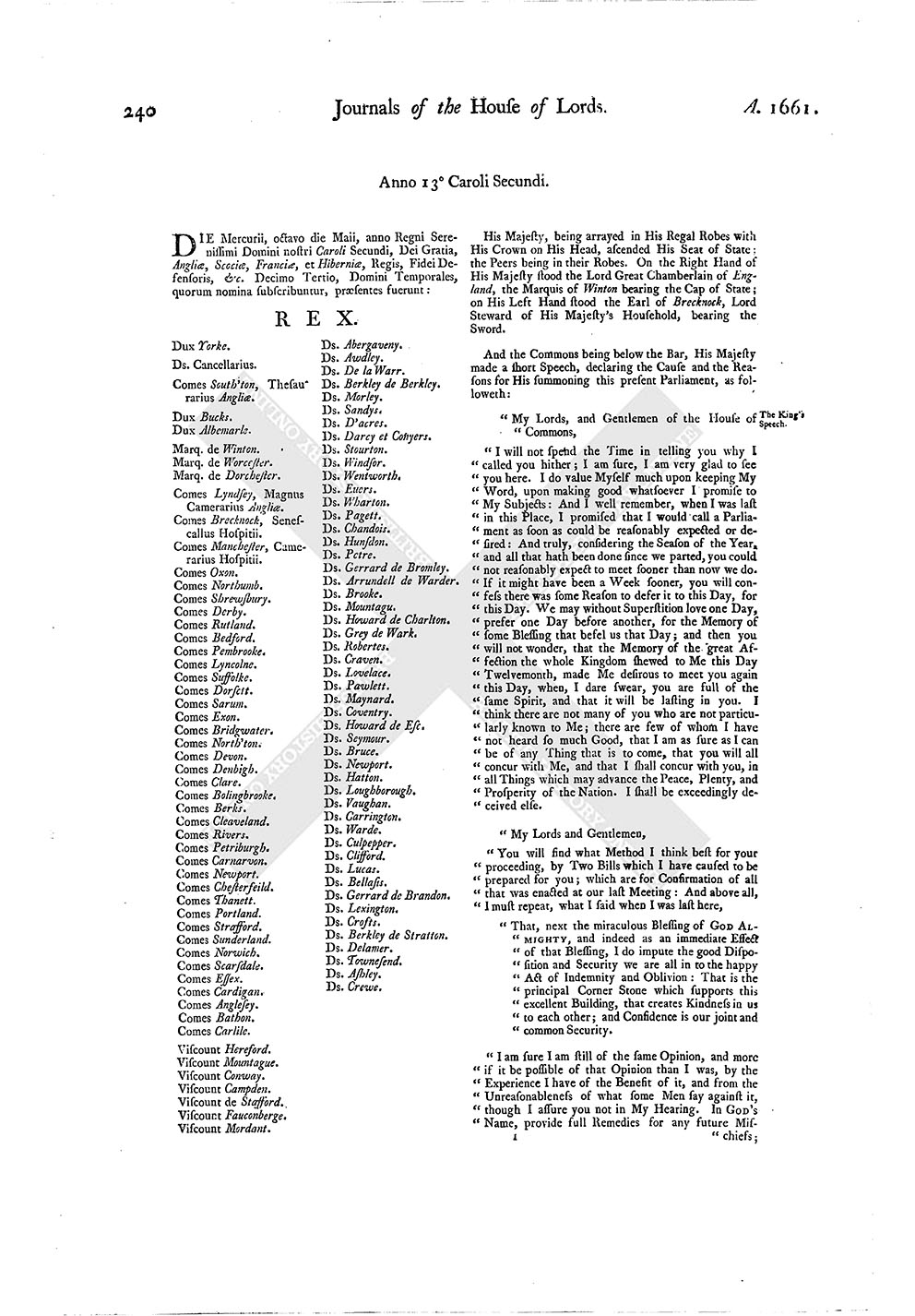
DIE Mercurii, octavo die Maii, anno Regni Serenissimi Domini nostri Caroli Secundi, Dei Gratia, Angliæ, Scociæ, Franciæ, et Hiberniæ, Regis, Fidei Defensoris, &c. Decimo Tertio, Domini Temporales, quorum nomina subscribuntur, præsentes fuerunt:
REX.
His Majesty, being arrayed in His Regal Robes with His Crown on His Head, ascended His Seat of State; the Peers being in their Robes. On the Right Hand of His Majesty stood the Lord Great Chamberlain of England, the Marquis of Winton bearing the Cap of State; on His Left Hand stood the Earl of Brecknock, Lord Steward of His Majesty's Household, bearing the Sword.
And the Commons being below the Bar, His Majesty made a short Speech, declaring the Cause and the Reasons for His summoning this present Parliament, as followeth:
The King's Speech.
"My Lords, and Gentlemen of the House of Commons,
"I will not spend the Time in telling you why I called you hither; I am sure, I am very glad to see you here. I do value Myself much upon keeping My Word, upon making good whatsoever I promise to My Subjects: And I well remember, when I was last in this Place, I promised that I would call a Parliament as soon as could be reasonably expected or desired: And truly, considering the Season of the Year, and all that hath been done since we parted, you could not reasonably expect to meet sooner than now we do. If it might have been a Week sooner, you will confess there was some Reason to defer it to this Day, for this Day. We may without Superstition love one Day, prefer one Day before another, for the Memory of some Blessing that besel us that Day; and then you will not wonder, that the Memory of the great Affection the whole Kingdom shewed to Me this Day Twelvemonth, made Me desirous to meet you again this Day, when, I dare swear, you are full of the same Spirit, and that it will be lasting in you. I think there are not many of you who are not particularly known to Me; there are few of whom I have not heard so much Good, that I am as sure as I can be of any Thing that is to come, that you will all concur with Me, and that I shall concur with you, in all Things which may advance the Peace, Plenty, and Prosperity of the Nation. I shall be exceedingly deceived else.
"My Lords and Gentlemen,
"You will find what Method I think best for your proceeding, by Two Bills which I have caused to be prepared for you; which are for Confirmation of all that was enacted at our last Meeting: And above all, I must repeat, what I said when I was last here,
"That, next the miraculous Blessing of God Almighty, and indeed as an immediate Effect of that Blessing, I do impute the good Disposition and Security we are all in to the happy Act of Indemnity and Oblivion: That is the principal Corner Stone which supports this excellent Building, that creates Kindness in us to each other; and Confidence is our joint and common Security.
"I am sure I am still of the same Opinion, and more if it be possible of that Opinion than I was, by the Experience I have of the Benefit of it, and from the Unreasonableness of what some Men say against it, though I assure you not in My Hearing. In God's Name, provide full Remedies for any future Mis- chiefs; be as severe as you will against new Offenders, especially if they be so upon old Principles; and pull up those Principles by the Roots. But I shall never think him a wise Man, who would endeavour to undermine or shake that Foundation of our Public Peace, by infringing that Act in the least Degree; or that he can be My Friend, or wish Me well, who would persuade Me ever to consent to the Breach of a Promise I so solemnly made when I was Abroad, and performed with that Solemnity, because, (fn. 1) and after I promised it, I cannot suspect any Attempts of that Kind by any Man of Merit and Virtue.
"I will not conclude without telling you some News that I think will be very acceptable to you; and therefore I should think Myself unkind, and ill-natured, if I should not impart it to you.
"I have been often put in Mind by My Friends, that it was high Time to marry; and I have thought so Myself ever since I came into England: But there appeared Difficulties enough in the Choice, though many Overtures have been made to Me; and if I should never marry till I could make such a Choice against which there could be no Foresight of any Inconvenience that may ensue, you would live to see Me an old Bachelor, which I think you do not desire to do. I can now tell you, not only that I am resolved to marry, but whom I resolve to marry, if God please; and towards My Resolution, I have used that Deliberation, and taken that Advice, as I ought to do in an Affair of that Importance; and, trust Me, with full Consideration of the Good of My Subjects in general, as of Myself: It is with the Daughter of Portugall. When I had as well as I could weighed all that occurred to Me, the First Resolution I took was, to state the whole Overtures which had been made to Me, and in Truth all that had been said against it, to My Privy Council; without hearing whose Advice, I never did, nor ever will, resolve any Thing of Public Importance: And I tell you with great Satisfaction and Comfort to Myself, that, after many Hours Debate in a full Council, for I think there was not above One absent; and truly, I believe, upon weighing all that can be said upon that Subject, for or against it, My Lords without One dissenting Voice, yet there were very few sat silent, advised Me with all imaginable Chearfulness to this Marriage; which I look upon as very wonderful, and even as some Instance of the Approbation of God Himself; and so took My own Resolution, and concluded all with the Ambassador of Portugall, who is departing with the whole Treaty signed, which you will find to contain many great Advantages to the Kingdom: And I make all the Haste I can to fetch you a Queen hither, who, I doubt not, will bring great Blessings with Her to Me and You. I will add no more, but refer the rest to the Chancellor."
After His Majesty had finished His Speech, the Lord Chancellor, having first conferred with His Majesty, spake as followeth:
Ld. Chancellor's Speech.
"My Lords; and you the Knights, Citizens, and Burgesses, of the House of Commons;
"The King hath called you hither by His Writ, to assist Him, with your Information and Advice, in the greatest and weightiest Affairs of the Kingdom; by His Writ, which is the only good and lawful Way to the Meeting of a Parliament; and the pursuing that Writ, the remembering how and why they came together, is the only Way to bring a happy End to Parliaments. There was no such Writ as this, no such Presence as this, in the Year 1649, when this unhappy Kingdom was dishonoured and exposed to the Mirth and Reproach of their Neighbours, in the Government of a Commonwealth. There was no such Writ as this, no such Presence as this, in December 1653, when that Infant Commonwealth, when the Three Kingdoms of England, Scotland, and Ireland, and the Dominions thereunto belonging, were delivered up into the bloody and merciless Hands of a devouring Protector, and sacrificed to his Lust and Appetite. There was no such Writ as this, no such Presence as this, in the Year 1656, when that Protector was more solemnly invested and installed, and the Liberty of the Three Nations submitted to his absolute Tyranny by the humble Petition and Advice. When People came together by such exorbitant Means, it is no Wonder that their Consultations and Conclusions were so disproportioned from any Rules of Justice or Sobriety. God be thanked, that He hath reserved us to this Day, a Day that many good Men have died praying for; that, after all those Prodigies in Church and State, we have lived to see the King at the Opening of the Parliament; that we have lived to see our King anointed and crowned, and crowned by the Hands of an Archbishop, as His Predecessors have been; and that we are come hither this Day in Obedience to His Writ.
"The King tells you, He hath caused a Bill or Two to be prepared for the Confirmation of all that was enacted in the last Parliament, and commends the Dispatch of those to you with some Earnestness. The Truth is, it is a great Part of the Business of this Parliament, to celebrate the Memory of the last, by confirming or re-enacting all that was done by that Parliament, which, though it was not called by the King's Writ, may be reasonably thought to have been called by God Himself, upon the Supplication and Prayer of the King and the whole Nation, as the only Means to restore the Nation to its Happiness, to itself, to its Honour, and even to its Innocence. How glad the King was of it, appears by what He writ to them from Breda, when He referred more to them than ever was referred to Parliament: He referred in Truth (upon the Matter) all that concerned Himself, all that concerned Religion, all that concerned the Peace and Happiness of the Kingdom, to them; and to their Honour be it spoken, and to their Honour be it ever remembered, that the King, Religion, and the Kingdom, have no Reason to be sorry that so much was intrusted to them, nor they to be ashamed of the Discharge of their Trust. It would have been a very unseasonable Scruple in any Man, who should have refused to bear his Part in the excellent Transactions of that Parliament, because he was not called thither by the King's Writ; and it would be a more unreasonable Scruple now, in any Man, after we have all received the Fruit and Benefit of their Councils and Conclusions, when in Truth we owe our orderly and regular Meeting at this Time to their extraordinary Meeting then, to their Wisdom in laying Hold upon the King's Promises, and to the King's Justice in performing all He promised, and to the Kingdom's Submission and Acquiescence in those Promises; I say, it would be very unseasonable and unreasonable now, to endeavour to shake that Foundation, which, if you will take the King's Judgement, supports the whole Fabric of our Peace and Security. He tells you what He shall think of any who goes about to undermine that Foundation; which is a Zeal no Prince could be transported with but Himself. It might have seemed enough for a King who had received so many Injuries so hardly to be forgotten, undergone so many Losses so impossible to be repaired, to have been willing to confirm and to re-enact the Act of Oblivion and Indemnity, when you should present it to Him; but to prepare such an Act for you, to conjure you by all that is precious, by your Friendship to Him, to dis patch those Acts with Expedition, is such a Piece of fatherly Tenderness and Piety, as could proceed from no Heart but such a one in which God hath treasured up a Stock of Mercy and Justice and Wisdom, to redeem a Nation. And truly, my Lords and Gentlemen, for ourselves, if we'll consider how much we owe to those who with all the Faculties of their Souls contributed to and contrived the blessed Change, the restoring the King to His People, and His People to the King, and then how much we owe to those who gave no Opposition to the virtuous Activity of the other (and God knows a little Opposition might have done much Harm), whether we look upon the Public, or upon our own private Provocations, there will remain so few who do not deserve to be forgiven by us, that we may very well submit to the King's Advice, and His Example; of whom we may very justly say, as a very good Historian said of a very great Emperor, and I am sure it could never be so truly said of any Emperor as of ours, Facere rectè Cives suos Princeps Optimus faciendo docet; cumque sit Imperio maximus, Exemplo major est: Nor indeed hath He yet given us, or have we yet felt, any other Instances of His Greatness, and Power, and Superiority, and Dominion over us, nisi (as He said) aut Levatione Periculi, aut Accessione Dignitatis; by giving us Peace, Honour, and Security, which we could not have without Him; by desiring nothing for Himself, but what is as good for us as for Himself; and therefore, I hope, we shall make no Scruple of obeying Him in this Particular.
"My Lords and Gentlemen,
"Though the last Parliament did great and wonderful Things, indeed as much as in that Time they could, yet they have left very great Things for you to do: You are to finish the Structure, of which they but laid the Foundation; indeed they left some Things undone, which it may be they thought they had finished: You will find the Revenue they intended to raise for the King very much short of what they promised: You will find the Public Debts for the Discharge of the Army and the Navy, which they thought they had provided for sufficiently, to be still in Arrear and unpaid: And here I am, by the King's special Command, to commend the poor Seamen to you, who, by the Rules which were prescribed for their Payment, are in much worse Condition than (without Question) was foreseen they would be; for, by appointing them to be paid but from 1658 (which was a safe Rule to the Army), very many are still in Arrear for Two, Three, or Four Years Service; and so His Majesty's Promise to them from Breda remains unperformed. Some other Losses, which resulted from other Rules given for their Payment, have been supplied to them by the King's own Bounty. They are a People very worthy of your particular Care and Cherishing; upon whose Courage and Fidelity very much of the Happiness and Honour and Security of the Nation depends; and therefore His Majesty doubts not you will see Justice done towards them with Favour.
"My Lords and Gentlemen,
"You are now the great Physicians of the Kingdom; and, God knows, you have many wayward, and froward, and distempered Patients, who are in Truth very sick, and Patients who think themselves sicker than they are; and some who think themselves in Health, and are most sick of all. You must, therefore, use all the Diligence, and Patience, and Compassion, which good Physicians have for their Patients; all the Chearfulness, and Complacency, and Indulgence, their several Habits, and Constitutions, and Distempers of Body and Mind, may require. Be not too melancholic with your Patients, nor suffer them to be too melancholic, by believing that every little Distemper will presently turn to a violent Fever, and that Fever will presently turn to the Plague; that every little Trespass, every little Swerving from the known Rule, must insensibly grow to a Neglect of the Law, and that Neglect introduce an absolute Confusion; that every little Difference in Opinion, or Practice in Conscience or Religion, must presently destroy Conscience and Religion. Be not too severe and rough towards your Patients, in prescribing Remedies, how well compounded soever, too nauseous and offensive to their Stomachs and Appetite, or to their very Fancy. Allay and correct those Humours, which corrupt their Stomachs and their Appetites: If the good old known tried Laws be for the present too heavy for their Necks, which have been so many Years without any Yoke at all, make a temporary Provision of an easier and a lighter Yoke, till, by living in a wholesome Air, by the Benefit of a soberer Conversation, by keeping a better Diet, by the Experience of a good and just Government, they recover Strength enough to bear, and Discretion enough to discern, the Benefit and the Ease of those Laws they disliked. If the present Oaths have any Terms or Expressions in them that a tender Conscience honestly makes Scruple of submitting to, in God's Name let other Oaths be formed in their Places, as comprehenfive of all those Obligations which the Policy of Government must exact; but still let there be a Yoke: Let there be an Oath, let there be some Law, that may be the Rule to that Indulgence, that, under Pretence of Liberty of Conscience, Men may not be absolved from all the Obligations of Law and Conscience.
"I have besought your Good-nature and Indulgence towards some of your weak Patients, if by it they can be brought to follow and submit to your Prescriptions for their Health; nor is it reasonable to imagine that the Distempers of Twenty Years can be rectified and subdued in Twelve Months. There must be a natural Time, and natural Applications, allowed for it. But there are a sort of Patients that I must recommend to your utmost Vigilance, utmost Severity, and to no Part of your Lenity or Indulgence; such who are so far from valuing your Prescriptions, that they look not upon you as their Physicians, but their Patients; such who, instead of repenting any Thing that they have done amiss, repeat every Day the same Crimes for the Indemnity whereof the Act of Oblivion was provided. These are the seditious Preachers, who cannot be contented to be dispensed with for their full Obedience to some Laws established, without reproaching and inveighing against those Laws, how established soever; who tell their Auditories, that the Apostle meant, when he bid them stand to their Liberties, that they should stand to their Arms; and who, by repeating the very Expressions, and teaching the very Doctrine, they set on-foot in the Year 1640, sufficiently declare that they have no Mind that Twenty Years should put an End to the Miseries we have undergone.
"What good Christian can think without Horrour of these Ministers of the Gospel, who by their Function should be the Messengers of Peace, and are in their Practice the only Trumpets of War, and Incendiaries towards Rebellion! How much more Christian was that Athenian Nun in Plutarch, and how shall she rise up in Judgement against these Men, who, when Alcibiades was condemned by the Public Justice of the State, and a Decree made, that the Religious, the Priests, and the Nuns, should revile and curse him, stoutly refused to perform that Office, saying, "That she was prosessed religious, to pray and to bless, not to curse and ban !" And if the Person and the Place can improve and aggravate the Offence, as no Doubt it doth both before God and Man, methinks the preaching Rebellion and Treason out of the Pulpit should be as much worse than the advancing it in the Market, as the poisoning a Man at the Communion would be worse than killing him at a Tavern: And it may be, in the Catalogue of those Sins which the Zeal of some Men declares to be against the Holy Ghost, there may not be any one more reasonably thought to be such, than a Minister of Christ's turning Rebel against His Prince, which is a most notorious Apostacy from His Order; and his preaching Rebellion to the People as the Doctrine of Christ, adding Blasphemy and Pertinacy to his Apostacy, hath all the Marks by which good Men are taught to know and avoid that Sin against the Holy Ghost. If you do not provide for the thorough quenching these Firebrands; King, Lords, and Commons, shall be their meanest Subjects, and the whole Kingdom kindled into one general Flame.
"My Lords and Gentlemen,
"When the King spake last in this Place before this Day, He said, "When He should call the next Parliament, He should receive their Thanks for what He had done since He had dissolved the last; for He said, He should not more propose any one Rule to Himself, in His Actions or His Councils, than this, What is a Parliament like to think of this Action, or of that Council? And that it should be want of Understanding in Him, if it would not bear that Test:" He told you but now, "That He values Himself much upon keeping His Word, upon performing all that He promises to His People." And He hath the worst Luck in the World, if He hath not complied with this Promise, and if His Understanding hath failed Him in it. It was in a very little Time after the Dissolution of that Parliament, His Majesty giving Himself a few Days to accompany His Royal Mother to the Sea Side, the only Time He hath slept out of this Town near these Twelve Months, that the most desperate, and prodigious Rebellion brake out in this City, that hath been heard of in any Age; which continued Two or Three Nights together, with the Murder of several honest Citizens. Let no Man undervalue the Treason because of the Contemptibleness of the Number engaged in it. No Man knows the Number; but, by the Multitude of intercepted Letters from and to all the Counties of England, in which the Time was set down wherein the Work of the Lord was to be done, by the desperate Carriage of the Traitors themselves, and their bragging of their Friends, we may conclude the Combination reached very far. And in Truth we may reasonably believe, that if the undaunted Courage and the indefatigable Industry of the Lord Mayor, who deserves to be mentioned before King, Lords, and Commons, and to be esteemed by them, had not prevented it; I say, it is probable this Fury would have not been extinguished, before this famous City, or a great Part of it, had been turned into Ashes.
"If you enquire what the King did upon this unheard-of Provocation, what Vengeance He took upon those whose prosessed and avowed Principle was, not to distinguish between Him and another Man, nay, to kill Him sooner than any other Man, you will find (as was said of Cæsar) that libentius Vitam Victor jam daret, quam Victi acciperent; that His Mercy hath been no less obstinate than their Malice and Wickedness; that few Persons have suffered; and that He hath restrained the Law from being severe to many, who at the same Time continue their Guilt, and undervalue His Compassion; that there hath not been a Week since that Time, in which there have not been Combinations and Conspiracies formed against His Person, and against the Peace of the Kingdom, which before this Time would have taken Effect, if God had not put it into the Hearts of some who were trusted in the Councils, to discover the Design, Time enough for Prevention. And upon all these Alarms, and the Interception of such Letters as would in all other Countries have produced the Rack for further Discoveries, and under the late Government in this would have erected High Courts of Justice for their Punishment, He hath left the Offenders to the Judges of the Law, and those Judges to the precise Forms and ordinary Rules of the Law.
"My Lords and Gentlemen,
"If the new License and Corruption of this Time hath exceeded the Wickedness of former Ages, that the old Laws have not enough provided for the Punishment of Wickedness they could not foresee or imagine; it will become your Wisdoms to provide new Remedies for new Diseases, and to secure the precious Person of our dear Sovereign from the First Approaches of Villany, and the Peace of the Kingdom from the First Overtures of Sedition.
"If you will not provide Laws to do it, the King will not do any Thing extraordinary, even towards His own Preservation. You see the Rule by which He hath walked; and as He hath made good His Promise to you, so, I doubt not, you will make good His Prophecy, and that He shall receive Thanks for what He hath done since He was last here.
"He hath told you now what He hath done; that He is resolved to marry, and resolved whom to marry; which, I believe, is the most grateful News that the whole Kingdom hath longed for, or could receive, from the First Day of His Landing here. And when they shall know the great Deliberation He hath used before that Resolution, and the Circumstances in resolving it, they will surely have Cause to confess, that never King, in the Disposal of Himself in Marriage, took so great Care for the Good and Felicity of His People.
"Within a very short Time after His Landing in this Kingdom, He was moved by the Ambassador of Portugall to renew a Treaty lately made between that Crown and the Usurper; a Treaty in very many respects the most advantageous to this Nation that ever was entered into with any Prince or People; a Treaty by which, at this Time, that Crown is paying the Penalty (which the Usurper exacted from it) for the most noble and heroic Act of Honour and Friendship, performed by that King to our Master, that ever was performed by any Prince towards another Prince in Distress. And yet the King was nothing forward to ratify this Treaty; though it is very true, every Article in it but One was entirely for the Benefit of this Nation, for the extraordinary Advancement of Trade, for the Good of Religion, and for the Honour of the Crown: Yet there was One, One single Article, that must oblige the King, as it did the Usurper, to supply Portugall with an Army for His Assistance, when He should require it; that is, Portugall should have Power to make Levies of Ten Thousand Men for their Service. This, the King foresaw, might produce a War with Spainc, (fn. 2) which He was very unwilling to undergo that Engagement; and yet His Council represented unto Him how heart-breaking a Thing it would be to His People, to lose the Possession of so great a Trade, and those other immense Advantages they had by that Treaty; and that it would be judged an irrecoverable Error in Policy, if Portugall should be suffered again to be swallowed up by Spaine. However, the King was resolved, not precipitately to engage Himself in such a Treaty as might be attended with such an Inconvenience; but to take Time, fully to consider of it; and this Delay the Portugall could not be pleased with, and so the Ambassador returned Home to his Master. About this Time, the House of Commons sent up a Bill to the Lords, for the annexing Dunkirk and Jamaica to the Crown of England, which seemed to have the most universal Consent and Approbation from the whole Nation that ever any Bill could be attended with: Yet the same Consideration which retarded the Treaty with Portugall made the King less warm towards the advancing of that Bill; and the Spanish Ambassador was as solicitous to obstruct it, as He hath been since to obstruct the Match with Portugall. This being the Case; and the Portugall Ambassador returning with such particular Overtures to the King for a Marriage with the Daughter of that Crown, that, both in respect of Portion, and many other transcendent Advantages for the Advancement of the Trade and Empire of this Kingdom, the like hath not been offered in this Age; and His Majesty having received as full Information and Satisfaction in the Beauty and Excellency of that Renowned Princess as can be had without a personal Interview (a Circumstance very rarely admitted to Princes); it was not in His Majesty's Power to be without some Approbation and Inclination to this Alliance: Yet even then He would not trust Himself in this great Affair, which so nearly and so dearly concerns Himself, and Himself above all others. Though the Benefit and Advantage could but appear the same upon further Consultation, yet there might possibly be some Mischiefs, or some Inconveniencies be discerned, which He had not foreseen. He resolves, therefore, to call His Council; tells them some Days before, that He had an Affair of great Importance to impart to them, and to receive their Advice in; and therefore appointed an extraordinary Day, that they might all appear (and truly, I think, there was but One Lord absent, who was then indisposed in his Health). In this Council He stated the whole Matter, all that was offered of Benefit and Advantage, all that occurred of Hazard or Inconvenience, without the least Discovery of His own Inclinations, further than that you would have believed He had seen the Picture of His Mistress; it having been a Speech He hath often accustomed Himself to, that He would not marry a Woman He had not some Reason to believe He could love, though she could bring Him the Empire of the World. He did not conceal from my Lords what the Spanish Ambassador had offered against this Marriage (who is not over-reserved in giving Counsel, nor in communicating the Counsel he gives), what Proffers he had made of others, what Threats of War in one Case, what Advantage of Dowry in another; that he is so solicitous for the Advancement of the Protestant Religion, that he had offered several Protestant Princesses to whom his Master shall give a Portion, as with the Infanta of Spaine; and truly less than the Universal Monarch could not dispose of so many Princesses without the least Consent or Privity of their own. His Majesty commanded all my Lords to deliver their Counsel and Advice freely, upon a full Prospect of what might appear good and happy for His People as well as for Himself; assuring them, as He hath done you now this Day, that, as He never did, so He never will do, any Thing of great Importance, without consulting with them. You will believe that my Lords of the Council are solicitous enough for the Advancement of the Protestant Religion, upon which the Welfare of this Kingdom so much depends. But they were very apprehensive, that the First Protestant Daughter that ever any King of Spaine had, would not probably bring so great Advantages to it as was pretended. They have no Mind to encourage the King to a War; we have had War enough: But they do not think He should so much fear a War, as, out of the Dread of it, to be at the Disposal of any other Prince; and that when He hath freed His own Subjects from Wardships and from Liveries, that He should Himself become a Ward to the King of Spaine, and not marry without His Approbation and Consent. They observed, that in the same Memorials (I do not mean that which He last printed, but a former) in which the Spanish Ambassador threatens War if the King marries with Portugall, he presseth very earnestly the delivering up of Dunkirke and Jamaica; and it is plain enough, he would have that Recompence for the Portion he would give. And, in Truth, whosoever is against the Match with Portugall, is for the Delivery of Dunkirke and Jamaica; War being as sure to follow from the latter as the former, and from neither till the King of Spaine find it convenient for Himself, which I hope He will not yet do. I will not enlarge upon the many Reasons. The King hath told you the Conclusion. There was never a more unanimous Advice from any Council, not any dissenting Voice, in the beseeching His Majesty to make this Marriage, and to finish it with all the Expedition imaginable. Upon this, He sent for the Portugall Ambassador, declared His Resolution to him, hath writ Himself to Portugall, and is preparing His Fleet to fetch Home our Queen. And I hope now He hath deserved all your Thanks, both for the Matter and the Manner; and that not only ourselves, but the Ages that are to succeed us, shall have Cause to bless God and His Majesty for this Resolution that He hath taken, and that He hath declared to us this Day, and hath reserved for this Day, having obliged His Council to Secrecy, that He might Himself communicate it to His whole Kingdom at once.
"There are some other Particulars of Weight; but He will not mingle them with this great important one, which must so much fill your Hearts and your Heads; but will reserve them till He sees you again after you have chosen your Speaker, which He now leaves you to do, and to repair to your House for that Purpose, that you may present your Speaker to Him at Four of the Clock upon Friday."
Which being ended, the Lord Chancellor commanded the Clerk to read the Names of Receivers and Triers of Petitions, which follow:
Receivers and Triers of Petitions.
Le Receavours des Petitions d'Angleterre, d'Escoce, et d'Ireland.
Messire Robert Foster, Cheval. et Cheife Justice.
Messire Robert Hyde, Ch'r, et Justicier.
Messire Wadham Windham, Ch'r, et Justicier.
Messire William Childe, Ar. Doctor au Droit Civill.
Messire William Glascock, Ar.
Et ceux qui veulent deliver leur Petitions eux baillent dedeins six Jours prochenement ensuent.
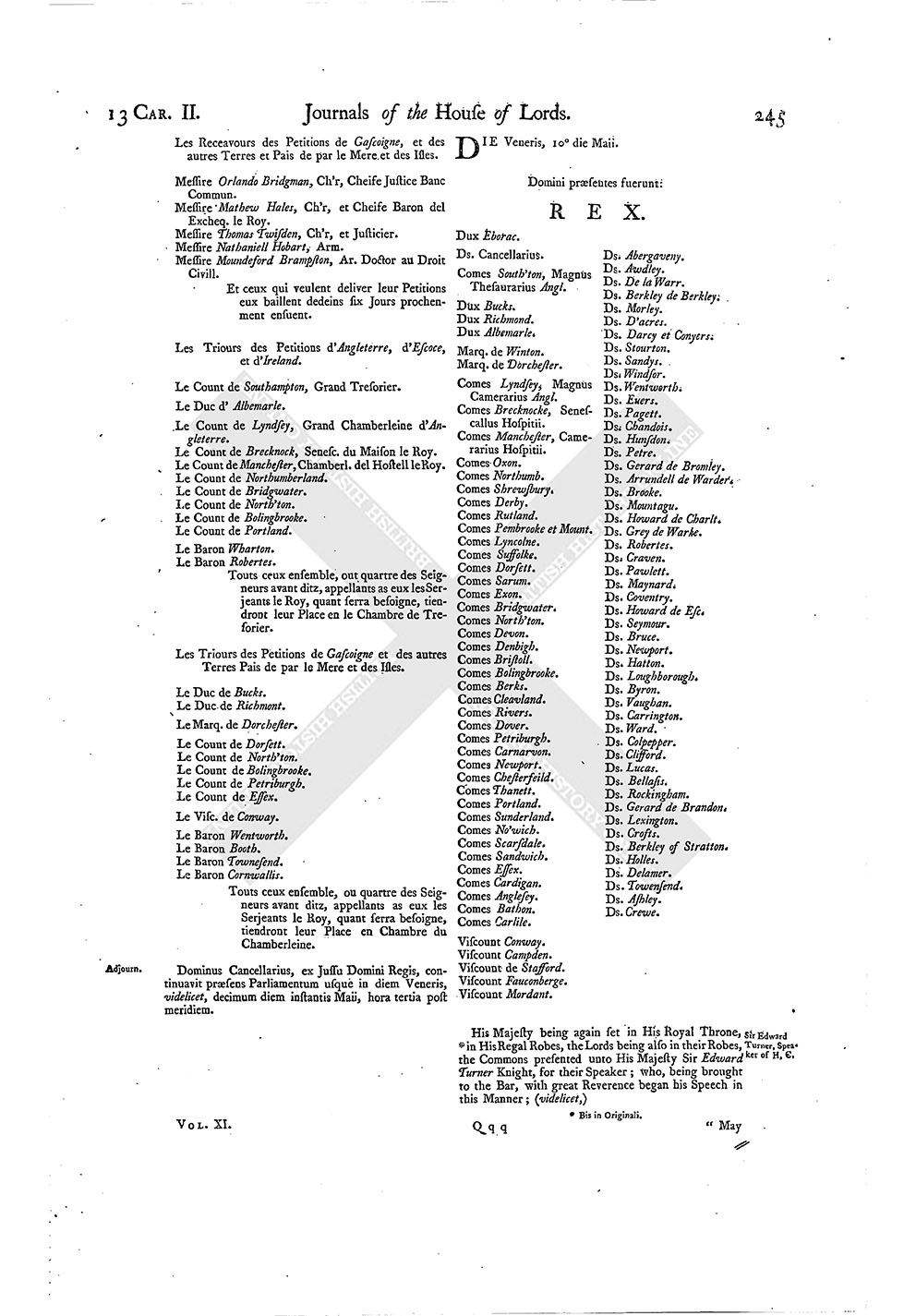
Les Receavours des Petitions de Gascoigne, et des autres Terres et Pais de par le Mere et des Isles.
Messire Orlando Bridgman, Ch'r, Cheife Justice Banc Commun.
Messire Mathew Hales, Ch'r, et Cheife Baron del Excheq. le Roy.
Messire Thomas Twisden, Ch'r, et Justicier.
Messire Nathaniell Hobart, Arm.
Messire Moundeford Brampston, Ar. Doctor au Droit Civill.
Et ceux qui veulent deliver leur Petitions eux baillent dedeins six Jours prochenment ensuent.
Les Triours des Petitions d'Angleterre, d'Escoce, et d'Ireland.
Le Count de Southampton, Grand Tresorier.
Le Duc d' Albemarle.
Le Count de Lyndsey, Grand Chamberleine d'Angleterre.
Le Count de Brecknock, Senesc. du Maison le Roy.
Le Count de Manchester, Chamberl. del Hostell le Roy.
Le Count de Northumberland.
Le Count de Bridgwater.
Le Count de North'ton.
Le Count de Bolingbrooke.
Le Count de Portland.
Le Baron Wharton.
Le Baron Robertes.
Touts ceux ensemble, out quartre des Seigneurs avant ditz, appellants as eux les Serjeants le Roy, quant serra besoigne, tiendront leur Place en le Chambre de Tresorier.
Les Triours des Petitions de Gascoigne et des autres Terres Pais de par le Mere et des Isles.
Le Duc de Bucks.
Le Duc de Richmont.
Le Marq. de Dorchester.
Le Count de Dorsett.
Le Count de North'ton.
Le Count de Bolingbrooke.
Le Count de Petriburgh.
Le Count de Essex.
Le Visc. de Conway.
Le Baron Wentworth.
Le Baron Booth.
Le Baron Townesend.
Le Baron Cornwallis.
Touts ceux ensemble, ou quartre des Seigneurs avant ditz, appellants as eux les Serjeants le Roy, quant serra besoigne, tiendront leur Place en Chambre du Chamberleine.
Adjourn.
Dominus Cancellarius, ex Jussu Domini Regis, continuavit præsens Parliamentum usque in diem Veneris, videlicet, decimum diem instantis Maii, hora tertia post meridiem.