Journal of the House of Lords: Volume 11, 1660-1666. Originally published by His Majesty's Stationery Office, London, 1767-1830.
This free content was digitised by double rekeying. All rights reserved.
'House of Lords Journal Volume 11: 7 May 1662', in Journal of the House of Lords: Volume 11, 1660-1666(London, 1767-1830), British History Online https://www.british-history.ac.uk/lords-jrnl/vol11/pp446-450 [accessed 9 May 2025].
'House of Lords Journal Volume 11: 7 May 1662', in Journal of the House of Lords: Volume 11, 1660-1666(London, 1767-1830), British History Online, accessed May 9, 2025, https://www.british-history.ac.uk/lords-jrnl/vol11/pp446-450.
"House of Lords Journal Volume 11: 7 May 1662". Journal of the House of Lords: Volume 11, 1660-1666. (London, 1767-1830), British History Online. Web. 9 May 2025. https://www.british-history.ac.uk/lords-jrnl/vol11/pp446-450.

In this section
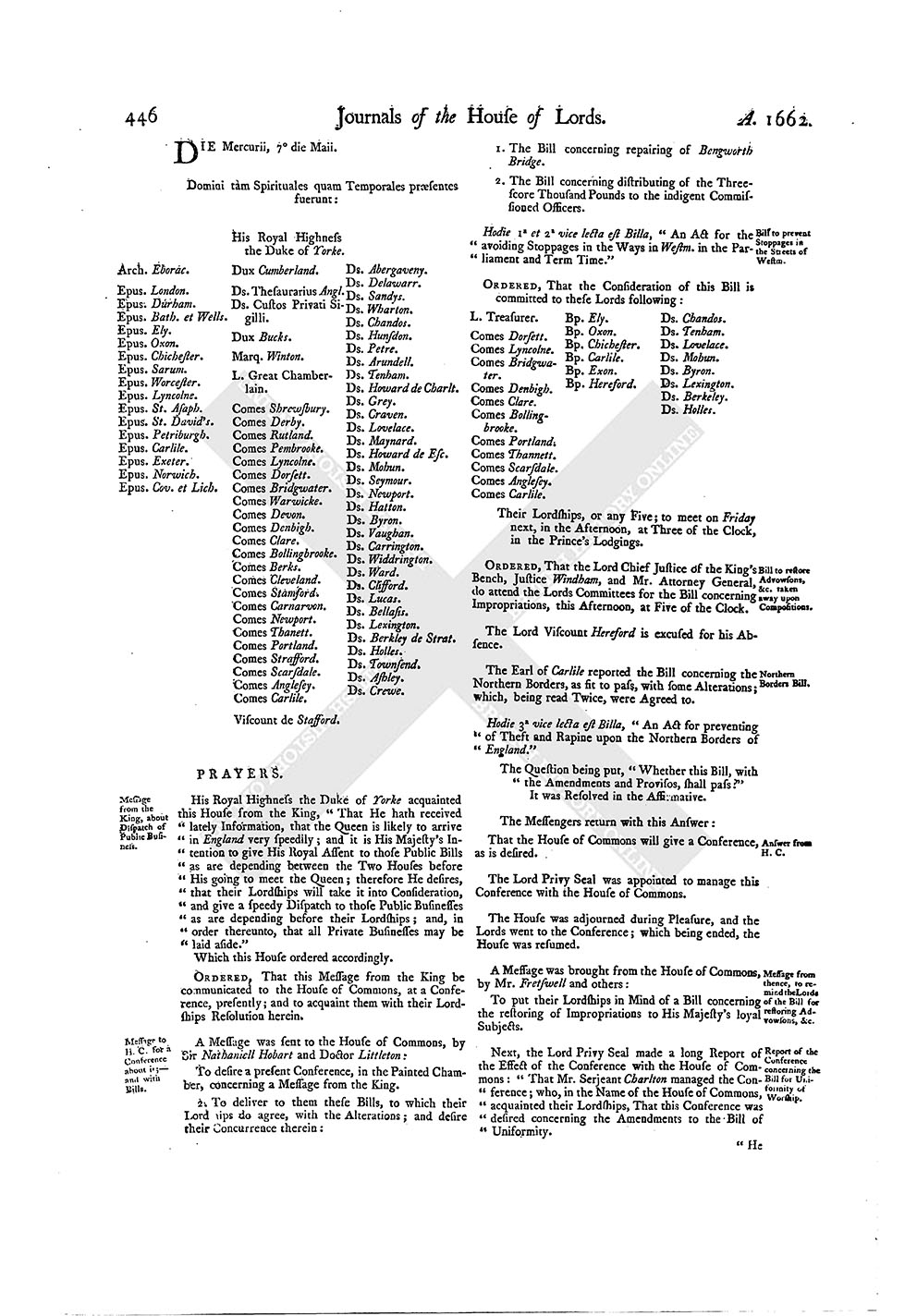
DIE Mercurii, 7 die Maii.
Domini tam Spirituales quam Temporales præsentes fuerunt:
PRAYERS.
Message from the King, about Dispatch of Public Business.
His Royal Highness the Duke of Yorke acquainted this House from the King, "That He hath received lately Information, that the Queen is likely to arrive in England very speedlly; and it is His Majesty's Intention to give His Royal Assent to those Public Bills as are depending between the Two Houses before His going to meet the Queen; therefore He desires, that their Lordships will take it into Consideration, and give a speedy Dispatch to those Public Businesses as are depending before their Lordships ; and, in order thereunto, that all Private Businesses may be laid aside."
Which this House ordered accordingly.
ORDERED, That this Message from the King be communicated to the House of Commons, at a Conference, presently; and to acquaint them with their Lordships Resolution herein.
Message to H. C. for a Conference about it;- and with Bills.
A Message was sent to the House of Commons, by Sir Nathaniell Hobart and Doctor Littleton:
To desire a present Conference, in the Painted Chamber, concerning a Message from the King.
2. To deliver to them these Bills, to which their Lordships do agree, with the Alterations; and desire their Concurrence therein:
1. The Bill concerning repairing of Bengworth Bridge.
2. The Bill concerning distributing of the Threescore Thousand Pounds to the indigent Commissioned Officers.
Bill to prevent Stoppages in the Streets of Westm.
Hodie 1a et 2a vice lecta est Billa, "An Act for the avoiding Stoppages in the Ways in Westm. in the Parliament and Term Time."
ORDERED, That the Consideration of this Bill is committed to these Lords following:
Their Lordships, or any Five; to meet on Friday next, in the Afternoon, at Three of the Clock, in the Prince's Lodgings.
Bill to restore Advowsons, &c. taken away upon Compositions.
ORDERED, That the Lord Chief Justice of the King's Bench, Justice Windham, and Mr. Attorney General, do attend the Lords Committees for the Bill concerning Impropriations, this Afternoon, at Five of the Clock.
The Lord Viscount Hereford is excused for his Absence.
Northern Borders Bill.
The Earl of Carlile reported the Bill concerning the Northern Borders, as fit to pass, with some Alterations; which, being read Twice, were Agreed to.
Hodie 3a vice lecta est Billa, "An Act for preventing of Theft and Rapine upon the Northern Borders of England."
The Question being put, "Whether this Bill, with the Amendments and Provisos, shall pass?"
It was Resolved in the Affirmative.
The Messengers return with this Answer:
Answer from H. C.
That the House of Commons will give a Conference, as is desired.
The Lord Privy Seal was appointed to manage this Conference with the House of Commons.
The House was adjourned during Pleasure, and the Lords went to the Conference; which being ended, the House was resumed.
Message from thence, to remind the Lords of the Bill for restoring Advowsons, &c.
A Message was brought from the House of Commons, by Mr. Fretswell and others:
To put their Lordships in Mind of a Bill concerning the restoring of Impropriations to His Majesty's loyal Subjects.
Report of the Conference concerning the Bill for Uniformity of Worship.
Next, the Lord Privy Seal made a long Report of the Effect of the Conference with the House of Commons: "That Mr. Serjeant Charlton managed the Conference; who, in the Name of the House of Commons, acquainted their Lordships, That this Conference was desired concerning the Amendments to the Bill of Uniformity.
"He said, They did agree in most of them with their Lordships. And wherein they differ, will appear by what follows.
"The First Difference was in omitting these Words ["Tenderness of some Mens Conscience"], being in the 5th Line of the Seventh Amendment, and instead thereof insert the Word ["hath"]; and then it runs thus, ["which the Indisposition of the Time hath contracted"], turning the Word ["have"] into ["hath]. He said, These Words might well be omitted, in respect there were Causes enough besides mentioned; and the Phrase of ["Tenderness of Conscience"] having been much abused, the Commons were loath to give so much Countenance to an abused Phrase as to insert it.
"He proceeded to the 11th Amendment; unto which he said, the House agreed in Part; as, instead of ["a"], to read the Word ["said"]; but disagreed in the other Part thereof, that is, to leave out these Words ["annexed and joined to this present Act, and"], adhering to the Bill in that Particular; and then it goeth thus, ["in such Order and Form as in the said Book, intituled, The Book of Common Prayer, &c."] and so put it in the Present Tense, upon which, he said, Two or Three more Differences depend.
"To the 13th Amendment, they agreed in all except these Words ["which Book is appointed to be annexed and joined to this present Act"].
"The 16th Amendment they agreed to, till it come to the Word ["nevertheless"] in the First Line of the 4th Part of the Paper Amendment; after which Word, they disagree to all that follows in that Amendment concerning the Cross in Baptism; the Reasons whereof he deferred till he came to the Proviso. And this was all he offered to their Lordships Paper Amendments; and so descended to those Additions sent by their Lordships to the Commons in Parchment.
To the first of those, in the 6th Line, instead of ["Three Months"], insert ["Month"]; the Reason is, that it was thought heretofore too slight a Work for the Chief Minister to read Common Prayer, which was usually performed by the Inferior Sort of Clergy; and therefore, to meet with that Inconvenience, they desired the Chief Minister might read it Once a Month.
"The next Alteration was in the 22th Line: From the Word ["aforesaid"] leave out all to the Word ["subscribed"] in the 29th Line, and instead thereof insert these Words following, ["That every Dean, Canon, and Prebendary, of every Cathedral or Collegiate Church, and all Masters and other Heads, Fellows, Chaplains, and Tutors, of or in any College, Hall, House of Learning, or Hospital, and every Public Professor and Reader in either of the Universities, and in every College elsewhere, and every Parson, Vicar, Curate, Clerk, Lecturer, and every other Person in Holy Orders, and every Schoolmaster keeping any Public or Private School, and every Person instructing or teaching any Youth in any House or Private Family as a Tutor or Schoolmaster, who, upon the First Day of March which will be in the Year of our LORD GOD 1662, or at any Time thereafter, shall be Incumbent, or have Possession of any Deanery, Canonry, Prebend, Mastership, Headship, Fellowship, Professor's Place, or Reader's Place, Parsonage, Vicarage, or any other Ecclesiastical Dignity or Promotion, or of any Curate's Place, Lecture, or School, or shall instruct or teach any Youth as Tutor, or Schoolmaster, shall, before the Feast Day of St. Bartholmewe which shall be in the Year of our LORD 1662, or at or before his or their respective Admission to be Incumbent, to have Possession aforesaid"]. The Reason of this Addition was, in extending it so far as Schoolmasters, in that the Commons observed the Force of Education was great, so as the Commons thought they ought to take Care for the Education of Youth; for so many, he said, of the Gentry and Nobility found in the Long Parliament differing from the Church of England did (as was conceived) arise from this Root.
"He observed, It was an Oversight in the Usurped Powers, that they took no Care in this Particular, whereby many young Persons were well seasoned in their Judgements as to the King. This made the Commons take Care that Schoolmasters as well as Ministers should subscribe, and rather more.
"The next Amendment was in the 38 Line ; after the word ["Covenant"], add these Words ["to endeavour any Change or Alteration of Government either in Church or State"].
"The Reason of this Alteration was in respect the added Words were the very same which were used in the Act for the Safety of the King's Person.
"The next Alteration is in the 40th Line; after the Word ["Kingdom"], leave out all the Words to the First Word in the 45 Line, and instead thereof insert these Words ["which said Declaration and Acknowledgement shall be subscribed by every of the said Masters, and other Heads, Fellows, Chaplains, and Tutors, of or in any College, Hall, or House of Learning, and every Public Professor and Reader in either of the Universities, before the Vice Chancellor of the respective Universities for the Time being, or his Deputy; and the said Declaration or Acknowledgement shall be subscribed before the respective Archbishop, or Ordinary of the Diocese, or every other Person hereby enjoined to subscribe the same, upon Pain that all and every of the Persons aforesaid, failing in such Subscription, shall lose and forfeit such respective Deanery, Canonry, Prebend, Mastership, Headship, Fellowship, Professor's Place, Reader's Place, Parsonage, Vicarage, Ecclesiastical Dignity or Promotion, Curate's Place, Lecture, and School, and shall be utterly disabled, and ipso facto deprived of the same; and that every such respective Deanery, Canonry, Prebend, Mastership, Headship, Fellowship, Professor's Place, Reader's Place, Parsonage, Vicarage, Ecclesiastical Dignity or Promotion, Curate's Place, Lecture, and School, shall be void, as if such Person so failing were naturally dead: And if any Schoolmaster, or other Person instructing or teaching Youths in any Private House or Family as a Tutor or Schoolmaster, shall instruct or teach any Youth, as a Tutor or Schoolmaster, before License obtained from his respective Archbishop, or Ordinary of the Diocese, according to the Laws and Statutes of this Realm, for which he shall pay Twelve Pence only, and before such Subscription and Acknowledgement made as afore, shall for the First Offence suffer Three Months Imprisonment, without Ball or Mainprize; and for every Second and other such Offence shall suffer Three Months Imprisonment, without Bail or Mainprize, and also forfeit to His Majesty the Sum of Five Pounds; and, after such Subscriptions made, every Parson, Vicar, Curate, and Lecturer, shall procure a Certificate, under the Hand and Seal of the respective Archbishop, Bishop, Ordinary of the Diocese, who are hereby enjoined and required, upon Demand, to make and deliver the same, and shall publicly and openly read the same, together with the Declaration or Acknowledgement aforesaid, upon some Lord'sday within Three Months then next following, in his Parish Church where he is to officiate.
"The Clause of Three Months Imprisonment is added, to meet with those Men who have no Livings to lose; and therefore the Commons thought this Addition necessary.
"Then he descended to an Amendment in the 49th Line : After the Word ["Benefice"], leave out the Word ["with Cure"], and insert these Words ["Curate's Place, or Lecturer's Place respectively"].
"In the disabling Clause, Livings with Cure were only included; but the Commons think not fit to leave Sine-cures to Non-conformists; for therein he thinketh more Favour would be shewn them, than to permit them to have Livings with Cure; wherefore they have inserted these Words ["Curate's Place or Lecturer's Place"].
In the 50th Line, after the Word ["dead"], insert the Words following, ["Provided always, That, from and after the 25th Day of March which shall be in the Year of our LORD 1682, there shall be omitted in the said Declaration or Acknowledgement so to be subscribed and read, these Words following, videlicet, ["And I do declare, That I do hold there lies no Obligation upon me, or any other Person, from the Oath commonly called the solemn League and Covenant, to endeavour any Change or Alteration of Government, either in Church or State; and that the same was in itself an unlawful Oath, and imposed upon the Subjects of this Realm against the known Laws and Liberties of this Kingdom; so as none of the Persons aforesaid shall from thenceforth be at all obliged to subscribe or read that Part of the said Declaration or Acknowledgement."]
"The Reason of this Proviso was, that the Commons would not perpetuate the Memory of the Covenant, which a common Medium of Twenty Years may probably determine the Lives of such as took it.
"The next was in the 53 Line: After the Word ["who"], insert these Words ["now is Incumbent, and in Possession of any Parsonage, Vicarage, or Benefice, and who"]; and leave out the Word ["who"] in the 54 Line.
"The Reason of this Alteration was, they would not exclude such as hereafter might be willing to conform from other Livings, though they disabled them as to such as for the present they enjoyed; whereas, in their Lordships Alteration, there was no Limitation of Time, and so none capable of Livings, who were capable hereafter to conform.
"The next Alteration was in the 57 Line: After the Word ["enjoyed"], insert the Words ["the said"] instead of the Word ["any"]; and then it goeth thus, ["shall have, hold, or enjoy, the said Parsonage, Vicarage, Benefice, or other Ecclesiastical Promotion"].
"The next Amendment is in the 63 Line : After the Word ["shall"], leave out the Words ["or do"], and instead thereof insert the Words ["thenceforth be capable to be admitted to any Parsonage, Vicarage, Benefice, or other Ecclesiastical Promotion or Dignity whatsoever, nor shall presume to consecrate or administer the LORD's Supper"].
"The Commons think every Incumbent should, before his Admission, give Testimony of his Conformity, and ought before such Admission to be in full Orders.
"The next Amendment is in the 63 Skin, where the 5th Line of that Skin is omitted: The Line is, ["or that the same Avoidance be openly and publicly declared"]. Now it doth not appear by that Clause what is meant by ["openly"]; and there being Certainty enough in the former Words, the Commons were not willing to leave in a Clause which might raise Disputes.
"And then the Gentleman came to the Amendments in the Second Paper; which they agreed to, with this Addition of the Words, ["Archbishop, Bishop of the Province, or"] after the Words ["by the"] in the 4 Line; and the Words ["Archbishop or"] after the Word ["same] in the 11th Line of the said Amendment. The Commons inserted the Archbishop, as being unfit to omit him in that Affair. The same Reason is for the Amendment in the 11th Line.
"The next Amendment is in the 40th Line: Agreed, with the Addition of the Word ["are"] between the Word ["and"] and ["hereby"] in the Amendment.
"The next is the 37 Line: Agreed to leave out the rest of the Bill, after the Word ["Authority"].
"Then he came to the Provisos in Parliament, N° 4.
"The First Paragraph for providing the Book, unto the Word ["provided"] in the 15th Line in the First Skin: Agreed, with the Addition following, videlicet, after the Word ["therein"] add these Words following, ["Provided always, and be it Enacted, by the Authority aforesaid, That the Bishops of Hereford, St. David's, Asaph, Bangor, and Landaffe, and their Successors, shall take such Order amongst themselves, for the Souls Health of the Flocks committed to their Charge in Wales, that the Book hereunto annexed be truly and exactly translated into the Brittish or Welsh Tongue, and that the same, being trauslated, and being by them or any Three of them at the least viewed, perused, and allowed to be imprinted, to such Number at least so that One of the said Books so translated and imprinted may be had for every Cathedral, Collegiate, and Parish Church, and Chapel of Ease, in the said respective Dioceses and Places in Wales, where the Welch is commonly spoken or used, before the First Day of May, 1665 ; and that, from and after the imprinting and publishing of the said Book so translated, the whole Divine Service shall be used and said by the Ministers and Curates, throughout all Wales, within the Diocese, where the Welsh Tongue is commonly used, in the Brittish or Welsh Tongue, in such Manner and Form as is prescribed, according to the Book hereunto annexed, to be used in the English Tongue, differing nothing in any Order or Form from the said English Book; for which Book, so translated and imprinted, the Churchwardens of every the said Parishes shall pay out of the Parish Money in their Hands for the Use of the respective Churches, and be allowed the same in their Accompt; and the said Bishops and their Successors, or any Three of them at the least, shall set and appoint the Price for which the said Book shall be sold: And another Book of Common Prayer in the English Tongue shall be bought and had in every Church throughout Wales, in which the Book of Common Prayer in Welch is to be had by Force of this Act, before the First Day of May, 1664 ; and the same Book to remain in such convenient Places within the said Churches, that such as understand them may resort at all convenient Times to read and peruse the same; and also such as do not understand the said Language may, by conferring both Tongues together, the sooner attain to the Knowledge of the English Tongue, any Thing in this Act to the contrary notwithstanding: And, until Printed Copies of the said Book so to be translated may be had, Provided, The Form of Common Prayer established by Parliament before the making of this Act shall be used as formerly, in such Part of Wales where the English Tongue is not commonly understood: And, to the End that the true and perfect Copies of this Act, and the said Book hereunto annexed, may be safely kept and perpetually preserved, and for the avoiding of all Disputes for the Time to come, be it Enacted, by the Authority aforesaid, That the respective Deans and Chapters of every Cathedral or Collegiate Church within England and Wales shall, at their proper Costs and Charges, before the Five and Twentieth Day of December, 1662, obtain under the Great Seal of England a true and perfect Copy of this said Act, and of the said Book annexed hereunto, to be, by the said Deans and Chapters and their Successors, kept and preserved in Safety for ever, and to be also produced and shewed forth in any Court of Record as often as they shall be thereunto lawfully required; and also there shall be delivered true and perfect Copies of this Act, and of the same Book, in the respective Courts at Westm. and into The Tower of London, to be kept and preserved for ever amongst the Records of the said Courts, and Records of The Tower, to be produced and shewed forth in any Court as Need shall require; which said Books, so to be exemplified under the Great Seal of England, shall be examined by such Persons as the King's Majesty shall appoint under the Great Seal of England for that Purpose, and shall be compared with the Original Book hereunto annexed, and shall have Power to correct and amend in Writing any Error committed by the Printer in the Printing of the same Book, or of any Thing therein contained; and shall certify in Writing under their Hands and Seals, or the Hands and Seals of any Three of them, at the End of the same Book, that they have examined and compared the same Book, and find it to be a true and perfect Copy; which said Books, and every of them, so exemplified under the Great Seal of England as aforesaid, shall be deemed, taken, adjudged, and expounded, to be good and available in the Law to all Intents and Purposes whatsoever, and shall be accounted as good Records as this Book itself hereunto annexed, any Law or Custom to the contrary in any wise notwithstanding.
"The Second and Third Paragraphs, touching the King's Professor of Law, and touching the Subscription to the 36 Article: Agreed, unto the Word ["Provided"] in the 17th Line, in the 2d Skin; all which Proviso they reject, for these Reasons;
"1. It is a Proviso without Precedent.
"2. That it would establish Schism.
"3. That it would not gratify such for whom it was intended.
"To the First, he said, it was very apparent in England, that it was without Precedent; and, as he thought, in the World also, for they never heard that ever any National Church did the like.
"It was one Thing, he said, to allow a differing Religion in a Nation; another Thing, to allow Men to receive Profits for that Church unto which Men would not conform.
"Secondly, Though there were Dissenters in the Particulars of the Proviso in the Time of Queen Eliz. and King James; yet in those Days those Opinions stayed there, and went no further.
"To the Second Head, That it would unavoidably 'stablish Schism. All Persons of different Inclinations would apply to such as should have this Liberty, and that necessarily make Parties, especially in great Cities. He did observe, these Two Ceremonies of the Cross and Surplice were long in Use in the Church; and he sound a high Commendation of the Use of the Cross in Baptism in the Book sent to the Commons from the Lords, wherein it is so clearly explained, as there can be no Suspicion of Popery in it. It was used, he said, to quicken the Memory, as to the Benefits of Baptism; and if that were omitted, much of the Service belonging to Baptism must be omitted also, many Passages depending upon the Use of that Ceremony.
"The Gentleman added, That he thought it better to impose no Ceremonies, than to dispense with any; and he thought it very incongruous, at the same Time when you are settling Uniformity, to establish Schism.
"To the Third Head, It would not satisfy those for whom it was intended; for such chiefly reject it upon these Grounds, that Things indifferent ought not to be enjoined; which Opinion, he said, took away all the Weight of human Authority, which consists in commanding Things otherwise indifferent; so as, when this shall be yielded, you give them nothing, they opposing for the Imposition Sake.
"He added, These were Reasons as to the Nature of the Thing; and as to the Reasons given by their Lordships to the Commons, he answered to as followeth:
"The King's Engagement at Breda as to tender Consciences; unto which he said, That His Majesty could not understand the Misleaders of the People, but the Misled. It would be very strange to call a schismatical Conscience a tender Conscience. He said, A tender Conscience denoted an Impression from without, received from another, and that upon which another strikes.
"Secondly, Suppose these had been meant, yet he said there could be no Inference of any Breach of Promise in His Majesty, because that Declaration had these Two Limitations:
"First, A Reference to Parliament.
"Secondly, Such Liberties to be granted only as consisted with the Peace of the Kingdom.
"Then he came to the Second Proviso, touching allowing Fifths to such Incumbents as should be excluded their Livings; which, he observed, was no seasonable Proviso, at least at this Time; and if it were, yet not sit to allow such Persons any Things out of Ecclesiastical Livings.
"He said, What could be more repugnant, at the same Time, to enact Uniformity, and to allow the Fifth of an Ecclesiastical Living to a Non-conformist, for not conforming; which, he said, joined with the Pity of their Party, would amount to more than the Value of the whole Living?
"He said, Such a Course was too jealous a Reflection upon the Act, when you say some godly People would not submit; and it can signify nothing but Fear, in making such a Concession.
"He added, This would make the Act contradictory; to say in one Part of the Bill that it was an equal Act, and in another Part to allow Dissenters to it.
"There was another Reason of the Commons Dissent: That divers Wives and Children of orthodox Ministers were made miserable by some of these Men; it may be, for not paying unto them those Fifths which were allowed unto them in the late Times.
"He added, That none that make Laws ought to suppose that any would break them.
"He said further, That it was not reasonable to allow the Fifths of Ecclesiastical Livings; because generally such Living were too small, not able to maintain a learned Man with Books; and by lessening Livings thus, it would gratify unconformable Men, who desire Livings in such Hands should be made small, whereby the Reputation of the conformable Clergy would be lessened.
"Secondly, he said, Such a Concession is not only against Reason, but Justice also. It was a Divine Canon, which said, he that served at the Altar, should live at the Altar; therefore the Profit of the Living ought to go to the Labourer.
"He said, That Unity was so precious, that it served not only for the Peace of the Church, but of the Kingdom also; for to give Occasions for Multitudes to meet which would certainly follow the Dissenters, what Danger that might carry with it, was worthy your Lordships Consideration.
"He did from the House of Commons desire their Lordships, that they would recommend to the Convocation the directing of such decent Gestures to be used in Time of Divine Service as was fit. He found One Mistake in the Rubric of Baptism, which he conceived was a Mistake of the Writer, ["Persons"] being put in instead of ["Children"]. And having thus far dissented from their Lordships in Decimo Sexto, he came to an Argument in Folio; giving the Commons Consent, that their Lordships should annex to the Bill that Book sent to the Commons by your Lordships; and so at length came to a final Concord by his Silence, which put an End to that Conference."
ORDERED, That the Alterations, and the Matter of this Conference, shall be read and taken into Consideration To-morrow in the Afternoon.
Order that no Persons shall go through the House, &c.
ORDERED, That no Person that hath any Business to attend Committees shall presume to go in and out through the Parliament House, or to stay there, until he or they shall be called for by some of the Waiters upon this House; neither shall any Person be permitted to come to the Clerks Table, after the Adjournment of the House, until the Lords shall depart out thereof, and the Clerks have put up their Books and Papers: and hereof all Persons are to take Notice, and obey this Order accordingly.
Carter sent for about a Building at the Bottom of St. Martin's Lane.
The Lords being this Day informed, "That there is a House erecting, at the lower End of St. Martine's Lane, next to The Strand:"
It is ORDERED, by the Lords Spiritual and Temporal in Parliament assembled, That Carter, who causeth the said Building to be erected, shall appear before the Lords in Parliament on Friday the Ninth Day of this Instant May, at Ten of the Clock in the Morning, to answer such Matters as shall be there objected against him: And herein he may not fail, as he will answer the contrary to this House.
Lady Roos, concerning the Bill for illegitimating her Child.
Whereas the Cause between John Lord Roos on the one Part, and Anne Lady Roos and her Son Ignotus on the other Part, should have been heard this Day, at the Bar, by Counsel and Witnesses on both Sides; but, in regard of the great and public Affairs of the Kingdom, it was put off:
It is ORDERED, by the Lords Spiritual and Temporal in Parliament assembled, That the said Cause shall be heard, at this Bar, on the First Thursday in the next Meeting, which shall happen to be after the next Recess of this Parliament; and then all Parties, with their Counsel and Witnesses, are to attend the said Hearing accordingly.
Adjourn.
Dominus Capitalis Justiciarius de Com. Placit. declaravit præsens Parliamentum continuandum esse usque in diem crastinum, videlicet, 8um diem instantis Maii, hora tertia post meridiem, Dominis sic decernentibus.