
Journal of the House of Lords: Volume 11, 1660-1666. Originally published by His Majesty's Stationery Office, London, 1767-1830.
This free content was digitised by double rekeying. All rights reserved.
'House of Lords Journal Volume 11: 19 May 1662', in Journal of the House of Lords: Volume 11, 1660-1666, (London, 1767-1830) pp. 468-477. British History Online https://www.british-history.ac.uk/lords-jrnl/vol11/pp468-477 [accessed 26 April 2024]



In this section
DIE Lunæ, 19 die Maii.
Domini tam Spirituales quam Temporales præsentes fuerunt:
REX.
PRAYERS.
Message to H. C. for a Conference on the Poor Bill; and to remind them of Two Bills.
A Message was sent to the House of Commons, by Sir William Childe and Sir Thomas Birde:
To desire a present Free Conference, in the Painted Chamber, concerning the late Conference touching the Bill for Relief of the Poor.
2. To put them in Mind of the temporary Bill concerning the Great Level of the Fens, and the Bill against Printing of seditious Books.
Highways Bill:
The Lord Wharton reported the Alterations concerning the Bill for Common (fn. 1) Highways, as they are amended according to the Debate on Saturday; which, being read, were Agreed to.
Conference about it.
The Lord Privy Seal, Earl Anglesey, Lord Wharton, and the Lord Ashley, were appointed to manage this next Free Conference with the House of Commons, concerning Highways.
And this House recommends it to the Lord Privy Seal, to manage that Part of it which concerns the Provisos touching the new altering of the Bridges mentioned in the Bill, which were added by this House.
The Messengers return with this Answer:
Answer from H.C.
That the House of Commons will give a present Free Conference, as is desired.
Message from thence, for a Conference on the Poor Bill.
A Message was brought from the House of Commons, by Sir John Holland and others:
To desire a Free Conference, concerning the Bill for the better Relief of the Poor.
The Answer returned was:
Answer.
That this House appoints a present Free Conference, in the Painted Chamber, presently after the other Free Conference is ended.
The same Lords are appointed to manage this Conference, as were formerly.
The House was adjourned during Pleasure, and the Lords went to the Free Conference; which being ended, the House was resumed.
Report of this Conference.
The Lord Ashley reported the Effect of this Free Conference, concerning the Alterations in the Bill for the Relief of the Poor:
"That in the First Skin, 33 Line, the Amendment Agreed to, putting in ["Ten Pounds"] instead of ["Forty Shillings"].
"In the 2d Skin, 5th Line, they Agree to.
"In the 9th Skin, 22 Line, they Agree to; and the 30 Line, Agreed to.
"In the 10th Skin, 1 Line, Agreed to; only that latter Part of the Paragraph concerning the Northern Counties to stand.
"The Third Proviso, Agreed to; adding at the End thereof these Words, ["Provided always, That this Act, as to all the Matters therein contained, excepting what relates unto the Corporations mentioned and constituted thereby, shall extend and be in Force until the 29th of May, 1665, and the End of the First Session of the next Parliament then next ensuing, and no longer."]
Agreed to.
Poor Bill.
And the Question being put, "Whether to agree with the House of Commons, in having the Sum to be Ten Pounds ?"
It was Resolved in the Affirmative.
Message to H C. that the Lords agree to it;-and to remind them of the Bill to restrain disorderly Printing.
A Message was sent to the House of Commons, by Sir Thomas Bird and Sir Toby Wolridge:
To let them know, that their Lordships have agreed to the Amendments in the Bill concerning the Relief of the Poor.
2. To put them in Mind of the Bill concerning Printing.
Message from thence, for a Conference on the Highways Bill.
A Message was brought from the House of Commons, by Edmond Waller Esquire and others:
To desire a Free Conference, touching the Subjectmatter of the last Free Conference, concerning the Bill for the Highways.
The Answer returned was:
Answer.
Their Lordships agree to a Free Conference; and appoints it to be presently, in the Painted Chamber.
The House was adjourned during Pleasure, and the Lords went to the Conference; which being ended, the House was resumed.
Message from H C. with Bills.
A Message was brought from the House of Commons, by Doctor Birkenhead and others; who returned the Bill concerning Printing; wherein they have made some Alterations and Amendments; to which they desire their Lordships Concurrence.
Briscoe's Bill.
2. To return the Bill concerning Mrs. Ellen Briscoe; to which they agree with some Amendments, and desire Concurrence therein.
The said Amendments were read Thrice, and Agreed to.
Bill to restrain disorderly Printing.
Then the Amendments in the Bill for Printing were read Twice.
And as to the Amendment in the First Skin, 45 Line, the Lords Agreed to, with adding the Word ["Private"] before ["Person"] in the 34 Line.
All the rest of the Amendments are Agreed to.
To the First Proviso read to the 5th Line; Agreed, adding after ["bound"] in the 3d Line ["not formerly prohibited"].
The Second Part of the First Parchment, to the 13th Line, read, and Agreed to.
The Third Part, to the 19th Line, read, and Agreed to.
The Fourth Part read, and Agreed to.
The Second Proviso read, and Agreed to, reading ["Lord Mayor of Yorke"].
The Third Proviso read, and Agreed to.
Report of the Conference concerning the Highways Bill.
Next, the Lord Ashley reported the Effect of the Free Conference with the House of Commons, concerning the Alterations in the Bill for mending the Common Highways: "That the House of Commons do not agree to their Lordships Amendment in the Fourth Skin, 41 and 42 Lines, concerning Horses to go abreast.
"And in the Fifth Skin, 6 Line, concerning the Penalty of Forty Shillings for each Horse forfeited; the Commons do adhere as it stands in the Bill.
"And as to their Lordships First and Second Provisos, concerning the altering of those Bridges mentioned therein, the House of Commons do not agree to them. And they were commanded to insist upon it, that their Lordships had no Right to offer such Provisos, because they concern assessing of the Commons.
"As to those Precedents which their Lordships urged at the Conference, as that for repairing of Dover Peare, and the Bill for rating Persons to the Poor, and the Bill in 4to and 5to Phillip and Mary, for Assessment of Horse and Arms, all which began in the House of Peers; the Commons said, they are but single Precedents, and do not weigh with them."
Provisos added to it by this House, for laying a Charge to repair Two Bridges.
The Lords, conceiving this Business to be a Matter of great Concernment to the Privilege of the House of Peers, fell into Debate concerning the leaving out of these Two Provisos touching the altering of the Two Bridges at the Charge therein mentioned.
And the Question being proposed, "Whether this House do agree with the House of Commons in this Business, asserting their Privileges at a Conference?"
And the Question being put, "Whether this Question shall be put?"
It was Resolved in the Affirmative.
Then the Question being put, "Whether this House do agree with the House of Commons, in leaving out the Two Provisos, asserting their Privileges at a Conference?"
It was Resolved in the Affirmative.
This House adheres to their Amendment for Two Horses to go abreast; and do agree with the House of Commons for the Penalty to be Forty Shillings.
Protest against rejecting them.
"Whereas a Bill, intituled, "An Act for enlarging and amending the Common Highways," came from the House of Commons, unto which the Lords added Two several Provisos, laying a Charge for the Repair of Two Bridges; which Provisos were rejected by the House of Commons, upon this Ground given to the Lords at several Conferences, by some Members of the House of Commons, videlicet, "That the Lords have no Power to begin any Bill, or add any Clause to any Bill, that in any Kind charged Money, either for repairing or paving of Highways, mending of Bridges, or other Public Use," which we conceived to be against the Privilege of this House, and many Precedents; as, a Statute made in the Fourth and Fifth of Phillip and Mary, for assessing all Persons therein mentioned, for Horse Arms and Foot Arms; and another Act in the Time of Queen Elizabeth, for Repair of Dover Peare, and one other Act in the Fifth Year of the said Queen, for Relief of the Poor, and other Acts; all which began in the House of Peers, and were assented to by the Commons, and by the Royal Assent passed into Laws. And whereas the House of Peers did, after the said Conference, pass this Vote in the Affirmative, videlicet, "To agree with the House of Commons in leaving out the Two Provisos, asserting their Privileges at a Conference." And whereas, before the putting the said Vote, we whose Names are hereunto subscribed desired Liberty of our Dissent unto the said Vote; we do, for the Reasons abovesaid, and to assert so much as in us lies so important and ancient a Privilege of the House of Peers, enter our Dissent and Protestation against this Vote.
"Robertes.
Derby.
Lawarr.
Essex.
Bolingbrooke.
Anglesey.
C. Warwick.
Awdley.
T. E. Howard.
W. Maynard.
Hen. Chichester.
R. Byron.
Stafford."
Message to H. C. for a Conference concerning the Highways Bill; and that the Lords agree to Briscoe's.
A Message was sent to the House of Commons, by Sir William Chylde and Sir Justinian Lewin:
To desire a present Free Conference with the House of Commons, in the Painted Chamber, concerning the Bill for the Highways.
Also to let them know, that their Lordships agree with them in the Bill concerning Mrs. Ellen Briscoe.
Answer.
The House of Commons return this Answer by the Messengers:
That they will give a present Free Conference, as is desired.
The Lord Treasurer, the Lord Privy Seal, Earl Anglesey, the Lord Wharton, and the Lord Ashley, were appointed to draw up what is fit to be said to the House of Commons at this Free Conference.
Report concerning the Highways Bill. A Salvo for the Peers Right to begin Bills relating to Money, &c.
The Lord Ashley reported what was thought fit to be said to the House of Commons: "That, after they had acquainted them wherein their Lordships did adhere, and wherein agreed with them, in the Bill concerning the Highways; then to let them know, their Lordships affirm it to be their undoubted Privilege to begin either Bills, or any Matters or Things of the Nature of these Provisos, in the House of Peers, and shall make Use of it as often as they shall have Occasion: But they conceive themselves not concerned to insist as to these Two Provisos at this Time, the altering of these Two Bridges being not of Consequence to obstruct all the Ways of England; therefore the Lords do agree with the House of Commons in leaving out the said Provisos."
The House, approving of this Report, ordered the Lord Ashley to deliver this to the House of Commons, as their Lordships Resolution; which was accordingly done.
Message to H. C. for a Conference on the Bill to restrain disorderly Printing.
A Message was sent to the House of Commons, by Sir William Childe and Sir Toby Wolridge:
To desire a present Free Conference, in the Painted Chamber, concerning the Bill for Printing.
The Messengers return with this Answer:
Answer.
That the House of Commons will give a present Free Conference, as is desired.
The Earl of Bridgwater, Earl of Anglesey, Lord Wharton, and the Lord Ashley, are appointed to manage this Free Conference with the House of Commons.
The House was adjourned during Pleasure, and the Lords went to the Conference ; which being ended, the House was resumed.
Address to the King, for preserving the Work of draining the Great Level of the Fens; and adjusting the Differences between the Adventurers.
Whereas, by reason of the Shortness of Time, several Bills now depending in Parliament cannot be dispatched this Session: It is therefore ORDERED, by the Lords Spiritual and Temporal in Parliament assembled, That the Lord Treasurer, the Duke of Bucks, the Earl of Bedford, and the Lord Bellasis, do forthwith attend the King, and recommend unto His Majesty the Preservation and Maintenance of the Works made for the Great Level of the Fens, called Bedford Levell, and other Fens, for which Bills are now depending, and for quieting and settling of the Possessions as now they are, until the Parliament can pass Acts on that Behalf; and that His Majesty will be pleased to hear and settle the Differences between the Adventurers of Francis Earl of Bedford and William Earl of Bedford.
After these Businesses were ended which were in Agitation between the Two Houses, the Lord Chancellor took his Place on the Woolsack as Speaker; and the Lord Chief Justice of the Common Pleas sat in his own Place amongst the Judges.
The King present.
Then His Majesty came and sat in His Throne arrayed with His Royal Robes; the Peers likewise sitting in their Robes, uncovered.
The King gave Command to the Gentleman Usher of the Black Rod, to let the House of Commons know, "It is His Majesty's Pleasure, they should attend Him forthwith."
Who, in Obedience, came presently, attended with their Speaker; who, after low Obeisance made to His Majesty, made this Speech following; videlicet,
The Speaker of H. C. Speech.
"May it please Your Most Excellent Majesty,
"The glorious Body of the Sun doth exhilarate the Soul of Man with its Light, and fructify the Earth by its Heat. In like Manner, we, the Knights, Citizens, and Burgesses of the Commons House of Parliament, do with all Humility and Thankfulness acknowledge, these frequent Accessions to Your Royal Presence do both comfort our Hearts, and influence our Actions.
"Geographers do tell us, the Land of Egypt is a dry Soil, but made fertile by the Overflowing of the River Nylus; and, according to the Degrees of the Flood, the Inhabitants do prognosticate the Fruitfulness of the ensuing Year. If it flows to Twelve Degrees, it presages a good Harvest; if to Thirteen, then more plentiful; but if to Fourteen Degrees, their Hopes are raised to an Expectation of an abundant Increase.
"Great Sir,
"Your Return into this Nation in the Twelfth Year of Your Reign resembles the Flowing of the River Nilus in the Twelfth Degree, That Year was crowned with the Enjoyment of Your Royal Person. The last Year, being the Thirteenth Year of Your Majesty's Reign, we were made happy in Your Coronation, and by Your Sanction of many good and useful Laws, both for the Church and State. And now our River Nilus begins to flow Fourteen Degrees, we are, by the Mercies of GOD, in an humble Expectation of a great Jubilee. Our Gracious Queen is now happily landed; who, we do hope, and daily pray, may prove a suitable Companion to Your Royal Person, and, ere long, a Nursing Mother to this Nation.
"If Your Majesty but please to cast Your Eyes upon the Table, and behold the great Number of Bills that there present themselves before You, like so many Sheaves of Corn bound up and ready to be housed; and will vouchsafe to see how both my Hands are filled with no light Presents from Your loyal Commons; and if Your Royal Majesty, the Great Lord of the Harvest, shall vouchsafe to crown this Day by Your Gracious Concessions to our Desires; the World will then see how great a Duty Your People chearfully pay both to Your Royal Person and Your Government; and likewise how great a Zeal Your Majesty hath, by the faithful Advice of the Lords Spiritual and Temporal and Commons assembled in Parliament, to settle the Church in her ancient Glory, and to restore the happy People of this Nation to their ancient Rights and Privileges.
"Some Foreign Writers, that envy the Happiness of our Government, injuriously asperse this Nation with a reproachful Saying, "That the Crown of England is only maintained by the Benevolence of the People; which never is granted, but in Exchange of some Royal Prerogative."
"Great Sir,
"We know, the strongest Building must fall, if the Coupling Pins be pulled out: Therefore our Care hath been, to prepare such Constitutions, that the Prerogative of the Crown and the Propriety of the People may, like Squared Stones in a well-built Arch, each support the other, and grow the closer and stronger for any Weight or Force that shall be laid upon them.
"We cannot forget the late disputing Age, wherein most Persons took a Liberty, and some Men made it their Delight, to trample upon the Discipline and Government of the Church. The Hedge being trod down, the Foxes and the Wolves did enter; the Swine and other unclean Beasts defiled the Temple. At length it was discerned, the Smectymnian Plot did not only bend itself to reform Ceremonies, but sought to erect a Popular Authority of Elders, and to root out Episcopal Jurisdiction. In order to this Work, Church Ornaments were first taken away; then the Means whereby Distinction or Inequality might be upheld amongst Ecclesiastical Governors; then the Forms of Common Prayer, which as Members of the public Body of CHRIST's Church were enjoined us, were decried as superstitious, and in Lieu thereof nothing, or worse than nothing, introduced.
"Your Majesty having already restored the Governors and Government of the Church, the Patrimony and Privileges of our Churchmen; we held it now our Duty, for the Reformation of all Abuses in the Public Worship of GOD, humbly to present unto Your Majesty, a Bill for the Uniformity of Public Prayers and Administration of Sacraments.
"We hope the GOD of Order and Unity will conform the Hearts of all the People in this Nation, to serve Him in this Order and Uniformity.
"Next to the Worship and Service of GOD, we applied ourselves to the settling our great Concern, the Militia. We have already, according to our Duties and the Laws, declared the sole Right of the Militia to be in Your Majesty: And now, with Your Permission, we humbly tender Your Majesty a Bill for the better Regulation and Ordering the Standing Forces of this Nation; wherein we have taken Care to make all Things so certain, that Your Majesty's Lieutenants and their Deputies may know what to command, and all the People learn how to obey.
"And because our late Wounds are yet but green, and possibly, before the Body Politic be well purged, may incline to break out again, whereby Your Majesty may be forced to draw Your Sword before Your Treasury be supplied with Money; we have consented that Your Majesty may raise, for the Three next ensuing Years, One Month's Tax in each Year, after the Rate of Seventy Thousand Pounds per Mensem, if Necessity shall so require.
"In the next Place, according to Your Majesty's Commands, we have surveyed the wasted Revenue of the Crown; and, in Pursuance of our Promises, do humbly propound unto Your Majesty a fair Addition. We considered, that great Part of Your Majesty's Revenue is but for Life; and both that, and also Part of the rest, depends upon the Peace, the Trade, and Traffic of the Nation, and therefore may be much impaired by Wars with Foreign Nations. This put us upon the Search of something that might arise within our own Walls, and not to be subject to such Contingencies. We pitched our Thoughts at last upon those Places where we enjoy our greatest Comforts and Securities, our Dwellinghouses; and, considering even that Security is secured unto us by Your Majesty's Vigilance and Care in the Government; we have prepared a Bill, whereby we desire it may be enacted, That all Houses in this Kingdom, which are worth in Yearly Value above Twenty Shillings, and not inhabited by Almsmen, may pay unto Your Majesty, Your Heirs and Successors, Two Shillings Yearly for every Chimneyhearth in each House for ever.
"When the great Ahitophels of our latter Age had by Force ravished the venerable Laws of this Nation (and Absurdo dato, sequuntur Mille); then every petty Artist in his Way, yea, even the very common Beggars, had the Confidence to offer Violence to their Chastity.
"We have therefore been constrained to prepare several Bills for the Regulation of Trade, our Clothing Trade, our Fishing Trade, our Trade for Stuffs, our Trade for Silks; and, for the better Maintenance of Intercourse in Trade, to reinforce our former Laws for maintaining the Highways, with some Additions for Decency and Pleasure of Travellers.
"GOD, in His Providence, hath determined that Poor we must have always with us: Some are made so by the immediate Hand of GOD; others by their Loyalty, Duty, and Service of Your Royal Person and Your Blessed Father; others by their own Wickedness and Idleness. We have taken Care to relieve the First, to encourage the Second, and to reform the last.
"Nor hath the Case of any Private Person been unwelcome to us. Those many Private Bills that lie before Your Majesty do enough confirm this Truth, that where we found it just and honourable, we have denied our helping Hand to none that prayed it.
"And now, Great Sir, after these many Months most painful and faithful Service of Your Majesty and our Countries, we hope we shall have Leave to go Home, to visit our Relations, to tell our Neighbours what great Things Your Majesty hath done for us; what great Things (absit Invidia Verbo) we have done for Your Majesty; and what great Things GOD hath done for us all; and so pray ALMIGHTY GOD for His Mercy to this Nation, in the Continuance of Your Majesty's long and happy Reign over us."
Bills presented by him.
This Speech being ended, the Clerk of the Parliaments came to the Speaker, and received from him those Bills which he presented from the House of Commons to His Majesty; which were these Four Bills:
"1. An Act for establishing an additional Revenue upon His Majesty, His Heirs and Successors, for the better Support of His and Their Crown and Dignity."
"2. An Act for ordering the Forces in the several Counties of this Kingdom."
"3. An Act for preventing Frauds, and regulating Abuses, in His Majesty's Customs."
"4. An Act directing the Prosecution of such as are accountable for Prize Goods."
Then the Clerk of the Crown read the Titles of these Bills following:
Bills passed.
"1. An Act for the Uniformity of Public Prayers, and Administration of Sacraments, and other Rites and Ceremonies; and for establishing the Form of making, ordaining and consecrating, Bishops, Priests, and Deacons, in the Church of England."
"2. An Act to prevent the Inconveniencies arising by melting the Silver Coin of this Realm."
"3. An Act for providing Carriage, by Land and by Water, for the Use of His Majesty's Navy and Ordnance."
"4. An Act for Relief of Collectors of Public Monies, and their Assistants and Deputies."
"5. An Act for the more speedy and effectual bringing those Persons to Accompt, whose Accompts are excepted in the Act of Oblivion."
"6. An Act for the Relief of poor and maimed Soldiers and Officers, who have faithfully served His Majesty and His Royal Father in the late Wars."
"7. An Act for the better Relief of the Poor."
"8. An Act for Distribution of Threescore Thousand Pounds amongst the truly loyal and indigent Commission Officers; and for assessing of Offices, and distributing the Monies thereby raised for their further Supply."
"9. An Act for enlarging and repairing of Common Highways."
"10. An Act for preventing the frequent Abuses in printing seditious, treasonable, and unlicensed Books and Pamphlets; and for regulating Printing Presses."
"11. An Act for regulating the making of Stuffs in Norfolke and Norwich."
"12. An Act for the better regulating of the Manufacture of Broad Woollen Cloth, within the West Ryding of the County of Yorke."
"13. An additional Act concerning Matters of Assurance amongst Merchants."
"14. An Act for the importing of Madder pure and unmixed."
"15. An Act for repairing of Dover Harbour."
"16. An Act against importing of Foreign Woolcards, Card-wire, or Iron-wire."
"17. An Act declaratory concerning Bankrupts."
"18. An Act for reforming Abuses committed in the Weight and false Packing up of Butter."
"19. An Act for reversing the Earl of Strafford's Attainder."
"20. An Act for regulating the Trade of Silk Throwing."
"21. An Act for prohibiting the Importation of Foreign Bone Lace, Cut-work, Embroidery, Fringe, Band-strings, Buttons, and Needle-work."
"22. An Act directing the Prosecution of such as are accountable for Prize Goods."
"23. An Act for the Regulation of the Pilchard Fishing, in the Counties of Devon and Cornwall."
"24. An Act for the restoring of all such Advowsons, Rectories Impropriate, Glebe Lands, and Tithes, to His Majesty's loyal Subjects, as were taken from them, and making void certain Charges imposed on them, upon their Compositions for Delinquency, by the late usurped Powers."
"25. An Act for preventing of Theft and Rapine upon the Northern Borders of England."
"26. An Act for preventing the unnecessary Charge of Sheriffs, and for Ease in passing their Accompts."
"27. An Act against exporting of Sheep, Wool, Woolsels, Mortlings, Shorlings, Yarn made of Wool, Wool Flocks, Fullers Earth, Fulling Clay, and Tobacco Pipe Clay."
"28. An Act to restrain the Exportation of Leather, and Raw Hides out of the Realm of England."
To all these Bills severally the Royal Assent was pronounced, by the Clerk of the Parliaments, in these Words,
"Le Roy le veult."
"29. An Act for ordering the Forces in the several Counties of this Kingdom."
"30. An Act for establishing an additional Revenue upon His Majesty, His Heirs and Successors, for the better Support of His and Their Crown and Dignity."
"31. An Act for preventing Frauds, and regulating Abuses, in His Majesty's Customs."
The Royal Assent was pronounced to these Bills severally, in these Words,
"Le Roy, remerciant Ses bons Subjects, accepte leur Benevolence, et ainsi le veult."
Next, the Titles of the Private Bills were read by the Clerk of the Crown, as followeth:
"1. An Act for settling of the Estate of James late Duke of Richmond and Lenos, according to Agreement of Charles Duke of Richmond and Lenos, Mary Dutchess Dowager of Richmond and Lenos, and the Lady Mary her Daughter, and the Trustees of the said Dutchess."
"2. An Act for Confirmation of certain Letters Patents made, and to be made, to the Right Noble Lord George Duke of Albemarle, of several Honours, Manors, and Hereditaments, granted, or mentioned to be granted, to him by His Majesty."
"3. An Act for confirming the Estate of John Marquis of Winchester, in certain Manors and Lands whereof the Deeds and Evidences were burnt and lost at the Taking of the Castle of Basing."
"4. An Act to confirm the Sale of certain Lands, sold by Ferdinando late Earl of Huntingdon, for the Payment of his own and his Father's Debts."
"5. An Act for settling a Capital Messuage, or Mansion-house, with the Appurtenances, in Kensington, in the County of Midd. upon Baptist Viscount Campden and his Heirs."
"6. An Act to enable the Bishop of London to lease out Tenements, now built upon the Site of his Palace in London."
"7. An Act for the Endowment of several Churches, by the Lord Viscount Scudamore, of Sligo, in the Realm of Ireland."
"8. An Act for confirming an Act, for restoring to Thomas Lord Culpeper, Son and Heir and sole Executor of John Lord Culpeper, Baron of Thorsway, and Master of The Rolls, deceased, all his Honours, Manors, Lands, and Tenements, Leases not determined, and Hereditaments whatsoever, whereof the said John Lord Culpeper was in Possession on the 20th Day of May 1642, or at any Time after, which have not been sold or aliened by the said John late Lord Culpeper, by Acts or Assurances to which himself was Party and consenting."
"9. An Act for the Naturalizing of Philadelphia Wife of the Right Honourable Thomas Lord Wentworth."
"10. An Act for the Naturalizing of Anna Ferrers, and several other Persons named therein."
"11. An Act for the Naturalization of Mark Le Pla and others."
"12. An Act for discharging the Manors of Stodscombe and Hollwell, and other Lands in the County of Devon, from the Trust of One Hundred and Fifty Years, made unto John Earl of Exon, John Earl of Bridgwater, and Oliver Earl of Bolingbrooke."
"13. An Act for confirming several Acts, therein mentioned."
"14. An Act for Confirmation of Three Acts, therein mentioned."
"15. An Act for confirming of Two Acts, therein mentioned."
"16. An Act for Confirmation of the Estates of divers Tenants and Copyholders of the Manors of Rannes, Irchester, Rushden, and several other Manors, Parcels of the Dutchy of Lancaster."
"17. An Act for confirming the Estates of divers of His Majesty's Copyhold Tenants, within the Honour of Clitheroe, in the County Palatine of Lancaster, according to several Decrees in the Court of Dutchy Chamber of the said County Palatine."
"18. An Act for the disuniting the Hundreds of Dudston and Kingsbarton from the County of the City of Gloucester, and restoring them to be Part of the County of Gloucester."
"19. An Act for supplying a supposed Defect of the Words ["stands and be seised"] in a Deed for settling of divers Manors and Lands on Sir Henry Frederick Thynn."
"20. An Act for enabling Sir Anthony Browne to sell Lands, for Payment of Debts."
"21. An Act for enabling Anthony Ettrick to sell Lands, for Payment of his Debts."
"22. An Act for the making void certain Fines unduly procured to be levied, by Sir Edward Powell Knight and Baronet, and Dame Mary his Wife."
"23. An Act for making navigable the Rivers of Stower and Salwerp, and the Rivulets and Brooks running into the same, in the Counties of Worcester and Stafford."
"24. An Act for Sale of Sir Robert Slyngsby, deceased, his Land, for Payment of his Debts."
"25. An Act for confirming of several Decrees of Sewers, made by the Commissioners of the Limits of the Level of the River of Antholme, in the County of Lyncolne."
"26. An Act for the enabling Sir Thomas Lee Baronet to exchange some Lands, settled upon the Marriage of Dame Anne Lee his now Wife, in Consideration of another Settlement of Lands of equal Value, in Lieu thereof."
"27. An Act vesting certain Lands in Bleasby, in Sir John Mounson the Younger, Robert Thorold Esquire, and Anthony Eyre the Elder, Esquire, and their Heirs, to sell Land, for Payment of the Debts of Sir Robert Dallyson and William Dallyson."
"28. An Act to enable Rowland Okeover Esquire to sell certain Lands, in the County of Derby."
"29. An Act for the settling certain Lands belonging to Francis Tyndall Gentleman, upon Trustees, to be sold, for the Payment of Debts."
"30. An Act to enable the Sale of some of the Lands of William Milward Esquire, for Payment of some of his Debts."
"31. An Act to enable Mistress Clemence Rivers and Mistress Rose Rivers to sell certain Lands and Houses, for Payment of the Debts of Edward Rivers Esquire, deceased, and Provision for his Younger Children.
"32. An Act for settling certain Manors and Lands, late of Sir James Enyons Baronet, on Sir Henry Puckering, alias Newton, Baronet, and Sir Charles Aderley Knight, his surviving Trustees, to sell, for Payment of his Debts."
"33. An Act to enable the Trustees of Henry Nevill Esquire to sell certain Manors, Lands, and Tenements, in the Counties of Yorke and Leicester, for Payment of his and his Son William Nevill's Debts; and likewise to confirm and strengthen the Sale of such Lands as they have already sold in the County of Yorke."
"34. An Act enabling Thomas Peck Esquire to sell a Manor, and some Lands, in the County of Norffolke, for the Payment of his Debts, and other Uses."
"35. An Act for confirming a Decree made on the Behalf of Thomas Deereham Esquire, and the Improvements, Exchanges, and Allotments, therein mentioned."
"36. An Act for making navigable the Rivers of Wye and Lugg, and the Rivers and Brooks running into the same, in the Counties of Hereford, Gloucester, and Monmouth."
"37. An Act for Confirmation of Agreements made between Thomas Bushell Esquire and the Miners of Row-pitts in Somersetshire, for recovering their drowned and deserted Works."
"38. An Act for confirming, explaining, and enlarging an Act, intituled, An Act for the levying of certain Monies, due upon the Collections for the Protestants of Piedmont."
"39. An Act for the Repairing of Bengworth Bridge."
To all these Private Bills the Royal Assent was pronounced severally, in these Words,
"Soit fait come il est desire."
Next, the Titles of these Three Private Bills following were read; videlicet,
"An Act for the restoring of Charles Earl of Derby to the Manors of Mould and Mouldsdale, Hope and Hopesdale, in the County of Flint."
"An Act for Confirmation of the Office of Register of Sales and Pawns made to Retailing Brokers in London and Westm. and Places adjacent."
"An Act for the empowering of Sir Courtney Poole and Sir John Drake Baronets, and others, to make Payment of the Portion of Ellen Briscoe Widow, One of the Daughters of Sir John Drake Knight, by Sale of the Manor of Lymmington, in the County of Somersett, or by granting Estates out of the same, or otherwise."
To which Three Bills His Majesty's Answer was pronounced in these Words,
"Le Roy s'avisera."
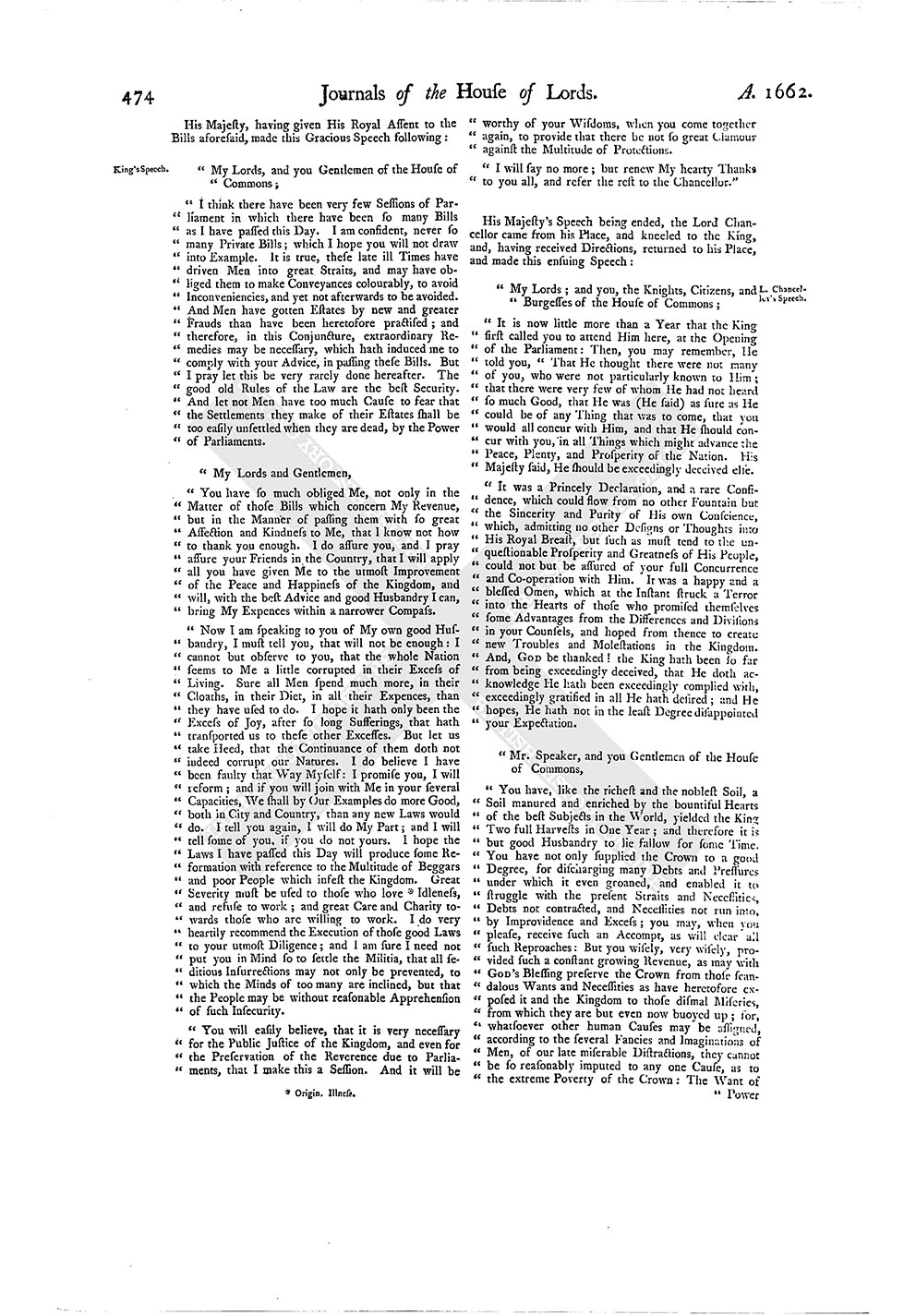
His Majesty, having given His Royal Assent to the Bills aforesaid, made this Gracious Speech following:
King's Speech.
"My Lords, and you Gentlemen of the House of Commons;
"I think there have been very few Sessions of Parliament in which there have been so many Bills as I have passed this Day. I am confident, never so many Private Bills; which I hope you will not draw into Example. It is true, these late ill Times have driven Men into great Straits, and may have obliged them to make Conveyances colourably, to avoid Inconveniencies, and yet not afterwards to be avoided. And Men have gotten Estates by new and greater Frauds than have been heretofore practised; and therefore, in this Conjuncture, extraordinary Remedies may be necessary, which hath induced me to comply with your Advice, in passing these Bills. But I pray let this be very rarely done hereafter. The good old Rules of the Law are the best Security. And let not Men have too much Cause to fear that the Settlements they make of their Estates shall be too easily unsettled when they are dead, by the Power of Parliaments.
"My Lords and Gentlemen,
"You have so much obliged Me, not only in the Matter of those Bills which concern My Revenue, but in the Manner of passing them with so great Affection and Kindness to Me, that I know not how to thank you enough. I do assure you, and I pray assure your Friends in the Country, that I will apply all you have given Me to the utmost Improvement of the Peace and Happiness of the Kingdom, and will, with the best Advice and good Husbandry I can, bring My Expences within a narrower Compass.
"Now I am speaking to you of My own good Husbandry, I must tell you, that will not be enough: I cannot but observe to you, that the whole Nation seems to Me a little corrupted in their Excess of Living. Sure all Men spend much more, in their Cloaths, in their Diet, in all their Expences, than they have used to do. I hope it hath only been the Excess of Joy, after so long Sufferings, that hath transported us to these other Excesses. But let us take Heed, that the Continuance of them doth not indeed corrupt our Natures. I do believe I have been faulty that Way Myself: I promise you, I will reform; and if you will join with Me in your several Capacities, We shall by Our Examples do more Good, both in City and Country, than any new Laws would do. I tell you again, I will do My Part; and I will tell some of you, if you do not yours. I hope the Laws I have passed this Day will produce some Reformation with reference to the Multitude of Beggars and poor People which infest the Kingdom. Great Severity must be used to those who love (fn. 2) Idleness, and refuse to work; and great Care and Charity towards those who are willing to work. I do very heartily recommend the Execution of those good Laws to your utmost Diligence; and I am sure I need not put you in Mind so to settle the Militia, that all seditious Insurrections may not only be prevented, to which the Minds of too many are inclined, but that the People may be without reasonable Apprehension of such Insecurity.
"You will easily believe, that it is very necessary for the Public Justice of the Kingdom, and even for the Preservation of the Reverence due to Parliaments, that I make this a Session. And it will be worthy of your Wisdoms, when you come together again, to provide that there be not so great Clamour against the Multitude of Protections.
"I will say no more; but renew My hearty Thanks to you all, and refer the rest to the Chancellor."
His Majesty's Speech being ended, the Lord Chancellor came from his Place, and kneeled to the King, and, having received Directions, returned to his Place, and made this ensuing Speech:
L. Chancellor's Speech.
"My Lords; and you, the Knights, Citizens, and Burgesses of the House of Commons;
"It is now little more than a Year that the King first called you to attend Him here, at the Opening of the Parliament: Then, you may remember, He told you, "That He thought there were not many of you, who were not particularly known to Him; that there were very few of whom He had not heard so much Good, that He was (He said) as sure as He could be of any Thing that was to come, that you would all concur with Him, and that He should concur with you, in all Things which might advance the Peace, Plenty, and Prosperity of the Nation. His Majesty said, He should be exceedingly deceived else.
"It was a Princely Declaration, and a rare Confidence, which could slow from no other Fountain but the Sincerity and Purity of His own Conscience, which, admitting no other Designs or Thoughts into His Royal Breast, but such as must tend to the unquestionable Prosperity and Greatness of His People, could not but be assured of your full Concurrence and Co-operation with Him. It was a happy and a blessed Omen, which at the Instant struck a Terror into the Hearts of those who promised themselves some Advantages from the Differences and Divisions in your Counsels, and hoped from thence to create new Troubles and Molestations in the Kingdom. And, GOD be thanked! the King hath been so far from being exceedingly deceived, that He doth acknowledge He hath been exceedingly complied with, exceedingly gratified in all He hath desired; and He hopes, He hath not in the least Degree disappointed your Expectation.
"Mr. Speaker, and you Gentlemen of the House of Commons,
"You have, like the richest and the noblest Soil, a Soil manured and enriched by the bountiful Hearts of the best Subjects in the World, yielded the King Two full Harvests in One Year; and therefore it is but good Husbandry to lie fallow for some Time. You have not only supplied the Crown to a good Degree, for discharging many Debts and Pressures under which it even groaned, and enabled it to struggle with the present Straits and Necessities, Debts not contracted, and Necessities not run into, by Improvidence and Excess; you may, when you please, receive such an Accompt, as will clear all such Reproaches: But you wisely, very wisely, provided such a constant growing Revenue, as may with GOD's Blessing preserve the Crown from those scandalous Wants and Necessities as have heretofore exposed it and the Kingdom to those dismal Miseries, from which they are but even now buoyed up; for, whatsoever other human Causes may be assigned, according to the several Fancies and Imaginations of Men, of our late miserable Distractions, they cannot be so reasonably imputed to any one Cause, as to the extreme Poverty of the Crown: The Want of Power could never have appeared, if it had not been for the Want of Money.
"You have, my Lords and Gentlemen, worthily provided for the Vindication and Manifestation of the one, by the Bill of the Militia; and for the Supply of the other, by the Act for the additional Revenue: And I am confident, both the present and succeeding Ages will bless GOD, and celebrate your Memories, for those Two Bills, as the Foundation of their Peace, Quiet, and Security, how froward and indisposed soever many are at present, who, finding such Obstructions laid in their Way to Mutiny and Sedition, use all the Artifice they can to persuade the People, that you have not been solicitous enough for their Liberty, nor tenacious enough for their Profit; and wickedly labour to lessen that Reverence towards you, which sure was never more due to any Parliament.
"It was a very natural and an ingenious Animadversion and Reflection, which the late incomparable Lord Viscount of St. Albans made upon that old Fable of the Giants, who were first overthrown in the War against the Gods, when the Earth, their Mother, in Revenge thereof, brought forth Fame: Which, he said, is the same when Princes and Monarchs have suppressed actual and open Rebellion, then the Malignity of the People, the Mother of Rebellion, doth bring forth Libels, Slanders, and Taxation of the State; which, he says, is of the same Kind with Rebellion, but more Feminine. And without Doubt this seditious Daughter of the Earth, this Spirit of Libeling, was never more pregnant than it is now; nor King, nor Parliament, nor Church, nor State, ever more exposed to those Flagella Linguæ, those Strokes of the Tongue, from which GOD ALMIGHTY can only preserve the most innocent and most excellent Persons; as if Repining and Murmuring were the peculiar Exercise of the Nation, to keep it in Health; as if England had so much of the Merchant, Nunquam habendi Fructu felix, semper autem quærendi Cupiditate miserrima.
"Men are in no Degree disposed to imitate or remember the general excellent Temper of the Time of Queen Elizabeth; the blessed Condescension and Resignation of the People then to the Crown, the awful Reverence they then had to the Government, and to the Governors both in Church and State. This good and happy Spirit was in a Time beyond our Memory; but they remember, as if it were but Yesterday, how few Subsidies Parliaments then gave to that Queen, how small Supplies the Crown then had from the People; and wonder that the same Measures should not still fill the Coffers, and give the same Reputation, and make the same Noise in Christendom.
"But (my Lords and Gentlemen) how bold soever some unquiet Spirits are with you, upon this Argument, you are much superior to those Reproaches. You know well, and you can make others know, without breaking the Act of Indemnity, how the Crown hath been since used; how our Sovereign Lord the King found it at His blessed Return to it. You can tell the World, that as soon as He came hither, besides the Infinite that He forgave, He gave more, more Money to the People, than He hath since received from them; that at least Two Parts of Three, that they have since given Him, have issued for the disbanding Armies never raised by Him, and for paying of Fleets never sent out by Him, and of Debts never incurred by Him. You will put them in Mind of the vast Disparity between the former Times and these in which we live; and consequently of the Disproportion in the Expence the Crown is now at for the Protection and Benefit of the Subject to what it formerly underwent: How great a Difference there is in the present Greatness and Power of the Two Crowns, and what they were then possessed of, is evident to all Men; and if the Greatness and Power of the Crown of England be not in some Proportion improved too, it may be liable to Inconveniencies it will not undergo alone. How our Neighbours and our Rivals, who court one and the same Mistress, Trade and Commerce, with all the World, are advanced in Shipping, Power, and an immoderate Desire to engross the whole Traffic of the Universe, is notorious enough; and this unruly Appetite will not be restrained or disappointed, nor the Trade of this Nation supported and maintained, with the same Fleets and Forces which were maintained in the happy Times of Queen Elizabeth. Not to speak of the Naval Power of the Turks, who, instead of sculking Abroad in poor single Ships as they were wont to do, domineer now on the Ocean in strong Fleets, make Naval Fights, and have brought some Christians to a better Correspondence, and another Kind of Commerce and Traffic with them, than was expected; insomuch as they apprehend no Enemy upon the Sea, but what they find in the King of England's Ships, which hath indeed brought no small Damage upon them, with no small Charge to the King, but a great Reputation to the Nation.
"My Lords and Gentlemen,
"You may with a very good Conscience assure yourselves, and your Friends and Neighbours, that the Charge the Crown is now at, by Sea and Land, for the Peace and Security and Wealth and Honour of the Nation, amounts to no less than Eight Hundred Thousand Pounds a Year, all which did not cost the Crown before these Troubles Fourscore Thousand Pounds the Year; and therefore they will never blame you for any Supply you have given, or Addition you have made to the Revenue of the Crown. And whosoever unskilfully murmurs at the Expence of Dunkirk, and the other new Acquisitions, which ought to be looked upon as Jewels of an immense Magnitude in the Royal Diadem, do not enough remember what we have lost by Dunkirk, and should always do if it were in an Enemy's Hands; nor duly consider the vast Advantages those other Dominions are like, by GOD's Blessing, in a short Time, to bring to the Trade, Navigation, Wealth, and Honour of the King and Kingdom. His Majesty hath enough expressed His Desire to live in a perfect Peace and Amity with all His Neighbours; nor is it an ill Ingredient (fn. 3) towards the Firmness and Stability of that Peace and Amity, which His Royal Ancestors have held and maintained with them, that He hath some Advantages in Case of a War, which They were without.
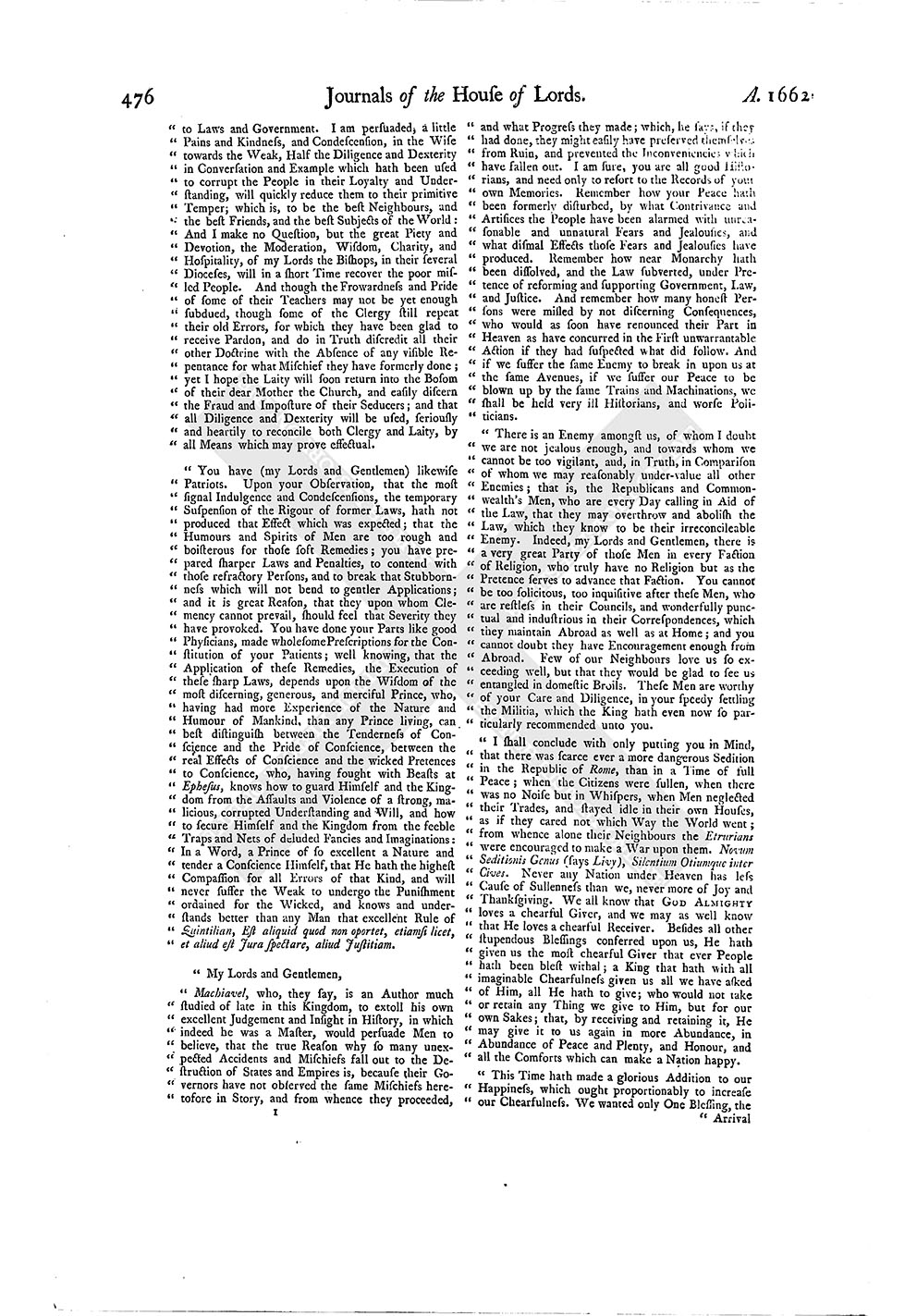
"It was a right Ground of Confidence, such an one as seldom deceives Men, that the great Law-maker, the wise Solon, had, when he concluded that Reverence and Obedience would be yielded to his Laws, because he had taken the Pains to make his Citizens know, and understand, that it was more for their Profit to obey Law and Justice, than to contemn and break it. The extravagant Times of License, which I hope we have almost out-lived, have so far corrupted the Minds, and even the Nature of too many, that they do not return with that Alacrity they ought to do, into the Road and Paths of Order and Government, from which they have so long been led astray; nor, it may be, is there Pains enough taken to make them understand the Profit, Benefit, and Ease, which always attends a chearful Obedience and Submission to Laws and Government. I am persuaded, a little Pains and Kindness, and Condescension, in the Wife towards the Weak, Half the Diligence and Dexterity in Conversation and Example which hath been used to corrupt the People in their Loyalty and Understanding, will quickly reduce them to their primitive Temper; which is, to be the best Neighbours, and the best Friends, and the best Subjects of the World: And I make no Question, but the great Piety and Devotion, the Moderation, Wisdom, Charity, and Hospitality, of my Lords the Bishops, in their several Dioceses, will in a short Time recover the poor misled People. And though the Frowardness and Pride of some of their Teachers may not be yet enough subdued, though some of the Clergy still repeat their old Errors, for which they have been glad to receive Pardon, and do in Truth discredit all their other Doctrine with the Absence of any visible Repentance for what Mischief they have formerly done; yet I hope the Laity will soon return into the Bosom of their dear Mother the Church, and easily discern the Fraud and Imposture of their Seducers; and that all Diligence and Dexterity will be used, seriously and heartily to reconcile both Clergy and Laity, by all Means which may prove effectual.
"You have (my Lords and Gentlemen) likewise Patriots. Upon your Observation, that the most signal Indulgence and Condescensions, the temporary Suspension of the Rigour of former Laws, hath not produced that Effect which was expected; that the Humours and Spirits of Men are too rough and boisterous for those soft Remedies; you have prepared sharper Laws and Penalties, to contend with those refractory Persons, and to break that Stubbornness which will not bend to gentler Applications; and it is great Reason, that they upon whom Clemency cannot prevail, should feel that Severity they have provoked. You have done your Parts like good Physicians, made wholesome Prescriptions for the Constitution of your Patients; well knowing, that the Application of these Remedies, the Execution of these sharp Laws, depends upon the Wisdom of the most discerning, generous, and merciful Prince, who, having had more Experience of the Nature and Humour of Mankind, than any Prince living, can best distinguish between the Tenderness of Conscience and the Pride of Conscience, between the real Effects of Conscience and the wicked Pretences to Conscience, who, having fought with Beasts at Ephesus, knows how to guard Himself and the Kingdom from the Assaults and Violence of a strong, malicious, corrupted Understanding and Will, and how to secure Himself and the Kingdom from the feeble Traps and Nets of deluded Fancies and Imaginations: In a Word, a Prince of so excellent a Nature and tender a Conscience Himself, that He hath the highest Compassion for all Errors of that Kind, and will never suffer the Weak to undergo the Punishment ordained for the Wicked, and knows and understands better than any Man that excellent Rule of Quintilian, Est aliquid quod non oportet, etiamsi licet, et aliud est Jura spectare, aliud Justitiam.
"My Lords and Gentlemen,
"Machiavel, who, they say, is an Author much studied of late in this Kingdom, to extoll his own excellent Judgement and Insight in History, in which indeed he was a Master, would persuade Men to believe, that the true Reason why so many unexpected Accidents and Mischiefs fall out to the Destruction of States and Empires is, because their Governors have not observed the same Mischiefs heretofore in Story, and from whence they proceeded, and what Progress they made; which, he says, if they had done, they might easily have preserved themselves from Ruin, and prevented the Inconveniencies which have fallen out. I am sure, you are all good Historians, and need only to resort to the Records of your own Memories. Remember how your Peace hath been formerly disturbed, by what Contrivance and Artifices the People have been alarmed with unreasonable and unnatural Fears and Jealousies, and what dismal Effects those Fears and Jealousies have produced. Remember how near Monarchy hath been dissolved, and the Law subverted, under Pretence of reforming and supporting Government, Law, and Justice. And remember how many honest Persons were misled by not discerning Consequences, who would as soon have renounced their Part in Heaven as have concurred in the First unwarrantable Action if they had suspected what did follow. And if we suffer the same Enemy to break in upon us at the same Avenues, if we suffer our Peace to be blown up by the same Trains and Machinations, we shall be held very ill Historians, and worse Politicians.
"There is an Enemy amongst us, of whom I doubt we are not jealous enough, and towards whom we cannot be too vigilant, and, in Truth, in Comparison of whom we may reasonably under-value all other Enemies; that is, the Republicans and Commonwealth's Men, who are every Day calling in Aid of the Law, that they may overthrow and abolish the Law, which they know to be their irreconcileable Enemy. Indeed, my Lords and Gentlemen, there is a very great Party of those Men in every Faction of Religion, who truly have no Religion but as the Pretence serves to advance that Faction. You cannot be too solicitous, too inquisitive after these Men, who are restless in their Councils, and wonderfully punctual and industrious in their Correspondences, which they maintain Abroad as well as at Home; and you cannot doubt they have Encouragement enough from Abroad. Few of our Neighbours love us so exceeding well, but that they would be glad to see us entangled in domestic Broils. These Men are worthy of your Care and Diligence, in your speedy settling the Militia, which the King hath even now so particularly recommended unto you.
"I shall conclude with only putting you in Mind, that there was scarce ever a more dangerous Sedition in the Republic of Rome, than in a Time of full Peace; when the Citizens were sullen, when there was no Noise but in Whispers, when Men neglected their Trades, and stayed idle in their own Houses, as if they cared not which Way the World went; from whence alone their Neighbours the Etrurians were encouraged to make a War upon them. Novum Seditionis Genus (says Livy), Silentium Otiumque inter Cives. Never any Nation under Heaven has less Cause of Sullenness than we, never more of Joy and Thanksgiving. We all know that GOD ALMIGHTY loves a chearful Giver, and we may as well know that He loves a chearful Receiver. Besides all other stupendous Blessings conferred upon us, He hath given us the most chearful Giver that ever People hath been blest withal; a King that hath with all imaginable Chearfulness given us all we have asked of Him, all He hath to give; who would not take or retain any Thing we give to Him, but for our own Sakes; that, by receiving and retaining it, He may give it to us again in more Abundance, in Abundance of Peace and Plenty, and Honour, and all the Comforts which can make a Nation happy.
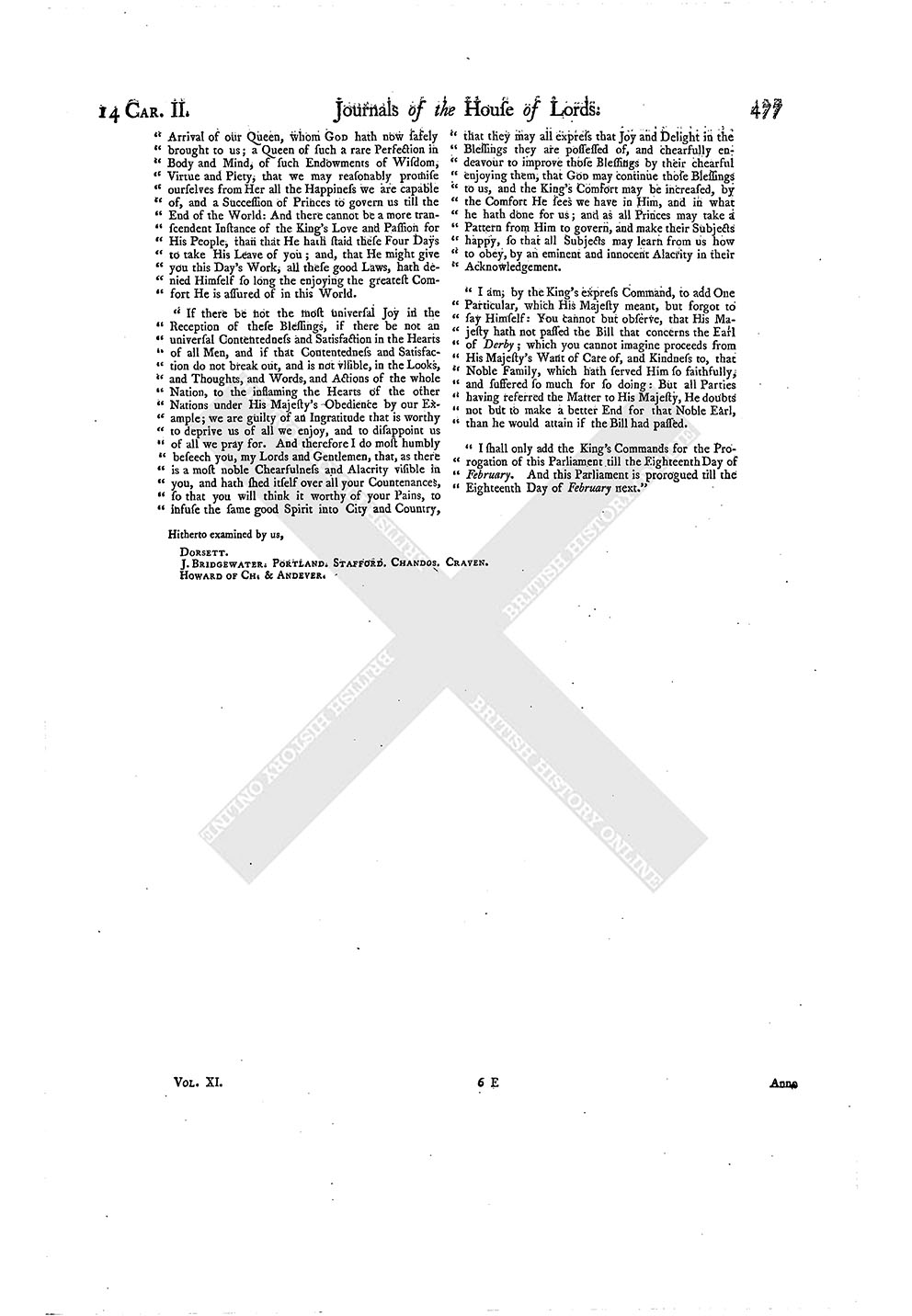
"This Time hath made a glorious Addition to our Happiness, which ought proportionably to increase our Chearfulness. We wanted only One Blessing, the Arrival of our Queen, whom GOD hath now safely brought to us; a Queen of such a rare Perfection in Body and Mind, of such Endowments of Wisdom, Virtue and Piety, that we may reasonably promise ourselves from Her all the Happiness we are capable of, and a Succession of Princes to govern us till the End of the World: And there cannot be a more transcendent Instance of the King's Love and Passion for His People, than that He hath staid these Four Days to take His Leave of you; and, that He might give you this Day's Work, all these good Laws, hath denied Himself so long the enjoying the greatest Comfort He is assured of in this World.
"If there be not the most universal Joy in the Reception of these Blessings, if there be not an universal Contentedness and Satisfaction in the Hearts of all Men, and if that Contentedness and Satisfaction do not break out, and is not visible, in the Looks, and Thoughts, and Words, and Actions of the whole Nation, to the inflaming the Hearts of the other Nations under His Majesty's Obedience by our Example; we are guilty of an Ingratitude that is worthy to deprive us of all we enjoy, and to disappoint us of all we pray for. And therefore I do most humbly beseech you, my Lords and Gentlemen, that, as there is a most noble Chearfulness and Alacrity visible in you, and hath shed itself over all your Countenances, so that you will think it worthy of your Pains, to infuse the same good Spirit into City and Country, that they may all express that Joy and Delight in the Blessings they are possessed of, and chearfully endeavour to improve those Blessings by their chearful enjoying them, that GOD may continue those Blessings to us, and the King's Comfort may be increased, by the Comfort He sees we have in Him, and in what he hath done for us; and as all Princes may take a Pattern from Him to govern, and make their Subjects happy, so that all Subjects may learn from us how to obey, by an eminent and innocent Alacrity in their Acknowledgement.
"I am, by the King's express Command, to add One Particular, which His Majesty meant, but forgot to say Himself: You cannot but observe, that His Majesty hath not passed the Bill that concerns the Earl of Derby; which you cannot imagine proceeds from His Majesty's Want of Care of, and Kindness to, that Noble Family, which hath served Him so faithfully, and suffered so much for so doing: But all Parties having referred the Matter to His Majesty, He doubts not but to make a better End for that Noble Earl, than he would attain if the Bill had passed.
"I shall only add the King's Commands for the Prorogation of this Parliament till the Eighteenth Day of February. And this Parliament is prorogued till the Eighteenth Day of February next."
Hitherto examined by us,
Dorsett.
J. Bridgewater.
Portland.
Stafford.
Chandos.
Craven.
Howard Of Ch. & Andever.