Journal of the House of Lords: Volume 17, 1701-1705. Originally published by His Majesty's Stationery Office, London, 1767-1830.
This free content was digitised by double rekeying. All rights reserved.
'House of Lords Journal Volume 17: 27 March 1704', in Journal of the House of Lords: Volume 17, 1701-1705(London, 1767-1830), British History Online https://www.british-history.ac.uk/lords-jrnl/vol17/pp526-536 [accessed 9 May 2025].
'House of Lords Journal Volume 17: 27 March 1704', in Journal of the House of Lords: Volume 17, 1701-1705(London, 1767-1830), British History Online, accessed May 9, 2025, https://www.british-history.ac.uk/lords-jrnl/vol17/pp526-536.
"House of Lords Journal Volume 17: 27 March 1704". Journal of the House of Lords: Volume 17, 1701-1705. (London, 1767-1830), British History Online. Web. 9 May 2025. https://www.british-history.ac.uk/lords-jrnl/vol17/pp526-536.




In this section
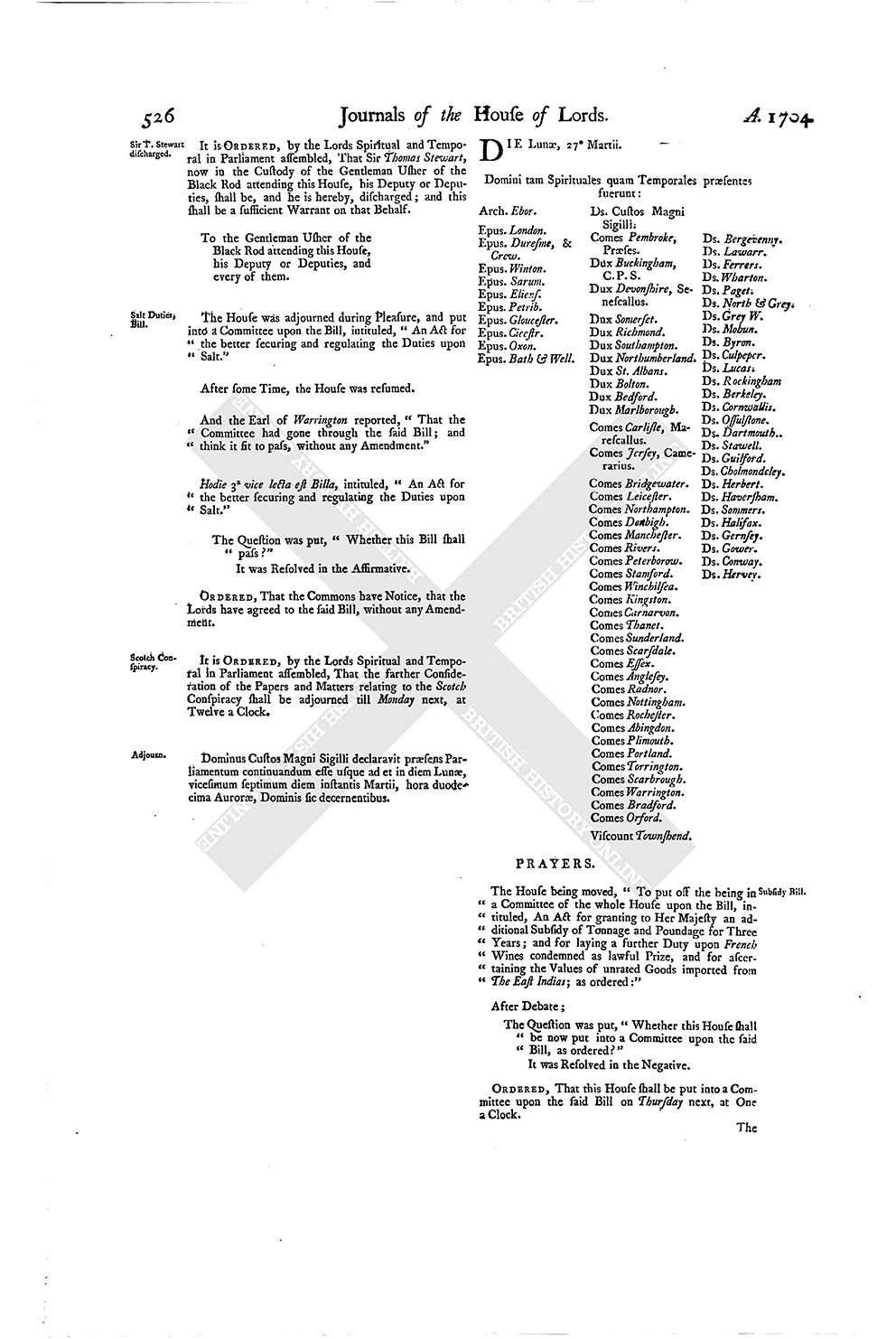
DIE Lunæ, 27 Martii.
Domini tam Spirituales quam Temporales præsentes fuerunt:
PRAYERS.
Subsidy Bill.
The House being moved, "To put off the being in a Committee of the whole House upon the Bill, intituled, An Act for granting to Her Majesty an additional Subsidy of Tonnage and Poundage for Three Years; and for laying a further Duty upon French Wines condemned as lawful Prize, and for ascertaining the Values of unrated Goods imported from The East Indias; as ordered:"
After Debate;
The Question was put, "Whether this House shall be now put into a Committee upon the said Bill, as ordered?"
It was Resolved in the Negative.
ORDERED, That this House shall be put into a Committee upon the said Bill on Thursday next, at One a Clock.
Ashby versus White & al. in Error:
The Lord Viscount Townshend made a Report from the Lords Committees appointed to draw up the State of the Case upon the Writ of Error lately depending in this House, wherein Mathew Ashby was Plaintiff, and William White and others were Defendants.
Which, being read, was agreed to, with an Amendment; and is as followeth; (videlicet,)
Report of the State of the Case.
"Ashby against White & al.
"The Plaintiff in this Action declares, That, the 26th of December in the 12th Year of King William the Third, a Writ issued out of Chancery, directed to the Sheriff of Bucks; reciting, "That the King had ordered a Parliament to be held at Westminster, on the Sixth of February following:" The Writ commanded the Sheriff to cause to be elected for the County Two Knights, for every City Two Citizens, and for every Borough Two Burgesses; which Writ was delivered to the Sheriff, who made a Precept, in Writing, under the Seal of his Office, directed to the Constables of the Borough of Aylsbury, commanding them to cause Two Burgesses of the said Borough to be elected, &c.; which Precept was delivered to the Defendants, to whom it did belong to execute the same. By virtue of which Writ and Precept, the Burgesses of that Borough, being summoned, did assemble before the Defendants, to elect Two Burgesses; and they being so assembled, in order to make such Election, the Plaintiff, being then a Burgess and Inhabitant of that Borough, being duly qualified to give his Vote at that Election, was there ready, and offered his Vote to the Defendants, for the Choice of Sir Thomas Lee Baronet and Simon Mayne Esquire, and the Defendants were then required to receive and admit of his Vote. The Defendants, being not ignorant of the Premises, but contriving, and fraudulently and maliciously intending, to damnify the Plaintiff, and to defeat him of that his Privilege, did hinder him from giving his Vote, and did refuse to permit him to give his Vote; so that the Two Burgesses were elected without any Vote given by the Plaintiff, to his Damage, &c. Upon Not Guilty pleaded, the Cause went down to Trial; and a Verdict was given for the Plaintiff, and Five Pounds Damages, and also Costs.
"It was moved in the Court of King's Bench, in Arrest of Judgement, "That this Action did not lie;" and that Point was argued by Counsel, and afterwards by the Court.
"The Lord Chief Justice Holt was of Opinion, "That Judgement in this Case ought to be given for the Plaintiff;" but Mr. Justice Powel, Mr. Justice Powys, and Mr. Justice Gold, being of a different Opinion, Judgement was entered for the Defendant: Whereupon the Plaintiff brought a Writ of Error in Parliament; and the Cause being argued, at the Bar of the House of Lords, by Counsel, and Ten of the Judges who were present in the House being heard, and the Matter fully debated by the Lords, the House was of Opinion, "That the Judgement given in the King's Bench was erroneous; and that the Plaintiff has a good Cause of Action, and ought to have Judgement."
"To maintain this Opinion, these Three Positions were laid down:
"1. That the Plaintiff, as a Burgess of this Borough, had a legal Right to give his Vote for the Election of Parliament Burgesses.
"2. That, as a necessary Consequence thereof, and an Incident inseparable to that Right, he must have a Remedy to assert and maintain it.
"3. That this is the proper Remedy, which the Plaintiff hath pursued; being supported by the Grounds and Principles of the ancient Common Law of England.
"To make good the First Position, "That the Plaintiff has a legal Right to give his Vote at the Election of Burgesses for this Borough;" it was said, "That it is well known, the House of Commons consists of Knights, Citizens, and Burgesses."
"The Knights of Shires represent all the Freeholders of the Counties. Anciently, every the least Freeholder had as much Right to give his Suffrage, as the greatest Owner of Lands in the County. This Right was a Part of his Freehold, and inherent in his Person by reason thereof, and to which he had as good a Title as to receive the natural Profits of his Soil. This appears by the Statute of 8 H. VI. Cap. 7; which recites the great Inconvenience which did arise in the Election of Knights of the Shires, by Men that were of small Substance, who pretended to have an equal Right with Knights and Esquires of the same County; therefore that Right was abridged, and confined only to such Freeholders as had Forty Shillings per Annum: But thereby it appears, that the Right which a Freeholder hath to vote, in the Election for Knights of the Shire, is an original and fundamental Right, belonging to him as he is a Freeholder.
"The Second and Third Sort of Men, which compose the great Representation of the People of England, are Citizens and Burgesses; who though they differ in Name, yet are in Essence and Substance the same; for every City is a Borough, and as such sends Members to Parliament.
"There are Two Sorts of Boroughs; the one more ancient, the other more modern.
"Of the First Sort are the most ancient Towns of England, whose Lands are held in Burgage; and, by reason thereof, had the Right and Privilege annexed to their Estates, of sending Burgesses to Parliament.
"The Second Sort are those Cities and Boroughs that have a Right by Prescription, Time immemorial, or by Charter within Time of Memory, to choose Burgesses for the Parliament: Both these are upon several Foundations; the one, as belonging to their Burgages; the other, as belonging to their Corporations: The First is a real Right, belonging to their Houses and Lands; the other is a Personal Right, belonging to their Body Politic.
"As for the First, it is sufficiently described in Littleton's Tenures, Sect. 162, 163, 164. A Tenure in Burgage is a Tenure in Soccage, and is called a Tenure in Burgage, because these are the most ancient Towns in England; and from thence came the Burgesses to Parliament: And they who have this Privilege, have it as belonging to their Estates or Possessions.
"The other Right of choosing Parliament Burgesses is not annexed to any Freehold or Estate in Possession, but vested in the Corporation of the Place; and is created in this Manner; (videlicet,)
"When a Town was incorporated, a Grant was either then or after made to the Body Politic, that they shall have Two Burgesses for the Parliament, to be chosen either by all the Freemen and Inhabitants of the Place, or such a selected Number as is prescribed by the Charter.
"The Inheritance of this Privilege is in the whole Corporation aggregate; but the Benefit, Possession, and Exercise, is in the Persons of those who, by the Constitutions of those Charters, are appointed to elect.
"And in all Cases where a Corporation hath such a Privilege, the Members thereof, in their private Capacity, have the Benefit and Enjoyment thereof, because the Corporation, as such, is not to be represented; for it is not necessary that it should have any Estate; but, by being a Corporation, they have only a Capacity to have Estates. Jones 165, Hyward, and Fulcher. For as the Citizens and Freemen of a Place are incorporated for the better Government of those of the Place; so is this Privilege of having Burgesses given for the Advantage of the particular Members thereof, whose Estates are to be bound by the Acts of their Representatives.
46 Ed. III. M 4. Dorso, &c.
"And therefore the Wages of Citizens and Burgesses were always levied, not upon the Estates or Goods of the Corporation, but upon the Goods and Estates of the Members thereof.
"It appears, by other Instances, that it is usual and proper for Corporations to have Interests granted to them, which enure to the Advantage of the Members in their private Capacities. Moore 832, Sir Thomas Waller versus Hanger. The King granted to the Mayor and Citizens of London, "That no Prisage be taken and paid for Wines, of the Citizens and Freemen of London." This enures to the Benefit of every Citizen and Freeman of London for his own Wines, in which the Corporation of the City hath no Interest.
"The same Thing appears by the Case of Waller and Spateman, I Saund. 343, and by the Case of Meller and Walker. These Instances make it sufficiently appear, that though the Inheritance of this Franchise be in the Body Corporate, yet it is for the Benefit of the particular Members thereof; and it is certainly a great Advantage for the Men or Inhabitants of a Place, to choose Persons to represent them in Parliament, who thereby will have an Opportunity, and be under an Obligation, to represent their Grievances, and advance their Profit.
"Of this Opinion have Two Parliaments been, as appears by Two several Acts; the one, 34 and 35 H. VIII. Cap. 13; the other, 25 Car. II. Cap. 9. The First is an Act for making Knights and Burgesses within the County and City of Chester, which begins in this Manner: "In humble Wise shew to Your Majesty, the Inhabitants of Your Grace's County Palatine of Chester, that they being excluded and separated from Your High Court of Parliament to have any Burgesses within the said Court, by reason whereof the Inhabitants have hitherto sustained manifold Losses and Damages, as well in their Lands as Goods and Bodies;" therefore it was Enacted, "That they should have Knights for the County, and Citizens for the City of Chester:" The other Act, which constitutes Knights and Burgesses for the County Palatine and City of Durham, recites, "That the Inhabitants thereof, hitherto, had not that Liberty and Privilege of electing and sending Knights and Burgesses to the High Court of Parliament."
"The Application of these Two Acts is very plain: The First saith, "To be excluded from sending Knights and Burgesses to Parliament, is a Damage to Lands, Goods, and Body." The other saith, "That it is a Liberty and Privilege to send them."
"Thus the Right of Election is explained, and shewed to be a legal Right.
"That, of electing Knights of Shires belonging to, and inherent in, the Freehold.
"The other, of electing Burgesses, is belonging, in some Cities and Towns, to the Real Estates of the Inhabitants; and, in others, is vested in the Corporation, for the Benefit of the particular Members, who are the Electors; the having of which is a great Benefit and Advantage to the People thereof, and will prevent great Loss and Damage, that otherwise would ensue.
"2. It follows, that, in Consequence of this Right or Privilege, the Possessors thereof must have a legal Remedy to assert and maintain it.
"It was said, That there are many Rights, for which a Man has no Remedy by the Common Law; as in Case of a Legacy given, if it be not paid, the Party cannot bring an Action for it. This is very true, but not applicable to the present Purpose; for the Constitution of the English Government has wisely distributed to several Courts the Determination of proper Causes; but has left no Subject, in any Case where he is injured, without his adequate Remedy, if he will go to the right Place for it. If a Man will seek for a Remedy at Common Law for a Legacy, which by our Constitution is to be recovered in the Ecclesiastical Court, it is his own Fault if he do not recover; as it would be, if he should begin a Suit for Land in the Court of Admiralty, or go for Equity to the Common Pleas.
"But there is no such Notion in the Law of England as a Right without a Remedy.
"He who loses or quits his Remedy, loses his Right. If a Man has a Bond for Payment of One Thousand Pounds, he has no Remedy to recover this Money but by Action; therefore, if he releases all Actions, he loses his Right to the Money, because he has given away the Means to recover it. Coke's 6th Rep. 58. Bridgeman's Case. If a Man purchases an Advowson, and at the next Avoidance suffers an Usurpation, and brings not the Quare Impedit in Time, he hath lost all Manner of Remedy, and in Consequence his Right, to which neither he nor his Heirs can ever be restored.
"Would it not look very strange, in a Constitution so formed that the Commons of England have an undoubted Share in the Legislative Authority, which is to be exercised by their Representatives, chosen by themselves, in which every Freeholder of Forty Shillings per Annum hath a Right to vote for the County, every Citizen for a City, and every Burgess for a Borough; that if the Sheriff, or other Officer, who is to cause the Election to be duly made, shall hinder or deprive any of those Electors of his Right, the Person injured shall have no Remedy, though the Injury be done to such a Right, upon the Security whereof the Lives, Liberty, and Property, of all the People of England so much depend?
"That the Defendants in this Case, by hindering the Plaintiff from voting, have done ill, cannot be denied; because they have excluded One, who has a Right, from his Vote. Then, if the Law doth not allow an Action to the Party injured, it tolerates the Injury; which is absurd to say is tolerable, in any Government.
"There was much Weight laid upon the Case of Ford and Hoskyns, 2 Cro. 388, Mo. 842; which is, "That where, by the Custom of the Manor, every. Tenant for Life might name his Successor for his Life, whom the Lord is to admit; if One be named, and the Lord refuses to admit him, it was held an Action on the Case would not lie, because the Nominee had no Right without being admitted." But the Reason given for that Opinion, shews it has no Relation to this Case; for the Plaintiff's Right of voting is vested in him, without any previous Admittance; therefore, though it should be Law, that no Action will lie for not giving a Right, yet certainly an Action must lie, for defrauding and hindering a Man to enjoy a Right that he hath.
"When any Statute requires an Act to be done for the Benefit of another, or to forbear the doing of an Act which may be to his Injury, though no Action be given in express Terms by that Statute for the Omission or Commission; the general Rule of Law in all such Cases is, That the Party injured shall have an Action. Coke, 10 Rep. 75, the Case of The Marshalsea, 12 Rep. 100. Co. Mag. Car. 118. This is a Maxim allowed and approved of in all Ages.
"There is the same Reason, where the Common Law gives a Right, or prohibits doing a Wrong: But, in this Case, an Act of Parliament is not wanting; for the Stat. of West. 1. Cap. 5. enacts, "That Elections shall be free." If he who hath a Right to vote be hindered by him who is to take his Vote, or to manage the Election, that Election is not free; such an Impediment is a manifest Violation of that Statute, as well as an Injury to the Party whose Vote is refused. This Stat. of West. 1. shews what Opinion the King and Parliament had of the great Consequence it was to the whole Realm, that People should have their Freedom in Choice. And though the Common Law was the same before, as appears even by the Statute itself, the Words whereof are, "Elections ought to be free;" yet it was adjudged necessary to add the Sanction of an Act of Parliament thereunto: "The King commandeth, upon great Forfeiture, that no great Man, or other, by Force of Arms, or by Malice or Menaces, shall disturb any to make free Election." The Defendants did not by Force of Arms drive the Plaintiff away from the Election, nor by Menaces deter him; but they did maliciously hinder him (so it is charged by the Plaintiff in the Declaration, and it is found by the Jury to be done by Fraud and Malice); and so the Defendants are Offenders within the very Words of the Statute of West. 1. Where the Law is so clear as to the Right, and the Duty so strictly enjoined by Act of Parliament to be observed, it seems a great Presumption to make it but a light Thing.
"It being apparent that the Plaintiff had a Right, and that the Defendants have done him Wrong; and that, by Consequence of Law, he must have some Remedy to vindicate his Right and to repair the Wrong:
"3. The Third Thing to be shewn is, That the Remedy the Plaintiff, pursued by bringing this Action, is the proper Remedy allowed by the ancient Law of England.
"This Action is that, which is called in the Law, "An Action upon the Case;" that is, founded upon the particular Case of the Party injured.
"The Law, in all Cases of Wrong and Injury, hath provided proper and adequate Remedies.
"1. When a Man is injured in his Person, by being beaten or wounded, the Law gives him an Action of Trespass, Assault, and Battery; if by being imprisoned, an Action of False Imprisonment.
"2. If his Goods be taken away, or Trespass done unto his House or Lands, an Action of Trespass lies, to repair him in Damages.
"3. If a Man hath a Franchise, and is hindered in the Enjoyment thereof, the proper Remedy is by an Action upon the Case.
"The Plaintiff in this Case hath a Privilege and a Franchise; and the Defendants have disturbed him in the Enjoyment thereof in the most essential Part, which is, his Right of voting.
"4. Where any Officer, or Minister of Justice entrusted with the Execution of the Process of Law, does an Injury, an Action of the Case lies against him. If the Sheriff will not execute a Writ, by arresting the Party Defendant, or taking his Goods, the Plaintiff shall have his Action upon the Case, because he refused to do his Duty, to the Plaintiff's Damage.
"The Precept which the Defendants received from the Sheriff, in this Case; was founded upon the King's Writ; and the Defendants are commanded to cause Two Burgesses to be elected for the Borough of Aylsbury, of which they are to give Notice; and to admit every One, who hath a Vote, to make Use of it; if they refuse any Man to vote who hath a Right, they act contrary to the Duty of their Office.
"It was objected, "That it did not appear that the Persons for whom the Plaintiff voted were elected, nor that they would have been elected if his Vote had been admitted."
"The Answer is, "That it is not material, whether the Person for whom the Plaintiff voted was chosen, or would have been chosen if his Vote had been taken: His Right and Privilege is, to give his Suffrage, to be a Party in the Election; if he be excluded from it, he is wronged, though the Persons for whom he would have given his Vote were elected.
"The Right of Action must accrue upon the Refusal of the Vote, and is never to be made better or worse by the Return, which is a Matter ex post facto."
"It was said, in the arguing this Case, "That the Plaintiff had no Damage, or at least that there was no such Injury or Damage done to him as would support an Action."
"The Answer to that is, "That the Law will never imagine any such Thing as Injuria sine Damno; every Injury imports Damage in the Nature of it. If a Man pick a Lock, and come into an House without the Consent of the Owner, perhaps there is no Pecuniary Damage done to the Value of a Farthing, yet the Owner shall have an Action against him, and recover Damages for the Invasion of his Possession and Property. There are many Cases of the same Nature, which have been determined upon this Ground. In the Case between Turner and Starling, 24 Car. II. in Com. Ban. and afterwards in Ban. Reg. the Plaintiff Turner, amongst others, stood to be One of the Bridgemasters of London Bridge, which Officer is to be elected by a Common Hall of the City of London. The Question was, "Who had the greatest Number of Voices?" The Plaintiff demanded the Poll; and the Defendant, being then Lord Mayor of London, refused it. It was adjudged, "That the Action was maintainable for refusing the Poll, because every Candidate has a Right to have it; and though perhaps, if the Poll had been granted to the Plaintiff in that Action, it might have been against him, yet the Denial of that Right was a good Ground of Action."
"Upon the same Reason, the Case 29 E. III. 18. was determined; and also the Case of Hunt and Dowman, 2 Car. 478. 2 Rolls, 21.
"It is apparent, by what has been said, that the Plaintiff in this present Case hath been injured, in being denied his Right; and no good Reason can be assigned, that so affects this Case, as to make it differ from other Cases; though to that Purpose several Matters were urged and insisted upon. As, First, "That this would be the Occasion of many Actions."
"If that be so, there is the greater Reason to support this Action, to punish the many Wrongs that have been done, which will prevent any more of the like Nature. If Offences multiply, Remedies against them ought to be advanced. If other Officers of Boroughs have been, or shall be, guilty of the like Misfeazances as these Defendants have been, it is fit they should be liable, as these Defendants are, to make Satisfaction. If One Man be beaten and imprisoned, is it any Objection against his having an Action, because all others who shall be as evilly treated as he hath been shall have the like Remedies? The only Means to hinder Corruptions, that will soon become frequent among those Officers of Boroughs and Corporations, is to let them see that they are obnoxious to the Law, and that their Purses must make Satisfaction to all whom they shall injure in this Manner. It is true, if One Act which tends to the Injury of many Persons be committed, no One Person injured shall be allowed to have an Action, because the rest might have the same, Co. 5 Rep. 72. Williams's Case, 3 Cr. 664. Fincux versus Hovenden, the Case of not saying Divine Service in a Chapel of a Manor to the Lord and Tenants, or for stopping of a Lane or Common Way, because the Defendant for One Act would have a Multitude of Suits against him; the Injury alike affecting a Multitude. But the Refusal of every Vote is a distinct Act. The Party grieved, whose Vote was denied, can only bring an Action for the Refusal; the others, whose Votes were admitted, are not concerned. And if an Officer denies an Hundred who have a Right, these are a Hundred several Wrongs for which he ought to be liable to as many several Actions: As, if a Man will make it his Business to fling Stones, and shall hit a Hundred several Men, he must make Satisfaction to them all. But surely this is so far from being an Objection, that it is a strong Argument to support the Action; for, if the Mayor or Bailiff of a Borough shall have Liberty to refuse Men who have Votes, he can easily make a Majority to vote on his Side; and then what will become of Elections? The Officer will return him that is elected by a Majority of his own making, by excluding the Votes of others that have a Right.
"This would encourage Officers to be partial and corrupt, and to return divers Persons to be elected in that Manner, who at least must have Possession of Seats in the House of Commons for some Time, and give Voices in the making of Laws and imposing of Taxes, until the Right of Election be determined.
"And though, upon hearing the Cause in the House of Commons, this Matter may be set right at last; yet, what can compensate for the Mischief that may be done to the Kingdom in the mean Time, by the Votes of those who shall be partially returned, and are not the Representatives of the People of the Place who are to choose them?
"Besides, the fore-mentioned Rule against multiplying Actions is confined to such Acts where there is another Remedy to be had; but where there is no other Remedy but an Action, the Wrong-doer must answer to so many several Actions as there are Persons injured. Suppose a Man will plough up the Ground in which a Hundred Persons have Common, he must answer all their Actions. If the Inhabitants of a Town have a Common Watering-place, and a Stranger stops the Current, whereby the Water is diverted; every Inhabitant shall have his Action, because there is no other Remedy.
"The injured Plaintiff, in this Case, has no other Remedy besides this Action: No Indictment lies, because it is a Personal Wrong to the Party, and no Wrong to the Public; but only in the Consequence of it, as an evil Example, which tends to the Encouragement of other such Officers to commit the like Transgressions. Nor is there any Danger to an honest Officer, that means to do his Duty; for where there is a real Doubt touching the Party's Right of voting, and the Officer makes Use of the best Means to be informed, and it is plain his Mistake arose from the Difficulty of the Case, and not from any malicious or partial Design; no Jury will find an Officer guilty in such a Case, nor can any Court direct them to do it, for it is the Fraud and the Malice that entitles the Party to the Action. In this Case, the Defendants knew the Plaintiff to be a Burgess, and yet fraudulently and maliciously hindered him from his Right of voting; and Justice must require, that such an obstinate and unjust ministerial Officer should not escape with Indemnity.
"That the Officer is only ministerial in this Case, and not a Judge, nor acting in a Judicial Capacity, is most plain; his Business is only, to execute the Precept, to assemble the Electors, to make the Election, by receiving their Votes, computing their Numbers, declaring the Election, and returning the Persons elected. The Sheriff, or other Officer of a Borough, is put to no Difficulty in this Case, but what is absolutely necessary in all Cases. If an Execution be against a Man's Goods, the Sheriff must at his Peril take Notice what Goods a Man has."
"Another Objection was made, in respect to the Novelty of the Action; it was said, "Never any such Action was brought."
"In Answer to this Objection, it may be said, "That probably there have not been many Occasions given for bringing such Suits. It is to be hoped, that very few have ever been so presumptuous, as to dare to make an obstinate and malicious Refusal of an undisputed Vote. If the Case has happened before, perhaps the Party, out of Consideration that only small Damages were to be expected, might be discouraged, and think it better to acquiesce. And it is probable, the ill-designing Officer would be at least so cautious, as to refuse the Votes of such Persons only, as he thought, by reason of the Meanness of their Circumstances, were unable to vindicate their Right. It is not every One that has such a true English Spirit as the Plaintiff, who could not sit down meanly under a Wrong done to him in One of the most valuable Privileges of an Englishman. It is not the Novelty of the Action that can be urged against it, if it can be supported by the old Grounds and Principles of Law: The Ground of Law is plain, certain, and indeed universal, That where any Man is injured in his Right, by being either hindered in or deprived of the Enjoyment thereof, the Law gives him an Action to repair himself.
"The Case of Hunt and Dowman, which was 16 Jac. I. A° Domini 1618, of an Action by the Landlord against the Tenant, for hindering him from searching his House to see whether it was in Repair, was never brought before that Time; and that of Turner and Starling was not brought till 23 Car. II.
"The Law of England is not confined to particular Precedents and Cases; but consists in the Reason of them, which is much more extensive than the Circumstance of this or that Case. Ratio Legis est Anima Legis ; et, Ubi eadem Ratio, ibi idem Jus, are known Maxims.
"An Action against the Master of a Ship, for that the Ship lying in the River of Thames was robbed, was maintained upon the same Reason as against a Common Carrier; yet such an Action was never known until 23 Car. II. in the Case of Moss and Slue, I Cr. 15. Jones 93. Palmer 313, Smith and Cranshaw, an Action of the Case was brought, for maliciously, and without any probable Cause, indicting the Plaintiff of High Treason. This was the First Action that was ever brought in such a Case; and yet it was adjudged maintainable, upon the same Reason as upon a malicious Indictment of Felony. 2 Levinz, 250, Heming and Beal, an Action of the Case was brought against the Mayor of a Town, for refusing the Plaintiff to give his vote at the Choice of a new Mayor; and there was not any Scruple made but that the Action did well lie, though that was the First Precedent.
"It is granted, that if a Freeman, who hath a Right to give his Vote for the Choice of a Mayor, be denied his Vote, he may maintain an Action upon the Case.
"There can be no Difference between that Case and this, unless it can be supposed that the Right to vote at the Election of a Mayor is of higher Estimation in the Eye of the Law, than a Right to choose Members to serve in the High Court of Parliament.
"This Action is not only founded upon the Reason of the Common Law, but it hath the Sanction of an Act of Parliament; videlicet, the Statute of West. 2. Cap. 24; which says, "That whensoever from thenceforth it shall fortune in Chancery, that in One Case a Writ is found, and in a like Case falling under like Right, and wanting like Remedy, none is found; the Clerks of the Chancery shall agree in making a Writ, and, by Consent of Men learned in the Law, a Writ shall be made; lest it should happen hereafter, that the King's Court might fail in ministering Justice to Complainants."
"The Objection most insisted on was, "That this is a Matter relating to Parliaments, and ought to be determined by the Law and Custom of Parliaments; and for that Reason, is not cognizable in the Queen's Courts."
"In Answer to this Objection, it was shewed, First, that this Case is proper, in the Nature of it, to be determined in the Queen's Court.
"2. There is no other Provision made for the Plaintiff, who is highly injured in his Right, but by bringing his Action in the Courts of Law, that have Power to determine of Men's Lives, Liberties, and Properties.
"First, the Case, in the Nature of it, is proper for the Queen's Courts. This will be apparent, if the several Rights of electing Members to serve in the House of Commons be considered.
"The Right of choosing Knights of the Shire is founded upon the Elector's Freehold. Matters of Freehold are determinable originally and primarily in the Queen's Courts, by the Rules and Methods of the Common Law, by a Jury sworn, and by the Evidence of Witnesses upon Oath; and as the Right of the Freehold is determinable there, so are all Benefits, Rights, and Advantages, depending thereupon, or belonging thereto.
"If a Freeholder's Voice be refused by a Sheriff, what is it should hinder the Queen's Court from trying and determining this Matter, like all other Questions of Freehold, by a Jury, upon the Oaths of Witnesses, or Evidence in Writing, whether the Plaintiff that supposes himself wronged was a Freeholder or not?
"The Right of choosing Citizens and Burgesses depends either upon Prescription or Custom, or upon Letters Patents. These are also primarily and originally cognizable by the Queen's Courts: Customs and Prescriptions are triable by the Country; that is, by a Jury of Twelve Men of that County, where the Custom is alledged to be. This is known Law in all Cases without Exception.
"And as to Letters Patents, if pleaded specially, the Court must judge of them; and if either Party conceives the Court hath judged amiss, he hath his Remedy by Writ of Error, till at last it comes where it will receive a final Judgement. So that every Right which an Elector can have is proper for the Determination of the Queen's Courts. There are various Ways of Election in different Boroughs; but they all depend upon Charters or Customs, and therefore are not more difficult to determine than other Franchises or Liberties, which depend upon the same Foundations."
"And whereas it was said, "That by a late Act of Parliament in the 7 and 8 W. III. the last Determination of the House of Commons concerning the Right of Elections is to be pursued;" it amounts to no more than this, that the Officer who is to make the Return, is to take Care to return him to be elected, who is chosen by a Majority of Electors, qualified according to the last Determination of the House of Commons: If he does so, he incurs no Danger, he is not liable to an Action. But the House of Commons itself is not bound by that Rule. Now suppose the Officer will deny a Man a Vote, who, according to the last Determination there, ought to have One, and this the Officer did well know; what is it hinders him that had Right according to that Determination from bringing his Action against the Officer who hath injured him? It cannot be the Act of Parliament; for the Queen's Courts are by Law the First and original Expounders of the Statutes of this Realm.
"But Secondly, there is no other Court or Jurisdiction appointed by the Law of England, for determining the Right and repairing this Injury, but the Courts of Westminster.
"It is a general Rule, "That whoever impeaches the Jurisdiction of One Court, must entitle some other Court to have a Jurisdiction of that Cause;" but that is impossible to be done in this Case.
"It was said, "That the Determination of the Right of Elections of Members, to serve in Parliament, is the proper Business of the House of Commons, which they would be always very jealous of, and this Jurisdiction of theirs is uncontested; that they exercise a great Power in that Matter, for they oblige the Officer to alter his Return according to their Judgement; and that they cannot judge of the Right of Election, without determining the Right of the Electors; and if Electors were at Liberty to prosecute Suits, touching their Right of giving Voices, in other Courts, there might be different Judgements, which would make Confusion, and be dishonourable to the House of Commons; and that therefore such an Action was a Breach of their Privilege."
"As to these Objections, several Answers were given.
"It was admitted, that the House of Commons exercise a Jurisdiction in determining the Right of Election of their own Members; and though the Time may be assigned when that Jurisdiction was exercised in another Place, yet there has been a Usage long enough to hinder that Point from being drawn in Question, especially after the Sanction given to it by the Act made in the Seventh Year of King William's Reign.
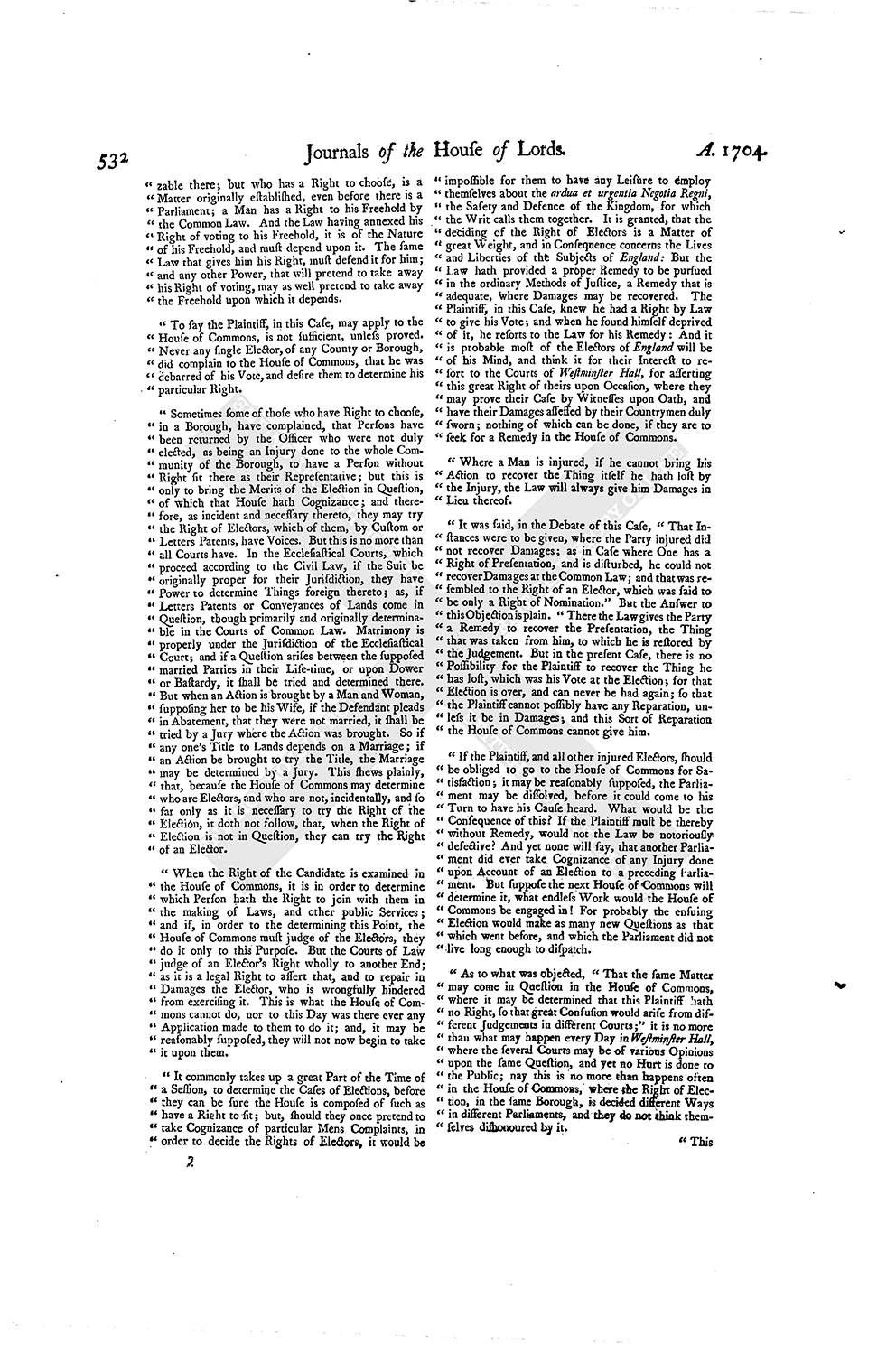
"But though it be true, that the Merit of the Election of a Member be a proper Subject for the House of Commons to judge of, because they only can give the proper and most effectual Remedy, by excluding the Usurper, and giving the Possession of the Place to him who has the Right; yet there is a great Difference between the Right of the Electors, and the Right of the Elected: The One is a temporary Right to a Place in Parliament pro hac vice; the other is a Freehold, or a Franchise. Who has a Right to sit in the House of Commons, may be properly cognizable there; but who has a Right to choose, is a Matter originally established, even before there is a Parliament; a Man has a Right to his Freehold by the Common Law. And the Law having annexed his Right of voting to his Freehold, it is of the Nature of his Freehold, and must depend upon it. The same Law that gives him his Right, must defend it for him; and any other Power, that will pretend to take away his Right of voting, may as well pretend to take away the Freehold upon which it depends.
"To say the Plaintiff, in this Case, may apply to the House of Commons, is not sufficient, unless proved. Never any single Elector, of any County or Borough, did complain to the House of Commons, that he was debarred of his Vote, and desire them to determine his particular Right.
"Sometimes some of those who have Right to choose, in a Borough, have complained, that Persons have been returned by the Officer who were not duly elected, as being an Injury done to the whole Community of the Borough, to have a Person without Right sit there as their Representative; but this is only to bring the Merits of the Election in Question, of which that House hath Cognizance; and therefore, as incident and necessary thereto, they may try the Right of Electors, which of them, by Custom or Letters Patents, have Voices. But this is no more than all Courts have. In the Ecclesiastical Courts, which proceed according to the Civil Law, if the Suit be originally proper for their Jurisdiction, they have Power to determine Things foreign thereto; as, if Letters Patents or Conveyances of Lands come in Question, though primarily and originally determinable in the Courts of Common Law. Matrimony is properly under the Jurisdiction of the Ecclesiastical Court; and if a Question arises between the supposed married Parties in their Life-time, or upon Dower or Bastardy, it shall be tried and determined there. But when an Action is brought by a Man and Woman, supposing her to be his Wife, if the Defendant pleads in Abatement, that they were not married, it shall be tried by a Jury where the Action was brought. So if any one's Title to Lands depends on a Marriage; if an Action be brought to try the Title, the Marriage may be determined by a Jury. This shews plainly, that, because the House of Commons may determine who are Electors, and who are not, incidentally, and so far only as it is necessary to try the Right of the Election, it doth not follow, that, when the Right of Election is not in Question, they can try the Right of an Elector.
"When the Right of the Candidate is examined in the House of Commons, it is in order to determine which Person hath the Right to join with them in the making of Laws, and other public Services; and if, in order to the determining this Point, the House of Commons must judge of the Electors, they do it only to this Purpose. But the Courts of Law judge of an Elector's Right wholly to another End; as it is a legal Right to assert that, and to repair in Damages the Elector, who is wrongfully hindered from exercising it. This is what the House of Commons cannot do, nor to this Day was there ever any Application made to them to do it; and, it may be reasonably supposed, they will not now begin to take it upon them.
"It commonly takes up a great Part of the Time of a Session, to determine the Cases of Elections, before they can be sure the House is composed of such as have a Right to sit; but, should they once pretend to take Cognizance of particular Mens Complaints, in order to decide the Rights of Electors, it would be impossible for them to have any Leisure to employ themselves about the ardua et urgentia Negotia Regni, the Safety and Defence of the Kingdom, for which the Writ calls them together. It is granted, that the deciding of the Right of Electors is a Matter of great Weight, and in Consequence concerns the Lives and Liberties of the Subjects of England: But the Law hath provided a proper Remedy to be pursued in the ordinary Methods of Justice, a Remedy that is adequate, where Damages may be recovered. The Plaintiff, in this Case, knew he had a Right by Law to give his Vote; and when he found himself deprived of it, he resorts to the Law for his Remedy: And it is probable most of the Electors of England will be of his Mind, and think it for their Interest to resort to the Courts of Westminster Hall, for asserting this great Right of theirs upon Occasion, where they may prove their Case by Witnesses upon Oath, and have their Damages assessed by their Countrymen duly sworn; nothing of which can be done, if they are to seek for a Remedy in the House of Commons.
"Where a Man is injured, if he cannot bring his Action to recover the Thing itself he hath lost by the Injury, the Law will always give him Damages in Lieu thereof.
"It was said, in the Debate of this Case, "That Instances were to be given, where the Party injured did not recover Damages; as in Case where One has a Right of Presentation, and is disturbed, he could not recover Damages at the Common Law; and that was resembled to the Right of an Elector, which was said to be only a Right of Nomination." But the Answer to this Objection is plain. "There the Law gives the Party a Remedy to recover the Presentation, the Thing that was taken from him, to which he is restored by the Judgement. But in the present Case, there is no Possibility for the Plaintiff to recover the Thing he has lost, which was his Vote at the Election; for that Election is over, and can never be had again; so that the Plaintiff cannot possibly have any Reparation, unless it be in Damages; and this Sort of Reparation the House of Commons cannot give him.
"If the Plaintiff, and all other injured Electors, should be obliged to go to the House of Commons for Satisfaction; it may be reasonably supposed, the Parliament may be dissolved, before it could come to his Turn to have his Cause heard. What would be the Consequence of this? If the Plaintiff must be thereby without Remedy, would not the Law be notoriously defective? And yet none will say, that another Parliament did ever take Cognizance of any Injury done upon Account of an Election to a preceding Parliament. But suppose the next House of Commons will determine it, what endless Work would the House of Commons be engaged in! For probably the ensuing Election would make as many new Questions as that which went before, and which the Parliament did not live long enough to dispatch.
"As to what was objected, "That the same Matter may come in Question in the House of Commons, where it may be determined that this Plaintiff hath no Right, so that great Confusion would arise from different Judgements in different Courts;" it is no more than what may happen every Day in Westminster Hall, where the several Courts may be of various Opinions upon the same Question, and yet no Hurt is done to the Public; nay this is no more than happens often in the House of Commons, where the Right of Election, in the same Borough, is decided different Ways in different Parliaments, and they do not think themselves dishonoured by it.
"This Contrariety of Judgement can never appear; for the House of Commons never gives a direct Judgement on this or that individual Elector's Right: The Voting is either upon a general Question of the Right of the Competitors, or where the Right of Election in the Borough is placed; whether all Inhabitants, or those under a particular Qualification, or whether the whole Commonalty, or a selected Number, have Voices; and all these are but Ways and Means to determine the Right of Election.
"If the House of Commons judge of the Right of a particular Elector at any Time, it is only pro ista vice, so far as it relates to the particular Case before them: But surely the House never thought the Elector's Freehold finally concluded thereby, because he is no Party to that Suit; his Right came not there in Question originally; but consequentially, in a Cause litigated between other Persons, to which he is no Party; and it cannot be agreeable to right Reason, or the Principles of Law, for a Man's Right to be conclusively determined in a Cause between other Parties.
"And, after all, where is the Damage to the Public, if there should be a Variety in the Determination of the House of Commons and the Courts of Westminster? It is not impossible in the Nature of Things; for the Courts of Law have great Advantages, which the House of Commons want: They want the Help of Juries, and the Power of giving Oaths; and they ought not to be displeased with their Electors, if they resort to Courts provided with these Powers, for asserting the Right of Election; especially when it is considered, that the Person, whose Pretensions the House of Commons approves of, will sit there, which is all they are concerned in. They are the Elected; and it would be strange, if that should entitle them to challenge the sole Power of deciding the Rights of their Electors, which is indeed to choose their Electors."
"It was urged, as a great Argument against the maintaining this Action, "That it had been adjudged, in the Case of Mr. Onslow, in the 33th of King Charles the Second, That no Action did lie at Common Law, for a false Return of a Member to sit in Parliament; and that, in the Case of Barnadiston and Soames, it was adjudged, the Candidate could not maintain an Action against the Sheriff for a Double Return; and if the Person, elected to serve in Parliament, cannot maintain an Action against the Officer, it was urged a fortiori, that the Person electing, who perhaps is but a Cobler, ought not to be allowed to have such an Action."
"It was answered, "That the Law of England has no Respect to Persons; if an Elector be a Cobler, he is a Freeman of England, and has that great Privilege belonging to him, to be represented in Parliament: It was remembered, with what great Variety of Opinion, among the Judges, that Case of Sir Sam. Barnadiston was determined, and what an Alarm that Judgement gave to the House of Commons, to such a Degree, that in the Session of Parliament, 1679, a Committee was appointed to inquire into it, as a Grievance; and it was observed, that the great Design of the Act of Parliament made in the Seventh Year of the late King (which was often mentioned in the Debate of this Case, to other Purposes) was, to cure the many Inconveniencies arising from that Judgement, and the Judgement in Mr. Onslow's Case, which only followed Barnadiston's, and was judged upon the Authority of it. But there is no Resemblance between those Cases and the Case of an Elector. In Barnadiston's Case, of a Double Return of Members, the Reason on which the Judgement was founded was, thas a Double Return was no Return which the Law took Notice of, but was only allowed of by the Custom of Parliament: When an Officer, who doubts, makes a Double Return, he submits to the Judgement of the House of Commons; and if that House admits of such a Return, as they had often done, it would be hard the Law should subject a Man to an Action, for submitting a Matter of Fact (the Truth of which the Officer doubts) to the Determination of those who have a Jurisdiction of the Matter, and approve the Manner of such a Return.
"In the other Case, of a false Return of a Member, several Reasons may be assigned for the Judgement, which are not applicable to the Case of an Elector: Perhaps it might be, because such a Return is a manifest Injury to every One of the Electors (though principally to the Candidate); and therefore it might fall within the Reason of Williams's Case abovementioned, that every Elector might sue him, and therefore none of them severally can maintain the Action. But there is another Reason very obvious, because the Candidate has a proper Remedy to recover his Place, from which he is excluded by the false Return: The Right of Election is cognizable in the House of Commons; there he will recover his Seat in Parliament, which is what the Law has the principal Regard to; and there is no Reason he should have another Remedy elsewhere.
"It is absurd to say, the Electors Right of choosing is founded upon the Law and Custom of Parliament; it is an original Right, Part of the Constitution of the Kingdom, as much as a Parliament is, and from whence the Persons elected to serve in Parliament do derive their Authority, and can have no other but that which is given to them by those that have the original Right to choose them. This doth not touch the Jurisdiction claimed and exercised by the House of Commons, to try the Right of the Election of their own Members; they who pretend to be admitted to sit there, ought to make out their Right to the House; but there is no Ground to infer from thence, that the House hath Power to try or determine the Right of other Persons, who are not their Members, and do not pretend to any Place amongst them.
"It was said, "That, if this Action were allowed, there would be a Way found out for the Lords to let themselves into, to judge of the Right of the Members of the House of Commons to sit there, and, by Parity of Reason, to judge of their other Privileges, as if Actions were brought for Words spoken in the House of Commons, or other Things happening in that House; which would be of ill Consequence."
"But it was said, in the First Place, "That this Objection was little applicable to the present Case, because it has no Relation to the sitting of that Member, for whom the Elector, who brings his Action, gave his Vote.
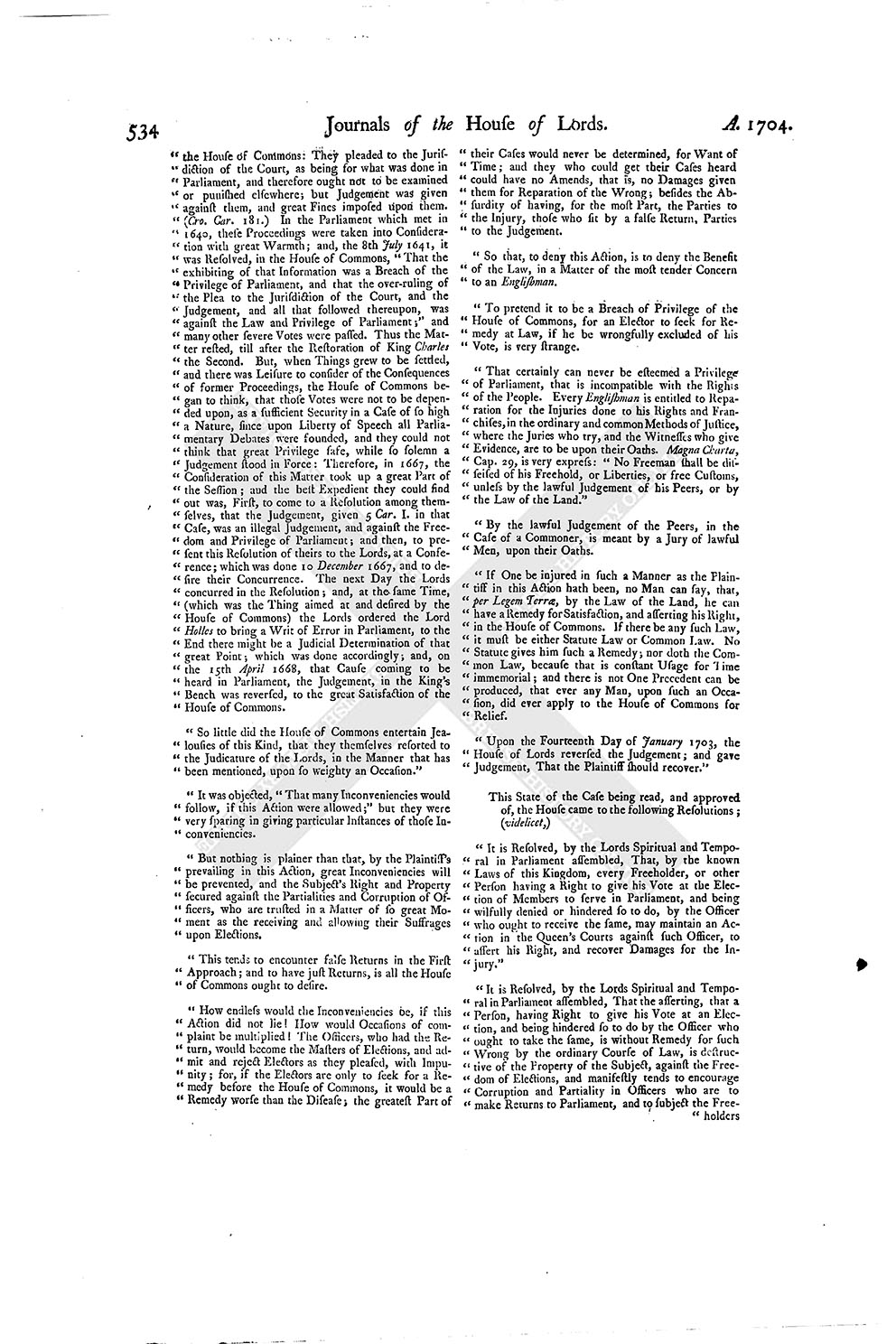
"And, Secondly, if Things are so ordered by the Constitution of the English Government, that the ultimate Resort in Point of Judicature is lodged with the Lords; let the Case concern what it will, when it is brought before them by Writ of Error, they are bound to give Judgement one Way or other." And as to the particular Instance mentioned, relating to Words spoken in the House of Commons, it was said, "There never was a greater Attempt made upon Liberty of Speech in the House of Commons, than by the Information brought in the King's Bench, 5 Car. I. against Sir John Elliot, Denzil Holles, and Benjamine Valentine Esquires, for Words spoken in the House of Commons: They pleaded to the Jurisdiction of the Court, as being for what was done in Parliament, and therefore ought not to be examined or punished elsewhere; but Judgement was given against them, and great Fines imposed upon them. (Cro. Car. 181.) In the Parliament which met in 1640, these Proceedings were taken into Consideration with great Warmth; and, the 8th July 1641, it was Resolved, in the House of Commons, "That the exhibiting of that Information was a Breach of the Privilege of Parliament, and that the over-ruling of the Plea to the Jurisdiction of the Court, and the Judgement, and all that followed thereupon, was against the Law and Privilege of Parliament;" and many other severe Votes were passed. Thus the Matter rested, till after the Restoration of King Charles the Second. But, when Things grew to be settled, and there was Leisure to consider of the Consequences of former Proceedings, the House of Commons began to think, that those Votes were not to be depended upon, as a sufficient Security in a Case of so high a Nature, since upon Liberty of Speech all Parliamentary Debates were founded, and they could not think that great Privilege safe, while so solemn a Judgement stood in Force: Therefore, in 1667, the Consideration of this Matter took up a great Part of the Session; and the best Expedient they could find out was, First, to come to a Resolution among themselves, that the Judgement, given 5 Car. I. in that Case, was an illegal Judgement, and against the Freedom and Privilege of Parliament; and then, to present this Resolution of theirs to the Lords, at a Conference; which was done 10 December 1667, and to desire their Concurrence. The next Day the Lords concurred in the Resolution; and, at the same Time, (which was the Thing aimed at and desired by the House of Commons) the Lords ordered the Lord Holles to bring a Writ of Error in Parliament, to the End there might be a Judicial Determination of that great Point; which was done accordingly; and, on the 15th April 1668, that Cause coming to be heard in Parliament, the Judgement, in the King's Bench was reversed, to the great Satisfaction of the House of Commons.
"So little did the House of Commons entertain Jealousies of this Kind, that they themselves resorted to the Judicature of the Lords, in the Manner that has been mentioned, upon so weighty an Occasion."
"It was objected, "That many Inconveniencies would follow, if this Action were allowed;" but they were very sparing in giving particular Instances of those Inconveniencies.
"But nothing is plainer than that, by the Plaintiff's prevailing in this Action, great Inconveniencies will be prevented, and the Subject's Right and Property secured against the Partialities and Corruption of Officers, who are trusted in a Matter of so great Moment as the receiving and allowing their Suffrages upon Elections.
"This tends to encounter false Returns in the First Approach; and to have just Returns, is all the House of Commons ought to desire.
"How endless would the Inconveniencies be, if this Action did not lie! How would Occasions of complaint be multiplied! The Officers, who had the Return, would become the Masters of Elections, and admit and reject Electors as they pleased, with Impunity; for, if the Electors are only to seek for a Remedy before the House of Commons, it would be a Remedy worse than the Disease; the greatest Part of their Cases would never be determined, for Want of Time; and they who could get their Cases heard could have no Amends, that is, no Damages given them for Reparation of the Wrong; besides the Absurdity of having, for the most Part, the Parties to the Injury, those who sit by a false Return, Parties to the Judgement.
"So that, to deny this Action, is to deny the Benefit of the Law, in a Matter of the most tender Concern to an Englishman.
"To pretend it to be a Breach of Privilege of the House of Commons, for an Elector to seek for Remedy at Law, if he be wrongfully excluded of his Vote, is very strange.
"That certainly can never be esteemed a Privilege of Parliament, that is incompatible with the Rights of the People. Every Englishman is entitled to Reparation for the Injuries done to his Rights and Franchises, in the ordinary and common Methods of Justice, where the Juries who try, and the Witnesses who give Evidence, are to be upon their Oaths. Magna Charta, Cap. 29, is very express: "No Freeman shall be disseised of his Freehold, or Liberties, or free Customs, unless by the lawful Judgement of his Peers, or by the Law of the Land."
"By the lawful Judgement of the Peers, in the Case of a Commoner, is meant by a Jury of lawful Men, upon their Oaths.
"If One be injured in such a Manner as the Plaintiff in this Action hath been, no Man can say, that, per Legem Terræ, by the Law of the Land, he can have a Remedy for Satisfaction, and asserting his Right, in the House of Commons. If there be any such Law, it must be either Statute Law or Common Law. No Statute gives him such a Remedy; nor doth the Common Law, because that is constant Usage for Time immemorial; and there is not One Precedent can be produced, that ever any Man, upon such an Occasion, did ever apply to the House of Commons for Relief.
"Upon the Fourteenth Day of January 1703, the House of Lords reversed the Judgement; and gave Judgement, That the Plaintiff should recover."
This State of the Case being read, and approved of, the House came to the following Resolutions; (videlicet,)
"It is Resolved, by the Lords Spiritual and Temporal in Parliament assembled, That, by the known Laws of this Kingdom, every Freeholder, or other Person having a Right to give his Vote at the Election of Members to serve in Parliament, and being wilfully denied or hindered so to do, by the Officer who ought to receive the same, may maintain an Action in the Queen's Courts against such Officer, to assert his Right, and recover Damages for the Injury."
"It is Resolved, by the Lords Spiritual and Temporal in Parliament assembled, That the asserting, that a Person, having Right to give his Vote at an Election, and being hindered so to do by the Officer who ought to take the same, is without Remedy for such Wrong by the ordinary Course of Law, is destructive of the Property of the Subject, against the Freedom of Elections, and manifestly tends to encourage Corruption and Partiality in Officers who are to make Returns to Parliament, and to subject the Freeholders and other Electors to their arbitrary Will and Pleasure."
"It is Resolved, by the Lords Spiritual and Temporal in Parliament assembled, That the declaring Mathew Ashby guilty of a Breach of Privilege of the House of Commons, for prosecuting an Action against the Constables of Aylesbury, for not receiving his Vote at an Election, after he had, in the known and proper Methods of Law, obtained a Judgement in Parliament for Recovery of his Damages, is an unprecedented Attempt upon the Judicature of Parliament, and is, in Effect, to subject the Law of England to the Votes of the House of Commons."
"It is Resolved, by the Lords Spiritual and Temporal in Parliament assembled, That the deterring Electors from prosecuting Actions in the ordinary Course of Law, where they are deprived of their Right of voting, and terrifying Attornies, Solicitors, Counsellors, and Serjeants at Law, from soliciting, prosecuting, and pleading, in such Cases, by voting their so doing to be a Breach of Privilege of the House of Commons, is a manifest assuming a Power to control the Law, to hinder the Course of Justice, and subject the Property of Englishmen to the arbitrary Votes of the House of Commons."
State of the Case to be printed:
"It is ORDERED, by the Lords Spiritual and Temporal in Parliament assembled, That the Report, made from the Lords Committees appointed to draw up the State of the Case, upon the Writ of Error lately depending in this House, wherein Mathew Ashby was Plaintiff, and William White and others Defendants, and the Resolutions made this Day relating thereunto, shall be forthwith printed and published; and that the Lords Committees who drew the said Report, or any Three of them, do give Directions therein."
To be sent to the Sheriffs.
"It is ORDERED, by the Lords Spiritual and Temporal in Parliament assembled, That the Right Honourable the Lord Keeper of the Great Seal of England do send to all the Sheriffs in the several Counties of England and Wales, the State of the Case, upon the Writ of Error lately depending in the House of Peers, wherein Mathew Ashby was Plaintiff, and William White and others Defendants, with the Resolutions of the House of Lords relating thereto; and also do order the several Sheriffs to communicate One of them to each City and Borough within their Precincts; and every Sheriff to have as many Reports sent him, as shall be necessary for each City and Borough to have One."
Resolution of H. C. concerning Ld. Wharton's Appeal, and declaring the Law, voted unwarrantable, &c.:
"It is Resolved and Declared, by the Lords Spiritual and Temporal in Parliament assembled, That the House of Commons, taking upon them, by their Votes, to condemn a Judgement of the House of Lords, given in a Cause depending before this House in the last Session of Parliament, upon the Petition of Thomas Lord Wharton, and to declare what the Law is, in Contradiction to the Proceedings of the House of Lords, is without Precedent, unwarrantable, and an Usurpation of a Judicature to which they have no Sort of Pretence."
To be printed.
"It is ORDERED, by the Lords Spiritual and Temporal in Parliament assembled, That the Resolution and Declaration made this Day, with respect to the Votes of the House of Commons, in relation to the Judgement of this House given upon the Petition of Thomas Lord Wharton, the last Session of Parliament, shall be forthwith printed and published."
Message from H. C. for Conference upon the Bill of Public Accompts.
A Message was brought from the House of Commons, by Mr. Cesar and others:
To desire a Conference with their Lordships, upon the Subject-matter of the Amendments made by this House to the Bill, intituled, "An Act for the taking, examining, and stating the Public Accompts of the Kingdom."
To which the House agreed.
Then the Commons were called in; and told, "That the Lords agree to a Conference, as desired; and appoint it presently, in the Painted Chamber."
The Lords following were appointed Managers; (videlicet,)
Queen's Answer to Address, concerning Linen Manufacture in Ireland.
The Lord Treasurer acquainted the House, "That he and the other Lords had attended Her Majesty, with the Address of this House concerning the Linen Manufacture in Ireland."
To which Her Majesty was pleased to return Answer to this Effect:
"That Her Majesty will take a proper Time to recommend that Affair to the Parliament, in such Manner as desired; and that Her Majesty will also give Encouragement to the planting of Hemp and Flax in Ireland, for the Increase and Improvement of the Manufacture of Hemp there."
Message from H. C. to remind the Lords of the Subsidy Bill.
A Message was brought from the House of Commons, by Sir Humphry Mackworth and others:
To put this House in Mind of the Bill, intituled, "An Act for granting to Her Majesty an additional Subsidy of Tonnage and Poundage, for Three Years; and for laying a further Duty upon French Wines condemned as lawful Prize; and for ascertaining the Values of unrated Goods imported from The East Indies."
Message to them, to remind them of the Bill for naturalizing the Protestant Subjects of Orange; and the Bill for manning the Navy.
Then, a Message was sent to the House of Commons, by Mr. Rogers and Mr. Hiccocks:
To put them in Mind of the Bill, intituled, "An Act for naturalizing the Protestant Subjects of the Principality of Orange, who have departed their Country upon the Account of their Religion, and who are, or shall, come to settle in this Kindom;" which tends so much to the Encouragement of the Protestant Religion throughout Europe.
And also to put them in Mind of the Bill, intituled, "An Act for the more regular and speedy Manning of the Royal Navy, and Increase of Seamen."
Mutiny Bill.
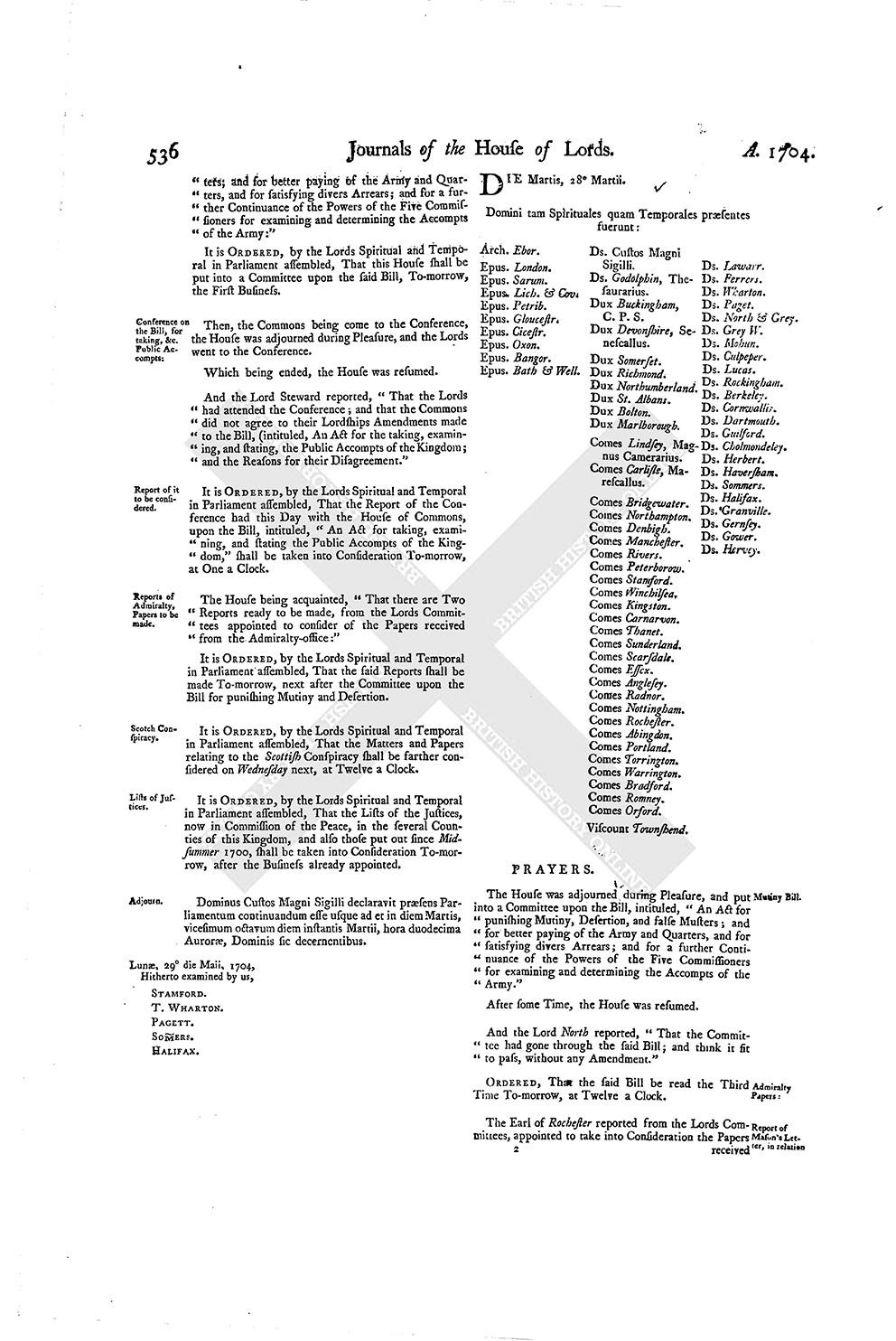
Whereas this Day was appointed, for the House to be put into a Committee upon the Bill, intituled, "An Act for punishing Mutiny, Desertion, and false Musters; and for better paying of the Army and Quarters, and for satisfying divers Arrears; and for a further Continuance of the Powers of the Five Commissioners for examining and determining the Accompts of the Army:"
It is ORDERED, by the Lords Spiritual and Temporal in Parliament assembled, That this House shall be put into a Committee upon the said Bill, To-morrow, the First Business.
Conference on the Bill, for taking, &c. Public Accompts:
Then, the Commons being come to the Conference, the House was adjourned during Pleasure, and the Lords went to the Conference.
Which being ended, the House was resumed.
And the Lord Steward reported, "That the Lords had attended the Conference; and that the Commons did not agree to their Lordships Amendments made to the Bill, (intituled, An Act for the taking, examining, and stating, the Public Accompts of the Kingdom; and the Reasons for their Disagreement."
Report of it to be considered.
It is ORDERED, by the Lords Spiritual and Temporal in Parliament assembled, That the Report of the Conference had this Day with the House of Commons, upon the Bill, intituled, "An Act for taking, examining, and stating the Public Accompts of the Kingdom," shall be taken into Consideration To-morrow, at One a Clock.
Reports of Admiralty, Papers to be made.
The House being acquainted, "That there are Two Reports ready to be made, from the Lords Committees appointed to consider of the Papers received from the Admiralty-office:"
It is ORDERED, by the Lords Spiritual and Temporal in Parliament assembled, That the said Reports shall be made To-morrow, next after the Committee upon the Bill for punishing Mutiny and Desertion.
Scotch Conspiracy.
It is ORDERED, by the Lords Spiritual and Temporal in Parliament assembled, That the Matters and Papers relating to the Scottish Conspiracy shall be farther considered on Wednesday next, at Twelve a Clock.
Lists of Justices.
It is ORDERED, by the Lords Spiritual and Temporal in Parliament assembled, That the Lists of the Justices, now in Commission of the Peace, in the several Counties of this Kingdom, and also those put out since Midsummer 1700, shall be taken into Consideration To-morrow, after the Business already appointed.
Adjourn.
Dominus Custos Magni Sigilli declaravit præsens Parliamentum continuandum esse usque ad et in diem Martis, vicesimum octavum diem instantis Martii, hora duodecima Auroræ, Dominis sic decernentibus.
Lunæ, 29° die Maii, 1704, Hitherto examined by us,
Stamford.
T. Wharton.
Pagett.
So&mtilde;ers.
Halifax.