
Journal of the House of Lords: Volume 17, 1701-1705. Originally published by His Majesty's Stationery Office, London, 1767-1830.
This free content was digitised by double rekeying. All rights reserved.
'House of Lords Journal Volume 17: 28 February 1705', in Journal of the House of Lords: Volume 17, 1701-1705, (London, 1767-1830) pp. 679-681. British History Online https://www.british-history.ac.uk/lords-jrnl/vol17/pp679-681 [accessed 25 April 2024]


In this section
DIE Mercurii, 28 Februarii.
Domini tam Spirituales quam Temporales præsentes fuerunt:
PRAYERS.
Wicks's Bill:
The Duke of Bolton reported from the Lords Committees, the Bill, intituled, "An Act to empower the Lord High Treasurer, or Commissioners of the Treasury, to compound with Michael Wicks Esquire, late Receiver General of the Plantation Duties in the Port of London," as fit to pass, with One Amendment.
Which was read Twice, and agreed to.
Hodie 3a vice lecta est Billa, intituled, "An Act to empower the Lord High Treasurer, or Commissioners of the Treasury, to compound with Michael Wicks Esquire, late Receiver General of the Plantation Duties in the Port of London."
The Question was put, "Whether this Bill, with the Amendment, shall pass?"
It was Resolved in the Affirmative.
Message to H. C. with an Amendment to it.
A Message was sent to the House of Commons, by Sir Robert Legard and Mr. Hiccocks:
To return the said Bill, and desire their Concurrence to their Lordships Amendment made thereto.
Commerce with France to prohibit Bill.
Hodie 2a vice lecta est Billa, intituled, "An Act for prohibiting all Trade and Commerce with France."
ORDERED, That the said Bill be committed to a Committee of the whole House, on Saturday next.
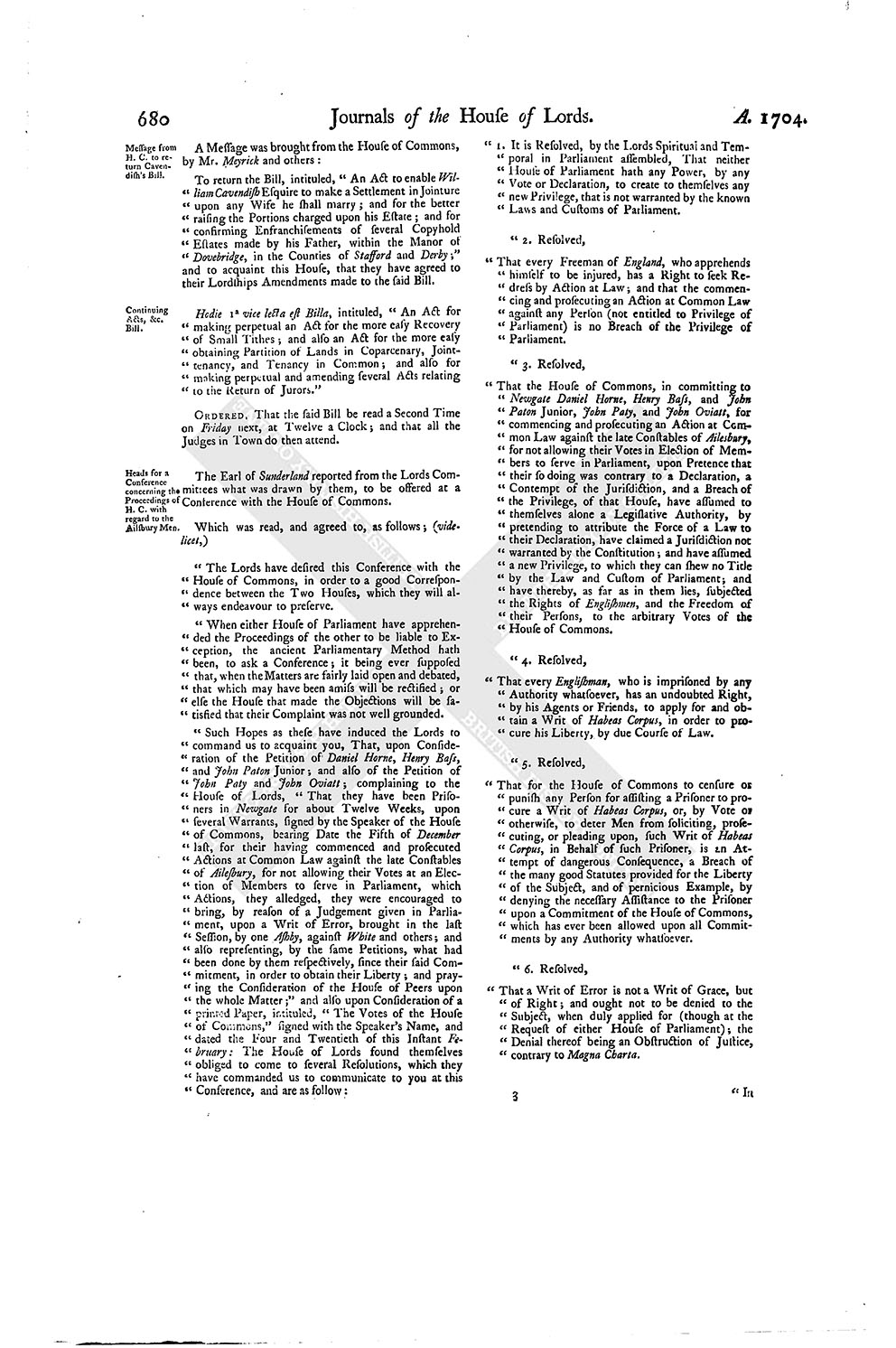
Message from H.C. to return Cavendish's Bill.
A Message was brought from the House of Commons, by Mr. Meyrick and others:
To return the Bill, intituled, "An Act to enable William Cavendish Esquire to make a Settlement in Jointure upon any Wife he shall marry; and for the better raising the Portions charged upon his Estate; and for confirming Enstranchisements of several Copyhold Estates made by his Father, within the Manor of Dovebridge, in the Counties of Stafford and Derby;" and to acquaint this House, that they have agreed to their Lordships Amendments made to the said Bill.
Continuing Acts, &c. Bill.
Hodie 1a vice lecta est Billa, intituled, "An Act for making perpetual an Act for the more easy Recovery of Small Tithes; and also an Act for the more easy obtaining Partition of Lands in Coparcenary, Jointtenancy, and Tenancy in Common; and also for making perpetual and amending several Acts relating to the Return of Jurors."
ORDERED, That the said Bill be read a Second Time on Friday next, at Twelve a Clock; and that all the Judges in Town do then attend.
Heads for a Conference concerning the Proceedings of H.C. with regard to the Ailsbury Men.
The Earl of Sunderland reported from the Lords Committees what was drawn by them, to be offered at a Conserence with the House of Commons.
Which was read, and agreed to, as follows; (videlicet,)
The Lords have desired this Conserence with the House of Commons, in order to a good Correspondence between the Two Houses, which they will always endeavour to preserve.
When either House of Parliament have apprehended the Proceedings of the other to be liable to Exception, the ancient Parliamentary Method hath been, to ask a Conference; it being ever supposed that, when the Matters are fairly laid open and debated, that which may have been amiss will be rectisied; or else the House that made the Objections will be satisfied that their Complaint was not well grounded.
Such Hopes as these have induced the Lords to command us to acquaint you, That, upon Consideration of the Petition of Daniel Horne, Henry Bass, and John Paton Junior and also of the Petition of John paty and John Oviatt; complaining to the House of Lords, "That they have been Prisoners in Newgate for about Twelve Weeks, upon several Warrants, signed by the Speaker of the House of Commons, bearing Date the Fifth of December last, for their having commenced and prosecuted Actions at Common Law against the late Constables of Ailesbury, for not allowing their Votes at an Election of Members to serve in Parliament, which Actions, they alledged, they were encouraged to bring, by reason of a Judgement given in Parliament, upon a Writ of Error, brought in the last Session, by one Ashby, against White and others; and also representing, by the same Petitions, what had been done by them respectively, since their said Commitment, in order to obtain their Liberty; and praying the Consideration of the House of Peers upon the whole Matter;" and also upon Consideration of a printed Paper, intituled, "The Votes of the House of Commons," signed with the Speaker's Name, and dated the Four and Twentieth of this Instant February: The House of Lords found themselves obliged to come to several Resolutions, which they have commanded us to communicate to you at this Conference, and are as follow:
1. It is Resolved, by the Lords Spiritual and Temporal in Parliament assembled, That neither House of Parliament hath any Power, by any Vote or Declaration, to create to themselves any new Privilege, that is not warranted by the known Laws and Customs of Parliament.
2. Resolved,
That every Freeman of England, who apprehends himself to be injured, has a Right to seek Redress by Action at Law; and that the commencing and prosecuting an Action at Common Law against any Person (not entitled to Privilege of Parliament) is no Breach of the Privilege of Parliament.
3. Resolved,
That the House of Commons, in committing to Newgate Daniel Horne, Henry Bass, and John Paton Junior, John Paty, and John Oviatt, for commencing and prosecuting an Action at Common Law against the late Constables of Ailesbury, for not allowing their Votes in Election of Members to serve in Parliament, upon Pretence that their so doing was contrary to a Declaration, a Contempt of the Jurisdiction, and a Breach of the Privilege, of that House, have assumed to themselves alone a Legislative Authority, by pretending to attribute the Force of a Law to their Declaration, have claimed a Jurisdiction not warranted by the Constitution; and have assumed a new Privilege, to which they can shew no Title by the Law and Custom of Parliament; and have thereby, as far as in them lies, subjected the Rights of Englishmen, and the Freedom of their Persons, to the arbitrary Votes of the House of Commons.
4. Resolved,
That every Englishman, who is imprisoned by any Authority whatsoever, has an undoubted Right, by his Agents or Friends, to apply for and obtain a Writ of Habeas Corpus, in order to procure his Liberty, by due Course of Law.
5. Resolved,
That for the House of Commons to censure or punish any Person for assisting a Prisoner to procure a Writ of Habeas Corpus, or, by Vote or otherwise, to deter Men from soliciting, prosecuting, or pleading upon, such Writ of Habeas Corpus, in Behalf of such Prisoner, is an Attempt of dangerous Confequence, a Breach of the many good Statutes provided for the Liberty of the Subject, and of pernicious Example, by denying the necessary Assistance to the Prisoner upon a Commitment of the House of Commons, which has ever been allowed upon all Commitments by any Authority whatsoever.
6. Resolved,
That a Writ of Error is not a Writ of Grace, but of Right; and ought not to be denied to the Subject, when duly applied for (though at the Request of either House of Parliament); the Denial thereof being an Obstruction of Justice, contrary to Magna Charta.
"In these Resolutions, the House of Lords have expressed that Regard and Tenderness which they have always had, and will ever maintain, for the Rights of the People of England, and for the Liberties of their Persons; and also their Zeal against all Innovations to the Prejudice of the known Course of Law, whereupon the Happiness of our Constitution does depend: And they hope that, upon Recollection, the House of Commons will be of the same Opinion in all the Particulars resolved by the Lords, and agree with their Lordships therein."
Then,
Message to H. C. for the Conference.
A Message was sent to the House of Commons, by Mr. Justice Tracy and Mr. Baron Smith:
To desire a present Conference, in the Painted Chamber, about some ancient fundamental Liberties of the Kingdom.
Merohants, against a Clause in the Bill to prohibit Commerce with France.
Upon reading the Petition of several Merchants, on Behalf of themselves and the rest of the Merchants and Traders in general; shewing, "That there is a Bill depending in this House, intituled, An Act for prohibiting all Trade and Commerce with France; wherein there is a Clause, relating to Foreign Bills of Exchange, which they conceive to be very destructive to the Trade and Credit of this Kingdom; and praying Relief therein:"
It is ORDERED, by the Lords Spiritual and Temporal in Parliament assembled, That the Petitioners shall be heard, by themselves or Counsel, as to this Matter, in the Committee of the whole House, on Saturday next, at Eleven a Clock.
Viscountess Dowager Falkland & al. versus L. Cheney & al.
After hearing Counsel, upon the Petition of the Right Honourable Rebecca Viscountess Dowager of Falkland, Sir Cloudesly Shovell Knight and Dame Elizabeth his Wife, Executrix of Sir John Norborough Knight, deceased, Francis Nicholson Esquire, and others, relating to a Cause lately heard in this House, to which William Lord Cheyney, Sir Walter Clarges Baronet, Peter Barwick Doctor in Pnysic, Executors of Christopher late Duke of Albemarle, deceased, were Respondents; and praying the Explanation of the Judgement of this House, as to the Petitioners having Interest for the said Duke's Share by them advanced towards the Third Voyage, in such Manner as they are to have Interest for the Duke's Share of Charges by them advanced in the Two former Voyages;" as also Counsel for the Respondents, and due Consideration of what was offered thereupon:
It is this Day ORDERED, by the Lords Spiritual and Temporal in Parliament assembled, That the Words following be added to, and made Part of, the Judgement of this House of the Twelth Day of December last; (videlicet,) ["And that the Respondents shall accompt with the Petitioners for the Charge of the Third Voyage; and that what shall appear to be due to the Appellants, upon such Accompt, shall be paid to them, with Interest, in such Manner as is directed in the Court below, as to the Accompt of the Two former Voyages."
Answer from H. C.
The Messengers sent to the House of Commons return Answer:
That the Commons agree to a present Conference, in the Painted Chamber, as desired.
Conference about the Ailsbury Man.
Then, the Lords following were named Managers of the Conference; (videlicet,)
The Commons being come to the Conference, the Managers Names were read.
Then the House was adjourned during Pleasure, and the Lords went to the Conference.
Which being ended, the House was resumed.
And the Earl of Sunderland reported, "That they had attended the Conference, and delivered what they were commanded."
Justices of Peace, Qualification Bill.
Whereas this Day was appointed, for the Second Reading of the Bill, intituled, "An Act for qualifying "Justices of Peace:"
It is ORDERED, by the Lords Spiritual and Temporal in Parliament assembled, That the said Bill shall be read a Second Time on Wednesday next, at Twelve a Clock.
Adjourn.
Dominus Custos Magni Sigill declaravit præsens Parliamentum continuandum esse usque ad et in diem Jovis, (videlicet,) primum diem Martii jam prox. futur. hora undecima Auroræ, Dominis sic decernentibus.
Die Lunæ, 26° Martii, 1705, Hitherto examined by us,
Ric. Peterb.
Jo. Chichester.
Guilford.