
Journal of the House of Lords: Volume 62, 1830. Originally published by His Majesty's Stationery Office, London, [n.d.].
This free content was digitised by double rekeying. All rights reserved.
'House of Lords Journal Volume 62: 21 May 1830', in Journal of the House of Lords: Volume 62, 1830, (London, [n.d.]) pp. 476-498. British History Online https://www.british-history.ac.uk/lords-jrnl/vol62/pp476-498 [accessed 26 April 2024]








In this section
Die Veneris, 21 Maii 1830.
DOMINI tam Spirituales quam Temporales præsentes fuerunt:
PRAYERS.
Ouchterlony v. Ld. Lynedoch, & Macdonald.
After hearing Counsel, in Part, in the Cause wherein John Ouchterlony Esquire is Appellant, and General Thomas Lord Lynedoch and William Macdonald Esquire are Respondents:
It is Ordered, That the further Hearing of the said Cause be put off sine Die.
Morrison et al. v. Mitchell.
Ordered, That the Hearing of the Cause wherein John Morrison, and others, are Appellants, and James Mitchell is Respondent, which stands appointed for this Day, be put off sine Die.
Thomson v. Forrester.
Ordered, That the Hearing of the Cause wherein James Thomson is Appellant, and Thomas Forrester is Respondent, which stands appointed for this Day, be put off sine Die.
East Retford Election Bill, Clarke to attend.
Ordered, That William Clarke do attend this House forthwith, in order to his being examined as a Witness upon the Second Reading of the Bill, intituled, "An Act to prevent Bribery and Corruption in the Election of Burgesses to serve in Parliament for the Borough of East Retford."
British Spirits, Petition from Wigtownshire against additional Duty on.
Upon reading the Petition of the Freeholders, Commissioners of Supply and Landholders of the County of Wigtown, whose Names are thereunto subscribed; praying, "That their Lordships will be pleased to take the proposed Measure at present before Parliament, of laying an additional Duty of One Shilling per Gallon on British Spirits in England, while no additional Duty is laid on Rum, into their serious Consideration, and to grant such Relief as in the Circumstances of the Case may appear to be just:"
It is Ordered, That the said Petition do lie on the Table.
Spirits & Stamps (Ireland), Petitions against additional Duty on: (Waterford:)
Upon reading the Petition of the Citizens of Waterford, whose Names are thereunto subscribed; praying, "That their Lordships will, in their Wisdom and Justice, refuse their Sanction to Measures which give an undue Preference to the Importation of West India Spirits, so essentially injurious to the Landed Interest of Ireland, or the Augmentation contemplated in the Stamp Duties:"
It is Ordered, That the said Petition do lie on the Table.
County of Limerick:
Upon reading the Petition of the Noblemen, Gentlemen and Freeholders of the County of Limerick; praying their Lordships "not to suffer the proposed Measures, of imposing an additional Duty on Home-made Spirits, without at the same Time laying a proportionate Tax on Colonial Spirits, or the contemplated Assimilation of the Stamp Duties of England and Ireland, to pass into a Law:"
It is Ordered, That the said Petition do lie on the Table.
Inhabitants of Limerick.
Upon reading the Petition of the Inhabitants of the City and Liberties of Limerick, whose Names are thereunto subscribed; praying their Lordships "not to suffer the Measures for encreasing the Duty upon Home-made Spirits, or for assimilating the Stamp Duties of the United Kingdom, to pass into a Law:"
It is Ordered, That the said Petition do lie on the Table.
Rickmersworth Road Bill, Petition against.
Upon reading the Petition of the several Persons whose Names are thereunto subscribed, being Owners and Occupiers of Estates in and near the Town of Rickmersworth, in the County of Hertford; taking notice of a Bill depending in this House, intituled, "An Act for more effectually repairing the Road from the Town of Rickmersworth, in the County of Hertford, through the Village of Pinner, to or near the Swan Public House at Sudbury Common in the Turnpike Road leading from Harrow to London;" and praying, "That the same may not pass into a Law as it now stands; but that they may be heard by their Counsel, Agents and Witnesses, against such Parts of the said Bill as may affect them:"
It is Ordered, That the said Petition do lie on the Table.
Welsh Judicature, Petition of Grand Jury, &c. of Flintshire against Alteration in.
Upon reading the Petition of The High Sheriff and Grand Jury assembled at the Spring Great Session for the County of Flint 1830, whose Names are thereunto subscribed; praying their Lordships, "That the Assizes may be continued in the County of Flint as heretofore:"
It is Ordered, That the said Petition do lie on the Table.
House & Window Tax, Petition from Liverpool for Repeal of.
Upon reading the Petition of the Inhabitants of Liverpool, in the County of Lancaster, whose Names are thereunto subscribed; praying, "That their Lordships will hasten to abolish the direct Taxes on their Dwellings, and on the Apertures therein for Light and Air, and thereby confer upon a large Part of the People of England one of the most acceptable Boons in the Power of the Legislature to bestow:"
It is Ordered, That the said Petition do lie on the Table.
Slavery, Petitions for Abolition of: (Heckmondwike:)
Upon reading the Petition of the Minister and Members of the Congregation of Protestant Dissenters of the Independent Denomination at Heckmondwike, Yorkshire, whose Names are thereunto subscribed:
And also, Upon reading the Petition of the Minister and Members of the Congregation of Protestant Dissenters of the Independent Denomination assembling at Heckmondwike, in Yorkshire, whose Names are thereunto subscribed; severally praying their Lordships "to take the Subject of Colonial Slavery into their serious Consideration at the earliest possible Period, with a view to its immediate and total Extinction in all Parts of His Majesty's Dominions, and to the Introduction of a much-injured Race to the Enjoyment of their Liberty:"
It is Ordered, That the said Petitions do lie on the Table.
Stroud:
Upon reading the Petition of the Inhabitants of Stroud and its Vicinity, in the County of Gloucester, whose Names are thereunto subscribed:
Chalford:
And also, Upon reading the Petition of the Inhabitants of Chalford and its Vicinity, in the County of Gloucester, whose Names are thereunto subscribed; severally praying their Lordships "to adopt such Measures as to their Lordships may appear best calculated immediately to mitigate, and as soon as possible to abolish, Colonial Slavery:"
It is Ordered, That the said Petitions do lie on the Table.
Wakefield:
Upon reading the Petition of the Minister and Members of a Congregation of Protestant Dissenters of the Independent Denomination in Wakefield, Yorkshire, whose Names are thereunto subscribed:
Thirsk:
Also, Upon reading the Petition of the Minister and Members of the Congregation of Protestant Dissenters of the Independent Denomination at Thirsk, Yorkshire, whose Names are thereunto subscribed:
Great Driffield:
And also, Upon reading the Petition of the Minister and Members of the Congregation of Protestant Dissenters of the Independent Denomination assembling at Great Driffield, in the County of York, whose Names are thereunto subscribed; severally praying their Lordships "to take the Subject of Slavery in the British Colonies under their most serious Consideration at the earliest possible Period, with a view to the total Abolition of the same through His Majesty's Dominions, and the Introduction of Constitutional Freedom:"
It is Ordered, That the said Petitions do lie on the Table.
Kirkby Moorside:
Upon reading the Petition of the Minister and Members of the Congregation of Protestant Dissenters of the Independent Denomination, and other Friends of Civil Liberty, at Kirkby Moorside, Yorkshire, whose Names are thereunto subscribed; praying their Lordships "for the Extinction of Negro Slavery within the Dependencies of Great Britain:"
It is Ordered, That the said Petition do lie on the Table.
Leeds.
Upon reading the Petition of the Protestant Dissenters of the Baptist Denomination assembling for Divine Worship at their Meeting House, South Parade, Leeds, in the County of York, whose Names are thereunto subscribed; praying their Lordships "to take into their Consideration the Condition of the Slave Population in the West Indies, and the consequent Need of some determinate and effective Measure by which the very Name of Slavery may be at once extinguished and annihilated:"
It is Ordered, That the said Petition do lie on the Table.
Poor Laws, Petition from the King's County against extending, to Ireland.
Upon reading the Petition of the Landed Proprietors, Clergy and Freeholders of the King's County, whose Names are thereunto subscribed; praying their Lordships "not to entertain the proposed Measure to provide for the Poor of Ireland by Means of a compulsory Assessment:"
It is Ordered, That the said Petition do lie on the Table.
Ashborne & Belpar Road Bill.
A Message was brought from the House of Commons, by Mr. Mundy and others;
With a Bill, intituled, "An Act for more effectually repairing the Road from Ashborne, in the County of Derby, to a Messuage or Public House in the Occupation of John Frost, near Belpar Bridge, in the said County of Derby;" to which they desire the Concurrence of this House.
The said Bill was read the First Time.
Southwold Harbour Bill.
A Message was brought from the House of Commons, by Mr. Mundy and others;
To return the Bill, intituled, "An Act for more effectually improving the Harbour of Southwold, in the County of Suffolk;" and to acquaint this House, That they have agreed to their Lordships Amendments made thereto.
Sunderland Harbour Bill.
A Message was brought from the House of Commons, by Lord William Powlett and others;
With a Bill, intituled, "An Act for the Improvement and Preservation of the River Wear, and Port and Haven of Sunderland, in the County Palatine of Durham;" to which they desire the Concurrence of this House.
Glasgow Road Bill.
A Message was brought from the House of Commons, by Lord William Powlett and others;
With a Bill, intituled, "An Act for maintaining and repairing the Road leading from the City of Glasgow, through Cowcaddens, to the North End of the Bridge over that Part of the River Kelvin called the Milnford of Garscube, and for making, repairing and maintaining the Road leading from Blackquarry Toll Bar, by Possil, to the Bridge across the River Allander at Langbank, in the Counties of Lanark and Stirling;" to which they desire the Concurrence of this House.
The said Two Bills were, severally, read the First Time.
De Chapeaurouge's Naturalization Bill.
A Message was brought from the House of Commons, by Mr. Campbell and others;
To return the Bill, intituled, "An Act for naturalizing Philip Augustus De Chapeaurouge;" and to acquaint this House, That they have agreed to the same, without any Amendment.
Queensferry Improvement Bill.
A Message was brought from the House of Commons, by Mr. Campbell and others;
With a Bill, intituled, "An Act for the further Improvement and Support of the Passage across the Frith of Forth called the Queensferry;" to which they desire the Concurrence of this House.
Courtown Harbour Bill.
A Message was brought from the House of Commons, by Mr. Campbell and others;
With a Bill, intituled, "An Act to amend an Act passed in the Fifth Year of the Reign of His present Majesty, for the completing the Harbour of Courtown, near Brenogue Head, in the County of Wexford;" to which they desire the Concurrence of this House.
The said Two Bills were, severally, read the First Time.
Accounts delivered:
The House being informed, "That Mr. Charles Crafer, from the Treasury, attended;"
He was called in; and delivered at the Bar, pursuant to an Address to His Majesty of the 30th of March last,
Per-centage paid to Captains for Freight of precious Metals, & to Greenwich Hospital:
"An Account of Per-centage paid to Captains of His Majesty's Ships of War in each of the last Ten Years, and to Commanders of Packets since the Year 1823:"
Also, "An Account of Per-centage paid to Captains of His Majesty's Ships of War and Captains of Packets, for Freight of the precious Metals, in each of the last Ten Years, so far as relates to the Packets on the Falmouth Station when under the Management of His Majesty's Post Master General:"
Also, "An Account of Per-centage paid to Captains of His Majesty's Ships of War and Captains of Packets, for Freight of the precious Metals, in each of the last Ten Years, so far as relates to Packets under the Management of His Majesty's Post Master General:"
And also, "An Account of Freight on Treasure paid in each of the last Ten Years by the Captains of His Majesty's Ships and the Commanders of Packets to Greenwich Hospital, being the Proportion (One Fourth) due to the said Hospital under the Royal Proclamation 12th July 1819."
Mr. Charles Crafer also delivered at the Bar, pursuant to Orders of the 26th of February last and the 6th and 11th of this instant May,
Pensions granted:
"An Account of all Pensions which have been granted under the Act 57 Geo. 3, C. 65, and under the Acts 6 Geo. 4, C. 90, and 9 Geo. 4, C. 28, by which the Provisions of the first-mentioned Act were extended:"
Salaries abolished:
"Also, "An Account of all Salaries abolished under Acts passed in the 57th Year of the Reign of Geo. 3d, for regulating Public Offices, so far as relates to Offices in England:"
Also, "An Account shewing the Amount of all Salaries abolished in Scotland under Acts passed in the 57th Year of George the 3d, for regulating Public Offices, in so far as the same are paid in Scotland:"
Also, "An Account of all Salaries abolished under Acts passed in the 57th Year of Geo. 3d, for regulating Public Offices, so far as relates to Offices in Ireland:"
Also, "An Account of the Amount of all Salaries abolished under Acts passed in the 57th Year of George 3d, for regulating Public Offices in Ireland, so far as respects Military Offices:"
Also, "An Account of the Amount of all Salaries abolished under Acts passed in the 57th Year of George the Third, for regulating Public Offices in Ireland from the Term of the then existing Interests, so far as relates to the Ordnance:"
Also, "An Account (so far as relates to the Customs) of the Amount of all Salaries abolished under Acts passed in the 57th Year of George the Third, for regulating Public Offices in Ireland:"
Funded Debt:
Also, "An Account of the Total Charge paid, in the Years ending 5th January 1817, 1819 and 1830, on account of the Dividends, Interest and Management of the Funded Debt of the United Kingdom, including any Annuities chargeable upon the Sinking Fund, and distinguishing permanent from temporary Annuities in each Year respectively:"
Exchequer & Irish Treasury Bills:
Also, "An Account of the Number of Exchequer Bills and Irish Treasury Bills (if any) outstanding and unprovided for on the 5th January 1817, 1819 and 1830:"
Also, "An Account of the Sums paid for Interest on Exchequer Bills and Irish Treasury Bills in the Years ended 5th January 1817, 1819 and 1830:"
Also, "An Estimate of the Sum required for Interest on Exchequer Bills for the Year 1830:"
Saving from Reduction of the Four per Cents:
Also, "An Estimate of the probable Saving in the Charge of the Funded Debt to be derived from the Reduction of the Four per Cents:"
Hops imported:
And also, "An Account of the Quantity of Hops imported in each Year from 1800 to 1829 inclusive, and the Duty paid thereon."
Mr. Charles Crafer also delivered at the Bar, pursuant to the Directions of an Act of Parliament,
Superannuation Allowance to Mr. Tatler.
"Copy of Treasury Minute dated 4th May 1830, granting a Superannuation Allowance of £100 per Annum to Mr. Tatler, late an Extra Clerk in the Audit Office."
And then he withdrew.
And the Titles thereof being read by the Clerk;
Ordered, That the said Papers do lie on the Table.
Ordered, That the Seventeen first-mentioned Papers be printed.
East India Co. Papers respecting, delivered, & referred to East India Comee
The House being informed, "That Mr. Preston, from the Court of Directors of The East India Company, attended;"
He was called in; and delivered at the Bar, pursuant to Orders of the 25th and 29th Days of March last,
"A Statement of the Company's Establishment of Supra Cargoes, &c. at Canton, specifying the Rank of each, their respective Salaries, and all other Charges of the Establishment at Canton, likewise the Commission paid to each on the European or Chinese Sales of Goods, or both, from the Years 1822-23 to 1828-29, inclusive:"
Also, "An Account shewing the Amount of all Supplies received from the several Presidencies and Settlements in India at the Factory at Canton, distinguishing the Presidencies, and specifying the particular Supplies under each Head and for each Year, from the Year 1822-23 to 1828-29, inclusive:"
Also, "An Account shewing the Amount of all Supplies from the Factory at Canton to the several Presidencies and Settlements in India, distinguishing the Presidencies, and specifying the particular Supplies under each Head and for each Year, from 1822-23 to 1828-29, inclusive:"
Also, "An Account shewing the Amount of all Supplies received from the Island of St. Helena at the Factory at Canton, specifying the particular Supplies under each Head and for each Year, from the Year 1822-23 to 1828-29, inclusive:"
Also, "An Account shewing the Amount of all Supplies from the Factory at Canton to the Island of St. Helena, specifying the particular Supplies under each Head and for each Year, from 1822-23 to 1828-29, inclusive:"
Also, "An Account shewing the Amount of all Supplies from England to the Factory of Canton, in each Year, from the Year 1822-23 to 1828-29, inclusive:"
Also, "An Account shewing the Amount of the Cargoes (and of what consisting) consigned from the Factory at Canton to England, like wise the Amount of all Payments for which England is debited, in each Year, from the Year 1822-23 to the Year 1828-29, inclusive:"
Also, "An Account shewing the Amount of all Bills of Exchange drawn upon the Court of Directors by the Supra Cargoes of Canton, in each Year, from 1822-23 to 1828-29, inclusive, in Tales, converted into Sterling Money at the Rate of 6s. 8d. per Tale, contrasted with the Amount of the Payment of the said Bills actually made in Sterling Money:"
Also, "An Account of Goods exported by the Court of Directors from England to Canton in the Years 1822-23 to 1828-29, inclusive; specifying the Quantities of each, their Invoice Value, and a Statement of the Gain or Loss on the Sales of the Company's Exports in each Year:"
Also, "An Account of the Losses sustained by The East India Company in the China Trade in each Year, from the Year 1822-23 to the Year 1828-29, inclusive, by Perils of the Sea, Capture, Damage or Waste of Goods, short Deliveries, or other Causes:"
Also, "An Account of the actual Cost of all the Company's Buildings in China, up to the latest Date; also, a Statement of the Sums annually expended in Repairs, Rent, Taxes or otherwise, from the Year 1822-23 to 1828-29, inclusive:"
Also, "An Account of all Goods imported from China into Great Britain from the Year 1811 to the Year 1828, both inclusive; specifying the Quantity and Value of the principal Articles imported, and distinguishing the Trade of The East India Company from the Privilege Trade:"
And also, "An Account of all Goods exported to China from Great Britain from the Year 1811 to the Year 1828, both inclusive; specifying the Quantity and Declared Value of the principal Articles exported, and distinguishing the Trade of The East India Company from the Privilege Trade."
Ordered, That the said Papers do lie on the Table.
Ordered, That the said Papers be printed.
Ordered, That the said Papers be referred to the Select Committee appointed to enquire into the present State of the Affairs of The East India Company, and into the Trade between Great Britain, the East Indies and China.
Crommelin Harbour Bill.
Ordered, That the Bill, intituled, "An Act for establishing and maintaining the Harbour of Port Crommelin, in the Bay of Cushenden, in the County of Antrim," be read a Second Time on Friday next.
North Level Drainage Bill.
A Message was brought from the House of Commons, by Sir James Graham and others;
With a Bill, intituled, "An Act for improving the Drainage of the Lands lying in the North Level, Part of the Great Level of the Fens called Bedford Level, and in Great Portsand, in the Manor of Crowland, and for providing a Navigation between Clow's Cross and the Nene Outfall Cut;" to which they desire the Concurrence of this House.
The said Bill was read the First Time.
Newspapers, &c. Petitions from the London Literary Institution, &
Upon reading the Petition of the Members of the City of London Literary and Scientific Institution, whose Names are thereunto subscribed; praying their Lordships "to take into their Consideration the pernicious Operation of the Tax on Paper, the Duty on Advertisements, and the Stamp Duty on Newspapers, and to reduce the same:"
It is Ordered, That the said Petition do lie on the Table.
Upon reading the Petition of the Journeymen Letter Press Printers of Liverpool, in the County of Lancaster, whose Names are thereunto subscribed; complaining of the heavy Duties upon Newspapers, and of the Duty upon Advertisements, and praying their Lordships "to reduce the same:"
It is Ordered, That the said Petition do lie on the Table.
Roman Catholic, &c. Worship, Petition from Dovoragainst compulsory Attendance on.
Upon reading the Petition of the Royal Free Barons and Inhabitants of the Town and Port of Dovor and its Neighbourhood; praying their Lordships "to take such Steps as may lead to a Discontinuance of the Practice of forcing Protestants holding Civil and Military Situations under the Crown to engage in the Idolatrous Services of the Roman Catholic and Greek Churches:"
It is Ordered, That the said Petition do lie on the Table.
Limerick Road Bill reported:
The Duke of Richmond reported from the Lords Committees, to whom the Bill, intituled, "An Act for improving and repairing the Road leading from Newcastle, in the County of Limerick, to the City of Limerick, and from thence to Charleville, in the County of Cork," was committed; "That they had considered the said Bill, and examined the Allegations thereof, which were found to be true; and that the Committee had gone through the Bill, and directed him to report the same to the House, without any Amendment."
Order for 3d Reading.
Ordered, That the said Bill be read the Third Time on Monday next.
Criminal Laws, Petition from Hoddesdon for Alteration of.
Upon reading the Petition of the Clergy, Gentry and other Inhabitants of Hoddesdon and its Vicinity, whose Names are thereunto subscribed; praying their Lordships, "That the Penalty of Death for the Crime of Forgery may be commuted in such Manner as to the Wisdom of the Legislature shall appear best adapted for the better Protection of Property:"
It is Ordered, That the said Petition do lie on the Table.
Northern Road Com rs, Petition of Trustees of Hitchin Road against the Appointment of.
Upon reading the Petition of the Trustees of the Turnpike Road leading from Lemsford Mill, through Welwyn and Stevenage, to Hitchin, and from Welwyn, through Codicote, to Hitchin aforesaid, all in the County of Hertford; praying their Lordships "not to consent to the Appointment of the Board of Commissioners recommended in a Report of a Select Committee appointed to enquire into the State of the Road between London and Edinburgh, constituted in a similar Manner and invested with similar Powers to those of the Commissioners for the Improvement of the Road between London and Holyhead:"
It is Ordered, That the said Petition do lie on the Table.
Dundalk Roads Bill, Petition in favor of.
Upon reading the Petition of the Noblemen, Gentlemen, Merchants and Landholders connected with the Trade of the Towns of Castleblayney and Carrickmacross, in the County of Monaghan, and of Dundalk, in the County of Louth, in Ireland, and with the Lines of Road at present leading from said Towns, in the County of Monaghan, to the said Town of Dundalk, whose Names are thereunto subscribed; taking notice of a Bill depending in this House, intituled, "An Act for repairing and maintaining the Roads from the Town of Dundalk, in the County of Louth, to the Towns of Castle Blayney and Carrickmacross, in the County of Monaghan;" and praying their Lordships "to pass the same, either in its present Form or with such Amendments as to their Lordships shall seem meet:"
It is Ordered, That the said Petition do lie on the Table.
Hollingrake's Patent Bill, Standing Order No. 173. to be considered.
Ordered, That the Standing Order No. 173, respecting Bills for the Extension of the Term of Letters Patent, be taken into Consideration on Monday next, in order to its being dispensed with on the Bill, intituled, "An Act for prolonging the Term of certain Letters Patent granted to James Hollingrake, for an improved Method of manufacturing Copper or other Metal Rollers, and of casting and forming Metallic Substances into various Forms, with improved Closeness and Soundness of Texture;" and that the Lords be summoned.
Beer Trade, Petition from New & Old Sleaford against opening.
Upon reading the Petition of the Inhabitants of the Town of New and Old Sleaford, in the County of Lincoln, and Neighbourhood, whose Names are thereunto subscribed; praying, "That their Lordships will pause ere they sanction a Measure so pregnant with Mischief to the Petitioners as the throwing open the Trade in Beer by Retail:"
It is Ordered, That the said Petition do lie on the Table.
Monks Risborough Inclosure Bill.
The Lord Bexley reported from the Lords Committees, to whom the Bill, intituled, "An Act for inclosing Lands in the Parish of Monks Risborough, in the County of Buckingham," was committed; "That they had considered the said Bill, and examined the Allegations thereof, which were found to be true; that the Parties concerned had given their Consents to the Satisfaction of the Committee; and that the Committee had gone through the Bill, and made One Amendment thereto."
Which Amendment was read by the Clerk as follows; (viz t.)
"Pr. 49. L. 36. After ("same") insert ("Provided further, that for the Purpose of securing for the Benefit of such poor Inhabitants, not being Proprietors as aforesaid, the full Advantage of such Equivalent or Compensation, Sir John Dashwood King Baronet shall be and is hereby appointed a Special Commissioner, for the sole Purpose of assigning, setting out and allotting such Plots of Land as last aforesaid, together with the Commissioners for the Time being acting under this Act, and for no other Purpose whatsoever; and all Acts, Matters and Things which shall be done and executed by a Majority of them the said Sir John Dashwood King and such Commissioners touching the Premises shall be as valid and effectual as if done and executed by all of them; provided also, that in case a Majority of them shall not agree in the Premises, the Master for the Time being of His Majesty's Court of King's Bench, on the Requisition in Writing of any Two of them the said Sir John Dashwood King and the said Commissioners, shall appoint a fit and proper Person, not interested in the said Inclosure, to be an Umpire, whose Decision, together with any Two of them the said Sir John Dashwood King and the said Commissioners, shall be final and conclusive, unless altered on an Appeal against the same by virtue of this Act.")
And the said Amendment, being read a Second Time, was agreed to by the House.
11th Report from Appeal Comee.
The Earl of Shaftesbury reported from the Lords Committees appointed to consider of the Causes in which Prints of the Appellants and Respondents Cases, now depending in this House in Matters of Appeals and Writs of Error, have not been delivered, pursuant to the Standing Orders of this House; and to report to the House; and to whom were referred certain Petitions in the following Causes; Ker and another against Sir Robert Williams Vaughan Baronet; Bulkley against Wilford; Duffy against Orr and others; Morgan against Evans and others, et e contra; Rhodes against De Beauvoir; Macalister against Macalister and others; the Two Causes Russell or Innes against The Duke of Bedford and others; Rowe against The King; and Turner against Gibb and another; "That the Committee had met, and considered the Appellants Petition in the Cause Ker and another against Sir Robert Williams Vaughan Baronet, praying their Lordships to allow the Petitioners until the 1st Day of February 1831 for lodging their printed Case; and had heard the Appellants Agent thereon, who stated that the Agent for the Respondent was consenting, and the Committee are of Opinion, That the Petitioners may, under the Circumstances of the Case, be allowed until the 1st Day of February 1831 to deliver in their printed Case: That the Committee had also considered the Appellant's Petition in the Cause Bulkley against Wilford, praying their Lordships for Two Months further Time to lay his Case upon the Table of the House, and had also considered the Respondent's Petition in the said Cause, praying their Lordships that she may be allowed the same Time to lay her Case upon the Table of the House as may be granted to the said Appellant; and had heard the Agents thereon, and the Committee are of Opinion, That the said Petitioners may respectively be allowed Two Months further Time to deliver in their printed Cases: That the Committee had also considered the Petition of Robert Orr and John Duffy, Two of the Respondents in the Cause Duffy against Orr and others, praying their Lordships for a Month's further Time from the 26th Day of May instant to lodge their respective Cases; and had heard the said Respondents Agent thereon, and had also heard the Appellant's Agent, who prayed their Lordships to allow him the same Extension of Time for lodging his Case, and the Committee are of Opinion, That the said Petitioners, and also the Appellant, may respectively be allowed a Month's further Time from the said 26th of this instant May to deliver in their respective printed Cases: That the Committee had also considered the Appellant's Petition in the Cause Morgan against Evans and others, et e contra, the Petition of Herbert Evans a Respondent in the said Original and Appellant in the said Cross Appeal, and the Petition of John Jenkins and Philip Hurd, Two of the Respondents in the said Original and Cross Appeals, severally praying their Lordships that further Time may be allowed them until the First Day of the next Session of Parliament, or such other Day as to their Lordships, in their great Wisdom, shall been seem proper, for laying the Prints of their Cases in the said Appeals upon the Table of the House; and had heard the Agents thereon, and the Committee are of Opinion, That the Petitioners may respectively be allowed (under the Circumstances of the Case) until the first Day of the next Session of Parliament to deliver in their printed Cases: That the Committee had also considered the Respondent's Petition in the Cause Rhodes against De Beauvoir, praying their Lordships that he may be allowed Six Weeks further Time to prepare his printed Case; and had heard the Agents thereon, and the Committee are of Opinion, That the Petitioner may be allowed Six Weeks further Time to deliver in his printed Case, but without Prejudice to any Application which the Appellant may in the mean time make to the House for an early Day for hearing the Appeal: That the Committee had also considered the Petition of Keith Macalister of Barr, Esquire, praying their Lordships to order that the Appeal Macalister against Macalister and others may stand revived in the Petitioner's Name, as in Place and Stead of Matthew Macalister his Father, (the deceased Appellant,) in respect of this Cause, and that the Petitioner may have the same Benefit of the said Appeal as his said Father might have had if in Life; and had heard the Agents thereon, and the Committee are of Opinion, That the said Appeal should stand revived in the Petitioner's Name, as in Place and Stead of the said Matthew Macalister, the late Appellant, as desired, and that the Petitioner should have the same Benefit of the said Appeal as his said Father would have had if in Life: That the Committee had also considered the Petition of both Parties in the Two Causes Russell or Innes against The Duke of Bedford and others, praying their Lordships to order that one of these Appeals, which stands last in the List, may be brought forward so as to stand immediately after the first of them in the Paper; and had heard the Agents thereon, and the Committee are of Opinion, That the Prayer of the said Petition may be complied with: That the Committee had also considered the Plaintiff's Petition in the Writ of Error Rowe against The King, praying their Lordships that he may be furnished forthwith with a Copy of the Return made to said Writ of Error, and that he may be forthwith, or on a Day to be named by this House, brought to the Bar thereof, that he may assign his Errors, and that the Prosecutors, or those who sue for The King, may also attend on the Day Petitioner is brought up, and may join in Error, and that the same may be heard this Session, or if not, and it appears to this House, on Inspection of the Record and Proceedings returned thereto, that there is Error, that then Petitioner may be admitted to Bail to attend ensuing Sessions, and this grievous Imprisonment, which has now through the Machinations of Conspirators been continued for near Three Years, may cease, and that an Enquiry may be made into said Conspiracy, Perjury, Subornation of Perjury, and Attempt to suborn, and that Petitioner may have Redress against the Order of Council of Benchers, and for further Relief; and had heard the Plaintiff's Agent thereon, who prayed Leave of their Lordships to withdraw the said Petition, and the Committee are of Opinion, That the said Petition may be withdrawn, as desired: And that the Committee had also considered the Respondents Petition in the Cause Turner against Gibb and another, praying their Lordships to dismiss the Appeal as incompetent; and had heard the Agents thereon, and the Committee are of Opinion, That the Prayer of the Petition ought not to be complied with, but that the Objection taken by the Respondents said Petition to the Competency of the Appeal should be reserved for Argument at the Bar on the Hearing of the Cause, and that the said Appeal should be appointed for Hearing on the first open Day for hearing Scotch Causes."
Which Report, being read by the Clerk, was agreed to by the House; and Ordered accordingly.
Hildyard's Estate Bill.
The Earl of Shaftesbury reported from the Lords Committees, to whom the Bill, intituled, "An Act for vesting the Estates in the County of Lincoln devised by the Will of Mary Hutton deceased, in Trustees, upon Trust to sell the same, and for laying out the Monies arising from such Sales in the Purchase of more convenient Estates, to be settled to the same Uses," was committed; "That they had considered the said Bill, and examined the Allegations thereof, which were found to be true; that the Parties concerned had given their Consents to the Satisfaction of the Committee; and that the Committee had gone through the Bill, and made several Amendments thereto."
Which Amendments, being read Twice by the Clerk, were agreed to by the House.
Ordered, That the said Bill, with the Amendments, be ingrossed.
Poore's Estate Bill.
The Earl of Shaftesbury reported from the Lords Committees, to whom the Bill, intituled, "An Act for exchanging a Fee-Simple Estate belonging to Edward Dyke Poore Esquire, situate at Ablington, in the County of Wilts, for an Estate under Settlement, devised by the Will of the late Edward Poore Esquire, situate at North Tidworth, in the same County; and for authorizing the Investment of a Sum of Money in the Purchase of other Lands, to be settled to the like Uses," was committed; "That they had considered the said Bill, and examined the Allegations thereof, which were found to be true; that the Parties concerned had given their Consents to the Satisfaction of the Committee; and that the Committee had gone through the Bill, and made several Amendments thereto."
Which Amendments, being read Twice by the Clerk, were agreed to by the House.
Ordered, That the said Bill, with the Amendments, be ingrossed.
Ellesmere & Chester Canal Bill Specially reported.
The Earl of Shaftesbury reported from the Lords Committees appointed to consider of the Bill, intituled, "An Act to enable the United Company of Proprietors of the Ellesmere and Chester Canal to make a Reservoir, and to establish Vessels for the Conveyance of Goods from Ellesmere Port across the River Mersey; and also to amend and enlarge the Powers of the Act relating to the said Canal;" "That the Committee had met, and considered the said Bill, and, in the first place, proceeded to enquire how far the Standing Orders of the House relative to Canal Bills had been complied with, and found that a Draft of the Bill was submitted to a Meeting of the Proprietors of the said Canal at a Meeting held specially for that Purpose on the 23d of April last, which Meeting it was proved to the Committee was called by Advertisement inserted for Four consecutive Weeks, viz t. on the 19th and 26th of March and 2d and 9th April last in the Newspaper intituled The Chester Chronicle, and on the 24th and 31st of March and 7th and 14th of April last in the Newspaper intituled The Salopian Journal, the said Newspapers being published in the Counties of Cheshire and Shropshire, to which Counties the Bill relates; and that it appears that such Meeting was held on a Period not earlier than Seven Days after the last Insertion of the said Advertisement, and that at the said Meeting a Draft of the Bill was submitted to the Proprietors then present, and was unanimously approved of by them: And the Committee further found, that all the rest of the said Standing Orders had been complied with on this Bill, except in the following Particulars; vizt. That no Map or Plan, together with a Book of Reference, containing a List of the Names of the Owners and Occupiers of Lands, and separate Lists of their Names, distinguishing also the Assents, Dissents and Neuters, and also an Estimate of the Expence of the Works proposed to be done, and of the probable Time within which the same may be completed, had been deposited with the Clerk of the Parliaments previously to the Bill being brought to this House from the Commons, as it was stated to the Committee by the Agent for the Bill, that the same had been omitted to be done through Inadvertence; but that the said Map or Plan and Papers, with the Exception of the said Estimate of Time, had since been deposited with the Clerk of the Parliaments, and had been produced to the Committee, and duly proved: The said Estimate of Time was produced to the Committee, by which it appears that the said Works may be completed in Three Years, and the said Estimate was proved: And that the Committee had gone through the Bill, and directed him to report the same to their Lordships, without any Amendment."
Ordered, That the said Report do lie on the Table.
Peebles Roads Bill.
The Earl of Shaftesbury reported from the Lords Committees, to whom the Bill, intituled, "An Act for more effectually repairing and keeping in Repair the Turnpike Roads in the County of Peebles, for making and maintaining certain new Roads, and for rendering Turnpike certain Parish Roads, in the said County," was committed; "That they had considered the said Bill, and examined the Allegations thereof, which were found to be true; and that the Committee had gone through the Bill, and directed him to report the same to the House, without any Amendment."
Queensferry Road Bill.
The Earl of Shaftesbury also made the like Report from the Lords Committees, to whom the Bill, intituled, "An Act for more effectually repairing and keeping in Repair the Road from Cramond Bridge to the Town of Queensferry, the Road leading Westward therefrom through Dalmeny to Echline, and the Road from the West End of the said Town of Queensferry to the Town of Linlithgow, in the County of Linlithgow, "was committed.
Humbert Leave for a Naturalization Bill:
Upon reading the Petition of Francis Joseph Humbert, praying their Lordships, "That Leave may be given to bring in a Bill for his Naturalization:"
It is Ordered, That Leave be given to bring in a Bill according to the Prayer of the said Petition.
Bill read.
Accordingly, The Earl of Shaftesbury presented to the House a Bill, intituled, "An Act for naturalizing Francis Joseph Humbert."
The said Bill was read the First Time.
East India, &c. Trade, Petition from Lanark for opening, referred to East India Comee.
Upon reading the Petition of the Commissioners of Supply of the County of Lanark, whose Names are thereunto subscribed; praying their Lordships, "That no Restrictions may be made upon the Resort of British Subjects to India, but that, on the contrary, the Right to settle and hold Lands in India may be freely allowed to them, subject always to such Laws and Regulations as under these Circumstances may be considered necessary; and that the Monopoly of the Trade to China, and the exclusive Right to trade in Tea, hitherto granted to The East India Company, may be discontinued:"
It is Ordered, That the said Petition do lie on the Table."
Ordered, That the said Petition be referred to the Select Committee appointed to enquire into the present State of the Affairs of The East India Company, and into the Trade between Great Britain, the East Indies and China.
Bath Hospital Bill:
Hodie 3a vice lecta est Billa, intituled, "An Act for altering and amending an Act passed in the Twelfth Year of the Reign of His Majesty King George the Second, for establishing and well-governing an Hospital or Infirmary in the City of Bath, and for constructing Baths therein, and supplying the same with Water from the Hot Baths in the said City."
The Question was put, "Whether this Bill shall pass?"
It was resolved in the Affirmative.
Kidwelly, &c. Inclosure Bill:
Hodie 3a vice lecta est Billa, intituled, "An Act for inclosing Lands within the several Parishes of Kidwelly, Saint Mary. in Kidwelly, Saint Ishmael and Pembrey, in the County of Carmarthen."
The Question was put, "Whether this Bill shall pass?"
It was resolved in the Affirmative.
Messages to H.C. that the Lords have agreed to the 2 preceding Bills.
And Messages were, severally, sent to the House of Commons, by Mr. Harvey and Mr. Stratford;
To acquaint them, That the Lords have agreed to the said Bills, without any Amendment.
Stonehouse Mill Bridge Bill, The King's Consent signified, & Bill passed:
The Earl of Shaftesbury acquainted the House, "That His Majesty having been informed of the Contents of the Bill, intituled, "An Act for erecting and maintaining a Bridge over Stonehouse Mill Pool, at or near Stonehouse Mills, in the County of Devon," was pleased to consent (as far as His Majesty's Interest is concerned) that their Lordships may proceed therein as they shall think fit."
Then the said Bill was read the Third Time.
The Question was put, "Whether this Bill shall pass?"
It was resolved in the Affirmative.
Waterford Roads Bill:
Hodie 3a vice lecta est Billa, intituled, "An Act for more effectually repairing several Roads leading from the Bounds of the County of Cork to the City of Waterford."
The Question was put, "Whether this Bill shall pass?"
It was resolved in the Affirmative.
Messages to H.C. that the Lords have agreed to the 2 preceding Bills.
And Messages were, severally, sent to the House of Commons, by the former Messengers;
To acquaint them, That the Lords have agreed to the said Bills, without any Amendment.
Everton Church Bill:
Hodie 3a vice lecta est Billa, intituled, "An Act for endowing a Church in the Township of Everton, in the Parish of Walton-on-the-Hill, in the County Palatine of Lancaster."
The Question was put, "Whether this Bill shall pass?"
It was resolved in the Affirmative.
Message to H.C. with Amendments to it.
A Message was sent to the House of Commons, by the former Messengers;
To return the said Bill, and acquaint them, That the Lords have agreed to the same, with some Amendments, to which their Lordships desire their Concurrence.
Beverley Road Bill.
Hodie 2a vice lecta est Billa, intituled, "An Act for more effectually repairing and otherwise improving the Road from Beverley, by Molescroft, to Kendell House, and from Molescroft to Bainton Balk, in the County of York."
Ordered, That the said Bill be committed to the Consideration of the Lords following:
Their Lordships, or any Five of them, to meet on Monday next, at Ten o'Clock in the Forenoon, in the Prince's Lodgings, near the House of Peers; and to adjourn as they please.
Yeovil Improvement Bill.
Hodie 2a vice lecta est Billa, intituled, "An Act for paving, lighting, watching, watering, cleansing, repairing, widening and otherwise improving the Streets, Lanes and other Public Passages and Places within the Town of Yeovil, in the County of Somerset; and for regulating the Police thereof."
Ordered, That the said Bill be committed to the Consideration of the Lords Committees aforenamed:
Their Lordships, or any Five of them, to meet on the same Day, at the same Place; and to adjourn as they please.
Kingsbury Episcopi Inclosure Bill.
Hodie 2a vice lecta est Billa, intituled, "An Act for inclosing Lands in the Parish of Kingsbury Episcopi, in the County of Somerset."
Ordered, That the said Bill be committed to the Consideration of the Lords Committees aforenamed:
Their Lordships, or any Five of them, to meet on the same Day, at the same Place; and to adjourn as they please.
Rickmersworth Road Bill read 2 a & committed:
Hodie 2a vice lecta est Billa, intituled, "An Act for more effectually repairing the Road from the Town of Rickmersworth, in the County of Hertford, through the Village of Pinner, to or near the Swan Public House at Sudbury Common in the Turnpike Road leading from Harrow to London."
Ordered, That the said Bill be committed to the Consideration of the Lords Committees aforenamed:
Their Lordships, or any Five of them, to meet on the same Day, at the same Place; and to adjourn as they please.
Petition against it, referred to the Com ee:
Ordered, That the Petition of the several Persons whose Names are thereunto subscribed, being Owners and Occupiers of Estates in and near the Town of Rickmansworth, in the County of Hertford, presented to the House this Day; taking notice of the last-mentioned Bill, and praying, "That the same may not pass into a Law as it now stands, but that they may be heard by their Counsel, Agents and Witnesses, against such Parts of the said Bill as may affect them," be referred to the Committee to whom the said Bill stands committed, and that the Petitioners be at liberty to be heard by their Counsel, Agents and Witnesses, against the same, as desired; and that Counsel be heard for the Bill at the same Time, if they think fit.
All Lords added to the Com ee:
Ordered, That all the Lords who have been or shall be present this Session, and are not named of the Committee to whom the last-mentioned Bill stands committed, be added thereto.
Com ee to appoint a Chairman.
Ordered, That the Committee to whom the said Bill stands committed do appoint their own Chairman.
Dundalk Roads Bill read 2 a & committed:
Hodie 2a vice lecta est Billa, intituled, "An Act for repairing and maintaining the Roads from the Town of Dundalk, in the County of Louth, to the Towns of Castle Blaney, and Carrickmacross, in the County of Monaghan."
Ordered, That the said Bill be committed to the Consideration of the Lords Committees aforenamed:
Their Lordships, or any Five of them, to meet on the same Day, at the same Place; and to adjourn as they please.
Petition in favor, referred to the Com ee.
Ordered, That the Petition of the Noblemen, Gentlemen, Merchants and Landholders connected with the Trade of the Towns of Castleblayney and Carrickmacross, in the County of Monaghan, and of Dundalk, in the County of Louth, in Ireland, and with the Lines of Road at present leading from said Towns, in the County of Monaghan, to the said Town of Dundalk, whose Names are thereunto subscribed, presented to the House this Day, taking notice of the last-mentioned Bill, and praying their Lordships "to pass the same, either in its present Form or with such Amendments as to their Lordships shall seem meet," be referred to the Committee to whom the said Bill stands committed.
Bankrupt Laws Amendment Bill.
The Order of the Day being read for the House to be put into a Committee upon the Bill, intituled, "An Act to explain and amend an Act of the Sixth Year of the Reign of His present Majesty, for amending the Laws relating to Bankrupts;"
Ordered, That the House be put into a Committee upon the said Bill on Tuesday next.
Copy of a Letter from East India Co. to The Governor General in Bengal, Ordered.
Ordered, That there be laid before this House, "Copy of a Letter from the Court of Directors of The East India Company to The Governor General in Council at Fort William in Bengal, in the Territorial Finance Department, dated 19th May 1830."
Rother Levels Drainage Bill read 2 a & committed:
The Order of the Day being read for the Second Reading of the Bill, intituled, "An Act to amend an Act of the Seventh Year of His present Majesty, for more effectually draining and preserving certain Marsh Lands or Low Grounds in the Parishes of Sandhurst, Newenden, Rolvenden, Tenterden, Wittersham, Ebony, Woodchurch, Appledore and Stone, in the County of Kent, and Ticehurst, Salehurst, Bodiam, Ewhurst, Northiam, Beckly, Peasmarsh, Iden and Playden, in the County of Sussex;"
It was moved, "That the said Bill be now read a Second Time."
The Question was put thereupon?
It was resolved in the Affirmative.
Then the said Bill was read a Second Time.
Ordered, That the said Bill be committed to the Consideration of the Lords Committees aforenamed:
Their Lordships, or any Five of them, to meet on Wednesday the 2d of June next, at Twelve o'Clock at Noon, in the Prince's Lodgings, near the House of Peers; and to adjourn as they please.
Petition against it, referred to the Com ee:
Ordered, That the Petition of the Inhabitants, Shipowners, Merchants and Traders of the Town and Port of Rye, in the County of Sussex, whose Names are thereunto subscribed, presented to the House on Tuesday last, taking notice of the last-mentioned Bill, and praying, "That the same may not pass into a Law, and that the Petitioners may be heard by their Counsel, Solicitor or Agents, against such Part or Parts of the said Bill as may affect their Rights and Interests," be referred to the Committee to whom the said Bill stands committed, and that the Petitioners be at liberty to be heard by their Counsel, Solicitor or Agents, against the same, as desired.
All Lords added to the Com ee:
Ordered, That all the Lords who have been or shall be present this Session, and are not named of the Committee to whom the last-mentioned Bill stands committed, be added thereto.
Com ee to appoint a Chairman:
Ordered, That the Committee to whom the said Bill stands committed do appoint their own Chairman.
Wilson to attend the Com ee.
Ordered, That William Wilson, Collector of the Customs at the Port of Rye, do attend this House on Wednesday next, to be sworn, in order to produce before the Committee to whom the last-mentioned Bill stands committed a certain Book in which is entered the Registers or Extracts of Registers of all Vessels belonging to the said Port of Rye.
Hickson's Marriage Annulling Bill, Buxton's Petition against.
Upon reading the Petition of Thomas Buxton, formerly of Stenson, in the County of Derby, Farmer, and now a Prisoner in the Castle of Lancaster; setting forth, "That at the Spring Assizes for the County of Lancaster 1829, the Petitioner Thomas Buxton, Mary Ann Buxton Spinster, his Sister, William Webster of Derby, Sheriff's Officer, Erasmus Webster, formerly of Derby, but late of Manchester, Attorney at Law, and Benjamin Wild of Manchester, Innkeeper, were indicted for having conspired to effect a Marriage between the Petitioner, the said Thomas Buxton, who was then 22 Years of Age, and Elizabeth Hickson, who was then 18 Years of Age, and resided at Stenson aforesaid, without due Publication of Banns; that is to say, by causing the Banns of Marriage to be published at the Collegiate Church at Manchester, instead of the Parish of Barrow, where the Petitioner and the said Elizabeth Hickson lived: That the Petitioner Thomas Buxton, Erasmus Webster, William Webster and Benjamin Wild, were also indicated for having wilfully and feloniously caused a false Entry to be made in the Register of Banns of the said Collegiate Church at Manchester; and the Petitioner Thomas Buxton, and Benjamin Wild, were also separately charged with having caused a false Entry to be made in the Register of Marriages of the same Church by Two other Indictments for Felony: That the Petitioner was arrested upon Warrants on these Indictments for Felony, and was compelled to give Bail in very heavy Sums for his Appearance, and to take his Trial upon the Charges of Felony; and he prepared and delivered Briefs to Counsel, and took many Witnesses from the Neighbourhood of Derby to Lancaster, at a great Expence, for his Defence against the same Charges: That when the Three Indictments for Felony were called on, the Prosecutor declined to offer Evidence upon any of them, and the Petitioner and all the other Defendants were acquitted upon those Indictments: That in fact it appeared, and was proved by the Prosecutor's Witnesses, on the Trial of the Conspiracy after mentioned, that neither the Petitioner nor any of the other Parties indicted had ever seen nor did they know the Contents of the Register of Banns containing the alleged false Entry; and it was also proved that such Part of the Entry in the Register of Marriages as was charged to be false was made after the Petitioner and the other Parties had signed the Book and left the Church, and that they had no Knowledge whatever of such alleged false Entry; and it further appeared, that it was not the Practice of the Persons in Authority at the said Collegiate Church to make any Enquiries as to the Residence of Parties applying to be married; and the Petitioner therefore affirms, that the Charges of Felony were made without any reasonable or probable Grounds: That the Petitioner Thomas Buxton, William Webster and Erasmus Webster, were found guilty of having conspired to effect a Marriage in the Manner before mentioned, without a due Publication of Banns, and the said Mary Ann Buxton and Benjamin Wild were acquitted: That the Petitioner was anxious to have had Miss Hickson examined upon the Trial, and actually paid the Expences of her Journey to and from Lancaster for that Purpose; but by abandoning the Indictments for Felony the Petitioner was deprived of the Opportunity of examining Miss Hickson, and the Evidence of Miss Mary Ann Buxton (who was acquitted) was also excluded, by her having been made a Defendant in the Indictment for Conspiracy, and the Petitioner was thus prevented from bringing before the Court and Jury the true History of the Transaction: That on Wednesday the 12th Day of May instant Leave was given to bring into their Lordships House a Bill to declare void the said Marriage between the Petitioner and the said Elizabeth Hickson; and the Petitioner respectfully submits to their Lordships the following brief Statement of the Facts connected with his said Marriage: That for Five Years before the Elopement after mentioned the Petitioner lived in the Village of Stenson, and the said Elizabeth Hickson also lived in the same Village: That the Petitioner and the said Elizabeth Hickson were in the same Condition of Life, being the Children of Farmers; and the said Elizabeth Hickson, and Mary Ann Buxton, the Sister of the Petitioner, went to the same School in the Town of Derby, and became very intimate Friends, and visited at each other's Houses: That an Attachment existed between the Petitioner, then 22 Years of Age, and the said Elizabeth Hickson, then 18 Years of Age, within, One or Two Months, but being disapproved of by their Friends, their Intercourse was carried on clandestinely, and they agreed to marry: That in fact the Petitioner wished the Marriage to be deferred until the said Elizabeth Hickson was of Age, but she objected to this, and in compliance with her Wishes the Petitioner determined to follow the Example of a Friend who had lately been married at the Collegiate Church at Manchester, and to have the Banns published there: That the Petitioner constantly (though privately) communicated with Miss Hickson; and every Arrangement was made with her Concurrence and Approbation, and she took a very active Part in all that was done: That it was ultimately agreed that they should be married at Manchester on the 10th Day of June 1828; and for more effectually avoiding the Suspicion of Miss Hickson's Friends, it was proposed by her that she should, on the Day before, obtain Permission to visit a Family of the Name of Goodall at a neighbouring Village, and take that Opportunity of meeting and going away with the Petitioner; and such Proposal was in fact carried into Effect by Miss Hickson, who contrived, upon some Pretext, to dismiss her Attendant, quitted the Road leading to Mr. Goodall's, and came alone, as she had appointed, to meet the Petitioner on the Road to Derby: That the Petitioner was considerably later than the appointed Time, and found that Miss Hickson had been waiting for him, and on his coming up to her they immediately went off to Manchester, and were married there on the following Morning: That Miss Hickson is not an Heiress, as has untruly been represented; and the Petitioner always understood from her that she was dependent upon the Bounty of her Uncles, who have a great Number of Relations in the same Degree, and many of nearer Relationship than herself, and both she and the Petitioner well knew that her Uncles would disapprove of their Connection; and if the Friends of Miss Hickson apprehend that the Petitioner is likely to dissipate any Property to which he may become entitled in her Right, the Petitioner declares his perfect Willingness, and hereby offers and engages, to settle such Property in any Way that One of the Masters of the Court of Chancery, or other competent Authority, shall approve: That the Petitioner has been promised, and hopes, by the Kindness of Friends to receive, the Assistance of Counsel, but by reason of the very heavy Expences he has occurred in defending the multiplied and for the most part groundless Prosecutions against him, the Petitioner is rendered utterly unable, from his own Means, to employ Professional Persons to oppose the said Bill, or to pay the Expence of bringing up the necessary Witnesses: That Mary Ann Buxton, the Sister of the Petitioner, Ann Redfearn, the Wife of William Redfearn of Stenson, near Derby, Thomas Harrison of Stenson, Benjamin Wilde of Manchester, Innkeeper, Sarah Wilde, his Niece, and Mary Linney, the Chambermaid in the said Benjamin Wilde's House, are, as the Petitioner has been advised and believes, important and necessary Witnesses in this Case, inasmuch as the said Mary Ann Buxton, Ann Redfearn and Thomas Harrison can prove the Intimacy and Attachment which for a long Time existed between the Petitioner and the said Elizabeth Hickson; and the said Benjamin Wilde, Sarah Wilde and Mary Linney can depose to Circumstances at Manchester, shewing that the said Elizabeth Hickson was most anxious to have the said Marriage completed; and the Petitioner earnestly entreats that, for the Furtherance of Justice and the complete Development of the Truth, their Lordships will require the Party applying for the Bill to produce all the above-mentioned Witnesses to be examined at the Bar of their Lordships House;" and therefore praying, "That their Lordships will not pass a Bill to declare void a legal Contract, founded upon long Acquaintance, mutual Attachment, Parity of Years and of Condition, and freely, voluntarily and solemnly entered into by both Parties; and that the Petitioner may be heard by himself, or by Counsel, (if his Friends shall afford him that Assistance,) at the Bar of their Lordships House against the said Bill:"
It is Ordered, That the Petitioner be at liberty to be heard by Counsel against the said Bill on the Second Reading thereof.
Suits in Equity Bill.
The Order of the Day being read for the Third Reading of the Bill, intituled, "An Act for further facilitating the Administration of Justice in Suits and other Proceedings in Equity;" and for the Lords to be summoned;
Ordered, That the said Bill be read the Third Time on Tuesday next; and that the Lords be summoned.
Returns of Sums expended for Improvement of the Holyhead Road delivered.
The Lord Chancellor acquainted the House, "That the Clerk Assistant had laid on the Table the several Returns which had been transmitted to him pursuant to an Order of the House of the 25th of March last, requiring "An Account of all Sums of Money granted and expended for the Improvement of the Road from London to Holyhead, (as far as the same can be made out by the Clerks to the several Trusts,") to be laid before the House."
And the Titles thereof being read by the Clerk;
Ordered, That the said Returns do lie on the Table.
Ordered, That the said Returns be printed.
East Retford Election Bill.
The Order of the Day being read for the further Consideration and Second Reading of the Bill, intituled, "An Act to prevent Bribery and Corruption in the Election of Burgesses to serve in Parliament for the Borough of East Retford;" and for the Lords to be summoned; and for permitting Counsel to examine Witnesses in support of the Bill; and for hearing Counsel on the Petition of the Burgesses of the Borough of East Retford, in the County of Nottingham, whose Names are thereunto subscribed, praying their Lordships, "That the said Bill may not pass into a Law;"
Counsel were accordingly called in.
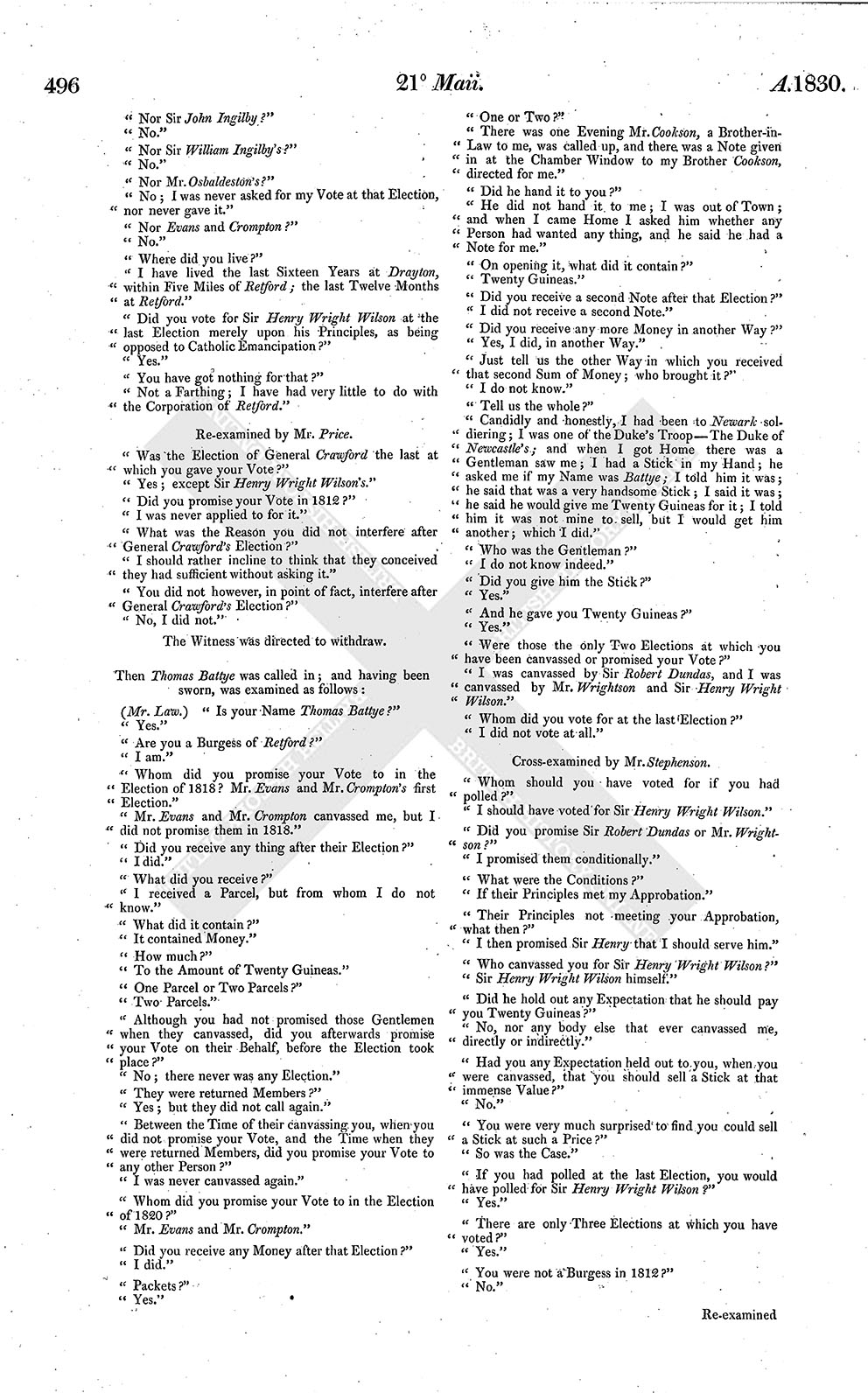
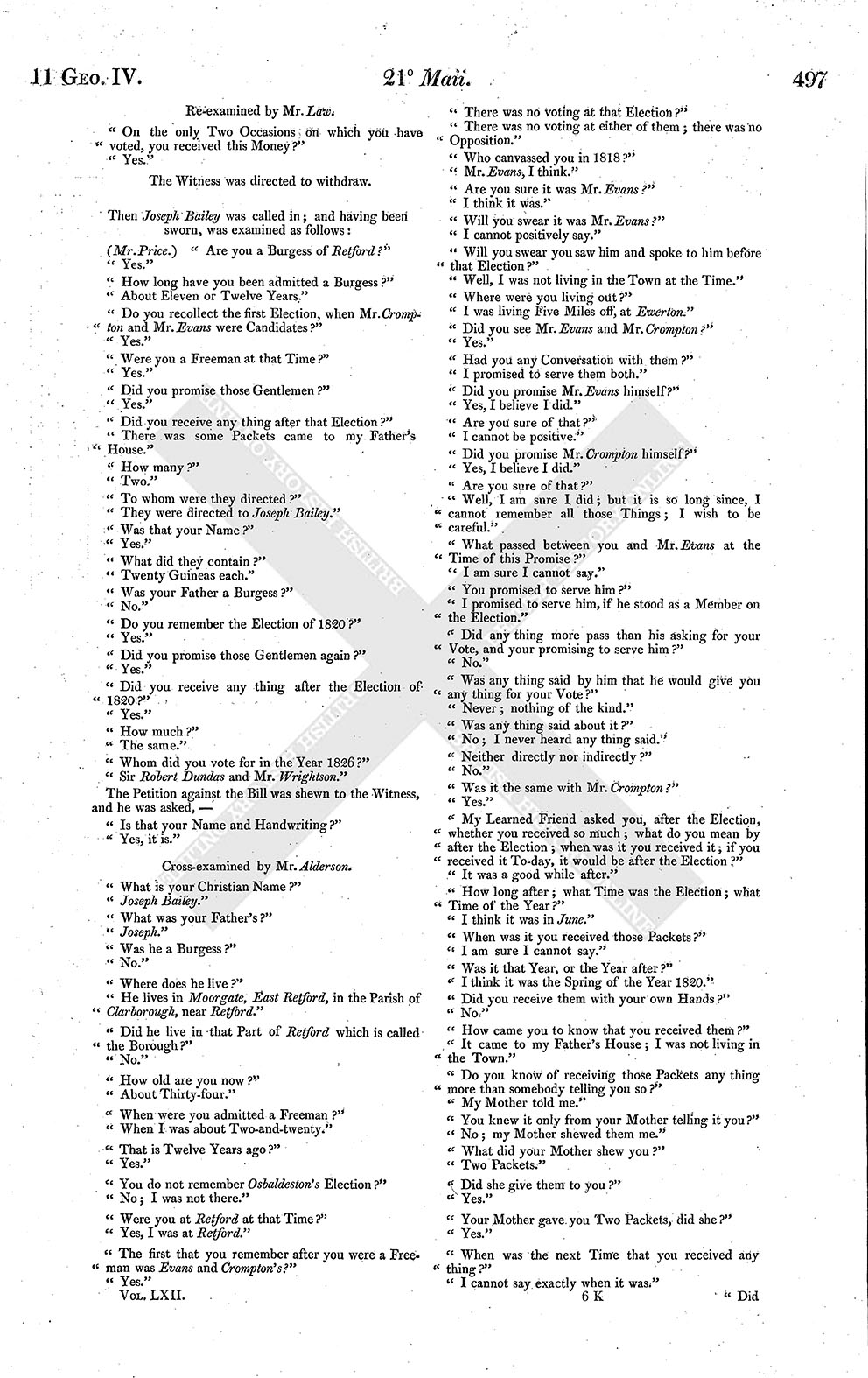
Then Henry Whittaker was called in; and having been sworn, was examined as follows:
(Mr. Price.) "You are a Clerk to Messieurs Howe and Heptinstall?"
"I am."
"Did you wait To-day upon Mr. Crompton, the late Member for Retford?"
"I did."
"Where did you call upon him?"
"At No. 20, Hertford Street."
"Did you see him?"
"I did."
"Did you deliver him any Letter?"
"I did."
"Had you examined the Letter before you delivered it to him?"
"I had."
"What Answer did Mr. Crompton make to that?"
"He said that it was not his Intention to attend and be examined."
"Have you a Copy of that Letter?"
"I have."
"Did you examined it with the Original?"
"I did."
"Will you produce it?"
The Witness produced the same, and it was read as follows:
"Sir, Lincoln's Inn, 21st May 1830.
"We have to request that you will attend at the Bar of The House of Lords, to give Evidence on the East Retford Bill, and also to produce all Letters, Accounts and Papers relative to your Elections for that Borough which are in your Possession or Power; in particular, we wish to have produced all Accounts and Papers furnished by Mr. Foljambe and Mr. Jonathan Fox. If it is your Intention to give Evidence in this Case, we request to be informed of the Time that will be convenient to you to be examined.
"We are, Sir,
"Your obedient Servants,
"Howe & Heptinstall."
"Samuel Crompton Esq."
"What Answer did you receive to that Letter?"
"Mr. Crompton stated that it was not his Intention to attend and be examined."
"Did you put any Question to him respecting the Papers mentioned in that Letter?"
"He stated to me, that he had some Papers given to him, but that they were in the Fire- that he had destroyed them."
The Witness was directed to withdraw.
Then The Reverend John Fell was called in; and having been sworn, was examined as follows:
(Mr. Law.) "Is your Name The Reverend John Fell?"
"Yes."
"Are you a Burgess of East Retford?"
"I am."
"When were you admitted?"
"In the Year 1818."
"Was it on the Day of the Election; did you vote in 1818?"
"I believe it was."
"Before that Election took place, had you been canvassed on behalf of the Candidates?"
"I had."
"To whom did you promise your Vote?"
"To Mr. Crompton and Mr. Evans."
"After that Election, did you receive any Money?"
"I did."
"How much?"
"I received Twenty Guineas, and Twenty Guineas were sent to my Father at the same Time."
"Was he also a Burgess of East Retford?"
"He was."
"Did you see the Money received by your Father?"
"No."
"How do you know it?"
"I received a Letter informing me."
(By a Lord.) "Have you got that Letter?"
"I have not it now."
"Where is it?"
"I destroyed it at the Time I received it."
(Mr. Law.) "What did the Letter you received contain?"
"Twenty Guineas."
"Did you see any Letter addressed to your Father at the same Time?"
"No."
"You do not know, of your own Knowledge, that your Father received the Money? Did you receive a Letter for your Father as well as one for yourself?"
"I did not receive any Letter that had been addressed to my Father."
(By a Lord.) "Did you see any Letter that had been addressed to your Father?"
"No."
(Mr. Law.) "Did you receive any Money on your Father's Account?"
"No."
"Only on your own?"
"Only on my own."
"Before the Election of 1820, to whom did you promise your Vote?"
"To Mr. Evans and Mr. Crompton."
"Did you receive any Money after that Election?"
"I did."
"How much?"
"Twenty Guineas, and Twenty more were sent to my Father in the same Way as before."
"Your Father was a Burgess?"
"Yes."
"Did you know from your Father that he received any Money?"
"No."
Cross-examined by Mr. Adam.
"How long have you been a Burgess?"
"Twelve Years."
"You do not remember any Elections previous to 1818?"
"No."
"Did you vote upon the last Election?"
"Yes."
"Whom did you vote for?"
"Mr. Wrightson."
"Any body else?"
"No."
"Did Mr. Wrightson canvass you?"
"He did."
"In person?"
"Not in person."
"Who canvassed you?"
"Colonel Kirke."
"When Colonel Kirke canvassed you, did you promise your Vote to Mr. Wrightson?"
"I did."
"Was any Promise made by Colonel Kirke to you upon that Occasion?"
"No."
"Have you received any Money since the Election of 1826?"
"No."
"Where were you residing at that Time?"
"At Huntingdon."
"Was any Offer made to pay your Expences from Huntingdon to Retford?"
"Yes."
"By whom?"
"By Mr. Wrightson."
"Did you accept that Offer, or reject it?"
"I rejected it."
"You paid your own Expences to Retford and back again?"
"I did."
Re-examined by Mr. Law.
"Had you any Conversation with Mr. Wrightson respecting a Payment of Money after the Election?"
"I had."
"Did you refer to what had occurred to you before on former Elections?"
"No."
"What was the Conversation you had with Mr. Wrightson the Candidate?"
"When he requested I would receive my Expences in going down to Retford and returning, I reminded him of the Conversation I had had previously with him, that in future I would never receive any thing either for Expences or as Election Money."
"What was said as to the Amount of your Expences by Mr. Wrightson?"
"Nothing."
"He offered to pay them, without specifying any Sum?"
"Yes, he did; he was returning from Retford on his Way to Cambridge, and just before he took his Leave of me he said there was one Thing he wished to mention, that he hoped I would allow him to settle with me for my Expences in going down; which I declined."
"You have said that you alluded to Election Money also?"
"I did in as delicate a Manner as I could."
"Was that for the Purpose of preventing Mr. Wrightson paying it?"
"I intended that it should; that he should understand from me that I would not in future receive any Election Money; that was my Intention."
"Having received it upon the Two former Elections?"
"Having received it upon Two former Elections."
The Witness was directed to withdraw.
Then Jonathan Fox was called in; and having been sworn, was examined as follows:
(Mr. Price.) "Is your Name Jonathan Fox?"
"It is."
"Are you a Clerk at Mr. Foljambe's Bank?"
"I am."
"How many Years have you been in that Situation?"
"Nearly Twenty Years."
"Is it Part of your Duty to make Entries in the Daily Ledger of the Credits and Debits of your different Clients?"
"It is."
"Is it Part of your Duty to enter into the Books every Sum received and every Sum paid?"
"Yes."
"Do you remember the Election of 1818, when Mr. Crompton and Mr. Evans were Candidates for the first Time?"
"I do."
"Did you take any Part in that Election?"
"I made several Payments during that Election."
"Were those Payments made to Freemen?"
"Yes; some of them were."
"In whose Favor did you act at that Election?"
"In favor of Mr. Crompton."
"Did Mr. Foljambe take any Part in that Election?"
"Yes."
"In whose Favor?"
"In Mr. Crompton's."
"After the Election of 1818 was over, did you receive any Remuneration from Mr. Crompton?"
"I received a Hundred Pounds."
"For what Services was that Remuneration made?"
"For the Payment of Bills and other Matters connected with the Election."
"What were those Matters?"
"It was principally the Payment of Bills, and Monies issued to Freemen."
"Did you canvass for Mr. Crompton?"
"I did not."
"Did you ever attend any Election Dinner?"
"I did."
"Did Mr. Crompton ever enter any Account with Mr. Foljambe's Bank?"
"Yes."
"When was that Entry first made?"
"I cannot exactly tell, without the Books; they are here in the House."
(Mr. Adam.) "Did you enter it yourself?"
"I did."
(Mr. Price.) "Have you that Book which you speak of in your Custody?"
"Yes, I have."
"Will you have the goodness to produce it?"
The Witness produced the same.
"Turn to Mr. Crompton's Account."
"The first Entry to the Credit of Mr. Crompton is, the 7th of February 1818, £200."
"Is that in your Handwriting?"
"No; that is in the Handwriting of the other Clerk."
Mr. Adam submitted, "That it could not be read, not being in the Handwriting of the Witness."
(The Witness.) "It is posted by him into the Ledger."
(By a Lord.) "That is not the original Entry?"
"It is not."
"Have you got the original Entry?"
"I believe it is at the Hotel."
"Every Entry in that Book is copied from another Book?"
"Yes, it is."
(Mr. Price.) "Was any Credit given to Mr. Crompton on the 13th of January 1819, to your own Knowledge?"
"Yes."
(Mr. Adam.) "Was any Entry in Writing made of that Credit, to your Knowledge?"
"Yes; it is in the Books here."
The Witness produced another Book.
(Mr. Price.) "Is that an original Entry made by yourself?"
"This is an Entry made by myself."
"Is it the original Entry?"
"It is not the original Entry; it is copied from our Waste Book into the Cash Book, and then into the Ledger."
"Did you receive any Money by your own Hand from Mr. Crompton?"
"It was paid into our Bankers in London, on Mr. Crompton's Account."
"After the Election of 1818, and in the Month of March 1819, did you see a Person of the Name of Westby Leadbeater at your Banking-house?"
"I did."
"Was he the Town Crier?"
"He was."
"Who sent for him?"
"I did."
"For what Purpose?"
"To distribute certain Parcels of Money to the Freemen."
"Did you make up any Packets upon that Occasion?"
"I did."
"Was a Person of the Name of Ramsay a Clerk in Mr. Foljambe's Bank at that Time?"
"He was."
"Was he present at the Time you made up those Packets?"
"He was."
"How many did you make up, to the best of your Recollection?"
"As far as I recollect, there were from Seventy to Eighty in the Town, and the rest was distributed to Burgesses nonresident; those were delivered out by a Person of the Name of William Cottam- those to the Nonresidents."
"Was there any Money in those Packets?"
"Yes."
"Who enclosed that Money?"
"I did."
"What was the Sum enclosed in the different Packets?"
"They were principally Parcels of Twenty Guineas each."
"Were there any above that Sum?"
"I think One."
"Refresh your Memory. Was there One or more than One?"
"I think there was One in the Town and One out of the Town."
"What was that Sum, larger than Twenty Guineas?"
"Forty Guineas."
"Who directed those Packets?"
"I directed them myself, as far as I recollect."
"Had you the Assistance of any List?"
"I had."
"Were they directed to Freemen?"
"The List furnished was to make those Payments to different Freemen."
"Did you direct those Letters to any but Freemen?"
"No, certainly not."
(By a Lord.) "What became of that Paper?"
"It was passed over by way of Voucher to Mr. Crompton, when the Account was balanced, in 1820."
"Did you deliver any of those Packets to Leadbeater?"
"Yes, I did, with the Assistance of the Clerk."
"At the Time you delivered them, did you give any Directions to Leadbeater?"
"To deliver them according to the Directions upon them."
"Did you write any thing at that Time upon a Sheet of Paper?"
"I probably might, but I do not distinctly recollect it."
"How many did you give to Leadbeater at a Time?"
"I cannot say that exactly."
"About how many?"
"I am sure I have no Recollection; there might be Ten or a Dozen; I cannot say exactly."
"Did you deliver them all to him at once?"
"No; I think they were delivered at different Times."
"Why did you not deliver them all at once?"
"Merely to see that he might be correct in the Delivery; merely with that View, I presume; I cannot state more distinctly."
"Did he return to you that Morning?"
"After he said he delivered them, he returned for the Remainder, and delivered them, 'till he had distributed the whole, as far as I recollect."
"By whose Direction was that Payment made?"
"The Money was paid into Coutts's by Mr. Hall."
(Mr. Adam.) "Do you know that from your own Knowledge?"
"Our Advice stated that Mr. Crompton has acknowledged the Account to be correct."
(Mr. Price.) "Did you deliver to Leadbeater the whole of those Packets you had made up?"
"I did, with the Assistance of the Clerk."
"Was his Name Ramsay?"
"It was."
"Do you know a Person of the Name of William Cottam?"
"Yes."
"Is he a Burgess?"
"He was a Burgess; he has long since been dead."
"Was he an Alderman of Retford?"
"No."
"Did you deliver any Packets to him?"
"There were several Packets delivered to him for the Out-Burgesses."
"Did they contain Money?"
"They did."
"To whom were they directed?"
"I cannot distinctly recollect now, from the Lapse of Time."
"Were they to Persons resident in Retford, or nonresident?"
"Nonresident."
"Were they Burgesses?"
"They were Burgesses."
"How many did you deliver to Cottam?"
"I cannot distinctly recollect."
"About how many?"
"I cannot distinctly recollect."
"Five or Ten?"
"Oh yes; a great many more."
"Twenty?"
"Yes; a great many more than that; I should think upwards of Fifty."
"Did you write the Directions on those?"
"I wrote the Directions upon those."
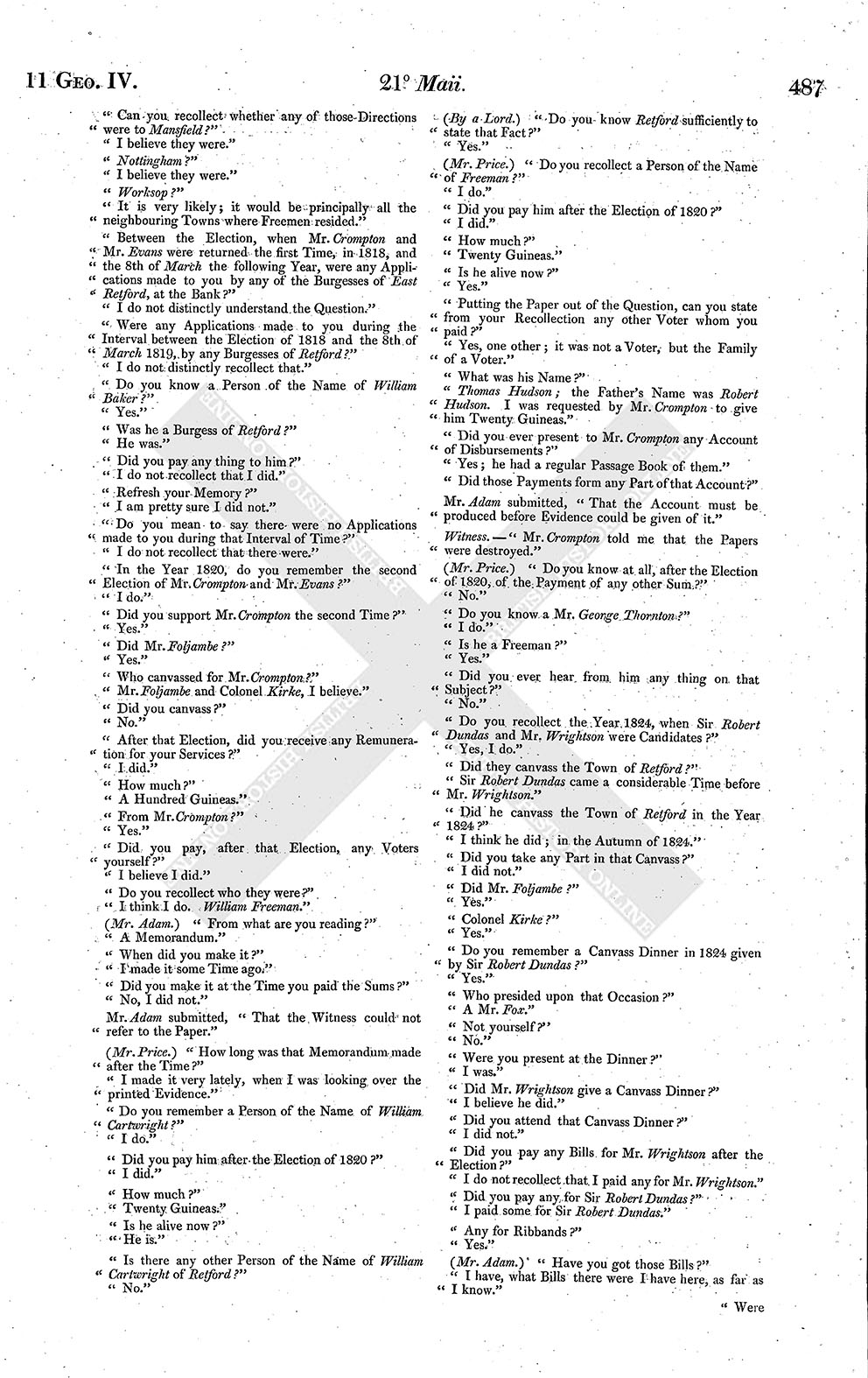
"Can you recollect whether any of those Directions were to Mansfield?"
"I believe they were."
"Nottingham?"
"I believe they were."
"Worksop?"
"It is very likely; it would be principally all the neighbouring Towns where Freemen resided."
"Between the Election, when Mr. Crompton and Mr. Evans were returned the first Time, in 1818, and the 8th of March the following Year, were any Applications made to you by any of the Burgesses of East Retford, at the Bank?"
"I do not distinctly understand the Question."
"Were any Applications made to you during the Interval between the Election of 1818 and the 8th of March 1819, by any Burgesses of Retford?"
"I do not distinctly recollect that."
"Do you know a Person of the Name of William Baker?"
"Yes."
"Was he a Burgess of Retford?"
"He was."
"Did you pay anything to him?"
"I do not recollect that I did."
"Refresh your Memory?"
"I am pretty sure I did not."
"Do you mean to say there were no Applications made to you during that Interval of Time?"
"I do not recollect that there were."
"In the Year 1820, do you remember the second Election of Mr. Crompton and Mr. Evans?"
"I do."
"Did you support Mr. Crompton the second Time?"
"Yes."
"Did Mr. Foljambe?"
"Yes."
"Who canvassed for Mr. Crompton?"
"Mr. Foljambe and Colonel Kirke, I believe."
"Did you canvass?"
"No."
"After that Election, did you receive any Remuneration for your Services?"
"I did."
"How much?"
"A Hundred Guineas."
"From Mr. Crompton?"
"Yes."
"Did you pay, after that Election, any Voters yourself?"
"I believe I did."
"Do you recollect who they were?"
"I think I do. William Freeman."
(Mr. Adam.) "From what are you reading?"
"A Memorandum."
"When did you make it?"
"I made it some Time ago."
"Did you make it at the Time you paid the Sums?"
"No, I did not."
Mr. Adam submitted, "That the Witness could not refer to the Paper."
(Mr. Price.) "How long was that Memorandum made after the Time?"
"I made it very lately, when I was looking over the printed Evidence."
"Do you remember a Person of the Name of William Cartwright?"
"I do."
"Did you pay him after the Election of 1820?"
"I did."
"How much?"
"Twenty Guineas."
"Is he alive now?"
"He is."
"Is there any other Person of the Name of William Cartwright of Retford?"
"No."
(By a Lord.) "Do you know Retford sufficiently to state that Fact?"
"Yes."
(Mr. Price.) "Do you recollect a Person of the Name of Freeman?"
"I do."
"Did you pay him after the Election of 1820?"
"I did."
"How much?"
"Twenty Guineas."
"Is he alive now?"
"Yes."
"Putting the Paper out of the Question, can you state from your Recollection any other Voter whom you paid?"
"Yes, one other; it was not a Voter, but the Family of a Voter."
"What was his Name?"
"Thomas Hudson; the Father's Name was Robert Hudson. I was requested by Mr. Crompton to give him Twenty Guineas."
"Did you ever present to Mr. Crompton any Account of Disbursements?"
"Yes; he had a regular Passage Book of them."
"Did those Payments form any Part of that Account?"
Mr. Adam submitted, "That the Account must be produced before Evidence could be given of it."
Witness,-"Mr. Crompton told me that the Papers were destroyed."
(Mr. Price.) "Do you know at all, after the Election of 1820, of the Payment of any other Sum?"
"No."
"Do you know a Mr. George Thornton?"
"I do."
"Is he a Freeman?"
"Yes."
"Did you ever hear from him any thing on that Subject?"
"No."
"Do you recollect the Year 1824, when Sir Robert Dundas and Mr. Wrightson were Candidates?"
"Yes, I do."
"Did they canvass the Town of Retford?"
"Sir Robert Dundas came a considerable Time before Mr. Wrightson."
"Did he canvass the Town of Retford in the Year 1824?"
"I think he did; in the Autumn of 1824."
"Did you take any Part in that Canvass?"
"I did not."
"Did Mr. Foljambe?"
"Yes."
"Colonel Kirke?"
"Yes."
"Do you remember a Canvass Dinner in 1824 given by Sir Robert Dundas?"
"Yes."
"Who presided upon that Occasion?"
"A Mr. Fox."
"Not yourself?"
"No."
"Were you present at the Dinner?"
"I was."
"Did Mr. Wrightson give a Canvass Dinner?"
"I believe he did."
"Did you attend that Canvass Dinner?"
"I did not."
"Did you pay any Bills for Mr. Wrightson after the Election?"
"I do not recollect that I paid any for Mr. Wrightson."
"Did you pay any for Sir Robert Dundas?"
"I paid some for Sir Robert Dundas."
"Any for Ribbands?"
"Yes."
(Mr. Adam.) "Have you got those Bills?"
"I have, what Bills there were I have here, as far as I know."
"Were the Charges for the Ribbands contained in the Bills you paid?"
"I think one of the Bills contained a Charge for Ribbands; but I made those Payments by the Request of Mr. Foljambe. I believe these are the Vouchers."
(Producing them.)
(Mr. Price.) "Turn to the Bill for Ribbands."
"£40 19s. 5½d."
"To whom was that paid?"
"It was paid to a Mr. Roberts."
"Is there a Receipt?"
"Yes."
"Was it paid by you?"
"It was paid by me."
(Mr. Adam.) "What is the Date?"
"The 11th November 1825."
(Mr. Price.) "What is the next?"
"They are only Memorandums, principally of small Sums paid."
"Are there any Bills you have paid?"
"Yes; here is a Bill to William Cottam of Eight Guineas and Sixpence, the 18th of November 1824."
"Did you pay that Bill?"
"I did, apparently."
"What is that for?"
"I believe I paid all these Bills. It is for Freemen being at his House; he was a Publican. I think it was on the Occasion of the Canvass Dinner; some Freemen came to his House."
"What was the Date of the Canvass Dinner; was it before that Bill, or after?"
"I should think it was at that Time; it appears in November 1824, but I cannot recollect that distinctly."
"Can you tell me what was the gross Sum you paid?"
"The whole Sum is £251 7s. 7d."
(Mr. Adam.) "Does that all appear by Bills?"
"Yes."
"Then have the goodness to produce the same?"
"Here is William Jackson, Five Guineas for Ale; Samuel Cocking, £5 19s. 6d. for Ale."
(Mr. Price.) "Did you pay all those Bills you hold in your Hand?"
"I believe I did; but I paid them by Direction of Mr. Foljambe."
The Witness delivered in several Accounts.
(Mr. Price.) "Have you now got the original Book to which Reference was made a short Time ago?"
"I have; it contains the original Entry of the Transaction."
"I wish to call your Attention to the 13th of January 1819."
(Mr. Adam.) "What Book are you referring to?"
"The Waste Book."
"Is that the Book in which the Entry is made for the first Time?"
"It is."
"Is it made by yourself; is it in your own Handwriting?"
"I will see."
"Was that Book kept by yourself?"
"It was not altogether kept by myself; it was kept also by the other Clerk."
(Mr. Price.) "Will you turn to that Entry of the 13th of January 1819, and say whether that is in your own Handwriting?"
"I perceive it was made by myself."
"What Book is that?"
"That is the Waste Book."
"Is that the original Book?"
"It is."
"Is there an Entry on the 23d of January?"
"It is the 23d; that is the Reason I did not find it."
"What is the Credit given to Mr. Crompton?"
"£2,800."
"From whom did you receive that Money or Credit? Read the Entry."
"Samuel Crompton Esq. Credit by Coutts and Company, £2,800."
"Turn to the Date of the 8th of March; is there any Entry respecting Mr. Crompton?"
"Yes."
"Is the Entry in your Handwriting?"
"It is."
"Read it?"
"Samuel Crompton Esq. £2,840 1s."
"Is that a Credit or a Debit?"
"A Debit."
"Between the 23d of January and the 8th of March, is there any Debit on Mr. Crompton's Account?"
"There are several."
"Are they made in your Handwriting?"
"In the Ledger they are."
"Was that Sum of £2,840 1s. issued in One Day?"
"No; I cannot strictly recollect any One Day; it might be probably a longer Period; I do not distinctly recollect that it was issued the same Day."
"When was it Westby Leadbeater saw you at the Banking House; was it about that Time?"
"It was about that Time, certainly."
"When was it?"
"It was about that Time."
"To the best of your Belief, was that issued to Leadbeater on the Day you have stated to us?"
"It was, to Leadbeater and Cottam; there might be some few distant Freemen that might be directed by Post, but that I cannot positively recollect at this distant Period. The whole of the Sum, or thereabouts, was issued to Leadbeater and Cottam, to be distributed to the Burgesses of the Town and Neighbourhood."
"When did Mr. Crompton close his Account?"
"Either in 1826 or 1827; but after that large Sum there was not any thing of great Moment."
Mr. Adam submitted, "That the Book must be produced."
(Mr. Price.) "Will you produce the Book?"
"The Account was closed on the 26th of April."
(Mr. Adam.) "Are you speaking from an Entry made by yourself?"
"Yes."
"An original Entry?"
"I am speaking when the Account was balanced."
"Is what you are reading an original Entry made by yourself?"
"Yes; the Entry is made by myself."
"Is it an original Entry?"
"No, it is not."
(Mr. Price.) "Have you any Vouchers of your Payments?"
"I have not."
"Had you ever any Vouchers?"
"I delivered up all the Vouchers to Mr. Crompton, in 1820."
(By a Lord.) "From what is that copied, if it is not an original Entry?"
"I will produce the original Entry; it is £3 17s. 9d. at the Close of the Account." (Producing another Book.)
(Mr. Price.) "What is the Date?"
"The 25th April 1827."
"Is that an Entry made by yourself?"
"Yes."
"When did you deliver up the Vouchers?"
"The Vouchers were delivered up in 1820, as appears by the Ledger Account. I dare say the Vouchers were delivered up at the Time."
(Mr. Adam.) "Is there any Entry of the Vouchers having been delivered up at that Time?"
"Yes; that appears by the Account."
"Did you make that Entry yourself?"
"Yes, on the 10th of August 1820."
(Mr. Price.) "When did you deliver up the Vouchers?"
"I sent them by Mr. Foljambe, who was going over there at the Time."
"At what Time?"
"On the 10th of August."
"Can you speak of that from your own Knowledge?"
"I can. The Account states, "By Balance, as per Account sent this Day, £15 5s. 7d."
"Turn to your Book under the Date of the 14th of April 1826."
The Witness referred to the same.
(Mr. Adam.) "What Book is that?"
"It is the Waste Book; the original Book."
"Is that the Waste Book of the Banking House; the Public Book?"
"Yes."
(Mr. Price.) "Is there any Entry on that Day?"
"I have found that Day."
"Is the Entry of that Date in your own Handwriting; an Entry of £700?"
"No; it is in the Handwriting of one of the other Clerks."
"By whom was that made?"
"It is a Sum of Money to the Credit of Mr. Foljambe; it is entered by one of the other Clerks."
"By whom is that entered?"
"It is entered by one of the Clerks in our House."
Mr. Adam objected to the Entry.
Mr. Law submitted, "That it might be received as Evidence that the House gave a certain Credit, proposing to shew, by other Evidence, the Application of it to Election Purposes."
The Counsel were informed, "That it did not appear to be Evidence until its Reference to Election Purposes was shewn."
(Mr. Price.) "Do you know where Mr. Foljambe is at present?"
"I do not."
"When did you see him last?"
"On the 5th of February."
"Where was he then?"
"He left Home on the 5th of February."
"Can you, from your own Knowledge, state where he is at present?"
"No."
"Do you know his Handwriting?"
"Yes."
"Have you received any Letter from him?"
"I have received a Letter from him since."
(Mr. Adam.) "Have you got it?"
"I have."
(By a Lord.) "When did you receive it?"
"I received it a Day or two after he left Home."
"By the Course of the Post?"
"Yes."
"Have you seen him since that Time?"
"I have not."
Cross-examined by Mr. Adam.
"You stated that Westby Leadbeater came to you upon one Occasion, and received certain Packets?"
"He did."
"When was that?"
"I do not recollect the precise Day."
"Shut up that Book; and state the Fact, if you can, from your own Knowledge."
"It is about the Time stated in the Entry I made in the Ledger of the £2,840."
"When was it that Westby Leadbeater came to you, to the best of your Recollection, and received Money in Packets?"
"I was only referring to the Ledger to fix the Date; I think it is the 8th of March 1819."
"Why do you say it is the 8th of March 1819?"
"Because the Sum is credited on that Day."
"Have you any Reason for giving that Date, except the Entry made by yourself?"
"No."
"Have you any the least Means of knowing when it was that he came to you?"
"It was either on that Day, or about that Time."
"Can you state it from your Knowledge, independently of the Entry in the Ledger?"
"I cannot."
"Can you state, from your Recollection, whether it was in 1818, 1819 or 1820?"
"Oh, it was in 1819, and about that Date."
"Can you state that from your Recollection?"
"Yes."
"Are you, without that Book, in a Condition to state that it was in 1819?"
"I am."
"Can you state the Month?"
"March."
"Are you quite clear it was in March?"
"As far as my Memory serves me."
"Does your Memory serve you to say that you are quite clear?"
"As far as I can recollect."
"Are you clear about it, or do you doubt?"
"I have no doubt, as far my Mind goes, in this; we generally, when we supply Money, place it down to the Account on the Day it is issued."
"That is returning again to the Book to assist your Memory; but, laying aside the Book, can you recollect the Time?"
"It was, I say, at that Time, as far as my Memory goes."
"What Time was it Cottam came?"
"It was the same Time."
"What Sum did you pay to Leadbeater?"
"The Money was issued generally to the Freemen of the Town."
"What Sum did you issue to Leadbeater?"
"I should say, as far as my Recollection goes, it was for Seventy to Eighty Voters."
"What Sum did you say; I am not asking the Number of Voters?"
"I do not recollect the Sum."
"What Sum did you issue to Cottam?"
"I cannot recollect the Sum; the whole Sum was divided between them."
"Have you any Recollection what Sum you paid to Leadbeater, what to Cottam, or what to both?"
"I have not."
"Why do you say that the whole of this was distributed to Cottam and Leadbeater?"
"Because they were the Persons employed to distribute the Sum."
"What Sum?"
"£2,840."
"Have you never stated, on any Occasion, that you could not say whether it was distributed?"
"I have; but I am sorry to say that I was at the Time not in a State to give my Evidence; I was labouring under a Bilious Attack; I waited Seven Hours; I requested my Evidence might not be taken that Evening, and that was not granted to me."
"What Occasion are you referring to now, when you were labouring under a Bilious Attack; you have been examined twice?"
"It was on my last Examination."
"Did you not, on the Examination before the Committee of the House of Commons in 1827, state that you had no Recollection of having paid any Money to any Freemen?"
"I do not recollect that."
"Are you sure you did not state that?"
"When I alluded to that, I alluded to the last Election of all."
"Did you never state, in answer to a Question put to you, "What! have you never heard of any Sums being gained by Voters for giving their Votes?-No, I have no Knowledge of that Fact?"
"I was alluding then to the last Election of all."
"Did you ever say so?"
"I think I did; but I alluded only to the last Election of all."
"You were alluding then only to the last Election of all?"
"Yes; that in the Year 1826."
"You have no Knowledge of that Fact, with reference to the Election of 1826?"
"I have not."
"When you were examined before the House of Commons, and gave the Answer you have stated, did that refer to the Election of 1826 alone, or to the Elections of 1818 and 1820?"
"To the Election of 1826, for I stated so, certainly."
"Do you mean to state, that in the House of Commons you stated that you had Knowledge or no Knowledge of Money paid in 1826?"
"I had no Knowledge of Monies paid in 1826."
"You stated that you had no Knowledge of Money paid in 1818 or 1820, did you not?"
"I think not."
"Not in your Examination before the House of Commons?"
"No."
(By a Lord.) "Were you upon your Oath then?"
"No."
"(Mr. Adam.) "Do you remember being asked this Question before the House of Commons: "Did you never on any Occasion, either at the Election of 1818 or 1820, fold up Election Money for the Purpose of paying it to Freemen, and direct it with your own Hand?" To that Question did you not say, "I cannot recollect it?"
"No; if I did, I can only say that I was in that bad State of Health that I scarcely knew at the Time what
I did say."
"Did you make use of the Expression?"
"I probably might; but I was in such a bad State of Health I scarcely knew what I said, and I applied twice to have my Examination postponed, and it was not granted to me; that Fact was known to Mr. Owen and others."
"Were not you asked, "Did you not so direct a Packet containing Money to The Reverend Mr. Fell of Huntingdon?" and did you not say, "I cannot recollect it?"
"I did."
"Were you not asked, "Did you not send, or were you not privy to sending, one William Cottam to Mansfield and to other Towns to pay Out-voters?" and did you not say, "That I cannot recollect any thing about indeed?"
"I answer that by saying, that I was in that infirm State of Health that I scarcely knew what I said."
"How many Days did your Examination last?"
"Only One Evening."
"Did you ever apply for Leave to explain any Errors you had fallen into through Mistake or ill Health?"
"I never did."
"When did you first ascertain that you had made those Mis-statements through ill Health?"
"I was committed, I am sorry to say, to Newgate, in consequence of my Hesitation in giving Evidence."
"Did you not, after you had Time to reflect, apply to the House of Commons for Leave to explain, and shew this was the Effect of Illness?"
"I never though of that."
"How came you, if what you stated was not true, but it was an Error you had fallen into through Imbecility, arising from ill Health, not to correct it?"
"It was entirely through Imbecility, arising from ill Health."
"How came you not to explain it to the House of Commons?"
"I never had an Opportunity."
"Could you not have explained it by Petition?"
"I did explain it by Petition."
"When?"
"When I applied for my Release."
"How long was that after your Commitment?"
"A Day or two afterwards. I will explain how the Circumstance arose. I applied to Mr. Gregson, Mr. Tennyson's Solicitor, to postpone my Examination. He found me ill in Bed at Will's Coffee House. I said, "I feel myself so extremely ill, in consequence of a Bilious Attack this Morning, that I shall be very glad if you will get my Examination postponed to another Day." He said, "I will go down to the House, and try to get it postponed. If you do not hear from me by a certain Time, you must come down." I came down and waited Seven Hours, and saw him again in the Evening, and again solicited that it might be postponed; and he said it could not be granted. I waited Seven Hours, and when I appeared in the House of Commons I scarcely knew what I said, I was so overdone."
"Then am I to understand that your Examination in the House of Commons does not, from that Circumstance, exhibit a true Statement of Facts?"
"I am sorry to say it does not."
"Am I justified then in not putting Reliance on your Statement in that House as giving a true Representation of Facts?"
"It certainly was not so correctly given as I could wish."
"Was it materially erroneous?"
"It was; doubting Things that I should not have doubted under other Circumstances."
"Was that essentially erroneous?"
"I do not know that it was essentially erroneous. I admit that the Impression on my Mind was, that was given to Westby Leadbeater; but from the Infirmity of my Mind, I could not help doubting instead of stating it positively."
"Did you state that, before the Election Committee, any thing you said about Money had relation to the Election of 1826?"
"I presumed so when I was giving my Answer."
"Did you state, upon your Examination before the Election Committee, that you recollected the Election of Mr. Crompton; that he was twice a Candidate for that Place, and that, upon the second Occasion, a Person of the Name of Baker voted for him?"
"Yes, I recollect that."
"Will you explain this? Do you remember being asked this Question, "Did many of the Voters come to your Bank after that Election?" to which you said, "No, I have no Recollection of it;" and then you were asked, "Have you any Recollection that any of the Voters came to your Bank after the Election?" to which you said, "No; you mean the last Election?"
"A Question then is put, "No; the second Election of Mr. Crompton;" to which you say, "I do not recollect one." The Question then is, "Perhaps you would undertake to say, no one came." Your Answer is, "I have no Recollection that they did." "Can you undertake to say positively that they did not?" to which your Answer is, "They might come to the Bank, because Freemen, as well as others, are in the habit of coming to the Bank constantly, therefore I cannot speak to the Fact of their not coming." "Do you happen to know whether any came to the Bank to apply for Money?" "That I 'can take upon me to say, they did not, not to my Knowledge." How do you reconcile that with the Fact of Leadbeater and Cottam coming?"
"That was on Mr. Crompton's first Election in 1818."
"Your Explanation is, that this refers to the Election of 1820?"
"Yes."
"You have told my Learned Friend, that before the Election of 1826 a Mr. Fox presided at the Election Dinner?"
"Yes."
"Who was Mr. Fox?"
"A Relative of Mr. Crompton's."
"Is he a Gentleman of Fortune in the Country?"
"I believe he is; but I am not perfectly correct in stating that I understood he was known to The Duke of Newcastle; he lives in the Neighbourhood of Derby."
"Had you ever seen him before?"
"Never."
"You stated, that this took place at the Canvass Dinner; that Mr. Fox presided at that Dinner given by Mr. Wrightson in the Year 1824?"
"That is a Mistake then; this was on the first Occasion that Mr. Crompton came to offer himself for Retford."
"You were asked whether Sir Robert Dundas and Mr. Wrightson canvassed; you say, yes; that they came and canvassed; and Foljambe and Kirke canvassed. Do you remember the Dinner? you have stated that Mr. Wrightson gave a Dinner, and that Mr. Fox presided at that Dinner, and you were present."
"That is a Mistake of the Question; I have not understood it correctly; it was on the first Occasion of Mr. Crompton's offering for Retford that Mr. Fox came and presided at that Dinner; I have never seen Mr. Fox since."
"Was there any Dinner given by Mr. Wrightson, to your Knowledge, in the Year 1824?"
"No; I think Mr. Wrightson came after 1824 as a Candidate; it was Sir Robert Dundas."
"As to Mr. Wrightson, there was no Dinner?"
"There was a Dinner for Mr. Wrightson, certainly; there was a Canvass Dinner by Mr. Wrightson."
"When was that?"
"I think towards the latter End of 1825."
"That was an Occasion to which you have not yet spoken?"
"I misunderstood the Question; I understood the Question, whether there was one for Mr. Wrightson, and another for Sir Robert Dundas."
"There was an Election Dinner by Mr. Wrightson late in 1825?"
"Yes."
"There was an Election Dinner by Sir Robert Dundas in 1824, and an Election Dinner by Mr. Crompton in 1818 or 1820?"
"Yes; in 1818; at that in 1818 Mr. Fox presided; on the last Occasion Mr. Crompton presided."
"That was the only Dinner, was it?"
"Yes."
"Did you attend the Dinner of Sir Robert Dundas?"
"It is very probable I might."
"Did you?"
"I think I did."
"Do you recollect any Circumstance which took place there?"
"No."
"That was a Dinner to the Freemen a Year and more before the Election took place?"
"Yes."
"You stated that you received from Mr. Crompton a Hundred Guineas for your Services?"
"Yes."
"You stated that your Services were the Payment of Bills and the Payment of Money for Freemen?"
"Yes."
"Was there any Money paid to Freemen during the Election?"
"In 1820 I know nothing more than those Three Sums I have stated."
"Which Three Sums?"
"To Freeman, Cartwright and Hudson."
"Those were for Bills, were they not?"
"No; they were issued to Freemen,"
"How much?"
"Twenty Guineas each."
"Did you pay that?"
"I paid it myself."
"At what Period of the Election?"
"I cannot recollect; it was a considerable Time after the Election."
"Was it before the Time you received the £100?"
"I cannot recollect that."
"Did you ever state before that the £100 was given by Mr. Crompton in respect to your having paid any Freemen whatever at the Election?"
"Probably I might, but I have no Recollection that I did."
"If it were so, have you recollected it since your last Examination?"
"I have no Recollection that I said any thing of the kind."
"You have said now, as I understand you, that the £100 was paid to you in respect of the Payment of Freemen?"
"I was paid for paying the regular Expences of his Election; Tavern Bills and those Bills; I paid no more than those Three Men."
"Am I correct in understanding that the £100 was paid to you for your Services in paying Bills for the regular Expences of this Election?"
"Yes."
"And for nothing else?"
"There were those Three Sums."
"Had you paid those Three Sums before you received the £100?"
"I do not recollect that I had."
"Have you ever said that you did?"
"No."
"Why do you say that this £100 was paid you for paying those Three Men?"
"I do not say it now."
"Was that £100 paid to you for any thing more than the Payment of regular Expences?"
"Not as I can say."
"What was the first £100 paid you for?"
"For paying the regular Expences of the Election."
"Do you mean the regular Payment to the Returning Officer, and the Hustings, and so on?"
"Tavern Bills, and so on."
"Did you ever pay a Man of the Name of Baker any Money?"
"No, I have no Recollection that I did."
"As it is so long ago since 1818, how can you recollect that you gave so many as Seventy or Eighty Packets to Leadbeater?"
"I consider the Distribution a general one."
"As it is so long ago, can you recollect that you gave so many as Seventy or Eighty Packets to Leadbeater?"
"I can only recollect by charging my Memory; I have no Documents, for they were all given up."
"When did it occur to you for the first Time that you had given as many as Seventy or Eighty Packets to Leadbeater?"
"It has occurred to me a long Time ago, no doubt."
"Since you were examined before the House of Commons, I presume. Was it not since that Examination that it occurred to your Memory that you had delivered those Packets to Leadbeater?"
"I have stated, that I had an Impression at that Time that those Packets were delivered to Leadbeater; it was only my indirect Manner of expressing it."
"Did you state then that you had delivered those Packets to Leadbeater?"
"I did not give my Evidence so perfectly as I should if I had been in a different State of Mind."
"Did you ever state on that Occasion, or any other, 'till now, that you had ever delivered Packets to Leadbeater?"
"I cannot say that I did; I do not recollect it."
"Do not you recollect that you did not?"
"No; I do not recollect that I mentioned any thing about it."
"Is not your Memory quite perfect that this is the first Time you ever mentioned Packets?"
"I mentioned Packets in my former Evidence before the House of Commons."
"What did you say?"
"I said that they were made up in Packets, as far as I recollect."
"Did you say that you had delivered Packets to Leadbeater?"
"Yes; I had an Impression to that Effect."
"You said so?"
"Yes."
"Did you say how many?"
"No, I do not recollect that I did."
"Did you ever mention Cottam's Name, as having had Packets delivered to him?"
"No, I did not."
"How did that happen, when you were asked whether you delivered Money to any one?"
"I stated that it was in consequence of Infirmity that I did not at the Time."
"When did it first occur to you that you had delivered Money to Cottam?"
"After my Examination was over."
"Do you remember now the Number you delivered to Cottam?"
"No, I do not."
"Will you swear that you delivered to Cottam as many as Fifty Packets?"
"I cannot charge my Memory distinctly to that."
"You have said that you delivered upwards of Fifty to Cottam; is that true?"
"I think, it was so."
"You have said they were for the Purpose of paying Out-voters?"
"As far as I recollect, it was."
"Not for any other Purpose?"
"It could not be for any other Purpose, I apprehend."
"Do you mean to say that you delivered upwards of Fifty Packets to Cottam for that Purpose?"
"Yes, for that Purpose, as far as I can say."
"How many Days did Leadbeater's Distribution take?"
"They were all distributed in One Day, as far as I recollect."
"You are not a Freeman yourself?"
"No."
"Had you any thing to do with any Election, except those of 1818 and 1820?"
"No. I assisted Mr. Foljambe in paying those Bills for 1826-those of Sir Robert Dundas."
"Which Bills?"
"Those I have given in To-night."
"The Ribband Bills, and so on?"
"Yes."
"Did you ever assist in any Election, except in the Payment of those Bills, except those of 1818 and those of 1820?"
"No."
"Did you ever canvass for any one?"
"I never did."
"You are quite sure of that?"
"I am quite sure of that."
"Did you ever assist any body in the Canvass?"
"No; I never had any thing to do with canvassing."
"You never went round the Town with any one, particularly Sir Robert Dundas?"
"No, never."
Examined by the Lords.
"You admit that the Evidence you gave before the House of Commons was not strictly correct?"
"It was not."
"And you account for that by the State of Health in which you were at the Time?"
"I do; and I sincerely regret that it happened so."
"You petitioned the House of Commons in consequence of your Commitment?"
"I did."
"Did you, when you petitioned the House of Commons, admit you had not given a correct Evidence?"
"I did."
The Witness was directed to withdraw.
Then Anthony Hartshorne was called in; and having been sworn, was examined as follows:
(Mr. Law.) "Is your Name Anthony Hartshorne?"
"Yes."
"Are you a Burgess of Retford?"
"Yes."
"How many Elections have you voted at?"
"Not One."
"At how many Elections have you promised your Vote?"
"Two."
"When were they?"
"I cannot tell you the Time."
"Was it the Elections of Mr. Evans and Mr. Crompton?"
"Yes."
"The first or the second of those Elections?"
"It was the second that I promised."
"Did you receive any Money after that Election?"
"No."
"Did you receive any Packet after that Election?"
"No."
"Did you receive any after the Election in 1818?"
"No."
"Have you ever received any Money after any Election?"
"That Question I cannot recollect; I am an old Burgess; but I believe Mr. Wharton Amcott's was the first Election I ever voted, or Sir John Ingilby's."
"Did you receive any Money after Mr. Wharton Amcott's Election?"
"I had some Trifle sent me."
"What was that Trifle; how much?"
"Not more than £5; I cannot tell exactly, it is so many Years ago."
"Did you receive any Money after Sir John Ingilby's Election?"
"No; I had no Vote then."
"How soon were you restored to your Right of voting after Mr. Wharton Amcott's Election?"
"I cannot answer you that Question; I cannot recollect, I am sure."
"When were you next entitled to vote; you were not entitled to vote at Sir John Ingilby's Election, that was in 1790; how soon after that did you become entitled to vote?"
"I think not before this last Time."
"Not before 1826?"
"No, I think not."
"The only Election at which you were entitled, to vote before 1826 you received £5?"
"No; it was before that; long ago; many Years ago; I cannot say how many Years ago."
"Did you not just state, that after Mr. Wharton Amcott's Election you received about £5?"
"Yes."
"Did you not also state that you were not entitled to vote again 'till the Year 1826?"
"I cannot immediately answer that; I did not vote before the Year 1826; that was the last Election."
"You promised your Vote?"
"Yes; I promised my Vote to Mr. Evans and Mr. Crompton; to Mr. Evans only, I mean."
"Did you not receive any Money after having promised Mr. Evans?."
"Not myself, I did not."
"Not yourself?"
"I do not know I am sure."
"Did no other Person receive any Money on your Account after that Election, to your Knowledge?"
"I cannot tell, I am sure."
"Do you not know it; did you give that Gentleman a Plumper?"
"Yes, I gave Mr. Evans a Plumper."
"Did you receive from any Person Forty Guineas after the Election?"
"No."
"Any other Sum?"
"No; I do not know that there was any thing paid for it; I did not vote at all for that Election."
"There was no Opposition; nobody voted?"
"No."
"Did not you receive some Money after that Election, having promised your Vote?"
"No, I did not."
"Nor any one for you, to your Knowledge?"
"No, not to my Knowledge; I can swear to that."
"Do you mean to say that no Packet containing Money was received by any one for you?"
"No."
Cross-examined by Mr. Alderson.
"How long ago was Sir Wharton Amcott's Election?"
"I am sure I cannot tell that."
"Is it Thirty or Forty Years ago?"
"I suppose it is Thirty or Forty Years ago; I know by my own Age; I am now Sixty-seven."
"What Age were you then?"
"I suppose about Two or Three and twenty."
The Witness was directed to withdraw.
Then William Leach was called in; and having been sworn, was examined as follows:
(Mr. Price.) "Are you a Burgess of Retford?"
"Yes."
"How many Years have you been a Burgess?"
"Eighteen, I believe."
"Were you a Freeman at the Time of the Election of Mr. Osbaldeston and Mr. Marsh?"
"Yes."
"Did you promise either of those Gentlemen?"
"Yes, I think I did."
"Which?"
"Mr. Marsh."
"Do you recollect the first Election of Mr. Crompton and Mr. Evans in 1818?"
"Yes."
"Did you promise either of those Gentlemen?"
"I think I did."
"Which of them?"
"I think I promised both; I am not certain."
"After that Election, did you receive any Money or Packet?"
"No, I think not."
"After the Election of 1818, did you receive any Money?"
"I think not."
"Will you swear you did not?"
"Yes, I think I can."
"Can you swear that you did not receive any Money?"
"Not from those Gentlemen."
"Did you receive any Money in any Packet after that Election?"
"Not to my Knowledge."
"Where did you reside at that Time?"
"At the Election, do you mean? In North Place, Gray's Inn Road; Upper North Place."
"Do you remember the second Election of Mr. Crompton and Mr. Evans, in 1820?"
"Yes, I do."
"Did you promise those Gentlemen before that Election?"
"No; I saw one of them, but not the other."
"Which of them did you see?"
"Mr. Evans I saw."
"Did you promise him your Vote?"
"I think I did not; but he understood it. He said I had promised his Servant. I had a Note from him."
"Had you promised any one for Mr. Evans?"
"No, I think not."
"Did you, after that Election, receive any Money or any Packet?"
"I think I did, after that Election."
"What did you receive?"
"I had a Packet with Twenty Pounds or Twenty Guineas in it."
"Who gave it you?"
"That I do not know."
"Who brought it for you?"
"I do not know."
"Was it delivered to you?"
"I am not certain of that."
"Whom did you vote for at the last Election?"
"Sir Robert Dundas and Mr. Wrightson."
"Was that the only Packet you received; that one with Twenty Guineas?"
"I will not be certain, but I think it was."
"Did you receive One or Two Packets after that Election?"
"Only One."
"Do you mean to swear that?"
"Yes."
"Cross-examined by Mr. Alderson.
"Have you looked at the Petition to see whether you signed it?"
"No."
"You have been Eighteen Years a Burgess?"
"Yes; Eighteen Years next October, I think."
"You voted in 1812?"
"Yes, it was in 1812."
"You received nothing then, I take for granted?"
"No."
"And nothing in 1818, and you think only One Packet in 1820?"
"Yes."
"From whom?"
"I do not know."
"When was it you received the Packet?"
"I cannot say."
"What sort of Packet was it; did you see it?"
"I saw it, no doubt."
"Do you remember seeing it?"
"Yes; but I cannot recollect whether I took it, or not."
"Was it in the Shape of a Letter?"
"Yes, it was."
"What did it contain?"
"Twenty or Twenty-one Pounds."
"Did you go down from London to Retford?"
"I did."
"When was it you received this Letter?"
"I cannot say."
"As nearly as you can, tell us?"
"Upon my Word I cannot say."
"Was it a Year after the Election?"
"I cannot say whether it was Six Months or Twelve Months."
"Was it not a long while after the Election?"
"That I cannot say if I was to die this Moment."
"You can probably tell us it was some Months after the Election?"
"Yes, it was certainly some Months after the Election."
"You do not know the Handwriting outside the Letter; was it directed?"
"That I do not know."
"You got nothing at the last Election in 1826, I take for granted?"
"No."
Re-examined by Mr. Price.
"Who paid you your travelling Expences when you went down?"
"I do not know any thing about that."
"Did you pay them?"
"I did."
"Have you been repaid them?"
"I think I had somewhere about £3 10s. for them."
"Who gave it you?"
"I cannot tell that."
"Where were you paid?"
"I think it was down at Retford."
The Witness was directed to withdraw.
Then Daniel Bolton was called in; and having been sworn, was examined as follows:
(Mr. Law.) "Is your Name Daniel Bolton?"
"Yes."
"Are you a Freeman of East Retford?"
"Yes."
"When did you become so; in what Year?"
"I cannot say exactly what Year."
"How long before 1812, if at all?"
"About Three Years."
"Did you promise your Vote on Mr. Evans and Mr. Crompton's first Election in 1818?"
"Yes, I did."
"To whom did you promise it?"
"I believe to themselves; but I cannot positively say."
"Did you receive any Money after that Election?"
"I believe I received some Money; but from whom it came I do not know."
"Did you receive some Money after that Election?"
"I did receive some Money, certainly."
"Was it in a Packet, or how?"
"It was in a Packet."
"Were there One or Two Packets?"
"I cannot say."
"What did the Packets contain?"
"I really do not know; my Wife received them; I did not."
"Was the Money produced to you?"
"No, it was not."
"Not at all?"
"Not the whole of it; some of it was."
"How much was produced to you?"
"I think I received Five Pounds or Ten Pounds; I cannot tell which."
"Did you promise your Vote at the Election of 1820?"
"Yes, I did."
"What did you receive after that Election?"
"I cannot positively say. There were Packets came; but I cannot say."
"What did they contain, to the best of your Belief?"
"Money, I believe."
"How much?"
"I really do not exactly know the Amount."
"You received Packets, but do not know the exact Amount?"
"No, not exactly."
"Whom did you vote for at the last Election?"
"Sir Robert Dundas and William Battie Wrightson Esquire."
Cross-examined by Mr. Adam.
"The Money you received in 1818, whatever it was, was through your Wife?"
"My Wife received it."
"Do you know any thing more than that your Wife gave you Five or Ten Pounds?"
"No, I do not, indeed."
"Do you remember when it was that your Wife gave you Five or Ten Pounds?"
"No, I do not, indeed; I cannot exactly say; I never heard any Account of it."
"What are you?"
"I am a Boot-maker."
"Do you keep a Shop?"
"Yes, I do."
"Have you Apprentices?"
"No, I have not any at present"
"Had you, in 1819, any Apprentices?"
"No, I had not, I believe, then."
"Had you any Journeymen that were working for you?"
"I have got Journeymen now; I had not then."
"Have you more Business now than you had then?"
"Yes; I had not been long in Business then."
"But you kept a Shop?"
"Yes."
"Did you sell ready-made Articles?"
"Yes."
"Was your Wife in the habit of selling sometimes in the Shop?"
"No, she was not."
"Who sold the Goods in the Shop?"
"Generally myself."
"What was your Wife's Business?"
"She was a Midwife."
"Used she to receive Money in her Vocation, as well as you in yours?"
"Yes."
"The Ladies of Retford were very prolific?"
"I lived in London."
"Had your Wife much to do in London?"
"Yes."
"Did she make much Money for visiting her Patients?"
"I do not know exactly what she received."
"She received Money?"
"Yes; but she never told me what she received."
"She did not go for nothing, any more than you made Boots for nothing?"
"No, certainly not."
"Did not you know that she was in the habit of receiving Money for her Services?"
"Yes."
"Was your Wife the Pay mistress, or you the Paymaster?"
"Sometimes she, and sometimes I."
"Had not she Money on her own Account, that she had got in her own Business from Time to Time?"
"Yes, she had."
"In 1820, did you receive the Packets yourself?"
"I believe she received them."
"Are you quite sure you did not?"
"Yes, I am."
"How came you to know there were Packets in 1820?"
"She told me so."
"Is that the only Way in which you know it?"
"Yes; I saw the Packets; the Packets were lying open when I saw them."
"Where were they when you saw them in 1820?"
"To the best of my Knowledge they were in the front Room where I lived."
"Did you see them with any thing in them, or merely the Paper forming the Packet?"
"Only the Paper that formed the Packet; there was no Money in the Packet when I saw it."
"Do you know that those Packets ever contained Money, except as your Wife told you?"
"No, I do not; except as she told me, I do not."
"At what Time of Day was it you saw them; Morning or Evening?"
"I positively cannot say that."
"Did you vote in 1826?"
"Yes, I did."
"Whom for?"
"For Sir Robert Dundas and William Battie Wrightson Esquire."
"Did you promise them themselves?"
"Yes, I did."
"Did they make you any Promise?"
"Never."
"Have you received any thing since 1826?"
"What I received has been in my own Trade Affairs; I have received nothing no further."
"Did you ever receive what the Learned Gentlemen call Election Money since 1826?"
"No, I did not."
"Did it ever happen to you to receive any Money from your Wife since 1826?"
"Yes."
"Is she still a Midwife?"
"My Wife is dead; she has been dead about a Twelvemonth."
Re-examined by Mr. Law.
"At the Time the Packet was open before you, did your Wife state what it had contained?"
"No, she did not."
"Did she produce any Money to you?"
"She produced Five or Ten Pounds."
"In 1820, when the Packets were opened, did she say what they contained?"
"The Packets were opened, and she stated to me that she had received Money."
"How long had you seen the Packet lying open before you before you had the Conversation with your Wife about it?"
"I cannot exactly say."
"How many Minutes?"
"Positively I do not know; she might have had the Packets for Two or Three Days, or for Two or Three Weeks."
"Had they been laying open on the Table Two or Three Days?"
"No; not that I know of."
"In consequence of any thing your Wife stated, did you give her any Directions to return any Money?"
"No; I did not give her any Directions to return any Money; I could not give her any Directions to do so."
"After you had seen the Packets open on the Table, did your Wife hand over the Money?"
"She gave me either Five or Ten Pounds; I cannot exactly state which."
"Did you receive any Money after you saw those Two Packets open upon the Table in the Year 1820, separating this from that which occurred in the Year 1818?"
"I received Five or Ten Pounds each Time."
"Do you mean after each of those Elections?"
"Yes; but from where they came I do not know."
"At the Time of your Wife delivering over Five or Ten Pounds to you, did she say any thing to you respecting that Money she so handed over?"
"She, like myself, did not know where it came from."
"When she handed you the Five or Ten Pounds, did she say something or nothing to you?"
"She said, there is a Letter come with some Money in it, and there is Five or Ten Pounds, but where it is come from I do not know; neither did I."
The Witness was directed to withdraw.
Then Richard Hodgkinson is called in; and having been sworn, was examined as follows:
(Mr. Price.) "Is your Name Richard Hodgkinson?"
"Yes."
"Are you a Freeman of Retford?"
"Yes."
"How many Years have you been a Freeman of Retford?"
"Four-and-thirty."
"Do you remember the Election of 1796, when Mr. Petrie and Mr. Blackburn were Candidates?"
"Yes."
"Were you a Freeman at the Time of that Election?"
"I was sworn in the Morning of that Election."
"Did you vote for either of those Gentlemen?"
"I voted for Blackburn and Petrie."
"Was there any Opposition?"
"I do not recollect; I rather think there was."
"Did you at any Time after that receive any Money?"
"Yes."
"When was that?"
"About a Year afterwards."
"Where was that?"
"In the Square at Retford."
"From whom did you receive it?"
"From Thornton."
"What was his Christian Name?"
"I do not know."
"Was he the Father of the late Mr. John Thornton?"
"There were Two Brothers; the one I received it from was the lesser."
"Was he a Burgess of Retford?"
"A Burgess and an Alderman."
"What did he say to you?"
"He told me that Mr. Petrie had sent Twenty Guineas for me, but that he thought I should not be so shabby as to take it; I said I thought I might as well receive it as he keep it."
Cross-examined by Mr. Alderson.
"Whose Candidate was Mr. Petrie; who supported him in that Election; any Person of Consequence?"
"Nobody, I should think; he was a perfect Stranger when he came."
"Whose Interest did he stand on?"
"His own, I should think."
"Being a perfect Stranger?"
"He was a perfect Stranger, I believe."
"Did not he stand on The Duke of Newcastle's Interest?"
"No; Blackburn did."
"Did you vote for Blackburn?"
"Yes."
"How came you to vote for him?"
"I voted for him as a Friend of The Duke of Newcastle."
"Are you a Tenant of The Duke of Newcastle?"
"No; I voted for him because I respected the Character of The Duke of Newcastle."
"That was your Motive for voting?"
"Yes; as I have always done since."
"You have always voted according to your Respect for The Duke of Newcastle?"
"Yes."
"Throughout?"
"Yes."
"From the Beginning to the End?"
"Yes."
"Had you any Expectation of receiving those Twenty Guineas from Mr. Petrie?"
"None in the least."
"You were very much surprised?"
"Yes, very much."
"Mr. Thornton seemed to think you would not take it?"
"Yes."
"You thought it was as well to have it?"
"Yes."
"That was about Two Years after the Election?"
"Yes; a Year and a Half after Mr. Petrie was gone to India."
"Was it the Mr. Petrie who made a Figure at Cricklade?"
"The Governor of Bengal."
"Whom did you vote for at the next Election after that?"
"General Crawford."
"That was the present Duke of Newcastle's Father-inLaw?"
"Yes."
"You voted for him out of Respect to the Family?"
"Yes."
"You got nothing but the Respect of the Family?"
"Nothing else."
"Whom did you vote for at the next Election?"
"I think I have never given a Vote since."
"Did not you vote in Sir Wharton Amcott's?"
"No."
"Nor Sir John Ingilby?"
"No."
"Nor Sir William Ingilby's?"
"No."
"Nor Mr. Osbaldeston's?"
"No; I was never asked for my Vote at that Election, nor never gave it."
"Nor Evans and Crompton?"
"No."
"Where did you live?"
"I have lived the last Sixteen Years at Drayton, within Five Miles of Retford; the last Twelve Months at Retford."
"Did you vote for Sir Henry Wright Wilson at the last Election merely upon his Principles, as being opposed to Catholic Emancipation?"
"Yes."
"You have got nothing for that?"
"Not a Farthing; I have had very little to do with the Corporation of Retford."
Re-examined by Mr. Price.
"Was the Election of General Crawford the last at which you gave your Vote?"
"Yes; except Sir Henry Wright Wilson's."
"Did you promise your Vote in 1812?"
"I was never applied to for it."
"What was the Reason you did not interfere after General Crawford's Election?"
"I should rather incline to think that they conceived they had sufficient without asking it."
"You did not however, in point of fact, interfere after General Crawford's Election?"
"No, I did not."
The Witness was directed to withdraw.
Then Thomas Battye was called in; and having been sworn, was examined as follows:
(Mr. Law.) "Is your Name Thomas Battye?"
"Yes."
"Are you a Burgess of Retford?"
"I am."
"Whom did you promise your Vote to in the Election of 1818? Mr. Evans and Mr. Crompton's first Election."
"Mr. Evans and Mr. Crompton canvassed me, but I did not promise them in 1818."
"Did you receive any thing after their Election?"
"I did."
"What did you receive?"
"I received a Parcel, but from whom I do not know."
"What did it contain?"
"It contained Money."
"How much?"
"To the Amount of Twenty Guineas."
"One Parcel or Two Parcels?"
"Two Parcels."
"Although you had not promised those Gentlemen when they canvassed, did you afterwards promise your Vote on their Behalf, before the Election took place?"
"No; there never was any Election."
"They were returned Members?"
"Yes; but they did not call again."
"Between the Time of their canvassing you, when you did not promise your Vote, and the Time when they were returned Members, did you promise your Vote to any other Person?"
"I was never canvassed again."
"Whom did you promise your Vote to in the Election of 1820?"
"Mr. Evans and Mr.Crompton."
"Did you receive any Money after that Election?"
"I did."
"Packets?"
"Yes."
"One or Two?"
"There was one Evening Mr. Cookson, a Brother-inLaw to me, was called up, and there was a Note given in at the Chamber Window to my Brother Cookson, directed for me."
"Did he hand it to you?"
"He did not hand it to me; I was out of Town; and when I came Home I asked him whether any Person had wanted any thing, and he said he had a Note for me."
"On opening it, what did it contain?"
"Twenty Guineas."
"Did you receive a second Note after that Election?"
"I did not receive a second Note."
"Did you receive any more Money in another Way?"
"Yes, I did, in another Way."
"Just tell us the other Way in which you received that second Sum of Money; who brought it?"
"I do not know."
"Tell us the whole?"
"Candidly and honestly, I had been to Newark soldiering; I was one of the Duke's Troop-The Duke of Newcastle's; and when I got Home there was a Gentleman saw me; I had a Stick in my Hand; he asked me if my Name was Battye; I told him it was; he said that was a very handsome Stick; I said it was; he said he would give me Twenty Guineas for it; I told him it was not mine to sell, but I would get him another; which I did."
"Who was the Gentleman?"
"I do not know indeed."
"Did you give him the Stick?"
"Yes."
"And he gave you Twenty Guineas?"
"Yes."
"Were those the only Two Elections at which you have been canvassed or promised your Vote?"
"I was canvassed by Sir Robert Dundas, and I was canvassed by Mr. Wrightson and Sir Henry Wright Wilson."
"Whom did you vote for at the last Election?"
"I did not vote at all."
Cross-examined by Mr. Stephenson.
"Whom should you have voted for if you had polled?"
"I should have voted for Sir Henry Wright Wilson."
"Did you promise Sir Robert Dundas or Mr. Wrightson?"
"I promised them conditionally."
"What were the Conditions?"
"If their Principles met my Approbation."
"Their Principles not meeting your Approbation, what then?"
"I then promised Sir Henry that I should serve him."
"Who canvassed you for Sir Henry Wright Wilson?"
"Sir Henry Wright Wilson himself."
"Did he hold out any Expectation that he should pay you Twenty Guineas?"
"No, nor any body else that ever canvassed me, directly or indirectly."
"Had you any Expectation held out to you, when you were canvassed, that you should sell a Stick at that immense Value?"
"No."
"You were very much surprised to find you could sell a Stick at such a Price?"
"So was the Case."
"If you had polled at the last Election, you would have polled for Sir Henry Wright Wilson?"
"Yes."
"There are only Three Elections at which you have voted?"
"Yes."
"You were not a Burgess in 1812?"
"No."
Re-examined by Mr. Law.
"On the only Two Occasions on which you have voted, you received this Money?"
"Yes."
The Witness was directed to withdraw.
Then Joseph Bailey was called in; and having been sworn, was examined as follows:
(Mr. Price.) "Are you a Burgess of Retford?"
"Yes."
"How long have you been admitted a Burgess?"
"About Eleven or Twelve Years."
"Do you recollect the first Election, when Mr. Crompton and Mr. Evans were Candidates?"
"Yes."
"Were you a Freeman at that Time?"
"Yes."
"Did you promise those Gentlemen?"
"Yes."
"Did you receive any thing after that Election?"
"There was some Packets came to my Father's House."
"How many?"
"Two."
"To whom were they directed?"
"They were directed to Joseph Bailey."
"Was that your Name?"
"Yes."
"What did they contain?"
"Twenty Guineas each."
"Was your Father a Burgess?"
"No."
"Do you remember the Election of 1820?"
"Yes."
"Did you promise those Gentlemen again?"
"Yes."
"Did you receive any thing after the Election of 1820?"
"Yes."
"How much?"
"The same."
"Whom did you vote for in the Year 1826?"
"Sir Robert Dundas and Mr. Wrightson."
The Petition against the Bill was shewn to the Witness, and he was asked,-
"Is that your Name and Handwriting?"
"Yes, it is."
Cross-examined by Mr. Alderson.
"What is your Christian Name?"
"Joseph Bailey."
"What was your Father's?"
"Joseph."
"Was he a Burgess?"
"No."
"Where does he live?"
"He lives in Moorgate, East Retford, in the Parish of Clarborough, near Retford."
"Did he live in that Part of Retford which is called the Borough?"
"No."
"How old are you now?"
"About Thirty-four."
"When were you admitted a Freeman?"
"When I was about Two-and-twenty."
"That is Twelve Years ago?"
"Yes."
"You do not remember Osbaldeston's Election?"
"No; I was not there."
"Were you at Retford at that Time?"
"Yes, I was at Retford."
"The first that you remember after you were a Freeman was Evans and Crompton's?"
"Yes."
"There was no voting at that Election?"
"There was no voting at either of them; there was no Opposition."
"Who canvassed you in 1818?"
"Mr.Evans, I think."
"Are you sure it was Mr. Evans?"
"I think it was."
"Will you swear it was Mr. Evans?"
"I cannot positively say."
"Will you swear you saw him and spoke to him before that Election?"
"Well, I was not living in the Town at the Time."
"Where were you living out?"
"I was living Five Miles off, at Ewerton."
"Did you see Mr. Evans and Mr. Crompton?"
"Yes."
"Had you any Conversation with them?"
"I promised to serve them both."
"Did you promise Mr. Evans himself?"
"Yes, I believe I did."
"Are you sure of that?"
"I cannot be positive."
"Did you promise Mr.Crompton himself?"
"Yes, I believe I did."
"Are you sure of that?"
"Well, I am sure I did; but it is so long since, I cannot remember all those Things; I wish to be careful."
"What passed between you and Mr. Evans at the Time of this Promise?"
"I am sure I cannot say."
"You promised to serve him?"
"I promised to serve him, if he stood as a Member on the Election."
"Did any thing more pass than his asking for your Vote, and your promising to serve him?"
"No."
"Was any thing said by him that he would give you any thing for your Vote?"
"Never; nothing of the kind."
"Was any thing said about it?"
"No; I never heard any thing said."
"Neither directly nor indirectly?"
"No."
"Was it the same with Mr. Crompton?"
"Yes."
"My Learned Friend asked you, after the Election, whether you received so much; what do you mean by after the Election; when was it you received it; if you received it To-day, it would be after the Election?"
"It was a good while after."
"How long after; what Time was the Election; what Time of the Year?"
"I think it was in June."
"When was it you received those Packets?"
"I am sure I cannot say."
"Was it that Year, or the Year after?"
"I think it was the Spring of the Year 1820."
"Did you receive them with your own Hands?"
"No."
"How came you to know that you received them?"
"It came to my Father's House; I was not living in the Town."
"Do you know of receiving those Packets any thing more than somebody telling you so?"
"My Mother told me."
"You knew it only from your Mother telling it you?"
"No; my Mother shewed them me."
"What did your Mother shew you?"
"Two Packets."
"Did she give them to you?"
"Yes."
"Your Mother gave you Two Packets, did she?"
"Yes."
"When was the next Time that you received any thing?"
"I cannot say exactly when it was."
"Did you promise in 1820 in like Manner?"
"Yes."
"Without any thing being said?"
"Yes."
"When was it you got the Packets, as you call them?"
"Well, I cannot say, I am sure, now."
"Was it the same Year, or the Year after?"
"I think it was the same Year."
"Who gave them to you then?"
"I am sure I cannot say; I did not receive any thing of the kind myself."
"How did you get them?"
"My Mother gave them to me; they came to my Father's House."
"All you know is, that in 1819 your Mother gave you Two Packets, and in 1820 your Mother gave you Two more Packets, each containing Twenty Guineas?"
"Yes, Twenty or Twenty-one."
"Did you vote at the last Election?"
"Yes."
"Whom did you vote for at the last Election?"
"Sir Robert Dundas and Mr. Wrightson."
"Did you promise them?"
"Yes."
"Was any thing said to you about the Terms of your voting?"
"No."
"Did you receive any Money?"
"No."
"You had no Promise, and you did receive no Money?"
"No."
"Were you present at the Time of the Poll at the last Election?"
"Part of the Time I was."
"Were you present at the Time of the Riot?"
"Yes; Part of it."
"Was it a bad Riot?"
"There was a great deal of Disturbance?"
"Were the Soldiers called in?"
"Yes."
"On which Day was there a Disturbance?"
"The Day of the Election; there was a great deal of Disturbance-breaking Mr. Foljambe's Windows."
"Did they break other Windows?"
"Yes; some of the Public Houses."
"Did you see the Bailiff knocked on the Head with a Stone?"
"I came up at the Time one came against the Side of his Head."
"That was while he was reading the Riot Act?"
"Yes."
The Witness was directed to withdraw.
The Counsel were directed to withdraw.
Ordered, That the further Consideration and Second Reading of the said Bill be put off to Monday next; and that the Lords be summoned.
East Retford Election Bill, 3d Report from Com ee on Expences of Witnesses:
The Earl of Shaftesbury reported from the Lords Committees appointed a Select Committee to enquire respecting the Expences of the Witnesses on the Bill, intituled "An Act to prevent Bribery and Corruption in the Election of Burgesses to serve in Parliament for the Borough of East Retford;" and to report from Time to Time as to what it may be proper to do therein; "That the Committee had again met, and had inspected further Accounts of Expences and Claims for Remuneration for Loss of Time of certain other of the Witnesses who were Ordered to attend; which Accounts were also laid before the Committee by Thomas Sambrooke Heptinstall, the Solicitor for the said Bill; and the Committee are of Opinion, That it is reasonable and proper that the said Witnesses should be allowed the several Sums set opposite to their Names in the annexed Abstract."
Abstract of Expences of certain Witnesses on the "East Retford Election Bill."
Which Report, being read by the Clerk, was agreed to by the House.
Witnesses discharged from further Attendance on it.
Ordered, That The Reverend John Fell, Jonathan Fox, Anthony Hartshorn, William Leach, Daniel Bolton, Richard Ramsey, Richard Hodgkinson, Thomas Batty and Joseph Bailey be discharged from further Attendance on this House upon the Second Reading of the lastmentioned Bill.
Stewart v. Fullarton et al.
Ordered, That the further Consideration of the Cause wherein Frederick Campbell Stewart Esquire is Appellant, and Stewart Murray Fullarton Esquire, and others, are Respondents, which stands appointed for Tuesday next, be put off to the first Thursday after the Recess at Whitsuntide.
Bruce v. Bruce.
Ordered, That the further Consideration of the Cause wherein James Carstairs Bruce Esquire is Appellant, and Thomas Bruce Esquire is Respondent, which stands appointed for Tuesday next, be put off to the first Thursday after the Recess at Whitsuntide.
Munro & Rose v. Drummond et al.
Ordered, That the further Consideration of the Cause wherein Mrs. Catharine Munro or Rose and Hugh Rose her Husband are Appellants, and Andrew Berkeley Drummond Esquire, and others, are Respondents, which stands appointed for Tuesday next, be put off to the first Thursday, after the Recess at Whitsuntide.
Sir J. Montgomery et al. v. M. of Queensberry, & Selkrig.
Ordered, That the further Consideration of the Cause wherein Sir James Montgomery Baronet, and others, are Appellants, and Charles Marquess of Queensberry, and Charles Selkrig, are Respondents, which stands appointed for Tuesday next, be put off to the first Thursday after the Recess at Whitsuntide.
Adjourn.
Dominus Cancellarius declaravit præsens Parliamentum continuandum esse usque ad et in diem Lunæ, vicesimum quartum diem instantis Maii, horâ undecimâ Auroræ, Dominis sic decernentibus.