Journal of the House of Lords: Volume 62, 1830. Originally published by His Majesty's Stationery Office, London, [n.d.].
This free content was digitised by double rekeying. All rights reserved.
'House of Lords Journal Volume 62: 3 June 1830', in Journal of the House of Lords: Volume 62, 1830(London, [n.d.]), British History Online https://www.british-history.ac.uk/lords-jrnl/vol62/pp580-597 [accessed 9 May 2025].
'House of Lords Journal Volume 62: 3 June 1830', in Journal of the House of Lords: Volume 62, 1830(London, [n.d.]), British History Online, accessed May 9, 2025, https://www.british-history.ac.uk/lords-jrnl/vol62/pp580-597.
"House of Lords Journal Volume 62: 3 June 1830". Journal of the House of Lords: Volume 62, 1830. (London, [n.d.]), British History Online. Web. 9 May 2025. https://www.british-history.ac.uk/lords-jrnl/vol62/pp580-597.






In this section
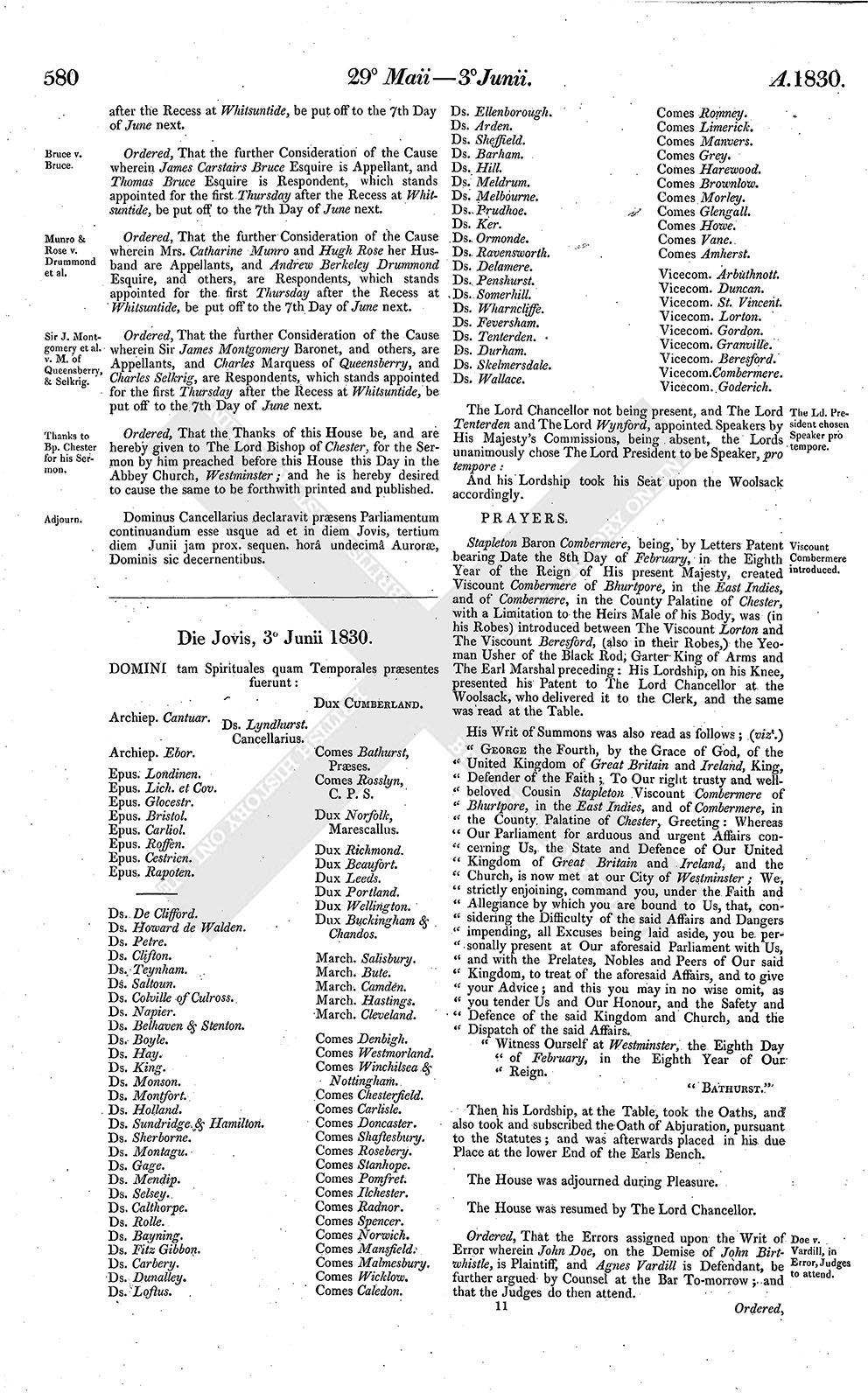
Die Jovis, 3 Junii 1830.
DOMINI tam Spirituales quam Temporales præsentes fuerunt:
Dux Cumberland.
The Ld. President chosen Speaker pro tempore.
The Lord Chancellor not being present, and The Lord Tenterden and The Lord Wynford, appointed Speakers by His Majesty's Commissions, being absent, the Lords unanimously chose The Lord President to be Speaker, pro tempore:
And his Lordship took his Seat upon the Woolsack accordingly.
PRAYERS.
Viscount Combermere introduced.
Stapleton Baron Combermere, being, by Letters Patent bearing Date the 8th Day of February, in the Eighth Year of the Reign of His present Majesty, created Viscount Combermere of Bhurtpore, in the East Indies, and of Combermere, in the County Palatine of Chester, with a Limitation to the Heirs Male of his Body, was (in his Robes) introduced between The Viscount Lorton and The Viscount Beresford, (also in their Robes,) the Yeoman Usher of the Black Rod, Garter King of Arms and The Earl Marshal preceding: His Lordship, on his Knee, presented his Patent to The Lord Chancellor at the Woolsack, who delivered it to the Clerk, and the same was read at the Table.
His Writ of Summons was also read as follows; (viz t.)
"George the Fourth, by the Grace of God, of the United Kingdom of Great Britain and Ireland, King, Defender of the Faith; To Our right trusty and wellbeloved Cousin Stapleton Viscount Combermere of Bhurtpore, in the East Indies, and of Combermere, in the County Palatine of Chester, Greeting: Whereas Our Parliament for arduous and urgent Affairs concerning Us, the State and Defence of Our United Kingdom of Great Britain and Ireland, and the Church, is now met at our City of Westminster; We, strictly enjoining, command you, under the Faith and Allegiance by which you are bound to Us, that, considering the Difficulty of the said Affairs and Dangers impending, all Excuses being laid aside, you be personally present at Our aforesaid Parliament with Us, and with the Prelates, Nobles and Peers of Our said Kingdom, to treat of the aforesaid Affairs, and to give your Advice; and this you may in no wise omit, as you tender Us and Our Honour, and the Safety and Defence of the said Kingdom and Church, and the Dispatch of the said Affairs.
"Witness Ourself at Westminster, the Eighth Day of February, in the Eighth Year of Our Reign.
"BATHURST."
Then his Lordship, at the Table, took the Oaths, and also took and subscribed the Oath of Abjuration, pursuant to the Statutes; and was afterwards placed in his due Place at the lower End of the Earls Bench.
The House was adjourned during Pleasure.
The House was resumed by The Lord Chancellor.
Doe v. Vardill, in Error, Judges to attend.
Ordered, That the Errors assigned upon the Writ of Error wherein John Doe, on the Demise of John Birtwhistle, is Plaintiff, and Agnes Vardill is Defendant, be further argued by Counsel at the Bar To-morrow; and that the Judges do then attend.
Bp. Lincoln et al. v. Rennell, in Error, Judges to attend.
Ordered, That the Errors assigned upon the Writ of Error wherein George Lord Bishop of Lincoln, and others, are Plaintiffs, and Frances Henrietta Rennell Widow is Defendant, be argued by Counsel at the Bar To-morrow; and that the Judges do then attend.
E. of Mexborough's Claim, Com ee to meet.
Ordered, That the Committee for Privileges to whom the Petition of John Earl of Mexborough, praying, "That his Right to vote at the Election of Peers of Ireland to sit in the Parliament of the United Kingdom may be admitted by their Lordships," stands referred, do meet to consider further of the said Claim on Wednesday next.
Viscount Lifford's Claim, Com ee.
Ordered, That the Committee for Privileges to whom the Petition of James Viscount Lifford, praying, "That his Right to vote at the Election of Peers of Ireland to sit in the Parliament of the United Kingdom may be admitted by their Lordships," stands referred, do meet to consider of the said Claim on Wednesday next.
British Spirits, Petition of Perthshire Agricultural Society against additional Duty on.
Upon reading the Petition of the Members of the Perthshire Agricultural Society, whose Names are thereunto subscribed; praying their Lordships "to grant to them that Protection from the Consequences that will ensue if the proposed additional Duty on British Spirits is imposed, as to their Lordships Wisdom may seem proper:"
It is Ordered, That the said Petition do lie on the Table.
Baal's Bridge Bill.
A Message was brought from the House of Commons, by Mr. Spring Rice and others;
With a Bill, intituled, "An Act for the Improvement of the Shannon Navigation, from the City of Limerick to Killaloe, by rebuilding the Bridge called Baal's Bridge, in the said City;" to which they desire the Concurrence of this House.
The said Bill was read the First Time.
Glasgow Road Bill.
A Message was brought from the House of Commons, by Mr. Spring Rice and others;
To return the Bill, intituled, "An Act for maintaining and repairing the Road leading from the City of Glasgow, through Cowcaddens, to the North End of the Bridge over that Part of the River Kelvin called the Milnford of Garscube, and for making, repairing and maintaining the Road leading from Blackquarry Toll Bar, by Possil, to the Bridge across the River Allander, at Langbank, in the Counties of Lanark and Stirling;" and to acquaint this House, That they have agreed to their Lordships Amendments made thereto.
Galway Canal Bill.
A Message was brought from the House of Commons, by Mr. O'Hara and others;
With a Bill, intituled, "An Act for making and maintaining a Navigable Cut or Canal from Lough Corrib to the Bay of Galway, and for the Improvement of the Harbour of Galway;" to which they desire the Concurrence of this House.
The said Bill was read the First Time.
Beale's Estate Bill.
A Message was brought from the House of Commons, by Mr. Spring Rice and others;
To return the Bill, intituled, "An Act for the Resettlement of certain Interests in the Trust Estate of William Browne deceased; and for other Purposes;" and to acquaint this House, That they have agreed to the same, without any Amendment.
Treasury Minutes, remitting Custom Duties on certain West India Produce, & respecting Reduction of Military Account Department, Ireland, delivered.
The House being informed, "That Mr. Charles Crafer, from the Treasury, attended;"
He was called in; and delivered at the Bar, pursuant to an Order of the 25th Day of May last,
"Copy of Treasury Minute dated 15th April 1828, directing the Custom House Duties heretofore levied upon West India Produce subject to the Four and Half per Cent. Duty to the Crown to be remitted."
Mr. Charles Crafer also delivered at the Bar, pursuant to the Directions of an Act of Parliament,
"Copy of Treasury Minute dated 21st May 1880, relative to the Reduction of the Military Account Department in Ireland."
And then he withdrew.
And the Titles thereof being read by the Clerk;
Ordered, That the said Papers do lie on the Table.
East India Co. Papers respecting, delivered, & referred to Comee on the Subject.
The House being informed, "That Mr. Danvers, from the Court of Directors of The East India Company, attended;"
He was called in; and delivered at the Bar, pursuant to an Order of the 24th Day of May last,
"A Statement of the Account between the Territorial and Commercial Branches of the Affairs of The East India Company, in each Year, from 1st May 1814 to the latest Period; drawn out upon the Principle observed in the Accounts transmitted to the Government of Bengal as Enclosures to the Letters of the Court of Directors in the Territorial Finance Department."
And then he withdrew.
And the Title thereof being read by the Clerk;
Ordered, That the said Paper do lie on the Table.
Ordered, That the said Paper be printed.
Ordered, That the said Paper be referred to the Select Committee appointed to enquire into the present State of the Affairs of The East India Company, and into the Trade between Great Britain, the East Indies and China.
Malt & Beer, Accounts respecting, Ordered forthwith.
Ordered, That there be laid before this House forthwith, "An Account of the Number of Bushels of Malt that have paid the Duty, in each Year, from the earliest Period at which the said Return can be made out; and the Amount per Bushel of Duty laid thereon:"
And also, "An Account of the Amount of Beer, Porter or other Malt Liquor that has paid the Duty, from the earliest Period at which the said Return can be made out; stating each Year respectively in both Returns," severally Ordered to be laid before the House on the 5th Day of May last.
Criminal Laws, Petitions for Revision of: (Coventry:)
Upon reading the Petition of the Inhabitants of the City of Coventry, whose Names are thereunto subscribed; praying their Lordships "to adopt such Measures as may be deemed most expedient in rendering Punishments for Crimes against Property less sanguinary, and more equal, just and certain:"
It is Ordered, That the said Petition do lie on the Table.
Reading:
Upon reading the Petition of the Inhabitants of the Borough of Reading, whose Names are thereunto subscribed; praying their Lordships "to enter on a Revision of the Penal Law, so far as relates to the Punishment of Death, and more especially in as far as that Punishment is applied to the Crime of Forgery:"
It is Ordered, That the said Petition do lie on the Table.
Northampton:
Upon reading the Petition of the Inhabitants of the Town of Northampton and its Vicinity, whose Names are thereunto subscribed; praying their Lordships "to repeal, in all Cases of Forgery, those sanguinary and inefficient Laws inflicting Death for that Crime, and to substitute others more mild, but more likely to promote the Ends of Justice; and that their Lordships Labours in Penal Legislation will not stop here, but that an Alteration in the Laws relating to Forgery may be followed by the Consideration and Revision of many other Statutes, which are revolting to Humanity, and a Disgrace to our National Code:"
It is Ordered, That the said Petition do lie on the Table.
Henley upon Thames.
Upon reading the Petition of the Inhabitants of Henley upon Thames, in the County of Oxford, and its Vicinity, whose Names are thereunto subscribed; praying their Lordships, "That, both for the Protection of Property and the invariable Prosecution and adequate Punishment of the Offence of Forgery, the Penalty of Death may be commuted in such Manner as may appear to the Legislature best adapted to effect these important Ends:"
It is Ordered, That the said Petition do lie on the Table.
Message to H. C. for Report on Sale of Beer.
Ordered, That a Message be sent to the House of Commons, to request that they will be pleased to communicate to this House, "A Copy of a Report made from the Select Committee appointed by that House on the Sale of Beer."
Correspondence relative to Petitions of Ship Owners, Port of London, Order for, discharged, & Address for the same.
It was moved, "That the Order made on the 13th Day of May last, "That there be laid before this House, "The Correspondence relative to the Petitions of the Ship Owners of the Port of London, addressed to the Privy Council," be now read."
The same was accordingly read by the Clerk.
Ordered, That the said Order be discharged.
Ordered, That an humble Address be presented to His Majesty, to request that His Majesty will be graciously pleased to order that there be laid before this House, Copies of all Petitions addressed to the Lords of the Privy Council on behalf of the Ship Owners of the Port of London since the 4th of August 1823 to the present Time, together with Copies of all Correspondence relative thereto within the same Period, and all Documents referred to therein or explanatory thereof."
Ordered, That the said Address be presented to His Majesty by the Lords with White Staves.
Hops, Accounts respecting, Ordered forthwith.
Ordered, That there be laid before this House forthwith, "A Return of the Amount of the Hop Duty, old and new Duty included, from the Year 1800 to 1829, inclusive:"
Also, "An Account of the Expences of Collection in each Year, and Number of Persons employed chiefly in the Collection of the said Duties:"
Also, "An Account of the Quantity of Hops imported in each of the said Years, and the Duty paid thereon:"
Also, "An Account of the Quantity of Acres in Cultivation of Hops in each Year aforesaid:"
Also, "An Account shewing how often in each Year the Payment of the said Duties has been deferred, and to what Periods, and upon what Securities:"
And also, "An Account of the Amount of any Arrears of Duty now owing, stating the Year," severally Ordered to be laid before the House on the 11th Day of May last.
Distress of the Country, Petitions from Burwash & Etchingham, &c. respecting, & for Repeal of Malt & Beer Duties.
Upon reading the Petition of the Owners and Occupiers of Land, Yeomen, Tradesmen and other Inhabitants of the Parishes of Burwash and Brightling, in the County of Sussex, whose Names are thereunto subscribed:
And also, Upon reading the Petition of the Proprietors and Occupiers of Land, Tradesmen and Inhabitants of the Parishes of Etchingham and Salehurst, in the County of Sussex, whose Names are thereunto subscribed; taking notice of the Distress of the Country, and severally praying their Lordships, "That the Duties upon Malt and Beer may be totally repealed:"
It is Ordered, That the said Petitions do lie on the Table.
Corn Laws, Petition from Oldham for Repeal of, & for Reform in Parliament.
A Petition of the Inhabitant Householders in the Township of Oldham and County of Lancaster was presented and read, praying, "That their Lordships will adopt such Measures as shall cause the Annual Taxation not to exceed that of the Year 1792, and, if possible, reduce it to that of the Year 1772; also to cause a total Repeal of the Corn Laws, and also a thorough Reformation in the Mode of electing Members for the Commons House of Parliament, on the Principles of Univeral Suffrage, Annual Parliaments, and Vote by Ballot, in order that the Peoples' Wants and Sufferings may be known to and removed by Parliament before the People are driven to Misery, Despair and Crime:"
Ordered, That the said Petition be received as the Petition of "John Hague, Chairman," and "John Knight, Secretary," who only have signed it.
Four per Cents Dissents Bill:
Hodie 3a vice lecta est Billa, intituled, "An Act to authorize the issuing of Exchequer Bills for the Payment of the Proprietors of Four Pounds per Centum Annuities in England and Ireland who have signified their Dissent under an Act passed in the present Session for transferring such Annuities into Three Pounds Ten Shillings per Centum Annuities."
The Question was put, "Whether this Bill shall pass?"
It was resolved in the Affirmative.
Message to H. C. that the Lords have agreed to it.
A Message was sent to the House of Commons, by Mr. Stephen and Mr. Cross;
To acquaint them, That the Lords have agreed to the said Bill, without any Amendment.
Evelyn's Estate Bill:
Hodie 3a vice lecta est Billa, intituled, "An Act for authorizing the granting of Building and other Leases of Freehold Ground and Hereditaments late the Property of Dame Mary Evelyn deceased, in the Parishes of Saint Paul and Saint Nicholas, Deptford, in the County of Kent."
The Question was put, "Whether this Bill, shall pass?"
It was resolved in the Affirmative.
Benson's Estate Bill:
Hodie 3a vice lecta est Billa, intituled, "An Act for vesting an Estate at Liverpool, in the County of Lancaster, devised and settled by the Will of Moses Benson Esquire, deceased, in Trustees, to be sold, and for laying out the Monies arising from such Sale in the Purchase of Estates, to be settled to the same Uses."
The Question was put, "Whether this Bill shall pass?"
It was resolved in the Affirmative.
Messages to H.C. with the 2 preceding Bills.
And Messages were, severally, sent to the House of Commons, by the former Messengers;
To carry down the said Bills, and desire their Concurrence thereto.
Netterville Peerage, Henry to attend the Com ee.
Ordered, That The Reverend Richard Henry do attend this House on Tuesday next, to be sworn, in order to his being examined as a Witness before the Committee for Privileges to whom the Petition of James Netterville Esquire, of Frehane, late of Coarsefield, in the County of Mayo, in Ireland, to His Majesty, praying His Majesty, "That the Title, Dignity and Peerage or Honour of Viscount Netterville of the Kingdom of Ireland may be declared and adjudged to belong to the Petitioner;" together with His Majesty's Reference thereof to this House, and the Report of The Attorney and Solicitor General for Ireland, and also the Report of The Solicitor General of England, thereunto annexed, stands referred.
Scot v. Irving, Respondent's Petition to resume Consideration of Petition to dismiss Appeal, referred to Appeal Com ee.
Upon reading the Petition of John Irving, Respondent in a Cause depending in this House, to which Archibald Scot is Appellant; praying, "That the Consideration of the Petition presented by him to their Lordships on the 25th Day of February last, praying, "That the said Appeal might be dismissed as incompetent," may be resumed; and that their Lordships will be pleased to do therein as in their great Wisdom shall seem just and expedient:"
It is Ordered, That the said Petition be referred to the Committee appointed to consider of the Causes in which Prints of the Appellants and Respondents Cases, now depending in this House in Matters of Appeals and Writs of Error, have not been delivered, pursuant to the Standing Orders of this House.
Sir R. Graham's Petition claiming ing the Earldom of Annandale, &c.
The Earl of Shaftesbury (by His Majesty's Command) presented to the House, A Petition of Sir Robert Graham Baronet, of Walbrook, in the City of London, to His Majesty, praying His Majesty "to declare that the Petitioner has Right to the Titles, Honours and Dignity of Earl of Annandale and Hartfell, Viscount Annan, and Baron Johnstone of Lochwood, Lochmaben, Moffatdale and Evandale;" together with His Majesty's Reference thereof to this House.
Which Petition and Reference were read by the Clerk, and are as follow; (vizt.)
"To The King's Most Excellent Majesty.
"The humble Petition of Sir Robert Graham Baronet, of Walbrook, in the City of London;
"Sheweth,
"That His Majesty King Charles the Second, by His Royal Letters Patent under the Great Seal of Scotland, bearing Date the 13th Day of February in the Year of Our Lord 1661, in the 13th Year of the Reign of His said Majesty, was graciously pleased, for the Reasons therein set forth, to make, constitute and create James the Earl of Hartfell, and His Heirs Male; whom failing, the elder Heir Female without Division of the Body of the said James Earl of Hartfell, then procreated or to be procreated, and the Heirs Male of the Body of the said Eldest Heir Female, lawfully procreated, bearing the Sirname and Arms of Johnstone; whom all failing, the said James Earl of Hartfell's nearest Heirs whatsoever, Earls of Annandale and Hartfell, Viscounts of Annan, and Lords Johnstone of Lochwood, Lochmaben, Moffatdale and Evandale, with the Privilege of Lords of Parliament, and with Precedency, as Earls of Annandale, from the Date of the Patent of the Earldom of Hartfell in favor of James Earl of Hartfell, in the Year 1643.
That in the Year 1662 a Charter of Resignation and Novodamus, proceeding on a Signature under the Royal Sign Manual, passed under the Great Seal of Scotland in favor of the said James Earl of Annandale and Hartfell, whereby His Majesty King Charles the Second granted to him and the Heirs Male of his Body, whom failing, to the Heirs Female of his Body without Division, and to the Heirs Male of the Body of the elder Heir Female; whom failing, to the nearest Heirs and Assignees of the said Earl, the Lands and Estate of Annandale, therein described, with all and sundry Lands, Teinds, Honors, &c. belonging or that might belong to His Majesty's Castle of Lochmaben, or to the Lordship or Earldom of Annandale, lying within the Stewartry of Annandale; and by this Charter the whole was erected into a Lordship and Earldom, to the said Earl and his Heirs foresaid, called and to be called the Earldom of Annandale and Hartfell and Lordship of Johnstone, with the Title, Stile and Dignity of an Earl, according to the Date of the said James Earl of Annandale and Hartfell and his deceased Father their Patents granted to them thereupon.
"That the said James, so created Earl of Annandale and Hartfell, enjoyed the Honours conferred by the said Patent and Charter during his Life.
"That Lady Mary, the Sister of the said James the First Earl of Annandale and the Second Earl of Hartfell, married Sir George Graham of Netherby, in the County of Cumberland, Baronet, by whom she was the Mother of The Reverend William Graham Dean of Carlisle, who was the Father of The Reverend Charles Graham, who was the Father of The Reverend William Graham, who was the Father of Your Petitioner.
"That Your Petitioner is advised that he is the Heir General of the said James First Earl of Annandale, claiming through the said Lady Mary the Sister of the said Earl, and as such is become intitled to the Honors conferred by the said Letters Patent and Royal Charter.
"Your Majesty's Petitioner therefore most humbly prays, That Your Majesty will be graciously pleased, on Proof being given of the Facts before stated, to adjudge and declare that Your Petitioner has Right to the Titles, Honours and Dignity of Earl of Annandale and Hartfell, Viscount Annan, and Baron Johnstone of Lochwood, Lochmaben, Moffatdale and Evandale, according to the Terms, Limitations of and Precedency mentioned in the said Letters Patent and Royal Charter of His Majesty King Charles the Second, in favor of Your Petitioner's Ancestor the said James Earl of Annandale and Hartfell.
"And Your Majesty's Petitioner will ever pray, &c.
"Robert Graham."
"Whitehall, 31st May 1830.
"His Majesty, being moved upon this Petition, is graciously pleased to refer the same to The Right Honorable The House of Peers, to examine the Allegations thereof, as to what relates to the Petitioner's Title therein mentioned, and inform His Majesty how the same shall appear to their Lordships.
"Robert Peel."
Ordered, That the said Petition, with His Majesty's Reference thereof to this House, be referred to the Committee for Privileges to whom the Petition of John James Hope Johnstone of Annandale, Esquire, to His Majesty, claiming the Titles, Honors and Dignity of Earl of Annandale and Hartfell, Viscount Annan and Baron Johnstone, with His Majesty's Reference thereof to this House, stands referred.
Mackenzie v. Houston.
The House being informed, "That Thomas Houston Esquire, Respondent to the Appeal of Murdo Mackenzie Esquire, had not put in his Answer to the said Appeal, though duly served with the Order of this House for that Purpose:"
And thereupon an Affidavit of Andrew Cunningham of the City of Edinburgh, Writer, of the due Service of the said Order, being read;
Ordered, That the said Respondent do put in his Answer to the said Appeal peremptorily in a Week.
Message to H.C. for Documents produced to Com ee on 18th Report of Comrs of Judicial Enquiry in Ireland.
Ordered, That a Message be sent to the House of Commons, to request that they will be pleased to direct the proper Officer to attend this House with the Documents produced before the Select Committee appointed by that House in the last Session of Parliament, to take into Consideration the Eighteenth Report of the Commissioners of Judicial Enquiry in Ireland, together with the Depositions forwarded to those Commissioners by Sir Jonah Barrington, Judge of the High Court of Admiralty in Ireland, and other Papers connected with the Conduct of Sir Jonah Barrington in the Discharge of his Judicial Functions, and to report their Observations thereupon to the House, and who were empowered to report the Minutes of the Evidence taken before them, from Time to Time, to the House.
East India comee, Witnesses to attend.
Ordered, That Francis Hastings Toone Esquire, Walker Stevenson Davidson Esquire, and Hollingworth Maguire Esquire, do attend this House on Monday next, to be sworn, in order to their being examined as Witnesses before the Select Committee appointed to enquire into the present State of the Affairs of The East India Company, and into the Trade between Great Britain, the East Indies and China.
East Retford Election Bill.
The Order of the Day being read for the further Consideration and Second Reading of the Bill, intituled, "An Act to prevent Bribery and Corruption in the Election of Burgesses to serve in Parliament for the Borough of East Retford;" and for the Lords to be summoned; and for permitting Counsel to examine Witnesses in support of the Bill; and for hearing Counsel on the Petition of the Burgesses of the Borough of East Retford, in the County of Nottingham, whose Names are thereunto subscribed, praying their Lordships, "That the said Bill may not pass into a Law;"
It was moved, "That the Counsel be now called in."
Which being objected to;
The Question was put thereupon?
It was resolved in the Negative.
Ordered, That the further Consideration and Second Reading of the said Bill be put off' till To-morrow; and that the Lords be summoned.
Hickson's Marriage Annulling Bill:
The Order of the Day being read for the Second Reading of the Bill, intituled, "An Act to declare void an alleged Marriage between Elizabeth Hickson, an Infant, and Thomas Buxton;" and for hearing Counsel for the same, as also Counsel on behalf of the said Thomas Buxton against the Bill; and for the Lords to be summoned;
Counsel were accordingly called in:
And Mr. Adam and Mr. William Brougham appearing as Counsel in support of the Bill;
And Mr. Frederick Pollock and Mr. Clarke appearing as Counsel on behalf of the said Thomas Buxton against the Bill;
Mr. Adam was heard to open the Allegations of the Bill.
Then Thomas Heppell was called in; and having been sworn, was examined as follows:
(Mr. William Brougham.) "Are you a Clerk in the Office of Messieurs Moss and Bainbrigge, the Solicitors at Derby?"
"I am."
"Did you, on the 17th of May last, serve Mr. Buxton with a Copy of any thing?"
"I did."
"Will you state what you served him with?"
"I served him with a Copy of the Bill, and with the Order of this House."
"The Order for what?"
"The Order for the Second Reading."
"Had you compared that Order with the Original?"
"I had."
"Was it a correct Copy?"
"It was."
"On what Day was it?"
"It was on the 17th of May."
(By a Lord.) "Did you serve him personally?"
"Yes, I did."
The Witness was directed to withdraw.
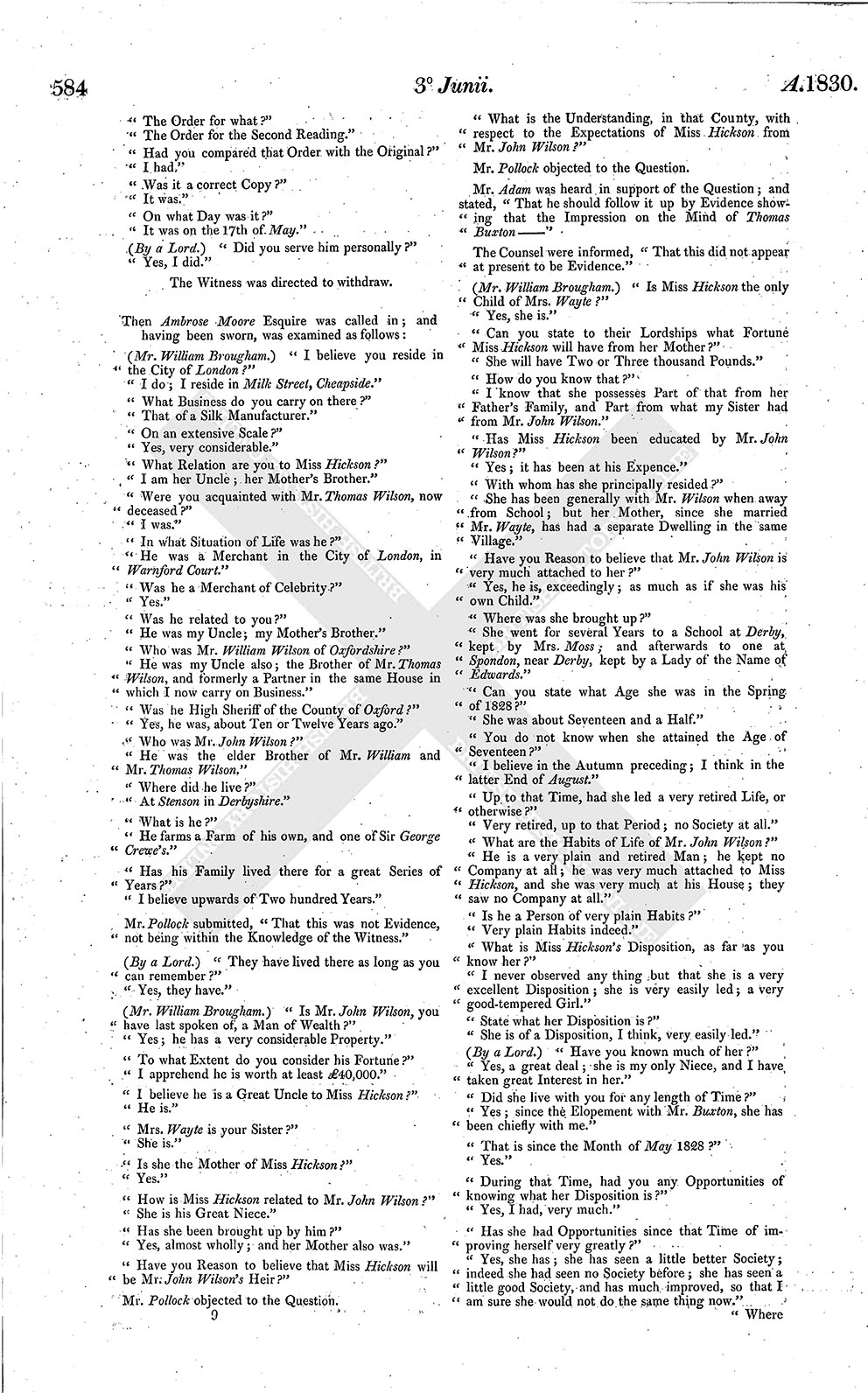
Then Ambrose Moore Esquire was called in; and having been sworn, was examined as follows:
(Mr. William Brougham.) "I believe you reside in the City of London?"
"I do; I reside in Milk Street, Cheapside."
"What Business do you carry on there?"
"That of a Silk Manufacturer."
"On an extensive Scale?"
"Yes, very considerable."
"What Relation are you to Miss Hickson?"
"I am her Uncle; her Mother's Brother."
"Were you acquainted with Mr. Thomas Wilson, now deceased?"
"I was."
"In what Situation of Life was he?"
"He was a Merchant in the City of London, in Warnford Court."
"Was he a Merchant of Celebrity?"
"Yes."
"Was he related to you?"
"He was my Uncle; my Mother's Brother."
"Who was Mr. William Wilson of Oxfordshire?"
"He was my Uncle also; the Brother of Mr. Thomas Wilson, and formerly a Partner in the same House in which I now carry on Business."
"Was he High Sheriff of the County of Oxford?"
"Yes, he was, about Ten or Twelve Years ago."
"Who was Mr. John Wilson?"
"He was the elder Brother of Mr. William and Mr. Thomas Wilson."
"Where did he live?"
"At Stenson in Derbyshire."
"What is he?"
"He farms a Farm of his own, and one of Sir George Crewe's."
"Has his Family lived there for a great Series of Years?"
"I believe upwards of Two hundred Years."
Mr. Pollock submitted, "That this was not Evidence, not being within the Knowledge of the Witness."
(By a Lord.) "They have lived there as long as you can remember?"
"Yes, they have."
(Mr. William Brougham.) "Is Mr. John Wilson, you have last spoken of, a Man of Wealth?"
"Yes; he has a very considerable Property."
"To what Extent do you consider his Fortune?"
"I apprehend he is worth at least £40,000."
"I believe he is a Great Uncle to Miss Hickson?"
"He is."
"Mrs. Wayte is your Sister?"
"She is."
"Is she the Mother of Miss Hickson?"
"Yes."
"How is Miss Hickson related to Mr. John Wilson?"
"She is his Great Niece."
"Has she been brought up by him?"
"Yes, almost wholly; and her Mother also was."
"Have you Reason to believe that Miss Hickson will be Mr. John Wilson's Heir?"
Mr. Pollock objected to the Question.
"What is the Understanding, in that County, with respect to the Expectations of Miss Hickson from Mr. John Wilson?"
Mr. Pollock objected to the Question.
Mr. Adam was heard in support of the Question; and stated, "That he should follow it up by Evidence showing that the Impression on the Mind of Thomas Buxton -"
The Counsel were informed, "That this did not appear at present to be Evidence."
(Mr. William Brougham.) "Is Miss Hickson the only Child of Mrs. Wayte?"
"Yes, she is."
"Can you state to their Lordships what Fortune Miss Hickson will have from her Mother?"
"She will have Two or Three thousand Pounds."
"How do you know that?"
"I know that she possesses Part of that from her Father's Family, and Part from what my Sister had from Mr. John Wilson."
"Has Miss Hickson been educated by Mr. John Wilson?"
"Yes; it has been at his Expence."
"With whom has she principally resided?"
"She has been generally with Mr. Wilson when away from School; but her Mother, since she married Mr. Wayte, has had a separate Dwelling in the same Village."
"Have you Reason to believe that Mr. John Wilson is very much attached to her?"
"Yes, he is, exceedingly; as much as if she was his own Child."
"Where was she brought up?"
"She went for several Years to a School at Derby, kept by Mrs. Moss; and afterwards to one at Spondon, near Derby, kept by a Lady of the Name of Edwards."
"Can you state what Age she was in the Spring of 1828?"
"She was about Seventeen and a Half."
"You do not know when she attained the Age of Seventeen?"
"I believe in the Autumn preceding; I think in the latter End of August."
"Up to that Time, had she led a very retired Life, or otherwise?"
"Very retired, up to that Period; no Society at all."
"What are the Habits of Life of Mr. John Wilson?"
"He is a very plain and retired Man; he kept no Company at all; he was very much attached to Miss Hickson, and she was very much at his House; they saw no Company at all."
"Is he a Person of very plain Habits?"
"Very plain Habits indeed."
"What is Miss Hickson's Disposition, as far as you know her?"
"I never observed any thing but that she is a very excellent Disposition; she is very easily led; a very good-tempered Girl."
"State what her Disposition is?"
"She is of a Disposition, I think, very easily led."
(By a Lord.) "Have you known much of her?"
"Yes, a great deal; she is my only Niece, and I have taken great Interest in her."
"Did she live with you for any length of Time?"
"Yes; since the Elopement with Mr. Buxton, she has been chiefly with me."
"That is since the Month of May 1828?"
"Yes."
"During that Time, had you any Opportunities of knowing what her Disposition is?"
"Yes, I had, very much."
"Has she had Opportunities since that Time of improving herself very greatly?"
"Yes, she has; she has seen a little better Society; indeed she had seen no Society before; she has seen a little good Society, and has much improved, so that I am sure she would not do the same thing now."
"Where is she now?"
"She has been lately at my House in the City of London; she has during Part of the Time resided with Mr. Thomas Wilson in Portman Square."
"Are her Appearance and Manners different from what they were before the Elopement?"
"She has improved; both her Manner and Appearance were always very good, for she had been to a very excellent School, and had improved."
"Has she a childish Appearance, or is she more womanly?"
"She looks young; she has very simple and childish Manners now."
"Can you state whether she appeared more childish before the Elopement that she does now?"
"Yes, certainly; she was perfectly ignorant of the World, from having been kept in so quiet a Place, without any Advantages which a young Woman of her Age usually has."
(By a Lord.) "Was it Weakness of Understanding, or Want of Experience?"
"Want of Experience; I believe her Understanding is not at all deficient."
(Mr. William Brougham.) "What is the Age of Mr. John Wilson?"
"He is, I believe, in his Seventy-fifth Year."
"Is he in a bad State of Health?"
"He is very infirm."
"Is he incapable of bearing a Journey to London?"
"Yes; I apprehend he could not with Safety take such a Journey."
"It would be attended with Danger to his Health?"
"Yes; it would be evident to any Person who saw him, that he is in a very infirm State of Health, and incapable of bearing such a Journey."
"Have you Reason to know that the Family of Miss Hickson objected to her Marriage with Mr. Buxton?"
"Since it took place; they had no Knowledge of it before, excepting One Letter that was received, and which was shown to her Mother."
Cross-examined by Mr. Pollock.
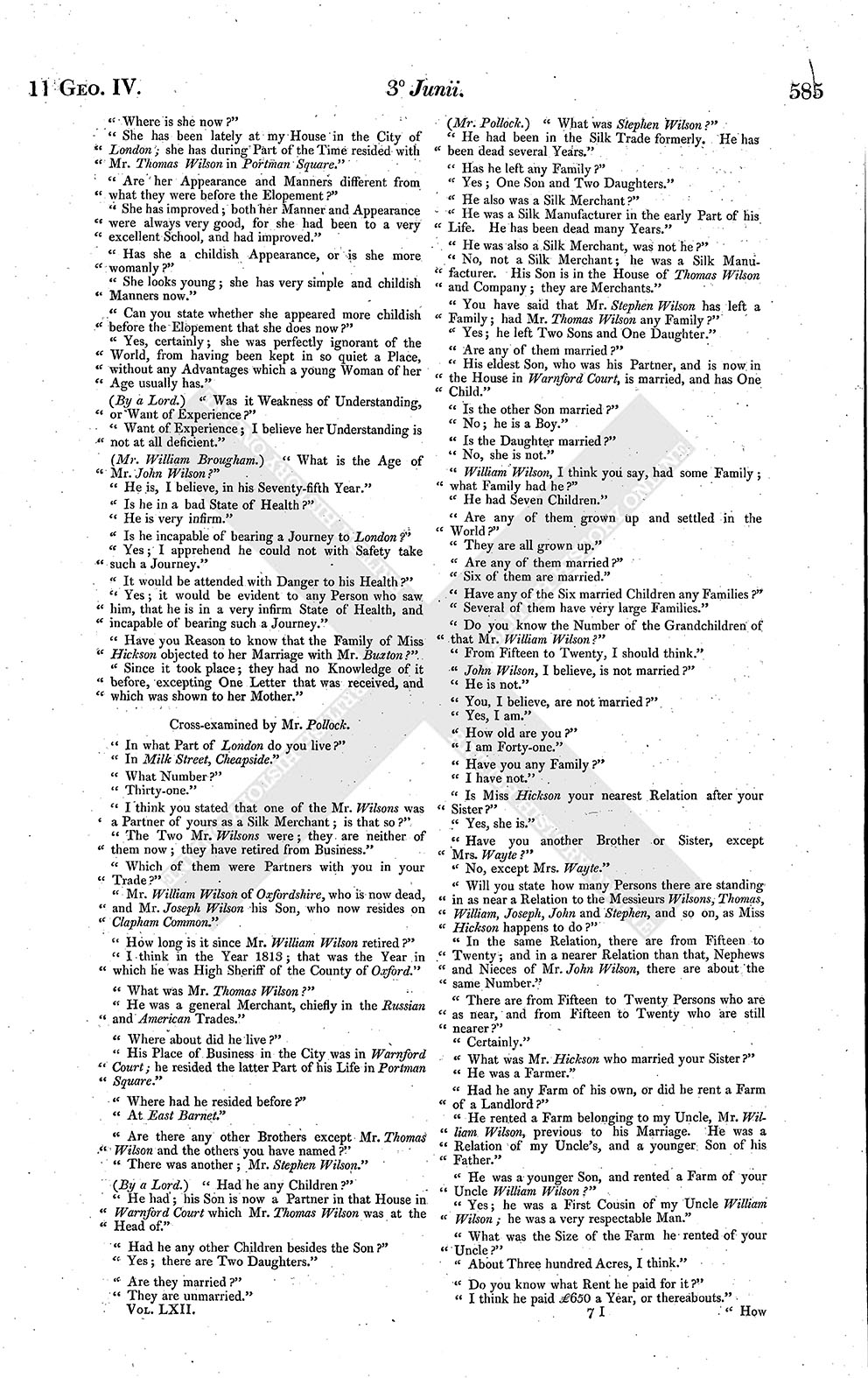
"In what Part of London do you live?"
"In Milk Street, Cheapside."
"What Number?"
"Thirty-one."
"I think you stated that one of the Mr. Wilsons was a Partner of yours as a Silk Merchant; is that so?"
"The Two Mr. Wilsons were; they are neither of them now; they have retired from Business."
"Which of them were Partners with you in your Trade?"
"Mr. William Wilson of Oxfordshire, who is now dead, and Mr. Joseph Wilson his Son, who now resides on Clapham Common."
"How long is it since Mr. William Wilson retired?"
"I think in the Year 1813; that was the Year in which he was High Sheriff of the County of Oxford."
"What was Mr. Thomas Wilson?"
"He was a general Merchant, chiefly in the Russian and American Trades."
"Where about did he live?"
"His Place of Business in the City was in Warnford Court; he resided the latter Part of his Life in Portman Square."
"Where had he resided before?"
"At East Barnet."
"Are there any other Brothers except Mr. Thomas Wilson and the others you have named?"
"There was another; Mr. Stephen Wilson."
(By a Lord.) "Had he any Children?"
"He had; his Son is now a Partner in that House in Warnford Court which Mr. Thomas Wilson was at the Head of."
"Had he any other Children besides the Son?"
"Yes; there are Two Daughters."
"Are they married?"
"They are unmarried."
(Mr. Pollock.) "What was Stephen Wilson?"
"He had been in the Silk Trade formerly. He has been dead several Years."
"Has he left any Family?"
"Yes; One Son and Two Daughters."
"He also was a Silk Merchant?"
"He was a Silk Manufacturer in the early Part of his Life. He has been dead many Years."
"He was also a Silk Merchant, was not he?"
"No, not a Silk Merchant; he was a Silk Manufacturer. His Son is in the House of Thomas Wilson and Company; they are Merchants."
"You have said that Mr. Stephen Wilson has left a Family; had Mr. Thomas Wilson any Family?"
"Yes; he left Two Sons and One Daughter."
"Are any of them married?"
"His eldest Son, who was his Partner, and is now in the House in Warnford Court, is married, and has One Child."
"Is the other Son married?"
"No; he is a Boy."
"Is the Daughter married?"
"No, she is not."
"William Wilson, I think you say, had some Family; what Family had he?"
"He had Seven Children."
"Are any of them grown up and settled in the World?"
"They are all grown up."
"Are any of them married?"
"Six of them are married."
"Have any of the Six married Children any Families?"
"Several of them have very large Families."
"Do you know the Number of the Grandchildren of that Mr. William Wilson?"
"From Fifteen to Twenty, I should think."
"John Wilson, I believe, is not married?"
"He is not."
"You, I believe, are not married?"
"Yes, I am."
"How old are you?"
"I am Forty-one."
"Have you any Family?"
"I have not."
"Is Miss Hickson your nearest Relation after your Sister?"
"Yes, she is."
"Have you another Brother or Sister, except Mrs. Wayte?"
"No, except Mrs. Wayte."
"Will you state how many Persons there are standing in as near a Relation to the Messieurs Wilsons, Thomas, William, Joseph, John and Stephen, and so on, as Miss Hickson happens to do?"
"In the same Relation, there are from Fifteen to Twenty; and in a nearer Relation than that, Nephews and Nieces of Mr. John Wilson, there are about the same Number."
"There are from Fifteen to Twenty Persons who are as near, and from Fifteen to Twenty who are still nearer?"
"Certainly."
"What was Mr. Hickson who married your Sister?"
"He was a Farmer."
"Had he any Farm of his own, or did he rent a Farm of a Landlord?"
"He rented a Farm belonging to my Uncle, Mr. William Wilson, previous to his Marriage. He was a Relation of my Uncle's, and a younger Son of his Father."
"He was a younger Son, and rented a Farm of your Uncle William Wilson?"
"Yes; he was a First Cousin of my Uncle William Wilson; he was a very respectable Man."
"What was the Size of the Farm he rented of your Uncle?"
"About Three hundred Acres, I think."
"Do you know what Rent he paid for it?"
"I think he paid £650 a Year, or thereabouts."
"How long has he been dead, or in what Year did he die?"
"He died in November 1811."
"How soon after did your Sister, then Mrs. Hickson, marry Mr. Wayte?"
"I think she married him in the Year 1825; but I am not quite sure; it was perhaps 1824; but I am not quite sure."
"Do you mean to state you are not quite sure whether the Marriage was in 1824 or 1825?"
"Yes, I do mean to state that; I will endeavour to recollect it."
"Were you yourself at the Marriage?"
"I was."
"What was Mr. Wayte?"
"He was a Farmer; he rented a Farm of Sir George Crewe, and he had some little Land of his own; at the Time he married Mrs. Wayte he was not in Business at all, but living on his own Property."
"Was he not employed as Steward to some one?"
"No."
"Never?"
"Not that I know of; I believe never."
"Do you know where Miss Hickson went to School?"
"Yes; she went to a School at Derby with Mrs. Moss, and subsequently with a Miss Edwards."
"Mrs. Moss lives at Derby, you say?"
"Yes, she does."
"Where does Miss Edwards live?"
"At Spondon, Five or Six Miles from Derby."
"Where has your Residence principally been; in London or in Derbyshire?"
"Principally in London; but for a few Months in each Year latterly I have been at Derby; in the Autumn of the Year."
"For how many Years have you latterly been at Derby?"
"Since the Year 1823."
"Do you know what were the Terms of the Schooling of Mrs. Moss; what were her Terms for her Boarders?"
"I do not know; I do not recollect. I know Miss Hickson was a Parlour Boarder there."
"You did know; but you do not now recollect?"
"Yes, that is so."
"As far as you recollect, were her Terms as much as Fifty Pounds a Year?"
"I should think not; but I cannot say they were not; it depends on what is included in that Statement."
"Were her Terms as much as Twenty-five Pounds a Year?"
"I am sure that more than Twenty-five Pounds was paid there for Miss Hickson."
"That is not the Question."
"I cannot recollect what was stated as her general Terms."
"Having stated that you do not know, I will trouble you to say whether you can take upon yourself to say that you believe her Terms were as much as Twentyfive Pounds a Year?"
"For Miss Hickson, as a Parlour Boarder, I believe they were more."
"To what Extent do you believe they were more?"
"I should think Ten or Fifteen Pounds a Year more; but that is a Guess, for I do not recollect."
"What Means have you of knowing what the Terms were?"
"I saw the Bills frequently; not always. I used to interest myself very much about Miss Hickson's Education, and that was the Reason I saw them."
"I beg you will fix your Recollection, whether the Expence of her Education at Mrs. Moss's was as much as Forty Pounds a Year?"
"I believe it was more; I have no doubt it was more."
"What was it at Miss Edwards's?"
"I really have forgotten; it was considerably more than that."
"Was it more at Miss Edwards's than at Mrs. Moss's?"
"Yes, it was."
"How much?"
"I do not recollect; I would state it if I did. Miss Edwards's was considered a superior School; in fact it was the best that could be found in that Part of the Country; and she had the Children of very respectable Families there."
"Do you happen to know at which of those Schools it was that Miss Buxton was educated and became a Schoolfellow of Miss Hickson's?"
"The youngest Miss Buxton went, I am informed, for a short Time to Mis. Moss's; that is all I know upon that Question."
"Did Miss Hickson ever come to London to any of her rich Relations?"
"She came to London on a Visit to my House once."
"When was that?"
"It was in the Year 1819."
"How long did she stay?"
"I think Two Months; but I do not recollect exactly."
"Did she ever come on any other Occasion?"
"No. It was not for Want of Invitation; but her Uncle did not choose to part with her. Mr. Thomas Wilson was anxious she should come, for the sake of improving herself and seeing better Society; but Mr. John Wilson could not be persuaded to part with her."
"How old was Miss Hickson at this Time?"
"She was Seven and a Half in 1819."
"She was Seven and a Half Years old when you particularly wished to have her Society, but her Uncle would not part with her?"
"I speak not of the Time she actually visited me before she was old enough to go much to School, but I speak of the Interval before this unfortunate Affair happened, as the Time when her Friends would have been glad, as I should have been, for her Improvement, that she should have come to them."
"When did Miss Hickson go to School first?"
"She went to another School in Derby, before she went to Mrs. Moss's; her Mother then resided in Derby."
"What was she doing in Derby?"
"She was doing nothing. Mr. Wilson had a Housekeeper then. When she left Oxfordshire she went to Derby."
"Did she reside with Mr. Wilson?"
"She did not reside with her Uncle immediately after her Husband's Death, but she did afterwards."
"With which of her Uncles?"
"Mr. John Wilson. Previously she lived a short Time at Derby; she had a House there."
"When did Miss Hickson first go to School?"
"She went when she was very young; before she went to Mrs. Moss's."
"What School was that?"
"I really do not recollect; I believe the Lady was a Quaker."
"How long was Miss Hickson at Mrs. Moss's?"
"I think Four or Five Years."
"How long was she at Miss Edwards's?"
"She was at Miss Edwards's only Two Years."
"You say she passed her Vacations at her Great Uncle's, Mr. John Wilson's?"
"Certainly; I think she did."
"Did you ever meet her there?"
"Very frequently."
"Do you mean that you have seen her very frequently in the same Year, or that you have frequently seen her in different Years?"
"I have all my Life been very much in the habit of going to Mr. John Wilson's House at Stenson; there has been no One Year within these Twenty Years I have not visited him; and latterly severally Times in a Year."
"You say Mr. John Wilson brought Miss Hickson up; I think you said that?"
"I said she was chiefly brought up by him; he paid for her Education, and, in fact, treated her as he had done her Mother, just as if they were his own Children."
"Was her Mother in a Situation to pay for her Education herself?"
"Yes, she could have paid; but her Income was not large, from the Amount of Property I have stated."
"What was her Income?"
"I have stated that her Property was Two or Three thousand Pounds, and therefore she was dependent upon her Uncle for any thing afterwards."
"How long did she live at Derby before she went to live with her Uncle?"
"She lived Two or Three Years at Derby, and than lived with her Uncle, I should think, Four or Five Years, perhaps Six or Seven."
"Where was she at the Time that Mr. Wayte was paying his Addresses to her?"
"She was living at her Uncle's."
"Had she at any Time an Estblishment of her own?"
"No; she was living entirely with her Uncle."
"What was Mr. Wayte at that Time?"
"He had some Property of his own; he was in no Business."
"Do you know the Amount of his Property?"
"No; he had occupied a Farm, and had some Land himself."
"Had he any possible Means of getting his Livelihood?"
"He lived upon his own Property."
"Do you know what that Property was?"
"No; I know he has some little Land of his own."
"How much do you believe it to be; how many Acres?"
"I do not think that I have heard."
"How do you know he has any?"
"I have heard it spoken of, but I have never seen it."
"Do you mean to say you have not the least Notion whether it is One Acre or Five hundred?"
"I should think it is not Five hundred, certainly; I should think it is under One hundred."
"Perhaps under Fifty?"
"I do not know enough of it to say."
"Will you swear you believe it to be Ten?"
"I have always believed it to be that."
"How much have you believed it to be?"
"I cannot state that; but I think a Person may easily form a Notion that a Thing is above one Quantity, and yet not be able to prove it to be another."
"Do you believe it to be more than Twenty?"
"Yes, I do."
"Do you believe it to be more than Thirty?"
"Beyond that I have no Belief; it may be beyond Thirty."
"Beyond Belief that it is Twenty, you have no Belief upon the Subject?"
"I certainly have not, because I do not know whether it is or is not. I should state Mr. Wayte had some Personal Property besides."
"What was that?"
"I had Seven or Eight hundred Pounds of his in my own Hands, which he asked me to take."
"What more?"
"I cannot say; he may have more."
"Was the Marriage between Mr. and Mrs. Wayte with the perfect Sanction of the Family?"
"Yes, quite so; he was a respectable Man; it was sanctioned."
"Did not Mrs. Wayte begin another Establishment with her Husband at the Farm?"
"For a short Time; they came to my Uncle's House, and he shortly afterwards rebuilt, on his own Land, a House, then in a dilapidated State, for them, and they then lived in that House on my Uncle's Land."
"Did they live in it up to the Time of Miss Hickson going away?"
"They did."
"What do you suppose was the Value of that House, to be rented?"
"I do not know how they would estimate Houses there; I can tell better what the Land is worth attached to the House."
"What is the Value of the Land?"
"I should think the Value of the Land attached to it would be £250 a Year."
"Did Miss Hickson live with Mr. and Mrs. Wayte as Part of their Family, or with Mr. John Wilson as Part of his Family?"
"With Mr. and Mrs. Wayte."
"When did she leave School?"
"In the Year 1827."
"About what Time; at Midsummer?"
"I think it was at Midsummer."
"Or was it at the Christmas before?"
"It was not at Christmas; I think it was at Midsummer."
"Then leaving School, did she not go, as Part of the Family, to Mr. and Mrs. Wayte, and not to the Family of Mr. John Wilson?"
"Her Residence was with her Mother; but she, and also Mr. and Mrs. Wayte, were as much at my Uncle's House as at their own."
"How far did they live from Mr. Wilson?"
"About Half a Mile. Mr. Wayte manages my Uncle's Business."
"That was what I asked you before?"
"You asked me whether he was Agent to any Person."
"He was his Manager?"
"You may call him so if you please; he manages my Uncle's Business."
"What do you mean by managing your Uncle's Business?"
"He gives Orders."
"Is not he your Uncle's Steward?"
"No, he is not."
"What does he do for your Uncle?"
"He manages for my Uncle, who is too infirm to take an active Part; he receives in no Way a Remuneration for it, therefore he cannot be called a Bailiff or Steward."
"Have you ever seen Miss Hickson at Mr. Wayte's?"
"Yes, frequently."
"Was not that the regular Place of her Residence?"
"Yes; it was her Home."
"Did she ever sleep at Mr. John Wilson's House at all?"
"I cannot say whether she did or did not; I do not know that she did, after her Mother had a separate House; I think it is highly probable she did."
"I do not ask you was it probable?"
"I do not know whether she did or did not."
"How old is Mr. John Wilson?"
"He is in his Seventy-fifth Year."
"Has he any Family of his own living with him, or what does his Establishment consist of?"
"He is a Bachelor, and therefore can have no Family of his own."
"Has he no Relation living with him?"
"No, except my Sister."
"He may have Persons living with him?"
"He has nobody but Mr. and Mrs. Wayte, and Servants."
"Has Mr. John Wilson any Persons living with him as Members of his Family?"
"Not, excepting Mr. and Mrs. Wayte."
"In what Way do they live with him; as Part of his Family?"
"They live exactly as he does; as Part of his Family."
"Do they sleep in his House?"
"They do now, since Miss Hickson's running away."
"Up to the Time of Miss Hickson's going away, did Mr. John Wilson live alone?"
"Yes; he had a Housekeeper and Servants."
"He has a large House, has not he?"
"Not a very large House; he has a large Farm; he has a good many Servants."
"You stated that your Niece Miss Hickson is very much improved?"
"Yes, I consider her so, since she has had better Society."
"What better Society has she had?"
"She has had an Opportunity of seeing those Relations who live in London, and those Friends with whom I and Mrs. Moore associate."
"Where has she lived?"
"She has lived with me."
"Where; in Milk Street?"
"Yes, certainly."
"How long has she lived in Milk Street?"
"She has been there the greater Part of the Time since she left her Mother's House."
"Was that since you met with her at Manchester?"
"Since I took her away from Manchester."
"She lived chiefly in Milk Street?"
"Yes; she was Part of the Time before Mr. Thomas Wilson's Death with him."
"In Milk Street she has seen better Company and is much improved?"
"She has seen such Society as it is my Fortune to mix in, and I trust it is respectable."
"I do not doubt that Society is respectable in Milk Street?"
"As you asked me whether she has associated with Persons in Milk Street, she has not associated with Persons in that Street, or any other Street in the City; my Friends do not live there."
"You live there yourself?"
"I do."
"You say Mr. Wayte is a very respectable Man; did he keep up any Society in the Country?"
"I fancy very little."
"Did Mr. John Wilson keep any Company?"
"He never did all his Life, except the occasional Visits of his Relations."
"Has Miss Hickson, since she left School, ever lived any where except with her Father and Mother, to your Knowledge?"
"No; I do not know of her being any where, excepting with her Mother and Mr. Wilson."
"You do not know of her being with her rich Uncles or yourself until since this Affair?"
"I know she was not with any body but her Mother and Mr. Wilson."
Examined by the Lords.
"You were understood to say that this young Lady, Miss Hickson, was between Seventeen and Eighteen when she eloped with Mr. Buxton?"
"Yes."
"That she was a young Lady of good Education, and by no means deficient in point of Understanding?"
"Certainly."
"Did Miss Hickson always spend her Holidays with her Uncle Mr. John Wilson?"
"I think always."
"Were Mr. and Mrs. Wayte there at the same Time?"
"When they had a separate House, although Miss Hickson might go to Stenson for Holidays, she would go to her Mother's House; but they were constantly there in the Day-time, but went Home to sleep."
"Was she alone at Mr. John Wilson's, or with her Mother?"
"Generally with her Mother; sometimes she would go and call upon her Uncle alone; but her Mother was there almost every Day; her Home was considered as at her Mother's House."
The Witness was directed to withdraw.
Then John Moss was called in; and having been sworn, was examined as follows:
(Mr. Adam.) "What have you in your Hand?"
"An Office and an Examined Copy of the Conviction of Thomas Buxton, William Webster and Erasmus Webster, for a Conspiracy."
"Did you examine that Copy with the Original yourself?"
"I did."
"Is it correct?"
"It is a correct Copy."
"Just read that Part of the Indictment which charges the Offence?"
(By a Lord.) "Were the Defendants found Guilty on all the Counts?"
"On all the Counts; a general Verdict of Guilty."
The same was delivered in, and read; being an Office Copy of the Record of the Conviction, at the General Session of Assizes of Oyer and Terminer and General Gaol Delivery holden for the County Palatine of Lancaster on Saturday the 7th Day of March, in the Tenth Year of the Reign of His present Majesty, of Thomas Buxton, Erasmus Webster and William Webster, on an Indictment by The King against them and others for a Conspiracy to cause and procure a Marriage to be had and solemnized between the said Thomas Buxton and Elizabeth Hickson, without any due and legal Publication of Banns for the same Marriage, and contrary to the express Provisions of the Statute made and passed in the Fourth Year of the Reign of Our Sovereign Lord the now King, for amending the Laws respecting the Solemnization of Marriages in England, and with the Intent to elude the Force of the said Statute, and that a Marriage should be solemnized between the said Thomas Buxton and the said Elizabeth Hickson, without the Knowledge or Consent of the said Mother of the said Elizabeth Hickson, and without the Consent of any other Person by Law authorized or to be authorized to consent to the Marriage of the said Elizabeth Hickson; and adjudging Three Years Imprisonment to the said Thomas Buxton, Erasmus Webster and William Webster.
The Witness was directed to withdraw.
Then Edward Fletcher was called in; and having been sworn, was examined as follows:
(Mr. Adam.) "What are you; what Business are you?"
"A Labourer."
"Were you ever in the Sheriff's Office for the County of Derby?"
"Yes."
"What Situation did you fill there?"
"An Assistant Sheriff's Officer."
"Whom were you under; who was your Principal?"
"William Webster."
"What was William Webster?"
"He was a Sheriff's Officer."
"Was he a bound Bailiff to the Sheriff, do you know?"
"Yes, he was."
"How long had he been in that Situation, as nearly as you recollect?"
"As nearly as I can recollect, about Twelve Months."
"What aged Man was William Webster; about what Age?"
"Perhaps Four or Five and thirty."
"Did he assist his Father before he was a Sheriff's Officer himself?"
"Yes, many Years."
"Do you know his Brother Erasmus Webster?"
"Yes."
"What was he?"
"He was an Attorney in Manchester."
"Does he live in Manchester now?"
"No."
"Do you know when he quitted Manchester?"
"I cannot say when he quitted Manchester."
"Was it before or after this Transaction we are talking of?"
"Before."
"How long before?"
"But a very few Months."
"Whom did he come to reside with when he quitted Manchester?"
"With his Brother William Webster."
"Where did they live?"
"In Mary's Gate in Derby."
"Did Erasmus Webster carry on his Business as an Attorney at his Brother's?"
"No."
"What did he do when he resided there?"
"Nothing."
"Do you happen to know whether he was in distressed Circumstances?"
"Yes, he was."
"Was William Webster, the Sheriff's Officer, in distressed Circumstances?"
"Yes."
"Do you know Thomas Buxton?"
"Yes."
"What was he?"
"He was a Farmer along with his Mother."
"Did his Mother rent Land of another Person, or did she occupy her own?"
"She rented Land of Sir George Crewe."
"Did Thomas Buxton live with her?"
"Yes."
"What did the Buxton Family consist of; how many Children; was Mr. Buxton, the Father, alive?"
"He has been dead several Years."
"Mrs. Buxton was one, Thomas Buxton was another?"
"Yes; and Mary Ann another, and Elizabeth Buxton another."
"Two Daughters and a Son, then?"
"Yes."
"Did you know the Buxton Family well?"
"Very well."
"Do you happen to know whether William Webster was to be married to one of the Buxtons?"
"Yes, he was."
"To which?"
"To Elizabeth."
"Do you know a Person of the Name of Wild?"
"Yes; they called him Captain Wild, from having been in the Army; but he kept a Public House, the White Lion, in Hanging Ditch, in Manchester."
"He had been in the Army?"
"They said so."
"Do you know what Mr. Buxton's Mother's Name was?"
"No, I do not know that I do."
"Do you know what her Father was?"
"Yes; her Father was a Blacksmith at Hulland Ward; Wood was his Name."
"What sort of Blacksmith?"
"A working Blacksmith."
"Is William Webster a Sheriff's Officer now, or when did he cease to be so?"
"He is in Prison now."
"Before that?"
"He had done with it before he went to Prison."
"How did that happen, do you know?"
"I do not know; he was a good bit behind in the Sheriff's Office."
"Do you know that?"
"Yes, I know that."
"Was he turned off?"
"Yes; he was turned off."
"Were the Buxtons and Websters, Webster being to be married to Elizabeth Buxton, on Terms of Intimacy, within your Knowledge?"
"Oh yes; Thomas Buxton and William Webster."
"Did you ever happen to see them together?"
"Oh yes, many Times."
"While they were together did you ever hear them talking of Miss Hickson?"
"Yes, many Times."
"Tell me what you have heard them say of Miss Hickson with reference to this Enquiry?"
"I heard them say before old Mr. Webster died, when he was in the Sheriff's Office, and we were getting our Supper there one Night, Mr. Buxton came in at the Time, Will Webster told Mr. Nuttall he had planned a Wife for Buxton if he would look round him and mind what he was about; and Mr. Nuttall told him it was of no Use, for he once told him of one, and if he went to see her, instead of taking notice of the Girl, he was always smoking and drinking at the House, and took on Notice of her, and so she would not have him."
"What passed next; what did William Webster say upon that?"
"It was common Talk."
"What did William Webster say?"
"William Webster said he did not mean Buxton to do so now."
"What more passed about this Wife for Buxton?"
"That she had Plenty of Money- Miss Hickson; that she had some of her own, and she would have more."
"He mentioned Miss Hickson as the Lady he intended for Buxton?"
"Yes; that after Mr. Wilson's Death she would have more."
"Did he say what Mr. Wilson?"
"Mr. Wilson of Stenson, and another Mr. Wilson in London, as I understood."
"Did Buxton say any thing upon that?"
"No; he did not take much Notice of him; he laughed at him, that was all."
"Did you at any Time after that hear Buxton and Webster speak on this Subject?"
"Yes, many Times; but one particular Time."
"What was that particular Time; when was that?"
"It was in the Wardwick."
"Do you recollect when that was?"
"It was early in the Spring of 1828, I think."
"What did you hear Buxton and Webster say then?"
"Mr. Webster and I was in the Wardwick, we had been for some Writs, and Mr. Buxton rode up to us; and when they got together, I leaned back, not to hear what they were talking of, but I did hear; they were discoursing respecting Miss Hickson; I heard that Name mentioned sometimes, when Will Webster was speaking to Buxton, and he was persuading Mr. Buxton to run away with Miss Hickson."
"What did Mr. Buxton say to that?"
"He did not say a deal to it; very little."
"Did he consent, or what passed?"
"We were not together a Minute; he said he should see him again."
"Who said that; Buxton or Webster?"
"Buxton said he would see him again; and Webster told him he would write a Letter for him to Miss Hickson."
"What did Buxton say to that?"
"He said he would call for it; he did not call; Webster sent his Lad over with it."
"Do you know that?"
"Yes, I saw it go; I saw it sealed up, and heard it read, and every thing."
"Did you read it, or hear it read?"
"I read it."
"Do you know where the Letter is?"
"I do not; Buxton was to copy it before he sent it to Miss Hickson."
"Webster was to write the Letter, and Buxton to copy it?"
"Yes, before it went to Miss Hickson."
"What was to be done with it then?"
"It was to be sent to Miss Hickson; Mary Ann Buxton was to take it to Miss Hickson."
"Mary Ann Buxton is Thomas Buxton's Sister?"
"Yes."
"Was this before the Conversation in Wardwick, or afterwards?"
"No, it was after."
"How long after?"
"I cannot tell; Two or Three Days."
"Was it within Two or Three Days?"
"Yes; I think it was within Four or Five Days."
"Will you recollect whether any thing more was said about Mr. Wilson and Miss Hickson at the Conversation in Wardwick?"
"Yes; he said, when Buxton left us, for I do not recollect any thing more until Buxton left us-"
Mr. Pollock submitted, "That any thing said in the Absence of Buxton was not Evidence."
Mr. Adam submitted, "That he was entitled to give this in Evidence."
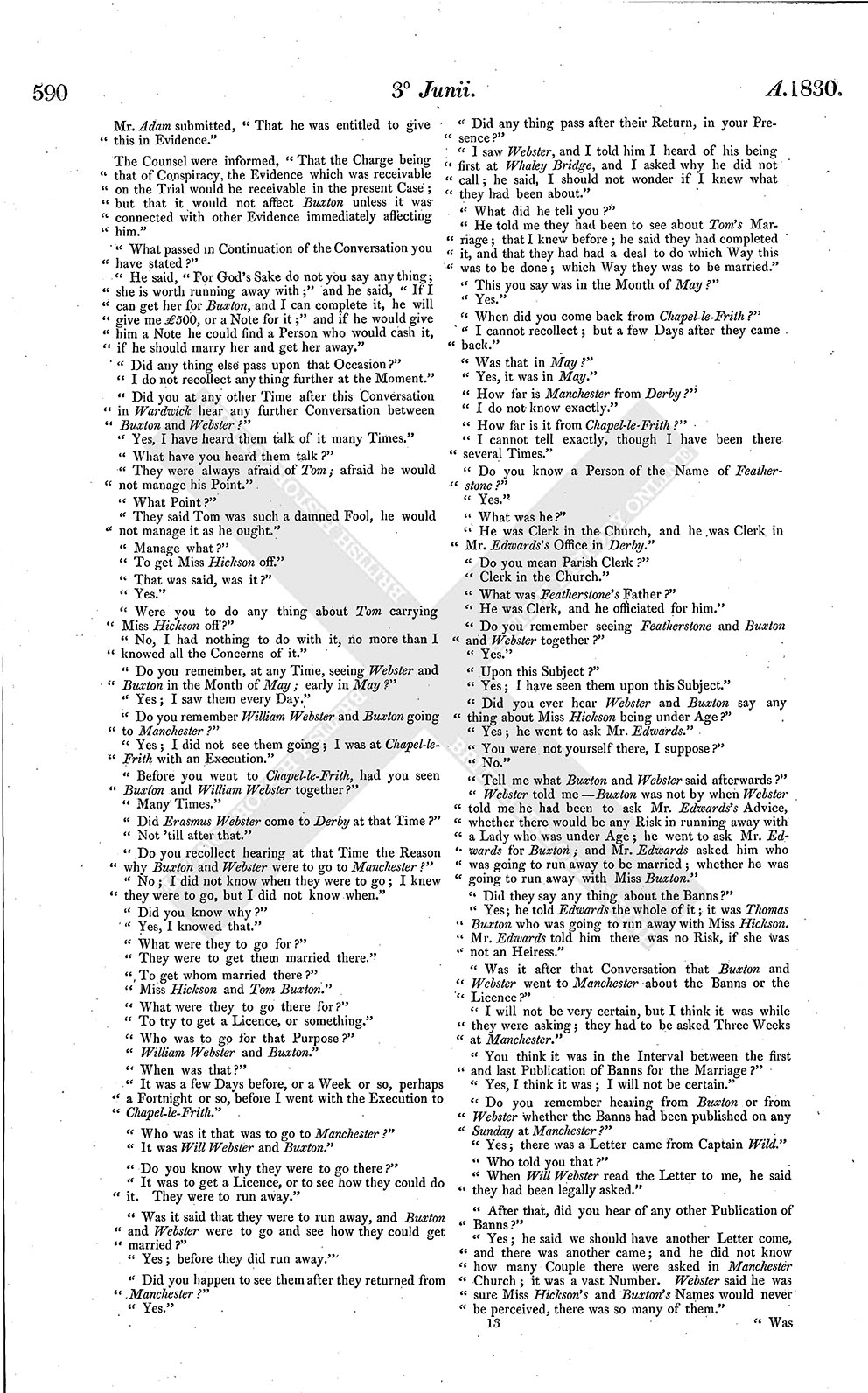
The Counsel were informed, "That the Charge being that of Conspiracy, the Evidence which was receivable on the Trial would be receivable in the present Case; but that it would not affect Buxton unless it was connected with other Evidence immediately affecting him."
"What passed in Continuation of the Conversation you have stated?"
"He said, "For God's Sake do not you say any thing; she is worth running away with;" and he said, "If I can get her for Buxton, and I can complete it, he will give me £500, or a Note for it;" and if he would give him a Note he could find a Person who would cash it, if he should marry her and get her away."
"Did any thing else pass upon that Occasion?"
"I do not recollect any thing further at the Moment."
"Did you at any other Time after this Conversation in Wardwick hear any further Conversation between Buxton and Webster?"
"Yes, I have heard them talk of it many Times."
"What have you heard them talk?"
"They were always afraid of Tom; afraid he would not manage his Point."
"What Point?"
"They said Tom was such a damned Fool, he would not manage it as he ought."
"Manage what?"
"To get Miss Hickson off."
"That was said, was it?"
"Yes."
"Were you to do any thing about Tom carrying Miss Hickson off?"
"No, I had nothing to do with it, no more than I knowed all the Concerns of it."
"Do you remember, at any Time, seeing Webster and Buxton in the Month of May; early in May?"
"Yes; I saw them every Day."
"Do you remember William Webster and Buxton going to Manchester?"
"Yes; I did not see them going; I was at Chapel-leFrith with an Execution."
"Before you went to Chapel-le-Frith, had you seen Buxton and William Webster together?"
"Many Times."
"Did Erasmus Webster come to Derby at that Time?"
"Not 'till after that."
"Do you recollect hearing at that Time the Reason why Buxton and Webster were to go to Manchester?"
No; I did not know when they were to go; I knew they were to go, but I did not know when."
"Did you know why?"
"Yes, I knowed that."
"What were they to go for?"
"They were to get them married there."
"To get whom married there?"
"Miss Hickson and Tom Buxton."
"What were they to go there for?"
"To try to get a Licence, or something."
"Who was to go for that Purpose?"
"William Webster and Buxton."
"When was that?"
"It was a few Days before, or a Week or so, perhaps a Fortnight or so, before I went with the Execution to Chapel-le-Frith."
"Who was it that was to go to Manchester?"
"It was Will Webster and Buxton."
"Do you know why they were to go there?"
"It was to get a Licence, or to see how they could do it. They were to run away."
"Was it said that they were to run away, and Buxton and Webster were to go and see how they could get married?"
"Yes; before they did run away."
"Did you happen to see them after they returned from Manchester?"
"Yes."
"Did any thing pass after their Return, in your Presence?"
"I saw Webster, and I told him I heard of his being first at Whaley Bridge, and I asked why he did not call; he said, I should not wonder if I knew what they had been about."
"What did he tell you?"
"He told me they had been to see about Tom's Marriage; that I knew before; he said they had completed it, and that they had had a deal to do which Way this was to be done; which Way they was to be married."
"This you say was in the Month of May?"
"Yes."
"When did you come back from Chapel-le-Frith?"
"I cannot recollect; but a few Days after they came back."
"Was that in May?"
"Yes, it was in May."
"How far is Manchester from Derby?"
"I do not know exactly."
"How far is it from Chapel-le-Frith?"
"I cannot tell exactly, though I have been there several Times."
"Do you know a Person of the Name of Featherstone?"
"Yes."
"What was he?"
"He was Clerk in the Church, and he was Clerk in Mr. Edwards's Office in Derby."
"Do you mean Parish Clerk?"
"Clerk in the Church."
"What was Featherstone's Father?"
"He was Clerk, and he officiated for him."
"Do you remember seeing Featherstone and Buxton and Webster together?"
"Yes."
"Upon this Subject?"
"Yes; I have seen them upon this Subject."
"Did you ever hear Webster and Buxton say any thing about Miss Hickson being under Age?"
"Yes; he went to ask Mr. Edwards."
"You were not yourself there, I suppose?"
"No."
"Tell me what Buxton and Webster said afterwards?"
"Webster told me - Buxton was not by when Webster told me he had been to ask Mr. Edwards's Advice, whether there would be any Risk in running away with a Lady who was under Age; he went to ask Mr. Edwards for Buxton; and Mr. Edwards asked him who was going to run away to be married; whether he was going to run away with Miss Buxton."
"Did they say any thing about the Banns?"
"Yes; he told Edwards the whole of it; it was Thomas Buxton who was going to run away with Miss Hickson. Mr. Edwards told him there was no Risk, if she was not an Heiress."
"Was it after that Conversation that Buxton and Webster went to Manchester about the Banns or the Licence?"
"I will not be very certain, but I think it was while they were asking; they had to be asked Three Weeks at Manchester."
"You think it was in the Interval between the first and last Publication of Banns for the Marriage?"
"Yes, I think it was; I will not be certain."
"Do you remember hearing from Buxton or from Webster whether the Banns had been published on any Sunday at Manchester?"
"Yes; there was a Letter came from Captain Wild."
"Who told you that?"
"When Will Webster read the Letter to me, he said they had been legally asked."
"After that, did you hear of any other Publication of Banns?"
"Yes; he said we should have another Letter come, and there was another came; and he did not know how many Couple there were asked in Manchester Church; it was a vast Number. Webster said he was sure Miss Hickson's and Buxton's Names would never be perceived, there was so many of them."
"Was any thing else said about Buxton?"
"Yes; he used repeatedly to say he was such a damned Fool; they were afraid he should not get on with it."
"Did Erasmus Webster come to Derby at that Time?"
"Yes; he met me at Chapel-le-Frith when I was there; he never came and went away."
"Did you know Buxton?"
"Yes, very well."
"What are his Habits, about Temperance or Sobriety?"
"If I was to tell you all about him, I should tell you a good deal; he was a very gay Youth."
"What do you mean by a gay Youth?"
"He was fond of drinking and smoking."
"Have you ever seen him in any Houses?"
"Yes; at Public Houses; Scores of Times."
"At any other Houses?"
"Yes."
"What sort of Houses?"
"I have had to fetch him from a House; Webster sent me for him."
"Without going into Details, was he a Man of dissipated Habits?"
"He was not a steady Man; far from it."
"What Description of House was it you took him from?"
Mr. Pollock objected to the Evidence.
The Counsel were informed, "That this was receivable in Proof of the Preamble; their Lordships not at present deciding on the Materiality of that Part of the Preamble."
(Mr. Adam.) "Who kept this House you took him from?"
"The Name was Mrs. Cockin."
"Was it a House of Ill-fame?"
"Yes."
"Do you remember at any Time seeing Mrs. Cockin, and any other Female, at Stenson, at Mrs. Buxton's House?"
"No, I have not seen them there; but I know they were there."
"Do you know that from Thomas Buxton?"
"Yes."
"What did you hear from Thomas Buxton?"
"He fell out with Webster; Buxton owed Mrs. Cockin a Sum of Money; he told Mrs. Cockin Webster would pay her."
"How much was the Money?"
"I think Four or Five-and-twenty Shillings; I know it was above a Pound."
"What sort of a House is that Mrs. Cockin keeps; is it a low mean House, or a House of what Decription?"
(By a Lord.) "In what Part of Derby was it?"
"It is on the Brook Side."
(Mr. Adam.) "Is it a mean shabby House; is it a low Brothel, or what?"
"Yes, it is; she keeps Girls."
"Do you know a House called the Ship?"
"Yes."
"What sort of a Place is that?"
"It is a Public House."
"Do you recollect, about the Time the Banns were publishing, seeing Buxton at this House called the Ship?"
"I did not see him there."
"Did you afterwards hear from Buxton that he had been at the Ship?"
"Yes; many Times."
"Tell me what you have heard Buxton say, as to what passed at the Ship about that Time?"
"He said that Fordester and he had been there drinking with Mary Wilkinson."
"Who is Fordester?"
"Fordester Edwards."
"Is he a Companion of Buxton's?"
"He used to be sometimes."
(By a Lord.) "Is he an Attorney?"
"He is an Attorney's Brother; his Clerk."
(Mr. Adam.) "That he had been drinking there with Mary Wilkinson?"
"Yes, and her Sister, and some other Girls."
"What sort of Girls are Mary Wilkinson and the others?"
"Common Girls; Girls of the Town."
"What more did he say besides that?"
"He said that he had been there; they had got nothing with which they could pay; that they had nothing about them but Bellairs Notes as we found in Webster's House when old Webster was dead, and that they pulled out those Notes."
"What was Bellairs?"
"Bellairs was a Banker that had been broken for many Years; so the Landlord trusted them 'till they got up to Three Pounds, then when they could not pay he kept them."
"From seeing what?"
"From their pulling the Notes out of their Pockets the Landlord thought they had a deal of Money; he trusted them to Three Pounds odd; then when they were not able to pay, having no Money, Fordester and he wanted to come off, and he would not let them."
"That was about the Time the Banns were publishing?"
"Yes, very near."
"Do you know the Time of Milton Wakes?"
"Yes."
"When were Milton Wakes held?"
"In June; the first Week, I think."
"Do you remember the Day of the Week?"
"It begins on the Sunday."
"How long does it last?"
"'Till the Saturday Night."
"Do you recollect seeing Buxton there?"
"He was there, and William Webster; I went to fetch him away."
"Did you see him there?"
"No, I did not see him there, but he told us he was there; we heard he was coming away, and we went to Milton to seek him."
"Do you go to the Wake to fetch him away?"
"Yes; because he was going to run away with Miss Hickson, and Will was afraid she would not have him if she heard he was with those Girls at Milton Wakes."
"What Girls was he with at Milton Wakes?"
"The same Girls that he was at the Ship with."
"Did Buxton say that?"
"Yes; Buxton told me he had been there with them, and that he was sorry he had."
"How many Days was it that he was at Milton Wakes before he ran away with Miss Hickson?"
"It was not many Days; it was while the asking was going on."
"Was it more than a Week?"
"It was more than a Week; I think a Week or a Fortnight."
"You know it was the first Week in June?"
"Yes, it was."
"Do you remember what Day it was that you went to Milton Wakes?"
"On the Tuesday; we did not go to the Wakes."
"Do you remember upon the 9th of June seeing Buxton any where; do you remember Buxton and Miss Hickson going off together?"
"Yes."
"When was that?"
"It was on a Monday in June."
"What Week in June was that?"
"I cannot say; it was on a Monday Morning, I know."
"Did you see Buxton upon that Occasion?"
"Oh yes; I was there on the Sunday."
"Where were you on the Sunday?"
"At Buxton's House."
"Why did you go there on the Sunday?"
"Will asked me if I would go with him; that they was going to arrange about their setting off on the Monday."
"Did you go?"
"Yes."
"After you went there, were the Arrangements made?"
"Yes."
"Did you hear Buxton say what the Arrangements were?"
"Yes; I heard Webster and Buxton, and them all."
"State what the Arrangements were?"
"They was to be at Derby about Eight o'Clock on the Monday Morning, and Miss Hickson was to tell Mrs. Wayte and her Friends that she was going to Normanton to, I think, her Aunt's; it was some Relation of hers. This was settled on the Sunday Afternoon, for Mary Ann to go and tell Miss Hickson."
"This was arranged after you went over to Stenson?"
"Yes."
"On the Monday, did you see them in Derby?"
"Yes. I did not see Miss Hickson, but I saw Buxton and Mary Ann."
"What did you see them do?"
"Buxton came to me at Will Webster's, and I went and changed some Notes, and got some Sovereigns for him."
"Who gave them to you?"
"Will Webster; but I saw Buxton hand them to him."
"Did you change them?"
"Yes. Will told me if I saw the Carriage to tell them to go along."
"What Carriage?"
"The Carriage I went with him to order; he asked me to go with him to order the Carriage; it had been ordered before; but to tell them what Time to come."
"Did you go with him to order the Carriage?"
"Yes; I went up to Charles Holmes's; but that was before I saw Buxton in the Morning."
"But you saw Buxton; before you changed the Notes had you gone up to Holmes's to tell him what Time the Carriage was to come?"
"Yes; it was to go towards Littleover, on the Burton Road."
"Is that in the Road to Manchester?"
"No, not in the direct Road; they were to go on the bye Road, that they might not be seen."
"Did Webster say any thing to you then about their going to Manchester?"
"Oh yes."
"Tell us what he said?"
"I told them that I hoped they would not get into a Scrape through it; he said, "Catch a Weasel asleep;" that was a Cant Word with him."
"Was any thing said more about what was to be done after the Marriage?"
"Yes."
"Catch a Weasel asleep; did you suppose they could catch a Weasel asleep?"
"I had a Brooch mending on the Burton Road, and I thought I would go and fetch it, and I should see something of them; and when I got there I saw Erasmus Webster and Tom Buxton and Mary Ann on the Road; and I came back, and I met Keeling, the Man that was with Charles Holmes the Coach Owner, and I put my Hand up, and he stopped, and I told him that Webster and Buxton said he was to drive on."
"Was he with the Carriage?"
"Yes."
"Do you remember Webster saying any thing before this, what Webster and Buxton were to do?"
"I do not know which way you mean."
"Recollect all that passed?"
"Erasmus Webster?"
"No; I mean William Webster in Derby?"
"Will said, he was afraid he would make a bad Job of it; that he was such a damned Fool they could not get on an Inch."
"Did he say any thing more?"
"Yes, he did."
"Do you recollect at the Time you went up to Holmes's about this Carriage, whether William Webster said any thing as to what was to happen after they went to Manchester?"
"Yes; he said he should have the £500, and Tom would give him old Peacock."
"What was old Peacock?"
"A Horse."
"A Horse of Buxton's?"
"Yes."
"He said that if they went on and married he was to have £500 and old Peacock?"
"Yes."
"This was the Day they were going off to be married?"
"Yes."
"Did you afterwards see him set off?"
"I saw them go off on Foot, but I did not see them get into the Carriage; Erasmus went with them."
"Do you remember seeing William Webster after they went to Manchester?"
"Yes. Tom and Mary Ann had brought a Gig to the Nag's Head; we sent for it to Will's Stables, and he said we would go off in the Afternoon to see whether they had missed Miss Hickson."
"Where did you go to?"
"We went to a Public House at Findern that Tom used to go to."
"How far is Findern from Stenson?"
"About a Mile and a Half."
"Is it in the Road to Manchester?"
"No."
"Why did you go there?"
"Because they said that if we went all the way with the Gig they would have a Suspicion that Thomas and Mary Ann had not gone to Hulland Ward."
"Who would have a Suspicion."
"Mr. Wayte and Mr. Wilson."
"Did you see any thing of Mr. Moore and Mr. Wayte that Night?"
"Yes; they came to Buxton's at Night; I heard them."
"Who was there at that Time?"
"Will Webster and me."
"Did you hear any thing pass?"
"They asked the Girl whether Mr. Buxton was at Home."
"What was said then?"
"They asked the Girl whether Miss Buxton was in, and she said she was; and she went and fetched her down in the Parlour. Then they asked, that is, Mr. Moore or Mr. Wayte, whether Mary Ann and Tom was at Home; and she said, no, they was not; they were gone to Hulland Ward."
"What did Mr. Moore and Mr. Wayte do then?"
"They went into the other Parlour, and what they said then I cannot tell."
"How long did you stay at Stenson on that Occasion?"
"We stopped there 'till between Three and Four in the Morning."
"Where did you go to then?"
"To Will's House in Derby."
"Whom did you find there?"
"We found Erasmus; he had come back from Matlock Bath."
"When had he gone to Matlock Bath?"
"He had rode on the Dickey with them so far."
"That is in the Way to Manchester?"
"Yes."
"The next Day, did you hear William Webster say any thing about it?"
"Yes; when Erasmus came down Stairs, we asked him how they went on, and he said that Buxton was a damned Fool, and that he had given the Post-boy some extra Money to stop 'till Night."
"Who had done that?"
"Erasmus; and that he had lent Buxton his Watch that he might know the Time to get along, and he had also wrote a Note, and gave Miss Hickson Directions how they should go on."
"Did Erasmus Webster say whether he had given Buxton any Directions as to what he was to do?"
"Yes; to get off as soon as he was married, and to get to Bed to Miss Hickson."
"Do you recollect whether Erasmus said any thing else?"
"I cannot recollect."
"Do you recollect afterwards hearing that Mr. Moore had got to Manchester, and had brought away Miss Hickson?"
"Yes."
"Do you remember Buxton being taken to Lancaster Castle?"
"Yes."
"Do you remember Buxton being taken to Lancaster Castle before the Trial?"
"Yes, I remember that."
"Do you remember having any Conversation with Buxton after they had been to Lancaster, and after he had been bailed?"
"Yes."
"Who was present on that Occasion?"
"My Brother."
"Where did you fall in with him?"
"My Brother was going to Norton-in-the-Moors shooting; we called at Hulland Ward to take a Lunch, and we saw Buxton and his Sister come to his Grandmother's; my Brother sent a Note to him; he wanted to speak to him."
"Did you afterwards meet him?"
"Yes."
"Tell us what passed in that Conversation?"
"I said, "Tom, you see what the Websters have done for you; they have got out themselves, and let you into it."
"How had they got out themselves?"
"That they kept away 'till they were bailed; they came and surrendered themselves at Derby."
"Buxton had been apprehended, and had given Bail?"
"Yes; they had given Bail; they were not in Prison long."
"You said, "Tom, you see they have kept themselves out, and let you into it?"
"Yes; I said, "You see what Will has been doing was all for his own Benefit, and not for yours;" and he said, "I know that very well." He said, "If it had not been for Will I should never have thought of running away with Miss Hickson, or any thing of the kind."
"Did he say any thing else?"
"I do not remember any thing else now."
"Did he say any thing of the Consequences to himself and Webster?"
"Yes. I asked him what he thought would be the Consequences; he said, he supposed they should be imprisoned for Two or Three Years, or transported."
"Was any thing else said about Webster's Benefit?"
"Yes; I said he would not have done it but for the Promise of Five hundred Pounds; he said, he knew that very well; he was very sorry he had been led into it."
Cross-examined by Mr. Pollock.
"What are you now?"
"A Labourer."
"What do you labour in?"
"Different Things."
"What Things?"
"I assist my Father in Law."
"In what?"
"At his Work."
"What Work?"
"Some Land."
"Am I to understand that you are a Farming Man?"
"Yes; I am farming or doing any thing I can get to be in."
"What was the last Job you had to do?"
"The last Thing I had was serving some Writs for Mr. Campbell of Nottingham."
"What Wages have you got as a Farming Man?"
"I cannot tell."
"What is the highest Wages you have had by the Year or the Week?"
"I was appointed Receiver by The Lord Chancellor 'till my Brother was of Age."
"(By a Lord.) "When were you appointed Receiver by the Court of Chancery; how many Years ago?"
"I cannot exactly say how many Years."
"Three Years ago?"
"Longer than that."
"(Mr. Pollock.) "Five Years ago?"
"I dare say Eight or Nine."
"That is no Answer to the Question I was putting to you, which was, what Wages you got from your Father?"
"Not from my Father."
"From any body, for the last Two or Three Years?"
"For the last Two or Three Years I had a Place to conduct a Farm for myself."
"How many Acres?"
"I cannot tell how many Acres."
"About how many?"
"Nearly Thirty. I kept Horses and sold Coals."
"How many Horses did you keep?"
"Sometimes Six or Seven; sometimes Four or Five."
"Perhaps none sometimes?"
"Yes, always some."
"Have you ever been Bail?"
"Yes."
"What is the largest Sum you were ever Bail for?"
"I am sure I cannot tell."
"Cannot you tell within Ten or Twenty Pounds?"
"No, I cannot."
"For how many have you been Bail in the Course of your Life?"
"I cannot tell."
"Am I to understand you have been Bail so often, you cannot tell how often?"
"Perhaps Two or Three Times, or Three or Four."
"Perhaps Five or Six?"
"I cannot tell."
"Perhaps Ten?"
"No, nothing of the kind."
"Will you swear that you have not been Bail Ten different Times?"
"I am sure I have not."
"Have you been Bail Six or Eight Times?"
"I cannot tell; I think not."
"Will you swear you have not?"
"Indeed I am not prepared to answer exactly; if you had told me that I could have brought all the Particulars I have been Bail for."
"You say you cannot tell within Ten or Twenty Pounds the largest Sum you have been Bail for?"
"No, I cannot."
"Can you tell within Thirty Pounds?"
"No."
"Can you tell within Fifty?"
"I declare if I had known that would be asked I could have brought the Particulars."
"How long is it since you were Bail last?"
"A long Time."
"How long?"
"Four or Five Years."
"Were you Bail for Persons you were acquainted with; Friends of yours?"
"My Brother."
"How much were you Bail for your Brother?"
"I cannot exactly tell."
"About how much; I do not ask you exactly?"
"I cannot tell exactly."
"Cannot you tell at all?"
"No, I cannot."
"Cannot you tell whether it was for Twenty Pounds or One hundred?"
"It was more than Twenty and more than a Hundred."
"Was it more than Two hundred?"
"I cannot tell the exact Amount."
"About what Sum was it; what do you believe it was about?"
"I cannot exactly tell."
"I do not ask you exactly to tell. You were asked to state, on your Oath, what you believed to have been the Debt of your Brother for which you became Bail?"
"It was some Bills he gave to Webster; and after he bailed them he paid the Money."
"You would very likely remember how much it was you were Bail for?"
"I cannot remember exactly."
"Can you tell me within Fifty Pounds?"
"No, I do not know that I can."
"Were you ever Bail for a Person of the Name of Bullivant?"
"Yes; he is my Brother."
"What is your Name?"
"Fletcher."
"He is your Half Brother?"
"No, my own Brother."
"How came he to change his Name, or you yours?"
"Mr. Bullivant left him his Property, and so he changed his Name; his Name is Fletcher Bullivant."
"How often have you been Bail for him?"
"I do not know; I cannot recollect."
"Do you mean to state that you have been Bail for him only Once?"
"Well, I cannot tell; I have been informed that Webster has put my Name to Bail Bonds at Times; I have not known when; he was a Sheriff's Officer."
"I ask only to that done with your own Knowledge and by your Consent?"
"I cannot speak to that."
"Do you know of your Brother being sued by a Person of the Name of Dalman, and a Person of the Name of Reynolds?"
"Yes; that was a Bill."
"A Person of the Name of Savage?"
"Yes; there was Savage."
"Was there not another Person of the Name of Archer?"
"I cannot exactly recollect the Name."
"Were not there Three or Four Actions?"
"Yes, I think there was."
"Was not there a Person of the Name of Fowle who was suing your Brother?"
"I do not know."
"A Person of the Name of Siddon?"
"I cannot recollect."
"Will you swear there was not?"
"I cannot recollect."
"What is your Belief upon the Subject?"
"I cannot recollect."
"Do you mean to say you have no Belief at all?"
"I cannot recollect."
"I ask you what you believe, not what you recollect; have you forgotten it altogether?"
"I am sure I have."
"In what Year was this that you were Bail for your Brother?"
"I cannot exactly recollect."
"Was not it in the Year 1826?"
"It might be."
"Was not it in the Month of November 1826, late in the Year?"
"I cannot speak to the Time."
"Do you mean to say that you do not know whether it was a Year or more?"
"I cannot say whether it was."
"I do not ask you the Day or the Month, but the Year?"
"I cannot say indeed what Bail I have given; if I had known I could have brought the Papers."
"I am trying your Recollection; you have been giving a very long Story without any Memorandum?"
"It was Four or Five Years ago; I have not given any since I left Swadlincoat."
"Will you swear it was Four or Five Years ago since you gave Bail?"
"I mean 'till that Year I left Swadlincoat; I think it was either in 1825 or 1826 when I left my Land there."
"Did not you give Bail in 1826?"
"I might so; I cannot say."
"Did you ever justify Bail in any of those Actions?"
"What is justifying?"
"Did you ever go before any Person and take an Oath that you were worth a certain Sum of Money?"
"They say I went before Mr. Cockayne; but I never was sworn; I was never sworn to it."
"You went before Mr.Cockayne, but you were never sworn?"
"Yes."
"Do you mean that you did not kiss the Book?"
"Yes."
"Were you asked no Questions respecting your Property?"
"No, I never was."
"You were a Sheriff's Officer?"
"I have been an Assistant Sheriff's Officer."
"Were you not before a Sheriff's Officer?"
"No."
"When did you first begin to be an Assistant Sheriff's Officer?"
"I cannot say."
"About what Time?"
"In 1827."
"How many Years or Months did you assist as a Sheriff's Officer?"
"I think that was in 1827."
"How long did you continue to be a Sheriff's Officer?"
"I do Jobs now."
"Do you mean to say at this Moment you did not know what justifying Bail was, 'till I explained it?"
"No; if you had said Special Bail I should have known."
"Were you ever Special Bail?"
"At the Time they said I was I never was; I was not sworn."
"Do you mean to say you were never Special Bail?"
"I was not at that Time."
"Were you at no other Time?"
"I cannot recollect."
"Do you mean to say you do not know whether you were ever Special Bail?"
"I said I was before Mr. Cockayne, but I was not sworn."
"Will you swear you were not at any other Time?"
"I will not swear that I was, and I will not swear I was not."
"You mean now to swear you do not know whether you ever were or were not Special Bail?"
"No; only what they indicted me for; and I had sufficient Witnesses to produce."
"You say at that Time you were not Special Bail?"
"I had sufficient Witnesses to prove my Innocence."
"Do not talk about your Innocence; that is not the Question now; the Question is, whether you were ever at any Time Special Bail?"
"I cannot recollect only what I was telling you; I was not sworn, nor nothing of the kind."
"Do you mean to swear you never were on any Occasion sworn as Special Bail?"
"I mean to say that I cannot recollect that I ever was."
"Were you ever present when any body else was sworn as Special Bail; do you know what Special Bail is?"
"Yes. I do not know that I was ever present."
"Did you ever see Special Bail put in or sworn?"
"No, I do not know that I have; I have Common Bail Scores of Times, when People was arrested."
"Will you now swear that you were not Special Bail, and did not justify to the Amount of £600?"
"Mr. Adam submitted, "That that must appear by the Proceedings."
The Counsel were informed, "That they might ask whether he was sworn to a particular Fact."
(Mr. Pollock.) "Do you mean to say that you never have had the Question put to you whether you were worth a certain Sum of Money after the Payment of all your Debts?"
"I never had them put to me."
"Were you ever applied to to become Special Bail?"
"I have been applied to many Times, and have refused."
"Did you ever consent?"
"I cannot recollect."
"That is a Circumstance you would, probably, remember?"
"I was not asked at the Time I went up to Mr.Cockayne."
"Did you ever consent to become Special Bail in your Life?"
"They asked me to go up to Mr. Cockayne."
"How long ago was that?"
"It is many Years since."
(By a Lord.) "About how long? Answer the Question readily."
"It was Four or Five Years ago, I should think."
(Mr. Pollock.) "Was not it in November 1826; will you swear it was not?"
"I should think that was about the Time that they asked me to go up to Mr.Cockayne; they did not say what it was for."
"Did you consent when you got there?"
"I was never asked any thing there."
"Who were they that asked you to go there?"
"Let me see; there was-I am sure I do not know whether it was Mr.Daykin; I do not know who it was; whether it was Webster, or who it was."
"Were you ever imprisoned for Debt?"
"Yes."
"How long is that ago?"
"I think that was in 1826 or 1827; 1827, I should think."
"Was it 1826 or 1827?"
"I think 1827."
"Did you take the Benefit of the Insolvent Debtors Act?"
"Yes."
"How long were you in Custody?"
"I cannot exactly tell how long I was in Custody."
"About how long?"
"Nine or Ten or Eleven or Twelve Weeks; I cannot tell to a Week."
"What was the Amount of Debt for which you went to Prison?"
"I do not know; it was not a Debt of my own; I did not owe a Debt of my own; it was some Acceptances I had lent to Webster and my Brother, and they told me they were settled; and I did not know they was not."
"Do you mean to say you do not know the Amount?"
"If I did know it I have forgotten it."
"Who was the Plaintiff?"
"I do not know who the Plaintiff was; I cannot recollect who it was."
"Do you not know the Amount within Thirty, Forty or Fifty Pounds?"
"I do not; I have no Idea what it was."
"Perhaps you do not know within a Hundred Pounds?"
"I do not; it was not a deal; I do not know exactly what it was I owed."
"Was it upon that Debt you were detained for Nine or Ten or Eleven Weeks?"
"I am sure I do not know, nor I do not know my detaining Creditor's Name."
"If you did you have forgotten it?"
"Yes, I have."
"Had you more than One detaining Creditor?"
"No."
"You do not know his Name?"
"No."
"Nor the Amount of the Debt?"
"No; nor I did not know what it was on; and I wrote to Webster to know what Bills I was liable to for him."
"When was it you first heard any thing said on the Subject of an intended Marriage with Miss Hickson?"
"It was before old Mr.Webster died."
"When was that?"
"Well, I do not know what Year it was."
"How long before Miss Hickson went away?"
"Oh, it was a long Time."
"About how long?"
"I cannot tell to Two or Three Months, I am sure."
"Tell me to Three or Four Months; was it more than a Year?"
"No."
"Was it Four Months?"
"I cannot tell to a Month."
"Was it Six Months?"
"It was before Mr. Webster died."
"When did Mr. Webster die?"
"I cannot tell exactly; I was in his House when he died; I saw him die."
"That Fact might enable you to tell about when it was?"
"I cannot."
"Can you tell me the Year in which he died?"
"I was thinking. I think it was in 1828, but I will not be certain. I cannot recollect just at this Moment."
"The Witness was admonished to make an Effort to recollect the Transactions to which he was asked."
"I was there when he died, and I went the next Day to get his Son the Father's Situation."
"Who is Mr. Nuttall, who was present at the first Conversation?"
"He kept a Shop at Hulland Ward."
"Where is that?"
"It is close to Mrs. Wood's."
"I do not know Mrs. Wood; in what Town is it?"
"It is between Ashbourne and Derby."
"How old was Buxton at that Time?"
"He might be Four or Five and twenty."
"Do you remember his coming of Age?"
"No."
"Do you know his Age?"
"I had it from the Register."
"Then perhaps you can tell us pretty accurately?"
"I know he is Four or Five and twenty; I should think he is now Six and twenty."
"You went to the Register for it, did not you?"
"Yes."
"Who sent you there?"
"Mr. Bainbrigge."
"One of the Attorneys?"
"Yes."
"Did you get a Copy of the Register?"
"Yes; I saw it in the Book."
"Did you give that to Mr. Bainbrigge?"
"No."
"What did you do with the Copy?"
"I gave it to Mr. Heppell, I think."
"That is a Clerk of theirs?"
"Yes, it is."
"Did you ever get a Copy of the Register of Miss Hickson's Age?"
"No."
"Do you know how old she is?"
"No; I cannot tell exactly her Age."
"About how old did she appear to be?"
"I think she might be about Seventeen or Eighteen; perhaps Seventeen."
"She was a large grown Girl, was not she, then?"
"Yes; she was not a tall one; she had a young Look."
"Mr. Nuttall, you say, had said that he had suggested a Match for Mr. Buxton?"
"Yes."
"Mr. Buxton is a good-looking young Man, is not he?"
"He is very well; he is small."
"About the same Proportion as Miss Hickson, probably; he is a well-made young Man; is not he a good-looking young Man?"
"I have seen better, and I have seen worse."
"Is Mr. Nuttall any Connection of Mr. Buxton's at all?"
"Yes."
"What Connection is he?"
"He was at Mr. Buxton's with Webster many Times, and I have been with him many Times; I recollect at one Time Mr. Nuttall going with Buxton to the Dog and Duck Public House at Stanton, and stopping Two or Three Times; he was frequently with him."
(By a Lord.) "What was Nuttall?"
"He kept a Shop; a Grocer's Shop."
(Mr. Pollock.) "At this Time, when this Conversation first took place, was Webster paying his Addresses to Miss Buxton?"
"Will Webster was."
"And the Conversation turned upon Buxton and Miss Hickson?"
"Yes."
"Did not Webster mention Miss Hickson as a good Match for Buxton?"
"Yes; he said that he had laid out a Wife for him."
"I think you before said that he had planned a Wife?"
"Yes; that is the same Thing."
"Was it planned or laid out?"
"I think it was planned; but it is the same Thing; if he would mind what he was after."
"Buxton laughed at this, you say?"
"Yes."
"He considered it merely a Gossip, a Joke of his?"
"He was drunk at that Time; he was fresh."
"Which of them?"
"Buxton."
"Was not Webster?"
"No; but Buxton was very fresh."
"This was the Subject of Conversation very often, was not it?"
"Yes; I have heard them talk many a Score Times; I have heard Webster tell Buxton what a good Thing it would be for him."
"And he has said that before you?"
"Many Times; many Score Times."
"Before other Persons?"
"Yes, he has, before other Persons."
"How far did Buxton live from Miss Hickson?"
"It is only a Field or Two."
"Is it nearer than Mr. John Wilson's?"
"I should think it is about the same Distance; I cannot tell to a few Hundred Yards."
"Are they not very near Neighbours?"
"Yes."
"Is there any House nearer?"
"Yes, there are other Houses, but there are not many in the Village; it is a small Village."
"The Society there is not very large?"
"No, it is not."
"And not many Persons of either Sex, I suppose, very young?"
"I do not know indeed."
"There are very few?"
"I cannot tell how many."
"Are there many or few?"
"There cannot be many in a small Village."
"I ask you whether there are few or many?"
"I cannot say; I do not know them all; I do not know how many."
"I do not ask you how many; but I ask you whether there are many or few?"
"I cannot tell; it is but a small Village."
"How far is Stenson from Derby?"
"It may be about Five Miles."
"Did you know Miss Hickson herself?"
"I knew her when I saw her; I did not know her; the first Time I ever saw her was that Sunday we was going to plan to be off."
"Was that the Day before she went away?"
"Yes; I never was close to her before, I believe."
"Did you ever see her and Miss Buxton together?"
"No, never in my Life."
"Re-examined by Mr. Adam."
"Those Debts, for which you took the Benefit of the Insolvent Act, I understand you to say were Acceptances?"
"Yes, they were."
"Were they Acceptances on your own Account, or for the Accommodation of others?"
"For the Accommodation of Webster."
"The Witness was directed to withdraw.
"The Counsel were directed to withdraw.
Ordered, That the further Consideration and Second Reading of the said Bill be put off to Wednesday next; and that the Lords be summoned.
Evidence to be printed.
Ordered, That the Evidence taken from Time to Time upon the Second Reading of the last-mentioned Bill be printed.
Ld. Mount Sandford's Estate Bill Specially reported.
The Earl of Shaftesbury reported from the Lords Committees appointed to consider of the Bill, intituled, "An Act to enable the Devisees under the last Will and Testament of The Right Honorable Henry Lord Mount Sandford, deceased, to make Leases of the Lands, Tenements and Hereditaments lately in the Possession of the said Henry Lord Mount Sandford, and devised by his said Will, and also to enable the said Devisees to execute a Conveyance to The Lord Bishop of Elphin of a certain Piece of Ground situate in the Parish of Kilkevan and County of Roscommon, wherein the Church of Kilkevan has been lately erected;" That the Committee had met, and considered the said Bill, and examined the Allegations thereof, which were found to be true; and that all the Parties concerned in the Consequences of the Bill had consented thereto in the Manner required by the Standing Orders of this House, except Mary Grey Wills, an Annuitant under the Will of Henry Lord Mount Sandford deceased, mentioned in the Bill, and also one of the Two Sisters and Co-heiresses of the said Testator, and William Robert Wills Esquire, her Husband, for his Interest, and also as an Annuitant under the said Will, the said Mary Grey Wills and William Robert Wills being proved to be at Paris, in the Kingdom of France; but that Joseph Copeland Bell of Austin Friars, in the City of London, Gentleman, appeared and consented to the Bill on the Behalf of the said Mary Grey Wills and William Robert Wills, by virtue of a special Power of Attorney for that Purpose, which was produced to the Committee and duly proved; and that the Committee had gone through the Bill, and directed him to report the same to their Lordships, with some Amendments."
Which Report, being read by the Clerk, was agreed to by the House.
Then the Amendments made by the Committee to the said Bill, being read Twice by the Clerk, were agreed to by the House.
Ordered, That the said Bill, with the Amendments, be ingrossed.
Elgin Roads Bill.
The Earl of Shaftesbury reported from the Lords Committees, to whom the Bill, intituled, "An Act for rebuilding the Bridges over the Rivers Spey and Findhorn, for making Accesses thereto, and for making and maintaining certain new Roads in the County of Elgin, was committed; "That they had considered the said Bill, and examined the Allegations thereof, which were found to be true; and that the Committee had gone through the Bill, and directed him to report the same to the House, without any Amendment."
Commons Answer to Message for Documents produced to Comee on 18th Report of Comrs of Judicial Enquiry in Ireland.
The Messengers sent to the House of Commons this Day, to request, "That they would be pleased to direct the proper Officer to attend this House with the Documents produced before the Select Committee appointed by that House in the last Session of Parliament, to take into Consideration the Eighteenth Report of the Commissioners of Judicial Enquiry in Ireland, together with the Depositions forwarded to those Commissioners by Sir Jonah Barrington, Judge of the High Court of Admiralty in Ireland, and other Papers connected with the Conduct of Sir Jonah Barrington in the Discharge of his Judicial Functions, and to report their Observations thereupon to the House;" being returned, acquainted the House, "That the Commons return for Answer, That they will give Directions accordingly."
Report of H.C. on the Sale of Beer, communicated.
The Messengers sent to the House of Commons this Day, to request, "That they would be pleased to communicate to this House, "A Copy of a Report made from the Select Committee appointed by that House on the Sale of Beer;" acquainted the House, "That the Commons had delivered to them a Copy of the said Report, as desired."
Ordered, That the said Report do lie on the Table.
Ordered, That the said Report be printed.
Com ee on the Coal Trade, Coffin to attend.
Ordered, That Walter Coffin Esquire do attend this House on Monday next, to be sworn, in order to his being examined as a Witness before the Select Committee appointed to take into Consideration the State of the Coal Trade in the United Kingdom, together with the Duties of all Descriptions and Charges affecting the same, as well in the Port of London as in the several other Ports of the United Kingdom.
Yeovil Improvement Bill.
The Earl of Shaftesbury reported from the Lords Committees, to whom the Bill, intituled, "An Act for paving, lighting, watching, watering, cleansing, repairing, widening, and otherwise improving the Streets, Lanes and other Public Passages and Places within the Town of Yeovil, in the County of Somerset; and for regulating the Police thereof," was committed; "That they had considered the said Bill, and examined the Allegations thereof, which were found to be true; and that the Committee had gone through the Bill, and directed him to report the same to the House, without any Amendment."
Masters in Chancery Bill.
The Order of the Day being read for the House to be put into a Committee upon the Bill, intituled, " An Act to regulate the Salaries and Emoluments of the Masters in Ordinary of the High Court of Chancery, and the Clerks employed in the Offices of the said Masters;"
Ordered, That the Committee upon the said Bill be put off Sine Die.
Register of Chancery Bill.
The Order of the Day being read for the House to be put into a Committee upon the Bill, intituled, " An Act to regulate the Office of Register and Keeper of the Register and Registers of the High Court of Chancery;"
Ordered, That the Committee upon the said Bill be put off sine Die.
Adjourn.
Dominus Cancellarius declaravit præsens Parliamentum continuandum esse usque ad et in diem Veneris, quartum diem instantis Junii, horâ decimâ Auroræ, Dominis sic decernentibus.