Journal of the House of Lords: Volume 62, 1830. Originally published by His Majesty's Stationery Office, London, [n.d.].
This free content was digitised by double rekeying. All rights reserved.
'House of Lords Journal Volume 62: 4 June 1830', in Journal of the House of Lords: Volume 62, 1830(London, [n.d.]), British History Online https://www.british-history.ac.uk/lords-jrnl/vol62/pp597-625 [accessed 9 May 2025].
'House of Lords Journal Volume 62: 4 June 1830', in Journal of the House of Lords: Volume 62, 1830(London, [n.d.]), British History Online, accessed May 9, 2025, https://www.british-history.ac.uk/lords-jrnl/vol62/pp597-625.
"House of Lords Journal Volume 62: 4 June 1830". Journal of the House of Lords: Volume 62, 1830. (London, [n.d.]), British History Online. Web. 9 May 2025. https://www.british-history.ac.uk/lords-jrnl/vol62/pp597-625.













In this section
Die Veneris, 4 Junii 1830.
DOMINI tam Spirituales quam Temporales præsentes fuerunt:
PRAYERS.
Doe v. Vardill, in Error:
The Order of the Day being read for hearing Counsel further to argue the Errors assigned upon the Writ of Error wherein John Doe, on the Demise of John Birtwhistle, is Plaintiff, and Agnes Vardill is Defendant; and for the Judges to attend;
Counsel were accordingly called in:
And the Defendant's Counsel being further and fully heard;
As also one Counsel for the Plaintiff, by way of Reply;
The Counsel were directed to withdraw.
Question put to the Judges.
Proposed, "That the following Question of Law be put to the Judges; (viz t.)
A. went from England to Scotland, and resided and was domiciled there, and so continued for many Years, 'till the Time of his Death. A. cohabited with M. an unmarried Woman, during the whole Period of his Residence in Scotland, and had by her a Son, B. who was born in Scotland. Several Years after the Birth of B. who was the only Son, A. and M. were married in Scotland according to the Laws of that Country. By the Laws of Scotland, if the Marriage of the Mother of a Child with the Father of such Child takes place in Scotland, such Child, born in Scotland before the Marriage, is equally legitimate with Children born after the Marriage, for the Purpose of taking Land, and for every other Purpose. A. died seised of Real Estate in England, and Intestate. Is B. entitled to such Property, as the Heir of A?"
The same was agreed to; and the said Question was accordingly put to the Judges:
And the Judges desiring Time to consider the said Question;
Ordered, That the further Consideration of the said Cause be put off sine Die.
Bp. Lincoln et al. v. Rennell, in Error.
The Order of the Day being read for hearing Counsel to argue the Errors assigned upon the Writ of Error wherein George Lord Bishop of Lincoln, and others, are Plaintiffs, and Frances Henrietta Rennell Widow is Defendant; and for the Judges to attend;
Ordered, That the arguing of the said Errors be put off to Monday next; and that the Judges do then attend.
Giles v. Grover & Pollard, in Error.
The Order of the Day being read for hearing Counsel to argue the Errors assigned upon the Writ of Error wherein Daniel Giles Esquire is Plaintiff, and Harry Grover and James Pollard are Defendants; and for the Judges to attend;
Ordered, That the arguing of the said Errors be put off to Monday next; and that the Judges do then attend.
Mellish v. Richardson, in Error.
The Order of the Day being read for hearing Counsel to argue the Errors assigned upon the Writ of Error wherein William Mellish is Plaintiff, and George Richardson is Defendant; and for the Judges to attend;
Ordered, That the arguing of the said Errors be put off to Monday next; and that the Judges do then attend.
Cadell v. Palmer et al.
Ordered, That the Order made on the 14th Day of May last, "That the Cause wherein Thomas Cadell Esquire is Appellant, and Arthur Palmer, and others, are Respondents, be heard by Counsel at the Bar on Monday the 7th of June next; and that the Judges do then attend," be discharged.
Documents produced to Com ee of H. C. on 18th Report of Com rs of Judicial Enquiry in Ireland, communicated.
The House being informed, "That Mr. White, One of the Clerks of the House of Commons, attended;"
He was called in; and delivered at the Bar, pursuant to their Lordships Message to the Commons of Yesterday, The Documents produced before the Select Committee appointed by the House of Commons in the last Session of Parliament, to take into Consideration the Eighteenth Report of the Commissioners of Judicial Enquiry in Ireland, together with the Depositions forwarded to those Commissioners by Sir Jonah Barrington, Judge of the High Court of Admiralty in Ireland, and other Papers connected with the Conduct of Sir Jonah Barrington in the Discharge of his Judicial Functions."
And then the withdrew.
Ordered, That the said Papers do lie on the Table.
Yeovil Improvement Bill:
Hodie 3a vice lecta est Billa, intituled "An Act for paving, lighting, watching, watering, cleansing, repairing, widening and otherwise improving the Streets, Lanes and other Public Passages and Places within the Town of Yeovil, in the County of Somerset; and for regulating the Police thereof."
The Question was put, "Whether this Bill shall pass?"
It was resolved in the Affirmative.
Message to H.C. that the Lords have agreed to it.
A Message was sent to the House of Commons, by Mr. Stephen and Mr. Cross;
To acquaint them, That the Lords have agreed to the said Bill, without any Amendment.
Criminal Laws, Petitions for Alteration of: (Charlbury:)
Upon reading the Petition of the Inhabitant Householders of Charlbury and its immediate Vicinity, whose Names are thereunto subscribed; praying their Lordships, "That the Penalty of Death for so many different Sorts and Degrees of Crime may be ere long commuted in such Manner as may appear to them best adapted to ensure the Ends of Justice, the due Punishment of Crime, and the Protection of Persons and Property:"
It is Ordered, That the said Petition do lie on the Table.
Baptist Chapel, South St. Exeter:
Upon reading the Petition of the Members of the Congregation of Protestant Dissenters assembling for Religious Worship in the Baptist Chapel South Street, Exeter, whose Names are thereunto subscribed; praying their Lordships "to take into their serious Consideration the Laws relating to Forgery, and to make such Alterations therein as they, in their Wisdom, may deem fit, so that the Commission of that Crime may no longer involve the Forfeiture of Life:"
It is Ordered, That the said Petition do lie on the Table.
Madeley:
Upon reading the Petition of the Clergy, Gentry and other Inhabitants of the Parish of Madeley, in the County of Salop, whose Names are thereunto subscribed; praying their Lordships, "That in any Revision or Alteration of the Penal Laws which may be in Contemplation, sanguinary Punishments may be discontinued; and particularly that in case of Forgery Death may not be inflicted:"
It is Ordered, That the said Petition do lie on the Table.
Manchester Chamber of Commerce:
Upon reading the Petition of the President and Board of Directors of The Manchester Chamber of Commerce and Manufactures, whose Names are thereunto subscribed:
Provincial Bank, Tralee.
And also, Upon reading the Petition of the Local Directors and Manager of the Provincial Bank of Ireland at Tralee, whose Names are thereunto subscribed; severally praying, "That their Lordships will not withhold from them that Protection to their Property which they would derive from a more lenient Law than that inflicting Death for Forgery:"
It is Ordered, That the said Petitions do lie on the Table.
Elgin Roads Bill:
Hodie 3a vice lecta est Billa, intituled, "An Act for rebuilding the Bridges over the Rivers Spey and Findhorn, for making Accesses thereto, and for making and maintaining certain new Roads, in the County of Elgin."
The Question was put, "Whether this Bill shall pass?"
It was resolved in the Affirmative.
Message to H.C. that the Lords have agreed to it.
A Message was sent to the House of Commons, by the former Messengers;
To acquaint them, That the Lords have agreed to the said Bill, without any Amendment.
Watching, & c. Parishes Bill.
The Order of the Day being read for the Second Reading of the Bill, intituled, "An Act to make Provision for the lighting and watching of Parishes in England and Wales;"
The said Bill was accordingly read a Second Time.
Ordered, That the said Bill be committed to a Committee of the Whole House.
Ordered, That the House be put into a Committee upon the said Bill on Tuesday next.
Proposed Duty on Medicines, Petition of Chemists of Lynn Regis against.
Upon reading the Petition of the Chemists and Druggists of Lynn Regis, whose Names are thereunto subscribed; praying their Lordships "not to sanction the proposed Stamp Duties on Medicines:"
It is Ordered, That the said Petition do lie on the Table.
Taxes, (Ireland,) Petition from Dublin against Encrease of.
Upon reading the Petition of the Persons whose Names are thereunto subscribed, on behalf of a General Meeting of the Bankers, Merchants and Citizens of Dublin; praying their Lordships "not to give their Sanction to any Measures calculated to encrease the present Taxation of Ireland:"
It is Ordered, That the said Petition do lie on the Table.
Birmingham Grammar School Bill, Petition from Birmingham against, referred to the Com ee.
Upon reading the Petition of the Inhabitants of the Town of Birmingham, in the County of Warwick, whose Names are thereunto subscribed; taking notice of a Bill depending in this House, intituled, "An Act to enable The Governors of the Possessions, Revenues and Goods of the Free Grammar School of King Edward the Sixth in Birmingham, in the County of Warwick, to pull down the present Masters Houses and Schoolhouse in New Street, in the Town of Birmingham, and to make and erect more suitable Accommodations on a new Site in the Vicinity of the Town, and to procure such new Site; and to extend the Objects of the Charity by erecting and making on the old Site in New Street Accommodations suitable for a new School for teaching modern Languages, the Arts and Sciences; and to make certain Additions to the Estates of the said Charity by Purchase; and to raise Money for the Purposes aforesaid, by applying certain Funds now belonging to the said Charity, and by Sale of Part of the Estates belonging thereto, and by Mortgage; and for other Purposes;" and praying their Lordships, That they may be heard by themselves, their Agents, Counsel and Witnesses, against the said Bill; and that the same may be postponed:"
It is Ordered, That the said Petition be referred to the Committee to whom the said Bill stands committed, and that the Petitioners be at liberty to be heard by themselves, their Agents, Counsel and Witnesses, against the same, as desired.
Rother Levels Drainage Bill, Witnesses to attend the Com ee.
Ordered, That Charles Hicks and Thomas Cooper Langford do attend this House on Monday next, to be sworn, in order to their being examined as Witnesses before the Committee to whom the Bill, intituled, "An Act to amend an Act of the Seventh Year of His present Majesty, for more effectually draining and preserving certain Marsh Lands or Low Grounds in the Parishes of Sandhurst, Newenden, Rolvenden, Tenterden, Wittersham, Ebony, Woodchurch, Appledore and Stone, in the County of Kent, and Ticehurst, Salehurst, Bodiam, Ewhurst, Northiam, Beckly, Peasmarsh, Iden and Playden, in the County of Sussex," stands committed.
Slane Peerage, Evidence to be printed.
Ordered, That the Evidence taken from Time to Time before the Committee for Privileges to whom the Petition of George Bryan of Jenkinstown, in the County of Kilkenny, Esquire, to His Majesty, praying, "That his Claim to the Barony of Slane may be referred to The House of Peers, to report whether the said Title be or be not a Barony in Fee by Writ of Summons descendible to Heirs General, and whether the same is or is not now in Abeyance between Edward Lord Dunsany and the Petitioner;" together with His Majesty's Reference thereof to this House; and the Report of The Attorney and Solicitor General for Ireland, and also the Report of The Solicitor General for England, thereunto annexed; and also the Petition of Henry Fleming of the City of Dublin, praying, "That their Lordships will not adjudge the Barony of Slane to the Claimant Mr. Bryan, until he has fully and clearly proved, that according to the Usage and Law of Ireland he is entitled to it; and that Time may be allowed until James Fleming, his eldest Brother, who is at present in France, and altogether ignorant of the Steps that have been taken by the said George Bryan, shall return, and have an Opportunity of proving, at the Bar of their Lordships House, the Truth of the Allegations contained in the said Petition," stand referred, be printed.
Scot v. Ker et al. Respondents Petition to lodge their Case, referred to Appeal Com ee.
Upon reading the Petition of James Ker, and others, Respondents in a Cause depending in this House, to which Archibald Scot is Appellant, praying, "That their Lordships will grant them Leave to deposit their Case:"
It is Ordered, That the said Petition be referred to the Committee appointed to consider of the Causes in which Prints of the Appellants and Respondents Cases, now depending in this House in Matters of Appeals and Writs of Error, have not been delivered, pursuant to the Standing Orders of this House.
Scot v. Ker & Johnston, Respondents Petition to lodge their Case, referred to Appeal Com ee.
Upon reading the Petition of James Ker and Henry Johnston, Respondents in a Cause depending in this House, to which Archibald Scot is Appellant, praying, "That their Lordships will be pleased to grant them Leave to lodge their Case:"
It is Ordered, That the said Petition be referred to the Committee appointed to consider of the Causes in which Prints of the Appellants and Respondents Cases, now depending in this House in Matters of Appeals and Writs of Error, have not been delivered, pursuant to the Standing Orders of this House.
Houston & Griffiths v. Hughes et al. Petition of certain Respondents to lodge their Case, referred to Appeal Com ee.
Upon reading the Petition of Elizabeth Charlotte Strong, Elinor Beresford Strong, Robert Gregg and Ann his Wife, Susanna Strong, Charlotte Sarah Strong, Nicholson Peyton, Eliza Peyton, Charlotte Lea Peyton, Reynolds Peyton, Thomas Griffith Peyton, Henry Nicholson Peyton, Frances Maria Peyton, Charles William Peyton, Elizabeth Rosetta Peyton and Eliza Berry Peyton, some of the Respondents in a Cause depending in this House, to which Elizabeth Houston and Charlotte Griffiths are Appellants, and Henry Alwright Hughes, and others, are Respondents; praying, That their Lordships will be pleased to permit the Petitioners Case in this Appeal to be received, although the Time limited by their Lordships Standing Order for receiving Cases has expired in regard to this Appeal:"
It is Ordered, That the said Petition be referred to the Committee appointed to consider of the Causes in which Prints, of the Appellants and Respondents Cases, now depending in this House in Matters of Appeals and Writs of Error, have not been delivered, pursuant to the Standing Orders of this House.
Ashborne & Belpar Road Bill.
The Earl of Shaftesbury reported from the Lords Committees, to whom the Bill, intituled, "An Act for more effectually repairing the Road from Ashborne, in the County of Derby, to a Messuage or Public House in the Occupation of John Frost, near Belpar Bridge, in the said County of Derby," was committed; "That they had considered the said Bill, and examined the Allegations thereof, which were found to be true; and that the Committee had gone through the Bill, and directed him to report the same to the House, without any Amendment."
Mildmay's Divorce Bill.
The Order of the Day being read for the Second Reading of the Bill, intituled, "An Act to dissolve the Marriage of Captain Edward St. John Mildmay with Marianne Catherine his now Wife, and to enable him to marry again; and for other Purposes therein mentioned;" and for hearing Counsel for and against the same, and for the Lords to be summoned;
Ordered, That the said Bill be read a Second Time on Tuesday next; and that Counsel be then heard for and against the same, and that the Lords be summoned; and that the several Witnesses who were Ordered to attend do then attend.
Ordered, That the Counsel be called in at Four o'Clock.
Petition of Sir J. Barrington to be heard in Opposition to Charges against him:
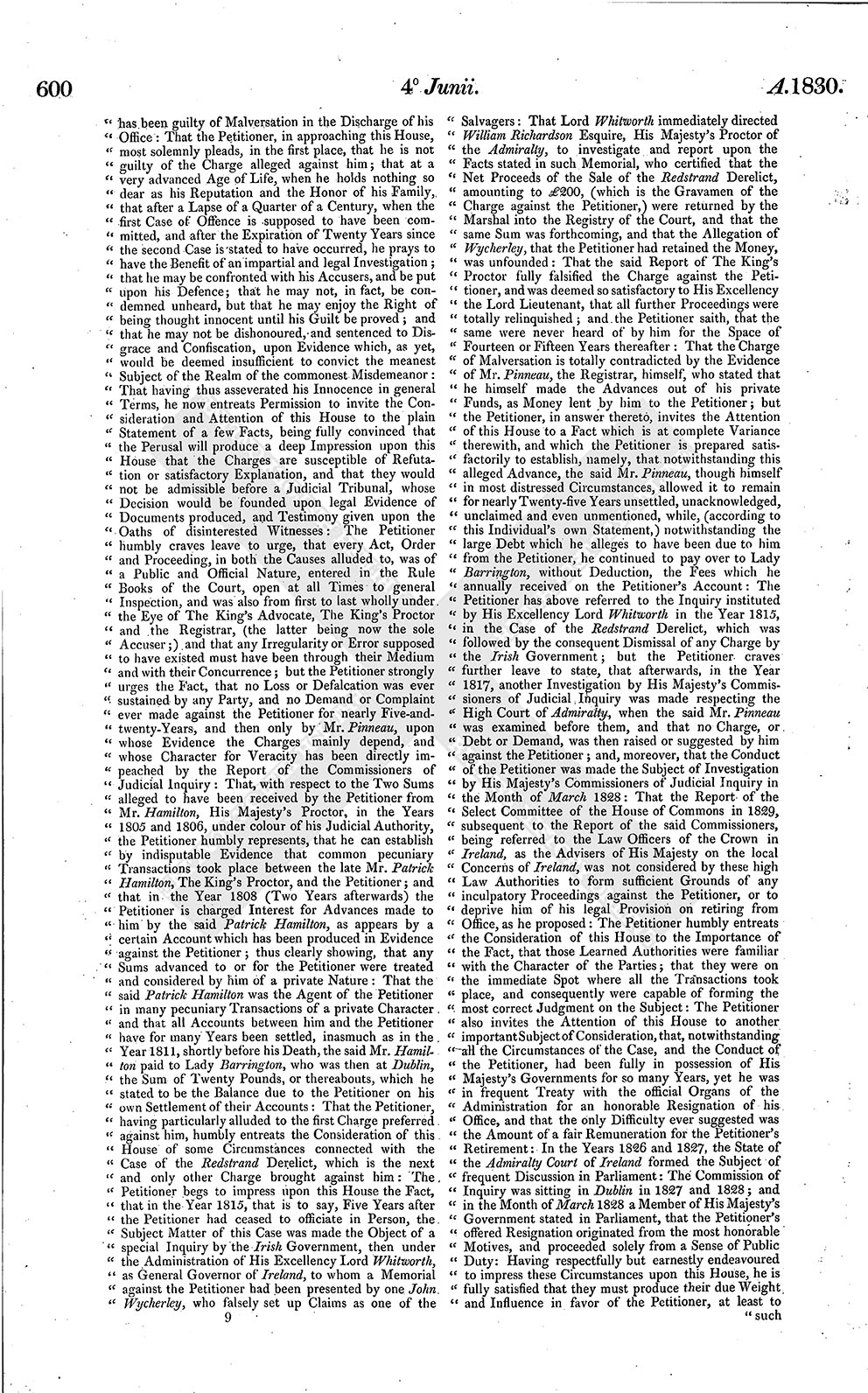
Upon reading the Petition of Sir Jonah Barrington Knight, Judge of His Majesty's High Court of Admiralty in Ireland; setting forth, "That the Petitioner was appointed to the Office of Judge of the said Admiralty Court by Letters Patent under the Great Seal of Ireland, dated the 23d May 1797, with Powers therein contained authorizing him to depute and surrogate any Deputy or Deputies as often as he should think fit: That the Petitioner hath enjoyed the said Office, and hath continued to exercise the same in Person or by Surrogates, (duly qualified,) for the last Thirty-three Years: That the Petitioner, in submitting his humble Petition to this House, respectfully craves leave to state, that, from the Nature of his Case, and the State of the Matter as now pending in Parliament, he is under the unavoidable Necessity of adverting to the Proceedings which have led The Honorable House of Commons to adopt an Address to His Majesty to remove the Petitioner from the Office which he holds as Judge of the High Court of Admiralty in Ireland: That the sole Charges brought against the Petitioner are, that as Judge of the said Court he did, in the Years 1805 and 1806, under colour of his Official Authority, apply to his own Use Two Sums amounting together to £500 9s. 2d. out of the Proceeds of the Derelict Ship Nancy, then lodged in the Hands of the Registrar of that Court; and that he did, in the Year 1810, in a similar Manner, apply to his own Use the Sum of £200 out of the Proceeds of the Redstrand Derelict; and thereby implying, that the Petitioner has been guilty of Malversation in the Discharge of his Office: That the Petitioner, in approaching this House, most solemnly pleads, in the first place, that he is not guilty of the Charge alleged against him; that at a very advanced Age of Life, when he holds nothing so dear as his Reputation and the Honor of his Family, that after a Lapse of a Quarter of a Century, when the first Case of Offence is supposed to have been committed, and after the Expiration of Twenty Years since the second Case is stated to have occurred, he prays to have the Benefit of an impartial and legal Investigation; that he may be confronted with his Accusers, and be put upon his Defence; that he may not, in fact, be condemned unheard, but that he may enjoy the Right of being thought innocent until his Guilt be proved; and that he may not be dishonoured, and sentenced to Disgrace and Confiscation, upon Evidence which, as yet, would be deemed insufficient to convict the meanest Subject of the Realm of the commonest Misdemeanor: That having thus asseverated his Innocence in general Terms, he now entreats Permission to invite the Consideration and Attention of this House to the plain Statement of a few Facts, being fully convinced that the Perusal will produce a deep Impression upon this House that the Charges are susceptible of Refutation or satisfactory Explanation, and that they would not be admissible before a Judicial Tribunal, whose Decision would be founded upon legal Evidence of Documents produced, and Testimony given upon the Oaths of disinterested Witnesses: The Petitioner humbly craves leave to urge, that every Act, Order and Proceeding, in both the Causes alluded to, was of a Public and Official Nature, entered in the Rule Books of the Court, open at all Times to general Inspection, and was also from first to last wholly under the Eye of The King's Advocate, The King's Proctor and the Registrar, (the latter being now the sole Accuser;) and that any Irregularity or Error supposed to have existed must have been through their Medium and with their Concurrence; but the Petitioner strongly urges the Fact, that no Loss or Defalcation was ever sustained by any Party, and no Demand or Complaint ever made against the Petitioner for nearly Five-andtwenty-Years, and then only by Mr. Pinneau, upon whose Evidence the Charges mainly depend, and whose Character for Veracity has been directly impeached by the Report of the Commissioners of Judicial Inquiry: That, with respect to the Two Sums alleged to have been received by the Petitioner from Mr. Hamilton, His Majesty's Proctor, in the Years 1805 and 1806, under colour of his Judicial Authority, the Petitioner humbly represents, that he can establish by indisputable Evidence that common pecuniary Transactions took place between the late Mr. Patrick Hamilton, The King's Proctor, and the Petitioner; and that in the Year 1808 (Two Years afterwards) the Petitioner is charged Interest for Advances made to him by the said Patrick Hamilton, as appears by a certain Account which has been produced in Evidence against the Petitioner; thus clearly showing, that any Sums advanced to or for the Petitioner were treated and considered by him of a private Nature: That the said Patrick Hamilton was the Agent of the Petitioner in many pecuniary Transactions of a private Character and that all Accounts between him and the Petitioner have for many Years been settled, inasmuch as in the Year 1811, shortly before his Death, the said Mr. Hamilton paid to Lady Barrington, who was then at Dublin, the Sum of Twenty Pounds, or thereabouts, which he stated to be the Balance due to the Petitioner on his own Settlement of their Accounts: That the Petitioner, having particularly alluded to the first Charge preferred against him, humbly entreats the Consideration of this House of some Circumstances connected with the Case of the Redstrand Derelict, which is the next and only other Charge brought against him: The Petitioner begs to impress upon this House the Fact, that in the Year 1815, that is to say, Five Years after the Petitioner had ceased to officiate in Person, the Subject Matter of this Case was made the Object of a special Inquiry by the Irish Government, then under the Administration of His Excellency Lord Whitworth, as General Governor of Ireland, to whom a Memorial against the Petitioner had been presented by one John Wycherley, who falsely set up Claims as one of the Salvagers: That Lord Whitworth immediately directed William Richardson Esquire, His Majesty's Proctor of the Admiralty, to investigate and report upon the Facts stated in such Memorial, who certified that the Net Proceeds of the Sale of the Redstrand Derelict, amounting to £200, (which is the Gravamen of the Charge against the Petitioner,) were returned by the Marshal into the Registry of the Court, and that the same Sum was forthcoming, and that the Allegation of Wycherley, that the Petitioner had retained the Money, was unfounded: That the said Report of The King's Proctor fully falsified the Charge against the Petitioner, and was deemed so satisfactory to His Excellency the Lord Lieutenant, that all further Proceedings were totally relinquished; and the Petitioner saith, that the same were never heard of by him for the Space of Fourteen or Fifteen Years thereafter: That the Charge of Malversation is totally contradicted by the Evidence of Mr. Pinneau, the Registrar, himself, who stated that he himself made the Advances out of his private Funds, as Money lent by him to the Petitioner; but the Petitioner, in answer thereto, invites the Attention of this House to a Fact which is at complete Variance therewith, and which the Petitioner is prepared satisfactorily to establish, namely, that notwithstanding this alleged Advance, the said Mr. Pinneau, though himself in most distressed Circumstances, allowed it to remain for nearly Twenty-five Years unsettled, unacknowledged, unclaimed and even unmentioned, while, (according to this Individual's own Statement,) notwithstanding the large Debt which he alleges to have been due to him from the Petitioner, he continued to pay over to Lady Barrington, without Deduction, the Fees which he annually received on the Petitioner's Account: The Petitioner has above referred to the Inquiry instituted by His Excellency Lord Whitworth in the Year 1815, in the Case of the Redstrand Derelict, which was followed by the consequent Dismissal of any Charge by the Irish Government; but the Petitioner craves further leave to state, that afterwards, in the Year 1817, another Investigation by His Majesty's Commissioners of Judicial Inquiry was made respecting the High Court of Admiralty, when the said Mr. Pinneau was examined before them, and that no Charge, or Debt or Demand, was then raised or suggested by him against the Petitioner; and, moreover, that the Conduct of the Petitioner was made the Subject of Investigation by His Majesty's Commissioners of Judicial Inquiry in the Month of March 1828: That the Report of the Select Committee of the House of Commons in 1829, subsequent to the Report of the said Commissioners, being referred to the Law Officers of the Crown in Ireland, as the Advisers of His Majesty on the local Concerns of Ireland, was not considered by these high Law Authorities to form sufficient Grounds of any inculpatory Proceedings against the Petitioner, or to deprive him of his legal Provision on retiring from Office, as he proposed: The Petitioner humbly entreats the Consideration of this House to the Importance of the Fact, that those Learned Authorities were familiar with the Character of the Parties; that they were on the immediate Spot where all the Transactions took place, and consequently were capable of forming the most correct Judgment on the Subject: The Petitioner also invites the Attention of this House to another important Subject of Consideration, that, notwithstanding all the Circumstances of the Case, and the Conduct of the Petitioner, had been fully in possession of His Majesty's Governments for so many Years, yet he was in frequent Treaty with the official Organs of the Administration for an honorable Resignation of his Office, and that the only Difficulty ever suggested was the Amount of a fair Remuneration for the Petitioner's Retirement: In the Years 1826 and 1827, the State of the Admiralty Court of Ireland formed the Subject of frequent Discussion in Parliament: The Commission of Inquiry was sitting in Dublin in 1827 and 1828; and in the Month of March 1828 a Member of His Majesty's Government stated in Parliament, that the Petitioner's offered Resignation originated from the most honorable Motives, and proceeded solely from a Sense of Public Duty: Having respectfully but earnestly endeavoured to impress these Circumstances upon this House, he is fully satisfied that they must produce their due Weight and Influence in favor of the Petitioner, at least to such an Extent as to induce this House to pause before it concurs in an Address to the Throne for his Removal from Office, which, so far as relates to this House, as an independent Branch of the Legislature, would in Effect be to pass a Penal Sentence, without Evidence to warrant it, and to pronounce the Petitioner guilty, without his having had the Means or Opportunity of being heard in his Defence: And the Petitioner humbly submits to this House, that the Address carried up by The Honorable The House of Commons on Tuesday 22d May last, for the Removal of the Petitioner as one of His Majesty's Judges, will not meet their Lordships Concurrence, for the following Reasons; first, that their Lordships House, forming the highest Judicial Tribunal in the Realm, and the Court of dernier Resort, establishing Precedents for future Ages on all Subjects of Law, Equity and Justice, never sanction any Measure or Course of Proceeding which does not seem to their Wisdom to be unequivocally founded on the Laws of the Land, and the Lex Parliamentaria, and, if it savours of Criminality, by the strict Construction of the Penal Statutes; secondly, that the Resolutions condemnatory of the Petitioner, and on which such Address was founded, were passed by a Committee of the Whole House without the Production of any Evidence whatsoever, oral or documentary, or any Investigation into the Merits of the Petitioner's Case; thirdly, that such Resolutions are composed solely of selected ex-parte Sentences, extracted from very voluminous Reports of confused and conflicting Evidence, taken in private, before a close Committee of The Honorable The House of Commons, composed of Ten attending Members, and without any Inquiry or Investigation by that Honorable House itself, except simply reading over such Resolutions and reporting them in like Manner; the Petitioner humbly states, that although no Evidence whatever was produced, received or gone into before that Honorable House, such Resolutions declare that the whole were borne out by the Evidence, and such Declaration is followed on the same Night, condemning the Petitioner in like Manner, without any Investigation, and in his unavoidable Absence, to the Deprivation of his Honor, his Office and his Means of Subsistence; fourthly, that at the Conclusion of those Resolutions The Honorable The House of Commons, in like Manner, without any Investigation whatsoever, voted an Address to His Gracious Majesty for the Petitioner's Removal: But the Petitioner humbly submits, that he was by Law, Precedent and the due Construction of the Judges Act, entitled to a Judicial Trial, or at least to a full and open Investigation on the Merits of his Case at their Bar, by Evidence, and confronting his Accusers, previous to such Resolutions and Address being voted against him, so that sufficient Criminality should have been in Evidence before that Honorable House itself on which to found such Proceedings: To confirm these Observations and Statements the Petitioner begs Permission humbly to suggest some Principles of settled Law bearing upon these Cases, and by legal Inference and Deduction, clearly shewing that the Address for the Petitioner's Removal cannot meet the Concurrence of this House, who never would pass such Resolutions or Address upon similar Proceedings, or adopt any Act upon any Evidence taken by another Tribunal, upon simple Assertion, without Oath or even Publicity: By the Letter and Spirit of British Law and Jurisprudence, every accused Person is held innocent until his Criminality is established by an open public Investigation, through legal Evidence and a competent Tribunal; this fundamental Principle covers the whole Face of our Penal Code; it forms the grand Distinction between a despotic and a free Constitution; and an Outlaw only is deprived of its Protection: Every Penal Statute therefore, and every Penal Clause of any Statute conferring penal Powers, or the Authorities which might deviate or diminish the Security of that fundamental Principle, are by another Principle of the Laws and of the Rules of Evidence, to be construed strictly; and where a Doubt arises, either on the Law or on the Facts, such Construction is in such Case always to be made in favor of the accused and of presumed Innocence; and this being a constitutional as well as a legal Construction, extends to all Courts and all Jurisdictions throughout the Realm: That Statute which, consummating the great Charter and the Bill of Rights, confers a final Security to the Liberties of Great Britain, by rendering the Judges independent of the Crown, contains a Clause which entrusts His Majesty with a discretional Power to remove any Judge upon Addresses of both Houses of Parliament; but neither the Quantity nor Quality of Cause or Crime which may warrant such Address for Removal is designated or alluded to, nor is the Mode or Course of Proceeding by which such Address is to be proceeded on by either House of Parliament pointed out by that or any other Statute; however, the Constitution and the Common Law supply the last Omission: By Reference to the ascertained Jurisdictions of both Houses of Parliament, The House of Lords, the highest Tribunal of the Country, possessing both inquisitorial and judicial Jurisdictions, adjudicating with open Doors, and examining on Oath, have always the integral Power and Authority of founding their Proceedings on legal Evidence of Facts, obtained in a solemn Manner and open Investigation, whereby the accused have all the legal Advantages, Rights and Safeguards he would be entitled to in any Court of Justice; their Course of Proceeding, therefore, is clear and unembarrassed; but the Commons House of Parliament have no such integral Jurisdiction, and neither the Silence of the Statute, not its own Privileges, can create or extend any Jurisdiction or any Power not constitutionally given to it by Law, or its own inherent Privileges, or prescriptive Precedents: The House of Commons however possesses no Penal Jurisdiction, either directly or indirectly, except the occasional one when its legal Privileges are broken or infringed upon: It can frame Resolutions and Addresses with Penal Objects, but only as laying the Ground and incipient Foundation for ulterior Measures; but its Proceedings are in no Case mandatory on the Lords; a limited Tribunal cannot command an extensive one, and in Penal Cases it acts as a Grand Jury, to investigate and report, but the Lords are never obliged to adopt its Resolutions: The Petitioner further begs leave humbly to submit, that the Clause of the Judges Bill which gives to The King the Power of removing Judges upon Addresses of both Houses of Parliament is not mandatory, but discretional; and when the very Object and Enactments of that Statute may be partially defeated by the Operation of Addresses, the Crown, of course, before it acts upon that Clause, exercises its own sound Discretion as to the Justice and Expediency of subverting pro tempore so vital a Principle of the Constitution entrusted to His Protection: It is therefore constitutionally essential that ample Grounds and a sound and sufficient Foundation should be submitted to the deliberate Consideration of the Crown, on which to induce its Accession to such Addresses, otherwise the Weight of Parties or of Prejudices, of Politicks or of Passions, might influence His Majesty to remove any Judge upon inadequate Grounds or interested Misrepresentations: When therefore The Honorable The House of Commons are disposed to address the Crown under that Clause of the Statute, for the Exercise of its Power in the Removal of a Judge, that Clause being of a penal Nature, it is constitutionally bound to proceed according to that Course which within its Jurisdiction most approximates to the legal Rights of every Subject in competent Courts of Justice: That Course is plain and open, namely, by a public Inquiry and Investigation at the Bar; and as Evidence there cannot be examined in a solemn Manner, to elicit Truth, as in the superior House of Parliament, and Witnesses have only to dread a few Days Confinement for a Contempt or a Breach of Privilege, so they may depose upon bare Assertion what they please, with little Fear of Punishment: The only Safety therefore for an accused Person is an open, public and strict Examination, openly confronting and examining his Accusers, and his exculpatory Evidence, as in all Courts in the United Kingdom: That being duly performed, the Honorable House may then originate ulterior Proceedings, with a penal View, because it had then done what the Law, Precedent and the Constitution gave Authority for doing: The Honorable The House of Commons have no doubt a Power of delegating to a Committee the Task of investigating with closed Doors, inquisitorially, the Subject Matter of any thing it intends for more formal Investigation; but a close Committee has constitutionally no Power to do more than investigate, and report to the House by whom it is appointed; but for ulterior Proceedings the Decision reverts to the House itself, and if the Report of that Committee, and the private Evidence which the Report contains, should induce the House to proceed, or to investigate, they then hear the Evidence before the Whole House, openly in the Presence of several Hundred Members, which might entirely alter the View of the Case from that furnished by close and reported Evidence, and probably lead to a very different Result: It is for these Reasons the Petitioner humbly states, that Evidence taken and reported by a close Committee is only the Basis of further Enquiry, but that taken before the Whole House is Evidence for its Decision; and as the Opinion of Ten Members may be totally over-ruled by that of Four Hundred, an accused Subject is constitutionally entitled to that open Investigation: And any Decision in personam, grounded on the reported Evidence of a close Committee, seems not to be perfectly consonant to the Common Law, the Rules of Evidence, the Principles of Jurisprudence, or the Rights of an accused: If then a simple Individual enjoys such protecting Means, how much more so, the Petitioner would urge, is one of the King's Judges entitled to experience the same Course of Justice which he is appointed to administer to others: The severest Sentence in the Penal Code is, by far, the Removal of a Judge from his Station; and no trivial Case should deprive him of the same Power of Defence which the Law allows to Criminals of the lowest Degree: The Petitioner humbly suggests, that there are Four distinct Modes of Procedure applicable to the Case of a Judge holding his Office by Patent, during good Behaviour; first, in Cases of Misconduct not extending to a legal Misdemeanor, the appropriate Course appears to be by Scire facias to repeal his Patent, "Good Behaviour" being the Condition precedent of the Judges Tenure; secondly, when the Conduct amounts to what a Court might consider a Misdemeanor, then by Information; thirdly, if it amounts to actual Crime, then by Impeachment; fourthly, and in all Cases, by the joint Exercise of the inquisitorial and judicial Jurisdiction of the House of Lords: Every Gradation therefore of a Judge's Conduct may be judicially investigated and decided: If adverse to the Judge, both Houses may concur in exercising one of the most grave and important of their Prerogatives: The Petitioner finally and humbly submits to their Lordships the following short Summary of some of the Facts which the Petitioner will be able to prove and substantiate before their Lordships, as exculpatory of any corrupt Act or Intention, or any Malversation which should subject him to a Punishment so grievous: That every Official Act, or Order and Proceeding, in both Cases, were open public Acts, entered by the proper Officer, and recorded in the regular Rule Books of the Court, and subject to the unrestricted Inspection of any Suitor, Claimant, or Person connected with the Court, or who had any Interest in its Proceedings, and at no Time or in any Instance secret or clandestine, and so continues to the present Day: That every Official Act, Order or Proceeding passed through the Medium of His Majesty's Proctor of Admiralty, under the Eye of His Majesty's Advocate of Admiralty, and in which Daniel Pinneau himself, (the Registrar,) was the Officer and Actuary: That no Party, Claimant, Owner, or any other Person whatsoever, makes or made any Complaint or Charge against the Petitioner, or alleges any Loss, Injury or Defalcation whatsoever, through or by the Conduct, directly or indirectly, of the Petitioner, as is falsely asserted and circulated, to the great Injury of the Petitioner: That Daniel Pinneau, the said Registrar, is the only Person who has made any Charge or alleged any Demand whatsoever against the Petitioner, and who alone has ventured to assert that the Petitioner is in his Debt for Money actually lent to him out of his own private Funds, not out of any public Funds or Deposits of any Suitor: That the said Mr. Pinneau never demanded or claimed any such pretended Debt, or any Security, nor ever mentioned such Debt to any Officer of the Court, or to any Connection of the Petitioner, nor in fact to any Person whatsoever, until the Year 1827, although he had been himself in the Interim much embarrassed, and had been sued to Execution by the Petitioner's Solicitor and Agent, John C. Lyons Esquire, for so small a Sum as £35: That in 1817 the said Mr. Pinneau was examined personally by the Commissioners of Judicial Inquiry in Dublin, as to his Office of Registrar of the Admiralty, and did not make any Charge or suggest any Debt of the Petitioner, although the Petitioner's Absence was made a Subject of Inquiry and Report by the said Commissioners: That in the Year 1817 the said Mr. Pinneau sold his Office of Registrar to Mr. Robinson for £900, and handed to him all the Official Documents and Rule Books of the Court, but that he never mentioned to the said Mr. Robinson any Demand he had, or any Debt or Charge against the Petitioner: That in 1815 the very same Charge of Malversation as to the Redstrand Derelict was made against the Petitioner to The Lord Lieutenant of Ireland, and was investigated, and reported to be false, as therein beforementioned; but which Proceeding and Report, although of great Importance to the Petitioner, was not produced or made known to the Petitioner for more than Nine Months after the Select Committee had discharged the Petitioner: And as the Charges against the Petitioner have been publicly made, and Prejudices widely disseminated, to the serious Injury of his Character, so he humbly prays that the Investigation may be of equal Publicity, in order that even-handed Justice may be dealt towards him: The Petitioner therefore humbly prays, that any Charge brought against him may be made before an open and public Tribunal, and substantiated by Judicial Evidence, that the Witnesses may be on Oath, and liable to Cross Examination; that he may have the Benefit of an impartial and legal Investigation; that he may be confronted with his Accusers, and be put upon his Defence; and the Petitioner further prays, That their Lordships will not be induced to give their solemn Concurrence to an Address to His Most Gracious Majesty, for the Removal of the Petitioner from his Office of Judge, until the Charges alleged against him have been publicly established by legal and judicial Evidence, nor until he has had an Opportunity of examining the Witnesses and Documentary Evidence against him, and of previously inspecting and examining the Rule Books of the Admiralty Court from the Year 1805 to 1815, both inclusive, and the Originals of the Documentary Evidence produced against the Petitioner, and likewise of producing Witnesses and Documentary Testimony before their Lordships, on his own Behalf, the List of which he is prepared to produce; and finally, the Petitioner humbly prays to be heard by himself, or Counsel or Agent, at the Bar of their Lordships House, on his Defence, and upon the Subject Matter of this his humble Petition:"
It is Ordered, That the Petitioner be at liberty to be heard by himself, or Counsel or Agent, on his Defence, and upon the Subject Matter of the said Petition, as desired.
Consideration of the Address of H.C. respecting Sir J. Barrington put off:
The Order of the Day being read for taking into Consideration the Address communicated by the Commons at the Conference on the 25th Day of May last, for the Removal of Sir Jonah Barrington from the Office of Judge of the High Court of Admiralty in Ireland; and for the Lords to be summoned;
Ordered, That this House will take the said Address into Consideration on Monday the 14th of this instant June; and that the Lords be summoned; and that His Majesty's Attorney General do then attend.
Witnesses to attend:
Ordered, That Daniel Pinneau Esquire, William Richardson Esquire and Matthew Anderson Esquire do attend this House on Monday the 14th of this instant June, in order to their being examined as Witnesses touching the Conduct of Sir Jonah Barrington, Judge of the High Court of Admiralty in Ireland.
Sir J. Barrington to be heard.
Ordered, That Sir Jonah Barrington be at liberty to be then heard by himself or his Counsel against any Charge to be brought against him.
General Cemetery in London, Petition of G. F. Carden respecting.
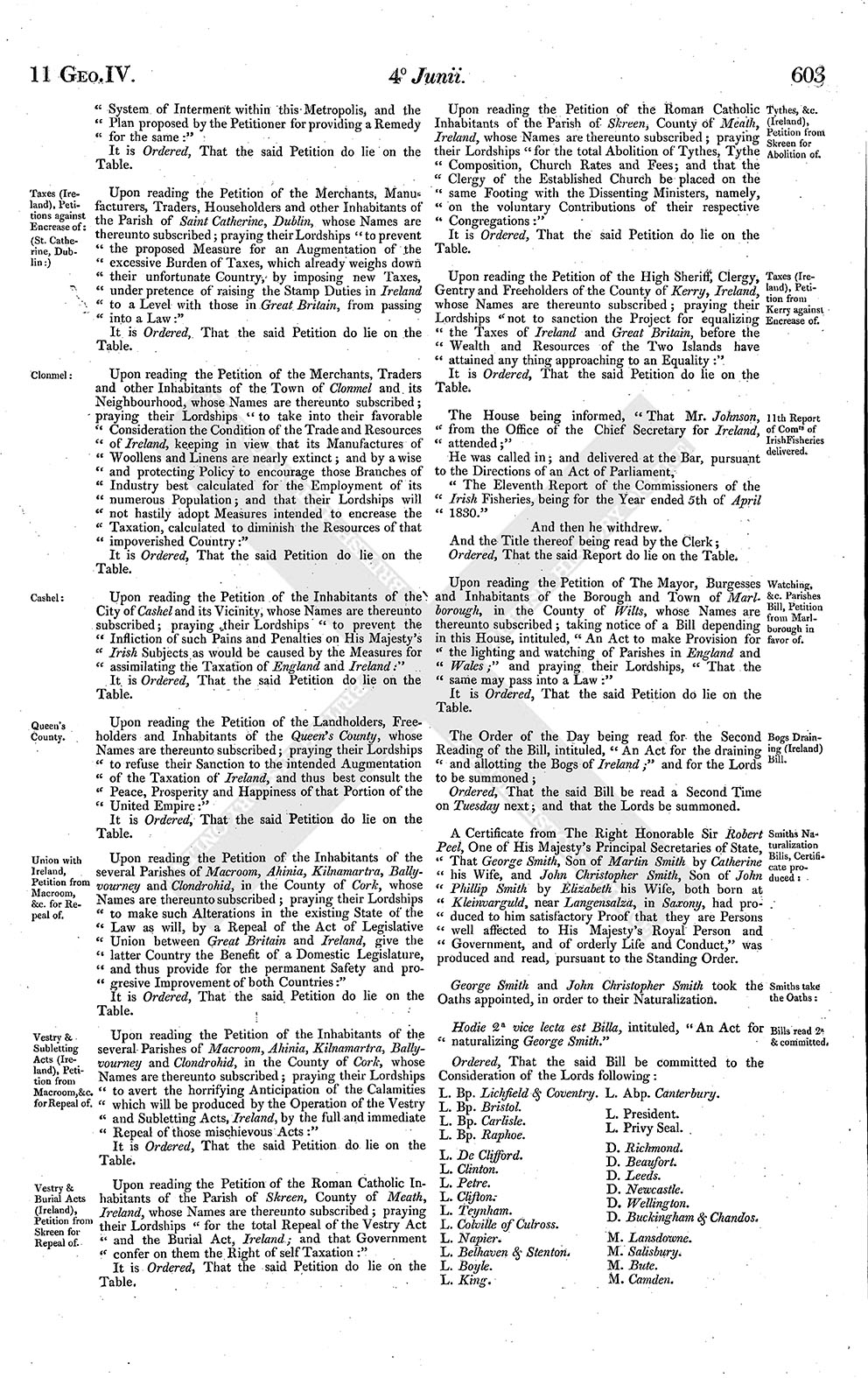
Upon reading the Petition of George Frederick Carden of The Honorable Society of the Inner Temple, Barrister at Law; praying their Lordships, "That a Committee may be appointed to enquire into the Evils of the present System of Interment within this Metropolis, and the Plan proposed by the Petitioner for providing a Remedy for the same:"
It is Ordered, That the said Petition do lie on the Table.
Taxes (Ireland), Petitions against Encrease of: (St. Catherine, Dublin:)
Upon reading the Petition of the Merchants, Manufacturers, Traders, Householders and other Inhabitants of the Parish of Saint Catherine, Dublin, whose Names are thereunto subscribed; praying their Lordships "to prevent the proposed Measure for an Augmentation of the excessive Burden of Taxes, which already weighs down their unfortunate Country, by imposing new Taxes, under pretence of raising the Stamp Duties in Ireland to a Level with those in Great Britain, from passing into a Law:"
It is Ordered, That the said Petition do lie on the Table.
Clonmel:
Upon reading the Petition of the Merchants, Traders and other Inhabitants of the Town of Clonmel and its Neighbourhood, whose Names are thereunto subscribed; praying their Lordships "to take into their favorable Consideration the Condition of the Trade and Resources of Ireland, keeping in view that its Manufactures of Woollens and Linens are nearly extinct; and by a wise and protecting Policy to encourage those Branches of Industry best calculated for the Employment of its numerous Population; and that their Lordships will not hastily adopt Measures intended to encrease the Taxation, calculated to diminish the Resources of that impoverished Country:"
It is Ordered, That the said Petition do lie on the Table.
Cashel:
Upon reading the Petition of the Inhabitants of the City of Cashel and its Vicinity, whose Names are thereunto subscribed; praying their Lordships "to prevent the Infliction of such Pains and Penalties on His Majesty's Irish Subjects as would be caused by the Measures for assimilating the Taxation of England and Ireland:"
It is Ordered, That the said Petition do lie on the Table.
Queen's County.
Upon reading the Petition of the Landholders, Freeholders and Inhabitants of the Queen's County, whose Names are thereunto subscribed; praying their Lordships "to refuse their Sanction to the intended Augmentation of the Taxation of Ireland, and thus best consult the Peace, Prosperity and Happiness of that Portion of the United Empire:"
It is Ordered, That the said Petition do lie on the Table.
Union with Ireland, Petition from Macroom, & c. for Repeal of.
Upon reading the Petition of the Inhabitants of the several Parishes of Macroom, Ahinia, Kilnamartra, Ballyvourney and Clondrohid, in the County of Cork, whose Names are thereunto subscribed; praying their Lordships "to make such Alterations in the existing State of the Law as will, by a Repeal of the Act of Legislative Union between Great Britain and Ireland, give the latter Country the Benefit of a Domestic Legislature, and thus provide for the permanent Safety and progresive Improvement of both Countries:"
It is Ordered, That the said Petition do lie on the Table.
Vestry & Subletting Acts (Ireland), Petition from Macroom, & c. for Repeal of.
Upon reading the Petition of the Inhabitants of the several Parishes of Macroom, Ahinia, Kilnamartra, Ballyvourney and Clondrohid, in the County of Cork, whose Names are thereunto subscribed; praying their Lordships "to avert the horrifying Anticipation of the Calamities which will be produced by the Operation of the Vestry and Subletting Acts, Ireland, by the full and immediate Repeal of those mischievous Acts:"
It is Ordered, That the said Petition do lie on the Table.
Vestry & Burial Acts (Ireland), Petition from Skreen for Repeal of.
Upon reading the Petition of the Roman Catholic Inhabitants of the Parish of Skreen, County of Meath, Ireland, whose Names are thereunto subscribed; praying their Lordships "for the total Repeal of the Vestry Act and the Burial Act, Ireland; and that Government confer on them the Right of self Taxation:"
It is Ordered, That the said Petition do lie on the Table.
Tythes, & c. (Ireland), Petition from Skreen for Abolition of.
Upon reading the Petition of the Roman Catholic Inhabitants of the Parish of Skreen, County of Meath, Ireland, whose Names are thereunto subscribed; praying their Lordships "for the total Abolition of Tythes, Tythe Composition, Church Rates and Fees; and that the Clergy of the Established Church be placed on the same Footing with the Dissenting Ministers, namely, on the voluntary Contributions of their respective Congregations:"
It is Ordered, That the said Petition do lie on the Table.
Taxes (Ireland), Petition from Kerry against Encrease of.
Upon reading the Petition of the High Sheriff, Clergy, Gentry and Freeholders of the County of Kerry, Ireland, whose Names are thereunto subscribed; praying their Lordships "not to sanction the Project for equalizing the Taxes of Ireland and Great Britain, before the Wealth and Resources of the Two Islands have attained any thing approaching to an Equality:"
It is Ordered, That the said Petition do lie on the Table.
11th Report of Com rs of Irish Fisheries delivered.
The House being informed, "That Mr. Johnson, from the Office of the Chief Secretary for Ireland, attended;"
He was called in; and delivered at the Bar, pursuant to the Directions of an Act of Parliament,
"The Eleventh Report of the Commissioners of the Irish Fisheries, being for the Year ended 5th of April 1830."
And then he withdrew.
And the Title thereof being read by the Clerk;
Ordered, That the said Report do lie on the Table.
Watching, & c. Parishes Bill, Petition from Marlborough in favor of.
Upon reading the Petition of The Mayor, Burgesses and Inhabitants of the Borough and Town of Marlborough, in the County of Wilts, whose Names are thereunto subscribed; taking notice of a Bill depending in this House, intituled, "An Act to make Provision for the lighting and watching of Parishes in England and Wales;" and praying their Lordships, "That the same may pass into a Law:"
It is Ordered, That the said Petition do lie on the Table.
Bogs Draining (Ireland) Bill.
The Order of the Day being read for the Second Reading of the Bill, intituled, "An Act for the draining and allotting the Bogs of Ireland;" and for the Lords to be summoned;
Ordered, That the said Bill be read a Second Time on Tuesday next; and that the Lords be summoned.
Smiths Naturalization Bills, Certificate produced:
A Certificate from The Right Honorable Sir Robert Peel, One of His Majesty's Principal Secretaries of State, "That George Smith, Son of Martin Smith by Catherine his Wife, and John Christopher Smith, Son of John Phillip Smith by Elizabeth his Wife, both born at Kleinvarguld, near Langensalza, in Saxony, had produced to him satisfactory Proof that they are Persons well affected to His Majesty's Royal Person and Government, and of orderly Life and Conduct," was produced and read, pursuant to the Standing Order.
Smiths take the Oaths:
George Smith and John Christopher Smith took the Oaths appointed, in order to their Naturalization.
Bills read 2 a & committed.
Hodie 2a vice lecta est Billa, intituled, "An Act for naturalizing George Smith."
Ordered, That the said Bill be committed to the Consideration of the Lords following:
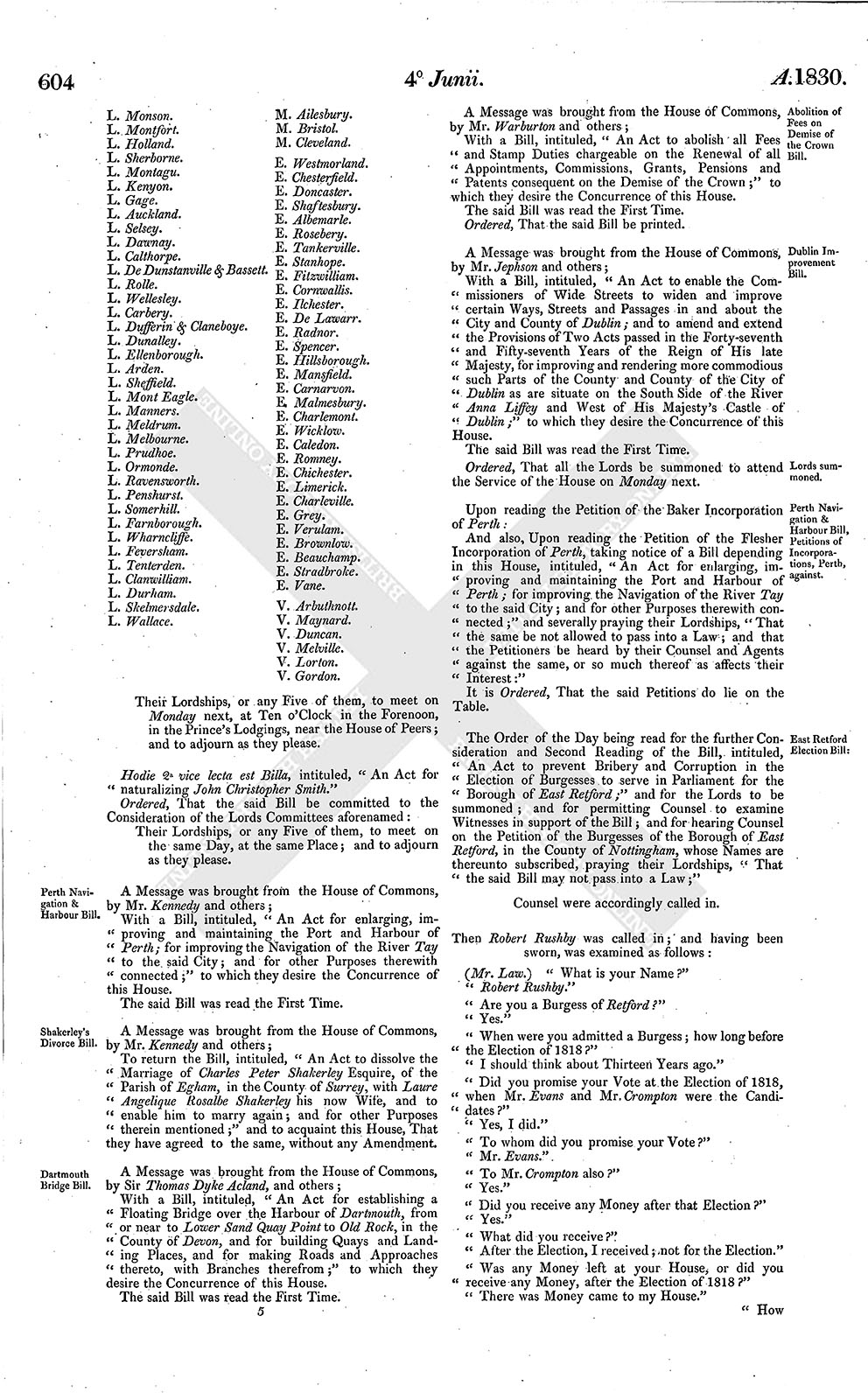
Their Lordships, or any Five of them, to meet on Monday next, at Ten o'Clock in the Forenoon, in the Prince's Lodgings, near the House of Peers; and to adjourn as they please.
Hodie 2a vice lecta est Billa, intituled, "An Act for naturalizing John Christopher Smith."
Ordered, That the said Bill be committed to the Consideration of the Lords Committees aforenamed:
Their Lordships, or any Five of them, to meet on the same Day, at the same Place; and to adjourn as they please.
Perth Navigation & Harbour Bill.
A Message was brought from the House of Commons, by Mr. Kennedy and others;
With a Bill, intituled, "An Act for enlarging, improving and maintaining the Port and Harbour of Perth; for improving the Navigation of the River Tay to the said City; and for other Purposes therewith connected;" to which they desire the Concurrence of this House.
The said Bill was read the First Time.
Shakerley's Divorce Bill.
A Message was brought from the House of Commons, by Mr. Kennedy and others;
To return the Bill, intituled, "An Act to dissolve the Marriage of Charles Peter Shakerley Esquire, of the Parish of Egham, in the County of Surrey, with Laure Angelique Rosalbe Shakerley his now Wife, and to enable him to marry again; and for other Purposes therein mentioned;" and to acquaint this House, That they have agreed to the same, without any Amendment.
Dartmouth Bridge Bill.
A Message was brought from the House of Commons, by Sir Thomas Dyke Acland, and others;
With a Bill, intituled, "An Act for establishing a Floating Bridge over the Harbour of Dartmouth, from or near to Lower Sand Quay Point to Old Rock, in the County of Devon, and for building Quays and Landing Places, and for making Roads and Approaches thereto, with Branches therefrom;" to which they desire the Concurrence of this House.
The said Bill was read the First Time.
Abolition of Fees on Demise of the Crown Bill.
A Message was brought from the House of Commons, by Mr. Warburton and others;
With a Bill, intituled, "An Act to abolish all Fees and Stamp Duties chargeable on the Renewal of all Appointments, Commissions, Grants, Pensions and Patents consequent on the Demise of the Crown;" to which they desire the Concurrence of this House.
The said Bill was read the First Time.
Ordered, That the said Bill be printed.
Dublin Improvement Bill.
A Message was brought from the House of Commons, by Mr. Jephson and others;
With a Bill, intituled, "An Act to enable the Commissioners of Wide Streets to widen and improve certain Ways, Streets and Passages in and about the City and County of Dublin; and to amend and extend the Provisions of Two Acts passed in the Forty-seventh and Fifty-seventh Years of the Reign of His late Majesty, for improving and rendering more commodious such Parts of the County and County of the City of Dublin as are situate on the South Side of the River Anna Liffey and West of His Majesty's Castle of Dublin;" to which they desire the Concurrence of this House.
The said Bill was read the First Time.
Lords summoned.
Ordered, That all the Lords be summoned to attend the Service of the House on Monday next.
Perth Navigation & Harbour Bill, Petitions of Incorporations, Perth, against.
Upon reading the Petition of the Baker Incorporation of Perth:
And also, Upon reading the Petition of the Flesher Incorporation of Perth, taking notice of a Bill depending in this House, intituled, "An Act for enlarging, improving and maintaining the Port and Harbour of Perth; for improving the Navigation of the River Tay to the said City; and for other Purposes therewith connected;" and severally praying their Lordships, "That the same be not allowed to pass into a Law; and that the Petitioners be heard by their Counsel and Agents against the same, or so much thereof as affects their Interest:"
It is Ordered, That the said Petitions do lie on the Table.
East Retford Election Bill:
The Order of the Day being read for the further Consideration and Second Reading of the Bill, intituled, "An Act to prevent Bribery and Corruption in the Election of Burgesses to serve in Parliament for the Borough of East Retford;" and for the Lords to be summoned; and for permitting Counsel to examine Witnesses in support of the Bill; and for hearing Counsel on the Petition of the Burgesses of the Borough of East Retford, in the County of Nottingham, whose Names are thereunto subscribed, praying their Lordships, "That the said Bill may not pass into a Law;"
Counsel were accordingly called in.
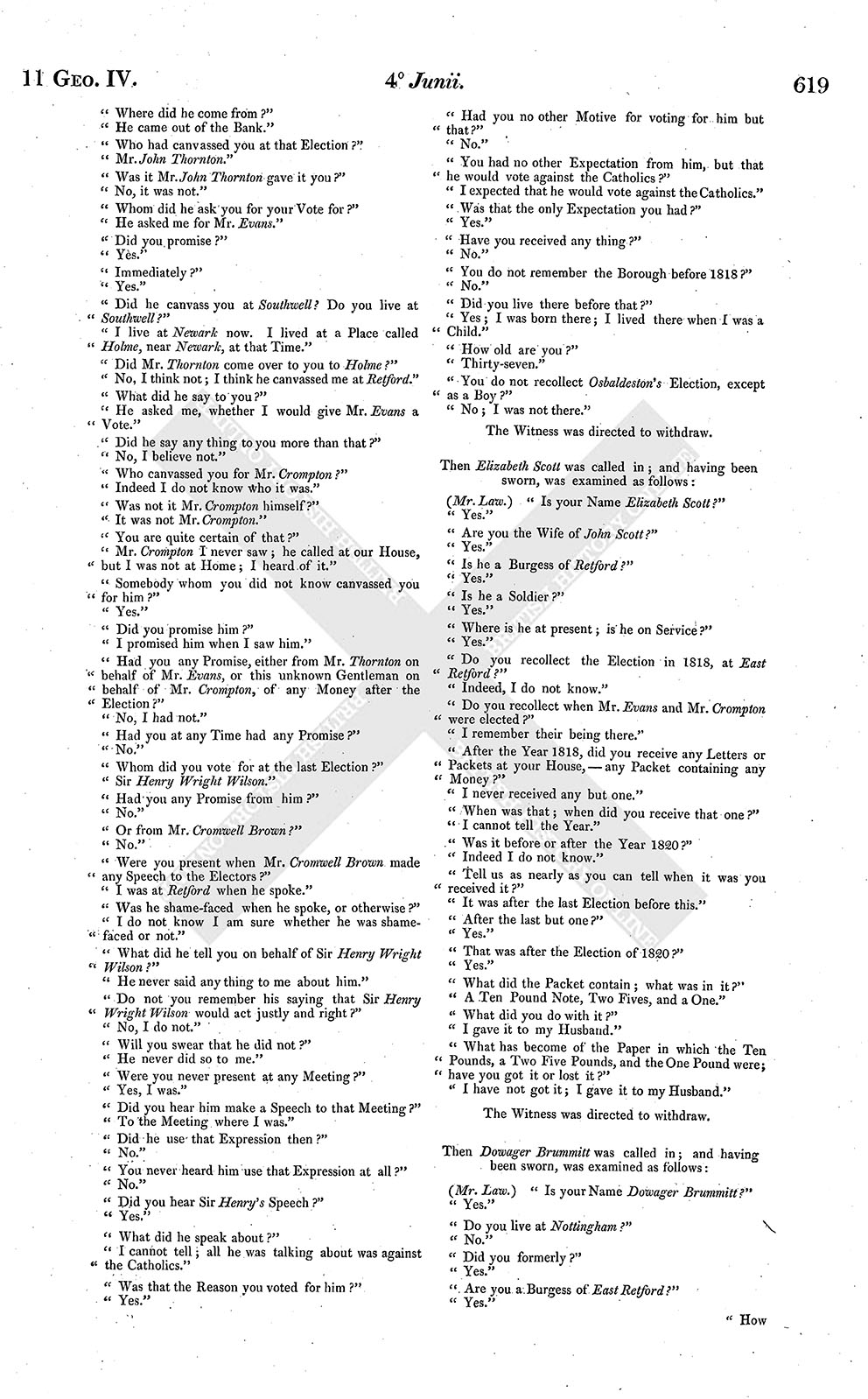
Then Robert Rushby was called in; and having been sworn, was examined as follows:
(Mr. Law.) "What is your Name?"
"Robert Rushby."
"Are you a Burgess of Retford?"
"Yes."
"When were you admitted a Burgess; how long before the Election of 1818?"
"I should think about Thirteen Years ago."
"Did you promise your Vote at the Election of 1818, when Mr. Evans and Mr. Crompton were the Candidates?"
"Yes, I did."
"To whom did you promise your Vote?"
"Mr. Evans."
"To Mr. Crompton also?"
"Yes."
"Did you receive any Money after that Election?"
"Yes."
"What did you receive?"
"After the Election, I received; not for the Election."
"Was any Money left at your House, or did you receive any Money, after the Election of 1818?"
"There was Money came to my House."
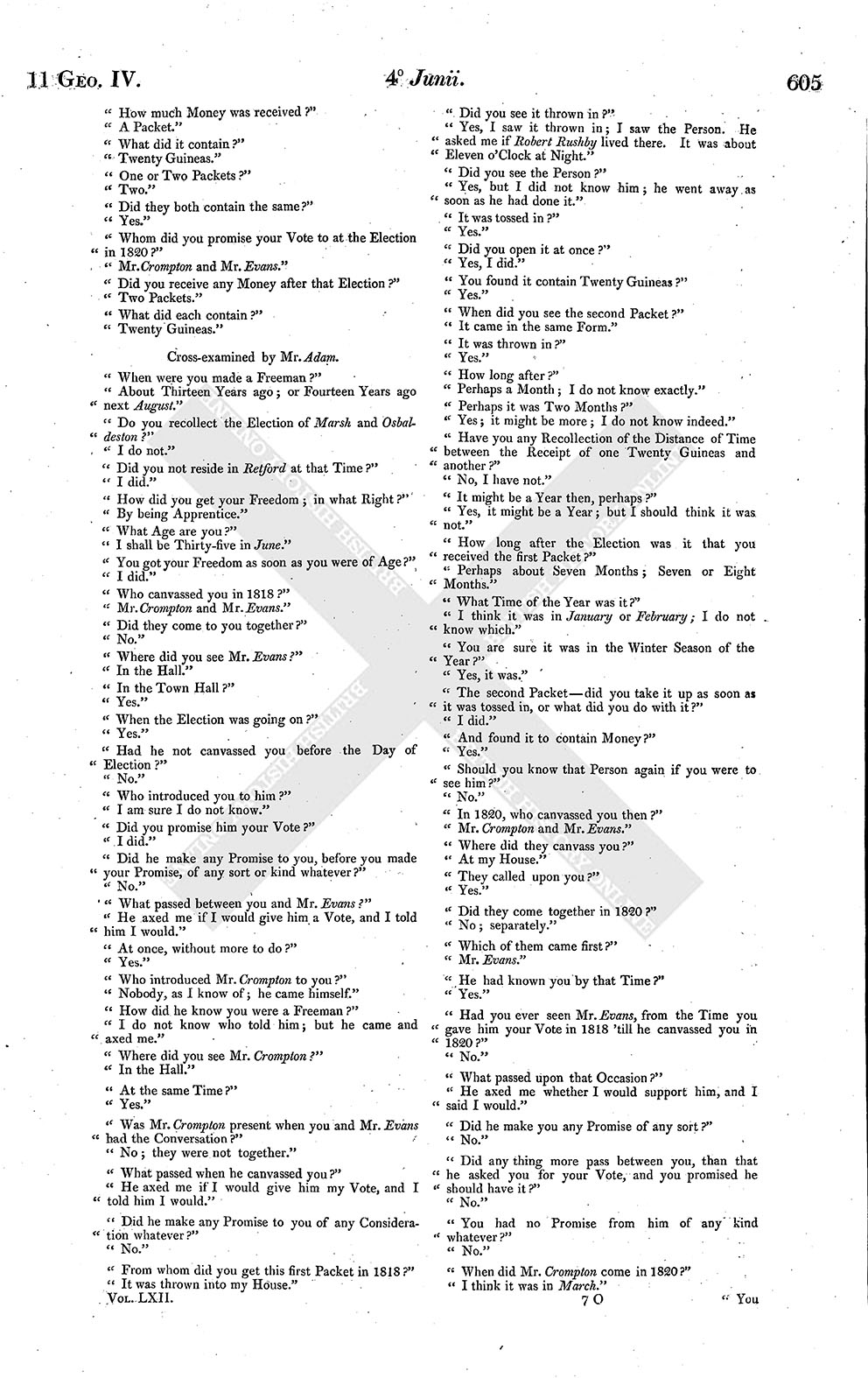
"How much Money was received?"
"A Packet."
"What did it contain?"
"Twenty Guineas."
"One or Two Packets?"
"Two."
"Did they both contain the same?"
"Yes."
"Whom did you promise your Vote to at the Election in 1820?"
"Mr. Crompton and Mr. Evans."
"Did you receive any Money after that Election?"
"Two Packets."
"What did each contain?"
"Twenty Guineas."
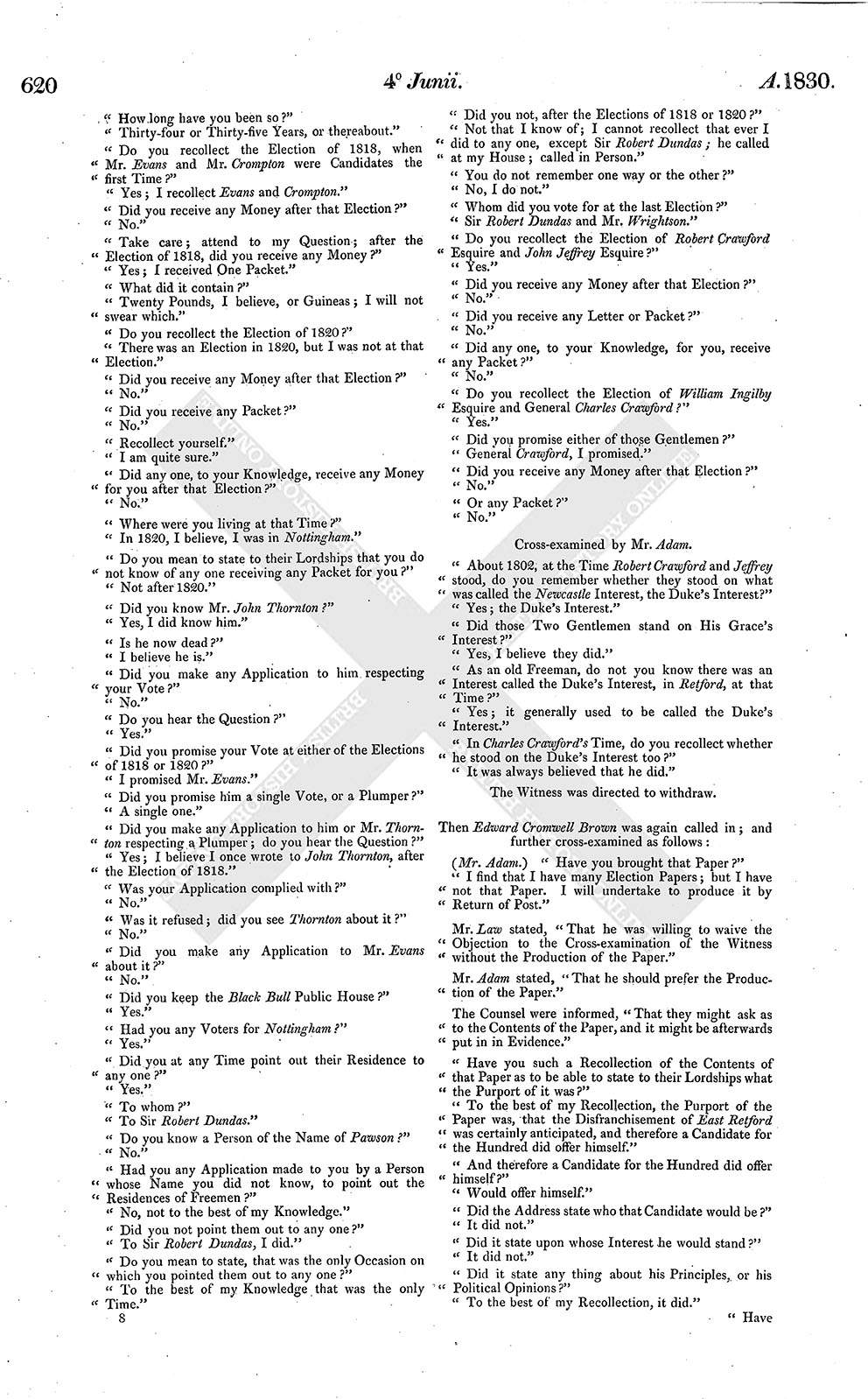
Cross-examined by Mr. Adam.
"When were you made a Freeman?"
"About Thirteen Years ago; or Fourteen Years ago next August."
"Do you recollect the Election of Marsh and Osbaldeston?"
"I do not."
"Did you not reside in Retford at that Time?"
"I did."
"How did you get your Freedom; in what Right?"
"By being Apprentice."
"What Age are you?"
"I shall be Thirty-five in June."
"You got your Freedom as soon as you were of Age?"
"I did."
"Who canvassed you in 1818?"
"Mr. Crompton and Mr. Evans."
"Did they come to you together?"
"No."
"Where did you see Mr. Evans?"
"In the Hall."
"In the Town Hall?"
"Yes."
"When the Election was going on?"
"Yes."
"Had he not canvassed you before the Day of Election?"
"No."
"Who introduced you to him?"
"I am sure I do not know."
"Did you promise him your Vote?"
"I did."
"Did he make any Promise to you, before you made your Promise, of any sort or kind whatever?"
"No."
"What passed between you and Mr. Evans?"
"He axed me if I would give him a Vote, and I told him I would."
"At once, without more to do?"
"Yes."
"Who introduced Mr. Crompton to you?"
"Nobody, as I know of; he came himself."
"How did he know you were a Freeman?"
"I do not know who told him; but he came and axed me."
"Where did you see Mr. Crompton?"
"In the Hall."
"At the same Time?"
"Yes."
"Was Mr. Crompton present when you and Mr. Evans had the Conversation?"
"No; they were not together."
"What passed when he canvassed you?"
"He axed me if I would give him my Vote, and I told him I would."
"Did he make any Promise to you of any Consideration whatever?"
"No."
"From whom did you get this first Packet in 1818?"
"It was thrown into my House."
"Did you see it thrown in?"
"Yes, I saw it thrown in; I saw the Person. He asked me if Robert Rushby lived there. It was about Eleven o'Clock at Night."
"Did you see the Person?"
"Yes, but I did not know him; he went away as soon as he had done it."
"It was tossed in?"
"Yes."
"Did you open it at once?"
"Yes, I did."
"You found it contain Twenty Guineas?"
"Yes."
"When did you see the second Packet?"
"It came in the same Form."
"It was thrown in?"
"Yes."
"How long after?"
"Perhaps a Month; I do not know exactly."
"Perhaps it was Two Months?"
"Yes; it might be more; I do not know indeed."
"Have you any Recollection of the Distance of Time between the Receipt of one Twenty Guineas and another?"
"No, I have not."
"It might be a Year then, perhaps?"
"Yes, it might be a Year; but I should think it was not."
"How long after the Election was it that you received the first Packet?"
"Perhaps about Seven Months; Seven or Eight Months."
"What Time of the Year was it?"
"I think it was in January or February; I do not know which."
"You are sure it was in the Winter Season of the Year?"
"Yes, it was."
"The second Packet -did you take it up as soon as it was tossed in, or what did you do with it?"
"I did."
"And found it to contain Money?"
"Yes."
"Should you know that Person again if you were to see him?"
"No."
"In 1820, who canvassed you then?"
"Mr. Crompton and Mr. Evans."
"Where did they canvass you?"
"At my House."
"They called upon you?"
"Yes."
"Did they come together in 1820?"
"No; separately."
"Which of them came first?"
"Mr. Evans."
"He had known you by that Time?"
"Yes."
"Had you ever seen Mr. Evans, from the Time you gave him your Vote in 1818 'till the canvassed you in 1820?"
"No."
"What passed upon that Occasion?"
"He axed me whether I would support him, and I said I would."
"Did he make you any Promise of any sort?"
"No."
"Did any thing more pass between you, than that he asked you for your Vote, and you promised he should have it?"
"No."
"You had no Promise from him of any kind whatever?"
"No."
"When did Mr. Crompton come in 1820?"
"I think it was in March."
"You say Mr. Evans and Mr. Crompton both canvassed you at your House in 1820?"
"Yes."
"What Time was the Election?"
"I do not know what Time it was."
"Do not you remember the Time of Year?"
"I think it was in March."
"How long before the Election was it that Mr. Crompton canvassed you?"
"Perhaps a Month."
"Was it before Mr. Evans canvassed you, or after?"
"It was after."
"Did Mr. Evans come to you more than a Month before the Election?"
"Yes, I think he did."
"How long before?"
"I do not know; not a long Time."
"A Couple of Months, perhaps?"
"It might be; I do not know."
"It might be a Twelve?"
"It might be a Month."
"What a passed between you and Mr. Crompton?"
"He axed me if I would give him a Vote."
"You said you would?"
"Yes."
"Did he make any Promise to you of any sort or kind then?"
"No."
"Did you vote for him?"
"No, I did not vote."
"There was no polling?"
"No, there was not; I promised him."
"Did you go to the Town Hall on the Election Day?"
"I did, on the Election Day."
"About the Packets in 1820-how did you receive the first?"
"I received it at Home."
"Who gave it you?"
"It was thrown into the House."
"Thrown in in the Day-time, or when?"
"In the Night-time again."
"What Time of Night?"
"It was about Twelve o'Clock."
"What Time do you usually go to Bed?"
"I am very often up all Night."
"What Business are you?"
"I go on the Canal."
"You are a Bargeman, are you?"
"Yes."
"Sometimes you are up all Night?"
"When I am at Home, I am very often."
"You happened to be up 'till Twelve that Night?"
"Yes."
"Do you happen to recollect what the Man said who left it?"
"He axed if I was in, and said there was a Letter."
"When did you open that Letter?"
"Then."
"How long after that first was it you received the second?"
"Perhaps a Week."
"Do you think it was a Week or a Month?"
"About a Week."
"How did you receive that?"
"In the same Form."
"A Man called upon you yourself?"
"Yes."
"Did you vote in 1826?"
"No."
"Were you at Retford in 1826?"
"Yes."
"Did you promise any body in 1826?"
"I believe I did."
"Whom did you promise?"
"Sir Henry Wright Wilson."
"Who canvassed you for Sir Henry Wright Wilson?"
"I came to him myself, and promised to vote without canvassing."
"Where was Sir Henry at the Time you went to him?"
"He was at the White Hart in Retford."
"Was any body with him when you went there?"
"Mr. Dickenson, I think, was with him."
"He is a Gentleman of the Neighbourhood, I believe?"
"Yes, he is."
"When you went to Sir Henry, what did you say to him?"
"I axed him if he was come as a Candidate for the Borough."
"Had you known him before?"
"I had heard speak of him."
"Was Sir Henry well known in the Town of Retford?"
"I axed him his Principles."
"Was he well known to the Burgesses?"
"Not as I know of."
"But you had heard of him?"
"Yes, I had heard of him."
"What Answer did he give when you asked him as to his Principles?"
"He said he would support the Church and King as long as he had an Arm on his Body; and then I promised him a Plumper."
"Why did you promise Sir Henry Wilson a Plumper?"
"Because his Principles suited me."
"Was the only Reason you promised to vote for Sir Henry Wilson, that you agreed with him in his Political Principles?"
"Yes."
"Why did you not vote for him?"
"Because the Poll was broken before I had a Chance or an Opportunity on the Saturday. I had not an Opportunity of voting on the Friday; and there was not any Poll on the Saturday."
"Why did not you vote on the Friday, as you were fond of his Principles?"
"I could not get in."
"Were you in the Town?"
"I was."
"Why did not you vote?"
"Because it was so crowded, I could not get in."
"Was there any rioting?"
"I did not see any rioting; but it was so full I could not get up to the Bench."
"There was no rioting, or any thing of that kind?"
"No, no."
"It was a quiet as the Gentlemen are here?"
"Yes."
"Were there any Cries of "Church and King?"
"I heard none; they was doing Business at the Bench, and I could not get up."
"Any Cries of "No Popery?"
"I did not hear it in the Hall."
"Just outside the Hall?"
"Oh yes; there were many Cries of that sort."
"How was the Crowd outside the Hall?"
"I was very little in it."
"But you got through it to get into the Hall?"
"I got into it very well."
"There was no Trouble at all?"
"No."
"What were your Colours?"
"They were Blue and Pink."
"Sir Henry's, I suppose, were Blue and Pink?"
"Yes."
"Those were the No Popery Colours, were not they?"
"Yes."
"Was not there a Cry of "No Popery?"
"I heard such a Cry."
"Did the Persons who wore those Colours make that Cry?"
"Many of them did not."
"Did many of them wear the same Colours?"
"Yes."
"Was the Reason you could get into the Hall, that you wore the same Colours as the No Popery Men?"
"I was never disturbed in any way; I do not know the Reason."
"Did you see any body else disturbed?"
"No."
"Did you happen to see any Purple Colours about that Day?"
"Yes."
"A good many, were there not?"
"There might be a few; I did not take much Notice of them; there were not many."
"There were not so many Purples as Blues and Pinks?"
"I think not."
"Were the Purples making use of any Cry or any Expression?"
"I never heard any."
"They did not call "Pope for ever," or any thing of that kind?"
"No."
"They made no Cry at all?"
"No."
"Do you think the Men with Purple Colours could get in as quietly as you did?"
"I did not see them disturbed."
"Did you wait 'till the Soldiers came in?"
"I believe I went before the Soldiers came in; I went away, I think."
"Recollect whether you did, or not?"
"I am sure I did."
"Did you see the Soldiers in the Town?"
"I did, about Nine o'Clock in the Evening."
"But you had left the Hustings before they were called in?"
"Yes."
"You could not vote that Day, you say?"
"No."
"You were very anxious to vote for Sir Henry, because you agreed in his Principles?"
"Yes."
"You did not receive any Money from Sir Henry?"
"No."
"You would have been very much disappointed if he had offered you any, I dare say?"
"He never offered me any at all."
"Do you frequent the Turk's Head; do you know the Turk's Head Public House?"
"Yes."
"Is that a House you go to?"
"I do go there sometimes; I have not been there this Twelvemonth; I should think it is nearly a Twelvemonth."
"Do you belong to the Birmingham Club?"
"No."
"Are you sure of that?"
"What is the Birmingham Club?"
"Do you belong to any Club at the Turk's Head?"
"I am an Odd Fellow."
"Do you belong to the Birmingham Club?"
"I have no Concerns with no other Society."
"Going to the Turk's Head, do you happen to know that a Club called the Birmingham Club meets there?"
"No, I do not."
The Witness was directed to withdraw.
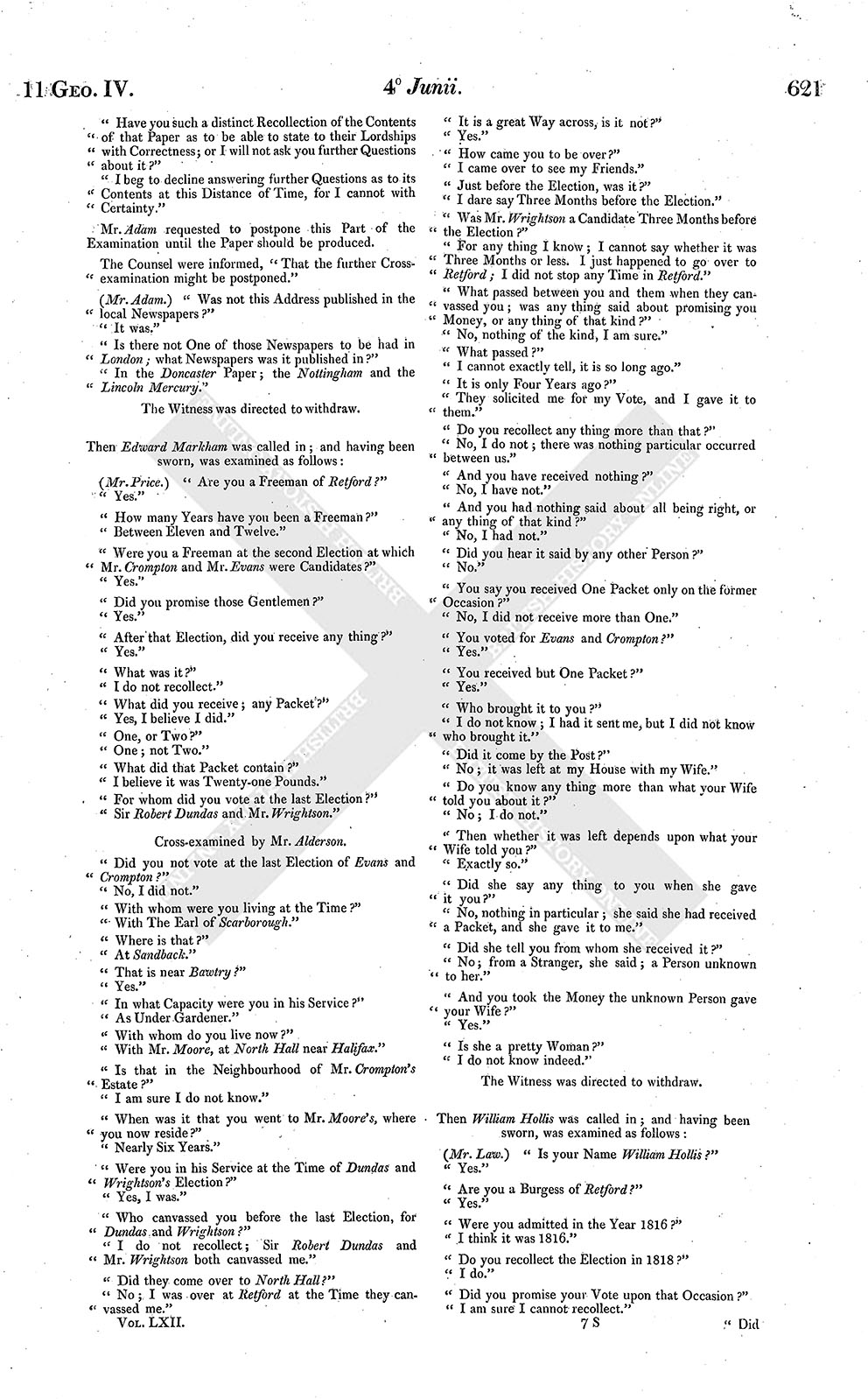
Then William Trueman was called in; and having been sworn, was examined as follows:
(Mr. Price.) "Is your Name William Trueman?"
"It is."
"What are you?"
"I am a Baker by Trade; a Baker and Brewer."
"Are you a Burgess of Retford?"
"Yes."
"How many Years have you been a Burgess?"
"Twenty-eight Years, as nearly as I can guess."
"Do you recollect the Election of 1818, when Mr. Evans and Mr. Crompton were Candidates the first Time?"
"Yes."
"Were you canvassed by those Gentlemen?"
"Yes."
"Did you promise your Vote?"
"I promised my Vote to Mr. Evans."
"To Mr. Crompton too?"
"Mr. Crompton would not accept my Vote, because I did not go to the Canvass Dinner."
"After that Election, did you receive any Money?"
"Yes."
"How much?"
"Twenty-one Pounds."
"Do you remember the second Election, when Mr. Evans and Mr. Crompton were Candidates the second Time?"
"Yes."
"Did you promise your Vote to those Gentlemen at that Time?"
"To Mr. Evans."
"After that Election, did you receive any Money?"
"Yes."
"How much?"
"Twenty-one Pounds."
"When was the first Election that you remember?"
"Crawford and Jeffrey's."
"Did you vote upon that Occasion?"
"Yes."
"For whom?"
"For Crawford and Jeffrey."
"Did you receive any Money after that Election?"
"Nothing at all."
"Was that in the Year 1806?"
"1806 or 1807; I am not certain which."
"Where were you at that Time?"
"I was at Clumber before that."
"Where at?"
"At His Grace The Duke of Newcastle's."
"Were you in the Service of The Duke of Newcastle at that Time?"
"Yes."
"Do you recollect the Election of 1807, when William Ingilby Esquire and General Charles Crawford were elected?"
"Yes, I remember it; but I did not vote."
"Had you promised your Vote upon that Occasion?"
"I was not a Freeman."
"I thought you told me you had been a Freeman Twenty-eight Years?"
"Yes; I have been a Freeman Twenty-eight Years."
"In the Year 1807, did you vote?"
"I voted for Crawford. I beg your Pardon."
"Do you remember voting for General Charles Crawford in 1807?"
"Yes, I believe it was then that I voted for General Charles Crawford."
"Was William Ingilby Esquire the other Candidate?"
"Yes, he was."
"After that Election, did you receive any thing?"
"Nothing at all."
"No Packet?"
"No; no Packet at all."
"For whom did you vote in 1812?"
"For Osbaldeston and Marsh."
"Did you receive any thing after that Time?"
"Nothing at all."
"Did you reside in Retford at the Time?"
"No, I did not."
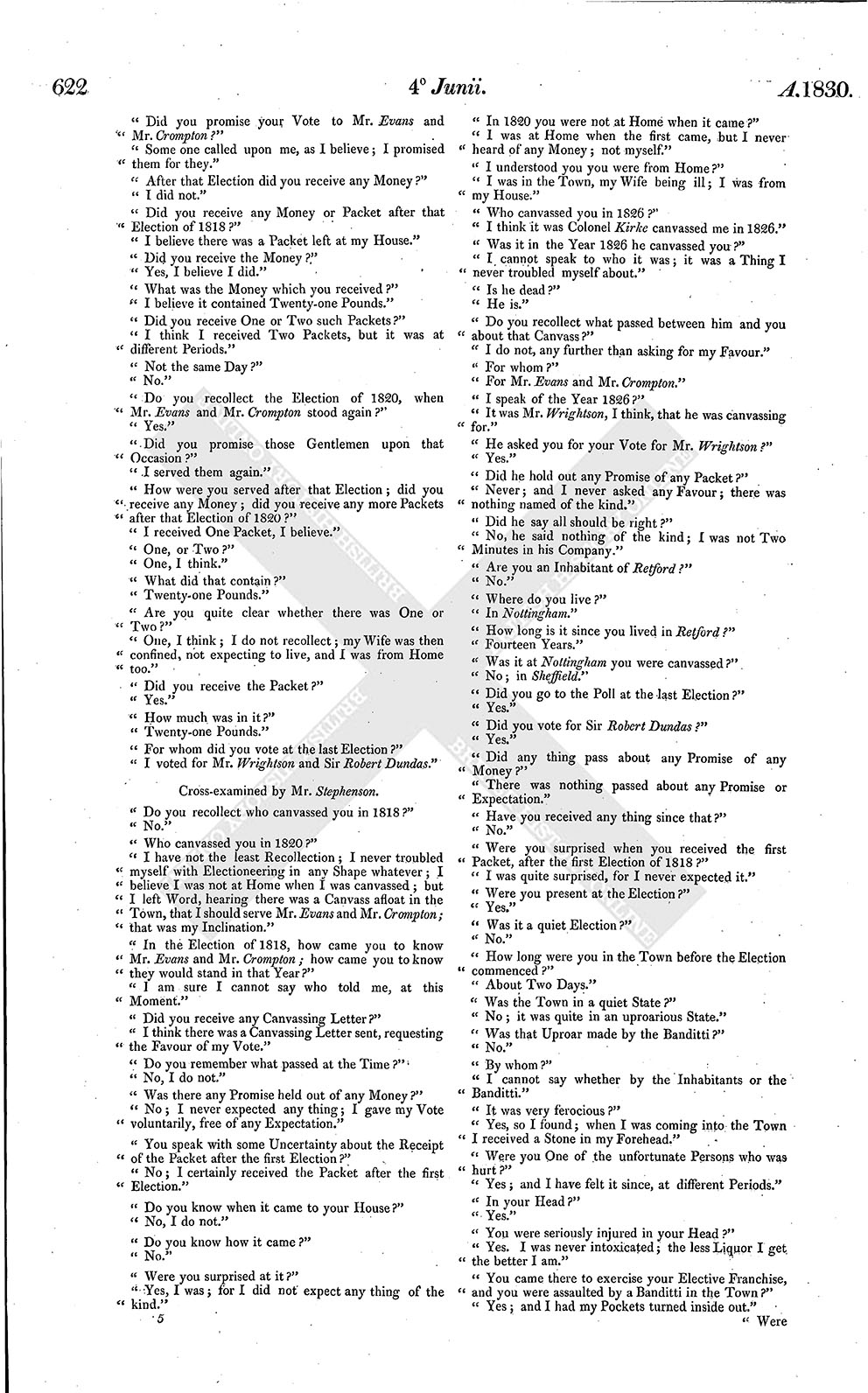
"Cross-examined by Mr. Alderson.
"What was the first Election at which you ever voted?"
"Crawford and Jeffrey's, I believe."
"Which was the second?"
"Ingilby and Crawford's again."
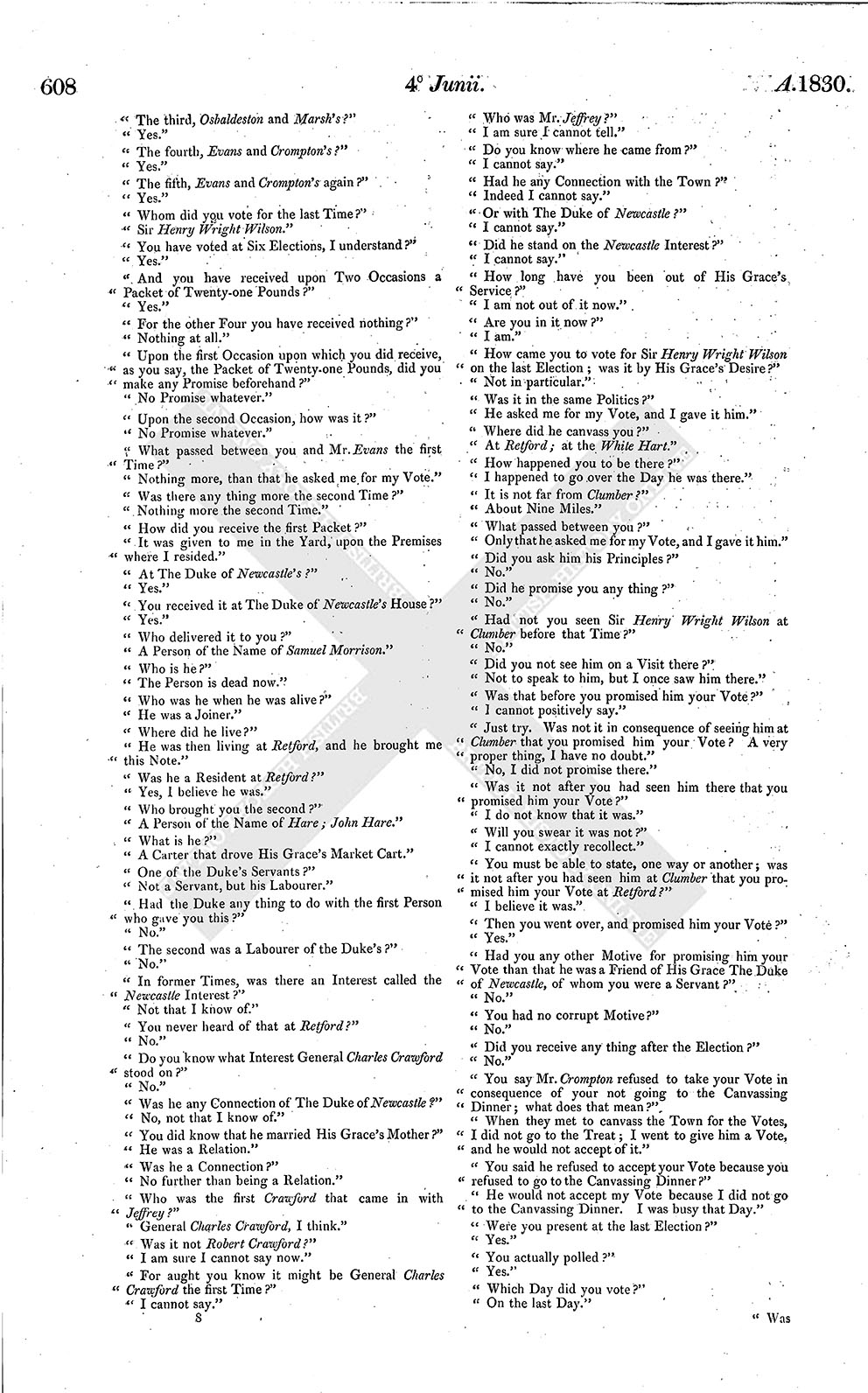
"The third, Osbaldeston and Marsh's?"
"Yes."
"The fourth, Evans and Crompton's?"
"Yes."
"The fifth, Evans and Crompton's again?"
"Yes."
"Whom did you vote for the last Time?"
"Sir Henry Wright Wilson."
"You have voted at Six Elections, I understand?"
"Yes."
"And you have received upon Two Occasions a Packet of Twenty-one Pounds?"
"Yes."
"For the other Four you have received nothing?"
"Nothing at all."
"Upon the first Occasion upon which you did receive, as you say, the Packet of Twenty-one Pounds, did you make any Promise beforehand?"
"No Promise whatever."
"Upon the second Occasion, how was it?"
"No Promise whatever."
"What passed between you and Mr. Evans the first Time?"
"Nothing more, than that he asked me for my Vote."
"Was there any thing more the second Time?"
"Nothing more the second Time."
"How did you receive the first Packet?"
"It was given to me in the Yard, upon the Premises where I resided."
"At The Duke of Newcastle's?"
"Yes."
"You received it at The Duke of Newcastle's House?"
"Yes."
"Who delivered it to you?"
"A Person of the Name of Samuel Morrison."
"Who is he?"
"The Person is dead now."
"Who was he when he was alive?"
"He was a Joiner."
"Where did he live?"
"He was then living at Retford, and he brought me this Note."
"Was he a Resident at Retford?"
"Yes, I believe he was."
"Who brought you the second?"
"A Person of the Name of Hare; John Hare."
"What is he?"
"A Carter that drove His Grace's Market Cart."
"One of the Duke's Servants?"
"Not a Servant, but his Labourer."
"Had the Duke any thing to do with the first Person who gave you this?"
"No."
"The second was a Labourer of the Duke's?"
"No."
"In former Times, was there an Interest called the Newcastle Interest?"
"Not that I know of."
"You never heard of that at Retford?"
"No."
"Do you know what Interest General Charles Crawford stood on?"
"No."
"Was he any Connection of The Duke of Newcastle?"
"No, not that I know of."
"You did know that he married His Grace's Mother?"
"He was a Relation."
"Was he a Connection?"
"No further than being a Relation."
"Who was the first Crawford that came in with Jeffrey?"
"General Charles Crawford, I think."
"Was it not Robert Crawford?"
"I am sure I cannot say now."
"For aught you know it might be General Charles Crawford the first Time?"
"I cannot say."
"Who was Mr. Jeffrey?"
"I am sure I cannot tell."
"Do you know where he came from?"
"I cannot say."
"Had he any Connection with the Town?"
"Indeed I cannot say."
"Or with The Duke of Newcastle?"
"I cannot say."
"Did he stand on the Newcastle Interest?"
"I cannot say."
"How long have you been out of His Grace's Service?"
"I am not out of it now."
"Are you in it now?"
"I am."
"How came you to vote for Sir Henry Wright Wilson on the last Election; was it by His Grace's Desire?"
"Not in particular."
"Was it in the same Politics?"
"He asked me for my Vote, and I gave it him."
"Where did he canvass you?"
"At Retford; at the White Hart."
"How happened you to be there?"
"I happened to go over the Day he was there."
"It is not far from Clumber?"
"About Nine Miles."
"What passed between you?"
"Only that he asked me for my Vote, and I gave it him."
"Did you ask him his Principles?"
"No."
"Did he promise you any thing?"
"No."
"Had not you seen Sir Henry Wright Wilson at Clumber before that Time?"
"No."
"Did you not see him on a Visit there?"
"Not to speak to him, but I once saw him there."
"Was that before you promised him your Vote?"
"I cannot positively say."
"Just try. Was not it in consequence of seeing him at Clumber that you promised him your Vote? A very proper thing, I have no doubt."
"No, I did not promise there."
"Was it not after you had seen him there that you promised him your Vote?"
"I do not know that it was."
"Will you swear it was not?"
"I cannot exactly recollect."
"You must be able to state, one way or another; was it not after you had seen him at Clumber that you promised him your Vote at Retford?"
"I believe it was."
"Then you went over, and promised him your Vote?"
"Yes."
"Had you any other Motive for promising him your Vote than that he was a Friend of His Grace The Duke of Newcastle, of whom you were a Servant?"
"No."
"You had no corrupt Motive?"
"No."
"Did you receive any thing after the Election?"
"No."
"You say Mr. Crompton refused to take your Vote in consequence of your not going to the Canvassing Dinner; what does that mean?"
"When they met to canvass the Town for the Votes, I did not go to the Treat; I went to give him a Vote, and he would not accept of it."
"You said he refused to accept your Vote because you refused to go to the Canvassing Dinner?"
"He would not accept my Vote because I did not go to the Canvassing Dinner. I was busy that Day."
"Were you present at the last Election?"
"Yes."
"You actually polled?"
"Yes."
"Which Day did you vote?"
"On the last Day."
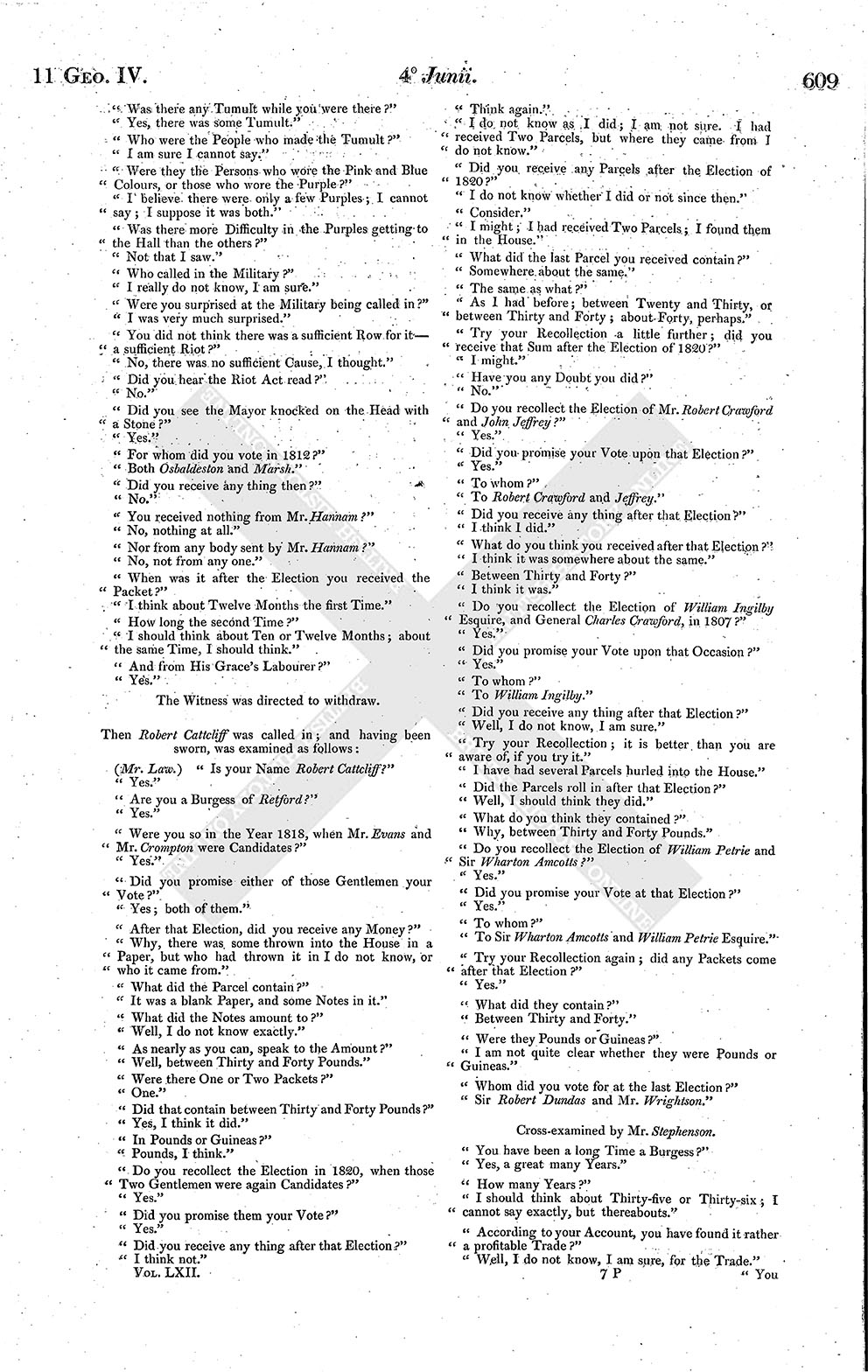
"Was there any Tumult while you were there?"
"Yes, there was some Tumult."
"Who were the People who made the Tumult?"
"I am sure I cannot say."
"Were they the Persons who were the Pink and Blue Colours, or those who wore the Purple?"
"I believe there were only a few Purples; I cannot say; I suppose it was both."
"Was there more Difficulty in the Purples getting to the Hall than the others?"
"Not that I saw."
"Who called in the Military?"
"I really do not know, I am sure."
"Were you surprised at the Military being called in?"
"I was very much surprised."
"You did not think there was a sufficient Row for it- a sufficient Riot?"
"No, there was no sufficient Cause, I thought."
"Did you hear the Riot Act read?"
"No."
"Did you see the Mayor knocked on the Head with a Stone?"
"Yes."
"For whom did you vote in 1812?"
"Both Osbaldeston and Marsh."
"Did you receive any thing then?"
"No."
"You received nothing from Mr. Hannam?"
"No, nothing at all."
"Nor from any body sent by Mr. Hannam?"
"No, not from any one."
"When was it after the Election you received the Packet?"
"I think about Twelve Months the first Time."
"How long the second Time?"
"I should think about Ten or Twelve Months; about the same Time, I should think."
"And from His Grace's Labourer?"
"Yes."
"The Witness was directed to withdraw.
"Then Robert Cattcliff was called in; and having been sworn, was examined as follows:
"(Mr. Law.) "Is your Name Robert Cattcliff?"
"Yes."
"Are you a Burgess of Retford?"
"Yes."
"Were you so in the Year 1818, when Mr. Evans and Mr. Crompton were Candidates?"
"Yes."
"Did you promise either of those Gentlemen your Vote?"
"Yes; both of them."
"After that Election, did you receive any Money?"
"Why, there was some thrown into the House in a Paper, but who had thrown it in I do not know, or who it came from."
"What did the Parcel contain?"
"It was a blank Paper, and some Notes in it."
"What did the Notes amount to?"
"Well, I do not know exactly."
"As nearly as you can, speak to the Amount?"
"Well, between Thirty and Forty Pounds."
"Were there One or Two Packets?"
"One."
"Did that contain between Thirty and Forty Pounds?"
"Yes, I think it did."
"In Pounds or Guineas?"
"Pounds, I think."
"Do you recollect the Election in 1820, when those Two Gentlemen were again Candidates?"
"Yes."
"Did you promise them your Vote?"
"Yes."
"Did you receive any thing after that Election?"
"I think not."
"Think again."
"I do not know as I did; I am not sure. I had received Two Parcels, but where they came from I do not know."
"Did you receive any Parcels after the Election of 1820?"
"I do not know whether I did or not since then."
"Consider."
"I might; I had received Two Parcels; I found them in the House."
"What did the last Parcel you received contain?"
"Somewhere about the same."
"The same as what?"
"As I had before; between Twenty and Thirty, or between Thirty and Forty; about Forty, perhaps."
"Try your Recollection a little further; did you receive that Sum after the Election of 1820?"
"I might."
"Have you any Doubt you did?"
"No."
"Do you recollect the Election of Mr. Robert Crawford and John Jeffrey?"
"Yes."
"Did you promise your Vote upon that Election?"
"Yes."
"To whom?"
"To Robert Crawford and Jeffrey."
"Did you receive any thing after that Election?"
"I think I did."
"What do you think you received after that Election?"
"I think it was somewhere about the same."
"Between Thirty and Forty?"
"I think it was."
"Do you recollect the Election of William Ingilby Esquire, and General Charles Crawford, in 1807?"
"Yes."
"Did you promise your Vote upon that Occasion?"
"Yes."
"To whom?"
"To William Ingilby."
"Did you receive any thing after that Election?"
"Well, I do not know, I am sure."
"Try your Recollection; it is better than you are aware of, if you try it."
"I have had several Parcels hurled into the House."
"Did the Parcels roll in after that Election?"
"Well, I should think they did."
"What do you think they contained?"
"Why, between Thirty and Forty Pounds."
"Do you recollect the Election of William Petrie and Sir Wharton Amcotts?"
"Yes."
"Did you promise your Vote at that Election?"
"Yes."
"To whom?"
"To Sir Wharton Amcotts and William Petrie Esquire."
"Try your Recollection again; did you Packets come after that Election?"
"Yes."
"What did they contain?"
"Between Thirty and Forty."
"Were they Pounds or Guineas?"
"I am not quite clear whether they were Pounds or Guineas."
"Whom did you vote for at the last Election?"
"Sir Robert Dundas and Mr. Wrightson."
"Cross-examined by Mr. Stephenson.
"You have been a long Time a Burgess?"
"Yes, a great many Years."
"How many Years?"
"I should think about Thirty-five or Thirty-six; I cannot say exactly, but thereabouts."
"According to your Account, you have found it rather a profitable Trade?"
"Well, I do not know, I am sure, for the Trade."
"You say you received Forty, or between Thirty and Forty, after 1818; are you sure it was not Fifty?"
"Oh no."
"Are you sure it was Forty?"
"I cannot say; I think it was thereabouts."
"Did you open the Packet yourself?"
"Yes."
"Did you take the Notes out?"
"Yes; I was always glad to see them."
"You do not recollect how much they might amount to?"
"It was between Thirty and Forty, I think."
"Had you any Idea on what Account you received it?"
"No, I had not."
"You thought it was a Godsend?"
"It came, I did not know how."
"The same came again in 1820?"
"I received it several Years, but I do not know in what Years."
"It was after the Election of 1820?"
"Yes."
"Do you think you have received £200 in the whole?"
"I do not know, I am sure; I should think not."
"One hundred?"
"I do not know, indeed, what it is."
"In 1802, when Mr. Petrie and Sir Wharton Amcotts stood, who canvassed you?"
"They canvassed me themselves; Mr. Amcotts and Mr. Petrie."
"You have a Recollection of the Gentlemen?"
"Yes."
"What passed?"
"They asked me for my Vote and Interest."
"Did they tell you you should have Thirty or Forty Pounds after the Election?"
"No, they did not, I am sure."
"But you received it?"
"Yes, I did."
"Have you any Doubt it came from them?"
"I cannot say nought about that."
"You felt quite confident, when you promised them your Vote, that they would give it?"
"No, I did not."
"Were you surprised at receiving it?"
"Yes, I was."
"It was quite unexpected?"
"Yes."
"In 1806 was the next Election?"
"Yes."
"Then the Thirty or Forty came again?"
"Yes."
"Was it always about the same Sum?"
"Yes, it always was somewhere about that."
"Were you surprised again that Time?"
"Yes; it came quite unexpected."
"Was your Surprise greater then than at the first?"
"I cannot say, indeed."
"In 1807, you voted only for Sir William Ingilby?"
"Yes, for him alone."
"Did you receive the same?"
"Well, I cannot say."
"Did you always receive Forty Pounds?"
"I do not know, indeed; I have had several Packets thrown in."
"Now about throwing in; do you live in East Retford?"
"No; in Southwell."
"How far is that from East Retford?"
"Twenty Miles."
"Were those Packets thrown in in the Day-time or the Night-time?"
"I think they came twice in the Night."
"Did you know the Persons?"
"I never saw one Person that ever brought them."
"You know nothing more than finding the Packets in your House?"
"Nothing at all; it was hurled in."
"At what Time of the Day?"
"It was Twice in the Night. Once I had it open when I was not within."
"Did you find it there when you came Home?"
"My Wife did find it."
"Do you remember in what Election that was?"
"No."
"Had she opened it?"
"Yes, I think she had."
"How do you know that she opened it?"
"It was there when I got Home."
"What was there?"
"A Packet."
"Do you know any thing more about it than what your Wife told you?"
"She said it was thrown into the House, directed for me."
"Did you open it?"
"My Wife opened it, I dare say."
"You know nothing about it more than your Wife told you?"
"I saw the Packet, and had it."
"Did you take the Money out?"
"Yes."
"You put it into your Pocket?"
"Yes."
"What Election was that?"
"I cannot say, I am sure."
"Was it in 1802?"
"I am sure I cannot say."
"Who canvassed you in 1806, when you voted for Mr. Crawford and Mr. Jeffrey?"
"I do not know, I am sure, who it was that canvassed me; I cannot recollect his Name that came."
"Was it either of the Gentlemen themselves?"
"I saw both of them before I voted for them."
"Then the same Thing happened; Thirty or Forty Pounds came?"
"Yes."
"A very lucky Fellow you are?"
"I thought so."
"Did they say any thing to you before the Election, that you should have it?"
"No, not a Word in my Life."
"But you looked for it?"
"I was glad to see it."
"Whom did you vote for in 1826?"
"I do not know, I am sure, who was put in then."
"Dundas and Wrightson and Sir Henry Wright Wilson were the Candidates."
"I voted for Sir Robert Dundas and William Wrightson."
"Have you had any Money thrown into your House since that Election?"
"No."
"It has not happened to you this Time?"
"No."
"Are you disappointed?"
"Well, I do not feel disappointed, because it is just as it happens, I suppose, them Things."
"You have not been an Inhabitant of Retford for some Time, have you?"
"No."
"There has been no previous Promise with respect to those Packets at any one of the Elections?"
"No."
"There has been no Expectation held out that you should receive this Money?"
"No."
"That you are quite satisfied?"
"I am certain sure there has never been a Promise of a Penny."
"You are not an Inhabitant of East Retford?"
"No."
"You do not know any thing of the Riots which took place at East Retford?"
"No."
"Were you there?"
"I was sitting in my Chamber when they began to break Windows and such, and I got away, and went to my Father's, and went to Bed."
"You gave your Vote, and went away?"
"I went away as fast as I could."
The Witness was directed to withdraw.
Then William Freeman was called in; and having been sworn, was examined as follows:
(Mr. Price.) "Are you a Burgess of East Retford?"
"Yes."
"How many Years have you been a Burgess?"
"I was sworn in 1819."
"Do you recollect the second Election, when Mr. Evans and Mr. Crompton were Candidates?"
"Yes."
"Did you promise those Gentlemen?"
"Yes."
"After that Election, did you receive any thing?"
"Yes."
"What?"
"I received One Packet."
"Did you receive more than One Packet?"
"No."
"What did that Packet contain?"
"Twenty Guineas."
"For whom did you vote at the last Election?"
"Sir Robert Dundas and Mr. Wrightson."
Cross-examined by Mr. Adam.
"How did you get your Freedom?"
"By Servitude."
"What Business are you in?"
"A Shoemaker."
"Whom did you vote for in 1820?"
"Mr. Crompton and Mr. Evans."
"Had you known either of the Gentlemen before?"
"No."
"Were you in Retford in the Year 1818?"
"Yes, I was in Retford."
"Did you not see them upon that Occasion?"
"No; I never spoke to Mr. Evans."
"You did not know Mr. Crompton before?"
"I recollect him when I was Apprentice; that is all."
"Whom were you apprenticed to; to your Father?"
"No."
"What is your Father's Name; is his Name John Freeman?"
"George."
"Was he a Shoemaker?"
"No."
"What Business was your Father in?"
"A Labouring Man."
"Had he a Son named John?"
"No."
"Had not you a Brother named John?"
"No."
"What is your Brother's Name then?"
"George."
"George is not a Freeman?"
"No."
"In 1820, did either Mr. Evans or Mr. Crompton canvass you themselves; I mean in their own Person?"
"No."
"Who canvassed you; did any body do it in 1820; you say you did not know Mr. Evans or Mr. Crompton?"
"Mr. Thornton, I think."
"Which of the Thorntons?"
"John."
"He is dead, is not he?"
"Yes."
"Do you mean to say that John Thornton canvassed you for both Mr. Crompton and Mr. Evans?"
"Well, I do not know; it was for Mr. Evans, I think."
"He did not canvass you for Crompton then?"
"No."
"Who did?"
"I had a Letter that came."
"A Letter from Mr. Crompton?"
"No; it was not from Mr. Crompton."
"From whom was it then?"
"I am sure I do not at present know whom it was from."
"Do you recollect whether it was a Letter or not?"
"It was a Letter."
"Have you a distinct Recollection that you were canvassed on Mr. Crompton's Part by Letter?"
"I think it was so."
"Do you recollect receiving it by Post; or what Circumstance makes you remember it?"
"I think it was sent to me by somebody."
"Mr. Crompton came into the Town before the Election of 1820, did not he?"
"I was not reading at Retford then."
"Where were you residing then?"
"At Misterton."
"How far is that from Retford?"
"Either Eleven or Twelve Miles; I am not certain which."
"Did John Thornton come over to you to canvass you for Mr. Evans?"
"No; I think I saw him myself in Retford."
"You happened to be in Retford, and saw John Thornton?"
"Yes."
"How long before the Election?"
"I think not many Days."
"Do you happen to recollect whether Mr. Crompton and Mr. Evans were in the Town at that Time?"
"I really do not know whether they were or not."
"Had you been canvassed for Mr. Crompton by means of Letter?"
"Yes; for Mr. Crompton."
"If he made no Promise to you himself, did Mr. Crompton ever make any Promise to you for your Vote in any other Way?"
"Make any Promise to me, do you mean?"
"Did he ever promise that he would give you any Money?"
"No."
"This Letter contained no Promise?"
"No."
"Did John Thornton make any Promise when he canvassed you for Evans?"
"He did not."
"You promised to vote for both?"
"Yes."
"Did you go into the Town on the Election Day in 1820?"
"Yes."
"Did you see the Gentlemen in the Hall?"
"Yes."
"There was no Poll, we understand?"
"No."
"Did you speak to the Two Gentlemen?"
"No."
"Did they speak to you?"
"No."
"Were there Colours at that Election?"
"Yes."
"Had you Colours for both Candidates?"
"Yes."
"Did you wear them for both?"
"Yes."
"And yet you received but One Packet?"
"Yes."
"You are quite sure of that?"
"Yes."
"You promised both, you went into the Hall with the Colours of both, and yet you received but One Packet?"
"I received only One."
"When did you receive that; how many Months after the Election?"
"It was some Time in the Summer; about Harvest, I think."
"Are you quite sure it was not in the Winter?"
"Well, I think not; it was either in the Harvest, or the back End of the Year."
"Was it about a Twelvemonth after the Election?"
"It was something under a Twelvemonth."
"Was it near upon a Twelvemonth?"
"I think it was."
"At what Time of the Year was the Election at Retford; as you came over to vote, and wore those Colours, you can probably tell me; it does not happen every Day?"
"I am not certain what Month it was in."
"Recollect at what Time the Election in 1820 was?"
"Well, it was in the Spring of the Year."
"Was not it a full Twelvemonth before you received this Packet you have spoken of?"
"Well, I think it was not a Twelvemonth; but I am not certain."
"Where did you receive it?"
"I did not exactly receive it myself; it was left at my Father's for me."
"Did your Father live at Retford?"
"No."
"Where did he live?"
"At Ranskill."
"That is very near Retford, is it not?"
"Yes."
"When did you receive it then?"
"Well, I cannot exactly say the Time."
"Had it been opened?"
"Yes, it had been opened."
"Did you see the Packet itself?"
"No."
"How did you know that any Packet came at all?"
"Because I was told so."
"You never saw the Packet yourself, and only know it was left for you, by having been told so?"
"Yes."
"Who told you?"
"My Father."
"Is your Father alive?"
"Yes."
"Did you go constantly to your Father's at that Time, or only accidentally?"
"Only accidentally."
"Your Father told you of the Packet; what else did he tell you?"
"Nothing no more."
"How do you know there was any Packet received at all?"
"I did not know any thing further."
"How do you know there were Twenty Guineas in the Packet?"
"Because I saw the Money."
"Not in the Packet?"
"No."
"Where did you see the Money?"
"At my Father's."
"Whether it came in a Packet or not, or where it came from, you do not know?"
"No."
"In 1826, who canvassed you for Sir Robert Dundas?"
"Mr. Fox."
"Recollect yourself; do you mean Mr. Fox the Banker's Clerk?"
"Yes."
"Where did he canvass you?"
"I was at Retford, I think, at that Time."
"Did you live in Retford in 1826?"
"No; I accidentally came to Retford."
"How long before the Election of 1826?"
"Not long, I dare say."
"I do not know what Time you call not long; was it a Month, or Six Weeks, or a Day, or what Time?"
"It might perhaps be a Twelvemonth."
"Do you mean to say that Mr. Fox canvassed you for Sir Robert Dundas a Twelvemonth before the Election took place?"
"I cannot say exactly."
"Do you think it was about a Twelvemonth?"
"Well, I think perhaps it was."
"You think it was about a Twelvemonth before 1826 that Mr. Fox the Banker's Clerk canvassed you for Sir Robert Dundas?"
"Yes."
"Have you any correct Recollection in what Part of the Town he canvassed you?"
"No, I have not."
"Was it in the Bank?"
"No."
"Was it in any Public House?"
"I think very likely it was."
"Is Mr. Fox in the habit of going to the Public Houses in Retford?"
"I am sure I do not know."
"How did Mr. Fox and you happen, a Year before the last Election, to meet in any Public House?"
"I am sure I do not know."
"Do you mean to say it was in a Public House?"
"Well, I think it was."
"In what Public House do you think it was?"
"I think in the Vine."
"Have you such a correct Recollection as to be able to swear, that a Year before the Election, in the Vine Public House, Mr. Fox the Banker's Clerk canvassed you for Sir Robert Dundas?"
"I will not swear that."
"Will you swear that Mr. Fox canvassed you for Sir Robert Dundas at any Time?"
"He axed me if I had any Objections to vote for him."
"Will you swear that was in the Vine?"
"No, I will not."
"Where was it?"
"I cannot exactly say; but I think it was in a Public House."
"Will you swear that was a Year before the Election?"
"I cannot say; I cannot speak to the Time."
"But you will swear that Mr. Fox asked you if you had any Objection to vote for Sir Robert Dundas?"
"Yes."
"You happening to be in the Town of Retford by Accident?"
"Yes."
"But you do not recollect where he met you?"
"No."
"What Time in the Year was it; Summer or Winter?"
"I think it was in Winter; I am not certain."
"Have you any Doubt it was in Winter that this Conversation took place?"
"Well, I think it was in Winter that this Conversation took place."
"You think it was in the Winter, a Year before the Election, that Mr. Fox canvassed you for Sir Robert Dundas?"
"I think it was."
"Was any thing said about Mr. Wrightson on that Occasion?"
"No."
"Mr. Fox never canvassed you for Mr. Wrightson then?"
"No."
"Was Mr. Wrightson a Candidate at that Time, do you know?"
"I do not know, I am sure."
"Did any body ever canvass you for Mr. Wrightson?"
"Yes."
"Who?"
"Mr. George Thornton."
"When was that?"
"Well, I do not exactly know the Time."
"You do not recollect when?"
"No."
"What is George Thornton?"
"A Gentleman."
"How did you happen to fall in with Mr. George Thornton?"
"Well, I think to the best of my Recollection he came over to where I reside."
"When did he come; how long before the Election?"
"I really do not know."
"How long after Mr. Fox had canvassed you for Sir Robert Dundas did George Thornton canvass you for Mr. Wrightson?"
"I am sure I cannot say."
"Was it within a Month, or a Week, or what Time?"
"I should think it was perhaps a few Months."
"Was it a few Months after Fox had canvassed you?"
"I think it was."
"How long before the Election?"
"I am not able to say."
"You can tell whether it was Two Months, or Six, or Nine?"
"I am sure I cannot tell."
"Was it in the Summer or the Winter Time of the Year?"
"It was in the Spring of the Year, I think."
"Did Mr. Fox, when he canvassed you for Sir Robert Dundas, make you any Promise about your Vote?"
"No."
"Did Mr. George Thornton, when he canvassed you for Sir Robert Dundas, make any Promise for him upon it?"
"No."
"Were you carrying on your Business of a Shoemaker then?"
"Yes."
"At what Place?"
"At Bawtry."
"Did you vote for Sir Robert Dundas and Mr. Wrightson?"
"Yes."
"Which Day did you vote; the first Day or the second?"
"The first Day."
"Have you received any thing since the Election of 1826?"
"No."
"You are quite sure it was Mr. George Thornton who canvassed you for Mr. Wrightson?"
"Yes, I believe it was."
"Have you any Doubt about it?"
"No, I think not."
"Had you a Shop of your own at Bawtry?"
"Yes."
"Was it in your Shop he canvassed you?"
"Yes."
"Have you a distinct Recollection of that?"
"Yes."
"Had you any body working with you then?"
"No."
"Have you a distinct Recollection of his coming over to your Shop at Bawtry and asking you for your Vote?"
"Yes."
The Witness was directed to withdraw."
Then Thomas Hempsall was called in; and having been sworn, was examined as follows:
(Mr. Law.) "Is your Name Thomas Hempsall?"
"Yes."
"Are you a Burgess of East Retford?"
"Yes."
"Do you recollect the Election of 1818, when Mr. Evans and Mr. Crompton were Candidates?"
"Yes."
"Did you promise your Vote to either or to both of those Gentlemen?"
"To both."
"After that Election, did you receive any Money?"
"Yes, after the Election; yes, I did."
"How much did you receive?"
"I received Two Packets."
"What did they contain?"
"Twenty Guineas apiece."
"Did you promise your Vote a second Time, in 1820?"
"Yes."
"To the same Gentlemen?"
"Yes."
"What did you receive after that Election?"
"The same."
"Two Packets, containing Twenty Guineas each?"
"Yes."
"Do you recollect the Election of Robert Crawford Esquire and John Jeffrey Esquire?"
"Yes."
"Did you vote upon that Election?"
"Yes."
"For whom did you vote?"
"For General Crawford and John Jeffrey."
"Was Robert Crawford Esquire, General Crawford?"
"No, I do not know that he was; he was called, I think, only a Colonel."
"After that Election of Mr. Robert Crawford and Mr. John Jeffrey, did you receive any Money?"
"Yes."
"How much?"
"I think Two Packets."
"What did they contain?"
"The Twenty Guineas each."
"Do you recollect the Election of William Ingilby Esquire and General Charles Crawford, in 1807?"
"Yes."
"Did you vote for either of those Gentlemen, or both?"
"It was not Crawford that stood then."
"The Question refers to General Charles Crawford and William Ingilby, in 1807; whom did you vote for upon that Occasion; the Election before Mr. Marsh's I am speaking of, when William Ingilby and General Charles Crawford were elected?"
"I voted for General Charles Crawford and Mr. Hugham or Ewens, I think they called him."
"Did you vote in the Year 1807, when William Ingilby Esquire and General Charles Crawford were elected?"
"Yes."
"That was the first Time that Crawford was elected?"
"Yes."
"Whom did you vote for?"
"I voted for Crawford and him that was brought in before."
"Mr. Hugham?"
"Yes."
"Was he thrown out at that Time?"
"Yes."
"You voted for General Charles Crawford and Mr. Hugham?"
"Yes."
"Did you receive any Money after that Election?"
"No."
"Do you recollect the Election of Robert Crawford Esquire and Thomas Hugham; the Election before that, in 1806?"
"Yes."
"Did you receive any Money after that Election?"
"Well, I do not know; I am sure I cannot recollect."
"Did you receive any Money after any Elections when any of the Crawfords stood?"
"Yes."
"How many?"
"After One, I know."
"There was a Crawford at each of the Elections from 1802 to 1807; Robert Crawford, Robert Crawford again, and General Charles Crawford; how many Times after the Election of a Crawford did you receive Money?"
"Well, I do not recollect; Twice, I think."
"What Sum do you think you received upon those Two Occasions?"
"I received Twenty Guineas in each Packet."
Cross-examined by Mr. Alderson."
"When was it you were made a Freeman of the Borough of Retford?"
"I do not know, I am sure."
"Were you made Twenty Years ago?"
"Yes; Thirty Years since."
"Just clear up your Memory."
"I think I was made Thirty Years ago."
"Was it not in the Year 1799 you were made?"
"I do not know, indeed."
"How came you to be made a Freeman?"
"I served Seven Years Apprenticeship."
"To whom?"
"To John Mason, a Shoemaker."
"Is Shoemaking a very prevalent Trade in Retford?"
"I do not know, I am sure; I am not in it."
"Did you serve your Apprenticeship to get your Freedom, or to learn to make Shoes?"
"Both."
"Did you ever serve in the Trade as a Shoemaker?"
"Yes; and I followed it as a Master Shoemaker in the Country."
"Was it a very thriving Concern you formed?"
"Yes; a very small one it is."
"I am very sorry for it. What was the first Election you remember?"
"It was Crawford and Jeffrey."
"Are you sure of that?"
"Yes."
"Who stood against them?"
"Bowles and Bonham."
"Which Crawford was it; was it the Colonel or the General?"
"The Colonel, I think."
"Colonel Robert Crawford?"
"Yes."
"What was Mr. Jeffrey?"
"I do not know what he was, I am sure; he came from London, I believe."
"Did not they stand on The Duke of Newcastle's Interest?"
"I do not know."
"Did not you hear it called The Duke of Newcastle's Interest?"
"Yes, it was called so."
"What Colours did The Duke of Newcastle's Interest wear?"
"Pink and Yellow."
"They have struck out the Yellow now, have they not?"
"He has no Colours at all, as I know; he has had no Concerns with it for some Time, as I know."
"Do you mean to say you received Packets in The Duke of Newcastle's Time; at the Time when his Interest governed the Borough?"
"He was not of Age then."
"Will you undertake to tell their Lordships that you received Packets at the Time The Duke of Newcastle had to do with the Borough?"
"I do not know whether he had any thing to do with it, or not."
"At the Time they talked about the Newcastle Interest, do you mean to say you received Packets then?"
"Yes; they used to say it was upon the Newcastle Interest."
"Will you undertake to say you received Packets at the Time The Duke of Newcastle's Interest was talked of?"
"I never received any Packets before the Time I have spoken of."
"Will you undertake to say that you received Packets at the Time when the Interest called The Duke of Newcastle's Interest existed in that Borough?"
"It was always called so; I do not know whether it was before or after."
"The Question is, whether or not you undertake to swear that you received any Packets at the Time when the Interest called The Duke of Newcastle's Interest existed in the Borough?"
"It may be called The Duke of Newcastle's Interest now, but he has no Interest; I do not know whether he has any Interest in the Borough, or not."
"You know there was an Opposition made to the Interest called The Duke of Newcastle's Interest at the Time of Mr. Osbaldeston's Election; was there not; was not that called The Duke of Newcastle's Interest turned out of Retford for the first Time at Osbaldeston's Election?"
"There was no Opposition in Osbaldeston's Election."
"Did not Mr. Osbaldeston stand against The Duke of Newcastle's Interest, as it was called?"
"No, he did not; he had nobody to stand against."
"Did not he stand against the Interest which was called The Duke of Newcastle's Interest, which did not bring the Candidate to poll them?"
"No, they did not then."
"Was not there a Person of the Name of Dawkins coming down to your Town?"
"Yes; but Dawkins did not stop in the Town."
"Did not Mr. Osbaldeston stand against Dawkins, and drive him off the Field?"
"He was not in the Town not Two Hours, I do not think."
"Did not he go away because Mr. Osbaldeston had more Votes?"
"He had not tried what he could get; he had not canvassed the Town."
"Did not he come for the Purpose of canvassing the Town?"
"Yes, he did."
"Did he come on what was called The Duke of Newcastle's Interest?"
"I never spoke to him."
"Have you not heard Freemen say that he came for the Purpose of canvassing the Town?"
"I have heard a many Things said."
"Have not you heard that?"
"Yes; I have heard a many Things said."
"Do you mean to say that you have received Packets before that Time; before Mr. Osbaldeston's Election?"
"Yes, to be sure."
"How many?"
"Oh, I do not know; Two or Three Times."
"Will you swear you received Two or Three Times Two Packets, was it?"
"Well, I do not know particularly, for I do not keep such Things in my Mind."
"I do not want you to tell me what you do not know?"
"Well, I do not know."
"You do not know that you received Packets before Mr. Osbaldeston's Time?"
"Yes, I have."
"How many Times?"
"I cannot tell you."
"Do you mean that you received it twice?"
"Yes."
"How many Packets?"
"I cannot say."
"From whom did you receive it?"
"I do not know."
"Where did you receive it?"
"I do not know."
"From whom did you receive it?"
"I do not know."
"Do not you remember the Year when you received it?"
"No. I never kept no Account."
"Do you mean to swear that every Thing is as true as that?"
"Yes."
"Whom did you vote for at the Time of Sir William Ingilby's Election; against him or for him?"
"I was against him."
"You voted for General Charles Crawford?"
"Yes; it was one of the Crawfords; I do not know which."
"You knew General Charles Crawford?"
"Yes; I have seen him."
"Was not The Duchess of Newcastle with him, the Dowager Duchess; the Lady whom he married?"
"I never saw her there with him."
"Do you know whether he was the Husband of The Duchess of Newcastle?"
"No; how should I know that."
"You might have heard it, I should suppose; do you mean to state that you do not know that General Crawford was the Father-in-Law of The Duke of Newcastle?"
"I am sure so."
"Are you not a Tenant of The Duke of Newcastle?"
"Yes."
"How long have you have been a Tenant of The Duke of Newcastle's?"
"Ever since my Father died."
"How long ago was that?"
"Fifteen or Sixteen Years, I should think."
"Was your Father a Tenant before?"
"Yes."
"You mean to tell their Lordships you do not know that-being a Tenant of The Duke of Newcastle- you and your Father having been Tenants for Twenty Years. How long was your Father a Tenant?"
"All his Life-time I dare say he was in that House."
"Was he an old Man when he died?"
"Yes; Eighty, I should think."
"Had he been Tenant for Twenty or Thirty Years before that?"
"I should think that he had."
"Where was the Place where he was Tenant?"
"At West Markham."
"How far is that from Retford?"
"About Six Miles."
"Was your Father a Burgess?"
"No."
"Do you mean to swear you do not know whether The Duke of Newcastle's Interest had existed in the Borough of Retford?"
"It has been talked so."
"Has it not been talked so for the last Thirty or Forty Years?"
"I dare say it has; but I cannot recollect Forty Years since."
"Is that not notorious in Retford?"
"I do not understand the Meaning of that."
"Is it not well known in Retford; have you not heard it said by other Freemen?"
"No. I do not know the Meaning of the Word, and so I shall not answer."
"Then you would not answer to notorious Corruption?"
"No."
"You do not know of notorious Corruption in Retford?"
"No."
"Whom did you vote for at the last Election; Sir Henry Wright Wilson?"
"Yes; I gave him One Vote."
"How came you to vote for him?"
"I do not know."
"Did any body ask you?"
"Yes; a many talked."
"Do you know The Duke of Newcastle's Steward?"
"Yes."
"Did he ask you?"
"I know him very well; I see'd him often enough."
"Did he ask you?"
"Yes, he did."
"What is his Name?"
"John Parkinson."
"What did he promise you; a new Lease?"
"He promised me nothing."
"Did not he promise you a new Lease at a reduced Rent, Ten per Cent., or any thing of that kind?"
"He is very likely."
"(By a Lord.) "Did The Duke of Newcastle's Steward promise you a new Lease, or not, of your Farm?"
"I never had it upon a Lease; only from one Year to another."
"Did he promise you a Lease?"
"No; he never promised me nothing, nor nobody else."
(Mr. Alderson.) "Did he promise to reduce your Rent?"
"No; nor I never axed him."
"You made a Mistake then just now, when you said that it was very likely; you meant that it was very unlikely?"
"Yes, yes."
"You are sure he never did?"
"Yes."
"You voted without any Promise of any Reward?"
"I never had no Promise of nothing; nor I never received nothing."
"Had you a Promise of any thing on any Occasion, notwithstanding?"
"No, on no Occasion whatever."
"Not even in Jeffrey and Crawford's Time?"
"No."
"Nor Crompton nor Evans's?"
"No."
"Whom did you vote for before Sir Henry's last Election; any body?"
"Yes, to be sure I did."
"It is not a great Secret, is it? If it is, I will not ask you."
"No; but you must give me Time to think of his Name."
"Was it Wrightson?"
"No."
"Dundas?"
"Yes."
"You voted for Sir Robert Dundas?"
"Yes."
"Who canvassed you for him?"
"Well, I do not know."
"Do you know Mr. Foljambe?"
"Yes."
"Did he canvass you?"
"No."
"Mr. Kirke?"
"No; but he did come to my House."
"With Sir Robert?"
"No; he had nobody with him."
"Did Colonel Kirke come and canvass you for him in his Absence?"
"Yes, yes."
"Did Colonel Kirke promise you any thing?"
"No."
"And you had nothing?"
"No."
"Had you any thing after Mr. Osbaldeston's Election?"
"No."
The Witness was directed to withdraw.
"Then Edward Cromwell Brown was called in; and having been sworn, was examined as follows:"
"(Mr. Law.) "Is your Name Edward Cromwell Brown?"
"It is."
"Are you a Burgess of East Retford?"
"I am."
"How long have you been so?"
"About Fifteen Years."
"Do you recollect the Election of 1818?"
"I do."
"Did you receive any Money after that Election?"
"I acknowledge, with great Sense of Shame, I did."
"How much did you receive?"
"Twenty-one Pounds."
"Do you recollect the Election in 1820?"
"I do."
"Did you receive any Money after that Election?"
"The same Sum again."
"Twenty Guineas?"
"Yes."
"Did you receive the Sum of Twenty-one Pounds only, or Twenty-one after each Election?"
"Twenty-one Pounds at each Time."
"How much did you receive altogether after the Election of 1820?"
"Forty-two Pounds."
"How much altogether after the Election of 1818?"
"Forty-two again; making Eighty-four Guineas."
"Do you know Mr. Foljambe?"
"I do."
"Was he a Banker at Retford?"
"He is."
"Do you know where he is now?"
"I do not."
"Did you know Colonel Kirke?"
"I did."
"Who canvassed in company with Mr. Crompton?"
"To the best of my Recollection, Mr. Kirke and Mr. Foljambe."
"Did you know a Person of the Name of John Thornton, an Alderman?"
"I did."
"William Clarke?"
"Yes."
"Was he a Voter?"
"Yes, he is."
"Mr. George Kippax; did you know him?"
"I did."
"Who canvassed with Mr. Evans?"
"To the best of my Recollection, Mr. Thornton and Mr. Clarke."
"Who canvassed the Voters in the Year 1820 for the Candidates?"
"The same Gentlemen again, I think."
"The same as before in 1818?"
"Yes."
"In what Manner did you receive the Money you have spoken of?"
"It came enclosed in Letters directed to myself."
"Were you Town Clerk from the Month of February 1828 to the September of the same Year?"
"I was."
"Who was the Town Clerk before you?"
"Mr. Mee."
"Did that Gentleman succeed you also in the Office?"
"He did."
"Do you happen to know whether Mr. John Thornton is dead?"
"I believe he is dead."
"Do you know whether his Wife, who was examined in the House of Commons, is dead?"
"I have heard she is, but I do not know it."
"When the Proceedings were taking place in Parliament in 1828, and you were in the Situation of Town Clerk, had you any Conversation with any of the Freemen on the Subject of those Proceedings then pending in Parliament?"
"I certainly had."
"Did they make any Application to you?"
"I do not understand the Question as to Application."
"Did they make any Request to you?"
"None whatever."
"Be good enough to state what Persons whom you know to be Freemen stated any thing to you?"
"I cannot, at this Distance of Time."
"The Substance of it?"
"Perhaps the general Conversation was, that they hoped I should do them no Harm in giving my Evidence before the House."
"Was any thing said about the Amount you had received, or others-the Sum of Forty Guineas?"
"The Fact is, that you have acknowledged the Money yourself, but you do not know of any other Person having received it;" perhaps that was their Observation."
"Tell us what their Observations were?"
"That was the Nature of the Observation."
"Do you happen to recollect the Names of any of the Freemen who conversed with you upon the Subject?"
"I cannot state the Name of any One of them now."
"Were there several?"
"Yes."
(By a Lord.) "Were those Conversations to which you refer Conversations which took place with several Freemen assembled together, or were they Conversations with several Freemen successively?"
"They were Conversations individually, as Chance might throw them in my Way."
"Can you name any Individual with whom you had such a Conversation?"
"I cannot."
"How do you know that the Persons with whom you had this Conversation, if you do not remember them at all, were Freemen?"
"I believe them to be Freemen, because no other Persons would talk upon the Subject; but I cannot recollect them."
(Mr. Law.) "Were you the Town Clerk at the Time?"
"Yes."
"Were you in the habit, at the Time, of communicating with the Freemen?"
"Yes, I was."
"Try to recollect who were the Persons with whom you had the Conversation?"
"I really cannot."
"Did you assist Sir Henry Wright Wilson in his Canvass?"
"I did."
"Did you say any thing in his Company, when you canvassed the Freemen?"
"I said nothing more, than that he was decidedly opposed to Catholic Emancipation."
"You have already stated you received the Money after Elections?"
"I have."
"Was any Allusion made to Money when you canvassed for Sir Henry Wright Wilson?"
"None whatever."
"Did you hear Sir Henry Wright Wilson say any thing on the Subject of Money?"
"I did not."
"Did you make any Allusion to Money in your Canvass with the Electors?"
"Not as to its being paid, I did not."
"Did you make any Allusion to Money?"
"I did."
"What did you say to the Voters?"
"I repeated the Words of Sir Henry Wright Wilson, that he would not talk about Money, but that he would do that which was right and just."
"Did the Freemen make any Observation upon that?"
"The Words I repeated were in a public Assembly."
"Of whom did that Assembly consist?"
"Of the Freemen."
"Was any Observation made by the Freemen assembled, upon what you said?"
"It was to this Effect: Let the Consequences be what they might, they still would vote for Sir Henry Wright Wilson."
"Was that Observation in answer to any thing you said- "Let the Consequences be what they might?"
"It was merely an Observation upon what I had said."
"Had Sir Henry Wright Wilson many Supporters?"
"Sixty; I think about Sixty."
Cross-examined by Mr. Adam.
"In 1818, I understand you, you received Two Sums of Twenty Guineas each?"
"I did."
"But you received it with deep Sense of Shame?"
"I did."
"Do you mean to represent that you felt a Sense of Shame at the Time, or that you have felt it since?"
"I have felt it since."
"At the Time you were not so much affected?"
"Perhaps I might be."
"Were you so affected or not?"
"I was."
"Do you mean to represent, that in 1818, when you received that Sum of Forty Guineas, you received it impressed with a deep Sense of Shame at your Conduct, or not?"
"Yes; but my Situation was such that the Money was acceptable to me."
"You took the Money, and took the Shame too. In 1820, I observe you state you received Two Sums of Twenty Guineas each; but you do not state that you received them with any Sense of Shame. How were your Feelings at that Time?"
"Because I felt it was wrong; but my Poverty, and not my Will, consented."
"Your Poverty induced you to take Twenty Guineas upon each Occasion?"
"It did."
"Were you affected with a Sense of Shame in 1820?"
"Yes, I was."
"I believe now you are employed for The Duke of Newcastle, are you not?"
"I am not."
"Have you never been?"
"I have seen the Duke; I have had the Honor of an Interview with the Duke."
"As you have had the Honor of an Interview with the Duke, were you not employed by The Duke of Newcastle upon any Occasion?"
"I never was, upon my Oath."
"Have you ever published any Address to the Inhabitants of the Hundred of Bassetlaw?"
"I have."
"How long ago?"
"At the Time this Question was pending before the Commons."
"This Year?"
"Last Year, I believe."
"Do you mean in the Spring of last Year?"
"I cannot speak correctly to the Time; it was during the Course of last Year. I have printed Copies by me, if you wish to have them."
"You disseminated them through the Country?"
"No; not the Country; but through the Town."
"Not into the Hundred?"
"I did not."
"Was not your Address to the Freeholders of the Hundred?"
"Not as connected with The Duke of Newcastle, it was not. I understood your Question to refer to any Connection with The Duke of Newcastle."
"Was not your Address to the Freeholders of the Hundred of Bassetlaw?"
"I thought you were alluding to the Address circulated among the Freemen of Retford. I beg to say, I labour under the Infirmity of Deafness."
"Did you at any Time circulate an Address to the Freeholders of the Hundred of Bassetlaw?"
"I have."
"Have you any Copies of that Address here?"
"I think I have not; but I can obtain them."
"Had you not an Interview with The Duke of Newcastle?"
"I had."
"Were you with him after the Circulation of the Address?"
"The Address was circulated previous to my Interview."
"Are you acquainted with His Grace's Steward?"
"Yes."
"Is his Name Mr. Parkinson?"
"I know his Name very well."
"Do you know His Grace's Chaplain?"
"I do."
"What is the Reverend Gentleman's Name?"
"Mr. Mason."
"Had you any Opportunity of seeing Mr. Mason and seeing Mr. Parkinson previous to the Circulation of your Address to the Freeholders of Bassetlaw?"
"I certainly had."
"Did you happen to shew to those Gentlemen, or either of them, this Address?"
"I have not the least Doubt that I did."
"Did you shew it them in Manuscript?"
"No; in the printed Form, I think."
"Did they not see it in Manuscript?"
"I believe the Steward did."
"Do not you recollect an Alteration that was suggested; just fix your Memory?"
"I am taken completely by Surprise. If I had been permitted to go and fetch my Papers, I could have answered that. I am upon my Oath, and I believe
"Alterations were made."
"Do not you recollect distinctly Alterations being made in this Manuscript of the Address?"
"I do."
"By whom were they made?"
"To the best of my Recollection, by Mr. Parkinson."
"Do not you recollect Mr. Mason being present?"
"Upon my Oath, I do not; Mr. Parkinson, I believe, altered the Address."
"If you were to see the Address, do you think you should recollect the Alterations Mr. Parkinson suggested?"
"I should not, unless I saw the Manuscript."
"How was the Address circulated?"
"It was pasted up, and distributed by Hand."
"There were Messengers sent through the Country?"
"Yes."
"How many Messengers were employed?"
"Two hundred, perhaps."
"Do you mean Two hundred Messengers?"
"No; Copies."
"How many Messengers were employed?"
"Perhaps Three or Four."
"Were they circulated in Worksop and Retford, and all the large Market Towns?"
"They were."
"Was not that with the Concurrence of Mr. Parkinson?"
"Yes."
"You have told me you had the Honor of an Interview with the Duke; during that Interview did you talk about this Address?"
"Upon my Oath it was never mentioned."
"That Interview was before the Address was circulated?"
"After the Address was circulated."
"Mr. Parkinson altered it, and it was circulated with his Knowledge?"
"Yes."
"I refer to Mr. Parkinson, the Duke's Steward?"
"Yes."
"Was there any Allusion to the Borough of Retford in the Address?"
"Mr. Law objected to the Contents of a written Address.
Mr. Adam was heard in support of the Question.
The Counsel were informed, "That if the Paper could be procured it should be put in, and not Evidence received of its Contents."
Mr. Adam requested, "That the Cross-examination might be postponed, if Evidence of the Contents of the Paper was not to be received."
(By a Lord.) "Have you a Copy of the Paper in Town?"
"I believe I have."
"At your Lodgings here?"
"I have a Copy in London."
"Where is it?"
"At the King's Arms in Palace Yard."
The Witness was directed to fetch the Copy; and his further Cross-examination was postponed in the mean time.
The Witness was directed to withdraw.
Then Richard Hindley was called in; and having been sworn, was examined as follows:
(Mr. Price.) "Is your Name Richard Hindley?"
"Yes."
"Are you a Burgess of East Retford?"
"Yes."
"Do you remember the first Election when Mr. Evans and Mr. Crompton were Candidates?"
"Yes."
"Were you a Freeman at that Time?"
"I was sworn in at that Election."
"Did you promise your Vote to either of those Gentlemen?"
"Yes."
"To which?"
"To both of them."
"After that Election, did you receive any thing?"
"Yes."
"What was it?"
"A Packet."
"One or Two?"
"One."
"What did that Packet contain?"
"Twenty-one Pounds."
"Was that all you received after that Election?"
"No."
"What did you receive besides?"
"Twenty-one Pounds."
"From whom?"
"I do not know from whom."
"When did you receive that second Twenty-one Pounds?"
"I cannot tell when it was; but it was some Time about Eight Months after."
"Was it after that you received the first Packet?"
"Yes."
"As to the Election of 1820, do you remember that?"
"Yes."
"Did you promise your Vote to the same Gentlemen again?"
"Yes."
"Did you receive any thing after that?"
"Yes."
"How much?"
"I received Two Packets."
"How much did they contain?"
"Twenty-one Pounds each."
Cross-examined by Mr. Alderson.
"You were admitted by Birthright, were not you?"
"Yes."
"Was your Father a Freeman before you then?"
"Yes."
"Whom did you receive the Packet from the first Time?"
"I do not know."
"When was it you received it the first Time?"
"It was in the Winter Season, towards Spring."
"Was it before or after Christmas?"
"After Christmas."
"In the Winter after the Election?"
"Yes."
"How was it brought?"
"A Man on Horseback brought it to me."
"Did he bring it to your House?"
"Yes."
"Did he give it into your own Hand?"
"Yes."
"There were Twenty-one Pounds in it?"
"Yes."
"Did he say any thing to you at the Time?"
"No, nothing."
"Did you say any thing to him?"
"I asked if he would go in and take any thing; and he said "No."
"Was that all that passed?"
"Yes."
"Did you know what it was?"
"No."
"Not until you opened it?"
"I did not open it for some Time after."
"How long after did you open it?"
"Five or Six Hours."
"How came you not to ask any thing about it?"
"I was killing a Pig at the Time he brought it to me."
"You did not know the Contents?"
"No."
"You asked him to come in and have something to drink?"
"Yes, I have never seen the Man since."
"You never saw him before nor since?"
"No."
"How came Twenty Guineas to be paid to you?"
"I do not know, I am sure."
"Was it in a Packet, or how?"
"A young Man in Retford gave me that."
"Who was he?"
"I do not know, I am sure; he was a Stranger to me."
"Did he give it you in Notes or Money?"
"In Notes."
"In your Hand?"
"Yes."
"Did he count them out to you?"
"No."
"How did it happen?"
"I was in Retford, and met him in the Square; and he gave them to me."
"That is not a common Thing to happen, is it?"
"I do not know. He never said any thing to me; but he said "Hindley!" -gave them to me in this Way, and I took them."
"You thought him a very civil Person?"
"Yes, I did."
"Did you ask him any Question?"
"No; he did not give me an Opportunity."
"He went away directly?"
"Yes."
"He was shy of receiving Thanks?"
"I cannot say, indeed."
"Did you know the Name of this Man of Ross?"
"No, I did not."
"Had you any Packet before the Election?"
"No."
"Had you seen this Person before?"
"No."
"Was it openly in the Streets it was done?"
"No; it was 'gainst the Bank Door."
"Where did he come from?"
"He came out of the Bank."
"Who had canvassed you at that Election?"
"Mr. John Thornton."
"Was it Mr. John Thornton gave it you?"
"No, it was not."
"Whom did he ask you for your Vote for?"
"He asked me for Mr. Evans."
"Did you promise?"
"Yes."
"Immediately?"
"Yes."
"Did he canvass you at Southwell? Do you live at Southwell?"
"I live at Newark now. I lived at a Place called Holme, near Newark, at that Time."
"Did Mr. Thornton come over to you to Holme?"
"No, I think not; I think he canvassed me at Retford."
"What did he say to you?"
"He asked me, whether I would give Mr. Evans a Vote."
"Did he say any thing to you more than that?"
"No, I believe not."
"Who canvassed you for Mr. Crompton?"
"Indeed I do not know who it was."
"Was not it Mr. Crompton himself?"
"It was not Mr. Crompton."
"You are quite certain of that?"
"Mr. Crompton I never saw; he called at our House, but I was not at Home; I heard of it."
"Somebody whom you did not know canvassed you for him?"
"Yes."
"Did you promise him?"
"I promised him when I saw him."
"Had you any Promise, either from Mr. Thornton on behalf of Mr. Evans, or this unknown Gentleman on behalf of Mr. Crompton, of any Money after the Election?"
"No, I had not."
"Had you at any Time had any Promise?"
"No."
"Whom did you vote for at the last Election?"
"Sir Henry Wright Wilson."
"Had you any Promise from him?"
"No."
"Or from Mr. Cromwell Brown?"
"No."
"Were you present when Mr. Cromwell Brown made any Speech to the Electors?"
"I was at Retford when he spoke."
"Was he shame-faced when he spoke, or otherwise?"
"I do not know I am sure whether he was shamefaced or not."
"What did he tell you on behalf of Sir Henry Wright Wilson?"
"He never said any thing to me about him."
"Do not you remember his saying that Sir Henry Wright Wilson would act justly and right?"
"No, I do not."
"Will you swear that he did not?"
"He never did so to me."
"Were you never present at any Meeting?"
"Yes, I was."
"Did you hear him make a Speech to that Meeting?"
"To the Meeting where I was."
"Did he use that Expression then?"
"No."
"You never heard him use that Expression at all?"
"No."
"Did you hear Sir Henry's Speech?"
"Yes."
"What did he speak about?"
"I cannot tell; all he was talking about was against the Catholics."
"Was that the Reason you voted for him?"
"Yes."
"Had you no other Motive for voting for him but that?"
"No."
"You had no other Expectation from him, but that he would vote against the Catholics?"
"I expected that he would vote against the Catholics."
"Was that the only Expectation you had?"
"Yes."
"Have you received any thing?"
"No."
"You do not remember the Borough before 1818?"
"No."
"Did you live there before that?"
"Yes; I was born there; I lived there when I was a Child."
"How old are you?"
"Thirty-seven."
"You do not recollect Osbaldeston's Election, except as a Boy?"
"No; I was not there."
The Witness was directed to withdraw.
Then Elizabeth Scott was called in; and having been sworn, was examined as follows:
(Mr. Law.) "Is your Name Elizabeth Scott?"
"Yes."
"Are you the Wife of John Scott?"
"Yes."
"Is he a Burgess of Retford?"
"Yes."
"Is he a Soldier?"
"Yes."
"Where is he at present; is he on Service?"
"Yes."
"Do you recollect the Election in 1818, at East Retford?"
"Indeed, I do not know."
"Do you recollect when Mr. Evans and Mr. Crompton were elected?"
"I remember their being there."
"After the Year 1818, did you receive any Letters or Packets at your House,-any Packet containing any Money?"
"I never received any but one."
"When was that; when did you receive that one?"
"I cannot tell the Year."
"Was it before or after the Year 1820?"
"Indeed I do not know."
"Tell us as nearly as you can tell when it was you received it?"
"It was after the last Election before this."
"After the last but one?"
"Yes."
"That was after the Election of 1820?"
"Yes."
"What did the Packet contain; what was in it?"
"A Ten Pound Note, Two Fives, and a One."
"What did you do with it?"
"I gave it to my Husband."
"What has become of the Paper in which the Ten Pounds, a Two Five Pounds, and the One Pound were; have you got it or lost it?"
"I have not got it; I gave it to my Husband."
The Witness was directed to withdraw.
Then Dowager Brummitt was called in; and having been sworn, was examined as follows:
(Mr. Law.) "Is your Name Dowager Brummitt?"
"Yes."
"Do you live at Nottingham?"
"No."
"Did you formerly?"
"Yes."
"Are you a Burgess of East Retford?"
"Yes."
"How long have you been so?"
"Thirty-four or Thirty-five Years, or thereabout."
"Do you recollect the Election of 1818, when Mr. Evans and Mr. Crompton were Candidates the first Time?"
"Yes; I recollect Evans and Crompton."
"Did you receive any Money after that Election?"
"No."
"Take care; attend to my Question; after the Election of 1818, did you receive any Money?"
"Yes; I received One Packet."
"What did it contain?"
"Twenty Pounds, I believe, or Guineas; I will not swear which."
"Do you recollect the Election of 1820?"
"There was an Election in 1820, but I was not at that Election."
"Did you receive any Money after that Election?"
"No."
"Did you receive any Packet?"
"No."
"Recollect yourself."
"I am quite sure."
"Did any one, to your Knowledge, receive any Money for you after that Election?"
"No."
"Where were you living at that Time?"
"In 1820, I believe, I was in Nottingham."
"Do you mean to state to their Lordships that you do not know of any one receiving any Packet for you?"
"Not after 1820."
"Did you know Mr. John Thornton?"
"Yes, I did know him."
"Is he now dead?"
"I believe he is."
"Did you make any Application to him respecting your Vote?"
"No."
"Do you hear the Question?"
"Yes."
"Did you promise your Vote at either of the Elections of 1818 or 1820?"
"I promised Mr. Evans."
"Did you promise him a single Vote, or a Plumper?"
"A single one."
"Did you make any Application to him or Mr. Thornton respecting a Plumper; do you hear the Question?"
"Yes; I believe I once wrote to John Thornton, after the Election of 1818."
"Was your Application complied with?"
"No."
"Was it refused; did you see Thornton about it?"
"No."
"Did you make any Application to Mr. Evans about it?"
"No."
"Did you keep the Black Bull Public House?"
"Yes."
"Had you any Voters for Nottingham?"
"Yes."
"Did you at any Time point out their Residence to any one?"
"Yes."
"To whom?"
"To Sir Robert Dundas."
"Do you know a Person of the Name of Pawson?"
"No."
"Had you any Application made to you by a Person whose Name you did not know, to point out the Residences of Freemen?"
"No, not to the best of my Knowledge."
"Did you not point them out to any one?"
"To Sir Robert Dundas, I did."
"Do you mean to state, that was the only Occasion on which you pointed them out to any one?"
"To the best of my Knowledge that was the only Time."
"Did you not, after the Elections of 1818 or 1820?"
"Not that I know of; I cannot recollect that ever I did to any one, except Sir Robert Dundas; he called at my House; called in Person."
"You do not remember one way or the other?"
"No, I do not."
"Whom did you vote for at the last Election?"
"Sir Robert Dundas and Mr. Wrightson."
"Do you recollect the Election of Robert Crawford Esquire and John Jeffrey Esquire?"
"Yes."
"Did you receive any Money after that Election?"
"No."
"Did you receive any Letter or Packet?"
"No."
"Did any one, to your Knowledge, for you, receive any Packet?"
"No."
"Do you recollect the Election of William Ingilby Esquire and General Charles Crawford?"
"Yes."
"Did you promise either of those Gentlemen?"
"General Crawford, I promised."
"Did you receive any Money after that Election?"
"No."
"Or any Packet?"
"No."
Cross-examined by Mr. Adam.
"About 1802, at the Time Robert Crawford and Jeffrey stood, do you remember whether they stood on what was called the Newcastle Interest, the Duke's Interest?"
"Yes; the Duke's Interest."
"Did those Two Gentlemen stand on His Grace's Interest?"
"Yes, I believe they did."
"As an old Freeman, do not you know there was an Interest called the Duke's Interest, in Retford, at that Time?"
"Yes; it generally used to be called the Duke's Interest."
"In Charles Crawford's Time, do you recollect whether he stood on the Duke's Interest too?"
"It was always believed that he did."
The Witness was directed to withdraw.
Then Edward Cromwell Brown was again called in; and further cross-examined as follows:
(Mr. Adam.) "Have you brought that Paper?"
"I find that I have many Election Papers; but I have not that Paper. I will undertake to produce it by Return of Post."
"Mr. Law stated, "That he was willing to waive the Objection to the Cross-examination of the Witness without the Production of the Paper."
"Mr. Adam stated, "That he should prefer the Production of the Paper."
The Counsel were informed, "That they might ask as to the Contents of the Paper, and it might be afterwards put in in Evidence."
"Have you such a Recollection of the Contents of that Paper as to be able to state to their Lordships what the Purport of it was?"
"To the best of my Recollection, the Purport of the Paper was, that the Disfranchisement of East Retford was certainly anticipated, and therefore a Candidate for the Hundred did offer himself."
"And therefore a Candidate for the Hundred did offer himself?"
"Would offer himself."
"Did the Address state who that Candidate would be?"
"It did not."
"Did it state upon whose Interest he would stand?"
"It did not."
"Did it state any thing about his Principles, or his Political Opinions?"
"To the best of my Recollection, it did."
"Have you such a distinct Recollection of the Contents of that Paper as to be able to state to their Lordships with Correctness; or I will not ask you further Questions about it?"
"I beg to decline answering further Questions as to its Contents at this Distance of Time, for I cannot with Certainty."
"Mr. Adam requested to postpone this Part of the Examination until the Paper should be produced.
The Counsel were informed, "That the further Crossexamination might be postponed."
(Mr. Adam.) "Was not this Address published in the local Newspapers?"
"It was."
"Is there not One of those Newspapers to be had in London; what Newspapers was it published in?"
"In the Doncaster Paper; the Nottingham and the Lincoln Mercury."
The Witness was directed to withdraw.
Then Edward Markham was called in; and having been sworn, was examined as follows:
(Mr. Price.) "Are you a Freeman of Retford?"
"Yes."
"How many Years have you been a Freeman?"
"Between Eleven and Twelve."
"Were you a Freeman at the second Election at which Mr. Crompton and Mr. Evans were Candidates?"
"Yes."
"Did you promise those Gentlemen?"
"Yes."
"After that Election, did you receive any thing?"
"Yes."
"What was it?"
"I do not recollect."
"What did you receive; any Packet?"
"Yes, I believe I did."
"One, or Two?"
"One; not Two."
"What did that Packet contain?"
"I believe it was Twenty-one Pounds."
"For whom did you vote at the last Election?"
"Sir Robert Dundas and Mr. Wrightson."
Cross-examined by Mr. Alderson.
"Did you not vote at the last Election of Evans and Crompton?"
"No, I did not."
"With whom were you living at the Time?"
"With The Earl of Scarborough."
"Where is that?"
"At Sandback."
"That is near Bawtry?"
"Yes."
"In what Capacity were you in his Service?"
"As Under Gardener."
"With whom do you live now?"
"With Mr. Moore, at North Hall near Halifax."
"Is that in the Neighbourhood of Mr. Crompton's Estate?"
"I am sure I do not know."
"When was it that you went to Mr. Moore's, where you now reside?"
"Nearly Six Years."
"Were you in his Service at the Time of Dundas and Wrightson's Election?"
"Yes, I was."
"Who canvassed you before the last Election, for Dundas and Wrightson?"
"I do not recollect; Sir Robert Dundas and Mr. Wrightson both canvassed me."
"Did they come over to North Hall?"
"No; I was over at Retford at the Time they canvassed me."
"It is a great Way across, is it not?"
"Yes."
"How came you to be over?"
"I came over to see my Friends."
"Just before the Election, was it?"
"I dare say Three Months before the Election."
"Was Mr. Wrightson a Candidate Three Months before the Election?"
"For any thing I know; I cannot say whether it was Three Months or less. I just happened to go over to Retford; I did not stop any Time in Retford."
"What passed between you and them when they canvassed you; was any thing said about promising you Money, or any thing of that kind?"
"No, nothing of the kind, I am sure."
"What passed?"
"I cannot exactly tell, it is so long ago."
"It is only Four Years ago?"
"They solicited me for my Vote, and I gave it to them."
"Do you recollect any thing more than that?"
"No, I do not; there was nothing particular occurred between us."
"And you have received nothing?"
"No, I have not."
"And you had nothing said about all being right, or any thing of that kind?"
"No, I had not."
"Did you hear it said by any other Person?"
"No."
"You say you received One Packet only on the former Occasion?"
"No, I did not receive more than One."
"You voted for Evans and Crompton?"
"Yes."
"You received but One Packet?"
"Yes."
"Who brought it to you?"
"I do not know; I had it sent me, but I did not know who brought it."
"Did it come by the Post?"
"No; it was left at my House with my Wife."
"Do you know any thing more than what your Wife told you about it?"
"No; I do not."
"Then whether it was left depends upon what your Wife told you?"
"Exactly so."
"Did she say any thing to you when she gave it you?"
"No, nothing in particular; she said she had received a Packet, and she gave it to me."
"Did she tell you from whom she received it?"
"No; from a Stranger, she said; a Person unknown to her."
"And you took the Money the unknown Person gave your Wife?"
"Yes."
"Is she a pretty Woman?"
"I do not know indeed."
The Witness was directed to withdraw.
Then William Hollis was called in; and having been sworn, was examined as follows:
(Mr. Law.) "Is your Name William Hollis?"
"Yes."
"Are you a Burgess of Retford?"
"Yes."
"Were you admitted in the Year 1816?"
"I think it was 1816."
"Do you recollect the Election in 1818?"
"I do."
"Did you promise your Vote upon that Occasion?"
"I am sure I cannot recollect."
"Did you promise your Vote to Mr. Evans and Mr. Crompton?"
"Some one called upon me, as I believe; I promised them for they."
"After that Election did you receive any Money?"
"I did not."
"Did you receive any Money or Packet after that Election of 1818?"
"I believe there was a Packet left at my House."
"Did you receive the Money?"
"Yes, I believe I did."
"What was the Money which you received?"
"I believe it contained Twenty-one Pounds."
"Did you receive One or Two such Packets?"
"I think I received Two Packets, but it was at different Periods."
"Not the same Day?"
"No."
"Do you recollect the Election of 1820, when Mr. Evans and Mr. Crompton stood again?"
"Yes."
"Did you promise those Gentlemen upon that Occasion?"
"I served them again."
"How were you served after that Election; did you receive any Money; did you receive any more Packets after that Election of 1820?"
"I received One Packet, I believe."
"One, or Two?"
"One, I think."
"What did that contain?"
"Twenty-one Pounds."
"Are you quite clear whether there was One or Two?"
"One, I think; I do not recollect; my Wife was then confined, not expecting to live, and I was from Home too."
"Did you receive the Packet?"
"Yes."
"How much was in it?"
"Twenty-one Pounds."
"For whom did you vote at the last Election?"
"I voted for Mr. Wrightson and Sir Robert Dundas."
"Cross-examined by Mr. Stephenson.
"Do you recollect who canvassed you in 1818?"
"No."
"Who canvassed you in 1820?"
"I have not the least Recollection; I never troubled myself with Electioneering in any Shape whatever; I believe I was not at Home when I was canvassed; but I left Word, hearing there was a Canvass afloat in the Town, that I should serve Mr. Evans and Mr. Crompton; that was my Inclination."
"In the Election of 1818, how came you to know Mr. Evans and Mr. Crompton; how came you to know they would stand in that Year?"
"I am sure I cannot say who told me, at this Moment."
"Did you receive any Canvassing Letter?"
"I think there was a Canvassing Letter sent, requesting the Favour of my Vote."
"Do you remember what passed at the Time?"
"No, I do not."
"Was there any Promise held out of any Money?"
"No; I never expected any thing; I gave my Vote voluntarily, free of any Expectation."
"You speak with some Uncertainty about the Receipt of the Packet after the first Election?"
"No; I certainly received the Packet after the first Election."
"Do you know when it came to your House?"
"No, I do not."
"Do you know how it came?"
"No."
"Were you surprised at it?"
"Yes, I was; for I did not expect any thing of the kind."
"In 1820 you were not at Home when it came?"
"I was at Home when the first came, but I never heard of any Money; not myself."
"I understood you you were from Home?"
"I was in the Town, my Wife being ill; I was from my House."
"Who canvassed you in 1826?"
"I think it was Colonel Kirke canvassed me in 1826."
"Was it in the Year 1826 he canvassed you?"
"I cannot speak to who it was; it was a Thing I never troubled myself about."
"Is he dead?"
"He is."
"Do you recollect what passed between him and you about that Canvass?"
"I do not, any further than asking for my Favour."
"For whom?"
"For Mr. Evans and Mr. Crompton."
"I speak of the Year 1826?"
"It was Mr. Wrightson, I think, that he was canvassing for."
"He asked you for your Vote for Mr. Wrightson?"
"Yes."
"Did he hold out any Promise of any Packet?"
"Never; and I never asked any Favour; there was nothing named of the kind."
"Did he say all should be right?"
"No, he said nothing of the kind; I was not Two Minutes in his Company."
"Are you an Inhabitant of Retford?"
"No."
"Where do you live?"
"In Nottingham."
"How long is it since you lived in Retford?"
"Fourteen Years."
"Was it at Nottingham you were canvassed?"
"No; in Sheffield."
"Did you go to the Poll at the last Election?"
"Yes."
"Did you vote for Sir Robert Dundas?"
"Yes."
"Did any thing pass about any Promise of any Money?"
"There was nothing passed about any Promise or Expectation."
"Have you received any thing since that?"
"No."
"Were you surprised when you received the first Packet, after the first Election of 1818?"
"I was quite surprised, for I never expected it."
"Were you present at the Election?"
"Yes."
"Was it a quiet Election?"
"No."
"How long were you in the Town before the Election commenced?"
"About Two Days."
"Was the Town in a quiet State?"
"No; it was quite in an uproarious State."
"Was that Uproar made by the Banditti?"
"No."
"By whom?"
"I cannot say whether by the Inhabitants or the Banditti."
"It was very ferocious?"
"Yes, so I found; when I was coming into the Town I received a Stone in my Forehead."
"Were you One of the unfortunate Persons who was hurt?"
"Yes; and I have felt it since, at different Periods."
"In your Head?"
"Yes."
"You were seriously injured in your Head?"
"Yes. I was never intoxicated; the less Liquor I get the better I am."
"You came there to exercise your Elective Franchise, and you were assaulted by a Banditti in the Town?"
"Yes; and I had my Pockets turned inside out."
"Were you confined in a House in the Town?"
"I was confined in the House of my Uncle, in the Town."
"Which House was that?"
"Francis Baker; I was at the Waggon and Horses; but I made that my Home."
"In whose Interest was he?"
"He was in no Interest, but it was for my Sake that he was attacked."
"What Colours did this ferocious Banditti wear?"
"They carried Blue and Pink."
"Whose Colours were they?"
"Sir Henry Wright Wilson."
"Was this ferocious Banditti the Party attached to him?"
"They were."
"Were you there when the Military were called in?"
"I was."
"In your Judgment, was the Town in such a State as to require that Assistance?"
"Yes, fully."
"Did you get up with Difficulty or Ease to the Place of polling?"
"I got up with Ease to the Place of polling; but we were in great Danger in retreating."
"At what Time did you leave the Polling Place?"
"Perhaps Two or Three o'Clock; but I cannot say positively."
"Do you know whether the Bailiff of the Town read the Riot Act?"
"Yes, I think, when the Military came in; I walked out for a little Air, and I met them at the Entrance with the Corporation to read the Riot Act."
"Did you see any thing pass?"
"I was glad to retire to get to my Uncle's; I think the Sight of the Military rather frightened them."
"Do you know the Person of Mr. Edward Cromwell Brown?"
"I know him by Sight."
"Did you see him in the Town during this Riot?"
"Yes; I saw him in the Town at different Periods, but I had no Conversation with him."
"Was he attached to this ferocious Party?"
"He was certainly on that Side."
"Did he mix up himself with them?"
"I cannot say; I do not think it was with the Burgesses altogether, but the more ferocious Part of the Inhabitants."
"But Mr. Brown was attached to this Party?"
"Yes."
"And took part with them?"
"I cannot say whether he took part with them, or not."
"Was there any No Popery Cry?"
"Yes, there was a No Popery Cry."
"Do you recollect seeing Sir Robert Dundas go to the Broad Stone?"
"Yes; I was in the Square at the Time."
"Do you recollect his being obliged to leave it?"
"Yes, he was obliged to leave it; and I think it was with Difficulty that he saved his Life; it was a miraculous Escape."
"Where did he go to?"
"I cannot say whether he went to Mr. Parker or Mr. Foljambe's."
"Do you know Mr. Foljambe's House?"
"Yes; I was born near it."
"Did you see his House at the Time of the Election?"
"Yes."
"Were not the Windows broken?"
"Yes."
"Were not they all broken?"
"I cannot say, for I dare not venture out."
"You saw Sir Robert Dundas go away from the Broad Stone at the Danger of his Life from this ferocious Banditti?"
"Yes."
"How far may the Broad Stone be from Mr. Foljambe's House; was it One hundred Yards?"
"It was more than that."
"It was with Difficulty he could get that One hundred Yards?"
"Yes."
"Did you see Mr. Wrightson?"
"I cannot say."
"Could Sir Henry Wright Wilson go peaceably through this ferocious Banditti?"
"Yes; he could go peaceably through the Town."
The Witness was directed to withdraw.
"Lists of the Burgesses of East Retford at the Period of 1818, 1820 and 1826, distinguishing those who have since died," were put in by the Counsel in support of the Bill, being admitted by the Counsel against the Bill to be correct; and were read, and are as follow:
"List of Burgesses in 1818.
Wm Cottam, Junior Bailiff, dead.
"List of Burgesses in 1820.
Bailiffs.
Aldn D. Parker, Senior Bailiff.
Wm Cartwright, Gent. Junior Bailiff.
"List of Burgesses, 9th June 1826.
Bailiffs.
Aldern Hudson, Senior Bailiff.
John Dawber, Junior Bailiff.
The Counsel were directed to withdraw.
Ordered, That the further Consideration and Second Reading of the said Bill be put off to Monday next; and that the Lords be summoned.
Witnesses discharged from further Attendance on it.
Ordered, That William Trueman, William Freeman, Elizabeth Dernie, Robert Cattcliff, George Crooks, Thomas Hempsall, Richard Hindley, Elizabeth Scott, Dowager Brummitt, Edward Markham and William Hollis, be discharged from further Attendance on this House on the last-mentioned Bill.
Dovor Improvement Bill.
The Earl of Shaftesbury reported from the Lords Committees, to whom the Bill, intituled, "An Act to amend Two Acts of His late Majesty, for paving, cleansing, lighting and watching the Town of Dovor, and for removing and preventing Nuisances and Annoyances therein," was committed; "That they had considered the said Bill, and examined the Allegations thereof, which were found to be true; and that the Committee had gone through the Bill, and made several Amendments thereto."
Which Amendments were read by the Clerk as follow; (vizt.)
"Pr. 5. L. 2. Leave out ("Quarter") and insert ("Fifth")
"L. 3. Leave out ("immediately preceding") and insert ("of July One thousand eight hundred and twenty-nine")
"Pr. 6. L. 12 & 13. Leave out ("up to the Quarter Day") and insert ("for the Year")
"L. 17. After ("Office") insert ("Provided always, that all the said Commissioners who shall vacate their Seats by Lot as aforesaid shall be eligible to be re-elected immediately afterwards, or at any subsequent Election")
"Pr. 12. L. 28. Leave out ("or") and insert ("and")
"Pr. 86. L. 20. Leave out ("appointing")
"Pr. 101. L. 35. Leave out ("where") and insert ("when")
And the said Amendments, being read a Second Time, were agreed to by the House.
Treasury Minute, remitting Custom Duties on certain West India Produce, to be printed.
Ordered, That the Copy of the Treasury Minute dated 15th April 1828, directing the Custom House Duties heretofore levied upon West India Produce subject to the Four and Half per Cent. Duty to the Crown to be remitted, delivered to the House Yesterday, be printed.
Stewart v. Fullarton et al.
Ordered, That the further Consideration of the Cause wherein Frederick Campbell Stewart Esquire is Appellant, and Stewart Murray Fullarton Esquire, and others, are Respondents, which stands appointed for Monday next, be put off to Monday the 14th of this instant June.
Bruce v. Bruce.
Ordered, That the further Consideration of the Cause wherein James Carstairs Bruce Esquire is Appellant, and Thomas Bruce Esquire is Respondent, which stands appointed for Monday next, be put off to Monday the 14th of this instant June.
Munro & Rose v. Drummond et al.
Ordered, That the further Consideration of the Cause wherein Mrs. Catharine Munro and Hugh Rose her Husband are Appellants, and Andrew Berkeley Drummond Esquire, and others, are Respondents, which stands appointed for Monday next, be put off to Monday the 14th of this instant June.
Sir J. Montgomery et al. v. M. of Queensberry, & Selkrig.
Ordered, That the further Consideration of the Cause wherein Sir James Montgomery Baronet, and others, are Appellants, and Charles Marquess of Queensberry, and Charles Selkrig, are Respondents, which stands appointed for Monday next, be put off to Monday the 14th of this instant June.
Adjourn.
Dominus Cancellarius declaravit præsens Parliamentum continuandum esse usque ad et in diem Lunæ, septimum diem instantis Junii, horâ decimâ Auroræ, Dominis sic decernentibus.