Journal of the House of Lords: Volume 62, 1830. Originally published by His Majesty's Stationery Office, London, [n.d.].
This free content was digitised by double rekeying. All rights reserved.
'House of Lords Journal Volume 62: 10 June 1830', in Journal of the House of Lords: Volume 62, 1830(London, [n.d.]), British History Online https://www.british-history.ac.uk/lords-jrnl/vol62/pp695-708 [accessed 9 May 2025].
'House of Lords Journal Volume 62: 10 June 1830', in Journal of the House of Lords: Volume 62, 1830(London, [n.d.]), British History Online, accessed May 9, 2025, https://www.british-history.ac.uk/lords-jrnl/vol62/pp695-708.
"House of Lords Journal Volume 62: 10 June 1830". Journal of the House of Lords: Volume 62, 1830. (London, [n.d.]), British History Online. Web. 9 May 2025. https://www.british-history.ac.uk/lords-jrnl/vol62/pp695-708.






In this section
Die Jovis, 10 Junii 1830.
DOMINI tam Spirituales quam Temporales præsentes fuerunt:
PRAYERS.
Doe v. Vardill, in Error, Judges Opinion delivered on Question propounded to them.
The Judges attending, The Lord Chief Baron of the Court of Exchequer delivered the unanimous Opinion of the Judges present, upon the Question of Law propounded to them on Friday last, in the Writ of Error wherein John Doe, on the Demise of John Birtwhistle, is Plaintiff, and Agnes Vardill is Defendant, in the Negative, and gave his Reasons.
Ordered, That the further Consideration of the said Cause be put off to Friday the 18th of this instant June.
Munro & Rose v. Saunders et al.
Ordered, That the Cause wherein Mrs. Catherine Munro or Rose, and Hugh Rose her Husband are Appellants, and John Saunders or Woodman, and others, are Respondents, be taken into further Consideration on Friday the 18th of this instant June.
Bp. Lincoln et al. v. Rennell, in Error:
The Order of the Day being read for hearing Counsel further to argue the Errors assigned upon the Writ of Error wherein George Lord Bishop of Lincoln, and others, are Plaintiffs, and Frances Henrietta Rennell Widow is Defendant; and for the Judges to attend;
Counsel were accordingly called in:
And the Defendant's Counsel being further and fully heard;
As also One Counsel for the Plaintiff, by Way of Reply;
The Counsel were directed to withdraw.
Question put to the Judges.
Proposed, "That the following Question of Law be put to the Judges; (viz t.)
"An Advowson belongs to a Prebendary in Right of his Prebend, and the Church becomes vacant, and the Prebendary dies without having presented: Does the Right of Presentation belong to his Personal Representatives?"
The same was agreed to; and the said Question was accordingly put to the Judges:
And the Judges desiring Time to consider the said Question;
Ordered, That the further Consideration of the said Cause be put off sine Die.
East Retford Election Bill, C. Ogilvy to attend.
Ordered, That Charles Ogilvy do attend this House forthwith, in order to his being examined as a Witness upon the Second Reading of the Bill, intituled, "An Act to prevent Bribery and Corruption in the Election of Burgesses to serve in Parliament for the Borough of East Retford."
Report from Com ee on E. of Mexborough's Claim to vote for Peers for Ireland:
The Earl of Shaftesbury reported from the Lords Committees for Privileges to whom it was referred to consider of the Petition of John Earl of Mexborough; praying, "That his Right to vote at the Election of Peers for Ireland to sit in the Parliament of the United Kingdom may be admitted;" "That the Committee had met, and considered the Petition to them referred, and had come to the following Resolution; (viz t.)
"Resolved, That it is the Opinion of this Committee, That John Earl of Mexborough, in that Part of the United Kingdom called Ireland, hath made out his Claim to be admitted, as a Temporal Peer of Ireland, to vote at the Election of the Lords Temporal to represent the Peerage of Ireland in the Parliament of the United Kingdom."
Which Report, being read by the Clerk, was agreed to by the House.
Resolution that his Lordship hath made out his Claim.
Resolved and Adjudged, by the Lords Spiritual and Temporal in Parliament assembled, That John Earl of Mexborough, in that Part of the United Kingdom called Ireland, hath made out his Claim to be admitted, as a Temporal Peer of Ireland, to vote at the Election of the Lords Temporal to represent the Peerage of Ireland in the Parliament of the United Kingdom.
Ordered, That the Clerk of the Parliaments do transmit to the Clerk of the Crown in Ireland the said Resolution and Judgment.
Slave Bounties Bill.
A Message was brought from the House of Commons, by Sir Alexander Grant and others;
With a Bill, intituled, "An Act to reduce the Rate of Bounties payable upon the Seizure of Slaves;" to which they desire the Concurrence of this House.
The said Bill was read the First Time.
Ordered, That the said Bill be printed.
Bear & Bigg (Ireland) Bill.
A Message was brought from the House of Commons, by Sir Alexander Grant and others;
With a Bill, intituled, "An Act for reducing the Duty on Malt made from Bear or Bigg only in Ireland, to the same Duty as is now payable thereon in Scotland;" to which they desire the Concurrence of this House.
The said Bill was read the First Time.
Ordered, That the said Bill be printed.
Forgeries Bill.
A Message was brought from the House of Commons, by Sir James Mackintosh and others;
With a Bill, intituled, "An Act for reducing into One Act all such Forgeries as shall henceforth be punished with Death, and for otherwise amending the Laws relative to Forgery;" to which they desire the Concurrence of this House.
The said Bill was read the First Time.
Ordered, That the said Bill be printed.
Poore's Estate Bill.
A Message was brought from the House of Commons, by Sir John Astley and others;
To return the Bill, intituled, "An Act for exchanging a Fee-Simple Estate belonging to Edward Dyke Poore Esquire, situate at Ablington, in the County of Wilts, for an Estate under Settlement, devised by the Will of the late Edward Poore Esquire, situate at North Tidworth, in the same County; and for authorizing the Investment of a Sum of Money in the Purchase of other Lands, to be settled to the like Uses;" and to acquaint this House, That they have agreed to the same, without any Amendment.
Dovor Improvement Bill.
A Message was brought from the House of Commons, by Mr. Trant and others;
To return the Bill, intituled, "An Act to amend Two Acts of His late Majesty, for paving, cleansing, lighting and watching the Town of Dovor, and for removing and preventing Nuisances and Annoyances therein;" and to acquaint this House, That they have agreed to their Lordships Amendments made thereto.
Hildyard's Estate Bill.
A Message was brought from the House of Commons, by Sir Alexander Grant and others;
To return the Bill, intituled, "An Act for vesting the Estates in the County of Lincoln devised by the Will of Mary Hutton deceased, in Trustees, upon Trust to sell the same, and for laying out the Monies arising from such Sales in the Purchase of more convenient Estates, to be settled to the same Uses;" and to acquaint this House, That they have agreed to the same, without any Amendment.
East India Co's Annual Account delivered, & referred to East India Com ee.
The House being informed, "That Mr. Danvers, from the Court of Directors of The East India Company, attended;"
He was called in; and delivered at the Bar, pursuant to the Directions of an Act of Parliament;"
"Annual Account, made up to the 1st Day of May 1830, containing the Amount of the Proceeds of the Sale of Goods and Merchandize of The East India Company in Great Britain, and of their Commercial and other Receipts, Charges and Payments in Great Britain, under the several Heads thereof, together with an Estimate of the same for the current Year; and a Statement of their Bond Debts and Simple Contract Debts, with the Rates of Interest they respectively carry, and the Amount of such Interest, and the State of Cash remaining in their Treasury, and other Effects appertaining to the Company, in Great Britain and afloat; distinguishing the Receipts and Payments, Debts and Assets, in the Political and Territorial Branch, from the Receipts and Payments, Debts and Assets in the Commercial Branch."
And then he withdrew.
And the Title thereof being read by the Clerk;
Ordered, That the said Account do lie on the Table.
Ordered, That the said Account be printed.
Ordered, That the said Account be referred to the Select Committee appointed to enquire into the present State of the Affairs of The East India Company, and into the Trade between Great Britain, the East Indies and China.
New River Co's Estate Bill:
Hodie 3a vice lecta est Billa, intituled, "An Act to authorize the granting of Leases of Lands Parcel of the Prebend of Stoke Newton or Newnton otherwise Newington, in the County of Middlesex, founded in the Cathedral Church of Saint Paul in London, to The Governor and Company of the New River brought from Chadwell and Amwell to London; and for empowering the Prebendary of the said Prebend, and the Rector of the Rectory or Parsonage of Stoke Newington, respectively to grant Building Leases; and for other Purposes."
The Question was put, "Whether this Bill shall pass?"
It was resolved in the Affirmative.
Message to H.C. with it.
A Message was sent to the House of Commons, by Mr. Cox and Mr. Eden;
To carry down the said Bill, and desire their Concurrence thereto.
Baal's Bridge Bill:
Hodie 3a vice lecta est Billa, intituled, "An Act for the Improvement of the Shannon Navigation from the City of Limerick to Killaloe, by rebuilding the Bridge called Baal's Bridge, in the said City."
The Question was put, "Whether this Bill shall pass?"
It was resolved in the Affirmative.
Galway Canal Bill:
Hodie 3a vice lecta est Billa, intituled, "An Act for making and maintaining a Navigable Cut or Canal from Lough Corrib to the Bay of Galway; and for the Improvement of the Harbour of Galway."
The Question was put, "Whether this Bill shall pass?"
It was resolved in the Affirmative.
Courtown Harbour Bill:
Hodie 3a vice lecta est Billa, intituled, "An Act to amend an Act passed in the Fifth Year of the Reign of His present Majesty, for the completing the Harbour of Courtown, near Brenogue Head, in the County of Wexford."
The Question was put, "Whether this Bill shall pass?"
It was resolved in the Affirmative.
Dublin Improvement Bill:
Hodie 3a vice lecta est Billa, intituled, "An Act to enable The Commissioners of Wide Streets to widen and improve certain Ways, Streets and Passages in and about the City and County of Dublin; and to amend and extend the Provisions of Two Acts passed in the Forty-seventh and Fifty-seventh Years of the Reign of His late Majesty, for improving and rendering more commodious such Parts of the County and County of the City of Dublin as are situate on the South Side of the River Anna Liffey, and West of His Majesty's Castle of Dublin."
The Question was put, "Whether this Bill shall pass?"
It was resolved in the Affirmative.
Watching, &c. Parishes Bill:
Hodie 3a vice lecta est Billa, intituled, "An Act to make Provision for the lighting and watching of Parishes in England and Wales."
The Question was put, "Whether this Bill shall pass?"
It was resolved in the Affirmative.
Messages to H.C. that the Lords have agreed to the 5 preceding Bills.
And Messages were, severally, sent to the House of Commons, by the former Messengers;
To acquaint them, That the Lords have agreed to the said Bills, without any Amendment.
Message to H.C. for Mr. Stewart to attend East India Com ee.
Ordered, That a Message be sent to the House of Commons, to request that they will give Leave to John Stewart Esquire, a Member of that House, to attend their Lordships, in order to his being examined as a Witness before the Select Committee appointed by this House to enquire into the present State of the Affairs of The East India Company, and into the Trade between Great Britain, the East Indies and China.
Galway Town Regulation Bill, Petitions from Galway in favor of.
Upon reading the Petition of the Persons carrying on Handicraft Trade in the Town of Galway, whose Names are thereunto subscribed; taking notice of a Bill depending in this House, intituled, "An Act to repeal so much of an Act passed in Ireland in the Fourth Year of the Reign of King George the First, for the better regulating the Town of Galway, and for strengthening the Protestant Interest therein, as limits the Franchise created by the said Act to Protestants only;" and praying their Lordships, "That the same may pass into Law:"
It is Ordered, That the said Petition do lie on the Table.
Upon reading the Petition of the Protestant and Roman Catholic Land Owners, Merchants, Traders, Freeholders, Freemen, Tradesmen and Inhabitants of the Town and County of the Town of Galway, whose Names are thereunto subscribed; taking notice of the last-mentioned Bill, and praying, "That their Lordships will be pleased to pass the same into a Law without Qualification or Restriction:"
It is Ordered, That the said Petition do lie on the Table.
Port Glasgow Harbour, &c. Bill, Petitions in favor of, referred to the Com ee: (Leith:)
Upon reading the Petition of the Merchants, Ship Owners and other Inhabitants of the Town and Port of Leith, in Scotland, whose Names are thereunto subscribed:
Incorporation of Magistrates, Leith:
Also, Upon reading the Petition of the Incorporation of Magistrates and Masters of Incorporations of the Town of Leith, in Scotland:
Provost, &c. of Irvine:
Also, Upon reading the Petition of The Honorable The Provost, Bailies and Town Council of the Royal Burgh of Irvine, under their Common Seal:
Ayr.
And also, Upon reading the Petition of the Merchants and Ship Owners of the Burgh of Ayr, whose Names are thereunto subscribed; taking notice of a Bill depending in this House, intituled, "An Act for improving the Harbour of Port Glasgow, constructing a Wet Dock or West Docks adjacent thereto, and for altering the Road leading from Port Glasgow to Glasgow, near the said Harbour;" and severally praying their Lordships, That the same may pass into a Law:"
It is Ordered, That the said Petitions be referred to the Committee to whom the last-mentioned Bill stands committed.
Beer, Account respecting, Ordered.
Ordered, That there be laid before this House, "A Return of the Quantity of Beer, Porter and other Malt Liquor that paid the Duty in the Year ending January 5th, 1830; distinguishing the Quantity of the same returned for the Counties of Middlesex and Surrey from that returned from the rest of Great Britain."
Criminal Laws, Petitions respecting:
Upon reading the Petition of the Local Directors and Manager of the Provincial Bank of Ireland, at Kilkenny:
Provincial Banks, Kilkenny;
Also, Upon reading the Petition of the Local Directors and Manager of the Provincial Bank of Ireland, at Ballina, Mayo:
Ballina; and Coleraine:
Also also, Upon reading the Petition of the Local Directors and Manager of the Provincial Bank of Ireland, at Coleraine; severally praying, "That their Lordships will not withhold from them that Protection to their Property which they would derive from a more lenient Law than that inflicting the Punishment of Death for Forgery:"
It is Ordered, That the said Petitions do lie on the Table.
Leighton Buzzard:
Upon reading the Petition of the Inhabitants of the Town of Leighton Buzzard, in the County of Bedford, whose Names are thereunto subscribed; praying their Lordships, "That on a deliberate Review of the Laws inflicting the Punishment of Death, they will think fit to mitigate the Severity of them; and to adopt a System of Punishments more mild in themselves, but more certain, and therefore more effective in their Operation; a System which, whilst it acts as a Safeguard to Property, may be consistent with the Principles of Christianity, and may afford to the unhappy Culprit Time and Opportunity for Repentance and Amendment:"
It is Ordered, That the said Petition do lie on the Table.
Maidenhead.
Upon reading the Petition of the Mayor, Burgesses and Inhabitants of Maidenhead, and its Vicinity, whose Names are thereunto subscribed; praying "their Lordships serious Consideration to the Laws relating to Forgery; relying on the Wisdom and Ability of Parliament to adopt such Measures as to their Lordships may seem meet:"
It is Ordered, That the said Petition do lie on the Table.
Apothecaries Act, (Ireland,) Petition from Kilkenny for Repeal of.
Upon reading the Petition of the Licentiate Apothecaries of the County and City of Kilkenny, in Ireland, whose Names are thereunto subscribed; praying, "That their Lordships will be pleased to take into their most serious Consideration the Irish Apothecaries Act of the Year 1791, with a view to its Repeal, and more effectually securing to His Majesty's Subjects the Benefits contemplated by its Enactment; and that a Clause may be introduced into the solicited Act preventing Grocers and other unqualified Persons from selling Drugs, than which a greater Injury cannot exist to the regularly qualified Apothecary, and to His Majesty's Subjects at large, Instances enough of which can be adduced to shew the serious Injury that attends such unqualified Persons trafficking in Drugs and Groceries:"
It is Ordered, That the said Petition do lie on the Table.
East India, &c. Trade, Petitions for opening, from Colne & Liverpool.
Upon reading the Petition of the Gentry, Clergy, Tradesmen and other Inhabitants of the Town of Colne, and its Vicinity, whose Names are thereunto subscribed; praying their Lordships "not to continue The East India Company's Monopoly, and the Restrictions which are thereby imposed on Commerce, and on the Settlement of British Subjects in India:"
It is Ordered, That the said Petition do lie on the Table.
Upon reading the Petition of the Inhabitants of the Town of Liverpool, Members of the First Liverpool Cooperative Society, whose Names are thereunto subscribed; praying their Lordships, on behalf of themselves and the Multitudes of starving Mechanics and Labourers, their wretched Wives and Children, "to take the Restrictions on the Commercial Affairs of the Nation into their serious Consideration: The Petitioners ask for no pecuniary Assistance, no Interference in their private Concerns, but anxiously implore their Lordships to give Freedom to Trade and Commerce, and thereby enable every Labourer to procure Employment and a just Reward for his Labour; to let no private Motives, or any undue Influence, guide their Decisions on those momentous Questions; but, with a single Eye to the Approbation of their Consciences, and to the Good of their Country, as honest Men, and Friends to the Poor, but above all as Christians, to remove that most galling Oppression upon Mankind, the East India and China Monopoly, and establish an unrestricted Commercial Intercourse with every Country in the World:"
It is Ordered, That the said Petition do lie on the Table.
Corn Laws, Petition from Colne for Repeal of, & for Reform of Parliament.
Upon reading the Petition of the Gentry, Clergy and other Inhabitants of the Town and Vicinity of Colne, in Lancashire, whose Names are thereunto subscribed; praying their Lordships "to repeal the existing Corn Laws; and to direct their Attention to the paramount Necessity of a free, full and effectual Reform in the Commons House of Parliament, and that their Lordships will give their Sanction and Co-operation to every Legislative Measure calculated to accomplish that great National Object:"
It is Ordered, That the said Petition do lie on the Table.
Taxes & Duties on Spirits, (Ireland,) Petition from Down against Encrease of.
Upon reading the Petition of the Freeholders of the County of Down, whose Names are thereunto subscribed; praying, "That their Lordships may resist all such Measures as may be proposed for the Assimilation of the Taxes in Ireland to those of Great Britain; and that they will be pleased to reject the Proposition for the Alteration of the relative Duties upon Rum and Home-made Spirits, as well as for placing the Stamp Duties in Ireland upon an Equality with those of England:"
It is Ordered, That the said Petition do lie on the Table.
Dartmouth Bridge Bill, The King's Consent signified:
The Earl of Shaftesbury acquainted the House, "That His Majesty having been informed of the Contents of the Bill, intituled, "An Act for establishing a Floating Bridge over the Harbour of Dartmouth, from or near to Lower Sand Quay Point to Old Rock, in the County of Devon, and for building Quays and Landing Places, and for making Roads and Approaches thereto, with Branches therefrom;" was pleased to consent (as far as His Majesty's Interest is concerned) that their Lordships may proceed therein as they shall think fit."
Bill reported.
The Earl of Shaftesbury reported from the Lords Committees, to whom the last mentioned Bill was committed; "That they had considered the said Bill, and examined the Allegations thereof, which were found to be true; and that the Committee had gone through the Bill, and directed him to report the same to the House, without any Amendment."
Viscount Lifford's Claim, The Rev. W. F. Hooke to attend the Com ee.
Ordered, That The Reverend W. F. Hooke, Vicar of the Parish of the Holy Trinity, in the City and County of Coventry, do attend this House on Tuesday the 22d of this instant June, to be sworn, in order to his being examined as a Witness before the Committee for Privileges to whom the Petition of James Viscount Lifford, of that Part of the United Kingdom called Ireland, praying, "That his Right to vote at the Election of Peers for Ireland to sit in the Parliament of the United Kingdom may be admitted," stands referred; and that he do also attend on Wednesday the 23d of this instant June, and do bring with him the Register of Burials of that Parish for the Year 1830, containing the Entry of the Burial of James Viscount Lifford, in order to its being produced before the said Committee.
Bridge & Co. et al. v. Lady M. Montgomerie & Sir C. Lamb.
The House being informed, "That The Right Honorable Lady Mary Montgomerie, and Sir Charles Lamb Baronet, her Husband, had not put in their Answer to the Cross Appeal of John Bridge, and others, though duly served with the Order of this House for that Purpose;"
And thereupon an Affidavit of Alexander Donald of the City of Edinburgh, Writer to the Signet, of the due Service of the said Order, being read;
It is Ordered, That the said Respondents do put in their Answer to the said Cross Appeal peremptorily in a Week.
Mackenzie v. Rose:
Upon reading the Petition and Appeal of Murdo Mackenzie of Ardross, in the County of Ross, Esquire; complaining of an Interlocutor of the Lords of Session in Scotland, of the Second Division, of the 26th (and signed 29th) May 1830, "excepting in so far as it finds that the Pursuer and Suspender has produced a sufficient Title to the Property of the Fishings of Salmon in the River Skinn, including the Lenn thereof generally, as in a Question with the Defender and Respondent;" and praying, "That the same may be reversed, varied or altered, so far as complained of, or that the Appellant may have such Relief in the Premises, as to this House, in their Lordships great Wisdom, shall seem meet; and that Hugh Rose of Glastullich, Esquire, may be required to answer the said Appeal:"
It is Ordered, That the said Hugh Rose may have a Copy of the said Appeal, and do put in his Answer thereunto, in Writing, on or before Thursday the 8th Day of July next; and Service of this Order upon the said Respondent, or upon any one of his known Agents in the Court of Session in Scotland, shall be deemed good Service.
Fraser to enter into a Recog ce on it.
The House being moved, "That Alexander Fraser of Lincoln's Inn Fields, in the County of Middlesex, Gentleman, may be permitted to enter into a Recognizance for Murdo Mackenzie Esquire, on account of his Appeal depending in this House, he residing in Scotland:"
It is Ordered, That the said Alexander Fraser may enter into a Recognizance for the said Appellant, as desired.
Mackay v. Davidson & Wilson, Respondents Petition to lodge their Case, referred to Appeal Com ee.
Upon reading the Petition of James Gillespie Davidson and Robert Sim Wilson, Respondents in a Cause depending in this House, to which Flora Mackay is Appellant; praying, "That their Lordships will be pleased to grant them Leave to deposit their Case:"
It is Ordered, That the said Petition be referred to the Committee appointed to consider of the Causes in which Prints of the Appellants and Respondents Cases, now depending in this House in Matters of Appeals and Writs of Error, have not been delivered, pursuant to the Standing Orders of this House.
Lady M. Montgomerie & Sir C. Lamb v. Rundell & Co. et al. Respondents Petition for an early Day, referred to Appeal Com ee.
Upon reading the Petition of Messieurs Rundell and Company, and others, Respondents in a Cause depending in this House, to which The Right Honorable Lady Mary Montgomerie, and Sir Charles Lamb Baronet, her Husband, are Appellants; praying, "That their Lordships will appoint this Cause to be heard on an early Day:"
It is Ordered, That the said Petition be referred to the Committee appointed to consider of the Causes in which Prints of the Appellants and Respondents Cases, now depending in this House in Matters of Appeals and Writs of Error, have not been delivered, pursuant to the Standing Orders of this House.
Criminal Offenders, Scotland, Statement respecting, delivered.
The Earl of Shaftesbury laid before the House, pursuant to an Address to His Majesty of the 1st Day of April last,
"A summary Statement of the Number of Persons charged with Criminal Offences, who were committed to the different Gaols in Scotland, for Trial before the High Court of Justiciary or at the Circuit Courts during the last Seven Years; distinguishing the Number in each Year, and shewing the Nature of the Crimes respectively of which they were convicted, acquitted, and with which those were charged who were not prosecuted to Trial; also the Sentences of those convicted, and the Number executed who received Sentence of Death."
And the Title thereof being read by the Clerk;
Ordered, That the said Paper do lie on the Table.
Ordered, That the said Paper be printed.
Slavery, Petition from Honley for Abolition of.
Upon reading the Petition of the Persons whose Names are thereunto subscribed, being the Minister and Members of the Congregation of Protestant Dissenters of the Independent Denomination at Honley, Yorkshire; praying their Lordships "to take the Subject of Slavery into their serious Consideration at the earliest possible Period, with a view to the immediate and total Extinction of it in all Parts of His Majesty's Dominions, and to the Introduction of a much-injured Race to the Enjoyment of Constitutional Freedom:"
It is Ordered, That the said Petition do lie on the Table.
Assizes for West Riding of Yorkshire, Petitions from Stansfield for Removal of, to Wakefield.
Upon reading the Petition of the Inhabitants of the Township of Stansfield, in the West Riding of the County of York, whose Names are thereunto subscribed:
And also, Upon reading the Petition of the Inhabitants of the Township of Stansfield, in the West Riding of the County of York, whose Names are thereunto subscribed; severally praying their Lordships, "That the Assizes and General Gaol Delivery for the Business of the said West Riding may in future be held at Wakefield:"
It is Ordered, That the said Petitions do lie on the Table.
Greenwich Hospital, Petition of Merchant Seamen of Poole against contributing to.
Upon reading the Petition of the Trustees, in the Name and on behalf of the Merchant Seamen of the Port of Poole, whose Names are thereunto subscribed; praying, "That their Lordships will, in their Wisdom, deem it just to provide that the Sixpence per Month now deducted out of their Wages for the Support of Greenwich Hospital shall, instead of being appropriated to that Purpose, be applied to their own Fund, whereby they and their Families will receive the Benefit of their Industry when it shall be their Misfortune through Age, Infirmity or other Circumstance to need Aid and Assistance from such a Fund:"
It is Ordered, That the said Petition do lie on the Table.
Cotton Factories, Petition from Lees & Hey respecting.
Upon reading the Petition of the Operative Spinners and others employed in the spinning of Cotton at Lees and Hey, near Oldham, whose Names are thereunto subscribed; praying, "That their Lordships will pass such a Law as shall totally prohibit all Persons under Twenty-one Years of Age from working in the Night in Cotton and other Factories:"
It is Ordered, That the said Petition do lie on the Table.
East India Com ee, Ld. Lauderdale added to:
Ordered, That The Lord Lauderdale be added to the Select Committee appointed to enquire into the present State of the Affairs of The East India Company, and into the Trade between Great Britain, the East Indies and China.
Witnesses to attend the Com ee.
Ordered, That Holingworth Magniac Esquire and Captain Abel Coffin do attend this House on Wednesday next, to be sworn, in order to their being examined as Witnesses before the last-mentioned Committee.
Mildmay's Divorce Bill.
The Order of the Day being read for the House to be put into a Committee upon the Bill, intituled, "An Act to dissolve the Marriage of Captain Edward St. John Mildmay with Marianne Catherine his now Wife, and to enable him to marry again; and for other Purposes therein mentioned;" and for the Lords to be summoned;
The House was accordingly adjourned during Pleasure, and put into a Committee upon the said Bill.
After some Time, the House was resumed:
And The Earl of Shaftesbury reported from the Committee, "That they had gone through the Bill, and made One Amendment thereto, which he was ready to report when the House will please to receive the same."
Ordered, That the said Report be received To-morrow.
Boydell's Divorce Bill.
The Order of the Day being read for the House to be put into a Committee upon the Bill, intituled, "An Act to dissolve the Marriage of Samuel Boydell with Jane Boydell Boydell his now Wife, and to enable him to marry again; and for other Purposes;" and for the Lords to be summoned;
The House was accordingly adjourned during Pleasure, and put into a Committee upon the said Bill.
After some Time, the House was resumed:
And The Earl of Shaftesbury reported from the Committee, "That they had gone through the Bill, and made One Amendment thereto, which he was ready to report, when the House will please to receive the same."
Ordered, That the said Report be received To-morrow.
Abolition of Fees on Demise of the Crown Bill.
Ordered, That the House be put into a Committee upon the Bill, intituled, "An Act to abolish all Fees and Stamp Duties chargeable on the Renewal of all Appointments, Commissions, Grants, Pensions and Patents consequent on the Demise of the Crown," on Monday next; and that the Lords be summoned.
Tythe System, (Ireland,) Petition from Maglas, &c. against.
Upon reading the Petition of the Landed Proprietors and Farmers of the United Parishes of Maglas, Ballymore, Killinick and Shaughmon, in the County of Wexford, Ireland, whose Names are thereunto subscribed; praying their Lordships "to be relieved from the Tythe System a of Ireland, a System so pernicious to the Peace and Prosperity of the Country, and more or less oppressive to the Laity of every Creed:"
It is Ordered, That the said Petition do lie on the Table.
Machinery for making Paper, Petition of Journeymen Paper Makers, Norfolk, against the Use of.
Upon reading the Petition of the Journeymen Paper Makers in the County of Norfolk, whose Names are thereunto subscribed; praying their Lordships "to take into their Consideration the unprecedented and yet encreasing Distress under which the Petitioners are suffering, and by the Imposition of an extra Duty to be levied upon all Paper made by Machinery, by a Tax to be levied on every Machine in the Hands of the Maker, or by an Enactment prohibiting the Use of such Machinery as tends most to decrease the Demand for Manual Labour, to equalize the Expences of manufacturing Paper by Machinery and by Hand; or to adopt such other Measures to prevent the Substitution of Machinery for Manual Labour, as to their Lordships shall seem meet:"
It is Ordered, That the said Petition do lie on the Table.
Bogs Draining (Ireland) Bill.
The Order of the Day being read for the House to be put into a Committee upon the Bill, intituled, "An Act for the draining and allotting the Bogs of Ireland;" and for the Lords to be summoned;
Ordered, That the House be put into a Committee upon the said Bill on Monday next; and that the Lords be summoned.
Message to H.C. for Report on Holyhead & Liverpool Roads.
Ordered, That a Message be sent to the House of Commons, to request that they will be pleased to communicate to this House, "A Copy of a Report made from the Select Committee appointed by that House on the Holyhead and Liverpool Roads."
East Retford Election Bill:
The Order of the Day being read for the further Consideration and Second Reading of the Bill, intituled, "An Act to prevent Bribery and Corruption in the Election of Burgesses to serve in Parliament for the Borough of East Retford;" and for the Lords to be summoned; and for permitting Counsel to examine Witnesses in support of the Bill; and for hearing Counsel on the Petition of the Burgesses of the Borough of East Retford, in the County of Nottingham, whose Names are thereunto subscribed, praying their Lordships, "That the said Bill may not pass into a Law;"
Counsel were accordingly called in.
Then Charles Ogilvy Esquire was called in; and having been sworn, was examined as follows:
(Mr. Law.) "In the Years 1825 and 1826, were you a Candidate for the Representation of the Borough of East Retford?"
"Not in 1825; in 1826 I was."
"Do you recollect being at the White Hart Inn, East Retford?"
"Yes."
"When you were there, did you see Mr. Hornby?"
"Yes."
"Did Mr. Hornby wait upon you alone, or in company with any of the Burgesses?"
"Mr. Hornby waited upon me, I believe, in company with a Portion of the Aldermen; I cannot say of the Burgesses; I mean the Aldermen, in their Character of Aldermen."
"Will you be good enough to state what passed between you and Mr. Hornby in the Presence of the Aldermen who accompanied him?"
"I stated, that I had gone to Retford in consequence of some Communication made to me by my Solicitor, and I expected that some of the Aldermen would meet me, as it turned out that they did, when I arrived at Retford."
"What was stated by the Aldermen?"
"The Aldermen stated what was consistent with a Letter which I had seen."
"Be good enough to state what actually passed?"
"I should prefer being allowed to state what preceded as well as what passed, because the one explains the other."
"Have you the Letter here to produce?"
"No; but I can state the Interviews that took place with the Parties in London, who produced a Letter; and those were the Instructions upon which I went to Retford."
"Be good enough to pass over what passed before you arrived at Retford, and state simply what occurred between you, Mr. Hornby and the Aldermen assembled at the White Hart?"
"I found when I got to Retford what I had previously understood-"
Mr. Adam objected to the Witness stating what he understood.
(By a Lord.) "Will you state what you heard yourself, or what you saw with your own Eyes?"
"When I got to Retford, I learnt that the Electors at Retford, and more especially the Aldermen of Retford -"
"From whom did you learn it?"
"I heard it from the Aldermen present at Retford; from the Aldermen assembled."
"Did the Aldermen come and meet you at Retford?"
"They did."
"Were they all the Aldermen of the Borough?"
"Certainly not."
"How many?"
"Not above Three or Four."
"What passed upon that Occasion?"
"It was stated to me that the Burgesses desired very anxiously to return Two Individuals who were opposed to Catholic Concession, and they did put it so forcibly forward, that I was led to believe it was the only Object they had in view. I expressed my Feelings upon the Matter, and they said that upon a certain Sum of Money being forthcoming, they would guarantee the Return of that Individual free of further Expence. I am not allowed to allude to what preceded, which I believe would explain it altogether, but at the Instant I understood that the Party who should be recommended to them -"
(Mr. Adam.) "Do not state what you understood."
"I mean by understanding, literally hearing what the Person said."
"Did you understand it from what they stated?"
"Yes; I understood from the Parties in verbal Language that they were desirous of returning Two Members opposed to Catholic Concession, and it seemed to me certainly that I was one that they were disposed to select, upon my undertaking to deposit, or to be prepared with, £3,500, which it was understood they were to disburse and to guarantee."
(Mr. Law.) "Did they say so?"
"Which they said was to exonerate me from all other Expence; and out of that Sum of £3,500, either a Thousand or Fifteen hundred, I forget which, was to be deposited instantly, because, the Election being expected in Two or Three Months, there would be that Period in which to promote the Interest of the Person they might support."
"With whom was it proposed that that Money should be deposited?"
"It was certainly to be at the Command of the Aldermen of the Borough, but whether it was at a Banker's, or what Place, I had so little Interest there that I forgot it as soon as I left the Place."
"Did you object to that Arrangement?"
"I did object, when I saw the Place. I do not know whether I am acting rightly in saying, that I am not sensible that I have myself done any thing that is wrong in this, for an Expenditure of Money before an Election is absolutely necessary; and I should have been considerably obliged to them if I had really believed the Fifteen hundred or a Thousand Pounds would have been so spent. I do not mean that there was any corrupt Intention with regard to me; but I did see enough about it to make me cautious, I may almost say, in depositing as many Pence with those Persons."
"You have stated that you had had some written Communication previous to going to Retford; did you state to the Aldermen assembled the Substance of that written Communication?"
"I did not state that I had had any written Communication."
"You said something of a Letter?"
"I said something of a Letter."
"Did you state the Substance of the Letter you had received?"
"I had received no Letter; I stated the Substance of a Letter I had seen."
"Will you be good enough to state all you said to them upon which this Proposition arose?"
"I have stated the Substance of all that I know; I know nothing beyond this."
"You stated that a previous Communication had been made to you; what I want to know is, whether you stated the Substance of that Communication to the Aldermen assembled?"
"Unquestionably."
"Be good enough to state what it was you said to the Aldermen, in making that Communication?"
"May I be allowed to state in what Manner that Communication reached me?"
"What I want to know is what you said to the Aldermen?"
"I am not aware that I can add any thing more than what I have stated; that I was willing to undergo a Contest for this Place, upon being assured that the Aldermen would so conduct their Interest which they could throw into the Scale as to hold me harmless upon my paying £3,500."
(By a Lord.) "Did you propose that Sum, or did they?"
"Unquestionably not. The Sum was named by them; and the Circumstances under which that Sum was to be laid out, I conceive, are as clearly distinct from the Bribery Laws -"
Cross-examined by Mr. Adam.
"The Circumstances were as clearly distinct from the Bribery Laws - as what?"
"I consider that those Gentlemen, with a view to promote their own Object, that of returning certain Members of Parliament, met in the Form of a Committee; I looked upon them as such."
"Was any thing said upon that Occasion about giving Money to the Voters?"
"Most unquestionably, to me nothing was said; but I wish you to understand that I give my Answers specifically to your Question; I am not involving myself in giving any Opinion upon it."
"Will you have the goodness to tell me who those Aldermen were?"
"At this Moment of Time, I quite forget their Names."
(By a Lord.) "Cannot you tell the Name of any one?"
"I should inform your Lordships that it was only Four o'Clock Yesterday Afternoon that I was waited upon; and I am at this Moment in such a State of Health that I am scarcely able to articulate; and it was only Yesterday Afternoon that I was waited upon by some Gentleman, and told that my Evidence would be wanted; and I have not had Time to refresh my Memory at all, and the Circumstances that have occurred would make it almost my Duty to detail all that passed. There was a Person of the Name of Cottam that I think was an Alderman; I am almost persuaded he was."
"If you do not recollect the Names of the Persons, how do you know they were Aldermen?"
"They were introduced to me by the Solicitor, Mr. Hornby, as Aldermen; and beyond that I do not know. They waited upon me Two or Three Days successively as such."
(Mr. Adam.) "Their Names you do not recollect?"
"If I saw a List, I think I could point out Two or Three."
"Do you think there were as many as Three or Four introduced to you as Aldermen?"
"I think as many."
"But you cannot be positive?"
"No."
"Who introduced you to Mr. Hornby?"
"I was introduced to Mr. Hornby by the Letter I have spoken of."
"Had you never seen Mr. Hornby before?"
"Never seen or heard of him."
"Did you apply to Mr. Hornby, upon going to Retford; or did Mr. Hornby apply to you?"
"I had a Note addressed to Mr. Hornby, which I sent to him upon my Arrival at Retford."
"Allow me to ask what Situation in Life you are in yourself?"
"I have for many Years held a Situation in the Custom House; I do not hold a Situation of such a kind as would debar me from a Seat in Parliament, as I am advised by Counsel. If it is necessary to detail the Situation I shall be happy to do so."
"I will thank you to do so?"
"There is an Office in the Custom House, which is a Patent Office, held for a Term of Years under the Crown; it is called the Clerk of the Board of His Majesty's Customs in England and Wales; and I hold the Lease of that Office for the Remainder of the Term."
"Did you do so at the Time you went to Retford?"
"Yes."
"Have you any other Situation in Life, or any Business?"
"I had the Honor of being called to the Bar, but I do not practise."
"Have you any other Situation in Life upon which you depend for your Subsistence, except your Office in the Customs?"
"Though I may have no other Situation in Life, I beg to observe, with reference to the Income which I derived from that Situation; there is no Salary attached to the Situation; there is no Fee attached to the Situation; I pay, on the contrary, a Rent to the Crown for Permission to hold it annually; and the Emoluments which I derive from that Situation have been of a Nature which, though not very great, have been perhaps such as to justify a young Man in endeavouring to place himself in that Situation."
"Do I understand you correctly then to say, that at present there is no Emolument attached to that Situation?"
"By no Means. In a Moment it may be explained: there is an exclusive Right attached to this Office to publish an Account of Imports and Exports, to be sold to all Persons who choose to buy it; and the whole Emoluments are derived by the Sale of those Documents to Merchants and others."
"That is your Situation, and your Means of Livelihood?"
"That is my Situation, and my Means of Livelihood."
"When you went to Retford, were you introduced as an Army Agent?"
"Unquestionably not, to my Knowledge; I never heard of it 'till this Moment."
"Do you know whether, when you went there, you were represented as a Gentleman of Property?"
"I do not know; I cannot say what some indiscreet Friend might do."
"You do not know in what Character you were represented to the Burgesses of Retford?"
"The only Representation of me to the Burgesses of Retford was that of my Solicitor, and what Representations he made I do not know."
"And they required a Deposit of £3,500?"
"I must beg entirely to contradict it; you are begging the Question. The Deposit of the Money depended upon this Letter, respecting which neither one Counsel nor the other will allow me to say a single Word."
"Did I not understand you to say that you would be cautious in depositing your Money?"
"Unquestionably."
"Am I incorrect then in supposing that there was some Conversation about a Deposit?"
"Certainly not."
"Was not the Sum of £3,500 the Sum that was required to be deposited?"
"No."
"What was the Sum?"
"To the best of my Recollection, a Thousand or Fifteen hundred."
"Do you recollect whether upon that Occasion any Publicans of the Town were present?"
"I do not recollect."
"Do not you recollect that this Deposit was with reference to the Expences, Dinners, and Entertainment?"
"I admit, most fully, that the One thousand or Fifteen hundred was to be expended in promoting my Interests until the Day of Election.
"And in promoting your Interest in the Shape of Entertainment, and so on?"
"I do not know in what Shape; in every Shape you can imagine, in order to carry the Purposes of those Persons."
"How many Days were you at Retford?"
"I have tried to recollect since Yesterday; certainly not above Three or Four entire Days, exclusive of Sunday."
"Had you Occasion to see any of the Burgesses of Retford except those you have referred to?"
"I canvassed every Man in the Town."
"You found a strong Feeling among the Burgesses against Catholic Emancipation being granted?"
"No; I found a strong Feeling against the Opposition which was being raised, and by which Opposition Sir Henry Wright Wilson and myself were put forward; I certainly found an Opposition that I saw could not be overcome."
"Did I not understand you to say that there was a strong Feeling about the Catholic Relief Bill?"
"There was a strong Feeling; but the Town of Retford is a Town of considerable Population, having for its Electors a very poor Body of Persons, chiefly little Shoemakers. The Mass of the Town, the Individuals having Shops in the Town, the opulent and the respectable Part of the Town, were almost to a Man against Catholic Concession; and they had formed a very powerful Club, which, with the Minority of the Electors, formed a very strong Body in the Town, who were able to do a great deal in their Character of opulent Townspeople which they could not do in their Character of Burgesses to return Members to Parliament."
Re-examined by Mr. Law.
"You stated that you should recollect the Names of the Aldermen if they were mentioned; I believe you mentioned the Name of Mr. Cottam as one?"
"Yes."
"Was Darker Parker one of them?"
"Yes."
"Thornton?"
"I recollect Thornton,"
"And Clark?"
"I recollect the Name of Clark."
"At that Meeting, in addition to the One thousand or Fifteen hundred Pounds to be deposited, was it stated to you what was to be done with the Two thousand?"
"It was distinctly not specified at all; it is only a Surmise of my own, from what passed."
Mr. Adam objected to the Witness stating what he surmised.
(By a Lord.) "State, if you can, the Facts upon which your Surmise was founded?"
"I think I should not be doing Justice to my own Feelings if I concealed from your Lordships that there was a thorough Persuasion in my Mind."
(Mr. Law.) "From what Facts did the Persuasion arise?"
"I will explain in a few Words. I arrived at Retford at about Six o'Clock in the Evening; in Ten Minutes the Tables were covered with Wine, and with Punch, and with every Thing your Lordships can imagine; and towards Twelve o'Clock at Night your Lordships may imagine that many of the Burgesses began to use Observations with regard to Money and with regard to many Things."
"Were they all Burgesses at that Meeting?"
"I cannot undertake to say that they were all Burgesses; but I am quite sure that those I had near me began to make Addresses to me in a sort of Language which any one would have been wanting in Understanding not to comprehend."
Mr. Adam objected to the Statement of the Witness being received as Evidence, unless it was proved that the Persons assembled were Burgesses.
"Did you go to that House for the Purpose of meeting them as Voters and Burgesses?"
"I arrived at the House by Coach, and those Persons were introduced to me as Burgesses. Will your Lordships allow me to say, that if I have once or twice used the Expression of eating and drinking, it has been with no invidious Feeling to those Persons; it has been merely to explain the Observations which fell from them subsequently. Then when I canvassed the Borough next Morning --"
"Will you state first what passed at the Meeting the Night before?"
"I will premise, that in consequence of the eating and drinking of the Evening what passed towards the End did not go for much with me. I certainly did hear from certain rough People, that they hoped that the usual Gratuity would be forthcoming; and I should have thought nothing of that, but on the next Morning, when I canvassed the Town, I was particularly cautioned by those who went round with me, that were with me during the Canvass --"
"Were they Burgesses?"
"Burgesses and Aldermen. They cautioned me, that I should frequently be asked as I passed through the Town, whether I had come to a proper Understanding with the Gentlemen who were accompanying me; and I was also told, that that was the Method by which they knew whether to promise the Vote or not, because the Parties so accompanying me by some Motion or other signified to them."
"Did you follow that Advice?"
"I declare most solemnly I made no such Allegation; but I will not conceal from your Lordships that I passed it over in the best Way I could; and the Gentlemen that accompanied me I supposed satisfied those that made the Enquiry."
"Did you get Promises of Votes?"
"I got, I think, a very fair Proportion, considering that I had been only so recently introduced; probably Fifty or Sixty Promises; but the greater Number of the Voters were engaged."
"Do you recollect any Persons whom you canvassed that Morning as being at the Meeting the Evening before?"
"Unquestionably."
"Were the greater Part of them there?"
"I should say that those who attended the Evening before were necessarily all of them Burgesses, and Burgesses under the Influence of the Aldermen to whom I was introduced; they had brought their Friends there."
"Did those Aldermen go about with you the next Day?"
"I think not all; I think Mr. Clark, who is rather an infirm Gentleman, did not go."
"Did the others?"
"Yes; Two at a Time; I think they relieved each other."
"Did the Aldermen tell you that they were Burgesses?"
"I cannot say whether they told me distinctly that they were so; but I entertained no Doubt whatever of it, and certainly Mr. Hornby introduced them as such."
The Witness was directed to withdraw.
Then Edward Cromwell Brown was again called in, and further cross-examined as follows:
(Mr. Adam.) "Have you that Placard that you stated had been published by you?"
"I have."
"Have the goodness to hand it to me?"
The Witness produced the same.
"Who are Holmes and Brown?"
"Myself and my Partner."
"Being Attornies in the Town of Retford?"
"We are."
"Who is George Marshall?"
"A respectable Attorney of the same Place."
"Then this is a Handbill that was published after it had been corrected by Parkinson, The Duke of Newcastle's Steward?"
"I beg to say that it was not corrected by Mr. Parkinson."
"Did you not say that the Manuscript had been submitted to Mr. Parkinson?"
"The Manuscript was handed to Mr. Holmes and myself by Mr. Parkinson, and an Alteration was suggested by us, with the Approbation of Mr. Parkinson."
"Then it is in fact Mr. Parkinson's Address, amended and adopted by you and Mr. Holmes?"
"It is our Address, approved by Mr. Parkinson."
"Did you not tell me that, upon your Oath, you did not recollect Mr. Mason to have been present; but that Mr. Parkinson, you believed, altered the Address?"
"I was completely taken by Surprise. The Circumstances relating to that could only have escaped from the Office by the Treachery of a Clerk. I am willing to admit the whole Truth, that the Address was first received by Mr. Parkinson; the Alteration was suggested by myself and Mr. Holmes, and that Alteration was approved of by Mr. Parkinson."
"Will you explain how this having been got from your Office by Treachery should have affected your Recollection upon your last Examination?"
"It is impossible to speak to a Circumstance of that kind; we publish a great many Handbills in the course of a Year."
"Then you stated what was not correct, upon a former Occasion, when you told me upon a former Occasion that Mr. Parkinson altered the Address?"
"I was mistaken; the Address was not altered by Mr. Parkinson."
"Please to deliver in a Copy of the Address?"
The same was delivered in, and read as follows:
"To the Gentry, Clergy and Freeholders of the Hundred of Bassetlaw, in the County of Nottingham:-
"Gentlemen.-One of the Candidates for the Honour of representing your Interests in Parliament, in the Event of an Extension of the Elective Franchise from East Retford to the Hundred of Bassetlaw, having declared himself in favour of Roman Catholic Emancipation, to which an overwhelming Majority amongst you are decidedly opposed, we are authorized to acquaint you, that a Third Candidate, of those Principles which you altogether approve of, a zealous Supporter of our enviable Constitution in Church and State, a strenuous Friend to the Agricultural Interests, from a Conviction of their primary Importance to the Welfare of the Nation, (and who has never offered himself as a Representative for any Part of this District,) will immediately, upon its being determined that the Privilege is to be so extended, announce himself, and hasten personally to solicit your powerful Support.
"In the mean time you are earnestly requested not to promise a Vote to any Candidate, however high his Character may be, who professes only a Part of those essential Principles.
"We have the Honour to be,
Gentlemen,
"Your most obedient humble Servants,
"Holmes and Brown.
"Geo. Marshall."
"East Retford, 19th April 1828.
"Will you point out the Part that was altered?"
"The Words that were suggested by Mr. Marshall were these: "and who has never offered himself as a Representative for any Part of this District."
"All the rest, except that, is in the Shape in which it was produced to you by Mr. Parkinson, The Duke of Newcastle's Agent?"
"It is."
"Exactly in the State in which it was produced by Mr. Parkinson, with that Exception?"
"Yes."
(By a Lord.) "Was The Duke of Newcastle's Steward a Freeman of the Borough?"
"No, he was not."
(Mr. Adam.) "Who paid the Expence of that Bill?"
"That has not been paid."
"Are you liable for it?"
"I am."
"Are you to be indemnified by any body for the Expence?"
"I am not."
"Has nothing passed between you and any body as to the Expence?"
"Nothing."
"Is it a joint Expence of yourself and your Partner, or your private Concern?"
"It is a joint Expence between my Partner and Mr. Marshall and me."
"How came you to publish, at your Expence, along with Mr. Marshall and your Partner, this Address, which was produced to you by Mr. Parkinson, The Duke of Newcastle's Steward?"
"Mr. Parkinson presented it to us as The Duke of Newcastle's Steward; he brought it to us, requesting that we would undertake the Agency for the Candidate for the Hundred of Bassetlaw, in the event of the Bill passing for the Extension of the Franchise; we said we would, and it was at our own Responsibility we undertook it."
"Am I to understand that Mr. Parkinson said nothing about the Expence, at the Time it was produced?"
"He did not."
"Did he say in whose Interest the new Candidate was to come forward?"
"He did not."
"Who paid the Expence of the Circulation of that Hand-bill?"
"We paid the Messengers in our Office."
"And the Circulation in the Town?"
"And the Circulation in the Town."
"Was it advertized in the Newspaper?"
"It was, in the Three Papers, I named the other Evening."
"Often?"
"I dare say for the Space of Six Weeks."
"What do you suppose is the Expence incurred in the printing and the Circulation and Publication of this Placard?"
"I do not know."
"One hundred Pounds?"
"I should think not so much; but I do not know."
"Was the Gentleman's Name mentioned who was to be the Candidate?"
"It was never."
"And you did not know it then?"
"I never did."
"Then you undertook this Agency without knowing who you were to be Agent for?"
"I did."
"At the Solicitation of Mr. Parkinson, who is The Duke of Newcastle's Steward?"
"I do not know that he is."
"Do you mean to say that you do not know that Mr. Parkinson is The Duke of Newcastle's Steward?"
"I do not know that."
"Have not you told me that he is?"
"I only know it from common Report."
"Did not you say, in answer to a Question upon the last Examination, whether the Name of His Grace's Steward was not Mr. Parkinson, "Yes; I know his Name very well?"
"I say, by common Report I believe he is the Steward."
"Were you not upon your Oath when you gave this Answer?"
"I believe he is the Steward."
"Have you the least Doubt that he is the Steward?"
"When I am upon my Oath I must speak to Matter of Fact; I believe he is the Steward."
"Have you the least Doubt?"
"I have no doubt."
"Was any thing else done towards the forwarding of that Gentleman's Success besides the Publication of this Placard?"
"By soliciting our Clients."
"How many did you canvass?"
"All that we had."
"Who else canvassed besides you and Mr. Holmes?"
"Mr. Marshall."
"Who else?"
"I do not know any one else."
"Did Mr. Mason canvass?"
"I do not know that he did."
"Did you ever accompany them?"
"Never."
"Did Mr. Parkinson or you prepare any List, or make any Arrangement as to who should be canvassed?"
"We never did."
"Was the Management left entirely to you and Holmes and Parkinson?"
"It was left to all of us."
"Was there any Gentleman of the Name of Broughton who canvassed upon that Occasion?"
"I do not know that he canvassed; there was a Gentleman of that Name."
"Did you represent that your Third Candidate was a zealous Supporter of our enviable Constitution in Church and State?"
"I did."
(Mr. Law.) "Did you do that in Writing or by Word of Mouth?"
"By Word of Mouth."
(Mr. Adam.) "A Friend to the Agricultural Interests?"
"I did."
"And that he had never offered himself as a Representative for any Part of this District?"
"I did."
"And all that without knowing who he was, and whether any Part of it was true?"
"Exactly so; I had no doubt it was true."
"Did you state that immediately upon its being determined that the Privilege was to be extended he would announce himself, and hasten personally to solicit the Votes?"
"I did; and I believed all the Facts."
"Why did you believe them?"
"Because they came from a respectable Source."
"What was that respectable Source?"
"Mr. Parkinson."
"Then because Mr. Parkinson, The Duke of Newcastle's Steward, was a respectable Source, you believed and stated all this."
"Yes; I would believe any respectable Man who stated such Things."
"And you had no other Reason?"
"I had none."
"Before you were Agent for Sir Henry Wilson were you Agent for Mr. Maddox?"
"Yes, I was."
"Were Mr. Maddox's Opinions and Sir Henry's the same?"
"Precisely the same."
"Had Mr. Maddox ever represented any Part of the District before in Parliament?"
"I believe not."
"Did he ever represent any Part of the Kingdom?"
"I believe he was Member for Boston."
"Do you mean to represent that the Gentleman that was Member for Boston and Sir Henry Wilson agreed in their Political Opinions?"
"I do not know."
"Did not I understand you to say that Sir Henry and Mr. Maddox were of the same Political Opinions?"
"I believe they so represented themselves at Retford."
"Did Mr. Maddox come forward to represent himself to the People?"
"Yes."
"In what Way did he represent himself?"
"By his public Speeches, by his Addresses to the Freemen, and by his Circulars; he represented himself as decidedly opposed to Catholic Emancipation."
"How came you to cease to be Agent for Mr. Maddox?"
"Because Mr. Maddox ceased to offer himself for a Candidate."
"Did Mr. Maddox declare his Reasons?"
"He did not."
"And you do not know any other Reason for your ceasing to be his Agent but that he ceased to be the Candidate?"
"Yes."
"How long after Mr. Maddox left the Town did Sir Henry come?"
"I think Mr. Maddox left in September, and Sir Henry came in the following November."
"How long were you Agent for Sir Henry?"
"'Till the following March."
"The Election being in June?"
"Yes."
"Having been Agent for Sir Henry for so many Months, how came you to cease to be so before the Election?"
"I had a Letter from Sir Henry, stating that he had no further Necessity for professional Assistance, because Mr. Dickinson undertook to do every thing he wanted; and after that he did me the Honor to call upon me, and left his Card."
"And I believe he did Mr. Hornby the Honor to employ him as his Agent?"
"I believe he did, at the Recommendation of the Freemen."
"Did Sir Henry, at the Time he left his Card, take the same Opportunity of discharging his Bill?"
"He discharged his Bill before he called upon me."
"Was that the only Reason for Sir Henry's ceasing to employ you as his Agent; that he did not require a professional Agent?"
"I can only judge from his Letter."
"Had you any Discussion as to the Amount of your Bill before?"
"No; the Bill had not been presented."
"Had there been any Charges made?"
"Several Charges had been made for travelling Expences."
"And any objected to?"
"They were all objected to."
"Were they objected to on the Ground of being exorbitant?"
"They were not."
"How were they unnecessary?"
"Because it was supposed that the Dissolution of Parliament would not take place so soon, and therefore the Expences ought to have been postponed."
"Was it not in consequence of improper Charges, in his Opinion, whether right or wrong I do not say, that he dismissed you from being his Agent?"
"He did not dismiss me; he said he had no further Occasion for professional Assistance."
"Was it not in consequence of improper Charges, as alleged by him, that he said he had no further Occasion for your Services?"
"No, it was not; he said in consequence of the Assistance of Mr. Dickinson and his Friends, he had no further Occasion for professional Assistance."
"You did take a very active Part in the Election?"
"I did."
"For Sir Henry?"
"Yes."
"I believe you were Spokesman upon many Occasions?"
"I dare say I was."
"Have you any Doubt about it?"
"None whatever."
"You addressed the Electors very often?"
"I did."
"Do you remember at any Time seeing an Attack made upon Sir Robert Dundas?"
"I do remember it."
"How far off were you?"
"I was close by him."
"Did you assist in the Assault?"
"I did, and rescued a Gentleman from the Fury of the Mob; and I gave him a Name, and he has never yet acknowledged to it; he stands behind you there - Mr. Stephenson."
"At the same Time that all this took place with Mr. Stephenson, you recollect yourself committing Violence upon Sir Robert Dundas?"
"I never did; upon my Oath I never did."
"You never tore his Coat?"
"No, never."
"You will swear that?"
"I will swear that."
"There were a good many People present?"
"There were a great many People present."
"Do you recollect pulling him by the Legs off the Broad Stones?"
"I do not; but I saw it done by other People."
"Will you take upon yourself to say, upon your Oath, that you did not assist in it yourself?"
"I will."
"Did you not excite the Mob to do it?"
"I did not; but I rescued Sir Robert Dundas, and saw him safe to the Bank."
"Will you swear that?"
"I will."
"Were you as calm at Retford as you are now?"
"Perhaps not always so."
"Will you swear that you rescued Sir Robert Dundas?"
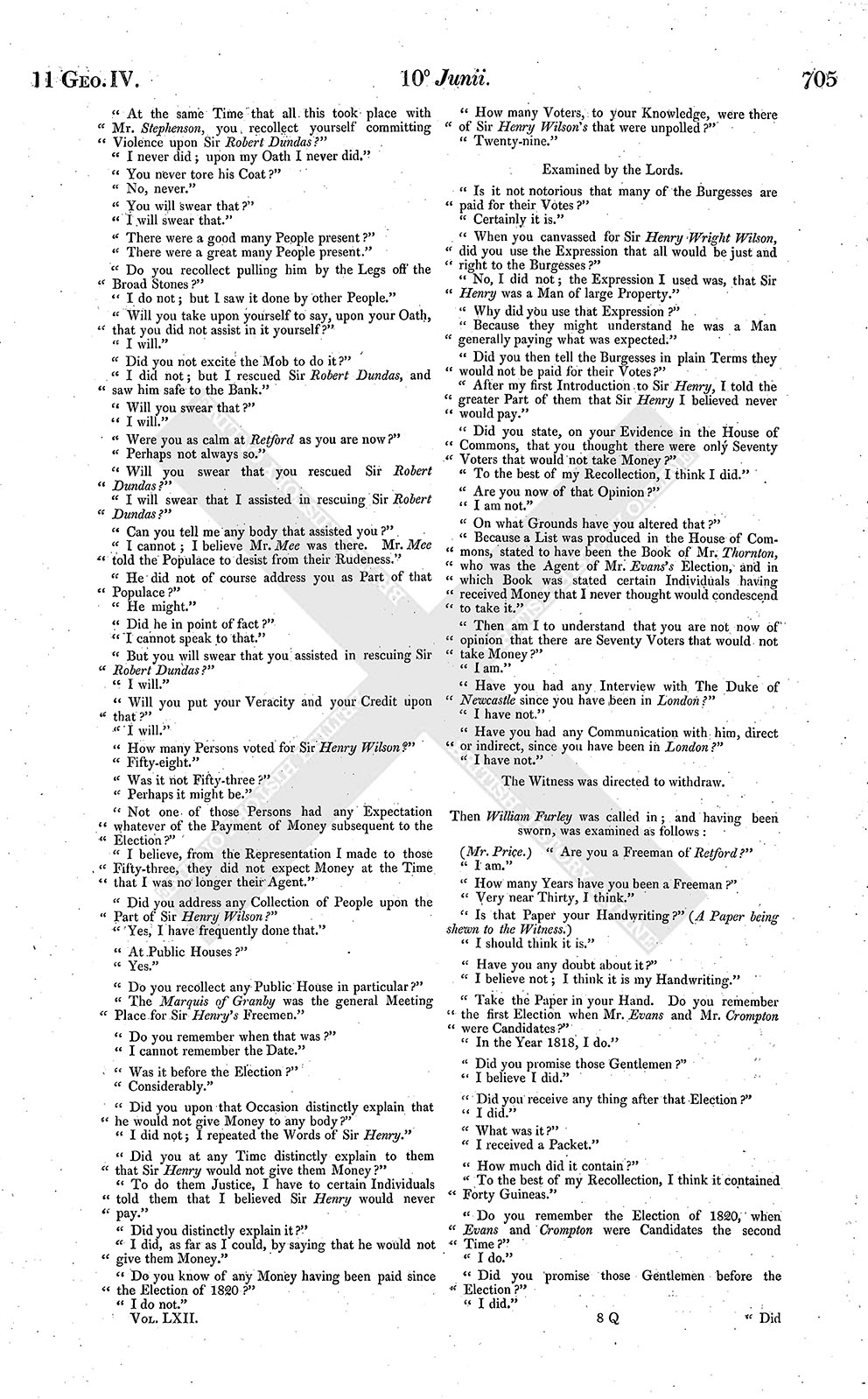
"I will swear that I assisted in rescuing Sir Robert Dundas?"
"Can you tell me any body that assisted you?"
"I cannot; I believe Mr. Mee was there. Mr. Mee told the Populace to desist from their Rudeness."
"He did not of course address you as Part of that Populace?"
"He might."
"Did he in point of fact?"
"I cannot speak to that."
"But you will swear that you assisted in rescuing Sir Robert Dundas?"
"I will."
"Will you put your Veracity and your Credit upon that?"
"I will."
"How many Persons voted for Sir Henry Wilson?"
"Fifty-eight."
"Was it not Fifty-three?"
"Perhaps it might be."
"Not one of those Persons had any Expectation whatever of the Payment of Money subsequent to the Election?"
"I believe, from the Representation I made to those Fifty-three, they did not expect Money at the Time that I was no longer their Agent."
"Did you address any Collection of People upon the Part of Sir Henry Wilson?"
"Yes, I have frequently done that."
"At Public Houses?"
"Yes."
"Do you recollect any Public House in particular?"
"The Marquis of Granby was the general Meeting Place for Sir Henry's Freemen."
"Do you remember when that was?"
"I cannot remember the Date."
"Was it before the Election?"
"Considerably."
"Did you upon that Occasion distinctly explain that he would not give Money to any body?"
"I did not; I repeated the Words of Sir Henry."
"Did you at any Time distinctly explain to them that Sir Henry would not give them Money?"
"To do them Justice, I have to certain Individuals told them that I believed Sir Henry would never pay."
"Did you distinctly explain it?"
"I did, as far as I could, by saying that he would not give them Money."
"Do you know of any Money having been paid since the Election of 1820?"
"I do not."
"How many Voters, to your Knowledge, were there of Sir Henry Wilson's that were unpolled?"
"Twenty-nine."
Examined by the Lords.
"Is it not notorious that many of the Burgesses are paid for their Votes?"
"Certainly it is."
"When you canvassed for Sir Henry Wright Wilson, did you use the Expression that all would be just and right to the Burgesses?"
"No, I did not; the Expression I used was, that Sir Henry was a Man of large Property."
"Why did you use that Expression?"
"Because they might understand he was a Man generally paying what was expected."
"Did you then tell the Burgesses in plain Terms they would not be paid for their Votes?"
"After my first Introduction to Sir Henry, I told the greater Part of them that Sir Henry I believed never would pay."
"Did you state, on your Evidence in the House of Commons, that you thought there were only Seventy Voters that would not take Money?"
"To the best of my Recollection, I think I did."
"Are you now of that Opinion?"
"I am not."
"On what Grounds have you altered that?"
"Because a List was produced in the House of Commons, stated to have been the Book of Mr. Thornton, who was the Agent of Mr. Evans's Election, and in which Book was stated certain Individuals having received Money that I never thought would condescend to take it."
"Then am I to understand that you are not now of opinion that there are Seventy Voters that would not take Money?"
"I am."
"Have you had any Interview with The Duke of Newcastle since you have been in London?"
"I have not."
"Have you had any Communication with him, direct or indirect, since you have been in London?"
"I have not."
The Witness was directed to withdraw.
Then William Furley was called in; and having been sworn, was examined as follows:
(Mr. Price.) "Are you a Freeman of Retford?"
"I am."
"How many Years have you been a Freeman?"
"Very near Thirty, I think."
"Is that Paper your Handwriting?" (A Paper being shewn to the Witness.)
"I should think it is."
"Have you any doubt about it?"
"I believe not; I think it is my Handwriting."
"Take the Paper in your Hand. Do you remember the first Election when Mr. Evans and Mr. Crompton were Candidates?"
"In the Year 1818, I do."
"Did you promise those Gentlemen?"
"I believe I did."
"Did you receive any thing after that Election?"
"I did."
"What was it?"
"I received a Packet."
"How much did it contain?"
"To the best of my Recollection, I think it contained Forty Guineas."
"Do you remember the Election of 1820, when Evans and Crompton were Candidates the second Time?"
"I do."
"Did you promise those Gentlemen before the Election?"
"I did."
"Did you receive any thing afterwards?"
"I did."
"How much?"
"Forty Guineas."
"For whom did you vote at the last Election?"
"For Mr. Wrightson and Dundas."
"Was the Election of 1818 the first Election you received any Money?"
"No; after the Election of 1802."
"Were you a Freeman at that Time?"
"I was."
"For whom did you vote on that Occasion?"
"For Crawford and Jaffray."
"What did you receive after that Election?"
"I believe I received a Package containing Forty Guineas."
"In 1806, did you receive any thing after that Election, when Robert Crawford and Thomas Hugham were Candidates?"
"I cannot charge my Memory."
"Whom did you promise?"
"I promised them."
"Do you remember the Election of 1807, when William Ingilby Esquire and General Crawford were Candidates?"
"Yes."
"Did you promise either of those Gentlemen?"
"I promised them both."
"Did you receive any thing after that Election?"
"I cannot charge my Memory at all."
"Did you receive any Packet?"
"I cannot call to mind at all."
"Do you know a Gentleman of the Name of Hannam of Retford?"
"Yes."
"Was that Letter written to him, the Attorney?"
"Yes."
(Mr. Stephenson.) "Is that your own Handwriting in the Inside of the Letter?"
"Yes."
(Mr. Price.) "Do you remember the Election of 1812, when Mr. Marsh and Mr. Osbaldeston were Candidates?"
"I do."
"Did you promise those Gentlemen?"
"I promised them both."
"Was it after that Election you sent that Letter to Mr. Hannam?"
"I do not recollect the Date of the Election."
"You remember the Election; was it after that Election you sent that Letter to Mr. Hannam?"
"I think it was."
"Read it."
"I cannot read it without Glasses."
"But it is your Handwriting?"
"I think it is."
(Mr. Stephenson.) "Are you sure of that?"
"I am."
(Mr. Price.) "Have you any doubt it is your Handwriting?"
"None at all."
"Please to deliver in that Letter?"
The Witness delivered in the same, which was read as follows:
"Nottingham, 24th April 1815.
"Sir,
"I have been informed, that some of the Freemen of Retford have received from you a Part of the Election Money, if so, I feel myself equally entitled to the same, having served my regular Apprenticeship; will thank you to give me your Answer immediately, and you will oblige,
"Sir,
"Your obedient Servant,
"Wm. Furley.
"No. 1, Long Row.
"Since writing the above, have heard that you was in Nottingham this Day."
(Addressed.) "Mr. Hannam, Retford."
Cross-examined by Mr. Stephenson.
"Who did you vote for at the last Election?"
"For Mr. Wrightson and Sir Robert Dundas."
"Who canvassed you?"
"I think Mr. Wrightson on his Part."
"And Sir Robert Dundas on his Part?"
"Not at all; I called upon Sir Robert Dundas himself."
"Are you an Inhabitant of Retford?"
"No; I am an Inhabitant of Gainsborough."
"Was any thing said to you about any Money?"
"Not in the least."
"Was there any Promise at any of the Elections at which you have voted?"
"Never."
"Any Consideration of any kind held out to you?"
"Not the least Item."
The Witness was directed to withdraw.
Then James Bailey was called in; and having been sworn, was examined as follows:
(Mr. Price.) "Are you a Freeman of Retford?"
"Yes, I am."
"What Profession or Line of Life are you in?"
"I am a bit of a Cottage Farmer now."
"Were you at any Time a Butcher?"
"Yes."
"How many Years have you been a Freeman of East Retford?"
"I cannot tell you."
"About how many?"
"Forty Years, or more."
"Do you remember the Election of 1784, when Mr. Wharton Amcotts and The Earl of Lincoln were returned?"
"Yes."
"Were you a Freeman at that Time?"
"I think I was."
"Do you remember the Election of 1812, when Mr. Osbaldeston and Mr. Marsh were Candidates?"
"Yes."
"Did you promise either of those Gentlemen?"
"Yes."
"Which did you promise?"
"I promised Osbaldeston."
"Did you at any Time after that go to the Angel Inn, and meet Mr. Hannam there?"
"No."
"Did you receive any thing after that Election of 1812?"
"Not a Halfpenny."
"Do you remember the Election of 1818, when Mr. Evans and Mr. Crompton were Candidates the first Time?"
"Yes."
"Did you promise those Gentlemen?"
"Yes."
"Did you receive any thing after the Election?"
"Yes."
"What did you receive?"
"I cannot say; I received a Letter."
"What did it contain?"
"I cannot tell now."
"Was there Money in it?"
"Yes."
"How much?"
"I cannot tell exactly."
"Recollect yourself?"
"I cannot tell."
"About how much?"
"Twenty Pounds."
"Were there Two Letters, or One?"
"Only One."
"Do you remember the Election of 1820, when they were Candidates the second Time?"
"Yes."
"Did you promise those Gentlemen again?"
"Mr. Crompton."
"Did you receive any thing after that Election?"
"I cannot tell whether I did or not; I would not swear it for my Life."
"Do you mean to say that having sworn that you received a Packet after 1818, you do not remember having received any thing after 1820?"
"I think I have not; I would not take my Oath of it."
"Do you remember the Election of 1790, when Sir John Ingilby and William Henry Clinton Esquire were Candidates?"
"Yes."
"Did you vote at that Election?"
"Yes."
"Did you receive any Money after that Election?"
"I cannot positively say whether I did or not."
"Was the Election of 1818 the first Time that you received any Money?"
"I am sure I cannot tell what was the first Time."
"Did you receive any Money before the Election of 1818?"
"I cannot positively say."
"Will you swear that you never received any Money before that Election?"
"I cannot exactly."
Cross-examined by Mr. Stephenson.
"Whom did you vote for at the last Election in 1826; Sir Robert Dundas and Mr. Henry Wrightson?"
"Yes."
"And Sir Henry Wilson?"
"No, I did not vote for all Three of them."
"Had you any Money at the last Election?"
"Not a Halfpenny."
"You have been upwards of Forty Years a Burgess?"
"Somewhere thereabout."
"Have you had, in those Elections, any Promise made to you that you should have Money given to you upon the Condition of your giving your Vote?"
"Never in my Life."
The Witness was directed to withdraw.
Then William Hemsworth was called in; and having been sworn, was examined as follows:
(Mr. Law.) "Are you a Burgess of East Retford?"
"Yes."
"When were you admitted a Burgess?"
"About Twelve Years ago."
"Was it in the Year 1817, or long before the Election of 1818?"
"About a Year."
"Do you recollect the Election of 1818, when Mr. Evans and Mr. Crompton were the Candidates?"
"Yes."
"Did you promise your Vote to those Gentlemen?"
"Yes."
"Did you receive any Money after that Election?"
"I have received Packages."
"How many?"
"Two."
"What did they contain?"
"Twenty Guineas each."
"Do you recollect the Election of 1820?"
"Yes."
"Did you promise your Vote again to the same Gentlemen?"
"The same."
"Did you receive any Packages?"
"Two."
"What did they contain?"
"Twenty Guineas each."
Cross-examined by Mr. Stephenson.
"Who did you vote for at the last Election?"
"I was not polled."
"Whom did you promise?"
"Sir Wright Wilson."
"Who canvassed you for them?"
"Mr. Brown."
"Did he say that he would guarantee you?"
"No."
"Had you any Promise of Money?"
"Yes."
"Had you any Conversation with Mr. Hornby?"
"No."
"Do you know him?"
"I know him."
The Poll Book of the Election in 1826 was delivered in.
The Journals of the House of Commons of the Date Martis, 1° die Maii 1827, were produced, and the following Entry was read:
"Martis, 1° die Maii 1827.
"Mr. Western, from the Select Committee appointed to try and determine the Merits of the Petition of Sir Henry Wright Wilson and of Darker Parker and others, severally complaining of an undue Election and Return for the Borough of East Retford, in the County of Nottingham, informed the House, That the said Committee have determined, That Sir Robert Dundas is not duly elected a Burgess to serve in this present Parliament for the Borough of East Retford: That William Battie Wrightson Esquire is not duly elected a Burgess to serve in this present Parliament for the Borough of East Retford: That the last Election of Burgesses to serve in Parliament for the said Borough is a void Election: That the said Petition did not appear to be frivolous or vexatious, so far as the same relates to Sir Robert Dundas and William Battie Wrightson Esquire: That the Opposition of the said Sir Robert Dundas to the said Petition did not appear to be frivolous or vexatious: That the Opposition of the said William Battie Wrightson Esquire to the said Petition did not appear to be frivolous or vexatious: That the Allegations contained in the said Petition against the Returning Officer did appear to the Committee to be frivolous and vexatious."
"Mr. Western, from the said Select Committee, also acquainted the House, That the said Committee had come to the following Resolutions; which they had directed him to report to the House: Resolved, That it appears to this Committee that Sir Robert Dundas was, by his Agents, guilty of treating at the last Election for the said Borough. Resolved, That it appears to this Committee that William Battie Wrightson Esquire was, by his Agents, guilty of treating at the last Election for the said Borough. Resolved, That the Committee consider it their Duty to direct the serious Attention of the House to the corrupt State of the Borough of East Retford. It appears to the Committee, from the Evidence of several Witnesses, that at Elections of Burgesses to serve in Parliament for this Borough, it has been a notorious, long-continued and general Practice, for the Electors who voted for the successful Candidates to receive the Sum of Twenty Guineas from each of them; so that those Burgesses who voted for both the Members returned have customarily received Forty Guineas for such Exercise of their Elective Franchise: It further appears to the Committee, that an Expectation prevailed in the Borough that this Custom would be acted upon at the last Election, although they have no sufficient Proof that such Expectation was encouraged by the Candidates then returned. Resolved, That the Chairman be requested to move, That this Report, with the Evidence taken before the said Committee, be printed; and that the Speaker do not issue his Writ for the Return of Two Burgesses to serve in Parliament for the said Borough of East Retford until the same shall have been taken into the Consideration of the House."
The Witness was directed to withdraw.
Then William Butt was called in; and having been sworn, was examined as follows:
(Mr. Law.) "Did you endeavour to serve, by Order of this House, Mr. Henry Saville Foljambe, a Banker at Retford?"
"Yes."
"Have you been able to meet with this Gentleman?"
"No; nor to get any Information of him. I went over to Doncaster, to his Partner, to the Bank, and to his House, and every Place were I thought I could get any Information of him."
"Have you been able to serve Mr. William Clark?"
"I have not; his House was closed, and I could get no Answer; myself and others have done every thing we can."
"Have you endeavoured to serve John Clark?"
"My Son went down."
"And James Clark?"
"James Clark, also, he did his utmost Endeavour to serve."
Mr. Law stated, "That it was admitted by the other Side, that William Mellors, a Burgess who was stated in Mr. Mee's List as alive, is in fact dead."
The Witness was directed to withdraw.
Mr. Law informed the House, "That he had closed his Case in support of the Bill."
The Counsel were directed to withdraw.
Ordered, That the further Consideration and Second Reading of the said Bill be put off to Monday the 21st of this instant June; and that the Lords be summoned.
Witnesses discharged from further Attendance on it.
Ordered, That Charles Ogilvy, Edward Cromwell Brown, George Thornton, Charles Crooks, Robert Brown, Philip Mills, Mary Tranter, James Bailey, George Bailey, William Wright, William Furley, John Hutchinson, William Tomlinson, William Hemsworth, John Hunt, William Taylor, George Crooks, William Pierpoint, James Barker and John Walker be discharged from further Attendance on this House, upon the last-mentioned Bill.
Adjourn.
Dominus Cancellarius declaravit præsens Parliamentum continuandum esse usque ad et in diem Veneris, undecimum diem instantis Junii, horâ undecimâ Auroræ, Dominis sic decernentibus.