
A History of the County of Wiltshire: Volume 17, Calne. Originally published by Victoria County History, London, 2002.
This free content was digitised by double rekeying. All rights reserved.
'Calne: Local government', in A History of the County of Wiltshire: Volume 17, Calne, (London, 2002) pp. 94-100. British History Online https://www.british-history.ac.uk/vch/wilts/vol17/pp94-100 [accessed 12 April 2024]
In this section
LOCAL GOVERNMENT
Borough government
Tenements in Calne were held by burghal tenure in 1086 (fn. 1) and later, and burgesses of Calne elected members of parliament from 1295, (fn. 2) but the burgesses were not incorporated by charter until 1685, and until 1835 the town was not self-governing. (fn. 3) In the Middle Ages all or some of the burgesses apparently acted together as members of a guild, (fn. 4) and in the 16th century they tried and failed to prove that they held liberties which had been granted by charter. In 1569 the queen confirmed that the men and tenants of Calne, presumably all the inhabitants of the borough, had liberties usually enjoyed by those holding ancient demesne of the Crown: the liberties included freedom from toll, pannage, murage, and passage, exemption from contributing to the expenses of the knights of the shire, and quittance from suit at all courts and from service on all juries and assizes outside the borough, but no right to govern the town. (fn. 5) Small payments were made to the undersheriff of Wiltshire in recognition of those liberties, which were later confirmed again. (fn. 6)
In the 16th century and until 1685 there were two stewards and usually no more than c. 20 burgesses. The stewards were called burgess stewards from 1561 or earlier to 1628, guild stewards from 1628. In 1683, as part of its attempt to control the choice of members of parliament for boroughs, the Crown instituted quo warranto proceedings against the burgesses of Calne, in 1684 judgment was given in favour of the Crown, and in 1685 a charter was issued incorporating Calne as a borough with a steward and 12 burgesses. (fn. 7) Later in 1685 the number of burgesses was increased to 30, most of whom were to be gentlemen living outside the town. (fn. 8) The removal of burgesses from office was ordered by the Privy Council in 1687 and 1688, and later in 1688 a new charter, reverting to a steward and 30 burgesses, was issued. The provision of the charter defining the number of burgesses was apparently set aside after the flight of James II, and from 1689 to 1835 Calne was an incorporated borough of two stewards and a varying number of burgesses. (fn. 9) There were c. 30 burgesses c. 1710, (fn. 10) 12 in 1835. (fn. 11)
On criteria which are obscure new burgesses were chosen by the existing burgesses at a special meeting. (fn. 12) Those chosen were admitted at the court of the honor of Wallingford (Berks., later Oxon.), from 1540 the honor of Ewelme (Oxon.), held at Ogbourne St. George. (fn. 13) In 1086 some burgesses held their tenements of the king, as probably all of them did earlier, (fn. 14) and the obligation to attend the court of the honor may have originated in service owed to the king for the tenements and performed at Wallingford castle. (fn. 15) From c. 1700 the guild stewards took the borough book to Ogbourne St. George for the steward of the court to sign the certificates of the admittance of new burgesses entered in it. (fn. 16) In the late 17th century and early 18th, in an attempt to increase the number eligible to vote at parliamentary elections, it was claimed that all those with rights to use the borough's land, probably most of the inhabitants of the borough, could become burgesses by presenting themselves at the honor court even though not chosen by the existing burgesses. The claim was rejected in 1724. (fn. 17)
The burgess or guild stewards were chosen from among the burgesses, from 1589 in February by the two outgoing stewards with the consent of the other burgesses. Each steward held office for a year, and the office was held by the burgesses in turn. (fn. 18) In 1733 a distinction was made between the elder steward and the younger, and in 1830 a distinction, perhaps different, between the senior and the junior. (fn. 19)
In 1589 the burgesses published written orders and constitutions governing their own proceedings. Thereafter they held two principal meetings a year, presumably summoned and presided over by the stewards. From 1589 to 1599 those meetings were held on the Sunday before 24 February, when the stewards were nominated, and on the Sunday before 11 November; from 1599 they were held on the Monday after 2 February and on 1 November or the following Monday. (fn. 20) Meetings were also held at other times of the year, and a pattern of two to four meetings a year was followed until the early 19th century. At the meetings burgesses were fined for not attending and sometimes for acting as jurors at courts to which, as burgesses, they owed no suit; occasionally one was disburgessed. (fn. 21)
The burgesses together owned the pastures called the Alders and the Marsh, in the 16th and 17th centuries nearly all their joint income arose from selling the grass and leasing the pasture, and at the burgesses' meetings regulations for the use of the pastures were made and fines imposed for breaking them. In the 18th century other income arose from gifts, besides those made charitably and managed as the Town Stock charity; £950 had been given by 1792, when the borough received £47 10s. from it. The borough's income was received by the stewards, whose accounts exist for 1561-1835. Money was spent by the stewards on inter alia the upkeep of the boundaries of the pastures and the payment of a hayward, legal expenses at the honor court, quarter sessions, and assizes, entertainment at the borough meetings, accountancy, and the purchase and repair of armour. Although they were not governing the borough the burgesses gave money to maintain the town bridge and to repair stocks and a blind house. (fn. 22) The stewards and burgesses managed the Town Stock charity and acted as trustees of several other charities for the poor. (fn. 23) For their labours the stewards in office in the late 16th century and earlier 17th may have been entitled to feed more sheep on the pastures than, as burgesses, they would have been entitled to, and from 1648 each steward in office was given 6s. 8d. (fn. 24)
From 1589 or earlier there were two constables for the borough. They were chosen by the burgesses from among their own number in the morning of the day on which the view of frankpledge for Calne hundred was held, and they were appointed at the view. From 1669 or earlier only one of the constables was chosen by the burgesses, who agreed that the second should be either of two men nominated by them and chosen at the view of frankpledge. (fn. 25) In the early 19th century the first was called the borough constable, the second the town constable. (fn. 26) Expenses incurred by the constables were met by the burgesses. (fn. 27)
There was a guildhall in Calne in the 13th century. (fn. 28) It may have survived as the building called Guildhall Cottage standing in 1706 (fn. 29) or as one adjoining it, and it was possibly the building called the old guildhall, which stood behind buildings at the south end and on the east side of High Street in the 18th century (fn. 30) and was demolished in the 19th century. From 1581 or earlier to 1829 the burgesses met in the church house, immediately north of the church, which was often called the guildhall. From 1829 they met in a room on the first floor of the market house which in the period 1826-9 was converted from a corn store to a town hall. (fn. 31)
The borough is known to have had two seals, each bearing its arms, and possibly had a third. (fn. 32) The arms were approved by heralds in 1565 and 1623. (fn. 33) The matrix of a seal was lost in 1565 and a new matrix was engraved in 1566. (fn. 34) The new matrix was probably that, known to have been used later, carrying the device of a castle between two feathers and with a third feather in its doorway, and bearing the legend SIGILL[UM] BURGI ET BURGENSIUM DE CALNE IN COM[ITATU] WILTS. (fn. 35) A drawing of a seal with the same device, except for the third feather, and bearing the legend SIGIL[LUM] COM[MUNE] DE CALN[E] may represent a different and perhaps earlier seal, or it may be an inaccurate representation of the seal known to have been used. (fn. 36) A new matrix, with the same device but without the feathers, was made in 1685 and bore the legend CALNE IN WILTS. It was lost in 1708 and was later recovered. It was replaced by the earlier matrix, which was used until 1734 and then lost. The older matrix was recovered in 1756 and used thereafter. The matrix of 1685 was used from 1734 to 1756. (fn. 37)
The borough boundary is first known to have been described in 1828. It took in nearly all the town. The principal exceptions were, on the east edge of the town, Eastman Street, the site of the farmsteads and mill of the Prebendal estate, and, on the south edge, buildings beside the London road and Silver Street. Agricultural land north and west of the town, including the Marsh, lay within the boundary; the Alders, west of the town and not part of the borough's lands from 1818, was excluded. South-west of the town the boundary ran between two of Calne's former open fields, taking in Wenhill field and leaving out South field; the ditch which divided Wenhill field and South field was called the borough ditch in 1818 but not in 1828, when that name was given to the borough boundary along the south edge of Wenhill field. (fn. 38)
By the Municipal Corporations Act, 1835, the old corporation was replaced by a new one, consisting of a mayor, 4 aldermen, and 12 councillors, to which some parts of the government of the town were committed. The boundary given to the borough under the Act was that described in 1828. The first election of councillors was in 1835, when 164 owners of property were entitled to vote. The councillors chose the aldermen from among their number, elected a mayor, and appointed a clerk and a treasurer, and in 1836 a further election was held to replace the four aldermen as councillors. Thereafter four councillors were elected each year. The borough council received income from its land, its investments, and a watch rate; it spent £96 in 1836, £156 in 1874. The council was responsible for policing the borough; it appointed its own constables until 1850, from when the borough was policed by the Wiltshire county force partly at the borough's expense. The council maintained the electoral roll, supervised the market, passed bylaws, and managed charities. In 1867 it appointed a town crier and from 1878 and 1879 became responsible for respectively a school attendance officer and a veterinary inspector. (fn. 39)
From 1851 members of the corporation and others sat as a local board of health for the borough. The area served by the board was altered in 1852; its new boundary included the whole town and excluded the agricultural land around it, and representatives of the part of the town outside the borough were elected to the board. Calne board of health was responsible for sewerage, street lighting, and the fire brigade. In 1872 it became an urban sanitary authority under its existing name and serving its existing area. (fn. 40)
In 1889 the borough absorbed the local board of health and adopted its boundary. (fn. 41) From then until 1974 the corporation had wide powers to govern the town. In the 20th century it built many houses, bought the companies supplying gas and water to the town, and provided many other public services. (fn. 42) The boundaries of the borough, which were conterminous with Calne Within parish, were extended in 1934 to take in much of the land excluded in 1889 and other land east of the town. (fn. 43) In 1974 the corporation was abolished and, as Calne Within parish, the borough became part of North Wiltshire district. (fn. 44)
From 1835 the borough council met in the town hall on the first floor of the market house. That building was demolished in 1882. From 1886 the council met in the new town hall, having met in the old church house, formerly called the guildhall, in the interim. (fn. 45)
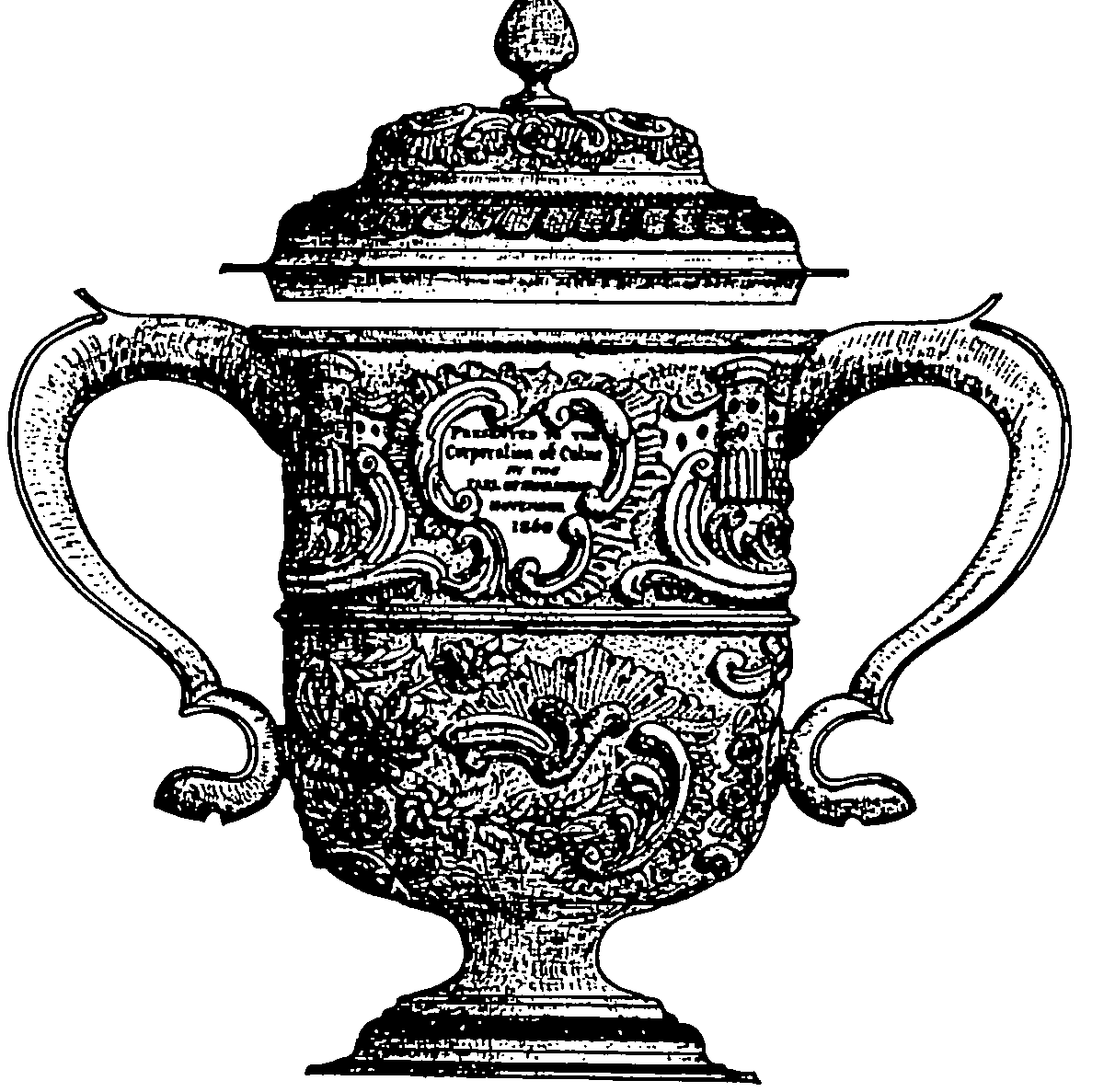
The loving cup given in 1860
In 1836 the new corporation acquired a new matrix for a seal. It was engraved with the borough arms, then described as gules a castle between two ostrich feathers with a third in base argent, and with the legend MAYOR AND COUNCIL OF THE BOROUGH OF CALNE, WILTS, 1836. (fn. 46) A crest, a gold mural crown ensigned by a gold mitre with jewels proper in front of two archiepiscopal staves crossed saltirewise proper, and supporters to the arms, two boars gules with gold tusks, each with a garland of silver teazles about its neck, were granted to the borough in 1950. (fn. 47)
A silver snuff box made between 1696 and 1720 was given to the borough in 1851, and a two-handled silver loving cup made in 1741-2 or 1756-7 was given in 1860. A chain and robes for the mayor were bought by a public subscription of c. 1881; the chain is hallmarked for 1881 and was first used in 1883. (fn. 48)
Manorial government
From the 13th century or earlier the lord of Calne manor had the right to hold view of frankpledge and exercise leet jurisdiction over Calne borough. (fn. 49) In 1288- 9 the liberties claimed were return of writs, pleas of vee de naam, view of frankpledge, the assize of bread and of ale, gallows, pillory, and tumbril. (fn. 50) The lord of the manor was also lord of Calne hundred, (fn. 51) and his jurisdiction over the borough was exercised in the view of frankpledge held for the hundred. Until 1840 the view was held biannually, in spring and autumn, and from 1841 to 1851 once a year or less. The business of the borough was transacted, and recorded, separately, and the borough was represented by an alderman who was appointed by the court and presented breaches of the assizes; a borough jury affirmed the alderman's presentments and presented under leet jurisdiction. (fn. 52)
The presentment of breaches of the assizes, and the amercement of offenders, was probably the main part of borough business at the view until the 16th century. In 1491 the alderman presented 3 innkeepers, 2 bakers, 5 butchers, 1 tanner, and 1 chandler for overcharging or supplying inadequate goods. In the 16th century and early 17th brewers, alehouse keepers, fishmongers, vintners, mercers, and millers were also presented. (fn. 53) It is not clear how many such presentments were made later in the 17th century; they had ceased by the 18th (fn. 54) although oversight of such tradesmen may have continued. In the earlier 18th century the alderman was occasionally called an ale taster, (fn. 55) and in the 19th century the court still appointed an alderman each year. (fn. 56) From 1673 until the early 19th century the court also appointed leather sealers, usually two each year; (fn. 57) in 1729 it ordered that the stamping hammer should be used only by the sworn leather sealers. (fn. 58)
In the 16th century the borough jurors occasionally presented a breach of the peace, but most presentments under leet jurisdiction then and later were of public nuisances. In the late 15th century and the 16th they concerned mainly the unsatisfactory condition of highways and watercourses, and in 1594 the owner of an inadequate chimney was presented. (fn. 59) In the late 17th century and earlier 18th a greater number and variety of nuisances came before the view. The fouling of streets and watercourses was frequently presented, as were deficient stiles, gates, and boundaries, and quarries, saw pits, wood piles, and chimneys which caused danger or inconvenience. In the 1680s men were amerced for throwing dying liquor, and emptying lime pits, into the Marden, and it was ordered that the town bridge should be railed and the mill pound walled and railed. The overseers of the highways were presented for failing to obey their charge. (fn. 60) From c. 1750 the number of presentments made by the borough jurors declined, and in the 19th century the only borough business at the view was the appointment of officers. (fn. 61)
In 1595 the view ordered the borough constables to make a new pillory. (fn. 62) In the 1670s the borough had, desired, or protested a desire for other instruments of punishment or restraint. The prison, presumably the blind house mentioned in 1687, and the stocks were said to need repair, and in 1676 the view ordered the guild stewards to repair them. In 1675 the view ordered the lord of Calne manor to provide, on pain of 40s., a cucking stool for the suppression of scolds; by 1684 the cucking stool had not been provided and the threatened penalty had risen to £30, and the town still lacked a cucking stool in 1687. Between 1678 and 1685 the view also ordered that iron guards should be fitted to the whipping post. (fn. 63) The market house built in the late 17th century or early 18th and demolished in 1882 incorporated a blind house at its northeast corner. Stocks and whipping posts stood near the south end of the building in the early 19th century, when the stocks were often used. (fn. 64)
From the early 12th century the Prebendal estate of Calne was free from suit to shire and hundred courts. (fn. 65) In the earlier 13th century the treasurer of Salisbury cathedral, as owner of the Prebendal estate, claimed that such exemption gave him the right to hold view of frankpledge and enforce the assize of bread and of ale, a claim denied in 1229 by the king. (fn. 66) In 1280-1 the treasurer claimed gallows and the right to take waifs and to enforce the assize. (fn. 67) A court was held for Eastman Street manor, which was part of the Prebendal estate and included copyholds with tenements at Eastman Street, (fn. 68) and there are direct records of it from 1681. In the later 17th century it was called a court baron, and then and in the early 18th century it met irregularly, presumably at need, and dealt only with the conveyance of copyholds. In the early 18th century the court, held by the lessee of the Prebendal estate, began to be called a view of frankpledge with court baron, and from c. 1719 it began to proceed on the presentment of jurors and, in addition to witnessing conveyances, to order amendment of public nuisances. It also nominated tithingmen, one for the part of the borough which lay within Eastman Street manor and one for Eastman Street tithing. Among nuisances presented were dung heaps, rubble, unfenced quarries, and dilapidated stiles and gates. In the earlier 18th century the court met at the principal house on the Prebendal estate (later the vicarage house) and in the later 18th century at the Catherine Wheel (later the Lansdowne Arms). (fn. 69) In the early 19th century what was then called the court leet was usually held once a year in November. Public nuisances continued to be presented at it and the tithingmen to be nominated; the nuisances, including one in Mill Street and one in Silver Street, were apparently those made in the part of the town which lay outside the borough. The court leet was apparently not held after 1833; (fn. 70) there were later and occasional meetings of the court baron for the conveyance of copyholds. (fn. 71)
Twice in 1594 and evidently at no other time the lord of Calne manor held a court for Bowers manor. In the 13th century the manor consisted of no more than 4 yardlands, and the court bearing its name was convened probably to promote the lord of the manor's cause in a dispute, about a gate and feeding in Cow Lane, with the owner of the Prebendal estate. (fn. 72)
A court and view of frankpledge, and a court baron, held by the lord of Calstone manor, exercised jurisdiction over all or part of Calstone, Quemerford, and Stockley. Their proceedings are discussed elsewhere. (fn. 73)
A court for Studley manor met in the late 16th century and early 17th and probably at other times. At meetings in 1589 and 1620 the homage presented that tenants had died and copyholds had been transferred, and the court ordered the repair of boundaries, ditches, and buildings and heard evidence about a disputed right of way. (fn. 74)
In 1320 the lord of Whetham manor was said to hold a court at Fynemore. It was probably the court of Whetham manor and held at Whetham. (fn. 75) No later court of the manor is known.
Parochial government
There was an outbreak of plague at Calne in 1637: to deal with it the overseers employed a physician from London for two months, used a house on the Alders and a house on the Marsh as pesthouses, incurred a debt of over £20, and in 1638 levied an additional rate to pay the debt. (fn. 76) The justices of Wiltshire ordered that £913 should be collected throughout Wiltshire to help the poor of Calne who had suffered in the outbreak, and £587 had been received by 1638. (fn. 77) Although the town had suffered, the estimate made in 1640 that 2,000 paupers lived there (fn. 78) was possibly exaggerated.
Until the mid 17th century paupers living or born in Bowood park, and in several settlements adjoining the park, were relieved by Calne parish. Those places thereafter relieved their own poor, but by the earlier 19th century all but one of the settlements had been excluded from Bowood liberty and the relief of their paupers again charged on Calne. (fn. 79)
By the later 17th century Calne parish had been divided into 17 rating areas, 7 of which lay in the borough. (fn. 80) In 1732 there were 22, of which 9 lay in the borough. The 9 in 1732 were the Green, Rotten Row (later Back Street), beyond the bridge (presumably High Street and Wood Street), Market Place (possibly including Hog Street), and five bearing the names of streets; by the early 19th century the number of divisions in the borough had been increased to c. 15. Of the 13 divisions outside the borough 11 were called tithings in 1732. The 11 were Beversbrook, Blackland, Calstone, Cowage, Eastman Street, Quemerford, Stock, Stockley, Studley, Whetham, and Whitley. Beversbrook included land in Calne parish which was part of Beversbrook manor (mainly in Hilmarton), Blackland and Calstone excluded the lands of those places which lay in Blackland and Calstone Wellington parishes respectively, Eastman Street included Eastman Street and land north-east of the town, and Stock included Pinhills and Laggus farms and other freehold estates south-west of the town. The other two divisions were land at Studley, all or part of the estate called Rumsey's, which was rated separately and described as part of Compton (presumably Compton Bassett) tithing, and an area called the borough lands which included Calne's open fields. (fn. 81) Apart from Blackland, Cowage, and Studley the rating areas called tithings corresponded roughly to divisions of the hundred represented by tithingmen at the private hundred court (fn. 82) or at the private views held by the lord of Calstone manor (fn. 83) and the owner of the Prebendal estate. (fn. 84)
The parish had four overseers, whose accounts exist for 1709-30 and from 1761. Throughout the period 1709-1835 they gave money regularly or occasionally to individual paupers, met expenses connected to childbirth, clothing, apprenticing, housing, medical treatment, and funerals, and observed the laws on bastardy and settlement. Between 1710 and 1730 they spent an average of c. £500 a year. Expenditure rose rapidly in the later 18th century: £720 was spent on the poor in 1761-2, £1,498 in 1771-2, £1,535 in 1781-2, and £1,541 in 1793-4. From 1799-1800 to 1800-1 spending increased from £1,981 to £3,328, between 1801 and 1835 it was usually above £3,000, in 1812-13 and 1833-4 it was over £4,000, and in 1831-2 and 1832-3 it was over £5,000. (fn. 85)
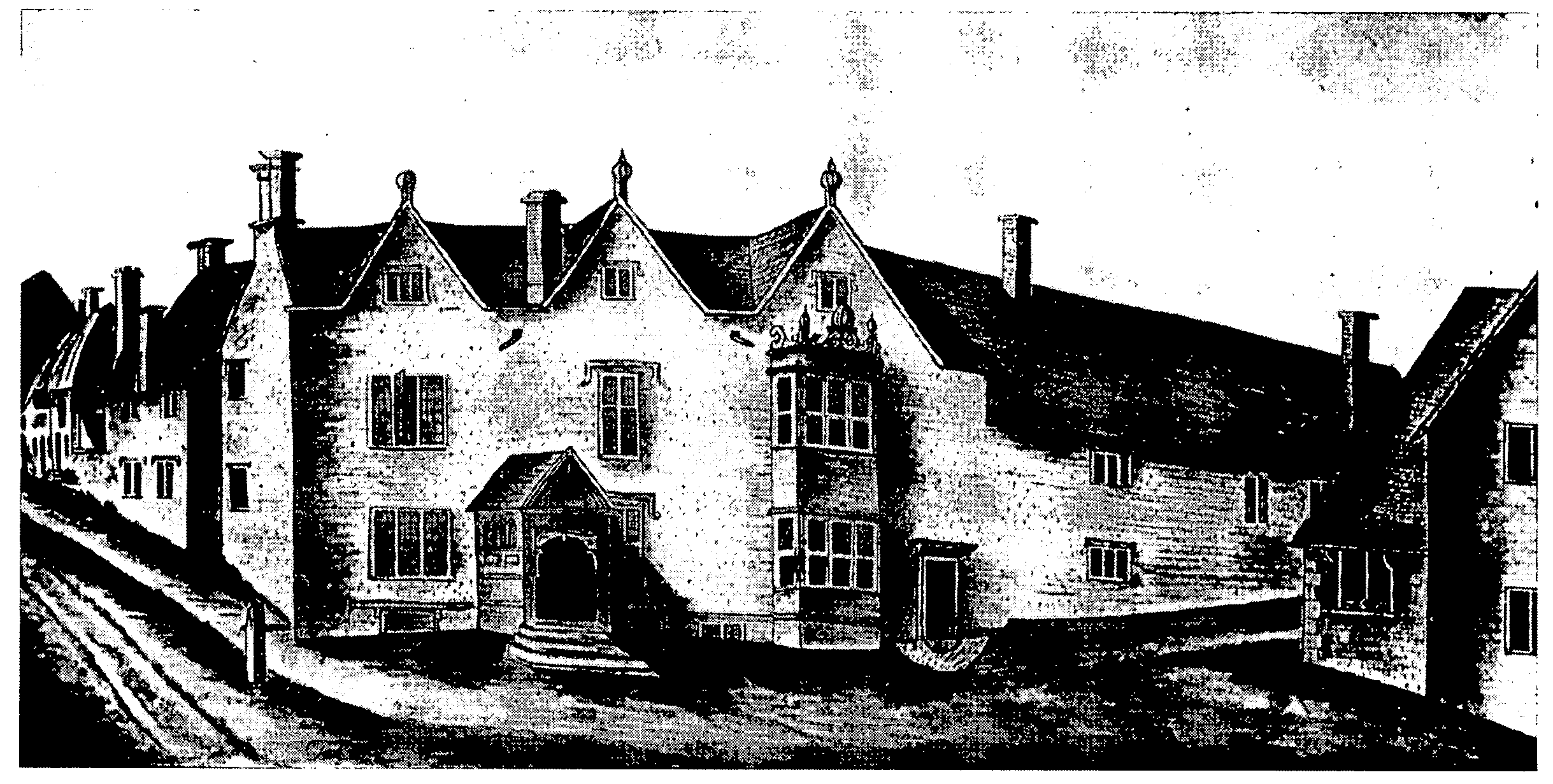
The parish workhouse c. 1760
Between 1710 and 1728 c. 50-100 paupers were relieved regularly. In 1728 the parish acquired a building by lease and equipped it as a workhouse. The workhouse was apparently open from August 1728, when monthly payments to paupers ceased. From 1728 to 1730 the cost of keeping paupers in it was c. £30-£50 a month, of which c. £3-£5 was contributed by profits from the paupers' work; ad hoc outdoor relief continued and then cost c. £12-£15 a month. (fn. 86) The site of the workhouse opened in 1728 is not known.
In 1755 the vestry resolved to apply to the justices to rescind the licence of the landlord of any public house in which the poor were allowed to drink, and to build a new workhouse. (fn. 87) In 1758 the parish bought a large dwelling house with an adjoining malthouse at the corner of Patford Lane (later New Road) and Silver Street and converted it to a workhouse. (fn. 88) In 1768 and later the inmates were employed in spinning, in 1779 the master was allowed to keep the profits of their work and for each inmate was paid 1s. 9d. a week to keep them in all necessities except clothes, and in 1791 the master was given extra money to provide them with small beer. By 1761 regular doles had been resumed, and in 1774 each pauper applying for or receiving relief from the parish was required to wear, on the right shoulder of the outermost garment, a badge of red cloth bearing the letters CP. (fn. 89) In the late 18th century the parish also used the almshouse at the north end of the Green as a poorhouse. (fn. 90) In 1802-3 outdoor relief was given regularly to 180 adults and 218 children, occasionally to 91 people, and the workhouse had 60 inmates. In 1812-13 outdoor relief was given regularly to 379, indoor relief to 47. (fn. 91)
In 1753 the vestry appointed a doctor at 20 guineas a year to attend the sick poor of the parish, and in 1769 a woman was paid £25 a year, presumably as a midwife. In 1771 an apothecary was appointed at £20 a year, more if he practised midwifery or treated more than five families with smallpox, and from 1784 three surgeons and apothecaries were appointed each year at all-inclusive salaries. The poor were sometimes inoculated. Also from 1784 one of the overseers was salaried and required to do the work of all four. In 1809 his title was acting overseer, his salary was £50, and his work included monthly visits to the house of each pauper and attendance one day a week at the vestry room in the workhouse to give money to paupers. (fn. 92)
By 1817 the workhouse had been converted to a poorhouse, in which paupers were lodged, and then and later attempts were made to find work for the poor outside it. In 1817 a full-time assistant overseer was appointed at a salary of £100 and with a remit covering all aspects of poor relief except the levying of rates, and in 1822 the parish established a select vestry to which the assistant overseer was answerable. (fn. 93) The poorhouse remained in use until 1828 (fn. 94) and probably until 1835, when the parish joined Calne poor-law union, (fn. 95) or c. 1847, when the union workhouse was built. (fn. 96)
The dwelling house bought in 1758 was of the mid 17th century and of stone. It had three gabled bays, a two-storeyed bay window, and a single-storeyed porch wholly or partly of timber. The adjoining malthouse, which stood to the north-west, was of two storeys, had twoand three-light mullioned windows and a steep roof, and may have been older. (fn. 97) By 1828, and probably not by 1822, the north-west end of the former malthouse had been altered to house a fire engine. (fn. 98) The main part of the dwelling house, at the corner of the two roads, had been demolished by 1885; (fn. 99) part of the former malthouse, including the engine house, survived in 1999. (fn. 100)
From the later 17th century or earlier the parish had four overseers of the highways. (fn. 101)
Calne Within and Calne Without parishes were in North Wiltshire district from 1974. (fn. 102)