A History of the County of Somerset: Volume 6, Andersfield, Cannington, and North Petherton Hundreds (Bridgwater and Neighbouring Parishes). Originally published by Victoria County History, London, 1992.
This free content was digitised by double rekeying. All rights reserved.
A P Baggs, M C Siraut, 'Cannington Hundred', in A History of the County of Somerset: Volume 6, Andersfield, Cannington, and North Petherton Hundreds (Bridgwater and Neighbouring Parishes), ed. R W Dunning, C R Elrington (London, 1992), British History Online https://www.british-history.ac.uk/vch/som/vol6/pp65-67 [accessed 30 April 2025].
A P Baggs, M C Siraut, 'Cannington Hundred', in A History of the County of Somerset: Volume 6, Andersfield, Cannington, and North Petherton Hundreds (Bridgwater and Neighbouring Parishes). Edited by R W Dunning, C R Elrington (London, 1992), British History Online, accessed April 30, 2025, https://www.british-history.ac.uk/vch/som/vol6/pp65-67.
A P Baggs, M C Siraut. "Cannington Hundred". A History of the County of Somerset: Volume 6, Andersfield, Cannington, and North Petherton Hundreds (Bridgwater and Neighbouring Parishes). Ed. R W Dunning, C R Elrington (London, 1992), British History Online. Web. 30 April 2025. https://www.british-history.ac.uk/vch/som/vol6/pp65-67.
CANNINGTON HUNDRED
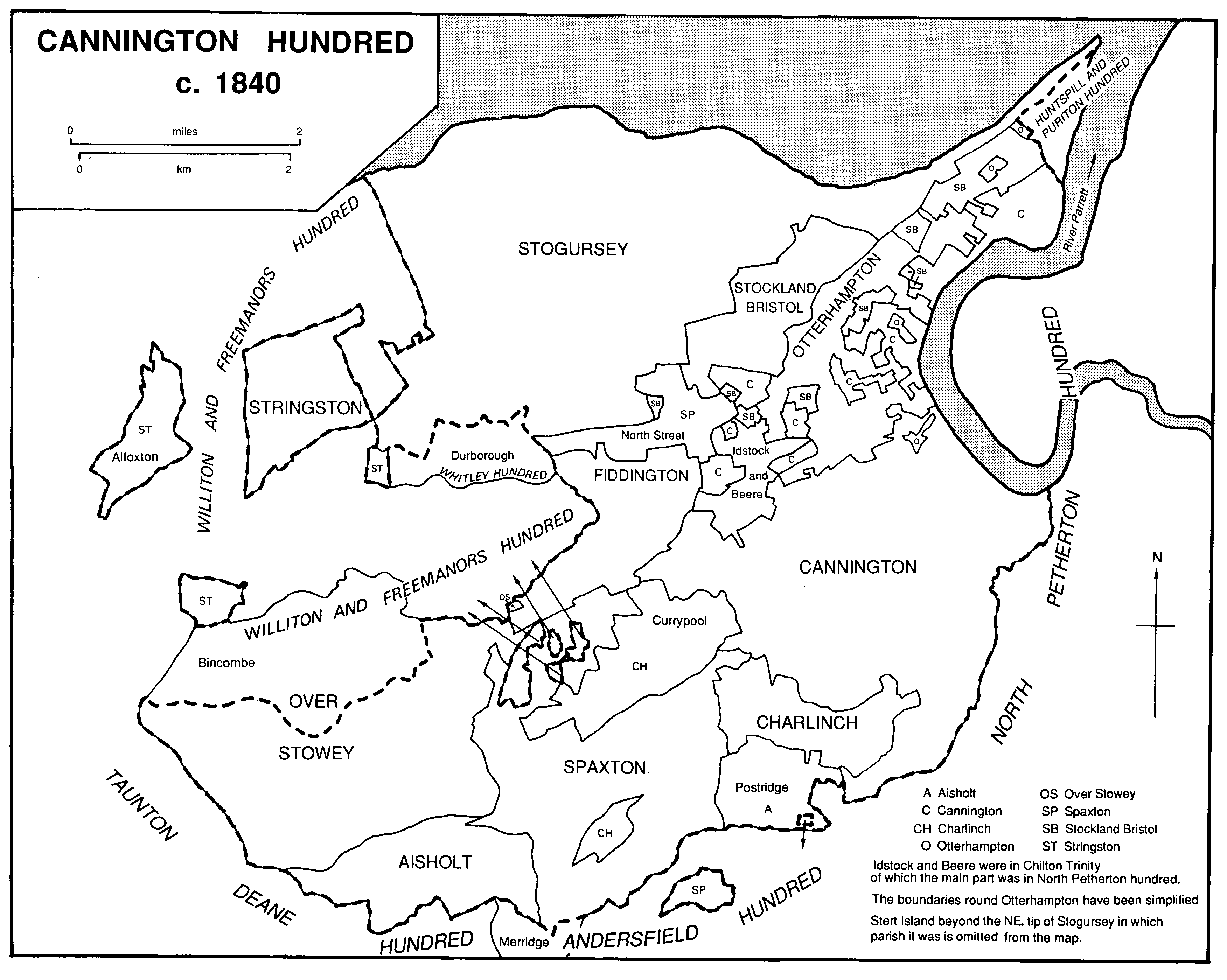
Cannington Hundred c.1840
CANNINGTON hundred occupies an area bordering the Bristol channel between the Quantock ridge on the west and the river Parrett on the east. It ranges between the flood plain of the lower Parrett, where flood prevention schemes have checked the changes in boundaries that formerly resulted from coastal erosion and river movement, and the higher ground of the Quantock scarp. The close settlement pattern in the 11th century was of villages, hamlets, and isolated farms, (fn. 1) some of the farms sited on outcrops of gravel in the Parrett basin. At least three sites have not been identified. (fn. 2) The hundred interlocks with Williton hundred on the west, a demonstration of the links between Cannington and Williton through ownership of both by the West Saxon royal house from the time of King Alfred if not earlier. (fn. 3) A detached part of Whitley hundred marked the presence at Durborough in Stogursey of a Glastonbury abbey estate. (fn. 4) In the Middle Ages agriculture and cloth production dominated the area and there was some commerce through Bridgwater's out-port at Combwich. Cloth was produced until the later 17th century; agriculture continued to be of prime importance in the mid 20th century, but forestry had been introduced extensively on the Quantocks.
Richard I granted the hundred to Hugh de Neville 'the elder', (fn. 5) possibly Hugh de Neville of Essex (d. 1234) who was referred to as lord of the hundred in the early 13th century. (fn. 6) The hundred descended with Stogursey manor (fn. 7) until 1541 when Edward Rogers of Cannington obtained a 21-year lease from the Crown. In 1545 the lease was converted into a grant in tail male. (fn. 8) A grant of the hundred in fee tail was made to Edward Courtenay, earl of Devon, in 1553 on the assumption that Rogers still held under lease. (fn. 9) Courtenay died in 1556 and a grant in reversion was made to Thomas Percy, earl of Northumberland, in 1557. (fn. 10) Rogers died in 1567 leaving the hundred to his heir George. (fn. 11) The hundred then descended, apart from a gap following its sale in 1652 to William Cox, with the manor of Cannington through the Rogers and Clifford families. (fn. 12) Charles, Lord Clifford, still claimed ownership in 1871. (fn. 13)
In 1086 Cannington hundred comprised just over 45 hides of which 10½ hides were free of geld. It included an estate belonging to Cannington church, William de Mohun's estate at or near Shurton in Stogursey, William de Falaise's at Stogursey, and possibly also Stockland and Spaxton. (fn. 14) In 1212 the hundred included Stogursey, Stockland Bristol, and the lands of the Hostiaria or Usher family, (fn. 15) presumably those later identified as at Huntstile in Chilton Trinity. (fn. 16) In 1242-3 Aisholt and Fiddington were part of the hundred; Stogursey borough attended the eyre by its own jury. (fn. 17)
By 1284-5 the hundred comprised Aisholt, Cannington (together with Chilton Trivet, Combwich, and Rodway tithings), Currypool tithing in Charlinch, Idstock tithing in Chilton Trinity, Otterhampton, Spaxton, Stockland Bristol, Shurton and Wick tithings in Stogursey, Adscombe and Plainsfield in Over Stowey, and Stringston. (fn. 18) In the earlier 14th century West Postridge in Aisholt, Charlinch, Fiddington with Bonson, Farringdon in Stogursey, and Aley in Over Stowey were also mentioned as in the hundred. (fn. 19) There were a few minor changes in the constituent parts of the hundred in the 16th and 17th centuries. (fn. 20) In 1742 the parishes within the hundred were listed as Aisholt, Cannington, Charlinch, Enmore, Fiddington, Otterhampton, Spaxton, Stockland, Stogursey, Over Stowey, and Stringston, together with the tithings of Alfoxton, Bincombe, Goathurst, Honibere and Fairfield, and Idstock and Beere. Alfoxton, Bincombe, and Honibere and Fairfield were otherwise recorded as in Williton and Freemanors hundred, (fn. 21) and Goathurst (rendered as Goathouse) was perhaps included in error for Lexworthy in Enmore parish and in Andersfield hundred. (fn. 22) In the later 18th century and until 1832 Cannington hundred comprised for fiscal purposes Aisholt, Cannington (including Chilton Trivet, Combwich, Orchard, Rodway Home, and Rodway Quarter tithings), Currypool tithing in Charlinch, Idstock and Beere tithing in Chilton Trinity (the rest of the parish being in Andersfield and North Petherton hundreds), Fiddington (including Bonson tithing), Otterhampton, Spaxton parish (including North Street, Pightley, and Tuxwell tithings but excluding Merridge in Andersfield hundred), Stockland Bristol, Stogursey (including Cock and Idson, Monkton, Shurton, and Wick tithings but excluding Durborough in Whitley hundred), Over Stowey (including Adscombe, and Higher and Lower Plainsfield tithings), and Stringston (excluding Alfoxton in Williton and Freemanors hundred). (fn. 23)
The sheriff's tourn for the hundred was held at Lypestone Hill, probably north of Clayhill in Cannington, by the 1370s. (fn. 24) Robert, Lord Poynings (d. 1446), held two 'legal' courts a year and a 'baronial' court every three weeks for the hundred. (fn. 25) Before 1652 the sheriff's tourn for the three hundreds of Andersfield, Cannington, and North Petherton had been held together at Lypestone Hill, but by that date was 'much discontinued'. (fn. 26) Charles, Lord Clifford (d. 1831), held a court at Stolford in Stogursey concerning rights on the foreshore in 1796-7. (fn. 27) At Christmas 1829 Charles, Lord Clifford, gave the usual hundred court dinner and lord's feast. (fn. 28) The court met at the Anchor inn in Cannington in 1834. (fn. 29)
In 1301 the income from the hundred included payments at the Purification called 'horderzeld', at Hockday called 'borghryst' or 'burghryzt', and at Michaelmas called 'austage'. (fn. 30) The lords claimed rights on the shore over seaweed (oare) and fishing in the 15th and earlier 18th centuries. (fn. 31) In the later 15th and early 16th century payments, known as 'borowryght' at Easter and as 'harderle' or 'harderhyll' at Michaelmas, were due from some tithings in the hundred and some manors. Additional income came from payments for watercourses and oare-burning licences. (fn. 32) Tithing silver was payable from the hundred in 1652. (fn. 33) In 1828-9 the hundred court jury ordered the levy of money from 'tithing acres' in the hundred. (fn. 34) The lords licensed a quarry in 1770-1 and fined a tenant in the same year for taking a cable found on the shore. (fn. 35)
A serjeant or bailiff of the hundred was recorded in 1225, (fn. 36) a bailiff in 1531, (fn. 37) a beadle c. 1608, (fn. 38) constables in the 17th century, (fn. 39) and a salaried bailiff in 1829. (fn. 40) There was a hundred pound in 1771-2. (fn. 41)