A History of the County of Somerset: Volume 7, Bruton, Horethorne and Norton Ferris Hundreds. Originally published by Victoria County History, London, 1999.
This free content was digitised by double rekeying. All rights reserved.
A P Baggs, M C Siraut, 'Norton Ferris Hundred', in A History of the County of Somerset: Volume 7, Bruton, Horethorne and Norton Ferris Hundreds, ed. C R J Currie, R W Dunning (London, 1999), British History Online https://www.british-history.ac.uk/vch/som/vol7/pp161-163 [accessed 30 April 2025].
A P Baggs, M C Siraut, 'Norton Ferris Hundred', in A History of the County of Somerset: Volume 7, Bruton, Horethorne and Norton Ferris Hundreds. Edited by C R J Currie, R W Dunning (London, 1999), British History Online, accessed April 30, 2025, https://www.british-history.ac.uk/vch/som/vol7/pp161-163.
A P Baggs, M C Siraut. "Norton Ferris Hundred". A History of the County of Somerset: Volume 7, Bruton, Horethorne and Norton Ferris Hundreds. Ed. C R J Currie, R W Dunning (London, 1999), British History Online. Web. 30 April 2025. https://www.british-history.ac.uk/vch/som/vol7/pp161-163.
NORTON FERRIS HUNDRED
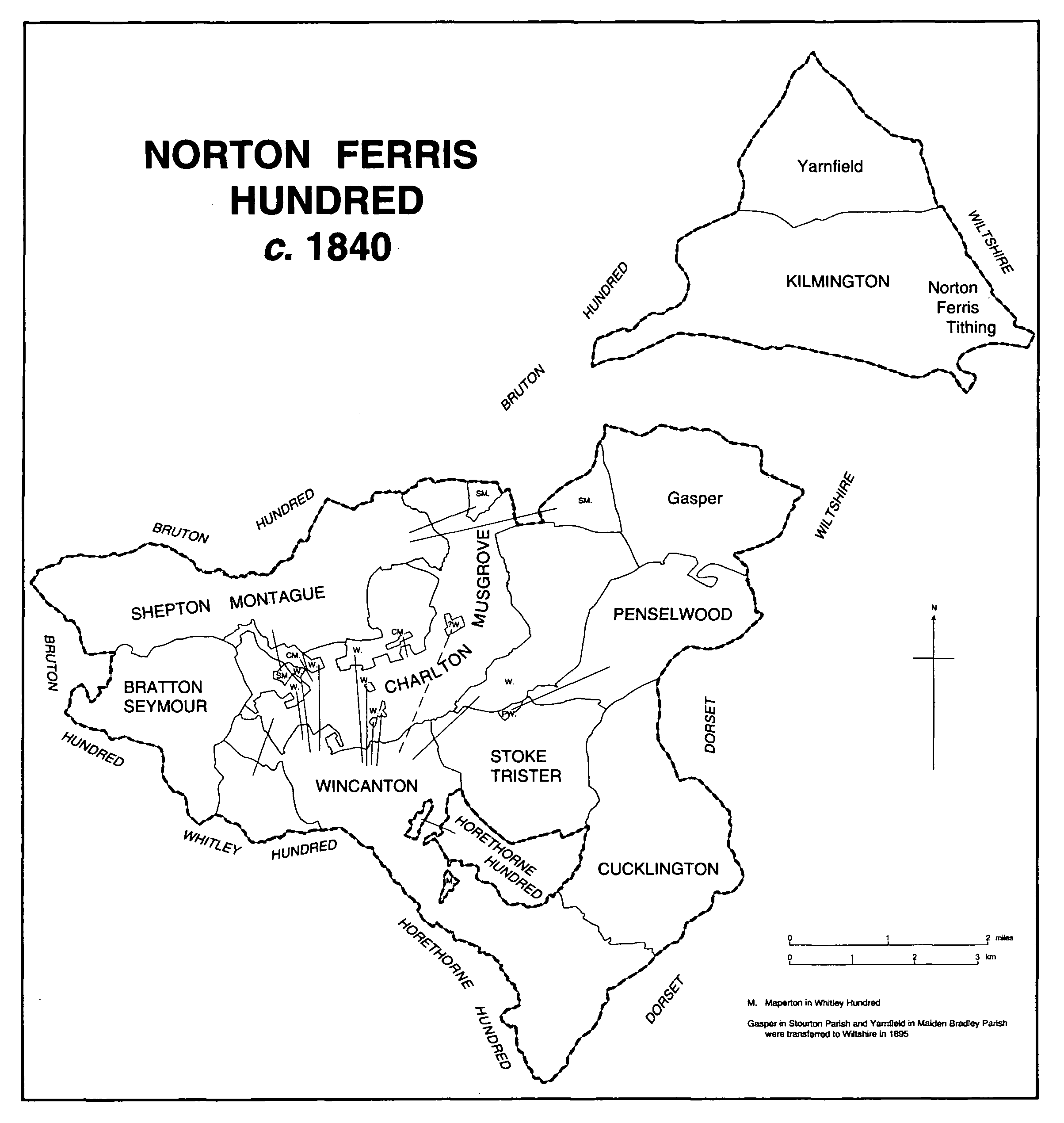
Norton Ferris Hundred c.1840
The hundred was reckoned as part of Bruton hundred in the geld inquest of 1084, (fn. 1) perhaps the last formal trace of the royal manor and minster parish of Bruton. (fn. 2) The hundred was named Wincanton in two versions of the Exeter Domesday. (fn. 3) From the earlier 12th century it took the name of Norton manor in Kilmington (later Wilts.) with which it was held, (fn. 4) and in the later 13th century was known as Norton on (super or desuper) Selwood. (fn. 5) The name Norton Ferrers or Ferris occurs in the early 16th century (fn. 6) and Norton Stourton in 1557. (fn. 7)
In 1282-5 the hundred comprised Charlton Musgrove, Cucklington, Knowle in Shepton Montague, Kilmington (presumably including Norton), Penselwood, Shepton Montague, Stoke Trister, and Wincanton, although the lords of Cucklington and Stoke had secured the release of suit from 1238-9. (fn. 8) In 1316 Bratton was named as a separate tithing and Holbrook hamlet in Charlton Musgrove was linked with Wincanton. (fn. 9) By 1327 Bratton was linked with Wincanton (fn. 10) and from the early 16th century until the 19th it formed part of Wincanton tithing, (fn. 11) as distinct from Wincanton borough, which had become a separate unit by 1523-4. By that date Cucklington and Stoke Trister, and later also Bayford, were named as a single tithing, and Kilmington and Yarnfield (later Wilts.) were similarly joined. (fn. 12) Holwell (later Dors.) was included, evidently in error, in 1624. (fn. 13) In 1625 Brook tithing, part of Stourton (Wilts.) ancient parish, answered at the hundred court, (fn. 14) but c. 1671 burgagers and residents of Wincanton borough claimed exemption because they held their own leet court. (fn. 15) By c. 1735 the hundred had been divided into east or upper and west or lower divisions, the east comprising Cucklington, Kilmington, Norton Ferris, Penselwood, and Stoke Trister. Norton Ferris, then defined as a tithing in Kilmington, also included Brook and Yarnfield. (fn. 16) In 1800 Brook, also called Gasper, Charlton Musgrove, Cucklington, Kilmington, Norton Ferris, Penselwood, Shepton Montague, Wincanton and Bratton, and Yarnfield sent tithingmen to the hundred court. (fn. 17)
The hundred was royal demesne until Henry I granted it with Norton manor to John or Jordan of Auffay (Seine Maritime, France) in marriage with Gillian, a woman of the king's chamber. (fn. 18) In 1212 it was held by Reynold de Ponz in right of his wife. (fn. 19) In 1251-2 it was held by Gerard of Blaye (Gironde, France), from whom it was held at farm for four years by Robert de Musgrove (d. 1254). (fn. 20) Before 1271 Robert's son Sir John de Musgrove was granted both manor and hundred by Archibald, count of Perigord, of the inheritance of his wife Agnes, said to be heir of Gillian, wife of John of Auffay. (fn. 21) Ownership of the hundred descended after the death of Sir John de Musgrove in 1275 (fn. 22) like Charlton Musgrove manor (fn. 23) until the attainder of Charles Stourton, Baron Stourton, in 1557. (fn. 24) It then reverted to the Crown and in 1585 was leased to Matthew Ewens. (fn. 25) In 1611 it was leased to George Whitmore and others, (fn. 26) but seems to have reverted to the Crown in Charles I's reign. (fn. 27) By 1664 it was owned by Sir John Jacob (fn. 28) and on his death in 1666 ownership descended with Temple Combe manor to Henry William Paget (d. 1854), marquess of Anglesey. (fn. 29) Henry Paget, marquess of Anglesey, son of the last, evidently sold the hundred in 1858-9 to George Digby Wingfield-Digby (d. 1883), owner in 1862. (fn. 30)
In 1436 hundred courts were held every three weeks and sheriffs' tourns at Epiphany, Easter, and Michaelmas. (fn. 31) In 1625-30 leet courts were still held every three weeks by a steward assisted by two bailiffs hearing cases concerning excessive tolls demanded by millers, too much profit taken by butchers, uncured skins, unrepaired highways, overgrown hedges, the absence of a parish rook net, breaches of the assize of bread, and persistent bowls playing. (fn. 32)
In 1652, when the hundred was in Crown hands, the courts were said to have been 'much discontinued' but the Easter and Michaelmas tourns for both Norton and Bruton hundreds were held with the tourn for Catsash in Bruton field. (fn. 33) The tourns were still so held for the three hundreds c. 1735 by 'an ash tree growing in the corner of a field by three cross ways near Bruton'. (fn. 34) In the 18th and the early 19th century hundred courts were held annually at Wincanton. (fn. 35)
In 1652 tithing silver and certainty money were paid at the tourns, (fn. 36) and fines were paid for release of suit by Penselwood tithing in the later 16th and the earlier 17th century. (fn. 37) Lawday silver totalled 24s. in 1818, and in 1825 £2 0s. 4d. less rents amounting to 16s. In 1836 the net income was 6s. No lawday silver was paid after 1839. (fn. 38) About 1735 each of the two divisions of the hundred had a constable. (fn. 39) From 1800 until 1812 two constables were appointed for each division. (fn. 40) A salaried bailiff for Norton and Horethorne hundreds was in office by 1825 until 1854 or later. (fn. 41)