A History of the County of Chester: Volume 5 Part 1, the City of Chester: General History and Topography. Originally published by Victoria County History, London, 2003.
This free content was digitised by double rekeying. All rights reserved.
'Roman Chester', in A History of the County of Chester: Volume 5 Part 1, the City of Chester: General History and Topography, ed. C P Lewis, A T Thacker (London, 2003), British History Online https://www.british-history.ac.uk/vch/ches/vol5/pt1/pp9-15 [accessed 30 April 2025].
'Roman Chester', in A History of the County of Chester: Volume 5 Part 1, the City of Chester: General History and Topography. Edited by C P Lewis, A T Thacker (London, 2003), British History Online, accessed April 30, 2025, https://www.british-history.ac.uk/vch/ches/vol5/pt1/pp9-15.
"Roman Chester". A History of the County of Chester: Volume 5 Part 1, the City of Chester: General History and Topography. Ed. C P Lewis, A T Thacker (London, 2003), British History Online. Web. 30 April 2025. https://www.british-history.ac.uk/vch/ches/vol5/pt1/pp9-15.
In this section
ROMAN CHESTER
First roman contacts and the establishment of the fortress
The precise date of the first occupation of Chester by the Roman army remains uncertain, (fn. 1) but the potential uses to which the site could be put - a fine harbour at the highest navigable point on the Dee, a river crossing, and a defendable position - were doubtless well appreciated by Rome from an early date, perhaps even before Caesar's time. (fn. 2) The earliest Roman knowledge of the area was presumably through commerce: although proof is lacking, ships from the western Mediterranean and Gaul may occasionally have visited to engage in barter. Traces of cultivation on the site, (fn. 3) together with a few sherds of Iron Age pottery accidentally redeposited in the earliest Roman structures, (fn. 4) clearly attest to pre-Roman occupation, perhaps a small Cornovian fishing and farming settlement by the river bank, defended by a promontory enclosure on the site of the later castle. The place was potentially convenient for merchants trading with local people throughout the lower reaches of the Dee valley. (fn. 5) The river in time gave its name to the site in a Latinized form: Deva, 'the holy one'. (fn. 6)
Contacts with Rome presumably increased greatly after Claudius's successful invasion of south-eastern Britain in A.D. 43, and by the earlier 50s elements of the Roman army had probably arrived in the area during campaigns against the Ordovices and Deceangli in central and northern Wales and the Brigantes north and east of Cheshire. (fn. 7)
Further campaigns in Wales during the late 50s culminated in Suetonius Paulinus's attack on Anglesey in 60. Although there is no conclusive archaeological evidence, the Romans may well have used the harbour and crossing-point at Chester, defending them perhaps by a small fort. If so, their occupation then is likely to have been short-lived, since the Boudiccan uprising in 60 demanded the governor's immediate attention elsewhere and an abrupt cessation to his campaigns in north Wales. (fn. 8) It was only c. 70 that a new policy of total conquest of the British Isles led to the establishment of the first permanent military presence at Chester. (fn. 9)
As a prelude to implementing the new policy, the Ninth Legion was moved forward from Lincoln to York, and a new legion, the Second, called Adiutrix and recently raised by Vespasian from the marines of the Adriatic fleet, was sent to Britain with the new governor, Petillius Cerialis, and based initially at Lincoln. (fn. 10) It was soon moved west to construct a new legionary depot at Chester, probably under orders from Sextus Julius Frontinus as incoming provincial governor in or shortly after 74. (fn. 11)
During Frontinus's governorship (74-8) and in the first year of his successor, Gnaeus Julius Agricola, the Roman army completed the subjugation of the Silures and Ordovices in Wales by reconquering Anglesey in 78. Agricola was then free to complete the conquest of the Brigantes begun by Cerealis in the early 70s. The legionary depot and related installations at Chester were built during those years, with the finishing touches to the basic military requirements added by c. 80. (fn. 12)
Scarcely two years later Agricola had subdued Brigantia, occupied the Forth-Clyde isthmus, and was advancing towards the river Tay. Chester, with superb harbour facilities, played a key role in the seaborne support of the campaigns, and it was also adequately placed to keep watch on the Ordovices and southern Brigantes. At the same time the Roman army may have been preparing for the conquest of Ireland, (fn. 13) for which Chester was admirably situated to be the main embarkation point and supply base. Although never accomplished, the plan probably encouraged the development at Chester of a major military base. (fn. 14)
The idea that Chester's main role was naval is supported by the importance which the Roman army attached to seaborne operations, exemplified by the circumnavigation of northern Britain by its fleet in 84, and in particular by the positioning at Chester of the Second Legion, a unit with naval experience. (fn. 15) Other factors lend further support to the idea. First, the legionary depot at Wroxeter (Salop.) appears to have remained in commission, though perhaps merely under care-and-maintenance. (fn. 16) It was sufficiently well situated for campaigns in the Marches, central and north Wales, and probably southern Brigantia to make the relocation of a legionary depot to Chester merely to control the Ordovices and Brigantes unnecessary. Chester indeed may not have been well placed for campaigns in north Wales, since a direct overland route was made difficult by marshlands to its southwest. (fn. 17) Moreover it was located somewhat away from the existing main roads leading north on the west side of the Pennines. Probably the main advantage of the site was that it was the highest navigation point on the Dee. (fn. 18)
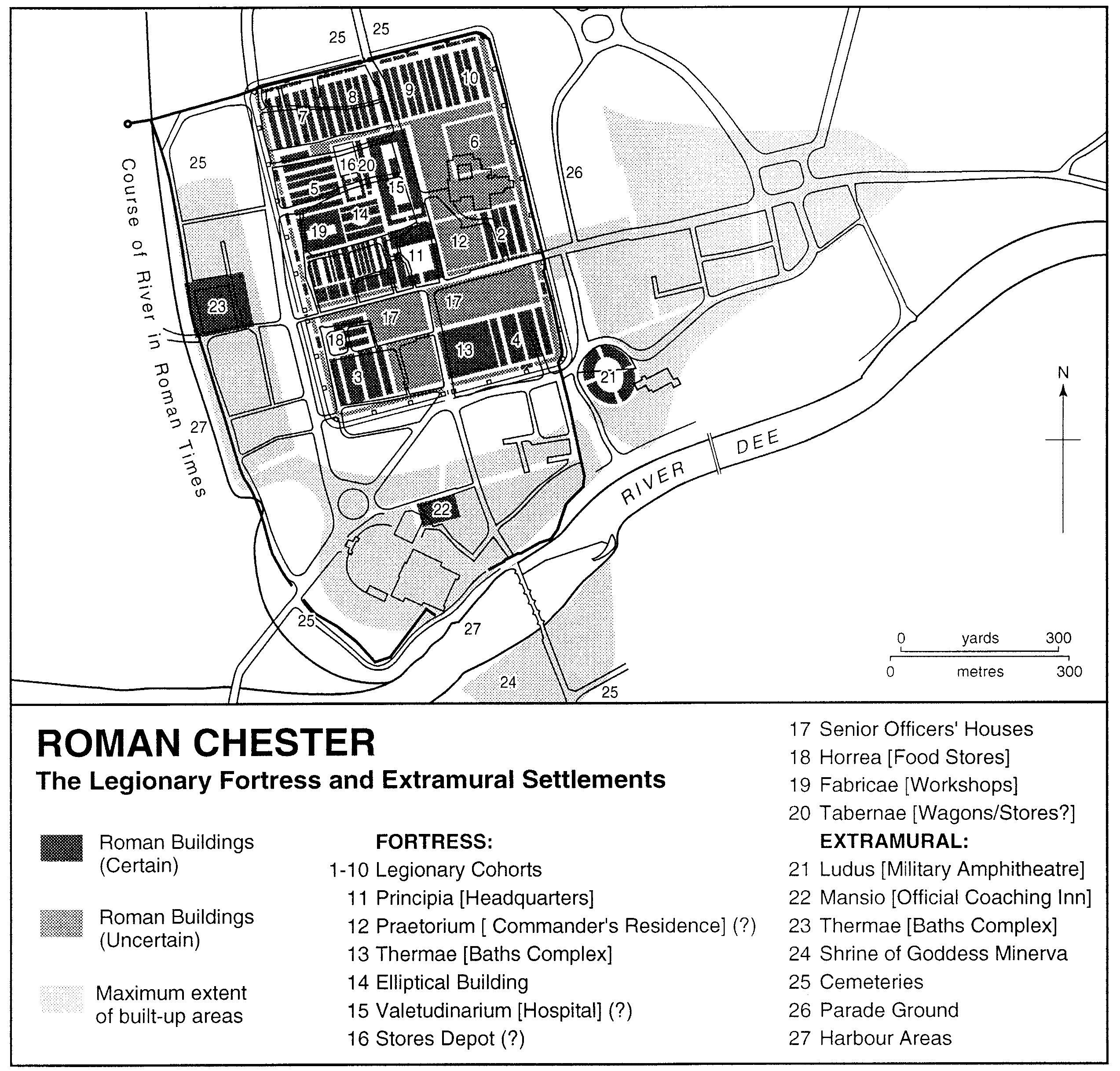
Roman Chester, with modern street plan superimposed
The second legion at chester, 74-90
Acting as an essential reserve force (the meaning of Adiutrix), (fn. 19) supplying the northward-moving army by sea, and perhaps preparing for the conquest of Ireland, the men of the Second Legion are unlikely to have been heavily used by Agricola in his northern campaigns.
Roman chester
They were, moreover, deeply committed to the building of their depot and related installations at Chester, involved in supervising lead-mining operations in north-east Wales, and incidentally (with the support of various auxiliary regiments) kept some kind of watch over the Ordovices and southern Brigantes. During its service at Chester the legion, styled Pia Fidelis (Loyal and Faithful) for supporting Vespasian in the civil war of 69, comprised mostly men of Mediterranean origins, recruited in such regions as the eastern shore of the Adriatic, Thrace, northern Italy, and Greece. (fn. 20)
The new legionary depot at Chester was constructed in the manner typical of the period in Britain, mainly of timber-framed, wattle-and-daubed buildings. The enceinte consisted of a double turfrevetted rampart and palisade some 20 Roman feet (c. 6 metres) wide at base and 10 Roman feet (c. 3 metres) high, topped with a palisade 5 Roman feet high, to which were added wooden gates and towers probably 25 Roman feet (c. 7.4 metres) high, and with at least one substantial ditch outside. (fn. 21) Although of simple materials, many of the buildings, particularly the houses of the senior centurions, were finished to a high standard, with elaborate interior wall decoration, tiled roofs, and glazed windows. (fn. 22) A permanent piped water supply was laid from springs a short distance to the east, with subsidiary lead pipes connecting the main supply to the more important buildings. (fn. 23) There was also a main sewage and waste-water disposal system via rock-cut culverts set below the main streets and no doubt connected to both communal and private latrines, such as those for the centurions at Abbey Green. (fn. 24) Some buildings were of stone and concrete from the outset, among them the bath building and leisure complex alongside the via praetoria (Bridge Street), whose functions and status demanded a tall and structurally complex building. Its technical sophistication was comparable with that of similar buildings at the heart of the Roman Empire. While building continued, and at least until work on the depot itself was far advanced, the legionaries probably lived in temporary construction camps near by. (fn. 25) Together with annexes for baggage trains and other surplus equipment, they appear to have been mainly east of the depot. (fn. 26)
Outside the ramparts the army probably gave priority to constructing harbour installations, a parade ground, a bridge (presumably at first entirely of timber), and various official establishments such as extramural baths, (fn. 27) posting houses, (fn. 28) and the amphitheatre. The amphitheatre was used for celebrating the many religious feasts in the legion's calendar, weapon training, drill, military parades and demonstrations, and, most important, public address. It was also designed for entertainment, initially largely for the soldiers, though the cavea (spectators' seating area) of the original wooden structure appears to have been too small for a full legion of c. 5,500 men. (fn. 29)
Attracted to Chester by the chance of a living from the large number of well-paid legionaries were local tribesmen, traders of all kinds from near and far, an army of servants and labourers (both slave and free), and officials employed to run the extramural posting houses, harbour facilities, and other official establishments. There were, too, retired soldiers, some probably from Wroxeter, who preferred to live close to their former comrades-in-arms in a lifestyle which retained a military flavour. (fn. 30) Many had wives and families. Thus, quite quickly, a sizeable settlement, known as the canabae, (fn. 31) grew up outside the walls of the fortress. It remained under direct military supervision, unlike the nearby independent and very large civil settlement at Heronbridge. (fn. 32)
In the early 80s part of the Second Legion was posted to the Rhine frontier. Although there was probably nothing new in the sending of detachments to other parts of the Empire while the main body of the legion remained in Britain, soon afterwards, in the late 80s, the remaining fighting strength of the legion was sent to the Danube. (fn. 33) Placed as it was in reserve at Chester, well south of the frontier zone, the Second was the legion which could most easily be spared. Its removal appears to have been related to the gradual abandonment of recent conquests in Scotland. (fn. 34)
Despite the withdrawal of the legion's fighting strength it is unlikely that the army altogether abandoned the depot, which probably remained for a time nominally under the legion's command, many of its empty buildings being retained on a care-andmaintenance basis. The soldiers who stayed behind were presumably non-combatants involved in the administrative and other tasks of military depot life. The training of recruits probably continued unchanged. (fn. 35)
The early years of the twentieth legion, 90-122
By c. 90 the Second Legion had no further need of its base at Chester and the depot's future had to be decided. It was quickly realized that, since much of Brigantia was controlled by the army, and Wales had been subjugated, Chester was more usefully placed than Wroxeter, which was effectively landlocked. Accordingly, the legionary depot at Wroxeter was abandoned c. 90, and the Twentieth Legion, Valeria Victrix, established itself instead at Chester, possibly after a short stay at Gloucester. (fn. 36)
The Twentieth had been in Britain since the Claudian invasion in 43, (fn. 37) and had served in Brigantia and Scotland. (fn. 38) The legion, which during its early years at Chester was still recruiting heavily from Spain, northern Italy, the Adriatic, and southern France, (fn. 39) took over a depot at Chester in full working order, and the daily routine of training and repairs clearly continued. Many of the buildings were nearly twenty years old and required much replacement of rotting timbers. The defences may also have been refurbished, (fn. 40) and minor internal alterations were made to many buildings, particularly the officers' quarters c. 100. (fn. 41) Some buildings were completely reconstructed. At Abbey Green, for instance, a new timber-lined main sewage culvert was inserted alongside the via sagularis (the road running round the depot inside the defences) and new timber-framed cookhouses and mess huts were inserted alongside the ramparts. (fn. 42) In the canabae some official buildings were still being completely renewed in timber in the early 2nd century. (fn. 43)
Soon after the arrival of the Twentieth Legion, however, it was decided, apparently, to rebuild the entire depot in stone. An unlimited supply of building sandstone lay in the immediate neighbourhood, and quarries were opened on both sides of the Dee, (fn. 44) but the main reason for such a major undertaking may have been a decision to make the Chester base permanent. Sound building in stone, or timber framing on stone sills, was potentially far more durable in a damp climate than timber framing alone. The scope of construction, the imposing major buildings, and the sophistication of even the barrack blocks, the verandas of which were supported on lathe-turned sandstone columns, suggest further that the legion was thinking on a grand scale in line with the general mood of confidence expressed in building and design throughout the Roman world at that time. (fn. 45)
Within the rebuilding programme some priority seems to have been given to the defences, which may still have been in their original form, though no doubt much repaired and patched during the previous 25 years or so. (fn. 46) In addition to the recutting of the ditch, the wooden interval towers and palisade appear to have been dismantled, though the turf-revetted rampart was retained. The gates were probably rebuilt then or soon after in stone on their original sites, and work began on an impressive stone revetment added to the front of the rampart. (fn. 47)
The extent and appearance of the defences c. 100 remain uncertain. If, as seems likely, (fn. 48) further work continued on them in the 3rd century, a hint of their intended strength is provided by the internal stone towers placed at regular intervals round the circuit. Although the towers were substantially rebuilt later, they probably originated in the late 1st or early 2nd century, and were fewer and more widely spaced than the original timber ones. It is perhaps more likely, however, that the walls under construction c. 100 were those which survived, albeit with later additions, on the north and east sides into modern times, constructed in opus quadratum (large dressed and squared blocks of stone), since there are striking similarities to the first wall at Gloucester and, to a lesser degree, the stone curtain wall at Inchtuthil (Perthshire), both built at about the same time at places associated with the Twentieth Legion. (fn. 49)
The rebuilding of the depot was conducted randomly rather than systematically, presumably because the cohorts made widely differing rates of progress. As previously, detachments would have been on duty elsewhere, and in their absence little building work may have been carried out in their parts of the depot. By the early 2nd century in the central area at least one large building and some barracks were rebuilt in stone, or with stone sills, (fn. 50) whereas in the rearward areas progress appears to have been far slower, only a few cookhouses and mess huts near the north gate having been completed. (fn. 51) Curiously, replacement of some of the larger buildings seems to have been delayed. Indeed, the intended site of one major building, perhaps a stores compound, stood vacant from the first occupation by the Second Legion, being used instead for refuse pits. (fn. 52) The most essential requirements were satisfied first, other buildings receiving attention later as time and opportunity permitted, but curiously the headquarters building (principia) may not have been rebuilt in stone at all at that time. (fn. 53)
In the canabae the rebuilding programme seems scarcely to have begun by the 120s. One of the earliest extramural buildings reconstructed in stone was the amphitheatre, the various official functions of which presumably demanded priority. On a much grander scale than its predecessor, with seating for at least 7,000 spectators, more than the full strength of the legion, it reflected the expansion of the canabae and perhaps also the requirements of an increasing population, both military and civilian, for entertainments. (fn. 54) Such a major construction project also showed confidence in the future of Chester and its canabae.
The Dee bridge may also have received attention early in the 2nd century. In 2000 its remains, including pier bases, massive stones, and cornice fragments, lay scattered across the river bed a few metres downstream of its medieval successor, evidence of a very solid bridge of Roman military design, perhaps with a timber superstructure. (fn. 55)
In the extramural settlement between the waterfront and the western ramparts, a short distance outside the west gate, what appear to have been luxurious and extensive baths in stone and concrete were also already in use early in the 2nd century. (fn. 56)
The 'military hiatus', 122-97
In 122 Emperor Hadrian may have visited Chester on his way north to organize the construction of his great frontier works from the Solway Firth to the Tyne, (fn. 57) a project in which the Chester legion played a large part. Work continued on the frontier for the rest of Hadrian's reign (117-38) and into that of Antoninus Pius (138-61), still involving men from the Twentieth, (fn. 58) so that in Chester the reconstruction of the depot and its canabae in stone had to be severely curtailed.
In all parts of the depot and its extramural settlement there is abundant evidence of a halt in building between c. 120 and c. 130. In the left retentura (the rearward part of the depot) scarcely had work on the defences been completed and two cookhouses nearest the north gate rebuilt in stone, when the whole operation was abandoned; the remaining cookhouses, all the barracks, and even the main drains below the via sagularis were left in their original timber-framed form. (fn. 59) In the right retentura it seems that none of the cookhouses had yet been rebuilt, whereas work on the barracks had just started and at least one of the new centurions' houses was abandoned in a very incomplete state. (fn. 60) In the centre of the depot the barracks of one cohort, recently rebuilt in stone and reoccupied, seem to have been abandoned, and work on parts of a very large building immediately behind the headquarters may likewise have been cut short. (fn. 61) In the canabae just outside the south gate a second attempt at rebuilding a posting house in stone was abandoned incomplete by c. 130, (fn. 62) and other official establishments may have been similarly affected by the legion's preoccupations elsewhere. There is also circumstantial evidence that the amphitheatre may have fallen into neglect before c. 150. (fn. 63)
Events in northern Britain during the reign of Antoninus Pius continued to frustrate rebuilding at Chester. In particular, work was delayed by the lengthy involvement of the Twentieth Legion in a new campaign in Scotland and in building the Antonine Wall. (fn. 64) Legionaries from Chester manned some of the northern forts and at least one centurion from the Twentieth commanded an auxiliary regiment on the frontier. (fn. 65) Further trouble in the North in the 150s and 160s and the removal of troops from Britain to strengthen imperial armies elsewhere also probably affected Chester. (fn. 66) Certainly a detachment of the legion was employed in construction at Corbridge (Northumb.), (fn. 67) and deployment in the Danubian provinces is suggested by the fact that some of the 5,500 Iazygian cavalrymen drafted to Britain in the 170s found their way to Chester, where at least one was commemorated by a tombstone rediscovered in 1890. (fn. 68) A detachment from the legion was in Armorica in the reign of Commodus (180-92), (fn. 69) and the Twentieth may also have contributed to the token force sent to Rome to meet the emperor in 185. The legion was doubtless also involved, along with the rest of the provincial British army, in the succession struggles after Commodus's assassination in 192, in support of the British candidate for the purple, Clodius Albinus, defeated in 197 with heavy losses among the legions of Britain. (fn. 70)
Such commitments meant that the legion's base at Chester was run down for most of the 2nd century. The barracks in the left retentura appear to have fallen into a semi-derelict condition, and at least some were used for rubbish disposal. (fn. 71) In the right retentura the site of a centurion's house abandoned incomplete by c. 130 was also used as a rubbish tip for at least several decades. (fn. 72) A large building directly behind the headquarters had rubbish piled into one corner from c. 130 to as late as c. 240, (fn. 73) though other parts may have remained in use. Elsewhere in the retentura a very large open site was used for dumping refuse and metalworking waste. (fn. 74) A seemingly unique elliptical building appears also to have been abandoned incomplete and used as a rubbish tip until c. 230. (fn. 75)
The area housing the first cohort suffered similar neglect. (fn. 76) Three barracks in Crook Street and Goss Street had building activity in the early 2nd century, an accumulation of rubbish later in the century, and renewed building in the early 3rd. One was used for metalworking and another for a kiln or furnace. Stores or offices adjacent to the headquarters meanwhile became a makeshift latrine. In the extramural settlement the site of the posting house south of the depot was used as a rubbish dump, with urinal pits being dug through the floors in the period c. 130 to c. 180. (fn. 77) In parts of the amphitheatre, too, rubbish accumulated. (fn. 78) Other sites in the canabae, however, seem to have experienced gradual expansion and improvement in the earlier 2nd century, (fn. 79) and perhaps only official buildings were run down.
Changes in the character of occupation after c. 130 may be explained by an intention, perhaps implied in an incomplete inscription found reused behind the headquarters, to demilitarize the site and establish an independent civilian settlement. (fn. 80) Nevertheless at least one senior officer of the legion was present at Chester in 154, (fn. 81) and Sarmatian cavalry were stationed there after c. 175, (fn. 82) indications that the site remained under military control. The garrison may have been small throughout the 2nd and early 3rd century, parts of the depot in effect being abandoned as accommodation for troops; on the other hand the extensive deposits of metalworking debris in the central parts of the depot, in at least one case associated with a building converted to workshops, imply intensive use. (fn. 83) The most likely explanation is that Chester was retained as a rearward works establishment, under the command of a senior officer, in which equipment was repaired and manufactured for the Roman army in the North.
The severan dynasty and after, 197-250
In 197 Emperor Septimius Severus dispatched a new governor, Virius Lupus, to restore order in Britain, and a few years later campaigned there himself. No doubt the Twentieth Legion, brought back up to strength after 197, took part in his campaigns in Scotland. Severus died at York in 211 and soon afterwards his sons Caracalla and Geta withdrew from Britain. (fn. 84) Severus's intervention prompted great building activity at Chester, and within a generation or so every part of the depot appears to have been systematically refurbished. (fn. 85) The works included the completion of buildings planned a century before, most clearly the elliptical building, a building to its north with a walled com pound, and possibly even the headquarters. In the canabae major reconstruction and restoration also took place. As a result the early 3rd century could well be termed Deva's heyday. (fn. 86) The stimulus may have been the Severan dynasty's support for the army, together with reforms designed to make military life more agreeable for recruits. (fn. 87) Soldiers' dependants, for example, may have been given access to buildings such as the baths which had previously been purely for military use. (fn. 88) Work at some sites, including the elliptical building, however, continued until the later 3rd century. (fn. 89)
The programme included at least the repair of the defences and perhaps even completion of the curtain wall. (fn. 90) Many of the barrack blocks appear to have been completely rebuilt, frequently on new foundations sometimes themselves set amid earlier debris. Most notably the headquarters and other major buildings around it, perhaps including the commander's house (praetorium) to the east, were systematically rebuilt. (fn. 91)
Men of the Twentieth Legion were involved in the work, (fn. 92) and the legion presumably still provided much of the garrison. In the early 3rd century there is also evidence for the presence of men of the Second (Augusta) Legion, (fn. 93) and Chester may thus have housed a mixed garrison, like those stationed elsewhere in Britain, which included detachments of both those legions brigaded together with auxiliaries. (fn. 94) At the same time the changes introduced or encouraged by the Antonine constitution in the early 3rd century probably blurred the divisions between military and civilian. (fn. 95)
The end of roman military occupation, 250-400
A unit called the Twentieth Legion was still at Chester in the middle of the 3rd century, (fn. 96) but it is not clear whether it comprised the fighting troops or merely the men maintaining the depot. Nevertheless the use of the legion's title implies some continuity in organization and structure, however superficial. As earlier, detachments were still active elsewhere both in northern Britain (fn. 97) and shortly after c. 250 on the Rhine and Danube. (fn. 98) Men of the legion were present on Hadrian's Wall in the 260s, (fn. 99) and the Twentieth, with its traditional style Valeria Victrix, was in the army of the usurper Carausius in the late 3rd century. (fn. 100) Furthermore, if the presence of Carausius's coinage in Chester derives from regular payments to his troops, then presumably elements of the legion were still at their old depot too. Thereafter, however, it is not clear what troops were stationed at Chester: the depot was certainly occupied, but not necessarily only by soldiers.
Detachments of the military units based at Chester (by then not necessarily a legion in the traditional sense) would presumably have been used in Constantius Chlorus's campaigns in the North against the Picts in 306. (fn. 101) It used to be thought that many of the barracks had been systematically dismantled by that date, (fn. 102) but by the 1990s it was apparent that all parts of the depot, not least the barrack blocks, continued to be occupied. The internal alterations to buildings and reroofing carried out in the early 4th century may have been merely routine repairs, but they imply continued widespread use, and at least some are likely to have been undertaken to house soldiers living with their families. (fn. 103)
Intensive occupation continued both within and outside the walls until the later 4th century, (fn. 104) though the status of the occupants and the position of Chester within the reorganized military structure of Britain are obscure. (fn. 105) Soldiers based at Chester were still being paid in coins from the imperial mints until, but not during, the time of Magnus Maximus (383- 8), (fn. 106) who perhaps removed the remaining regular troops from Chester when he invaded Gaul in 383. (fn. 107) The Notitia Dignitatum, a list of officials probably compiled c. 400, mentioned neither troops at Chester nor the Twentieth Legion elsewhere in Britain. The archaeological evidence available in 1996 was insufficiently clear to support definite conclusions, but probably a substantially civilian population continued to use the old legionary defences for security from raiders in the Irish Sea. (fn. 108)