
A History of the County of Chester: Volume 5 Part 1, the City of Chester: General History and Topography. Originally published by Victoria County History, London, 2003.
This free content was digitised by double rekeying. All rights reserved.
'Early modern Chester 1550-1762: Demography', in A History of the County of Chester: Volume 5 Part 1, the City of Chester: General History and Topography, (London, 2003) pp. 90-97. British History Online https://www.british-history.ac.uk/vch/ches/vol5/pt1/pp90-97 [accessed 25 April 2024]
In this section
DEMOGRAPHY
POPULATION STATISTICS
Five types of data allow Chester's demographic history during the early modern period to be traced: full surveys of inhabitants at seven dates between 1563 and 1728, parish Easter books, evidence about household size, parish registers, and bills of mortality.
Full Surveys of Inhabitants. The full surveys were of heterogeneous origin and usually need to be corrected by supplying omissions. The figures for mean household size used to calculate numbers of inhabitants from the numbers of households are discussed below. All the corrected figures are necessarily approximations.
The diocesan returns of 1563 recorded 966 'families' by parish. (fn. 1) That figure included perhaps 70 households in the townships of St. Oswald's and St. John's parishes which lay outside the liberties, and excluded perhaps 40 households of clergy and others in the cathedral precincts. Negligence led to undercounting by c. 15 per cent. (fn. 2) The corrected figure was thus 1,041 households, representing 4,685 inhabitants.
The murage assessment of 1629 named 1,117 'citizens and inhabitants' (that is, householders) by ward. (fn. 3) St. John's Lane was omitted, but 78 householders were assessed there in 1630. (fn. 4) The poor were exempt from paying the murage, but a survey of 1631 numbered c. 250 pauper households. (fn. 5) The total number of households in 1629 was thus 1,445, representing 6,503 inhabitants.
The people of Chester were counted individually towards the end of the siege in January 1646, householders being listed by name along with the size of their 'families', including children, lodgers, and billeted soldiers. Civilians totalled 4,268 in 772 households, a mean household size of 5.53, higher than normal because of the siege. (fn. 6) Perhaps another 1,600 people lived in areas missing from the enumeration: c. 300 households in St. Olave's ward and c. 25 on the east side of Northgate Street. Civilians thus numbered an estimated 6,056. There were 387 soldiers in billets among c. 3,000 stationed within the walls. (fn. 7)
In the assessment list for the 1660 poll tax 1,307 householders were named by ward, (fn. 8) but those in receipt of alms and exempt from the tax amounted to at least another 20 per cent, (fn. 9) suggesting a real household total of 1,568 and a population of 6,742.
The hearth tax assessment of September 1664 named 1,648 householders, probably omitting only 18 almsmen. (fn. 10) The exempt were among those listed, and amounted to 26 per cent of the total. The population of the city may thus be reckoned as 7,164.
Bishop Gastrell's census of c. 1725 numbered 2,311 'families' by parish, a figure which included the residents of rural townships outside the liberties. (fn. 11) The corrected figures are 1,888 households and 8,118 inhabitants. In 1728 it was reported that a recent count had revealed c. 1,300 dwelling houses and 7,800 inhabitants. (fn. 12) The estimate was imprecise but independent of Gastrell's census, the general accuracy of which it confirms.
Parish Easter Books. For the periods between the full surveys rougher estimates can be made from partial surveys. Annual lists of householders paying parish rates or tithes, recorded in parish Easter books, can be used as the basis for such estimates where the proportion of the city's population living in a parish with an Easter book can be determined. When two or more Easter books survive for the same date, projections from each of them are a means of verifying the estimates, as is comparison with the full surveys (Table 1, p. 94). (fn. 13) The diocesan survey of 1563 and the protestation returns of 1642 allow the proportion of the city's population living in five of the parishes to be estimated for the later 16th and the earlier 17th century (Table 2, p. 94). The change in proportions coincided with a major epidemic.
Household Size. Mean household size varied over time, (fn. 14) and the multipliers adopted in this section in order to derive population figures from counts of households are 4.5 for the period 1547-1644, (fn. 15) and 4.3 for the period 1660-1725. (fn. 16)
Parish Registers. The value of parish registers for estimating Chester's population is limited by their coverage, since they are only 33 per cent complete for the period 1560-81, between 63 and 98 per cent for 1582-1644, 92 per cent for 1660-91, and 100 per cent thereafter, but probably with increasingly defective registration. Even when coverage was partial, however, the annual numbers of baptisms and burials indicate trends in the natural growth of the population (Table 3, p. 94).
Bills of Mortality. Bills of mortality can be used to assess the numbers of dead in two major epidemics when parochial registration of burials broke down. They survive for 1647. (fn. 17) For 1603-5 death tolls were reported in the town annals (Table 4, p. 95).
DEMOGRAPHIC HISTORY
Chester's population in 1563 of c. 4,700 (or c. 5,200 if mean household size was 5) put it in the second rank of provincial towns, half the size of York and a third that of Norwich. (fn. 18) Within the North-West, however, it was the largest town for sixty miles around. (fn. 19) The city probably reached that population after half a century of growth following the recession of the later Middle Ages. It evidently grew quickly between 1563 and 1586, reaching perhaps 6,130, an estimate projected from the single parish of St. Michael's, which had 72 householders in 1563 and 94 in 1586. Such growth is consonant with Chester's known economic expansion over the same period. (fn. 20) A population rise of 30.4 per cent in 23 years, or 1.32 per cent a year, far exceeded the likely natural growth, and must have been fuelled by immigration. The number of freemen increased from c. 400 in 1555 to c. 600 in 1573. (fn. 21) New freemen were able to practise their trade legally and thus establish a family and employ workmen, (fn. 22) so that economic growth could lead directly to a larger population.
A population of c. 6,130 in 1586, however, was the highest level reached in the 16th century. If St. John's and St. Michael's parishes were typical, numbers fell to c. 5,610 in 1597 and c. 5,220 in 1602 (Table 1). The decline was reflected in the number of tenants on the former nunnery estate, a mixture of suburban and intramural property, which fell from 114 in 1588 to 102 in 1597. (fn. 23) New building, including 86 properties first rented from the corporation between 1590 and 1603, (fn. 24) was industrial, commercial, and agricultural rather than residential. Chester was simultaneously prospering and losing population probably because of the Irish wars. Chester supplied and shipped the huge armies involved, (fn. 25) but local military recruitment drained off potential migrants to the city and even enticed away some inhabitants. (fn. 26)
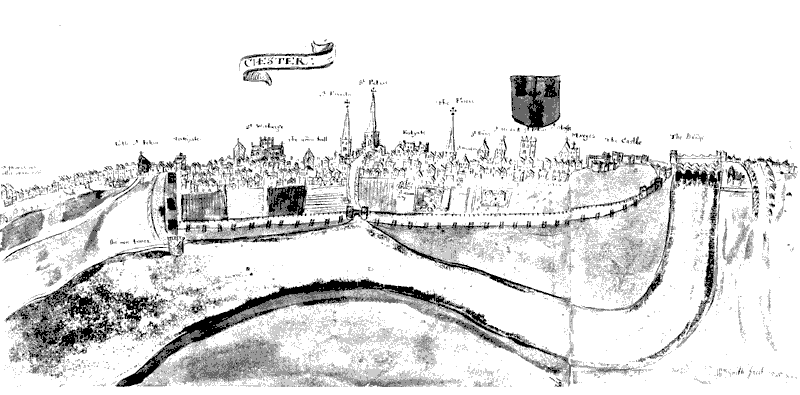
Chester from the west, 1585
The importance of migration to Chester is underlined by the trends in natural growth (Table 3). There were perhaps 1,000 more baptisms than burials throughout the city between 1560 and 1579, but a baby-boom then would not have led to larger numbers of householders until at least twenty years later. The increasing numbers of householders as early as the 1560s must instead have been due to an influx of young adults from the countryside. (fn. 27) Between 1580 and 1599 the number of baptisms grew in accordance with the larger population of young adults, but the burial rate was simultaneously rising even faster, and the net natural growth in population fell to nil by 1600.
Higher mortality cannot be ruled out as an explanation, since the trend elsewhere in Cheshire and nationally was also towards lower natural growth. (fn. 28) Chester, however, seems to have escaped disease and famine in the 1580s and 1590s, even in 1596, a year of dearth elsewhere. (fn. 29) Possibly newcomers to the city in earlier decades were beginning to die off by the 1580s, whereas some young men who had been baptized in Chester were perhaps leaving in the 1580s and 1590s as colonists and soldiers in Ireland, and so neither raising families in the city nor adding to the local death rate.
The widespread and severe epidemic of bubonic plague in 1603-5 was unusual in Chester in falling into two contrasting phases (Table 4). (fn. 30) The first was long drawn out but relatively mild: 933 dead out of c. 5,220 inhabitants over 83 weeks represented a death rate of 11 per cent a year, four times the annual rate of the previous decade but not as severe as that experienced elsewhere. (fn. 31) The second phase killed 1,041 people in 34 weeks, or 20 per cent a year among a population probably as large as in 1603. Shorter periods of plague normally inflicted greater proportionate losses, (fn. 32) but the differences between the two phases in Chester and especially a fresh outbreak in May 1605 require separate explanation.
The first outbreak was not, apparently, of a more benign strain: in one house it killed seven people in a short time, (fn. 33) it was accompanied by 'other diseases' (probably smallpox), (fn. 34) and when it was carried from Chester to Nantwich in June 1604 it killed 430 people in 10 months, a mortality of between 23 and 28 per cent. (fn. 35) Preventive measures taken in Chester by the Assembly in 1603-5 may have retarded the spread of infection, even though they were conventional and crude: erecting pesthouses on the outskirts to isolate the sick; destruction of infected bedding; orders against overcrowded housing; and a ban on the Michaelmas fair and Christmas watch in 1604 to prevent crowds from gathering. (fn. 36) The spontaneous flight of gentlemen's households may have had the helpful effect of thinning the population. (fn. 37) Coincidentally trade through Chester declined: fewer merchants brought goods in, (fn. 38) maritime trade was in the doldrums, and cloth exports in 1604 were only a tenth of their level in 1602. (fn. 39) Such factors placed obstacles in the way of a build-up of infection which might have led to an explosive outbreak.
On the other hand the first phase was evidently prolonged, at a low level, by the repeated arrival of outsiders lacking immunity. (fn. 40) The dead of Chester certainly seem to have been replaced between 1602 and 1604: new tenants were found for the former nunnery estate; (fn. 41) in St. Michael's parish the number of householders actually increased: (fn. 42) and membership of the guilds was kept up by new admissions. (fn. 43) Immigration was at odds with the council's policy of quarantine, though the mayor himself tried to recall an alderman from Wrexham to pay his taxes. (fn. 44) During the epidemic the Assembly's expenditure was higher and its revenue lower, so that the burden of paying for relief grew and urban landlords, churchwardens, and guild stewards needed to find replacements for dead tenants, ratepayers, and company freemen. (fn. 45)
Such considerations may also have made the citizens overhasty in relaxing their guard against disease. In May 1605, after a six-week lull, the plague returned, (fn. 46) either from incubating bacilli or a fresh infection. Its increased severity was apparent from a broader impact across the social range. It struck first not in the suburbs but in the city centre, and so made the civic élite unusually vulnerable. One of the first victims was the previous year's mayor, John Aldersey. (fn. 47) Two gentlemen's families and four aldermen's were hit in Aldersey's parish, and the mayor, Edward Dutton, paid for remaining in the city by having his house twice infected and losing some of his children and servants. In all a third of the dead were from the middling ranks of the freemen and just over half from the lowest orders. (fn. 48)
There are several explanations for the increased severity of the second phase. Earlier replacement meant that there were as many people susceptible to infection as ever. Although the Midsummer show and fair were cancelled, citizens seem to have flouted safety measurers: John Aldersey, for example, was moved from Eastgate Street to Watergate Street while sick. Richer citizens, perhaps more worried about the state of their businesses after the first phase than about the disease itself, may have delayed flight too long. William Aldersey, another former mayor, left only when the weekly death-toll reached 58 and his next-door neighbour's family had been decimated. (fn. 49) The community as a whole was poorer, and among the poorest illnourishment and bad housing may have made many people less resistant. (fn. 50) On the other hand Chester's desperate state seems to have discouraged immigration, and for the first time there were gaps in rate- and rent-rolls. (fn. 51) The epidemic's greater intensity thus ensured its briefer duration.
Sources: B.L. Harl. MS. 2177, ff. 21-52 (Holy Trinity); C.C.A.L.S., P 29/7/2 (St. Oswald's); P 63/7/1 (St. Peter's); P 65/8/1 (St. Michael's); ibid. ZCR 65/39-42 (St. John's); ZCAS 1, ff. 6-12, 115-40 (poll tax for St. John's parish, 1641).
Sources: B.L. Harl. MS. 594, f. 97 (for 1547-1605); House of Lords R.O., Protestation Returns (Chester City) and B.L. Harl. MS. 2107, ff. 118-21 (for 1606-44). The relative size of St. John's and St. Oswald's was established by comparing Easter book lists.
Sources: Par. Reg. Holy Trin. ed. Farrall; B.L. Harl. MS. 2177 (St. Bridget's, printed in 3 Sheaf, xv-xviii); C.C.A.L.S., P 16/1/1 (St. Martin's); P 20/1/1 (St. Mary's); P 29/1/1 (St. Oswald's); P 51/1/1 (St. John's); P 63/1/1 (St. Peter's); P 64/1/1 (St. Olave's); P 65/1/1 (St. Michael's).
In the long term, the double epidemic of 1603-5 was not a serious demographic setback for Chester. Only in the final year was there a net loss in numbers of householders. For a time afterwards families may have been on average smaller, though there seems to have been an immediate baby-boom (Table 3). The excess of baptisms over burials in the years 1606-9 was pro rata comparable with that in the 1560s, and in St. Michael's parish the number of householders was back to its pre-plague level by 1610. By 1612 pre-plague levels had been surpassed by a large margin and Chester was embarked upon its period of fastest growth in early modern times. Projections of the total population from the balanced cross-section of the city represented by St. Michael's and St. Oswald's parishes point to as many as c. 6,700 inhabitants. St. John's, a suburban parish containing a quarter of the total population, lagged behind in pace of growth, but it was more populous than before the epidemic and its rate of growth had caught up by 1620.
Sources: B.L. Add. MS. 39925, f. 25; Harl. MS. 2125, ff. 46v.-47v., 123; Stowe MS. 811, f. 60.
The growth in population in the early 17th century seems to have occurred in two well spaced bursts: a sudden acceleration between 1606 and 1612 (averaging 4.04 per cent a year), a pause or even a slight decline until c. 1629, when there were c. 6,500 inhabitants, and a fresh leap to c. 7,650 in 1644 (averaging a growth of 1.18 per cent a year). (fn. 52) On the eve of the siege Chester's population reached a level not exceeded until the early 18th century. Recovery from the epidemic of 1603-5 thus inaugurated a new period of prosperity. (fn. 53) The growth in population was, as earlier, powered by economic developments. The similarity of the relative numbers of baptisms and burials with those of the late 16th century suggests that the same forces were at work (Table 3). The birth rate rose each decade between the later 1600s and the earlier 1640s, but the surpluses of baptisms over burials were inexorably eroded by rising numbers of burials. By 1630 there was no natural growth, despite a rise in the actual population. Presumably there was considerable immigration to Chester, the effect of which towards the end of the forty-year period was to increase the numbers dying there. Elsewhere in the county there were certainly large rural surpluses in population throughout the period, especially between 1600 and 1629, (fn. 54) and much of the increase was probably drawn to Chester. The proportion of Chester apprentices from outside the city, for example, grew to two thirds after 1600. (fn. 55)
The siege of Chester between late 1644 and February 1646, and the ensuing epidemic, put an end to population growth. The initial influx of royalists and exodus of parliamentarians probably cancelled each other out, (fn. 56) but soon the city also housed c. 3,000 soldiers and the many women and children who accompanied them. (fn. 57) The resulting overcrowding worsened as the suburbs were evacuated and burnt in 1645. Randle Holme II, a former mayor, estimated the refugees at c. 1,600. (fn. 58) At the end of the siege civilians still numbered c. 6,000, cooped up inside the walls with the soldiers. The exceptionally high mean household size of 5.53 and a density of 9 people per house in Northgate Street indicate the degree of overcrowding. Much new accommodation was jerrybuilt and insanitary. (fn. 59) Although disease did not strike during the siege, crowding and poor hygiene persisted throughout 1646 and early 1647, partly because rebuilding was delayed. (fn. 60)
The plague arrived in June 1647, perhaps with troops bound for Ireland. (fn. 61) The onslaught was unprecedented. In 16 weeks 1,863 people died. The first week alone claimed 64 victims, more than the week of highest mortality in 1605. The peak was the seventh week, with 209 dead, and the worst of the epidemic was over in the sixteenth week with 52 dead, after which there was a long tail of intermittent deaths, lasting until April 1648 and numbering 236. (fn. 62) The plague was reported as taking its victims 'very strangely, strikes them black of one side, and then they run mad; . . . they die within a few hours'. (fn. 63) It was evidently bubonic plague, and Chester was one of two places in the British Isles hit hardest in the outbreak. (fn. 64) Total deaths between June 1647 and April 1648 amounted to 2,099, perhaps 35 per cent of the population if it had remained stable after the end of the siege. The incidence of deaths varied greatly among the parishes: in St. Peter's, one of the most uniformly prosperous parts of the city, there were only 75 dead in a population of 700-800, whereas in Holy Trinity, where rich and poor lived side by side, 232 died out of c. 600, four times the rate.
The outbreak started in the city centre, probably in St. Michael's parish. In the first week 70 per cent of fatalities occurred in the five intramural parishes where habitational densities were highest in the multi-storeyed mansions lining the main streets. In that sense the epidemic can be attributed to overcrowding caused by the siege. Nevertheless it quickly spread outwards, and by the fourth week 65 per cent of deaths were occurring in the suburban and partly suburban parishes. By the end three quarters of all deaths had been in those parishes, despite the sparsity of housing left in the suburbs after the siege. Evidently the normal social selectivity of plague was reasserted. (fn. 65) The course of the epidemic implies great impoverishment among the mass of citizens, and indeed it was asserted at the time that almost all the wealthy had left the city. (fn. 66) The intensity of the onslaught, however, combined with the quarantining effect of widespread flight, slack trade, and little immigration, hastened the decline of infection, especially as winter approached.
By contrast with the epidemic of 1603-5, recovery was slow. In the 1650s even prosperous parishes like St. Peter's and St. Michael's had only two thirds of their pre-plague population (Table 5). St. Mary's in 1657 had only three quarters the number of households of a century before. Holy Trinity parish was the exception, perhaps because squatters settled on the Crofts. Not until the Restoration did the population recover beyond the level at the end of the siege: c. 6,750 inhabitants in 1660, rising to c. 7,160 in 1664, still well below the pre-Civil War peak of c. 7,650. Chester did not recover from the combined effects of the siege and the epidemic until perhaps 1700.
Sources: B.L. Harl. MS. 2177, ff. 21-52 (Holy Trinity); C.C.A.L.S., P 20/13/1 (St. Mary's); P 63/7/1 (St. Peter's); P 65/8/1 (St. Michael's).
One immediate cause of the delay in recovery was the prevalence of plague or other diseases in the region around Chester until 1665. (fn. 67) Another was the slow rebuilding of the devastated suburbs, not under way until the mid 1660s. (fn. 68) The underlying cause, however, was Chester's impoverishment and the political blight which it suffered in the 1650s for its royalist sympathies. The siege caused an estimated £200,000 worth of damage, liquidated the city's assets, and completely dislocated its trade. (fn. 69) As elsewhere, the arrival of plague was particularly serious for a town already at a low ebb. (fn. 70)
Natural growth, absent in the 1630s and earlier 1640s, did not resume after the epidemic: between 1655 and 1669 there was a net natural loss of 17. The loss of capital and trade had also greatly reduced net migration to the city, and much if not all of the increase in the number of householders between 1646 and 1664 was due to the return of at least 258 freemen who had fled earlier. With their families, they perhaps represented 1,100 inhabitants, the whole of Chester's 'growth' between 1646 and 1664. (fn. 71) Outsiders and non-free traders, in contrast, were systematically discouraged as likely to be a burden to the city. (fn. 72) An apparently smaller surplus population in Chester's hinterland in the 1650s and 1660s, in part due to disease, (fn. 73) also reduced the number of potential migrants to Chester.
After the Restoration Chester was still regarded as 'the head of the region', (fn. 74) but in fact its provincial standing was permanently reduced. By the yardstick of the hearth tax both Shrewsbury and Manchester were as big, and soon after 1700 Chester was outstripped by Liverpool, Manchester, Birmingham, and Dublin. (fn. 75) Georgian Chester was perhaps only the 30th largest city in England. (fn. 76) Chester's 18th-century decline has been traced to the combined blows of siege and plague, (fn. 77) but that explanation ignores both the wider changes in the region and Chester's later capacity for growth: to over 8,000 inhabitants in 1725 and 13,000 by 1775. (fn. 78) In fact Chester's decline was not absolute but relative to its urban neighbours. It is significant, however, that the mid 17th-century disasters coincided with a crucial turning point in Chester's history when, like many other old-established towns, it was disadvantaged by fundamental economic transformations in its region. (fn. 79)
Between 1664 and 1725 the population rose modestly from c. 7,160 to c. 8,120 inhabitants. No doubt the progression was not smooth but its exact course cannot be traced because the later 17th-century Easter books are unreliable. The natural increase of 381 between 1665 and 1724 did not account for the total rise, so there must have been net immigration, but it can only have been at moderate levels since, unlike earlier periods of growth, burials rarely exceeded baptisms. The relatively slow increase in Chester was similar to that experienced nationally in the same years. (fn. 80) Although the ratio of births to deaths dipped further locally than nationally in the 1680s, and rose less high in the 1700s, the pattern of fluctuations was remarkably similar and actual rates in each decade were often the same or close (Table 6). There were greater differences between Chester and the North of England, suggesting that the natural growth of the rural population throughout the North-West and west Midlands was being channelled to towns other than Chester. (fn. 81)
Note: A figure higher than 1.0 denotes natural population growth; a figure lower than 1.0 denotes natural population decline.
Sources: Chester: as Table 3; N. Eng.: Hist. Geography of Eng. and Wales, ed. R. A. Dodgshon and R. A. Butlin (1978), 230; Eng.: Wrigley and Schofield, Population Hist. of Eng. 532-3.