A History of the County of Cambridge and the Isle of Ely: Volume 4, City of Ely; Ely, N. and S. Witchford and Wisbech Hundreds. Originally published by Victoria County History, London, 2002.
This free content was digitised by double rekeying. All rights reserved.
T D Atkinson, Ethel M Hampson, E T Long, C A F Meekings, Edward Miller, H B Wells, G M G Woodgate, 'City of Ely: Cathedral', in A History of the County of Cambridge and the Isle of Ely: Volume 4, City of Ely; Ely, N. and S. Witchford and Wisbech Hundreds, ed. R B Pugh (London, 2002), British History Online https://www.british-history.ac.uk/vch/cambs/vol4/pp50-77 [accessed 6 May 2025].
T D Atkinson, Ethel M Hampson, E T Long, C A F Meekings, Edward Miller, H B Wells, G M G Woodgate, 'City of Ely: Cathedral', in A History of the County of Cambridge and the Isle of Ely: Volume 4, City of Ely; Ely, N. and S. Witchford and Wisbech Hundreds. Edited by R B Pugh (London, 2002), British History Online, accessed May 6, 2025, https://www.british-history.ac.uk/vch/cambs/vol4/pp50-77.
T D Atkinson, Ethel M Hampson, E T Long, C A F Meekings, Edward Miller, H B Wells, G M G Woodgate. "City of Ely: Cathedral". A History of the County of Cambridge and the Isle of Ely: Volume 4, City of Ely; Ely, N. and S. Witchford and Wisbech Hundreds. Ed. R B Pugh (London, 2002), British History Online. Web. 6 May 2025. https://www.british-history.ac.uk/vch/cambs/vol4/pp50-77.
In this section
CATHEDRAL
Preliminaries
A religious house was founded on the present site by Etheldreda, a daughter of Anna King of East Anglia, in 673. The monastery was laid waste by the Danes in 870, refounded by Ethelwold, Bishop of Winchester, as a Benedictine abbey in 970 and dedicated to St. Peter and the Blessed Virgin by Dunstan in 974. (fn. 1) The building of the present church and monastic buildings was begun under Simeon the first Norman abbot. Bishop Northwold rededicated the church on the completion of a new presbytery about 1250 in honour of the Virgin, St. Peter, and St. Etheldreda. (fn. 2) At the time of the Dissolution the dedication was St. Peter and St. Etheldreda when it was changed to the Holy and Undivided Trinity. (fn. 3) An indenture between Henry VIII and the bishop has 'the convent of St. Audre's in Ely'. (fn. 4) The House was surrendered to the king on 18 November 1539. The New Foundation consisted of a dean, 8 prebendaries, 8 minor canons, deacon and sub-deacon, 24 scholars, 2 schoolmasters, an organist, and various singing men and boys; the prior Robert Wells or Steward became dean; the Almonry School was refounded as the 'Kings School' and still continues. This establishment continued, with the break from 1649 to 1661, with little change until the 19th century. By the Cathedrals Act (1840) the number of canonries was reduced to 6, and in the last few years has been reduced to 4. One canonry is annexed to the Ely Professorship of Divinity in the University of Cambridge, and one of the lapsed canonries was annexed to the Regius Professorship of Hebrew. There are now 24 honorary canons.
No fragment of the pre-Conquest church has been found but it is suggested on the evidence of early graves that it occupied the east part of the present nave: the bodies of the early abbesses were removed to make way for the new building in 1103, that is twenty-one years after its commencement. Definite architectural history opens with Simeon's rebuilding. Simeon had been prior of Winchester and was brother of Walkelin the bishop. The brothers were related to the Conqueror. Simeon's connexion with Winchester is important, for it influenced the lay-out of his own church, particularly in the two towers on the main axis and in the aisles of the main transept; on the other hand, the churches differ in the important matter of the treatment of the east end. It seems clear that the two are from the hand of the same master mason.
The monastic buildings lie on three sides of the church. The cloister and all the more important buildings are on the south, but one important guest house lay to the east while the almonry with its school and the workshops in the charge of the sacrist were on the north in Stepil Row now High Street: obviously a convenient situation being easy of access by mendicants, workmen, and merchants. The monks' cemetery was to the south of the presbytery and the parish cemetery to the north of the presbytery and nave. To the west of the claustral buildings and separated from them by a roadway spanned by a covered bridge was the Bishop's Palace. The great building periods for church and monastery were that immediately following the Conquest, the second quarter of the 13th century, and the second quarter of the 14th. Much less important was a short period on either side of the year 1500 which saw the rebuilding of the palace and half the cloister and within the church some very notable monuments. Until 1770 the medieval ritual arrangement remained almost intact.
THE ROMANESQUE CHURCH.
Simeon was already 80 when in 1081 he became abbot and began the rebuilding. He continued the work until his death in 1093. The abbacy was vacant until the appointment of his successor Richard in 1100; Richard continued the work until his death in 1107. The progress made by either of these abbots is uncertain, but it was necessary to disturb the graves of the three successors of St. Etheldreda in 1102; the church was ready for her ceremonial Translation on 17 October 1106. The building itself is so uniform in character right up to the west end of the nave that it gives us no clue as to the rate of progress but we may suppose that that part was finished about 1170 and the west tower and transept about 1200. The plan was in several respects peculiar. It had two steeples on the main axis, a central and a western, both flanked by transepts. The aisle was carried across the north and south ends of the main transept. In these respects the church followed the plan of Winchester of which house Simeon had been prior. It was to have been like Winchester in having an eastern apse but the idea was abandoned.

Bishopric of Ely
Gules three crowns or. (Seal of Bishop William of Louth (1290-8),S.C.13/F 14.)
There seems to have been from the very first a detached bell tower. It ' was perhaps looked upon as a temporary expedient to provide for the period until either the central or western tower could be finished. As early as 1110 (fn. 5) the tower over a 'porta' was struck by lightning. (fn. 6) The gateway and tower in question seem to have formed the entrance to the lay-folk's cemetery and thence to the church from the main street on the north. (fn. 7) Probably the whole was of timber.
The plan of the eastern termination as built is doubtful. Foundations uncovered in 1850 led Professor Willis, who examined and recorded them, (fn. 8) to think that the central division was intended to end with an apse the foundations of which were clear, and that the change to a square end was made at once, additional foundations being laid. The terminations of the aisles were still more doubtful. We may perhaps assume that the first plan was to have a central apse showing the round outside as well as within, and side apses showing square outside, a common English plan. Thus if the apse had been built it would have been very different from Winchester. The easternmost bay whether apsidal or square was deep, the length from east to west being nearly equal to the width. It was separated from the next bay by two half round columns which have survived all the alterations of later times. Between these columns and the central tower there were four bays. West of the tower there was a nave of thirteen bays with alternate compound and simple piers. The western tower is flanked by transepts with eastern apses, and a large decagonal turret at each angle. There is a large two-storied west porch called the Galilee. The aisles were continued on the east and west sides of the main transept and were intended to be returned across the north and south ends as at Winchester. But here again there was a change of intention or else a very early alteration. Instead of a continuation of the wide triforium gallery there are quite narrow bridges to connect the triforia on the two sides. (fn. 9)
The ritual arrangement of the Romanesque church was as follows. The high altar stood presumably on the chord of the apse-foundation. The bishop's throne (from 1109) may have occupied the primitive position behind the altar as it does at Norwich. But it must be remembered that at Ely the bishop has now no throne; he occupies the stall of the abbot on the south side of the quire door, the dean having the stall on the north side, formerly the prior's, and in other monastic cathedrals the sub-priors. This is an ancient, possibly the original, arrangement. (fn. 10)
The Lady Chapel was at the east end of the south aisle of the presbytery. The monks' quire was under the Tower and extended one bay beyond in both directions. It was enclosed by stone walls against which the stalls were placed. The northern of these walls contained in later times, and doubtless from the first, small sealed cavities in which were placed the bones of Saxon worthies. The eastern aisles of the transepts were divided by thick walls to form eight chapels. The west aisle of the north transept had a doorway in its north wall and a stone seat runs along the west wall; we may believe that this aisle formed an entry or cloakroom for pilgrims (cf. Winchester). The west aisle of the south transept was enclosed by walls rising to the arches and forming a sacristy (cf. Winchester and Peterborough). It had a doorway direct into the cloister, now blocked but visible, and one into the church, now destroyed. In the south wall of the transept there is a doorway, now blocked, into the monks' cemetery.
The bay west of the quire was enclosed on the west by a wall forming the pulpitum which separated the monks' quire from the nave forming the parish church. The pulpitum stood until near the end of the 18th century and some sketches of it have been preserved. (fn. 11) The screen wall was continued across the south aisle and presumably across the north aisle. The enclosed space was opposite the north-east corner bay of the cloister and into it was the doorway from the cloister. In the seventh bay west of the pulpitum was the second doorway for the return of the Sunday procession; it opened from the north-west corner of the Norman cloister. In the south wall of the west transept there is a doorway to a staircase leading to the upper parts of the transept and thence to the west tower. Another doorway at a higher level communicated with the raised 'gallery' or passage to the palace.
The elevational treatment of almost the whole of the Romanesque church can be recovered with fair certainty. There is much doubt, however, about the east wall. The flanks of the nave and east transept appear to have been the same in general arrangement and to have differed only in details such as mouldings. Externally the design of the aisle windows is preserved in two examples in the south aisle which have shafted jambs; a window in the end of the south-east transept was doubtless the same before mutilation. The triforium bay had three equal arches on shafts, the central one being pierced as a large window; these are preserved in the east wall of the north-east transept. Immediately above the triforium windows is an arched corbel table carrying the parapet; it is stopped against the flat pilasters which divide the bays. The clerestory is preserved in the nave and transept. In each bay a wide window with shafted jambs is flanked by narrow blind arches also with shafts. A little above these is a corbel table and parapet similar to the aisle wall. There can be little doubt that the side walls of the presbytery were of the same general design and detail.
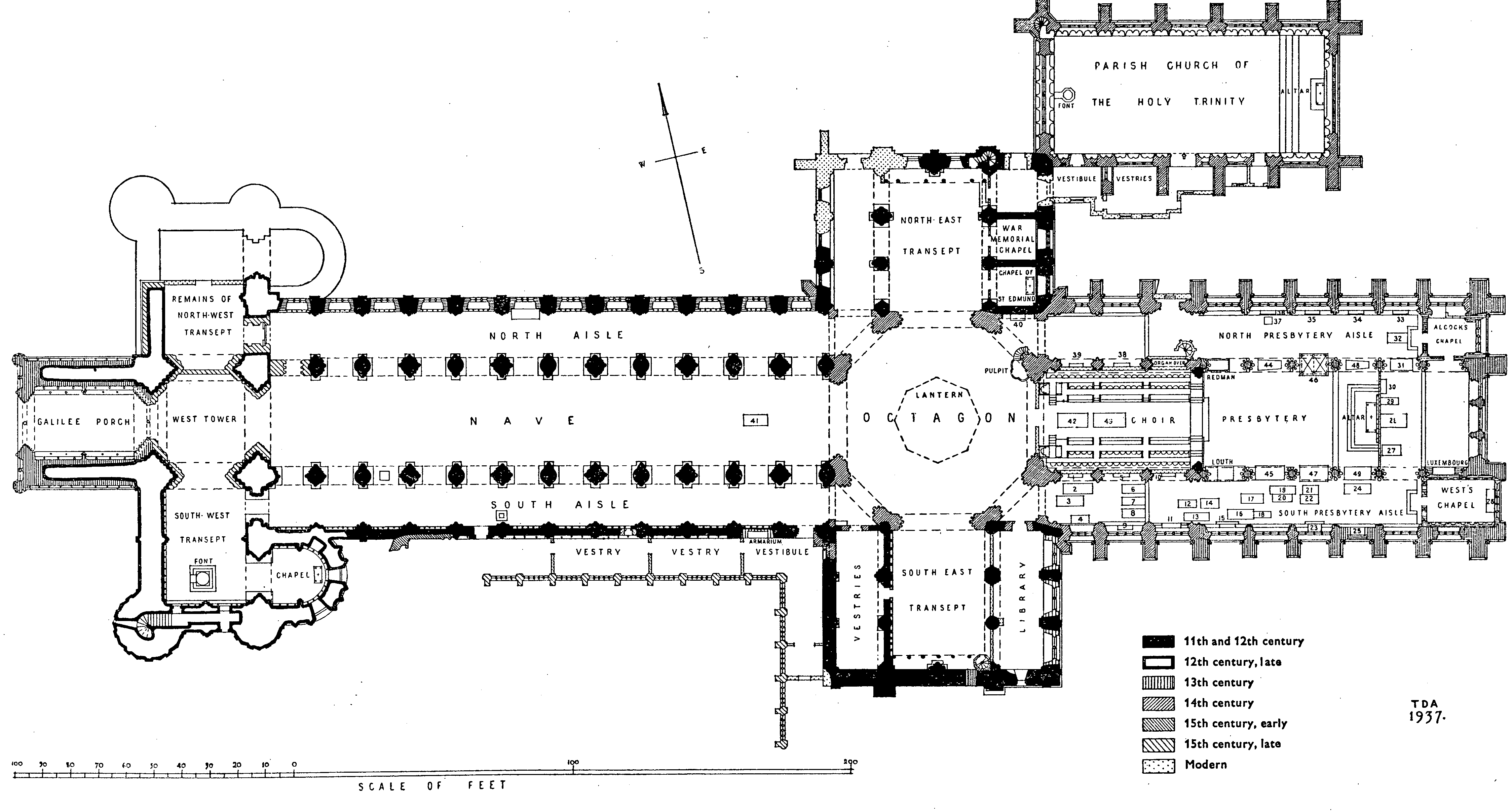
CATHEDRAL CHURCH OF THE HOLY AND UNDIVIDED TRINITY, ELY
KEY TO THE PLAN OPPOSITE
1. Bishop Moore (1707-14).
2, 3. Brass indents.
4. Bishop Allen (1836-45) (monument).
5. Bishop Butts (1738-48).
6-8. Brass indents.
9. Sir Mark Steward (d. 1603).
10. Bishop Greene (1723-38).
11. Sir Robert Steward (d. 1570).
12. Dean Tyndall (1591-1614).
13. Brass indent.
14. Bishop Goodrich (1534-54).
15. Bishop Heton (1600-9).
16-20. Brass indents.
21. Robert Steward or Wells (Prior 1522-39, Dean 1541-57).
22. Bishop Gunning (1675-84) (grave slab).
23. Bishop Gunning (monument).
24. Bishop West (1515-33) (grave slab, removed from his chapel in 1885).
25. Canon Selwyn (d. 1879) (on site of entrance to Reliquary).26. Altar of Bishop West's Chapel.
27. Canon Mill (d. 1855).
28. Bishop Allen (1836-45) (grave slab).
29. Bishop Niel (1133-69).
30. Pre-Reformation chest.
31. Indent of brass of Bishop Gray (1454-78).
32. Indent of brass of Sir William Thorpe.
33. Bishop Laney (1667-75).
34. Bishop Mawson (1754-71).
35. Bishop Patrick (1691-1707).
36. Bishop Chase (1905-24).
37. Brass of George Basevi (d. 1845); early medieval grave slab.
38. Canon Fleetwood (d. 1737).
39. Bishop Fleetwood (1714-23); grave slab of Thomas Stuart (d. 1744) on
floor below.
40. Dean Caesar or Adelmare (1614-36).
41. Brass indent, probably Prior Walsingham (1341-64).
42. Bishop Hotham (1316-37) (restored brass).
43. Prior Crauden (1321-41) (restored brass).
44. Bishop Kilkenny (1254-7) (heart burial).
45. Bishop Barnet (1366-74).
46. ? Private Pew of Queen Philippa, enclosing fragments of Shrine of St.
Etheldreda (formerly at 39).
47. John Tiptoft, Earl of Worcester (d. 1470) and two of his wives (cenotaph).
48. Bishop Northwold (1229-54).
49. Tomb of Bishop Hotham (1316-37) (removed from 42).
The transept ends were evidently alike except that in the south transept all the lowest windows apart from that of the east aisle were blocked by a building which abutted against the western part of the transept end: the one window of the east aisle was evidently the same as the windows of the aisles generally. The side windows and arches of the triforium were also repeated at the ends of the aisles. The same design is carried across the central part to a larger scale in two bays; above them is a row of small blind arches; the two large clerestory windows have two shafts in each jamb; immediately above these was the gable, but alterations at both ends have entirely effaced the original design. The central part of each transept end is separated from the aisles by square turrets, the eastern containing stairs. The upper parts of the four turrets vary; speaking generally the square becomes near to a round at the level of the triforium parapet and a little higher an octagon with an octagonal spire; these two top stages are arcaded. Of the central tower we know only that it contained bells, for they are mentioned in a letter at the time of the Dissolution. We may safely conclude that below the bell chamber and ringing chamber there was a stage with windows giving light to the quire.
The doorway to the vestry has been blocked and partly destroyed; the remains show a jamb-shaft and arch similar in section to the jamb, both with very rich scroll-work arranged between spiral bands; the keystone of the arch is carved with a human head; the capital is of cushion form carved with foliage. Above this arch is another which it superseded, carved with a slight and delicate enrichment. The eastern doorway from the cloister has a round head with cusps, the spandrels carved with kneeling figures holding crosiers. The arch is of four orders two of which are carved with scrollwork, one is a spiral with a head as keystone and one is moulded. The jamb has two nook shafts, the outer one plain and the inner a spiral. The flat faces of the jamb are carved with scroll-work. The western doorway is square-headed. Its lintel is on corbels from which human heads project. It is surmounted by a tympanum sculptured with a Majesty, under an arch of two orders. The inner arch is adorned with foliage arranged in spiral, and the outer with shallow carving standing on a grotesque, now decayed, and carved with spiral foliage like the arch above it. The innermost square part of the jamb is carved with a running scroll. The outer square has a succession of circles containing satirical subjects and finished at the top with a representation of a building; it carries a grotesque monster; the capital of the shaft is of cushion form carved with foliage, the abacus with a monster.
The west front is extremely rich. The transept is the same height as the nave; the west wall is of two bays and has two rows of windows corresponding with the triforium and clerestory windows. The wall below the lower windows, corresponding to the pier arches of the nave, is divided into three tiers, the lowest plain and the two upper with blind arcades. The lower windows are large and have a narrow blind arch on each side; the wall surfaces are diapered. Between these windows and the upper row there is another blind arcade. The top stage is the same height as the clerestory and corresponds closely with it in design, making allowance for later and richer detail. The arches are pointed and the jambshafts have three annulets. Each spandrel has a sunk quatrefoil. The parapet is carried on an arched corbel table; the parapet on the east side may be the original one, but that on the west side is 14th or 15th century.
The two lowest of the six tiers on the west wall are carried round the angle turrets and across the south end which is in two bays. There are slight variations in the upper parts of the south end; the lower windows are more lofty than the west windows and their sills are at a lower level; the windows of the turrets are necessarily narrower or are omitted. But the general character is preserved, most of the string-courses are continuous and the important quatrefoils are carried round. There is a third pair of windows in the transept end which lighted the space above the ceiling. The wall probably ended with a horizontal parapet level with the top of the roof. The top windows are repeated as blind arches in the turrets with rather greater height; those in the larger west turret have round arches; the east turret with shorter sides has pointed arches. The turrets are continued up for another two stages with slight variations between the two turrets. The lower stage is a small blind arcade, the upper has a large unglazed lancet with a pointed arch in each face. Above these there is an arched corbel table to carry the parapet. The present parapet is 14th and 15th century. The turrets have been already called decagonal. (fn. 12) Strictly speaking, however, their plan is twenty-sided. Each of the twenty sides forms an obtuse salient angle with the next on the one hand and a re-entering angle with the next on the other. In each re-entering angle there is a shaft standing on a pilaster in the lowest stage. These shafts are carried up passing in front of the large arches in the top stage but three. At the sill level of these arches the salient angles are pushed back making the angle more obtuse and obliterating the re-entering angle; the turret therefore becomes ten-sided. The shafts stop at this level in the east turret but are continued up another two stages in the west turret. The eastern apse of the transept is deep, like the great apse of the presbytery; the round is separated from the straight part by shafts. The apse fell and is shown in ruins in J. Heins's south elevation of 1764. (fn. 13) Enough was left standing to show the general design, and it has been rebuilt.
The fall of the north-west transept is not recorded but there is reason to suppose that it happened in the first half of the 15th century, for it seems that a beginning at rebuilding it was made at that time. An overhanging piece of the original wall is supported by masonry which, with its enriched plinth and its stringcourse, can hardly be mere utilitarian underpinning; moreover plans (fn. 14) and views of the 18th and 19th centuries show a complete transept with the walls standing several feet above ground. This would appear to be work actually carried out. If it had been a mere fancy of the draughtsman he would certainly have drawn it to correspond exactly with the south transept, whereas it is 15 ft. shorter from north to south. There are very small octagons treated in a 15th-century manner at the angles and there is no apse. The reason for the abandonment of the work is not known.

ELY CATHEDRAL: PLAY OF VAULTING
The west tower stands on four wide and lofty arches. To cover the west arch it was necessary that the porch should be as high as the present Galilee. Even if there had been no west arch, and instead a solid wall with a doorway, it would still have been necessary to build a porch or something equivalent in order that its walls might provide an abutment for the north and south arches. The west archway did not, however, begin at the floor level; the lower part was a solid wall, a part of which still remains and shows on its west face a small 12th-century blind arch just above the north haunch of the Galilee vault. The sill of the tower archway was above this small arch. It seems clear therefore that the original porch was of two stories like the present one. We must assume that the porch was covered, or designed to be covered, by a timber floor above the small blind arch and at about the level of the crown of the Galilee vault. In a word the original' arrangement was exactly the same as that made in the 13th century, (fn. 15) whether the actual fabric is the original or a rebuilding.
The west tower is of three stages above the roof of the Galilee and two above those of the transept and nave; it has a large octagonal buttress or turret at each angle. Each stage is divided into two parts: a row of three lancets with pointed heads and a band containing in the two lower stages a low blind arcade of trefoil arches and in the top stage three cusped circles. In the two upper stages the wall treatment is repeated on the cardinal faces of the buttresses but in the lowest stage the buttress has three narrow arches instead of a wide one.
In the middle stage the jamb-shafts have two annulets. In the two upper stages the lancets are separated by a continuous shaft which is carried up to the arched corbel table and the parapet or eaves. The stringcourses which separate and subdivide the stages are carried round the octagonal buttresses but the corbeltable is not. The intermediate sides of the octagons have rows of shafts running from bottom to top. The fine octagonal stage with its turrets forming the present top stage is later work. (fn. 16) Bishop Northwold (1229-54) erected a timber spire which was almost certainly covered with lead and was probably finished with an eaves. (fn. 17)
The tower has some features which are characteristic of a broad part of eastern England. Among them are the circles in the top stage seen in their most remarkable development at the top of the central tower of Norwich Cathedral. They may be seen as far south as Old and New Shoreham (Suss.), and may be compared with French examples such as St. Pierre-sur-Dives, Calvados. The closely set shafts on the octagonal buttresses occur at St. Margaret's Church, King's Lynn. The west front as a whole is very remarkable, the two lofty transept turrets being particularly striking; they are half as high again as the side wall of the transept and three-quarters the height of the tower.
The bay-design of the interior is much like that of Winchester. The heights of the pier arches, the triforium and the clerestory are in the proportion of 6:5:4. The bays are separated by a triple group of shafts. The pier arches are stilted and are of three moulded orders. The triforium arcade is also stilted; each main arch, of two moulded orders, embraces two stilted and moulded sub-arches and a plain tympanum. The clerestory arcade has three arches, the central one wide and stilted, the side arches half round, all of one order slightly moulded. The capitals throughout are of cushion form. The main transept is similar but the work is plainer; the bays are not separated by shafts and the arches of the main arcade are square edged.
The interior of the west transept contrasts as strongly with the earlier work as does the outside: a Byzantinesque architecture of colour has given place to a Western architecture of form. The west wall is covered with a succession of blind arcades of varying design. The ceiling was probably flat and of wood. The tower was doubtless open to a level above the middle row of lancets; that would still leave a height of 40 ft. for the ringing and bell chambers.
GALILEE AND PRESBYTERY.
The Galilee was the gift of Bishop Eustace (1198-1215). The name was in use at Ely at least as early as 1340-2 and probably very much earlier; it occurs at Durham in 1186 which was about the time that the Ely porch was first planned. (fn. 18)
The present Galilee measures 44 ft. from east to west between the inner and outer doors; the vaulting covers a space 35 ft. by 20 ft.; the side walls are about 13 ft. thick. At the external angles there is a group of five attached shafts terminating in gablets and a spire. At a height of four-fifths of the whole height the shafts are diminished in diameter, the junction being masked by a row of gablets. Similar but smaller groups without diminution divide the west end into three. The central division contains the doorway and a group of three lancets, and finishes with a high, level parapet of three loopholed battlements. The side divisions are divided into four equal stages containing wall arcades of almost identical designs with pointed cinquefoil arches. They finish with a horizontal parapet at a lower level than the central division, each with one wide battlement of two embrasures. The four stages of arcading are carried with slight variations along the north and south sides of the porch. The sides are without windows and are finished with a plain parapet.
The doorway is divided by a central shaft supporting two cinquefoil arches; the tympanum contained a sexfoil panel, but this was destroyed early in the 19th century by Bernasconi, who filled the whole tympanum with the present tracery done in his artificial stone. Each spandrel of the outer arch is filled with three sunk panels of quatrefoil and multifoil, which are of rather earlier character than the rest of the work. The outer archways evidently had no doors but were probably provided with iron gates as they are at present. Harris's elevation of about 1700 shows the archways filled to the level of the capitals with a later wall containing two doorways; the drawing is not sufficiently clear to indicate the date. The engraving shows a clock face in the lower part of the central lancet.
All the capitals have carved foliage; it is of both spray and crocket sorts and is quite mature; dogtooth is used between the shafts of the lancets and nail-head freely elsewhere. The curious form of the top of the west wall is probably due to the use of the 'kerb' roof, that is one with a truncated apex; it is of the 14th or 15th century.

Ely Cathedral
Galilee before 19th- Century Alterations (Part of plate facing p.57 in Stevenson's Supplement to Bentham's History of Ely.)
Internally the Galilee is of two bays covered with a quadripartite vault with cross ribs and diagonals but without ridge ribs. The bays are separated by a vaulting shaft rising from a continuous bench, but there are no shafts in the eastern angles of the porch corresponding with this. The side walls are divided into two stages of arcading. In the lower there are in each bay trefoil arches standing on shafts placed close against the wall along which their lower base mouldings are continued. Half-way up the columns the wall face is set back forming a continuous deep recess. This recess is covered by a vault springing from the four front columns and from a row of shafts against the back wall, placed opposite the centres of the front arches somewhat in the manner of the south quire-aisle of Lincoln. The spandrels of the front wall have sunk sexfoil panels. The upper tier has five cinquefoil arches, the recess behind being covered by one wide arch. The inner doorway is similar to the outer, but the whole is a restoration or renewal by Sir Gilbert Scott based on the remains of the original work and on an old drawing. The tympanum is pierced by a sexfoil; it had been altered by Bernasconi whose work is shown by Harris. The detail of the interior is similar to that of the outside: the mouldings are rich and refined; the dogtooth is used freely; all the capitals have carved foliage. A striking characteristic is the variety of stones: Purbeck, Barnack, and clunch are consistently used in positions which leave little doubt that it was done as decoration. This was a wise step, for in such an exposed position any applied colour would soon perish. At the same time it will be noticed that the softer and finer grained clunch is used for the arches which have the dogtooth enrichment.
It has been shown (fn. 19) that the room over the porch existed from the first, and was open to the church. For what purpose it was used or designed is unknown. It has been suggested that it was a chapel in honour of St. Michael the Archangel. Such chapels often occupied an elevated position. The objection to this theory is that the only access to the room is by a roundabout route and a very small doorway; there is a blocked archway in the north wall visible outside but this is merely a builders' access hole. Another suggestion is that the room was intended for a band who would sound a fanfare when a procession entered the church; the musicians could use the indirect approach or even a ladder. (fn. 20) The room was destroyed about 1800 when the roof was lowered to a level immediately above the vault and the tower-arch filled with a wall containing a window.
The first alteration of importance to the Romanesque church was the addition of a large presbytery or retroquire to the east of the high altar by Bishop Hugh of Northwold (1229-54), with help from the priory and from outside subscribers. (fn. 21) He took down the deep apse as far as but not including the two shafts which separated it from the work to the west and have survived later alterations. Northwold's work consists of nave and aisles of six bays in continuation of the four Romanesque bays east of the central tower. The work seems to have been begun in 1234 and finished in 1250. The whole was vaulted: the first vault that the brethren had seen except the small and low one over the Galilee. The only irregularity in the plan was a small Reliquary which was built between the third and fourth buttresses on the south side. The next bay but one is shown by Bentham as similarly treated: the enclosure was presumably medieval and formed a vestry for the Lady Chapel. On the north side the aisle wall shows outside in the second bay marks of a recess. (fn. 22) The third bay has a Purbeck threshold and the bases of two nook-shafts, but immediately above these the courses of the original ashlar run through without break or irregularity. This suggests that a door was planned but abandoned, although there are holes for roof timbers in the sides of the two buttresses. The next bay shows marks of a doorway cut since the wall was built and now blocked, and scars of roofs of several periods: indications of the feretrar's checker built about 1425 (fn. 23) Some work had been done in 1357-8 including fourth and fifth windows from the west, and also some carpentry and plumbing costing £46, but its character has not been determined.
Northwold's ritual arrangement was as follows. The high altar was placed on what would have been the chord of the Norman apse as the Norman altar had been. There was doubtless a screen at the back of Northwold's altar. The next three bays eastward were fenced round to form a feretory, in the centre of which was placed the Shrine (fn. 23) of St. Etheldreda with a small altar against its west face. Three of the bosses of the vaulting in this part are carved with figures. Northwold himself was buried at the feet of St. Etheldreda and farther east were the shrines of the three Saxon abbesses, Sexburga, Erminilda, and Werburga. St. Alban's shrine was in the north-east corner. The Lady Altar was placed in the south aisle opposite to the central pier. Here may be mentioned a fragment dating from Northwold's time. It is the massive standard and arm of an important stone seat; an animal clasps between its paws the head of a man, alluding probably to the legend of St. Edmund's head having been defended by a wolf; Northwold had formerly been abbot of Bury. (fn. 24)
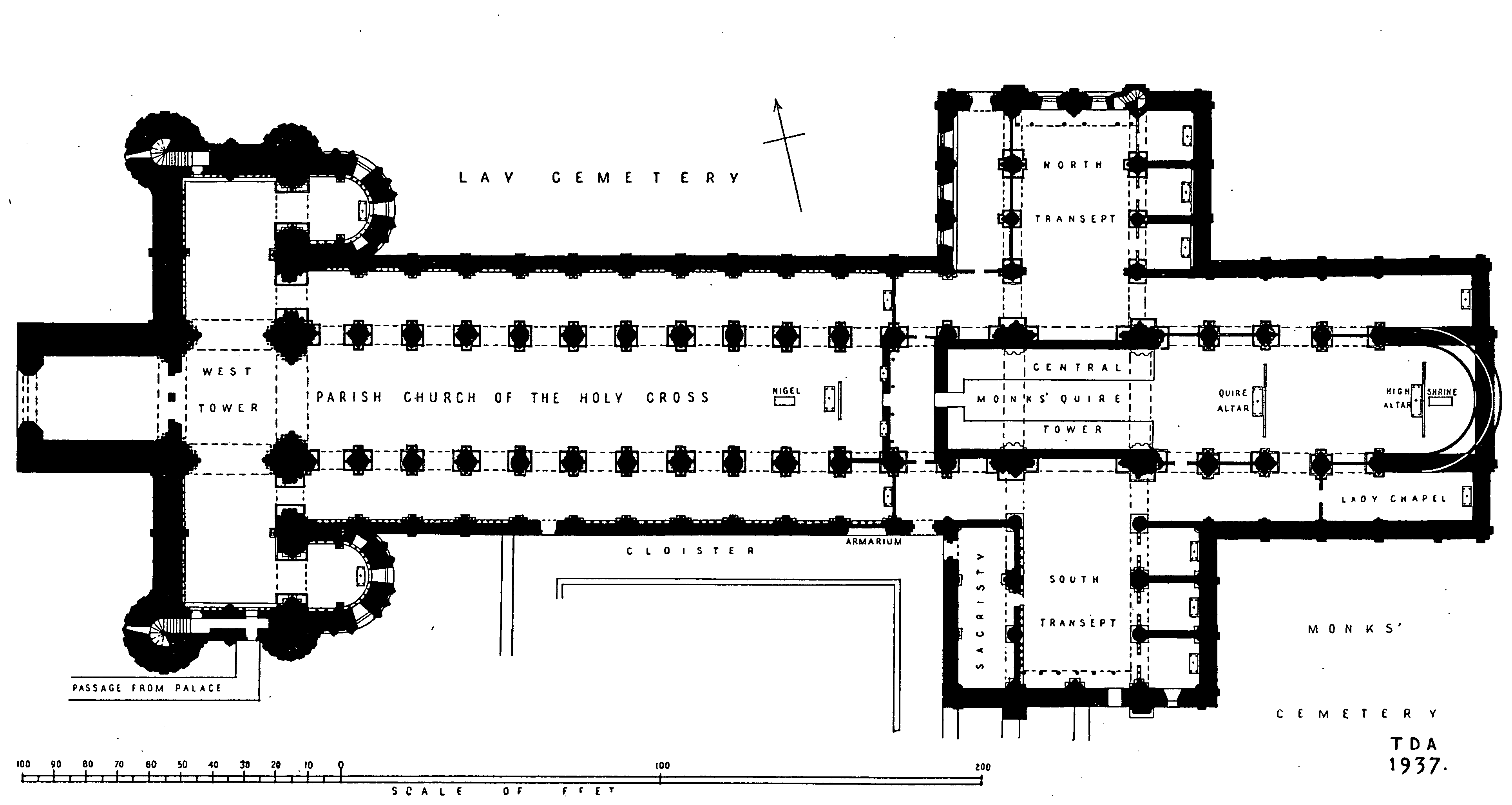
PLAN OF ELY CATHEDRAL, circa 1225
Many alterations have been made in Northwold's work but enough has been preserved to show the original design in almost every detail. Four bays of the Romanesque eastern arm were left standing and the height of the several stories no doubt influenced the proportions of the new work. The clerestory is the same height as the clerestory of the nave but the triforium is rather lower and the main arches rather higher than those of the nave. The height of the stages had no doubt been preserved uniformly throughout the Romanesque church and there was therefore a step up in the level of the triforium sill where Northwold's work began; the rise was about 3 ft. The old and new work were, however, strongly separated by the half-round column which still exists, so that the break in continuity was unobjectionable. A capital and the tas-de-charge were inserted at the right level, and the 12th-century column became one of the vaulting shafts of the 13th-century work.
The main piers have eight detached shafts standing on a low octagonal plinth, (fn. 25) with annulets and with capitals carved with spray foliage. The bases have bold spurs, into some of which human heads are introduced. The whole is in Purbeck marble. The arch is well moulded and has one row of dogtooth spaced widely in the eastern bays and set close farther west. The spandrel has a sunk trefoil panel with a Purbeck back and two sprays of foliage. The triforium arcade has bluntly pointed arches containing two trefoil pointed sub-arches; the tympanum has a sunk quatrefoil panel with a Purbeck back; the jambs have five Purbeck shafts and the central columns show three. The clerestory has a group of three lancets; the central rear arch is much stilted, the flanking arches have one springing line much higher than the other and the difference is got over by making the high side trefoil; the jambs have two shafts and the columns show three in front. The east wall is of two stories; the lower is of equal height to the main arcade and triforium; it has three equal lancets with quatrefoils in the spandrels; the upper story, corresponding to the clerestory, has five lancets rising towards the centre to fit the line of the vault, the asymmetrical form of the arches being adjusted rather clumsily in the same way as those of the clerestory. The main vault is slightly plough-share in form; it has one intermediate rib between the diagonal and the cross rib and one between the diagonal and the wall rib; the longitudinal ridge rib is continuous, the cross ridge rib stops at the intermediate; the vault springs from a group of three shafts of the same height as the triforium; at sill level the shafts stand on a long conical corbel.
The detail is rich. All capitals are carved with the characteristic foliage of the period, (fn. 26) and the cusps of the trefoil arches and of the panels have small sprays. The bosses of the vaulting are carved with foliage which also appears on the three with figures, mentioned above. The admirable corbels carrying the vaulting shafts have a spiral of stalks breaking into small leaves at intervals until they reach the top, where they break into full foliage. The corbels opposite the shrine are richer but scarcely so happy; the spiral is abandoned arid there are rings of heavy crocket foliage at frequent intervals from bottom to top. (fn. 27) There are three rows of crockets between the shafts of the triforium. The aisles are simpler but suitably finished; the vault has cross ribs and diagonals and wall ribs only; it springs from triple groups of Purbeck wall shafts which stand on a benchtable and have annulets and moulded capitals. No original aisle window remains.
The original triforium is preserved only in two bays on the south side. It has coupled lancets with shafted jambs, foliage capitals, and dogtooth enrichment. Above these externally there is a corbel table of trefoil arches and a low parapet. (fn. 28) The three windows of the clerestory are included under an arch; the capitals are carved. The buttresses are carried up as pinnacles with gablets and spires. The flying buttress consists of two arches giving not very steep slopes. The upper arch abuts on the very top of the aisle wall and was intended, Professor Willis says, to counteract the thrust of the nave rafters. This thrust would be met by the tie-beams which existed in 1760 when James Essex renewed the roof, but Essex considered that they were additions to the original work. (fn. 29) The lower arch abuts on the springing line of the nave vault and follows the line of the aisle roof. It carries a buttress of slight projection against the clerestory wall. It is probably for this reason that, instead of being a half-arch of the usual form, it springs from the clerestory wall and rises to an apex about 4 ft. away. The whole structure was not quite adequate; the arches pushed out the vertical part of the buttress. The upper part of every buttress, except the three where Northwold's triforium windows have been preserved, was rebuilt in the 14th century. The inner face of the vertical part was removed inwards and the pinnacle made higher; the lower arch was made much steeper and its point of abutment raised; the upper arch was also made steeper and designed to ride on the back of the lower arch. (fn. 30) The work was probably done at the same time as the rebuilding of the three western bays. The failure of the original flying buttress was probably accelerated by the ingenious way in which the upper flyer was made to serve as a channel to carry off the rainwater from the nave roof and through the buttress. Naturally the thing soon ceased to be water-tight and the wet soaked into the masonry. Moreover the whole work had undoubtedly been jarred by the fall of the central tower in 1321. (fn. 31)
The east end has not been very seriously altered. Externally the central part is separated from each aisle by a stair-turret and bold buttress, and similar turrets and buttresses flank the whole. The central part is divided into three stages: the two lower containing the windows described above, and the top stage corresponding to the part above the vault. The lowest stage has two shafts in the outer jambs and three in the piers between the lancets, with dogtooth between. The capitals are carved with foliage, there are two annulets, and the spandrels have quatrefoil panels. In the middle stage the central lancet occupies the whole height; over the next there are sexfoil panels and over the flanking windows niches with pedestals for statues; the jambs are similar to those of the lowest stage. The top stage has three equal lancets flanked by two statue-niches; above the windows there is a group of three sexfoil panels, the large central one having a pedestal for sculpture. The gable is crowned by a foliated cross. The buttresses have very little diminution as they rise, but in decorative treatment they are divided into five stages, in no case answering to those of the wall. The lowest is plain but all the others have a niche on the face and on each side, all with Purbeck shafts and dogtooth. The lowest niches are shallow as are the side niches of the upper tiers, but the front niches of the three upper tiers have coved backs and pedestals of varying size for statues; (fn. 32) the heads of the lowest and highest niches of the four are trefoil, the two intermediate cinquefoil. In the middle of the 18th century the east front was found to be leaning outwards nearly 2 ft. but was pushed back by the architect James Essex. The buttresses are shown in 1762 as being finished with a low gable and small cross, probably 17th or 18th century, as the northern one still does; this north stair turret is now flat topped. The south buttress has a high pitched gable and the turret has a crocketed spire on an arcaded octagonal shaft, the work of Sir Gilbert Scott.
The ends of both aisles have been altered but the original design can be recovered in part. They are in two stages corresponding with the two lowest stages of the main buttresses. The lower stage presumably contained a pair of lancets with their sill at the same level as the sills of the central group. The upper stage has a range of four arches, the two central pierced with windows, the lateral arches narrow and blank. The arcade was continued on the canted faces of the angleturret and presumably round the buttresses; but these have been altered. The aisle wall no doubt finished with a slope to suit the original roof referred to above. The original finish of the top of the angles can only be conjectured ; the buttresses now end with a gable and the staircases are continued up as octagonal turrets crowned with tall crocketed spires, characteristic of the district from the Eastern Midlands to the coast. The east end of the north aisle now contains a window of the 14th century and the south aisle one of the 15th century.
LADY CHAPEL.
Until the present Lady Chapel was built the altar of the Blessed Virgin had stood in the south aisle of the presbytery. In the first quarter of the 14th century it was decided, in accordance with general ecclesiastical policy of the time, to build an enlarged chapel. The site chosen, almost detached, to the north of the presbytery is similar to that of Peterborough, built in 1274. The two were the same length, 97 ft., but Peterborough was rather narrow for its length, little over 30 ft., while Ely was exceptionally wide, being 42 ft. At Peterborough the ground did not admit of such a long chapel in the usual position to the east of the great church. At Ely there was land enough, but the important Outer Hostelry already occupied a part of it. It was necessary to remove a few buildings to clear the chosen site, but these were probably of no great importance, for the ground seems to have been originally a part of the parish cemetery. The first stone of the new chapel was laid on the feast of the Annunciation 1321. The moving spirit in the scheme was one of the brethren, John of Wisbech (d. 1349), who lived just long enough to see the work completed.
One angle of the chapel overlaps an angle of the north transept but there is here no communication with the church. The chapel was approached by a wide passage from the north aisle of the presbytery and was entered by a doorway in the centre bay. There-was also a small doorway in the second bay on the south, clearly for the use of the chaplains and singing boys. This doorway was also reached by a staircase from the upper story over the passage and from a small raised gallery over the main entrance, to be described presently. (fn. 33) The chapel is divided into five bays separated by buttresses carried up as spired pinnacles and containing windows of four lights with tracery of geometrical form verging on flowing. Above these windows are two bulls'-eyes, formerly traceried, in each bay, to ventilate the space above the vault; the parapet is plain. The east end has a seven-light window, the gift of Bishop Barnet, and was made between 1371 and 1375. It has more advanced tracery in which the vertical line appears, including a transom with sub-arches, and the lights are continued down below the sill as panels. Above the window and filling the gable there are nine niches with pedestals for statues; the heads have four cusps and ogee hood-moulds; the central niche has two pedestals and presumably contained the Coronation of the Virgin. The low-pitched gable has battlements with sunk tracery. The two buttresses at each angle are carried up as pinnacles like those at the sides; they abut on a third and higher pinnacle. The contrast between this front and that of the great church well illustrates the change to greater concentration of interest which had taken place in the century which separates the two buildings. The west end has an eight-light window; each half of the window has tracery like the four-light side windows, the central space between filled with tracery in which the vertical line predominates, similar to but not exactly the same as the corresponding part of the east window. The wall is not dissimilar to the east wall but has many more niches for statues, for this end was very conspicuous from the parish cemetery and by people entering the church by the north transept door. Below the window sill there are six niches separated by pilasters rising from the ground; the niches have four cusps and ogee heads, and contain statuepedestals; the backs are concave and retain clear traces of having been painted with a pattern. On each side of the windows there are three niches, one above the other, of similar character; the lowest is level with the niches under the window; the uppermost has a steep gablet, flanking which are shields bearing the arms of the see, of Montacute, and others. At top of all is a pair of small niches. Above the window is a row of seven niches with cusped heads and ogee hood-moulds like those at the east end. The centre niche has a small secondary spired niche above the canopy which may have contained a subject. The angles are treated similarly to the eastern, but the north-west angle contains a staircase and this demands a larger spire, and the spire-heads of the two buttresses are omitted. The face of each buttress has two niches, the lower one having a bold canopy carried on detached shafts standing on the weathering below. This end of the chapel thus showed, if the attached north buttress is included, twenty-nine statues.
The vault (fn. 34) is a somewhat elaborate lierne. It belongs to the class which combines the cellular or ordinary vault with the barrel vault as seen in St. George's Chapel Windsor, Gloucester, Winchester, and elsewhere. This has one intermediate between the diagonal and the cross rib, and three between the diagonal and the wall rib. The vault is skilfully designed and carefully built and the construction is evidently light, for it has a span 7 ft. greater than the presbytery and the buttresses are of no great massiveness. The bosses (fn. 35) carved with subjects or recognizable heads are with one exception on the main ridge rib; (fn. 36) others have foliage or grotesques or unrecognizable heads. The wall-shafts which carry the vault stand on the stone bench of the stalls. They are partly masked by the stalls and by the two niches above, and must have been almost entirely hidden before the statues were removed. Nevertheless the scheme is carried out quite methodically and accurately from base to cap. But one mistake was made: the wall against which the shafts are placed is rather farther back than the plane of the window arch, and when the wall rib has risen about half its height it has to be brought forward to clear the window arch. This is done by a bend in the rib, rather awkwardly and not quite regularly.
The piers between the windows contain two tiers of niches above the stalls. Their hood-moulds are ogee in plan, bringing the pinnacles well forward in front of a base for another statue; each window jamb contains two tall narrow niches; thus there were in all ten statues to the pier. The feature for which the chapel is most famous is the series of seventy-four stone stalls. The normal bay contains three double bays under the window and there is a double bay against each pier. At the west end there are six stalls, wider than those at the sides, flat backed and not subdivided; they are flanked by narrow coupled stalls. The side stalls have rounded backs; the embracing arches are ogee, double-cusped and with crocketed hood-moulds, with finials; over them there are crocketed gables with finials. Each pair of stalls is separated from the next by a narrow pilaster with pinnacle top. In spandrels enclosed by the pinnacles and gables is the well-known series of subject sculptures. Above the cornice of the stalls there is a traceried parapet; a part of it has been removed and replaced by an arcaded corbel-table of the 13th century. The canopy work and cornice of the stalls are stepped up between the first and second bays; the seat is stepped to suit the altar steps; the easternmost niche on both sides of the chapel had a marble shelf, now broken away; the southern niches presumably contained piscina basins. The central part of the east wall is occupied by a stone reredos of later date. Next to the reredos on either side are two niches, (fn. 37) not coupled like the stalls; between them and the corners of the chapel there is one wide niche divided by a central moulding; (fn. 38) the niches were not intended for stalls, their sills being formed to a steep slope; this slope has been cut away, so it is possible that the recesses were used as seats at some time; the more important spandrels have no sculpture and the ruins of any pictures there were have been smoothed away. The work of the whole chapel is very rich in foliage and fanciful creatures exquisitely carved. The chronicler tells us that there were 147 statues, not including the reredos or the entrance [in the presbytery aisle], but including presumably the outside; a statement which the curious can verify or correct without difficulty. Walter Ymagour was paid £3 for making five images, Philip Wale £1 6s. 8d. for four, and John the painter £1 for seven. (fn. 39)
No fragment of the numerous large statues has been preserved and only a small proportion of the statues in the stall-work. The reliefs have been so much mutilated by the iconoclasts that out of 93 subjects 22 could not be identified even by M. R. James, (fn. 40) and many of the 71 which he was able to explain could be recognized only by the smallest fragments of evidence; hardly a head remains. The two easternmost bays and one pair of stalls in the third bay on the south side represent miracles wrought by the intervention of the Virgin after the death of her body. The remainder of the south side, the whole of the west end and the four westernmost niches of the north side are scenes from the lives of the Virgin and her parents; in the remainder of the north side the miracles are resumed. The first series of miracles is richly coloured; the rest of the sculpture shows only slight remains of colour.
James could not identify the literary source used by the artist of these pictures. He found one Bury MS. (fn. 41) containing a miracle which happened in the diocese of Ely and perhaps four miracles which are found in these sculptures. Yet the omissions outweigh the coincidences. He recognized the journey of the Virgin and St. Joseph to Bethlehem before the Nativity in the centre niche of the westernmost bay on the south, and thought it must be unique in Western art; (fn. 42) he had never seen any other attempt to figure the incident. One small figure on a corbel just outside the chapel was missed by James but not, unfortunately, by the iconoclast for it is now headless. The outside of the principal entrance, which is double, has over its central shaft a corbel for a statue, doubtless of the Virgin. On this corbel is carved the kneeling figure of a monk in supplication; this almost certainly represents John of Wisbech. At this statue of Our Lady or at that over the doorway in the aisle oblations were made in 1485-6. (fn. 43)
The reredos was made in the time of Bishop Fordham (1388-1425) who was a contributor to the cost. A roll of 1389-90 gives particulars of the work done under the direction of Master Robert Wodehirst in clunch from Burwell. (fn. 44) The reredos is 16 ft. wide and consists of a uniform row of thirteen niches with a narrow one at each end. The niches had rich vaulted canopies evidently of remarkable character, but the more projecting parts have been cutaway, for the better accommodation of a wood reredos of the Corinthian Order (fn. 45) which was still standing in 1834. It is clear, too, that some important feature has been altogether removed from the top which is now a good deal lower than the stall-work. The central part of the parapet, which ran all around the chapel, has also been taken down.
The masonry generally outside is Barnack or Weldon or similar oolite stone, but the window tracery was worked in Burwell stone, which is unsuitable for outside work. The inside, including the vault and the reredos, seems to be entirely of clunch except the following parts: the pilasters between the niches are of Purbeck marble from the floor to the springing of the gables; the curved backs of the stalls are of oolite formerly plastered; the bench is of oolite and the shelves for sacramental uses are Purbeck. The pavement, also of Purbeck marble, cost the considerable sum of £59 16s. 8d. (fn. 46)
The glass has been almost entirely destroyed but what is left in the heads of eight lights and a dozen tracery lights is contemporary with the building and suggests a remarkable scheme.
A few charges occur in the accounts for 1356-9. William Pyrown was paid £22 for the glazing (verrura) of a window and Simon de Lenn £12 13s. 4d. for the Duke of Lancaster's window. Glass, costing with the carriage £39 11s. and probably from Flanders, was bought at Yarmouth. (fn. 47)
The Chronicler tells us that John of Wisbech died on 16 June 1349 and that he had continued the work for 28 years and 13 weeks from its commencement, which is a nearly correct statement of the period from 25 March 1321 when the foundation-stone was laid. At the beginning when his funds were low he had persuaded some of the brothers and some seculars to help with digging the foundations at night. He himself found a bronze urn full of coin, but he kept the fact secret and hid the money under his bed; by this means he made sure of the whole for his chapel. He sold private property of his own which the bishop had given him licence to retain. He seems to have been a shrewd man of business and left the building fund with a balance of over £100. He was buried at the door of the Lady Chapel. (fn. 48) He had finished, we are told, the stone shell, the east and west windows, the east gable and the images inside and out, including those at the entrance doorway, and he had made the timber roof and covered it with lead. Bishop Simon Montacute (1337-45), who had contributed liberally to the cost of the building, was buried at the altar. Bishop Fordham (1388-1425) was buried near the west end; (fn. 49) contributions were made at his tomb for a long period of years. Bishop Hotham bequeathed £100 to the chapel. (fn. 50) In 1478-9 the Guild of St. Mary gave 20d. in offerings (oblacionibus) at Bishop Fordham's tomb. (fn. 51)
The doorway from the church to the connecting passage is a wide and handsome arch with housings for statues in the casement moulding; on either side are very wide niches with two tiers of smaller niches above. In the spandrels of the arch are figures adoring or censing a large seated figure above, of which only the lower part remains; doubtless the Virgin and the Child. The passage-way was 48 ft. long by 12 ft. wide; this width would allow for presses to contain the gear of the chapel; it was paved with tiles, some of which are now laid in the south transept, making a panel 8 ft. wide. There was an upper story reached by a staircase at the north end; it probably formed a sacristy for the chapel and rooms for the custos; at the Suppression it was occupied by a monk, and in 1649 had a third story in the roof. The north end of the upper story was partitioned off to form a gallery looking into the chapel. (fn. 52) This gallery was reached from the church by a long and elaborately contrived approach; a stairway in the presbytery aisle led to a raised passage along the transept wall, and thence, turning along the Lady Chapel wall, passed through archways in the chapel buttresses on vaulting in the spaces between. The central window of the chapel has a transom, a little way below which are sub-arches; it was evidently against this transom that the roof of the upper chamber abutted.
The Lady Chapel had a pair of organs; there are charges for its repair before 1461. At the time of the Suppression, but after the removal of things required for 'the King's use', there were four laten candlesticks, a frontal, an altar-pillow, two cushions, two tappets, and a vestment. The 'Lady Chapel Chamber', the room over the passage, contained: four chasubles, four vestments, two frontals and some odds and ends; some chests, benches and chairs; an andiron, perhaps for baking the sacramental wafer, and a pair of tongs; 'a folding table' was no doubt a triptych; a psalter is the only book entered in the inventory. Nothing is entered for the passage itself.
In 1566 the use of the Lady Chapel was given to the parish of Holy Trinity (see below-Churches). The present roof dates from 1762. In 1938 the chapter resumed possession of the chapel and cleared it of its modern furniture.
OCTAGON AND HOTHAM'S BAYS.
The central tower fell on the night of 12-13 February 1322. The quire had been abandoned for some time past, the services being held in the chapel of St. Catherine against the end of the south transept; so the catastrophe was not unexpected. The brethren had left the chapel after matins, had been in procession to the shrine of St. Erminilda and had returned; this had been done only, as it proved, at considerable risk. It is likely that St. Catherine's Chapel continued to be used as a temporary quire for the twenty years of the rebuilding. In the second year a cord was provided for the sanctus bell: pro parva campana in choro.
The credit for the idea of building an octagonal instead of a square tower has always been given to the sacrist, Alan of Walsingham, and very likely quite fairly. A general notion of this sort is, and presumably was in former times, often suggested by the employer. The sacrist was of an East Anglian family of wealth, capacity, and craftsmanship. But it was not a new idea. The polygonal form had come from the Continent and was already highly popular for several classes of building across central England; at Ely itself the large angle turrets of the west transept are sixteen-sided. Walsingham had to employ an architect, and secured the services of a certain 'Master John' and afterwards of a 'Master John atte Greene', masons. The timber lantern was the work of 'Master William Hurle', or Hurley, a 'Master Thomas' being first engaged to put up a crane. That some departure was made 'from the customary procedure by the co-operation of an amateur seems possible and is suggested by the want of harmony between the parts, such as the plan of the octagon and of the stalls.
The eight piers are built against the first pair of old main piers left standing in each arm after the fall of the tower. This reduced each arm by one bay and gives an irregular octagon with the cardinal sides longer than the intermediate. This plan gives sufficient length for the quire which in the Romanesque church had extended east and west one bay beyond the tower. In each side there is a lofty arch all agreeing with the vault of the presbytery; in the intermediate sides there are large four-light windows overlooking the low aisle roofs; below the windows there are three niches of unconventional form with pedestals for statues. (fn. 53) The vaulting shafts of the octagon are small at the bottom but at about one-third of their height they are enlarged to adequate size, the change of plan being masked by a large niche: a mere architectural contrivance not capable of holding a statue; the corbels under them have minute sculptures illustrating the life and miracles of St. Etheldreda.
Externally the tower rises very little above the ridge of the main roof; it is then finished with a cornice, a parapet of pierced tracery and cresting. Bulls'-eyes light and ventilate the space between the vault and the floor immediately over it. Above the floor there is a ringingroom, 15 ft. high, covered by a flat lead roof, and lighted by square-headed windows of six and three lights with cusped ogee heads in the long and short sides; those to the east and west are partly blocked by the apexes of the roofs.
The lantern is a regular octagon on plan with its angles opposite to the centre of the sides of the stone tower. It is 30 ft. in diameter with angle-posts nearly 100 ft. above the floor. It has a large window on each side and a vaulted ceiling above which there is a room, formerly the bell chamber, 12 ft. high. This room has eight louvred windows, a flat lead roof, and a pierced and traceried parapet with a cresting. The angle-posts are carried up as pinnacles and finished with a level battlemented top; they are cased with boarding and lead; in one of them the space between the post and casing contains a vertical ladder. The octagonal lower room through which the lantern passes has shuttered windows which command striking views into the church below.
The designing of this great work forms almost a revolution in roof construction. The great strusses supporting the lantern are brackets and are in effect the germ of the hammer-beam system of fifty years later-a fact which places Hurley in the front rank of English architects or engineers. The posts are 63 ft. long, perhaps in two lengths, and of 3 ft. 4 in. by 2 ft. 8 in. scantling. Each is supported by two brackets from adjoining angles of the stone octagon; each of these brackets consists of two steeply raking struts springing from the same point low down in the angle of the stone tower, but the upper being the steeper abuts on the corner post of the lantern at a higher level. The inward thrust of these struts is met by horizontal beams from post to post forming a series of rings at several levels. All these timbers are below the lower chamber. The corner posts receive some further support and much aid in maintaining the vertical by a third series of raking shores at a higher level and almost wholly above the roof of the stone octagon. These are not in pairs like those just described but a single one to each post; nor from the corners of the tower, but from the middle of its sides. Springing from a point below the roof they break through it and strike the post half-way up the large windows. The comparatively small timbers of the roof and of the floor of the lower room are of use for other than their primary purposes: they hold the timber octagon with a firm grip. The roof rafters help to keep it upright; the floor joists, which radiate from the angles of the stonework and are secured directly or indirectly to the lantern, prevent a turning movement in the lantern. The upper part of the lantern is stiffened by the floor and roof of the bell-chamber. These were important matters. Although the dead weight is great it is constant and tends to tighten the joints. The wind pressure, on the other hand, is variable and is exerted in gusts, which tends to set up a rocking movement.
The Historian is emphatic on the care the sacrist took to secure a good bottom for his foundations. (fn. 54) The stone is from Barnack but some may be from Weldon or other Northamptonshire oolite quarry. It was finished as far as the upper tabulatum (either the cornice under the parapet or the sills of the square-headed windows) in 1328 and the timber lantern was, we are told, begun at once. Timber of ordinary scantlings was bought at Stourbridge or Reach Fairs; but for the great balks for the angle-posts much search had to be made. It is generally thought that they were those obtained from Chicksands Priory in Shefford (Beds.) where 20 oak trees were bought in 1322-3 for £9. The accountant was careful to give particulars of the transaction. Master Thomas a carpenter was fetched from Newport (Essex) and sent to fell the trees, for which he received £1, the incidental expenses amounting to 18s. 5d. Next year (1323-4) a carriage was made for 6s. 10d. and the wheels for 5s., the sacrist providing the iron for the latter. The butts were then brought away. They went by land to the river at Barnwell, a distance of about 25 miles, and thence by water 15 miles to 'the cemetery' (of the parish, on the north side of the church), at a cost of £2 16s. for the whole journey. There are some difficulties about these particulars. The meaning of tabulatum is doubtful, the prices are low and the time is short. In regard to cost: although carriage and incidental expenses added about £4 14s. to the prime cost, the £9 which the Chicksand nuns got for their trees was a small sum. As to time: between February 1322 and Michaelmas 1323 the design of the octagon and lantern had to be made before suitable trees could be looked for. But they were found and felled, and brought away next year, and a small payment was made to Robert le Sawyer, carpenter, for roofing the stonework temporarily.
In 1334-5, six years after the stonework was ready, we find Master William of Hurley, carpenter, in receipt of the considerable yearly fee of £8 with board and lodging. In the same account there is an important memorandum that eight carpenters were engaged for nine weeks raising great posts, or the great posts, in the new quire. The roll for the next year is missing but that for 1336-7 shows Hurley still at Ely at the same fee and large charges for timber and for sawyers' and carpenters' wages; leadwork costs £12 10s.; the vaulting is painted for £12 19s. of which £10 is for the painter Master William Shanks. (fn. 55) It is certain, therefore, that the fabric was then finished. After another gap in the rolls of two years Hurley's name does not appear in connexion with the new work and the cost of the carpenters' wages for 1339-40 is half that for 1336-7; the central boss of the lantern vault is carved; the cost of the leadwork is higher; there is the large charge of £6 for iron and nails; and an item of 45 yards of canvas at 3d. for the windows. By 1341-2 the whole was finished and the claim of the Historian (fn. 56) that the work was done in the twenty years that Walsingham, who now became prior, had held the office of sacrist is justified. He tells us that the cost was £2,408. (fn. 57) But there remained the numerous supplementary items which always take so long and cost so much. In 1345-6 four new bells were cast and hung in the west tower; windows were glazed and some more painting was done.
The foregoing particulars seem to suggest that the course of the work was somewhat as follows. An energetic start in the year of the fall and early purchase of timber including eight special posts; stone tower ready in 1328 for timber lantern which we are told was begun at once; yet in 1334-5, six years later, great posts are raised, much carpentry done and the leading carpenter of the country at work at high pay; decoration done in 1336. These two years 1334-6 would be time enough for the timber work which it would be unwise to dally over (for the timbers would warp from exposure and then the tenons would not fit); and time enough also for the decoration. We may therefore suppose a pause in the work of some years (fn. 58) between 1328 and about 1334 (notwithstanding the chronicler quoted above) due perhaps to lack of funds. It is to be noted in this connexion that twice (1334-5 and 1336-7) the sacrist had been obliged to borrow money apparently to meet the fees asked by his carpenter-architect.
Little is known of the history of the stalls. There is little doubt that they were designed by Hurley, (fn. 59) to whom in 1339-40 and perhaps in the two preceding years an honorarium of 6s. 8d. was paid. A large number of carpenters were at work in 1339-40 and large quantities of nails, chiefly of the smaller sizes, were bought. These items point clearly to the stalls being in hand. If there are similar charges in the lost rolls of the previous years the bench work would be finished and the stalls could be put up in 1340 or 1341. In 1339-40 the sacrist had contributed 13s. 4d. which had been allowed him by the convent for the annual autumn feast called 'Oet Olla'. In that year the plumbing cost £15. In 1341-2 there are a number of small charges for fittings in the quire and in connexion with Hotham's monument. We may therefore assume without much risk that the stalls were erected in 1340-1.
Before the erection of the woodwork it was necessary to build two stone walls across the octagon to which they could be fixed; perhaps some of the occasional references in the rolls to 'the parclose of the quire' refer to these. In the north wall seven chambers were formed, each 22 in. long, 7 in. broad, and 18 in. deep, to contain the bones of distinguished Saxons of East Anglia. (fn. 60) These cavities were no doubt in the same position that they had occupied in the Norman church and maybe were the identical chambers. At the fall of the tower the lower parts of the walls would at once have been buried in debris which would protect them from serious injury. The chambers were given new architectural fronts and paintings to represent the persons whose bones were within. These paintings would be the first things to meet the gaze of the pilgrim. When the wall was destroyed in the 18th century the relics were carefully preserved. (fn. 61)
The stalls are seventy in number; they have lofty arched canopies, over which is a continuous enriched cornice. Above this is a series of sculptured panels surmounted by projecting canopies with spires and pinnacles. Any sculpture or other decoration that there may have been in the panels in the Middle Ages has been destroyed and the present carvings were done by Belgian artists in the 19th century. They represent scenes from Scripture, those on the north being from the Old Testament, and those on the south from the New. The misericords have well-carved medieval brackets with scenes from the Old Testament (as the Fall, and the Return of the Dove to the Ark), from the New (as Herodias tumbling before Herod and the Decollation of St. John Baptist), from Legend (as St. Martin parting his cloak), grotesques and contemporary life (as men dicing). The sub-stalls and other seats and desks are of the 19th century, and were designed by Sir Gilbert Scott.
The octagon and lantern have been a good deal altered in detail since they were first built. A view (fn. 62) by Heins in 1756 shows the pinnacles of the stone tower without spires, and pinnacles at the angles only, without any in the centres of the longer sides, lantern windows of three lights and tracery of rather simple character and the lantern pinnacles finished square as at present. Most of these details are no doubt due to Essex, who found the lantern in a decayed condition in 1756 or 1759 (fn. 63) and carried out extensive repairs. Stewart (fn. 64) says that 'the original design or pattern of the tracery of the windows in the wooden octagon, has been irrevocably lost, but with this exception the strictly Decorative construction of this part of the church remains very much as it left the hand of the carpenters who put it together'. He states somewhat baldly (fn. 65) but unconvincingly that 'the roof of the bell-chamber is known to have been, from the first, protected with lead; but otherwise the timber was intentionally left freely exposed to the weather. The upper story was, in fact, intended to be (i.e. to show as) a wooden octagon, springing from a stone one.'
About 1860 a very thorough restoration was carried out by Sir Gilbert Scott as a memorial to Dean Peacock, to whose initiative the extensive works of repair of the church during the previous twenty years were largely due. Scott completed the shafts of the stone pinnacles and added spires; built additional pinnacles in the centres of the longer sides of the octagon, of which the old views give no sign, although there may have been some evidence in the fabric; added the picturesque cresting to the traceried parapet, perhaps from remains. He remodelled the casing of the angle-posts of the lantern and finished them without spires; reconstructed the parapet and added a cresting; and made new fourlight windows with very elaborate tracery.
It is clear that the tower fell eastwards on the four remaining bays of the Romanesque presbytery between the tower and Northwold's work. One of these bays was absorbed by the Octagon; the remaining three were rebuilt at the expense of Bishop John Hotham (1316- 37). There is a brief mention of the work at the very start when we find charges for sharpening the chisels and axes of the masons employed by the bishop and the priory in the same account. Thereafter we have no indication of the progress of the work, except that the west bay on the south side differs in some details from the others on either side and has been thought on these grounds to be the first to be built. The proportions are the same as those of Northwold's work. Neither Northwold's nor Hotham's rebuilding involved the destruction of the important pair of half-round columns of the Romanesque church which still stands. The piers of Hotham's work are coursed Purbeck marble with clustered attached shafts; the main arches have cusped spandrels; the triforium arch is subdivided by a shaft carrying very flat ogee arches elaborately cusped and with geometrical tracery; the clerestory has a wide fourlight window with flowing tracery; Northwold's clerestory wall-passage is continued in Hotham's work. Above both the main arcade and the triforium there are enriched cornices with crestings. The vaulting shaft is carried on a high conical corbel with foliage in the spandrel of the main arcade. The detail of the whole is rich. In verbal description Hotham's work is thus very like Northwold's. The detail is, however, remarkably different. The century which separates the two is hardly an adequate explanation: there is as much difference between the art of Hotham's presbytery and the contemporary stone octagon as there is between Hotham's work and Northwold's. This shows that different architects were employed. The vault is a lierne-vault with one intermediate rising to the ridge between the diagonal and the wall and one between the diagonal and the cross rib stopped against the liernes before reaching the ridge. The bosses are carved with the foliage of the period. The vault of the south aisle is similar to Northwold's aisles with the addition of ridge ribs. The north aisle has a lierne-vault without intermediates; the liernes form an octagon round the centre boss and other liernes spring from the haunch of the wall rib and rise, parallel with the diagonal, to the ridge. The windows are of four lights except the westernmost which is of three lights on the south side, and on the north side of two lights (to leave room for a raised doorway); all are filled with flowing tracery. The buttresses have been already described along with the Northwold work.
WESTERN TOWER AND TRANSEPT, WINDOWS, ROOFS.
West Octagon
The addition of the tall octagonal top stage gives much distinction to the dignified but rather monotonous square tower. It is one of the most important works at Ely and aesthetically is quite the most important single external feature. It must be considered along with two others: the strengthening of the Romanesque piers and arches below, and the work consequent on the fall of the north-west transept.
The new top stage belongs, like the central octagon, to the group of polygonal buildings characteristic of central England in the later Middle Ages. It follows closely the small steeple at Barnack. In both the octagonal stage is a late addition to an early tower and the designs of the two have a strong resemblance. At Ely the octagonal buttresses of the original work offer themselves as obvious bases for turrets, which follow the same plan and rise 75 ft., with panelled sides and high battlements. The turrets are connected with the alternate sides of the main octagon by two flying buttresses, the upper and heavier of which gives access from the stairs in the turret to the roof; they steady, not the tower, but the slender turret which could not have endured without them, and are, moreover, of great value aesthetically. The central octagon is set back about 10 ft. from the face of the tower and a battlemented parapet passes in front of it leaving a wide 'alure'; it is itself finished with a similar battlement 64 ft. above the corbel table of the tower. The construction is extraordinarily light. The intermediate sides are carried on squinch arches of the 12th century, suggesting that Northwold's timber spire was intended to have been of stone. The octagon was capped by a slender timber spire covered with lead. This elegant little structure, characteristic of the county, was removed in 1801, apparently only on the ground that it was not approved by the taste of the day.
The strengthening of the tower piers and arches must have been undertaken for one of four reasons: either as a general precaution against a repetition of the disaster of 1322, or because it had been decided to load the tower with a great additional weight, or because settlements had already occurred with visible results, or because of the scars raised by the fall of the north-west transept. (fn. 66)
Windows
Other medieval work consists chiefly of new windows. Late in the 13th century windows with simple geometrical tracery were made in the east chapels of the south transept: the only work of this character in the church. In the 14th century almost every aisle window in the eastern arm was made as wide as possible and the head filled with flowing tracery. The triforium windows were similarly treated; they were also made higher, the parapet was raised to allow of this, and the roof made flatter accordingly. Two south bays alone were excepted, and were treated in a very peculiar manner: the original triforium windows were preserved, but the glass was removed; the arches of the triforium gallery were converted into windows, and the aisle roof was lowered upon the vault; the north side of these two bays was treated in the same way but the triforium wall and windows were not preserved; this work was done at the expense of Bishop Barnet, 1366-73, whose monument is in the easternmost of the two bays. Two of the original windows in the north aisle remained but these were renewed by Bishop Gray (1454-78) whose arms are seen on the jambs. All this work was no doubt done with the object of getting more light; the new windows were not only larger than the old but the new glass would be more translucent than that of Northwold's time.
The top window of the south transept, of six lights with tracery, dates from the 14th century; the north transept has two lofty three-light windows of the 15th century. In the nave the Romanesque windows of the aisle and clerestory were replaced by windows of three lights, without tracery, and with low four-centred heads in 1469-70. (fn. 67) Bentham's south views show two of the original windows remaining; the aisle windows have been destroyed again since his time and their place taken by imitation Norman.
Roofs.
The nave roof is of trussed-rafter construction without tie-beams, probably the largest of the sort in England; it appears to have been continued in similar but not identical form (fn. 68) over the presbytery and possibly the whole was the work of Northwold. But the presbytery roof having become ruinous was renewed by Essex about 1760; it had tie-beams but it was the opinion of Essex that these were later additions to the original work; there would be some difficulty in getting suitable timbers long enough for the tie-beams (the clear bearing being 34 ft. 6 in.) and of sufficient scantling. A sketch (fn. 69) of the old presbytery roof has been preserved and shows diagonal cross-bracing cut by a collar half-way up the rafter and another collar above; the rafters were about 37 ft. long; the scantlings are not given. The names of the several members are given by Stewart. (fn. 70) The construction would produce a polygonal wagon ceiling of five cants.
In the 14th century, a departure was made from the ordinary roof by the use of that with a truncated apex, sometimes called a 'kerb' roof, the predecessor of the French 'Mansard' roof. It was used on both sides of the main transept, and on the south wing of the west transept and on the Galilee. (fn. 71) The north side of the west transept was prepared for an ordinary roof, and such was actually put up for there are signs on the stonework of an alteration in it. The small hall of the Prior's House also has a kerb roof. This type is peculiar to the eastern parts of England and to this period. In the 15th century the transept roofs were replaced by the present hammerbeam roof. They are of the simplest possible construction of Norfolk type: that is, without collars or other strengthening features except the hammer-beams.
RITUAL ARRANGEMENT AND MONUMENTS AT THE CLOSE OF THE MIDDLE AGES.
The ritual arrangement of the whole church has been so much altered from time to time that it is difficult to appreciate the significance of what remains. It is therefore necessary to describe in some detail its leading features and monuments as they were just before the Dissolution.
The pulpitum of the Romanesque church survived until 1770 when Essex destroyed it. Essex, however, left some rough sketches (fn. 72) of its west face and a short description, while the general arrangement is shown by Browne Willis in his plan of the church. Essex's description is as follows. 'The front of it was a solid wall pierced with three doors, and decorated with small pillars and feint arches, behind which was a low arcade which supported the roof loft, the walls or battlements of which are composed of open-work of little pillars and circles. The way up to this gallery was by a stone staircase, on the north side, still remaining.' The pulpitum was therefore an elaborate architectural composition 14 ft. 6 in. high of three arches with narrow stilted arches between and a rich parapet above. The central arch had a clear span of 2 ft. 2½ in. and was open to the floor; all the columns stood on a plinth about 1 ft. 6 in. high, which was carried across the side arches; these arches were 2 ft. 10 in. wide; they had a low segmental sub-arch with joggled joints and a tympanum of masonry jointed diagonally, lattice-wise. The four or six small columns shown in the plan against the east face of the wall are explained as a low arcade. Another wall crossed the church 8 ft. farther east. Essex mentions only one stairway to the loft, on the north side, whereas the plan shows a second and smaller one on the south. In the 18th century the loft contained the organ, and seats for the use of the bishop, dean, and canons when sermons were preached in the nave. (fn. 73)
The first pair of piers west of the octagon are in part of clean masonry showing where the pulpitum abutted before the original whitewashing was done. Between the south pier and the next to the west there was a wall 1 ft. 2 in. thick up to the soffit of the arch, and there is some evidence of a wall under the corresponding arch on the north side. On the second pair of piers there are marks of a screen: holes have been cut in the bases and at heights of 5 and 11 ft., clearly for attaching woodwork; these have been filled with modern stone. The northern colonnade has remains of painted decoration, consisting of a 7-in. band of scroll work from 7 ft. 10 in. to 8 ft. 5 in. high with masonry lines above; below the band the stonework is bare.
Taking into account all the foregoing facts it would appear that the west wall of the pulpitum had at the close of the Middle Ages a central doorway and an archway on either side with a sill 18 in. from the floor. These side arches may have been windows to give a borrowed light to the entry of the quire under the low floor of the pulpitum. One bay west of the pulpitum there was a light screen with the nave altar in the centre and a doorway on each side. (fn. 74) The principal nave altar, dedicated to the Holy Cross, was also known as the Black Rood; perhaps the figure was of silver which had tarnished. (fn. 75) With the building of a separate church for the use of the parish in the 15th century the principal use of the altar was gone but it remained and was called altare ad crucem. There is a charge in the Sacrist's Roll for 1359-60 which would seem to be for the Lenten Veil hung in front of the Cross. In front of the central doorway of the pulpitum there is a grave slab with a sinking for a brass, believed to mark the grave of Alan of Walsingham who was buried ante chorum. The figure wore a mitre, and the right to wear a mitre was granted to Walsingham's successor William Powcher; the brass may have been made subsequent to 1413, the date of the grant. A little farther west is a stone which is believed to mark the grave of Bishop Niel (1133-69).

Ely Cathedral. Reconstruction of Pulpitum
In the same bay as the pulpitum is the monks' entrance to the church. In the aisles this bay is cut off from the next to the west by the extension of the west wall of the pulpitum. In the south aisle the next bay to the west was the chapel called 'Crux ad Fontem'. This is one of the three altars that received offerings in 1291-2. In 1354-5 the sacrist paid a goldsmith 3s. 4d. for making the arms (manus) of this cross. The east wall of the chapel was 2 ft. 6 in. thick. There are remains of the painting on the vault; on the north-east pier there is a corbel and canopy for a statue. The floor of the aisles was until the mid-19th century several inches lower than the nave. (fn. 76) The corresponding bay in the north aisle, perhaps the chapel of St. Peter, was similarly enclosed and there is a niche for a statue.
The west aisle of the north transept has an external doorway; there is a stone seat against the west wall; it seems likely that this aisle was enclosed to form an entry for pilgrims. (fn. 77) The east aisle is divided by stone walls into three chapels. The southernmost is presumably that of St. Edmund as it contains a painting of his martyrdom; the west arch is enclosed by a wooden screen of about 1350 said to have been brought from the south transept. The remains of paintings on this chapel will be described below. The north, originally the centre chapel, contains the memorial to those who fell in the First World War; one of the piers has scars of the old screen. The transept was enclosed on the south by a stone wall against which the quire stalls were built. This wall contained small sealed cavities in which had been placed the bones of several Saxon bishops and of Duke Brithnoth. (fn. 78)
In the south wall of the south transept there was a doorway of Simeon's time into the monks' cemetery; it was blocked early in the 13th century when the building against the transept-end was enlarged eastwards. In the 14th century a small stair turret was built within the church under the narrow south gallery, to which and to the triforium it gave access.
The central part of the transept must have been used chiefly for such purposes as marshalling processions. It is believed that the clock, which was smashed in the fall of the tower, was in this transept; it is mentioned in 1291; the brethren were enjoined to be punctual for service per horologium.
The east aisle of the south transept was divided by cross walls but these were removed in 1814 (fn. 79) to form the present library, the fittings of which cover the walls and hide any ancient features; the south bay has a window which has been cut about and may at some time have formed a doorway into a room over St. Catherine's Chapel. The west aisle was enclosed to form a vestry 50 by 18 ft.; it was entered from the cloister until the doorway was blocked and partly covered by a buttress of the octagon; the present entrance has its medieval door of latticed framework. The vestry appears to have contained 'seven great chests' in which were kept the vestments and jewels. An inventory of the former made in 1539 of what remained exclusive of what had been taken for the king's use may be summarized as follows: copes 61, albs 82, suits 16, 'vestments' 4, tunicles 10, altar fronts 5, besides various small things; probably Henry had taken few vestments. (fn. 80) Of the precious metals the king had taken 344 ounces of gold and 5,040 ounces of silver, making with what was left a total before the Suppression of 344 ounces of gold and 6,228 ounces of silver. (fn. 81) A few more vestments but no more jewels are described as being kept in other places. (fn. 82) Some of the vestments received proper names, as a chasuble called Pascha Floridum, a capa called Gloria Mundi, a chasuble called Summa Confessorum, and 'Theofile' with his story embroidered on it given by Bishop Kilkenny. (fn. 83) One valuable robe was given to Prior Crauden by Queen Philippa; a robe of purple-red velvet powdered with golden squirrels, which she had worn at her Churching after the birth of the Black Prince, was not included in the inventory of 1539.
The east triforium of the south transept was occupied as living-rooms which were reached by the small 14thcentury stair turret on the inside of the south wall. There is a blocked fireplace, the character of which is hidden; the windows are near the floor; on the wall above them there is the mark of a ceiling; there is a sink or washing-basin in a recess lighted by a small quatrefoil window. The rooms, which were perhaps two or three in number, were probably occupied by watchers; the Ordinances of 1314 lay it down that two servants of honest conversation must guard the church day and night.
Entering the quire we find on either side a range of thirty-five canopied stalls. (fn. 84) Those near the west end are placed at a canted angle to avoid the piers of the octagon; a plan not found elsewhere. The actual return stall on the decani or south side was occupied by the bishop as abbot; there is no throne at Ely. The prior's stall, now the dean's, is therefore on the cantoris side. The entrance used by the monks as they took their places in the quire was on the south side. (fn. 85) Near to it was a small set of organs and a lectern; the great organs seem to have been in the pulpitum (fn. 86) as was the large organ of the 18th century. The quire was decorated at Whitsuntide with ivy which the homagers of Wentworth were bound to bring; (fn. 87) and the precentor paid the children of the almonry 2s. a year for strewing flowers in the quire.
The quire altar of St. Peter (fn. 88) stood against a screen (fn. 89) between the first pair of piers east of the octagon. Browne Willis shows the screen with two doorways and an altar 11 ft. long (fn. 90) standing on a dais of three steps which are very likely medieval. A table covered with a white cloth is shown without the steps and in incorrect perspective in the picture in the Palace of the funeral of Bishop Cox in 1581. The one bay between the stalls and the screen is enclosed on either side, by return screens, that on the south containing the doorway referred to above. The furniture about the quire altar at the time of the Dissolution consisted of two frontals, four large laten candlesticks before the altar and two others of iron, six iron stools with leather seats: probably high folding stools for the ease of assistants of the celebrant. It may be that it was over the quire altar that the 'folding table' or triptych was placed that was confiscated by Henry VIII and described by his Treasurer of the Jewels as: 'A table of silver and gilt, with two leaves, the inside plated with gold and garnished with saphires, balases [like rubies], small sparks of emeralds, and small coarse pearls lacking many of the stones with the collets [bezels, sockets] and part of the pearls in the back of the said table, plated with gilt plates of silver, weighing with the wood and stones 104 oz.'; (fn. 91) no hint of the subjects of the pictures.
The north arch contained a raised gallery. (fn. 92) Although there may be no direct evidence of this, such as actual mention in a document, it may be inferred from a complete if slight chain of circumstantial evidence. The gallery in the Lady Chapel was reached by a long, raised passage from a doorway in the wall of the north aisle. Below the threshold of this doorway there is a skewback indicating the springing of a segmental arch 5 ft. 9 in. wide crossing the aisle very much after the manner of that at Norwich Cathedral. If it had been necessary to gain access to the Lady Chapel gallery only, a staircase close to the wall and leading directly up to the doorway, or one in an external turret reached by a doorway at floor level, or even the stairs against the Lady Chapel wall, would have sufficed: a bridge gives a strong presumption of some gallery (fn. 93) looking into the quire and of the importance of direct communication between it and the Lady Chapel gallery. There is room for difference of opinion on the use (fn. 94) of the galleries, but all the explanations have their difficulties; to almost all there is that presented by the elaboration of the connecting passage. For this passage vaulting was made between the buttresses (fn. 95) of the Lady Chapel when they were only some 10 ft. above ground; and the chapel was begun twelve months before the fall of the central tower. The bridge at Norwich is said to have been for the exhibition of relics and perhaps for their preservation. The position of our quire gallery is like that near the high altar at Durham, which was first an anchorage and later the prior's pew; the gallery in Durham nave was also a pew for the prior; the Cambridge examples are analogous to the Durham galleries, being for the use of the master. In regard to its possible use for the quire organ which has been proposed there is some evidence that this was on the south side. A suggestion has been put forward that both the quire and the Lady Chapel galleries were pews for Queen Philippa. (fn. 96) As such, the elaboration and cost of the connecting passage would not be considered. Philippa arrived in England for her marriage in 1328; the provision made in the fabric of the Lady Chapel would have to be after that date which was seven years after the beginning of the work and twenty-one years before its completion. There was a personal friendship between the young Queen and the prior. She used to visit him, and it was almost certainly for her that he built the hall to the west of and connected with his own lodging. She gave him the valuable robe described above. (fn. 97)
The high altar was almost certainly 16 ft. long, for a large Purbeck marble slab now lying in the paving of the south aisle as a post-Reformation gravestone is quite certainly a part of an altar of that length; a mensa of such a length must have been the high altar or the Lady altar, which latter is shown by the reredos to have been of that length. The ornaments of the high altar at the time of the Suppression, exclusive of what had been taken away for the King's use, were as follows: 'A fronte of bawdkyn imbrodred with swannes. Thirteen altar clothes good and bad. Two rede tappetts [small pieces of carpet] to lye afore the altar, with roses and flowres, and other of blew. A pall of silke for an altar. A standyng lecturn of laten with an egle. Two great candlesticks of laten and 2 little candlesticks of laten.' In front of the altar were buried five bishops of the 13th and 14th centuries and a dean of the 16th.
In the middle of the three bays which he had built was the monument of Bishop Hotham, of interest for its architecture but more remarkable for its curious arrangement. The two parts of which it consisted, the tomb and the canopy, have both survived though they are now separated. The tomb is of clunch, with figures of weepers, of which a part of one remains, with a Purbeck marble top 9 ft. 8 in. long. In the slab there are six iron staples, (fn. 98) the spacing of which suggests that at the head of the figure there was the common form of a recumbent niche-head or that that part of the slab was covered in some other way. It is recorded that the effigy of the bishop was of alabaster. The canopy was a boxlike thing, open at the top, on a vault supported by eight Purbeck columns. The upper part, of Barnack stone or the like, is ornamented with arched shallow panels formerly painted with coats of arms. (fn. 99) The detail is refined and delicate and has both natural and conventional foliage-oak, maple, and rose appear; two label stops are monks' heads with their black hoods pulled forward; one stop is a mitred head; some of the mouldings have and others had metal paterae fixed with ornamental studs; a good deal of colour and gilding remains on the north side.
The lower, arched, part of this canopy is 7 ft. 7½ in. long between the columns and 9 ft. 2½ in. outside. This was to cover a tomb some 3 ft. too long. The canopy is clearly shown, in a view in Bentham's History, (fn. 100) covering the eastern part of the tomb, the head of which disappears into the stone screen against which the canopy is built. It is curious that none of the historians and other writers ancient (fn. 101) or modern (fn. 102) who have described or referred to the monument has made the slightest reference to this unusual arrangement. Several possible explanations may be put forward: (1) that it was the bishop's intention that his tomb should be actually built into the choir altar which stood on the other side of the screen; (2) that a mistake in the measurements had been made, perhaps through tomb and canopy being made in different and widely separated places, and that Hotham or his executors accepted the work and hit upon this solution; or (3) that at some later time alterations in the quire included moving the screen eastwards, thereby cutting across the monument, destroying one-third part of the canopy and burying the head of the tomb in the altar, much in the same way as was at a later time done with Stephen Langton's tomb at Canterbury Cathedral, and for much the same reason. On the other hand, doubt has been expressed on the canopy being a part of Hotham's monument; it has been held by some since c. 1850 to be the shrine of St. Etheldreda. (fn. 103) That is impossible but it has been claimed that it was perhaps the private pew for Queen Philippa, and that the Elizabethan or Jacobean inscription, (fn. 104) or indeed any such labelling, almost proclaims the thing as a reconstructed antiquarian exhibit by Bishop Wren (1638-41 and 1660- 7) or one of his school.
Under the arch immediately to the south of the altar stands the monument of Bishop Louth (1290-8) consisting of a table tomb (fn. 105) under a canopy of three arches with gables over them and tall pinnacles between. The monument is remarkably like the Westminster monuments of Edmond Crouchback, Earl of Lancaster, and Aymer de Valence (d. 1296) assigned (fn. 106) to Master Michael of Canterbury. Like those it has brackets for statuettes from the central gable; the panels of the tomb under the side arches are carved with the symbols of the Four Evangelists: the destroyed central part may have had a row of 'weepers'. The slab has an indent for a brass under a niche-head. There seems to have been a close grating standing on its south edge. (fn. 107)
In the northern archway is the tomb and chantry chapel of Bishop Redman (1501-5). It consists of a high tomb on which is an effigy of the bishop under a hanging canopy (one having a series of arches without supporting columns); the risers of the tomb have traceried panels with shields bearing the Instruments of the Passion and the arms of the see, and of Redman and of the see of St. Asaph of which he had formerly been bishop. The monument is placed under the western part of the canopy leaving a clear space to the east sufficient for a small altar of St. Andrew and for a celebrant. There is a reredos formed of three niches with a space for a picture below, the masonry now restored; at the west end there are corbels for three statues. The standards supporting the ends of the canopy have on their north and south sides four niches for statues (eight in all). The canopy arches are double cusped and have ogee hood-moulds with lofty and elegant finials; the cornice is stepped up over the middle arch. At the Suppression there was a vestment, an old diaper altar cloth, a frontal, and a little chest.
Prior Crauden was buried 'at the foot of the tomb of Bishop Hotham towards the high altar'. One day when the bishop 'had celebrated mass at the high altar and was returning to the vestry to take off his robes it happened that his pastoral staff broke on the very place where he was afterwards buried and turning to the prior who was walking with him he said: "Prior, this will be the place of my burial and you will afterwards be buried at my feet."' A grave slab, believed to be Crauden's, with the sinking for a brass of a kneeling figure at the foot of a cross, has been filled by a good modern brass and laid very nearly in the right position.
The screen behind the high altar doubtless had a doorway at each end leading to the feretory which appears to have included three bays and to have been enclosed on the north, south, and east sides by an iron paling. The existence of this fence is proved by the sacrist's account for 1349-50: 'Item in j pare garnet pro le Wyket versus feretrum' (fn. 108) and by the feretrar's account (fn. 109) for building his checker which is described as 'opposite hostii feretri S. Etheldr' ex parte boreali'.
Bishop Hugh of Northwold, the builder of the retrochoir, was buried in 1254 at the feet of the Saint and in the middle of his building. The monument was moved in 1770 to the arch north of its former position and north of the present altar. It consists of a low sarcophagus (modern) with a very elaborate effigy in Purbeck marble. The figure lies in a niche with a cinquefoil arch and canopy and richly carved columns. On either side of the niche is a series of three small niches containing figures in relief; on one side St. Etheldreda, an abbess or queen and a nun; on the other a king, a bishop, and a monk. Above the canopy is a sculpture representing the soul being lifted up to Heaven in a sheet by two angels; a motif going back to Hellenic times; an early Ely example will be noticed below. The bishop had formerly been Abbot of Bury, and at his feet is cut the scene of St. Edmund being shot by the Danes; thus the effigy was made to represent Northwold and was not merely a stock design.
The monument of Bishop Kilkenny (d. 1256), Northwold's immediate successor, is under the next arch; perhaps its original position. (fn. 110) Practically contemporary with that of Northwold's it has a strong likeness to it; in its greater severity it is perhaps even'better than Northwold's; it has the niche-treatment, the arch of the niche being simple. Under the corresponding arch on the south side of the shrine is the monument of Bishop Barnet (1366-73). It is a simple high tomb without canopy but of great size for a monument of this type, filling as it does the whole space between the piers. The design is remarkable for its simplicity, the vertical sides and ends being covered with sunk quatrefoils; on the slab is the indent for a brass: a demi-effigy of the bishop under an elaborate canopy. In the next bay eastwards is the fine monument of the scholarly 'Italianized Englishman' of sinister record, John Tiptoft, Earl of Worcester (d. 1470), and two of his three wives; the three effigies lie on a high slab. (fn. 111) The hanging canopy, the second of the Luxemburgh type, has a level cornice and cambered lower transom. To the west of the shrine was the grave of Sir William Thorpe covered by a large slab with an elaborate brass. (fn. 112) Sir William was brother and heir of Sir Robert Thorpe, Chancellor of England; he died in or before 1398 and stipulated in his will that he should be buried near the tomb of St. Etheldreda. (fn. 113) The feretrar had, in addition to his primary duty, the keeping of the relics, and he took the offerings, averaging £15 in 1420-9, made at the relics altar. (fn. 114) Presumably in this part of the church and within the feretory enclosure there was the statue of St. Ursula for which the feretrar bought a crown from the goldsmith in 1423-4.
The remains of St. Etheldreda had been translated 'into view' from the old church on 17 October 1106, by Richard the last abbot (1100-1107). Neither the old position nor the new is known. The new position must have been to the west of that which is here assumed (see plan) for the next renewal (by Northwold), for otherwise it would have been outside the Romanesque church. Bishop Niel (1133-69) robbed the shrine of much precious metal but it was repaired by his successors Ridel and de Burgh who covered the 'cumulus' with silver. Of Northwold's rebuilding there are some slight but important remains, and an account for work done on it at a later time, and statements of the offerings made. The remains consist of: fragments of a slab of Purbeck marble on which are worked a series of shaftbases; some loose upper bases which stood on the slabbases and are prepared for 3-in. columns; and (hardly more doubtfully) an arch cut in one stone with another, and projecting, trefoil arch and gablet below it. The lower bases are in two rows; the back row are arcs of circles joined by a plinth with the same mouldings; they are placed opposite to the intervals between the front bases; the whole plan is the same as that of the internal arcades of the Galilee. The arcades clearly covered three sides of a rectangular mass of masonry, one of the short sides being plain. This arrangement exactly suits the pedestal of a shrine, the plain end being to the west and forming a reredos for the shrine altar. The restoration here attempted is based on these fragments; the height of the columns, the capitals, the spandrels, and the cornice are conjectural. The degree of richness indicated is justified by the treatment of the bases; the upper bases have sprays of foliage growing downwards from the necking and lapping round the roll; the lower bases are connected with the plinth behind by delicate sprigs of foliage. The feretory itself, the coffin containing the relics of the saint, which stood on this high podium has, of course, been entirely destroyed; it is shown in the sketch as hidden by its protecting cover (cooperatorium). The account for making and decorating the cover in 1455 includes the following payments: for the expenses of John Soham, B.C.L., going by land and water to 'Welles' and Wisbech for a carpenter and 'graver', 2s. 3d.; for making the cover, 6 marks; for the labour of Robert Pygot 'peyntour' of Bury and of one Henry, 12d.; to them for a picture 12 marks with their keep; for 11 ells of linen cloth to hang within the cover 6d.; for 300 gilt nails, 7d. (fn. 115) There is also a payment of 12s. to T. Glaswryche. Perhaps he was a glasswright who glazed peepholes in the cover. In the latter half of the 14th century the annual offerings at the shrine sometimes amounted to £40 as against about £25 from the five other similar sources, including the high altar, acknowledged by the sacrist. The shrine was violated by robbers in 1386. (fn. 116) Opposite to it was the feretrar's checker, described below.

ELY CATHEDRAL, SHERINE OF ST. ETHELDREDA
The architectural detail of the church was somewhat enriched in the part immediately surrounding the shrine. The boss in the vaulting over it is carved with a seated figure of the foundress wearing wimple, hood, and crown and holding in her right hand a crozier and in her left a book; the boss to the west has the Coronation of the Virgin. In the second bay from the east there is one other boss in the same style; it has the seated figure of a monk, hooded, holding in his right hand two keys and in his left, which is in his sleeve, the model of a cruciform church with central tower and spire; this might be Bishop Northwold who was a monk, or Prior Ralph (1229 until after 1235). The corbels of the vaulting shafts are also enriched and one capital of the main arcade on the south side has leaves growing up round the necking.
The bay east of the feretory contained, under the north arch, the monument now destroyed of Bishop William Gray (1454-78). Bentham shows it as a slab with the indent of a brass on the floor with two short wing-walls about table-height at head and foot; the canopy is a very flat arch under a level cornice; on the standard at the head there are indents for brasses. The monument was of 'grey marble', presumably Purbeck; the slab remains on the floor. Gray had contributed to the strengthening of the west tower and gave two windows in the north aisle, near his monument on the jamb of which are shields of his arms (Gray (fn. 117) impaling the see) and of Gray impaling a saltire. (fn. 118) On the pier adjacent to the monument is a fragment of a paper notice, with the red lion of the Gray family at its head.
There were three altars against the east wall. On the north the altar and shrine of St. Alban. The saint's relics had been sent to Ely by the St. Albans monks for safety during the Danish incursions and when peace was made they were returned. The monks of St. Albans protested that they were not those of the saint, but it did not matter, for the bones they had sent to Ely were not St. Alban's but those of some nameless monk. The dispute was ultimately settled in favour of St. Albans and the Ely shrine does not seem to have acquired a reputation, for there is no record of oblations being made at it. The dedication of the central altar is unknown; the southernmost is that of the relics, (fn. 119) so called, it is thought, from its being near the reliquary. The lower part of the east wall has traces of thirteen painted panels with ogeearched cusped heads which evidently formed a continuous series and contained figures of saints. (fn. 120) In this part of the church were buried saints Sexburga, Erminilda, and Werburga, abbesses; the positions of their graves are not known either actually or relatively to one another. The monument of the Cardinal Bishop Lewis of Luxemburgh (1438-43) fills the easternmost arch on the south side. It is a high tomb with an effigy and has a hanging canopy of three arches; the panelling above has a cambered sill and lower transom. The effigy lost its head in the 18th century.
The easternmost bays of the aisles are the chantry chapels which Bishops John Alcock (1486-1500) and Nicholas West (1515-33) made during their own lifetimes. Alcock's Chapel is formed in the north aisle by enclosing the west and south sides with screen walls; no outside work was required except the blocking of the north window; the tracery of the east window is of the 14th century. A foundation or consecration stone was found in the 19th century near by and is now preserved in the chapel; it states that Alcock caused the chapel to be made in 1488. The chapel is characteristic of its late period in including a vestry 7 ft. by 3 ft. 3 in. The monument is in a recess on the north side and consists of a high tomb with a cadaver below; over it is a hanging canopy of two arches embraced under an ogee; the grave is in the centre of the chapel. The niches for statues (fn. 121) form a single tier; they start from the floor and contain high pedestals; the canopies are triangular in plan and are solid but covered with ordinary architectural forms; they are surmounted by high openwork spires. The vault is of fan form with a very bold openwork pendant boss; the wall ribs are cusped. The chapel has been censured as heavy and dull; it seems to be the design of a west-country mason, perhaps a Gloucester man. The small windows in the screenwalls have the original painted glass displaying the rebus of the bishop: a cock perched on a globe, frequently repeated in Alcock's work. The west entrance has its original iron gates; there is now no gate in the south doorway. At the Dissolution the chapel contained 'a gilted table upon the Altar' presumably either a portable altar or a picture, two altar cloths, four 'vestments', and a chasuble.
West built his chapel in the south aisle, 1525 to 1533. He enlarged the area by taking down the east wall up to the level of the vaulting and rebuilding it as far east as the projection of the buttresses would allow. His monument is on the south side; he rebuilt the vault in two bays with a rich lierne vault without diagonals and with small deep cells decorated with Italian carving; the central bosses are particularly remarkable, each consisting of a descending angel bearing a shield of the bishop's arms; the chapel is enclosed by a beautiful stone screen, unpierced except by the doorway. The walls of the chapel are covered with two tiers of tabernacle work for statues with panels above filled with sculpture in relief. (fn. 122) The lowest niches start from the floor but contain high pedestals for the statues, the capitals having carved foliage in the highest relief and very delicate, all now woefully damaged. The niches are separated by groups of pinnacles or buttresses among which are small decorative tabernacles containing figures in relief 6 in. and 3 in. high; even these small niches have gables on which minute men and animals gambol. The bishop's motto: GRACIA · DEI · SUM · ID · QUOD · SUM · appears over the doorway outside and is repeated many times. The Italian detail will well repay close study; of heraldry there is very little, the bishop's arms (fn. 123) appearing but few times, and then in association with others, as France and England, and the three crowns of Ely diocese. The grave is presumably under the centre of the floor; (fn. 124) the monument is in a low recess on the south side, and formerly had thirteen figures sculptured or painted in niches on the front and seven at the back of the recess; the panelling above the monument is pierced so that the window behind it is seen through with admirable effect. Many fragments of bright colour remain showing that the whole was brilliantly painted. The iron entrance gate has a fine flourish of briar rose naturally treated; it is of Flemish character and accomplished technique, and is probably the work of a Fleming settled in England. (fn. 125)
The destruction of these statues, the work of an Englishman, Edmund Moore, (fn. 126) and of all the small figures and reliefs, is probably the greatest single loss that Ely has suffered. The chapel contained at the Dissolution four 'vestments', an altar frontal, a hearsecloth of black damask with a white cross, possibly that used at the bishop's funeral six years before, and a few other things. When the quire was removed from the octagon and the stone walls against which they were placed taken down, the relics which had been sealed up in cavities in the north wall were brought to West's Chapel and placed in holes prepared for them in the south wall, in the same order as they had held in the transept. (fn. 127)
In the third bay of the south aisle the wall contains a wide archway contemporary with the building, and outside there is evidence to show that a small building, 12 by 8 ft., filled the space between the buttresses. There can be little doubt that this was the reliquary. A roll in the arch-moulding contains a series of small iron pins let into holes in the stone; they are very slight and can have held nothing heavier than metal enrichments. The following are charged for by the feretrar, showing that he had custody of the reliquary: a leaden laver (lavacro) standing at the mouth of the reliquary with the octroi (dacione) thereof, 2s. 2d.; a large round bowl (pelve), 3s.; a large table for the reception of relics on Ascension Day, 2s. (fn. 128) The two next bays formed Northwold's Lady Chapel. The easternmost has two piscina basins (plan E). The western bay had between its buttresses a vestry similar in plan to the reliquary; it is shown by Browne Willis and referred to in the Ordinances of 1330. (fn. 129) Bishop Eustace, who built the Galilee, was buried 'prope altare sancte Marie in capella veteri'. Projecting mouldings of the Worcester monument have been cut away, evidently to allow some piece of furniture to be pushed back. Bays 6 and 7, west of Northwold's Lady Chapel, were the site of Simeon's 11th-century Lady Chapel. The pier between these two bays marks the junction of Hotham's three western bays with Northwold's presbytery. At the height of 4 ft. from the floor there are some remains, in red paint, of one of Hotham's consecration crosses: the only trace of a consecration cross in the church.
West of these bays the aisle is crossed by two Purbeck steps. Below these there are three Purbeck grave slabs 11 ft. 6 in. long (fn. 130) in a row. The two southernmost are said by Browne Willis to mark the graves of priors and this is not unlikely; they are of the 15th century. The third stone has the indent of a late monumental brass and is post-Reformation; but it also shows clearly two, of the small incised consecration crosses of an altar: one of the angle crosses and the central one: these give us the size of the altar, namely 16 ft. by 3 ft. 6 in.; one end and one side have a hollow chamber underneath. The slab must have belonged to the high altar or to the 14thcentury Lady altar which is shown by the reredos to have been of that length. Between the buttresses of this bay there appears to have been a cistern in former days, but we have no knowledge of the period of its construction.
Some part of the north aisle, nowhere precisely defined, was commonly called ad tria altaria. Here were the altars of Saints Martin, Benedict, and John Baptist, but their relative positions and how they were placed is unknown. (fn. 131) Here also, equally vaguely, were the graves of Bishops Longchamp, Burgh, and Kirkby. The wall of the bay west of the Lady Chapel door has an incomplete inscription asking for prayers for deceased benefactors; it is evidence of paintings of benefactors on the wall below, without which it would make small appeal to pilgrims who would pass it at the beginning of their progress. It was partly destroyed by a mason in the 19th century in the process of 'refreshing' the surface of the wall. The legible part runs '. . . pro animis benefactorum ecclesie Eliensis et omnium fidelium defunctorum'. On the column to the north of the high altar hung 'the Boies' (from medieval Latin boia): the fetters (or copies) which St. Etheldreda struck off the criminal Britstan. They were hung here by Bishop Niel (1133-69), and offerings are recorded yearly from 1302 till 1420; a cross was put up over them and renewed in 1352-3. (fn. 132) The Boies were the origin of the well-known toy St. Audrey's (tawdry) chains, sold at Ely Fair.
In the fourth bay from the east, opposite to the shrine, is a blocked doorway which formed the entrance to the feretrar's checker. This building was of two stories, and the quantity of the lead, 2 foders, charged for the roof suggests a length of about 20 or 25 ft. with a width of 12 ft. (the space between the buttresses). Bricks called 'waltyl' were brought from Wiggenhall (Norf.) about 20 miles down the river; as only 4,700 were used, it is clear that they were for an inner lining only, as in the great barn at the south end of the College. The windows were glazed and barred, and there were two privies. The timber bought includes 'overwayes' [floor joists], 'bemys', 'spars' [rafters], and 'stodys' [upright studs]; poplar boards for beds, a tripod, a pair of bellows, a pair of tongs, and some napery indicate that the upper story formed the feretrar's checker and private chamber; it seems also to have been arranged to form a watching loft. The shrine had been robbed in 1386. (fn. 133) The same account includes some alterations to the aisle windows. At the Suppression the rooms were allotted to a 'discreet' monk who remained; they seem to have been destroyed before 1649. In the next bay, the third from the east, there is seen on the outside the bases of two nook shafts of a contemporary doorway. (fn. 134) In the second bay from the east there is a rough doorway of unknown date, now blocked, which may indicate the position of the ankerhold of the hermit John Growe who is known to have been living in 1434-5; a little hut between the buttresses would have sufficed for him. In this part of the church several fragments are preserved. (1) The massive arms of the stone seat shaped as an animal grasping a human head. It is of 13thcentury character and may be Northwold's work. If so, it probably represents the wolf which guarded the head of St. Edmund after his martyrdom. (2) The headless Purbeck marble grave slab of a bishop with a finely sculptured effigy of the first half of the 14th century; the raised hand stands out clear, the staff is across the body, the scarf wound round it, the feet rest on a bird; the bishop wears fringed dalmatic, chasuble, and stole. Around the edge of the slab there is a running scroll of ball-flower. This is perhaps the monument of Bishop Ketene. (3) An early sculptured grave slab brought from St. Mary's church, where it was found buried in 1829. The Archangel Michael, under an elaborate canopy, supports in a figured cloth the soul of a bishop, represented by a small naked man with a crosier. Prior (fn. 135) thinks the slab is from Tournai in Belgium and dates it at about 1150.
POST-DISSOLUTION HISTORY.
The Main Transept
The north-west corner of the north transept fell without warning on 29 March 1699 owing to an earthquake felt some years before. The chapteraccounts for 1698-9 show an expenditure 'upon the occasion of the Breach' for £97, presumably for shoring and so forth. The chapter seems to have begun by consulting Mr. Grumbold (fn. 136) and some masons of the name of Boston. In August (1699) (fn. 137) Dean Lambe was in London: he was going to get the opinion of the 'ablest builders' and to consult the archbishop. The latter commanded him to consult Sir Christopher Wren. Wren and Mr. Fulkes could not exactly understand Grumbold's plan and thought his charges excessive (and Wren would write to him) but thought the Bostons' account and demands plain and reasonable. On 14 June 1700 the chapter resolved to 'agree with Mr. Grumbal of Cambridge freemason to reform and do all the mason's work ... which shall be built to the other part from which it fell, exactly in the same manner, and on the same foundation it stood before and that Mr. Grumbal shall receive ... what it shall be adjudged to be worth (by the foot) by Sir Christopher Wren, Mr. Banks his Majesty's master carpenter and Mr. Fulks overseer of the mason's work on the Cathedral Church of St. Paul's in London....' Notwithstanding the deliberation in arriving at this decision it was not adhered to and the work was done in Wren's manner and of new Ketton stone. The sum of £443 was spent in this first year and the work was finished in 1702 at a cost of £1,667. (fn. 138) There is nothing to show who was responsible for the design: there is no record of a fee. It is strongly held by some that the doorway is Wren's and in his early manner, say 1665; (fn. 139) a favourite design used at Bow Church, finished 1680. But Wren's style had become familiar to many by 1700, and if built in 1665 the masonry would certainly bear traces of the earthquake.
There was a balance of £385 on the north transept account. This may be said to have been earmarked for general repairs, for the chapter had so ordered in June 1700 before they knew that there would be any overplus. It was probably spent on the south face of the south transept. The chapter had ordered that £100 be set aside 'towards the refraising and beautifying the south side of the Church' in 1696, and in 1697-8 Grumbold was paid 5s. 'to view the South Wall'. We may assume that both entries refer to the transept, part of which has been refaced with Ketton stone. The north part of the east pane of the cloister was enclosed to form a vestibule to the church. Both doorways are provided with medieval iron gates taken evidently from the east part of the church. The part of the north aisle wall against which the parish church had abutted was refaced in 1662.
The west aisle of the south transept, built as a sacristy, was originally or at some later time divided by cross walls, and is so shown in Browne Willis's plan. The south bay was the 'Archive Room and Chapter House'; it was entered from the transept; in the middle of the 19th century Statutable Chapters were opened here and immediately adjourned to the deanery dining-room (fn. 140) where they are still held. The wall between the vestry and transept was destroyed in 1840, its place being taken by the present arcaded stone screen; (fn. 141) it was probably at that time that the handsome oak door with Bishop Alcock's rebus was hung; it was brought from Landbeach, having been sent thither from Jesus College, Cambridge. The eastern aisle, originally three chapels separated by walls, are so shown by Browne Willis, who calls the southern bay 'The Library' and the two northern bays 'Vestreys'. The dividing walls were doubtless stone and 12th century, like those of the north transept, and the enclosing screens wood and of later date. All have been destroyed to form a larger library, which now consists of three bays enclosed by walls.
In 1849 the chapter library consisted of 4,300 volumes, mainly theological but with an admixture of works on English history and the classics. The larger part had been bequeathed by Bishop Patrick (1691- 1707) and the Revd. Dr. Ralph Perkins (d. 1751), Canon of Ely 1715-51. (fn. 142)
The Quire
In 1768 it was decided to move the quire to the east end of the church. It had been first suggested by Bishop Gunning (1675-84), but his scheme not taking effect he bequeathed money for a new pavement. It has been thought that the idea of the removal was prompted by the extreme cold of the building in winter; that it was felt that the east part with its stone vault and low aisles would be at least less uncomfortable in a building without any artificial heating than the old position under the lofty lantern and with the open-timber roofs of the nave and transepts on three sides. But there is no suggestion of this in Bentham. He says that it was agreed that the removal would be 'one of the most useful and ornamental Improvements that could be effected; the Design was worthy of that Taste and spirit of Improvement, which so eminently distinguish this Age and Country'. He points out that the east part had been built for 'the reception of the High Altar, but more particularly to make room for the Magnificent Shrine of St. Etheldreda, and for such-like gainful and superstitious purposes', and consequently became useless at the Reformation; which is very true. It had also been found better for reading and hearing. Moreover, the octagon 'being already laid open is now seen as it deserves', like St. Paul's in London.
The work was carried out in 1770. Of course, it was necessary first to remove any monuments that remained in the central space including Hotham's and the reredos of the old quire altar. There are two plans of the new quire in the second edition of Bentham: one, dated I November 1770, is described as 'the Choir as proposed... which Work is now carrying on'; the other, dated 1811, is said to be 'as designed by Mr. Essex'. The first plan, which no doubt was also by Essex, shows a sacrarium of two bays, stalls occupying four bays and an open space with an organ-loft above in the easternmost of Hotham's three bays. The front of the loft is supported on two columns with responds against Hotham's piers, and these columns probably carried arches; at the back there is a narrow enclosed space with entrance to the quire in the centre, and a staircase on either side. The work, of course, involved repaving, the total effacement of any traces of graves, and the removal of several monuments, notably Bishop Hotham's and Dean Caesar's. The latter stood against the seventh pier from the east on the north side; it was moved into the north aisle and put against the blocked doorway to the Lady Chapel whence, about 1850, it was moved about 50 ft. to the west. The space occupied by the stalls is about 65 ft., against 85 ft. shown by Browne Willis as the length of the medieval stalls, but the number, thirty-five each side, is the same, a discrepancy not explained. The pair of arches beyond the stalls are filled with screens with doors. The easternmost bay is panelled at the sides and end, the corners coved. The new work was evidently done in the Classical (fn. 143) style of the period. Some remains-good work of the Corinthian Order-preserved in the triforium are believed to be part of the reredos. When the stalls and the stone walls across the octagon and the pulpitum had been cleared away the octagon was paved.
Restorations
The thorough restoration of the church was begun in 1845, under the direction of Dean Peacock (1839-58) to whose initiative the work was in great measure due. A floor above the main arches in the west tower was removed in 1845, bringing into view the fine 12th-century masonry above. It was then that George Basevi, who was paying a casual visit to the cathedral, was killed by falling through a hole in the scaffolding. Basevi was not there professionally, for neither he nor apparently any other architect was consulted in the earlier stages of the restoration. (fn. 144) The present ceiling of the tower was put up and painted by Henry le Strange, (fn. 145) and finished in 1855; the floor was laid in 1870, and the ruined apse rebuilt in 1848. (fn. 146)
The most important single item was the second removal of the stalls. The question had long been mooted, and the work was carried out in 1852. At one time it was proposed to replace the stalls in the octagon. The ultimate decision was, of course, a compromise: they were put in their present position in Hotham's three bays. They were enclosed by a screen designed by Sir Gilbert Scott, and elaborate stalls for the bishop and dean, and sub-stalls were added. The reredos was the gift of John Dunn Gardiner in 1858; it was designed by Sir Gilbert Scott, and executed by Rattee and Kett of Cambridge; it is a very rich and costly piece of tabernacle work, containing sculptures of scenes from scripture; on either side of the reredos is a traceried screen made at the same time.
The principal altar ornaments when they were catalogued in 1901 were the following. A cross of silvergilt with gold and enamel ornament and set with jewels, strengthened at the back with copper, on a copper-gilt base and shaft, at the back the arms of Woodford and of the see and an inscription; the whole 37 in. high; made in memory of Bishop Woodford, 1886. Two alms-dishes, silver-gilt, 1795. Two flagons, silver-gilt, without hall-marks, probably 18th century; given in 1844. Two handsome candlesticks, silver-gilt, marked 1661; weight (inscribed) 129 oz. 12 dwt. and 132 oz.; height 22½ in. With the exception of the two flagons all the communion vessels are 19th century; the whole, with the flagons, may amount to 200 oz.
A new floor of several kinds of stone and marble, designed by Sir Gilbert Scott, was kid in the nave and aisles in 1868-70. Before that time the aisle floors were several inches lower than the nave, and though the actual paving was of common brick, Scott considered this to be the original arrangement; (fn. 147) it had been relaid in 1676. The nave floor was also higher towards the west end, and this part was lowered to show the bases of the piers. (fn. 148) The paving of the north transept was finished in 1876. The octagon pulpit is by Scott; the lectern by Thicknesse, 1897, in commemoration of the Diamond Jubilee of Queen Victoria; the reredos of St. Edmund's Chapel is by J. A. Reeve; the memorial of those who fell in the First World War by Guy Dawber.
The trussed rafters of the nave roof had until now been exposed to view. The present boarded ceiling was begun in 1858. The painting was begun by Henry le Strange, without payment, and after his death in 1862 on the completion of the six western bays, was carried on by Gambier Parry (fn. 149) on the same terms; it was finished in 1865. The scheme of the subjects is to illustrate 'the sacred history of man from his creation by the Word of God, to the final consummation in the glorified humanity of the Son of Man reigning in Majesty'. (fn. 150) Le Strange maintained that the painting of the ceiling could only be a first step to colouring the walls and arches of the nave. (fn. 151) The restoration of the lantern was done by Sir G. Scott in 1874, as a memorial to Dean Peacock. The monument to Bishop Woodford (1873-86) in the north aisle hides the blocked doorway which led into Trinity Church; it was designed by G. F. Bodley. The font was given by Canon Selwyn in 1866, and was placed in its present position in 1895; it replaces one which had been bought with a bequest of Dean Spencer in 1693, and is now in Prickwillow church. In 1870 the west tower was strengthened by Scott with iron tie-rods and the foundations of the southeast transept and the south side of the quire were repaired. In 1897 vestries were formed in a part of the ruined north pane of the cloister. Advantage was taken of a double doorway shown in Browne Willis's plan as that through the back wall of the. cloister armarium. In the present century the cloister vestry was extended westwards, and curtailed eastwards so that the bay containing the armarium was thrown into the open part of the cloister, and a new doorway made to the church from the vestry; the lower part of the armarium was then filled in and the doorways blocked to restore it to its original form. An oak screen has now been placed across the vestibule which had been formed in the 18th century by roofing and glazing the remains of the east cloister.
There is no medieval glass except some fragments unfortunately collected into one window from several parts of the church and the slight though important remains in the Lady Chapel. Most of the painted glass is of the middle of the 19th century. The east window of Alcock's chapel was given by Bishop Lord Alwyne Compton as a thank-offering for the escape of everyone in what might have been a serious accident in the Palace. The open arch between the nave and the room over the Galilee was converted into a window when the Galilee roof was lowered in 1807. The window was filled with Flemish glass of a late date, stonework and glass being the gift of Bishop Yorke. The window in the southwest apse had some crude glass by Wilmshurst, 1855, which was at least better than any other modern work, except the Compton window; it has recently been replaced. The great east window was executed in 1857 by Wailes, a well-known Victorian stained-glass artist. The easternmost window of the south nave aisle, the middle window in the west wall of the south transept, and the east window in the middle tier of the north wall of the north transept are by the Revd. A. Moore, Rector of Walpole St. Peter (Norf.). (fn. 152)
Among the restorations of this period may be recorded Ovin's cross, standing in the south aisle near the western door from the cloister. It consists of the base and part of the shaft of a stone cross which was brought in the 19th century from Haddenham, where it had long been used as a horse-block. The base bears the inscription: lucem tuam ovino da deus et requie(m) amen. Ovin was steward to Etheldreda. The monument is therefore of high importance as the only object that has survived from the foundress's time.
Paintings
There are remains of 12th-century paintings (fn. 153) in the north transept and nave. In the transept the south-east chapel has on its north wall a band of scroll-work at the level of the springing of the vault and above this the Martyrdom of St. Edmund (now almost disappeared); below the band there is a square, 9 ft. 6 in. wide by 8 ft. high, filled with vertical stripes 3 in. wide and 3 in. apart with a sort of cusping on a white ground, with a 9-in. border; below this there are faint traces of hanging drapery. On the south wall there is a square of the same size filled with circles 20 in. in diameter, alternately red with a white centre and rim, and white with a red centre and rim; the spaces between the circles are filled with rings alternately red and white; in every case what appears as white may have been yellow or some other colour; the red is deep Indian. The vault has bold scroll-work; the arch of the entrance has disks 24 in. across. The next chapel has drapery in bold red lines on the round column and on the walls (the walls have also 20-in. circles) from a band about 3 ft. below the capital; the band consists of a sort of honeysuckle enrichment and above it there is a diagonal diaper; the above described patterns on this column have been painted over an earlier painting of broad spirals; the groins of the vault are painted. The south transept has remains of painting on the scroll-work of the capitals and the arches have alternate voussoirs coloured, but all was repainted in the 19th century.
The east part of the nave and south aisle have remains of contemporary painting. Parts of the masonry are clean and fresh, showing where the walls of the pulpitum abutted; the rest was whitewashed and decorated with patterns; this was the part occupied by the principal nave altar; the vault of the south chapel was elaborately painted. The wall between the quire and north transept containing the bones of the Saxon bishops was decorated in the 14th century with paintings representing the persons whose remains lie in the cavities; over each is canopy-work. There are few traces of colour in Northwold's work; the back of the piscina in the south aisle has painted masonry-lines. Of the 14thcentury colouring a good deal remains; the vaulting of the octagon preserved much of its original colour but it has all been repainted. The colouring of the Queen's pew ('Hotham's monument') has not been retouched. At the east end the wall below the windows was painted with thirteen panels with cusped ogee heads, containing figures and with an inscription above. There was probably a similar painting on the wall of the north presbytery aisle.
The Great Guest Hall (now the Deanery) is said to have contained a painting of which the 'Tabula Eliensis' in the Bishop's Palace is a copy. In Prior Crauden's Chapel there is a large blank wall-space opposite to the entrance, showing signs of having been a picture, which was recognizable as a Crucifixion when Professor Tristram made his notes. There are said to have been slight remains of painting in the Prior's Hall visible when alterations were being made in the 19th century. The north-east wing which Alan of Walsingham added to the infirmary was sometimes called the 'Painted Chamber'. Barclay in his Eclogues, v, 515-42, describes a wall-painting of the Nativity in the church but he does not say in what part. The painted panel (fn. 154) now in the possession of the Society of Antiquaries has four pictures: The Marriage of St. Etheldreda; her parting from her husband; building her abbey at Ely; her burial. The painting is of the 15th century and of high excellence; it probably formed the 'Table' above an altar; the panel is believed to have been found in a cottage in Ely during the 19th century. (fn. 155)
The Organ
The earliest reference to the organ is in the gift made by Bishop Niel (1133-69). In the 14th century the great organ stood on the pulpitum but there were smaller sets in the quire and in the Lady Chapel. The quire organ (on the south side) was renewed in 1396. (fn. 156) The great organ was rebuilt in 1662; the case is described in 1843 as being 'of Renaissance design, and of excellent workmanship in oak, much enriched with carving and surmounted by reclining figures of angels, blowing long gilded trumpets'. The organ was rebuilt by Elliot and Hill, and fitted into the old case in 1849, and ingeniously arranged in its present position in the north triforium. The existing case was designed by Sir Gilbert Scott, being partly imitated from that in Strasbourg Cathedral. The instrument has been enlarged several times since, notably by Harrison about 1918.
Bells
In the early part of the 14th century there were bells hanging in both the central and western steeples. In writing to the king in 1322 announcing the fall of the central steeple Prior Crauden particularly mentions the breaking of the bells. In the same year new clappers were bought for the tenor bell called Baunce and for another called Peter; whence it would appear they hung in the west tower; perhaps the repairs were consequent on the destruction of the bells in the central tower. On the completion of the rebuilding in 1341 the famous Master John of Gloucester was engaged to cast four bells; this was presumably a recasting of old bells as no material but one blome of tin and some charcoal fuel was brought; (fn. 157) no doubt the metal from the old bells had been salved from the ruin; the cost was £7 1s. 7d. Baunce was again repaired. (fn. 158) In 1345-6 John of Gloucester was again employed, this time to cast four new bells which were named IHS, John, Maria, and Walsingham; they were hung in the west tower at a total cost of £63 8s. 2d. (fn. 159) There were six bells hanging in the Lantern about 1539 and six in the west tower. (fn. 160)
The bells were removed from the Lantern in 1669 and the frame 100 years later. (fn. 161) Dean Harvey Goodwin (fn. 162) maintained that they had been rung from the floor of the church in monastic times, for he found that some of the timbers were scored by the ropes, and that these scorings pointed to the base of the eastern column of the arch of the south transept; he assumed that this was done before the Suppression. In 1723 'a small peel of five the treble of which is now used for a clock-bell' was cast by Henry Penn of Peterborough. (fn. 163) There are two bells in the tower standing hard on the High Street used by Holy Trinity parish: (fn. 164) (1) the alarm bell cast by a Bury St. Edmunds foundry in the latter half of the 15th century, and (2) 'a good bell' by Thomas Norris of Stamford in 1648. (fn. 165)