A History of the County of Cambridge and the Isle of Ely: Volume 4, City of Ely; Ely, N. and S. Witchford and Wisbech Hundreds. Originally published by Victoria County History, London, 2002.
This free content was digitised by double rekeying. All rights reserved.
T D Atkinson, Ethel M Hampson, E T Long, C A F Meekings, Edward Miller, H B Wells, G M G Woodgate, 'Ely Hundred: Littleport', in A History of the County of Cambridge and the Isle of Ely: Volume 4, City of Ely; Ely, N. and S. Witchford and Wisbech Hundreds, ed. R B Pugh (London, 2002), British History Online https://www.british-history.ac.uk/vch/cambs/vol4/pp95-102 [accessed 30 April 2025].
T D Atkinson, Ethel M Hampson, E T Long, C A F Meekings, Edward Miller, H B Wells, G M G Woodgate, 'Ely Hundred: Littleport', in A History of the County of Cambridge and the Isle of Ely: Volume 4, City of Ely; Ely, N. and S. Witchford and Wisbech Hundreds. Edited by R B Pugh (London, 2002), British History Online, accessed April 30, 2025, https://www.british-history.ac.uk/vch/cambs/vol4/pp95-102.
T D Atkinson, Ethel M Hampson, E T Long, C A F Meekings, Edward Miller, H B Wells, G M G Woodgate. "Ely Hundred: Littleport". A History of the County of Cambridge and the Isle of Ely: Volume 4, City of Ely; Ely, N. and S. Witchford and Wisbech Hundreds. Ed. R B Pugh (London, 2002), British History Online. Web. 30 April 2025. https://www.british-history.ac.uk/vch/cambs/vol4/pp95-102.
In this section
LITTLEPORT
Littleport is a large parish on the eastern border of the Isle, 5 miles north of Ely. The village stands on a patch of high ground, rising to 65 ft., separated from the Isle of Ely proper by the narrow Wood Fen. Inclosure, as in most Fenland parishes, has been gradual, as reclamation proceeded, but though some 1,500 acres had already been so treated in the early 17th century and nearly 1,000 more were ready to be inclosed, the area surrounding the village is still known as Littleport Fields. In or before 1548, 28 acres of arable were unlawfully inclosed and converted to pasture by eleven persons, including Mr. Hopkyns, then lessee of the manor, and Christopher Bryggs, vicar. (fn. 1) The final inclosure of the common fields did not take place until 1840. (fn. 2) There were five common fields, all south of the village-East Field on the river side of the Ely road, and Knowle, Mill, Down, and Gray Fields west of it. An area of 546 acres was divided between thirty-seven proprietors, by far the largest allotment (134 acres) going to Henry Martin. Clare College and Thomas Gillett (40 acres each), the Earl of Hardwicke, lord of the manor (39 acres), and John Cutlack (35 acres) were the other principal allottees. The first two and the earl were among the 'principal landowners' in Littleport in 1851. (fn. 3) The small Hemp Field, already inclosed, just south of the road to Sandhill, is a reminder that Littleport was one of the few parishes in the county where, at the beginning of the 19th century, this crop was grown, along with the typical fen crops of potatoes and mustard. In 1801 the total cultivated area amounted to just over 5,000 acres (rather less than one-third of the total of the parish). Nearly 4,000 acres were under oats. (fn. 4)
In the middle of the 18th century Carter, the historian of Cambridgeshire, remarked that it was as rare to see a coach at Littleport as a ship at Newmarket, (fn. 5) but the village is now well served with communications. It is on the main road (A 10) from Ely to King's Lynn, which is here crossed by an important fen cross-country road, that from Wisbech to Mildenhall and Bury St. Edmunds (A 1101), on the canalized River Cam, (fn. 6) which is crossed just below the village by a bridge carrying the above roads; and on the Ely-Lynn branch of the Eastern Region, British Railways, which was opened in 1847 and has a station here. (fn. 7) The Littleport-Wisbech section of A 1101 was turnpiked under an Act of 1824 (5 Geo. IV, c. lx) through the efforts of the Revd. W. G. Townley of Upwell, at whose cost the suspension bridge at Welney (now replaced by a concrete structure) was erected in 1826. (fn. 8) The village is a very large one, with a population greater than that of several neighbouring market towns such as Downham Market and Mildenhall. (fn. 9) It is one of the few in the county to have a non-agricultural industry, the shirt factory of Messrs. Hope Bros., which employs some 300 persons. (fn. 10) A tradesman's token of 1668 has been recorded. (fn. 11) Two serious fires occurred in 1707 and 1727. Collections for relief were made by brief. The damage caused by the former fire was nearly £4,000. (fn. 12) In the middle of the 19th century the place was making considerable progress. The Removal of Nuisances Acts (9 & 10 Vic., c. 96, amended by 11 & 12 Vic., c.123) were vigorously enforced, and 'the town, which once appeared to be immersed in mud and mire, now wears the face of cleanliness and comfort, possessing good roads, well-drained premises, paved footpaths and other evidences of civilization ...'. (fn. 13) Such urban features as a Gas Company (1867), Savings Bank (1868), and a working-men's club have appeared. The third of these is the Alexandra Institute, erected by Hope Bros. for their employees. In 1879 a town hall was erected by the Town Lands Trustees with some of the proceeds of the charity estates. (fn. 14) In 1900 there was a town crier. (fn. 15) The village boasts a weekly newspaper, the Littleport Gazette, established 1879, and a cinema in Hempfield Road. At the Constitutional Hall (1890) films are also shown. The British Legion premises in Silt Road (fn. 16) are a very handsome and substantial brick building. The Grange, Ely Road, a house built about 1855 by Canon Sparke of Ely, and later occupied by the Hope family, was used in 1914-18 as a home for Belgian refugees and later for the internment of German prisoners of war. In 1920 it was purchased by the Transport and General Workers' Union for a convalescent home. It has so continued except during 1939-45 when it was used as a R.A.F. hospital. The various rooms were fitted up at the cost of Areas of the Union. (fn. 17)
The rise of Littleport to the status of an urban village is a comparatively modern feature. The recorded population of 31 in 1086 approximates to the average of the Isle vills. The 1251 Ely cartulary shows a large number of novi feoffati, but, judging by the number of 'works' commuted for money payments round about 1300, Littleport was at that time the smallest of the six episcopal vills in the southern part of the Isle. (fn. 18) A return of 1563 (fn. 19) shows 80 householders, the same number as in Downham but distinctly below many neighbouring villages such as Haddenham, Stretham, and Sutton. The ship money rating of 1639-40 was £42 10s. for Littleport, again the same as Downham, while Wisbech, Whittlesey, Ely, Haddenham, Elm, and Chatteris were assessed more highly. (fn. 20) By 1676, when there were 556 persons of communicant age in Littleport, (fn. 21) it had become the largest village except Haddenham, and the 1801 census returns show that it had outpaced Haddenham by a considerable margin and Thorney by a very slight one. (fn. 22) Thereafter development was rapid, a 150 per cent. increase being recorded in the next half-century; this rate was considerably above the high average for the Isle as a whole.
At the 1851 census, 2,622 of the 3,832 inhabitants of Littleport were natives of the parish. The proportion of natives (68 per cent.) is higher than might have been expected, in view of the exceptional increase of the previous half-century; it may be compared with 71 per cent. in Potterne (Wilts.), 68 per cent. in Deddington (Oxon.), and 59 per cent. in Bottesford (Leics.) at the same date. (fn. 23) Slightly earlier figures for Castle Acre (Norfolk), a village more akin to Littleport in its social structure and rate of growth, showed in 1843 that at least 103 of the 249 families had come to the village from elsewhere. (fn. 24) The distribution of the Littleport immigrants is interesting. Four hundred and sixty-four, or 38 per cent. of them, came from the immediately surrounding parishes. Ely (126) and Downham (74) come first, but it is remarkable that 71 and 44 came from as far away as Mildenhall and Welney respectively, and that the numbers from Lakenheath (38), which to this day is very difficult of access from Littleport, should almost equal those from Southery (42), the first village across the fen along the Lynn road. One hundred and thirty-eight came from other villages in the Isle, all of which were represented except Thorney, Newton, and Tydd, and 83 from elsewhere in Cambridgeshire. Three hundred and eighty-five came from other parts of the eastern counties (Norfolk, Suffolk, Essex, Huntingdonshire, the Soke, and parts of Holland) as against 63 from the rest of England. This bears out Professor Redford's conclusion that migration in the early 19th century was mainly short-distance-from one county to or from its immediate neighbours. (fn. 25) It is interesting to note the presence of 12 Irish, 4 of whom were described as 'vagabonds'. (fn. 26)
There are very few secular buildings of any antiquity, and none of much architectural distinction. The following, all dating from the late 18th or early 19th centuries, may be mentioned. The Old Turk's Head Inn, Granby Street; Nos. 7 and 8 Victoria Street; No. 14 Wellington Street; and the house in Main Street opposite the town hall.
The greater part of the parish is fen land, and north and east from the village stretches an expanse that is one of the loneliest pieces of country within a hundred miles of London. It includes Burnt Fen (said to be so called from having been burnt by Hereward the Wake) (fn. 27) on the Cambridgeshire, and Feltwell Fens on the Norfolk side of the Little Ouse. There are no made roads between the one from Littleport to Shippea Hill and Mildenhall and the one from Southery to Feltwell nearly 6 miles away north-east, except the by-road to the remote village of Little Ouse on the county boundary. Much of this potentially fertile land lay derelict from lack of drainage and sheer inaccessibility until the Second World War. 'A desolate country except in harvest time under blazing sun, and quite without interest except to the farmer who gets his living there. (fn. 28)
In 1638 the local justices had information of a gathering of 600 men who were to meet in Whelpmore (now Wheltmore) (fn. 29) Fen at 'a foot ball play or camp, which camp should be called Anderson's camp, who should bring an hundred strong with him'. Rain prevented this assembly, but 200 men, including some from Lakenheath across the Suffolk border, met the following day and threw down the Undertakers' drainage dikes. They did not hurt any man's person or goods. Six men in all were committed to jail as a result of these disturbances. (fn. 30) Whelpmore was at that time common to Littleport, Ely, and Downham, and as late as 1782 there was considerable doubt as to where the boundary ran. One of the witnesses before an Exchequer commission, who was then 64 years of age, stated that as a child he had been rowed to a house called Lees Hill in a gunning boat. (fn. 31) Farther east, the former extra-parochial place of Redmere, (fn. 32) originally on the Norfolk but now on the Cambridgeshire side of the Little Ouse, was transferred in 1895 from the former to the latter county. It had at various times in its history been associated with Methwold and Hockwold in Norfolk and Lakenheath in Suffolk. In 1933 Redmere was abolished as a civil parish and absorbed into Littleport. (fn. 33) Another change involving county boundaries took place in 1885, when a detached part of Hilgay (Norf.) was added to Littleport or to Southery according as it lay on the left or right bank of the Little Ouse. (fn. 34)
Among the vicars or curates of Littleport have been Edward Leeds (d. 1590), Master of Clare Hall and a noted civil lawyer, George Townsend (1788-1857), miscellaneous author, and G. B. Jermyn (1789-1857), whose collections for a history of Suffolk are in the British Museum. (fn. 35) Henry Moore, clerk to Sir Edmund Berry Godfrey, was living at Littleport in 1684; Cole says that he 'was made use of by the Presbyterian faction to stifle and conceal all evidence that could be brought to prove [Godfrey's] self-murther'. (fn. 36)
In 1381 Thomas Ixning and Thomas Lyncoln of Littleport led the rioters who burnt the Bishop of Ely's court rolls at Balsham. (fn. 37)
Owing to discord amongst the inhabitants Thomas Tawney, overseer, found it impossible to make an assessment to the poor rate during the greater part of 1698-9. In consequence he spent £135 5s. in relief but recovered in rates only £72 1s. 3d. An appeal was made to the Queen's Bench, whence in 1703 a mandamus issued enjoining the churchwardens and overseers to make an assessment of the lesser or the greater sum upon the assessable inhabitants and to pay Tawney what was due to him, or else to show cause why not. (fn. 38) Further proceedings have not been traced.
Littleport was one of the principal scenes of the rioting that took place in the Isle in 1816. (fn. 39) The disturbances broke out at a benefit club meeting at the Globe Inn on Wednesday, 22 May, when several hundred people assembled, besides the 50 or 60 club members. Various houses were broken into, including those of the vicar (the Revd. J. Vachell, a magistrate), (fn. 40) Messrs. Clark, Sindall, Speechley, and Mrs. Waddelow, and a post-chaise passing through the village was robbed. Two days later, when the rioters withdrew from Ely, they barricaded themselves in the George and Dragon Inn at Littleport, and in the fight to dislodge them one rioter, Thomas Sindall, was killed, and another and one of the militia severely wounded. The pursuit and arrest of the rioters occupied several days, some of them hiding in the fens. One of them took refuge at Apes Hall, whence the then occupier, Mr. Crystal, drove him 70 miles in his trap, thus enabling him to escape completely. (fn. 41)
MANORS
LITTLEPORT, acquired by the church of Ely at an unknown date, was in 1086 rated at 2½ hides (6 ploughs), 1 hide with 2 ploughs being then in demesne. There were 15 villeins, 13 of whom held 9 acres each and two, 12 acres. There were 8 cottars and 8 serfs, and sufficient meadow for the plough-teams and pasture for the cattle. The value had been £7 when received, £6 in 1066, and £10 in 1086. These high values, for which the hidage alone could not have accounted, were made up by very important fisheries, rendering 17,000 eels and 12s. 9d. in tribute. The manor belonged, as it had always done, to the demesne of Ely. (fn. 42)
Littleport was allotted to the bishop on the formation of the see of Ely in 1109, and remained in the bishop's hand until the Elizabethan alienations. The survey of Bishop de Fontibus (1221) (fn. 43) shows a demesne of 277½ acres arable and 29½ meadow, 29 customary tenants with holdings ranging from 18 to 5 acres, 15 cottars without land, and 12 fisheries rendering 26,500 eels. Thirty years later (fn. 44) the demesne was of approximately the same area, rated at 2 carucates and stocked with 10 cows, a bull, 20 pigs, a boar, and 300 sheep. There were 8 customary tenants cum plenis terris and 23 cum dimidiis terris, and 17 cottars. While these figures show little increase upon those of 1221, there were over 60 novi feoffati, (fn. 45) mainly at 'Apesholt', holding nearly 500 acres of reclaimed land, usually at 1d. an acre. (fn. 46) With these last, the rents due in 1251 amounted to £3 4s. 7d., besides 40s. from the roseria or rush ground of Rack Fen. The fisheries were now called upon to produce 36,000 eels, besides 2,000 'bedrepeeles' from 'Mudyke' and 'Burewere'. These fisheries had now become much subdivided, as was usual by 1251 on the episcopal manors. There was also a windmill, (fn. 47) valued at £3 6s. 8d., which dated from the episcopate of Bishop Northwold (1229-54). The tenants owed suit of multure. (fn. 48) In return for 40s. a year Bishop Northwold had granted his tenants the right to cut sedge and rushes in the marsh of Rackfen, provided they were not sold outside the manor. (fn. 49) The cottars had the duty of thatching the demesne corn stacks with these reeds and rushes, and were responsible for damage if it was badly done. (fn. 50) Customary services included work on Aldreth causeway, and the inclosing of the bishop's park at Downham with a ditch and his garden at Ely with a wall. In 1286, 116 summer and 490 autumn works were commuted for 4s. 10d. and £2 0s. 10d. respectively; in 1302 19s. was received for 477 works, in 1316 10s. 3d. for 246 works. (fn. 51)
In 1298-9 a total of £36 8s. 6¼d. was obtained from Littleport manor. (fn. 52) Fisheries (£10 1s. 6¾d.) continued to be the most profitable source of revenue, but rents had gone up to £4 1s. 9d. and perquisites of court amounted to £4 12s. 5d. The windmill brought in £3 18s. 8d. (fn. 53) In 1302 the total receipts were £19 6s. 1d. and in 1316 £23 16s. (fn. 54) The usual mid-14th-century decrease in value is shown in the survey of 1356. (fn. 55) Fisheries then accounted for only £4, and the rents of customary tenants for £3 13s. 7d. The mill was let for £1, and the demesne (let to farm for £2 3s. 4d.) had shrunk to 125 acres of arable and a 10-acre meadow, of which the stock and produce were valued at £23. The manor house, not being an habitual residence of the bishop, was small (parva aula) but was in better condition than many, e.g. Doddington and Wisbech Castle, that were recognized palaces. All its defects were stated to be repairable. Its farm buildings included a windmill. (fn. 56) The right of free warren in Littleport was confirmed to the bishop in 1399. (fn. 57) A warren is mentioned in 1468, when Elias Cliderow and his son Clement were put in charge of it. (fn. 58)
In 1541 the value of the manor was said to be £36 7s. 5d., (fn. 59) and in 1548-9 it produced £55 15s. 9d. gross, excluding arrears. (fn. 60)
During the Elizabethan vacancy (1581-1600) a survey was taken, (fn. 61) showing the 'Berrystead' (fn. 62) with 280 acres of demesne let for £5 6s. 8d., rents of assize of £28 4s. 10d., fisheries worth £6 a year, and ferry tolls of £1 13s. 4d. The total capital value of the manor, at forty years' purchase, was put down at £1,640, but there were considerable differences of opinion as to certain items. Thus the value of the fisheries was variously estimated at £260 and £340, of the ferry at £71 13s. 4d. and £76 13s. 4d., and of the demesne at £273 6s. 8d. and £308 6s. 8d. There were large commons, but 2,500 acres in the parish were worth only 3d. an acre, presumably owing to poor drainage. The occasion for this survey was probably the lease (1592) of the manor to Richard Drake. (fn. 63) Previous lessees had been John Cox and Richard Arkenstall, son and nephew respectively of the late bishop. (fn. 64)
Littleport was one of the manors granted away from the see by Bishop Heton on his appointment; (fn. 65) in 1602 it was purchased with all its appurtenances, except the advowson, by Sir John Peyton, Lieutenant of the Tower. (fn. 66)
During the reign of James I another survey was made, with less ambiguous valuations. (fn. 67) The manor house, with two barns, a stable, 160 acres of arable land in the common fields, and 70 acres of good meadow (worth nearly twice as much as the arable) was £158 in capital value. Fen ground, 1,490 acres in extent, had been embanked and planted with willows and divided into twelve plots of meadow. It was worth £391 7s., the value of an acre varying from 6s. 8d. to 4s. There were also 294½ acres inclosed but not embanked, mostly in hand, worth 5d. an acre, and 200 acres (described as 'decreed to the lord but not yet several') ready for inclosure. There were also 400 acres capable of inclosure about which agreement had not yet been reached. All these inclosed or inclosable lands were valued at 4s. an acre. The vaccary of the medieval bishops was represented by a dairy farm of 10 acres with 100 cattle. There were 14 miles of fisheries (£20), sheepwalk in the common fields for 500 sheep (£10), 2 windmills (£8 together), and manorial perquisites of £40. The total value was computed at £740 0s. 4d., the fee farm rent to the king being £41. There were 'very many cottages' on the waste.
In 1618 Sir John Peyton, with his son John and Alice John's wife, sold Littleport manor, with appurtenances including 5 mills and 2,000 acres of (arable) land and 10 of wood, to Sir Thomas Josselyn for £1,400. (fn. 68) Josselyn was lord of the manor four years later, (fn. 69) but became financially embarrassed and had to hand it over to Sir Miles Sandys, bt., of Wilburton, and his son, Josselyn's creditors. The Sandys in turn had difficulty in collecting the rents owing to the detention of deeds by Thomas Wadelowe and other tenants, and failed to pay the king's fee farm rent. (fn. 70) It was probably on the extinction of the Sandys baronetcy in 1654 (fn. 71) that the manor was purchased by Sir Edward Partheriche or Partridge, who in that year refused to pay an annuity of £50 (dating from the Josselyn tenure) from Littleport manor to Eleanor, daughter of Sir Robert Brooke. (fn. 72) The Partheriche family held the manor until 1734, (fn. 73) when Edward, High Bailiff of the Isle of Ely from 1726 to 1749, sold it to Lord Chancellor Hardwicke, (fn. 74) whose family retained the lordship until 1851 or later. (fn. 75) In the 1820's the net profit averaged about £20 a year. Quit-rents produced between £25 and £30 annually and fines up to about £2. The expenses of the bailiff and steward were £8 7s. In the early 1840's an annual court dinner was held in March or April, for which £2 was set aside. (fn. 76)
In 1900 Mr. A. H. Irvine of Meldreth held the manor, and in 1933 Mrs. J. Spearing and Mrs. W. L. Raynes. By the opening of the 20th century no fewer than 13 'principal landowners' were enumerated, 6 being nonresident. (fn. 77)
The convent of Ely, as in other of the bishop's manors, retained certain interests. In 1251 parcels of land in Littleport, valued at 6s. 7d. and 5s., were appropriated to the infirmarian and to the almoner respectively. (fn. 78) In 1538-9 the convent's property, specified as a mill called Monks Croft and an acre of arable land, was worth 6s. 8d. (fn. 79) It was formally transferred to the dean and chapter in 1541. (fn. 80)
A tenement called the Priesthouse has a long recorded history. It is first mentioned by implication in 1301 when an agreement was made between St. John's Hospital, Ely, as rector, and the vicar, concerning tithes of hay in Presthous fen. (fn. 81) In 1426 Henry Parys held of the Bishop of Ely a messuage in Littleport called the 'Presteshous' and died so seised. (fn. 82) Fines were levied upon the same property in 1590 and 1625, when the appurtenances included a free fishery. (fn. 83) The Priesthouse was perhaps the old rectory house which was rendered superfluous upon the appropriation of the rectory.
REDMERE is mentioned in the 1251 cartulary of Ely. (fn. 84) It lay between the bishop's manors of Littleport and Feltwell and Methwold (Norf). In 1347 it was described as a marsh belonging to Methwold and was held by John de Warenne, Earl of Surrey of the king in socage. (fn. 85) It followed the descent of Methwold for about a century (fn. 86) as parcel of the Duchy of Lancaster. At an uncertain date it was granted to Fotheringhay College (Northants.), founded in 1411. (fn. 87) It was in the possession of the college in 1535, and was then worth £3 6s. 8d. and described as a lordship. (fn. 88) The postDissolution grantee was Sir Richard Lee, (fn. 89) who in 1553 had licence to alienate in fee a moiety of this 'manor' with its 874 acres of moor, marsh, and fishery, to Nicholas Bacon. (fn. 90) In the same year Lee conveyed the other half to Sir Ambrose Jermyn of Rushbrooke (Suff.). (fn. 91) The Bacon half passed in 1590 to Sir Robert Wingfield, who died seised six years later; (fn. 92) the Jermyn half was conveyed by Sir Robert, who succeeded his father in 1577, to Henry Warner six years later. (fn. 93) By 1646 the Warner family were in possession of the whole, (fn. 94) after which its history is unrecorded until its constitution as a separate parish about 1868 (fn. 95) and transfer from Norfolk to Cambridgeshire in 1895.
Bishop Gray in 1465 granted 20 acres and 1 rood in his marsh of Littleport to the hospital of St. John the Evangelist, Cambridge, in frank almoin at a yearly rent of 1s. This parcel of land, called 'le Fenpole', lay in Westmore, near plots belonging to St. John Baptist Hospital, Ely. (fn. 96)
'Apesholt', now Apes Hall in the north of the parish, the area newly reclaimed in the 13th century, was in the 16th and 17th centuries in possession of the Guibon family. In 1560 Anthony Guibon of Cockfield (Suff.) leased it to Paul Gresham of Little Walsingham (Norf.) together with tenements called 'Thameshouse' and 'Cowpers'. (fn. 97) His nephew William Guibon died seised of these in 1612, being succeeded by his second son Thomas, a minor. (fn. 98)
CHURCHES
During the episcopal vacancy of 1169-73 Geoffrey, Archdeacon of Canterbury, accounted for tithes from Littleport to the value of 11s. 5d. yearly. (fn. 99) The church was appropriated to the hospital of St. Mary Magdalene, Ely, by Bishop de Burgh in 1225, (fn. 100) but a vicarage was not ordained until the latter part of the 13th century (see below). This hospital was united shortly afterwards with the hospital of St. John Baptist, Ely. (fn. 101) After the suppression of the hospital the rectory must in the first instance have gone to Clare Hall, (fn. 102) but in 1720 a seventeen-year lease of it was made by Richard Bigg and others to Thomas Marsh. (fn. 103) Cole records the final verdict (1772) in a lawsuit between the vicar and lay rector, the latter having claimed corn tithes from the severals and fens, basing his claim on his rights in common law as impropriator. The vicar won the case, which was regarded as a leading one in the neighbouring parishes. (fn. 104)
In 1217 and 1254 the church was valued at £10. (fn. 105) Another valuation, probably of 1276, raised it to £20. (fn. 106) It was probably shortly after this date that the vicarage was instituted, at the customary third (£6 13s. 4d.) of the total value. (fn. 107) By 1291 the vicarage had been reduced to £5; at this date and again in 1535 the appropriated rectory was returned with the spiritualities of the Ely hospital. (fn. 108) In 1414 a further reduction, made by order of the Archbishop of Canterbury, reduced the value of the vicarage to £4, (fn. 109) but in 1535 it had risen again to £8. (fn. 110) In 1301 it was agreed between St. John's Hospital, Ely, and the vicar that the tithes of hay in 'Presthous' fen should be paid in kind and equally divided between the two parties. All other hay tithes were to be paid in money, of which the hospital was to take 3s. 4d. and the vicar the remainder. Another composition in respect of tithes was made between the master and brethren of the hospital and the vicar in 1384. (fn. 111)
The advowson of the parish church has always been with the bishops of Ely, as has that of the daughter churches of St. John Evangelist, Little Ouse (1869), and St. Matthew, Littleport (1878). (fn. 112)
The patronal festival (St. George's Day) falls in spring. The date proving an inconvenient one, the village feast was altered in 1768 to the Tuesday after 5 November. (fn. 113)
Littleport had four guilds-St. George and Corpus Christi (1377), St. John Baptist (1380), and St. Mary (1382). The first two were unusual in making allowances of 3d. a week to indigent members whilst funds lasted. (fn. 114) St. Mary's guild hall was in 1571 granted to Richard Hill and Robert Don. (fn. 115) This was probably the messuage of that name granted in 1747 by Aungier Peacock for charitable purposes. (fn. 116) Certain property of the Downham guild, specified as 50 acres of land and 6 'holtes' (18 acres) of marsh, with a tenement called Bartrams, 4 cottages, and a croft called Chamber Croft, with 2s. 6d. rent, lay in Littleport. (fn. 117)
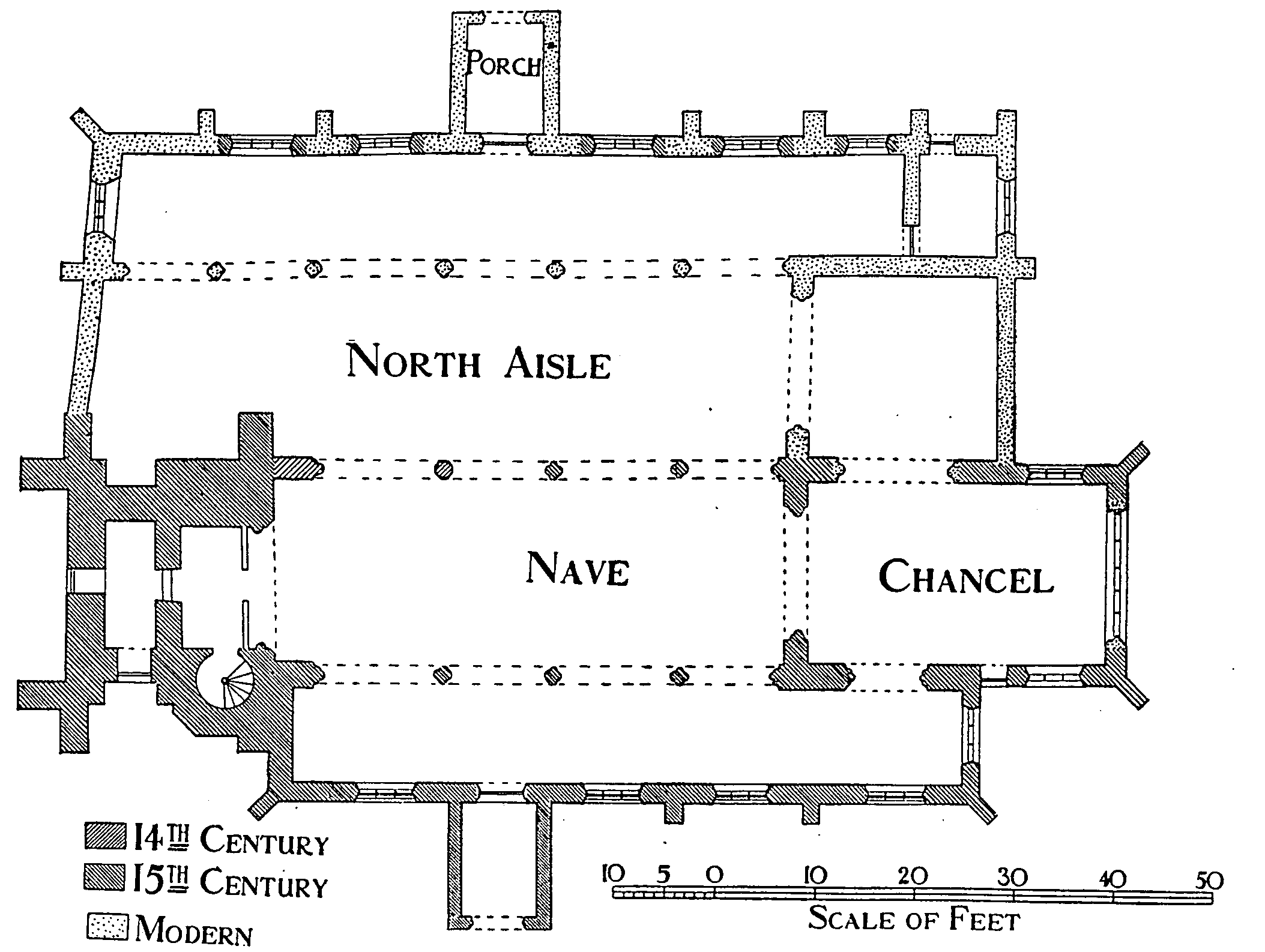
Plan of St. George's Church
The church of ST. GEORGE, Littleport, consists of chancel, north organ chamber and vestry, south chapel, clerestoried nave, two north aisles, north porch, south aisle, south porch, and west tower. The fabric was almost entirely rebuilt late in the 15th century with the exception of the west bay of the north arcade, which is of 14th-century date. In 1857 the church was drastically restored, when the north aisle was rebuilt and enlarged and a second north aisle added. The vestry and organ chamber, which are eastward extensions of these aisles, are also modern. The whole church was re-roofed at this time: the roofs are slated. The chancel has a modern east window of five lights, and there are diagonal buttresses with three set-offs. There is a window on the north and south of the chancel of three lights with cinquefoiled heads. The chancel opens to the south chapel by a four-centred arch with moulded caps and bases. There is a plain piscina in the chancel with a four-centred head, chamfered, and a stone credence shelf. The chancel opens to the organ chamber by a modern two-centred arch. The chancel arch is four-centred and of two orders; the outer order has continuous mouldings, and the inner shafts with moulded caps and bases. The fenestration of the south chapel is similar to the lateral windows in the chancel. In the south wall there is a plain doorway with a fourcentred and chamfered head. The chapel opens to the south aisle by a four-centred arch of two orders dying into the wall.
The nave has arcades of four bays, the arches of which are similar to the chancel arch except the west bay on the north, which has an octagonal column and semi-octagonal respond with moulded caps and bases supporting an arch of two orders, and is of 14th-century date. The clerestory has windows of two lights with cinquefoiled heads; the tracery on the north has been removed to the inner north aisle, which is also clerestoried. The two-centred tower arch is of two orders with moulded caps and bases to the inner order of the responds. The two north aisles terminate in a line with the west face of the tower. The arcade between the two aisles is modern and similar to those of the nave. The windows of the south aisle are of three lights with cinquefoiled heads, without tracery, and date from the 15th century. The windows of the old north aisle, which are similar, are now in the outer north aisle, to which they were removed when the church was enlarged. The aisle buttresses have two set-offs, those on the north being modern.
The roofs are modern, but that of the nave has eight medieval wooden angels, which have lost their wings, attached to the bases of the intermediates. The south porch is of 15th-century date with a four-centred arch of two orders, the inner with moulded caps and bases. The south doorway has continuous mouldings. The north porch is entirely modern.
The tower, a fine example of 15th-century design, is of four stages with an embattled parapet and angle buttresses with four set-offs. There is a stair turret at the south-east angle reaching to the parapet, the upper part of which is semi-octagonal. There is a west window of three cinquefoiled lights in the second stage; the third stage has three two-light windows with cinquefoiled heads on the north, south, and west sides. The windows of the belfry are of three lights with cinquefoiled heads, and the parapet is of brick. There is no west doorway. There was formerly a passage running through the base of the tower from north to south, separated from the church by a thin partition wall with a ringers' gallery above; the north entrance is now completely blocked but the south still exists, though it has had a modern doorway and door inserted. The entrance to the tower stairway is by a door in the south-east angle, which has a moulded arch and chamfered jambs. The ringers' gallery has a 17th-century rail serving as a parapet on the east.
The font is of 15th-century date with an octagonal bowl having quatrefoils in the panels. There is a massive iron-bound chest with rounded cover dated 1672. There are two massive benches with moulded poupée heads having a shield charged with a lion rampant, and another bench with poupée heads of less massive construction, all being of 15th-century date. At the west end of the inner north aisle is preserved the old north door, a fine piece of medieval carpentry, with a band of leaf carving round the frame and plain old hinges.
The plate includes a communion cup and paten cover of silver, 1570; a paten of silver, 1830; an almsdish of silver, 1829; a flagon of glass; a silver-plated memorial chalice of 1916; and a paten of 1928. The 1830 paten and the alms-dish were the gift of Bishop Sparke of Ely (1812-36).
The tower contains eight bells by Warner, 1891. There were formerly four, three by John Draper of Thetford (1st, 1640; 2nd, 1622; 3rd, 1624).
The registers begin in 1754 (marriages), 1756 (burials), and 1783 (baptisms). The earlier registers were destroyed during the Littleport Riots in 1816.
The church of ST. JOHN EVANGELIST, Little Ouse, stands in a remote position on the Norfolk boundary, 2 miles from the Littleport-Mildenhall road. It was erected in 1869 at the cost of Canon E. B. Sparke, Rector of Feltwell and son of Bishop Sparke. It is a building of flint with stone dressings and slate roof, consisting of chancel with north vestry and organ chamber, nave, and north-west tower with pyramidal slated roof. The ground stage of the tower forms a porch. The weather vane is in the form of a dragon.
The tower contains three bells. The registers begin in 1867. The parish was formed the previous year from Littleport and the following Norfolk parishes- Feltwell St. Mary, Feltwell St. Nicholas, Hilgay, and Southery.
The church of ST. MATTHEW, on the road to Welney and Wisbech, stands about 2 miles from Littleport town. It was erected in 1878 and is a brick structure consisting of chancel, transepts, nave, south porch, and west turret containing one bell. The registers begin in 1878, in which year the parish was formed from Littleport, Ely Holy Trinity, Ely St. Mary, and Downham.
NONCONFORMITY
There was a Baptist congregation at Littleport during the Interregnum. About 1655 its elders, Samuel and Ezekiel Cater, seceded to the Friends with 10 of the members, leaving 22 in the congregation. (fn. 118) In 1676 there were 67 Dissenters amongst Littleport's 556 persons of communicant age, but no Papists. (fn. 119) Licences for various Nonconformist meeting-houses were issued-to Thomas Young in 1747, to Rebeccah Godson in 1750, to James Clarke in 1754. (fn. 120) The denominations of the licensees, however, are not recorded, and it is not possible to connect them either with the Baptists mentioned above, or with the numerous Nonconformist chapels which were later established in Littleport.
A Particular Baptist church was founded in 1834 and a Calvinistic Baptist church in 1841. Neither of these was in association with the Baptist Union, and in 1851 the congregations were quite small. Both are now closed. (fn. 121)
The Methodists were established somewhat earlier. Their church in High Street dates originally from 1806, and was rebuilt in 1890 when the old building became a Sunday school. In 1851 its congregation of 380 (including 100 Sunday scholars) was equal to those of all the other Nonconformist chapels put together, and was about two-thirds of that of the parish church. (fn. 122) This was a Wesleyan church, and other chapels of this denomination were established at Dairy Houses (1840) and Black Horse Drove (1843). Both of these are in use today (1951), though that at Black Horse Drove was rebuilt towards the end of the 19th century. Another chapel was opened about 1916 on Mildenhall Road near the Little Ouse turning; this was closed during 1939-45, and the iron building has since been sold and demolished. (fn. 123) The Primitive Methodists opened a church in Victoria Street in 1845, having been established as a congregation ten years earlier. This church was restored in 1871. The Primitive Methodist chapel at Little Ouse (Morley Theobald Memorial) dates from 1910. Both of these are still in use.
The Independent church (Salem) in Globe Street dates from 1850. The Salvation Army barracks in City Road were established between 1904 and 1908. (fn. 124)
SCHOOLS
In 1789 Littleport was one of the sixtyeight Cambridgeshire parishes without a school, but nine years later three small unendowed day schools had sprung up, whose unlicensed masters taught from the Bible and Prayer Book. (fn. 125) One of these schools, or a successor, adopted the monitorial system of the National Society as early as 1819. (fn. 126) Nevertheless the parish lagged behind many in its educational equipment, and when the society made its inquiry in 1846-7 only 130 children, in a population of over 3,500, were being taught-about 50 of them on Sundays only. (fn. 127) In 1847, however, a National School, 'a handsome building', (fn. 128) was erected in Wisbech Road, near the church, and a master appointed at a salary of £36 a year, without house. This school, which cost £1,756, provided 172 places in the first instance, and was in 1871 supplemented by an infants' school for 100 at a cost of £413. (fn. 129) Attendance in 1867, by which date the school seems to have been enlarged, averaged 151 boys and 117 girls during the winter. In summer, owing to the gang system, the numbers were only 85 and 67 respectively. (fn. 130) Provision for the outlying districts was made by other National Schools at Fen and Dairy Houses, at the end of Hale Drove (1869), and Little Ouse (1870); these buildings were combined schools and mission churches. The total accommodation provided (about 400 places) was, however, still inadequate, and in 1874 a School Board was formed, (fn. 131) which provided two more outlying schools at Black Horse Drove (1874) and at Westlands in Littleport St. Matthew (1900). Between 1874 and 1885 the Board took over the four National Schools.
The Town Schools (fn. 132) were enlarged in 1885 to take 537 children. Further enlargements were made in 1909-10 and 1922 to keep pace with the population and to counteract the reduced capacity that would have resulted from the adoption of improved standards of accommodation. After the second enlargement there were places for 552 (207 boys, 212 girls, and 133 infants). In the early part of the Second World War the presence of evacuees made it necessary to hire additional temporary accommodation in the Salvation Army Hall (boys), Alexandra Hall (girls), and Primitive Methodist Hall (infants). To replace the halls upon their surrender, two additional classrooms and a staff room were provided in the shape of a hut at the infants' department in 1950.
In 1894 an infants' school for 80 was erected at the Littleport end of Ten Mile Bank. Before 1910 it was enlarged to provide 108 places, reduced to 94 in that year. In 1923 there were only 25 children in attendance and the school was closed. The buildings were sold nine years later for £300. (fn. 133)
Black Horse Drove and Little Ouse Schools are both near the Norfolk border, and take children from that county. This has led to overcrowding. At Black Horse Drove in 1932 there were 114 children on the roll and recognized accommodation for only 75. The overflow was taught in the Wesleyan Sunday school. The school had been on the black list for some time owing to its dangerous structural condition. A new school was therefore built, providing 80 places at a cost of over £3,000, and renamed at its opening (1937) the Coronation County Primary Junior Mixed and Infants' School. There were 38 children on the books in 1949. (fn. 134)
The Little Ouse School was housed in very poor premises-an iron hut used also as a mission room, which still exists. Shortly before the First World War a new site was bought and a teacher's house erected, but the school itself was not furnished with new buildings until 1927. They are an attractive example of semi-permanent timber construction. (fn. 135)
Also in Little Ouse village, on the Norfolk side of the river, is Feltwell Fen School, known until 1929 as Feltwell Anchor School. This was built by Feltwell School Board in 1889 for 60 children at a cost of £650, and was enlarged by a classroom for 27 infants in 1914, after a merger with the Little Ouse (Isle) School had been rejected. In the great floods of 1915, 1916, and 1917 the buildings were used as a refuge for homeless families. (fn. 136)
The Westlands School also started in converted mission-room premises (1900), but unlike Little Ouse was a provided school from the outset. The original accommodation was for 48. In 1921 the County Council purchased a new site slightly nearer Littleport, on which an army hut to hold 80 was erected as temporary accommodation. No permanent buildings, however, were ever erected, and in January 1932 the seniors were transferred to Littleport Town; the remaining 28 juniors followed in September of the same year. (fn. 137)
Fen and Dairy Houses School originally (1869) provided 100 places, reduced in 1910 to 83. This school was leased by the church authorities to the School Board in 1874. It stood in a very remote position in the fen, more than 6 miles north of the village, and the average attendance had dropped to 31 in 1938 and 25 in 1943. The school was therefore closed the following year, and the children transferred to the Town Schools. (fn. 138)
CHARITIES
In 1747 Aungier Peacock gave a messuage called the guildhall (fn. 139) and 27½ acres of land for the maintenance of a causeway and the relief of the poor. Under the Bedford Level Act of 1677, 158 acres were allotted as Town Lands. By 1837 these Lands with Peacock's bequests were being let for £430 a year. The Commissioners of 1837 also recorded the existence of Fleet's charity, of unknown date, valued at £100, and two small charities producing £5 10s. a year. In 1837 all these charities were given indiscriminately to the poor in clothing, coals, and money. There were also 21 tenements inhabited rent free by the poor, one of which was said to have been given to the parish under the will of Robert Allison (1593). (fn. 140) In 1875 the Town Lands were regulated by a Scheme of the Charity Commissioners, and in 1879 the Trustees built a town hall with some of the proceeds of the charitable estates. (fn. 141)