A History of the County of Cambridge and the Isle of Ely: Volume 4, City of Ely; Ely, N. and S. Witchford and Wisbech Hundreds. Originally published by Victoria County History, London, 2002.
This free content was digitised by double rekeying. All rights reserved.
T D Atkinson, Ethel M Hampson, E T Long, C A F Meekings, Edward Miller, H B Wells, G M G Woodgate, 'North Witchford Hundred: March', in A History of the County of Cambridge and the Isle of Ely: Volume 4, City of Ely; Ely, N. and S. Witchford and Wisbech Hundreds, ed. R B Pugh (London, 2002), British History Online https://www.british-history.ac.uk/vch/cambs/vol4/pp116-123 [accessed 30 April 2025].
T D Atkinson, Ethel M Hampson, E T Long, C A F Meekings, Edward Miller, H B Wells, G M G Woodgate, 'North Witchford Hundred: March', in A History of the County of Cambridge and the Isle of Ely: Volume 4, City of Ely; Ely, N. and S. Witchford and Wisbech Hundreds. Edited by R B Pugh (London, 2002), British History Online, accessed April 30, 2025, https://www.british-history.ac.uk/vch/cambs/vol4/pp116-123.
T D Atkinson, Ethel M Hampson, E T Long, C A F Meekings, Edward Miller, H B Wells, G M G Woodgate. "North Witchford Hundred: March". A History of the County of Cambridge and the Isle of Ely: Volume 4, City of Ely; Ely, N. and S. Witchford and Wisbech Hundreds. Ed. R B Pugh (London, 2002), British History Online. Web. 30 April 2025. https://www.british-history.ac.uk/vch/cambs/vol4/pp116-123.
In this section
MARCH
March, the county town of the Isle of Ely, once formed a chapelry in the northern part of the parish of Doddington. A Local Board of Health, set up in 1851, (fn. 1) was converted in 1894 into an Urban District Council of twelve members, by which the town is now governed. Small adjustments of boundary were made in 1933 under the Isle of Ely Review Order. (fn. 2) An outlying portion of Wisbech Borough was brought into the district, and a mutual exchange made with the parish of Elm.
The town probably owes its origin to the ford on the old course of the Nene, (fn. 3) where the road between Ely and Wisbech, the two chief towns of the Isle, crossed the river. It early outstripped the parent settlement of Doddington and in the 15th century possessed several guilds; (fn. 4) the church also is as large as and finer than that of Doddington, and its wonderful hammerbeam roof testifies to the affluence of the place at the end of the Middle Ages. (fn. 5)
A market, with two annual fairs, was first granted in 1670, (fn. 6) in spite of the opposition of Wisbech Corporation. (fn. 7) In 1785 the tolls were assessed at £6. (fn. 8) Soon after this the market appears to have lapsed, and an attempt to revive it in 1821 was not very successful, though the fairs continued at this period to be prosperous. The development of the market was impeded by the absence of a covered hall and by the fact that market day in March and several neighbouring towns fell on the same day (Friday). After the opening of the railway in 1847 another attempt was made to increase the market. The want of a market house was remedied, in a makeshift fashion, by Sir Henry Peyton, 2nd baronet of the 1776 creation, who was lord of the manor and holder of market rights. His building, however, was only 40 ft. long by 17 ft. broad, (fn. 9) and provided 14 stalls under cover as compared with the 54 available at Wisbech and 74 at Peterborough. The difficulty of the clashing with other market days was solved in December 1856 by changing the day to Wednesday 'by private arrangement and without any formalities'. (fn. 10) In 1851 the market had been stated to be 'making some progress'; £150 was subscribed to give a treat to the poor at its reopening. (fn. 11) The tolls were, however, collected in an arbitrary and haphazard way; they were assessed for poor rate purposes at £10, but the toll-keeper in 1888, though he had no fixed scale of charges and kept no record of receipts, was said to be taking about £50 a year. An attempt by the Local Board to purchase the market rights to mark the Jubilee of 1887 was a failure, (fn. 12) but they were secured by the Urban District Council in 1898, and the market is now well attended. The fairs are held on the Monday before Whitsun and the third Tuesday in October. (fn. 13)
The first record of a post office is in 1793. In 1832 March was made a post town, and in 1851 the post office was situated in High Street. (fn. 14) It was rebuilt in 1887, and was moved to Broad Street in 1901; (fn. 15) the present building dates from 1936. (fn. 16) A telegraph service was first provided in 1870, and telephones in 1908. (fn. 17)
The 1563 list of householders (fn. 18) does not distinguish March from Doddington, but the evidence of the registers at this period suggests that March may have had a population of 1,000. (fn. 19) The ship-money assessment of 1639-40 rated March at £35 5s. The rate is a little greater than that set upon Doddington and Wimblington combined, but lower than that upon several of the larger villages, for example Downham, Elm, Haddenham, Littleport, Stretham, and Sutton. (fn. 20) In 1669 there were 165 holders of common rights in March as compared with 42 in Wimblington, (fn. 21) and 7 years later Bishop Compton's 'census' showed 949 persons of communicant age in March as compared with 813 in the rest of Doddington parish. (fn. 22) In 1808 March was described as a 'considerable town'. (fn. 23) It was in fact slightly larger than Chatteris, but about a third smaller than Ely and Whittlesey and only half the size of Wisbech. It had long been consolidating its position as the main centre in Doddington parish, and the 1801 Census showed about twice as many people in March as in the three villages. The growth of Doddington and its hamlets in the first half of the 19th century was exceptional even for the Fens, and the proportion of about two to one between March and the rest of the parish still obtained in 1851. The usual heavy decrease occurred in 1851-61, amounting in the case of March to over 12 per cent. Since 1861, however, March has forged ahead, not only in comparison with the rest of Doddington parish, but with the other towns of the Isle. By 1891 March had outstripped Whittlesey, and by 1911 Ely also, and the 1931 figure for March (11,266 persons) was more than twice that of 1861. The 1951 population was 12,993.
In the reign of Queen Elizabeth March was a minor port. In 1566 eight boats, capable of carrying one, one and a half, or two cartloads, were used in the coal and grain trades. (fn. 24) A certain amount of traffic in coal and other commodities, carried in barges, was observed by Dugdale in 1657. (fn. 25) Tradesmen's tokens of 1669, and a silver shilling token of 1811, have been noted. (fn. 26) A 'town hall' existed in 1669. (fn. 27) From 1778 to 1846 the 'Guildhall' was used by the Court of Requests, which had been established in the Isle for the recovery of small debts. (fn. 28) The Guildhall was rebuilt in 1827 and still stands in High Street, but is no longer used for any civic purpose. (fn. 29)
The main cause of the rapid growth of March in the past hundred years is its emergence as the chief railway centre of the Isle. The first line was that from Ely to Peterborough, opened in 1846, from which branches were laid to Wisbech and to St. Ives respectively in the two following years. Another important line (to Spalding) was opened in 1867 and provided through communication between the north and east of England. (fn. 30) The situation of the railway station at the north end of the town has quickened the consistently northward trend of the town plan. From its original nucleus round St. Wendreda's Church the town has spread past the cross and along High Street to the bridge. Thence it has fanned out northwards between the two roads to Wisbech. Land is not so valuable round March as farther north in the county, and the modern development is rather scattered and untidy as compared with that of Wisbech.
The sidings at Whitemoor on the Spalding line, constructed in the 1930's, are the largest in England and among the largest in Europe, and in its industrial structure the town is more akin to Peterborough or Wellingborough than the other towns of the Isle, whose industrial interests are closely tied to the land. In 1921 a remarkably high percentage of the population (22.3 per cent. of occupied males) was engaged on the railway. Proportionately, this was three times as many as in the railway town of Swindon. The startling fact that the Isle of Ely had then a greater proportion of railway workers than any other county except Cumberland and the Soke is mainly explained by this notable concentration in March. In 1931 the Isle had surpassed Cumberland also. The percentages then were: the Soke, 9.2; the Isle, 4.8; Cumberland, 3.6. The percentage for March was 24.5. But the Urban District contains some 30 square miles of farm land as well as the town itself, and even in March agricultural workers approach railwaymen in numbers and proportions. (fn. 31)
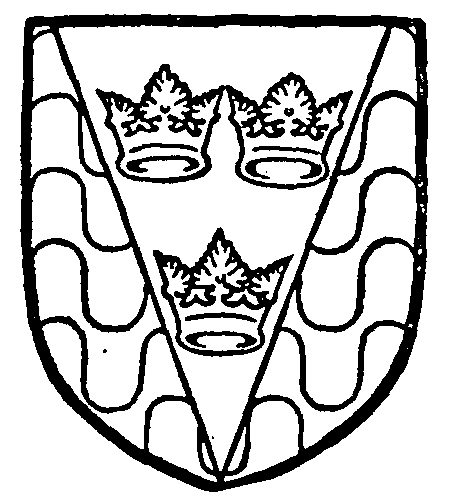
Isle of Ely County Council
Argent three bars wavy axure and a pile gules charged with three open crowns or.(Granted 1931.)
It was mainly due to the excellent railway communications that March became the county town of the Isle. The first meeting of the County Council took place, 24 January 1889, in the County Court House at March, 'this being considered neutral ground' as opposed to the older centres of Ely and Wisbech where alternately the Quarter Sessions were held. (fn. 32) At the next meeting, also held at March, a motion was put forward for meetings at Ely, March, and Wisbech in rotation, but an amendment to make March the permanent meeting-place was carried. It was pointed out that, although March was the most convenient centre for only 18 of the 52 members who expressed a preference, it was more convenient than Ely or Wisbech for most of those who preferred the other of these towns. Experience at Quarter Sessions had, moreover, shown that meetings at Ely were poorly attended from the north of the Isle and meetings at Wisbech attracted few from the south. (fn. 33) In its early years the County Council met in the Temperance Hall, erected in 1885 by the Peckover family of Wisbech; (fn. 34) the County Hall dates from 1908 and as a late comer among the public buildings of the town has been crowded out from the centre. The original cost was £4,764; it has been enlarged in 1927 and 1937 for considerably larger sums. (fn. 35)
An Inclosure Act for March was passed in 1792. (fn. 36) The award, dealing with about 2,760 acres, was not made until 1805. (fn. 37) There were 95 beneficiaries. Of these Sir Henry Peyton was the chief. He received 300 acres, 138 of them as lord of the manor.
In the early 19th century a 'pretty little theatre' was built in Bridge Street by a Mr. Smedley, but did not flourish, and in 1844 the building was converted into a British school and a Mechanics' Institute. (fn. 38) Another feature of Early Victorian March was the Exotic Gardens, laid out in 1836 by Mr. Fuller with 'choice flowers, evergreens, American plants etc. . . . giving them a very pleasing aspect'. (fn. 39)
In a field immediately south of Eastwood Avenue, adjoining the golf course, is a small star-shaped sconce, almost obliterated but showing up in air photographs, formerly known as the 'Battery Hills'. It stands on land which was once part of Cavalry Barn Farm, so named according to local tradition because 'Oliver Cromwell kept his horses there'. (fn. 40)
About 600 yards north of St. Wendreda's Church, on the west side of the road into the town, is the base of a wayside cross on three steps. The base is square with a sunk panel on each face, two with blank shields and two with roses.
There are no medieval secular buildings remaining in March, but several of later date have some architectural distinction. Some of the best are: (a) The Ship Inn, Nene Parade, dating from the 17th century, timber-framed with an overhanging upper story and thatched roof; (b) Elwyn House, in the market place, a Regency building with a good doorway; (c) No. 3 West End, 18th century, also with a good doorway and a roof partly stone-slated; (d) No. 38 West End, dated 1626, with elaborately carved beams in the parlour ceiling and an Adam-style fireplace in the dining-room. West End contains other old houses of less architectural importance, and there are some also in High Street and at Knight's End. The banks of the Nene, near the bridge, recall the Brinks at Wisbech on a small scale, and the Urban Council Offices, with a conspicuous and picturesque tower, are good for their date (1900). The clock in the tower is a Diamond Jubilee memorial. (fn. 41) During the 19th century a fashion for ornamental structures of cast iron developed in March and the neighbourhood. An early example is the Regency-style porch of No. 36 High Street, which may be compared with that at Wade's Hotel, Station Road (c. 1870). Another building in this local style is the 1911 Coronation Fountain in Broad Street. (fn. 42)
MANORS
March was given to the monastery of Ely c. 1000 by Oswy and Leofleda when their son Aelfwin was admitted as a monk. (fn. 43) In 1086 the berewick of March contained 12 villeins, each with 12 acres. It was valued as part of Doddington (q.v.). The abbot of Bury St. Edmunds also held 16 acres, land for half a plough, 3 bordars and woodland for 4 pigs, stated to be worth 3s., which had always belonged to the demesne of that abbey. The abbot of Ely had the soke. (fn. 44) The Bury estate is recorded in 1291 as worth 16s., (fn. 45) but the greater part of March was throughout the Middle Ages included in the Bishop of Ely's manor of Doddington. Its importance vis-À-vis the present settlement soon began to increase. Already in 1221 one of the bishop's tenants was Alan the merchant (mercator), who held 'Stretreche', probably in March, for 500 eels and 3s. 3d. yearly. There were at the same time 11 customary tenants specifically described as holding in March. (fn. 46) By 1251 March had become a fair-sized village with 77 messuages; (fn. 47) there were 35 free and about 50 servile tenants, including 9 novi feoffati and 9 others enfeoffed since the time of Bishop Geoffrey. (fn. 48) The bishop's vaccary of Dereford or Dernford lay in March, forming a minor but continuous item of manorial economy in the early 14th century. (fn. 49) The name is preserved in the present Dartford Road. (fn. 50)
A manor of March is mentioned for the first time in 1328, when Geoffrey de Colevill sued Roger Huse for unlawful entry into the manor of HATCHWOOD. The case was removed from the king's to the bishop's court and must have resulted in (fn. 51) favour of Geoffrey, for in 1361 Sir John de Colvile, before his departure overseas, settled property in 'Marcheford' on trustees for the benefit of his son John, or of himself should he return. It consisted of a messuage, 10 acres of inclosed ground, 2 acres of meadow and 2s. 6d. from the rent of a cottage. (fn. 52) In 1407 Geoffrey Colvile and his wife had licence of private oratory in their house at Hachewood near March. (fn. 53) This manor of Hatchwood (fn. 54) was conveyed by John Colvile to Humphrey Gardner in 1586; (fn. 55) it then contained 40 messuages. Gardner and his wife Elizabeth passed it to William Hynd (1559), whose relict conveyed it to Sir John Peyton in 1606, (fn. 56) since when it has followed the descent of Doddington (q.v.). Robert Masters was tenant under the Peytons in the middle of the 17th century. (fn. 57)
The growth of population in the 17th century resulted, as at Wimblington, in the overstocking of the commons, and in 1669 Sir Algernon Peyton entered into an agreement with his 165 March tenants somewhat similar to that made at Wimblington (q.v.). About 4,440 acres were set aside as common and cow pasture in two portions: (a) Burrowmoor and Great and Little Binnimoor, and (b) Stow Fen, Great and Little Hurst, part of Witch Fen, Joan Sades Hole, Poutsherne, Low Fen, and Town End, Knight's End, Tyburn, Northwood, and Crawford Greens. From May Day to Michaelmas each tenant was stinted to 2 horses or 4 cows or 16 sheep, double that number being allowed between Michaelmas and Lady Day. The fines for overstinting or pasturing during the close season were similar to those levied at Wimblington, but in view of the greater number of tenants a steward or bailiff was appointed to collect the fines. He was allowed a salary not exceeding £10 a year, and was chosen by the fifteen trustees who regulated the scheme, every Easter Monday at the 'town hall' of March. A 'register' or town clerk was also appointed to set down the trustees' decisions in writing, and to copy them into the Doddington court rolls. He was to have £5 a year. The commoners were responsible for keeping the gates, bridges, and dikes in repair. The lord of the manor was entitled to nominate twenty poor persons to the privilege of grazing one or two cows or heifers, and the trustees empowered to grant temporary licences for one year to other poor persons. An area of 200 acres on Burrowmoor was set aside for the poor to dig turves. The commonable houses were defined as those existing in 1613, when Sir John Peyton altered the customary fines from arbitrary to certain; to discourage further building, future houses were to pay 10s. monthly as a fine. An unstated amount of inclosure had already been carried out, and proving 'very beneficiall and advantageous' for the provision of winter feed, a further 1,567 acres, in 175 parcels, were decreed for inclosure. An inclosure by Roger Jennyns, one of the chief tenants, of 600 acres in West Fen, was recognized. The Couledge, Sheppard, Southwell, and Walsham families are prominent among the names of the consenting parties. (fn. 58)
Manorial courts were held as recently as 1900, annually at the Griffin Hotel. (fn. 59)
The priory of West Dereham (Norf.) had property in March worth £1 6s. 8d. in 1291. (fn. 60) By 1535 the value, including a fishery, (fn. 61) had gone up to £5, when this estate ranked as a fee and involved suit at the bishop's court at Doddington twice a year. (fn. 62) The post-Dissolution grantee was John Huddilston. (fn. 63)
In 1364 Adam Orchard and William atte Lofte were licensed to alienate to Walden Abbey (Essex) 2 messuages, a toft, and 190 acres of land in March, Doddington, and Elm. (fn. 64) This property was worth only 14s. in 1535, (fn. 65) and with the other possessions of this monastery was granted three years later in fee to Sir Thomas Audeley. (fn. 66)
In 1249 Bishop Northwold granted 12 acres of marsh in March to the priory of St. Neots (Hunts.). (fn. 67) This small piece of land is not noticed in the Taxatio, but in 1535 its value, with a fishery, was £1 6s. 8d. (fn. 68) In 1560 the reversion in fee simple was granted to John Norden of London and Clement Robertes of Little Braxted (Essex), (fn. 69) Thomas Barrett and John Wrighte alias Goldwell being tenants on a twenty-oneyear lease dating from 1548.
CHURCHES
The Doddington Rectory Division Act (1856) (fn. 70) provided for the separation of the chapelry of March from Doddington and for its elevation to the same rectorial status as its parent. The sum of £1,300 was reserved as the stipend of the rector of March (St. Wendreda's), and provision was made for the formation in due course of three other rectories in the town. The Act did not come into force until the death (1868) of the Revd. Algernon Peyton, last rector of the undivided parish. The following year March St. Wendreda's became a rectory, and the rectories of St. John, St. Mary, and St. Peter were created in 1872, 1873, and 1881 respectively. The four advowsons were at first reserved to the Peyton family, with whom those of St. John and St. Mary have remained. That of St. Wendreda was before 1900 transferred to the trustees of the Revd. G. E. Walker (a former Rector of Doddington), and between 1915 and 1926 to the Martyrs' Memorial Trust, who now hold it. That of St. Peter was transferred between 1905 and 1915 to the Revd. D. A. Stewart; in 1940 Mrs. Stewart was patron. (fn. 71)
The Act of 1856 also provided that a chapel should be built in the parish of St. Mary, which was to comprise the expanse of fen west of the town. Such a chapel was built in 1891 and dedicated to St. Mary Magdalen. (fn. 72)
One of the March guilds, that of St. Wendreda, (fn. 73) dated from the 14th century. (fn. 74) Its hall was sold in 1571 to Richard Hill and Robert Don, the former receiving other properties of the guild including an inn called the 'Swan' in tenure of Henry Cornewallis. (fn. 75) There were also five smaller guilds of Holy Trinity, St. Anne, St. John Baptist, St. Mary, and St. Peter. (fn. 76)
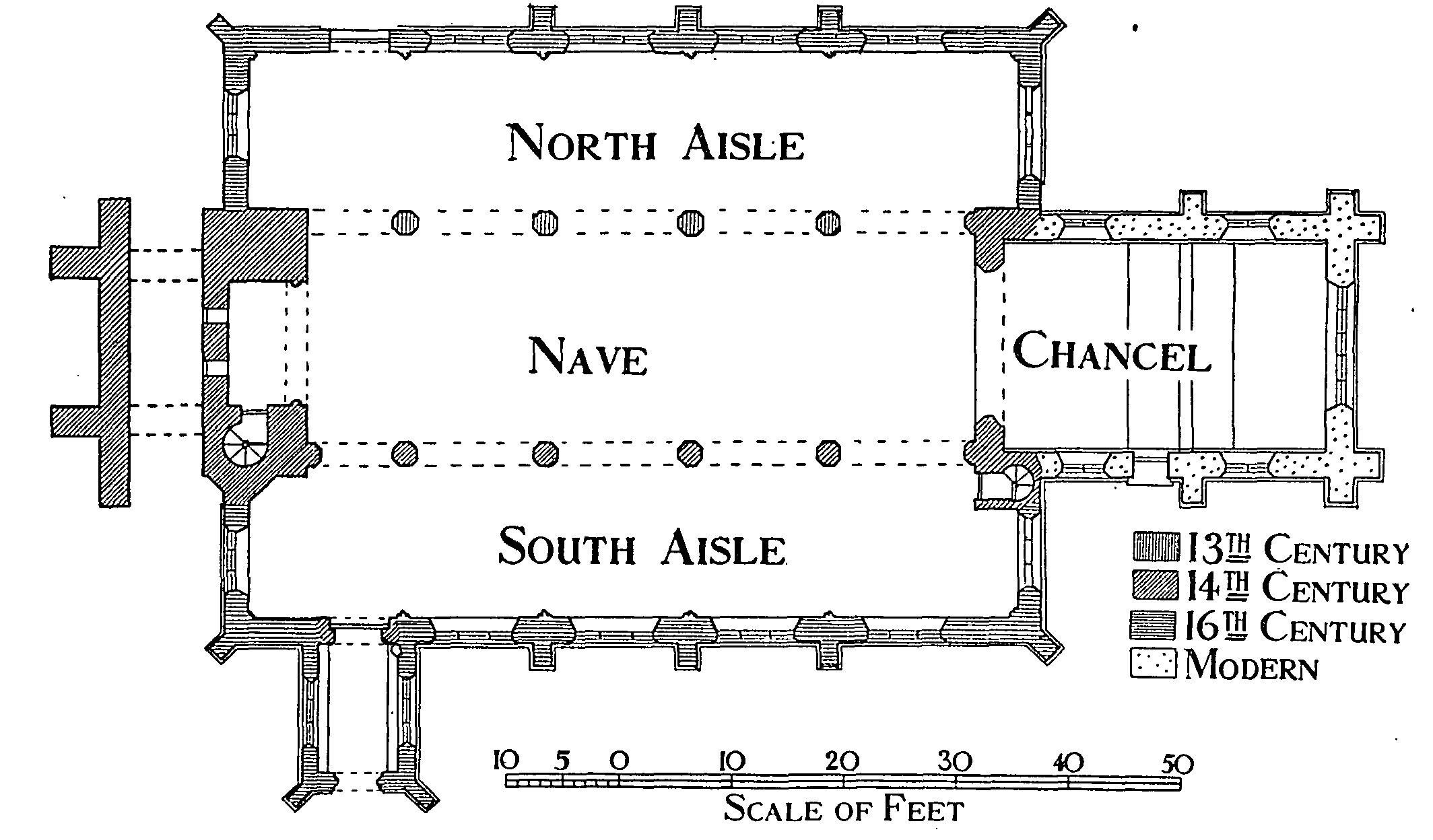
Plan of St. Wendreda's Church
The church of ST. WENDREDA consists of chancel, clerestoried nave, aisles, south porch, and west tower and spire. The material is flint and rubble with Barnack stone dressings. The chancel roof is tiled. The roofs of the nave, aisles, and porch are covered with lead. The earliest surviving work is the north arcade, which belongs to the middle of the 13th century. A general reconstruction took place, doubtless in pursuance of the indulgence granted by Clement VI in 1343 for the rebuilding of the chapel. (fn. 77) To this period belong the south arcade and the tower and spire. Early in the 16th century the church was completely transformed by the addition of a clerestory and the rebuilding of the aisles and south porch. New roofs were also provided at this time. In 1874 the chancel, which had been modernized in the 18th century with rounded windows and plaster ceiling, was completely rebuilt in 14th-century style.
The chancel, which is entirely modern, has an east window of five lights with flowing tracery. In the lateral walls are three windows of two lights of 14thcentury character. The chancel arch is two-centred and of two orders with semi-octagonal responds having moulded caps and bases; it dates from the middle of the 14th century. The nave arcades are of five bays, the westernmost on each side being truncated. The north arcade is the sole survival of the 13th-century fabric and has plain two-centred arches of two orders with octagonal columns having bell-shaped moulded caps and moulded bases. The south arcade has twocentred arches of two orders with octagonal columns having moulded caps and bases, and dates from the middle of the 14th century. In the south-east angle of the nave is the newel stair which formerly led to the rood loft; it has plain upper and lower doorways. The clerestory consists of nine windows on each side, of two cinquefoiled main lights with trefoil-headed openings above. The external face of the clerestory is panelled with flushwork in the East Anglian manner. On the east gable of the nave is a sanctus bell-cote with crocketed pinnacles.
Both the aisles were completely rebuilt in the first quarter of the 16th century and are of uniform character. The east and west windows and those in the north and south walls are of three lights cinquefoiled with trefoil-headed tracery lights. There is blind arcading on the internal face of the lateral walls, within which the windows are set, with demi-figures at the apex of the arches, a feature characteristic of East Anglian work of the period. Beneath the windows on the interior is a string-course. The buttresses are uniform, with one set-off, and there is a panelled base course with sunk quatrefoils which is continued round the porch. Both the nave and aisles have embattled parapets, which in the case of the nave and north aisle are furnished with crocketed pinnacles. The north aisle parapet has a band of sunk quatrefoils beneath the battlements. There is a good series of gargoyles. The north doorway has continuous mouldings, and the south doorway, which belongs to the 14th century, has continuous mouldings and a hood-mould terminating in heads. The porch has an outer doorway with fourcentred arch of two orders beneath an ogee hoodmould; the outer order has continuous mouldings and the inner has engaged jamb shafts with moulded caps and bases. In the east and west walls is a window of three cinquefoiled lights under a depressed head. The parapet is embattled and there is an original gable cross and good gargoyles. There is a stoup recess in the north-east angle.
The tower and spire are of mid-14th-century date. The tower is of three stages. There is a passage through the ground stage from north to south, which has ribbed vaulting with carved bosses. This passage occupies only the western half of the ground stage and is separated from the other half by a wall pierced by two narrow slits. The space above the passage serves as a ringing-chamber open on the east to the church. The west window is of three lights with flowing tracery and an external hood-mould terminating in heads. The lofty tower arch is two-centred and of two orders, the outer dying into the wall and the inner springing from shafts with moulded caps and bases. In the second stage is a window of two trefoil-headed lights with a quatrefoil above and a hood terminating in heads, on the north and south faces. The belfry windows are of two trefoil-headed lights with a sexfoil above. There are angle buttresses with four set-offs and an embattled parapet. There is a newel stair turret at the southeast angle, which is entered from the church by a plain doorway with continuous chamfer. The ribbed spire is octagonal with two tiers of openings, the lower of two lights and the upper of one.
The nave has a fine timber roof (fn. 78) of double hammerbeam construction, which was erected early in the 16th century. There are demi-angels with outspread wings on the hammerbeams, collars, and wall-plate, and on the corbels which terminate the wall-posts. The wallposts have niches with a series of figures holding musical instruments. All the principals, rafters, and purlins are moulded. The aisles have lean-to roofs with moulded principals and purlins and wall-posts resting on stone shafts, which spring from the floor and have moulded caps and bases. The porch has a plain cambered beam roof. The chancel roof is modern.
The 14th-century font has an octagonal bowl with crosses having splayed ends in low relief on the alternate sides; there are slight traces of colour. A portion of the 18th-century altar rails with turned balusters is now at the west end of the south aisle. There are two brasses: (1) William Dredeman and Joan his wife, 1501, with effigies of a civilian and lady, much worn; (2) Anthony Hansart and Catherine his wife, 1517, with effigies of man in armour with tabard and lady and one child, mutilated; above is a representation of the Annunciation and beneath a shield of arms.
The plate includes a silver chalice of 1752, the gift of James Collier, and a silver paten, 1703, the gift of Lora, wife of John Walsham. (fn. 79)
The tower contains six bells by Thomas Osborn of Downham, 1802. (fn. 80)
The registers begin in 1558 and are complete. Some loose sheets going back another eleven years are preserved.
The church of ST. MARY THE VIRGIN, erected in 1874, is a stone structure in 14th-century style consisting of apsidal chancel, nave, south porch, vestry, and west turret containing one bell. The registers begin in 1874 and are complete.
The church of ST. JOHN, erected in 1872, is a stone structure consisting of chancel, nave, aisles, south porch, and west turret containing one bell. The registers begin in 1872 and are complete.
The church of ST. PETER, erected in 1881, is a stone structure consisting of chancel, nave, aisles, north-west tower, and spire; the base of the tower serves as a porch. The tower contains one bell. The registers begin in 1881 and are complete.
NONCONFORMITY
March was an early centre of Nonconformity, with 139 Dissenters and 1 Papist in 1676. (fn. 81) The proportion of over 13 per cent. was the highest in the Isle, (fn. 82) and surpassed only by Barrington, Litlington, Oakington, and Orwell in the county; the number was surpassed by Cambridge alone. The Baptists, as usual, were early in the field, and established in the town by about 1700. (fn. 83) The house of Stephen Coward, occupied by Josiah Black, was licensed for their worship in 1703. (fn. 84) Their pastor, Thomas Speechley, had 160 adherents in 1715. (fn. 85) A Baptist Sunday school was started in 1808. (fn. 86) In the middle of the 19th century there were three Baptist churches in the town. (fn. 87) The oldest dated from 1799, and was rebuilt in 1870 as the Centenary Baptist Church, in High Street. Providence Strict Baptist Church, Burrowmoor Road, was established in 1821 and rebuilt in 1835, and there was a Particular Baptist Church in the town dating from 1849. The two former churches are still in existence, and also the chapel at Chain Bridge (1859), which was an offshoot of the now closed West Fen chapel (1845). The Independent or Congregational Church in Station Road dates from 1836; this sect had previously worshipped in a granary near the present church. (fn. 88) The Wesleyan Methodists opened a church in High Street in 1829, which was rebuilt in 1889, and the Primitive Methodists one in Station Road (1848). (fn. 89) There is a third Methodist church at Floods Ferry, west of the town. The Salvation Army began work in March between 1900 and 1904, (fn. 90) and the Roman Catholic Church of Our Lady and St. Peter, in St. John's Road, was built in 1912. (fn. 91)
SCHOOLS
A schoolmaster is reported in March in the Archdeacon's Visitation Return of 1596. (fn. 92) Besides the Grammar School, (fn. 93) there were in 1798 six Anglican and one Nonconformist schools at March, teaching about 230 children. None of the teachers was licensed, but the condition of the schools was said to be good. (fn. 94) In 1827, after certain of the March charities had been consolidated for educational purposes, the Guildhall in High Street was rebuilt and enlarged. The new building contained rooms for boys' and girls' schools conducted on National Society principles; (fn. 95) provision was made for 200 boys and 150 girls. In 1837 the master and mistress received £80 and £50 respectively, and there was an average attendance of 100 boys and 80 girls; this was in the winter months- in summer the numbers were lower. (fn. 96) No return was received from Doddington and March to the National Society's inquiry of 1846-7, but it was estimated that 400 children were being taught, weekdays or Sundays or both, in the undivided parish of Doddington, which at this date had about 9,000 inhabitants. (fn. 97) From 1844 the Society's efforts had been supplemented by the British and Foreign Schools Society, which opened a school in the old theatre in Bridge Street in that year. (fn. 98) In 1851 the Charity Commissioners introduced a revised scheme for the town charities, which allotted five-ninths of the total revenue to education. (fn. 99) A good deal of the money was swallowed up in building and maintaining a new Grammar School, and in 1872 'there being a great insufficiency of elementary school accommodation' the Trustees agreed to lease their primary schools to the School Board which had been set up the previous year (fn. 100) -the first in the Isle. (fn. 101)
The Board built a new girls' department, which was enlarged in 1902 to provide 190 places. In 1907, when the original buildings of this school (the South District Council School) were eighty years old, a new boys' and girls' school was built in Burrowmoor Road, with 300 places for each sex. The old girls' school was left to the infants, who still occupy it, (fn. 102) and the boys' and infants' departments converted into a cookery centre. Handicraft rooms were provided at Burrowmoor Road in 1913, and a new master's house the following year. Special practical instruction rooms were built in 1925, but in 1933, owing to great pressure on the available accommodation, they were used as ordinary classrooms. The position was eased the following year, when the Hereward School was opened. From 1922 to 1934 Burrowmoor Road had been the town's senior school, exchanging its younger children with the seniors from Dartford Road. In 1949 there were 211 boys and 218 girls at Burrowmoor Road. (fn. 103)
The North District Schools in Dartford Road were built by the March School Board in 1873-4 to take 510 children. They were enlarged in 1895 to provide 700 places, scaled down to 666 in 1910. After 1934, when all the senior children were transferred to the Hereward School, all the juniors, including those who had always attended Dartford Road, were transferred to Burrowmoor Road school which became the town's junior school, and Dartford Road was reserved for the infants from the northern part of the town. There were 388 on the roll in 1949. (fn. 104)
Another school was built by the Board in 1889, (fn. 105) in West Fen near St. Mary Magdalen's Church. It had accommodation for 100 children. The isolated position, some 3 miles out of the town, led to difficulty in finding staff, and in 1926 this school was closed. At this date there were only 26 children on the books. The buildings were valued at £550, but an auction sale failed to achieve the reserve price, and they were finally sold in 1930 for £100 only. (fn. 105)
The first step towards the reorganization of the March schools was taken in 1922, when the three principal schools at Burrowmoor Road, Dartford Road and by the old Guildhall were allocated to seniors, juniors, and infants respectively. This was soon found to be inadequate. Between 1925 and 1932 the number of school children in March increased 25 per cent., and at the latter date there were 1,838 on the books, but only 1,374 places for them. A site for a new senior school was purchased in 1931, in Robin Goodfellow's Lane, at the end of County Road. The plans were prepared during the depression, and, for economy's sake, Mr. R. D. Robson, the County Architect, introduced some interesting and unusual forms of construction, flat roofs among them. The school was completed in 1934, and provided 640 places for less than £20,000 including the equipment. At its opening it was named the Hereward School. (fn. 106)
CHARITIES (fn. 107)
The oldest of the March charities was that of John Fringe, who in 1579 left 12 acres in Leverington and Wisbech St. Mary for the benefit of the poor of March. The deed of feoffment seen by the Charity Commissioners was dated 1689. This charity, with those of William Neale (1696) and Henry Wade (1713), (fn. 108) was consolidated in 1826. The trustees then had at their disposal 268½ acres, producing £471 12s. a year. This included 12 acres allotted in respect of the Guildhall under the March Inclosure Award of 1805. Most of the proceeds were devoted to education in accordance with Neale's bequest, but in 1837 about £50 a year was being spent in apprenticing, £10 each was given to two decayed non-pauper householders, and an unspecified amount devoted to buying heifers or young cows to be given to householders on Easter Monday at the discretion of the trustees, in accordance with Wade's will.
A number of independent charities also existed in 1837.
Thomas Coward bequeathed 6 acres in Oldfield, Elm, in 1674, to provide coats for 10 poor men and 3 chaldrons of coal. The 1837 revenue of £10 was insufficient for these purposes.
In 1672 Roger Jennings built 4 almshouses on High Dyke, near the centre of the town. These were unendowed.
Thomas Rumsey in 1798 left £1,000 3 per cent. Consolidated Bank Annuities to provide bread for poor persons not on the rates. There were seventy-five recipients of this charity in 1837.
Dr. Abraham Jobson, sometime curate of March, in 1822 gave stock bringing in £5 yearly, to buy bibles, prayer books, and other religious books for the poor.
Martin Pierson, at an unknown date, gave £100, which was used to buy 6 acres in Norwood, which brought in £10 yearly at the time of the Commissioners' report. This was given in twopenny loaves to the poor.
John Walsham gave a rent charge of £4 10s. on 17 acres in Cow Fen, Norwood, which was given in crown pieces to thirty-six persons in alternate years, the amount being too small to buy heifers as was the donor's intention.
Beacham Walsham in 1675 gave 3 acres for the benefit of the poor, which brought in £2 in 1837.
Thomas Walsham gave a rent charge of £2 on 30 acres of fen in Norwoodside, of which £1 was devoted to a sermon, and £1 to bread for the poor, on St. Thomas's Day.
James Shepherd in 1684 gave 3 acres in Norwood, which in 1837 brought in £5 5s. and was applied to the Sunday School.
The Revd. Philip Williams gave £50 to buy land, the rent of which was to be applied to buying books for the poor. In addition, Michael Wyldbore in 1737 gave £10 for bread for the poor, and the following at various dates between 1635 and 1761 gave sums totalling £50 for the general benefit of the poor: John Neale, Reynold and Sarah Walsham, Thomas Shepherd, Stephen and Elizabeth Shepheard, Leonard Cremor. These nine charities together brought in £5. a year in 1837.
There was also a 'town fishery', let at 10s. a year, and 200 acres at Pillard's Corner, Burrowmoor, to provide 300,000 turves annually for the poor at the discretion of the minister and churchwardens at the rate of not more than 3,000 per person. The value of these lands in 1837 was £60.
All these charities were consolidated in 1851, when almshouses were built near St. Wendreda's Church for four married couples and four single persons, and fiveninths of the total revenue devoted to educational purposes. The scheme was revised in 1888 and 1898, when the amount reserved for general charity was fixed at £220 a year. (fn. 109)