
A History of the County of Cambridge and the Isle of Ely: Volume 4, City of Ely; Ely, N. and S. Witchford and Wisbech Hundreds. Originally published by Victoria County History, London, 2002.
This free content was digitised by double rekeying. All rights reserved.
'North Witchford Hundred: Whittlesey', in A History of the County of Cambridge and the Isle of Ely: Volume 4, City of Ely; Ely, N. and S. Witchford and Wisbech Hundreds, (London, 2002) pp. 123-135. British History Online https://www.british-history.ac.uk/vch/cambs/vol4/pp123-135 [accessed 26 April 2024]
In this section
WHITTLESEY
Whittlesey is a town in the north-west of the Isle, 6½ miles east of Peterborough and 11 miles west of March. Its 'island' rises to 26 ft. above sea level, and is about 3 miles long and ½ mile broad. It is therefore larger and slightly higher than that of Thorney. The 'island' is composed of a thin capping of gravel on a subsoil of Oxford Clay, which here reaches its farthest extension to the north-east. This fact has led to the development of important brickworks, whose forty chimney-stacks render Whittlesey conspicuous from a great distance. (fn. 1)
The town is situated at the intersection of the road from Peterborough to March with that from Ramsey to Thorney and Crowland. (fn. 2) The latter (B 1040) is planted with trees on the Thorney side of the town, a pleasant but unusual feature in this part of the country; from it fine views of Peterborough Cathedral may be obtained. The former is a first-class road (A 605) on the Peterborough side, but east of Whittlesey it is only a second-class road (B 1097) and becomes very crooked, crossing the railway three times in less than 2 miles. Branch roads diverge from it at Eastrea, a mile east of Whittlesey, to Benwick and Doddington (B 1093), and beyond Coates (2½ miles) to Ring's End and Wisbech (B 1072). The Ely-Peterborough section of the Eastern Region, British Railways, opened in 1846, (fn. 3) provides railway communication. From Three Horseshoes, 3 miles east of the town, a goods line (1897-8) runs south to Benwick.
The street plan of the town itself is complicated and irregular. An interesting feature is the 'back way' formed by Wallcroft Road on the west, Stonald and Bassenhally Roads on the north, and Cemetery Road and Inham's Lane on the east. This arrangement, representing perhaps the line of an earthen rampart and stockade behind the gardens and yards of houses fronting inwards to the main streets, (fn. 4) suggests that Whittlesey may have been settled very early. On the other hand, the names of certain streets, e.g. Scaldgate and Briggate, point to Danish influence and therefore to a late date for settlement. Some of the waterways traversing the parish are of considerable antiquity, such as Whittlesey Dyke, a continuation of Cnut's Dyke and King's Dyke, and Moreton's Leam. The modern course of the Nene forms the northern boundary, and the tides come up as far as Dog in a Doublet Bridge on the Thorney road. Here a 'floating bridge' was erected in 1787. (fn. 5)
Several travellers have recorded their impressions of Whittlesey. These have not always been compli mentary. Cole, in 1745, thought St. Mary's spire the most beautiful he had ever seen, but stated that the townsmen were 'reckoned but a boorish and rough kind of people'. (fn. 6) At the end of the 18th century a local farmer, when noting in his diary that the Volunteers paraded for the first time on 12 May 1797, remarked that they were 'very few'. He added that 'they like drinking better than fighting at Whittlesea'. (fn. 7) About this time the town had the reputation of being a 'wild and dirty' place, though Jeremiah Jackson, on his visit in 1816, noted a 'rapid improvement from the substitution of gravel for mud in the streets'. (fn. 8) A generation later rioting occurred regularly in the town on Guy Fawkes' Night, and in 1834 140 special constables were enrolled for the period 4 to 7 November to put a stop to it. (fn. 9) By 1851, however, Whittlesey was stated to have 'a cleanly appearance'. It had recently 'been much improved by the erection of some good shops, the slabbing of the pavements, and the introduction of gas'. (fn. 10) As at Chatteris, a literary movement was apparent in the first half of the 19th century, with societies known as the Old Book Society and the Whittlesey Institution. The former, it was said, 'is more select, but the principles of the latter are more in keeping with the spirit of the times-that is, it partakes more of the nature of the Mechanics' Institutes'. (fn. 11) In 1900 there was a Science and Art School in Whittlesey. (fn. 12)
At the present day, with its two fine churches and numerous old stone-built houses, Whittlesey is by no means an unattractive town. The great brick-pits also, whether active with their smooth steep sides of blue clay, or worked out and forming miniature descendants of the great Mere, form an agreeable contrast to the trim fenlands.
Judging by the value of the manors, Whittlesey was a prosperous place in the Middle Ages, and it is rather surprising that it did not attain corporate status. The division of the town into two lordships, however, must have been a handicap to independence. The numerous guilds, moreover, were all very small, and, when they were dissolved, none was in a position to act as a Corporation, as was the case at Wisbech. The economic importance of the town continued in the 17th century. Several tradesmen's tokens of that period are recorded, (fn. 13) and in 1639-40 the town was assessed at £115 9s. 7d. -more highly in fact than any place in the Isle except Wisbech. (fn. 14)
In 1563 there were 355 householders in Whittlesey, 266 in St. Mary's parish, and 89 in St. Andrew's. (fn. 15) About a century later (1676) the town contained 2,021 persons of communicant age. (fn. 16) At both dates Whittlesey ranked second amongst the towns of the Isle, Ely coming first. The actual population in 1563 and 1676 may have been rather more than 1,500 and 3,000 persons. This would represent an increase of about 100 per cent. and was similar to that which apparently occurred in both Ely and Wisbech. The increase, however, was not maintained during the 18th century. In 1801 the actual population of Whittlesey was 3,841, showing an increase of only about 25 per cent. in 125 years as contrasted with one of about 130 per cent. in Wisbech. (fn. 17) The doubling of the Whittlesey population in the first half of the 19th century and its slight decline in the second half show a trend similar to that of the Isle as a whole. The subsequent recovery, however, began earlier and, owing to the brickmaking industry, has been more marked in Whittlesey than elsewhere in the Isle. The preliminary figure of the 1951 census was 8,609, showing an increase of 8 per cent. since 1931. (fn. 18)
The right to hold a market, and three annual fairs on 25-27 January, 11-13 June, and 25-27 October, was granted in 1715 to George Downes, steward to Richard Price and Nathaniel Webb, the lessees of the manors. (fn. 19) The market had been discontinued for about twenty years in 1808, but the June fair, limited to one day only, was still kept up. Horses were the chief item of trade at this fair. (fn. 20) Shortly before 1851 the market was revived 'and bids fair to become an excellent corn market', (fn. 21) but in 1868 it was said that only 'the tradition of a market lingers about the place on Friday afternoons'. (fn. 22) Friday is still market day in Whittlesey, but the town is too close to Peterborough for the market to be of much importance. (fn. 23) The horse fair on 13 June still exists. (fn. 24)
The National Provincial and Gurney's Banks had established branches in Whittlesey by 1851; (fn. 25) the latter is now absorbed by Barclays Bank.
A 'swanner' and deputy swanner of the manor are mentioned in 1595. (fn. 26) At the beginning of the 19th century there were four parcels of land, totalling 42 acres, known as Constable's, Churchwardens', Bellman's, and Herdman's Grasses, enjoyed by the respective parish officers. (fn. 27) The Constable's Grass existed eo nomine in 1625, when a lawsuit occurred over the illegal seizure of its hay crop. (fn. 28) This piece was also known as Bull's Grass, as two bulls for the use of the commoners were kept on it. (fn. 29)
There was some hostility in Whittlesey to the inclosure and drainage movement of the early 18th century. In 1703 George Goulding of Whittlesey and seventeen others were accused of unlawful assembly axibus et securis, breaking into the close of Francis Keate and overthrowing a windmill or 'dreyning engine'. The defendants pleaded not guilty. The Attorney-General cited the Liberty of the Bishop of Ely and prayed a venire facias for a jury of inhabitants of Soham, as the nearest town to Whittlesey outside the liberty. (fn. 30) Goulding and his party were found guilty at the Cambridgeshire assizes. (fn. 31) Shortly after this (1707) it was stated that 750 acres in the Whittlesey parishes had already been inclosed, and there were 18,000 acres which might be so treated. (fn. 32) At the end of the 18th century Vancouver estimated that there were 1,550 acres of open arable field, 2,400 acres of pasture, and 20,000 acres of fen. (fn. 33) The final inclosure by Act of Parliament did not take place until 1840-1. (fn. 34) The award (1844) divided 4,051 acres amongst 332 proprietors. (fn. 35) The distribution of common rights was more even than in the other peat-fen parishes of the Isle, approaching nearly to that of marshland parishes like those near Wisbech, where minute subdivision of the land had taken place as far back as the later Middle Ages. Only six Whittlesey proprietors received more than 100 acres. These were Alice Hemmant (190 acres), the trustees of William Blades Fawn (180), the trustees of the Ladies Horatia Elizabeth and Ida Anna Waldegrave, in respect of their rights as ladies of the manors (130), James Read 'the farmer' (123), Alice Haynes (112½), and James and Elizabeth Ainger (102 acres). Thirteen other proprietors received between 50 and 100 acres each. Bassinghally, Church, Coates, Eastrea, Lattersey, and Stonald Fields are mentioned in the award, all of which are marked at the present day on the 1/25,000 Ordnance Survey map. It was stated that of the 4,051 acres partitioned, 892 were in respect of freehold and 3,159 of copyhold property.
As in most Fenland towns, a very large portion of the area within the urban boundaries is farmland, and the proportion of agricultural workers in Whittlesey (41.9 per cent. in 1921, 39 per cent. in 1931) is roughly the same of that of agriculturists in English rural districts as a whole (41.5 per cent. in 1931). (fn. 36) But for more than half a century (fn. 37) Whittlesey has been one of the chief centres of the brickmaking industry. In 1921 361, and in 1931 183 persons in Whittlesey were employed in the brick- and tile-making industry, forming 12.3 per cent. and 6.1 per cent. of the male working population. The decrease, caused mainly by increased mechanization, is not confined to Whittlesey and the Isle, though a contributory factor in this neighbourhood is that the local 'seams' are strictly limited in extent, and some of the best have been worked out.
Whittlesey was constituted a separate Poor Law Union under the 1834 Act. (fn. 38) By the Whittlesey Improvement Act, 1849, (fn. 39) an area of about half a square mile (the present East Central and West Central Wards of the Urban District) was placed under Commissioners and the provisions of the Towns Improvement Clauses Act, 1847, (fn. 40) applied to it. The Commissioners were replaced in 1894 by an Urban District Council of 18 members; at this date the remainder of the combined parishes of St. Andrew and St. Mary became a Rural District and civil parish under the name of Whittlesey Rural. In 1926, by the Isle of Ely (Whittlesey Urban District) Confirmation Order, (fn. 41) the boundary of the Urban District was extended to include the whole of Whittlesey Rural, making it in area one of the largest urban districts in England. In 1933 an area of nearly 4,000 acres along the northern border was transferred to Thorney. (fn. 42) This alteration, which left the North Side Ward of the Urban District as an area of nearly 2,500 acres with no population, linked up the Thorney Rural District, which had previously been in two detached pieces. Petty Sessions have been held at Whittlesey since 1797; (fn. 43) the Division also comprises the parishes of Thorney and North Stanground. From 1778 to 1846 Whittlesey was also one of the meetingplaces of the Court of Requests for recovering small debts within the Isle. (fn. 44)
A postal service was first provided in Whittlesey in 1807. (fn. 45) By 1851 the post office was in the market place, (fn. 46) but the present office, one of the attractive 18th-century buildings which are a feature of the square, was not brought into use until 1913; it was extensively renovated in 1933. (fn. 47) Telegraph service was first provided in 1872, (fn. 48) and telephones in 1906. (fn. 49)
A cemetery was opened in 1850, and has since been enlarged to contain 8 acres. The older burial grounds attached to the churches and chapels were closed by Order in Council, 1873. (fn. 50)
The town was probably the birthplace of William Whittlesey, Archbishop of Canterbury 1368-74. (fn. 51) Another famous native was General Sir Harry Smith (1786-1860), who had a successful military career in the Napoleonic and Sikh wars, and was Governor of the Cape of Good Hope. After his victory at Aliwal he was given a great reception in his native town, (fn. 52) and his still existing birthplace in London Street is known as Aliwal House.
Whittlesey is situated just off the limestone belt of England, and has an extensive display of good domestic architecture. The most important buildings are the manor house and the Butter Cross.
The manor house, immediately to the south of St. Mary's Church, is of medieval origin, but was considerably enlarged at two periods in the 17th century, and at a subsequent date the interior was altered and refashioned. It is now L-shaped in plan and may have been so always, but the north wing is now of 17thcentury date. The west wing is of 15th-century origin and retains several features of this period. Early in the 17th century this wing was extended on the east and new windows inserted in the original portion. Later in the same century, probably about 1680, the north wing was added or reconstructed. In the first half of the 19th century some new windows were inserted, and then or previously the interior was considerably altered. Though there is no visible evidence to show the full plan of the medieval house, it is almost certain that it was of greater extent than the existing west wing. The house throughout consists of two floors.
On the south front of the west wing there is a 15thcentury two-light window with trefoiled heads under a square label in the upper story. There are contemporary angle buttresses with one set-off and a similar buttress towards the west end of the south front. On the north side of the west wing is a large medieval chimney-stack with a later brick top. In the north wall in the upper story is a late-15th-century window with square head and formerly of two lights, but now deprived of its mullion. The original coping remains on the east and west gables. Early in the 17th century, when this wing was extended towards the east, several windows were inserted in the old portion, mostly of four lights with stone mullions and square heads. In the west wall there is a two-storied oriel, the lower window of which has been cut through to form a doorway. The eastern extension of this wing has been much modernized, but it retains one four-light window at the east end in the upper story. At the junction of the north and west wings is a 17th-century stone chimneystack. The north wing, which appears to date from the latter part of the 17th century, has some contemporary windows at the back with wooden mullions and transoms. There is also on this side a large external chimney-stack of brick. All the roofs are covered with stone slates. The interior has been much modernized and the original arrangements have been obscured. There are two staircases; that in the west wing is of medieval origin and runs up straight between two walls from north to south; it is lighted by the two-light 15thcentury window at the top; the treads are modern. The other is in the north wing and is of late 17thcentury date with turned balusters and moulded rail. There is an old cellar under part of the north wing.
'Portland House', in Station Road about 50 yards south-east of St. Mary's Church, was a fine stone building of two stories with attics and mullioned windows. The original structure dated from about 1600 and was H-shaped on plan; an addition on the south between the arms of the H dated from the later 17th century. Inside were several panelled rooms and one or two good fireplaces, contemporary with the house. The building was damaged by fire in 1949 (fn. 53) and subsequently demolished, but the massive garden walls remain, with an outer entrance on the north consisting of a large pair of gate piers surmounted by stone vases, and an inner entrance facing east with gate piers surmounted by eagles. The site is now (1951) being developed as a residential estate of detached houses.
The Butter Cross is a good late 17th-century example of an open market house; it is square in plan, and the roof, which is covered with stone slates, is supported by one square and two round stone columns at each angle and a single round column in the middle of each side.
The Black Bull Inn in Market Street and No. 8 Market Place are good examples of stone-built houses of mid-17th-century date, with stone slates and chimney-stacks and mullioned windows of Northamptonshire character.
Besides the foregoing, the following buildings in Whittlesey can be ascribed to a date earlier than 1714. No. 3 Delph Lane, a one-story stone-built cottage with thatched roof; 'The Wheatsheaf', Eastgate; No. 6 Gracious Street, also stone-built; Nos. 59 and 61 Gracious Street, of a similar type to the Delph Lane cottage; the Falcon Inn, London Street; 'The Wilderness', London Street, a three-story house of red brick with stone dressings, with a good doorway with shell canopy; Nos. 6, 12, 13, and 15, a set of one-story thatched cottages, timber-framed with cob walling; the post office and the house and shop at the south-east corner of the market place; 'Tudor House', Market Street, a 17th-century stone building now converted into a shop; No. 23 Market Street, one story, dated 1710; the National Provincial Bank premises in Market Street, with a modillioned cornice and classical doorway; Grove House, Station Road, late 17th century with mullioned windows and a doorway with a shell canopy; Nos. 1 and 2 Turner's Lane; a stone-built barn at No. 15 West End; the Pack Horse Inn, Whitmore Street. Other later houses of some merit are No. 4 High Causeway, with a well-designed Georgian front, and No. 7 Horsegate, which has a Doric portico in stone and modillioned cornice. St. Andrew's Vicarage is a pleasant building for its date (1861). The Town Hall (1857) in Market Street is of unusual and not unattractive design. The Market Place as a whole forms a group of buildings of some architectural importance.
MANORS
There were two important manors here, held in the Middle Ages by the Abbot of Thorney and the Prior of Ely severally and distinguished by the dedications of the two churches.
WHITTLESEY ST. MARY, the Thorney manor, was purchased by Bishop Aethelwold for £90 in pure silver, and given to the abbey. The vendors were three Saxons, Leofsig who had held one half, Leofwine who held a third, and Ufa who held a sixth, with part of Whittlesey Mere. (fn. 54) King Edgar confirmed the gift in 973. (fn. 55) This manor was in 1086 assessed at 4 hides with land for 6 ploughs, 2 hides with 2 ploughs being in demesne. There were 16 villeins each with 8 acres, 6 cottars, and 1 serf. The value, which had been 20s. when received, £7 in 1066, was £6 at the Survey. The 1086 value included 4s. from a weir and 20s. from fish. Though the manor was part of the Thorney Abbey demesne, the Abbot of Ely had the soke. (fn. 56)
This right was transferred to the Abbot of Thorney by Hervey, first Bishop of Ely, when he consecrated the abbey in 1128, (fn. 57) but disputes between the two monasteries as to their exact rights were frequent for a long time after. In 1251 the abbot was allowed view of frankpledge of his tenants in Whittlesey at Easter and Michaelmas, and assize of bread and ale, but in cases involving judgement of life and limb the bishop was to preside through his bailiff. The weights and measures used in Whittlesey were to be those used in the Liberty of Ely. (fn. 58) Another serious dispute occurred in 1341, when an assize of novel disseisin was brought against the Abbot of Thorney and men of Whittlesey, who had forcibly seized 3,800 acres of marsh which was held to belong to Ramsey. (fn. 59) In the later Middle Ages the manor was frequently leased by the abbots, apparently in the first place to Sir John Holt, a justice of the common pleas, who was impeached in Parliament in 1383 and forfeited his lands, rents, fisheries, and other services in Whittlesey and elsewhere. The forfeited lands were given to his son John in 1391, (fn. 60) but restored to him in person by Henry IV ten years later. (fn. 61) Later lessees were Ralph Grey (for sixty years from 1527) and Thomas Lyname (for eighty years from 1538). (fn. 62)
This manor was very valuable to the abbey, bringing in £67 14s. 6d. in 1291 (fn. 63) and £83 8s. 7½d. in 1539- 40. (fn. 64) The latter sum included £4 2s. from perquisites of court and £2 6s. 8d. from mills. (fn. 65) Whittlesey and Yaxley (Hunts.) were by far the most valuable manors belonging to Thorney.
Lyname does not seem to have been disturbed in his tenancy after the Dissolution, and no outright grant of the St. Mary's manor is recorded until 1603 (see below). In 1589 a presentation was made to the church on behalf of Henry Coney, a minor. (fn. 66) In 1611 Coney with his wife Martha passed the manor of Whittlesey St. Mary, with property in both parishes, to Sir Humphrey Orme, who in turn with his wife Frances conveyed it to Thomas Glapthorn two years later. (fn. 67) Glapthorn acted as bailiff to Lady Elizabeth Hatton in the St. Andrew's manor, and got into trouble with Bishop Andrewes of Ely (1609-19), who as king's almoner claimed as deodand against the lord of the manor a cart loaded with 'hassocks' that had caused a fatal accident. (fn. 68) Glapthorn's son George and grandson Robert were engaged in lawsuits over the property as late as 1671, (fn. 69) by which date the manors had become merged. George Glapthorn was at this time the occupier of Stonald Close. (fn. 70) The Lysons brothers, writing in 1808, state that the boundaries of the two parishes could not then be ascertained, and that the manors had long been held together. (fn. 71)
The Ely manor of WHITTLESEY ST. ANDREW was given in c. 1000 to the monastery of Leofwine son of Adulf, in atonement for the murder of his mother. (fn. 72) In 1086 it was assessed at 2 hides, with land for 4½ ploughs, 1 hide with 1½ ploughland in demesne. There were 8 villeins, 4 cottars, and 3 serfs. The value was £3 when given to the monastery, £5 in 1066 and £4 in 1086. The last sum included 2s. from a weir. (fn. 73) The manor was confirmed to the prior and convent by Bishop Hervey. (fn. 74) The exact status of the prior as regards manorial perquisites, however, was not defined until 1417, when after a long and costly lawsuit, arbitrators awarded the convent all fines, amercements, forfeitures, goods and chattels of felons and fugitives, and the wastes and marshes belonging to certain manors, including Whittlesey. (fn. 75) Free warren had been granted to the prior and convent in 1252. (fn. 76)
This manor, which lay on the west side of Whittlesey, intruded between the Thorney home property in that vill and Whittlesey St. Mary and the large compact block in Yaxley, Farcet, and Stanground (Hunts.). Boundary disputes were therefore common. One between the men of Whittlesey and Stanground was settled in 1241. The Stanground men were allowed 70 perches for hay in Whittlesey marsh between Easter and Michaelmas, after which this piece was to be in common. (fn. 77) A dyke was to be raised at the cost of the tenants of Whittlesey to mark the boundary of their exclusive portion of the marsh, which in turn was to be in common between the two manors of Whittlesey. Later in the century the rights and boundaries of these two manors were more clearly defined. (fn. 78)
St. Andrew's like St. Mary's was a valuable manor, assessed at £51 13s. 3½d. in 1291. (fn. 79) In 1324-5 it was farmed at £57 (including the rectory); perquisites of court amounted to £2 17s. (fn. 80) In 1539-40 it produced £51 2s. 5d. gross, including 26s. 8d. perquisites of court, from which £2 16s. 8d. had to be deducted as bailiff's fees to Roger Wylson, then lessee of the manor and rectory. (fn. 81) Wylson was replaced in 1546 by Thomas Walles, (fn. 82) to whose family the manor continued to be leased by the Crown up to the end of the century. (fn. 83) In 1597, towards the end of a twenty-one-year tenancy of the manor, Garnet Walleys and Bridget his wife sold 240 acres in the marsh to Edmund English for £80. (fn. 84) The reversion was granted in 1588-9 to Richard Beamond, John Pasfield, and Miles Barker. (fn. 85) They did not, however, long retain their interest, for in 1598 Sir Thomas Cecil, 1st Earl of Exeter, was holding both manors in trust for his daughter Lady Elizabeth Hatton. (fn. 86)
From this time the manors are usually treated together, although separate dealings in the St. Mary's manor continued for about seventy years. The manors were formally entrusted to Exeter in 1603, (fn. 87) and formed part of Lady Elizabeth's dowry on her marriage to Sir Edward Coke. In 1625 the earl and his cotrustees Sir Edmund Wittipole and Thomas Bellot sued William Lincklove, William Caveney, and other of their tenants for the illegal seizure of hay from the town meadows. (fn. 88) Lady Elizabeth brought an action in 1639 against her stepson Sir Robert and others for breach of an agreement made before her marriage 'damnifying' her for £30,000 derived from Whittlesey and other manors. (fn. 89) By this time, however, she had parted with her interest, having with her husband conveyed the manors to Richard Lord Weston of Neyland, later Earl of Portland (1632). (fn. 90) He died seised of them in 1635. (fn. 91) His son Jerome was a co-adventurer with the Earl of Bedford, receiving 2,000 out of 5,500 acres of newly drained fen in Whittlesey, which was to be held of the king in chief by 1/40th knight's fee. (fn. 92) Jerome conveyed part of this land, in North and South Fens, to his brother Nicholas to secure him an annuity of £300 a year. During the Civil War Nicholas was disturbed in possession. (fn. 93) The manors remained in the family for another two generations, (fn. 94) and were passed by fine and recovery in 1671 by Thomas, 4th Earl, to Jeremiah or Jerome White, (fn. 95) whose successor George White conveyed them in 1685 to Philip Waldegrave of Borley (Essex). (fn. 96) The latter devised his estates to his kinsman James, 1st Earl Waldegrave. (fn. 97) In 1707 the value of the three manors of Whittlesey (St. Andrew's, St. Mary's, and the rectory manor) was estimated at £1,900 a year. This sum, it was stated, might be increased by 'improvements' to £2,520, since only 750 acres had yet been inclosed and there were 18,000 acres of fen whose value might be doubled by being so treated. The manorial perquisites were worth £80. (fn. 98) The occasion of this survey seems to have been an action brought by Francis Walmsley, nephew of Thomas, 4th and last Earl of Portland, against Philip Waldegrave and various members of the Downes family (fn. 99) regarding the payment of an annuity of £400 out of the manors, which had been granted by the Earl of Portland to his niece in 1671. Walmesley was successful in his suit. (fn. 100) In 1712 Berrystead House, probably the manor house, with 17 acres of high land, was valued at £9 for taxation purposes. The average value of land in Whittlesey at this time was about 5s. an acre, but it varied from 10s. to as little as 6d. 'Acre lands' with cottages were valued at £1. (fn. 101)
The united manors were held by the Waldegraves for about a century and a half (fn. 102) but did not follow the direct male line. By a series of family settlements (fn. 103) the lordship became vested in the representatives of Elizabeth, relict of the 4th earl (d. 1816), and her sisters Charlotte Duchess of Grafton and Lady Hugh Seymour. In 1843 it was held in trust for the Ladies Horatia Elizabeth and Ida Anna Waldegrave, sisters of the 7th earl, from whom it was purchased shortly before 1851 (fn. 104) by John Walbanke Childers of Cantley (Yorks.), sometime M.P. for Cambridgeshire. At this date courts leet and baron were held twice a year, at which fines certain were levied. (fn. 105) The six-monthly manorial courts were still being held in the present century. (fn. 106) Childers died in 1886, but his trustees continued to be principal landowners for nearly fifty years longer. (fn. 107)
The £400 annuity from the manors which was claimed by Francis Walmesley at the beginning of the 18th century was later diverted by the Earls Waldegrave to the Petre family, who were related to the Waldegraves by marriage. (fn. 108) This annuity continued to be paid up to the beginning of the 19th century at least. (fn. 109)
The RECTORY or COQUINARY manor is dealt with under the Churches.
Lands called Prior's Fen and 'les Willougrowse' were leased by Ely priory shortly before the Dissolution to Henry Parker and later to Giles Smartefote, who was confirmed in his tenancy (at £4 a year for twentyone years) in 1547. The reversion was granted in 1554 to John Pratt of Great Weldon (Northants.). (fn. 110)
The abbey of Waltham Holy Cross (Essex) acquired, apparently after 1291, land and pasture in Whittlesey called West Fen. The last tenants were successively Robert Everard and Thomas Wren. The latter obtained the reversion in 1553. (fn. 111) Fifty years later this small estate was held in socage by Robert Bevill (fn. 112) of Chesterton (Hunts.), whose family is commemorated in Bevill's Leam, one of the outlets of the former Whittlesey Mere.
CHURCHES
St. Mary's, the church of the Thorney manor, was from an early date appropriated to the monastic kitchen. (fn. 113) Its value was £13 6s. 8d. in 1217 and 1254, (fn. 114) and £22 13s. 4d. in 1291. (fn. 115) By 1535 it had risen to £46 7s. 1d. (fn. 116) Of this sum, £26 13s. 4d. was accounted for by the farm of the rectory. (fn. 117) The vicarage seems to have been ordained between 1254 and 1291. At the latter date it was worth £6 13s. 4d.; (fn. 118) in 1535 £19 13s. 9d. (fn. 119)
The advowson of this church, which had been held by Thorney Abbey up to the Dissolution, continued to follow the descent of the abbey manor, (fn. 120) although in 1622 a presentation was made by Robert Cage, who was apparently only a sub-lessee of the manorial rights. (fn. 121)
The rectory of St. Mary's was granted in socage in 1550 to Thomas Mildmay, whose son Sir Walter received a sixty-year lease of the tithes of hay in Northey in 1562. (fn. 122) Probably at Sir Walter's death (1589) the grant of the rectory was revoked; from the 17th century the rectory has followed the same descent as the united manors. (fn. 123) It is occasionally referred to as a separate manor, as in a survey of 1707, (fn. 124) sometimes under the name COQUINARY on account of the original appro priation of the church. (fn. 125) It was never of much consequence; in 1844 only 60 acres were awarded in respect of copyholds of Coquinary manor, as against 1,970 for the copyholds of St. Mary's and 1,129 for those of St. Andrew's manor. (fn. 126)
In 1404 the dedication feast of St. Mary's was changed from the morrow of St. Bartholomew to 21 September, because on the former day the vicar and parishioners were busy 'circa defalcacionem que illo die secundum consuetudinem observatam solet fieri'. (fn. 127)
St. Andrew's church was given to Ely priory by Bishop Niel (1133-69) to provide for the precentor and the care of the library. (fn. 128) This church was worth £10 in 1217 and 1254, (fn. 129) and £13 6s. 8d. in 1291. (fn. 130) Of this last sum, £10 was accounted for by the rectory. A vicarage was ordained some time between 1254 and 1291, (fn. 131) which in 1535 was valued at £4 13s. 4d. (fn. 132) At this last date the rectory, let to farm, was included with the other spiritualities of the cathedral priory.
In the Middle Ages the advowson of St. Andrew's was held by the prior and convent of Ely. The conventual property in Whittlesey, probably because it lay separated from the liberty proper by the Thorney estate of Whittlesey St. Mary, was excepted from the formal transfer (fn. 133) to the Dean and Chapter of Ely in 1541, and the advowson of St. Andrew's, the Ely church in Whittlesey, has been retained by the Crown ever since. (fn. 134)
A messuage and lands called a Full lande in Whittlesey St. Andrew which had been given by a member of the Folyatt family for an obit in the church were in 1571 granted to William James of London and John Grey of Nettlestead (Suff.). (fn. 135)
The two churches stand less than a quarter of a mile apart, and from 1570 to 1815 were served by the same incumbent. (fn. 136) St. Mary's was reckoned the senior church, and it was customary for the Lord Chancellor, who exercised the patronage of St. Andrew's, to accept the nominee of the lord of the united manors, the patron of St. Mary's. (fn. 137) In 1712 the 'field tithes' and the parsonage house were worth £150, the 'fen tithes' and small tithes £100. The hamlet of Eastrea paid £9 in tithes in respect of St. Mary's and £4 10s. in respect of St. Andrew's. (fn. 138) The fact that the lordship of the manor and the impropriation was identical in the case of St. Mary's, but not in the case of St. Andrew's, led to certain anomalies. It was stated at the beginning of the 19th century that 'it is worthy of remark that the vicar of St. Andrew's, being entitled to the small tithes of that parish, can only obtain them by uniting with the lords of the manors, who have all the tithes of the other parish, in a joint claim; the vicar is then allowed a third part of the small tithes of the whole, as it has always been supposed that St. Andrew's parish is not more than half so extensive as the other'. (fn. 139)
The anomalies were removed by an Act of 1850, which confirmed the union of the two parishes for civil purposes but divided them, and defined their boundaries, for ecclesiastical purposes. (fn. 140) The great and small tithes of St. Mary's continued to be united to the manor; those of St. Andrew's were commuted for a rent charge of £456 10s. 5d. (fn. 141)
In the Middle Ages there were chapels in the hamlets of Eastrea and Eldernell, east of the town. Licence to found the former was granted in 1403. (fn. 142) In 1561 its site and lands, in the tenure of the churchwardens, were granted to Ralph Shelton of Deopham (Norf.) and Sir Edward Warner, Lieutenant of the Tower of London, in fee simple. (fn. 143) Its site is unknown, but in the middle of the 19th century 'traces . . . of its existence' might be seen 'in many a sculptured stone now built into the walls of barns and cottages'. (fn. 144) Eldernell chapel was licensed in 1525, and consecrated by Abbot Blythe of Thorney in his capacity of Bishop of Down and Connor. It contained an image of the Blessed Virgin which is said to have wrought a miracle; Robert Whyt of Whittlesey St. Mary, a bedridden man, was cured by invoking its aid. (fn. 145) A tenement called the 'Chappell house in Eldernayle' was granted in 1571 to William James of London and John Grey of Nettlestead (Suff.). (fn. 146) Anthony Cave subsequently leased it, with a croft, poleyard, fisheries, and holts, for 40s. yearly. (fn. 147) The ruins of the chapel survived into the 18th century, and the site is still known. (fn. 148)
The ecclesiastical district of Coates was formed out of Whittlesey St. Mary in 1850. (fn. 149) The living was endowed with £600 and declared a rectory in 1867. (fn. 150) The patronage was originally exercised alternately by the Lord Chancellor and J. W. Childers as patrons of St. Andrew's and St. Mary's respectively; the rights of the latter are now exercised by the Bishop of Ely. (fn. 151)
The church of ST. MARY consists of clerestoried chancel, north and south chapels, clerestoried nave, aisles, south porch, and west tower with spire. The material is mainly rubble and Barnack ashlar, and the roofs are covered with lead. The chancel arch and the three eastern bays of the north arcade of the nave date from the middle of the 13th century. About fifty years later the north aisle and chancel and possibly also the chancel arch were rebuilt. In the 14th century the nave was extended by one bay and the wide south chapel and aisle and the porch were added. In the 15th century there was much building activity, when the chancel was extended and the tower, spire, and clerestory added. Restoration was carried out in 1862 by Sir Gilbert Scott at a cost of £3,000. It involved the reconstruction of the east end of the chapels and the refacing of the porch. Further restoration took place in 1926-7 when the roofs of the chancel and north aisle were repaired and a pier in the north arcade reconstructed. (fn. 152)
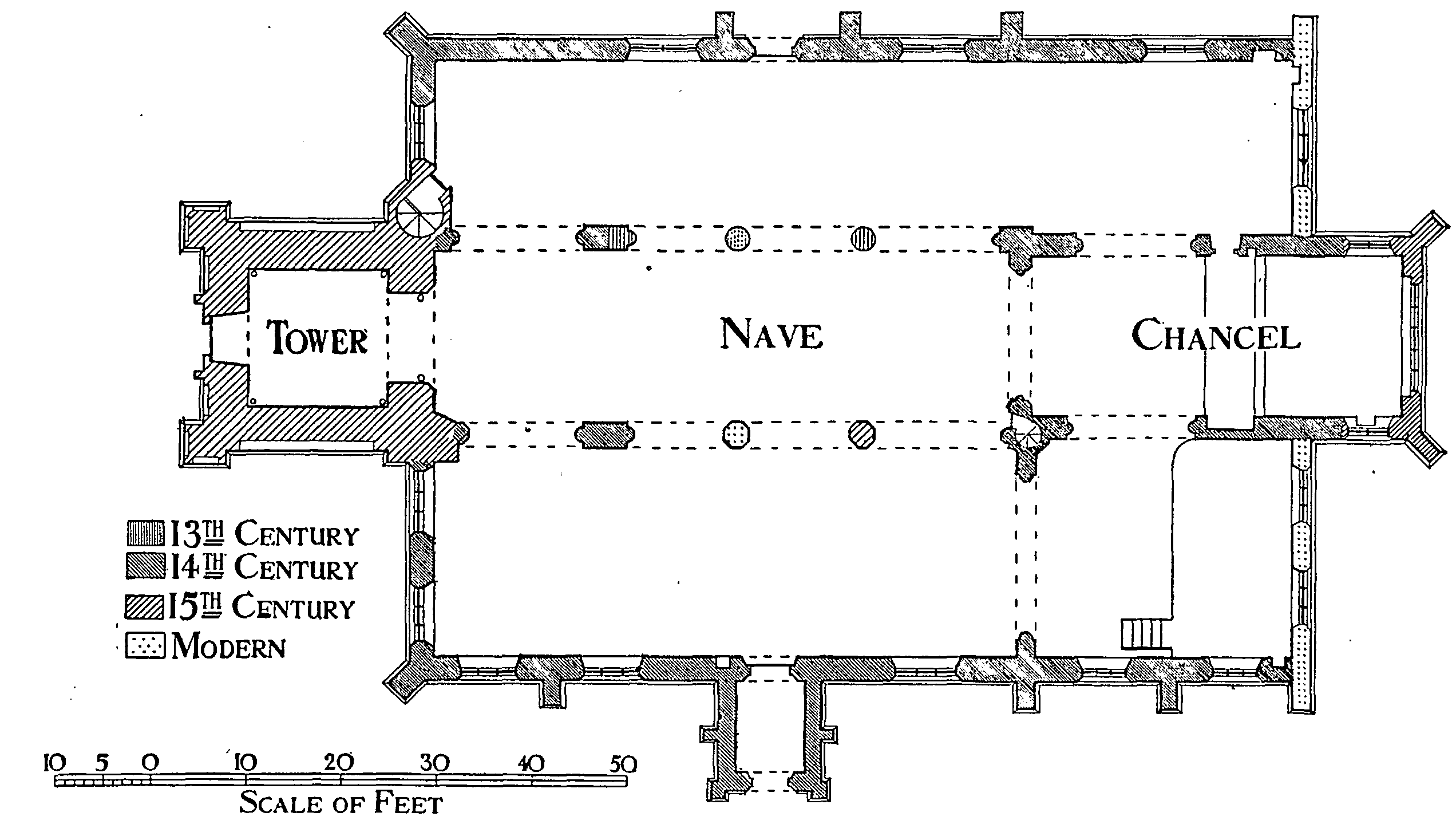
Plan of St. Mary's church
The chancel has a 15th-century east window of five cinquefoiled lights under a depressed and panelled head with an internal hood-mould. There is a canopied niche above and on either side of the window of the exterior. There are panelled diagonal buttresses with three set-offs having a canopied niche in the second stage, and a moulded base course. The north and south windows of the sanctuary are of two cinquefoiled lights with quatrefoil above and a hood-mould. There are three clerestory windows on either side of three cinque foiled lights under a depressed head, and an external hood-mould. The walls are finished with a plain coped parapet. The chancel opens to the south chapel by a 14th-century two-centred arch of two orders with semicircular responds having moulded caps and bases and a hood terminating in heads. The arch opening to the north chapel is also of 14th-century date with semicircular responds having moulded caps and bases and a hood on both sides, that on the south terminating in heads the eastern of which is modern. To the east of this arch is a doorway of the 15th century with fourcentred arch, continuous mouldings, and a hood. The 13th-century chancel arch is two-centred and of two orders with moulded caps and bases to the responds and a hood on both sides. There is a 15th-century piscina with a cinquefoiled head, and farther to the west a 14th-century piscina and a double sedilia with cinquefoiled heads and ogee hood-moulds with finials and heads as stops. In the north wall is a plain oblong aumbry, which may have served for the Easter sepulchre.
The north chapel, which is structurally part of the aisle, has a three-light east window with plain intersecting tracery and angle buttresses with one set-off; most of the east wall and the buttresses have been rebuilt. On the south wall above the arch is a corbel table consisting of masks. The north window is of three uncusped lights under an almost rounded head. There is an aumbry in the north wall and a niche with a trefoiled head in the east wall.
The south chapel has two east windows of three trefoiled lights with reticulated tracery. There is an angle buttress with one set-off, which like the east wall has been rebuilt. The south wall has two windows of three trefoiled lights with a pair of quatrefoils above and a hood-mould; beneath the western of these windows is a doorway with depressed ogee head formerly crocketed, and with continuous mouldings: the plain door is probably contemporary. Between the windows is a buttress with one set-off. The chapel communicates with the aisle by a two-centred arch of two orders with semi-octagonal responds. There is a piscina with trefoiled head in the south wall. The eastern part of the floor is considerably raised to accommodate a contemporary crypt of two bays with quadripartite vaulting. The crypt is lighted by a trefoil-headed opening in the east and south walls.
The nave has arcades of four bays. The three eastern bays on the north are of 13th-century date with twocentred arches of two orders, and round columns and semicircular responds having moulded caps and bases; the east respond and the second column have been rebuilt. There is a break between the third and fourth bays on both sides, which marks the 14th-century extension. The western arch on the north side and south is of two orders with semi-octagonal responds having moulded caps and bases. The three eastern bays of the south arcade were rebuilt in the 15th century with the exception of the 13th-century semicircular responds, which are similar to those on the north. The arches are of two orders and rest on octagonal columns with moulded caps and bases; the second column was rebuilt in 1927, and this date appears on it. There are four clerestory windows on either side, consisting of two trefoil-headed lights with a trefoil above. The newel stair to the former rood-loft is in the south-east angle of the nave; it has plain upper and lower doorways towards the nave and an upper doorway at a lower level in the aisle, an arrangement which indicates a difference in the height of the nave and aisle sections of the screen. The tower arch is two-centred and of two orders with a profusion of mouldings and a hood; the inner order springs from a rounded shaft with embattled cap and embattled band in the middle; the outer order has continuous mouldings which die into the responds half-way down, and below is a niche. The nave has plain coped parapets.
The north aisle has two lateral windows of two uncusped lights under an almost rounded head and a west window of three cinquefoiled lights with rectilinear tracery and a hood-mould. There are three lateral buttresses with one set-off and a diagonal gabled buttress at the north-west angle. The north doorway has a two-centred arch of two orders with continuous chamfers and a hood-mould terminating in masks. There is a string-course beneath the windows. The south aisle has a buttress with two set-offs at the junction with the lateral wall of the chapel and three others with one set-off. The three windows in the south wall are of three trefoiled lights with hood-mould, which in the case of the easternmost terminates in heads. There are two windows in the west wall, both of three trefoiled main lights with flowing tracery.
The 14th-century south porch is of two bays. The exterior has been completely refaced. There are clamped buttresses terminating in pinnacles and with a shallow niche on the face. The east and west walls have each a plain buttress with one set-off. The outer doorway has a two-centred arch with continuous mouldings and the inner a trefoiled head and continuous mouldings. The porch is covered with a plain quadripartite vault. There was originally a parvise, the blocked doorway to which, with a shouldered arch, remains in the aisle. The south gable of the porch is embattled.
The tower is of three stages and is a rich and beautiful example of 15th-century design. It shows distinctive Northamptonshire features. It is indeed tempting to suggest that the spire, with its tiers of lucarnes of 3, 2, and 1 lights, is a product of the Peterborough Abbey school of masons, who were almost certainly responsible for similar spires at Kettering and Oundle, or of a mason from the Thorney manor of Twywell near Kettering. The absence, however, of the finer nuances of design makes it more probable that Whittlesey spire was designed by a local man who may have seen the Northamptonshire work. Certain similarities with the spire at Yaxley (Hunts.), also a Thorney manor and only a few miles from Whittlesey, suggest a common origin.
The clamped buttresses of the tower are partially panelled, and run up into crocketed pinnacles, with brackets and canopies round the base. The lowest stage is panelled with an embattled cornice on the north, south, and west. The beautiful west doorway has an ogee crocketed head surmounted by a finial and continuous mouldings, and the arch, which is flanked by massive crocketed pinnacles, has a band of conventional flowers. The main west doorway window is of four lights with a large central mullion and good rectilinear tracery. There is a two-light window in the north and south walls of the ground stage with cinquefoiled heads and a quatrefoil above, and a crocketed hood-mould terminating in grotesques which support pinnacles. The second stage is panelled, with a two-light window pierced on the north and south. There are two belfry windows on each face with a double light above the transom and a single light below; the tracery of the north, east, and west windows is hidden by the clockfaces. The parapet is embattled and panelled. The crocketed spire has three sets of windows consisting of three lights, then two, and finally one light. Pierced flying buttresses spring from the angle pinnacles of the tower to the spire. The stair turret reaching to the second stage is of semi-octagonal form and is panelled and embattled with a conical cap; it is approached from the north aisle by a doorway with four-centred head and continuous mouldings. The ground stage has a good lierne vault with bosses carved with the Evangelistic symbols and a round bell-hole in the centre.
The chancel has a cambered beam roof with wall posts and brackets resting on embattled stone corbels; the principals and purlins are moulded and there are large carved bosses with traces of colour in the centre of the principals. The south aisle and chapel have modern roofs. The nave has a cambered beam roof with wall posts and braces resting on plain stone corbels; the purlins, principals, and intermediates are moulded, and there were formerly bosses at the intersections. The north aisle has a plain lean-to roof with wall posts and braces, those on the south resting on carved stone corbels; all the old roofs are probably of 15th-century date.
The font is modern and poor. Part of the base of a 15th-century screen is now at the west end of the nave; the base beam is missing and the southern portion of the wainscot is modern; the uprights and middle rail are well moulded and there are traces of a painted inscription on the latter; the northern portion of the wainscot has elaborate applied tracery with green and gold decoration. There is a plain oak chest probably of 17th-century date.
The altar was given in 1916 by Mrs. Saunders in memory of her son, Lieut. E. W. Saunders. There is a bust of Sir Harry Smith, by G. G. Adams; three of the stained-glass windows, and the reconversion of the east end of the south aisle from a school into a chapel, were carried out in his memory. (fn. 153) On the north wall of the chancel is a marble mural monument to Thomas Hake, 1590. Its two panels are now blank, but it is probable that they had figures. There are some good 18th-century headstones in the churchyard.
The plate includes two chalices, 1731, two patens and a flagon, 1765, and two alms-dishes.
The tower contains eight bells: 1st, 2nd, 5th, and 8th by Osborn and Dobson of Downham, 1803; 3rd, 4th, 6th, and 7th by Joseph Eayre of St. Neots, 1758. Some of the bells have interesting inscriptions. The 1st is inscribed 'The Lord to praise my voice I'll raise', the 3rd 'Peace and good neighbourhood', the 4th 'Do justice, love mercy, and walk humbly with thy God', the 6th 'The five old bells into six was run with additional metal near a tun', and the 7th 'Prosperity to the Establish'd Church of England and no encouragement to enthusiasm'. (fn. 154)
The registers begin in 1654, but are not complete before 1683.
The church of ST. ANDREW consists of chancel, north and south chapels, clerestoried nave, aisles, south porch, and west tower. The material is rubble and Barnack ashlar, and the roofs are covered with lead except those of the chapels, which are slated. The earliest surviving work is found in the west end of the south aisle, which dates from the middle of the 13th century. The chancel, chapels, and aisles belong to the second quarter of the 14th century, when the refashioning of the earlier church was begun. The nave arcades were rebuilt at the end of the 15th century and the tower and porch added about the same time. A vigor ous 'restoration' in 1872 left the interior rather dull and depressing.
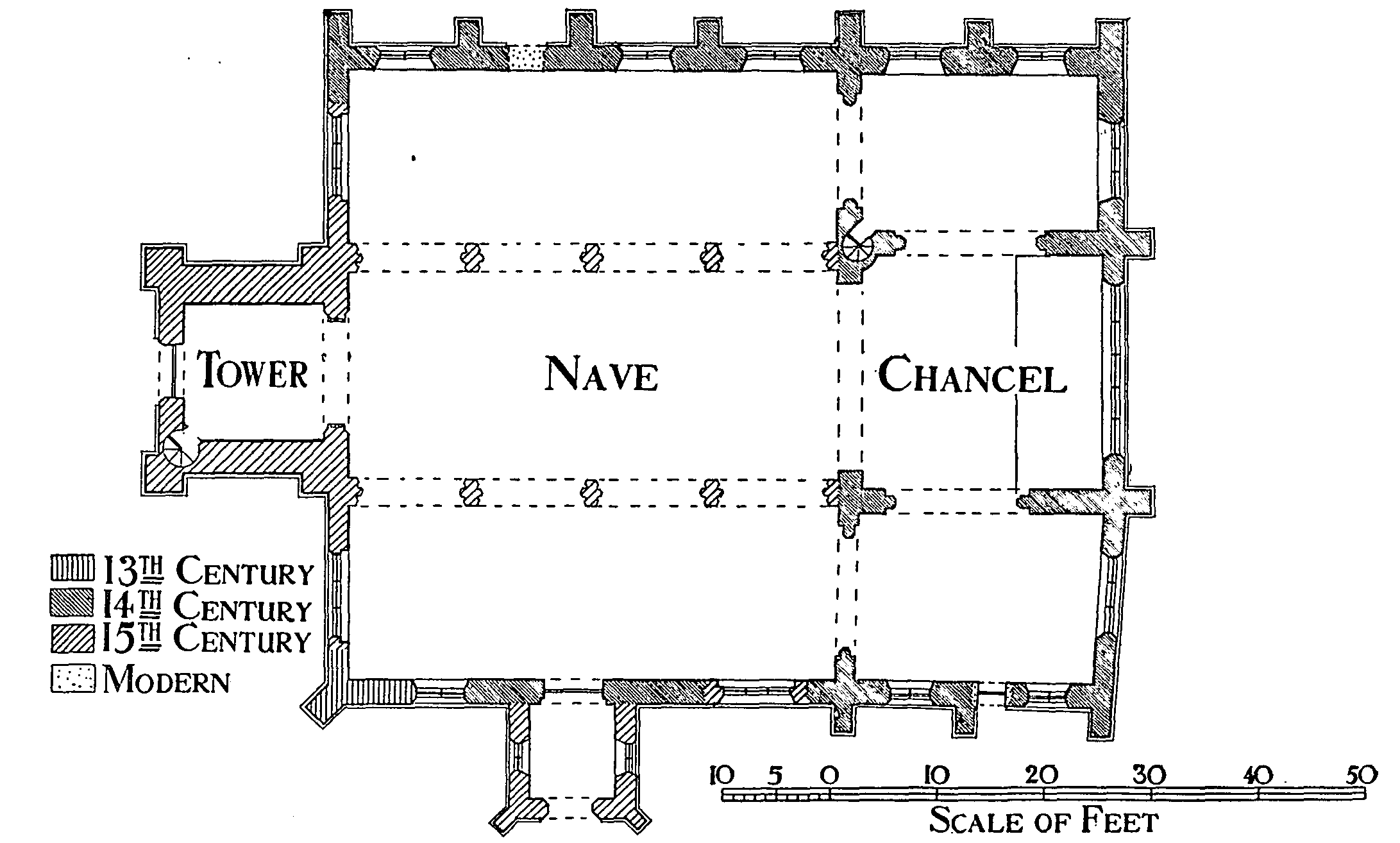
Plan of St. Andrew's church
The chancel has an east window of five lights with flowing tracery of rather unusual design. The east gable is embattled. The chancel communicates with the chapels by a single arch on each side, of two orders with a hood-mould on the north and south faces, those on the south terminating in heads; there are semioctagonal responds with embattled caps and moulded bases; the eastern respond on the north has been renewed. The lofty chancel arch is two-centred and of two orders, and springs from modern corbels. There is a modern piscina recess and sedilia. The south chapel has a three-light east window with reticulated tracery. There are two lateral windows of two trefoiled lights under a square head with a hood terminating in heads. Between the windows is a plain square-headed doorway, probably inserted early in the 19th century. There are two buttresses with one set-off. The chapel opens to the aisle by a two-centred arch of two orders springing from semi-octagonal responds with moulded caps and bases. The lateral parapet is embattled and there is an ancient foliated cross on the west gable. The north chapel, which like the chancel and south chapel dates from the second quarter of the 14th century, has an east window of three trefoiled lights and flowing tracery under a depressed head. The two lateral windows are similar to those in the south chapel. The arch to the aisle has semi-octagonal responds with embattled caps and moulded bases. There are two buttresses with two set-offs. The eastern gable is crocketed and the lateral parapet is embattled. In the south-west angle is the rood stair, with a plain rectangular doorway and above two openings to light the stair, one a quatrefoil and the other rectangular; the upper doorway is blocked. In the south wall there is a round-headed piscina recess and in the north wall an aumbry with pointed head.
The nave has arcades of four bays with two-centred arches of two orders, with a continuous hood, springing from clustered columns with moulded caps and bases, all of late 15th-century date. The clerestory consists of four two-light windows on each side, with cinquefoiled heads and a quatrefoil above. The tower arch, which is contemporary with the arcades, is panelled and without caps. The south aisle has varied fenestration and a plain coped parapet. The south-east window is of the 15th century, with three cinquefoiled lights under a depressed head and an external hood-mould terminating in heads. The south-west window dates from the middle of the 13th century and has two uncusped lights with a quatrefoil above and a hood terminating in masks. The west window, a 15thcentury insertion, has three cinquefoiled lights under a depressed head and a hood-mould terminating in heads. There is a 14th-century buttress with one set-off at the junction of the aisle and chapel, and a 13thcentury diagonal buttress with gabled top at the southwest angle.
The porch, a late-15th-century addition, has diagonal buttresses with one set-off and crowned with crocketed pinnacles. There is an embattled gable on the south with a crocketed pinnacle as a finial; the east and west walls are finished with plain coped parapets. The outer doorway is of two orders with a hood-mould; the outer order has continuous mouldings and the inner springs from shafts with embattled caps and moulded bases. There is a shallow niche on either side and above the arch, and a window of two trefoiled lights in the east and west walls. The inner doorway, which is of early 14th-century date, has continuous mouldings and a hood terminating in masks.
The north aisle has three lateral windows of two lights, similar to those in the chapels, and five buttresses with two set-offs, the second and fourth being smaller than the others. The west window is of three trefoiled lights with a trefoil above and a hood terminating in heads. The blocked 14th-century north doorway has a two-centred arch of two orders with mouldings dying into the chamfered jambs and a hood terminating in heads. The north parapet is embattled and with pinnacles, and on the west is a plain coped parapet.
The late-15th-century tower is of three stages, with an embattled parapet having crocketed pinnacles at the angles. It is of a type common in Northamptonshire and the adjacent districts, with clamped buttresses which are embattled at the top of the first stage. The newel stair is contrived in the south-west angle. The west doorway has a four-centred arch under a square label with carved spandrels displaying the Tudor rose and chamfered jambs. The west window is of three trefoiled lights with two quatrefoils above, beneath a four-centred arch with a hood-mould terminating in embattled caps. The second stage has a rectangular opening with a hood-mould on the north and south. The belfry windows are of two cinquefoiled lights with a quatrefoil and a transom.
The chancel has a plain cambered beam roof, probably of 15th-century date. The roof of the south chapel is of king-post type with wall posts and struts to the centre of the tiebeams; the principals, purlins, and intermediates are moulded. The north chapel has a plain tiebeam roof with wall posts resting on carved stone corbels. Both these roofs are ancient but of uncertain date; the former is probably of the 14th century. The nave has a cambered beam roof of late 15thcentury date with wall posts resting on stone corbels carved with heads; the principals, purlins, and intermediates are moulded, and there are carved bosses at the intersections. The aisles have lean-to roofs; the south has been much renewed and the north, which has wall posts resting on stone corbels, is entirely modern. The porch has a cambered beam roof with wall posts resting on wooden corbels; the purlins and wall plates are moulded.
The font and other fittings are modern and poor, with the exception of an 18th-century chest, the oak pulpit (a memorial to Lieut. J. D. Smalley (1916)), and the altar erected in 1928 in memory of Mr. and Mrs. Ellis Staffurth. (fn. 155) The plate includes a silver chalice of 1569, beautifully chased but clumsily repaired and not now in regular use, a silver paten (possibly originally an alms-dish) of 1632, a bread stand (1701) of Britannia ware, a flagon, paten, and spoon of 1766, and another chalice of 1772. (fn. 156)
The tower contains six bells: 1st, 4th, and 5th by T. Mears of London, 1843; 2nd and 3rd by Joseph Eayre of St. Neots, 1759; 6th by Gillett and Johnston of Croydon (20th century, replacing an Eayre bell of 1760).
The registers begin in 1653. They are complete up to 1695, the entries for 1687-95 being copied from the Bishop's Transcripts. From 1695 to 1815, when the vicarages of the two churches were held in plurality, the St. Andrew's registers are combined with St. Mary's; since 1815 they have again been separate. (fn. 157)
The church of Holy Trinity, COATES, erected in 1840, is a brick structure in an effective adaptation of the Norman style. It consists of nave, aisles, and tower at the north-east corner with pyramidal roof. The building was designed by James Wild, a pupil of Basevi and decorative architect to the Great Exhibition. The plate includes a silver chalice, paten, and flagon inscribed 'Coates Chapel', and another small silver paten; there is one bell in the tower. The registers begin in 1850.
There are Anglican chapels at Angle Bridge (St. Stephen, 1877) and North Side (St. Guthlac), served by the clergy of St. Mary's and St. Andrew's respectively. The latter is situated in the portion of Whittlesey transferred to Thorney (q.v.) in 1933.
GUILDS
In the Middle Ages there were many guilds in the town, but none of any great wealth or importance. In 1542 there were ten guilds in St. Mary's parish and two in St. Andrew's, rated to the lay subsidy at 30s. in two cases, 20s. in four, and 10s. in the remainder. (fn. 158) There was also a guild of St. Thomas the Martyr, a tenement called 'Thomas Beckett's guildhouse' in St. Mary's parish being sold by the Crown to William James and John Grey in 1572. (fn. 159) The hall of St. James's guild, in Arnold Street, came to the family of Thomas Dove, Bishop of Peterborough 1601-30, who was succeeded by his son Sir William (d. 1634) and grandson Thomas. (fn. 160)
NONCONFORMITY
There were ninety-six Dissenters in Whittlesey in 1676. At the end of the 17th and beginning of the 18th centuries there was a regular Baptist congregation there, worshipping under J. Cooper and T. Shearman. (fn. 161) In 1715 Thomas Speechley, an 'Anabaptist' preacher, had a congregation of 160, including 3 forty-shilling freeholders, at Whittlesey and March. (fn. 162) There is no evidence that the Whittlesey Baptist congregation had a continuous existence throughout the 18th century, but early in the 19th century communities of both Particular and General Baptists are found. Zion Particular Baptist Church in Gracious Street dates from 1836 and replaces an earlier building. In 1851 it had an average congregation of 210, including 50 Sunday scholars. (fn. 163) Zion Church has a dependent chapel (Beulah) at the Turves, the congregation dating from 1862 and the chapel from 1866. (fn. 164) The General Baptist congregation, reorganized in 1821, (fn. 165) built a church in Windmill Street in 1830, which in 1851 had 180 worshippers. (fn. 166)
An Independent meeting began in Whittlesey in 1809. William Evenett, its first pastor, came to the town in 1811, and four years later a regular congregation was formed. In 1820 there was a Sunday school with 40 children and a weekday prayer meeting. (fn. 167) The Congregational Church (Ebenezer) in Broad Street was built in 1813 and enlarged in 1863. (fn. 168)
The Methodist churches were of later foundation than the foregoing and had, individually, smaller congregations in 1851. (fn. 169) These churches now (1951) are Queen Street (Wesleyan, 1826), Coates (Wesleyan, 1831, enlarged 1866), Church Street (United, originally Primitive, 1841, rebuilt 1872), Eastrea (Wesleyan, 1845), and King's Dyke (United, c. 1898). There was formerly another Primitive Methodist church in Woolpack Lane, founded c. 1860. It was at one time used as a Masonic Hall. (fn. 170)
In about 1924 the Salvation Army opened a hall in premises now about a hundred years old in Church Street. (fn. 171)
SCHOOLS
There is some evidence for the existence of schools in Whittlesey at the end of the 16th century, (fn. 172) but the first permanent primary school in the town dates from more than a hundred years later. Adam Kelfull, by his will dated 1735, gave 17 acres of pasture at Lipnea and 12 acres of fen at Wype, from the issues of which a sum of £15 was to be devoted to teaching 15 poor boys or girls to read, write, and say their catechism. (fn. 173) In 1798 the master of Kelfull's School, the Revd. G. Burgess, was teaching 15 boys in accordance with the above bequest, 12 more in consideration of £10 advanced by the parish authorities, and about 25 others who were presumably paying pupils. There were also several schools in the town 'occasionally kept'. (fn. 174) Kelfull's bequest was augmented by John Sudbury, who, by his will dated 1811, left a farm-house and 40 acres at the Turves, and 15 acres at Blackbush, to provide £40 to enable 10 of the 'more discreet' boys to learn reading, writing, and arithmetic at Kelfull's School or at a new one. When the Charity Commissioners reported (1837) the schoolmaster was drawing £15 15s. a year from Kelfull's charity and £20 from that of Sudbury; all the 15 places under the former charity were filled (by boys only), and 5 boys were being taught under Sudbury's bequest. The parish authorities had increased their contribution to the schoolmaster's salary to £12 for 12 boys. Recently, however, the adoption of the agricultural gang system in the neighbourhood had caused a drop in attendance, and shortly before 1837 the town contribution had been reduced to £6 6s. for teaching during the winter months only. The master was allowed to take paying pupils, and drew £17 15s. a year from this source. No house was provided. (fn. 175) The amounts allocated to the master's salary and the number of free place holders were the same in 1867 as they had been thirty years before, but by 1867 Kelfull's School had become merged in the boys' national school (see below). None of the boys was learning anything besides reading, writing, and arithmetic, but the schoolmaster was now certificated and had an assistant. (fn. 176)
By his will Sudbury had directed that the residue of the rents arising from his devise should be devoted to apprenticing. In 1837 £17 15s. per annum was being set aside out of the charity for this purpose, and by this date 52 boys had been so placed, with a premium of £12 each. (fn. 177) By 1867 the practice of apprenticing had lapsed. (fn. 178) Under a scheme made by the Charity Commissioners in 1868 it was, however, revived. The charity is now devoted to giving a commercial education to boys. It amounts to about £69. (fn. 179)
From 1816 there was a Sunday school in Whittlesey associated with the National Society. In 1830 it was attended by 86 boys and 66 girls. (fn. 180) In that year a new building was erected, providing accommodation for 160 boys and 100 girls, and whole-time instruction upon National Society principles began in Whittlesey. (fn. 181) This school, which was in the town, was supplemented in 1843 by another at Coates. (fn. 182) In 1846-7 it was stated that, out of a population of about 7,000, about 300 children attended day schools in the parish, and 300 more on Sundays only. (fn. 183) In 1849 a new girls' school, with places for 225, was built in Whitmore Street, and two years later the boys' school to accommodate 240 was rebuilt on a site between Station Road and Scaldgate. The site was given by J. W. Childers, lord of the manor. The National Society made grants of £60 and £35 respectively towards these schools. (fn. 184) About 1867 the average attendance was 115 boys and 97 girls during the winter, and in summer about half that number. (fn. 185)
Stimulated no doubt by the establishment of a School Board (1875), (fn. 186) the church authorities built (1876-7) another school at Angle Bridge in the south-east of the parish. The building served also as a mission room. The National Society made a grant of £40 towards this school, (fn. 187) which provided 130 places, scaled down after the 1910 reorganization to 80. This school became redundant after the opening (1910) of the Turves Council School (see below). At the end of 1931 there were only 39 children on the books, and it was then closed. (fn. 188)
The accommodation in the four church schools, which by the middle seventies amounted to 615 places, was not adequate, especially for the younger children, (fn. 189) and in 1877 the Board built two new schools. One, at North Side, is now in Thorney (q.v.); the other, in Broad Street, was capable of holding 420 children including 240 infants. These arrangements proved sufficient until the end of the 19th century, when the brickfields at King's Dyke began to be opened up and a fairly rapid increase of population took place. A. W. Itter, one of the brick manufacturers, built a school in 1904 (fn. 190) on Peterborough Road near the level crossing, to take 60 children of his employees. This, however, was a private school, not subject to government inspection and with an uncertificated teacher, and by 1905 there was a total deficiency of 200 places in the town. The County Council planned an enlargement of the Broad Street school, into separate boys' and girls' departments with 536 places in all, and this was carried out in 1905-6 in spite of considerable local opposition. The position was also eased by: (a) the opening in 1910 of the Turves School, with 100 places, at Three Horseshoes Siding about half-way along the March Road, and (b) the adaptation of Itter's School at King's Dyke for 115 girls and infants. The Turves School, to which a teacher's house was added in 1914, belonged to the County Council from the first; that at King's Dyke was bought from Itter's executors in 1930 for £350. (fn. 191)
The Broad Street schools (fn. 192) were reunited as one department in 1927, and were again overcrowded in the late 1930's. Temporary accommodation for absorbing the overflow was provided in St. Andrew's Church Hall (60 places) in 1938 and in the Wesleyan Methodist Sunday school (50 places) in 1943. Some 36 boys who lived near the brickworks were transferred to King's Dyke in 1941, and a temporary extension has also been provided at the Turves School.
The Coates National School (fn. 193) was transferred to the School Board in 1877, when it was rebuilt at a cost of £1,135. After enlargement in 1900 it provided places for 120 mixed and 88 infants. It was again enlarged for an extra 42 in 1915, and completely overhauled in 1937-8, when £3,840 was spent on four new classrooms, a kitchen, dining-room, and staff room. Whilst the school was under reconstruction the children were taught in the old workhouse in Eastrea Road.
The National Schools in the town (fn. 194) were not transferred with the one at Coates, since the School Board and church authorities could not come to an agreement. Both schools were enlarged by an additional classroom in the late 1890's, and after further improvements had been made in 1911 the sixty-year-old buildings were recognized as capable of accommodating 173 children of each sex. In the early 1920's the numbers attending were lower than at the Broad Street Council Schools, although the recognized accommodation was about the same. Reorganization in Whittlesey was held up for some time by the fact that the town contained one provided and one non-provided school each for boys and girls, while the only infants' school was a provided one. In 1926 it was agreed to convert the two voluntary schools into senior schools, leaving the Broad Street schools for juniors and infants. Between 1928 and 1938 the number of school-children in Whittlesey rose from 715 to 838, and although theoretically 882 places were available, the two voluntary schools were very unsatisfactory. It was resolved therefore to build new senior and infants' schools. The site of the disused workhouse in Eastrea Road was obtained for the seniors, but the outbreak of war put a stop to the scheme.
In 1943-4 the Urban District Council, which had laid out a sewage system just before the war, threatened to close the two voluntary schools unless they were connected to the system. The managers were summoned for failure to abate a nuisance, and though the case was dismissed, great local feeling was aroused. It was pointed out that the Station Road and Whitmore Street schools, now nearly a century old, overcrowded, with poor lighting and ventilation and no proper washing or drying facilities, needed more than improved sanitation, and in 1945 they were taken over by the County Council under Section 38 of the 1921 Education Act. The following year the most urgent improvements were carried out at a cost of nearly £1,000. Some relief of the overcrowding was obtained in 1949 by the erection of a Horsa hut on the new site, and buildings for a senior school are now (1951) being prepared.
CHARITIES
The charities of Whittlesey were very considerable in 1837. (fn. 195) The Town Lands, which at that date comprised 262 acres bringing in £309 9s. 6d. a year, were the accumulation of a number of bequests of money and land dating from the 17th century and earlier. They were managed by twelve trustees known as Governors, and were let annually by public auction in the market place. The proceeds were devoted mainly to paving, lighting, and policing the town, repairs to bridges, and other local purposes. There were also seven 'town houses' and nineteen 'Governors' houses' let rent free to the poor and the 'grasses' (see above) enjoyed by the parish officers.
A messuage and 16 acres of land were given by one Folliett at an unknown date to provide the Whittlesey contribution to the repair of Aldreth Causeway. The issues arising continued, at least nominally, to be used for this purpose until 1898, when the Charity Commissioners ordered that one-quarter of this charity should be devoted to church purposes and the remainder to education. (fn. 196)
Adam Kelfull, besides his educational charity (see Schools), left £150 to purchase land for the general benefit of the poor. The total revenue of his charities in 1837 was £120 a year, of which about £45 was given to the poor indiscriminately on New Year's Day and £35 on Easter Monday.
John Sudbury (see Schools) also devised 22 acres in Flegcroft and 10 acres in Glassmoor for the support of decayed tradesmen, farmers, and their widows, and other small pieces of land for general charitable purposes. His relatives disputed his will and claimed half his property, but in 1837 about £20 was given to decayed tradesmen in sums of 5s. to 10s., and £9 to the poor indiscriminately in similar amounts.
The Commissioners of 1837 also recorded the existence of the charities of Anne Randal (1716), Richard Noble (1727), John Dow, and of persons called Bull and Hardley. Together these charities produced £45 12s. 6d. All were designed for the general benefit of the poor except Hardley's Charity of £5 5s., which was allocated to poor widows of Coates hamlet.
The Commissioners spoke scathingly of the conduct of the Whittlesey charities. 'The various sums of money, from halfpence to silver, which are distributed in this parish at different periods of the year, are considered to be injurious to the poorer classes, inasmuch as a great portion of the money is frequently spent in beershops, and a day of distribution is generally a day of dissipation; moreover, the labouring poor frequently neglect their certain work to obtain a less sum of money from the charity. They demand money as their right, and abuse their superiors if it is withheld, or not paid to the amount of their expectations.' The Governors promised to mend their ways, especially in regard to Kelfull's non-educational charity which was distributed in sixpenny pieces, and resolved to give larger sums to the most deserving cases, with a preference to non-paupers.
The charities, with the exception of Sudbury's (see Schools), were consolidated under a scheme of 1868. Their annual value is about £80. (fn. 197)