A History of the County of Cambridge and the Isle of Ely: Volume 4, City of Ely; Ely, N. and S. Witchford and Wisbech Hundreds. Originally published by Victoria County History, London, 2002.
This free content was digitised by double rekeying. All rights reserved.
T D Atkinson, Ethel M Hampson, E T Long, C A F Meekings, Edward Miller, H B Wells, G M G Woodgate, 'Wisbech Hundred: Elm', in A History of the County of Cambridge and the Isle of Ely: Volume 4, City of Ely; Ely, N. and S. Witchford and Wisbech Hundreds, ed. R B Pugh (London, 2002), British History Online https://www.british-history.ac.uk/vch/cambs/vol4/pp180-186 [accessed 30 April 2025].
T D Atkinson, Ethel M Hampson, E T Long, C A F Meekings, Edward Miller, H B Wells, G M G Woodgate, 'Wisbech Hundred: Elm', in A History of the County of Cambridge and the Isle of Ely: Volume 4, City of Ely; Ely, N. and S. Witchford and Wisbech Hundreds. Edited by R B Pugh (London, 2002), British History Online, accessed April 30, 2025, https://www.british-history.ac.uk/vch/cambs/vol4/pp180-186.
T D Atkinson, Ethel M Hampson, E T Long, C A F Meekings, Edward Miller, H B Wells, G M G Woodgate. "Wisbech Hundred: Elm". A History of the County of Cambridge and the Isle of Ely: Volume 4, City of Ely; Ely, N. and S. Witchford and Wisbech Hundreds. Ed. R B Pugh (London, 2002), British History Online. Web. 30 April 2025. https://www.british-history.ac.uk/vch/cambs/vol4/pp180-186.
In this section
ELM
Elm, on the Norfolk border between Wisbech and Outwell, is one of the larger parishes in the Isle. It was originally of the long, narrow shape usually found in Wisbech hundred, with the church and village on the firm silt land at the north-east end, just behind the 'Roman Bank'. The alterations made under the county Review Order of 1933 and the Ministry of Health Provisional Orders Confirmation (Ely, Holland, and Norfolk) Act, which came into force the following year, brought a net increase of 2,617 acres in area and a decrease in population of 67. The realinement of the county boundary transferred a small built-up area to Emneth (Norf.) which was not quite counterbalanced, as regards population, by the inclusion (from Wisbech Borough) of the hamlet of Ring's End, on the Nene opposite Guyhirn. Although it is questionable whether the name is derived from the common tree, (fn. 1) the country in the north-eastern part of the parish is undoubtedly more wooded and picturesque than is usual in the Fens. The northern end of the village practically adjoins Wisbech. It is divided by the Wisbech Canal, formerly the Well Stream, into Elm High and Elm Low Roads; the series of pools which is all that remain of the canal contribute largely to making Elm one of the prettiest villages in the Isle. The 'needle' spire of the church recalls the southern part of Cambridgeshire, while the fruit-growing hamlet of Begdale, about a mile west of the village, is reminiscent of the Vale of Evesham.
Among the few buildings of architectural interest, apart from the church, may be mentioned the Black Horse Inn, Elm House, and the Limes. The first has a tablet on the porch dated 1665; the others are 18thcentury buildings of some merit with well-designed doorways. The stone-slated roof of the Limes is noteworthy, in a district where such roofs are not common. The village hall dates from 1921. (fn. 2)
The River Nene formerly crossed the south of the parish diagonally. After turning gradually through a right angle past Upwell and Outwell, it returned to Elm to form the parish and county boundary. Now, however, it takes a more direct course through Wisbech; since 1933–4 the new course has formed the boundary between Elm and Wisbech St. Mary. There are many subsidiary drains. Elm High Road forms part of the main road from Wisbech to Outwell, Downham Market, and Ely (A 1101). The Low Road (B 1101) forms the village street and continues in a zigzag course through Friday Bridge and Coldham, two hamlets of Elm, to March. Railway communication with Wisbech is provided by the Upwell tramway opened in 1884. Since 1928 it has been used for goods only. There are two passenger stations in the parish—Coldham for Pear Tree Hill, on the March–Wisbech line (1847), and Guyhirn on the March–Spalding line (1867). They are both, however, too remote to be of much local importance.
The northern part of the parish, on silt soil, is largely given over to orchards and market-gardens; in the southwest, on the peat, farms are larger and are devoted to cereals, potatoes, and sugar-beet. As stated above, there are fairly numerous isolated trees round the village, and a long shelter belt running north and south along the March road at Coldham Hall, the site of a former manor house.
At the beginning of the 19th century Elm had the reputation of a law-abiding village. The peace celebrations of 1814, when '738 persons dined abundantly, and capital sports succeeded' were specially commended by Jeremiah Jackson in his diary. (fn. 3) Twenty years later, although barn robberies were common, sheep stealing was not prevalent in Elm, and the state of the parish 'though unpleasant, is not such as to excite any apprehension'. 'Much cheerfulness' was shown ata parish meeting called to consider measures to alleviate the state of the poor. There was at this date (1834) an effective parish fire-engine. (fn. 4) Some of the ill feeling was probably due to inclosures, of which a good many were being carried out privately at this time. (fn. 5) In 1834 an Act (fn. 6) was passed to inclose the commons, droves, banks, and waste lands in the parish. As in most Marshland parishes, the amount of land to be so treated was small (195 acres), and the award made under this Act was not signed and put into force. (fn. 7)
Among the incumbents of Elm-cum-Emneth have been: (i) Sir Richard Swale (1545 ?–1608), Chancellor of Ely and a noted civil lawyer; he was appointed rector in 1588 by dispensation, being a layman; (fn. 8) (ii) Dr. Joseph Beaumont (1616–99), poet and Master of Peterhouse, rector in 1645; (fn. 9) (iii) Edmund Castle (1698–1750), Master of Corpus Christi, Cambridge, and later Dean of Hereford, vicar in 1729; (fn. 10) and (iv) Jeremiah Jackson (1775–1857), Headmaster of Wisbech Grammar School, 'whose name leaps to the eye from every local record of contemporary social activity', (fn. 11) vicar 1826–57. Mrs. E. B. Tanqueray, wife of a vicar of Coldham, was the author of The Royal Quaker and other novels that had a vogue at the beginning of the present century. Robert Tillotson, rector in 1711, was a nephew of Archbishop Tillotson. (fn. 12)
MANORS
Like the other vills in the extreme north of the Isle, with the exception of Wisbech, ELM is not mentioned in Domesday Book. It is therefore conceivable that the district in which it lay was not reclaimed until c. 1200 and that the fine 13th-century church is the first on the site. At all events, the overlordship was at that time with the Bishop of Ely (fn. 13) and it has so continued, the Church Com being the present lords of the manor. (fn. 14) As at Wisbech and other episcopal manors in Wisbech hundred, John Thurloe was in possession during the Interregnum. (fn. 15)
In 1210–12 the bishop had six tenants at Elm who held by military service. Richard de Argentem or Argentan held 1 fee; Roger Mareis and Robert de Banstede (recte Haustede) (fn. 16) ½ fee each; Richard de Melkesham a ¼ fee in Elm and Wisbech; and Simon de Insula and Gerard de Vernun 1/6 fee each. (fn. 17) Most of these fees subsequently developed into subordinate manors (see below). They all reappear in the Ely cartularies of 1221 and 1251, but with changed assessments in some cases. In 1221 the Argentan fee was rated on 1,452 acres of land in Needham and 60 acres in 'Langebech'; in 1251 it was held by Giles de Wechesham. The Mareis tenement remained constant at ½ fee, as had that of Robert de Haustede. In 1221 Richard de Melkesham was assessed at a whole fee, on 380 acres of land, and he was stated to have made a purpresture of 60 acres in the marsh; in 1251 the rating of the Melkesham tenement is unstated. In 1221 Simon de Insula also was assessed at a whole fee, on 420 acres; in 1251 his tenement, now held by Philip de Insula, had been reduced to 1/6 fee again. The assessment of the de Vernun tenement had risen in 1221 and fallen in 1251 in a similar manner. These increases and reductions were no doubt due to early reclamation followed by the great sea flood of 1236. As at Wisbech, the 1251 cartulary showns the obligation of the customary tenants to repair Wisbech Castle and dig at 'Ramersdike' as well as the normal agricultural services. In spite of the flood, the numbers of free and customary tenants rose between 1221 and 1251 from 8 and 84 to 15 and 115 respectively. At the later date the total rents amounted to £45 5s. 6d. (fn. 18)
As usual in the 14th century, a decline in prosperity is evident. In 1391 the rents amounted to only £37 12s. 6d. By this time a good deal of reclamation had been undertaken. Fourteen fields of varying size are mentioned. Each embraced from 5 to 50 small tenements worth from 1s. to 2s. (fn. 19) Some of these fields survive in name to the present day, for example, Old, New, Town, Halfpenny, Redmoor, Needham, Needham Hall, and Coldham Fields.
In 1303 Richard Loveday held the ArgentanWechesham tenement, again as 1 fee, of Giles Mumpenzon, who held of the Bishop of Ely. (fn. 20) Loveday became bound to Bishop Walter Langton of Lichfield in various recognizances, and in 1321 the inquisition post mortem on the bishop shows him as holding, inter alia, a messuage called Bealford or BEAUFORD, together with 776 acres and 7 marks rent. Of this property, 501 acres were stated to be held of Giles de Wechesham as 1 fee, and 80 of the Bishop of Ely for 26s. 8d. annual rent. (fn. 21) The fee was in 1346 held by Elizabeth Peverel, the eventual heiress of Bishop Langton; (fn. 22) in 1428 William Venour was the holder. (fn. 23) By 1536 the property had come to be styled a manor, and was held by' Alexander Balam by service of ¼ fee and 25s. yearly. Balam was also tenant of 100 acres in the marsh at 10s. (fn. 24) The manor was situated in the Friday Bridge area, (fn. 25) and under the name Beauford or Bewford remained in the Balam family until 1699. (fn. 26) In that year Susan Balam, John Kelsall and Anne his wife, and William Jay, the last three probably brothersin-law and sister of the first, settled it upon trustees. (fn. 27) Thomas Jenkinson, one of the trustees, was dealing with it in 1720. (fn. 28) Beauford House still exists as an 18thcentury building with a doorway of good design.
In 1303 the Mareis tenement was again assessed at ½ fee and was held by a woman, Clemencia de Marisco. (fn. 29) She was probably the last of her line, for in 1321 Bishop Langton held the messuage of 'Mareystede' and 140 acres in chief of the Bishop of Ely, at ½ fee, and 863 acres of land and marsh at 7 marks rent. (fn. 30) In 1346 Elizabeth Peverel, Langton's heiress, held the ½ fee jointly with Sir John Colvile. (fn. 31) This estate is not subsequently recorded individually, and probably became merged with Langton's other property in Coldham (see below).
The Haustede estate is not entered in the lists of fees of 1303, 1346, or 1428. It was situated in BROKENE, on the north-west side of Elm towards Wisbech. (fn. 32) In 1470 it reappears, as a manor of Brokene, in the hands of the Colvile family of Newton (q.v.). It was again assessed at ½ fee and was valued at £5 6s. 8d. (fn. 33) It had been settled by Sir John Colvile, son of the founder of the Newton chantry, on himself and his wife Anne for their lives. Anne subsequently married Sir Robert Brandon, and outlived her son Francis Colvile. At her death in 1494 Brandon forcibly excluded Richard Colvile, Francis's son, then aged 14, from his lands. (fn. 34) Richard proved his age in due course and the manor, under the name HALSTED, remained in the family another hundred years, until it was sold (1591) by Francis Colvile to William Hynd. (fn. 35) Hynd died without issue in 1606; after which the manor seems to have come to William Steward of Ely, whose son-in-law, Francis Lord Aungier, died in possession in 1632. (fn. 36) He left his Cambridgeshire estates to his fourth son George, who was living in 1635. (fn. 37) In the early 18th century Halsted manor was held by three sisters, wives of Rupert Elcie, Richard Dent, and Thomas Briscoe; it is not recorded after 1720. (fn. 38)
In 1299 Richard de Melkesham conveyed his lands in Elm, Wisbech, and Upwell to Bishop Walter Langton by fine. (fn. 39) The following year the bishop was granted free warren in his demesnes in COLDHAM and elsewhere, (fn. 40) and in 1303 he held Coldham for ⅓ fee. (fn. 41) At his death (1321) he held, besides the Argentan-Wechesham-Loveday fee and the Mareis fee (see above), the manor of Coldham with 420 acres of the Bishop of Ely for 1 fee. His heir was his nephew, Edmund Peverel, then aged 14. (fn. 42) He died in 1331, when he was recorded as holding, jointly with his wife Elizabeth, the three estates of Coldham, Bealford, and Mareystede, and the fishery of 'Estiworth', by knight's service and a yearly rent of £6 13s. 4d. (fn. 43) Elizabeth Peverel had licence of oratory in her manor house for five years from 1344. (fn. 44) Two years later the assessment of Coldham was again ⅓ fee. (fn. 45) The subsequent descent of this manor is obscure. In 1368 the custody of lands in Coldham, late of Hugh Gros, was granted to Alan Palmer; Gros held these lands by knight's service of the heir of Edward de Montacute, a ward of the king. (fn. 46) In 1402 William Moore, vintner, was tenant, and desired his feoffees to sell a moiety of his interest in the manor and devote the proceeds to pious uses. (fn. 47) There is no further record until 1536, when Thomas Clarke of Elm held the manor as 1 fee. (fn. 48) In 1578 Humphrey Mychell made a settlement of it. (fn. 49) The manor changed hands several times at the end of the 16th century; (fn. 50) in 1586 it was in possession of George Carleton, Constable of Wisbech Castle, (fn. 51) and in 1612 it came to Sir John Peyton of Doddington (q.v.). (fn. 52) Towards the end of his life Peyton was engaged in a lawsuit with Bishop Felton over the boundaries between his manor of Coldham and the bishop's manor of Waldersea alias Bewdesert in Wisbech, (fn. 53) and at Peyton's death in 1630 he held it of the Bishop of Ely, together with other land in Elm and Needham Fen. (fn. 54) Peyton's son, also Sir John, died in 1635, (fn. 55) and the manor continued in the family until the middle of the 19th century. (fn. 56) The manor house was replaced by a farm-house about 1793. (fn. 57)
In 1303 John Ode of Lynn held the de Insula tenement, again as ½ fee, of the heirs of Simon de Insula for life. (fn. 58) In 1346 this holding was divided, at the same assessment, between Sir John Dene, Sir John de Colvile, Sir William de Ruston, and Robert de Waldusee. (fn. 59) It has not been subsequently traced.
The Vernun property remained in possession of that family and was returned at its 1251 assessment of 1/6 fee in 1303 (fn. 60) and 1346. (fn. 61) It may be identified with the manor of VERNONS which appears in 1593 in possession of William Steward, together with lands in Old Field and elsewhere in Elm, and in other places in the Isle. (fn. 62) His son Thomas, then a minor, had livery of his estates three years later. (fn. 63) Thomas died unmarried before 1605, when Edward Fincham, his cousin, (fn. 64) was dealing with the manor. (fn. 65) At his death in 1631 Fincham held it of the Bishop of Ely as of his manor of Wisbech Barton. He also held land called Vernons Fen, a messuage, and Need hams Field. The association of these tenements suggests that the property lay near Needham Hall in the east of the parish, south of Old Field. The property was settled on Edward Fincham's relict Frances (Richman) and son Thomas. (fn. 66) The latter died in 1666 leaving two daughters, Mary and Frances. (fn. 67) The Fincham estates in Norfolk and the Isle seem then to have been broken up, and this manor, with other property in Elm, Outwell, and Upwell, passed from Rachel Fincham and other members of the family to Baptist May. (fn. 68) In 1700 it came to Israel Wilkes of Clerkenwell, father of the politician, (fn. 69) and remained in his family until at least 1774. (fn. 70) The Wilkes family had long been settled in the neighbourhood. In 1592 William Wilkes held land bordering on the Crabhouse nunnery estate (see below). (fn. 71) In 1633 he or a namesake was seised of a messuage in Begdale and land called 'Gooles' in Haustedfield. (fn. 72) Needham Hall, 'formerly a most respectable residence', was at the end of the 18th century in possession of Dr. John Fountayne, Dean of York, who was succeeded in 1802 by his daughter, Catherine Judith. Two years later the Hall, being dilapidated, was pulled down and replaced by a farm. On Catherine's death in 1824 the property came to her nephew, Richard Fountayne Wilson, M.P. for Yorkshire 1826–30. (fn. 73) He died in 1847 and Needham Hall Farm passed, presumably by purchase, to F. Fryer. (fn. 74) In 1900 and 1933 the owner was (Sir) W. W. West, J.P., (fn. 75) sometime Chairman of the Isle County Council.
The manor of VAUX seems to have originated in the lands of the Lords Vaux of Harrowden (Northants.), who were recorded as holding property in Elm worth £2 15s. 9d. in 1600. (fn. 76) These lands may have come to them through the marriage of Thomas, 2nd Baron, to Elizabeth, daughter and heir of Sir Thomas Cheyne of Fen Ditton, c. 1530–5. (fn. 77) In the latter half of the 17th century Vaux manor was in the Stukeley, Squire, and Swaine families. (fn. 78) In 1801 the manor house was purchased by the parish officials of Elm from John Swaine of Stretham for use as a workhouse. It had long been let as a farm-house. (fn. 79)
Lands in Elm were given to Nuneaton Priory (Warws.) by Robert, Earl of Leicester, about 1154. (fn. 80) In 1210–12 4½ acres of this estate was held by John son of Rainer for 2s. 3d. and 2 acres and a square perch (perticatam) of Hildebrand the clerk for 1s. (fn. 81) The lands do not figure in the Taxatio, but they remained in possession of the convent until the Dissolution, when they were valued, with land in Upwell and Emneth, at 79s. 7d. (fn. 82) In 1541 they were granted, as 'manors', to Thomas Manners, Earl of Rutland. (fn. 83)
William son of William de Wendling (Norf.) gave to the abbey of that name, which he founded in 1265, a messuage and lands in Elm. (fn. 84) These were worth £2 in 1291 (fn. 85) and £2 5s. 7d. in 1391, (fn. 86) but only 18s. in 1535. (fn. 87) Presumably they formed the 'manor' of
WENDLING which, with lands and rents in Emneth and Wisbech, was passed by Edward Story and Katherine his wife to James Dudley in 1575. (fn. 88) They, together with certain otherwise unrecorded property of Wormegay Priory (Norf.), had in 1571 passed through the hands of the land speculators Thomas Jennings and Edward Forth. (fn. 89)
The Abbot of Crowland (Lines.) had two free tenants in Elm in 1210–12, John and Ralph de Croyland, each of whom held 30 acres and a fishery for 30s. (fn. 90) In 1291 this property was worth £2. In 1535 it was worth £2 18s. 8d., less 2s. to the Bishop of Ely. (fn. 91) In 1572 the fisheries, then held by William Payne and William Froman, and 60 acres held of the Bishop of Ely by Lord St. John (of Bletsoe), probably also exCrowland property, were granted to Richard Hill and William James. (fn. 92)
The nunnery of Crabhouse (Norf.) possessed pasture lands in Elm and Emneth, valued in 1535 at £16s. 8d. (fn. 93) They were leased in 1539 to Henry Webbe (fn. 94) and in 1552 for twenty-one years to Thomas Sydney. In 1555 the reversion was granted to Sir John Gage, Chamberlain of the Queen's Household. (fn. 95) Twentyeight acres of former Crabhouse land in Elm, which lay in two portions, was in 1592 granted to William Tipper and Robert Dawe at an annual rent of 4s. (fn. 96)
The possessions of the guild or chapel of the Holy Trinity next Stathedyke in Walsoken extended into Emneth and Elm. They were first granted (1545) to Ralph Stannowe, the late warden, then in 1552 to Mary, Duchess of Richmond and Somerset. (fn. 97)
In 1536 Sir Robert Brandon, lord of the manor of Halsted (see above), was recorded as having held, in the right of his wife Anne (Colvile), 36 acres in Elm and other land in Brokene which was formerly in the tenure of Robert Halsbeech, by service of ½ fee, 50s. rent, and suit at Wisbech hundred court. (fn. 98)
CHURCHES
The church of Elm with its chapel of Emneth was valued at £40 in c. 1217 and 1254, and at £17 in 1291; (fn. 99) the last figure does not include £5 from the tithes payable to Lewes priory from their estate of Lewes Fee in Emneth. It is recorded as an ecclesia, but a vicarage had been ordained by 1275. (fn. 100) The church, however, was not appropriated, and appointments were made to the sinecure rectory until the early 19th century. (fn. 101) The vicarage with its appurtenances except the house and garden was in 1494 leased for seven years at £8 6s. 8d. yearly by Edmund Roray, vicar, to Thomas Aleyn, rector. (fn. 102)
In 1535 the rectory was worth £17 10s. and the vicarage £14 15s. 10d.; (fn. 103) three centuries later their comparative value is shown by the commutation of the rectorial tithes for £545 annually, and the vicarial for £215. (fn. 104) The patronage of both has been continuously with the see of Ely.
Emneth was made a separate vicarage in 1858, after the death of the Revd. Jeremiah Jackson. The parishes of St. Matthew, Friday Bridge, and of St. Etheldreda, Coldham, were formed out of Elm in 1860 and 1874 respectively. The three vicarages are also in the gift of the bishop; Friday Bridge and Coldham have been held in plurality since 1931. (fn. 105)
The Lewes tithes had risen in value to £6 10s. in 1339, (fn. 106) and to £8 13s. 4d. in 1535. (fn. 107) At the Dissolution (1537) the last prior conveyed them with the other possessions of the convent to the king by fine. In 1538 they were regranted to Thomas Cromwell. (fn. 108) They were resumed by the Crown after Cromwell's attainder. The next grantee was the Earl of Essex. They finally formed part of the miscellaneous spiritualities given to Bishop Heton in 1600 in return for the alienated episcopal manors. (fn. 109)
In 1370 William de Petworth, rector, made an agreement with Prior Cherlew of Lewes to pay the convent an annual pension of £20, on pain of £5. This was confirmed by the Bishop and Convent of Ely. Early in the reign of Henry VI Prior Nelond sued Thomas Reynold, Petworth's successor, for £65 representing this pension and arrears. Reynold denied that he had ever received tithes from Lewes priory lands in Emneth, and pleaded that the confirmation of Petworth's agreement at Ely was invalid. In 1430 judgement was given for the priory in Reynold's absence, but Reynold put in a writ of error. The case was still in progress in 1432, and its conclusion, if any, has not been traced. (fn. 110) Probably the priors managed to enforce payment of the pension, for its existence was still remembered in 1589. As it was then stated that payment had neither been demanded nor made for more than thirty years, the pension presumably lapsed at the Dissolution. (fn. 111) In 1608, however, it was revived and granted to Thomas Howard, Earl of Suffolk, and his heirs. (fn. 112)
Petworth was licensed in 1377 to receive 8 acres of land in Elm and 1 acre and a house in Emneth, to provide inter alia 7 lighted tapers on the altar at high mass on feast days. (fn. 113) In 1553 6 acres in Elm, in tenure of the churchwardens, were stated to have been given for anniversaries in the church. (fn. 114)
Petworth makes one further appearance in 1396, when he came to blows in the church with John Wetyng, his vicar. As no serious hurt was caused Bishop Fordham held that the church had not been polluted. (fn. 115)
The church of ALL SAINTS, ELM, consists of chancel, clerestoried nave, aisles, north porch, and west tower. The fabric belongs mainly to the first and last quarters of the 13th century, with windows and roofs inserted in the 14th and 15th centuries. The plan has remained unaltered and the structure is a magnificent example of early Gothic design. There was the usual restoration in the last century but it was less destructive than was often the case. Much of the tower was refaced at this time, the porch was rebuilt, and there was some renewal of tracery. The roofs are leaded except that of the chancel which is slated.
The chancel has a modern east window of five lights and there are angle buttresses of the 13th century with two set-offs. At the north-east corner there is a doorway with round arch and continuous mouldings. The unusual position of this doorway would suggest that the chancel was originally longer, but if this was the case it must have been curtailed soon after its erection. The lateral fenestration consists of long twolight windows with 14th-century tracery consisting of trefoiled heads with a quatrefoil above inserted in 13th-century openings, and external and internal hoodmoulds. There is a 13th-century string-course round the interior, and an aumbry in the north and south walls, but no piscina. The roof is modern and of braced rafter construction. The chancel arch is two-centred and of two orders with moulded caps and bases, the latter partly covered by the raising of the floor.
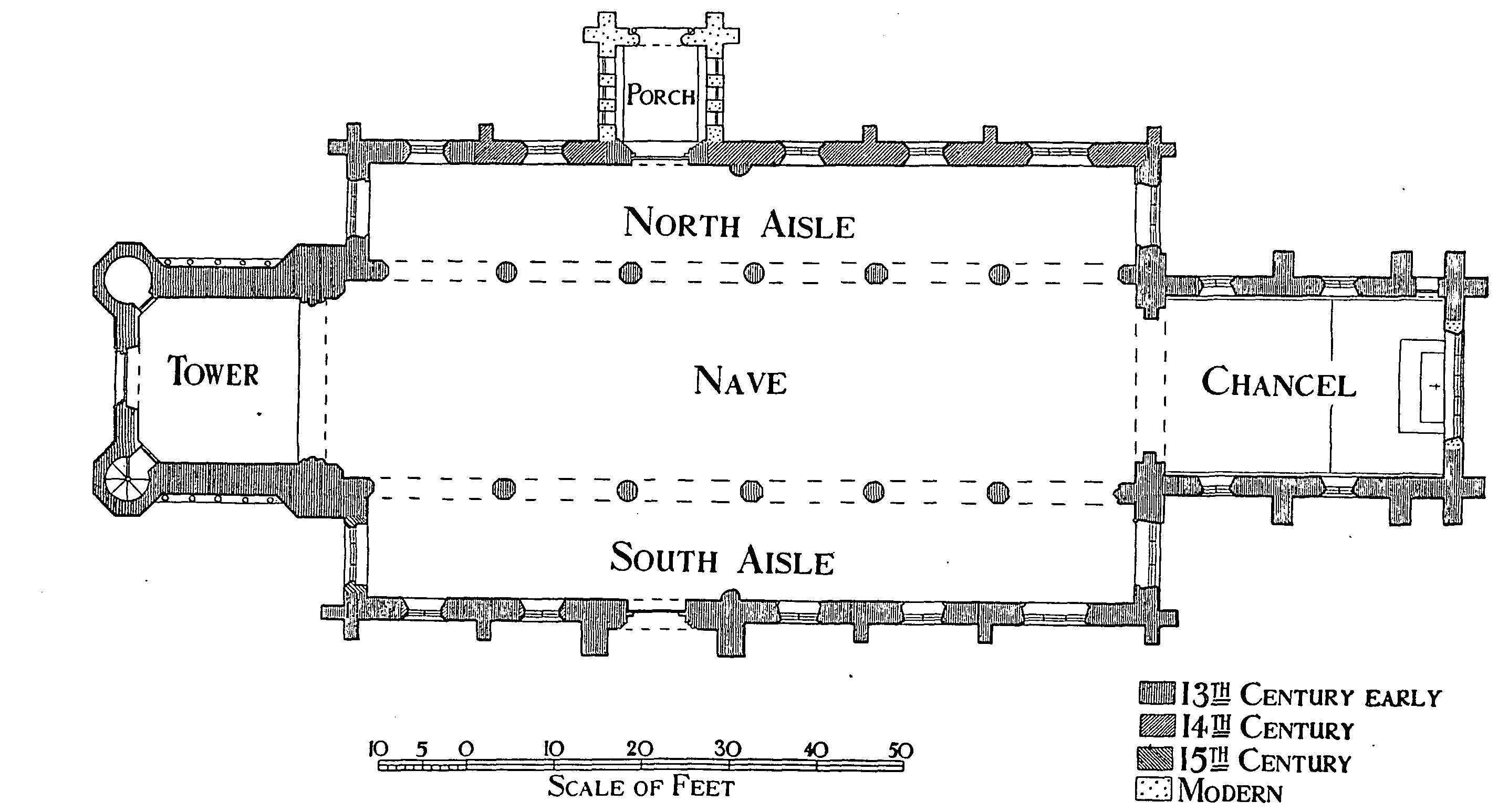
Plan of All Saints Church
The nave arcades are of six bays with piers alternately round and octagonal, and the two-centred arches are of two orders with moulded caps and bases and a hood-mould. Above the arcades is a string-course which probably indicates the original height of the walls. The clerestory is an addition of the last quarter of the 13th century and consists of ten lancets with angle-shafts having moulded caps and bases. There is an external corbel table of masks. Above the chancel arch is blind arcading contemporary with the clerestory and on the west wall the pitch of the original roof is clearly indicated with a blocked lancet near the apex. The nave roof is a superb example of 15th-century carpentry; it is of double hammer-beam construction with demi-angels having outspread wings at the termination of the hammer-beams, some of which -are missing; all the principals are richly moulded and there are long moulded wall-posts and carved spandrels. The ends of the principals and rafters are plastered. There is a very wide tower arch of two orders, two-centred with rounded responds and recessed shafts, all having moulded caps; the bases are concealed. The east and west windows of the aisles are of three lights with cinquefoiled heads and tracery, and of 15th-century date; all with the exception of the west window of the south aisle are inserted in 13th-century openings with angle-shafts having moulded caps and bases. The north-east window in the north aisle is a 14th-century three-light, while the remainder on this side are of two lights with cinquefoiled heads and quatrefoils above, of 14th-century date. Much of the north wall was rebuilt in the 14th century, and the buttresses with two set-offs are of this period. The west portion of the wall, however, is partly of the 13th century and the internal string-course remains here. The south-east window in the south aisle is a 15th-century three-light with cinquefoiled heads and tracery under a depressed arch, and is inserted in a 13th-century opening with angle-shafts as in the east window. The remainder of the windows in this wall are 14th-century two-lights similar to those in the north aisle, but the first two are inserted in 13th-century openings with angle-shafts and have external and internal hood-moulds. The walls and buttresses of the south aisle are of 13th-century date. To the east of the north and south doorways are rounded responds with moulded caps, the bases of which are beneath the floor-level. The origin and purpose of these responds is obscure. Several of the windows have old clear glass in rectangular leading. The north doorway is excellent, with seven recessed shafts and good 13th-century mouldings to its twocentred arch. The south doorway is more simple but quite effective, with three recessed shafts and deep mouldings. Both the aisles have external corbel tables of masks. The aisles have lean-to roofs with wall-posts and struts, that on the north having an embattled wallplate; they are probably of the 15th century.
The tower is of four stages, the three lower having external shafted arcading; the two lowest are open to the church and there are two lancets with banded shafts on the north and south and three on the west side; at the angles are octagonal turrets which are carried up above the parapet. The main newel staircase is in the south-west turret and there is a passage along the sill of the west windows to another stair in the north-west turret; beneath the latter on the ground floor is a small chamber with a domical ribbed vault having carved corbels; there is a quatrefoil opening on the west and a plain doorway communicating with the church on the east. The west doorway is semicircular with three recessed shafts and good 13th-century mouldings. In the third stage there is a lancet opening on the north, south, and west. The belfry windows are semicircular and of two lights. There is a corbel table of masks as in the nave and aisles. The embattled parapet has been rebuilt, and there is a small leaded spire.
All the fittings are modern and poor.
The plate includes a communion cup, 1753, a chalice, 1897, a paten on a foot, 1753, another paten, 1897, and a flagon, 1639, all of silver.
The tower contains five bells, the 1st and 2nd by Thomas Norris of Stamford, 1637, the 3rd 15th century but uninscribed, the 4th by G. Mears of London, 1865, the 5th by Thomas Gardiner of Sudbury, 1738. (fn. 116)
The registers begin in 1539 and are complete.
The church of ST. MARK, FRIDAY BRIDGE, was erected in 1860 and is a brick structure, with stone dressings, in the Early Decorated style. It consists of chancel, nave, chapel, north-west tower, and spire. These last show serious settlements owing to inadequate foundations. There is one bell.
The church of ST. ETHELDREDA, (fn. 117) COLDHAM, is a stone building in the Early English style, dating from 1876. It consists of chancel, nave, south porch, vestry, and west turret containing two bells.
There were at various dates in the later Middle Ages seven guilds in Elm—those of St. Katherine, St. Mary, St. Giles, St. John Baptist, All Saints, Corpus Christi, and the Assumption. The first named was founded before 1389, and this and the next three were maintaining lights in the church in 1456. At the earlier date St. Katherine's Guild possessed twelve cows, given by members, which were let out and produced 2s. yearly for the guild. (fn. 118)
NONCONFORMITY
In 1835 a Primitive Methodist chapel was built in Elm village, and three years later a Wesleyan Methodist congregation was established at Friday Bridge; (fn. 119) the chapel of the latter dates from 1843. (fn. 120) Another Primitive Methodist chapel was built at Coldham in 1915. (fn. 121) All these chapels are still in existence. (fn. 122) The Rings End Methodist Chapel of the March Circuit was brought into Elm parish by the boundary changes of 1933. The congregation, originally Wesleyan, was formed in 1849; (fn. 123) the present chapel dates from 1866. (fn. 124)
SCHOOLS
In 1582 Thomas Brise was licensed as schoolmaster at Elm. (fn. 125)
Thomas Squire by his will (1689) gave a messuage and 22 acres in Redmore Field, and a cottage and ½ acre for the support of a master for the school he had already established in a 'low room or place in his house newly built'. (fn. 126) The school was reconstituted in 1692, when 111 acres of the Town Lands were added to the endowment. In 1730 this amounted to £20 a year. The school was then in association with the S.P.C.K. (fn. 127) About the beginning of the 19th century the school was rebuilt (fn. 128) to accommodate 120 children, and in the 1830's there were about 50 boys and 25 girls learning reading, writing, and arithmetic; the school population of Elm and Emneth was estimated to be 225. Attendance was irregular owing to the claims of farm work, and the farmers were said to be abusing the foundation by getting their children taught free, to the exclusion of the industrious poor. By this time the endowments amounted to over £53; all the proceeds were paid to the schoolmaster, who 'has filled his present situation for about six years, and is considered an efficient person'. (fn. 129) When the National Society made their inquiry (1846–7) the school contained about 30 boys who attended weekdays and Sundays, 20 who attended on weekdays only, and 30 girls attending on Sundays only. (fn. 130) In 1859 the school was again rebuilt, to provide 130 places for boys, and seven years later there were 2 masters and 84 boys on the books. Seven of the boys were learning 'mensuration and book keeping'. (fn. 131) The trustees and inhabitants of Elm and Emneth subscribed £200 to bring the school up to the requirements of the 1870 Education Act, and a new scheme for the regulation of the school was promulgated by the Charity Commissioners (23 June 1874). Under the 1910 reorganization the recognized accommodation was reduced to 105. The school still provided for boys from both Elm and Emneth, and by 1922 it was seriously overcrowded, with 134 on the books. The situation was eased in c. 1925 when a senior school was erected by the Norfolk County Council at Emneth. Since 1931 Squire's School has been reserved for infants, the junior boys attending the Elm National School, and the seniors the new school at Friday Bridge. In 1944 there were 47 on the roll. (fn. 132)
In 1860–1 a separate girls' school was built in association with the National Society. It cost £622 of which £26 was contributed by the Society and rather less than half raised locally. The school and house were designed by S. S. Teulon. (fn. 133) The original accommoda tion was about 75, increased by a new classroom in 1884 to 139 (97 girls, 42 infants), (fn. 134) and scaled down in 1910 to 103. In 1931 this school was reorganized for junior boys and girls, and in 1949 voluntary (controlled) status was adopted. (fn. 134)
During the 1860's the vicar and churchwardens of the new parish of Friday Bridge had devoted much time to the provision of mission churches and Sunday schools. In 1870 the question of establishing a Church day school was formally raised. The National Society granted £50 towards the £886 required; nearly £600 was subscribed locally and the site was given by Lord Overstone, a 'principal landowner' whose name is commemorated in the public house of Coldham hamlet. (fn. 136) The school was opened in 1871, (fn. 137) with accommodation for 127, reduced in 1910 to 106 (71 mixed, 35 infants), and increased by an extra classroom in 1913 to 144. The cramped site of this school has prevented any further enlargement, and since the building of the Friday Bridge Secondary Modern School the National School has been reserved for juniors and infants, of whom there are now about 120 on the books. In 1950 the school accepted voluntary (controlled) status. (fn. 138)
The Church school at Coldham was built in 1897–8 for 108 children. In 1910 the recognized accommodation was reduced to 91 (60 mixed, 31 infants), and again in 1934 to 78. At this date the older children were moved to Friday Bridge. There are now (1951) about 42 children on the roll. (fn. 139)
The Friday Bridge County Secondary Modern Mixed School was planned to relieve the great overcrowding then prevalent in the schools of Elm parish. (fn. 140) The school, in Maltmas Lane, near the primary schools, was opened in 1928, for 108 senior children. (fn. 141)
Two schools were transferred from Wisbech to Elm in 1933.
The South Brink School was built by the Wisbech School Board in 1879 for 49 boys and girls and 16 infants. It was closed in 1929, and the buildings, which stand near the main road from Wisbech to Guyhirn, were for a time used as a wayside café. They were sold in 1933 for £335. (fn. 142)
Rings End School was built in 1860 as a combined school and mission room. The classrooms were all on the upper floor. The school was not accepted as satisfactory until 1882, when it was leased to the Wisbech School Board. The building was enlarged in 1894–5 and again in 1905, and provided 78 places before and 65 after 1910. In 1927 the County Council bought the school from the Wisbech church authorities for £425. In 1935 the senior children were transferred to the Hereward School at March, the nearest town. There were only 29 children in attendance when the school was closed in 1949; 10 children from the County Council small holding estate at Goosetree went to Coates School (Whittlesey) and the remainder to Guyhirn School across the river. (fn. 143)
In 1846–7 there were four dame schools in Elm, teaching about 70 children. (fn. 144) In 1870 there were three such schools (one kept by a Dissenter) and three Church Sunday schools in Friday Bridge. (fn. 145)
CHARITIES (fn. 146)
In 1597 William Payne gave 16 acres in Whales or Wales Field for the repair of the church and the relief of the poor. William Mayner, by his will dated 1638, gave a messuage and 6 acres in Oldfield. In 1837 the Mayner and Payne estates were let at £50 per annum, the proceeds being distributed in flour to about 250 families indiscriminately.
Thomas Coward, by his will dated 1674, gave 6 acres in Oldfield to provide clothing and coals for the poor. In 1837 4 chaldrons of coal were distributed indiscriminately in quantities of one bushel, and 5 coats and 5 petticoats given to non-paupers. 'The persons selected are out of the better class and best-conducted labourers.'
Thomas Adams, by his will dated 1697, gave 4 acres near New Common Bridge, on the north end of the parish adjoining Wisbech town, to provide 3 gowns or coats. Any surplus was to be given in bread to the poor. In 1837 the land was let at £13 15s. and provided for 8 men's coats and 2 women's gowns. Persons who had received parish relief during the previous three months were disqualified from this charity.
Thomas Jenkinson gave (1737–8) 2 acres in Whales Field. In 1837 this was let for £4 to provide gowns for women.
Daniel Swaine at an unknown date gave a rentcharge on 4 acres of land at the Gooles. In 1837 £1 was given to the vicar for a sermon on St. Thomas's Day, and £1 to the poor in 40 sixpenny pieces.
The poor of Elm were entitled to cut turf on a piece of land of about 40 acres which was inclosed about 1817. By 1837 the turf-cutting had been substituted by the letting of this land for £70 yearly. This sum was distributed in coals, at the rate of 6 bushels each, to families who paid less than £20 a year in rent.