
A History of the County of Essex: Volume 9, the Borough of Colchester. Originally published by Victoria County History, London, 1994.
This free content was digitised by double rekeying. All rights reserved.
'Medieval Colchester: Townspeople', in A History of the County of Essex: Volume 9, the Borough of Colchester, (London, 1994) pp. 57-66. British History Online https://www.british-history.ac.uk/vch/essex/vol9/pp57-66 [accessed 24 April 2024]
TOWNSPEOPLE
In 1086 houses in Colchester belonged to 11 Essex manors: Ardleigh, Elmstead, West Mersea, Great Wighborough, Tolleshunt, Birch, Feering, Great Tey, Rivenhall, Terling, and Shalford. In addition, the bishop's nephew William who held two houses in Colchester has been plausibly identified with William the deacon who held Peldon. (fn. 1) Such houses probably served as town houses for the manorial lords or their servants, but their use declined after the 11th century. Only one connexion can be traced after 1086, and that suggests that the house, if indeed it still existed, was of little use to its owner: in 1312 Philip de Verly, lord of Tolleshunt D'Arcy, leased to St. John's abbey a plot of land in Colchester with permission to remove the stone walls on it. (fn. 2) Few 13th-century Colchester householders seem to have been county landowners. William de la Haye, who held at least one house in Colchester in 1226 and at his death c. 1229, was perhaps the lord of Layer de la Haye, (fn. 3) and Arnulph or Arnold Mounteny, bailiff 1319-20, seems to have been heir to an estate in Mountnessing in 1321. (fn. 4) Richard Baynard, who made his will in Colchester in 1278, was probably a member of the family which held Little Maldon, Messing, Rayne, and St. Lawrence, but his connexion was with St. John's abbey, where he may have lived, rather than with the town. (fn. 5) Other medieval immigrants to Colchester, with the striking exceptions of Thomas Godstone (d. 1431-2) and Nicholas Peek (d. 1464), (fn. 6) seem to have been of humbler origin, until in the late 15th century a few London merchants invested in Colchester land. Thomas Cook, knight, who held a house and land in Colchester c. 1475 may have been the London alderman of that name, and Sir Henry Colet, father of Dr. John Colet, dean of St. Paul's, held land and three stalls in Colchester of St. John's abbey at his death in 1505. (fn. 7)
Few Colchester men seem to have invested in land outside the borough liberty in the earlier Middle Ages, and none established a county family, perhaps a reflection of the relative poverty of the borough in the 12th and 13th centuries. In the 14th century some burgesses did acquire land elsewhere in Essex and in Suffolk, but they usually held on lease and had at most a life interest. The early 14th-century bailiff Ellis son of John, possibly son of the prominent 13th-century burgess John son of Ellis, married before 1303 Gillian, widow of Henry de Merk (d. 1291), and acquired her life interest in the manor of Latton Merk near Harlow and an estate in Belchamp St. Paul and Marks Tey; in 1327 he was assessed for subsidy in Marks Tey and Belchamp St. Paul as well as in Colchester. (fn. 8) Joseph Eleanor, bailiff eight times between 1311 and 1342 and the founder of an important chantry in Colchester, gave land in Greenstead and Ardleigh to St. Botolph's priory in 1337 and endowed his chantry with land in Colchester in 1338; he retained over 100 a. of land in Wigborough and Salcott. In 1327 he was assessed for subsidy in Layer Breton with Salcott Virley. (fn. 9) The future bailiff Warin Atwell may have been acting for St. John's abbey when he acquired land in North Benfleet in 1332, for he gave it to the abbey in 1336. With William Brome of Greenstead he bought land in Little Yarmouth and Gorleston (Suff.) in 1330, and conveyed other land in Suffolk in 1331. (fn. 10)
The merchant and future bailiff William Buck held land in West Mersea in 1336 and acquired a house in Great Wigborough in 1354. Two thirds of the Mersea land was held in 1375 by another Colchester merchant William Hunt and his wife Philippa, Buck's daughter; the remaining third was held by the former bailiff Alexander Cogger and his wife Agnes, presumably Buck's widow, in dower. That year Hunt and Philippa conveyed their part of the estate to the wealthy Colchester merchant and bailiff Thomas Francis. Alexander Cogger also held land in Grundisburgh and Clopton (Suff.). (fn. 11) Thomas Francis gave land in Great and Little Clacton to St. Osyth's in 1393, but his principal estates were in Colchester. His daughter Christine married a Norwich merchant. (fn. 12) Another merchant and former bailiff, Geoffrey Daw, who came from Alresford, had a life tenancy of the manor there in 1375. (fn. 13) At his death in 1367 the clothier William Mate held land in Colchester and ploughs, carts, and livestock in Horkesley. (fn. 14) John Clerk (d. 1444), son of the bailiff Thomas Clerk who was a considerable landowner in Colchester, acquired land in West Mersea and Boxted and a house in London at Holborn; in 1439, when he owed 20 marks to the dean of Lincoln cathedral, he was styled gentleman. (fn. 15)
Robert, the son of Stephen Flisp, a merchant of the Hythe who acquired land in Boxted, Wormingford, and Great and Little Horkesley in 1405, was described as a gentleman of Tendring in 1434, but he, like his father, seems to have been a merchant and he had retained land in Colchester. (fn. 16) John Sumpter, bailiff in 1422, who seems to have come from St. Osyth's, married Margery, daughter of Sir Geoffrey Brockhole and Helen de Roos through whom his son John inherited a moiety of the manors of Brockhole's in Radwinter and Giffard's in Great Sampford. (fn. 17) Thomas Jopson or Jobson, from Heslington (Yorks. E.R.), was already wealthy at his admission as a burgess in 1462-3, suing for a debt of £20 in 1463. In 1478 and 1483 he bought land in Langenhoe, and in 1488 held freehold land in West Bergholt, (fn. 18) but the family did not establish themselves in the county until his grandson Francis Jobson made his fortune at the Dissolution of the monasteries. (fn. 19)
Thomas Godstone, who was admitted as a burgess of Colchester in 1387-8, inherited the manors of Chelsham Wateville and Warlingham (Surr.) and land in adjoining parishes. (fn. 20) From his wife Christine, daughter of the bailiff John Ford, (fn. 21) he acquired the manors of Ramsey and East Newland (St. Lawrence's parish) and probably a small estate in Peldon. The Peldon land was sold in 1402 but Thomas bought the manor of Braiswick in Lexden and Mile End, within Colchester. Thomas and Christine may have planned to establish their son John, to whom Christine devised Ramsey, as a country gentleman, but John predeceased his father, and on his death in 1431 Thomas devised most of his land to his brother, another John Godstone, who was already established at Rainham. (fn. 22) Thomas seems to have devised East Newland to Nicholas Peek, a member of a Suffolk gentry family who was admitted as a burgess in Colchester in 1440-1 and served as bailiff in 1442-3, 1444-5, and 1449-50. His widow Catherine held it when she died, without issue, in 1466. (fn. 23)
Other families can be traced in the town for several generations. Peter Christmas, a fuller, was assessed for subsidy in Colchester in 1272-3, and William Christmas, presumably a descendant, was bailiff in 1372-3 and died in 1391 leaving a son John. (fn. 24) The family rose to prominence in the late 15th century when Thomas Christmas the elder served as bailiff nine times between 1474 and his death in 1500, and Thomas the younger eight times between 1497 and 1519. (fn. 25) Another long-lived family descended from Warin of Colchester, who lost goods off the Kent coast in 1233. (fn. 26) His son William son of Warin bought houses and rents in Colchester market place from impoverished Jews in 1275 and held an estate in Colchester, Mile End, and Lexden, in 1293. (fn. 27) William's son, Warin son of William, sold land to Joseph Eleanor in 1332, but had died by 1338 leaving three sons, Adam, John, and John. (fn. 28) Adam, known as Adam Warin, was bailiff 1358-9 and granted land in Michaelstow, Ramsey, and Abberton to St. Osyth's abbey in 1380. At his death in 1381 he held extensive lands in Colchester and its liberty, including Braiswick in Lexden and Mile End. One of his brothers had moved to Bury St. Edmunds; the other, John Warin the elder, a wool merchant, served as bailiff 1344-5, apparently the year of his death, although there may have been two men of the name. Adam's son, Ralph Warin the chaplain, who died c. 1407, was the last known member of the family. (fn. 29)
John of Fordham and his son Walter were recorded in Colchester in 1265 when John was probably a borough officer. (fn. 30) The wool merchant John Fordham, bailiff in 1341 and 1342, may have been a descendant. He died in 1345-6 leaving four sons, William, George, Simon, and John, (fn. 31) of whom William was not recorded again in Colchester. A George Fordham was apprenticed to a London fishmonger and ran away to Colchester in 1352; he or an older man of the same name was bailiff in 1362-3 and owed money to a London vintner in 1379. (fn. 32) Simon, who married Mary or Mariot daughter and heir of the bailiff William Reyne, (fn. 33) was bailiff five times between 1382 and 1395. At his death, apparently childless, in 1400 he held at least 12 houses in Colchester with arable land and meadow in the suburbs, and employed his own chaplain. John, son and heir of George Fordham, conveyed land in the borough in 1439, but he or another man of the same name died that year, and the family disappeared from Colchester. (fn. 34) Several men surnamed Ford were prominent in 14th-century Colchester, but they may not all have been related. John Ford, bailiff in 1304-5, had land in the liberty in 1311. (fn. 35) Another John was bailiff eight times between 1350 and 1374, and a Robert Ford eight times between 1352 and 1379; both seem to have been merchants. John's son John was probably the John Ford bailiff eight times between 1399 and 1418; his daughter Christine married Thomas Godstone. (fn. 36) Another John Ford was bailiff six times between 1451 and 1466, and a William Ford nine times between 1454 and 1483.
For much of the Middle Ages Colchester seems to have drawn principally on north-east Essex and south-west Suffolk for its immigrants. The 13th-century evidence is scarce, but 54 people assessed for subsidy in 1272-3, 1296, or 1301 bore surnames derived from place names, 41 of which can be reasonably certainly identified. Of those, 14 are within 10 miles of Colchester, fairly evenly distributed around the borough, 11 are in north-east Essex or southern Suffolk, and 5 in northern Suffolk or Norfolk. Three of the four remaining Essex names are of places on or near the road from London (Moulsham, Waltham, and Terling). Other names include London, Leicester, Wiston (Sussex), and Wyham (Lincs.). (fn. 37) From 1327 the places of origin of some new burgesses were recorded. No consistent pattern can be seen in the recording, and it can probably be assumed that the places recorded provide a fair sample of the places of origin, or at least of last residence, of later medieval Colchester burgesses. In the period 1327-75 just over two thirds of the 94 burgesses whose place of origin was recorded came from within 10 miles of Colchester and almost all the remainder from elsewhere in Essex or Suffolk. No places of origin were recorded between 1375 and 1380-1, but by 1380-1 the numbers of new burgesses coming from parts of Essex and Suffolk more than 10 miles from Colchester was slightly greater than the number coming from nearer the town. A few came from Norfolk or Cambridgeshire, but more came from elsewhere in England, including London, Bristol, Gloucester, Ludlow, Canterbury, Sandwich, Manchester, and York. The pattern between 1400-1 and 1449-50 was very similar, although the number of more distant migrants grew in the early 15th century and did not drop in the second quarter as numbers from Colchester's more immediate hinterland declined; they came from most parts of England, notably from coastal counties such as Yorkshire and Kent, and from Wales, Ireland, and Calais. In the later 15th century the number of new burgesses coming from Essex and Suffolk continued to decline while the number coming from outside East Anglia fell only slightly so that they formed about a quarter of all new freemen whose places of origin were recorded. They included eight men from the Low Countries and one from Calais. (fn. 38)
Although the first burgesses stated to be from the Low Countries were not admitted until 1451-2, Vincent Van der Bek admitted in 1390-1 was almost certainly from there, and 'Flemings' had lived in Colchester from the 12th century or earlier. Boidin the Fleming was reeve of the town in 1181-2 and 1182-3; John the Fleming was bailiff in the 1260s; and at least five other Flemings were recorded in 13th-century Colchester. (fn. 39) Flemings appeared increasingly often in the borough courts from the late 14th century, and two allegedly murdered a fuller from Mount Bures at Colchester in 1395. (fn. 40) Many of the c. 38 aliens living in Colchester in the 1440s were probably Flemings, like the 11 given permission to stay in England in 1436, but others may have been Scottish or French. (fn. 41) One of the most successful later medieval immigrants was Edmund Harmanson from Brabant, a beer brewer admitted as a burgess in 1465-6. He does not appear to have held borough office, but he was master of the important St. Mary's guild in St. Leonard's parish in 1482-3. His wife then was Maud Barwick, perhaps a relation of Peter Barwick of the Hythe, founder of a chantry in St. Leonard's. (fn. 42) He was clearly a rich man when he died, probably childless, in 1502. His cash legacies totalled c. £224, he increased the endowment of Barwick's or the parish chantry, and founded a chantry of his own in St. Leonard's. His widow Elizabeth died in 1505, bequeathing cash legacies totalling c. £177, including £40 to found a fellowship at Cambridge and another £40 to be distributed at her burial. (fn. 43)
Emigration from Colchester is less easy to trace, but Walter of Colchester who held land in Shirley (Hants) in 1227 and a house in Southampton in or before 1258 may have been from the town. (fn. 44) John Lambyn of Colchester, citizen of London, was a benefactor of Bermondsey priory in the mid 14th century, and in 1447 John Brigge of Colchester was a citizen or late citizen of London. (fn. 45) About 1480 a freemason, probably from a Colchester family, moved from Colchester to London to find work. (fn. 46) Colchester's most distinguished emigrant was William Colchester, abbot of Westminster 1386-1420, who came from St. Nicholas's parish. (fn. 47)
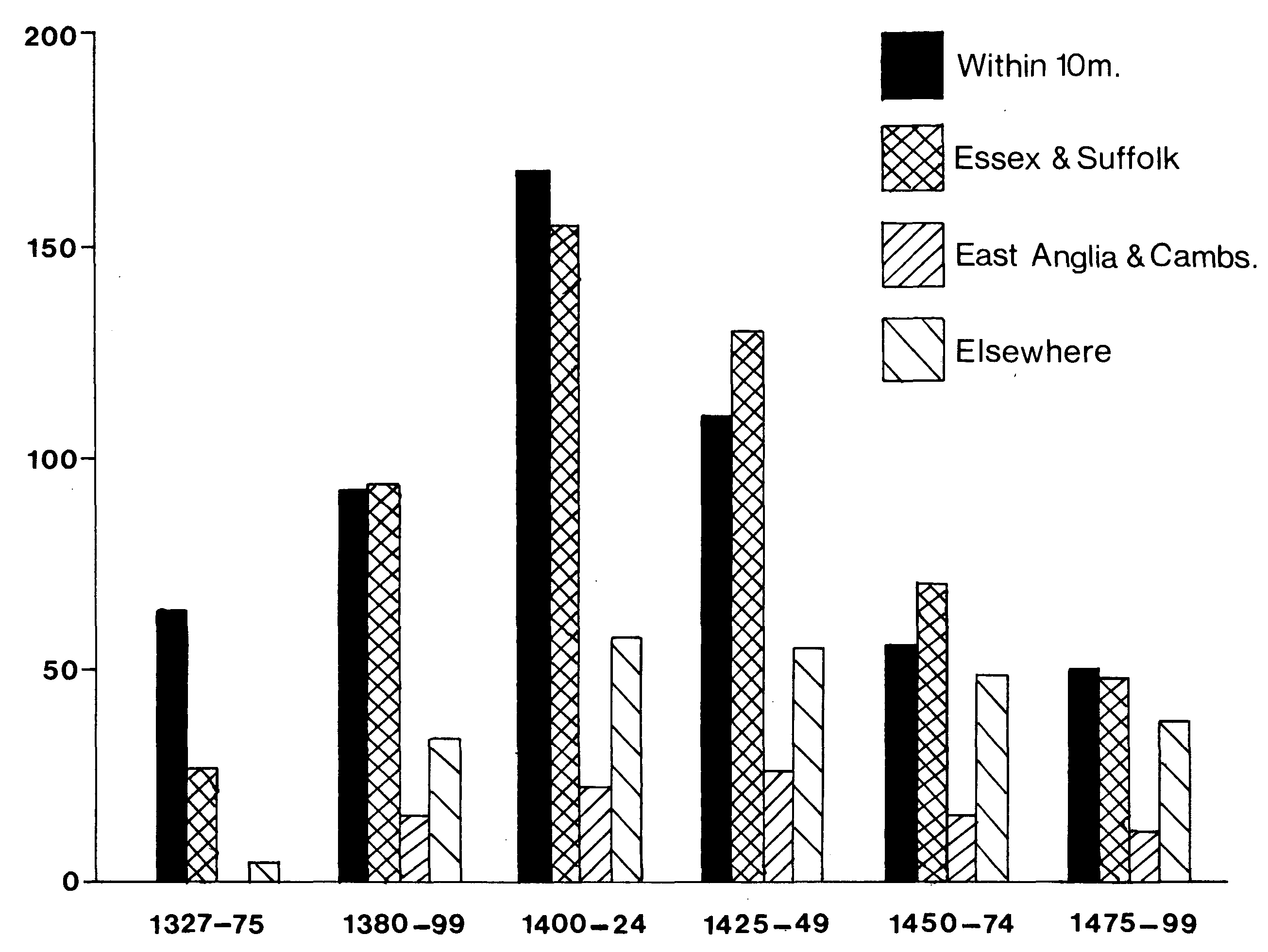
Origins of Freemen, 1327-1499
In 1272-3 the richer burgesses were assessed for subsidy on clothes and ornaments including gold rings, silver buckles, and silk belts, and on household goods including silver cups, silver spoons, mazers, and tablecloths. Similar goods were assessed in 1301, besides ewers, basins, and cooking utensils including brass pots and pans. (fn. 48) Goods stolen from humbler townsmen in the earlier 14th century ranged from the two silver cups and a small iron-bound chest of coins taken in 1346 and the 5 marks in silver taken from the parson of All Saints' church in 1317 to the brass pan and two linen sheets taken in Hythe Street in 1320 and a small bacon and cheese stolen in Mile End in 1317. (fn. 49) In the late 14th century and the 15th wealthier burgesses enjoyed a relatively high standard of living. William Christmas in 1391 bequeathed two pieces of silver plate, one with a cover, and 12 silver spoons. Robert Prior in 1443 owned at least two standing dishes and covers and two other pieces of silver gilt plate. (fn. 50) Wallhangings included the red cloth embroidered with two figures left by John Clerk to St. Nicholas's church in 1444 and the stained cloths with pictures of St. Mary and St. Anne and two other stained cloths with figures on them left by Agnes Bounde in 1508. (fn. 51) William Wheeler had a coverlet with birds and flowers on it, and in 1452 John Primerole's bed hangings were woven with primeroles (primroses). (fn. 52) Catherine, widow of Nicholas Peek, died in 1466, leaving among other goods her chalice and mass book, and a great long coffer in her chapel. Her hall and parlour were furnished with hangings, tables and forms, and a hanging candlestick, and her silver included a standing piece and cover weighing 16¼ oz., at least two salts, one weighing 8¼ oz., and a little silver goblet. (fn. 53) By contrast, a tailor who died in 'great poverty' in 1482 had only latten basins, pots, and lavers, four candlesticks, a spit, an andiron, and trivet, a few pieces of furniture including a bed with its mattress, coverlet, pair of blankets and pair of sheets, six cushions, an old painted cloth, a russet gown, and an old broken mazer. (fn. 54)
The burgesses had the right to hunt fox, hare, and cat within the liberty, (fn. 55) but they also hunted deer when they could. In 1267 a group of Christians and Jews chased a deer into the town and killed it there, but the bailiffs confiscated the carcass. (fn. 56) In 1291 John de Galingal of Colchester was among those imprisoned in the Tower of London for taking deer in Langham park, and Ellis son of John, William son of Warin, and two other Colchester men were accused before the forest justices of similar offences. Several prominent Colchester men were accused in 1324 of taking deer in Kingswood. (fn. 57) The burgesses were jealous of their own rights, accusing four 'foreigners' in 1407 of taking partridges, pheasants, and other birds within the liberty. (fn. 58)
Archery was presumably common in medieval Colchester, but it left few records. In the 18th century the butts were said to have been in the later Butt Road, but the only medieval reference is to shooting in the court of St. John's abbey in 1319. (fn. 59) The bearstake at the junction of High Street and North Hill was used for baiting bulls before slaughter, but a bear was baited there in 1365. (fn. 60) Gambling and dicing were commonplace, and in 1373 a chess player was accused of playing all night in a tavern. (fn. 61) Tennis seems to have been popular from 1382, and in 1425 a labourer was presented as a night vagrant and tennis player. (fn. 62) Respectable burgesses entertained themselves walking with their families in the castle bailey. (fn. 63) Waits or minstrels were recorded in 1379, 1384, and 1406; the first two were maintained by the borough. (fn. 64) A miracle play involving a death's head mask and a tunic with tails, both borrowed from Dovercourt, was performed in 1377. In 1490 the parishioners of St. James's gathered for games or entertainment in the street outside the church. The event, to raise funds for the church, may have been part of a patronal festival. (fn. 65) A boy bishop ceremony was held on St. Nicholas's day at St. Nicholas's church in the early 15th century. The grammar school took part, and in 1425 the master was accused of having assaulted the boy bishop and demanded unreasonable payments from his cross-bearers in 1422. (fn. 66)
The borough appears, intermittently at least, to have encouraged the cult of St. Helen as its patron. A chapel, possibly with some parochial functions, was dedicated to her by the early 12th century, and she appeared on the early 13th-century borough seal. The chantry founded in the chapel in 1328 may have had an associated guild from the first; there was certainly a St. Helen's guild by 1383 when it appointed the chantry priest, and it owned plate and vestments in 1389. (fn. 67) By 1400 it was associated with St. Cross chapel and hospital, and in 1407 it was refounded there as a guild or fraternity for men and women led by one or two wardens; it was to maintain five chaplains to pray for Henry IV and for the guild members. Those responsible for the refoundation, Thomas Godstone, Thomas Francis, John Ford, and John Sumpter, were among the wealthiest and most influential men in Colchester. (fn. 68) The guild received bequests of land and rents from Edmund Haverland in 1409 and Thomas Francis in 1416. (fn. 69) Thomas Godstone between 1424 and his death in 1431 gave land to the guild to found a chantry in St. Cross dedicated to God, the Virgin Mary, St. Helen, and St. Catherine for his soul and those of his wife Christine and son John, and of all the guild members. (fn. 70)
There were 65 members of St. Helen's guild in 1418, among them 'the countess of Hertford', probably Joan widow of Humphrey de Bohun earl of Hereford and Essex, a benefactress of Walden abbey and guardian of Richard de Vere earl of Oxford. Sir John Howard of Wivenhoe, Sir Gerard Braybroke of Danbury, and Helen, widow of Sir Geoffrey Brockhole and mother-in-law of John Sumpter, also belonged to the guild. (fn. 71) In 1442 there were 49 paid-up members, including the bailiff John Rouge, five other past or future bailiffs, and two aldermen. The abbots of St. John's and St. Osyth's were members, but perhaps surprisingly the prior of St. Botolph's was not. Some members lived in Harwich, others probably in Ipswich. Most were burgesses, but John Doreward of Bocking, who had held Olivers and Belhus in Stanway, Thomas Knevett of Stanway, and another unidentified gentleman had also paid their dues. (fn. 72) Richard Baynard of Messing (d. 1433 or 1434), (fn. 73) an associate of both Doreward and Knevett, left the guild the reversion of a house and land to support prayers for his soul. The 87 members in 1491 included the abbot of St. John's and John Bourchier, Lord Berners, but the guild may have been declining in popularity as it received only one further recorded bequest, of 20d. in 1486. (fn. 74) In 1518 the wardens were Sir John Rainsford of Bradfield, who had obtained Stanway by marriage, and Thomas Bonham, gentleman, the town clerk. (fn. 75) The guild held a feast on St. Helen's day each year. (fn. 76)
Most parish churches had at least one guild. Among the more important were St. Mary's guild in St. Leonard's church, which seems to have been responsible for the maintenance of the causeway to Hythe bridge and of a tumbrel, and to have paid for some work on the church; it was probably associated with St. Mary's light in the same church, which had been endowed with rents worth 11s. 6d. by c. 1500. (fn. 77) The endowments of the Jesus guild in St. Peter's church, first recorded in 1447, included Chiswell meadow, the source of much of the town's water. In 1537 all the parishioners of St. Peter's seem to have been members of the guild, one of whose wardens was the alderman Robert Leche. The guild was probably connected with the Jesus mass recorded from 1456, which seems to have enjoyed particularly strong support in the early 16th century, and with the Jesus chapel recorded from 1488. (fn. 78) The St. Anne's guild to which small sums were bequeathed in 1486 and 1517 was probably associated with St. Anne's chapel and hospital, which received regular bequests of money, sheets, and other goods in the late 15th century and the early 16th. (fn. 79) There were guilds of St. Mary and of St. Crispin and St. Crispain in the Greyfriars' church. (fn. 80)
Every parish church probably had at least a light dedicated to the Virgin Mary. The next most popular saint appears to have been St. Barbara who had a guild in St. Peter's church in 1457 and 1512 and an altar there in 1501 besides a guild in All Saints' in 1512. (fn. 81) St. Peter had chapels in St. James's and St. Leonard's and a guild in St. James's, and there was a St. John's chapel in St. Nicholas's besides a guild of St. John the Baptist in St. Peter's and a chapel of St. John the Evangelist in St. Martin's. (fn. 82) St. Anthony had a statue in St. Nichoals's and a light in St. Giles's in the early 16th century. (fn. 83) Other saints honoured in Colchester included St. Paul, who had a statue in St. Leonard's church in 1492, St. Francis, who had a guild, probably in St. James's, in 1435, and St. Catherine who had an altar in Holy Trinity in 1514 and a statue and perhaps a chapel in St. Giles's church in 1526. (fn. 84) There was a Corpus Christi guild in St. Nicholas's church in 1448, and Corpus Christi was the holy day of St. Leonard's church in the 1480s. (fn. 85)
The chantries founded in St. Helen's chapel by John of Colchester in 1322 and by Richolda Cofford in the late 14th century and that founded in St. Nicholas's church by John Bayn in 1383 seem to have been lost during the 15th century. (fn. 86) Chantries were founded in the parish churches of St. Mary-at-the-Walls by Joseph Eleanor in 1348, of St. Nicholas by Thomas Francis in 1416, and of St. Leonard by Peter Barwick c. 1480 and by Edmund Harmanson in 1502; all four survived until 1535 or 1546, as did Thomas Godstone's chantry in St. Cross chapel. (fn. 87) In addition to the perpetual chantries, 19 people between 1384 and 1500 left money to pay for temporary chantries, most for only one year, but others for 2, 3, or 5 years, and one, founded by Thomas Francis in St. Martin's, for 10 years. (fn. 88) William Bergholt in 1400 left 10 marks to a man to go to Rome on pilgrimage for his own and his wife's souls. (fn. 89) The Friars Minor received 20 bequests from townsmen in the late 14th century and the 15th, many more than any other religious house. Perhaps surprisingly in view of the frequent conflicts between the abbey and the town, St. John's received six bequests, compared with St. Botolph's five, and St. Osyth's two. (fn. 90)
Suspected Lollard books, in English, were confiscated from several townsmen in 1405, but were returned after examination by the prior of St. Bartholomew's, London. In 1414 at least ten men, including a friar and a parish clerk, had English books which they read both alone and in groups. The only man to join the Lollard rising that year was not among the book-reading group, but a Lollard cordwainer pardoned later in 1414 may have been. (fn. 91) Colchester was a centre of Lollardy in the late 1420s. A Norfolk Lollard confessed in 1430 to having attended a Lollard 'school' or meeting in the town, and others had visited the houses of two leading Lollards there, John Finch and John Abraham. Abraham and another Lollard, a tailor, were burnt in the town in 1428 or 1429. (fn. 92) Another man was falsely accused of Lollardy in 1428, and in 1428 or 1429 the abbot of St. John's, in the course of an acrimonious dispute with the town over Hythe mill, claimed that some of the townsmen were Lollards. (fn. 93) There are no other references to Lollards in the 15th century, apart from the use of 'Lollard' as an insult in 1438, but the sect flourished in the early 16th century. (fn. 94)
Two apparent instances of witchcraft came before the town court, one in 1420 when the parish clerk of St. Peter's was accused of practising magic and using devils' names, and one in 1456 when a man and his wife were accused of trying to kill boys by witchcraft. (fn. 95)