A History of the County of Middlesex: Volume 2, General; Ashford, East Bedfont With Hatton, Feltham, Hampton With Hampton Wick, Hanworth, Laleham, Littleton. Originally published by Victoria County History, London, 1911.
This free content was digitised by double rekeying. All rights reserved.
'Spelthorne Hundred: Hampton Court Palace, history', in A History of the County of Middlesex: Volume 2, General; Ashford, East Bedfont With Hatton, Feltham, Hampton With Hampton Wick, Hanworth, Laleham, Littleton, ed. William Page (London, 1911), British History Online https://www.british-history.ac.uk/vch/middx/vol2/pp327-371 [accessed 9 May 2025].
'Spelthorne Hundred: Hampton Court Palace, history', in A History of the County of Middlesex: Volume 2, General; Ashford, East Bedfont With Hatton, Feltham, Hampton With Hampton Wick, Hanworth, Laleham, Littleton. Edited by William Page (London, 1911), British History Online, accessed May 9, 2025, https://www.british-history.ac.uk/vch/middx/vol2/pp327-371.
"Spelthorne Hundred: Hampton Court Palace, history". A History of the County of Middlesex: Volume 2, General; Ashford, East Bedfont With Hatton, Feltham, Hampton With Hampton Wick, Hanworth, Laleham, Littleton. Ed. William Page (London, 1911), British History Online. Web. 9 May 2025. https://www.british-history.ac.uk/vch/middx/vol2/pp327-371.
HAMPTON COURT PALACE: HISTORY. (fn. 1)
-There is no doubt that the preceptory of the Knights Hospitallers of St. John of Jerusalem stood on the site of the present palace at Hampton Court, but it seems to have been almost entirely destroyed by Wolsey when he began his new building. (fn. 2) At the end of Wolsey's lease is a curious list of the goods of the brethren, which were left in the house when he took possession of it. (fn. 3) They were of the most meagre description: even in the chapel the chalice alone was of silver. An item of twenty-two beds gives an idea of the number of people the house could contain. In the hall were some forms, two tables, and a cupboard. There were also some chests, and two bells in the 'toure,' one of which, the sole remaining relic of the order in the palace, still rings for service in the chapel, and has the following inscription on it:-
+ STELLA + MARIA + MARIS + SUCCVRRE + PIISIMA + NOBIS +
(Mary most gracious, Star of the Sea, come to our assistance)
The date of the bell is fixed by the letters 'T. H.' stamped on it, which are the initials of a famous bellfounder, Thomas Harrys, who lived about 1479. (fn. 4)
From the date of Wolsey's purchase to the reign of George III the history of Hampton Court Palace may almost be said to be the history of England. Besides its intimate connexion with the private lives of kings and statesmen, there were few questions of political importance that were not discussed by the Privy Council, which met frequently within its walls, and innumerable letters and documents which have made history are dated from it. (fn. 5)
Wolsey's political services in the successful campaigns against France and Scotland in 1513 had secured him a high place in the king's favour. (fn. 6) At this date or shortly afterwards he held the offices of chancellor and grand almoner, (fn. 7) and many minor dignities, and was besides bishop of three English sees and one French see. (fn. 8) From the revenues of these offices he amassed considerable wealth, and his ambition led to the design of building for himself a great palace. (fn. 9)
He was influenced in his choice of Hampton Court as the site for his great house, not only by the proximity of London and the convenience of the river as a 'swift and silent' highway, but by the exceptional healthiness of the neighbourhood. Afterwards, when the 'sweating sickness' and the plague raged in London, only 20 miles off, Hampton and Hampton Court remained singularly immune from infection. (fn. 10)
Henry VIII and Katherine of Arragon paid their first recorded visit to Hampton Court in March 1514, probably to see the property which Wolsey intended to acquire.
Giovanni Ratto, an emissary of the Marquis of Mantua, took the opportunity to present some very fine horses which his master had sent to the king-a present highly appreciated by Henry. (fn. 11) A little later in the same year (June 1514) Wolsey took possession of the property, and immediately began his extensive works on the site of the old manor-house. (fn. 12)
In May 1516 the building was so far advanced that he was able to entertain the king and queen at dinner, (fn. 13) but he did not stay there for any considerable period before 1517, (fn. 14) and it was not till after the return from 'The Field of the Cloth of Gold' in 1520 that he seems to have considered the house practically complete and ready for the splendid entertainments which afterwards took place in it. (fn. 15)
It has been said that Wolsey was probably the greatest political genius that England has ever produced, and that 'he must be estimated rather by what he chose to do than by what he did.' (fn. 16) His designs were cast on a vast scale, and at a great crisis in European history he raised England to the leading position in international affairs which she has held practically ever since. (fn. 17) The field of action he deliberately chose was foreign policy, and all his schemes, and his magnificence, including the almost regal state in which he lived at Hampton Court and elsewhere must be understood as part, and not a small part, of his political design. The letters of the ambassadors from foreign courts, which have been preserved, show plainly the important share that the cardinal's splendour had in influencing their policy. It conveyed to their minds more rapidly than anything else could have done the power of the man-said to be the son of a butcher at Ipswich-who was not only making himself the master of England's fortunes, but who came very near to making himself master of the fortunes of Europe. Without this explanation, without some appreciation of the largeness of the plan into which the gorgeous entertainments of the cardinal's 'court' fit like the fine detail on some great building, without which it would be incomplete, a mere description of his magnificence shrinks into a meaningless list of somewhat barbaric festivities meant only to dazzle the populace. It is necessary to gain some insight into the vast interests he had at stake to appreciate at its full value the picture of the cardinal walking in his 'gallories, both large and long,' (fn. 18) meditating on affairs of State ; giving unwilling audience to impatient petitioners during his moments of leisure in the garden, (fn. 19) or presiding over the princely fêtes he organized in honour of the king or his guests or the foreign ambassadors.
The political letters and documents of Wolsey's time, calendared in the Letters and Papers of Henry VIII, dated at Hampton Court or addressed there, are innumerable, (fn. 20) but the papers which most intimately touch Wolsey himself at Hampton Court Palace are his letters to his agents in Rome, concerning his candidature for the Papacy in 1523, on the death of Adrian III, (fn. 21) and those relating to the foundation of the cardinal's colleges at Oxford and Ipswich. (fn. 22) It is mentioned that the foundation charter of 'Cardinal's College' (afterwards Christ Church), Oxford, was granted in 'the south gallery at Hampton Court.' (fn. 23) The letters of Melancthon and Luther were among those discussed at Hampton Court, and there is some correspondence concerning them. (fn. 24) The majority of papers, however, dated from Hampton Court, until the matter of Henry's divorce has to be considered, are concerning foreign affairs.
Sebastian Giustinian, the Venetian ambassador, who constantly visited Wolsey at Hampton Court, writing to his Signory in 1519, gives the following description of the cardinal: 'He is but forty-six years old, very handsome, (fn. 25) learned, extremely eloquent, of vast ability, and indefatigable. He alone transacts the same business as that which occupies all the magistracies, offices and councils of Venice, both civil and criminal, and all state affairs likewise are managed by him, let their nature be what it may. He is pensive and has the reputation of being extremely just. He favours the people exceedingly, and especially the poor, hearing their suits and seeking to dispatch them instantly. He is in very great repute, seven times more so than if he were Pope. He is the person who rules both the king and the entire kingdom. He is in fact ipse rex, and no one in this realm dare attempt aught in opposition to his interests.' (fn. 26) His influence with Henry during the early part of the king's reign was almost unlimited, and Henry entertained a great affection for him personally, writing to him as 'mine awne good Cardinal,' expressing his gratitude for and appreciation of his Lord Chancellor's services, begging him to pay attention to his own health, and signing himself 'Your loving Master, Henry R.' (fn. 27) He seems also to have treated him with great confidence and unusual familiarity, walking with him in the gardens at Hampton Court arm in arm, and sometimes even with his arm thrown round the cardinal's shoulder. (fn. 28)
Wolsey, who 'passed for an old man broken with the cares of state' before his fall, and died when he was only fifty-five, seems to have failed in health from an early date. In 1517 he suffered from the 'sweating sickness,' and was still ill at Hampton Court in December of that year. It was stated that his life had been in danger, and so great was the fear of infection that Giustinian said, 'None of those who were once so assiduous ever went near him.' (fn. 29) It was not, however, by any means only as a health resort that the cardinal used his great house ; there is a contemporary description by Hall (fn. 30) of a characteristic masquerade given by Wolsey at Hampton Court, to entertain the king in 1519 ; he says: 'There were as many as thirty-six masquers disguised, all in one suite of fine green satin, all over covered with cloth of gold, undertied together with laces of gold, and making hoods on their heads: the ladies had tyers made of braids of damask gold, with long hairs of white gold. All these masquers danced at one time, and afters they had danced they put off their vizors, and then they were all known.' Their supper was ' of countless dishes of confections and other delicacies,' and afterwards, 'large bowls filled with ducats and dice were placed on the table for such as liked to gamble ; shortly after which the supper tables being removed, dancing commenced,' and lasted, as it often did on such occasions, 'till long after midnight.'
Cavendish says that when the king repaired to the cardinal's house 'for his recreation, divers times in the year, there wanted no preparation or goodly furniture with viands of the finest sort that could be gotten for money or friendship,' and tells an amusing story of the king's coming ' suddenly thither in a masque with a dozen masquers all in garments like shepherds (sic) made of fine cloth of gold and fine satin . . . with vizors of good proportion and physiognomy.' He goes on to say that they startled the cardinal and his guests with ' the noise of guns-they sitting quiet at a solemn banquet'-and that Wolsey entertained them as strangers, and to the great joy of king and court mistook which was the king, and went up to one of the gentlemen of the court, hat in hand. (fn. 31) Only Shakespeare could do justice to these scenes of simple yet magnificent festivity, with the figure of the great cardinal moving through the gay courtiers that thronged his stately courts, unmindful of the jealousy already at work to undermine his power and his influence with the king. (fn. 32) It was in 1522 that Anne Boleyn returned from France, and in 1524 Skelton's satire, Why come ye not to Court? was published, in which he drew attention to the vast crowd of suitors who followed the cardinal rather than the king. (fn. 33)
It is impossible here to follow the course of Wolsey's diplomacy during the following years, though Hampton Court was the scene of many of his negotiations. (fn. 34) In 1515 he had received the cardinal's hat, and in 1517 was made papal legate. His moment of greatest success was perhaps in 1518, when universal peace was concluded among the European nations, but his path was beset with difficulties from the time of Maximilian's death in 1519, and in the course of the next few years his great design to maintain the peace of Europe and the position of England as mediator in the politics of the Continent was overthrown. (fn. 35) He continued to work for peace, and an important treaty was signed at Hampton Court in 1526 by Wolsey on behalf of Henry VIII, and by the French ambassador on behalf of Francis I, to the effect that neither king should unite with the emperor against the other, and that the King of England should endeavour to procure the liberation of the French king's sons, then held as hostages in Spain. (fn. 36) Wolsey had been working for some time to arrange a separate peace with France, and his letter to Henry from Hampton Court three days later expresses his satisfaction with the agreement. (fn. 37) In the following year the French commissioners, Gabriel de Grammont, Bishop of Tarbe, Francois Vicomte de Turenne, and Antoine le Viste, president of Paris and Bretagne, arrived in England to arrange a further alliance between the two kingdoms and a marriage between Francis I and Henry's daughter Mary, then only ten years old. Dodieu, the secretary to the French embassy, gives a detailed account of the negotiations. (fn. 38) The ambassadors seem to have stayed in 'the village at the end of the Park,' probably Hampton Wick. They were taken to the palace, where the king and queen were staying, and received by Wolsey, afterwards having an audience of the king 'in the hall.' (fn. 39) In the evening, after dining with Wolsey and other members of the council, they were admitted to the queen's 'chamber,' and talked with the king on indifferent matters, discussing Luther and his heresy, and the book that Henry had lately written ; the king showing himself, as Dodieu says, 'very learned.'
The ambassadors and Wolsey afterwards discussed the subject of the treaty at length in the 'Cardinal's own room.' (fn. 40) They went back to London, and it was some time before a final conclusion was reached, and the treaty signed by Henry at Greenwich in April 1527. (fn. 41) It was ratified at Amiens in September, when Wolsey went to meet Francis I. On account of the negotiations having been carried on there, it is known as the 'Treaty of Hampton Court.' (fn. 42)
Perhaps the most wonderful, as well as the last, of all Wolsey's regal entertainments at Hampton Court took place in the autumn of 1527, when a special embassy, consisting of the Grand Master and Marshal of France, Anne de Montmorency du Bellay, the Bishop of Bayonne, the president of Rouen, and M. d'Humières, followed by a retinue of a hundred 'of the most noblest and wealthiest gentlemen in all the Court of France,' and a guard of five or six hundred horse, came to England to ratify the agreement finally, and to invest the king with the order of St. Michael. (fn. 43) It is of their visit to Hampton Court that Cavendish gives a de lightful account. He begins by describing how the cardinal sent for 'the principal officers of his house, as his steward, comptroller, and the clerks of the kitchen-whom he commanded to prepare for this banquet at Hampton Court, and neither to spare for expenses or travail'-that the guests may make 'a glorious report in their country.' 'The cooks wrought both day and night in divers subleties and many crafty devices-the yeomen and grooms of the wardrobe were busied in hanging of the chambers with costly hangings, and furnishing the same with beds of silk and other furniture apt for the same in every degree. . . . Then the carpenters, the joiners, the masons, the painters, and all other artificers necessary to glorify the house and feast were set to work. There were fourteen score beds provided and furnished with all manner of furniture to them belonging. . . .' (fn. 44)
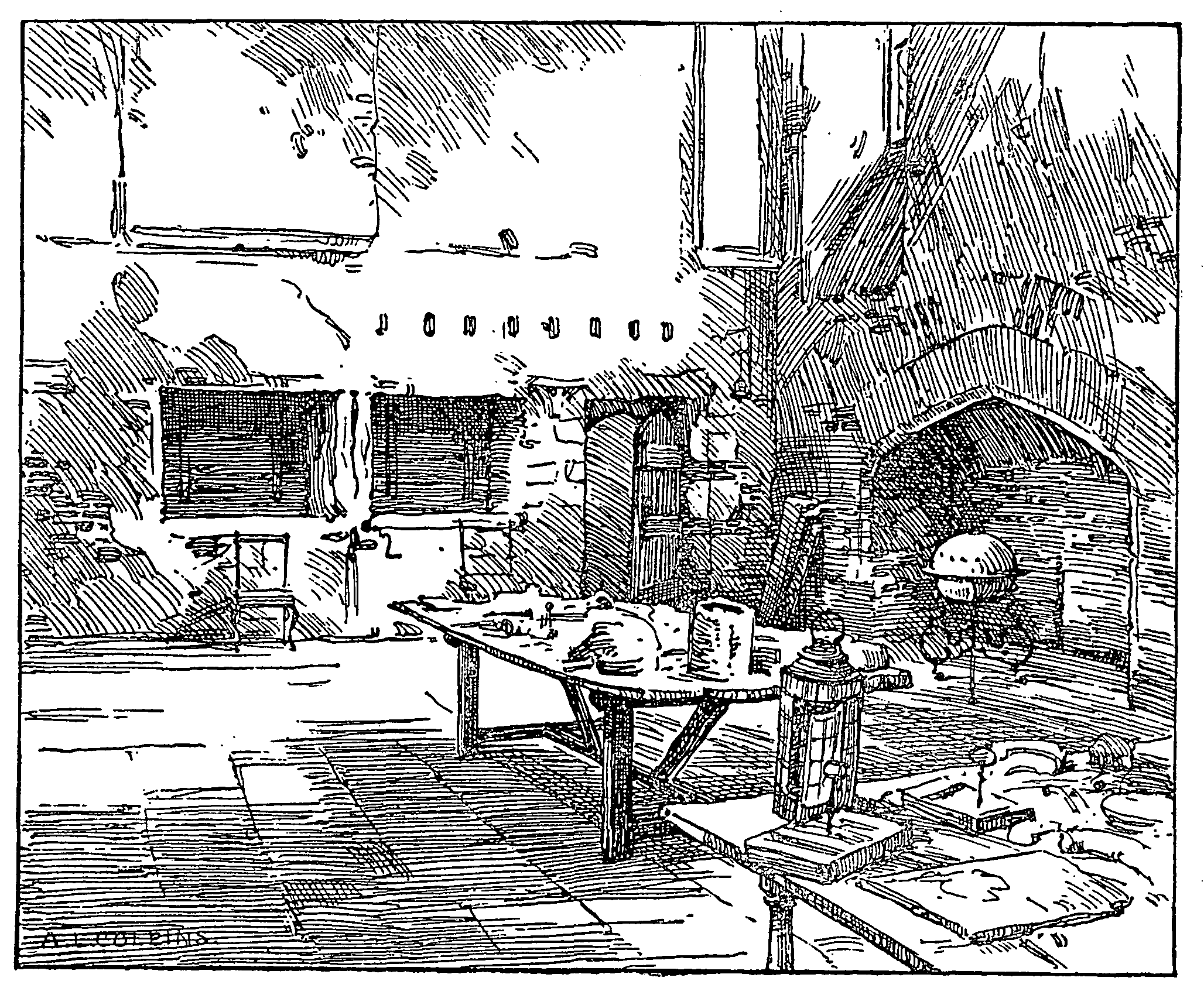
Hampton Court Palace: Wolsey's Kitchen
On the day appointed 'the Frenchmen' assembled at Hampton Court and rode to Hanworth (2 or 3 miles away), where they hunted till the evening, and then returned to the palace, where 'everyone of them was conveyed to his chamber severally, having in them great fires and wine ready to refresh them. The first waiting chamber was hanged with fine arras, and so were all the rest, one better than another, furnished with tall yeomen. There was set tables round about the chambers banquet-wise, all covered with fine cloths of diaper. A cupboard of plate (fn. 45) parcel gilt . . . having also in the same chamber, to give the more light, four plates of silver, set with lights upon them, and a great fire in the chimney. The next chamber, being the chamber of presence, hanged with very rich arras, wherein was a gorgeous and precious cloth of estate hanged up, replenished with many goodly gentlemen ready to serve . . . the high table was set and removed beneath the cloth of estate. . . . There was a cupboard-in length the breadth of the chamber, six desks high, full of gilt plate, very sumptuous, and of the newest fashions; and upon the nethermost desk garnished all with plate of clean gold, having two great candlesticks of silver and gilt, most curiously wrought, the workmanship whereof, with the silver, cost three hundred marks, and lights of wax as big as torches burning upon the same. The plates that hung on the walls to give light in the chamber were of silver and gilt, with lights burning in them, a great fire in the chimney, and all other things necessary for the furniture of so noble a feast. . . . My lord's officers caused the trumpets to blow to warn to supper . . . the service was brought up in such order and abundance, both costly and full of subtleties, with such a pleasant noise of divers instruments of music, that the Frenchmen, as it seemed, were rapt into Paradise. . . .
'Before the second course, my Lord Cardinal came in among them, booted and spurred, all suddenly, and bade them proface (welcome). My Lord commanded them to sit still-and straightways being not shifted of his riding apparel, sat down in the midst-laughing and being as merry as ever I saw him in all my life. . . . Then my Lord took a bowl of gold, which was esteemed at the value of 500 marks, filled with hypocras-putting off his cap, said, "I drink to the king, my Sovereign Lord and Master and to the king your master," and therewith drank a good draught. And when he had done he desired the Grand Master to pledge him cup and all, the which cup he gave him, and so caused all the other lords and gentlemen in other cups to pledge these two royal princes. . . . Then went my Lord to his privy chamber to shift him ; and returned again among them, using them so nobly, with so loving and familiar countenance and entertainment, that they could not commend him too much.'
Cavendish goes on to describe that every chamber had 'a bason and a ewer of silver, some gilt and some parcel gilt, and some two great pots of silver in like manner, and one pot at the least with wine and beer, a bowl or goblet, and a silver pot to drink beer in-a silver candlestick or two-and a staff torch ; a fine manchet, and a chetloaf of bread. . . . In the morning of the next day (not early) they rose and heard mass, and dined with my Lord and so departed towards Windsor, and there hunted, delighting much in the castle or college, and in the Order of the Garter.' (fn. 46)
On another occasion the king expressed his pleasure in hunting with Wolsey, 'and wished him to come again that they might have the pastime together two or three days.' (fn. 47)
Wolsey at first seems to have encouraged Henry's desire for a divorce in order to further his own foreign policy, (fn. 48) but 'the greatest political genius that England has ever seen' was no match for the ambition of Anne Boleyn, supported by the king's passion. From the moment that Anne became Wolsey's political rival his doom was sealed. (fn. 49) His enemies began to make themselves felt when his efforts to obtain the decree of divorce from the Pope failed, (fn. 50) and the royal favour was withdrawn from him. His gift of Hampton Court to the king was doubtless made at a moment when he first realized that his influence was declining. The satirists, Skelton and Roy, expressed public opinion when they dared to publish reflections on his name and fame. (fn. 51)
Meanwhile the cardinal continued to live at Hampton Court, to receive private visits there, and to transact business. The ambassadors continued to wait upon him, notably Du Bellay, the French ambassador, who stayed at the palace in June 1528, and mentions in his dispatches the various conversations he had with Wolsey, often while he was 'walking in his gardens.' (fn. 52) It was at Hampton Court, too, that he saw the Netherlands ambassadors, and there that eventually a truce for eight months was arranged with the Low Countries, and signed 15 June 1528. On 17 June it was solemnly confirmed in the chapel, Wolsey, the envoys of the Netherlands, Du Bellay, and the representatives of the emperor being present. (fn. 53) This truce, which must not be confused with the peace mentioned before, is also known as 'The Truce of Hampton Court.'
After this, the troubles which were gathering fast about Wolsey, and the prevalence of the 'sweating sickness,' seem to have prevented him from offering further hospitalities. During June, July, and August 1528 he was at the palace, attended only by a few followers, instead of by the train of noble and gallant gentlemen who had hitherto clustered round him. (fn. 54) On 3 July 1529, Du Bellay wrote that 'Wolsey is hidden at Hampton Court, because he knew nowhere else to go. He has fortified his gallery and his garden (? against the sickness). Only four or five are allowed to see him.' (fn. 55) The king seems to have stayed with him there again in September and December 1528, (fn. 56) and in March, April, and July 1529. (fn. 57) The last time that Wolsey himself was at Hampton Court was in July 1529. In November of that year a bill of indictment was preferred against him in the King's Bench. (fn. 58) He was told that the king wished him to retire to Esher, where he had built a small house, of which a part still remains. (fn. 59) He only lived for about a year longer, and Hampton Court is not concerned in the final details of disgrace of him who:-
Once trod the ways of glory, And sounded all the depths and shoals of honour. (fn. 60)
Henry was already at the palace when he sent for Cavendish to speak with him about the cardinal's death. Cavendish's account shows plainly the profoundly self-seeking character of Henry. Wolsey's faithful servant was summoned to attend the king, who was engaged in archery in the park. As Cavendish stood against a tree, sadly musing, Henry suddenly came up to him and clapped him on the shoulder, saying, 'I will make an end of my game, and then I will talk with you.' He afterwards went into the garden, but kept Cavendish waiting for some time outside. Their interview was long, and the king said he would 'liever than twenty thousand pounds that the cardinal had lived.' (fn. 61) He nevertheless inquired anxiously about £1,500, apparently all that remained of his favourite's great fortune, which he had sent Sir William Kingston (fn. 62) to claim from Wolsey on his deathbed. (fn. 63)
It is possible to obtain a very clear idea of the wonderful collection of furniture, pictures, tapestries, and plate which Wolsey had at Hampton Court from an inventory of his belongings taken after his attainder, (fn. 64) from an Augmentation Office Roll now in the Record Office ; from Cavendish's Life; and from the Venetian ambassador's accounts of his plate. (fn. 65)
Venier, the Venetian ambassador in 1527, estimated what he saw at Hampton Court alone as worth 300,000 golden ducats, or £150,000. Giustinian valued the silver he saw in 1519 at the same amount, and says that the cardinal always had a sideboard of plate worth £25,000, in any house where he might be, and in his own room a cupboard with further plate to the amount of £30,000. (fn. 66)
The number of the cardinal's retainers, as estimated in contemporary records, varies, but consisted probably of about four hundred persons. (fn. 67) In Cavendish's different MSS. the numbers vary from one hundred and fifty to eight hundred. The first assessment of his household in a subsidy roll (No. 204) at the Record Office gives the number as 429 people; another, dated 1525, makes the total not more than two hundred and fifty ; (fn. 68) but an assessment, taken apparently after his attainder in 1530, gives the number again as 429. (fn. 69) The expenses of his household were something over £30,000 a year in modern reckoning, but of course this 'included the entertainment of numerous gentlemen of good family, a very considerable retinue, and all the expenses of the Chancery.' (fn. 70)
Henry did not take possession of Hampton Court until Wolsey was actually banished. Up to that time the 'King's Manor' of Hampton Court was apparently a figure of speech, but one of his first acts was to erase the cardinal's badges and to mark the whole building with his own arms and monograms. (fn. 71) In the Chapter House Accounts for 1530-2 there are numerous items for fixing, carving, painting, and gilding the king's heraldic devices, which are still to be seen in some parts of the palace. (fn. 72) It was not till the following year that he made the exchange of lands with the Prior of St. John of Jerusalem by which the manor of Hampton Court became legally Crown property. (fn. 73) The proceedings for the king's divorce had been going on for some time, and as early as 1528, while Wolsey was still at the palace, the French ambassador, Du Bellay, wrote that 'Melle de Boulan' had been given a 'very fine lodging near the king,' (fn. 74) and mentioned that 'greater court was paid to her than has been to the queen for a long time.' (fn. 75) Katherine, however, accompanied Henry in the beginning of February 1530, when he first went to Hampton Court after Wolsey's disgrace, (fn. 76) and they were said to treat each other in public with the 'greatest possible attention.' (fn. 77) The king at this time inhabited the first floor in the Clock Court, the queen the rooms previously allotted to her by Wolsey on the floor above, (fn. 78) and Princess Mary the ground floor. (fn. 79) There are also many entries of a later date in the Chapter House Accounts for 'the lady Anne's lodgynges,' (fn. 80) but it is not possible to say exactly which rooms they were. The king's 'Privy Purse Expenses' give an idea of the numerous presents he made to her. They spent Christmas 1530 at Hampton Court, and the king gave her, besides other things, £100, and further sums 'to play with' at bowls and other games. (fn. 81) In September 1532 he had some of the Crown jewels sent from Greenwich to Hampton Court for her. (fn. 82) She was allowed her own suite of attendants, (fn. 83) and Henry treated her with the greatest consideration. He rode with her, (fn. 84) walked in the park or the gardens with her, and taught her to shoot at the target. (fn. 85) Katherine meanwhile remained constantly with the king while he enjoyed his 'usual sports and royal exercises' at Hampton Court (fn. 86) until 14 July 1531, when he left her at Windsor and rode to Hampton Court. (fn. 87)
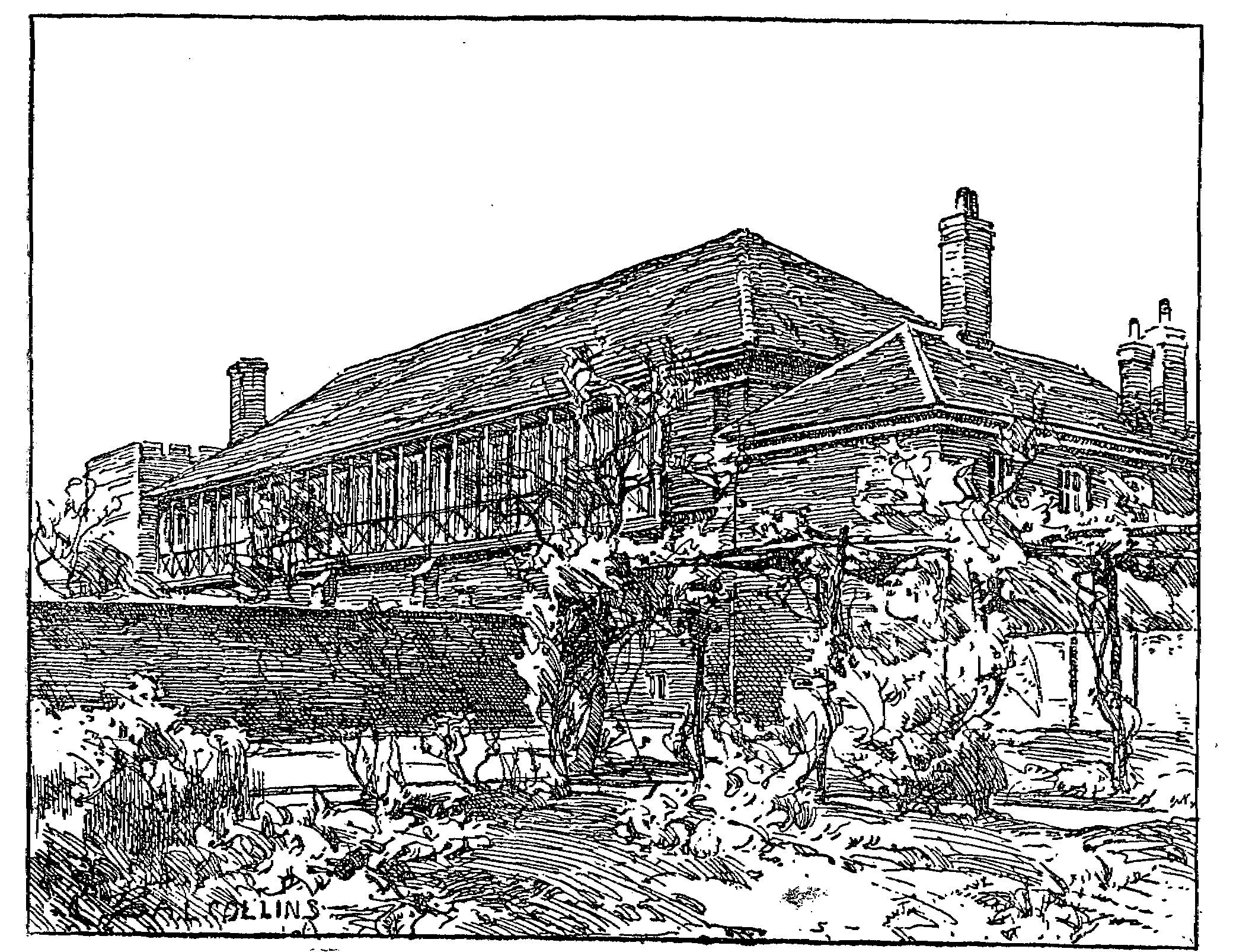
Hampton Court: Tennis Court From The West Side
From that day he never saw her again. The accounts of Henry's sojourns at Hampton Court read like the shifting scenes of one long pageant of joy and revelry, yet in the background are the meetings of the Council, the dispatches daily submitted to the king, the discussions of foreign policy, and the masterly manipulation of one of the greatest revolutions England has ever seen, the detachment of the National Church from the Church of Rome. (fn. 88)
Hampton Court was, however, chiefly the scene of the king's pleasures. At the time of the Dissolution of the Monasteries he created the 'Honour and Chase of Hampton Court to improve his hunting.' (fn. 89) The king was also fond of fishing, and in his privy purse expenses are several entries for his rods to be brought to the palace, and for payments to the fishermen who attended him. (fn. 90)
A large 'Tilt Yard' was made on the north side of the palace, about 9 acres in area, (fn. 91) with five towers in which the spectators might sit, (fn. 92) and there numerous jousts and tournaments took place, in which Henry often distinguished himself 'in supernatural feats, changing his horses and making them fly rather than leap, to the delight and ecstasy of everybody.' (fn. 93) Giustinian gives an account of one of these tournaments held at Hampton Court, and says that when the king himself appeared a grand procession was formed, headed by the marshal of the jousts on horseback, dressed in cloth of gold, surrounded by thirty footmen in liveries of blue and yellow. Then followed the drummers and trumpeters, all dressed in white damask ; next forty knights and lords in pairs, all in superb attire, and many in cloth of gold ; then 'some twenty young knights, on very fine horses, all dressed in white, with doublets of silver and white velvet, and chains of unsual size, and their horses barded with silver chain-work, and a number of pendent bells.' Next came their pages, on horseback, their trappings, half of gold embroidery and half of purple velvet, embroidered with stars ; and then the jousters, armed, with their squires and footmen. Last of all came his Majesty, armed cap-Àpie, with a surcoat of silver bawdakin, surrounded by some thirty gentlemen on foot, dressed in velvet and white satin, and in this order they went twice round the lists.' (fn. 94)
Another favourite pastime of the period was archery, in which Henry also excelled, and amused himself by teaching Anne Boleyn, and perhaps other ladies of the Court, to shoot. Lord Rochford, Anne Boleyn's brother, won large sums from the king at this sport. (fn. 95) The butt stood in what was called 'The Great Orchard,' to the north of the palace. (fn. 96)
The tennis-court, or 'close tennis play,' at Hampton Court must also be mentioned, as it is the oldest court of the kind in England, and Henry was a skilful and graceful player. (fn. 97) There seems to have been also an 'open tenys play,' no doubt a forerunner of lawn tennis, and an open and two close bowling alleys. One of these alleys existed until about a hundred years ago, and was 270 ft. long, with windows on both sides. It stood apparently behind the tennis court, and there was another near the river. (fn. 98) Henry was an inveterate gambler, his losses at dice, backgammon, shovel-board, &c., in one year amounted to £30,000. (fn. 99) At the same time, his great versatility must be acknowledged, for, besides his encouragement of artists, (fn. 100) and numerous entries of payments to the king's minstrels for playing before him at Hampton Court, (fn. 101) he seems to have been a musician himself (some of the songs he composed are still extant) (fn. 102) and all witnesses speak of his skill in singing. He had also some taste for literature, and spoke several languages. The king's 'libarye' at Hampton Court is often mentioned in the Chapter House Accounts, and he filled it with books from York Place. (fn. 103)
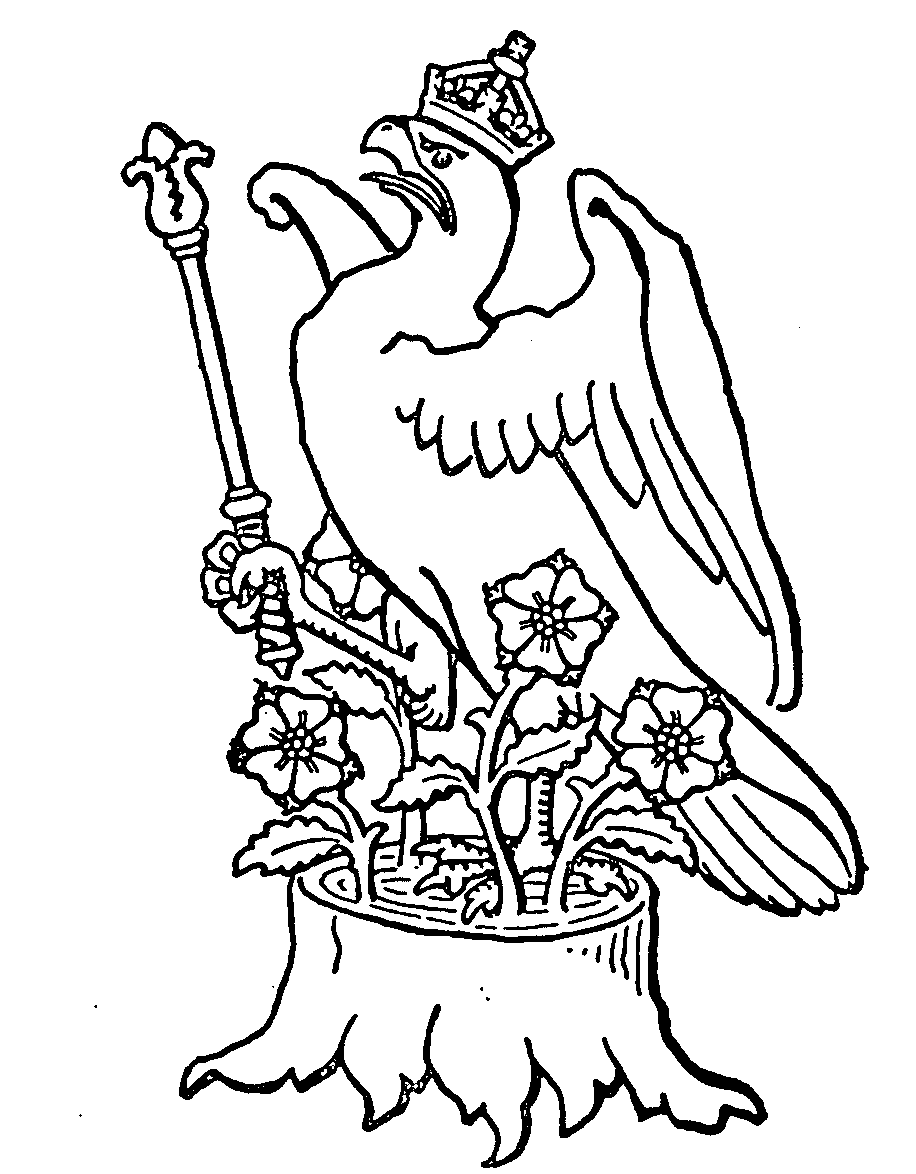
Badge Of Queen Anne Boleyn
Anne Boleyn was crowned in June 1533, and in July she came to Hampton Court, where a series of magnificent 'revellynges' took place in her honour. Besides joining in hunting, dancing, gambling, and other diversions, (fn. 104) she seems to have shared Henry's love of music, and to have amused herself and her ladies by doing needlework, of which specimens were to be seen at Hampton Court for many years after her death. (fn. 105) As well as his other additions to the palace Henry caused a new suite of rooms to be erected for Anne, instead of the 'Queen's Old Lodgynges'; but she never occupied the splendid apartments designed for her. (fn. 106)
There were great rejoicings at the birth of Elizabeth, but Henry very soon made manifest how all-important he considered the birth of a son. It becomes sufficiently apparent what the dominating motive was for the vast labour, time, trouble and expense lavished on obtaining his divorce. Anne was too slight a creature to retain any sort of influence over the king when she thus failed to satisfy his ambition. In January 1536, possibly at Hampton Court, it is said that she made her first discovery of Jane Seymour's attraction for Henry, (fn. 107) and her remonstrances only completed her estrangement from the king, who had apparently for some time previously contemplated the possibility of annulling his marriage with her. (fn. 108) Four months later, on 19 May 1536 she was executed on Tower Green, and the general sentiment of the country was one of joy at her death. (fn. 109)
A fortnight before her execution Henry left York Place for Hampton Court, and on 11 May Cromwell visited him there and settled with him the details of the coming trial ; returning the same night. (fn. 110)
Jane Seymour was sent to Sir Nicholas Carewe's house, about seven miles from London, but was shortly removed to a house on the Thames nearer to the king. (fn. 111) The following week, when the death of Anne was announced to Henry, he immediately went by barge to the house where Jane Seymour was staying. A dispensation for the marriage was obtained from Cranmer on the very day of Anne's execution. (fn. 112) The next morning at six o'clock Jane secretly joined the king at Hampton Court, and there, in the presence of a few courtiers they were formally betrothed, (fn. 113) not married as has sometimes been stated. Ten days later they were married in the 'Quene's Closet at York Place.' (fn. 114)
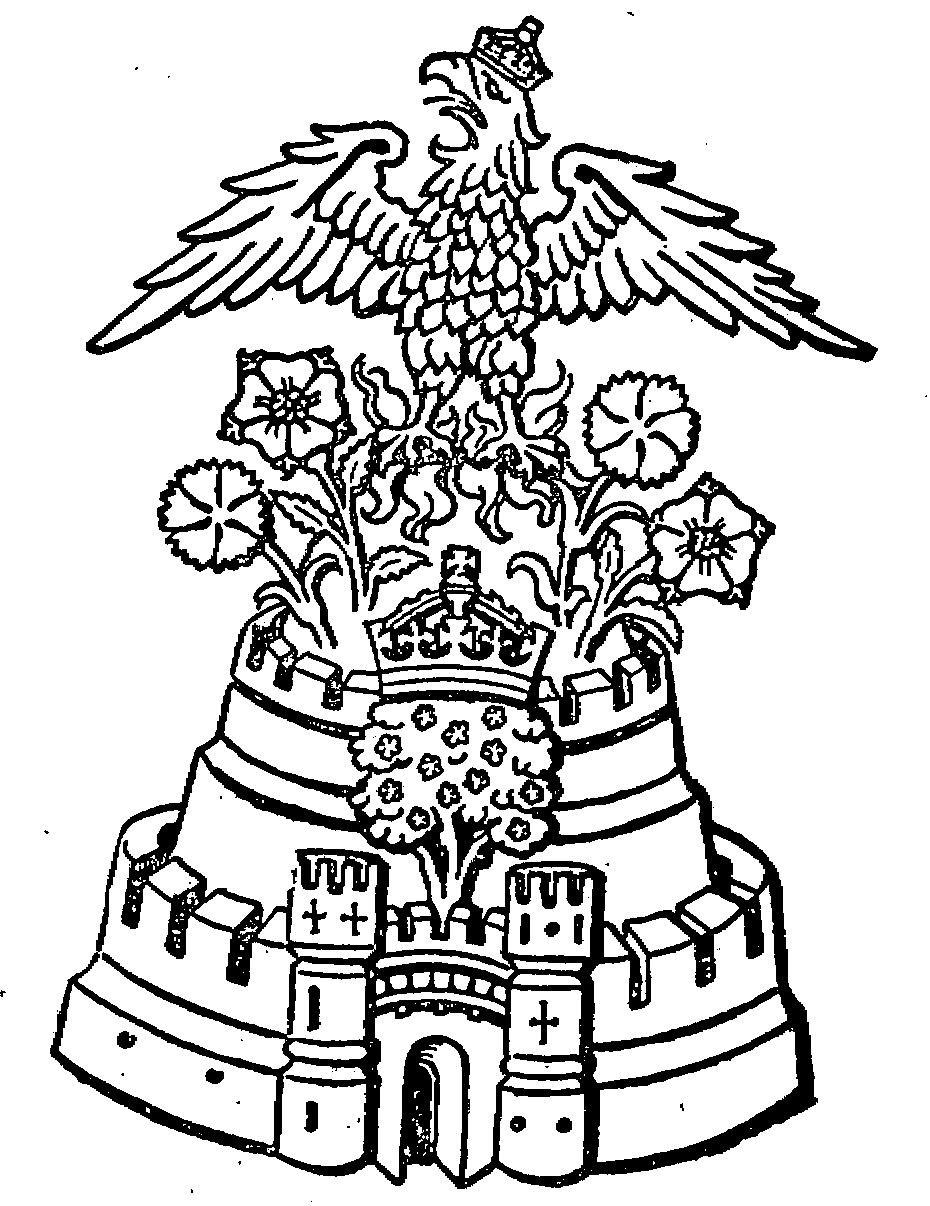
Badge of Queen Jane Seymour
The new apartments not being finished, Jane Seymour does not seem to have resided at Hampton Court during the first year of her reign, (fn. 115) but in September 1537 she retired there to await the birth of the anxiously-expected heir to the throne. (fn. 116) The king accompanied her, and was present when on Friday 12 October, the vigil of St. Edward's Day, 1537, at two o'clock in the morning, the long-desired prince was born. (fn. 117) How much the evil of a disputed succession was dreaded is shown by the extreme joy of the whole nation. (fn. 118) A circular announcing the birth, signed by Jane Seymour, was sent to ' all the estates and cities of the realm. Given under our signet at My Lord's Manor of Hampton Court, 12 Oct. 1537.' (fn. 119) By tradition the room in which Edward VI was born is one on the first floor in the south-east corner of the Clock Court. This room was partially rebuilt and altered in the reign of George II, (fn. 120) but the queen's rooms appear to have been among those destroyed to make way for Wren's new building. The bed in which Edward VI was born and Jane Seymour died was to be seen in the palace in Queen Elizabeth's time. (fn. 121)
The christening took place on the Monday following in the chapel at Hampton Court, and a long account is given in the 'Preparations ordained for the said christening at Hampton Court,' (fn. 122) in which the course of the procession, the decorations of the chapel, and the positions occupied by the Officers of the Household are minutely described. (fn. 123)
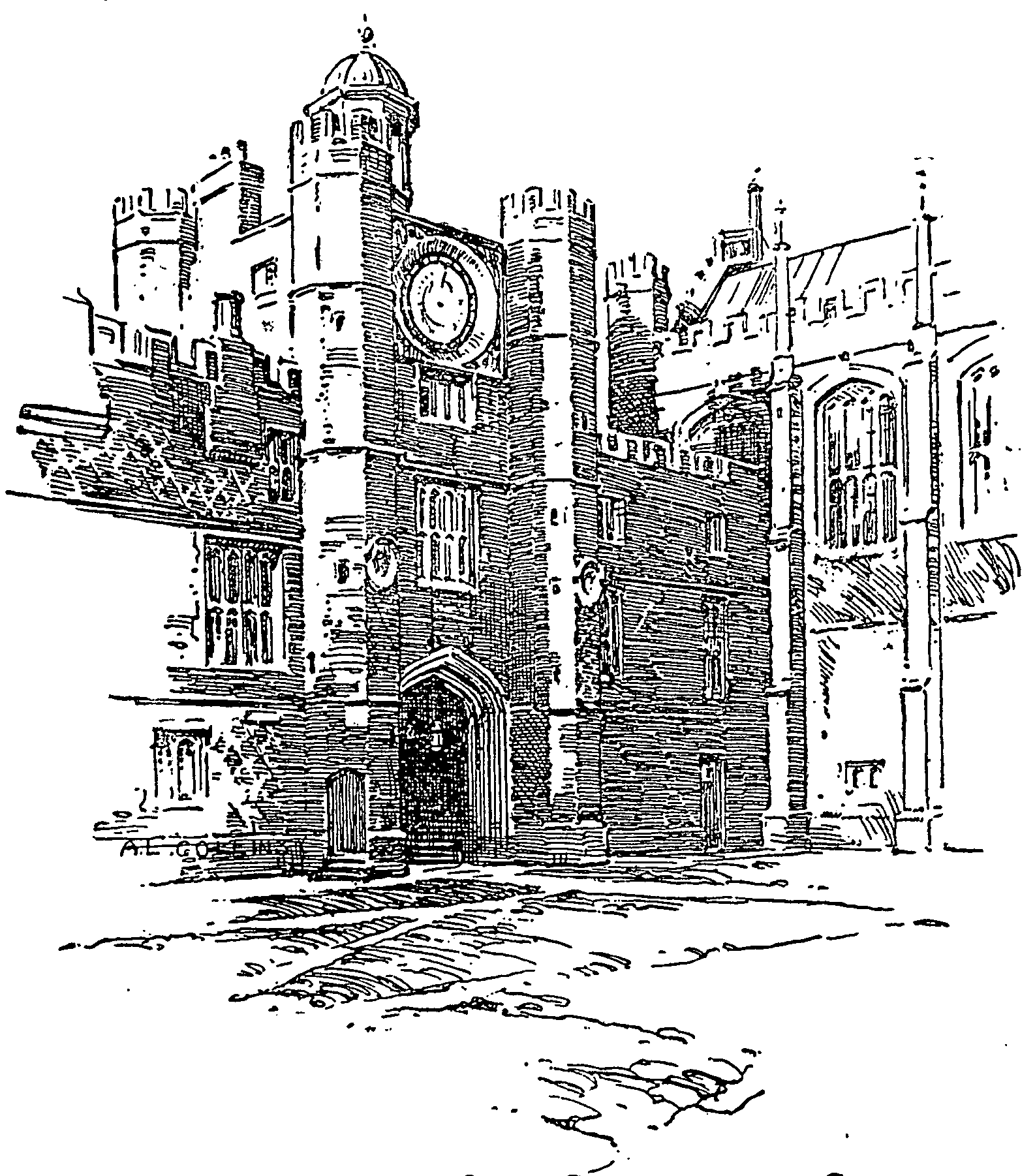
Hampton Court Palace: Clock Court From The Colonnade
The procession (fn. 124) started from the 'Prince's Lodgynges,' situated to the north of the Chapel Court, and passed through the 'Council Chamber,' where it was joined by the Officers of the Household, the children and ministers of the chapel, the king's council, and the other great lords, spiritual and temporal, the ambassadors and their suites, the chamberlains of the king and queen, and the Lord High Chamberlain of England, Cromwell, Lord Privy Seal, the Lord Chancellor, the Duke of Norfolk, and the Archbishop of Canterbury. The 'chrysom richly garnished' was borne by the Lady Elizabeth, the king's daughter, being herself carried by Lords Beauchamp and Morley. The prince was carried by the Marchioness of Exeter, 'assisted by the Duke of Suffolk and the Lord Marquis her husband.' A rich canopy was borne over the prince by four gentlemen of the King's Privy Chamber. (fn. 125)
'The Lady Mary, the king's daughter, was appointed for the lady Godmother,' and a vast number of ladies of honour and gentlewomen followed her.
The procession, leaving the Council Chamber, passed through part of the room now known as 'the Haunted Gallery,' and so into the 'King's Great Watching Chamber' at the upper end of the Great Hall. They entered the hall through a door, now hidden by tapestry, and passed down the stairs under Anne Boleyn's Gateway into the Clock Court, and so through the cloisters to the chapel door. (fn. 126) All the way was lined with men-at-arms, attendants and servants holding torches. The ground of the courtyard was strewn with rushes, and barriers, covered with rich hangings, were erected to keep back the spectators, who were all inhabitants of the palace, as access to the court was forbidden to others on account of infection from the plague which prevailed at the time. (fn. 127) The decorations of the entrance and of the chapel itself were of 'rich cloth of gold or arras and tapestries,' the floor 'boarded and covered with carpets,' the 'high altar richly garnished with plate and stuff.' In the middle of the choir the font of 'solid silver gilt was set upon a mount or stage,' and over it 'a rich canopy.' The Te Deum was sung by the choir, and then the prince was baptized with the usual elaborate ceremonial. After the christening the torches were all lighted, and Garter King-atArms proclaimed the prince's name and style. The procession then re-formed, carrying with them the christening gifts, and proceeded to the queen's bedchamber, where the king and queen awaited their son, and he 'received the blessing of Almighty God, Our Lady and St. George, and his father and mother.' The trumpets meanwhile 'standing in the outer court with the gate, there blowing and the minstrels playing, which was a melodious thing to hear,' (fn. 128) but it is hardly surprising that the excitement proved too great for the health of the queen. She did not die, as has been sometimes stated, at the birth of her son, or two days after, (fn. 129) but on 24 October, nearly a fortnight later. (fn. 130)
The king may have been sincerely distressed by her death ; he 'retired to a solitary place to pass his sorrows,' (fn. 131) and wrote to Francis I of the 'bitterness of the death of her who brought me this happiness.' (fn. 132) Her body was embalmed, and her heart, &c., 'were honourably interred in the chapel.' On 26 October the corpse was laid on a hearse, surrounded with tapers, in her room, and all the ladies and gentlemen of the court 'doing on their mourning habit and white kerchers hanging over their heads and shoulders,' knelt about it during mass and Dirige. A watch was kept about it till the last day of the month, when it was removed to the chapel with much ceremony. 'The great chamber and galleries leading to the chapel and the chapel itself were hung with black cloth and garnished with rich images.' The hearse prepared in the chapel had eight bannerrolls with 'rachments and majestye.' 'The king's officers and servants stood in double rank with tapers lighted, and the procession formed, first the cross, with priests two and two, then gentlemen, esquires, pursuivants, and heralds, then the noblemen, then Garter, then the Earl of Rutland the Queen's Chamberlain, and the Duke of Norfolk, then the corpse, then the chief mourner (Lady Exeter representing the Princess Mary) assisted by two noblemen as earls, then eight noble ladies, mourners. The corpse was received in the chapel by the prelates and placed in the hearse, Lancaster Herald said with a loud voice "Of your charity pray for the soul, &c." Then Dirige was sung and all departed to the Queen's Chamber.' (fn. 133) Solemn masses were sung every day, and a constant watch kept-at night by the gentlemen, in the day by the ladies of the household-until Monday, 12 November, when the corpse was removed in a chariot drawn by six horses, with four banners borne by four barons. A long account of the procession is given in the Letters and Papers, and the route through Colbrooke and Eton to Windsor described, many people coming out to meet it with signs of mourning. On the following day the late queen was solemnly buried in St. Ceorge's Chapel at twelve o'clock in the morning. (fn. 134)
Orders were sent to all the peers and noblemen 'to attend at Hampton Court and so to Windsor for the Queen's funeral, on 9 November.' (fn. 135) Jane Seymour's arms still remain, impaled with those of the king, at the entrance to the chapel. (fn. 136)
Henry seems for a time to have left the palace as a sort of nursery for his son. (fn. 137) The ambassadors were occasionally invited there to see the prince. (fn. 138) In November 1539 the king came to Hampton Court while waiting for the arrival of Anne of Cleves. (fn. 139) He never brought her there, but she stayed there by herself for some days before the decree of divorce was pronounced in July 1540. (fn. 140) She then retired to Richmond, and Henry arrived shortly afterwards to spend his honeymoon with Katherine Howard. They had been married privately at Oatlands on 28 July, (fn. 141) and on 8 August she appeared openly as queen, and sat next to the king in the royal closet in the chapel. (fn. 142) She afterwards dined in public at one of Henry's characteristic Hampton Court banquets, and the Princess Elizabeth appeared, apparently for the first time in public, with her. (fn. 143) Henry and Katherine then started on a royal progress, visiting the king's numerous palaces and other places, and returning to Hampton Court on 19 December. (fn. 144) They remained there in some seclusion for several months. (fn. 145) The Privy Council, with the king presiding, met almost daily during this period. A chapter of the Garter was held at Hampton Court, apparently for the first time, on 9 January 1541, when the Earl of Hertford was elected to a vacant stall in the order. (fn. 146) There is an amusing entry of six pasties of venison being solemnly presented to the king by Marillac, the French ambassador, who went to Hampton Court on purpose, and the king told him the next day that he had 'tasted the venison and found it marvellously good.' (fn. 147) Marillac also writes of a great excitement when two gentlemen of the court were unexpectedly 'led prisoners from Hampton Court to London, with their hands bound, and conducted by twenty-four archers to the Tower.' (fn. 148) Marillac was not certain of their identity, but they seem to have been Sir Thomas Wyatt and Sir John Wallop, the friends of Cromwell, who were accused of a 'traitorous correspondence' with Reginald Pole, but they both received the king's pardon shortly afterwards. (fn. 149)
In January 1541 Anne of Cleves sent the king a New Year's present of two large horses with violet velvet trappings, and came herself to Hampton Court with her suite, accompanied only by the Duke of Norfolk's brother, who 'happened to meet her on the road.' She was graciously received by the king and queen, and after supper she and the queen danced together. The next day they all three dined together, and the king sent, through the queen, a present to the Lady Anne of a ring and two small dogs. She then returned to Richmond. (fn. 150)
The king and queen were again away, and returned to Hampton Court in October 1541. (fn. 151) The day after their arrival the king heard mass in the chapel, 'and gave most hearty thanks for the good life he led and trusted to lead with his wife ; and also desired the Bishop of Lincoln, his ghostly father, to make like prayer and give like thanks with him on All Souls' Day.' (fn. 152) The Privy Council were 'given permission to go to their country houses for change of air.' On All Souls' Day (November 2) they were to meet again. (fn. 153)
It was on the occasion of this return that Henry found his son, the Prince of Wales, 'sick of a quartan fever, an unusual malady for a child of three or four years.' Henry summoned ' all the physicians of the country' to advise, and was told that the fever would put the child in danger. One of the physicians secretly told Marillac, the French Ambassador, that the 'Prince was so fat and unhealthy as to be unlikely to live long.' (fn. 154) It is possible that this incident throws a lurid light on Henry's subsequent treatment of Katherine, to whom he had been married for over a year without any signs of the issue he always desired so ardently. (fn. 155) No one has ever hidden a more crafty and subtle mind under a bluff and genial outward demeanour than Henry VIII. It is impossible to doubt the guilt of Katherine, but it is difficult to believe that Cranmer and the other members of the Council would have dared to bring the matter before the king if they had known that the news would be altogether unwelcome to him. (fn. 156) He received the first intimation of it, made to him by a paper put into his hand by Cranmer while he was hearing mass in the chapel at Hampton Court, with extreme horror, and showed himself overwhelmed with rage and distress. (fn. 157)
He professed to refuse to believe the account brought to him, and constrained himself, as Marillac says, 'to be as gay as ever with the ladies,' while a further investigation was going on; but on Sunday, 6 November, he left Hampton Court on pretext of hunting, dined 'at a little place in the fields,' and at night came secretly to London, (fn. 158) where the Council was called at midnight, and did not disperse till 4 or 5 a.m. on Monday. (fn. 159) The palace was closely guarded and Katherine was informed of the charges against her by the Archbishop of Canterbury and other members of the Council. Cranmer's letter to Henry gives an affecting account of a private interview he had with her afterwards, and of her state of terror and despair. (fn. 160) To the Council she denied all, but confessed to Cranmer, hoping thereby to obtain the royal pardon. In the midst of this harrowing conversation she heard the clock strike six, and gave way to an outburst of grief, saying it was 'for remembrance of the time ; for about that hour Master Heneage was wont to bring her knowledge of the king.' (fn. 161)
The Council sent instructions to Cranmer to declare the whole miserable state of affairs to the queen's household, which he did, in the ' Great Watching Chamber.' (fn. 162) The household was then dismissed, and Katherine herself sent to Syon House, Isleworth, under an escort. She remained there a few weeks, hoping in vain for Henry's pardon, which Cranmer certainly endeavoured to obtain for her. (fn. 163) From Syon House she was taken to the Tower, and was executed on Tower Hill on 13 February 1542. (fn. 164)
The best-known ghost story of the palace is connected with Katherine Howard. The 'Haunted Gallery,' part of the Tudor building on the righthand side of the way down the 'Queen's Great Staircase,' is so called because Katherine's ghost is said to run shrieking through the room. The legend is that she attempted to make her way into Henry's presence as he was hearing mass in the royal closet in the chapel. She ran down the gallery and reached the door, where the king's guard seized her and carried her back, while her husband remained in the chapel listening to her screams unmoved. This strange scene her unquiet spirit is supposed to enact over and over again, and her screams are said to have been heard by several ladies who at different times inhabited the neighbouring apartments. (fn. 165) The great objection to the story seems to be that Katherine was not informed of the charges against her until after Henry had left the palace. Marillac mentions particularly that he maintained an unmoved demeanour and left Hampton Court 'secretly.' Even if Katherine suspected what was going on it was not likely, until the circumstances were made public, that the guards would have dared to use force to prevent the queen from entering the king's presence.
Nothing seems to have changed Henry's affection for the place. He returned there in December 1541 after Katherine had left, and he was there in the summer of 1542, entertaining at different times both the Imperial and French ambassadors, (fn. 166) when an offensive and defensive alliance was sworn between the king and the emperor on Trinity Sunday (May 1542). (fn. 167) Chapuys wrote to the Queen of Hungary in December following that some slight advantages gained against the Scots had rejoiced the king, who had 'continually shown himself sad' since he heard of the conduct of his last wife, and 'nothing has been said of banquet or of ladies, but now all is changed, and order already taken that the Princess (Mary) shall go to court at this feast, accompanied with a great number of ladies ; they work day and night at Hampton Court to finish her lodging. It is possible that amidst these festivities the king might think of marrying, although there is yet no bruit of it.' (fn. 168)
Henry chose to return to Hampton Court with his last bride, Catherine Parr, widow of Lord Latimer. (fn. 169) Their marriage took place 'in an upper oratory called the Quyne's Pryvy Chapel' on 12 July 1543. The ceremony was performed by Stephen Gardiner, Bishop of Winchester, in the presence of about twenty witnesses, including the Princesses Mary and Elizabeth. (fn. 170) Christmas of that year was spent at Hampton Court, and on the Sunday before Christmas Eve the queen's brother, Lord Parr, was created Earl of Essex, and Sir William Parr, her uncle, Lord Parr of Horton. (fn. 171) The ceremony is described at much length-how 'the king went to his closet to hear high mass'-and the new peers 'went to the pages' chamber, which was strawed with rushes, and after sacring of high mass, when the king was come into the chamber of presence under cloth of estate, the Earl of Essex was led into the chamber under cloth of estate, by the Marquis of Dorset and the Earl of Derby, Viscount Lisle bearing the sword, and Garter the Letters Patent, which were read by Mr. Wriothesley.' The usual ceremonies then took place, and the Baron (Lord Parr of Horton) was afterwards led in by Lords Russell and St. John, Clarencieux (in default of a baron) bearing the robe, and Garter the Letters Patent, which were read by Mr. Pagette. The new earl and baron afterwards dined in the Council Chamber, (fn. 172) and their styles were proclaimed. (fn. 173)
On Christmas Eve, after the court had attended grand vespers in the chapel, a chapter of the order of the Garter was held, and Sir John Wallop was made a member of the order. (fn. 174) There is also an account of Sir Thomas Wriothesley being created Baron Wriothesley at Hampton Court on 1 January 1544. (fn. 175)
The Earl of Surrey was among the knights who attended the chapter on this occasion, and it must have been about this time that he first fell in love with the 'fair Geraldine,' as he says in the famous sonnet giving the 'Description and Praise of his Love':
Hampton me taught to wish her first for mine. In another poem he speaks of
The large green courts where we were wont to hove (hover) With eyes cast up into the maiden's tower.
Surrey, whose picture, attributed to Holbein, is in the palace, was at this time about twenty-five years of age, and had been married at the age of eighteen to Lady Frances Vere. Lady Elizabeth Fitzgerald, who has been identified as the 'fair Geraldine,' belonged to the Princess Mary's household, and was then only about fourteen. (fn. 176)
The Christmas festivities were carried on into the following week, when the king received in state 'Ferdinand de Gonzaga, Viceroy of Sicily, Prince of Malfeta, Captain-General of the Chivalry and Army of the Emperor Charles,' who came in pursuance of the alliance sworn between the king and the emperor the year before, (fn. 177) to arrange about the renewal of the war with France. (fn. 178) Henry eventually left Katherine Parr and his three children at Hampton Court, and went himself to take command of the English army in France. (fn. 179) The queen remained at the palace during his absence; some of her letters are extant, informing him of the health of the prince and other children. (fn. 180) He rejoined her in October, and they continued at Hampton Court for some time. The picture, attributed to Holbein, of Henry VIII and his family sitting in the cloisters at Hampton Court, which is now in the State Apartments (No. 340), was probably painted at this period, about 1546. (fn. 181)
The last of Henry's great 'revellynges' took place in the summer of 1546, when the French ambassador, Claude d'Annebaut, Admiral of France, came to ratify the peace recently concluded between England and France. He went by river to Hampton Court from London, and was met by the young Prince Edward, attended by the Archbishop of York, the Earls of Hertford and Huntingdon, and 'a retinue of five hundred and forty in velvet coates; the Prince's livery with sleeves of cloth of gold, and half the coats embroidered also with gold.' At the outer gate he was met by the Lord Chancellor and all the Council. The next day he had an audience of the king, 'and in great triumph went to the Chapel, where the king received his oath to perform the articles of the league as covenanted.'
After that followed six days of 'banquetings, huntings and triumphings, with noble masques and mummeries.' (fn. 182) This was the end of the gay scenes at Hampton Court which Henry had loved. A little later his health failed entirely ; he left the palace for the last time before the end of 1546, and died at Westminster on 28 January 1547. (fn. 183) Though Henry VIII himself left the palace on the death of Jane Seymour, and did not return there till the following year, the infant prince remained, and a regular household was appointed for him in March 1538. (fn. 184) It consisted of a chamberlain- Sir William Sydney-a vice-chamberlain, a chief steward, a comptroller, a lady mistress, (fn. 185) a cofferer, a dean, and several others, including the nurse and rockers. (fn. 186) An elaborate code of regulations was drawn up for the use of these officials. (fn. 187) The rooms allotted to the young prince were on the second floor on the north side of the Chapel Court, facing the gardens to the east. (fn. 188)
His nurse was Sibell Penn, daughter of William Hampden, and wife of David Penn. She was appointed in October 1538, having been recommended by her brother-in-law, Sir William Sydney, the prince's chamberlain. (fn. 189) She apparently continued to live at Hampton Court after Edward's death, and died there on 6 November 1562, of smallpox, at the time when Queen Elizabeth suffered from the same disease. (fn. 190) Mrs. Penn was buried in Hampton Church, and her monument is still to be seen there, a life-sized recumbent effigy, under a marble canopy. On the tomb are the date of her death, her coat of arms, and a quaintly-rhyming epitaph. Her ghost is the best authenticated of those that are said to haunt the palace. (fn. 191)
The foreign ambassadors were occasionally invited to the palace to visit the prince, before Henry returned there himself. (fn. 192) Princess Mary, then living at Richmond, also came over sometimes to see her brother, by barge or on horseback. (fn. 193) Although Edward was sometimes at Hampton Court after his father's marriage to Katherine Howard, (fn. 194) and later when he and his sisters were there with Katherine Parr, (fn. 195) he and Princess Elizabeth were brought up together chiefly at 'Havering-atte-Bower,' Romford, Essex, and afterwards at Hunsdon in Hertfordshire. Very few of his letters which are still extant are dated from Hampton Court before his accession. (fn. 196)
His first return to the palace as king was in June 1547. (fn. 197) Edward was, of course, still entirely under tutelage. He himself gives an account of his walking with the Lord Admiral (Seymour of Sudeley) in 'the gallery' at Hampton Court; the Lord Admiral tried to urge the young king to assert himself' that within three or four years he should be ruler of his own things,' (fn. 198) he also said that his uncle had told him he was 'too bashfull in myne owne matters.' (fn. 199) Meanwhile Somerset's splendour and arrogance increased. The people became discontented and the Council alarmed. In September 1549 the Lord Protector and his party (fn. 200) were with the king at Hampton Court, while the Council met secretly in London, hoping to arrange measures to bring Somerset to reason. (fn. 201) He heard of their meetings, and becoming suspicious of their intentions, caused all the armour to be brought down from the armoury in the palace, to arm his own men and the king's servants. (fn. 202) He also drew up a proclamation, which Edward signed, and it was issued in all directions on 5 October, commanding the king's 'loving subjects with all haste to repair to His Highness at His Majesty's manor of Hampton Court, in most defensible array, with harness and weapons to defend his most royal person and his entirely beloved uncle the Lord Protector, against whom certain have attempted a most dangerous conspiracy.' (fn. 203) Edward in his journal says simply, 'Peple came abundantly to the house,' and also mentions that the 'gates of the house were impared,' but it is said that the moat was filled, the gates fortified, and every preparation made for withstanding a siege. (fn. 204) The people came in numbers, probably chiefly from curiosity, for Somerset was not popular. They were gathered in the 'outer green court'-now called the 'barrack yard'-and the Lord Protector brought the king out to the first or Base Court, where their armed force was probably drawn up, and then took him to the gate where the people could see him. (fn. 205) After making him say 'I pray you be good to us and our uncle,' Somerset harangued the people himself, assuring them that he and the king would stand or fall together. Apparently he was not satisfied with their reception of his speech, as at nine or ten o'clock that night he hurried Edward off to Windsor 'with al the peple.' (fn. 206)
The council had assembled, meaning to 'repayre to Hampton Courte accompanyed with their ordynary number of servantes to have had friendly communicacion with the Lord Protector about the reformacion of the State,' but 'as they were booted and redy to have mounted upon their horses' they received the information that he had 'suddenly raysed a power of the communes to thintent if their Lordschippes had come to the Courte to have destroyed them.' (fn. 207) The council wisely 'determyned to stay at London,' met at Ely Place and sent forth letters requiring the nobles and gentlemen of the realm not to obey the Protector's commands. (fn. 208) Their action must have been successful, (fn. 209) for in five days' time Somerset was forced to submit without striking a blow, and was sent to the Tower. Edward, who did not like Windsor, was brought back to Hampton Court, or ''Ampton Court,' as he always wrote it. (fn. 210) After three months' imprisonment Somerset was pardoned. He was at Hampton Court with the king in July 1551, when the 'sweating sickness' had driven the royal household from London. (fn. 211) Maréchal St. André, (fn. 212) the envoy of the King of France, who was staying at Richmond with a retinue of four hundred gentlemen, came to the palace on 14 July to present Edward with the order of St. Michael. He was received by the Duke of Somerset at nine o'clock in the morning at the 'wal end,' according to Edward's 'Journal,' probably at the end of the park. (fn. 213) The 'Journal' mentions that after his audience he went 'to his chamber on the quene's side, al hanged with cloth of arrase, and so was the hal and all my logeing.' After dinner St. André had some conversation with Edward, assuring him of the friendship of the King of France. The next day the king received the order of St. Michael with great ceremony. He was first arrayed in the robes and collar in his 'privy chamber,' and then proceeded in state to the chapel, with St. André on his right and de Gyé on his left, where Edward recorded in his journal that 'after the Communion celebrated eich of them kissed my cheke.' Various entertainments afterwards took place, such as coursing, hunting and shooting, in which the Maréchal and his staff joined. (fn. 214) They also heard the king play on the lute, and attended his 'arraying' as he called it, in his state bedchamber. At their last interview they dined with the king, 'after dinner saw the strength of the English archers,' (fn. 215) and St. André received 'a dyamant from my finger worth by estimation 150 li.' (fn. 216) The Scotch ambassador was at Hampton Court on 19 July to receive the treaty 'for a better understanding with Scotland in the peace between France and England,' dated 10 June. (fn. 217) The Marquis of Northampton also came to the palace to be given final instructions concerning his embassy to France to present the Garter to Henri II, and to make proposals for the Princess Elizabeth of France on Edward's behalf, she being at the time five years old. (fn. 218)
On 18 July 1551 was issued from Hampton Court the famous proclamation of the council to the bishops and clergy, desiring them 'to exhort the people to a diligent attendance at Common Prayer, and so to avert the displeasure of Almighty God, He having visited the realm with the extreme plague of sudden death.' (fn. 219) At a council held on 9 August the Princess Mary's chaplains were inhibited from celebrating mass in her house or elsewhere, and five days later her comptroller and others were brought before the council for not informing the princess and causing this decree to be obeyed. She afterwards refused to obey, and three of the gentlemen of her household were sent to the Tower. (fn. 220)
The Duke of Somerset was absent from the court on account of sweating sickness in his household when the new permanent ambassador from France arrived at Michaelmas, and was especially invited to be present in the chapel when the king and council received the Sacrament, 'wherein he seeth and understandeth the great difference betwixt our reverence in our religion and the slanders thereof usually spread by evil men.' (fn. 221) On the day following the council asked Somerset to return, and on 11 October he was present at the gorgeous ceremonies in the Great Hall, when, among other promotions in the peerage, the Earl of Warwick, his mortal enemy, was created Duke of Northumberland, and the Marquis of Dorset Duke of Suffolk. (fn. 222) Charges against Somerset had been made secretly by Sir Thomas Palmer on 7 October. On 13 October the king was informed of these accusations and left the palace. Somerset attended the council at Hampton Court on the following day, but a few hours after the meeting he was accused of treason and felony and removed to the Tower. Six weeks afterwards the late Lord Protector was found guilty of felony and condemned to death, but was not executed till 22 January 1551-2. (fn. 223)
During the autumn of 1551 the Queen Dowager of Scotland was entertained at Hampton Court on her way from France to Scotland. She had an escort from Portsmouth (fn. 224) of the gentlemen of Sussex and Surrey, (fn. 225) and arrived at the palace on 31 October. (fn. 226) She was received 2½ miles from the house by the Marquis of Northampton with 120 lords and gentlemen. (fn. 227) At the gate she was met by Lady Northampton and sixty other ladies, and the 'Journal' mentions that all the 'logeings' in the house and the 'hale' were 'very finely dressed.' A banquet with dancing and other diversions took place in the evening. On the next day 'the Dowager perused the house of Ampton Courte, and saw some coursing of dere.' (fn. 228) On 2 November she came by water from the king's palace and landed at 'Pawles Wharfe,' on her way through London. It is said that she afterwards expressed her appreciation of the young king's 'wisdom and solid judgment.' (fn. 229)
Hampton Court plays but a small part in the history of the remaining three years of Edward's reign. He was there apparently twice again:- namely in June and September 1552. (fn. 230)
There seems to be no record that Mary ever made Hampton Court her residence until she went there to spend the first part of her married life with Philip of Spain. On 23 August 1554, a few days after their state entry into London, they arrived at the palace, and, the court being in mourning at the time, lived in a very retired manner for some weeks. (fn. 231) It was perhaps the happiest period of Mary's ill-starred existence, but the people had become accustomed to the gorgeousness of the Tudor display, and her retirement did not make the marriage more popular. (fn. 232)
In April 1555 Mary returned to Hampton Court, to await the birth of her child, (fn. 233) all preparations were made, the nurseries were opened, and 'a cradle sumptuouslie and gorgeouslie trimmed' was ready. (fn. 234) Copies of the letters drawn up to announce the child's birth to all the foreign powers are still extant among the State Papers, 'from her Majesty's Manor of Hampton Court,' but with the date left blank. (fn. 235) There is an account in Holinshed's Chronicle of a scene on St. George's Day, 23 April 1555, when Philip, after attending high mass at the chapel in state, wearing his robes as Sovereign of the Order of the Garter, with the Lord Chancellor (Bishop Gardiner) in his mitre, the other knights of the order, and the lords of the council, also in their robes with crosses, 'and clarkes and prestes,' went in procession round the cloisters and courts of the palace, the thurifers swinging censers and the clergy in copes of gold and tissue. They marched through the old Inner Court-where the present Fountain Court now stands-and Mary, wishing to show her reverence for the ceremony, watched the procession from a window, so that she was seen 'by hundreds.' This was considered a serious breach of etiquette. (fn. 236) It was at this time that Elizabeth arrived at the palace, and the much-discussed reconciliation took place between the sisters. Thomas Wharton, in his Life of Sir Thomas Pope, gives a picturesque account of Elizabeth's reception at Hampton Court at Christmas 1554; he describes 'the Great Hall iit with a thousand lamps curiously disposed,' and Elizabeth's dress of 'white satin strung over with large pearls,' but there is no evidence for this. (fn. 237) Philip and Mary were in London for Christmas 1554, and Elizabeth was still a prisoner at Woodstock. She was summoned to Hampton Court, and arrived on 25 April, under the escort of Sir Henry Bedingfeld. (fn. 238) She found herself regarded as a prisoner, entered by a back gate, was taken to her apartments, and closely guarded. (fn. 239) The rooms she was given appear to have been in the water gallery, where there was a building isolated from the rest of the palace. (fn. 240) There she was visited by Philip, and afterwards by her great-uncle, Lord William Howard, but she was otherwise kept in solitude, until she had interviewed Gardiner, then Lord Chancellor, and the other lords of the council, who tried without success to make her acknowledge complicity in the Wyatt rebellion. After she had been at Hampton Court about three weeks she was summoned by the queen one night at 10 o'clock, and was conducted across the garden by Bedingfeld and one of the queen's ladies, while the gentlemen ushers and grooms carried torches before her. (fn. 241) She was taken to the queen's bedchamber, where she found Mary alone, seated on a chair of state. Elizabeth, as usual, acquitted herself with great courage and prudence, maintaining stoutly her innocence. The queen ended the interview by saying 'Sabe Dios'-'God knows,' and then added, 'Whether innocent or guilty I forgive you.' (fn. 242) A week after Elizabeth was set at liberty, allowed to have a separate establishment, and treated with deference as heir to the throne, (fn. 243) although to the end of her life Mary refused to abandon her hope of a child. Her health had broken down completely, and the accounts of the ambassadors who visited her at Hampton Court give a terrible picture of her physical and mental condition. (fn. 244) Elizabeth remained at the palace, attended mass in the chapel, and otherwise affected a complete submission to her sister; but when Mary left for Oatlands on 3 August, Elizabeth asked and received permission to retire from court. (fn. 245) A curious incident is recorded by Machyn, that when Mary left the palace on this occasion, as she went through the garden to enter her barge, she met a cripple, who was so much overcome by his joy on seeing her that he threw away his crutches and ran after her. Mary appears to have looked on this as a miracle, and gave him a reward from her privy purse. (fn. 246)
Mary and Philip were at Hampton Court again in August, but left on the 26th by barge for Westminster on their way to Greenwich. (fn. 247) Six days later Philip returned to the Netherlands, and did not rejoin his wife for two years. He and Mary paid their last visit to the palace during his second brief sojourn in England in June 1557, when they came down with several members of the council to hunt in the park, but it was only a flying visit, as the household was left at Whitehall. (fn. 248)
Though Hampton Court was not the scene of any great historic events during the reign of Elizabeth, it was the background for many festivities. (fn. 249) Elizabeth inherited to the full the Tudor love of splendid ceremonial and gorgeous pageantry. In June 1559 Winchester (fn. 250) wrote to Cecil (fn. 251) that he had made a survey of Hampton Court, and pointed out the alterations and improvements that he thought should be made for the queen. 'The grounds,' he said, 'will be laid out with as many pleasures as can be imagined.' (fn. 252) The queen arrived there for the first time after her accession on 10 August 1559, from Nonsuch. (fn. 253)
The question of Elizabeth's marriage was already the cause of anxiety to her advisers. The Earl of Arran, eldest son of the Duke of Châtelherault, (fn. 254) was the suitor at this time most favoured by Elizabeth and her Protestant advisers. Arran was a fugitive from France, hiding in Switzerland. He came over to England and concealed himself at Cecil's house in the Strand. In August he came to Hampton Court, crossed the river secretly, and was brought by Cecil into the 'Privy Gardens' where a sort of clandestine interview took place between him and the queen. The romantic touch no doubt appealed to Elizabeth, but Arran did not please her personally, and he returned to Scotland. (fn. 255) The meeting was kept profoundly secret, though de Quadra, the Spanish ambassador, discovered it. (fn. 256) The next turn of the political wheel brought him a message from the queen to say that she was disposed to consider favourably a marriage with the Archduke Charles, the son of the Emperor Ferdinand. De Quadra hastened to Hampton Court, (fn. 257) and a strange story was told him about a plot which had been discovered to murder the queen and Lord Robert Dudley, and put Mary Stuart on the throne.
It is necessary to mention here some of the scandals about Elizabeth and Leicester.
Many years after Elizabeth's death a man appeared in Madrid who declared that he was their son, and told a circumstantial story of his birth at Hampton Court in 1562. 'He was,' he said, 'the reputed son of Robert Sotheron, once a servant of Mrs. Ashley, of Evesham.' By order of Mrs. Ashley, Sotheron went to Hampton Court, and was told that Mrs. Ashley wished him to provide a nurse for the child of a lady of the court, whose honour the queen wished to preserve. 'Being led into the gallery near the royal closet (? the "Haunted Gallery") he received the infant from Mrs. Ashley, with directions to call it Arthur; entrusted it to the wife of the miller at Moulsey,' and afterwards conveyed it to his own house. He treated the child as his own son, and only on his death-bed revealed to the boy his real parentage. (fn. 258) The old mill at East Molesey still exists. The story is discussed at length, with all the evidence, in Martin Hume's Courtships of Queen Elizabeth, and dismissed as improbable. 'Arthur Dudley' was most likely only a carefully coached spy. A curious story of the very familiar terms on which Dudley and the queen were is told by Randolph, writing to Sir William Throckmorton. The queen was sitting in the dedans of the tennis court at the palace, watching a game between the Duke of Norfolk and Leicester, when 'My lord Robert being verie hotte and swetinge tooke the Quene's napken oute of her hande and wyped his face, which the Duke seinge saide that he was to sawcie, and swore yt he wolde laye his racket upon his face. Here upon rose a great troble, and the Queen offendid sore with the Duke.' It can hardly be said that he was more courtly than Dudley. Nevertheless Elizabeth understood when to let her favourite know 'that there was only one mistress in England and no master.' (fn. 259)
The autumn of 1562 was a period of great political anxiety in England, (fn. 260) and in October Elizabeth lay ill at Hampton Court suffering from a dangerous attack of smallpox. On the night of the 15th she was thought to be dying, and the council came in haste to decide on measures to be taken in the event of her death. Froude's description of the scene, taken from the Simancas MS., is very graphic. On recovering from a state of unconsciousness that had lasted for hours, she found the council gathered round her bed, waiting to hear what she might say of the succession. Her first thoughts appear to have been of Dudley, who she begged might be made protector of the realm, and she asked that provision might be made for others of her relatives and attendants. This probably took place in the room on the south side of the palace, which still has Elizabeth's crown and cipher over the window. The worst part of her illness seemed, however, to be over, and the queen recovered rapidly. By 11 November she was sufficiently well to be moved to Somerset Place. (fn. 261)
Elizabeth still continued to welcome suitors for her hand. Hans Casimir, the eldest son of the Elector Palatine, asked Sir James Melville, the Scotch envoy, who was going from the Electoral Court to London, to carry his portrait to the queen, in April 1564. Elizabeth received Melville at Hampton Court, and he brought her the pictures of the 'Duke Casimir' and of his father and mother to see. The next morning she met him in the garden, and gave him back the portraits: 'She would have none of them,' Melville said, and wrote to the duke and his father 'dissuading them to meddle any more in that marriage.' (fn. 262)
In October Melville returned to Hampton Court on a special mission from Mary Queen of Scots, (fn. 263) and stayed at the palace for nine days, seeing Elizabeth constantly, and trying to appease her insatiable curiosity about Mary.
Like Wolsey, Elizabeth often made appointments with the ambassadors to meet her in the gardens, where she habitually walked every morning at eight o'clock, being careful, when she was likely to be observed, not to walk with undignified haste; 'she, who was the very image of majesty and magnificence, went slowly and marched with leisure, and with a certain grandity rather than gravity.' (fn. 264)
Melville tells a story of his being taken by Lord Hunsdon to hear the queen play on the virginals. He was apparently led into 'a quiet gallery,' where he might hear without being seen, but after a time pushed aside the tapestry which hung over the door and entered the room where she sat. She stopped playing when she found that she was not alone, and expressed surprise at his entrance, but made him 'kneel on a cushion,' and at last drew from him the compliment the old courtier had hitherto skilfully evaded, as he was obliged to own that she played better than his own queen did. (fn. 265) He also conceded that Mary 'danced not so high or disposedly as she did.' (fn. 266) She was really fond of music, and always had a great number of musicians to play and sing while she dined or supped, as well as on state occasions, at masquerades, balls and banquets. (fn. 267) She was also particular about the music in the chapel at Hampton Court, and used to send sometimes to tell her organist Tye that 'he played out of tune,' to which he returned, in uncourtier-like phrase, that 'her ears were out of tune.' (fn. 268)
In 1568 an important council was held at Hampton Court on 30 October, to decide on the further action of England with regard to the conference then being held in London concerning the chances of reconciliation between Mary Queen of Scots, who was a prisoner at Carlisle, and her rebel lords. (fn. 269) It was probably on this occasion that Elizabeth was made aware of the growing excitement among her Roman Catholic subjects, and the likelihood of a rising in the north on Mary's behalf. (fn. 270) The queen gave Mary's commissioners an audience at Hampton Court on 23 November, and assured them that the proceedings were to be in no way judicial. (fn. 271)
During the sitting of the conference Elizabeth remained at Hampton Court, where she received the new French ambassador, La Motte Fénelon, and also the Cardinal de Chatillon, brother of Coligny, who was the envoy of Condé and the Huguenots. (fn. 272)
On Friday 3 December Mary's commissioners again appeared at Hampton Court, and protested against the attitude of the Regent Murray and of the English commissioners. (fn. 273) An answer was not given at once, and they returned to the palace the next day, when they asked to see Leicester and Cecil, and suggested a compromise. (fn. 274) On 8 December the celebrated Casket letters were produced by Murray and laid before the English commissioners, and a great council of peers was summoned at Hampton Court to discuss the proceedings of the conference and to see these proofs. (fn. 275) The first meeting was on 13 December, the opinion of the peers was not unanimous, and for some time afterwards negotiations were carried on incessantly between Elizabeth and Mary's commissioners. (fn. 276)
Before Murray's departure (fn. 277) he had an interview with the Duke of Norfolk in the park, talking with him and encouraging him in his aspirations for the hand of Mary. Norfolk, with good reason, did not trust the Regent. 'Earl Murray,' he said, as they parted at the postern gate, 'thou hast Norfolk's life in thy hands.' (fn. 278) In less than a year Murray had betrayed to Elizabeth all that Norfolk had said to him.
The queen continued to visit Hampton Court annually, and to spend some time there, but her visits were usually only occasions for rest or amusement. In the autumn of 1569, when Norfolk's rebellion in the north was at its height, she was at the palace, (fn. 279) and also in July 1571 and September 1572. (fn. 280) On the last occasion she again suffered from smallpox, and was so ill that 'my lord of Leicester did watch with her all night,' but the illness lasted a very short time, and she was soon able to go to Windsor. (fn. 281) At Christmas she returned to Hampton Court, and kept the season gaily with a long series of the revels in which she rejoiced as much as her father before her. (fn. 282) Masques and plays were presented before the court almost every evening in the Great Hall. The Accounts of the Revels at Court (fn. 283) contain many details of such performances, and show that the stage scenery of those days was not really so primitive as is generally thought. There are entries for 'painting seven cities, one village, and one country house,' and for bringing in trees to represent a wilderness. (fn. 284) The method of illumination by stretching wires across the open roof of the hall and hanging on them small oil lamps is also described in the accounts. (fn. 285) In 1576 and 1577 (fn. 286) she again spent Christmas with great cheer at Hampton Court, and in 1576 six plays were presented before her by 'the Earl of Warwick's servants,' 'the Lord Howard's servants,' 'the Earl of Leicester's men.' The most interesting of these is 'The historie of Error showen at Hampton Court on New Year's Day at night, enacted by the children of Powles.' (fn. 287) It has been conjectured that this play was the foundation of Shakespeare's 'Comedy of Errors.' There is a little picture of Elizabeth at the palace in 1576, which shows a less pleasant side of her character, contained in a letter from Eleanor Bridges to the Earl of Rutland: 'The Queen hath used Mary Shelton very ill for her marriage. She hath telt liberall bothe with bloes and yevell wordes and hath not yet graunted her consent. . . . The Court is as full of malice and spite as when you left.' (fn. 288)
The queen's hospitality was practically boundless. The sum total of the charges for the upkeep of her household amounted to £80,000 in one year, but this very enormous sum for the period was exclusive of charges for Christmas and other feasts. (fn. 289) In January 1579 John Casimir, Count Palatine of Rhene and Duke of Bavaria, hunted in the park while he was staying with the queen. (fn. 290) She was also at the palace during 1580, and again in 1582. (fn. 291) In 1592 the Duke of Würtemberg came to shoot and hunt in the parks, and described his sport as 'glorious and royal.' He also described the palace as 'the most splendid and magnificent to be seen in England, or indeed in any other kingdom.' (fn. 292) In Shirley's Deer and Deer Parks are some interesting accounts of Elizabeth's own love of hunting and of turning every occasion into a scene of pageantry. (fn. 293) For Christmas 1592 (fn. 294) and 1593 (fn. 295) she was again at Hampton Court. In February 1593 a considerable robbery of plate and jewels took place, which is thus described by a gentleman of the court: 'Bryan Annesley, Francis Hervey, James Crofts, and John Parker, all four gentlemen pensioners, three days agone were robbed, and in their absences at six o'clock at night their chamber door, which is in one of the five towers of the Tilt Yard, (fn. 296) was broken open, and all their trunks likewise, out of all of which the thieves took and carried away of jewels and ready money, from these four, to the value of £400, and no news heard of them since.' (fn. 297) The chief perpetrator, John Randall, was afterwards discovered and hanged. (fn. 298)
At about the same time a plot was discovered to murder the queen, her Spanish Jew physician, Dr. Lopez, having been bribed by the Governor of the Netherlands to put poison in her medicine. The plot was discovered by Essex; some of the investigations were carried on at Hampton Court, and at first Elizabeth, who was still at the palace, was very angry with Essex for bringing such an accusation against an apparently innocent man. Essex retaliated by shutting himself up in his own room for several days, until Lopez's guilt having become more evident, the queen sent repeated apologies and affectionate messages to her offended favourite. Lopez was afterwards found guilty and executed. (fn. 299)
In 1599 Elizabeth paid her last visit to Hampton Court, (fn. 300) as determined as ever to be young and frivolous. She was seen through a window dancing 'The Spanish Panic (? pavane) to a whistle and tabourem (pipe and tabor), none being with her but my Lady Warwick.' (fn. 301) The Scottish Ambassador also reported that when she left Hampton Court she wished to go on horseback as usual, though she was 'scarce able to sit upright,' and 'the day being passing foul, my Lord Hunsdon said "It was not meet for one of Her Majesty's years to ride in such a storm." She answered in great anger, "My years! Maids, to your horses quickly," and so rode all the way.' As she passed Kingston an old man fell on his knees praying God 'that she might live a hundred years, which pleased her so as it might come to pass.' (fn. 302) Three and a half years later Elizabeth died at Richmond Palace.
James I came to Hampton Court for the first time about four months after his accession. (fn. 303) On 17 July 1603 he issued from there a general summons to all persons who had £40 a year in land or upwards to come and receive the 'honour of knighthood'; the payment of the necessary fees in return being understood, or a fine in default. (fn. 304) The first two of those who had this 'honour' thrust upon them were Mr. John Gamme of Radnorshire and Mr. William Cave of Oxfordshire, who were knighted by the king at Hampton Court on 20 July. (fn. 305) On 21 July the king created eleven peers, and the ceremony took place with much magnificence in the Great Hall at Hampton Court. (fn. 306)
A Roman Catholic plot to seize the king, and so to enforce some change in his policy towards the recusants, was betrayed by John Gerard, a Jesuit, (fn. 307) and the proclamation for the apprehension of the chief conspirators was issued from Hampton Court on 16 July.
James apparently determined to keep up Elizabeth's habit of spending Christmas at Hampton Court with suitable festivity. In December 1603 he and the queen returned to the palace, and a grand 'masque' called The Vision of the Twelve Goddesses was specially written for the occasion by Samuel Daniel. (fn. 308) Lady Arabella Stuart, in a letter dated 18 December 1603, says, 'The Queen intendeth to make a masque this Christmas, to which end my Lady Suffolk and my Lady Walsingham hath warrant to take of the late Queen's best apparel out of the Tower at their discretion.' (fn. 309) Sir Dudley Carleton also wrote of a 'Merry Christmas at Hampton Court,' and said that 'the Duke (of Lennox) is rector chori of one side (of the masques about to be produced) and the lady Bedford of the other.' (fn. 310) The exchequer accounts for the queen's royal household and wardrobe (fn. 311) give an idea of the preparations in the Great Hall and 'Great Watching Chamber' for this masque, and in a copy of the first edition, now at the British Museum, in the King's Library, the names of the twelve ladies who took part in it are inserted in a contemporary handwriting, thought to be that of Lord Worcester. (fn. 312) The representation took place in the Great Hall on Sunday, 8 January 1604, at nine or ten o'clock in the evening. All the ambassadors were entertained at court this Christmas, and were present at the masque. A letter from Sir Dudley Carleton, printed in Mr. Law's History, speaks of the banquet afterwards as being 'despatched with the customary confusion.' (fn. 313) Shakespeare belonged to 'the King's Company of Comedians,' (fn. 314) and it is extremely probable that he took part in some of the numerous plays presented before the king and queen in the Great Hall at different times. (fn. 315)
The first political difficulty with which James had to deal related to the necessity for a recognized form of religion. James was anxious to make a satisfactory compromise, and consented that a conference should be summoned at Hampton Court, when the bishops and other clergy of the Church of England and some of the great divines of the Puritan party were appointed to discuss the questions at issue. Those present for the Church were Whitgift, Archbishop of Canterbury, the Bishops of London, Durham, Winchester, Worcester, St. David's, Chichester, Carlisle, and Peterborough, the Deans of the Chapel Royal, St. Paul's, Chester, Salisbury, Gloucester, Worcester, and Windsor, the Archdeacon of Nottingham and Dr. Field for the Puritans Dr. John Reynolds and Dr. Thomas Sparks of Oxford ; Mr. Chaddeston and Mr. Knewstubs, of Cambridge. (fn. 316) It is not proposed here to do more than mention the fact that the Hampton Court conference took place in January 1603-4, and that a first meeting (fn. 317) was held on Saturday 14th in the king's privy chamber, (fn. 318) one of the large rooms built by Henry VIII on the east side of the Clock Court, which was altered in the reign of George II. The Puritans did not attend this meeting, but the conference met formally on the following Monday and Wednesday, and James's theological learning received the approbation and support of the bishops; though the Puritan party can hardly have appreciated the forcible style of his language. (fn. 319) James was pleased with the opportunity to display his own erudition, and wrote to a friend in Scotland, 'I have peppered thaime soundlie.' One effect of the conference at the time was no doubt to emphasize the hostility which developed later into the Great Rebellion.
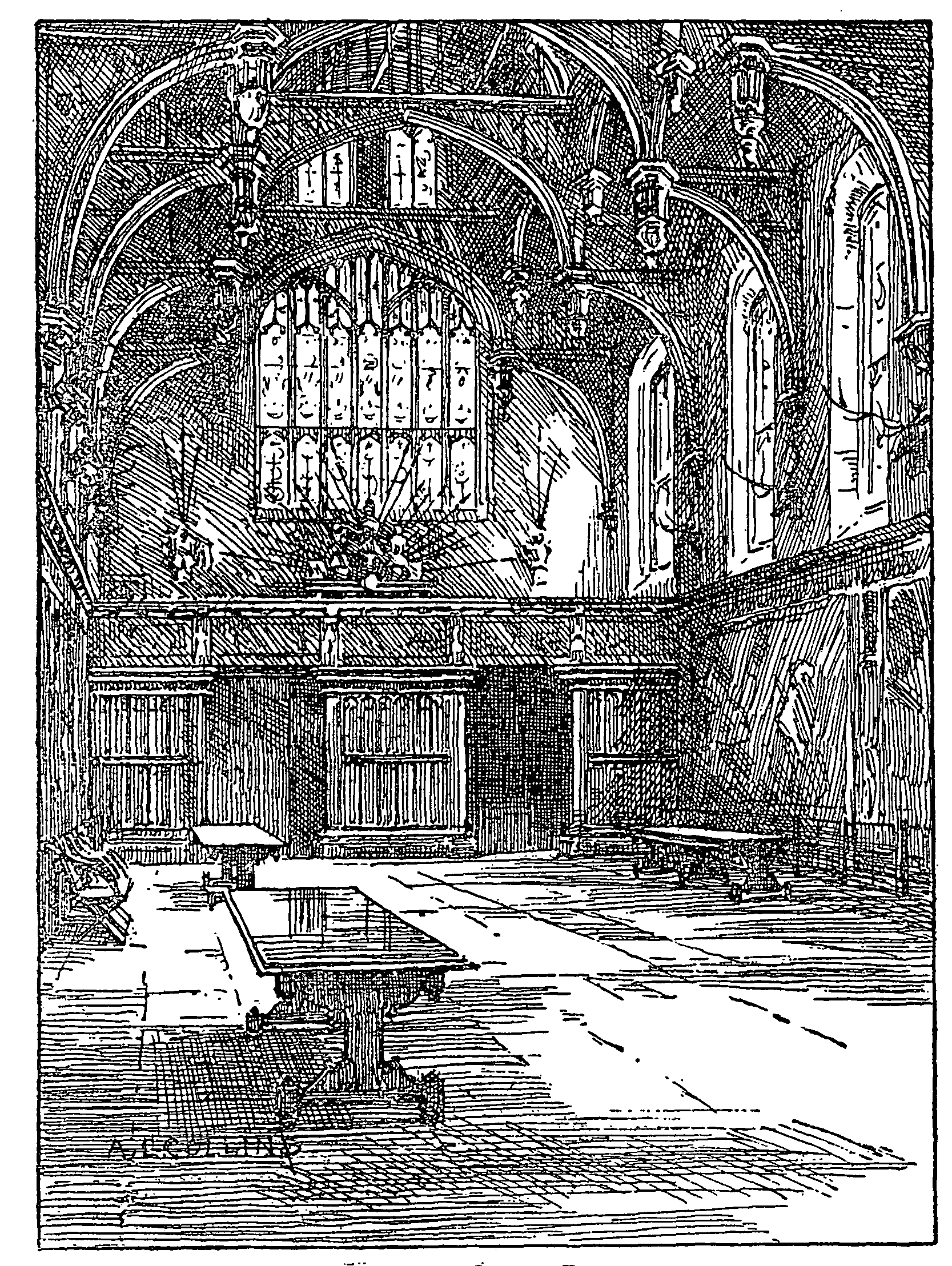
Hampton Court Palace: The Hall, Looking Towards The Screens
The most lasting consequence was that the decision to make a new translation of the Bible gave the nation the 'Authorized Version.' (fn. 320)
For eight or nine months in 1604 Henry Prince of Wales with his tutors and household remained at the palace, and there are accounts of his skill at tennis and his prowess in hunting while he was there. (fn. 321) From this time forth the king came to Hampton Court always in the autumn, the time when it is generally considered that the Thames Valley is at its worst; but he was also there for hunting in the spring, and often spent Christmas there. (fn. 322)
Up to the time of her marriage in 1610 the unfortunate Lady Arabella Stuart was constantly at Hampton Court with the king and queen. (fn. 323)
In September 1605, on Michaelmas Day, Dr. Bancroft, Archbishop of Canterbury, was sworn a Privy Councillor at Hampton Court, and the king remained there till October, (fn. 324) just before the famous meeting of Parliament after the discovery of the Gunpowder Plot. He was also there in December while the trial of the conspirators was going on. (fn. 325)
In August 1606 the queen's brother, Christian IV of Denmark, came to England and visited Hampton Court with the king and queen, they 'dyned and there hunted and killed deare, with great pleasures.' (fn. 326) The King of Denmark also saw a play 'presented by his Majesties' Players in the Great Hall.' (fn. 327) Sir John Harrington wrote an astonishing account of his convivial manners and habits. (fn. 328)
James always enjoyed associating the frivolities of the court with theological discussions, and in the autumn of 1606 he invited several of the leading ministers of the Presbyterian Church of Scotland to attend him at Hampton Court, and chose four eminent English divines to preach before them, 'for the reduction of . . . the Presbyterian Scots to a right understanding of the Church of England.' (fn. 329) Between the sermons the king received the Scottish ministers in private audience and argued with them at much length, no doubt to his own satisfaction; 'in effect they returned to Scotland of the same opinion, no good end having been served by their visit.' (fn. 330)
While they were still at the palace Francis Prince of Vaudemont, third son of Charles Duke of Lorraine, also arrived with a great retinue. (fn. 331) One of the gentlemen of the court wrote to the Earl of Shrewsbury that 'this night the Earl of Vaudemont will be here, with his crew, plus clinquant que le soleil.' (fn. 332) He stayed at Hampton Court for a fortnight, being 'very royally entertained and feasted, and rode a-hawking and hunting with the king to divers places, and then returned.' (fn. 333) Lord Shrewsbury's correspondent also described the 'dancing in the Queen's Presence Chambre,' when 'my lady Pembroke carried away the glory.' (fn. 334)
The following year saw a different scene when the queen went to Hampton Court alone, after the death of her infant daughter Mary, and 'the Court officers had leave to play, and are gone every one to his own home, only Lord Salisbury went to Hampton Court to comfort the Queen.' (fn. 335)
There are two contemporary accounts of Hampton Court in the reign of James I, (fn. 336) one written by Prince Otto, the son of the Landgrave Maurice of Hesse, who came there in 1611, and gives a long description of the palace, the tapestries, pictures, and other curiosities. Among the rooms he mentions one called 'Paradise-within which almost all the tapestry is stitched with pearls and mixed with precious stones.' (fn. 337) The Duke of Würtemberg had described this room in Elizabeth's reign, and mentioned a table-cover in it worth fifty thousand crowns, and the 'royal throne studded with . . . diamonds, rubies, sapphires, and the like.' (fn. 338) The German traveller Hentzner also spoke of it at that time, and said it 'glitters so with silver, gold, and jewels as to dazzle one's eyes.' (fn. 339) The other account is by Ernest, Duke of Saxe-Weimar, who was at the palace in 1613. (fn. 340) He was also astonished by the 'Paradise' room, and adds the detail that 'all the apartments and galleries were laid with rush matting.' He further described a 'great hunt' he had with the king, who was devoted to the sport. On 9 September 1609 the king issued from Hampton Court a stringent proclamation against 'Hunters, stealers and killers of Deare, within any of the king's Majesties Forests, Chases or Parks.' (fn. 341) Anne of Denmark shared this taste, and Ben Jonson called her 'the Huntress Queen.' (fn. 342)
On 20 September 1613 James wrote the order at Hampton Court for the removal of the remains of his mother Mary, Queen of Scots, from Peterborough to Westminster Abbey. (fn. 343) The court was at the palace again in December 1614, (fn. 344) and in April 1615. (fn. 345) In June 1616 George Villiers, afterwards Duke of Buckingham, was appointed 'Keeper of the Honour of Hampton Court for life.' (fn. 346) In September 1617 was solemnized in the chapel the marriage of Buckingham's brother, Sir John Villiers, with Frances, daughter of Lord Chief Justice Coke. The wedding was followed by a great banquet and masque, (fn. 347) when the king and his courtiers ran about the palace and played extraordinary pranks. According to the strange custom of the period, early the next morning the bride and bridegroom were given a réveille-matin, the king himself jumping and rolling on their bed 'in shirt and nightgown.' (fn. 348)
In 1618 Anne of Denmark became seriously ill, and after a short stay at Oatlands moved to Hampton Court, (fn. 349) in the hope of regaining her health away from London. She was evidently consumptive, and by the end of February 1619 grew rapidly worse. On 1 March 'all the Lords and Ladies went to Hampton Court, but very few were admitted.' (fn. 350) The physicians, (fn. 351) the Prince (Charles) of Wales, and the Bishop of London were called to her hastily in the early morning of the following day, and at four o'clock she died. (fn. 352)
Her body was embalmed and taken by water in a royal barge to Somerset House. She was afterwards buried in Westminster Abbey. (fn. 353)
One of the curious economies of James I was the refusal to grant 'lodgings' in the precincts to any of the ambassadors, but in 1620 he allowed Gondomar, the Spanish ambassador, to take up his residence in one of the detached towers of the palace. (fn. 354) Inigo Jones was surveyor of the Royal Works at the time, (fn. 355) and a letter which is said to be the only one of his that has been preserved is from Hampton Court, and is addressed to the Earl of Arundel and Surrey, concerning the 'lodgings intended for the ambassador.' (fn. 356)
In January 1620-1 the French ambassador was invited to the palace, and 'nobly entertained with hunting and hawking,' probably to prevent any jealousy concerning the Spaniard. Charles, Prince of Wales, returned to Hampton Court in September 1623, after his romantic journey to Spain, to make his own proposals of marriage to the Infanta, or rather perhaps to test the sincerity of the professions of the Spanish government. (fn. 357)
The negotiations were broken off very soon after Charles's return, and in September 1624, when the chargé d'affaires for Spain, in the absence of the ambassador, came to the palace, he was received with great coldness, (fn. 358) and did not even see the prince, who had had a severe fall while hunting in the park a week or two before, and remained in his own room. (fn. 359) There is no record that James I was at Hampton Court again before his death on 27 March 1625.
During the earlier part of the reign of Charles I (fn. 360) Hampton Court was chiefly the scene of his many difficulties with regard to Henrietta Maria's household, (fn. 361) and the record is one of succeeding misunderstandings, quarrels and reconciliations with her and with the diplomatic agents of France. The lady in waiting who had the greatest influence over the queen, and therefore inspired great distrust in Charles and his advisers, was Mme. de Saint Georges. Charles seized the opportunity, both in going to Hampton Court for the first time with his wife, and on leaving it for Windsor, to exclude Mme. de Saint Georges from the coach which carried himself and the queen. De Tillières, who was Henrietta Maria's chamber lain, says that as he was conducting the queen down the steps of the Great Hall, when they were leaving the palace, he heard the king and the Duke of Buckingham speaking about it, and that Charles made Lord Hamilton take a seat inside the coach that Mme. de Saint Georges might be excluded. (fn. 362) The quarrels were no doubt rather between Buckingham and the ladyin-waiting than between Charles and his queen. (fn. 363) Jealousies that arose from the presence of the king's chaplain and the queen's Roman Catholic confessor also led to trouble. One day when the king and queen were dining together in the 'Presence Chamber' at Hampton Court, 'Mr. Hacket (chaplain to the lord-keeper) being there to say grace, the confessor would have prevented him, but that Hacket shoved him away; whereupon the confessor went to the queen's side, and was about to say grace again, but that the king, pulling the dishes unto him, and the carvers falling to the business, hindered. When dinner was done' they both started saying grace aloud together, 'with such confusion that the king in great passion instantly rose from the table, and taking the queen by the hand, retired into the bedchamber.' (fn. 364) Such a scene at the king's table seems hardly credible in these days.
As the virulence of the plague kept the court away from Whitehall, and a proclamation was issued to prohibit communication between Hampton Court and London, (fn. 365) the French ambassador, M. de Blainville, was very anxious to be lodged in the palace, and he tried in various ways to overcome the king's reluctance. Sir John Finett, the Master of the Ceremonies, told him that 'his Majesty would be loth to make a "President," that would hereafter . . . beget him so great a trouble as this was like to be.' (fn. 366) The rooms were at last granted to him, and 'Mr. Secretary' Conway writing to Buckingham from Hampton Court complains much of the expense and trouble caused thereby. (fn. 367)
In 1626 Paul Rosencrantz, the Danish ambassador, was received twice at Hampton Court, (fn. 368) and an ambassador from Bethlem Gabor, 'the Prince of Transylvania,' also had an audience. (fn. 369) On 6 October Laud was appointed Dean of the Chapel Royal, and took the oath in the vestry of the chapel at Hampton Court before the Lord Chamberlain. (fn. 370) Eventually the difficulties concerning Henrietta Maria's household arrived at such a pass that Richelieu sent the Marquis de Bassompierre to try to arrange a compromise. On Sunday, 11 October, he arrived at Hampton Court in one of the king's coaches. A splendid repast had been prepared for him, but neither he nor his suite would touch it. To enter into the details of his mission is not possible here; de Bassompierre acted with tact and discretion, but ineffectually, (fn. 371) and on 31 July 1626, after a final scene with the queen, Charles insisted on her French attendants being turned out of Whitehall. On 8 August they re-embarked for France. (fn. 372)
Charles continued to visit Hampton Court at intervals, and the Duke of Buckingham was constantly with the king there up to the time of his own assassination in 1628. (fn. 373) The usual court ceremonies, and the usual plays performed by the king's players, took place from time to time, and it is interesting to find two of Shakespeare's plays among them-the Moore of Venice, on 8 December 1636, and Hamlet on 24 January 1637. (fn. 374)
In June 1636 Strafford came to Hampton Court to 'kiss hands' on his appointment as Lord Deputy of Ireland. (fn. 375) In 1639 Charles caused the canal called the 'King's' or 'Longford' River to be cut for the supply of water to the palace; (fn. 376) he also interested himself in the gardens and in the decoration of the interior. The catalogue of his pictures was compiled by Vanderdoort in the same year, and he also attempted once more to make a 'chase' and inclose it with a wall; but, as before, the inhabitants objected so strongly to the encroachment on their lands and commons (fn. 377) that the scheme had to be given up; and political difficulties were thickening rapidly round the king so that he had little further time to devote to private or domestic interests. He was at Hampton Court in December 1641, when Parliament presented to him 'the Grand Remonstrance.' (fn. 378) He refused to answer it immediately, and Parliament caused the text of the declaration to be published at once, much to the king's annoyance. Three days later he entertained seven of the city aldermen at the palace, and knighted three of them in the hope of reviving personal loyalty to himself in the City; (fn. 379) but the time to remove difficulties by such means was past.
In January 1642 Charles made his untoward attempt to arrest 'the Five Members' in the House of Commons, and, alarmed by the menaces of Parliament and people, the king and queen, with their family, fled from London to Hampton Court, where their arrival was so unexpected that they and their three eldest children had to share one room. (fn. 380) This ill-judged flight led to the final breach between king and Parliament. It meant practically the surrender of London, with all its arsenals and stores, to the Parliamentary party. Colonel Lumsden, who had commanded the royal escort, realized the danger, rode on to Kingston with his squadron, and took possession of the magazine of arms in the town. Lord Digby drove over from Hampton Court the next morning to thank him for what he had done, and to suggest further measures. For this Lord Digby was afterwards attainted of treason for 'levying war,' and Lumsden was arrested by the Parliamentary party and sent to the Tower. (fn. 381)
On 12 January 1642 the king moved to Windsor for 'greater security,' (fn. 382) and only returned to the palace for one night, at the end of February, when the queen was on her way abroad, until he was brought back, five years later, as a prisoner. (fn. 383)
After the battle of Naseby, in 1645, Hampton Court had become the property of the state, seals were affixed to the doors of the state apartments, and Sir Robert Hadow gave orders for the destruction of the religious emblems in the chapel. All the pictures, the stained glass in the windows, and the altar-rails, were pulled down and destroyed. (fn. 384)
Charles returned, as a prisoner, on 24 August 1647, and remained for about two months, receiving honourable and dignified treatment. (fn. 385) He dined in public in the 'Presence Chamber' as he had done formerly, and any gentlemen who wished to show their loyalty might attend and kiss his hand. John Evelyn, the diarist, was among them. (fn. 386) The king's old servants and faithful followers were allowed to confer with him ; Mr. John Ashburnham and Sir John Berkeley, though voted delinquents by Parliament, were permitted to return and to be constantly with the king. (fn. 387) He also had his own chaplains, and his two younger children, who were then with the Duke of Northumberland at Syon House, were brought over to see their father, and sometimes to stay with him. He also played at tennis and hunted in the parks, (fn. 388) but the Parliamentary Commissioners were living in the palace, and a guard of soldiers, under a Parliamentary officer, Colonel Whalley, was kept in attendance. (fn. 389) The head quarters of the army was at Putney, and Cromwell, with other superior officers, came over to see the king. It was noticed that Fairfax kissed his hand, but Cromwell and his son-in-law, Ireton, though they expressed themselves in a loyal manner, declined the ceremony. (fn. 390) Charles's prospects really looked brighter than they had done for some time previously; Cromwell had long conferences with him of a friendly nature, and he received Mrs. Cromwell very graciously. (fn. 391) One of the most interesting of the historical scenes of which Hampton Court has been the background is that of Charles and Cromwell walking together, in friendly converse, through the galleries or in the gardens of the palace. (fn. 392) It is generally thought that Cromwell at the time sincerely wished to come to terms with the king, (fn. 393) but Charles's fatal love of intrigue, and of what he considered 'king-craft,' entirely destroyed any prospect of compromise, and the Parliamentary officers gradually ceased to come to Hampton Court. (fn. 394)
Charles understood the difference in his position, and was warned that he was in danger of assassination while he remained in the palace. (fn. 395) He eventually withdrew the promise that he had made to Colonel Whalley not to attempt to escape. (fn. 396) Ashburnham was dismissed, and the guards were doubled, but in other ways the king was allowed the same liberty as before, and his daughter Elizabeth came to stay with him in October. (fn. 397) She complained of the noise made by the two sentinels stationed in the gallery into which her bedchamber, as well as that of the king, opened, perhaps in the hope that they might be removed; but Colonel Whalley only gave stricter orders to the soldiers to move quietly, unless the king 'would renew his engagement' not to escape, but this Charles refused to do. (fn. 398) Ashburnham and Berkeley were chiefly concerned in arranging for the king's escape, which took place on 11 November, 1647. (fn. 399) On the day before, Whalley had shown him the letter from Cromwell, which has always been quoted to prove that Cromwell did not wish to prevent the king's escape, but meant to use it against him. (fn. 400) From Colonel Whalley's official narrative of the event read in the House of Commons, it appears that after showing Charles the letter Whalley withdrew, leaving the king to carry on his correspondence as usual, as it was mail-day. He waited till six o'clock 'without mistrust,' and then, as there seemed no sign of the king's appearance for the evening meal, and his door remained locked, Whalley spoke to the king's gentleman-inwaiting, who tried to reassure him, but at seven o'clock he became, according to his own account, 'extreme restless in my thoughts, lookt oft in at the key-hole to see whether I could perceive his Majesty, prest Mr. Maule to knock very oft-he still plainly told me he durst not disobey his Majesty's commands'-which were that he had important letters to write, and was not to be disturbed on any account. (fn. 401)
Meanwhile, in the early darkness of the November evening, Charles had already left the palace, with Colonel Legge, passing through the room called 'Paradise' (fn. 402) by the private passage spoken of as 'the vault,' to the river-side, (fn. 403) where he was met by Ashburnham and Berkeley, with horses, and so made good his escape. (fn. 404) It has never been satisfactorily decided whether they crossed the river at Thames Ditton, and went thence through West Molesey to Oatlands, (fn. 405) or whether they rode to Hampton and over Walton Bridge to Oatlands. (fn. 406) In the first report to the House of Commons, the Speaker said that 'the king went last night, with nine horses, over Kingston Bridge.' (fn. 407) Colonel Whalley became desperate at about eight o'clock, called Mr. Smithsby, the 'keeper of the Privy Lodgings,' and with him went by the back way, 'through the Privy Gardens to the Privy Stairs, where he had sentinels stationed. (fn. 408) . . . We came to the next chamber to his Majesty's bed-chamber, where we saw his Majesty's cloak lying on the midst of the floor, which much amazed me.' Whalley then sent for the Parliamentary Commissioners to go with them, and the king's servant, Mr. Maule, went into the bedchamber and declared that the king was not there. On his table were found three letters, one addressed to Colonel Whalley, one to the Parliamentary Commissioners, and one to both Houses of Parliament. (fn. 409) He assured Whalley that it was not Cromwell's letter which had caused him to take this step, but confessed that he was 'loath to be made a close prisoner under pretence of securing my life.' The rest of the letter is chiefly concerning the 'household stuffe and moveables,' which the king still looked upon as his own. It does not appear that he realized at all the extreme significance of the step he had taken. Whalley immediately sent out soldiers to search the lodges in the park, and Colonel Ashburnham's house at Ditton, and informed the generals at head quarters, then at Putney, of the occurrence. Cromwell rode over to Hampton Court at once, (fn. 410) and wrote to the Speaker of the House of Commons from the palace at twelve o'clock the same night. His letter, and that of the king, were laid before the House the next day. This was the last departure of Charles I from the palace. (fn. 411)
Immediately after the execution of the king a Bill was introduced into Parliament to provide for the sale of all the property of 'the late Charles Stuart.' This Bill was passed on 4 July 1649, (fn. 412) and a very full and ample inventory was made of all the furniture, plate, jewels, pictures, tapestries, &c., in Hampton Court Palace. The inventory is still preserved in the British Museum, (fn. 413) under the title 'Goods viewed and appraised at Hampton Court, in the custody of William Smithsbie, Esq., Wardrobe Keeper, 5 Oct. 1649.' The sum at which each entry was valued, and the price for which it was sold, are entered, together with the name of the purchaser. A certain number of the tapestries, (fn. 414) pictures, &c., were fortunately eventually kept 'for the use of the Lord Protector.' The sale lasted for nearly three years. (fn. 415)
A rough survey of the manor was also made in view of its being sold for 'the benefit of the Commonwealth.' (fn. 416) The palace was valued at £7,777 13s. 5d. (fn. 417) The total value of the manor, including the parks and other inclosures, was computed to be £10,765 19s. 9d.
The Council of State, however, concluded that Hampton Court, Whitehall, Westminster, and a few other places were 'to be kept for the public use of the Commonwealth.' (fn. 418)
In October 1651 Cromwell installed himself in the palace, but in November 1652 a Bill for the sale of the late king's houses and lands hitherto exempted was brought before Parliament, and it was resolved that Hampton Court, 'together with the Parks, the Harewarren and Meadows-with appurtenances-be sold for ready money.' (fn. 419) Further debates took place on the subject, (fn. 420) and it was even offered to Cromwell in exchange for 'New Hall' in Essex, (fn. 421) but at that time he refused the proposal, and the parks were put up for auction on 15 November 1653, the fee of the honour and manor having been previously sold. (fn. 422) Cromwell was proclaimed Lord Protector in December 1653, and immediately proceeded on behalf of the State to buy back the palace and surrounding property. (fn. 423) On 30 August 1654 Mr. Phelps, (fn. 424) to whom the manor had been sold, re-conveyed it to Cromwell; in 1657 the Lord Protector's name is entered in the Court Rolls as lord of the manor. (fn. 425)
Cromwell was constantly at Hampton Court after this, and one of the early records of his time is concerning a Royalist plot to assassinate him on his way to or from London to the palace, frustrated by his receiving a timely warning and returning by another road. (fn. 426) He transacted affairs of state at Hampton Court, and the members of the council came down to him on such occasions as they had done during the late king's reign. (fn. 427) Mrs. Cromwell, the 'Lady Protectress' as she was sometimes called, seems to have attempted, somewhat awkwardly, to hold a sort of court in the palace. In a scurrilous pamphlet entitled The Court and Kitchen of Joan Cromwell her household and habits are commented on in no kindly spirit. It is said, among other accusations, that she had little labyrinths and trap-doors made for her, 'by which she might at all times, unseen, come unawares upon her servants, and keep them vigilant in their places.' (fn. 428) Occasionally, however, public entertainments had to take place, and some of the old state was revived, such as the Protector's bodyguard of halberdiers attending in the banqueting room, and the old court ceremonials being observed in bringing up the dishes to the table. On 25 July 1656 the Swedish ambassador dined and hunted with Cromwell at Hampton Court (fn. 429) quite in the old manner, but this return to ceremony was by no means relished even by his friends and supporters. (fn. 430) A curious picture of his familiar ways with his officers and ordinary associates is given by both Whitelocke and Heath. Heath says, 'His custom was now to divert himself frequently at Hampton Court . . . here he used to hunt . . . his own diet was very spare, and not so curious, except in publique Treatments, which were constantly given every Monday in the week to all the officers of the Army not below a Captain, where he dined with them and shewed them a hundred Antick Tricks, as throwing of cushions and putting live coals in their pockets and boots . . . he had twenty other tricks in his head.' (fn. 431) He was fond of music, and instruments of one kind or another were always played during his banquets at the palace. He also had two good organs put up in the Great Hall, on which no doubt his secretary, Milton, used to play. (fn. 432) There is also record of sermons preached before him in the chapel, where the rich ornamentation of the Tudor roof of Henry VIII must have been strangely out of keeping with the severity of the Puritan preaching. (fn. 433) Cromwell's third daughter Mary was married to Lord Falconbridge in the chapel on 17 November 1657. This public marriage was solemnized by one of Cromwell's chaplains, in accordance with the rite accepted by the Puritans, but they also seem to have been married privately on the same day by Dr. Hewitt, with the Church of England ceremonial, partly to please Mary Cromwell, who was still a member of the Church, and partly no doubt that there should be no question of the validity of the marriage in the event of a Restoration. (fn. 434) Cromwell always seems to have amused himself on such occasions with the 'anticks and tricks' mentioned by Heath. (fn. 435)
The accounts of conspiracies and plots against the 'Lord Protector's' life read like the records of a modern anarchist society. In 1657 it was actually proposed that he should be blown up by a sort of 'infernal machine' at Hammersmith, on his way to Hampton Court. The Duke of York, writing to Charles II, says calmly that the plan was 'better laid and resolved on than any he had known of the kind.' (fn. 436) In the same year a Captain Thomas Gardiner was also 'taken in the gallery at Hampton Court with two loaded pistols and a dagger.' Such discoveries naturally had some effect on Cromwell, and Heath says he was always 'shifting and changing his lodging, to which he passed through several locks; when he went between Whitehall and Hampton Court he passed by private and back ways, but never the same way backward and forward; he was always in a hurry, his guards behind and before riding at full gallop, and the coach always filled with armed persons, he himself being furnished with private weapons.' (fn. 437) He seems to have felt himself safer at Hampton Court than in London, and was constantly there with his children and grandchildren, to all of whom apartments in the palace were assigned. (fn. 438) Only one of his sons-in-law, Fleetwood, who lived near Hampton Court, was avowedly Republican, and refused to allow his wife to visit her father. (fn. 439) Cromwell's favourite daughter was Elizabeth Claypole, and she died at Hampton Court, after a short illness, on 6 August 1658, (fn. 440) to the inconsolable grief of her father. Dr. Bates, Cromwell's physician, who attended her, testifies to her great distress and agony of mind, and declares that on her death-bed she implored her father to make atonement for his disloyalty by taking steps to ensure the restoration of the king. (fn. 441) Her body was taken by water to London and buried among the kings and queens in Westminster Abbey.
A week after her death Cromwell himself was dangerously ill, (fn. 442) and though he recovered sufficiently to ride in the park on 17 August, George Fox, who came to the palace to present a petition on behalf of the Quakers, says that 'he looked like a dead man.' (fn. 443) He shortly afterwards again visited Cromwell, but found that he had become too ill to see anyone. (fn. 444) On 24 August he was confined to his room; the doctors evidently thought that he was dying, (fn. 445) and 'a public fast was ordered for his sake and kept at Hampton Court'; (fn. 446) but two days later he was well enough to receive Whitelocke, who dined with him. (fn. 447) However, the improvement did not continue, and he was removed to Whitehall, (fn. 448) where he died on 2 September 1658, the eve of his 'fortunate day,' the anniversary of the battles of Worcester and Dunbar. (fn. 449)
Richard Cromwell probably desired to keep Hampton Court as his private property; the Cromwell family certainly endeavoured to take possession of some of the contents, and an inventory (fn. 450) was immediately made by the Parliamentary Commissioners, who did not acknowledge Mrs. Cromwell's claim. (fn. 451) Richard Cromwell was also ordered not to kill deer in the parks. (fn. 452) A resolution was once more passed in the House of Commons for the sale of Hampton Court and other royal manors and parks, (fn. 453) but Ludlow seems to have considered the place 'very convenient for the retirement of those in public affairs, when they should be indisposed in the summer season,' (fn. 454) and he was successful in preventing the sale. In February 1660 a Bill was introduced in the 'Long Parliament' to settle Hampton Court on Monk, the Parliamentary General, (fn. 455) but he looked on it as a bribe, and induced his friends to have the Bill rejected. On 15 March 1660 a sum of £20,000 was voted to him, together with the custody and stewardship of Hampton Court Manor and Park for his life, (fn. 456) an office in which he was confirmed by Charles II almost immediately after his restoration. (fn. 457)
Charles II made a great many alterations in the palace, (fn. 458) and frequently went backwards and forwards between Hampton Court and Whitehall, riding down early in the morning to play tennis, and returning the same day. (fn. 459) From 1662 to 1667 many applications for offices about Hampton Court were made to the Crown. The 'Housekeeper of Hampton Court,' the 'Keeper of the Standing Wardrobe,' 'Keeper of the Still House,' 'Keeper of the Game about Hampton Court,' are a few of the coveted titles. (fn. 460) One claimant, Clement Kynnersley, Yeoman of the Wardrobe of Beds, seems to have been afraid that his services would not be sufficiently appreciated. He not only claimed £7,000 for 'arrears of salary,' but declared that 'he had, by his exertions, preserved £500,000 worth of His Majesty's goods together at Hampton Court from sale and embezzlement.' (fn. 461) Edward Progers, Groom of the Bedchamber to the king, received a great many of these appointments, chiefly of privileges granted in and about Hampton Court. He rebuilt the Upper Lodge in Bushey Park, spent £4,000 on it, (fn. 462) and had some difficulty in getting a warrant for the payment of the amount. (fn. 463) De Grammont declares plainly what the extremely equivocal services were for which he was thus rewarded by the 'Merry Monarch.' (fn. 464)
The marriage of the king and Catherine of Braganza took place at Portsmouth on 21 May 1662, (fn. 465) and they arrived at Hampton Court on the 29th. (fn. 466) Their progress, judging from the contemporary etchings by Dirk Stoop, must have been stately and dignified. They probably alighted at the foot of the Great Hall Stairs under Anne Boleyn's Gateway, and in the Great Hall itself were received by the Lord Chancellor Clarendon, (fn. 467) the Lord Treasurer, and the Councillors of State.
In the Presence Chamber they were met by the foreign ministers, the peers, and the lords and ladies of the court, who came to do homage to the new queen. (fn. 468) The Duchess of York also came by barge from London, and was received at the 'Privy Garden Gate' by the king himself. (fn. 469) Two days after, John Evelyn the diarist records that he was taken by the Duke of Ormonde to be presented to the queen, and saw her dining in public. (fn. 470)
Like Henrietta Maria before her, and in the same place, Catherine suffered on account of her retinue, who were quite unable to adapt themselves to their gay surroundings, (fn. 471) and were described by de Grammont as 'six frights . . . and a Duenna, another Monster.' (fn. 472)
At first, however, the king and queen amused themselves with entertainments out of doors, balls, plays and music indoors. Evelyn gives an account of their going on the river in a gondola, a present from the state of Venice, and on another occasion mentions 'the Queen's Portugal music, consisting of fifes, harps, and very ill voices.' He also describes the queen's bed, 'of embroidery of silver on crimson velvet, and cost £8,000-a present from the States of Holland . . . and the great looking-glass and toilet of beaten and massive gold given by the Queen-Mother. The Queen also brought over with her from Portugal such Indian cabinets as had never been seen here.' (fn. 473) Pepys was also much struck by the 'noble furniture.' (fn. 474) His diary and other records are full of gossip concerning occurrences at Hampton Court, (fn. 475) and he expressed the discontent of the people at the length of time during which 'the King and new Queen minded their pleasures at Hampton Court.' (fn. 476) As it happened in the palace it is necessary to mention the insult Charles was weak enough to offer the queen, by unexpectedly bringing the notorious Lady Castlemaine into her presence before the whole court. (fn. 477) The scene ended in the utmost confusion, for the queen fainted, and afterwards maintained her absolute refusal to receive Lady Castlemaine. Clarendon has described all that followed, (fn. 478) and to his own dishonour was persuaded by the king to use his influence with the queen, not only to receive Barbara Palmer, but to make her a Lady of the Bedchamber. For some time Catherine persisted in her refusal, and Clarendon says that 'Everyone was glad . . . they were still at Hampton Court and that there were so few witnesses of all that passed. The Queen sat melancholic in her chamber in tears, except when she drove them away by a more violent passion in choleric discourse; and the king sought his diver tisements in that company that said and did all things to please him.' Catherine's Portuguese attendants were sent away; she was told, not truly, that her dowry was in arrears; and the Portuguese ambassador was 'so grossly insulted that he left Hampton Court and retired to his own house in the city.' Lady Castlemaine had apartments assigned to her in the palace, and received greater homage than the queen herself. At last the pressure brought to bear on Catherine had its effect, and she yielded to the king's wishes; Clarendon being the first to blame her for the 'downfall' he himself had been instrumental in bringing to pass. (fn. 479)
On 28 July the king and queen went to meet Henrietta Maria at Greenwich, and on their return to Hampton Court supped together in public that their reconciliation might be understood. (fn. 480) Two days later the queen mother arrived at the palace, which she had not visited since the fatal flight from London in 1642. (fn. 481) She alighted at the foot of the stairs leading to the Great Hall, where she was received by the queen, and they sat together in the Presence Chamber, under the 'Cloth of State.' The king and the Duke of York had to act as interpreters, for Catherine could not speak French, nor Henrietta Spanish or Portuguese. (fn. 482) She shortly afterwards returned to Greenwich, but Charles and Catherine remained at Hampton Court till 23 August, when they made their state entry into London by river. (fn. 483) Pepys and Evelyn both describe the scene of the journey, the number of spectators, the barges and boats that covered the river, the splendid reception given to the king and queen. (fn. 484) It can hardly be hoped that all this magnificence was much comfort to Catherine; from that time forward a suite of apartments was always kept for Lady Castlemaine at the palace, and in 1666 was fitted up again for her. (fn. 485)
Several distinguished travellers who visited England at this time have left records of their impressions of Hampton Court, among them the Duc de Monconys and M. de la Molière, in 1663. (fn. 486)
In 1665 the king and queen were at the palace, in quarantine from the plague, the deaths in London amounting to 267 a week. (fn. 487) They remained at Hampton Court for a month, the king transacting business with the council at Syon House, probably that they might not come to the palace from London. (fn. 488) Pepys gives an entertaining account of his being at Hampton Court on 23 July, 'where I followed the king to chapel and there heard a good sermon.' He was distressed because no one invited him to dinner, but was eventually entertained by Mr. Marriott the housekeeper, in whose house he found 'good dinner and good company, amongst others Mr. Lilly the painter.' (fn. 489)
On 26 July the king and queen went by river to Greenwich, and thence proceeded to Salisbury and afterwards to Oxford, where Parliament had been summoned to meet on account of the plague in London. In January of the following year it was thought safe for the king to return to London; he stayed at Hampton Court for a week; Pepys and Evelyn record their visits to him there. (fn. 490) The queen also stayed there for a couple of days on her way back from Oxford in February. (fn. 491) In September 1666, at the time of the Great Fire of London, many of the king's valuables were sent by water to Hampton Court for safety. (fn. 492)
Towards the end of his reign Charles was not often at the palace, but he sometimes came down to play tennis, or for stag-hunting, (fn. 493) and he retired there with the Duke of York in August 1669, when they received news of the death of their mother, Queen Henrietta Maria. (fn. 494) There is also an account of a council held in the palace in June 1679, when Charles, to the dismay of the majority of those present, ordered the Chancellor to prepare a proclamation for the dissolution of the Parliament then sitting, and a writ for calling together a new one. (fn. 495) At another council in the palace on 23 May 1681 an order was issued by Charles forbidding 'the king's servants to frequent the company of the Duke of Monmouth,' whose conduct had become so overbearing as to excite the displeasure even of his father. (fn. 496)
Charles never stayed at Hampton Court for any length of time after 1666, though he continued to pay short visits and to hold councils there. (fn. 497) Concerning one of these visits a story is told by Walpole of the reckless extravagance of Verrio the painter, who had done much work in the palace, and had received large sums from Charles, which did not prevent him from constantly asking for more. On one occasion at Hampton Court, when he had but lately received an advance of £1,000, he found the king in such a circle that he could not approach him. He called out: 'Sire, I desire the favour of speaking to your majesty.' 'Well, Verrio,' said the king, 'what is your request?' 'Money, sir, money; I am so short of cash that I am not able to pay my workmen; and your majesty and I have learnt by experience that pedlars and painters cannot give long credit.' The king smiled, and said he had but lately ordered him £1,000. 'Yes, sir,' replied he, 'but that was soon paid away, and I have no gold left.' 'At that rate,' said the king, 'you would spend more than I do, to maintain my family.' 'True,' answered Verrio, 'but does your majesty keep an open table as I do?' (fn. 498)
James II never appears to have lived at Hampton Court during his reign, though he held a council there on 29 May 1687, when 'the militia was put down, and the licensing of ale-houses was put in other hands than the justices of the peace.' (fn. 499) He was, however, often at Hounslow, where he encamped in 1687 with an army of 16,000 men, a force which apparently only met with derision. (fn. 500)
The reign of William and Mary opens a new era in the history of Hampton Court Palace, as under their auspices more than half the original Tudor building was pulled down. Wren's new palace was erected, and the whole place assumed very much the appearance it has now. (fn. 501) The quietness of the situation, the distance from London, and perhaps something congenial to William's Dutch taste in the formal lines of the avenues and the long canal, formed no doubt part of the attraction which the place evidently had for him. Mary has never been given credit for any feelings of sympathy for her father, and has often been censured for her apparent heartlessness, but perhaps one reason for her affection for Hampton Court was that James II had never lived there as king, and she could have had no memories of the place connected with him. From the beginning of their reign Mary and her husband paid frequent short visits to the palace, (fn. 502) and one of William's first acts was to offend the religious susceptibilities of a large proportion of his subjects by refusing to continue the ancient custom of 'touching for the king's evil,' a practice which he had the blunt common-sense to denounce as a 'silly superstition.' (fn. 503) At Easter as usual a crowd of diseased folk arrived at the palace, but had to be content with the customary dole and no ceremony. (fn. 504)
William seems to have decided at once that the old palace was inconvenient and ill-arranged. Queen Mary wrote to a friend in Holland that it had been much neglected, (fn. 505) and almost immediately after their first visit Christopher Wren was appointed architect and the works began. (fn. 506) Wren's building will be dealt with in another place, (fn. 507) but while plans and elevations were being prepared, and the work of demolition had actually begun, the king and queen still passed a great deal of time in the palace. On 31 March 1689 they publicly received the sacrament in the chapel from the Archbishop of York, in preparation for their coronation at Westminster on 11 April. (fn. 508) They soon afterwards returned to Hampton Court, and the Princess Anne joined them there. (fn. 509) The routine of their life was sufficiently simple; Queen Mary superintended everything herself, inspecting the building and the gardens, making fringe, and playing 'Bassett.' (fn. 510) In May a declaration of war with France was issued from Hampton Court, and during that month the king and Prince George of Denmark went from the palace to inspect the fleet at Portsmouth. (fn. 511) The king hunted in the parks, and occupied himself during the first summer by visiting the camp formed on Hounslow Heath on 13 August. He rode over from Hampton Court to review the troops there on 17 August. (fn. 512)
An alarm was caused in July by intelligence of a supposed plot to attempt the king's life, to set fire to Whitehall and other places in London, and to seize the Tower. (fn. 513) Several companies of foot and horse were kept under arms all night round the palace, the guards were doubled, and stringent measures taken to prevent the entry of suspicious persons, but nothing further seems to have happened. The king, however, remained constantly at Hampton Court, and the life of the court was so quiet as to cause great dissatisfaction among the people. (fn. 514) Lord Halifax took upon himself to inform William that 'his inaccessibleness and living so at Hampton Court altogether, and at so active a time, ruined all business,' and remonstrated with him on the loss of time caused to the ministers, who took five hours to come and go. The king answered, peevishly, 'Do you wish me dead?' (fn. 515) The 'Bill of Rights' was being debated at the time, and no doubt William's presence in London was highly desirable. The vexed question of the succession was for the moment set at rest by the birth at Hampton Court, on 24 July, of the Princess Anne's son, William Henry, afterwards known as Duke of Gloucester. He was baptized in the chapel on the evening of Saturday, 28 July, just a hundred and fifty years after the last christening there of an heir to the throne, (fn. 516) and from the first seems to have been a very weakly child. (fn. 517) The usual routine of the court was observed; William's adherents were knighted, and the ambassadors were received. On 29 August, George Walker, the hero of the defence of Londonderry, was given an audience by the king and queen, who made him a present of £5,000. (fn. 518)
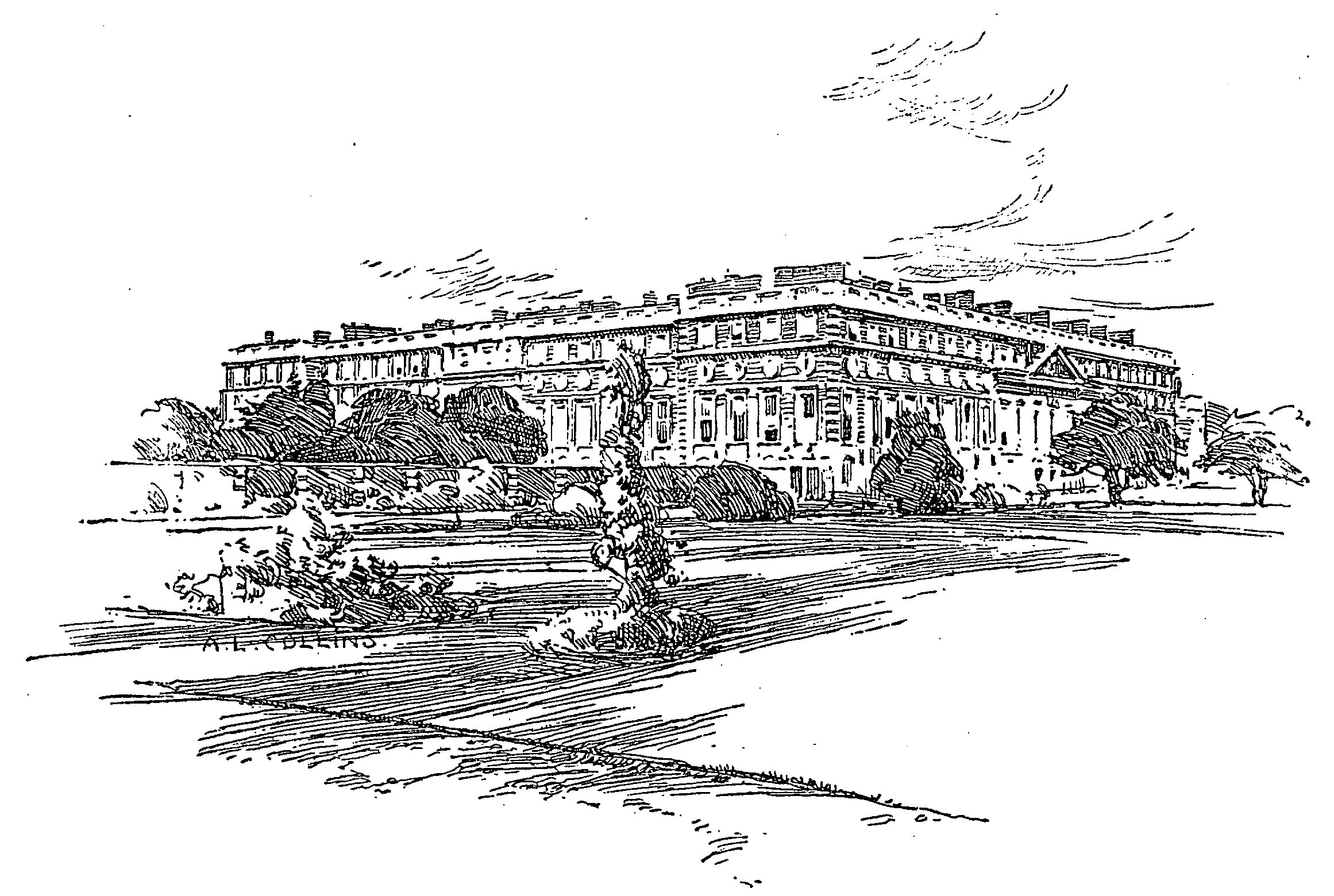
Hampton Court Palace: William The Third's Buildings From The South-East
The history of the palace during this reign is chiefly the history of the new building, which absorbed all attention when William and Mary were there. Quarrels occasionally arose between Wren, the 'surveyor,' and Talman, the 'comptroller,' (fn. 519) and the queen wrote constantly to the king during his absences in Ireland and Holland, complaining of the delays caused by 'want of money and Portland stone.' (fn. 520) Pending the completion of the new state apartments Mary installed herself in the building known as the 'Water Gallery,' where Queen Elizabeth had been lodged as a State prisoner, (fn. 521) and it is recorded that Mary made of it 'the pleasantest little thing within doors that could possibly be made, with all the little neat curious things that suited her conveniences.' (fn. 522) The interior was decorated for her by Wren in the style that appears in his state apartments, with painted ceilings and panels, carved doorways and cornices, (fn. 523) oak dados, hangings of tapestry, and the characteristic corner fire-places with diminishing shelves in tiers above them. Mary first introduced the taste for 'blue and white' oriental china into England; many of her quaint specimens are still to be seen in the palace. She had James Bogdane, a fashionable painter of animals, to decorate the 'Looking Glass Closett' for her; (fn. 524) she also had a 'Marble Closett,' finely painted, and a 'Bathing Closett' fitted with a white marble bath. (fn. 525) She also had a dairy in which she took much pleasure. (fn. 526) There is something very modern in the picture of her life thus presented. Her chief employments were her constant consultations with Wren, (fn. 527) who seems to have found her taste excellent, about the building, superintending the garden, making her botanical collection, (fn. 528) and working with her needle. Burnet says 'she wrought with her own hands-sometimes with so constant a diligence, as if she had been to earn her bread by it.' (fn. 529) Specimens of her needlework remained in the palace up to a comparatively recent date. (fn. 530) The queen, inspired no doubt by Lely's paintings of the beauties of the court of Charles II, also started making a gallery of portraits of the ladies of her own court, painted by Sir Godfrey Kneller. (fn. 531) When the 'Water Gallery' building was destroyed after Queen Mary's death, because it spoilt the view from the windows of the new palace, these pictures were placed in a room under the king's guard-chamber, known thenceforth as the 'Beauty Room,' and sometimes used by William as a private diningroom. (fn. 532) They are now in William the Third's 'Presence Chamber,' with other examples of Kneller's work. (fn. 533)
In 1690 William commanded the army in Ireland during the summer, and in 1691-4 he was absent for summer campaigns in the Netherlands. (fn. 534) During these numerous absences Mary was appointed regent, and affairs of State kept her chiefly in London, but she wrote constantly to report the progress of the new building at Hampton Court to the king. (fn. 535) The expenses of the war made it difficult to obtain sufficient funds from the Treasury to carry on the work, and Mary wrote on 12 July 1690 that the deficit had become 'so just a debt that it ought to be paid.' (fn. 536) Wren, in the Parentalia, says that the 'two royal apartments' were not finished till 1694, shortly before Mary's death; (fn. 537) they were sufficiently advanced when the king and queen visited them on 30 December 1691 for their magnificence to be fully appreciated, (fn. 538) but Mary never occupied the apartments in which she had taken such keen interest, (fn. 539) and William's final alterations and improvements were not finished till twelve years later. The king's pleasure in the place was much diminished by the loss of his wife, and for some years the work languished, (fn. 540) until, in January 1698, the palace of Whitehall was burnt down, and William once more turned his attention to the completion of Hampton Court. (fn. 541) He never attempted to rebuild Whitehall. (fn. 542)
In 1695 Sir Christopher Wren, who had become Grand Master of the Freemasons, initiated William into the mysteries of the order, and the king often presided over a lodge at Hampton Court during the completion of the building. (fn. 543) His apartments were finished and furnished in the style of stately if somewhat heavy splendour characteristic of the period towards the end of 1699; on 17 November he came down to stay for five days, (fn. 544) and a further estimate for furnishing and decorating the rooms not included before was laid before him. (fn. 545) It may be noted that the 'Queen's State Rooms' were not decorated at all during this reign.
William returned to the palace directly after the House had risen for Christmas, 'to divert himself during the holydays,' (fn. 546) and refused an audience to the French Ambassador, the Comte de Tallard, on the plea that he 'could not be troubled with business at Hampton Court.' (fn. 547) His diversions did not include the long series of balls, banquets and masques which would have taken place in Tudor or Stuart days. He disliked display and ceremonial, (fn. 548) but enjoyed superintending the alterations and improvements in the building, and his only other amusement seems to have been hunting or coursing in the parks. On 5 January he returned to town. (fn. 549)
Early in 1700 William was at Hampton Court again, just after what he termed 'the most dismal session' he had ever experienced. (fn. 550) He had given a reluctant consent to the Resumption Bill, (fn. 551) and immediately afterwards prorogued Parliament and retired to the palace for about six weeks of strict seclusion, though having lately been reconciled to the Princess Anne he entertained her occasionally at dinner. (fn. 552)
On 23 April a meeting of the Privy Council was held to discuss the question of reducing the army, for which Parliament had voted very inadequate supplies, (fn. 553) and two days afterwards to consider alterations in the Commissions of the Peace, (fn. 554) one of the proceedings aimed at the ministry, and especially at Lord Chancellor Somers, who was accused of being partial in his appointments. He was present at this meeting as Chancellor for the last time. (fn. 555)
Many of the intrigues and interviews described by Burnet took place no doubt at Hampton Court. (fn. 556) The king remained at the palace, and Serjeant Sir Nathan Wright received the Great Seal at a meeting of the Privy Council at Hampton Court on 21 May 1700. (fn. 557)
William had already begun to carry into execution his plan to receive the foreign ambassadors only at Hampton Court, and in April 1700 he received the envoys of Spain and France, (fn. 558) who came to present a petition on behalf of the Roman Catholic priests in England, against whom an Act of great severity had been passed in the preceding session. (fn. 559) The Envoy Extraordinary of the Grand Duke of Tuscany was also received at Hampton Court in May. (fn. 560) A Chapter of the Order of the Garter was held in the palace soon after for 'electing the Earl of Pembroke and Montgomery, Lord President of the Council, and the Rt. Honble. Arnold Joost, Earl of Albemarle, Master of the Robes to His Majesty, Knights of the Garter in the room of the late Kings of Sweden and Denmark.' (fn. 561) William's attachment to Albemarle was the cause of much of his unpopularity, and that he should 'lavish away a Garter on his favourite' was the text for many severe reflections. (fn. 562) In April 1700 the Duke of Shrewsbury decided to resign the office of Lord Chamberlain, on account of his health, in spite of the opposition of the king, who could ill afford to lose a friend near his person, (fn. 563) and on 24 June at Hampton Court the Earl of Jersey was appointed Lord Chamberlain in his place. (fn. 564)
It was noticed in June that the king was not in his usual health, (fn. 565) and he became very anxious to go to Holland in his customary manner, but was delayed by various affairs of state, (fn. 566) among them the question of the Scottish colony at Darien. (fn. 567) The king received the Scottish lords on Sunday 9 June, and the commissioners of the Lower House on 11 June. The physicians could not agree about him, and John Locke, the philosopher, who came to resign his commissionership at the Board of Trade, (fn. 568) was asked as a scientific expert to give an opinion on the king's state of health. He was sufficiently recovered to start for Holland on 7 July, after holding a Grand Council at the palace the day before, which was attended by the Lords Justices who were to administer the government in his absence. (fn. 569)
William went straight to Hampton Court when he returned in the autumn, but after holding one Privy Council there decided that they should meet at Kensington in future, for the greater convenience of the Lords. (fn. 570)
The Lord Mayor and Aldermen of London came to the palace to congratulate the king on his safe return, were entertained with 'a very splendid dinner,' and returned to the City with great satisfaction. (fn. 571) It was at about this period that William made up his mind, as he wrote from Hampton Court, to the 'absolute necessity of calling the House of Hanover to the succession, and of announcing the fact openly.' (fn. 572) On 1 November he received at Hampton Court the unexpected news of the death of the King of Spain, (fn. 573) an event which caused the utmost consternation in Europe, taking place as it did before the Second Partition Treaty had been completed. (fn. 574) Louis XIV, in violation of his most solemn pledges, accepted the late king's will in favour of the Duke of Anjou. William wrote to Heinsius from Hampton Court on 5 November, (fn. 575) expressing his extreme dissatisfaction, and his astonishment at the state of public opinion in England. 'It seems as if it were a punishment from Heaven,' he said, 'that people here are so little sensible to what passes without the island.'
In pursuance of a policy which it is impossible to follow here, the king dismissed the Whigs from office and sent for Lord Godolphin, (fn. 576) who had not been to court for four years. He attended the Cabinet Council held at Hampton Court on 1 December, and was appointed First Commissioner of the Treasury. Other Tory appointments followed, and on the 19th the king in Council at Hampton Court dissolved Parliament and ordered writs for the election of a new one to be issued immediately. (fn. 577)
On 3 December the court had been ordered to go into mourning for the King of Spain, (fn. 578) and Count de Tallard, the French ambassador, who the year before had signed the Second Partition Treaty on behalf of France, arrived at the palace on the same day, bringing a letter from Louis XIV. An audience was arranged for him on the 11th, but without waiting for it he came to the palace the day before, and insisted on making his bow to the king. It is related that William only gazed out of the window and observed 'M. 1'Ambassadeur, le temps est bien changé' (fn. 579) De Tallard no doubt felt the truth of the remark when he came to have his final audience the next day, and William would scarcely notice him at all. The interview lasted hardly five minutes, and the court followed the king's example. (fn. 580) De Tallard delivered Louis' letter, but seems to have disagreed with the policy pursued by France. For a time he avoided Hampton Court, but eventually appeared there once a week, by way of putting the best face he could on the strained relationship between his own country and England. Meanwhile, the Emperor's ambassador, Count Wratislaw, was received with many tokens of friendship and respect, though William, hampered by internal politics and the state of public opinion at home, (fn. 581) was unable to adopt any measures for carrying out the provisions of the treaty so cavalierly ignored by Louis. (fn. 582)
William's constant state of political disappointment and anxiety affected his health, and Vernon, the Secretary of State, wrote that his various symptoms were chiefly to be ascribed to his 'great thoughtfulness in relation to the public.' (fn. 583) He remained at Hampton Court in seclusion, undergoing a course of treatment, which included such strange prescriptions as 'crabs' eyes and hogs' lice.' (fn. 584)
The state of excitement in the country after the meeting of the new Parliament in February 1701 can hardly be said to affect the history of Hampton Court, though the attack on the Whig ministers was one of the many subjects which engaged William's attention at the time. (fn. 585)
An address to the king on behalf of the Whig peers was brought to the palace on 16 April by the Duke of Devonshire and the Earl of Ramsay. It was presented to William with much formality, but he did not vouchsafe any answer, a course of action which puzzled the promoters of the address considerably. (fn. 586) The king's real statesmanship was much impeded by purely party considerations, and Rochester's (fn. 587) dictatorial and assuming manner so much offended him that on one occasion after a consultation in the king's closet at Hampton Court he said to Lord Jersey, 'If I had ordered him to have been thrown out of the window, he must have gone; I do not see how he could have prevented it.' (fn. 588)
William's health again kept him at the palace, and on 1 June 1701 he was there when he reluctantly appointed 'John, Earl of Marlbough,' commander-in-chief of his Majesty's forces in Holland, (fn. 589) and soon after made him Ambassador Extraordinary and Plenipotentiary to carry on negotiations at the Hague for treaties to be made with other powers against France. (fn. 590) On Monday 30 June the king himself left Hampton Court for Holland. He returned somewhat unexpectedly on 5 November, and arrived at the palace about eight o'clock, 'much tired with his journey, so that he went immediately to bed.' (fn. 591) James II had just died, and Louis XIV had instantaneously restored all William's popularity in England by acknowledging James's son as king of England. William was almost overwhelmed even on the day after his return by deputations from 'cities, counties, and universities,' assuring him of the loyalty of his subjects and their devotion to his crown and person. (fn. 592) He probably received them in the new 'Presence Chamber,' one of the most stately of Wren's rooms, which remains practically the same as it was then. The original canopy of crimson damask is still fixed to the wall, with its rich embroidery of silver and gold somewhat dimmed by time. One of the most beautiful of the great silver chandeliers is also in this room, embossed with the royal emblems. (fn. 593) Kneller's large picture of William III landing at Torbay in 1697, hung then, as it hangs now, opposite the canopy. 'We can imagine,' says the historian of Hampton Court Palace, 'the ceaseless throng passing up Verrio's resplendent staircase, making their way through the stately guard-chamber, and surveying with curiosity all the magnificence of the new palace, of which so much had been reported, and then approaching the feeble but high-spirited king, who stood to receive them, pale, haggard, and coughing.' (fn. 594)
William wrote to Heinsius that he was 'quite exhausted by the labour of hearing harangues and returning answers.' (fn. 595) The first day, after all this fatigue, he afterwards walked for two hours in the garden at Hampton Court. (fn. 596) Macaulay writes of this time that 'the whole kingdom, meanwhile, was looking anxiously to Hampton Court. Most of the ministers were assembled there. The most eminent men of the party which was out of power had repaired thither, to pay their duty to their sovereign, and to congratulate him on his safe return. . . . Both Whigs and Tories waited with intense anxiety for the decision of one momentous and pressing question-Would there be a dissolution ?' (fn. 597)
William, as he owned to Heinsius, had some difficulty in making up his mind, but on 11 November 1701 he announced in council his intention to dissolve Parliament, and the proclamation to that effect, calling together a new one to meet on 30 December, was issued from Hampton Court at 11 o'clock p.m. (fn. 598)
The king continued at the palace, with Portland and Albemarle, who perceived, as he did himself, that his health was breaking down rapidly, though he carried on all the business of the state as usual, and even continued to hunt in the parks, but when he returned he had often to be carried upstairs to his own apartments. (fn. 599) When Parliament met he was obliged to return to London, and the night of Monday, 22 December 1701, was the last that he spent at the palace. He afterwards came down on Saturdays to hunt, and on 21 February (1701-2), though he had not been well that morning, he came as usual, and met with the accident which no doubt accelerated, if it did not cause, his death. (fn. 600) He was riding a favourite horse called Sorrel, who appears to have stumbled on a mole-hill, and the king was thrown on his right shoulder. His collar-bone was broken, but was immediately set by Ronjat, his serjeant surgeon, who happened to be at Hampton Court. In the evening, William, contrary to the doctor's advice, insisted on returning to Kensington, and it seems that the broken bone had to be set again. (fn. 601)
Even the date and time of the accident are recorded differently in contemporary accounts. The newspapers described it as having happened 'near Hampton Court,' but the exact locality has not been preserved even by tradition, (fn. 602) though twenty or thirty years ago a spot was still pointed out in the Home Park, near the cork-trees at the end of the Long Water, (fn. 603) as being the scene of the machinations of the 'little gentleman in black velvet,' as the Jacobites called the mole which was said to be the cause of the horse's stumble. (fn. 604) No serious alarm concerning the king's fall seems to have been felt at the time, but unfavourable symptoms appeared later, and he died at Kensington Palace on Sunday, 8 March 1701-2.
Hampton Court was left to Queen Anne with accumulated arrears of debts against the Crown amounting to thousands of pounds. (fn. 605) Her association with the palace is accurately summed up in Pope's lines:-
Here thou, Great Anna! whom three realms obey,
Dost sometimes Counsel take-and sometimes tea.
In the early part of her reign Anne used often to preside over meetings of the Privy Council in the Cartoon Gallery, otherwise known as 'The Great Council Chamber' or 'King's Gallery,' where the seven great cartoons of Raphael hung in the room built for their reception. (fn. 606) In 1702 councils were held there twice in July, three times in August; in 1703, once in June, once in July, and once in August; in 1704 on 1 June, and 'generally in the summers of succeeding years.' (fn. 607) After 1707 the queen does not seem to have been at Hampton Court till 1710, at a time when she had quarrelled with the Duchess of Marlborough, and wrote to Harley for help in her troubles and perplexities. She appears to have been afraid that the letter might fall into the hands of Godolphin or the Marlboroughs, so that she sent it by 'one of the under-labourers in Hampton Court Gardens,' and it was eventually delivered in a very grimy condition. (fn. 608)
On 4 May 1710 Queen Anne entertained 'some Indian kings' in the palace, (fn. 609) in June she came down twice a week 'for the air,' and on 26 September arrived with the whole court for a fortnight, the longest time she had spent there since her accession. (fn. 610) On 26 October a curious episode took place when the newly-appointed 'Lieutenancy' dined at the palace. Lord Halifax wrote to the Duke of Newcastle that 'the preparations were very great and magnificent, there were a hundred and fifty covers and a hundred and fifty dishes, but the day did not pass very cheerfully, for the Lord Mayor offered the names of five persons to be knighted . . . but the Queen remained fixt and would not knight any of them; (fn. 611) . . this resolution in the Queen was so great a mortification to these gentlemen that Sir W. Withers and some others went away before dinner. . . . The Duke of Somerset came to Court on Friday night, had a long audience and a very rough one on his part, and went away on Monday.' (fn. 612)
Swift came to Hampton Court once or twice while the queen was there, the first time on 2 October to dine with Lord Halifax at his 'lodgings,' in the highest story of the south side of the Fountain Court, overlooking the private gardens. (fn. 613) He went to the queen's drawing-room afterwards, where he met 'acquaintance enough.' (fn. 614) On another occasion he described his visit as follows: 'We made our bows, and stood, about twenty of us, round the room, while the Queen looked at us with her fan in her mouth, and once in a minute said about three words to some that were nearest to her. I dined at Her Majesty's Board of Green Cloth. It is much the best table in England, and costs the Queen £1,000 a month while she is at Windsor or Hampton Court, and is the only mark of magnificence or royal hospitality that I can see in the Royal household.' (fn. 615) The queen again held councils in the palace in October and November 1710. (fn. 616) In November she also held a chapter of the order of the Garter before she returned to London. After Christmas she came back to Hampton Court for some days. (fn. 617) She had drives, or 'chaise rides,' made for herself in the parks at this time, and Swift said that she hunted in a chaise with one horse, 'which she drives furiously, like Jehu.' He also said that on another occasion she hunted the stag till 4 o'clock in the afternoon, and drove in her chaise no less than 40 miles. (fn. 618)
A trivial incident which took place at Hampton Court about this time will always be remembered, as it led to the composition of Pope's famous poem 'The Rape of the Lock.' (fn. 619) The queen entertained the envoys of the King of France at the palace in the autumn of 1711, and also an ambassador from 'the Czar of Muscovy.' (fn. 620) Swift complained of the difficulties of going there himself, 'they have no lodgings for me-the town is small, chargeable and inconvenient.' (fn. 621) By 'the town' he meant the few houses which then existed near the palace. (fn. 622) That year Anne stayed at Hampton Court longer than usual: she received the Duke of Marlborough there on his return from abroad on 18 November, (fn. 623) and from there on 13 November she issued the proclamation by which she hoped to reform 'the indecencies and disorders of the stage.' (fn. 624) No further occurrence of any importance took place at Hampton Court up to the time of Anne's death in 1714.
George I arrived at the palace about nine months after his accession, and finding it more to his taste than his other English palaces, lived there in great retirement, with Madame Schulenberg (afterwards Duchess of Kendal) and Mme. Kilmansegg (afterwards Countess of Darlington and Leinster). These ladies added considerably to George's unpopularity with his subjects. One reminiscence of them possibly remains at Hampton Court in the name of the 'Frog Walk,' under the west wall of the Tilt Yard, where it is said that they used to promenade, whence it was designated the 'Frau,' afterwards corrupted to 'Frog', Walk. (fn. 625)
In 1716 the Prince of Wales was appointed Regent during his father's absence in Hanover, and was allowed to live at Hampton Court in the suite of apartments still known as 'the Queen's State Rooms,' on the east side of the palace. The prince and princess endeavoured to hold a court which should contrast with the dull and stiff formality which was the king's idea of regal dignity. It was probably Caroline who encouraged the world of wit and learning as well as that of birth and beauty, to come to Hampton Court. The reminiscences of Walpole and Swift, the poems of Pope and Gay, which commemorate this epoch in the history of the palace are too well known for it to be necessary to quote them in this limited space. It will be enough to mention a few of the more famous frequenters of this young court, where gaiety and amusement reigned as it never seems to have done when George and Caroline came back as king and queen for the last of the regal courts destined to be held in the palace.
The most famous of the wits who thus made the court brilliant was Philip Dormer, fourth Earl of Chesterfield, who had been appointed Gentleman of the Bedchamber to the Prince of Wales, though he cannot be numbered among the beauties; Lord Hervey called him 'a stunted giant.' (fn. 626) Carr, Lord Hervey, was also among the wits. He was said to be a cleverer man than his better-known brother John, who succeeded to the title, and was afterwards celebrated as the friend of Queen Caroline and of Sir Robert Walpole. (fn. 627) He began his career at court while the prince and princess were at the palace, and no doubt then began also his courtship of the princess's beautiful and vivacious maid of honour, Mary Lepell, whose praises were sung by all her contemporaries, including Pope and Gay, Pulteney and Chesterfield. Even Vol taire wrote verses in her honour. She married Lord Hervey in 1720. (fn. 628) Lord Chesterfield admired her good breeding, and said that 'she knew more than was necessary for any woman, but had the wit to conceal it.' A letter she wrote to Mrs. Howard (Lady Suffolk) twelve years later draws a pleasant picture of the gaiety and lightness of heart that existed at Hampton Court in those early days. (fn. 629)
Mary Bellenden was another charming maid of honour, of whom Horace Walpole wrote that 'she was never mentioned by her contemporaries but as the most perfect creature they had ever known.' (fn. 630) She married Colonel John Campbell, one of the Grooms of the Bedchamber, long afterwards fourth Duke of Argyll. The 'giddy and unfortunate' Sophia Howe, who died in 1726 was another of the maids of honour who amuse herself mightily at the palace. (fn. 631)
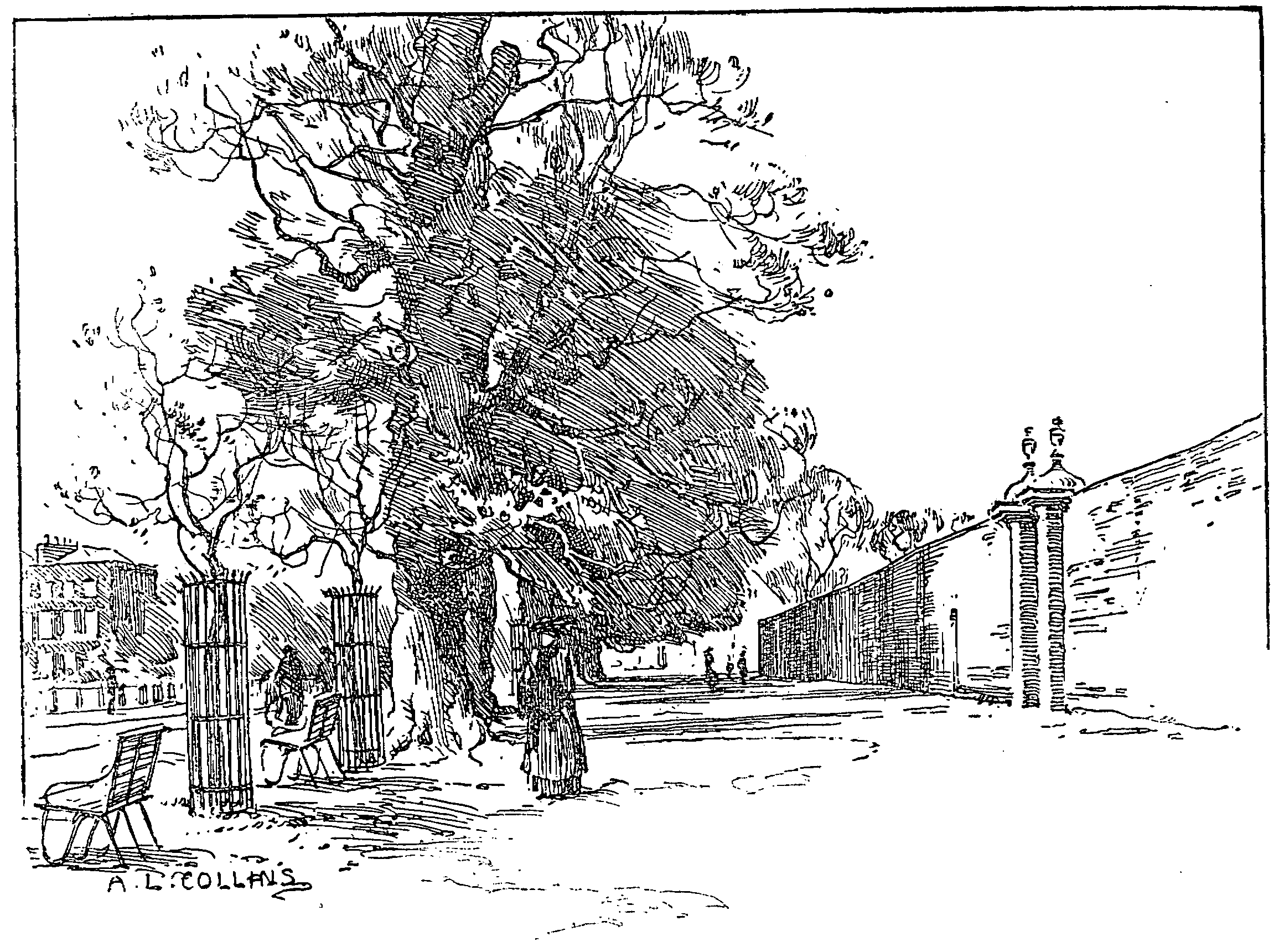
Hampton Court Palace: Frog Walk
Lady Bristol, mother of the two Herveys, was also among the wits, (fn. 632) and Sir Robert's first wife, Lady Walpole, was one of the ladies of the court. (fn. 633) Among others were Mrs. Clayton, afterwards Viscountess Sundon, the Princess of Wales's intimate friend; Mrs. Selwyn, mother of the wellknown George Augustus Selwyn, (fn. 634) and the notorious Mrs. Howard, afterwards Countess of Suffolk, (fn. 635) a woman of some ability and beauty, who encouraged Pope and his literary friends, and gained an ascendancy over the Prince of Wales which she never entirely lost till she retired from court in 1734. (fn. 636) Her supper parties in the rooms she occupied in the palace became celebrated. Her apartments were known to her friends as the 'Swiss Cantons,' and herself as 'the Swiss,' possibly from some political allusion. (fn. 637)
Lord Scarbrough, 'amiable and melancholy,' (fn. 638) Charles Churchill, natural son of the Duke of Marlborough's brother General Churchill, who afterwards married a daughter of Sir Robert Walpole, (fn. 639) Lord Bolingbroke, Lord Bathurst, as well as Pope, Gay, Pulteney, Arbuthnot, and latterly Swift, may be mentioned as among those who added to the brilliancy of the court. (fn. 640) The social life at Hampton Court was a constant round of amusement. In the morning it was the custom to go on the river in barges, gaily decorated and hung with silk curtains, (fn. 641) rowed by oarsmen in royal liveries. The prince and princess afterwards dined in public with the whole court in the princess's apartments. In the afternoon she received her guests and read or wrote, and in the evening walked for several hours in the garden. They also visited the four pavilions that stood at each corner of the bowling green, where chocolate was served and 'ombre' or 'commerce' played. Sometimes the princess would invite a party to play cards in the 'Queen's Gallery,' or to sup with her in the Countess of Buckenburgh's chamber, though all the Germans who belonged to the court disliked the English and abused them roundly. (fn. 642)
It must not be supposed that business and politics had no place at court. Sir Robert Walpole, Lord Methuen, the Lord Chancellor Finch, Lord Townshend, and Count Bothmar, George the First's Hanoverian minister, were constantly in attendance. Lord Sunderland, who was a friend of the king, and Lord Townshend both seem to have distinguished themselves by a want of consideration for the princess. A story is told of her having a heated controversy with Lord Sunderland in the Queen's Gallery, during which she told him to 'walk next the windows, for in the humour we both are, one of us must certainly jump out at the window, and I'm resolved it shan't be me.' (fn. 643)
In October 1716 the court left the palace, going by water in a barge, and did not return till August in the following year, in attendance on the king, whose presence did not add to their gaiety. (fn. 644) Pope wrote on 13 September 1717 that 'no lone house in Wales, with a mountain and a rookery, is more contemplative than this court ; and as a proof of it, I need only tell you Miss Lepell walked with me three or four hours by moonlight, (fn. 645) and we met no creature of any quality but the king, who gave audience to the vice-chamberlain (Hervey) all alone, under the garden wall. I hear of no ball, assembly, basset-table or any place where two or three were gathered together, except Madam Kilmansegg's, to which I had the honour to be invited, and the grace to stay away.' (fn. 646) The general state of ill-feeling between the king and his son, and still more between the king and his daughter-in-law, of whom he generally spoke as 'cette diablesse la Princesse,' at this time developed into an open quarrel, which attained such dimensions, though the actual cause is unknown, that the prince and princess departed from the palace in October, leaving the king in possession, and shortly afterwards the king put a notice in the Gazette to the effect that the prince's friends would not be received at court. (fn. 647) In 1718, when the king returned to Hampton Court in the summer, the prince was holding an opposition court at Richmond. George I had commanded the 'King's Company of Actors' to perform plays before him in the Great Hall twice a week during the summer, but the theatre not being ready in time only seven plays were acted in September and October. (fn. 648) Among them, on 1 October, Shakespeare's Henry VIII was represented on the very spot where so much of the action had really taken place. (fn. 649)
Richard Steele, who wrote a prologue for these theatricals, when asked how the king liked the play, replied, 'So terribly well, my lord, that I was afraid I should have lost all my actors; for I was not sure the king would not keep them to fill the posts at court that he saw them so fit for in the play.' (fn. 650)
One of the most shameful and sordid acts of the inglorious reign of George I took place in 1718, when the patent of Surveyor-General of the Board of Works given to Sir Christopher Wren by Charles II, which he had held with conspicuous success under five different monarchs, was withdrawn on 26 April, to please the Hanoverian favourites of the king, who persuaded him to give the appointment to William Benson, an ignorant and incompetent person, who had succeeded better than the great architect in obtaining and making use of court influence. The pretext for this action was stated to be a desire to effect economy in the public service, that old and most fallacious excuse for showing ingratitude and parsimony to the servants of the Crown. (fn. 651) Wren retired to his house on the Green (fn. 652) and thence wrote a letter to the Lords of the Treasury which is a perfect example of courtesy and forbearance towards his enemies on the part of an upright man unjustly accused. (fn. 653)
He had not long to wait for his vindication, for Benson's incapacity and dishonesty very soon became apparent, and he was ignominiously dismissed from his post, after holding it only for a year. (fn. 654)
George I made an ineffectual effort to put down an abuse which had apparently become conspicuous during his reign. People who had no prescriptive right to occupy 'lodgings' in the palace (fn. 655) established themselves there, on one pretext or another, with the aid, no doubt, of some 'friend at court,' and so acquired a position from which it was afterwards difficult to oust them. (fn. 656) This practice had begun even in the time of Henry VIII, and it continued to flourish more or less openly until George III, who never lived in the palace himself, made a strict rule, which was henceforward enforced, that no one was to occupy rooms without a written authorization from the Lord Chamberlain. (fn. 657)
From about 1719 onwards we have no record of any royal visit to Hampton Court until after the accession of George II. His court first went into residence there in July 1728, (fn. 658) and for the ensuing ten years or so of his reign they came regularly to the palace for some months during each summer, (fn. 659) but the court had entirely lost its early brilliancy. A letter from Mrs. Howard to Lady Hervey says that 'Hampton Court is very different from the place you knew . . . Frizelation, flirtation and dangleation are now no more, and . . . to tell you my opinion freely, the people you now converse with (her books) are much more alive than any of your old acquaintance.' (fn. 660) No doubt Mrs. Howard suffered more than the rest from the endeavour to 'amuse an unamusable king,' (fn. 661) besides having to bear with the small indignities the queen liked to inflict upon her as bedchamber woman. The room in the palace where she attended the queen's toilet is much as it was then, though little of the furniture remains. (fn. 662) Her Majesty's private chapel is next to this room, and prayers were read there by her chaplains while she was being dressed, (fn. 663) The door being left slightly open. Lord Hervey has among his Memoirs a curious little drama or dialogue, entitled 'The Death of Lord Hervey, or, A Morning at Court,' which gives an entertaining if not very edifying picture of life and study of conversation at the palace in those days. (fn. 664) The only amusement that the king permitted himself or others was stag-hunting and coursing, which went on even in the summer. 'We hunt with great noise and violence, and have every day a very tolerable chance to have a neck broke,' (fn. 665) wrote Mrs. Howard on 31 July 1730, from Hampton Court. Her fears were not ill-founded, as is proved by an account in a contemporary newspaper of accidents in the hnnting field on 25 August 1731, to the Princess Amelia, as well as to one of the pages and a groom. (fn. 666) A passing excitement was the scandal caused by the behaviour of Princess Amelia and the Duke of Grafton, who used to hunt two or three times a week, and occasionally separated themselves from their attendants and went off together. The princess was really devoted to hunting, and in defiance of court etiquette used to visit her horses in the royal stables on the Green. (fn. 667)
The king and queen generally dined together in public in 'The Public Dining Room,' one of the finest of the state apartments. In the evening the court played cards, (fn. 668) or receptions were held, (fn. 669) probably in the Queen's Audience Chamber, where a canopy of the royal damask still remains. (fn. 670) Lord Hervey gives an account of the dulness of these evenings, when 'the king walked about and talked (to Lord Lifford) of armies, or to Lady Charlotte (his sister) of genealogies, whilst the queen knotted and yawned, till from yawning she came to nodding, and from nodding to snoring.' (fn. 671) A further picture of the company is to be found in Pope's ballad, 'The Challenge,' and in a letter from Lord Hervey to Mrs. Clayton, although he begins by saying 'I will not trouble you with any account of our occupations at Hampton Court. No mill-horse ever went in a more constant track, or a more unchanging circle.' (fn. 672) The record of this last court, held every year at the palace until the death of Queen Caroline, is one of court intrigues of a sordid nature, and of the king's disagreeable manners and various flirtations, especially after the departure from court of Lady Suffolk. (fn. 673) The queen and Lord Hervey had interminable conversations and discussed every conceivable subject, (fn. 674) though when the king was present he took pains that none of the affairs that interested the queen should be mentioned. (fn. 675)
The most important domestic matter for a long time seems to have been the continual state of irritation and ill-feeling between the king and queen and their eldest son, Frederick, Prince of Wales. It came to an open climax, when the prince, apparently solely in order to offend his parents, and at the great risk of his wife's life, contrived to remove her secretly from Hampton Court in the evening of Sunday, 31 July 1737, so that the birth of their eldest child might take place at St. James's on the same night, without the knowledge or presence of the queen. Their departure took place at half-past eight, after they had dined with the king and queen. The unfortunate princess was dragged down the stairs behind the Prince of Wales' apartments in the north-east corner of the palace, hurried, probably through the cloisters past the chapel door, to one of the side doors in Tennis Court Lane, and was there put into a coach, accompanied by the prince, Lady Archibald Hamilton and some of the princess's attendants. They were driven at full gallop to London, arriving at St. James's at ten o'clock. Their daughter was born only an hour later. (fn. 676) A courier was sent back to Hampton Court to announce the state of affairs, and arrived at half-past one in the morning. By four o'clock the queen was at St. James's and heard the prince's account of what he had done. (fn. 677) She interviewed everyone concerned, and returned to Hampton Court by eight o'clock in the evening. (fn. 678) The king refused to see his son, (fn. 679) and Lord Carnarvon (fn. 680) was sent to Hampton Court with a letter, in very bad French, from the prince to express his grief and repentance for having incurred the displeasure of his father. The king's reply was to send Lord Essex with a curt message to Carnarvon, who was kept waiting in one of the galleries, refusing any further answer to the prince. This scene must have been remarkable, and is given at length in Lord Hervey's Memoirs. It is said by him to have taken place in the queen's bedchamber or dressing-room, the letter having been brought to the king while he was at dinner in the Public Dining-room. The prince was ordered to retire to Kew, his usual military guard was taken away as a sign of the king's displeasure, and it was notified to everyone likely to attend the prince's court that their doing so would be disagreeable to the king. (fn. 681) The court left Hampton Court on 28 October 1737, and on 20 November the queen died, and the history of the palace as a royal residence practically came to an end.
George II never actually lived at Hampton Court again after the queen's death, though he sometimes came down for the day with Lady Yarmouth (fn. 682) and some of the court.
'They went in coaches and six in the middle of the day, with heavy horse-guards kicking up the dust before them-dined, walked an hour in the garden, returned in the same dusty parade; and his majesty fancied himself the most lively and gallant prince in Europe.' (fn. 683) Occasionally he stayed for a night or two, (fn. 684) and it is to be supposed that he sometimes had his grandchildren to visit him there, as to this period belongs the famous story of his having on one occasion boxed the ears of the young prince, afterwards George III, and so disgusted him that he could never afterwards bring himself to live in the palace where he had suffered such an indignity. (fn. 685)
From the time of the death of George II no king of England has occupied the palace. It has ceased to be the scene of historical events, though among its inhabitants at all periods are found the names of some who have 'made history.' Even before the accession of George III the absence of the court had left the place much at the mercy of the housekeeper (fn. 686) and deputy-housekeeper, who made a show of it and exacted fees from the visitors who came to look at it. Horace Walpole, whose house at Strawberry Hill was only 3 miles off, constantly visited Hampton Court and made notes on its history, its pictures and curiosities. (fn. 687) On 3 August 1751, in a letter to Sir Horace Mann, he told one of the numerous stories about the famous and beautiful Misses Gunning, who, he said, 'make more noise than any of their predecessors since Helen. They went the other day to see Hampton Court; as they were going into the Beauty Room, another company arrived, the housekeeper said "This way, ladies; here are the Beauties." The Gunnings flew into a passion and asked her what she meant; that they came to see the palace, not to be shown as a sight themselves.' (fn. 688)
From 25 October 1760, the date of the accession of George III, the history of Hampton Court Palace assumes an entirely new aspect. Up to that time it had been the background of important public events, or connected with the private lives of the sovereigns of England; but thenceforward it became interesting only as the private individuals to whom apartments were allotted by grace and favour of the king or queen happened to be interesting.
The state apartments were gradually dismantled during the long reign of George III, furniture and pictures were sent to other palaces, and perhaps this gradual despoiling of the place, continued through so many years, is one of the chief reasons that it has remained in its present condition. (fn. 689) It was not till the reign of Queen Victoria that by her special kindness and thought for her people the picture galleries and gardens were thrown open to the public. (fn. 690) At first the private apartments were often held by irregular and more or less surreptitious devices. (fn. 691) by begging a grant from the Lord Chamberlain, or by bribing the housekeeper, until George III made the proviso that no one should occupy 'lodgings' unless the rooms were exactly specified in a written grant from the Lord Chamberlain. (fn. 692)
It may be said here that whatever reasons may have counted originally in conferring apartments on those favoured by the king, for a great many years they have been granted, in almost every instance, 'in recognition of distinguished services rendered to the Crown and country by the husbands or near relatives of the recipients. Recently the privilege has been almost entirely confined to widows or unmarried ladies.' (fn. 693) Some misapprehension of the terms on which these apartments are granted has often arisen, i.e. that there is some unwritten 'rule' limiting the 'grace and favour' of the sovereign to making grants of rooms only to ladies-which is erroneous, (fn. 694) as the king may give them to anyone he pleases. Another misapprehension, arising perhaps from William the Fourth's playful method of terming the palace 'the Quality Poorhouse,' is that the inhabitants are entirely without means. (fn. 695)
A guard of honour, supplied by the cavalry regiment stationed at Hounslow, is always on duty at the palace, and occupies the long low line of buildings on the north of the west entrance. Divine service is regularly performed in the chapel by one of the king's chaplains, (fn. 696) who occupies a suite of apartments, and who is appointed and partly paid by the Crown. (fn. 697) A clerk of the works, who is also assistant surveyor, is appointed by the Crown; (fn. 698) the fabric of the building and the gardens are under the jurisdiction of the Office of Works, though the interior is ruled by the Lord Chamberlain, who still signs all the warrants issued to holders of apartments.
Society in Hampton Court Palace has never been without its own peculiar charm and interest, as perhaps the following short list of a few of the more celebrated inhabitants may testify.
Commodore Hon. Robert Boyle Walsingham, youngest son of Henry, first Earl of Shannon, was granted rooms on the ground floor on the south side of the Clock Court. He took the name of Walsingham on succeeding to the property. He commanded a squadron sent to the West Indies to reinforce Rodney in 1780, and was lost in H.M.S. Thunderer in October that year. He married in 1759 Charlotte daughter of Sir Charles Hanbury Williams, K.B., who, after her husband's death, bought a property at Thames Ditton and built Boyle Farm, opposite the Home Park at the end of the gardens. (fn. 699) The rooms are now occupied by Miss Gordon, daughter of the late Lord Henry Gordon, who has a long connexion with the palace.
Elizabeth Countess of Berkeley had the rooms in the top story on the east side of the Fountain Court. She married first Augustus, fourth Earl of Berkeley, K.T., and secondly Robert Nugent, afterwards Earl of Clare. She is chiefly remarkable for Horace Walpole's remarks on her character: 'Be doubly on your guard against her. There is nothing so black of which she is not capable. Her gallantries are the whitest specks about her.' (fn. 700) The rooms were granted to her in 1782. They are now occupied by Mrs. Henderson, widow of Colonel Henderson, C.B., late Commandant of the Staff College, and author of Stonewall Jackson and the American Civil War, &c.
Admiral of the Fleet Sir George Francis Seymour, G.C.B., born 1787, died 1870; son of Lord Hugh Seymour, a distinguished naval officer, the personal friend of William IV, who gave him the Guelphic Order. He served for a short time in Nelson's flagship the Victory as a midshipman in 1803, was wounded in the face off St. Domingo in 1806, and afterwards saw service with Lord Cochrane and Lord Gambier. He was sergeant-atarms to the House of Lords from 1818 to 1841, and naval A.D.C. to William IV. He and his wife Lady Seymour held rooms in the north wing of the south front of Hampton Court Palace from 1820 till Lady Seymour's death in 1878. Sir George Seymour was the father of the fifth and grandfather of the sixth Marquis of Hertford. Among his daughters were Lady Harlech, Countess Gleichen, and Princess Victor Hohenlohe Langenburg. (fn. 701) The rooms are now held by Lady Gifford, widow of the second Lord Gifford.
Lady Albinia Cumberland, daughter of George, Earl of Buckinghamshire, married Richard Cumberland, Esq., son of the celebrated dramatic writer. He died in 1794, and she was granted 'The Maids of Honour's Gallery,' which she held till her death in 1850. (fn. 702) The rooms are now occupied by the Hon. Mrs. Saunderson, widow of the late Colonel Saunderson, M.P.
Colonel Sir Horace Seymour, K.C.H., was a younger brother of Sir George; born 1791, died 1851. He was one of the heroes of Water100, and is said to have been an unusually handsome man. He had the 'Secretary at War's Lodging' on the south side of the west front from 1827. His eldest son became Lord Alcester, and his second son, Colonel Charles Seymour, was killed at Inkerman. His daughter Adelaide married Earl Spencer. He also received the Guelphic Order from William IV. (fn. 703)
Lady Sarah Maitland, born 1792, died 1873. She was the second daughter of the fourth Duke of Richmond and Lennox; married in 1815 General Sir Peregrine Maitland, G.C.B., who died 1854. Lady Sarah was present at the famous ball in Brussels, the night before the Battle of Waterloo. Her two sons were afterwards severely wounded in the Crimea. She had the 'Cofferer's Lodgings,' in the north wing of the west front, from about 1857. (fn. 704)
The Countess of Mornington; Anne daughter of Arthur Hill, first Lord Dungannon, married in 1759 Garrett, first Earl of Mornington, and was the mother of the great Duke of Wellington and of the Marquis Wellesley, the illustrious GovernorGeneral of India, who used to visit her at the palace. The little garden adjoining her rooms (the Prince of Wales' lodgings on the ground floor in the north-east angle of Wren's building), retained for many years the name of 'Lady Mornington's Garden,' and the catalpa tree she planted still survives as a stump covered with creepers. The Duke of Wellington gave the name of 'Purr Corner' to a nook in the east front of the palace where his mother and her friends used to sit basking in the sun. (fn. 705) Another son, the Hon. and Rev. Gerald Valerian Wellesley, (fn. 706) was chaplain of the palace, and also held apartments, the rooms known as the Princesses' Lodgings on the first floor, at the east end of the north range. Her daughter, Lady Anne Wellesley, afterwards Fitzroy, afterwards Culling Smith, lived in 'the Queen's Half Storey' in the east front. (fn. 707) Lady Mornington was granted rooms in 1795, and died in 1831. Her rooms are now occupied by Lady Augustus Hervey, widow of the late Lord Augustus Hervey and mother of the present Lord Bristol.
Mrs. Sheridan was another inhabitant, the wife of Thomas Sheridan, son of Richard Brinsley Sheridan, who died in 1817; she was the mother of Frank and Charles Sheridan, and her daughters were the three famous beauties, Mrs. Norton, the Duchess of Somerset, and Lady Dufferin, grandmother of the present Marquis of Dufferin and Ava. She had ground-floor rooms on the north side of the palace, off 'the serving place' opposite Wolsey's kitchen, which were given her in 1820; she died in 1851. (fn. 708)
Major the Hon. William Beresford is interesting as the last holder of the ancient office of 'Master of the King's Tennis Courts,' to which he was appointed at the age of eighteen. He had the 'Lodgings of the Master of the Tennis Court,' from 1849. They are now occupied by Mr. Marlow, superintendent of the gardens. Major Beresford died in 1883.
Lady Georgiana Grey, daughter of Lord Grey, of Reform celebrity. She acted as secretary to her father, and is often mentioned in the diaries and letters of ministers and literary men of that era. (fn. 709) She had the 'Duke of York's Apartments' in the south-east angle of Wren's building from about 1861, and died in 1900 in her hundredth year. The rooms are now occupied by Mrs. Creighton, widow of the late Bishop of London.
H.R.H. Princess Frederica of Hanover, daughter of His Majesty the late King of Hanover, second Duke of Cumberland, K.G., married Freiherr von Pawel Rammingen, K.C.B., K.H., &c., and was given the 'Lady Housekeeper's Lodgings' in the south-west wing of the west front in 1880, soon after her marriage. Her daughter was born in this apartment, 7 March 1881, but died three weeks afterwards. Princess Frederica gave up the apart ment in 1898, and it is now held by Lady Wolseley, wife of F.M. Viscount Wolseley, K.P., &c.
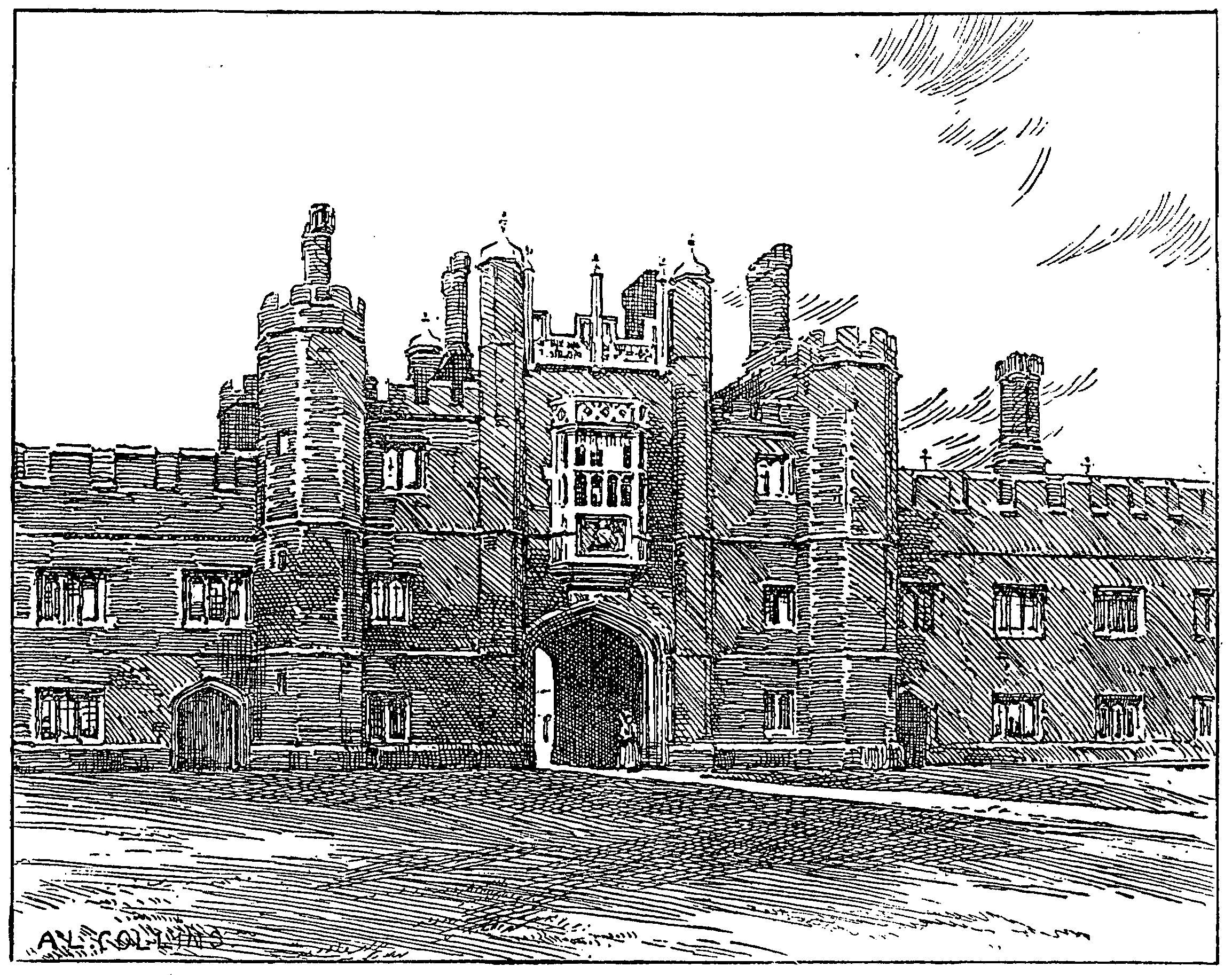
Hampton Court Palace: Entrance Court, looking towards the Moat