A History of the County of Middlesex: Volume 2, General; Ashford, East Bedfont With Hatton, Feltham, Hampton With Hampton Wick, Hanworth, Laleham, Littleton. Originally published by Victoria County History, London, 1911.
This free content was digitised by double rekeying. All rights reserved.
'Spelthorne Hundred: Hampton Court Palace, parks', in A History of the County of Middlesex: Volume 2, General; Ashford, East Bedfont With Hatton, Feltham, Hampton With Hampton Wick, Hanworth, Laleham, Littleton, ed. William Page (London, 1911), British History Online https://www.british-history.ac.uk/vch/middx/vol2/pp386-388 [accessed 30 April 2025].
'Spelthorne Hundred: Hampton Court Palace, parks', in A History of the County of Middlesex: Volume 2, General; Ashford, East Bedfont With Hatton, Feltham, Hampton With Hampton Wick, Hanworth, Laleham, Littleton. Edited by William Page (London, 1911), British History Online, accessed April 30, 2025, https://www.british-history.ac.uk/vch/middx/vol2/pp386-388.
"Spelthorne Hundred: Hampton Court Palace, parks". A History of the County of Middlesex: Volume 2, General; Ashford, East Bedfont With Hatton, Feltham, Hampton With Hampton Wick, Hanworth, Laleham, Littleton. Ed. William Page (London, 1911), British History Online. Web. 30 April 2025. https://www.british-history.ac.uk/vch/middx/vol2/pp386-388.
In this section
PARKS
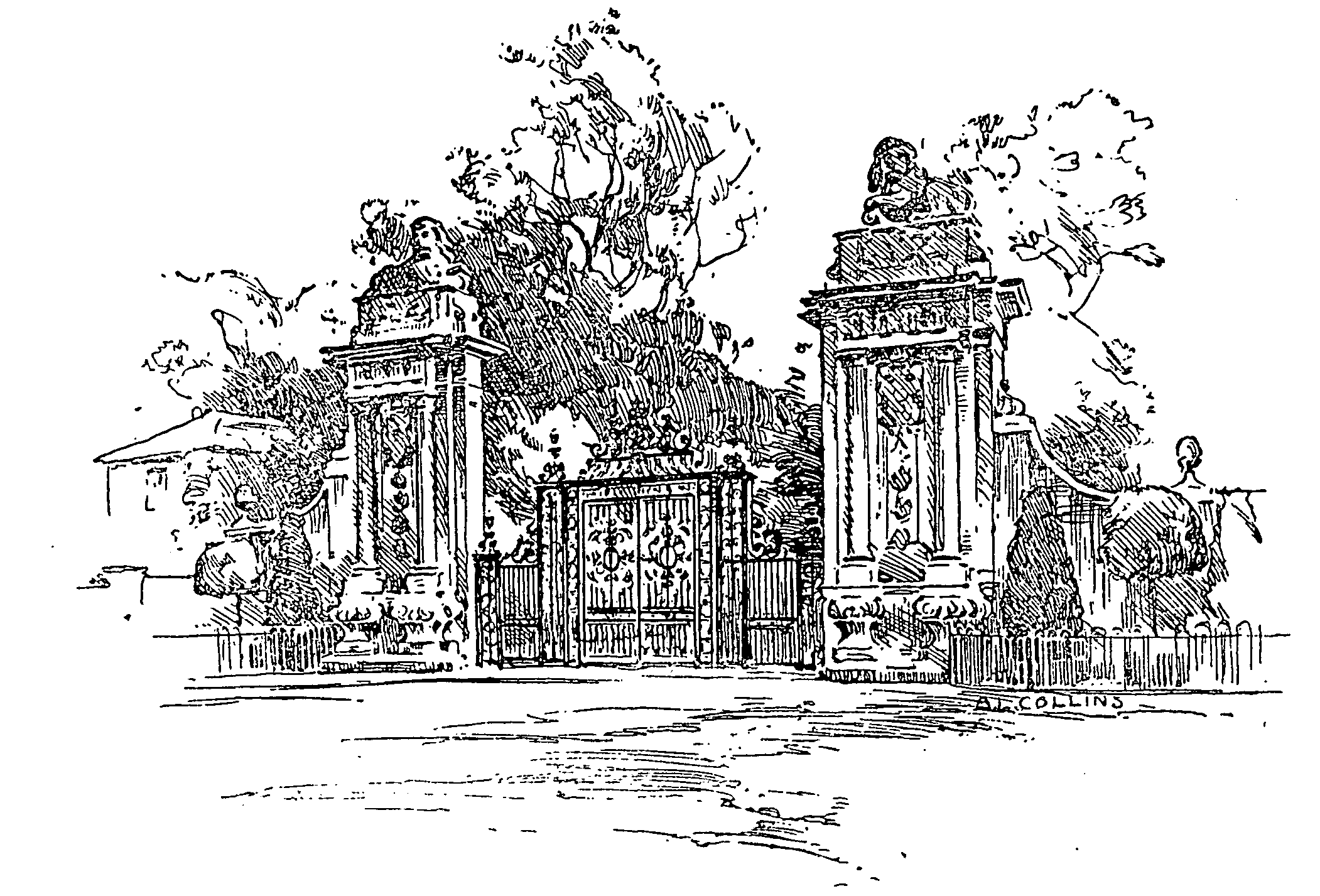
Hampton Court Palace: The Lion Gates
Wolsey inclosed with a wall about 2,000 acres as a park for his house. (fn. 1) Henry VIII had a large rabbit or hare warren in the park, where he also reared pheasants and partridges. (fn. 2) This domain was then as now divided into two parts by the Kingston road. These divisions are at present known simply as Bushey Park and the Home Park, Bushey lying to the north and the Home Park to the south-east of the palace. Henry had further inclosures made, taking in part of the heath near Hampton, and divided the north park into three parts, i.e. the Hare Warren to the east, the Upper (or Bushey) Park to the extreme west, and the Middle Park in the centre. The Home Park contained only the 'Course' near the Kingston road and the Home Park itself, with the river on the south. (fn. 3) At the time of the Commonwealth some of the parks were sold apart from the house, and the 'fee of the honour and manor,' in which the Home Park and the Course were included. Bushey Park was sold to Edward Blackwell, and the Middle Park, 'called Jockey's Park,' to Colonel Richard Norton, (fn. 4) but they were repurchased with the palace for Cromwell in 1653-4. (fn. 5) In the inventory of Cromwell's goods made in 1659 it is mentioned that there were about 700 deer in the Home Park, in Bushey Park 1,700, and about thirty red deer. (fn. 6) In the paddocks and stables on both sides of the Kingston road the royal stud was kept for many years. It was started by William III, who was fond of racing, and continued by Queen Anne, who ran horses in her own name. (fn. 7) The stud was maintained by the first three Georges, (fn. 8) but George IV was the real founder of the afterwards famous Hampton Court Stud. (fn. 9) In 1812 he established a stud for riding horses of good strain, intending that they should all be grey; but in 1820, when he came to the Throne, they were all sent to Tattersall's. The Duke of York then kept a stud for breeding racehorses at the paddocks until 1827, Moses, the Derby winner of 1822, being the most famous horse. (fn. 10)
George IV then began breeding his own racehorses at Hampton Court, and spent considerable sums of money on his stud. He had thirty-three brood mares there, and some famous stallions. William IV endeavoured to improve and keep up the stock, (fn. 11) but he knew very little about horses, and a story is told that when Edwards his trainer asked what horses were to go to Goodwood, the king said 'Take the whole fleet; some of them will win, I suppose.' Three of his horses started for the Goodwood Cup on 11 August 1830, and came in first, second, and third in the race, (fn. 12) there being six other starters. On the death of William IV in 1837, the entire stud was sold for 15,692 guineas. (fn. 13)
General, then Colonel, Peel and Mr. Charles Greville were then allowed to keep a breeding stud in the paddocks. General Peel sold his stock in 1844, and Mr. Greville remained in possession, after 1851 conjointly with Queen Victoria. Her Majesty's first managers were Major Groves and Mr. Lewis. The royal stud was afterwards under the skilful and successful management of Colonel Sir George Maude, K.C.B., Crown Equerry, and became famous and lucrative. Large sums were realized from very early days by the sale of yearlings. In the reign of George IV and William IV they were generally sold at Tattersall's on the Monday in Epsom week for sums varying from £150 to £200 apiece. (fn. 14) The sale afterwards took place on Saturday in the week after Ascot in one of the Bushey Park paddocks, and the highest prices reached were in 1889 and 1890. In 1889 twenty-eight yearlings were sold for 11,745 guineas, an average of 420 guineas apiece. In 1890 twenty yearlings fetched over 14,000 guineas, an average of 700 guineas each. The famous La Flèche was sold to Lord Marcus Beresford for 5,500 guineas at this sale.
The racing stud was eventually sold in 1894, and there now only remains a small establishment for carriage horses and the famous cream-coloured ponies which draw the king's state coach. They are descended from horses brought over by George I from Hanover, and the breed has been carefully preserved. They are showy and powerful animals; and some of them have lived to a great age. (fn. 15)
The STUD HOUSE in the Home Park was originally the official residence of the Master of the Horse. It was at one time granted to Mrs. Keppel, the illegitimate daughter of Sir Edward Walpole, and widow of the Hon. and Rev. Frederick Keppel, fourth son of the second Earl of Albemarle, Dean of Windsor and Bishop of Exeter. (fn. 16) Afterwards it was held by the Master of the Horse, or Master of the Buckhounds, of the period. From 1853 to 1865 it was granted to Lord Breadalbane, K.T., Lord Chamberlain, and in 1865 to Col. Sir George Ashley Maude, K.C.B., Crown Equerry. He died in May 1894, and the house was given to Colonel Sir Alfred Mordaunt Egerton, K.C.V.O., C.B., Treasurer to the Household and Equerry to the Duke of Connaught, who relinquished it in 1907, and it is now held by Lady Sarah Wilson, daughter of the seventh Duke of Marlborough, and wife of Major G. C. Wilson, Royal Horse Guards. Besides this house there are only cottages and keepers' lodges in the Park.
Henry Wise laid out BUSHEY PARK in its present form, making the great central road through the park, which is a mile long and 60 ft. wide. Near the Hampton Court gate it forms a circle, round the great 'Diana' fountain, 400 ft. in diameter, and only 5 ft. in depth. The fountain itself was removed from the 'Privy Garden' in 1712-13, and was mentioned by Evelyn as being designed by Fanelli. In the inventory of Cromwell's goods made in 1659 the statue is said to be of Arethusa. (fn. 17)
The great avenue of horse chestnuts, flanked by four rows of lime trees, borders this main road through the park, and there are two other avenues, each originally about three-quarters of a mile long, one leading towards the paddocks and the Kingston road and one to Hampton. The number of trees planted was 732 limes and 274 chestnuts. The whole cost only £4,300. (fn. 18) The idea of this magnificent avenue was of course that it should form part of the grand north approach to the palace designed, but never carried out, by Wren. (fn. 19) Fishponds and decoys were also made in the park, and Luttrell says that the deer were to be removed for the sake of the hare warren and pheasantry. (fn. 20)
The house now know as BUSHEY HOUSE, on the west side of the park, behind the chestnut avenue, near the Teddington Gate, was originally known as the 'Upper Lodge' and was rebuilt in the reign of Charles II by Edward Progers. (fn. 21) The existing house was built in the reign of George II by Lord Halifax. The Rangers of the park appear to have inhabited, or at all events had possession of, this house. William IV, then Duke of Clarence, was appointed Ranger in 1797, and lived almost entirely at Bushey House until his accession to the throne. He amused himself by looking after a farm he had made in the park and took a leading part in all the interests and amusements of the neighbourhood. Queen Adelaide was granted the house after his death in 1837, and lived there quietly till she herself died in 1849. One of the rare visits paid by the late Queen Victoria to Hampton Court was in 1844, when she and the Prince Consort, the King and Queen of the French, the King and Queen of the Belgians, the King of Holland and others were entertained by Queen Adelaide. Bushey House was afterwards lent by Queen Victoria to the late Duc de Nemours. It is now the National Physical Laboratory, and is occupied by the Director, Mr. R. T. Glazebrook, D.Sc., F.R.S.
There is another house in the park known as CHARLES THE SECOND'S LODGE, at present occupied by Lady Alfred Paget, widow of the late General Lord Alfred Paget, second son of the first Marquis of Anglesey, Equerry and Clerk Marshal of the Royal Household, who originally had the house granted to him. He died in 1888.
The one or two smaller houses in the park are keepers' lodges of a later date.
THE CHAPEL ROYAL.
In Wolsey's lease of the manor of Hampton Court a stipulation was made for a yearly sum to be paid by the Knights Hospitallers for the maintenance of a priest to serve the chapel. (fn. 22) When the manor became royal property the chapel was served by the 'Chapel Royal,' or 'King's Chapel' establishment, which has no existence as a corporate body, resembling the dean and chapter of a cathedral, but has existed according to its present constitution for a considerable period before the Reformation. (fn. 23) The 'Establishment of the King's Chapel' in the time of Henry VIII consisted of a Master of the Chapel, thirty-two Gentlemen of the Chapel, and Children of the Chapel. The total expenses of the same being £424 13s. 4d. per annum. In the time of Edward VI the allowances and fees amounted to £476 15s. 5d. (fn. 24)
At the Coronation of James I the following officers are mentioned besides the Dean and SubDean of the Chapel Royal: (fn. 25) the Ministers, the Master of the Children, Clerk of the Check, Doctor in Musicke, Gentlemen of the Chapel, Officers of the Vestry. At the coronation of Charles II the same are enumerated with the addition of grooms and yeomen and a Serjeant of the Vestry.
James II added a 'Confessor' and a 'common servant.' At the coronation of William and Mary two Organists and a 'Bellringer for the Household' are also mentioned. (fn. 26)
Strictly speaking, this establishment belongs to no fixed place, but is commanded to attend the sovereign wherever he may be. The services of the officers were required chiefly in London, formerly at Whitehall, and afterwards at what is now considered their head quarters, the Chapel Royal, St. James's, (fn. 27) but also at Greenwich, Hampton Court, and other royal residences.
In 1671 a petition was made to Charles II by a Doctor Thomas Waldon, physician, John Jones, apothecary to the household, and Captain Henry Cooke, master of the children of the Chapel Royal, 'that the Surveyor might provide lodgings for them when His Majesty removed to Hampton Court, as those they had were so decayed that they had to be pulled down.' (fn. 28) The Bishop of London is Dean of the 'Chapels Royal,' (fn. 29) and in 1699-70 asked for necessaries for the chapel from the Lord Chamberlain. (fn. 30)
At present the Chapel within St. James's Palace with the minor chapels within Hampton Court and Kensington Palaces constitute what are usually termed 'The Chapels Royal,' governed by the Dean, the Sub-Dean, and the Clerk of the King's Closet (the Bishop of Ripon), and there are various Chaplains, Preachers, Readers and other officers attached to them. (fn. 31) The Chapel Royal, Hampton Court, is served by a chaplain. The first chaplain appointed to Hampton Court as a separate office was the Rev. Gerald Valerian Wellesley, D.D., the brother of the first Duke of Wellington. He was appointed in 1806.
The plate is of silver gilt, and consists of a cup with paten and an almsdish 2 ft. in diameter, all of 1668; two flagons of 1687 with silver gilt linings of 1873 and 1874, all having the arms of William and Mary and the royal cipher; a dish of 1736 with the arms of George II; two cups of early 19th century unmarked; a spoon of 1850, and a white metal almsdish.